



Abstract
Micro, small, and medium-sized enterprises (MSMEs) are pivotal to economic growth, employment generation, and fostering innovation. Despite their critical role and significant representation in the EU economy, MSMEs face persistent challenges in accessing public procurement opportunities, often due to limited resources and the complexities of procurement regulations. Although policies to foster MSME in the public contract domain are well-acknowledged, empirical evidence regarding their effectiveness across different firm sizes remains inconclusive. Recognising the heterogeneity of MSMEs, this study investigates the impact of MSME-friendly procurement practices on their success, accounting for the diverse firm’s aspects such as size, age, and sector within which they operate. Utilising procurement data from Slovakia spanning 2016 to 2020, the analysis uncovers nuanced effects of measures such as contract allotment, best price-quality evaluation criteria, and geographical proximity to contracting authorities across individual MSME size subcategories. The findings reveal that while micro-enterprises benefit significantly from these practices, the advantages for small and medium-sized enterprises are comparatively limited. This study underscores the need to tailor procurement policies to different MSME size categories’ distinct needs and capacities to enhance their participation and success in public procurement markets.
Introduction
Public procurement is recognised as a key economic activity used to acquire goods, services, and public works to secure the best value for money. Every year, the public authorities within the EU Member States spend around 14% of GDP on public procurement (European Commission, 2023). This size makes public procurement a powerful strategic tool for supporting broader common societal goals beyond traditional procurement perspectives, such as promoting innovative solutions and tackling climate change and social injustice to achieve a smart, sustainable, and inclusive society. Achieving the goal of delivering the best value for public money in the broader societal context could hardly be possible without the effective involvement of micro, small, and medium-sized enterprises (MSMEs) in the public marketplace. MSMEs constitute the backbone of the EU economy, representing over 99% of enterprises and employing most of the EU workforce (European Commission, 2019). Given their well-known benefits to local employment, innovation potential, and sustainability (Schoenmaekers, 2015; Walker & Preuss, 2008), MSMEs are expected to play an even more important role in the recovery of the EU economy after the recent Covid-19 pandemic (European Commission, 2021; European Economic and Social Committee, 2021). Despite their importance and expected benefits, they struggle to compete for public contracts with their larger counterparts. Between 2011 and 2017, MSMEs accounted for only a third of the total value of above-threshold contracts awarded by public authorities in the EU (European Commission, 2019). The reasons for the underrepresentation of MSMEs in public contracts stem from the various constraints they often face when competing for public contracts, arising from their size and limited resources (e.g., Akenroye et al., 2020; Kreiser et al., 2013).
Promoting MSMEs’ involvement in the public contract domain has become one of the main objectives of a modernised EU public procurement regulatory framework included in the 2014 EU directives (2014/23/EU, 2014/24/EU, and 2014/25/EU). Unlike policy tools for promoting MSMEs in procurement outside the EU, such as set-asides or preferential agreements, the EU directives forbid such a treatment. Instead, the EU procurement legislation seeks to level the playing field for MSMEs by providing procurement tools that align with transparency, equal treatment, and non-discrimination principles in tendering procedures. The first important measure of the 2014 EU procurement directives is that they encourage the division of large contracts into lots so that the content of the individual contracts better corresponds to MSMEs’ capacity and specialisation (Schoenmaekers, 2015). Large and complex contracts have been identified as one of the significant impediments to MSMEs’ involvement in public contracts due to a lack of sufficient capacity to cover their full range (Flynn et al., 2015; Glas & Eßig, 2018). Another provision aiming at streamlining the tendering procedures introduced by the 2014 EU directives is the European Single Procurement Document (ESPD), by which tenderers can preliminary replace evidence of fulfilling the economic or technical selection criteria required by contracting authorities (Schoenmaekers, 2015). Even more importantly, concerning the SMEs’ specific assets and innovation potential, EU procurement directives encourage shifting from the lowest price award criteria to determining the most economically advantageous tender (MEAT). MEAT award criteria allow public authorities to utilise the best ratio between the qualitative, environmental, social, or innovation aspects and the price or cost elements of offered goods, services, and public works when deciding on contract award (P. Nemec et al., 2021).
Although the measures introduced by the EU procurement legislation to remove MSME impediments in public contracts look good on paper, empirical evidence of their practical effectiveness is somewhat controversial. The findings of empirical studies delving into lot-wise tendering suggest that it might not significantly affect the SMEs’ bidding or success (Glas & Eßig, 2018; Hoekman & Taş, 2022; P. Nemec et al., 2021; Stake, 2017). In a similar vein, MEAT criteria have been shown to merely significantly affect MSMEs’ bidding and success in practice (Di Mauro et al., 2020; Stake, 2017). The ambiguity between MSME-friendly policies and what happens in the public contract marketplace may arise from different institutional settings of procurement practices and firm composition across examined countries (e.g., Ancarani et al., 2019; P. Nemec et al., 2023). Indeed, 2014 EU directives provide a unified regulatory framework for public procurement, where non-discriminatory and equal treatment is a rule of thumb. Furthermore, country-specific legislation can indirectly support SMEs, particularly in contracts below EU thresholds (P. Nemec, 2024).
While existing research recognises the importance of procurement measures in fostering MSMEs’ performance in public contracts, with few exceptions, little attention is given to how these measures impact MSMEs when considering their heterogeneity. MSMEs are not a homogenous group; they differ significantly in size, resource, specialisation, and operational capacity, which can influence their ability to compete in public contracts (e.g., Tammi et al., 2017). Therefore, this paper seeks to contribute to the literature on MSME-public procurement nexus by exploring aspects that mostly remain overlooked by existing research. First, it leverages a unique dataset from the Slovak Public Procurement Journal, which, unlike traditional data sources such as Tenders Electronic Daily (TED), includes below-threshold contracts that typically remain unobserved in empirical analyses. Second, the study moves beyond the conventional MSME versus large firm dichotomy by examining heterogeneity within MSMEs, assessing how micro, small, and medium enterprises respond to pro-MSME procurement measures such as lot division and MEAT evaluation. Third, the study explores the potential influence of informal institutional factors on MSME access to public contracts. While formal procurement frameworks establish the rules, local proximity and existing relationships may affect procurement outcomes. Finally, the study employs a two-equation empirical model to effectively address selection bias, ensuring robust estimates of the factors influencing MSME success.
Slovakia provides an ideal research context, as MSMEs constitute over 99% of all enterprises, with micro-enterprises forming the majority (European Commission, 2024). Strengthening MSME competitiveness in public contracts has thus become a key objective of Slovakia’s public procurement strategy (OECD, 2021a). The study’s findings underscore the importance of accounting for micro firms’ unique constraints when designing MSME-friendly procurement policies to foster inclusive economic growth.
The paper is structured as follows: Section “Research Background” reviews the literature and delves into the specific context of Slovak public procurement. Section “Hypotheses Development” outlines the research hypotheses. Section “Data and Methods” introduces the data and methods employed, while Section “Empirical Findings” presents the results of statistical analyses. Section “Discussion” discusses the findings, and Section “Conclusion” highlights their implications and concludes.
Research Background
Literature Review
Previous research on MSMEs in public procurement typically draws upon two complementary theoretical frameworks, each offering a distinct perspective on how firm-specific assets influence their performance in public tenders. Transaction Cost Economics (TCE) emphasises the role of uncertainty and asset specificity in a firm’s cost structures and contractual choices (Williamson, 1989, 2008). For MSMEs, these factors are particularly relevant when navigating the complexities of public procurement. Meanwhile, the Resource-Based View (RBV) highlights the importance of firm-specific resources, such as knowledge, financial capacity, and capabilities, that can provide a sustained competitive advantage in procurement processes (Barney, 1991; Barney et al., 2001). Rather than treating these frameworks as independent explanations, emerging research underscores their complementary roles in explaining MSME challenges and opportunities in public procurement. For example, Di Mauro et al. (2020) argue that while transaction costs determine MSME participation, competitive advantage derived from strategic resources explains their procurement success. These findings align with the broader perspective that both reducing transaction costs and leveraging firm-specific resources are essential for designing effective procurement mechanisms that enhance MSME performance in contract engagements with the public sector (Loader, 2013; Nielsen, 2017).
Public procurement differs from traditional contracting in the private sector due to its normative regulation governed by strict legislation that pursues open competition, transparency, or sustainability objectives (Petersen et al., 2019; Rainey & Bozeman, 2000; Tadelis, 2012). While these objectives aim to ensure fairness, they often impose disproportionate administrative and compliance burdens on MSMEs compared to large firms. For instance, MSMEs must redirect their limited workforce to scan the public procurement marketplace for bidding opportunities and prepare tender documents. Albano and Zampino (2013) argue that electronic tools 1 alleviate these barriers by making tender information readily available and reducing transaction costs. Publishing prior calls for tenders reduces information asymmetries about upcoming business opportunities, fostering greater competition (Kubak et al., 2023; Tas, 2020). However, redirecting scarce resources toward procurement activities often comes at the expense of other revenue-generating or innovation-driven tasks (OECD, 2018).
Furthermore, increased direct indivisible costs and time spent on bid preparation and navigating tender documentation and procurement regulations present another significant obstacle to MSME participation (e.g., Loader, 2005; MacManus, 1991; OECD, 2021a). Such costs are influenced by the procedural choices of contracting authorities, including award criteria and contract division mechanisms. The 2014 EU procurement directives recognise various more formalised procedures to award contracts with a value above the EU thresholds (distinct from a degree of openness and obligation to publish prior calls for competition; e.g., Janssen, 2023; P. Nemec et al., 2023). On the other hand, awarding below-threshold contracts might use less formal procedures under national procurement legislation frameworks. In addition to the core principles of transparency, non-discrimination, and equal treatment, these procedures may also reflect additional values and priorities, such as those arising from organisational purchasing policies or specific strategic goals. Thus, these procedures are more straightforward because they do not require additional selection or exclusion criteria (Volker & Schotanus, 2023). They might benefit small and local suppliers who otherwise lack the administrative capacity to complete comprehensive bidding documents.
In a similar vein, prioritising the award rule focusing on price instead of value for money obtained by using MEAT award criteria may increase the MSMEs’ transaction costs arising from uncertainty, thus hindering their participation (Di Mauro et al., 2020; Loader, 2015; Nielsen, 2017). One can agree that allowing MSMEs to compete in the field of quality, in addition to the price or cost elements, may engender greater participation because they can compensate for higher prices by showcasing their specialisation, innovativeness, and flexibility (P. Nemec et al., 2021; Schoenmaekers, 2015). However, this would be more difficult under the lowest price award criteria, which prescribe minimum quality, and bidders compete for price only. Thus, the MSME side experiences more significant uncertainty about winning the contract with the lowest price award criteria.
Alongside mentioned above, another significant impediment to better SMEs’ access to public contracts is excessive pre-qualification requirements to demonstrate their financial and technical standing (Karjalainen & Kemppainen, 2008; Loader, 2005, 2007). Minimum turnover or experience requirements and difficulties obtaining working and financial capital for timely contract execution burden SMEs’ bidding efforts (Loader, 2011, 2015; OECD, 2018). The imposition of exhaustive or demanding technical and financial selection criteria, intersecting with SMEs resource limitations, often ties to high-value or intricate contracts. In cases where the contract size is large, or the subject matter is complex – particularly when bundling diverse categories of products or professions – SMEs may be unable to cover a full range of these contracts (Bovis, 1998; Loader, 2005; Morand, 2003). In this context, dividing large contracts into smaller and more specialised lots is an important tool to tackle the barriers to SME access in public contracts (Flynn & Davis, 2015, 2016). Contracts can be divided into product-specific or geographic lots that offer an opportunity to bid for specific lots that account for their specialisation or expertise of SMEs or even facilitate better access for local SMEs (Schoenmaekers, 2015). Because technical or financial selection criteria required by contracting authorities must be proportionate to the value and subject matter of the procured contract (Janssen, 2023), splitting contracts into smaller lots may compensate SMEs for their limited resources to fulfil such qualification criteria (P. Nemec & Džupka, 2021).
Building on the resource-based view (RBV) perspective, Di Mauro et al. (2020) identify market knowledge, experience, and human resources as generic resources that can provide MSMEs with a competitive advantage in public tenders. Market knowledge usually develops over a firm’s years in business, allowing to leverage specific resources tied to experience and knowledge accumulation (Bao et al., 2012; Di Mauro et al., 2020; McDowell et al., 2016; Pinto et al., 2023). Thus, market-entrenched MSMEs might find it less difficult to perform well in the public contract domain (Reijonen et al., 2016; Tammi et al., 2014).
Moreover, the chances of winning a contract unfold from the quality of the submitted tender. In this direction, drafting a competitive bid requires a firm to redirect its staff from ordinary to tender-related tasks, which can be more difficult for MSMEs given their scarce human resources. Indeed, previous research shows that specialised staff dedicated to public contracts can help MSMEs overcome the barriers to better performing in the public contract marketplace (Saastamoinen et al., 2017). Because MSMEs do not form a uniform group, they differ at least in headcount, turnover, or the business sector in which they are active. It is unlikely that firms with fewer headcounts, hence micro firms, can secure procurement training for their workforce or even redirect their spare human resources to manage public tenders. For instance, micro firms can benefit more substantially from smaller or more specialised contracts procured under less administratively demanding procurement procedures that do not require filling documents needed to demonstrate their economic and technical capacity or the quality of their submitted bids.
Despite a lack of human resources, MSMEs possess the unique capabilities of agility, flexibility, and customer orientation, which can emerge as a competitive advantage when bidding for public contracts against their larger counterparts (Akenroye et al., 2020; Hillemane, 2012). These distinctive capabilities in competing against large firms may be an advantage for MSMEs when contracts are awarded based on not only the price. Similar to involvement, the criteria used to award contracts can thus be critical in increasing MSMEs’ chances of succeeding in public tenders. MSMEs can compensate for their higher transaction costs in tenders evaluated based on MEAT criteria by bringing their innovative and niche products to the table (e.g., Di Mauro et al., 2020; P. Nemec & Džupka, 2021; P. Nemec et al., 2021).
Drawing from the above, the research into the procurement-MSME nexus comprehensively explains the barriers MSMEs face in public procurement, such as administrative burdens, pre-qualification requirements, and transaction costs. However, while distinctions between micro, small, and medium enterprises are acknowledged in the literature, there is limited understanding of how these challenges interact with specific tools like lot division or MEAT evaluation, resulting in varying outcomes across individual MSMEs categories. Additionally, acknowledging the role of institutions, the interaction between formal frameworks, such as procurement laws, and informal factors, such as trust and relational networks, remains underexplored. While formal rules aim to ensure transparency and non-discrimination, informal dynamics often play a critical role in shaping MSME participation, particularly for micro-enterprises and local suppliers (e.g., Hinzmann et al., 2019; P. Nemec, 2024). This interplay is especially significant in below-threshold procedures with higher discretion from public buyers, where relational trust and network ties might influence access to tenders. It highlights the need to understand better how institutional environments affect procurement outcomes for MSMEs.
Public Procurement and MSMEs in Slovakia
The definition of MSMEs in Slovakia is the same as in the EU (Commission Recommendation 2003/361/EC); thus, enterprises with less than 250 employees and an annual turnover of up to EUR 50 million or a balance sheet total of no more than EUR 43 million. 2 Within this range, in terms of headcount, micro-enterprises (<10 employees) constitute 97%, while small (<50 employees) and medium (<250 employees) account for 2.6, and 0.5% of all MSMEs in Slovakia, respectively (Slovak Business Agency, 2020). MSMEs play a crucial role in the Slovak economy: they provide jobs for almost 73% of all employees, exceeding the average EU share of 66%. Nevertheless, their annual productivity is only 41% of the EU average (European Commission, 2024).
Besides the measures stemming from the Small Business Act for Europe and the 2014 EU procurement directives, Slovakia has no specific legislation or national policy to support MSMEs’ involvement in public procurement directly. The entire mechanism of implementing the MSME-friendly procurement measures is left to the Public Procurement Act 3 (PPA), which provides unified regulation for awarding contracts in all sectors as well as awarding concession contracts.
Although the Slovak procurement regulation regime ranks among the top EU countries regarding transparency and accountability (European Public Accountability Mechanisms, n.d.), it is often viewed as unpredictable and burdensome by both contracting authorities and economic operators (OECD, 2021a; Slovak Business Agency, 2020). Constant changes in procurement legislation make the entire procurement process unpredictable. For instance, since its effectiveness in April 2016, the Slovak PPA has already undergone 30 amendments by 2024. The vast majority of these changes mainly aim to enhance the transparency of public spending by introducing the Registry of Final Beneficiaries 4 as a mandatory requirement for receiving public funds or stipulating electronic compulsory communication in procurement. 5
As for individual MSME-friendly measures in the 2014 EU procurement directives, the Slovak PPA provides additional provisions to simplify the bidding for mainly below-threshold contracts. For instance, for contracts with values falling below EU thresholds, bidders are not necessarily required to demonstrate the nonexistence of specific exclusion grounds, such as clean criminal records or compliance with tax and social security obligations, thus reducing administrative burden. Additionally, economic operators can enlist in the Register of Economic Entities, thereby confirming the nonexistence of grounds for exclusion during the registration validity period. 6 Similarly to ESPD, economic operators can preliminary replace documents related to selection and exclusion criteria by providing an affidavit for below-threshold procedures. Finally, there are restrictions on financial security that shall not exceed 3% of the estimated contract value and, at the same time, not exceed EUR 100,000.
Besides the abovementioned, when it comes to the main procurement tools for enhancing MSMEs’ involvement and success chances, such as dividing contracts into lots or evaluating tenders based on MEAT, the Slovak PPA offers nothing beyond the default provisions of the 2014 EU procurement directives. Regarding the division into lots policy, the Slovak PPA adopts a soft approach in harmonising with Article 46 of the 2014/24 Directive, which requires contracting authorities to state a reason for not dividing the individual contract in related tender documents. Such a “divide or explain” mechanism means that the contracting authorities’ choice of not dividing contracts into lots should be justified by, for example, impossibility due to technical or economic reasons.
In a similar vein, contracting authorities are encouraged to use MEAT awards. For example, a contracting authority procuring IT services under MEAT evaluation may prioritise user-friendly design and flexible long-term support alongside price, ensuring a more efficient and sustainable solution rather than selecting firms solely based on the lowest bid. Still, it is up to the authorities to decide whether to evaluate submitted bids based on the MEAT or the lowest price. It leads to a procurement practice in which contracts awarded based on MEAT are minimal. Indeed, Slovak authorities consistently avoid using MEAT criteria and choose a procedural rather than managerial approach to procurement, where administrative compliance and the lowest final price are the ultimate goals in their purchasing efforts (J. Nemec, Grega & Orviska 2020; OECD, 2021a).
Hypotheses Development
Building on existing research and the Slovak procurement context discussed earlier, this section outlines hypotheses on the impacts of MSME-friendly procurement measures across different firm categories.
The Effects of Lot Division on MSME Success
Dividing contracts into smaller lots is a policy mechanism to make public procurement more accessible for MSMEs. Micro-firms, with fewer employees and limited financial resources, are significantly disadvantaged when competing for large, complex contracts that demand extensive capabilities (Flynn & Davis, 2015). By splitting contracts into smaller, more manageable portions that align with their specialisation, micro firms are better able to compete, as they can focus on their specific specialisations without the need to fulfil the requirements of an entire large contract (Glas & Eßig, 2018; Schoenmaekers, 2015). However, the relative advantage of lot division diminishes as firm size increases. Small and medium-sized firms typically have the administrative and financial capacity to compete for larger contracts without needing them to be divided. Furthermore, as lot division increases opportunities for micro firms, competition between them also rises, potentially reducing the probability of small and medium firms winning (Stake, 2017). Besides that, for small and medium firms, the administration effort of competing in fragmented lots may outweigh the potential benefits, pushing them to favour single-lot tenders. Therefore, we hypothesise that:
The Effects of Below-Threshold Procurement on MSMEs
While the procurement of contracts below the EU monetary thresholds still pursues the basic principles such as transparency, non-discriminatory, and equal treatment, it provides the authorities greater flexibility and discretion on applying exclusion or selection criteria that are otherwise obligatory in procuring above-threshold contracts. Extensive documentation and compliance demands associated with the above-threshold contracts, resulting from their higher value, create significant barriers for micro firms due to their limited resources and capacity (Loader, 2013). Awarding below-threshold contracts thus simplifies administrative requirements by reducing the need for extensive bidding documents and qualification requirements and relaxes the overall complexity of the tendering process. In other words, by eliminating complex pre-qualification criteria and simplifying the bidding process, below-threshold contracts help mitigate barriers that disproportionately affect smaller firms (P. Nemec, 2024; P. Nemec et al., 2021).
Furthermore, the lower financial value of below-threshold contracts may render these contracts less attractive to larger firms, which are better positioned to pursue higher-value contracts (Flynn & Davis, 2016). As firms grow, their reliance on these lower-value contracts procured under simplified procedures may diminish as they develop in-house administrative capacity to navigate complex procurement processes, reducing the relative advantage of below-threshold contracts (OECD, 2018). Consequently, while below-threshold contracts provide a crucial entry point for micro firms, their importance wanes for small and medium-sized enterprises that can compete for more complex tenders. Thus, we hypothesise:
The Effect of MEAT Evaluation Criteria on MSME Success
Contracts awarded based on MEAT criteria allow firms to compete based on quality, innovation, and service differentiation rather than solely on price. These award criteria are particularly beneficial for micro firms, which often struggle to compete on price but can offer specialisation, flexibility, and high-quality solutions. Unlike large firms, which may benefit more from economies of scale by reducing per-unit costs, efficient production, and lower administrative overhead, micro firms rely on customisation, flexibility, and niche expertise to remain competitive (OECD, 2018). For instance, micro firms engaged in high-end, eco-friendly products or specialised consulting services may struggle under the lowest price criteria. However, they can gain a competitive advantage under MEAT evaluation, where additional aspects such as quality, sustainability, or innovation are valued. In other words, by allowing bidders to demonstrate the added value of goods, services, and works offered, MEAT criteria create a level playing field for smaller firms to compete against larger, cost-efficient counterparts (Allen, 2021). In contrast, small and medium firms that use economies of scale more extensively may balance cost efficiency and quality considerations in their contract efforts, making them more competitive even in lowest price tenders (Stake, 2017). In this vein, MEAT criteria may offer these firms a competitive advantage, but their reliance on qualitative differentiation is probably lower than that of micro firms, as they can already achieve a certain degree of price competitiveness while maintaining quality. Thus, while micro firms may experience a significant benefit from MEAT criteria, this advantage is weaker for small and medium firms, as their cost efficiencies might reduce their dependence on non-price factors. Based on this, we formulate the following hypotheses:
Data and Methods
Data Description
We construct a database for this study based on contract award notices published in the Public Procurement Journal (PPJ) from 18 April 2016 to 31 March 2020. PPJ is an electronic platform for publishing information regarding upcoming and awarded contracts with a monetary value exceeding EUR 70,000 to 180,000 for works contracts and EUR 20,000 to 70,000 for goods and services contracts in the examined period. 7 After removing observations on contracts in the defence sector (32) and concession contracts (1), the dataset amounts to 21,439 observations on below- and above-threshold contracts. In the next step, we linked data on winning firms with the Statistical Registry and Commercial Registry to obtain more detailed information concerning the number of employees, date of firm establishment, or firm industry sector. Indeed, gathering the same data for individual firms that bid for contracts would also be beneficial. However, the dataset does not hold information on individual bidders; it only contains the number of offers and whether an MSME submitted the bid. Despite the mentioned limitation, the dataset obtained provides comprehensive information on contracting authorities, procurement procedures, the number of bidders, and winning firms at the contract (lot) level.
Dependent Variable
To investigate the effects of MSME-friendly measures on individual MSME categories, we use data on winning firms to construct a dependent variable that denotes whether the individual winner is a micro, small, medium-sized, or large firm. Winning firms were classified into the individual categories of MSMEs based on the number of employees obtained from the online Registry of Financial Statements. By following the EC recommendation concerning the definition of SMEs, we classify the contract winners into micro firms (<10 employees), small firms (<50 employees), medium firms (<250 employees), and large firms (250 and more employees).
Table 1 provides key characteristics of contracts won by micro, small, medium, and large firms, providing an overview of procurement patterns across firm sizes. The data highlights clear disparities in contract distribution: while micro firms secure the highest number of contracts (45%), their share of total awarded value remains low (17%). In contrast, despite winning fewer contracts (12%), large firms account for over one-third of total contract value. Besides, micro firms are more likely to win divided contracts (47% of all split contracts) and those with MEAT evaluation (40%), whereas larger firms dominate single-lot and lowest-price contracts. These patterns confirm the significant role of procurement measures, such as lot division and award criteria, in MSMEs’ success.
Characteristics of Examined Contracts by Winning Firms.

However, contracts split into lots tend to have a lower value than single-lot contracts, collectively accounting for 20% of the overall awarded value. Similarly, contracts evaluated using MEAT criteria comprise only 2% of the total awarded value. A more detailed distribution of contract values by firm size, excluding outliers, is depicted in Supplemental Appendix Figure A1. The distribution in Supplemental Appendix Figure A1 highlights differences in procurement success, particularly for micro firms, which show a wider spread in contract values. Nevertheless, micro firms tend to obtain mostly smaller value contracts than their larger counterparts.
Besides that, economic operators can participate in public procurement solo or as members of bidding consortia. Of the 21,439 contracts in the dataset, only 524 were acquired by bidding consortia. MSMEs are listed among the leading members in 75% of cases, obtaining 45% of the overall value awarded to consortia. On the other hand, large firms seem to benefit substantially from consortia, as one-third of the value they won was secured by bidding consortia (EUR 1.89 bln), in which they were listed as leading members.
Finally, Table 1 shows the 38% share of below-threshold contracts in the dataset that would otherwise remain unobserved using traditional data sources such as Tenders Electronic Daily. On average, MSMEs won over eight of ten contracts in the dataset.
Independent and Control Variables
We employ several dependent variables at the procurement, contract and firm level. First, the administrative complexity of the tendering procedure is proxied by the BelowThresh, a binary variable denoting whether an individual contract award procedure is below the EU-set monetary thresholds. Below-threshold contracts are awarded through generally more flexible procedures, reducing the administrative burden on economic operators. This is due to fewer formalities and obligations associated with demonstrating the fulfilment of selection criteria and preparing bidding documents (P. Nemec & Kubak, 2024). In addition, this variable indicates the financial intensity of awarded contracts, as the selection between an above- or below-threshold tendering procedure is based on the estimated value of the contract. In this context, the optimal choice would be to observe the estimated contract value and characteristics of the selection criteria. Nevertheless, the analysed dataset does not contain information on selection criteria, and data on the estimated contract value was unavailable for all observations. 8 In addition, reliance on estimated contract values may be problematic due to inherent calculation issues and fictitious savings phenomena among contracting authorities (e.g., J. Nemec, Kubak, et al., 2020; Plaček et al., 2020).
The division of contracts into lots and award criteria are among the second set of explanatory variables indicating the adoption of procurement tools oriented to leverage MSMEs’ specialisation and overcome their resource limitations; they are binary variables denoting whether a contract is divided into lots and uses MEAT evaluation for its award. A slight majority of contracts (57%) were single-lot. However, a 10% proportion of contracts awarded using MEAT evaluation confirms the reluctant attitude of Slovak public authorities toward best price-quality ratio award rules.
The firms’ potential experience and knowledge accumulation are proxied by the years the firm has been operating in the market. The mean firm’s age is 16 years and increases with firm size. However, general market experience may not fully capture public procurement-specific expertise, which could play a more decisive role in contract success. Prior public procurement experience may help firms develop specialised bidding skills, familiarity with complex procurement legislation, and strategic partnerships, which may increase the likelihood of their success. While our dataset does not provide direct information on firms’ past bidding, firm age serves as an indirect proxy, assuming that older firms are more likely to have encountered public tenders over time.
Another explanatory variable denotes the geographical proximity between winning firms and public authorities. SMEs located near public buyers can benefit from better access to contracts due to reduced transaction costs associated with searching, negotiating, and monitoring contract execution (Hinzmann et al., 2019; Kapetaniou & Lee, 2019). Moreover, to account for the potential of SMEs success chances within joint bidding, another binary variable indicates whether a winning firm is a leading partner of bidding consortia.
In addition, we incorporate several control variables that account for procurement-specific factors and the context of the tender process, affecting procurement outcomes. First is the degree of openness and transparency of the procurement procedure to award a contract. Some procedures can be more or less transparent, underlining the obligation of public authorities to publish a prior call for tenders, which helps to remove information asymmetry on upcoming tender opportunities. On the other hand, some procedures advertising the prior call for competition may allow public buyers to restrict competition by limiting the maximum number of bidders, for example, restricted competition or competitive dialogue (P. Nemec et al., 2023). Thus, a set of binary variables measures the degree of openness and transparency by denoting whether a specific contract award procedure is an Open procedure and whether it involves prior publication on an upcoming tender. We also control for the level of competition for an individual contract, measured by the number of submitted offers. The number of offers ranges from 1 to 106, with a mean of 5.19. Significant differences exist between below- and above-threshold contracts, with mean values of 3.4 and 6 bids, respectively.
As for regional characteristics, we incorporate the variable regional GDP per capita in purchasing prices in euros by the year of contract award to account for regional economic context and market potential. Besides this, we use regional population density per square kilometre to account for infrastructure, labour availability, and collaboration opportunities that may influence SME performance in public contracts.
Finally, we employ fixed effects for the type of contracting authority, firm activity, business sector, and contract category to capture sector-related business practices, budgeting, or competencies differences that may stem from the authorities’ position within the institutional arrangement. The type of contracting authority denotes whether a contracting authority is a national, regional, or local government, an agency established and governed by such authorities, a publicly owned enterprise, a sectoral authority, and other buyers who have to follow procurement rules in certain circumstances, such as subsidised private companies. Sector-related business practices comprise dummies corresponding to the economic activity of winning firms based on the first-level group of NACE. 9 Finally, contract category specifics are captured by the first two digits of the CPV code. 10
Estimation Method
Estimating the probability of whether an individual firm falling into the respective size category wins a contract has to account for procurements with MSME presence, that is, submitting at least one bid. A firm’s success depends on its participation in public procurement, as only participating firms can secure contracts (e.g., Hoekman & Taş, 2022; Stake, 2017). Unlike most previous studies that rely on a sample of contracts with at least one bid from an SME, we employ a two-equation model that effectively addresses selection bias (Heckman, 1979). Specifically, it considers a sample of SMEs participating in public tenders and estimates the probability of individual firm size winning a contract. The first stage involves a selection equation which estimates the probability that an observation will be included in the outcome sample. The baseline selection equation has the following form:

where
The second stage estimates the outcome of interest conditional on being selected by the selection equation (MSMEsBid = 1) and is defined as:

where
Table 2 summarises the variables used in the empirical specifications of both equations, accounting for the exclusion restrictions of the Heckman probit model. 11 Additionally, Table A1 in the Supplemental Appendix provides more detailed statistics. All statistical analyses were performed using Stata 18.
List of Variables.

Empirical Findings
Table 3 presents the estimation results of the outcome equation (Equation 2) obtained by the ordered probit model with sample selection. To ease the interpretation, we provide the average marginal effects (AMEs) of variables for individual firms’ size categories. Additionally, Supplemental Appendix Table A3 provides full estimation results.
Estimation Results From Ordered Probit Model With Sample Selection.
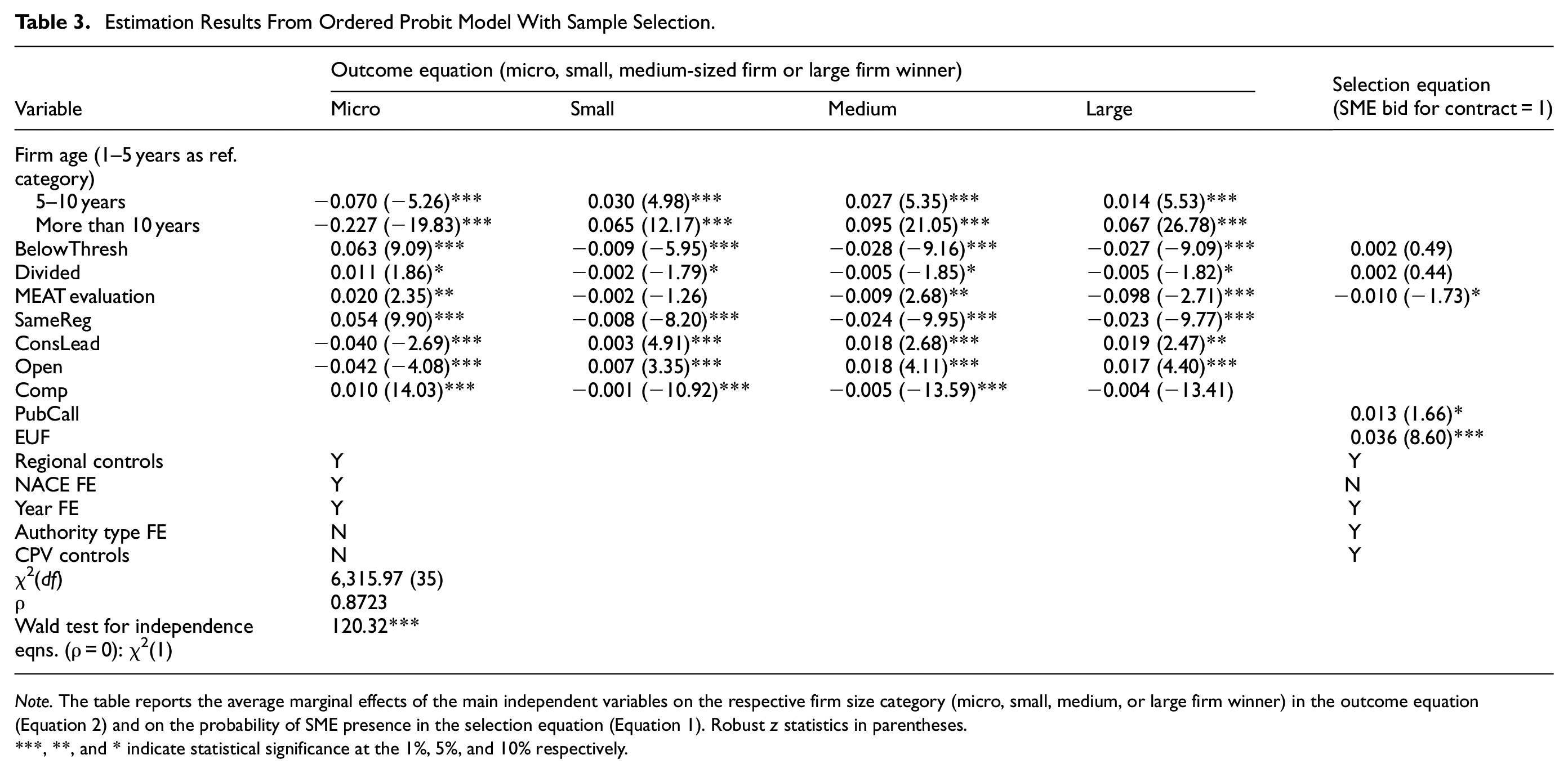
Note. The table reports the average marginal effects of the main independent variables on the respective firm size category (micro, small, medium, or large firm winner) in the outcome equation (Equation 2) and on the probability of SME presence in the selection equation (Equation 1). Robust z statistics in parentheses.
, **, and * indicate statistical significance at the 1%, 5%, and 10% respectively.
Wald’s test for independence equations assesses whether the error terms of the selection and outcome equations are correlated. A significant result (χ2(1) = 120.32, p < .001) justifies using the Heckman probit selection model over two separate regression models, indicating that the selection process affects the outcome variable.
SME Success
The estimates reported in Table 3 suggest that the firms’ age effects on procurement success chances vary across all size categories. The increased time that the firm operates in the market is negatively associated with the success of micro firms. Contrary to our expectations, the likelihood of winning a contract for micro firms older than 5 years decreases by 7 to 22 percentage points. On the other hand, firm age turns out to be a factor in increasing the success of small and medium firms, while similar positive effects are observed for large firms. Moreover, being listed as a leading partner in bidding consortia (ConsLead) is associated with a lower probability of winning a contract for micro firms (AMEs = −0.04, p < .001), whereas this effect turns out to be positive with an increase in firm size. Concerning the last variable at the firm level, the geographical proximity to the contracting authority (SameReg) positively affects only the micro firms. When micro firms operate within the same region as the contracting authority, the combination of reduced transaction costs and a better understanding of regional nuances can increase their chances of winning by up to 5.4 percentage points.
Zooming into cornerstone mechanisms to facilitate MSMEs in procurement, splitting contracts into lots (Divided) and awarding criteria using the best price-quality ratio (MEAT) suggest varying effects across respective MSME categories. While dividing contracts into smaller and more specialised lots slightly improves micro firms’ success by roughly 1 percentage point, larger firms experience slight adverse effects compared to single-lot contracts. Likewise, the MEAT award criteria allow micro firms to leverage their ability to showcase the quality of the products and services they offer, thereby increasing their success by approximately 2 percentage points compared to the lowest price criteria. In a similar direction, simple and fast-track procedures for awarding smaller-size contracts (BelowThresh) increase micro firms’ success (AMEs = 0.05, p < .001), whereas this effect again turns out to be negative with an increase in firm size.
Finally, turning to the remaining control variables, awarding contracts using unrestricted competitive procedures (Open) relates significantly to larger firms, increasing their chances of securing contracts up to 1.8 percentage points. However, when micro firms participate in unrestricted open procedures, their chances of success decrease by 5 percentage points compared to restricted procedures. Finally, greater competition (Comp), measured by the number of offers submitted per contract, is associated more with micro than larger firms’ success.
MSME Presence
While the selection equation lacks the variability observed in the success equation concerning MSME size categories, it remains worthwhile to interpret its results. Specifically, unbundling contracts by dividing them into lots (Divided) does not significantly impact MSME presence. In other words, this measure does not adversely affect MSMEs’ presence compared to single-lot contracts. Similarly, there is no significant effect on MSME presence in procurements of below-threshold contracts. This suggests that reducing administrative burden by procuring contracts through below-threshold procedures alone may not necessarily lead to a higher probability of SME presence.
In contrast, EU-subsidised contracts (EUF) exhibit a significant positive association with SME presence (AMEs = 0.037, p < .001) despite their more demanding regulatory and administrative requirements (Fazekas and King, 2019; P. Nemec & Kubak, 2024; OECD, 2021b). One possible explanation is that while administrative simplifications lower entry costs, MSMEs may view such contracts as less risky in terms of potential opportunistic behaviour. With their heightened oversight and transparency mechanisms, EU-funded contracts may create a procurement environment that fosters greater confidence in procedural fairness, thereby encouraging MSME participation.
Nevertheless, advertising prior calls for tenders (PubCall) is significant at 10% (p = .097), suggesting that notifying economic operators about upcoming tenders increases the likelihood of SMEs’ presence compared to contracts without prior publication. Contrary to theoretical expectations, MEAT award criteria negatively affect MSME participation in such tenders compared to the awards based solely on price by roughly 10 percentage points.
Robustness Checks
We employ a series of robustness checks to address potential concerns in our analysis using additional empirical specifications, estimators, and different subsamples. First, we omit large firm winners from the analysed sample to obtain comprehensive effects of procurement-related factors across individual SME size categories. These estimates are reported in Supplemental Appendix Table A4 and are consistent with the main findings. The only difference might be found in MEAT evaluation, which is not statistically significant at 10% for micro firms but is significant at the 10.7% level. Additionally, delving into the intricacies of resource capacities among micro firms, we employ an ordered probit model with sample selection with a dependent variable ordered on employee headcount: 0 to 1, 2 to 10, and more than 10 employees. Our findings, detailed in Supplemental Appendix Table A6, underscore that SME-friendly policies exhibit their most significant efficacy for firms with minimal staffing. Furthermore, Supplemental Appendix Table A5 presents the results of a multinomial logit model, considering four possible outcomes: micro, small, medium, or large firm winners using a sample of contracts with SME presence. Although from a different perspective, the coefficients for most dependent variables do not change much compared to those reported in the main findings, with only a few exceptions. These exceptions can be attributed to the slightly different empirical specification of the multinomial logit model, which does not account for CPV controls and selection bias.
Furthermore, building upon existing literature that highlights the impact of contract value on SME performance (e.g., Glas & Eßig, 2018; P. Nemec, 2024; Stake, 2017), we incorporate estimated contract value as a variable to assess the robustness of our findings related to below-threshold contracts affecting SMEs. In light of the drawbacks associated with determining contract prices and the presence of fictitious savings, as discussed earlier, we address the potential endogeneity of this variable. To mitigate this issue, we employ instrumental variables related to contract authority type, regional GDP, and whether a contract is divided or a single lot. These variables allow us to account for the nuances of budget allocation, funding sources, regulatory variations, and project-specific characteristics associated with divided contracts. The results of probit models with instrumental variables (Supplemental Appendix Table A7) indicate that micro and small firms are more likely to obtain contracts with small values. The positive effect on their success diminishes as contract value increases; however, we observe opposite effects for medium-sized firms, mirroring the main findings related to below-threshold contracts.
Discussion
The results of this study support previous findings that MSMEs are not a homogenous group in the tendering process. In this direction, a simple dichotomy of MSMEs against large firms in focusing on policies to facilitate their performance in the public marketplace has been proven untenable (Ancarani et al., 2019; Flynn et al., 2015). The findings align with TCE and RBV theories by highlighting how differences in firm size affect their procurement outcomes. From a TCE perspective, micro firms experience the highest transaction costs, particularly in search, compliance, and bid preparation, which explains their greater reliance on below-threshold contracts and MEAT evaluation criteria. In contrast, medium-sized firms with greater financial and administrative capacity experience lower transaction costs and rely less on MSME-friendly policies for procurement success. From an RBV perspective, micro firms leverage specialisation and flexibility to compete for best price-quality awards and split contracts. Small and medium firms can rely more on operational efficiencies and scale advantages, which enable them to optimise cost structures, streamline bid preparation, and compete more effectively for single-lot and higher-value contracts. The diverse impacts of MSME-friendly policies, such as the division of contracts into lots or MEAT award criteria, suggest that the effective implementation of one-size-fits-all measures is at least conditional on firm size.
Dividing contracts into lots whose size and specificity correspond to MSMEs’ specialisation and resource capacity (Anchustegui, 2016; Schoenmaekers, 2015) has been found to increase success only for micro firms. Customising the content of individual contract lots and their qualification requirements proportional to their size and specificities seems to allow micro firms to capitalise on competitive advantage built on their expertise over larger firms. For instance, including similar crafting professions or products into a separate lot, which may otherwise be part of a larger project or delivery, allows micro firms to focus solely on their specialised expertise. This study’s findings echo the conclusions of Solarte-Montufar et al. (2021), who argue that splitting contracts into specialised lots fosters innovation and niche participation among MSMEs in agri-food procurement. Larger MSMEs, such as small and medium-sized enterprises, derive limited benefits from lot division. This finding suggests that while lot division addresses micro-enterprises immediate barriers by allowing them to take advantage of their specialisation, its broader role as a policy tool requires standardisation across contracting authorities.
Similar outcomes are observed when award criteria prioritise the best price-quality ratio over the lowest price; MSMEs generally obtain vast contracts using MEAT award criteria (90%), which aligns with previous findings (e.g., P. Nemec & Džupka, 2021; Stake, 2017). P. Nemec et al. (2021) underline the flexibility of SMEs in demonstrating the quality of their products when they are less worried about higher prices. In this vein, micro firms benefit most from MEAT evaluation, while the chances of success for small and medium firms do not change significantly. This result does not necessarily mean that micro firms are more innovative than the rest of the competition; rather, it may imply that they are more vulnerable to award criteria that focus solely on the lowest price (Georghiou et al., 2014). However, adding a more critical viewpoint: there were minimum MEAT awards compared to the lowest price criteria, hardening the interpretation of their effects. The Slovak procurement system prioritises other “values” such as transparency, non-discriminatory, and equal treatment principles, and input maximisation rather than outcomes (e.g., J. Nemec, Grega & Orviska et al., 2020).
Reducing the administrative burden in below-threshold procurement procedures confirms theoretical expectations of its positive effect on micro firms. These fast-track procedures lower entry costs and simplify the bidding process by reducing the paperwork dedicated to bid preparation and filling tender documents, making participation more accessible for micro and small firms and allowing them to compete effectively against larger firms (European Commission, 2019; OECD, 2018). Alongside administrative burden, the lower value contracts below the EU thresholds seem to play a non-negligible role in explaining the success of micro and small firms. On the contrary, above-threshold contracts often involve exhaustive technical and financial selection criteria to prove tenderers’ ability to perform successfully, hindering smaller firms due to their limited resources. In contrast, below-threshold contracts are more accessible to micro firms because they do not require the same working and financial capital as contracts awarded using harmonised EU-wide rules. Another way SMEs may overcome obstacles related to large contract sizes, for example, when they cannot cover the full range of contracts, is by partnering with other firms (Reijonen et al., 2022). Although bidding consortia may offer comprehensive solutions for procurers’ needs by pooling suppliers’ resources that would not otherwise be achievable and provide benefits for micro firms (Albano et al., 2009; Di Mauro et al., 2020; Thomas, 2015), the findings of this study suggest otherwise. One might argue that consortia with micro firms are less effective than large firms, whose consortia contributed one-third to the overall value of contracts obtained by large firms. The negative association between micro firms’ probability of success and joint bidding offers an explanation that stems rather from data limitations, which prevent observing characteristics of other consortia members. This may include contracts obtained by consortia with less pronounced MSME participation, that is, MSMEs are not listed as leading partners. In this vein, previous research indicates that such indirect SME participation surpasses their direct participation rates, making consortium bidding an effective tool for enhancing SME participation and success (European Commission, 2019). Nevertheless, further research should investigate this in more detail to refine the understanding of how MSMEs participate in consortium bidding in procurement practices.
A significant positive association between geographical proximity to the contracting authority and micro firms’ success highlights the importance of localised networks and relational dynamics in public procurement. Unlike larger firms, micro-businesses often operate within confined regions, fostering buyer-vendor interactions and trust-based relationships that reduce perceived risks and enhance understanding of contracting authorities’ needs (Hinzmann et al., 2019; Oerlemans & Meeus, 2005). From an Institutional Theory perspective, the interplay between formal rules, such as procurement regulations mandating open competition, and informal norms, such as trust and local familiarity, helps explain this advantage. Proximity also minimises transaction and logistical costs, leading micro firms to prioritise local tenders, consistent with Transaction Cost Economics. Additionally, proximity allows micro firms to leverage tailored solutions aligned with regional needs, reflecting RBV theory. The findings further suggest that “buying local” policies, often shaped by regional or partisan objectives, may inadvertently favour micro firms. As Eckersley, Flynn, Ferry, and Lakoma (2023) and Eckersley, Flynn, Lakoma, and Ferry (2023) note, such policies can support local economies but may also introduce biases that conflict with transparency and open competition principles.
The relationship between a firm’s longevity in the market and its likelihood of success, particularly for larger businesses, aligns closely with the theoretical foundations of the RBV theory. It highlights how firms derive strategic advantages from the progressive accumulation of resources, such as market knowledge, over time (McDowell et al., 2016; Rangone, 1999). Established firms often capitalise on skilled personnel, operational expertise, and strong reputational capital, collectively positioning them to engage more effectively in public contracts (Pickernell et al., 2013; Reijonen et al., 2016). Despite micro-enterprises constituting the majority of newly founded Slovak businesses (European Commission, n.d.), they struggle to survive long enough to develop the critical competencies and resources required to compete with their larger counterparts effectively. In this context, Acs and Audretsch (1990) and Storey (2016) highlight that smaller firms, particularly micro-enterprises, face higher mortality rates due to limited resources, economies of scale, constrained capital, and operational inefficiencies. While firm age might be a useful proxy for accumulated market experience, it does not directly capture the firm’s past procurement experience. Some older firms may have extensive experience with bidding for public tenders, while others may have little or no procurement experience despite their longevity. This is something that should be explored in more detail in future research using contract-level data.
A higher number of bids typically indicates greater market interest and accessibility, benefiting micro firms by reducing barriers to participation. However, bid counts alone may not fully capture the competitive nature of procurement, as they do not account for potential collusive behaviour. In some cases, firms may engage in strategic bid-rigging, where certain bidders intentionally submit offers to create fictitious competition while ensuring the success of the preselected firm. While this study does not directly examine such practices, future research could explore the extent to which such practices may influence MSME procurement outcomes, particularly in markets characterised by frequent repeat interactions between bidders and procurement authorities.
This study has several limitations. Most of them pertain to data availability and completeness, a fundamental requirement for comprehensive procurement research using contract-level data. Focusing on MSME participation in public tenders would benefit from more granularity on individual tenderers, similar to winning firms. Indeed, the availability of data characterising unsuccessful firms, such as their size, age, or business sector, would be beneficial for a better understanding of interplay between bidders’ features and procurement mechanisms in MSME participation. However, overcoming data availability issues for individual tenderers seems to be on the right track in light of the recent “eForms” Commission Regulation, 12 which provides new standards for publishing procurement data and introduces more detailed reports on individual bidders in the tender process. Another dataset constraint relates to further unobserved factors inherent in the tendering process, such as selection and award criteria, contract performance clauses, or the time limit for tender submission, which may influence MSME participation and success (e.g., P. Nemec, 2024; Tátrai et al., 2024).
While this study extends its analysis to below-threshold contracts, typically absent from TED reports, the generalisability of its findings remains limited. The research is restricted to a single country and analysed within its unique institutional context. Therefore, in addition to the above, future studies should broaden their scope to include multiple countries, especially when examining the influence of discretion in below-threshold contracts under national procurement laws on MSMEs’ performance. Additionally, a promising direction for future research would be a detailed investigation of contract-specific attributes influencing both the award and contract execution stages, which are not covered in this study. For instance, a systematic content analysis of selection criteria and contract execution clauses could shed light on their impact across different MSME size categories. Leveraging open procurement datasets such as the OpenTender platform or the recently developed Global Public Procurement Dataset (Fazekas et al., 2024) offers significant potential for advancing research in this area. These resources address the limitations of TED data by providing comprehensive contract-level information below EU monetary thresholds.
Conclusion
This study provides empirical evidence on the differential impacts of MSME-friendly procurement measures, emphasising that firm size plays an important role in determining the effectiveness of such policies. Key procurement strategies, such as dividing contracts into smaller, more specialised lots, prioritising quality-based evaluation over the lowest-price criteria, streamlining tendering procedures, and considering the geographic proximity of suppliers, significantly enhance the likelihood of micro-firms securing public contracts. However, as firm size increases, these measures yield diminishing or even adverse effects.
The findings offer valuable implications for policymakers and practitioners. From a policy perspective, it is evident that MSMEs are not a homogeneous group, and a generalised, one-size-fits-all approach seems to fail to address the nuanced dynamics observed in the public contracting domain, extending even beyond the progress achieved by the 2014 EU procurement legislation. While the EU framework provides a strong foundation for addressing MSMEs’ resource constraints, national procurement policies tailored to institutional and market contexts could further enhance MSMEs’ participation and success in public contracts. Regardless of whether contracts are above or below a threshold, mandatory MEAT award criteria and dividing contracts into lots under specific circumstances may be a good start in improving MSMEs’ performance in public tenders. P. Nemec and Kubak (2024) call for legislation reform to increase the adoption of MEAT criteria by pointing to the regulatory framework of Poland and Hungary, where contract awards based on the best price-quality ratio are mandatory under certain circumstances. In the Slovak procurement reality, where public authorities predominantly rely on the lowest price criterion, a similar regulatory shift could help MSMEs leverage their specialisation, innovation, and flexibility, thus delivering better value for money. However, implementing such tailored policies requires systematic planning to avoid introducing institutional complexity and creating confusion for public authorities (Flynn et al., 2013; Loader, 2013; Morgan, 2008; Nooteboom, 1993). To ensure a smooth transition, introducing standardised evaluation guidelines, product-specific weightings, and training for public officers would indeed be helpful. More importantly, reorienting public procurement from a procedural obligation to a strategic policy instrument requires both public authorities and economic operators to recognise its potential to foster innovation, sustainability, and inclusive economic growth.
From a managerial perspective, the study findings underscore the need for MSME owner-managers, often directly handling bidding processes by themselves, to adapt their bidding strategies. Given the importance of MEAT award criteria, micro firms should capitalise on opportunities presented by smaller, specialised contracts, develop a better understanding of MEAT evaluation rules, and focus on simplified bidding procedures to leverage their competitive advantage in public procurement. Beyond that, micro firms should consider collaborating through bidding consortia when competing for larger-value contracts. Horizontal cooperation, where firms collaborate rather than compete, can enable them to pool resources, share administrative burdens, and collectively meet the qualification and financial requirements that often pose barriers to individual bidders. Last but not least, owner-managers in small and medium firms may need to reassess their procurement participation strategies in response to contract splitting, which may fragment tendering opportunities, requiring them to compete for multiple smaller instead of larger, consolidated contracts. To address the challenges posed by such procurement practices, which may not fully align with the operational capacities of small and medium firms, managers should also consider collaborative bidding approaches, which may help them remain competitive in the procurement arena with fragmented structures and best price-quality awards.
Supplemental Material
sj-docx-1-sgo-10.1177_21582440251352749 – Supplemental material for Size Matters: Unequal Gains Among Micro, Small, and Medium Enterprises in Public Contracts
Supplemental material, sj-docx-1-sgo-10.1177_21582440251352749 for Size Matters: Unequal Gains Among Micro, Small, and Medium Enterprises in Public Contracts by Peter Nemec in SAGE Open
Footnotes
Acknowledgements
The author would like to express his gratitude to Csaba Sidor for his invaluable assistance in preparing the dataset and to Stanislav Duricek and Juraj Toth for their comments on the practical aspects of this manuscript.

Ethical Considerations
This article does not contain any studies with human or animal participants.
Funding
The author(s) disclosed receipt of the following financial support for the research, authorship, and/or publication of this article: This work was supported by the Scientific grant agency of the Ministry of Education, Science, Research and Sport of the Slovak Republic and the Slovak Academy of Sciences under Grant 1/0366/23.
Declaration of Conflicting Interests
The author(s) declared no potential conflicts of interest with respect to the research, authorship, and/or publication of this article.
Data Availability Statement
Data used in this study are available from the author upon reasonable request.
Supplemental Material
Supplemental material for this article is available online.
Notes
References
Supplementary Material
Please find the following supplemental material available below.
For Open Access articles published under a Creative Commons License, all supplemental material carries the same license as the article it is associated with.
For non-Open Access articles published, all supplemental material carries a non-exclusive license, and permission requests for re-use of supplemental material or any part of supplemental material shall be sent directly to the copyright owner as specified in the copyright notice associated with the article.
