




Abstract
We introduce and study in this paper the policy design improvement regarding the public procurement process for public management innovation. Public procurement is obtained transparently and efficiently at the exact cost of goods, constructions, services, among others. In addition, it has decreased the national budget and supported the national economic development. Most of the major contributions of public procurement included support for small businesses, jobs, and balanced regional development. Nevertheless, a lot of issues have become apparent during the public procurement process, thus requiring preventive measures. The aim of this study is to demonstrate an enhanced public procurement process and develop efficient policies in the future. For this reason, we investigated the issues regarding South Korea’s public procurement process, and concentrated on policy improvement. It is our intention to provide a highly efficient global public procurement process that can be used as an academic paper that will help in developing South Korea’s public procurement process and policy direction.
Keywords
Introduction
The public management innovation means that a continuous improvement process to improve the supply level of services to public institutions for the welfare of the people. For example, services of public institutions the include welfare, the environment, the medical care, the transportation, and the communication. During the procurement process, each organization must buy materials from an external source in the process of performing its unique functions. Public or government procurement consists of the acquisition of goods or services from privately owned businesses, among others, based on their own needs, including storage, inventory management, and supply. Public procurement refers to the goods or services being purchased by the administrative unit in order to provide public services (e.g., education, defense, electricity, water, facilities, roads, ports, health, and other social overhead facilities). It also applies to measures for acquiring different feasible resources (e.g., construction, design, and consultation) that are important and the main source for the implementation of public events is the government’s levied tax. In order to prevent tax misuse, it is important to conduct tax-based public fund purchase activity in an effective manner. Furthermore, the specially designed public procurement will serve as an efficient way of supporting the administrative execution and bloated administration, which include the recurring daily purchases of services that needed specialized skills. The market is mostly influenced by the government via public procurement, along with both social and economic purposes providing protection to domestic corporations from the overseas market, thereby improving the competition among industries, including specialized industries, getting rid of regional imbalances, supporting economic activities, and providing security for people with weak social ties. Public procurement is approximately 10% to 20% of the country’s gross domestic product (GDP), based on the current OECD data. Direct buying from companies also resulted in securing a connection with the industry and a significant effect on the national economy. Figure 1 shows the general government procurement as a percentage of GDP (2015).

General government procurement as a percentage of GDP (2015).
We examined the existing research on public procurement through an actual research, which was conducted by Ferraz et al. (2015), who analyzed companies in Brazil. The study analyzed the performance of public procurement winning and losing companies, and it has been found that there is an increase in the companies who won public procurement contracts. Based on the study conducted by Hebous and Zimmermann (2016), the participation of a company in public procurement contracts has a positive impact on their capital investment. Furthermore, the gross component productivity of companies has been studied by Chang (2017) in regard to its impact on the public procurement of South Korea. This paper is composed of the introduction, literature review, public procurement of major countries, public procurement of South Korea and the issues associated with it, public procurement theoretical analysis, policy discussion improvement, and conclusions. The overview is described in the introduction. In the literature review, public procurement references are discussed. On the other hand, the international trend of public procurement is described in the public procurement of major counties. The public procurement of South Korea includes a comprehensive description of its public procurement procedures. Problems for public procurement in South Korea shows the issues that resulted from the overall public procurement process itself. In regard to the public procurement theoretical analysis, a theoretical approach toward public procurement behavior was pursued. In regard to the different aspects of the implementation policy discussion, the improvement policy discussion has been explained. The conclusions set out the points reviewed in this paper and specify the course of future research. We introduce and study in this paper the policy design improvement regarding the public procurement process for the innovation of South Korea’s public management. Public procurement often refers to the purchase of merchandise, construction, services, among others, that are required by the administrative unit. It is the most preferred system, which has contributed greatly to the promotion of small businesses, the creation of jobs, and the development of regional balance. Furthermore, it is generally publicized and enforced worldwide. Nevertheless, different issues emerged as a result of the public procurement process, and preventive measures had to be established. We studied the problems involving South Korea’s public procurement process and concentrated on policy improvement. Major research questions in this paper are as follows.
Does the public management innovation influence the public service?
Does the public management innovation influence the public procurement process?
Does the public management innovation influence the policy design?
Does the public management innovation influence the society?
Literature Review
Public procurement rules aim to promote fair and open competition and minimize the risk of discrimination and fraud when a contract is awarded by a contracting authority (Nicolaides & Schoenmaekers, 2014). Procurement has been transformed in a way to enforce regulatory obligations that are not intrinsic to the process of buying (Telles & Ølykke, 2017). Public sector organizations are large buyers and, in previous research public sector, have been regarded to be able to affect the market through demand-driven innovation, especially if different public sector entities collaborate with each other (Knutsson & Thomasson, 2014). Public sector procurement faces competing priorities, such as cost-efficiency, legal conformity, the advancement of environmental protection and the promotion of innovation. In addition, procurement departments are moving away from being mere organizational servants to having a strategic function (Patrucco et al., 2017). Public procurement tenders (PPTs) represent one of the largest sources of income for construction companies; the identification of factors that could favor the winning of these projects becomes more and more interesting (Apa & Sedita, 2017). The new EU Procurement Directives reinforced the importance of sustainable development by facilitating the strategic use of public procurement to achieve broader societal goals and as such offer significant new opportunities for sustainable public procurement (Andrecka, 2017). Public organizations are increasingly adding environmental and social aspects in their strategic agendas (Gelderman et al., 2017). Green public procurement (GPP) aims to integrate environmental criteria into public tender as instrument to develop and encourage production and consumption of sustainable products and services (Vidal & Sánchez-Pantoja, 2019). Green Public Procurement (GPP) is an increasingly debated “demand side” environmental policy instrument (Cheng et al., 2018). Policy makers can employ different instruments to address environmental policy objectives, and the guiding principles for a consistent system of environmental policy (Lundberg & Marklund, 2018). Donating firms receive more small contracts allocated under less regulated procurement procedures, face less competition in more regulated and open procurement procedures, and tend to win with bids further above the estimated cost of the procurement contract (Vidal & Sánchez-Pantoja, 2019). Governments have sought to respond to increasing pressures to accomplish aims with efficiency and at low cost (Atkinson, 2020). Public sector employees with responsibility for purchasing are under increasing pressure to implement small and medium enterprise (SME)-friendly policies. Such policies are intended to make it easier for SMEs to compete for and win public sector contracts (Flynn, 2018). The issue of reforming the institute of state (public) procurement is one of the key directions of the modernization of the administrative sector of our state (Dmytryshyn et al., 2018). Improving valued outcomes of public procurement lies in user and community co-production (Torvinen & Haukipuro, 2018). The growing awareness of public procurement as an innovation policy tool has recently sparked the interest of both policy makers and researchers (Obwegeser & Müller, 2018). Scientific literature highlights the need to engage social sustainability more effectively in the construction industry through public procurement. Previous contributions have been focused on establishing strategies and defining guides to encourage and facilitate the inclusion of social criteria in public procurement (Montalbán-Domingo et al., 2018). Public procurement for innovation (PPI) is a powerful, underutilized demand-side innovation policy instrument (Wesseling & Edquist, 2018). Innovative public procurement is increasingly considered as a form of public support for private innovation activities by both innovation scholars and policymakers (Raiteri, 2018). The public sector is facing an unprecedented request to become more efficient and effective in light of—on the one hand-tight budgets and financial cutbacks at each governance level, and—on the other hand-the rising demand for services, goods and furnitures to be procured by public administrations (Saussier & Valbonesi, 2018). The international dimension of public procurement has gained in importance in the last decade and has attracted the attention of economist and policy makers (Carboni et al., 2018). Public authorities and other stakeholders could benefit from basing their decisions upon scientific evidence and avoiding the prioritization of policies based on personal opinions or weak evidence (Cerutti et al., 2018). In an era of economic globalization and informatization, public institutions worldwide are required to provide higher quality of public service in response to demands from citizens (Wu & Walker, 2020). Access to a unique dataset permits a comprehensive study across the entire Danish public sector, centered on public managers’ perceptions of value created by public innovation (Thøgersen et al., 2021). There is increasing interest in analyzing job satisfaction and innovation in organizations (Demircioglu, 2021). Procurement is considered essential for lifting the EU out of the crisis by promoting competitiveness and growth (Pircher, 2020). Procurement has received scholarly attention as a valuable policy tool to reach desired outcomes in society, such as innovation (Demircioglu & Vivona, 2021). The increased use of public procurement and tenders have professionalized and standardized non-profit organizations while also providing room for innovations (Bergsgard & Nødland, 2020). The efficient and effective management of procurement activities has a crucial impact on the achievement of operational and broader government objectives (Patrucco et al., 2019). In this study, the necessity of research can be seen through the literature review, and we present and discuss the improvement policy of public procurement process.
Public Procurement in Major Countries
United States
In the United States, the Small Business Innovation Research (SBIR) program is coordinated by the U.S. government’s Small Business Administration (SBA) for the technological advancement of small and medium-sized enterprises (Lawther & Martin, 2005). SBIR is comprised of three stages wherein the most useful innovation among the candidates is an open challenge (Branton, 2006). In terms of the marketing of the products, this may be regarded as a support system for research and development, which consists of the structure of the public procurement process (Guijarro, 2009). Stages 1 and 2 involve planning and R&D phase that supports R&D budgets and accepts funding from other federal governments that have not participated in Stage 3 for the commercialization, including the feasibility study of the technology development and the enhancement of commercialization potential through R&D. During stage 1, a financial backing of $150,000 for 6 months is given for the feasibility study on technological development. On the other hand, the stage 2 support project is comprised of businesses that completed stage 1 of the project, and they will be paid up to one million dollars over 2 years to reassess their marketing potential. Stage 3 includes commercialization, as well as support for government procurement programs and market development.
United Kingdom
The importance of the United Kingdom procurement policy is placed on the value-for-money (VFM) maximization. Moreover, VFM corresponds with competitiveness and indicates that the public expenditure is economically and efficiently achieved. Small and medium-sized enterprises are actively involved in government bidding in the United Kingdom and contribute to the improvement of VFM (Murray, 2014). Emphasis is given on removing the likelihood that the small and medium-sized enterprises will experience a drawback when engaging in the market for public procurement because when compared to large companies, they do not have access to information on bidding. The participation programs of public institutions focused on encouraging the participation of small and medium-sized enterprises are conducted immediately. The procurement agreement of the United Kingdom government is a mandatory agreement that confirms the fair treatment of all suppliers for small enterprises in the community, as well as the medium-sized enterprises, by the local governments (Pickernell et al., 2011).
Germany
The public procurement in Germany served as an innovation strategy to enhance technologies, products, and services. It also resulted in the manufacture of products and services that are compliant with economic, social, environmental, and ethical standards through sustainable public procurement (Essig et al., 2009). Moreover, the competence center for sustainable procurement uses the public procurement market in order to provide consultancy services to public domain buyers who want to purchase and operate an information processing web platform (Lottermoser, 2013). There is a significantly high demand for inexhaustible products and services in the German public sector. In order to show the priorities of the government-specific priorities and sustainability standards, the federal government and certain state governments (e.g., Berlin, Niedersachsen, Hessen, etc.) operate separately. Support is mostly given to electric vehicles, resource efficiency, transportation, sustainable construction, among others, while the competence center publishes the annual results reports. Public demand is a result of the innovation in public procurement so as to achieve sustainable development in the economic, social, and environmental sectors in terms of national strategy, as well as the objective of achieving government policy through government procurement of one million electric vehicles and reduction of energy consumption by using Green IT by 2020. In order to promote a sustainable procurement, Germany works jointly with the federal and state governments in order to promote sustainable procurement and greater participation in public procurement by government departments and organizations via national and regional public procurement consultancy (Ruhlmann, 2016).
Japan
The public procurement system of Japan requires the local government to create a general competition bidding on the basis of the system’s price that can be made by the local government, and designated competition bidding or private contracts can be issued (Kusunoki, 2006). The contract manager sets the estimated value in the relevant specification for carrying out competitive contract offers. However, no bidder shall be permitted to make an offer at a price exceeding that of the estimated price. Each year, the Japanese government sets up an annual government procurement contract policy for small and medium-sized enterprises (Arai, 2012). The annual policy of the Japanese government aims to improve and expand the opportunities for small enterprises so as to participate in government procurement by means of information on the procurement plans and the approval of cooperative business associations as appropriate partners in government procurement contracts. In view of the revitalization of the regional economy, the local public organizations in Japan recommend that the local bidders use their subcontractor’s products or local products. The Japanese government is analyzing different aspects of the price, quantity, and process of ordering merchandise. It is also diversifying the market dynamics for small and medium-sized enterprises as much as possible by separating orders. In reference to the order of goods, the Japanese government must ensure the correct price of the product of small and medium-sized enterprises in light of the situation of supply and demand, the present situation of the price of raw materials, and the tax burden imposed upon the people.
Public Procurement in South Korea
Public procurement is a central procurement principle via central government offices. The central government and the public institution are carried out productively through the public procurement service (PPS) in order to manage procurement projects efficiently since each procurement increases the procurement burden. In addition, it is not significant in terms of the procurement expertise, efficiency, and economy. The law underlying this is the law on procurement business. The procurement business act is essentially a procedural law, which establishes the procedures and standards of the public procurement service (PPS) (e.g., national institutions, local autonomous organizations, educational institutions, public institutions, and local public enterprises). The government, which can exert its effect on the market via public procurement, aims to increase the public interest of the country while connecting the public procurement with industrial, social, and economic policies. The government’s use of public procurement both serves social and economic purposes, such as the protection of domestic industries from foreign competition, enhancement of the competitiveness of specific industrial sectors, elimination of regional imbalances, promotion of economic activities, and guardianship of the socially weak. The objective of the public procurement contract system is to establish judicial effects while serving the needs of either central or local governments by concluding contracts with the counterpart, including construction, manufacture, purchase, and service. In accordance with the relevant laws, regulations, and rules for the procurement of construction, services, and goods required by the public sector, the contract is referred to as a public procurement contract throughout the agreement. The core principles of South Korea’s government procurement include competition, disclosure, commercial function, and transparency. First, the principle of competition is the selection method based on the competition of multiple bidders, and this shows the buyer’s best conditions. Second, the principle of disclosure ensures that all bidders are allowed to take part in the bidding process. Third, the principle of commercial function utilizes only commercial functions, such as price and quality offered by contracts on the basis of the entity’s ability to carry out the contract in the selection of the winning bidder. The principle of transparency provides an explanation for clear rules and means. Figure 2 shows South Korea’s public procurement process.

Public procurement process of South Korea.
Problems of the Public Procurement in South Korea
First, the problem is considered as a legal matter. Public procurement contracts are considered as judicial contracts with judicial principles, along with the private autonomy principle and freedom of contract. Public procurement contracts are considered as internal legal features, including the provision of fiscal laws or budgetary laws in the past. The related regulations are not externally binding, and their violation may be invalid if it is evident that there have been acts against good customs and other social order in accordance with Article 103 of the Civil Code. During the bidding process, the activities of the administrative office shall neither be regarded as an administrative act nor as a disposal, but rather as a judicial act, so that no administrative dispute will be made and no civil action will be taken. For this reason, the majority of the cases are annulled and statuses confirmed provisional disposition suits. Declaring null and void can be seen as a situation wherein no right is granted or there is a legal vacuum. Even though public procurement contracts contain various legal issues, there are basically no means of institutionally resolving them under the public procurement contract act. It is hard for the bidders to be exempted from their provisional rights. Moreover, the legal nature and related regulations of the public procurement contracts are seen by judicial contracts and the owners’ internal regulations. Most cases are dismissed in the case of invalidation due to unlawful judgment.
Second, it is a matter of increasing the cost of purchase materials. An increased cost of direct purchase is prevalent compared to an order made by a general construction company, such as the total cost of purchase of materials, which served as a loss of the government budget. There will be less than 75% of the planned price if the minimum bid system is applied by including the construction material budget. However, if the construction material is separately bid through the public procurement service (PPS), the qualification bid system will be applied and most of the bid will be 85% of the scheduled price. This will eventually result in a marked increase in construction costs, thus increasing the budget at the actual ordering institution. It is a big problem if the winning bidder buys construction materials from small businesses at very low prices. The remarkably high pressure to reduce the supply prices is directly linked to the unfair practices of large companies toward small and medium-sized enterprises. The contractor’s winning rate is less correlated to the amount paid to the material supplier by an actual contractor through the purchase of the material.
Third, there is an administrative burden in regard to the bidding process and an increase in the contract. Multi-step administrative procedures will be required if the contractor does not purchase the building materials and the owner purchases them, but they do not meet the planned competitive bidding price, then there will be no bidding and administrative burdens will increase. If the owner directly purchases the material, it will be burdensome as the organization will be tasked with the direct purchase, management, and inspection of the material. From the viewpoint of the demand institute, the administrative burden has significantly increased as a result of the additional indirect costs (e.g., administrative power). Furthermore, the administrative staff must be directly involved in the verification of quantities and quality control, the management of government materials, and the storage of materials and surplus materials.
Fourth, there is a delay in the repair of defects and an increase in litigations due to the vagueness of the responsibility. The materials of the finished product are obviously responsible for the defects. The defect material may be difficult to determine in the case of semi-finished materials. The test reports have been issued and quality control has been carried out; however, there needs to be an institutional improvement. For public use, South Korea is buying materials via the direct purchase system, but the United States, EU, and Japan are placing separate transactions for the infrastructure projects that can protect small and medium-sized enterprises that are subjected to unfair circumstances.
Fifth, there are problems involving the turnkey base. It is virtually difficult for an owner to purchase building materials given the complexity of the turnkey base. There is uncertainty as to which materials will be used with an incomplete design. In regard to the direct procurement of items, the ordering institute cannot perform assessments on small and medium-sized enterprise administration. The cost of the construction profit will change according to the cost of materials that were purchased by the ordering institute, and there will eventually be differences of opinion among the ordering institute, contractor, and supplier of the material supplier.
Sixth, there is a problem regarding innovation. Public procurement is one of the key roles in actively supporting the growth of small and medium-sized enterprises. In addition, the public purchasing market is a significantly large market that offers sales channels to small and medium-sized enterprises through various public purchasing systems and businesses. Amid the successful growth of small and medium-sized enterprises via the public procurement system, the main issue is the insufficient efforts to establish a connection with technological development. South Korea’s public procurement service (PPS) specifies that some companies are more inclined to remain in a secured public market instead of using their efforts to innovate. This indicates that efforts to improve technical skills will not be able to secure the market or obtain different certifications to meet the eligibility assessment criteria. However, the issue is that the products, which were registered in one of the public markets for high-quality products, are mainly made up of commercial goods. Limited amount of sources for innovative products can be found in the building environment, as well as office equipment, thereby accounting for 30% of the overall supply performance and products that belong to high-tech manufacturing. This suggests that there is no actual public demand for high-tech products with high R&D ratio, and the purchase of innovative products via new technologies is limited. It also indicates that high-tech products can be registered in the public market; however, it is not easy to make actual purchases.
Research Methodology
The policy research means logically explaining the policy phenomenon. The policy research is the result of interactions for problem solving and approaches in a wide variety of ways. There are policy research methods that systematically study government policy goals, the achievement of government policy goals, and policy case research methods. Depending on the characteristics of policy research, there are empirical-positive approach research methods and normal-prescriptive approach research methods. In this study, a policy study was conducted through a prescriptive approach research method. It is a research method that provides specific strategies to solve perceived policy problems and find the best problem-solving solution.
Public Procurement Theoretical Analysis
In reality, the technological ingenuity of the business operator varies and operators with competitiveness or non-competitiveness in prices select the highest level of technology according to the bid assessment criteria, as well as participate in the bidding process. Each of the operators will try to reduce the costs in order to achieve the highest price and cost levels. The operator’s preference over price and non-price elements is shown in the price and non-price plane as the efficient frontier. Even if there is a technological difference among the operators, the efficiency changes will be structured differently for each of them. If there is a choice on operators who are remarkably inefficient, the highly efficient operator may select a high technology level at a certain price. Meanwhile, a highly qualified operator can apply the same level of technology at a reduced price. On the basis of this competitive advantage, operators who are highly competitive will select and make an offer on the level of price elements and non-price elements. Figure 3 shows the bidding pattern of the competitive advantage point.

Bidding pattern of the competitive advantage point.
The operator has secured technological competitiveness by selecting price elements and non-price elements based on “D,” that is to say that the operator will choose and bid on superiority point than “D” for a competitor’s price element and non-price element. The operator may select a high level of non-price elements at the same “D” price level, such as “C.” Moreover, the operator may select the same level of non-price elements at the same “D” price level, such as “A.” However, it is fully anticipated that “B” will be selected for the bid, with an appropriate combination of non-price elements at higher and lower levels than “D.” In reality, the operators will recognize the criteria for evaluating the post-bidding proposals and then they will strategically accept the offers. The combination of price elements and non-price elements can produce the same score as “D” via bidding assessment criteria. Figure 4 shows the multidimensional auction bidding pattern.
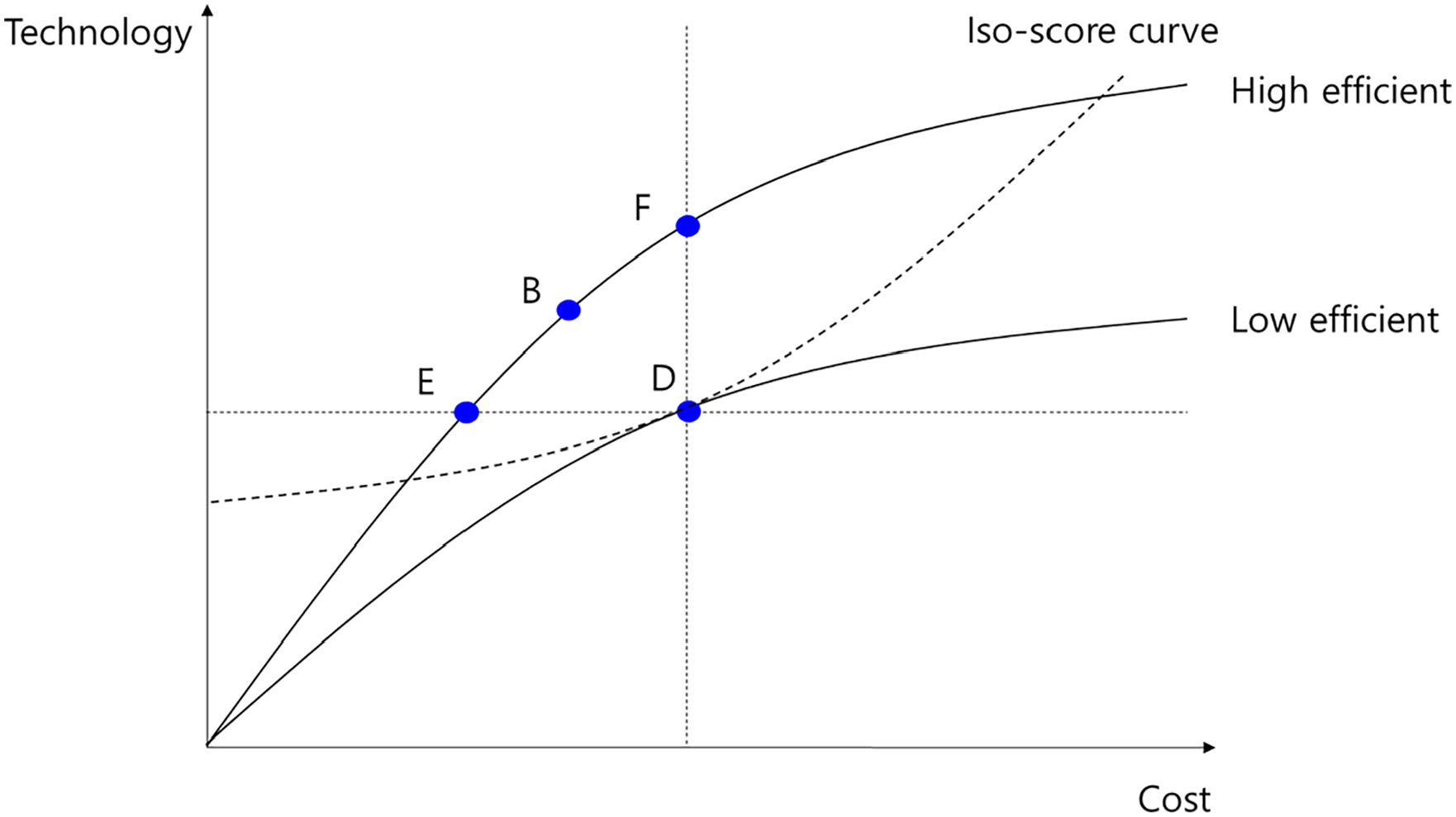
Multidimensional auction bidding pattern.
The combinations in the plane is represented in the iso-score curve passing through “D.” The technology-competitive operator is represented as a flat surface that can achieve higher scores than “D.” Furthermore, the operator with the highest technical competitiveness shall take part in the bidding process by selecting a combination to generate better scores than “D.” Nevertheless, either “E” or “F” can also be chosen in order to engage in the bidding process. “F” is comprised of higher level non-price components than “D” of a lower-level enterprise, but it can also be selected at a higher cost level. “E” can rank higher than “D” when taking into account the price; however, it will have a score that is higher than “D” if it is associated with the non-price category. If the bidder type is focused solely on “B” in response to “D,” then the price element and non-price element of the operator will show a positive correlation of the evaluation score. In this case, the key factors in the selection of the winning bidder are the evaluation scores of the price element and non-price element. If “F” is chosen instead of “D,” the score of the non-price sector will be the main factor in deciding the winning bidder. In this particular instance, the evaluation scores of the price element and non-price element signify a negative correlation. There will also be a negative correlation between the evaluation scores of the price element and non-price element if “F” is selected. In addition, the main factor for deciding on the winning bidder will be the price sector evaluation score. “E” has a significantly higher price than “D”; however, it has a lower rating in the non-price sector. The logical bid participation behavior is represented by “F” when the owner places extreme importance on the technology level and quality, and it is highlighted in the assessment criteria. If the owner emphasizes the competitiveness of the technology, it is expected that the actions of the bid participants can be achieved with “F.” Given the owners’ price competitiveness and quality level, “B” will most likely be selected.
Discussion on Improvement Policy
Legal Improvement
The participation eligibility in the bid is restricted by paragraph 1 of Article 27 of the national contract law from 1 month to 2 years if the reasonable execution of the competition or the proper implementation of the contract does not compromise the operators. In regard to public procurement contracts, the discussion about judicial remedies have to be addressed from the perspective of efficient rights relief against the contracting parties. Public procurement contracts are clearly different from civil construction contracts because procurement contracts are designed to satisfy the public interest. Other special legal rules for the performance or protection of public interest in public procurement contracts are often enforced in judicial contracts. Furthermore, the government can effectively explore and recognize the public legal nature of the public procurement contract and carry out administrative litigation. An independent judicial remedy for public procurement contracts is required to widen the scope of relief. First, the independence and expertise of the dispute coordinating committee must ensure efficiency. The most remarkable blind spot is that the ordering institute does not have to file a claim for the construction company’s adjustment. The national committee on contractual disputes cannot require the ordering institute to participate in the adjustment process since it does not specify the mandatory participation provisions for the other party’s adjustment procedures to the contract. If the ordering institute is not involved in the adjustment, the rules that impose a fine must be revised. In regard to the structure and procedure of the dispute coordinating committee, equality and autonomy are required. Professionalism and responsibility must be ensured through the formation of a workforce with a carrier and public procurement contract expertise. Moreover, it is necessary to activate the alternative dispute resolution. Disagreements between contracting parties have occurred in regard to the performance contract process. Such disputes shall be settled by external judicial resolution, such as consultation and arbitration between the parties, and a ruling of the court. Most disputes are settled by court rulings without consultation between the parties, and means of arbitration and mediation are deemed necessary due to the heavy burden of time and expense that are external to justice. At the time of the conclusion of the contract, the contract parties shall select the court’s decision or arbitration so that there will be no misconceptions regarding the dispute settlement clause in the accounting regulation. Regulations should be explained in order to eliminate conflict, confusion, and uncertainty. Arbitration is the solution used worldwide.
Support System Improvement for Small and Medium-Sized Enterprises
In South Korea, small and medium-sized enterprises are favored in various forms of government procurement. The preferential treatment is mainly focused on the indirect encouragement of the administration and congress to set purchase targets rather than mandatory purchases, and to motivate the government institutes to initially purchase products from socially weak companies. However, it should also be careful that measures are biased toward certain groups or that the preferential policies misrepresent the competitiveness of the market policies that are supporting the socially weak groups. There is a need to consider more carefully whether these procurement policies will affect the economy and society in particular. The balance between fiscal efficiency and social policy considerations should be factored in order to make sure that the use of quality goods does not impede the demand institute in using procurement goods. First, the target ratio system used for purchasing small and medium-sized enterprises must improve the reliability of the published statistics by enhancing the aggregation method for purchasing performance. For a harmonized policy discretion and transparency in the government procurement system, it is essential to create a database that provides real-time information on small and medium-sized enterprises, products, and purchasing facilities, as well as provide disclosure on the delivery performance of each company via government procurement support policy. Second, the over-segmented designated items in the system for the categorization of competitive products between small and medium-sized enterprises must be converted from detailed designations of item units to classification of products and units of industry. It is also necessary to ensure that the criteria for designating competitive products during the period can be applied to unorganized items with limited designation as medium-term competitive products. Furthermore, various factors (e.g., product and market characteristics, sales determinants, and competitiveness) must be reflected in the criteria to be improved so as to meet the objective of the medium-term competition. Third, in the case of the direct purchase system of public goods, there are certain public institutions that should avoid separate orders due to quality and management issues by using the exception to separate orders, and several materials subject to separate orders are difficult to separate from the actual construction. The review process for the designated criteria or designated items is also insufficient. In order to address these issues, the criteria for the designation of public goods must reflect the demand for separate orders from public institutions, and detailed operational manuals for the procurement of public goods must be prepared directly from the turn key base. In addition, the composition of the dispute review committee, including external experts, should be taken into account in the context of the conflict of defects in the direct procurement of materials. Fourth, in the case of a direct production verification system, there is a need for a legal basis to enable the cancelation and sanctions of verification companies to resolve issues that are encountered in practice if they are contrary to the intent of a medium-term competition system and direct verification system of production due to unfair acts. The inconvenience of running the system must be minimized. Fifth, the competition system should complement the competition structure in the scale of procurement and to introduce a system that provides opportunities for government contracts by classifying sales, production capacity, capital, liquidity ratio, and performance as this will help in preventing the closure of the structure in which superior small and medium-sized enterprises are monopolized in certain item-oriented competition. Sixth, improvement is necessary in the context of the contract performance evaluation system, since a company with a significant production capacity can be chosen instead of the sales and financial status. More diverse screening criteria (e.g., sales, production capacity, current ratio, past performance, and technical skills) are therefore required. Seventh, the priority purchase system for the technology development products or the performance certification and performance insurance system requires a system to support the development of new technologies of small and medium-sized enterprises, as well as achieve sales growth by creating products using their development technology and improving the competitiveness of small and medium-sized enterprises.
Public Procurement System Improvement
Government leadership is important in public procurement. For this reason, we are in need of an active leadership. There have been discussions recently in the area of neo-liberalism and public policy that emphasizes efficiency. It is therefore necessary to search for a solution that harmonizes value. In addition, transparency is the most important element in the system. While everyone is in agreement that transparency is important, there must be a variety of ways to improve it. The central government’s centralized procurement system requires a diversified and decentralized procurement system. To this end, it is necessary to promote small and medium-sized enterprises, attract investment, cooperate with related institutes, and develop policies. In regard to the quality degradation issue, which has emerged as the lowest bid system, it is preferable to actively use the multi-supplier contract or multi-level competition system. The government procurement system has excellent job creation, technological development, and balanced functions for regional development. Public procurement participation is important for the generation of revenue and creation of jobs. Quality control is one of the most important procurement factors. Moreover, the government and consumers can select excellent quality. In the case of the demand institutes’ general demand product group (e.g., office equipment and construction environment), an alternative inducement is required with technological innovation, such as eco-friendly products and energy efficient rainwater products. In regard to high-tech manufacturing sectors (e.g., science and technology medicine), as well as information and communication, a new demand must be created in connection with the discovery of new public services, since demand is not required. Strengthening the purpose of the system in terms of expanding investment in R&D for the innovation of small and medium-sized enterprises is deemed necessary in order to improve the R&D support measures, ranging from planning to marketing. In supporting R&D for innovative small and medium-sized enterprises, the targets and topics that are remarkable social needs, but are considered high risk, should also be included in the support list, which are difficult to implement in private-led projects. The flexibility of a formalized notification system for procurement materials based on an inventory system must be guaranteed, and logical and electronic channels must be secured in order to support it. On the other hand, it is necessary to reversely suggest demand so as to establish a process demanding technical niche and market-sensitive suppliers, instead of public products and services. Therefore, it is necessary to plan public services based on social needs and establish specialized institutes that are responsible for technological innovation, product development, and commercialization. The principle of the registration-oriented operation of the public procurement market must now be shifted toward a transaction-oriented focus. The technical skill evaluation method according to certification should be converted to an effective evaluation of technical ability.
Conclusions and Research Implication
Administrative action pattern is constantly changing and evolving. The previous one-sided administrative form does not conform to the current diverse and highly advanced administrative reality. Therefore, the means have been changed in order to meet different administrative needs, and the administrative contract is one of the administrative actions. These administrative contracts are used in different areas of administration, and the public procurement contracts are being used in the areas of procurement administration. Value and goal is achieved through the bidding process and public procurement transparency, and co-growth is achieved through the establishment of a symbiotic development foundation with the suppliers. The public procurement process should be based on the application of advanced purchasing to meet all three values (e.g., the price, the quality, and the delivery). The quality, schedule, and safety of the project will have a significant impact if technical bid evaluation is based on the excluded practice. The process of adopting the social market economic order and achieving social policy objectives (e.g., social weak protection and environmental protection), along with efficient enforcement of national finance, can be the role of national fiscal administrative action, which includes public procurement. The public procurement system has different objectives. While pursuing public procurement transparency and efficiency, the government will push through with social policy goals, such as the simultaneous protection of small and medium-sized enterprises. In this study, a policy study was conducted through a prescriptive approach research method. We focused on the policy research on improving the public procurement process for the public management innovation. In this study, the public procurement process is analyzed and improvement policies are presented. The public management innovation is needed to improve the public service. For the public management innovation, the improvement policy of the public process is very important. It creates social value and can greatly contribute to economic growth. We present and discuss in this paper the improvement policy design of the public procurement process for the public management innovation in South Korea. First, we discussed the theoretical analysis of public procurement. The competitive advantage bidding form and multi-dimensional auction bidding form were discussed, and the factors determined the winning bid in public procurement. We can observe closely the movements and factors in accordance with the form of public procurement and project. Then, we discussed the public procurement improvement policy. The improvement policy proposed different policy solutions via legal improvement, support system improvement for small and medium-sized enterprises, and public procurement system improvement. The purpose of this paper is to outline the direction of public procurement improvement and to establish effective policies. In this study, we analyzed South Korea’s public procurement issues and focused on policy improvement. In the future, we are going to try different public procurement studies. We will also study the improvement of the national electronic procurement system, the innovative public procurement processes, and the public procurement for construction materials. We are hoping to contribute to the improvement of the efficiency of the global public procurement process and to be shared as a useful academic paper by presenting South Korea’s improvement policy direction.
Footnotes
Author Note
This research was conducted while Donghun Yoon was at Seoul Center, Korea Basic Science Institute, South Korea. He is now at Division of Economics, Kyonggi University, South Korea and may be contacted at
Declaration of Conflicting Interests
The author declared no potential conflicts of interest with respect to the research, authorship, and/or publication of this article.
Funding
The author(s) received no financial support for the research, authorship, and/or publication of this article.
