




Abstract
Second-person pronouns (SPs) address readers directly, and they are widely used in the advertising discourse. SPs are often handled flexibly in English-Chinese advertisement translation, and SPs may be added to Chinese translations even when the original texts do not have second-person reference. This study has explored Chinese readers’ reception of SPs via pupillometry. Thirty-seven participants were recruited for an eye-tracking experiment. Two parallel Chinese versions of 20 English advertisements were prepared, one set with an SP and the other one without it. After the eye-tracking experiment, participants filled out a questionnaire and rated their impression of the texts on a five-point scale. Data analysis shows that pupil dilation was significantly higher when participants read the SP version, with longer fixation duration and more fixation counts. In addition, their subjective ratings of the SP version were also higher, meaning that they liked the version better. Such results suggest that using SPs in Chinese advertisement translation is an effective method of attracting readers.
Introduction
Advertising texts are intended to persuade consumers to accept a product, service, or idea, which needs to be taken into account in the translation process. To achieve this goal, translators apply various strategies to attract consumers’ attention such as introducing second-person reference. Second-person pronouns (SPs) frequently appear in the advertising discourse to enhance personalization and consumer involvement (Razzaq et al., 2024). The SP “you” is almost ubiquitous in English advertisements, which is “one of the most distinctive features of advertising” (Cook, 2001, p. 157). The direct form of address helps to reduce “the impersonality of mass-media discourse” and implies “a one-to-one relationship between advertisers and addressees” (Smith, 2004, p. 285). Chinese SPs “
Research Background
Second-Person Reference in Advertising
Different personal pronouns produce variant effects on marketing communication (Kou & Powpaka, 2021, p. 217). For example, the first-person pronoun “we” is more powerful than the SP “you” for current customers, but it is the other way around for potential customers (Sela et al., 2012). The plural and singular forms of pronouns may also bring about different results, and singular pronouns are more effective for individualistic consumers (Kou & Powpaka, 2021, p. 218). In this research, we intend to study singular second-person reference in English-Chinese advertisement translation and find out how effective it is in attracting potential Chinese consumers particularly the young, who, while living in a collectivistic culture, cherish individuality and uniqueness (ChoZan, 2017). This study does not cover first-person or third-person reference to avoid any mixed effects of different pronouns.
The current investigations on SPs in advertising mainly cover two streams, namely, the linguistic and marketing ones. The popularity of SPs in the advertising discourse has attracted various scholars’ attention (Corchete, 2021; Cruz et al., 2017; Cui & Zhao, 2014; Kim, 2006; Kow & Powpaka, 2021; Serrano, 2018, 2021; Van Compernolle, 2008). From the linguistic perspective, the specific use of SPs in advertising, including their singular, plural, formal, and informal forms, is analyzed (Corchete, 2021; Kim, 2006; Serrano, 2018, 2021; Smith, 2004; Van Compernolle, 2008), and the conversational atmosphere and personal relationship set up by SPs are emphasized (Cui & Zhao, 2014; Serrano, 2021; Smith, 2004; Torresi, 2010, p. 128). In brief, a key finding revealed by linguistic explorations is that incorporating SPs in textualization helps to make the message more personal and thus attract readers’ attention. However, it is mostly based on textual analysis and theoretical inference, and it remains to be substantiated with empirical evidence. The research from the advertising or marketing perspective is often empirical. For example, studies based on surveys and readers’ subjective ratings suggest that SPs bolster mental simulation and involvement (Packard & Berger, 2020; Razzaq et al., 2024), and influence consumers’ attitudes and behavior and hence advertising effectiveness (Cruz et al., 2017; Kow & Powpaka, 2021; Sela et al., 2012). One major weakness of using the self-rating method to assess consumers’ attitude and behavior is that respondents may be subject to social desirability bias and respond in a way that is socially and culturally more acceptable or positive (Chung & Monroe, 2003, p. 292). Therefore, the studies relying on subjective ratings also call for the support of objective data such as readers’ physiological measures.
In short, a major research gap in the current explorations on SPs lies in the lack of empirical evidence consolidated by objective data. Despite the interesting discussions on the possible effects of second-person reference, researchers mostly resort to textual analysis (Corchete, 2021; Cui & Zhao, 2014; Kim, 2006; Serrano, 2018, 2021; Smith, 2004; Torresi, 2010, p. 128; Van Compernolle, 2008), or participants’ subjective ratings (Cruz et al., 2017; Kou & Powpaka, 2021; Sela et al., 2012), which can be further strengthened by objective data not susceptible to bias. Some research also analyzes other type of data such as billboard rankings to confirm the effect of SPs (Packard & Berger, 2020). However, to the best of our knowledge, cognitive or experimental studies on SPs in the advertising discourse that are based on physiological measures rather than subjective ratings are rare. We have not been able to find any research in the current literature that applies such methods to investigate Chinese readers’ reception of SPs. In this study, we intend to explore this issue via pupillometry, as one’s state of arousal is reflected in their pupil response (Brisson et al., 2013, p. 1322; Gagl et al., 2011, p. 1171; Krejtz et al., 2018, p. 1). We will explain the potential benefits of pupillometry in Section “Pupil dilation as an indicator of arousal,” but, before that, we would like to point out another research gap, namely the lack of attention to SPs in advertisement translation.
Second-Person Reference in Advertisement Translation
The discussions concerning the positive effects of SPs on the linguistic and marketing levels lead us to consider a possibility: Since SPs are useful for advertising, incorporating SPs in advertisement translation should in principle be an effective strategy of attracting readers. However, despite the numerous investigations on SPs from the linguistic and marketing fields, SPs are rarely studied in the translation field (Cui & Li, 2023; Cui & Zhao, 2014; Smith, 2004). It is probably because the translation of SPs appears to be simple and straightforward. Actually, the transference of SPs from English to Chinese is not always that simple due to linguistic and cultural differences. For example, the SP “you” in English has four variations including you, your, yours, and yourself (Packard & Berger, 2020), it can express both informal and formal relationships (Cook, 2001, p. 183), and it can be a single referent and a general one (Munday, 2004, p. 209), while there are two pronouns in modern Chinese, “
Advertisement translation is not merely matter of linguistic transfer, and the translations are expected to perform the functions of their original texts. That is why translating advertisements is regarded as “a hard nut to crack for translators” (Pan, 2015, p. 205). As people generally try to avoid advertising (Vedula et al., 2017, p. 1), it is essential to produce translations that can attract target recipients’ attention, win their favor, and be workable in the target context. Based on the discussions on SPs in advertising (Corchete, 2021; Cruz et al., 2017; Cui & Zhao, 2014; Kim, 2006; Serrano, 2018, 2021), we believe that the skillful use of SPs in English-Chinese advertisement translation can help to draw target recipients’ attention and win their favor.
In the practice of English-Chinese advertisement translation, SPs are dealt with flexibly. We reviewed about 600 English-Chinese bilingual advertisements on the official websites of 41 international corporations, paying special attention to the treatment of SPs. We found that, for English advertisements with SPs, their Chinese translations may reproduce or may omit the SPs, and for English advertisements without SPs, Chinese translations may incorporate or not use SPs. In brief, there are two possible types of Chinese translations of English advertisements, one with SPs and the other without. It is worth investigating which version attracts Chinese readers’ attention more effectively. An experimental study on English-Chinese advertisement translation finds that using SPs in translation helps to strengthen reader memory (Cui & Li, 2023). As that study relies on participants’ subjective ratings, the reception of SPs by Chinese readers merits further investigation.
Pupil Dilation as an Indicator of Arousal
We have chosen to explore pupil dilation in this study for the following reasons. First, pupil dilation is an involuntary response (Brisson et al., 2013, p. 1322). It reflects one’s cognitive state more truthfully than fixation or saccade which, theoretically speaking, readers can control with their own will. Pupil dilation is not under conscious control, so it is free from bias (Balling et al., 2014, p. 238). Meanwhile, there are confounding factors such as external stimuli and task difficulty which may influence pupil dilation. In this study, we have tried to control those factors by keeping the luminance in the lab constant, excluding multimodal elements, using parallel verbal texts, and controlling text difficulty. More details about the experiment design will be presented in Section “The Eye-tracking Experiment.”
Second, pupillometry has “the greatest potential” for a reliable estimate of one’s cognition (Krejtz et al., 2018, p. 1). Broadly speaking, if we exclude the effect of drugs and luminosity, the pupil reacts to the two stimuli of cognitive and emotional activities (Seeber, 2013, p. 26). On the one hand, pupil dilation reflects such cognitive processes as arousal, emotion, interest, attention, and surprise (Brisson et al., 2013, p. 1322; Gagl et al., 2011, p. 1171; Hyönä et al., 1995, p. 598; Kuchinke et al., 2007; Partala et al., 2000). Therefore, pupil measures can provide insight into the impact of SPs. On the other hand, pupil dilation is also associated with cognitive effort (Caffrey, 2009, p. 64; Hyönä et al., 1995, p. 598; Iqbal et al., 2005; Seeber, 2013, pp. 27–28). Cognitive effort is concerned with people’s limited cognitive capacities to deal with certain tasks. However, understanding advertisements is generally not an intensive cognitive activity, because the words and syntactical structures are usually simple (UK Essays, 2018). The words are often emotive ones (Delin, 2000, p. 132), and being emotional is a prominent feature of the advertising discourse (Torresi, 2010, p. 128). For this reason, the pupil response caused by advertisements is more likely to be concerned with one’s state of arousal rather than cognitive effort.
Finally, pupillometry is non-invasive (Krejtz et al., 2018, p. 1), and pupil diameter is relatively easy to measure (Brisson et al., 2013, p. 1322). The technology of pupillometry has developed immensely. Still, there is difficulty with the processing of pupil data, as there is a lack of software and researchers often have to do it manually (Caffrey, 2009, p. 180). Furthermore, there are inconsistent results regarding the reliability of pupillometry (O’Brien, 2008; Sun, 2019). We would like to stress that the inconsistent results are largely attributable to the method of calculating pupil dilation (Balling et al., 2014). More discussion on how calculated pupil dilation will be presented in Section “Data processing.”
Research Objective and Methodology
In view of the above research background, this study aims to explore the following research questions: whether Chinese advertisement translations with SPs cause more acute arousal in Chinese readers than translations without SPs; whether Chinese translations with SPs attract more attention from Chinese readers than translations without SPs; and whether Chinese translations with SPs cause more positive attitude in Chinese readers than translations without SPs. An eye-tracking experiment has been conducted to collect readers’ eye movement data, followed by a post-task questionnaire to collect readers’ subjective ratings. The pupil data collected in the experiment could reflect participants’ state of arousal; the fixation data could reflect their attention distribution; and the subjective ratings data could reflect their attitude.
The Eye-Tracking Experiment
Participants
Thirty-seven postgraduate students (30 females and 7 males) took part in the experiment. They were all Chinese native speakers in their twenties, aged between 22 and 29 (M = 23.64, SD = 1.61). They were right-handed and had normal or corrected-to-normal vision, with no history of neurological or psychological impairment. We informed them of how the eye-tracker worked and the experiment procedure. They signed a consent form and took part in the experiment voluntarily. We gave each participant a USB flash drive as a gift in return for their participation.
Experiment Materials
We collected 20 local print advertisements from an American city which had no Chinese versions. We translated those advertisements ourselves, so the texts would be new to participants. Research applying pupillometry shows that one’s cognitive activity is impacted if they are acquainted with experiment materials (Hyönä et al., 1995, p. 602). Using new texts could avoid such familiarity effect.
We prepared two parallel Chinese translations for each advertisement according to the following criteria. First, we ensured that the two Chinese versions use the same Chinese characters and convey the same meaning, the only variation being the use of SPs.
English version: Moments to remember begin here. NSP (No SP) version: SP (With SP) version:
For example, in the above hotel advertisement, the two Chinese versions both use the phrase
We ran a readability test to assess the experiment materials’ complexity. We adopted the formula which, developed by Xu et al. (2021) for Chinese on the basis of the Gunning Fog formula, takes into account the length of a clause and the proportion of conjunctions and adverbs. We analyzed each text, and the final scores fell between 1.83 and 3.00, meaning that the texts were easy, as lower scores imply high readability (Xu et al., 2021, p. 31). Therefore, reading the texts would not impose much cognitive effort on participants.
As to the font type and size, we used Simsun 48 in the experiment, which was comfortable to the eye and helped to draw readers’ attention to the Chinese characters per se instead of the blank areas above or below. The texts were displayed in the middle of the screen.
Apparatus
We used the GP3 HD Desktop Eye Tracker by Gazepoint for the experiment. It provides binocular eye-tracking, with a sampling rate of 60 to 150 Hz and a visual angle accuracy of 0.5 to 1 degree. The measurement of pupil size may be affected by changes in gaze position when readers process a series of words (Gagl et al., 2011, pp. 1171–1172). Our experiment involved word series. We consulted the technicians with Gazepoint, and they confirmed that the algorithms could minimize the influence of head and eye movement. As for the sampling rate, we chose 60 Hz, and the eye tracker recorded pupil changes every 16.7 ms. According to the Nyquist theorem, when sampling a signal, we need a frequency that is higher than twice the signal’s maximum frequency (Blackledge, 2006, p. 96). A pupil response spans nearly 2 s or 2000 ms (Einhauser et al., 2008, p. 1704). With the sampling rate of 60 Hz, we could collect 120 samples within 2000 ms, which could meet the needs of this research. Setting a higher sampling rate would increase the amount of data and the workload to process them manually.
To ensure the accuracy of eye-tracking, we placed a chin and forehead rest at a distance of 60 cm in front of a high-definition monitor with 1920×1080 resolution. To ease the potential discomfort caused by the rest, we let participants adjust the rest themselves and find a position that was most comfortable to them.
The luminance level in the laboratory was kept constant. In addition, we adjusted the monitor’s background color to be grayish green (hue = 84, saturation = 91, brightness = 205), which was comfortable to the eye and popular among Chinese readers.
Procedure
We stayed in touch with participants to make sure that they were in good health. As pupil size is affected by external factors such as drugs and alcohol (Caffrey, 2009, p. 57), we reminded them not to take any medication or have coffee, alcohol, or tea before the experiment. Pupil response also decreases with fatigue (Seeber, 2013, p. 26), so we asked them to be well rested. The lab context might cause tension, so we had a warm-up session when a participant came to the lab by showing him/her around and familiarizing them with the environment.
We tested participants’ eye dominance before the experiment. Some studies applying pupillometry do not indicate eye dominance and only record one eye (see Einhauser et al., 2008), while others record both eyes and report the mean pupil diameter (see Brisson et al., 2013). We were interested in eye dominance because we wondered whether one’s dominant eye, with better visual acuity and sensitivity (Mapp et al., 2003, p. 310), would have slightly different pupil response. We used the “hole in the card” test, which is regarded as “the most satisfactory” method (Foutch & Bassi, 2020, p. 2). Participants repeated the test several times. Thirty-three participants were right-eye dominant, and four were left-eye dominant.
The eye tracker was calibrated with a five-point calibration routine at the beginning of each trial. The Chinese translations were randomly presented to participants with the NSP versions interspersed with SP versions. We made sure that each participant only saw one version of the same advertisement. To minimize participants’ pressure or effort, we asked them to simply enjoy the advertisements to be shown on the screen as potential consumers. We told them that they would be invited to fill out a questionnaire about their impressions of those texts. We asked participants to try not to blink when reading the texts but reminded them that they should be as comfortable as possible.
We set a 5-s display duration for each text. The texts were very short, and 5 s would be enough for participants to finish reading at ease, but they would not have extra time to roam around the screen. A blank screen was displayed for 2 s between two texts to avoid the spillover effect. By spillover, we mean the pupil response caused by the previous text extending to the subsequent text. As there is a delay of 200 to 500 ms for pupils to respond to a stimulus (Seeber, 2013, p. 26), the impact of the previous text on one’s pupil may still linger when the second text is displayed. Considering that the pupil response span lasts for about 2 s (Einhauser et al., 2008, p. 1704), we set a 2-s display for the blank screen so that the spillover of the previous text would be over when the next text was shown.
After the eye-tracking experiment, which took about 15 to 20 min, participants filled out an online questionnaire and rate the texts on a five-point Likert scale to indicate how much they liked the advertisements. We asked them to make impressionistic judgment and emphasized that there was no need to conduct in-depth analysis. We gave this instruction because consumers in real-world scenarios often evade advertising and would not pay much attention to advertisements (Vedula et al., 2017, p. 1). We explained to participants that their answers would be treated anonymously and we only wanted to learn about their truthful attitude.
Data Processing
Data Filtering
We acquired participants’ eye movement data in the form of CSV files, videos, and hot spot maps which provided visualized demonstration of the eye track. We watched the videos and hot spot maps first to observe participants’ performance during the experiment and to detect any abnormal behavior. They were all cooperative and concentrated on the task. Then we processed the CSV files. The pupil data were valid except for 16 dominant-eye samples and 16 non-dominant-eye samples. The fixation data were valid except for six samples from the SP version and six from the NSP version. The eye-tracker malfunctioned and did not record any data for those samples. In addition, we removed two types of outliers from the pupil data, namely blinks and sudden increases or decreases of 0.75 mm within 20 ms (Partala et al., 2000, p. 125). We also filtered the fixation data by deleting fixations shorter than 60 ms and longer than 800 ms (Kruger et al., 2022, p. 224).
Areas of Interest
We delineated Areas of Interest (AOI) with reference to perceptual span and punctuation. Perceptual span is the “region of effective vision” (Schotter & Rayner, 2012, p. 88), or the region from which we acquire useful information without making saccades. Perceptual span matters in this study because participants’ effective vision covers more than one Chinese character. Research finds that Chinese readers’ perceptual span covers one Chinese character to the left of the fixation point and two or three characters to the right (Schotter & Rayner, 2012, p. 94; Zang et al., 2024, p. 4). In other words, it includes approximately five characters. Therefore, while we are interested in participants’ pupil changes when they saw SPs, it is not accurate to regard SPs as AOIs, because participants might have already included the pronouns in their effective vision before their eyes were fixated on the Chinese characters per se. As a result, we had to delineate an area rather than one Chinese character. It does not mean that we have made any assumptions about how the perceptual spans might progress in actual reading; instead, we believe that in principle once a participant set eyes on the area, the SP could have already come into his/her effective vision. Meanwhile, perceptual span can be affected by punctuation. There is no space in Chinese and successive characters are concatenated until a punctuation mark is reached (Inhoff & Liu, 1998, p. 20; Zang et al., 2024, p. 1), and Chinese native speakers tend to segment character sequences into units as indicated by punctuation marks (Chen & Tang, 1998, p. 245). Therefore, we delineated AOIs as follows. (The colors in the figures were added after the experiment, and no color was used during the experiment.)
First, we regarded clauses or phrases marked by punctuation marks as separate units and delineated those shorter than five characters as different AOIs.
As shown in Figure 1, in the advertisement, “

Delineation of AOIs (I).
As illustrated in Figure 2, in the text “

Delineation of AOIs (II).
Calculation of Pupil Dilation
Calculating pupil dilation is tricky. Pupil size varies with individuals. Even the same person’s pupil size may be variant when doing the same task on different days (Caffrey, 2009, p. 70). Therefore, it is not accurate to compare participants’ pupil diameters; instead, we calculated the percentage of pupil change. A baseline or the starting value of pupil diameter and its peak value need to be identified to calculate the percentage. The peak value is relatively easy to locate. Research on word recognition finds that the maximum dilation is reached around 900 to 1,200 ms after a stimulus appears (Gagl et al., 2011, p. 1179; Hyönä et al., 1995, p. 605). Therefore, we tried to locate the peak value at the time frame of 900 to 1,200 ms after the participant set their sight on the AOI. Meanwhile, research shows that the effects of emotional arousal are generally longer lasting (Hyönä et al., 1995, p. 610). As second-person reference sets up a personal relationship with recipients and can have an emotive effect, the peak value of pupil size was reached after 1,200 ms for some samples in this study.
Compared with the peak value, the baseline is harder to determine. Pupil response usually occurs 200 to 300 ms after a stimulus appears (Gagl et al., 2011, p. 1171), and pupil dilation resulting from cognitive activities usually begins after 300 to 500 ms (Hyönä et al., 1995, p. 605; Seeber, 2013, p. 26). Generally, we regarded the pupil diameter when a participant first set sight upon an AOI as the baseline, but there were exceptions. First, there might be spillover from within a text. As noted earlier, participants were shown a blank screen for 2 s between texts to avoid spillover from the previous text, but we still observed spillover effect in some cases. For example, when the AOI with SP appeared in the second clause, for some participants, there might be a spillover from the previous clause. As shown in Figure 3, the participant’s pupil diameter was still declining when their sight was set upon the AOI with SP.

Spillover effect.
For such cases, we took the lowest pupil diameter after it came down from the prior peak as the baseline. Second, some participants blinked. Blinking interrupts the measure of pupil size. The eye tracker cannot record pupil data when the eyelid is closed, and when it opens after blinking, there is a brief pupil reaction to light which is not caused by cognitive activities (Caffrey, 2009, p. 113).
For such cases, as shown in Figure 4, we used as baseline the diameter after the pupil size was stable, usually 200 to 300 ms after the participant opened their eyes.

Blinking.
Calculation of Fixation Duration and Count
We analyzed participants’ fixation data on the AOIs as a supplementary measure to study participants’ attention distribution. Fixation duration and count indicate one’s effort and interest (Sun, 2019, p. 156; Szarkowska et al., 2018, p. 189). As the texts with SPs and those without SPs differ in length, we divided fixation duration and fixation count data with the number of Chinese characters to offset the length effect.
Research Findings
Normality Tests
We conducted Shapiro-Wilk normality tests on the data.
As shown in Table 1, the p values are all below .05, and the data are not normally distributed. Therefore, we carried out non-parametric statistical tests.
Normality Tests.

Wilcoxon Signed-Rank Tests
We did Wilcoxon signed-rank tests on the data. We calculated r to measure the effect size (Mellinger & Hanson, 2017, p. 107). The descriptive statistics and the results of Wilcoxon signed-rank tests are summarized in Tables 2 and 3, respectively. The following abbreviations are used: M = Mean; ME = Median; SD = Standard Deviation; CI = Confidence Interval.
Descriptive Statistics.

Wilcoxon Signed-Rank Tests.
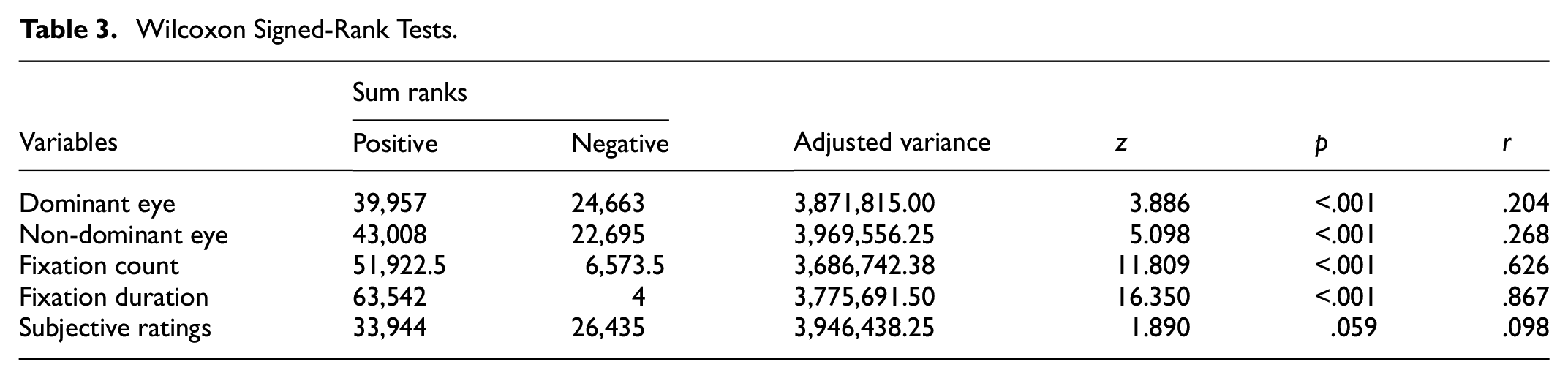
First, pupil changes for the SP version are more acute than those for the NSP version. As shown in Tables 2 and 3, for the dominant eye, the mean pupil dilation for the SP version (M = 0.142, SD = 0.089) is higher than the NSP version (M = 0.118, SD = 0.068). The difference is statistically significant (z = 3.886, p < .001). The effect size is moderate (r = .204). It is the same with the non-dominant eye. The mean pupil dilation for the SP version (M = 0.135, SD = 0.091) is higher than the NSP version (M = 0.107, SD = 0.067). The difference is statistically significant (z = 5.098, p < .001). The effect size is moderate (r = .268).
Second, the fixation count and duration for the SP version are higher than those for the NSP version. Fixation count of the SP version (M = 1.161, SD = 0.567) is higher than the NSP version (M = 1.041, SD = 0.440). Such difference is statistically significant (z = 11.809, p < .001). The effect size is large (r = .626). The fixation duration of the SP version (M = 0.361, SD = 0.189) is longer than the NSP version (M = 0.315, SD = 0.149). Such difference is statistically significant (z = 16.350, p < .001). The effect size is large (r = .867).
Third, the subjective ratings for the SP version are higher than those for the NSP version. The mean rating of the SP version (M = 3.832, SD = 0.855) is higher than the NSP version (M = 3.702, SD = 0.873). The difference is statistically significant at the 10% significance level (z = 1.890, p = .059). The effect size is small (r = .098).
Correlation Test
Considering that subjective ratings data show the same difference as pupil data, we did a correlation analysis. We further processed the data and deleted the samples where changes of pupil size were insignificant (<.05), because participants might have been disinterested or less involved. We also removed the corresponding subjective ratings to ensure the perfect match between the two. Altogether, we have 1384 samples for the Spearman’s Rank Correlation analysis. Spearman’s rho reaches .092, and the correlation between pupil dilation and participants’ attitude is significant (p < .01).
Difference Between Dominant Eye and Non-Dominant Eye
To explore the difference between the dominant and non-dominant eyes, we observed the waveform graphs of the two.
As demonstrated by a sample in Figure 5, while both eyes show similar trends in pupil changes, there are more fluctuations in the dominant eye, represented by the light-color line, than in the non-dominant eye, represented by the deep-color line. We did Wilcoxon signed-rank tests on the dominant eye and non-dominant eye pupil data, and the results are summarized in Table 4.

Fluctuations of pupil changes.
Comparison Between Dominant Eye and Non-Dominant Eye.

For the NSP version, the pupil change of the dominant eye is higher than the non-dominant eye. Such difference is statistically significant (z = 1.988, p = .047). The effect size is small (r = .105). It implies that the dominant eye is slightly more sensitive to stimulus. However, there is no significant difference for the SP version. The pupil change of the dominant eye is higher than the non-dominant eye, but the difference is not statistically significant (z = 1.603, p = .109), and the effect size is small (r = .085). The small effect size regarding the difference between the dominant eye and non-dominant eye is understandable, considering that the statistics are based on the same participants’ two eyes faced with the same stimuli.
Difference Caused by Location of SPs
We tried to explore the possible differences caused by the location of SPs. We classified the texts into three groups, namely those with SPs at the beginning (4 advertisements, 147 samples), at the middle (11 advertisements, 404 samples), and at the end (5 advertisements, 176 samples). As the dominant eye is more sensitive, we explored the dominant eye data. We obtained the ranks of the raw scores first. Then, we did Bartlett’s test for equal variances, and Chi2(2) = 1.447, p = .485, hence homogeneity of the three groups’ variances. Then we did a one-way ANOVA on the ranked data.
As shown in Table 5, the difference between the three groups is statistically significant, F(2, 724) = 8.74, p < .001. However, the effect size is small (ωω2 = 0.021). We did Bonferroni multiple-comparison test to avoid false positives and further investigate the differences between the three groups.
ANOVA on Texts With SPs.

As shown in Table 6, the texts with SPs located at the end evoke more pupil dilation than those with SPs placed at the beginning (MD = −97.04, p < .001) and those with SPs at the middle (MD = −46.32, p = .041). As the number of samples is imbalanced among the three groups and the textual content is not controlled, this finding remains to be further investigated in future studies.
Bonferroni Multiple-Comparison Test.

Discussion and Implications
Reception of SPs
Both the objective data and the subjective data indicate that the SP version is better received by Chinese readers. The analysis of pupil data confirms that using second-person reference in English-Chinese translation invokes more acute arousal in readers, as the pupil dilation caused by the SP version is significantly higher. Given that the two Chinese versions used in the experiment are strictly parallel, the difference in participants’ pupil dilation is attributable to the SPs. Furthermore, the fixation duration and count connected with the SP version are higher, which implies that the SP version draws more attention. The ratings of the SP version are also higher, meaning that the SP version is liked more. This result echos the research finding that cultural items using second-person pronouns are liked and purchased more (Packard & Berger, 2020).
A major reason for the above result is that second-person reference guides readers’ attention to themselves and thus may invoke their personal schemata. Schemata refer to the mental pictures that people set up on the basis of their experiences (Culpeper, 2009, p. 130), which help them to understand the situations occurring around them (Stockwell, 2002, p. 16), and provide instructions for their performance (Land, 2009, p. 53). When reading a text, readers retrieve knowledge from their memory and integrate it with the textual information to produce an interpretation (Culpeper, 2009, p. 128). In this sense, schemata provide them with assistance in understanding utterances (Stockwell, 2002, p. 77). While the schema-theoretic view is regarded by some scholars to be biased as people tend to accept the information consistent with their schemata but ignore exceptions (Culpeper, 2009, p. 133), it reveals a common feature of readers’ cognition, that is, resorting to personal experiences when reading a text. This is particularly relevant to SPs in advertising. We do not mean that a text without SPs does not invoke readers’ schemata but that SPs can enhance the directionality of a message toward readers. Therefore, the SP version attracts readers’ attention better and invokes more acute arousal. Besides, the involvement of personal schemata can produce an emotive effect, as psychological research finds that anything that concerns oneself has the potential to invoke their emotion (O’Shaughnessy & O’Shaughnessy, 2004, p. 27). Such emotive effect of SPs and its potential impact on readers’ memory has been tested (Cui & Li, 2023). In this study, as indicated by the pupil, fixation, and subjective ratings data, the SP version also causes more arousal and is liked better by readers.
Moderate Effect Size
Despite the statistical significance between the SP and NSP versions in terms of pupil dilation, fixation, and subjective ratings, the effect size is moderate for the pupil data and small for the questionnaire data. However, we believe that the difference still has practical significance for the practice of advertisement translation and international marketing. First, we used verbal texts only in the experiment, with no visual elements involved. The impact of language on one’s emotive state is in itself limited compared with multi-modal elements such as visuals. Research shows that words are by nature “experientially remote and less directly emotionally involving” than images (Barry, 2020, p. 14). In the experimental study conducted by Cui and Li (2023), which involves texts only and is based on participants’ subjective ratings, the difference between translations with SPs and those without SPs is also small. Therefore, the small or moderate effect size found in this research is a truthful reflection of reality. Second, the moderate or small effect size is also attributable to the parallel translations used in the study. The parallel versions are exactly the same in the semantic meaning conveyed, the linguistic form applied, and the Chinese characters used. Data analysis shows that the small detail of SPs can cause significant difference in pupil dilation, fixation duration and count, and subjective ratings. Therefore, we propose that, as far as English-Chinese advertisement translation is concerned, incorporating SPs is a zero-cost strategy that is potentially effective in invoking Chinese readers’ arousal and contributing to the promotion purpose.
Another point worth mentioning is that the location of SPs may produce different impact on readers’ state of arousal, though the effect size is also small. As reported earlier, initial analysis shows that the effect on readers’ pupil dilation is the strongest when SP appears at the end of a sentence. It might be related to the wrap-up effect, or the effect of end weight (Nordquist, 2020), and what is placed at the end tends to attract more attention. However, as the content of the texts is not controlled and the sample size is unbalanced, further studies are needed to confirm and explain this finding.
Methodological Implications
This research has the following methodological implications regarding the implementation of pupillometry. First, pupillometry is a reliable method to assess readers’ state of arousal. While subjective ratings can reveal one’s experience, it is pointed out that human ratings are not always reliable indicators of their actual mental state (Moorkens et al., 2015, p. 282). Therefore, objective evidence is needed to substantiate subjective ratings. The positive correlation between pupil data and subjective ratings data in this study provides evidence that the former can complement the latter. Since pupillometry can shed light on readers’ state of arousal, it may be of interest to international businesses. Although pupil dilation is influenced by various external stimuli such as light, with the development of technology to reduce pupil change due to brightness (Asano et al., 2021), pupillometry may be applied in studying advertisements with multimodal elements. Second, it is beneficial to include both the dominant and non-dominant eyes in studies based on pupillometry. As noted earlier, the pupil response of the dominant and non-dominant eyes are rarely distinguished (see Brisson et al., 2013; Einhauser et al., 2008). We have found significant difference between dominant and non-dominant eyes for NSP texts but no significant difference for SP texts. It was probably because SPs activated participants’ personal schemata and caused more arousal, resulting in more acute stimulation to the non-dominant eye. Still, as pupil changes could differ between the dominant and non-dominant eyes, we propose that studies exploring participants’ cognition via pupillometry record both eyes, and particularly, attention can be paid to the non-dominant eye, as its pupil response is relatively stable when stimulation is not intense as that caused by second-person reference.
Conclusion
To conclude, this study has investigated Chinese readers’ reception of SPs in English-Chinese advertisement translation by studying their pupil dilation recorded in an eye-tracking experiment, supplemented by the analysis of their fixation data and their subjective ratings in a follow-up questionnaire survey. Data analysis shows that the use of SPs invokes more acute pupil dilation and higher fixations and hence is effective in invoking readers’ arousal and attracting attention. Aside from corroborating the effectiveness of second-person reference, the positive correlation between pupil data and subjective ratings shows that pupillometry is a reliable indicator of one’s state of arousal. In addition, since the pupil changes differ between the dominant eye and non-dominant eye, we suggest that studies applying pupillometry examine both eyes. Meanwhile, this study has the following limitations. First, we used print advertisements whose content is not controlled in the experiment in order to reproduce the real-world context. We have tried to offset this limitation by providing strictly parallel translations. Still, a more rigorous control of experiment materials’ content and using audio stimuli can reduce the impact of confounding factors on pupil response. Second, due to the limited funding and manpower, we used only 20 advertisements in the experiment and had 37 participants. In future studies, we plan to recruit participants with more diverse backgrounds and further explore whether the location of SP impacts readers’ state of arousal. Third, the reception of advertisements covers various dimensions, and this study has mainly explored participants’ state of arousal and attention distribution. More variables such as purchase desire need to be explored in future research in order to reveal consumers’ reception more comprehensively.
Footnotes

Ethical Considerations
We did not have an Institutional Review Board at the place where the experiment was carried out. However, as eye-tracking is based on the video-recording of one’s eye movements and is noninvasive, the experiment was perfectly safe for participants. We tried to uphold research ethics by explaining to participants the detailed experiment procedure, how data would be anonymized, and how their privacy would be protected. We also told them that they could withdraw from the experiment at any time without any consequence whatsoever. They all signed the Consent Form and took part in the experiment voluntarily.
Funding
The author(s) disclosed receipt of the following financial support for the research, authorship, and/or publication of this article: This work was supported by the Humanities and Social Sciences Project Fund of Ministry of Education of China under Grant [23YJC740007] and Guangdong Philosophy and Social Science Research Programme under Grant [GD25CWY20].
Declaration of Conflicting Interests
The author(s) declared no potential conflicts of interest with respect to the research, authorship, and/or publication of this article.
Data Availability Statement
The datasets generated during and/or analyzed during the current study are not publicly available because they concerned individual participants and we made it clear in the Form of Consent that their data would not be made public, but the data are available from the corresponding author upon reasonable request.