




Abstract
The mining industry is one of the most dangerous industries and requires comprehensive occupational health and safety management to protect the mining industry employees. However, occupational accidents greatly influence employee turnover in the mining industry. Following the predictive study approach, a cross-sectional survey was designed to collect quantitative data from 275 workers in the mining industry. The data were analysed using standardized questionnaires, multiple regression, multi-collinearity tests, means, and standard deviation methods. The results show that the correlation coefficient revealed a negative association between occupational health and safety elements such as safety training (r = −.31, p < .01), safety leadership (r = −.28, p < .01), fire safety (r = −.33, p < .01), safety measure (r = −.25, p < .01), and the likelihood of turnover. Safety training (β = −.32, p < .01) and fire safety (β = −.231, p < .01) were shown to be critical indicators of employee turnover. Our findings suggest that safety training and fire safety play a pivotal role in occupational health and safety to minimize employee turnover in the mining industry of Pakistan. It was concluded that this study provides a better understanding to improve mining sectors and help to reduce the high employee turnover intention in the mining industry. The study also suggests that improving safety training and fire safety could reduce employee turnover and enhance workers’ well-being in the mining industry.
Plain language summary
The mining industry is recognized as one of the most perilous sectors, necessitating comprehensive occupational health and safety measures to safeguard its employees. Nevertheless, occupational accidents significantly impact employee turnover rates within the mining industry. A predictive study was conducted to address this issue, employing a cross-sectional survey involving 275 mining industry workers. Safety training and fire safety emerged as critical predictors of employee turnover. Consequently, the study underscores the pivotal role of safety training and fire safety in enhancing occupational health and safety and reducing employee turnover within Pakistan’s mining industry. This study offers valuable insights for improving the mining sector and mitigating high employee turnover intentions. It emphasizes the significance of enhancing safety training and fire safety measures to reduce turnover and enhance the overall well-being of mining industry workers.
Introduction
The domain of occupational health and safety is a field that encompasses multiple disciplines and practical approaches to minimize potential hazards and ensure the safety of employees in the workplace. The mining sector requires financial considerations, theoretical and practical research, and promoting health and safety in significant workplaces (Tamene et al., 2020). Mining is one of the most dangerous and hazardous sectors (Panhwar et al., 2017). The working activities involve manually moving heavy loads, falling materials, noise, handling hazardous substances, dust, fire, and heavy equipment, which pose a significant hazard in the mining industry (Ngaruiya et al., 2019). Occupational health and safety management in mining is vital to prevent accidents and serious health issues like infections leading to sepsis (Shaikh et al., 2017). These health risks can increase employee turnover, highlighting the need for strong safety systems.
Pakistan is one of the Asian countries that preferred mineral destinations for investment. However, Pakistan’s mining sector is known to be one of the most dangerous occupational sectors in the Asian region (Janjuhah et al., 2021). Moreover, Occupational health and safety are mostly neglected because of conflicting political, social, and economic objectives (Noman et al., 2021). Additionally, the Pakistan mining industry has been associated with increased employee turnover intention, which ruined a significant database of potential workers in the mining industry (Mohsin et al., 2021).
Turnover intention indicates the employee intends to save another job or leave the organization (Morin et al., 2016; Muthelo, 2022). Occupational health and safety management is apprehensive about professional employees leaving the company because recruiting and training new workers is very expensive and time-consuming (Ajith & Ghosh, 2019; Surahio et al., 2023). In light of this, maintaining knowledgeable and skilled employees is a critical concern in a sector as important as the mining sector. The investigations identify that proactive occupational health and safety are vital parameters that significantly reduce employee turnover. Amponsah-Tawiah and Mensah (2016) enlightened a positive correlation between occupational health and safety management, turnover intention, and how employees interpret a higher commitment to their work.
Despite the Pakistani mining industry’s incredible contribution, mining workers face critical occupational health and safety challenges. Such an unignorably complicated situation adversely impacts the turnover intention in the mining industry (Wong et al., 2023). Safety and health issues affect workers’ feelings about continuing with an organization in the workplace (Ashkanasy and Dorris, 2017). With a similar argument, Reukauf (2018) defended that unsafe and adverse working atmospheres highly affected employee turnover intention to remain with the firm or quit. Turnover intention is increasing in the mining sector, and workers are moving from one company to another. Could unsatisfactory occupational health and safety management practices be the reason for the constant movement of workers in the mining sector? Still, there is no empirical research investigated to find out the reasons for the turnover intention in the mining industry of Pakistan.
Therefore, we investigated empirical research to examine the relationship between occupational health and safety management and employee turnover intention in the mining industry of Pakistan. Throughout the study, we will investigate various relevant factors and objectives based on the central research question. In particular, we will explore the relationship between dimensions of occupational health and safety management and turnover intention in the mining industry of Pakistan. To achieve these goals, we will use questionnaires and different techniques. Later, we deliver results and discussion using secondary and primary evidence. Lastly, we describe recommendations and the study conclusion.
Literature Review
Theoretical Overview of the Safety Structure of the Pakistan Mining Industry
The mining industry is critical to the development and economy of Pakistan, as it implements a significant ratio of Pakistan’s population (Solangi et al., 2021). It is mainly considered that mining work influences turnover intention and socioeconomic conditions (Chao et al., 2015). Therefore, it is essential to conduct efficient research to enhance safety conditions and lower employee turnover in Pakistan’s mining sector (Marimuthu et al., 2021). Pakistan’s significant coal sector is the seventh largest country to produce coal (S. H. Shah et al., 2018). Approximately 200 billion tons of reservoirs have been deprived of occupational health and safety systems for many years, resulting in frequently increasing fatal incidents in the mining sector. Unfortunately, Pakistan’s mining management is adopting old approaches that do not follow international standards and codes. Currently, the Punch Longwall coal mining and Pillar extraction coal mining methods are used in the Pakistan mining industry, as shown in Figures 1 and 2.

Punch Longwall coal mining methods in Pakistan: (a) Pickaxe, (b) Face Conveyor, and (c) main gate.

The pillar extraction coal mining method in Pakistan.
Overview of Coal Mine Accidents and Deaths in Pakistan
Furthermore, a significant factor of accidents exists in mining industries because of various factors, such as gas explosion, gas accumulation, mine collapse, and mine blast. A possible cause of these accidents is inadequate government and stakeholder investment, poor infrastructure, insufficient technological innovations, lack of management skills, incompetent monitoring and regulatory authorities, and inadequate utilization of resources. Consequently, detrimental consequences negatively affect the country’s economy, environmental damage, and increase risk factors within the workplace. The accidents and deaths were statistically analysed, and data obtained from particular sources newspapers Dawn (2018), Xinhua (2017), Tripathy and Ala (2018); Y Charts (1981–2017), Peoples Dispatch (2021), Al Jazeera (2021), and IndustrialALL (2017d, 2018d). The deaths and accidents in Pakistan’s mining sector from (2010 to 2022) are presented in Figure 3.

The deaths and accidents in Pakistan’s mining sector from (2010 to 2022).
The Relationship Between Occupational Health and Safety and Turnover Intention
The coal excavation, cutting, and transportation are concerned with injuries, fatalities, potential health risks, and employee turnover in the coal mining field (Mohsin et al., 2021). The mining occupation is associated with specific occupational hazards, negatively impacting workers’ health. These hazards include respiratory diseases, such as lung infections, skin allergies, hearing impairments, heartburn, and psychological stress (Widanarko et al., 2013). Paul and Maiti (2007) further discussed that accidents/injuries directly influenced the worker’s behavioural motivation. Ajith and Ghosh (2019) research workers’ dissatisfaction with their workplace incidents in two neighbouring Indian coal mines industries, which negatively influenced employee turnover intention.
The findings of Muthelo (2022) indicated the convenience sampling method and a structured questionnaire to assess the coal mining industry’s potential health and safety risks. According to Panhwar et al. (2017) research based on the last 5 years, there have been unfortunate accidents such as roof falls, stone falls from mine shafts, suffocation, and inhalation of toxic gases, as well as injuries caused by various accidents in the Lakhra Coal Mines. Pakistan has been lacking in efforts towards implementing health and safety due to minor considerations by industrialists of this mining sector (Jiskani, Cai et al., 2020). The lack of awareness among workers contributes to persistent employee turnover. The OHS is a cross-disciplinary field to protect the working environment. Rantanen (1996) states, “Occupational health and safety seeks to promote social well-being and maintain physical health at the workplace.” Furthermore, Adu-Gyamfi et al. (2021) explained that occupational health and safety refers to higher socioeconomic contribution, lower environmental risk, and employee turnover benefits.
Meanwhile, yearly, Teo Ai Lin et al. (2017) reported that 2.78 million people die worldwide due to workplace accidents. Ngqeza and Dhanpat (2021) have illustrated insufficient occupational safety practices could lead to turnover intention in the mining industry. In this context, Kaynak et al. (2016) have stated a positive correlation between safety methods and turnover intention. Amponsah-Tawiah and Mensah (2016) have explained the positive relationship between management and employee turnover. Calisir et al. (2011) have revealed that occupational health and safety management are significant determinants for turnover intention, improving worker efficiency, and preventing workplace incidents.
Employee Turnover Intention
Turnover intention indicates the employee intends to save another job or leave the organization (Morin et al., 2016). The turnover intention concept indicates an employee’s intentional decision to quit the current company (Bothma and Roodt, 2013). According to Saridakis and Cooper (2016), employee turnover intention is based on the employee’s current job evaluation, satisfaction level with the company and the job, consequences of resignation, and comparison of old and new jobs.
Furthermore, factors contributing to quitting the organization include supervision style, remuneration policy, different organizational characteristics, and managerial practices (Mohsin et al., 2021). The turnover intention may negatively impact employees due to less commitment and unproductive outputs to their work (Shipp et al., 2014). In a competitive labour market, employee retention is essential for survival (Paul and Maiti, 2007). According to Aytac et al. (2016), workplace violence affects employees physically and mentally, becoming a higher liability to the organization. Most of the mining industry is located in remote areas, without access to basic amenities such as housing societies, healthcare centres, and education institutes. Employees’ turnover rates may increase if they disconnect from their community and families (Arlinghaus et al., 2019).
Lastly, Widanarko et al. (2013) have stated that reputed organizations provide a better environment; this may motivate employees not to leave the company. Overall, the mining sector faces unique challenges. Addressing these challenges through improved occupational health and safety practices may help reduce turnover intention in the mining industry. The research suggests that promoting positive Occupational health and safety helps to reduce turnover intention in the mining industries. Within a mining setting, it is to our knowledge that such research has not yet been established.
Study Gap and Hypotheses Building
Mohsin et al. (2021) explored environmental issues associated with occupational health and safety in Pakistan mining sectors. To develop a secure working environment, Jiskani, Cai et al. (2020) addressed conceptual concerns about the exploitation of mineral resources in the mining industry. K. S. Shah et al. (2020) stated that organizational downsizing and restrictions negatively impact mining workers in Pakistan. Jiskani, Silva et al. (2020) have explained the impact of occupational health and safety on psychosocial factors and musculoskeletal disorders in Pakistan’s mining industry. Currently, occupational health and safety precautions are more important than ever in Pakistani businesses to guarantee the well-being of workers. Thus, there needs to be up-to-date empirical research examining the relationship between occupational health and safety management and employee turnover intention in the mining industry of Pakistan. This research addresses a knowledge vacuum by investigating the impact of occupational health and safety management and employee turnover in the Pakistani mining industry. Therefore, this study examined the following four hypotheses:
H1: The role of safety training in occupational health and safety management will significantly impact employee turnover intention.
H2: The safety leadership dimension of occupational health and safety management leadership will impact employee turnover intention.
H3: The safety measure aspect of occupational health and safety will significantly impact the probability of employee turnover intention.
H4: The fire safety measures as an occupational health and safety dimension will substantially impact employee turnover intention.
Materials and Methods
Design of Research
A cross-sectional survey design was used to conduct the study. The non-experimental cross-sectional approach was chosen because it facilitated data collection from participants with various backgrounds. Because it could direct the researchers to gather comprehensive information on the subject under study and make relevant conclusions from the data obtained, this design was selected as the one used for the study. In addition, the research design was also partially established using a predictive pattern to forecast consequences, outcomes, and effects.
Sample and Sampling Technique
The study organization was chosen using a proper sampling technique. As a result, the study eagerly accepted participation and collected data from a conveniently accessible organization. Purposive sampling was conducted with the help of functional mining workers from various mine worker groups to serve as research respondents. The demographic features of the study are mentioned in Table 1. There was a total of 1,100 employees working in the industry. Selecting 300 workers was made to balance statistical robustness and practical feasibility. Three hundred questionnaires were provided, and 285 questionnaires were recovered. After careful consideration, 10 questionnaires were discarded because of identical answers, incomplete information, and identical handwriting. A total of 275 questionnaires were reliable in computing the data, with a response rate of 91.66% from Pakistan’s Lakhra coal mining industry, as shown in Table 2. Due to the risks and hazardous nature of the employment, this supports the perception that Pakistan’s mining sector is male-dominant.
Distribution of Respondents’ Demographic Characteristics.

Response Rate.

Instrumentation of Data Collection
A structured questionnaire was the primary research tool utilized to collect data. The questionnaire comprised 39 structured questions that were analysed and measured below and described two factors in sub-headings to assess the management of occupational health and safety and employee turnover intentions.
Occupational Health and Safety Management
The researchers adopted Lapidus and Waite’s [X] 28-item occupational health and safety management scale to evaluate employees’ perceptions of the various aspects of occupational health and safety management. The scale includes four statistically distinct factors that measure safety training, safety leadership, fire safety, and safety measures within the safety management programme. In this study, responses use a 5-point Likert scale, ranging from (1 = strongly disagree to 5 = strongly agree). Lower Scores reflect a less safe working environment, while higher scores suggest a greater level of workplace occupational health and safety management.
Employee Turnover Intention
The individuals’ intentions to remain or quit the organization were assessed using a six-item turnover intentions questionnaire. Using a Likert scale of 1 (strongly agree) to 5 (strongly agree), six propositions were counted (strongly agree). Higher ratings showed a higher likelihood of intentional employee turnover, while lower ratings showed a lesser probability.
Results
Preliminary Analysis
The Pearson r-test was used to examine the correlation between the variables under study to identify their relationship. The results of this analysis are presented in Table 3.
Study Variable Correlations (N = 275).

p < .001 (two-tailed).
Assumption and Test for Multicollinearity
The multiple variables’ variance inflation factor (VIF) was examined to see if they were collinear.
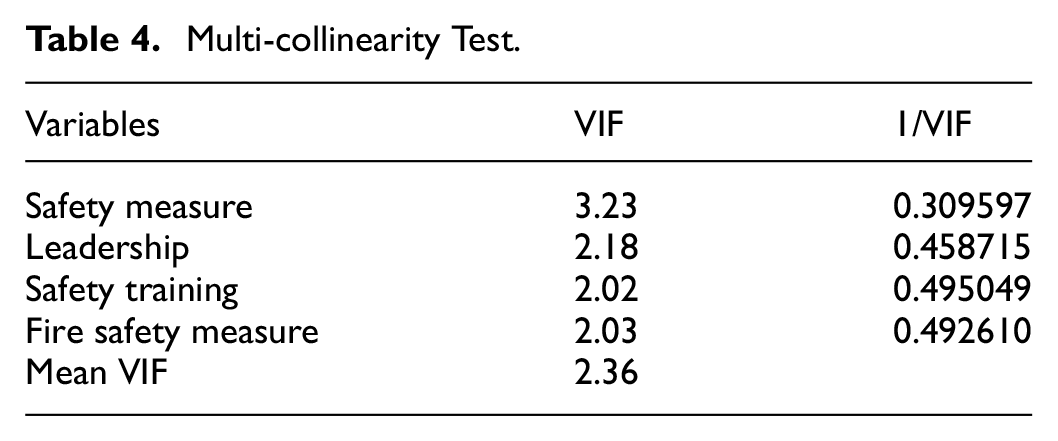
However, a thumb rule implies that correlations greater than 0.8 examine the VIF for all regression coefficients to officially evaluate whether or not the value of 0.8 violates the no-multicollinearity criteria (Gujarati, 2018). As mentioned in Table 4, Safety measures (3.23), leadership (2.18), Safety Training (2.02), and fire safety measures (2.03) were the VIFs observed for the variables. The average VIF of the variables was 2.36 in total. The observed VIFs were less than the collinearity criterion.
Multi-collinearity Test.
Discussion on Research Hypotheses
The present study investigates the research hypotheses related to the relationship between occupational health and safety management and employee turnover intention among employees in the mining industry in Pakistan.
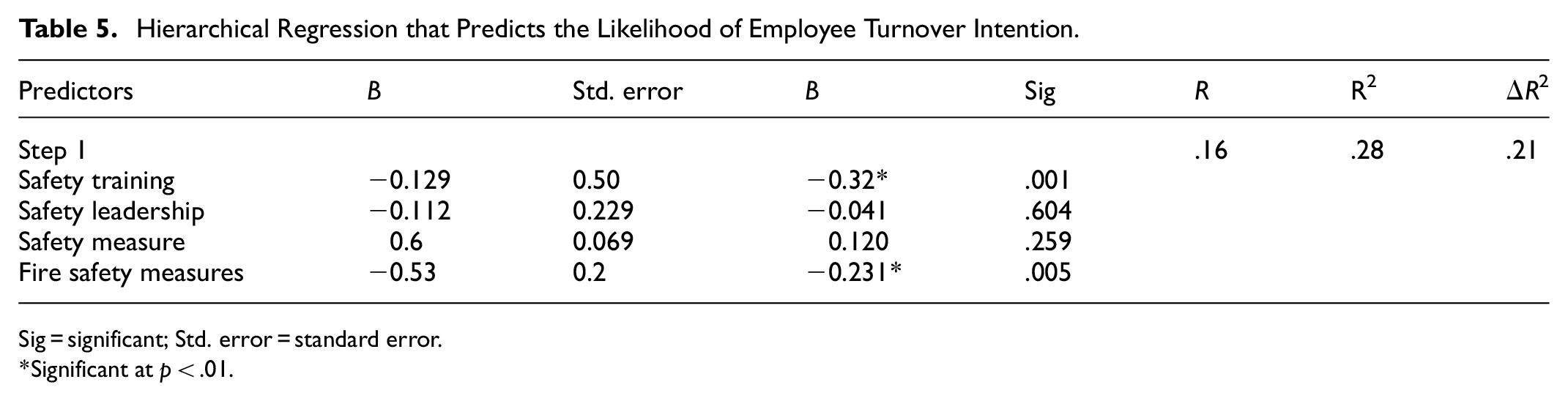
Hypothesis 1: Safety training role as a dimension of occupational health and safety management will strongly influence employee turnover intention. The hypothesis was assessed using hierarchical regression analysis and the Pearson product-moment correlation coefficient. It is proved in the correlation coefficient that safety training and employee turnover intention exist in a negative relationship (r = −.31, p < .01), as mentioned in Table 3. Furthermore, safety training could predict the results in Table 5 using hierarchical multiple regression analysis. In the mining industry, employee turnover intention was significantly expected by safety training (β = −.32, p < .01), as shown in Table 5. The findings of this study confirm hypothesis 1, which stated that safety training will have a robust predictive impact on employee turnover intention.
Hierarchical Regression that Predicts the Likelihood of Employee Turnover Intention.
Sig = significant; Std. error = standard error.
Significant at p < .01.
Hypothesis 2: The safety leadership dimension of occupational health and safety management is expected to predict employee turnover intention strongly. The second hypothesis shows that safety leadership and employee turnover intention are substantially inversely related according to the correlation coefficient (r = −.28, p < .1), as shown in Table 3. In the Hierarchical multiple regression, safety leadership (β = −.041, p > .05) was not a significant predictor of employee turnover intention in the mining sector, as mentioned in Table 5. Moreover, the results were unable to support the second hypothesis.
Hypothesis 3: This hypothesis developed the association between safety measures and employee turnover intention. The third hypothesis illustrated a significant negative relationship between safety measures and employee turnover intention (r = −.25, p < .01), as indicated in Table 3. Using hierarchical regression analysis (β = .120, p > .01), it was mentioned that safety measures significantly determine employee turnover intention in the mining industry. Thus, theory three was proven false.
Hypothesis 4: Employee turnover intention will be expressively predicted by the fire safety dimension of occupational health and safety management. The fourth hypothesis shows a negative correlation between fire safety and employee turnover intention (r = −.33, p < .01) in Table 3. Using Hierarchical multiple regression for predicting employee turnover intention (β = −.231, p < .01) revealed that fire safety measures significantly influenced employee turnover intention in Table 5. Consequently, the data support the hypothesis. According to the R2 value in Table 5, the independent variables contribute an additional 21% of the variance in employee turnover intention (dependent variable).
Results and Discussion
Hypothesis 1: According to the hierarchical regression analysis, safety training is statistically significant in predicting worker-employee turnover intention. As a result, higher safety training is associated with decreased employee turnover intentions, whereas lesser safety training is related to increased employee turnover intention in the mining industry. The findings highlighted the importance of coworkers and safety training in promoting safe behaviours (Amponsah-Tawiah et al., 2013). Employees may also derive social signals from these actions, which they could use in determining the expectations imposed on them. According to Ngqeza and Dhanpat (2021), the research raised safety training awareness within the company and promoted worker knowledge through better safety training. Jiskani, Silva et al. (2020) concluded that training worker detects risk and hazardous substances in their jobs. Safety training contributes to individual learning and training initiatives and helps managers better understand the position’s responsibilities. In comparing the relationship in the Spanish IT consulting sector between occupational health and safety and employee turnover intention, it concluded that organizational commitment and performance depend on the organization’s ability to keep the most highly skilled employees in the industry (Solangi et al., 2021). It is believed that safety training has the potential to develop and persist over the long term (Chao et al., 2015), and it also impacts the improvement of employee turnover intentions (S. H. Shah et al., 2018). According to Marimuthu et al. (2021), safety training influences an employee’s decision to stay more in an industry.
Hypothesis 2 indicates that safety leadership does not significantly predict employee turnover and intention to leave their jobs. According to this study, Pakistani workers give greater attention to equipment and safe work systems than leadership and do not recognize the need for safety monitoring at the workplace. Borley (1997) discovered that worker leadership predicts their willingness to take safety precautions and follow guidelines. Tomas et al. (1999) illustrated that leadership played an essential part in the hazard control process by conveying components of a safe atmosphere to workers in the workplace, based on three Spanish samples of high-risk firms. According to Eaves et al. (2016), safety leadership creates a positive influence to reduce employee turnover in the mining industry. This study’s findings contradict the previous study’s results.
Hypothesis 3: A negative correlation was formed between Safety measures and employee turnover intention. Evaluating safety measures is critical in the accident reduction of employee turnover intention or not. Although not identified a significant key of employee turnover intention. This result also complies with the research (DeJoy & Gregory, 1985) that stated that safety measures are insufficient to avoid accidents and assess a worker’s commitment to the company. The work (Cox & Flin, 1998) highlighted that having a presence of safety measures, even with no safety leaders, will not minimize workplace accidents. He additionally stated that skilled workers could control accidents without needing rules, supervisors, and guidelines. Furthermore, Cox and Flin stated that employees could stay safe by understanding the expense and risk of an accident or hazard.
Hypothesis 4: Analysis found a negative correlation between fire safety and employee turnover intention using the Pearson Product Correlation Coefficient. Adequate fire safety facilities may improve the employees’ perceptions of their decision to leave their existing position after considering the accidents or effects of likely events. Fire safety measures found some critical dimensions like first aid medical services, fire safety tools, fire safety awareness, fire safety supervisor, fire and smoke detection alarm system, fire evacuation plan, water storage tanker, fire drill, hazard control training, fire accident prevention training, worker skills training, emergency numbers and proper signage, risk management, and rapid evacuation system.
After the accident, the workers lose their courage and are eventually forced to leave the industry (Utembe et al., 2015). All employees require access to tools and equipment for fire safety, which is a critical component of adequate safety and health management. It safeguards employees from risks, improves their performance, and gives them a reason not to miss work (Utembe et al., 2015). Fire safety measures provide courage, prevent unhealthy consequences, boost industry reliability, and reduce workplace injuries, illnesses, and accidents (Fagan & Hodgson, 2017). The executed and well-designed system safety and health programmes contribute to developing an accident prevention plan and control of hazards. Well-designed safety and health programs are vital for accident prevention and hazard control, as workplace risks can lead to both immediate injuries and chronic conditions like hematological disorders (Ghori et al., 2017).
Limitations
One limitation of using a cross-sectional approach is its inability to evaluate the dynamic change in a given phenomenon across a specific period (Adu-Gyamfi et al., 2021). The mining industry was in uncertain conditions during the data collection. However, it is essential to note that this study design does not offer a narrative explanation for the behaviour demonstrated by the respondents. The researcher chose to collect quantitative data to examine causal relationships. Therefore, similar variables in mining sectors that are relatively stable can be explored in future research.
Recommendations for Future Studies
Based on the research on the relationship between occupational health and safety management and employee turnover intention, the following recommendations may help to reduce employee turnover intention in the mining industry of Pakistan. This study examines how the dimensions of the occupational health and safety management system affect employee turnover intention in Pakistan’s mining sector. This phenomenon could be ascribed to the mining sector’s fundamental features and cultural expectations. Consequently, it is advantageous to explore other strategies for evaluation. In contrast, the previously mentioned measure can be used for a more extensive sample size and various professional environments. A mixed-method methodology is one strategy to gather qualitative insights that could be utilized for narrative purposes. To enhance the generalizability of the findings, conducting the study across multiple mining organizations would be advantageous. A longitudinal study would be beneficial for assessing the evolution of this phenomenon over a particular period and gaining more knowledge of the variations in employee turnover intention.
Conclusion
The research examined the relationship between occupational health and safety management and employee turnover intention in the mining industry of Pakistan. The results revealed that safety training and fire safety measures positively correlate with employee turnover intention. Furthermore, increased accidents, injuries, and fatalities caused by inadequate facilities or equipment will increase employee turnover intention in the mining industry.
Occupational health and safety management also relates significantly to employee turnover intention due to the many direct and indirect costs. The subsequent effects create organizational efficiency when employees quit or leave their jobs. The understanding of employee turnover intention has the potential to facilitate targeted intervention strategies. From the government’s perspective, a financial budget is required to implement occupational health and safety in the mining sectors. Implementing effective occupational health and safety management has to be connected with dimensions such as adequate safety training, leadership, safety measures, and fire safety measures to become a fundamental part of the comprehensive occupational health and safety management with a practical objective of implementation and improvement of employee turnover intention with zero hazards.
Acknowledging that insufficient occupational health and safety measures have implications beyond the individual worker and the company is noteworthy. They also impact the well-being of friends, dependents, families, and the nation. From this research perspective, this study informs us that sufficient occupational health and safety helps the industry reduce employee turnover intention. This study contributes to the existing literature on occupational health and safety and employee turnover intention by providing empirical evidence from a specific context and industry. The study also has practical implications for managers and policymakers who want to improve the working conditions and retention of workers in the mining sector of Pakistan.
Footnotes

Funding
The author(s) received no financial support for the research, authorship, and/or publication of this article.
Declaration of Conflicting Interests
The author(s) declared no potential conflicts of interest with respect to the research, authorship, and/or publication of this article.
Data Availability Statement
Some or all data, models, or codes that support the findings of this study are available from the corresponding author upon request.