




Abstract
The construction sector, which supports the livelihood of over 50 million Chinese workers, is a key component of the growing economy. This study attempts to identify the factors of professional construction employees’ turnover intentions and offer actionable recommendations for enhancing talent retention in this pivotal sector. Respondents were practitioners of construction companies operating in different provinces, that is, Beijing, Tianjin, Hebei, Shaanxi, Guangxi, Fujian, Guangdong, and Zhejiang. SPSS 23.0 was used for data analysis to study correlations between the major variables. There was a clear positive link between intention to leave and work-family conflict (WFC) (r = .41, p < .01). Employees who had more conflict were more likely to leave their jobs. There is strong negative links between turnover intention and work-family enrichment (WFE) (r = –.38, p < .01) and perceived organizational support (POS) (r = –.47, p < .001). Regression analysis showed that WFC was a strong predictor of turnover intention (β = .32, p < .01), but POS (β = −.36, p < .001) and WFE (β = −.29, p < .01) were not. Also, POS linked WFC and WFE to turnover intention, and the interaction terms had a big effect on the model (ΔR2 = .06, p < .01); moreover, POS had a buffering effect. The study underscores the central role of creating supportive organizational cultures and improving work-life balance in curtailing turnover intentions and maintaining labor continuity in the construction industry. By implementing family-friendly policies, thereby promoting retention and guaranteeing long-run organization.
Keywords
Introduction
Turnover intention is the feeling of an employee to quit their current organization voluntarily. High turnover can have a great impact on an organization’s productivity, employee morale, operational expenses, and its long-term competitive edge (Doktorová et al., 2025). Because of the size and vibrancy of China’s construction sector, high turnover rates in the industry have economically and socially noteworthy consequences. Therefore, employee retention has become a growing concern for construction organizations in China. The aim of this study is to examine the key determinants of Chinese construction professionals’ turnover intentions.
In response to the ongoing challenges, the General Office of the State Council issued a directive in 2017 for supporting comprehensive reforms and rapid modernization and strategic transformation of the construction industry (General Office of the State Council of the People, 2017). All these initiatives are intended to support sustainable development and enhance overall project levels (Sajane et al., 2025). Significantly, the industry has reached record levels in terms of output and employment size. According to the 2018 China Yearly Statistics (Hai, 2025; National Bureau of Statistics of the People’s Republic of China, 2018), the construction industry achieved a total output of 23.51 trillion Yuan with a growth rate of 9.88% over the previous year. Total profits also climbed to 810.4 billion Yuan, an 8.17% year-on-year growth (see Figure 1).
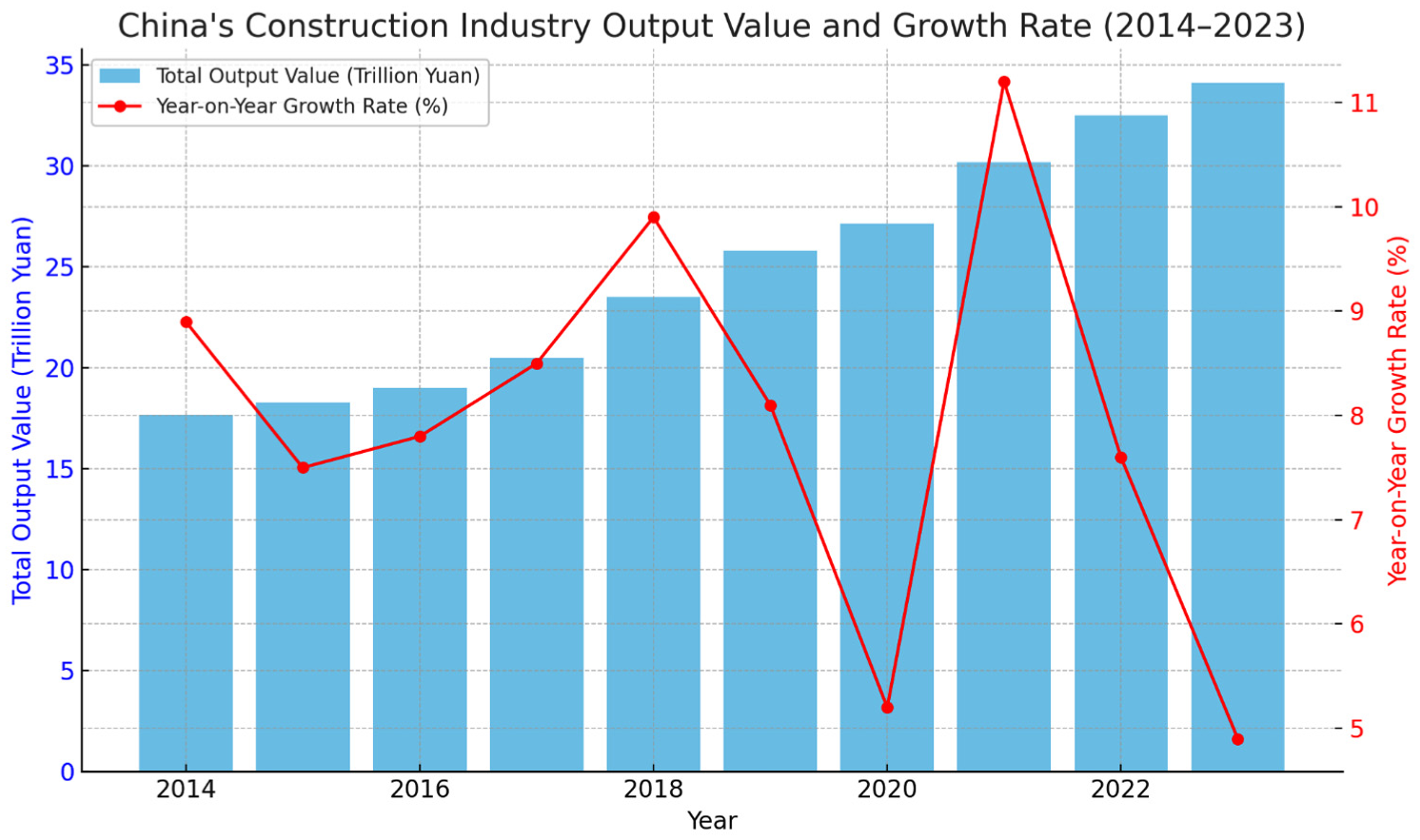
Total growth rate and value of China’s construction industry in 2009 to 2018.
At the end of 2018, the engineering construction industry in China had absorbed a talent pool of 55.633 million employees from the whole society, representing 7.17% of the employment figures. Notably, the industry was supported by an extensive network of around 95,400 associated companies. Within a decade, since 2009, the construction industry always contributed more than 6.5% to the GDP of the country. In 2018, it surged to a new high at 6.87% (refer to Figure 2), making the industry a strong and indispensable pillar of China’s national economy.

Construction proportion of GDP in the period 2012 to 2022 of the construction sector.
In China, the contracting and construction industry has evolved from capital and technology export to labor export in the classical sense, led by technical know-how, innovation, financial strength, and high-level human resources. Technical experts, engineers, and shop-floor managers occupy key positions in such companies, driving their advancement and successful completion of projects (Andres et al., 2012; Zheng & Wu, 2018).
But worker expectations have grown, that is, overtime, prolonged business travel, and electronic performance appraisal (Ojala & Pyöriä, 2017). The “24/7 connectivity” driven by technology has dissolved the divide between work and life. Social change, that is, the rise in dual-earner families, has made it even more critical to balance family life and work (Ji & Wu, 2018; Sumbal et al., 2025).
These reforms are also not easy, and cross-border studies may not prove effective in China’s unique cultural environment. The labor-intensive building trade has not received proper consideration to such an extent. Frontline workers of the Construction industry workday and night for managing their project and face heavy workload, mostly had talent management problem due to which turnover rates increased (Schlachter et al., 2017; Yang et al., 2025).
Besides that, construction workers are likely to be away from family members for an extended period since construction sites often shift locations frequently. This is complemented by varying conditions of societies like the two-child policy and aging society (U.S. Bureau of Labor Statistics, 2019). There has been limited evidence on Chinese construction industry work-family conflict and employee turnover intention.
The value of this research is that work-family conflict and enrichment are examined comprehensively, and the role played by perceived organizational support is realized. Since China has a huge number of professional workers working on site, more effective management practices need to be integrated to match competitiveness. It aims to assist Chinese construction companies by reducing employees’ conflict, recognizing work-family enrichment, and promoting mutual development between organizations and employees.
While there is a vast literature on work-family conflict and turnover intentions (e.g., Katja Mihelič, 2014; Russo & Buonocore, 2012; Zhang et al., 2016), most previous studies have covered only healthcare, education, and corporate sectors in Western cultures. In contrast, the Chinese construction sector with its distinct socio-cultural setting, project labor, and spatial labor mobility is comparatively less studied in relation to turnover mechanisms. Such prior studies are generally focused on individual or job-specific variables but fail to address more prevalent relational dynamics such as organizational support systems that can potentially mediate or moderate turnover intentions (Lyu & Li, 2024).
Second, newer trends provide new strategies like “Corporate AI Living Labs” to enhance organizational support, well-being, and commitment in organizations (Sani et al., 2024). Nevertheless, such methodical, technical, or structural efforts at enhancing organizational support are hardly explored in construction settings. Therefore, the research question becomes if and how support structures like perceived organizational support defend against the deleterious effects of work-family conflict and facilitate work-family enrichment in traditional, labor-intensive industries.
Through filling these gaps, this study not only explores the direct impact of work-family conflict and enrichment on turnover intention but also explores the moderating role of perceived organizational support and thus makes a novel contribution to the nascent body of literature on employee retention in China’s construction sector. Based on the above, we formulate the following research questions:
i. What is the impact of work-family conflict on an “employee’s turnover intention”?
ii. How does work-family enrichment affect an “employee’s turnover intention” to leave work?
iii. How is the presence of “perceived organizational support” connected with an “employee’s turnover intention”?
iv. To what extent does perceive organizational support mediate the connection between “work-family conflict,”“work-family enrichment,” and “employee’s turnover intention” for work?
Hypotheses Development
Work-Family Conflict and Turnover Intention
“Work-family conflict” is one main predictor of individual turnover (Ptoya et al., 2025), quantitatively manifested by Asghar et al. (2018), showing a positive correlation between work-family conflict among doctors and job resignation intentions. Raymo and Sweeney (2006), using a 10-year longitudinal study, followed individuals aged 52 to 54 and found a strong association between work-family conflict and early retirement decision by half refund or full refund.
Similarly, Kubicek et al. (2010), in a study of a Wisconsin longitudinal study, identified dual work-family conflict as the ideal predictor of early retirement. That was, however, contradicted by Li et al. (2022), who depicted that work problems were a more ideal predictor of turnover intention compared to family issues, and employees were bound to give notice of resignation whenever work encroached on their family work.
In the construction sector, employees involved in overseas-based projects experienced higher work-family conflicts aligned with stronger turnover intentions (Conte, 2024). Moreover, Yan and Liu (2016); Andres et al. (2012) and Yan (2017) observed the increasing trend of Chinese construction contracting firms engaged in overseas-based construction projects that resulted in a behemoth influx of multinational construction workers. Time away from home necessitated by project organization impermanence and engineering project complexity contributes power to turnover intention in this industry.
Hypothesis H1a and hypothesis H1b are therefore formed:
Work-Family Enrichment and Turnover Intention Relationship
Work-family boundaries and turnover are both direct and moderate in effect (Kamboj & Anthonysamy, 2025). Russo and Buonocore (2012) established that nurses who had a high degree of work-family enrichment tended to have lower intentions for turning over, and their top reason was that they had higher commitment towards their own profession. Katja Mihelič (2014) study of Central and Eastern European (CEE) transition economies found that work-to-family enrichment decreased job turnover intentions of employees. The opposite, where family was enriched by work, did not have the same impact (Kurowska et al., 2025).
For Chinese context, studies were carried out among employees of the IT sector in Shenzhen and found strong correlation: high family-work enrichment correlated with low turnover intentions of programmers (Ekmekcioglu et al., 2025). Zhang et al. (2016) also highlighted the effectiveness of enhancing family-work enrichment in China through the utilization primarily of the implementation of firm policies like flexible working hours, in predicting and attenuating turnover intentions of employees. It is important to mention that only a limited number of research studies have focused on work-family enrichment, especially the construction industry in China, although there are real benefits construction workers gain from the interpenetration of work and family life.
Against this background, hypothesis H2a and hypothesis H2b are formed:
Perceived Organizational Support and Turnover Intention
Employees perceived Organizational support, and turnover intent is positively correlated (Vuong et al., 2025). Eisenberger et al. conducted several studies with different groups of employees. They asked questions about 1,249 salespeople in 1986 and 422 manufacturing employees and 109 managers in 1992. They asked questions from 439 employees working in retail in 2002. In all these studies, the outcome always validated that perceived organizational support was a healthy preventive variable for employee turnover intent.
Meng (2010) conducted empirical research against the background of industry restructuring, and it was established that perceived organizational support negatively correlated with turnover intentions. Esop and Timms (2019) also determined that the absence of perceived organizational support was a predictor of higher turnover intentions among academic talent. Akgunduz and Sanli (2017) conducted research among Turkish hotel employees, and it was noted that perceived organizational support would arrest the intent to leave.
Madden et al. (2015) and Chiu et al. (2015) studies supported the direct, passive effect of perceived organizational support on turnover intention. The studies also suggested an indirect effect as perceived organizational support may affect turnover intention through affecting its positive relationships with job satisfaction and organizational commitment (Vuong et al., 2025).
The following hypothesis is therefore suggested:
Perceived Organizational Support Mediate the Relationship Between Work-Family Conflict, Work-Family Enrichment, and Turnover Intention
Perceived organizational support has moderation mediation function among work-family, family-work, and turnover intention according to Kamboj and Anthonysamy (2025). Fewer studies in the past considered the moderating function of perceived organizational support on the correlation between work-family conflict, work-family enrichment, and turnover intention. Zeng (2018) had a Chinese scenario involving family-work conflict’s interaction with employee turnover intention. Perceived organizational support became a relevant factor in influencing this link in this study. In a similar vein, Syed et al. (2018) also researched work-family conflict and turnover intention among female doctors and discovered that perceived organizational support was an intermediary in this case.
Li (2017) conducted a study on work stress, work-family conflict, and turnover intention for university employees. Perceived organizational support was emphasized to be the primary factor in moderation and reduction in turnover intentions of employees in this study. Haar (2004) established the significance of perceived organizational support towards work-family in alleviating work-family conflict and turnover intention among New Zealand government employees.
Besides, Yunita and Kismono (2014), in their research of turnover intention of Bali hotel maids, found organizational support could reduce the detrimental effect of work-family conflict. Hosain (2025) research provided us with information concerning the work-family conflict of dual-career parents with children afflicted with any illness, highlighting the most significant role of support from employers to avoid conflict between work and life.
Tang (2018) demonstrated that intervening variables of perceived organizational support predicted organizational behavior outcomes, for instance, job satisfaction and turnover intention. Perceived organizational support has affected these outcomes through intermediary variables such as work-family conflict and enrichment. Martinez et al. (2018) conducted a survey of 30 Spanish firms that had embraced family support policies and demonstrated that work-family policies acted as mediators of the effect of work-family enrichment on employees’ job satisfaction and organizational commitment.
Besides, Qiu (2010) also found that support from supervisors may play a mediating role between employee intention to turnover and work interference with family, particularly for front-line workers of Chinese manufacturing firms. To understand the importance of recognizing the work of construction professionals and safeguarding the health of construction workers of project engineering firms, this study suggests the following hypothesis:
Conceptual Framework
According to the literature review and research content, this study puts forward the following research model in Figure 3.

Conceptual framework.
This model considers work-family conflict, work-family enrichment, and perceived organizational support influence turnover intention. Perceived organizational support serves as a moderator among work-family conflict, work-family enrichment, and turnover intention.
Methodology
The target population for this study was professionals working in various roles within China’s construction sector, including architects, on-site personnel, building inspectors, project managers, and workers at various organizational levels. According to Hair et al. (2009), a sample size of over 200 respondents is often adequate to carry out parameter estimate analysis and establish the statistical power of a study. Similarly, Hair et al. (2007) suggest that for SEM, a minimum of 200 cases is required. In the current research, a 44-item questionnaire was formulated from literature and the conceptual model. Following the commonly accepted rule of thumb five times the number of indicators: a minimum of 200 participants was deemed satisfactory. The questionnaire, which was designed according to a 5-point Likert scale, included a brief description of the aim of the study, a guarantee of voluntary participation, and a guarantee of respondent anonymity and data confidentiality.
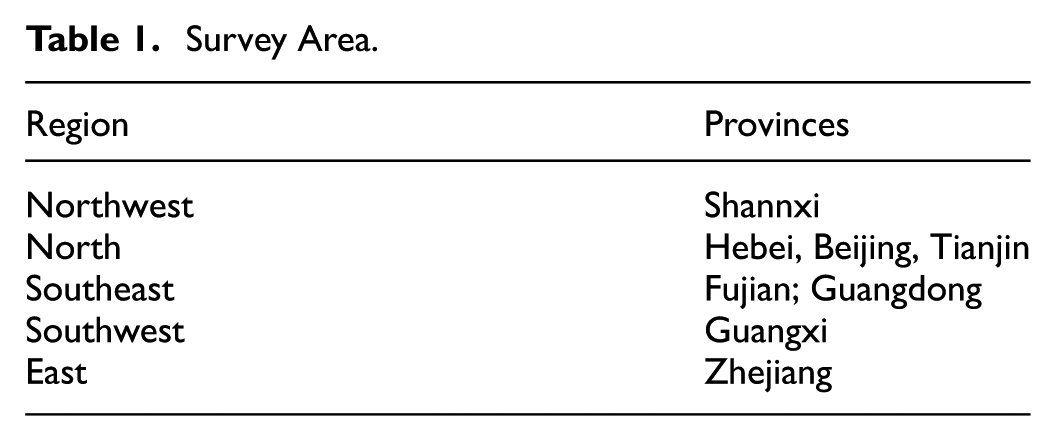
The questionnaire was delivered using a combined method of direct hand delivery, email, and web-based online survey tool. As indicated in Table 1, responses were collected from various regions of China, that is, the northern, northwestern, southwestern, southeastern, and eastern parts of China, to have representation from provinces that differ in their state of economic development. Further, CPMs from private construction firms and state-owned enterprises were selected in the sample, thereby giving a broader organizational perspective in the industry.
Survey Area.
Highlighting the significance of the research topic, the top managements and the Human Resource Management (HRM) units of different construction companies volunteered actively in dispersing and collecting the questionnaires of the survey. A total of 300 questionnaires were dispersed, of which 248 valid replies were obtained, thereby achieving an impressive response rate of 82.66%.
Measurement Instruments
All the constructs of this study were measured with multi-item scales on a 5-point Likert scale, on which 1 was marked as “strongly disagree” and 5 as “strongly agree”. Please refer appendix A.
Turnover Intention
Direct measurement of employee turnover intention is using the Mobley et al. (1978) scale by measuring the subjective feeling of the employees towards the company, perception of outside work opportunities, turnover intention, and change in job-hunting behavior. Thus, the turnover intention survey for this research is largely based on Mobley’s scale with 4 test items.
Work-Family Conflict
Measurement tools for work-family conflict have been relatively mature. Carlson and Perrewé (1999) constructed the scale of work-family conflict has been widely worried and used by researchers in studies. This study uses a questionnaire modified by Liu and Low (2011) to investigate family conflicts among Chinese project managers based on the Carlson questionnaire.
Work-Family Enrichment
It was well known and used by most researchers that (Greenhaus et al., 2006) constructed a work-family enrichment questionnaire. It consisted of 14 items that were distributed across 2 dimensions, and its internal consistency coefficient was 0.78 and 0.73 respectively.
Perceived Organizational Support
Eisenberger et al. (1986) described the development of a measure instrument-perceived organizational support survey on 36 items, which they scored on a 5-point Likert scale. Convenience prompted some authors to invent a handful of items to gauge the feeling of employee support. Eisenberger et al. (1997) took the highest load of 8 from the original scale. The composition scale’s reliability coefficient was 0.90.
Analysis and Results
Descriptive Statistics
Following the posting of an online survey, we received responses from 300 people. Following the removal of incomplete or irrelevant questionnaires to the industry, there were 248 valid responses, resulting in a valid questionnaire response rate of 82.66%. Descriptive statistics comprise activities focused on describing data characteristics via tabulation, classification, and graphical displays. In this section, we present demographic information of the respondents to our questionnaire study.
Based on our survey design, seven control variables are used in the study: gender, age, marital status, education level, organizational experience, monthly income, and number of children living at home. The variables permit a complete description of the sample’s structure. Among the participants, 69.4% were male and 30.6% were female. The gender distribution is very wide but corresponds to the predominantly male nature of the building construction industry.
As far as age structure is concerned, 28.2% were below 25 years, 29.9% were in the 26 to 30 group, 15.3% in the 31 to 35 group, 15.6% in the 36 to 40 group, and the remaining 11% were above 40 years. Many respondents were below 40 years of age, which is typical of the youthfulness of the industry.
By marital status, 43.2% were not married, 54.8% were married, and 2% were divorced. These percentages coincide with the age distribution of the respondents. Education level was predominantly at college and undergraduate levels, with a relatively balanced distribution across those below junior high school and high school (13.3%), and master’s degree and above (13.6%). This trend reflects standard educational qualifications demanded of construction industry employers.
In terms of organizational tenure, 21.6% had 1 year or less, 32.6% had 1 to 3 years, 16.6% had 4 to 6 years, 15.9% had 7 to 9 years, and 13.3% had 10 years or more. Monthly income was distributed with 13.3% earning less than RMB 3,000 and 7.3% earning more than RMB 10,000. The majority fell in the income band RMB 3,001 to RMB 5,000 (31.9%), RMB 5,001 to RMB 8,000 (27.6%), and RMB 8,001 to RMB 10,000 (19.9%).
For the number of children present at home, 33.9% of the participants had no children, 38.5% had one child, 22.6% had two children, and just 5% had three or more children.
Reliability Analysis
Cronbach’s alpha values for work-family conflict, work-family enrichment, and perceived organizational support, all of which are three of the scales under question, are all greater than the acceptable value of .7. This presents acceptable reliability within the survey. Cronbach’s Alpha value for turnover intention, however, is .662, showing less reliability for this part of the study.
Upon re-checking of the “Cronbach’s Alpha if Item Deleted” coefficient, it was found that the removal of item “TI4. I plan to stay in this company for long” significantly enhanced Cronbach’s Alpha coefficient for turnover intention. Due to this, the researchers removed the item. Upon removal, Cronbach’s Alpha coefficient for turnover intention was enhanced to .812, which crossed the “good” reliability criterion. All the variables in the study all have Cronbach’s Alpha values greater than .7, attesting to their reliability and high internal consistency, as demonstrated in Table 2.
Summary of Reliability Analysis.

Normality Analysis
This is necessary for the data normality check before the use of some multivariate data analysis methods, including regression analysis and structural equation modeling (SEM). According to (George & Mallery, 2010), to discover the normality of the data distribution, the skewness should range from −1 to +1, and the kurtosis value should range from −2 to +2. George and Mallery (2010) determined normality of data distribution by the assumption that the value of skewness should fall within the range −1 to +1 and that the value of kurtosis should fall within the range −2 to +2. It can be observed from Table 3 that all values of skewness and kurtosis of the variable are within the range −1 and +1.
Descriptive Statistics.

Correlation Analysis
The research aims to examine the nature and extent of the inter-relationships among five significant variables: turnover intention, work-family conflict, family-work conflict, work-family enrichment, family-work enrichment and perceived organizational support. Correlation coefficient (r) is employed with a range from +1.00 (perfect positive linear relationship) to −1.00 (perfect negative linear relationship) (Hair et al., 2010). A coefficient of +1.00 would show the strongest positive relationship and −1.00 for strongest negative relationship. A zero coefficient would show that there is no relationship between the variables.
Also, the size of a correlation can be described as follows: .20 to .40 signifies a weak relationship, .40 to .60 signifies a medium relationship, and .60 and greater signifies a strong relationship (Midi et al., 2010). In the case of a coefficient being higher than 0.9, then evidence of collinearity in the variables may exist and should be considered for their removal from the study. Correlation analysis, which was done using SPSS 23, is the initial test to establish the correlation between variables and is presented in Table 4.
Summary of Pearson Correlation Coefficient.

Note. TI = turnover intention; WFC = work-family conflict; FWC = family-work conflict; WFE = work-family enrichment; FWE = family-work enrichment; POS = perceived organizational support.
Correlation is significant at the .01 level (two-tailed).
The analysis depicted in Table 4 shows several significant correlations. Turnover intention has a very high positive correlation with family-work conflict (r = .347**, p < .01) and work-family conflict (r = .403**, p < .01). Turnover intention, however, is highly negatively correlated with family-work enrichment (r = −.810**, p < .01) and work-family enrichment (r = −.687**, p < .01). There is also a highly significant negative correlation between turnover intention and perceived organizational support (r = −.771**, p < .01).
Regression Analysis
Multiple regression analysis is a natural extension or adaptation of the simple linear regression analysis technique. It allows for the joint examination of how two or more independent variables influence a single interval-scale dependent variable (Zikmund, 2003). In the context of this research, it assists in testing whether there exists a relationship between turnover intentions, various dimensions of work-family conflict, and work-family enrichment. To examine the moderating effect, moderated multiple regression is applied. Essentially, a moderator analysis consists of a multiple regression equation with an interaction variable (Aguinis, 2004).
Multiple Regression Analysis
The role of the regression analysis is to identify the mathematical formula to describe the relationship between variables best and test the causal relationship between variables. Thus, the following steps of the regression analysis are conducted (see Table 5).
Multiple Regression Test Summaries.

As indicated in Table 6, the adjusted R2 stands at .180, implying that 18% of the variation in TI can be attributed to WFC and FWC. Additionally, with a VIF of 1.540 (below the threshold of 5), it can be affirmed that there is no multicollinearity among the independent variables. Furthermore, the F-statistics have a value of 32.747. This signifies that the influence of both WFC and FWC on ATB is statistically significant (B = 0.170 and B = 0.317, p < .05). Consequently, this study validates H1a and H1b. The regression equation is expressed as follows: TI = 0.167WFC + 0.304FWC + 1.355.
First Multiple Regression.

Note. Adjust R2 = .180, F = 32.747, p = .000.
Table 7 reveals that the adjusted R2 value stands at .692, implying that WFE and FWE collectively account for 69.2% of the variation in TI. Furthermore, the VIF values are all below 5, signifying the absence of multicollinearity among the variables. Additionally, the F-statistics have a value of 333.988. This underscores the significant impact of both WFE and FWE on TI (B = −0.341 and B = −0.947, p < .05). Consequently, this study lends support to both H2a and H2b. The regression equation is articulated as follows: TI = −0.637WFC − 0.255FWC + 7.583.
Second Multiple Regression.

Note. Adjust R2 = .692, F = 333.988, p = .000.
Simple Regression Analysis
The simple regression analysis is to test Hypothesis 3 and test the impact of POS on TI.
Table 8 shows that POS significantly affects TI because the p value is .000 at a significant level. POS is significant in the regression model. The adjusted R2 value is .594, proving that POS can explain 59.4% of TI. The regression coefficient of POS on turnover intention is −0.771 (p < .05), which reaches the significance level; hence, hypothesis H3 can be verified. The regression equation is TI = −0.771 * POS + 6.887.
Impact of POS on TI.
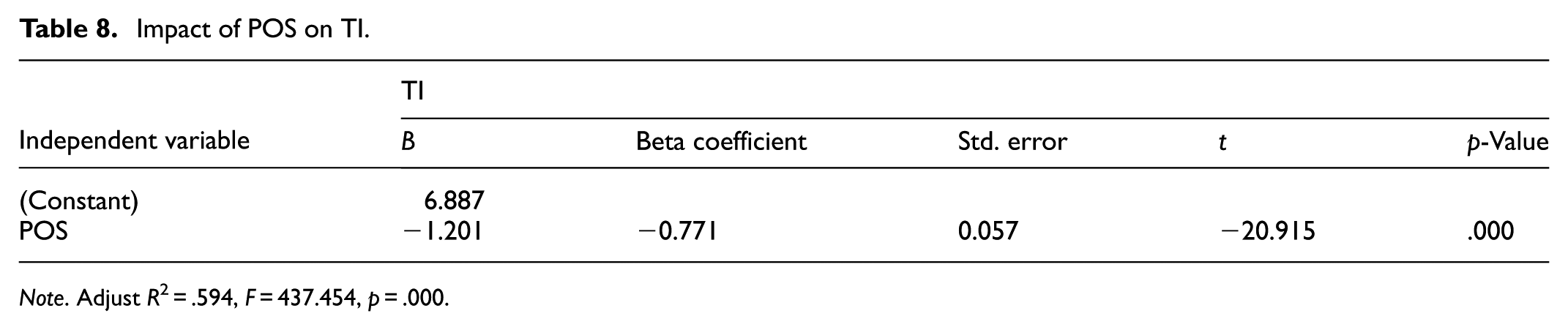
Note. Adjust R2 = .594, F = 437.454, p = .000.
Moderation Effect
In the analysis of the last section, it is known that work-family conflict and work-family enrichment can predict turnover Intention to a certain extent. We need to verify whether perceived organizational support moderating affects this relationship.
The steps for moderate regression analysis proposed by Aguinis (2004) are:
(1) Centralize variables, which is to subtract its mean so that the mean of the newly obtained data is 0. This is to reduce the multicollinearity problem between variables in the regression equation.
(2) Construct interactive items. Multiply the centralized independent variable and centralize the moderating variable.
(3) Create a model by incorporating both independent and dependent variables, along with their centered values, into the regression equation. This allows us to calculate the R12 square and R22 square coefficients. If R22 surpasses R12, and the significance level (Sig.) of the centered variables is below .05, it indicates the presence of a moderating variable and a moderating effect.
The moderating influence of POS on WFC and TI is detailed in Table 9. Upon introducing the interaction term (POS × WFC) in the second model, the projected constant range is: 0.635 to 0.643. Consequently, “R22” exceeds “R12” by 0.012, and (Sig.) of POS × FWE reduced from standard value of .05, affirming that POS indeed exerts a noteworthy moderating effect on WFC and TI. As such, this study supports hypothesis H4a. The regression equation is expressed as TI=− 1.141 POS + 0.243 WFC − 0.150 * POS × WFC +5.855.
Effect of POS on the Relationship Between WFC and TI.
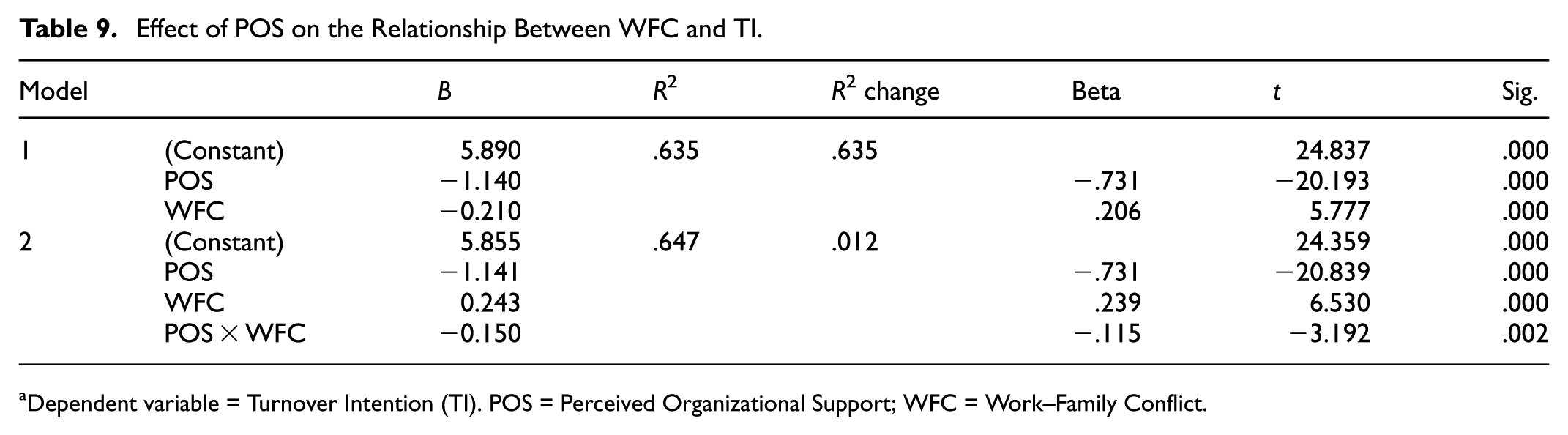
Dependent variable = Turnover Intention (TI). POS = Perceived Organizational Support; WFC = Work–Family Conflict.
Table 10 shows the moderation of POS on FWC and TI. Upon introducing the interaction term (POS×FWC) in the second model, coefficient estimation ranges from 0.640 to 0.649. Consequently, “R22” surpassed “R12” with the value of .009 at the significance level of POS×FWE fell below the threshold of 0.05, affirming that POS indeed exerts a noteworthy moderating effect on FWC and TI. Consequently, this study supports hypothesis H4b. The regression equation is expressed as TI=−1.124POS+0.253WFC−0.130*POS×WFC+5.858 (Table 11).
Effect of POS on the Relationship Between FWC and TI.

Dependent variable = Turnover Intention (TI). POS = Perceived Organizational Support; FWC = Family–Work Conflict.
Effect of POS on the Relationship Between WFE and TI.

Dependent = Turnover Intention (TI). POS = Perceived Organizational Support; WFE = Work–Family Enrichment.
Table 12 illustrates the moderating role of POS on WFE and TI. The inclusion of the interaction term (POS×WFE) in the second model led to a change in the estimated coefficient from 0.731 to 0.78. R22 exceeded R12 by 0.007, and the significance value of POS×FWE was .007 (p<.05). This suggests that POS significantly moderates the relationship between WFE and TI. Consequently, hypothesis H4c is supported in this study. The regression equation is presented as TI = −0.593POS−0.818FWE−0.163*POS×FWE+7.922.
Effect of POS on the Relationship Between FWE and TI.
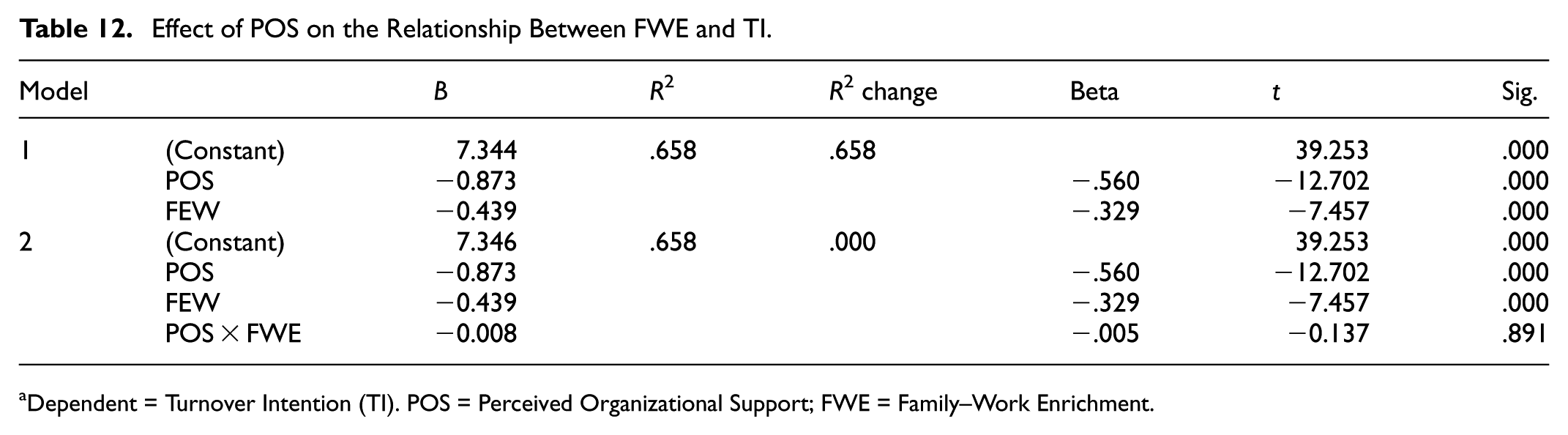
Dependent = Turnover Intention (TI). POS = Perceived Organizational Support; FWE = Family–Work Enrichment.
Table 12 displays the moderating impact of POS on WFE and TI. When the interaction term (POS×WFE) was introduced in the second model, the estimated coefficient changed from 0.731 to 0.780. Consequently, R22 surpassed R12 by 0.007, and the significance level (Sig.) of POS×FWE was .007 (p<.05). This indicates that POS plays a substantial moderating role in the relationship between WFE and TI. Thus, hypothesis H4c is supported by this study, with the regression equation as TI=−0.593POS−0.818FWE−0.163*POS×FWE+7.922 (Table 13).
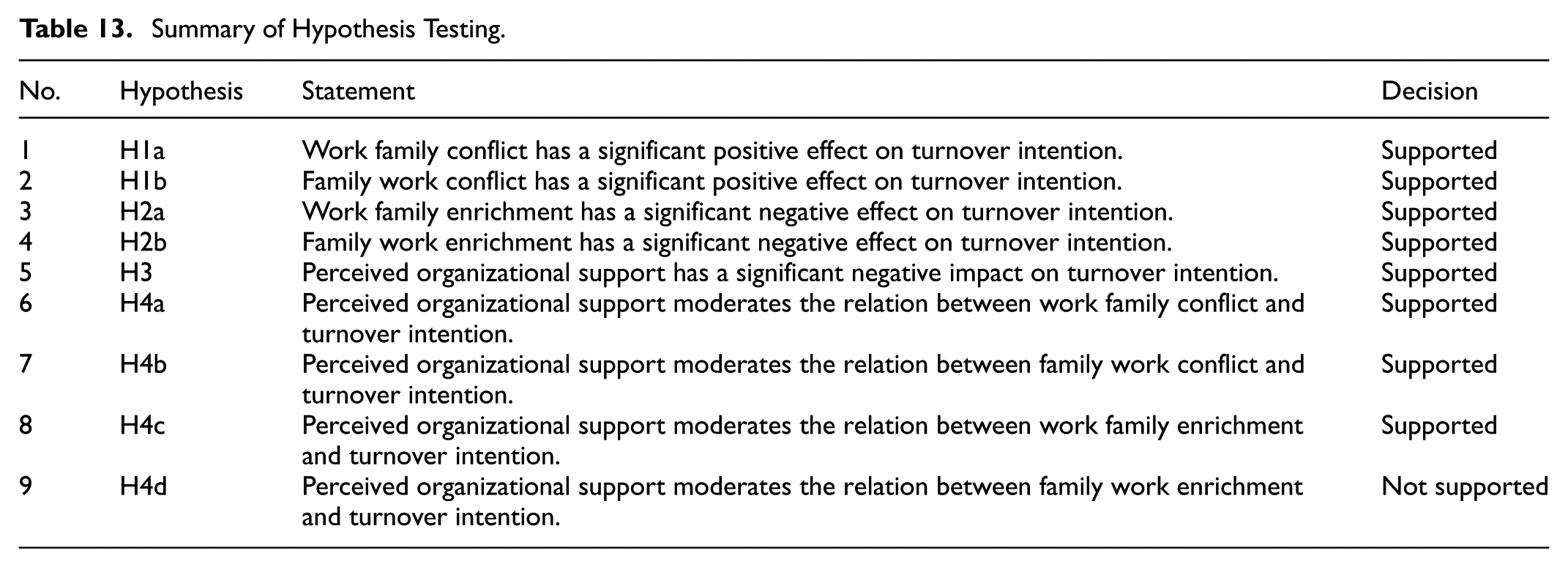
Summary of Hypothesis Testing.
Discussion
The present study rigorously examined the interaction between perceived organizational support (POS), work-family conflict (WFC), work-family enrichment (WFE), and turnover intention (TI) in China’s construction industry, a notoriously hard work environment with extended-upright talent retention problems. The findings showed a strong positive relationship between WFC and turnover intention, verified by correlation and regression analyses. Surprisingly, both conflict directions, that is, work-to-family and family-to-work reached almost similar effects on the intentions of employees to leave their firms. This contradicts the common hypothesis that work-to-family conflict is more significantly influencing and instead confirms the argument raised by Long et al. (2016), stating that excessive rates of interference across work and family life regardless of direction can critically destroy employee retention.
However, theoretical debate is not a consensus on the comparative efficacy of these two avenues of conflict. For instance, Katja Mihelič (2014) postulated that work-to-family conflict has a more significant impact on turnover intention, as employees are more likely to consider resigning when professional responsibilities frequently spill over into their family life. This study adds depth to this debate by showing that the cross-over effect wherein work intrudes on family can be equally destructive, especially in high-stress work settings like construction where boundaries between roles are already fragile.
On the positive side, the findings yield compelling empirical support for the protective role of work-family enrichment in moderating turnover intention. Construction professionals who reported higher levels of enrichment in which activities within one area spill into the other in a positive manner reported significantly lower job leave intentions. This is consistent with Russo and Buonocore (2012) research, wherein they explained how individuals who are exposed to dual-domain enrichment are bound to develop stronger organizational commitment and resilience. Katja Mihelič (2014) and Zhang et al. (2016) also emphasized that WFE is a psychological resource, more particularly important in industries where the job involves long working hours, manual labor, and work pressures. The causal mechanism behind this effect is generally thought to stem from increased personal gratification, skill acquisition, expanded professional networks, and sense of upward mobility factors all serving to enhance employees’ organizational attachment and affective commitment. Moreover, emotional and instrumental support from family members also reinforces this retention effect by safeguarding the psychospiritual cost of demanding work.
Above all else, perceived organizational support appeared as both direct and moderate within this model relationship. POS not only suppressed turnover intention directly but also undermined the adverse effect of WFC and increased the beneficial effect of WFE. This finding affirms the value of POS as a strategic human capital continuity tool. But the research also poses a critical caveat: once support by the organization is institutionalized, a part of routine, or perceived as obligatory rather than discretionary, its symbolic potency may be eroded. Employees may begin to see such support as an entitlement plateau, rather than a significant organizational action, thereby cooling their collective motivation to remain with the employer. This means that the success of support systems is less a function of whether they exist, and more a function of how they are perceived—that is, whether they are seen as authentic, personal, and responsive to evolving employee needs.
In general, this study contributes to the fine-tuning of the psychosocial factors of turnover intention in high-pressure sectors. It also further refines current theory by demonstrating that conflict and enrichment processes have symmetrical yet converse impacts, and organizational support effectiveness is contingent on its legitimacy. To companies that wish to hold on to top talent, these findings suggest the need to institutionalize not only flexible work arrangements and family-friendly initiatives but also a culture of real support that persists over the long term.
Theoretical and Practical Contributions
Theoretical Contributions
The current research makes its contribution to the work-family interface literature by highlighting the moderating role of perceived organizational support (POS) in lessening turnover intentions among construction professionals—a subject which has been rather overlooked in previous studies. It builds on existing research by showing how work-family conflict and enrichment affect turnover intentions in varying ways, and with new insights into relational and systemic forces in China’s construction sector. Furthermore, by integrating the newest knowledge on workplace relational systems (Lyu & Li, 2024) and programmatic employee engagement programs (Sani et al., 2024), this research positions POS as an active organizational asset with conflict buffering and enrichment amplification functions, supplementing the know-how of mechanisms for employee retention.
Practical Contributions
Practically, the findings offer concrete strategies for construction companies interested in improving talent retention. Along with systematic HR practices, the study underscores the need for building informal, relational support networks that address workers’ work-family needs. Building companies are called upon to transcend strict frameworks through flexible, employee-focused cultures and exploring new strategies such as AI-based HR assistance, akin to Corporate AI Living Labs (Sani et al., 2024). By systematically enhancing perceived support, organizations can reduce turnover intentions, improve job satisfaction, and promote sustainable operational excellence.
Practical Implications
The study’s findings offer several practical implications for employee turnover management in China’s construction industry. Organizations need to prioritize making the creation of a work culture that acknowledges and accommodates employees’ family obligations as well as professional responsibilities a priority. Facilitating a healthy work-family balance through formal policy and informal culture is essential to mitigating work-family conflict and enhancing employee satisfaction. The role of sensitive leadership, communication, and work relationships supportive of the family cannot be overstated in bringing about a family-supportive organizational climate.
In industries involving project-based work and frequent geographical mobility, such as construction, perceived organizational support is a deciding strategic factor. Organizations that most effectively foster this perception are likely to have higher employee morale, less turnover intentions, and greater productivity, thereby solidifying their competitive advantage in a difficult industry context.
Future Research Directions
Although the current study contributes substantially, it also points to a range of future research directions. Longitudinal studies are particularly to be wished for in order to capture dynamic changes in work-family conflict, enrichment, and perceived organizational support over time and to generate more convincing evidence of causality. Comparative studies between industries, most notably between traditional industries like construction and technologically intensive industries like information technology, would also enlighten us about how organizational support mechanisms function under varying contexts.
Moreover, future research can explore the impact of future digital technologies, for example, AI-driven human resource management systems and virtual relational platforms, on organizational support perceptions and turnover intentions of employees. Drawing on the recent advancements in the managerial psychology field (Lyu & Li, 2024), future research can also explore the mediating or moderating role of mindfulness-based interventions and sophisticated relational systems in the work-family-turnover model. Finally, subsequent research might move beyond examining turnover intention in isolation and investigate actual turnover behavior, which would have more robust implications for theory and practice.
Limitations
While this study makes valuable contributions, several limitations need to be taken into consideration. First, reliance on self-reported data may introduce biases such as social desirability or response errors even with promises of confidentiality and anonymity. Participants’ subjective perceptions might not reflect their actual experience or behavior, potentially undermining the validity of the findings.
Second, although the sample was drawn from different Chinese provinces, the relatively small size of the sample limits the external validity of results to the overall population of construction professionals. Large and representative samples in future studies would enhance external validity of results.
Third, the organizational support was assessed on a one-dimensional scale, and it may not be optimal to capture the multidimensional construct of organizational support with its instrumental and developmental dimensions. Incorporating multi-dimensional organizational support measures in future research may allow for a better understanding of its impact on employee outcomes.
Lastly, the cross-sectional design constrains the ability to make causal inferences among variables. Constructs such as work-family conflict, work-family enrichment, and turnover intention may vary with time or be influenced by outside sources. Longitudinal and experimental designs are therefore recommended for future research to better capture the dynamic and changing nature of such constructs.
Conclusion
This research presents an extensive analysis of the determinants of employee turnover intention in the construction industry of China, pointing out its exclusive labor issues and proposing evidence-based practices for employee retention improvement and sustainable industry growth. Specifically, the research indicates that work-family conflict raises turnover intention significantly, while work-family enrichment and perceived organizational support lower it. Also, perceived organizational support plays a moderating role by softening the negative effects of conflict while supporting the positive effects of enrichment. These results emphasize the deep meaning of encouraging both organizational support mechanisms as well as employee perceptions of being supported to effectively minimize turnover intentions. Resolving these issues is important not only to build a stable and effective workforce but also to sustain the construction sector’s crucial contributions to gross economic expansion.
Footnotes
Appendix A
Acknowledgements
This research is supported by the Universiti Tunku Abdul Rahman, Malaysia.

Ethical Considerations
This study was approved by the Ethical Review Committee wherein all participants provided informed consent prior to participation. The study doesn’t risk, and all ethical standards outlined by UTAR’s Code of Practice for Research Involving Humans were followed.
Consent to Participate
All participants provided informed consent prior to participation.
Author Contributions
M.K.: Highlighted the problem statement, set the hypotheses, and executed the research process. H.N.A.Y.: Served as the main supervisor, overseeing the entire project and providing key guidance throughout the research and writing process. F.B.S.: Performed the data analysis using SPSS. S.A.K.: Conceived the entire project idea. H.A.M.: Assisted in correcting the manuscript. All five authors contributed to data collection and analysis. In the end, all authors reviewed, read, and approved of the final manuscript.
Funding
The authors disclosed receipt of the following financial support for the research, authorship, and/or publication of this article: This research project is financially supported by the Universiti Tunku Abdul Rahman, Kampar, 31900, Perak, Malaysia.
Declaration of Conflicting Interests
The authors declared no potential conflicts of interest with respect to the research, authorship, and/or publication of this article.
Data Availability Statement
Data sharing not applicable to this article as no datasets were generated or analyzed during the current study.