




Abstract
This study examined the effects of high-performance work practices on turnover intention through the mediating role of employee morale. The study also examined the extent to which psychological capital could moderate the relationship between employee morale and turnover intention. With the aid of questionnaire administration, the study collected 469 valid responses from frontline employees in the hospitality sector of Ghana. Findings from the hierarchical regression analysis showed that training and empowerment had a significant influence on turnover intention. Training and reward also had a significant positive effect on job satisfaction. Empowerment, on the other hand, had a significant positive influence on affective organizational commitment. Both affective organizational commitment and job satisfaction significantly influenced turnover intention. Optimism and resilience moderated the relationship between affective organizational commitment and turnover intention. Also, self-efficacy moderated the relationship between job satisfaction and turnover intention. The study offers some implications and suggestions for future studies in the main text.
Keywords
Introduction
Long et al. (2012) termed human resource management practices as high-performance work practices (HPWPs). It includes practices such as career development employee relations, performance management, compensation, and employee relation (Long et al., 2012). Most organizations have inclined to design and introduce HPWPs over the past few years to boost operational efficiency and competitiveness (Sarikwal & Gupta, 2013). Such activities include building a highly trained, agile, and motivated workforce to allow companies to become cost-effective and retain competent staff. One would expect that this condition could attract the attention of many researchers to investigate the extent to which high-HPWPs affect employee behavior, such as turnover intention. Instead, very few researchers have examined the relationship between HPWPs and turnover intention, creating limited information in the extant literature. The few studies available fail to provide a more precise direction as to whether HPWP has a significant direct impact on turnover intention or not. While some studies reported a significant relationship between HPWP and turnover intention, others also accounted for an insignificant impact of HPWP on turnover intention. For instance, Karatepe and Vatankhah (2014) investigated the impact of HPWPs on turnover intention using flight attendants. Their study revealed that elements of HPWPs such as career opportunities, empowerment, selective staffing, rewards, job security, teamwork, and training have a significant influence on turnover intention. Sarikwal and Gupta (2013) in their study found no significant relationship to exist between HPWPs (such as ability, motivation, and opportunity to participate) and turnover intention among IT workers in Delhi. Luna-Arocas and Camps (2008) found mixed findings in their study. They reported in their study that HPWPs such as salary could have a significant direct impact on turnover intention. Still, job enrichment and job stability could not have a significant direct influence on turnover intention. Karatepe and Vatankhah (2014) suggest that these different findings occur because of the kinds of HPWP estimated on turnover intention. The study area could also account for the differences in the impact of HPWP on turnover intention. As very scarce information is found on the impact of HPWP on turnover intention among frontline employees working in hotels, this current study will rely on the study of Karatepe (2013) to examine the impact of HPWP such as training, empowerment, and reward on turnover intention among hotel employees in Ghana. Though Afsar et al. (2018) attempted examining the impact of HPWP on turnover intention using the indicators such as training, empowerment, and reward, their study did not consider each of the predictive capacity of these three HPWP. This current study will examine the predictive capacity of training, empowerment, and reward on turnover intention among hotel employees in Ghana.
Furthermore, the means through which HPWPs influence turnover intention among frontline employee seem to be unclear in the extant literature. Karatepe and Vatankhah (2014) in their study, admitted that there could be certain extraneous factors which could have accounted for the significant effect of HPWP on turnover intention. Their study recommended further studies to be conducted on HPWP and turnover intention, taking into account some confounding variables. Although Afsar et al. (2018) attempted exploring the extent to which on-the-job embeddedness would mediate the relationship between HPWP and turnover, there are more other variables suggested in previous studies to play a significant mediating role in human resource management practices and turnover intention. Therefore, this current study will rely on the work of Paek et al. (2015) to employ the kinds of employee morale (affective organizational commitment and job satisfaction) as mediators in the relationship between each of the dimensions of HPWP and turnover intention. Morale as a motivational concept refers to the ability of a group of individuals to always and reliably fulfill a common goal (Leighton, 1949). Employees who have high morale tend to be happy and positive at work. Paek et al. (2015) suggested that employee morale consists of affective commitment (refers to an affection one has toward his or her organization) and job satisfaction (is the degree of self-motivation, happiness, and satisfaction of the employee with his / her work). Retention of the satisfied and committed workforce is essential as they are likely to demonstrate high-organizational efficiency and meet their structured company success criteria (Chinomona & Mofokeng, 2016; Huang et al., 2016; Nor et al., 2017).
Evidence from previous literature highlighted that variables of employee morale alone might not be enough to persuade employees to work forever for a particular company (Chinomona & Mofokeng, 2016; Lew, 2009). Therefore, managers must create a more positive organizational behavior that can enhance positive employee well-being, employee morale, and employee retention relationship (Eid et al., 2012; Luthans, Avolio, et al., 2007; Paek et al., 2015). The positive organizational behavior can be termed as psychological capital (PsyCap; Eid et al., 2012; Luthans, Youssef, & Avolio, 2007). Eid et al. (2012) recommended that PsyCap be tested as a moderator on organizational outcomes (e.g., system comprehension, work involvement, motivation) and sustained high-quality outcomes (e.g., risk assessment, compliance, participation). Also, Abbas et al. (2014) suggested that future scholars should consider exploring the moderating mechanisms of PsyCap to improve organizational outcomes. This study will comply with suggestions by earlier researchers such as Abbas et al. (2014) and Eid et al. (2012) to explore the moderating impact of PsyCap on the relationship between employee morale and turnover intention.
Ultimately, it is essential to consider how HPWPs affect the morale of workers and discourage their intentions to leave their organizations. The social exchange theory (SET) offers valuable guidelines to explain the relations above. In particular, employees who obtain economic and socio-emotional support in the company appear to be indebted to the company and become committed to work, job satisfaction, and intention to stay as a payback (Cropanzano & Mitchell, 2005; Saks, 2006). Also, the level of positive organizational behavior (PsyCap) manifested by employees can enhance employee morale in ways that reduce turnover intentions. The objective of this current study, as illustrated in Figure 1, thus is to examine (a) the effects of HPWPs on turnover intention; (b) whether employee morale can mediate the HPWPs and turnover intention relationship; and (c) whether PsyCap can moderate the relationship between employee morale and turnover intention.
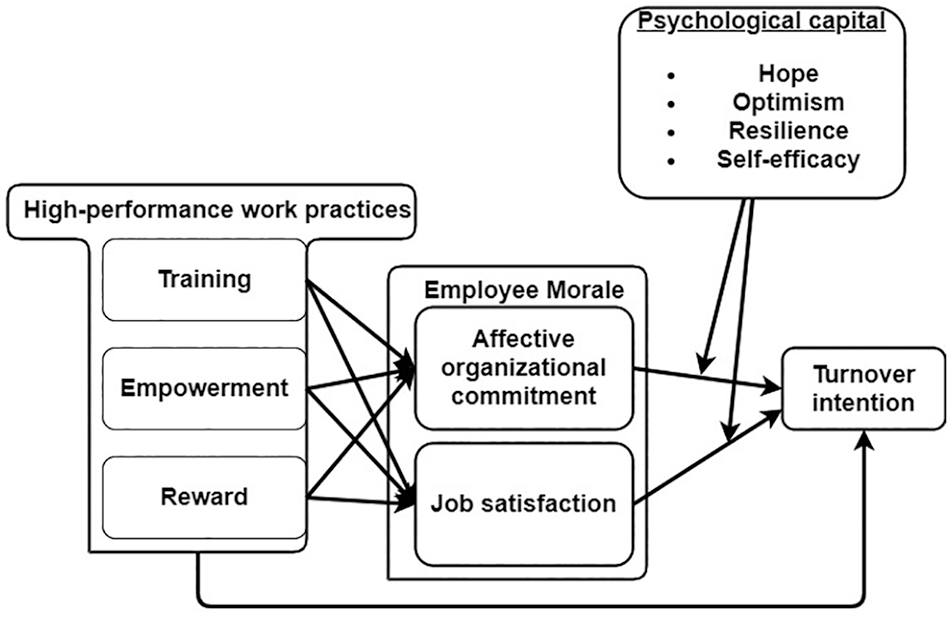
Conceptual framework.
Literature Review
SET
Blau (1964) asserts that the fundamental premise of the SET is human interaction; therefore, SET focuses on the social relations and personal ties among the actors that shape the exchange of resources and benefits. Empirical evidence on SET (cf. Cropanzano & Mitchell, 2005) highlights that relationships grow gradually into trust, loyalty, and requisite commitments if those concerns (e.g., superiors and subordinates) live by limited “rules” of exchange. Within the workplace exists two forms of relationships, namely economic relations (specific and tend to be more short-term) and social exchange (close personal association and open-ended responsibilities) (Cropanzano & Mitchell, 2005). If the company cares about workers, there are relationships of social exchanges that lead to successful work outcomes (Cropanzano et al., 2003). Employees in the workforce accessing economic and socio-emotional capital tend to feel compelled to repay the organization by different means; hence, social exchanges can be purely social or a combination of social and economic exchanges (Blau, 1964). Employee morale (commitment to organizational activities and job satisfaction) on the intention to stay and continue working for an organization includes how workers will repay the organization (Hopkins, 1995). In reality, workers dedicate their emotional, cognitive, and physical capital to tasks by maintaining high energy levels of being satisfied with their jobs and consistently being committed to staying with their organizations.
When workers receive HPWPs through empowerment, training, and rewards, their level of job satisfaction and work commitment to the organization becomes the conduit through which they repay, thus the reciprocity norm as espoused by Gouldner (1960). Thus, if workers feel that the provision of HPWPs comes from the commitment of leadership to service quality that is aligned with the company’s goal, workers feel more satisfied and show more commitment to work and enormously contribute to the quality of service processes. Moreover, HPWPs boost the efficiency of the employer–employee social interactions (Takeuchi et al., 2007; Tang & Tang, 2012) and reduces one’s intention to leave his or her organization (Hopkins, 1995).
SET and the Reciprocity norm of repayment took the center stage in accounting for the relationships in this study as it is the most common exchange rule between parties in an organization (Blau, 1964; Gouldner, 1960). Also, variables under investigation in this study have positive relationships and depict positive initiating action and need positive responses. In this vein, it is imperative to use SET to espouse their relationships as Blau (1964) opines that the voluntary actions of individuals that are motivated by the returns they are expected to bring and typically do in fact bring from others. Furthering, Gouldner (1960) is of the view that individuals must assist those who have previously given them assistance and as such individuals should not do anything that might harm those who have previously given them assistance. This assertion promulgate the idea that employees in the organization accessing economic and socio-emotional capital feel obliged to repay the organization by different means, for example, intention to stay to reduce turnover intention among employees. Thus, “I scratch your back, you scratch my back” syndrome in human relationships.
HPWPs on Employee Morale and Turnover Intention
This study utilized training, empowerment, and rewards as measures of HPWPs. Such metrics are essential for frontline service workers and are critical to the hospitality industry’s organizational success. Some significant factors of HPWPs are training, empowerment, and rewards, as mentioned above (Boselie, 2010; Pfeffer, 1994). Previous studies have proved that these factors of HPWPs are perhaps necessary measures regarding commitment exhibited by management in terms of service delivery (e.g., H. J. Kim et al., 2009).
Frontline staff can learn technological and interpersonal expertise to provide useful knowledge of service delivery processes and manage inquiries and grievances from customers. The lack of comprehensive and successful training programs for hospitality companies’ employees contributes to a labor pool, not having the skills needed, or unable to respond to demands and complaints of customers. As another HPWPs measure, empowerment applies to “the autonomy and capacity to make decisions and commitments” (Forrester, 2000). Frontline workers who are empowered perform their responsibilities, utilize their innovative judgment, and offer swift and rational answers to the disgruntled clients (Guchait et al., 2012; Yavas et al., 2010). However, it would be futile to empower employees without training programs to achieve the expected results or to train employees without the empowerment of successful complaint management. Reward usually follows training and empowerment, as employees with required training and substantial empowerment should earn appropriate compensation for satisfying clients and coping effectively with dissatisfied clients (H. J. Kim et al., 2009; Yavas et al., 2010).
Combs et al. (2006) contend that HPWPs, as used in this study, improve the skills, knowledge, and abilities and enable workers to achieve phenomenal productivity. Moreover, when utilized in a manner of coordination, these HPWPs strengthen and assist one another (Combs et al., 2006). Thus, there is support for such a statement by internal fit. Wall and Wood (2005) opined that “their aggregate influence, according to internal fit, will be greater than the sum of their parts.” This result in joint involvement of training, empowerment, and rewards will build cooperation within the company (Wall & Wood, 2005), activate employee morale (Hughes & Rog, 2008), and contribute to staff retention in the hospitality sector (Henry et al., 2004). Drawing from SET, employees who believe the organization emphasizes investment in the human capital through training, empowerment, and rewards are repaying through their morale toward job and intention to stay in an organization. Therefore, we hypothesize the following:
Employee Morale and Turnover Intention
Randhawa (2007) defined turnover intention as a complex phenomenon that depends on different factors. These factors include role conflict, job demands, decision control, training opportunities, reward, job satisfaction, and corporate fit (e.g., Carayon et al., 2006; Husain et al., 2015; Randhawa, 2007). It relates to feelings about leaving an organization voluntarily. A literature review of 23 studies conducted by Bluedorn (1982) confirmed that the leave intentions of an employee relate positively and significant to actual departure behavior. The stability of the workforce is a powerful business technique expected to become even more relevant shortly (Abdullah et al., 2010). The competitive advantage of a healthy workplace is the ability to create a long-term, positive partnership between workers and the organization. Employees increase productivity and performance by maintaining stable organizational relationships, remain long enough to get to know their clients, suppliers, and colleagues, and learn to become more efficient and effective. Previous studies on employee turnover behavior (e.g., Chambers & Honeycutt, 2009; Magloff, 2020; Verma & Kesari, 2016) demonstrated that employee morale consistently related to turnover intentions and actual turnover behavior.
Interestingly, a study by Paek et al. (2015) suggested that affective organizational commitment and job satisfaction are the two significant dimensions of employee morale, and these two components have also been shown by previous studies that it exercises a significant influence on turnover intention. Abbas et al. (2014), for instance, established that job satisfaction and turnover intention relationship is negative and significant. A meta-analysis by Carsten and Spector (1987) found that the correlation between job satisfaction and turnover intention is negatively strong. Similarly, Hellman (1997) performed a meta-analysis and discovered that the impact, which is harmful to job satisfaction and employees’ intention to quit, was highly significant. Hulin (1966) compared clerical employees who subsequently quit in an investigation with a matched sample of those who did not quit and concluded that turnover was negatively linked to job satisfaction. Hulin (1968) made improvements to the jobs in a follow-up study to address some of the dissatisfying factors listed by those who left. He acknowledged that these improvements resulted in significant slumps in turnover.
Furthermore, the strong willingness to make substantial efforts and a keen desire to remain as an organization’s member is termed as affective organizational commitment (Mowday et al., 2013). A study by Qi (2007) assessed that the impact affective commitment exercise on turnover intention is negative and significant. Similarly, the study of Law (2005) found that turnover intention influences negatively and significantly by the affective commitment and concluded that the most critical aspect of commitment in determining employee turnover.
Just as the SET implies, interactions between hospitality organizations and their employees build a connection that contributes to the employees’ affective commitment, job satisfaction, and the willingness the employee aspires to continue working with the organization. When hospitality employees engage in exchanges with their employers, these social exchanges generate a sense of obligation within them which leads them to feel quite satisfied and affectively committed to their work and their organization (Cropanzano & Mitchell, 2005; Ilies et al., 2007). Therefore, with substantial evidence from previous studies, we hypothesize the following:
Employee Morale as a Mediator Between HPWPs and Turnover Intention
A mediator variable clarifies the relationship between an independent variable and an outcome variable. Mediators explain why such an impact like this could happen (Fairchild & MacKinnon, 2009; Frazier et al., 2004; Hayes, 2017). The study assumes that employee morale (affective organizational commitment and job satisfaction) will help explain better the impact of HPWPs (training, empowerment, and rewards) and turnover intention. For instance, Karatepe and Vatankhah (2014) conducted a study on six HPWPs with data collected from the flight attendants in the Iran airline industry. They concluded that empowerment, job security, teamwork, selective staffing, rewards, career opportunities, and training as the metrics of HPWPs reduce turnover intentions as it fosters perceived organizational support. Literature has identified a significant negative impact on different elements of HPWPs and turnover intention relationship (Luna-Arocas & Camps, 2008; Selden & Sowa, 2015).
Interestingly, the mechanism by which HPWPs influence turnover intention is still a question hanging unanswered in human resource management and organizational behavior research. Empirical evidence from related literature highlights that training, empowerment, and reward significantly influence employee morale (job satisfaction and affective organizational commitment; Hughes & Rog, 2008), and employee morale is also related to turnover intention. Owing to this evidence, we proposed the following hypotheses:
PsyCap as a Moderator on Employee Morale and Turnover Intention
Conceptually, PsyCap is defined by Luthans, Avolio, and friends (2007; Luthans et al., 2005) as consisting of the four optimistic psychological instruments of hope, optimism, efficacy, and resilience which, once grouped, were found to be the core of the second-order (Luthans, Avolio, et al., 2007; Luthans et al., 2015). The shared variation among the four first-order constructs (hope, optimism, efficacy, and resilience) is a second-order construct. The complete description is that PsyCap is a positive psychological state of development of a person demonstrated by (a) having confidence (efficacy) to pursue and put in the required effort to excel in difficult tasks; (b) making a constructive reference (optimism) to progress now and in the future; (c) staying strong toward goals and if required, rerouting directions to goals (hope) to be successful; and (d) sustaining and coming back and even beyond (resilience) to achieve success while beset by challenges and adversity (Luthans, Youssef, & Avolio, 2007).
PsyCap is still emerging (Avey et al., 2011), and a study that seeks to examine the moderating effect of PsyCap on a behavioral outcome such as turnover intention is highly commendable (Abbas et al., 2014; Gupta & Shaheen, 2017). In the work of Avey et al. (2009) that included a heterogeneous sample of 416 workers showed a negatively significant relationship between PsyCap and intention to leave. They concluded that employees who have the psychological capabilities see things positively in their organizations. In most cases, if their expectations are not met, their commitment to the organization is heavily shaped by hope and optimism. As the employees consider that their organization requires additional work from them and rates them below average, the resilience element in them makes them take these arduous situations as a challenge, or even over demanding situations, and encourage them to spring back.
Another research by Abbas et al. (2014) in Pakistan in the domain of diverse industries concluded that in the mind of employees, positive thoughts would eclipse negative thoughts, such as quitting from the company. They did not, however, find significant evidence to support the aforementioned negative relationship. Such contradictory findings from the past study indicate that the PsyCap and turnover intention relationship suggested a moderating influence and not a direct impact. Also, the turnover intention was conceptualized as a function of employee morale (Chambers & Honeycutt, 2009; Verma & Kesari, 2016) specifically as a function of job satisfaction (Mobley et al., 1979) and affective organizational commitment (Law, 2005; Qi, 2007).
We further argued that workers with high PsyCap would prefer a long stay with the company as these stayers feel that the organizational atmosphere is perfect for them, and they have also well imbibed the organizational culture into themselves. Therefore, it is predicted that workers with PsyCap for their firms would have less desire to leave. To sum up, PsyCap is intended to influence both employee morale and employees’ turnover intention. As both components of employee morale and turnover intention are also negatively correlated, the PsyCap satisfies the moderation criterion as proposed by previous studies (e.g., Baron & Kenny, 1986; Frazier et al., 2004; Gupta & Shaheen, 2017; Hayes, 2017; Judd et al., 2014). The presence of PsyCap is, therefore, expected to moderate the relationship between employee morale and turnover intention. Thus, we hypothesized the following:
Method
Participants
This research used a questionnaire to gather data about how employees in Ghana’s hospitality industry perceive the effect of HPWPs on their work performance. About 150 employees from the hospitality industry in the Tarkwa-Nsuaem and Secondi-Takoradi were used to collect data using a questionnaire with in-depth interviews and extensive literature review. These employees were invited to complete the initial draft questionnaire designed. Some modifications were done to obtain the final version of the questionnaire afterward. With the help of old students, colleagues, and course mates, questionnaires totaling 612 were disseminated to employees of the hospitality industry randomly in eight regions of Ghana, based on the employee size and recognition by the Ghana Tourist Board. We got 525 questionnaire forms, of which 469 were valid (89.33%).
Among the 469 respondents, 246 (52.45%) were males, and 233 (47.55%) were females. Their ages ranged from 18 to 25 years (31; 6.61%), 26 to 45 years (420; 89.55%), and 46 to 60 years (18; 3.84%). The academic qualifications the employees worked with were junior high school certificate (6; 1.28%), senior high school certificate (276; 58.85%), and tertiary certificate (187; 39.87%). Also, their length of service ranged from 1 year or below (48; 10.2%), between 1 and 5 years (228; 48.6%), between 6 and 10 years (149; 31.8%), and between 11 and 15 years (43; 9.2%), and only 1 (0.2%) employee had worked for more than 15 years.
Measures
HPWPs
In this study, HPWP is referred to as practices with the track record of improving a company’s capacity of attracting, selecting, developing, and retaining competent staff. HPWP will be assessed with 12 items adopted from Karatepe (2013) which measured training (four items), empowerment (three items), and reward (five items).
Employee morale
This study defines employee morale as the satisfaction and overall commitment of employees during their relationship with an enterprise. Employee morale was assessed with 10 items adopted from (Paek et al., 2015), which measured affective organizational commitment (five items) and job satisfaction (five items).
PsyCap
This study defines PsyCap as the growth of an individual that is full of positive outcomes. PsyCap was assessed with 24-item adapted from Luthans, Avolio, et al. (2007) which measured hope (six items), optimism (six items), resilience (six items), and self-efficacy (six items).
Turnover intention
This study defines turnover intention as the state when an employee thinks and plans to quit his or her job or firms for several reasons. We measured turnover intention with three-item adopted from Singh et al. (1996).
A 6-point Likert-type scale ranging from 1 (strongly disagree) to 6 (strongly agree) was used in measuring all the constructs. We controlled demographic characteristics such as gender, age, educational qualification, and length of service in this study. Also, all the items used in measuring the constructs in this study are provided in the Appendix.
Common Method Variances
Buckley et al. (1990) assessed that the sum of spurious variance exchanged between variables as a consequence of common methods employed in data gathering is called a common method variance (CMV). Podsakoff et al. (2003) explained that CMV occurs from possessing a common rater, the common context of measurement and common context of items, or characteristics of the items used. Hence, as this research data were gathered using a self-report questionnaire, it is imperative to address some issues about CMV. In empirical research such as this one, failure to control CMV will adversely cause an effect on the magnitudes of the proposed relationships illustrated in the conceptual framework. Podsakoff et al. (2003) and Podsakoff and Organ (1986) recommended in their study that the data must be screened and analyzed by following four different procedural methods and two statistical redresses. This approach is a means of reducing and correcting the possible impact of CMV. First, to reduce assessment worries and social want, assurance was given to the respondents regarding the anonymity of their responses. According to Johnson and Fendrich (2005), this process helps respondents to portray an acceptable image of themselves. The participants were asked to fill out the questionnaire and return it in a sealed envelope to their superiors individually. Prior to filling the questionnaire, a group of doctoral students and some college professors from the field of management were consulted to provide experts’ advice about the contents of the chosen instruments. This process was important because it helped to provide some evidence for the content validity of the survey instruments. Also, the instruments for the survey were pre-tested and re-tested on 33 and 54 frontline employees, respectively, in the hospitality sector. These employees for the pilot studies were excluded from the final survey analysis. The piloting testing was important because it helped and gave the researchers confidence about the reliability of the measurement instruments.
Second, data were gathered from the frontline hotel staff on three occasions with a time-space of 1 month which was consistent with previous empirical research (Culbertson et al., 2010; T. T. Kim & Lee, 2013; Leung et al., 2011). During data collection in the first wave, the participants were given questionnaires that contained only items on the HPWP. Data collection in the second wave, which took place 1 month later, respondents answered questions only on employee morale and turnover intention. Questions on demographic characteristics of respondents were also inserted in between the employee morale and the turnover intention questions. In the third month, where we conducted the third wave of the data collection, participants responded to items only on PsyCap. This whole process can generate a psychological separation effect on the participant (Podsakoff et al., 2003). Last, Harman’s 1-factor test was adopted using exploratory factor analysis (EFA) and confirmatory factor analysis (CFA) to check and correct the collected data from any possible biases as outlined by Podsakoff et al. (2003). In the literature on hospitality (e.g., T. T. Kim & Lee, 2013; Yang & Lau, 2015), this approach has widely been used to check CMV as well as other research work (e.g., Aulakh & Gencturk, 2000; Culbertson et al., 2010).
Data Analysis
We used SPSS version 21.0 and AMOS version 21.0 software to analyze the collected data. SPSS was used to carry out the descriptive and inferential statistics. With Structural Equation Model (SEM) in AMOS software, we performed a CFA to specify the best model that fits the data set. Hierarchical regression analysis in SPSS software was employed to estimate the hypothesized relationships in this study. The reliability and validity of each of the variables were also assessed.
EFA was performed on all the 10 variables using principal component analysis (PCA) with varimax rotation (eigenvalue > 1 as cut off). The results revealed that four items (i.e., Hop5, Opt3, Res2, and Sef1) from the PsyCap scale (hope, optimism, resilience, and self-efficacy measures) loaded onto different components, hence, were deleted from the survey analysis. All the items in the survey analysis loaded onto their predicted variables, and the Kaiser–Meyer–Olkin (KMO) measure of sampling adequacy was 0.842. The variables together explained 77.79% of the total variance at an eigenvalue of 35.01, providing some evidence that the data did not suffer from common method variance.
Thereafter, CFA was performed for all the 10 variables (Table 1), and the results showed that each of the items for the survey analysis had a standardized factor loading greater than 0.45 and the t-values were all significant. The Cronbach alpha (ranging from 0.842 to 0.963) and composite reliability (ranging from 0.854 to 0.963) recorded for each of the variables were greater than the suggested 0.70 thresholds by Nunnally (1978), indicating high internal consistencies. The variables had average variance extracted (AVE) ranging from 0.586 to 0.840 which were greater than the suggested 0.50 threshold (Fornell & Larcker, 1981; Hair et al., 2010; Jöreskog & Sörbom, 1993), indicating high convergent validity. Each of the discriminant validity values along the diagonal line of the inter-factor correlation matrix is greater than the correlation coefficient (Table 3). This implies that the variables in the data set are distinct from each other. Further analysis to establish the best fit for the data set revealed that a 10-factor model as highlighted in Model 1 in Table 2 appears to be the model with the best goodness of fit to the data set with chi-square (χ2) = 2,579.612, df = 900, standardized root mean square residual (SRMR) = 0.060, root mean square error of approximation (RMSEA) = 0.063, and comparative fit index (CFI) = 0.906, normed fit index (NFI) = 0.863, Tucker–Lewis incremental fit index (TLI) = 0.897.
Factor Loadings, Reliability, and Validity Analysis.

Note. α = Cronbach alpha; β = standardized estimate. CR = composite reliability; AVE = average variance extracted.
Model Specification.

Note. SRMR = standardized root mean square residual; CFI = comparative fit index; NFI = normed fit index; TLI = Tucker–Lewis incremental fit index; RMSEA = root mean square error of approximation; TI = turnover intention; HPWPs = High-performance work practices; PsyCap = psychological capital.
Means, Standard Deviations, Correlation Analysis, and Discriminant Validity.

Note. Discriminant validity values are presented in bold along the inter-factor correlation matrix. Gen = gender; EQ = educational qualification; Ys = years; Tr = training; Emp = empowerment; Rw = reward; Hop = hope; Opt = optimism; Res = resilience; Sef = self-efficacy; AC = affective commitment; JS = job satisfaction.
p < .05. **p < .01.
Results
Means, Standard Deviations, and Correlation Analysis
A Pearson’s correlation analysis was carried to investigate the association among the variables of HPWPs, variables of PsyCap, and variables of employee morale and turnover intention. Also, the averages and standard deviations were estimated for the 10 variables. The results are presented in detail in Table 3.
Hypotheses Testing
Analysis of the main and mediating effects
We analyzed the relations between variables in this study. Controlling for other variables, we used SPSS version 21.0 software to conduct hierarchical regression analysis. The outcomes are presented in Table 4.
Mediating Effect of Employee Morale in the Relationship Between High-Performance Work Practices and Turnover Intention.
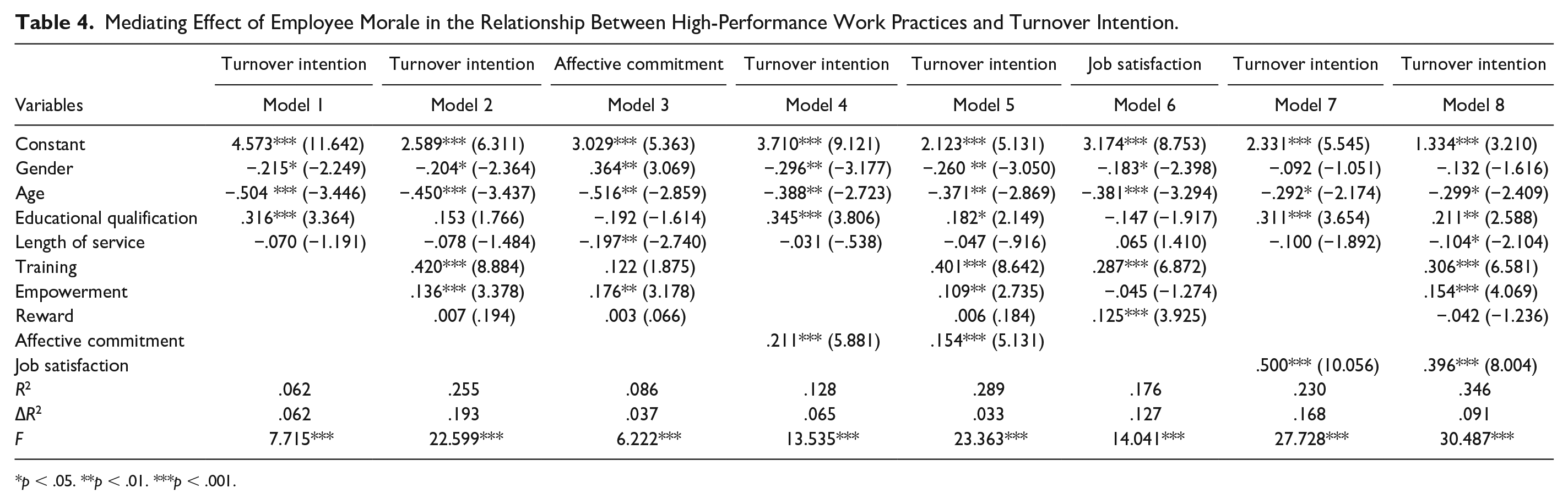
p < .05. **p < .01. ***p < .001.
First, in Model 2 in Table 4, the results suggest that training and empowerment had a positive and significant influence on turnover intention of employees, but the reward did not. Thus, Hypotheses 1a and 1b were supported, but 1c was not supported. Second, in Model 3 in Table 4, making the affective commitment as the criterion variable, only empowerment significantly and positively influences affective commitment, but training and reward did not, and this means that Hypothesis 2a was partially supported. Also, making the affective commitment as the independent variable and turnover intention as the criterion variable, the findings in Table 4, Model 4, show that the affective commitment had a positive and significant influence on the turnover intention, which confirmed Hypothesis 3a. Moreover, we regressed the training, empowerment, reward, and affective commitment in model 5 in Table 4. The results show that the effects of training and empowerment remained significantly positive on turnover intention, but reward still had a very minimal effect on turnover intention. The outcomes indicate a partial mediating effect pursued by affective commitment in only the empowerment and turnover intention relationship, and, thus, Hypothesis 4a was partially supported.
Similarly, in Model 6 in Table 4, with job satisfaction made as a dependent variable, it is suggested by the results that training and reward had a significant and positive influence on job satisfaction of employees, but empowerment did not. Hence, Hypothesis 2b received partial support. Furthermore, we treated job satisfaction as a predictive variable in model 7 in Table 4, and the results implied that job satisfaction had a positive and significant impact on turnover intention. Hence, Hypothesis 3b was supported. Finally, we regressed the three dimensions of HPWPs, and job satisfaction in Model 8 in Table 4, and the results suggested that the influence of training and empowerment remained significantly positive on turnover intention showing a partial mediating effect exercised by job satisfaction in only the training and turnover intention relationship, and, thus, Hypothesis 4b was partially supported.
Analysis of the moderating effect of PsyCap on employee morale and turnover intention relationship
Using hierarchical regression analysis to estimate the hypothesized moderated relationships, we centralized the employee morale and PsyCap variables. The findings are set out in Tables 5 to 8. From Tables 5 to 8, after centralizing the variables, the results show that both two dimensions of employee morale still exerted a positive and significant impact on turnover intention, which provides additional support for Hypothesis 3. Taking affective commitment and job satisfaction as the independent variables, the moderating impact of hope is presented in Table 5. The interaction terms among affective commitment, job satisfaction, and hope are not statistically significant. Although the results and evidence from Figure 2(A) and (B) suggested that hope enhances the positive effect of employee morale on turnover intention, their significance level was low. Hence, Hypothesis 5a was not supported. In Table 6, the results indicated that the product interaction term between affective commitment and optimism was negative and significant, and the interaction term between job satisfaction and optimism was negative but not statistically significant, thus validates partial support for Hypothesis 6b. Further evidence is illustrated by Figure 3(A) and (B). Also, results highlighted in Table 7 suggest that the interaction term between affective commitment and resilience was negative and significant, and the interaction term between job satisfaction and resilience was negative and at a very low significance level. Hence, Hypothesis 5c was partially supported. Further confirmation is depicted by Figure 4(A) and (B). Finally, the results in Table 8 suggest that the interaction term between affective commitment and self-efficacy was positive at a nonsignificance level. The interaction term between job satisfaction and self-efficacy was positive and significant. This implies that at a high level of employee morale, the turnover intention will moderately decline for employees with high-level self-efficacy; hence, Hypothesis 5d is partially supported. Further support is shown with Figure 5(A) and (B).
Moderating Effect of Hope on the Relationship Between Employee Morale and Turnover Intention.

Significant at .05. **Significant at .01. ***Significant at .001.
Moderating Effect of Optimism on the Relationship Between Employee Morale and Turnover Intention.
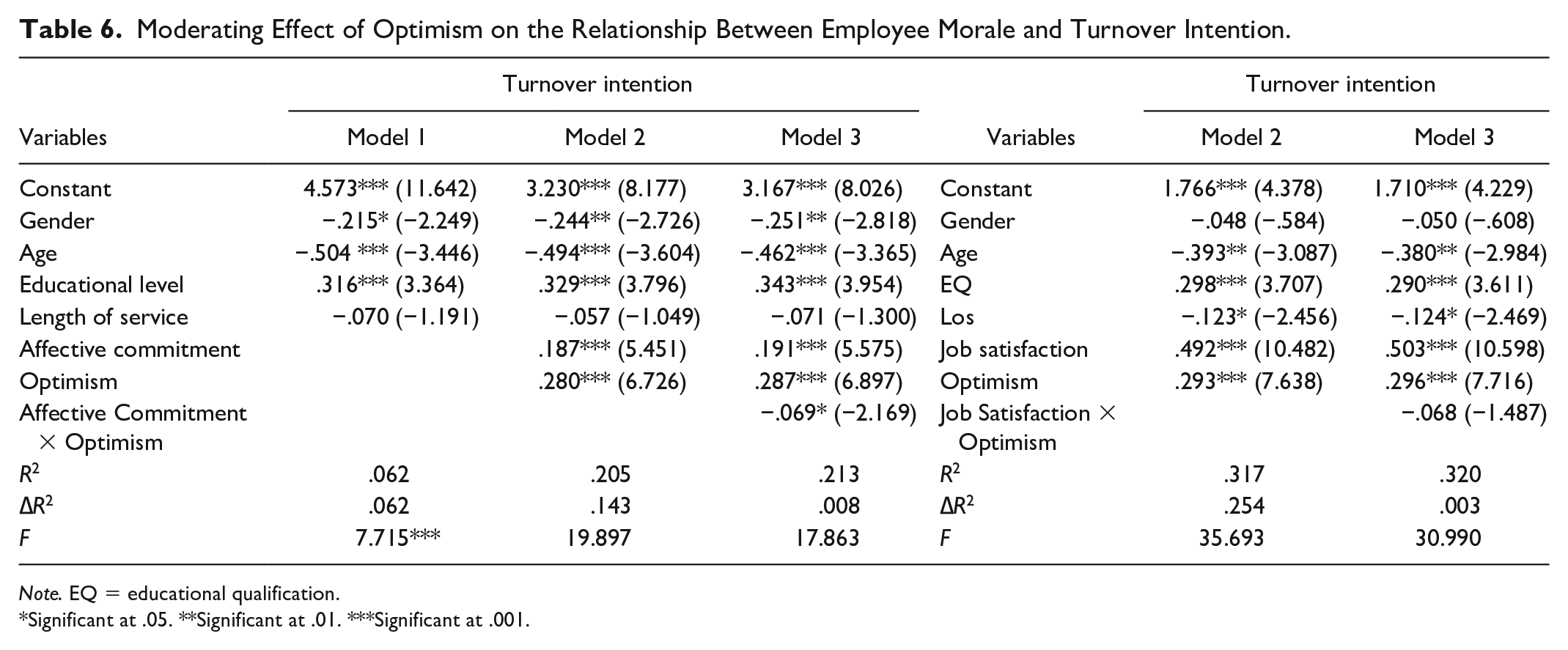
Note. EQ = educational qualification.
Significant at .05. **Significant at .01. ***Significant at .001.
Moderating Effect of Resilience on the Relationship Between Employee Morale and Turnover Intention.

Significant at .05. **Significant at .01. ***Significant at .001.
Moderating Effect of Self-Efficacy on the Relationship Between Employee Morale and Turnover Intention.

Significant at .05. **Significant at .01. ***Significant at .001.

(A) A graph of the moderating impact of hope on the between affective commitment (AC) and turnover intention relationship. The graph indicates that an increase in affective involvement would reduce workplace turnover intention with high hope. (B) A graph of the moderating influence of hope on the relationship between job satisfaction (JS) and turnover intention. The graph shows that an increase in job satisfaction will reduce turnover intention for employees with high hope.

(A) A graph of the moderating effect of optimism on the relationship between affective commitment (AC) and turnover intention. The graph shows that low affective commitment will increase turnover intention for employees with lower optimism. (B) A graph of the moderating effect of optimism on the relationship between job satisfaction (JS) and turnover intention. The graph shows that lower job satisfaction will increase turnover intention for employees with lower optimism.

(A) A graph of the moderating effect of resilience on the relationship affective commitment and turnover intention. The graph shows that lower affective commitment will increase turnover intention for employees with lower resilience. (B) A graph of the moderating effect of resilience on the relationship between job satisfaction (JS) and turnover intention. The graph shows that lower job satisfaction will increase turnover intention for employees with lower resilience.
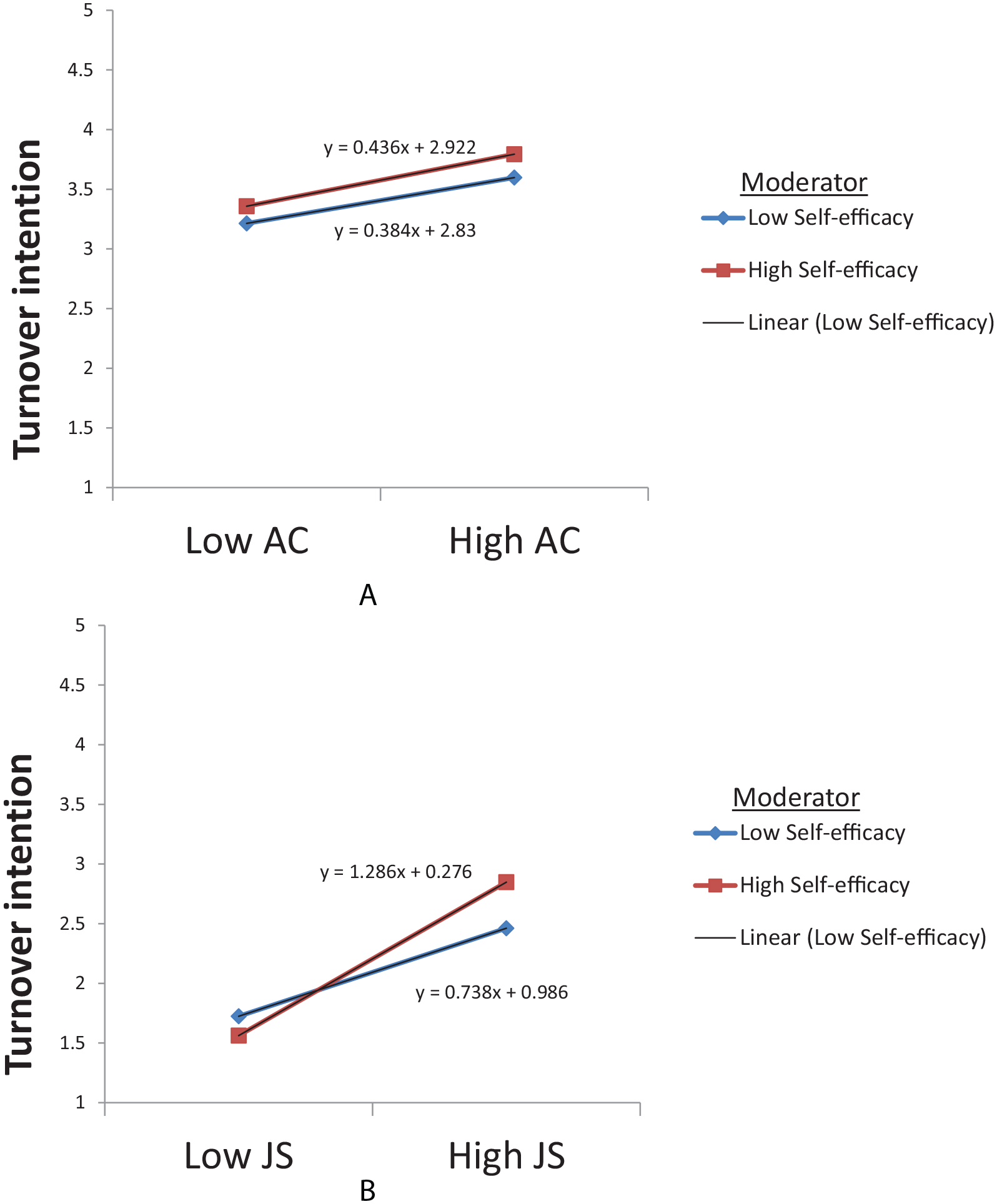
(A) A graph of the moderating effect of self-efficacy on the relationship between affective commitment and turnover intention. The graph shows that high affective commitment will reduce turnover intention for employees with high self-efficacy. (B) A graph of the moderating effect of self-efficacy on the relationship between job satisfaction (JS) and turnover intention. The graph shows that high job satisfaction will reduce turnover intention for employees with high self-efficacy.
Discussion
In this current research, a developed model was tested for which we examined two components of employee morale as a mediator in HPWPs and turnover intention relationship. Also, regarding the model, the variables considered under PsyCap, that is, hope, optimism, resilience, and self-efficacy were tested as moderators on employee morale (affective commitment and job satisfaction) and turnover intention relationship. The research’s strengths are detailed below.
First, this research investigated the HPWPs and its relationship with turnover intention. This study has conceptualized HPWPs and assessed them with training, empowerment, and rewards. We measured HPWPs as an independent variable of first order to enable us to determine the predictive capacity of each of the three components of HPWPs on each of the two dimensions of employee morale and then turnover intention. This is important as the most critical elements of human capital activities are training, empowerment, and rewards and may have different consequences on employees (Pfeffer, 1994). These HPWPs are also among the topmost human resource activities (Boselie et al., 2005). In service quality, HPWPs have been recognized as the key indicators of management commitment (Karatepe, 2013; H. J. Kim et al., 2009). Also, HPWPs are crucial implications on hospitality managers and business practices (Kusluvan et al., 2010).
Second, the research calls by Paek et al. (2015) were responded to in this study by estimating employee morale (affective commitment and job satisfaction) on other behavioral outcomes such as the intention of turnover. Third, this research adds to the current knowledge base by analyzing affective commitment and job satisfaction between HPWPs and turnover intention as mediators with data collected in Ghanaian frontline service employment (e.g., Karatepe, 2011, 2013; Takeuchi et al., 2007). Fourth, PsyCap was tested as a moderator on the employee morale (affective commitment and job satisfaction) and turnover intention relationship as a response to the research call by Eid et al. (2012) that future researchers consider the moderating role of PsyCap in organizational behavior studies.
Finally, the reliability and validity of the scales suggest the data had acceptable goodness of fit. It has been shown previously that only empowerment from HPWPs significantly and positively influences turnover intention through affective organizational commitment. Also, in this study, only training from HPWPs influences turnover intention through job satisfaction.
Assessment of Findings
Influence of HPWPs on turnover intention
The findings indicate accurate measures for HPWPs. In particular, for the relationships between variables of HPWPs and turnover intention, training (β = 0.420, p < .001) seemed to have the most predictive capacity on turnover, followed by empowerment (β = 0.136, p < .001) and then reward (β = 0.007, p > .05). The positive relationships between variables of HPWPs and turnover intention support earlier research work by Verhees (2012). Verhees (2012) holds it that a positive relationship in a study like this gives researchers two conclusions to worry with. First, when employees are empowered and given the requisite training to enable them to perform adequately in their field of empowerment with little or no reward, they may not be agitated to leave their organization. They may sympathize with their organization and continue with their work because the organization has invested in many resources to improve their competencies. When employees enjoy empowerment and training benefits from their firms, the best thank you employees can say is by staying and helping their organization achieve its stated goals. Therefore, under these conditions, workers feel obliged to respond by retaining their jobs with the organization. Also, the results are compatible with SET (Cropanzano & Mitchell, 2005). Second, employees who are empowered and trained by their employers become highly skilled and confident. The tendency for them to leave for better offers in different companies may be high. This becomes a huge cost to their former employer. Under this condition, employees who are highly empowered and trained will increase the turnover intention of employees, and this supports the human capital theory by Becker (1962).
Influence of HPWPs on employee morale
In addition, for the relationships between the three variables of HPWPs and the two variables of employee morale, the findings suggest that empowerment (β = 0.176, p < .01) significantly and positively affected affective organizational commitment better than training (β = 0.122, p > .05) and reward (β = 0.003, p > .05). Also, the findings suggest that training (β = 0.287, p < .001) and reward positively and significantly affected job satisfaction better than empowerment (β = −0.045, p > .05). These results are also compatible with the work of Hopkins (1995) and claims of SET (Cropanzano & Mitchell, 2005) and internal fit (Wall & Wood, 2005). The existence of the reward system in the workplace appears to give clear signals to workers that their contributions in the company are valued, acknowledged, and rewarded. Training initiatives focused on enhancing the task-related and interpersonal skills of workers and educating workers the purpose of empowerment in difficult service experiences are both valuable signs about the dedication of management to HPWPs. The combined involvement of these HPWPs builds on-the-job synergy. Employees feel satisfied with their job and respond by being affectively committed to the goals of the organization.
Effect of employee morale on turnover intention
The findings also show that all two components of employee morale (affective organizational commitment and job satisfaction) contribute to turnover intention. However, the influence of job satisfaction (β = 0.500, p < .001) on turnover intention is stronger than the way affective organizational commitment (β = 0.211, p < .001) influences turnover intention in an organization. As SET states, workers satisfied and committed to their jobs are probable to have more high-quality and trustworthy relationships with their organizations (Karatepe, 2013; Tnay et al., 2013). These staff, in turn, willingly stay with their organization and show no sign of leaving. Undoubtedly, organizations enjoy continuity of work through employee retention. These findings corroborates empirical findings in related literature (Chambers & Honeycutt, 2009; Chinomona & Mofokeng, 2016) and the SET’s claim that relationships grow over time into a commitment to trust, loyalty and mutuality (Cropanzano & Mitchell, 2005; Takeuchi et al., 2007).
Mediating effect of employee morale on HPWPs and turnover intention
Drawing from the standpoint of human resource management, HPWPs may inspire employees to display acceptable positive behavior results (Huselid et al., 1997; Karatepe, 2013). This study’s findings suggest partial support for this claim. Employee morale dimensions, that is, affective commitment and job satisfaction, are both considered as motivational constructions (Paek et al., 2015). As motivational constructs, the findings of this study suggest that affective organizational commitment partially plays a mediating effect in the empowerment and turnover intention relationship while job satisfaction also partially plays a mediating effect in the training and turnover intention relationship. In particular, the existence of HPWPs as evidenced by training and empowerment promotes job satisfaction and affective organizational commitment and in effect, advocates the stay of employees in their organization. Under this condition, organizations can retain competent staff.
Moderating effect of PsyCap on employee morale and turnover intention
Findings regarding the moderating role of the four components of PsyCap on the relationships between the two components of employee morale (affective organizational commitment and job satisfaction) and turnover intention were partially exercised as anticipated. The results demonstrated that optimism and resilience significantly moderated the relationship between affective organization commitment and turnover intention relationship while hope and self-efficacy displayed a very little moderating influence on the affective organizational commitment and turnover intention relationship. The negative and significant moderating impact of optimism and resilience on the affective organizational commitment and relationship between turnover intentions strengthens PsyCap’s negative influence on turnover intention. Besides, the affective commitment being low will increase turnover intention for employees with lower optimism and lower resilience. Interestingly, only self-efficacy from PsyCap showed an observable moderating effect on job satisfaction and turnover intention relationship while hope, optimism, and resilience showed a minimal moderating effect on job satisfaction and turnover intention relationship. The positive moderating effect of self-efficacy on job satisfaction and turnover intention relationship implies that high job satisfaction will reduce turnover intention for employees with high self-efficacy.
Theoretical/Practical Contributions of the Study
Theoretical contributions
Several important theoretical contributions were made in this study, which include the following. First, two key emerging constructs namely HPWPs (training, empowerment, and rewards) and employee morale (affective organizational commitment and job satisfaction) connected to turnover intention not only affirm the role employee morale plays in HPWPs and turnover intention but also recognize the crucial role of employee morale as a mediator between HPWPs and turnover intention. This is noteworthy because linking the three variables of HPWPs or two variables of employee morale to other variables such as turnover intention answers several questions hanging in human resource management and organizational behavior research. Most research work that paid attention to the impact of HPWPs on employee morale or turnover intention considered different variables to assess HPWPs (e.g., Luna-Arocas & Camps, 2008). Hence, this research breaks new ground by introducing a systematic model with key emphasis on the relationships between HPWPs, employee morale, and turnover intention with specific attention to human resource management and organizational behavior.
Second, this research indicates that employee morale in totality offers a partial mediation between HPWPs (training, empowerment, and rewards) and turnover intention. As employee morale has a variety of contexts and subsequent variables, it acts as a vital mediator, and some researchers have found affective organizational commitment and job satisfaction of employee morale to get the maximum impact (e.g., Huang et al., 2006; Luna-Arocas & Camps, 2008; Meyer & Allen, 1991). Nonetheless, by suggesting employee morale in this analysis, as a partial mediator, provides a theoretical context that indicates mutual and overlapping interactions between the determinant (HPWPs) and a consequent variable (turnover intention). From the viewpoint of human resources management and organizational behavior, this is important because employee morale as a partial mediator reveals the significance of a direct relationship between predictors of employee morale and the response variable and not only to present it in a complete mediating function. This means human resource relationships or organizational behavior research between the independent, mediator, and dependent constructs may involve more complex mutual or simultaneous processes that superficially cannot be clarified. As only a few studies have argued for this conceptually, with most suggesting basic structures, the empirical evaluation of the structural framework described in the study provides a significant path of study for work in the future. As stated in the discussion above, the influence of employee morale variables on turnover intention was far stronger than those of HPWPs.
Third, the moderating role of PsyCap (hope, optimism, resilience, and self-efficacy) on the employee morale (affective organizational commitment and job satisfaction) and turnover intention relationship has been verified in this study. As optimism and resilience remain the two key components of PsyCap to strengthen the negative impact affective organizational commitment has on turnover intention, self-efficacy remained the only component of PsyCap with the tendency to affect the strong positive effect job satisfaction has on turnover intention.
Practical implications
The results of this study outline some significant implications for HPWPs management and retention in the workforce of satisfied and committed employees. Employee morale at work is a constant and long-term process. Managers must, therefore, consider the critical role of social exchange in the employee’s morale and the success of outcomes (Cropanzano & Mitchell, 2005; Saks, 2006).
Managers should focus more on providing training, empowerment, and rewards to workers that would help them feel compelled to react to the company through job satisfaction and affective commitment because this would help lessen the turnover intention. In particular, the hotel management should ensure that appropriate and ongoing training programs are designed and implemented as a means of developing employee competency. This will equip employees with the necessary responsibility and authority to handle customer demands, persuade employees to be satisfied with their job, and help retain competent staff.
Ensuring consistent and appropriate training and empowerment activities, combined with the perception of fairness in compensation by workers, will allow managers to maintain a pool of satisfied and committed workers. The workers can successfully handle customer demands and grievances and go beyond their established customer service position requirements. Maintaining satisfied and committed workers is necessary for the workplace, as reported by Bakker and Demerouti (2008), as they are marked by optimistic emotions and stronger psychological and physical health than disengaged employees.
Furthermore, recognizing elements of PsyCap as significant factors in positive organizational practices and attitudes of an applicant in the recruitment and selection process is very key. Most especially, attracting high-level employees with optimism, resilience, and self-efficacy will help weaken the impacts of many organizational factors that contribute to turnover intentions. Organizations can also include in their training programs to develop employees to have positive psychological behavior for their organizations, and this can help improve employee retention.
Conclusion
The present study developed and tested a model of research that examined two components of employee morale as mediators between the dimensions of HPWPs and turnover intention. Four dimensions of PsyCap were also examined as moderators in employee morale (affective commitment and job satisfaction) and turnover intention relationships. The findings showed that the presence of HPWPs, as demonstrated through training and empowerment, resulting in the turnover intention. Also, the presence of HPWPs, as expressed by empowerment led to affective organizational commitment. Besides, the HPWPs, as expressed by training and reward, resulted in job satisfaction. Similarly, the presence of employee morale as expressed by the affective commitment and job satisfaction reduced the turnover intention of employees. Technically speaking, affective commitment partially mediated the relation between empowerment and turnover intention while job satisfaction partially mediated the relation between training and turnover intention. Also, based on the results, we conclude that employees experiencing a low level of optimism and resilience can negatively influence the affective organizational commitment of employees to increase the turnover intention of workers. However, the level of hope and self-efficacy whether high or low can have minimal effect on the way affective organizational commitment of employees will influence employees’ turnover intention. Furthermore, among the four dimensions of PsyCap, self-efficacy remained the variable that had a greater influence on the way job satisfaction influenced the turnover intention of employees.
Limitations of the Study
While this empirical analysis makes some significant contributions to the current base of knowledge, it does have some drawbacks that indicate promising potential research prospects. First, the data were collected using a 1-month time-lagged study method. Although such a method may offer some proof for temporal causality, it may have some limitations in drawing causal influence compared with a longitudinal research approach. To draw firm and sufficient causal inferences, Future research should gather data longer than was feasible in this respect (cf. Grandey & Cropanzano, 1999). Second, to have findings that researchers can widely generalize and cross-validate, it is recommended that further studies be carried out using larger samples from several hospitality sectors in Ghana and elsewhere. Third, the results of this research indicate that employee morale as manifested by affective organizational commitment and job satisfaction acts as an independent variable of employee turnover intention. Organizations need to retain competent staff as this is important for the generation of ideas that are new about the work procedures, services procedures, and products (Hon, 2011). Personal creative behaviors are, therefore, critical to sustaining the competitive advantage of hospitality firms, and their long-term service in an organization is very important. Hence, an examination of PsyCap as an employee retention booster (cf. Abbas et al., 2014; Avey et al., 2011) in the hospitality workers may provide important insights for both scholars and practitioners.
Footnotes
Appendix
Questionnaire for the study.

| Construct | Description |
|---|---|
| Training (Tr) | |
| Tr1 | I receive continued training to provide good service |
| Tr2 | I receive training on how to serve customers better |
| Tr3 | I receive training on how to deal with complaining customers |
| Tr4 | I receive training on dealing with customer problems |
| Empowerment (E) | |
| E1 | I do not have to get management’s approval before I handle customer problems |
| E2 | I am allowed to do almost anything to solve customer problems |
| E3 | I have control over how I solve customer problems |
| Reward (Rw) | |
| Rw1 | If I improve the level of service, I offer customers, I will be rewarded |
| Rw2 | The rewards I receive are based on customer evaluations of service |
| Rw3 | I am rewarded for serving customers well |
| Rw4 | I am rewarded for dealing effectively with customer problems |
| Rw5 | I am rewarded for satisfying complaining customers |
| Affective organizational commitment (AC) | |
| AC1 | I would be very happy to spend the rest of my career with this hotel |
| AC2 | I do not feel like part of the family at my hotel R |
| AC3 | I feel as if this hotel’s problems are my own |
| AC4 | I do not feel emotionally attached to this hotel R |
| AC5 | This hotel has a great deal of personal meaning for me |
| Job satisfaction (JS) | |
| JS1 | I am satisfied with my overall job |
| JS2 | I am satisfied with my fellow workers |
| JS3 | I am satisfied with my supervisor |
| JS4 | I am satisfied with the hotel’s policy |
| JS5 | I am satisfied with the support provided by this hotel |
| Turnover intention (TI) | |
| TI1 | It is likely that I will actively look for a new job next year |
| TI2 | I often think about quitting |
| TI3 | I will probably look for a new job next year |
| Hope (Hop) | |
| Hop1 | I feel confident analyzing a long-term problem to find a solution |
| Hop2 | I feel confident in presenting my work area in meetings with management |
| Hop3 | I feel confident contributing to discussions about my hotel’s strategy |
| Hop4 | I feel confident helping to set targets/goals in my work area |
| Hop5 | I feel confident contacting people outside my hotel (e.g., customers) to discuss problems |
| Optimism (Opt) | |
| Opt1 | If something can go wrong for me work-wise, it will R |
| Opt2 | I always look on the bright side of things regarding my job |
| Opt3 | I’m optimistic about what will happen to me in the future as it pertains to work |
| Opt4 | In my job, things never work out the way I want them to R |
| Opt5 | I approach my job as if every cloud has a silver lining |
| Resilience (Res) | |
| Res1 | When I have a setback at work, I have trouble recovering from it and moving on R |
| Res2 | I can be “on my own,” so to speak, at work if I have to |
| Res3 | I usually take stressful things at work in my stride |
| Res4 | I can get through difficult times at work because I’ve experienced difficulties before |
| Res5 | I feel I can handle many things at a time at my job |
| Self-efficacy (Sef) | |
| Sef1 | I feel confident analyzing a long-term problem to find a solution |
| Sef2 | I feel confident in presenting my work area in meetings with management |
| Sef3 | I feel confident contributing to discussions about my hotel’s strategy |
| Sef4 | I feel confident helping to set targets/goals in my work area |
| Sef5 | I feel confident contacting people outside my hotel (e.g., customers) to discuss problems |
R = reverse coded.
Declaration of Conflicting Interests
The author(s) declared no potential conflicts of interest with respect to the research, authorship, and/or publication of this article.
Funding
The author(s) received no financial support for the research, authorship, and/or publication of this article.
