




Abstract
This study aims to explore the significance of job embeddedness (JE) theory and practices to reducing employee turnover and then suggest future research directions. It also reviews the systematic development of JE theory and its relationship with different workplace theories. A comprehensive content analysis, including a systematic review of articles published between 2008 and 2018, is conducted to understand the extensive role of JE in the workplace. A total of 108 research papers published in various high-ranking journals are selected for further analysis. To identify the mediating role of JE in the service and manufacturing industry, most of the existing studies focus on turnover intention, organizational commitment, employee engagement, and job satisfaction. However, many other key areas, which can be linked to JE to understand and evaluate the theory of organizational and employee behavior, are ignored in the literature. In this study, a further understanding of JE is suggested to be expanded in accordance with various elements of organization and employee theories, such as job design, job burnout, and role performance. This study contributes to the literature by further expanding JE theory and proposing a comprehensive JE framework that researchers and practitioners can adopt in future research.
Introduction
In the contemporary work environment, human resource practices in organizations have been transforming into a truly sustainable domain in which employee engagement, commitment, and loyalty can be addressed to sustain individual and organizational performance standards (Nafei, 2014; Vorina et al., 2017). Workplaces have been facing a major challenge of job embeddedness (JE), which influences employee retention-related decisions. The roles of organizational (on-the-job) and community (off-the-job)-related embeddedness have been important in measuring job outcomes such as satisfaction, commitment, and turnover intention (TOI; Khan et al., 2018; Takawira et al., 2014).
Employees usually decide to leave organizations due to volunteer turnover, which is caused by contrasting administrative policies and the unwelcoming behavior of senior management (Jiang et al., 2012; Rehman, 2012). No managerial staff are not provided training opportunities and do not even have clearly defined organizational rules that managers have. Consequently, junior staff remain unsatisfied (Takawira et al., 2014) and thus often decide to leave their organization. Similarly, few off-the-job factors, such as work–family balance (Khan et al., 2018; Takawira et al., 2014) and community (Hobfoll, 2001) and psychological factors (Turhan et al., 2016), also contribute to the embeddedness position. J. Y. Lee and Lee (2018) indicated that people may be trapped in jobs because of the power of various organizations and community-related factors. Thus, employees become free and consistently stay silent due to highly embedded positions in their role performance in the organization, ultimately leading to job satisfaction and commitment (Jiang et al., 2012). Employees can be satisfied when they feel a high effect of JE and usually adhere to implemented ideas due to their loyalty, innovation, and commitment. Although many studies have documented the validity of the theoretical link among embeddedness, satisfaction, and turnover, they failed to provide a practical definition of a model that enhances job outcomes and reduces turnover. Empirical evidence suggests that the predictive supremacy of embeddedness is limited (Karatepe & Ngeche, 2012). Addressing the embeddedness position, Griffeth et al. (2000) found that the difference between satisfaction and turnover is 4%–5%, and the percentage difference between the intention to leave and actual turnover is 12%. The reasons that lead people to decide whether to stay or leave organizations must be investigated in the context of JE (Mitchell et al., 2001; Shehawy et al., 2018). JE should show potential implications in relation to different workplace theories (Darrat et al., 2017; Holtom et al., 2012; Mxenge et al., 2014) to investigate employee TOI.
A significant variance in TOI remains unexplored in the literature. Important topics, such as the critical role of on-the-job and off-the-job embeddedness in defining the links toward TOI (Agarwal, 2017), have also been neglected. Recently, JE has been explored to investigate TOI preventive measures such as (a) link, wherein employees have good working relationships, and each individual is officially or unofficially linked to other people, teams, and organizations; (b) fit, which refers to how compatible the employees feel with the company, organization, or the local community to which he or she belongs and how fit they feel they are for their job; and (c) sacrifice, which refers to the opportunity cost of turnover, that is, the perceived cost of physical or psychological convenience sacrificed when leaving a current job, indicating a retention or an antiwithdrawal construct (Chan et al., 2019; Hussain & Deery, 2018; Reitz, 2014).
The limited literature on JE status has resulted in the necessity of reviewing the basic understanding of JE theory and its implications (Alqarni, 2016). Within the foci of current JE theory, a high perceived job security by organizational- and community-embeddedness practices has been found to reduce the propensity to find alternative jobs (Karatepe & Vatankhah, 2014; Rahimnia et al., 2019). Therefore, regarding the continued attention on organizational initiatives to enhance embeddedness within the private and public sectors, a precise understanding of the relationship between JE and TOI is required to address the challenging nature of JE practices (Karatepe & Vatankhah, 2014). To explore the role of JE in the workplace, few studies have addressed JE in relation to TOI at the three levels of JE (Karatepe & Shahriari, 2014; Rubenstein et al., 2019; Shehawy et al., 2018; Spain et al., 2014). This study primarily intends to fill the gap of understanding the broad perspective of organizational- and community-related JE practices of organizations and how these practices affect employee TOI. Furthermore, this study explores the linkages between other firm- and employee-related factors to determine a complete path of employee turnover framework. From a theoretical perspective, this study is imperative for the systematic review of existing studies toward the progress of future trends of JE theory. First, a thorough systematic literature review is conducted, emphasizing the implications of JE on countering the turnover scenario across different types of organizations. Second, the study anticipates offering a comprehensive theoretical explanation of the JE phenomenon; the inferences can foster causal studies on TOI in the future. This study greatly contributes to the literature on achieving JE-driven sustainability in employee turnover. This study focuses on typically overlooked antecedents of JE, thereby justifying them.
This article first provides a systematic content analysis of literature related to the relationship between JE and employee TOI. Then, the corresponding discussions and future implications are presented. The final section states the conclusions and limitations of the study.
Method
The systematic review was selected as the preferred methodology to explore the previous contributions in JE theory at the workplace. Considering the study objectives, the researcher used the exploratory approach and adopted content analysis as the framework to collect and analyze the studies (Cole et al., 2010; Gong et al., 2011; Neuendorf et al., 2017). Some studies have reported that content analysis requires a detailed review of abstracts, introductions, methodologies, and study findings.
Accordingly, the concept of JE in relation to employee TOI was critically reviewed from published works between 2008 and 2018. In the last decade, major developments have occurred in the JE literature. Therefore, a rigorous study of the last 10 years for theory exploration and extension is essential. To ensure the element of credibility in a qualitative study, the researcher first ensured the authenticity of the studies by selecting peer-reviewed studies only. Thus, credible databases, such as Science Direct, Google Scholar, Emerald Insight, Springer, Wiley, and Elsevier, were targeted to extract relevant articles, conference proceedings, and book chapters. A total of 108 studies were retrieved. Figure 1 illustrates the use of prevention and recovery information systems for monitoring and analyzing guidelines regarding the selection of 108 studies.

PRISMA guidelines.
The researcher first described the broad perspective of the selected studies and then presented a unique set of findings at the interpretative level by exploring underlying meanings. During our search, the relevance of the studies was ensured by keywords such as “job embeddedness,” “turnover intention,” performance and burnout,” “innovation work behavior,” “career satisfaction,” “occupational commitment,” “employee performance,” “authentic leadership,” “burnout,” “job performance,” “organizational culture,” “organizational justice,” “social entrepreneurship,” employee commitment,” “organizational trust,” and “HRM effectiveness.” To increase the study-specific relevance of the search results, the researcher entered the keywords in combination. Thus, Boolean operators (i.e., AND/NO/OR) and symbols, such as +/*, were used. A total of 200 relevant articles were initially extracted for further review.
The following journals are repeatedly cited in this study to address the current trends of JE in the literature: (a) Journal of Occupational Psychology, (b) American Journal of Sociology, (c) Science Journal of Business and Management, (d) International Journal of Advance Research and Innovation, (e) American Psychological Association, (f) Academy of Management Journal, (g) Journal of Anesthesiology Clinical Pharmacology, (h) Journal of International Business Studies, (i) Sustainability, (j) International Journal of Tourism Research, (k) Educational Leadership Administration, (l) European Management Journal, (m) Journal of Organizational Behavior, (n) Academy of Management Journal, (o) International Journal of Scientific and Research Publications, (p) Procedia-Social and Behavioral Sciences, (q) Academy of Management Journal, (r) International Journal of Human Resource Management, and (s) Journal of Global Management.
Out of the 200 targeted articles, 108 articles are relevant to and frequently cited in the current study. Of the 108 papers, 90 are directly related to JE and TOI. A total of 30 papers show JE as a moderator, and 45 papers show the mediating role of JE along with other predictors. In addition, 20 papers show the direct effect of JE as predictor of TOI, along with other variables such as organizational and employee personal factors, job satisfaction, affective commitment, job satisfaction, organizational commitment, justice performance, and trust. Conversely, 18 papers are related to other variables such as organizational commitment, culturally diverse environment, job satisfaction, retention strategies, and work stress, as predictors of JE. Most cited papers are from the service sector, followed by the manufacturing sector, which contributed 30 articles. In this study, 23 papers are cited from the hospitality industry, 45 papers from the banking industry, 60 from the hospital industry, and 33 from the education sector. Table 1 presents some studies being reviewed for theories and applications of JE from the last decade.
A Summary of Historical Development of Job Embeddedness and Its Applications.
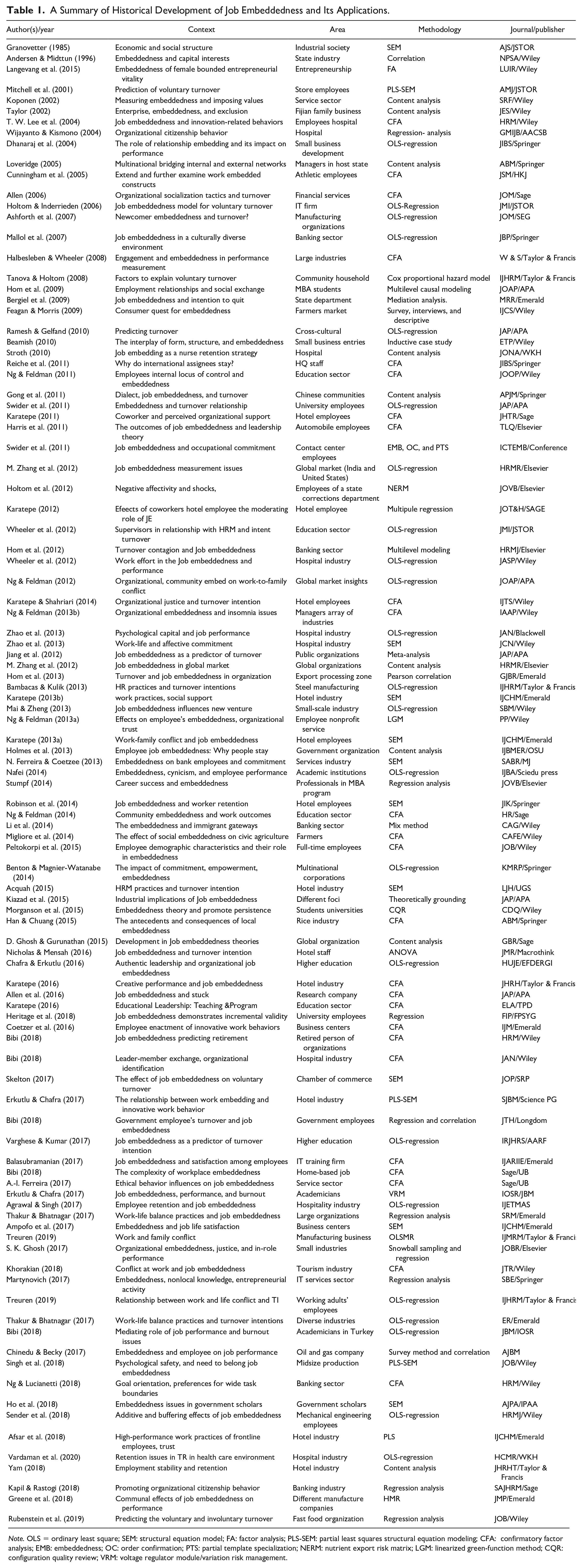
Note. OLS = ordinary least square; SEM: structural equation model; FA: factor analysis; PLS-SEM: partial least squares structural equation modeling; CFA: confirmatory factor analysis; EMB: embeddedness; OC: order confirmation; PTS: partial template specialization; NERM: nutrient export risk matrix; LGM: linearized green-function method; CQR: configuration quality review; VRM: voltage regulator module/variation risk management.
Theory and Implications of JE
JE is an employee’s state of mind within an organization, where the employee decides on quitting due to the influence of certain factors such as entombment, apathy, and prejudice to the status quo at the workplace (Robinson et al., 2014). These issues may be related to on-the-job and off-the-job matters that directly affect employee turnover (Reitz et al., 2011). Similarly, regarding the effect of JE on employees’ individual decisions, a threshold level of mental state known as “being embedded” refers to a person that remains indecisive about leaving or staying. Conversely, when a threshold point increases, a person decides to quit rather than stay (Kiazad et al., 2015). A JE state can be measured by three different constructs, namely, links, fit, and sacrifice. Furthermore, links are proper or causal influences on a person and organizations or other people, whereas sacrifice refers to the psychosomatic and physical improvements that a worker could discard at any assumed time if they decide to stay with an organization. Fit denotes a worker’s apparent compatibility or coziness with an association and with their atmosphere.
JE is the state of mind in which an employee decides to stay within the organization due to certain organization-related deciding factors (Robinson et al., 2014). The foci of these deciding factors are related to on-the-job (organizational) or off-the-job (community) embeddedness that directly affects employee performance and turnover. JE can be measured by three different constructs, namely, links, fit, and sacrifice. Fit is the compatibility of an employee with the current organizational culture and the surrounding community. Links refer to an employee’s connections inside or outside a community that may influence the decision process. Sacrifice is the level of opportunity cost that an employee can discard when leaving their job (Reitz, 2014).
Previous researchers have been working on the traditional model of Mitchell et al. (2001); displeasure was taken as a primary source of low performance and turnover. Mitchell et al. (2001) also found the key dimensions of JE that are linked with lower TOI above and beyond some other factors such as job satisfaction and commitment (Table 2). Holtom and Inderrieden (2006) also presented a model of JE for describing a unique perspective on “why people stay or leave” their jobs. Several researchers have worked on embeddedness performance and turnover. Their empirical findings suggest that JE characteristics predict employees’ intention to quit or the actual turnover. Bergiel et al. (2009) found a significant mediation of JE between organizational practices to embed an employee and intention to leave. They argued that if organizational practices are sufficiently effective to embed their employees, then they would show turnover. Meta-analytic data of various studies also suggest that JE has a reliable and adverse effect on TOI (Jiang et al., 2012). Other studies have found that enhancing JE tends to reduce voluntary TOI (VTOI) in organizations (Chan et al., 2019; Reitz, 2014).
Scale for Measuring the Job Embeddedness Among Young Teachers.

Different frameworks and applications of JE in relation to the manufacturing and service sectors have been discussed using different factors (J. Cheng & O-Yang, 2018). In the services sector, which includes academics, hospital industry, business centers, IT firms, home-based jobs, and banking sectors, JE has been widely discussed in the literature, addressing key issues of job performance, commitment, and TOI (Chan et al., 2019). The issue of JE has also been addressed in the manufacturing sector, including the chamber of commerce and industry, oil and gas companies, and the automotive industry (Wheeler et al., 2007). JE was initially described to explain job stability along with leader–member exchange theory, organization-based self-esteem, organizational citizenship behavior, and task performance. Researchers have been involved in determining criteria such as why people participate in the organization, the basic reason of job motivation, and the factors that instigate people to stay or quit. In consideration of employee voluntary turnover, traditional theories are based on the model of Mitchell et al. (2001); in this model, displeasure is the basic factor of employee turnover. Mitchell et al. (2001) also introduced a new framework of JE in organizations to understand a new perspective for “why people stay or leave the job.”
Figure 2 shows a summary of the important literature development of JE and TOI (Figure 2C) along with key organizational (see Figure 2A) and personal factors (Figure 2B). Figure 2D shows the historical development of JE literature from 2008 to 2019 and the number of articles from the aforementioned domain. Outcomes such as perceived organizational support, job satisfaction, employee commitment, and turnover show the job-related outcomes from employee- and organizational-centered outcomes. The former is based on job satisfaction and organizational commitment, and the latter is based on perceived organizational support, TOI, and turnover. Perceived organizational support is associated with current policies and supportive procedures of an organization that show embeddedness and reflect intention for further satisfaction and commitment.

A summary of the literature development of JE in relation with other key factors. (A) Number of JE articles having relation with organizational factors. (B) Number of JE articles having relation with employee personal factors. (C) Number of JE articles having relation with job outcomes. (D) Historical development of job outcomes, organizational and employees’ personal factors.
A relatively ruthless JE structure results in a challenging work environment that makes employees unhappy and hinders their careers. In various business settings, including retail stores, hospitals, and financial institutions, the relative role of JE on employee retention has been investigated, and appropriate preventive policy decision plans have been recommended to address JE problems (A.-I. Ferreira et al., 2017). Previous literature (A.-I. Ferreira, 2017; Jiang et al., 2012) has determined the key predictors that are directly involved in creating JE in the workplace. These factors are (a) supervisory support, (b) employee advocacy, (c) self-actualization, (d) ineffective work behavior, (e) burnout and work stress, (f) peer relations, (g) organizational silence, (h) personal factors (i.e., employee attitudes and on-work factors), (i) organizational factors (organizational culture), (j) retention, (k) moral downfall, (l) less social exposure, (m) absenteeism, (n) citizenship behavior, (o) and employee attitudes. Furthermore, various other studies have determined the potential factors that are reflected by JE as a predictor. These factors are (a) voluntary turnover, (b) employee engagement, (c) job, (d) job satisfaction, (e) service recovery performance, (f) empowerment, (g) work experience, and (h) community sacrifice. In addressing personal and organizational issues, previous literature has widely emphasized the mediating role of JE to determine the key on-the-job and off-the-job factors of employees’ voluntary turnover (Bergiel et al., 2009; Chinedu & Becky, 2017; Ghaffar & Khan, 2017; Nafei, 2015b; Ramesh & Gelfand, 2010; Reitz et al., 2011; Treuren, 2019; Wilson, 2010).
Predictors of JE
In the last decade, various studies have described different factors that affect the outcome of JE as a predictor (Costa & Costa, 2014; Hom et al., 2013; Ng & Feldman, 2012; Swider et al., 2011; Y. Zhang & Chen, 2010). Swider et al. (2011) described that supervisory support and employee advocacy predict a strong relationship with JE once workers experience a poor turnover. Similarly, Wang’s study proposed that self-actualization and ineffective work behavior predict a negative effect on JE in the organizational context (S. Wang et al., 2015). Ng and Feldman (2013) found that job burnout is also identified as a key predictor of JE. Studies have predicted that workers have a low JE level in the middle of their careers and a high JE level in the early stage of their careers.
At the individual level, JE is affected by different employee’s personal factors (Treuren, 2019). In addressing these personal factors, Wilson (2010) found that the absence rate is statistically significant to overall JE. The above studies found unique results. For example, if JE at work is high, then the absence rate is low, predicting that employee attitude induces JE. Kim (2013) suggested that organizational team leaders usually build trust among team members by showing personal concern and respect for followers. In an uncertain business environment, leadership is important as a key indicator of business development and positively affects performance. A leader quickly responds to dynamic changes and explores strategic value creation, so that an employee does not experience embeddedness at work. Several frameworks have addressed the phenomenon of job burnout in the JE context, along with organizational commitment and leadership styles. One of the studies on job burnout has found that burnout among professionals impairs not only psychological and physical health but also harms the working environment by reducing perceived self-efficacy (Watts & Robertson, 2011). In such situations, the job demand–resource model facilitates how job demands and job resources can control the influence of burnout, which greatly affects JE (Zábrodská et al., 2017). Similarly, Larkin et al. (2016) explained the organizational role of determining the JE level at the workplace. They found that retention policy enables an organization to actively embed new employees within the organization.
Studies have discussed various types of factors that directly relate to the creation of JE issues (Jiang et al., 2012). These factors have been grouped and addressed separately into organizational and employee behavior theories (Karatepe & Avci, 2019). The related organizational constructs as antecedents of JE include (a) open-mindedness, (b) organizational commitment, (c) effective human resource management practices, (d) perceived organizational and supervisor support, (e) benefits program, (f) job alternative, (g) skill transferability, (h) clear organizational roles for newcomers, (i) age, (j) extraversion, (k) agreeableness, (l) conscientiousness, (m) job investments, (n) local dialect, (o) compensation, (p) growth opportunity, (q) experience of negative shocks, (r) affirmative cultural identity, (s) adult development changes, (t) enhanced and newly acquired skills, (u) perceived investment in the international assignment, (v) mutual- and over-investment, and (w) employee–organization relationships and socialization. Personal factors are as follows: (a) personal resources, (b) work stressors, (c) burnout, (d) absenteeism, (e) social exposure, (f) workforce behavior, (g) employee involvement, (h) employee attitude, and (i) role performance (Dechawatanapaisal, 2018b).
Outcomes of JE
Studies have shown different types of job outcomes such as job commitment (Greene et al., 2018), satisfaction, perceived organizational support, and TOI, which have been reflected by the power of JE at the workplace (Duan et al., 2019). To briefly explain organizational commitment as an outcome of JE, studies have shown that if an employee is embedded, then the level of organizational commitment is enhanced, thus affecting performance (Chafra & Erkutlu, 2016). A team leader with a charismatic leadership style may develop strong organizational commitment and JE among staff.
Studies on JE found that employee performance is a function of knowledge, skills, competencies, and importantly, motivation for role-specific behavior (Bergiel et al., 2009). Mitchell et al. (2001) posited that employees must sustain job-related behavioral outcomes, productivity, and achievement of a company’s expectations. In addition to employee performance, job satisfaction is closely linked with embeddedness (Bibi, 2017). Satisfaction is commonly considered a multidimensional construct that comprises monetary benefits, development opportunities, working environment, and relationships with coworkers; satisfaction affects intention to quit and actual turnover. Zeffane and Bani Melhem (2017) stated that job satisfaction is largely related to specific and tangible aspects of the work environment, such as pay, promotion opportunities, coworkers, supervision, and the work itself. Conversely, JE does not only consider work-related factors, such as job satisfaction, but also includes employees’ social issues. Therefore, the off-the-JE paradigm has not been considered a part of overall organizational commitment and job satisfaction. Thus, many scholars in related fields have found that JE is an important antecedent determinant of organizational constructs such as satisfaction, performance, and turnover. Satisfaction is a more immediate consequence and can be considered a positive emotional reaction that enhances embeddedness.
Surie and Ashley (2017) showed that JE is an indicator of employee retention and TOI crosswise that is socially and culturally diverse. Halbesleben and Wheeler (2008) emphasized that researchers of embeddedness and engagement have found the critical relationship of embeddedness with TOI. At present, organizations face human capital crises and high turnover issues due to JE (Halbesleben & Wheeler, 2008). Studies have demonstrated that JE, perceived organizational support, and organizational and personal factors are major contributors to employee TOI (Wilson, 2010). Therefore, categorically, JE creates a huge difference in turnover; by contrast, how JE may associate with the effects of employees’ on-the-job and off-the-job issues, along with the perceived organizational support, is unclear (Dechawatanapaisal, 2018b).
Mediating Role of JE
The effect of JE has been profoundly considered a reliable predictor of intention to leave when used with the unfolding theory of turnover (Liu, 2018). However, previous studies lack explanations on how JE changes over time in relation to organization and employee behavior theories and on the mediating role of JE in explaining intention to leave and other predictors such as satisfaction and commitment. Thus, JE has been considered a key mediator among on-the-job and off-the-job factors (Greene et al., 2018) and employees’ intention to quit. Cho and Sung (2011) showed that JE partially regulates the effect of an individual’s mental state on role performance. Afsar et al. (2018) also emphasized the significant effect of embedding on job performance. However, their research does not support the link between on-the-job and off-the-job embedding phenomena separately. Another study showed that JE mediates the effect of work–life quality, satisfaction, performance, and intention to leave (Liu, 2018). A study in public health care organizations in the UAE showed that JE weakens the intention to quit (Afsar et al., 2018). JE has been found to be a strong mediator between on-the-job or off-the-job factors and organizational related factors to achieve personal and organizational outcomes. Studies have predicted the following important antecedents to JE as a mediator to achieve job outcomes: (a) work–life balance practices, (b) HR practices, (c) employee retention, (d) positive work-related attitudes, (e) work–life environment, (f) work stressors and proactive behavior, (g) personal resources, (h) occupational stress, (i) psychological stress at work, (j) cultural intelligence, and (k) employee empowerment. Accessibility, current utilization, career and life stage, employees reducing job-related stress, and retention strategy have also been studied in JE frameworks (Halbesleben & Wheeler, 2008; Nafei, 2014; Shehawy et al., 2018; J. Yang et al., 2019). A detailed review and summary of JE development are presented in Table 3.
A Summary of JE Predictors and Outcomes Developed Over Years Along With the Study Context.

Note. JE = job embeddedness; TOI = turnover intention.
Findings, Discussion, and Future Directions
This study presents preliminary evidence on the relationship between JE and TOI. Furthermore, this study explores the various conditions under which JE may have favorable effects on TOI, creating a potential dark side of JE. The review of previous studies indicates that many aspects of the JE phenomenon have yet to be investigated in the present literature. Allen et al. (2016) and Wheeler et al. (2012) studied JE to predict intention to quit and voluntarily leave. They recommended further exploring the antecedents of JE related to workplace culture. By contrast, Holtom et al. (2019) found the personal and social aspects of JE at work to predict TOI and further recommended addressing work–family conflict to avoid embeddedness. Therefore, future research can investigate why off-the-JE is critical to predicting voluntary intention.
Most traditional job turnover and JE models incorporate two basic constructs such as job satisfaction and organizational commitment. Jiang et al. (2012) found a strong correlation between JE dimensions, job satisfaction, and organizational commitment. Ampofo et al. (2017) found the effect of a colleague’s JE on individual employee turnover, and the results showed that at the individual level, organizational commitment is a stronger predictor of voluntary separation compared with JE. Emotional commitment is relevant to organizational embeddedness, and the correlated values are between .41 and .76.
Furthermore, a relationship between JE dimensions and human resource practices, such as performance appraisals or employee selection or employee recognition, training systems, technology, career plans, compensation, and succession plans, may be explored to help managers identify which human resource management components effectively address different organizational needs. Such identification would especially be valuable for researchers to incorporate JE into human resource practices. Over a certain period, different frameworks have been introduced by many authors in different fields. In most cases, JE has been discussed with variables such as organizational justice, employee commitment, organizational citizenship behavior, leadership, burnout, TOI, and employee satisfaction. Few studies have focused on fields such as employee retention, crafting, and employee silence. Overall, the literature indicates that JE is positively related to TOI. Although prior research has found that JE predicts organizational retention, little is known about its effect on performance. The argument for a positive effect of JE on performance is based on increased motivation to perform because highly embedded employees are connected to people and projects, and such employees attach a high cost to staying. By contrast, research suggests that in certain contexts, JE has associated negatives. The conditions of being highly embedded in the job have a consistently positive effect on subsequent performance in organizations. This research suggests that those conditions may include situations in which employees do not have emotional or social connections to the organization.
Research also suggests that the positive connotation of embeddedness can become negative when embeddedness is interpreted as having no freedom to leave and is associated with loss of control (Kiazad et al., 2015). However, this study failed to support a predictive sense of responsibility that would mediate the causal relationship between JE and TOI. Some people who have experienced negative events consider leaving, but highly embedded people choose to invest in ways that may help the organization. Instead of “balancing” by reducing jobs, these people realign their work through organization citizenship behavior, perform well, and contribute to the overall well-being of the organization. Evidences indicate that the structure of JE is vital in meeting the needs of the organizations to mitigate the effect of turnover, that is, to develop sustainable turnover. Employee turnover has the effect of various factors beyond the usual concerns such as satisfaction, participation, determinants of commitment, and identity. A typical nonemotional but cumulative factor in understanding employee TOI is JE, which forces the investigation of organizational and community factors that affect decisions on leaving or remaining in the organization (Kiazad et al., 2015; C. Yang et al., 2011; M. Zhang et al., 2012). For an organization, negative behavior (e.g., distrust of leadership) may be subtle; therefore, organizations are encouraged to assess other factors, such as reward systems and performance management systems, in the relationship between individuals and officialdoms to manage the potential negative effect of JE.
Future Directions
Aiming to address the JE phenomenon among employees, reducing unwanted turnover, and achieving sustainability in organizational commitment, this study presents a comprehensive review of developing JE theories in an organization. Highly embedded individuals in any organization tend to reflect high TOI, but on certain occasions, they become less likely to leave the organization. To achieve improved future organizational commitment, this phenomenon may be investigated beyond some theoretical inferences. The study emphasizes different future directions, such as exploring the link between JE and organizational justice, to build relationships with the attitudes (e.g., commitment) and behavior (e.g., absenteeism) of other key employees. On the basis of this discussion, a comprehensive framework of JE should also contain the following additional variables: job crafting, organizational silence, and employee commitment, where JE is reflected as a key mediator to find the role of employee engagement.
In addition, future research may explore how individual differences and contextual variables affect JE and how individuals respond to negative events such as collisions. For example, positive and negative affectivity may reflect a person’s level of embeddedness and its response to shock. Similarly, people with high negative emotions may tend to vote for certain events more negatively than those with positive emotions. Other constructs, such as organization-based self-esteem coping style, perceived organizational support, and social learning from a colleague or supervisor, can be explored to address emotional level.
Mitchell et al. (2001) classified 40 items of JE based on their effect. This study explored the key significant dimensions of fit, links, and sacrifice. The underlying key insight into JE abstraction explains the contextual perspectives of organization and community while addressing employee retention. Considering cultural differences, previous studies have focused on employee commitment in the context of occupational conflicts. Therefore, future research can consider the effect of cultural dimensions, such as collectivism and individualism, on conflicts at work as a predictor of JE. Authors, such as Holtom et al. (2019), have suggested that managers understand how their employees are currently being embedded and how an effective JE-based framework can be designed for organizational retention strategy.
To investigate the effect of JE on turnover, other studies have also examined the effect of various factors, such as organizational justice, organizational commitment, leadership style, personal orientation, and organizational loyalty, along with the mediation of JE. Additional evidence is needed to determine the interdependence of organizational characteristics related to workload, perception of decision-making, stress, empowerment, social behavior, growth opportunities, workforce behavior, and role performance, which will help decision-makers understand the role of JE in defining retention strategies. Previous studies have missed the literature on employees’ off-the-job social activities and their effect on JE. Addressing employees’ off-the-job activities along with on-the-job ones that affect JE is pertinent to determining organizational commitment level and reducing TOI.
Studies show the mediating role of JE to define particular employee or organizational outcomes (C. Yang et al., 2011). Recently, Chan et al. (2019) found major antecedents and outcomes of JE in the hospitality industry. They critically examined the mediating role of JE between working conditions and employee performance. Similarly, Dechawatanapaisal (2018a) examined the relationships between HR practices, organizational JE, job satisfaction, and intention to quit. A.-I. Ferreira et al. (2017) also found the mediation of JE and satisfaction in the relationship between task characteristics and turnover. Other studies have also focused on the mediating role of JE to determine the TOI of employees (Ampofo et al., 2017; Coetzer et al., 2017; DiRenzo et al., 2017). Figure 3 illustrates a comprehensive framework of JE that can be applied to reduce turnover in any organization. This framework briefly addresses the context of the organizational and personal levels of factors, along with the role of other job-related outcomes. These outcomes are based on the combination of employee-centered outcomes (i.e., job satisfaction and organizational commitment) and organization-centered outcomes (i.e., perceived organizational support, TOI, and turnover).

A comprehensive proposed framework of JE for reducing turnover.
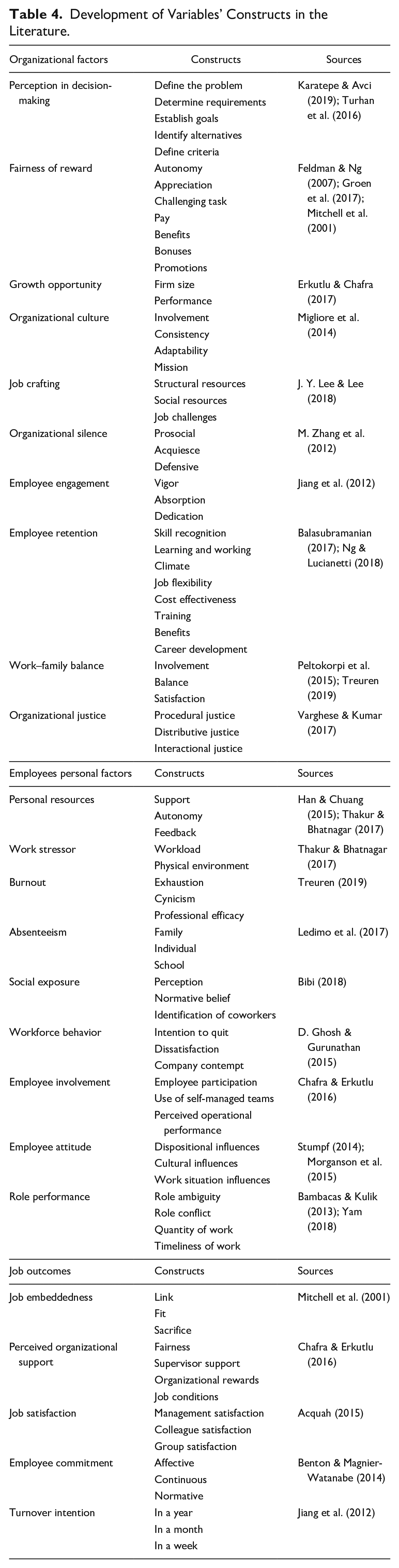
Based on our discussion of the previous literature, all job outcomes cannot be investigated independently due to the changing scenarios of workplace culture. Therefore, organizational and employee behavior theory elements must be jointly considered to address the JE phenomenon extensively and achieve organizational goals. A brief discussion in this study may extend the knowledge of JE theories in the context of job turnover and commitment. Furthermore, this study may help organizations design their embedded policies effectively for future sustainability in employee commitment. Table 4 describes the development of various levels of constructs applied to measure the significance of the proposed JE framework.
Development of Variables’ Constructs in the Literature.
Conclusion
JE has extended its implications as the key construct of investigating employee turnover at the workplace. However, the literature has not conceptualized the broad role of JE in accordance with theories of organization and employee behavior. This study expands the literature by investigating the embedded role of work as a mediating variable. Moreover, it aims to review the systematic development of JE implications in relation to different workplace theories across the service and manufacturing domains.
The systematic review was selected as the preferred methodology to explore the previous contributions to JE theories in the workplace. A content analysis consisting of a systematic review of published articles from 2008 to 2018 was conducted to understand the broad role of JE in the workplace. A total of 108 top-quality research articles published in various high-ranked journals were selected for detailed analysis. Most studies in the existing literature emphasized the intention to quit, work stress, organizational commitment, employee engagement, and organizational justice to find the mediating role of JE in employee turnover in the service and manufacturing sectors. Out of the 200 targeted articles, 108 articles were found relevant to the present study; these articles were frequently cited in the study. Out of 108 papers, 90 were directly related to JE and TOI. Similarly, 30 papers showed JE as a moderator, whereas 45 papers showed the mediating role of JE along with other predictors.
Study Implications
Empirical evidence has shown the extrapolative validity of organizational and community embeddedness in organizations (Watson, 2018). However, to the best of our knowledge, no study has explored embeddedness within the context of employee- and firm-related factors, along with VTOI. Scholars have continued the call to explore embeddedness in emerging domains to find subjective criteria based on the different classifications of embeddedness (Dechawatanapaisal, 2018a). Specifically, this study provides a gateway to studies on the role of JE subdimensions in relation to different outcomes and VTOI. Thus, the embeddedness criteria extracted using an appropriate framework can be applied across other domains where organizations are facing challenges related to achieving outcomes and reducing turnover.
This study presents employee- and organization-related factors as an additional source of JE for improved performance and retention. The relationship found between employee- and organization-related factors and JE suggests important practical implications for employees to develop retention criteria. Contemporary policymakers should understand the role of employees in the workplace and their social needs. Accordingly, to develop a good working environment, organizations should introduce policies that satisfy employees and further encourage them to stay for long periods (Karatepe & Vatankhah, 2014; G. Wang & Netemeyer, 2004). In this regard, proven criteria of embeddedness issues of employees should be addressed on priority bases that could effectively reduce the turnover.
The findings of this study demonstrate different practical implications for organizations looking to develop effective retention strategies. Specifically, this study suggests that organizations should focus on organization- and community-fit constructs in their nurturing strategies to embed staff in their organizations in the future. This study also suggests that monetary rewards only are comparatively trivial to retention. The findings also suggest that management should focus on individual embeddedness strategies. A communal approach might not work in certain organizational practices because individual embeddedness practices are idiosyncratic in nature and might show a different effect on employee creativity and turnover.
Scholars are increasingly emphasizing a series of high-performance organizational practices to enhance embeddedness, thereby controlling VTOI. First, skill upgrading can improve employees’ knowledge, skills, and abilities. These bundles of resources, such as training, tuition reimbursement, and socialization, can increase employee embeddedness in work, organization, or career. Second, opportunity enhancement involves individuals in the organization and work; provides them with resources; and enables them to expand decision-making power, independent team cooperation, and dispute resolution. Third, organizations should encourage and enhance their staff’s vitality and maintain and guide the staff to pursue their work goals. By implementing such practices, the organization can link work efforts with external compensation, thereby improving on-the-job and off-the-job embeddedness.
Limitations
Other key areas been have neglected in the literature. These areas can be linked with JE to understand and evaluate organizational and employee behavior theories. Subsequently, we suggest that further knowledge of JE can be extended in relation to the different key organizational and employees’ personal factors along with different job outcomes. This study contributes to the literature and further extends the theory of JE that researchers and practitioners should adopt for future studies.
This study shows that some factors can significantly change the relationship between JE and TOI from positive to negative. This study is a step toward an improved understanding of the negative aspect of JE; such an understanding can occur when an embedded connection network is created to capture individuals in an organization. In conclusion, this study involves the emotional aspects of JE and considers how TOI affects embeddedness, with adverse consequences for organizations in the form of low job commitment.
Footnotes
Declaration of Conflicting Interests
The author(s) declared no potential conflicts of interest with respect to the research, authorship, and/or publication of this article.
Funding
The author(s) received no financial support for the research, authorship, and/or publication of this article.
