




Abstract
New generation employees have become a major force in the workplace, and their high turnover rate is a major issue in academia and business. Drawing from the psychology of working theory and the job characteristics model, this study aims to explore the influence of decent work on new generation employees’ turnover intention and the roles of job satisfaction and job autonomy in this relationship. After collecting a sample of 391 new generation employees in China through online questionnaires, we utilized SPSS 21.0 and AMOS 21.0 to analyze the data. The results show that decent work has a negative impact on turnover intention and job satisfaction plays a mediating role in the relationship between decent work and turnover intention. Moreover, job autonomy is found to positively moderate the relationship between decent work and job satisfaction, and also moderate the indirect effect of job satisfaction on the relationship between decent work and turnover intention. Finally, the theoretical and practical implications are discussed, and limitations and future directions are highlighted.
Introduction
In today’s market environment full of volatility, uncertainty, complexity, and ambiguity, talents are valued by all excellent enterprises. New generation employees who were born between 1980 and 1999 have begun to board the stage of history, and have gradually become the main force in the workplace (Hou et al., 2014). However, growing up in an era of rapid economic development and diverse cultures, the young people in China differ from their older counterparts in personality traits, career choices, and work values (Zhao, 2018). On the one hand, they pursue fairness and freedom, have a strong sense of innovation and pay attention to interpersonal harmony (Zhu et al., 2015). On the other hand, they have strong self-awareness, low organization loyalty, and a high frequency of job-hopping (Lee et al., 2017). Park and Shaw (2013) claimed that the frequent turnover of employees will not only add to the human cost of enterprises but will also make enterprises lose their competitiveness in the market. Therefore, how to effectively prevent the resignation of new generation employees has become an urgent problem faced by many enterprises, and has also been widely concerned by scholars.
To address this issue, the academic circles at home and abroad have extensively discussed the impact of work-related factors on employees’ turnover intention, such as work pressure (Podsakoff et al., 2007), work environment (Caroline et al., 2016), and salary (Xiong et al., 2018). However, with the advent of the era of knowledge economy, young workers not only pursue material rewards but also desire to gain decent work which can enable them to have fulfilling and productive working experience (Ferraro et al., 2018). This is especially true in the context of a collectivist culture where Chinese people care much about what other people think about their work and new generation employees will feel proud of themselves when they mention their work in front of their relatives and friends.
Meanwhile, a newly proposed theory called the psychology of working theory emphasizes the importance of decent work for all working adults and explains how individuals can obtain a sense of achievement and happiness via decent work (PWT; Duffy et al., 2016), and a recent research drawing upon PWT has pointed out that decent work can negatively influence Chinese urban workers’ turnover intention (Wang et al., 2019). Buyukgoze-Kavas and Autin (2019) also conducted an empirical study based on the Turkish cultural context and found that decent work can negatively predict Turkish working adults’ withdrawal intentions. However, to date, there is no research on the link between decent work and turnover intention among new generation employees. Additionally, the mechanism of decent work on turnover intention and the boundary conditions of the process remain unknown. Through exploring the roles of job satisfaction and job autonomy in the relationship between decent work and turnover intention among new generation employees, our study bridges these gaps. Specifically, we identify job satisfaction as a potential mediating variable as it can reflect employees’ attitudes toward their work (Chen et al., 2012). Recent studies have shown that if new generation employees are content with their work, they will have higher organizational loyalty and are less willing to quit their jobs (Heimerl et al., 2020; Lee et al., 2017). Furthermore, we explore the role of job autonomy within the organization as a boundary condition to the relationship between decent work and turnover intention since it might be an important contextual resource to influence employees’ attitudes and behaviors (Morgeson & Humphrey, 2006).
In sum, given that new generation employees in China generally have lower organizational loyalty and higher frequency of job-hopping (Fang et al., 2020), it is of both theoretical and practical significance to study the relationship between decent work and turnover intention. In this present study, we aim to answer the questions of when and how decent work reduces turnover intention of new generation employees. Specifically, we will analyze the mediating effect of job satisfaction and the moderating effect of job autonomy in the underlying mechanism of decent work on turnover intention. The results of this study can help to open the "black box" in which decent work influences turnover intention of new generation employees, and to provide suggestions for enterprises to reduce the turnover rate of young employees.
Literature Review and Hypothesis Development
Psychology of Working Theory
Vocational psychologists have pointed out that work is an indispensable part of people’s life (Fouad, 2007) since it is closely associated with one’s sense of achievement, physical and mental health, well-being, and so forth (Blustein et al., 2008). Decent work was first proposed at the macro level “to promote opportunities for men and women to obtain decent and productive work on the premise of freedom, equality, security and human dignity” (International Labor Organization, 1999, p. 3). Later, it was integrated into PWT as a core variable which is defined at the micro level, including a safe working environment, sufficient remuneration, sound medical security, adequate leisure time, and matching values with one’s family and community (Duffy et al., 2016).
To date, the theory has been utilized as the theoretical basis of many empirical studies and many scholars throughout the world have confirmed many hypotheses proposed in the theory. For instance, a study showed that decent work can promote need satisfaction, including survival needs, social connection needs and self-determination needs (Autin et al., 2019). By satisfying these three needs, decent work can further promote work achievement, well-being (Kozan et al., 2019), and mental health (Duffy et al., 2019). In addition, when people are engaged in work that can provide them with safe working conditions, sufficient rest time, and medical security, they are more likely to gain physical health (Duffy et al., 2021). Other studies have shown that decent work positively influences work engagement and job satisfaction (McIlveen et al., 2021), and negatively influences employee turnover intention (Wang et al., 2019).
In the present study, PWT was used to build a theoretical framework and to explain the relationship between decent work and its outcomes.
Decent Work and Turnover Intention
When developing the decent work scale, Duffy et al. (2017) explored the relationship between the five dimensions of decent work and employees’ job satisfaction, perceived job meaning, and turnover intention. The results showed that a safe working environment, income, free time, and values positively predict job satisfaction; medical security, income, and values positively predict employees’ sense of work significance; safe working environment, income, and values negatively predict turnover intention (Duffy et al., 2017). A recent study conducted in Turkey found that all the five dimensions of decent work negatively predicted turnover intention (Buyukgoze-Kavas & Autin, 2019). Moreover, empirical studies in other cultures indicated that turnover intention can be attributed to poor working conditions (Arnoux-Nicolas et al., 2016), unsatisfactory income (Singh & Loncar, 2010), and inconsistent values (Moynihan & Pandey, 2008). Thus, the following hypothesis is proposed:
Decent Work and Job Satisfaction
Academics have long believed that job satisfaction provides insight into individuals’ work conditions (Judge et al., 2017), and it is positively related to decent work (Atitsogbe et al., 2021). According to PWT, decent work can allow individuals to obtain job satisfaction via need satisfaction (Duffy et al., 2016). Specifically, when people are involved in decent work, they can not only gain decent pay but also build good relationships with others in the workplace. As survival needs and social connection needs are met, people also experience higher job satisfaction and lower job burnout (Duffy et al., 2017). In addition, people who are involved in decent work tend to think of their work as meaningful (Rosso et al., 2010), which can promote them to enjoy their work better (Andreassen et al., 2010). Thus, the following hypothesis is proposed:
Job Satisfaction and Turnover Intention
Pepe (2010) proposed that job satisfaction will affect employees’ willingness to leave or stay in the organization. To put it another way, if employees are dissatisfied with their work, they are more likely to resign (Ravari et al., 2012). The study by Yu et al. (2020) demonstrated that there is a negative correlation between job satisfaction and turnover intention. Similarly, Lee et al. (2017) showed that job satisfaction of early-career employees exerts a negative impact on their turnover intention. A recent study on millennial employees in India also found that job satisfaction was negatively correlated with turnover intention (Chavadi et al., 2021). Thus, the following hypothesis is proposed:
The Mediating Role of Job Satisfaction
According to PWT, job satisfaction is an indicator of work fulfillment, which refers to workers’ affective reactions toward their job (Duffy et al., 2016). When people have access to decent work, they are more likely to meet their needs for survival, social contribution, and self-determination (Duffy et al., 2016). As these needs are met, people can eventually gain a sense of job satisfaction and well-being (Duffy et al., 2016). An empirical study of employees in China confirmed the positive relationship between decent work and job satisfaction (Chen et al., 2020), which has been empirically validated by many studies in different cultures (Di Fabio & Kenny, 2019; Kim et al., 2019). Besides, quite a few studies showed that employees’ job satisfaction can lower their turnover intention (Alsaraireh et al., 2014). In sum, employees who have access to decent work are likely to feel satisfied with their work, which will in turn reduce their intention to quit. In other words, if decent work perception increases, job satisfaction will increase as well. If job satisfaction increases, the turnover intention will decrease. Thus, the following hypothesis is proposed:
The Moderating Role of Job Autonomy
Job autonomy refers to the degree of freedom and independence allowed by a job in arranging work, making decisions and choosing the method of performing tasks (Morgeson & Humphrey, 2006). Specifically, when employees have autonomy at work, they can complete tasks in a free manner according to their judgment and preferences. According to Galletta et al. (2011), employees with high job autonomy are likely to experience a sense of responsibility for the results of their work. New generation employees are reluctant to obey orders and follow instructions. Instead, they prefer to work freely and independently (Lee et al., 2017). When they evaluate a job, they not only pay attention to the salary but also consider whether they can have a say in the job to give full play to their talents (Ding et al., 2016). According to the job characteristics model, when employees perceive more autonomous opportunities provided by the organization, they will have internal positive feelings toward their work (Fried & Ferris, 1987). A recent empirical study found that employees are highly motivated by job autonomy, and job autonomy exerts a positive impact on their job satisfaction (DeCarlo & Agarwal, 1999). Given that job autonomy is considered a contextual resource that affects employees’ attitudes in an organization, it is projected to be an important boundary condition in the influence of decent work on employees’ job satisfaction. Further, we speculate that job autonomy will also positively moderate the indirect impact of decent work on turnover intention via job satisfaction. In other words, if job autonomy is higher, it will strengthen the relationship between decent work and job satisfaction. Meanwhile, if job autonomy is higher, it will strengthen the mediation effect of job satisfaction between decent work and turnover intention. Thus, the following hypotheses are proposed:
We present our research model reflecting these hypotheses in Figure 1.

Research model.
Method
Procedure and Participants
We used convenience sampling approach to conduct our surveys which lasted from June 2021 to August 2021. After designing the questionnaire on WJX online data collection website (www.wjx.cn) which is deemed highly reliable by academic institutes in mainland China, a link to the online questionnaire was distributed via a social networking platform. We contacted members on WeChat which is a major social networking app in mainland China to reach our target subjects. The questionnaire we collected came from all over the country. Before taking the survey, participants were informed that working adults born between 1980 and 1999 could successfully submit the questionnaire online and that the survey was related to their experiences with work. To improve the accuracy of the research, we also informed the target respondents that the questionnaire would be kept confidential and the results of the survey would only be used for academic purposes. After completing the questionnaire, participants were rewarded with three RMB (approximately US $0.5) for their participation. We distributed 500 questionnaires and 402 questionnaires were returned with a return rate of 80.4%. In the process of sorting out the data, we excluded those who spent less than 2 minutes to finish our questionnaire and those who failed attention check items. Additionally, respondents who did not meet our age criteria were also removed. So, there were 391 valid questionnaires involved in the final statistical analysis. According to the survey system sample size calculator (https://www.surveysystem.com/sscalc.htm), we set the confidence level as 95% and confidence interval as 5%, the sample size request for new generation employees should be 384. Therefore, the sample we collected should be sufficient for the research.
The demographic characteristics of the 391 participants were analyzed via frequency analysis. In terms of gender, females accounted for the largest proportion at 58.57% (n = 229). In the age group, the post-1990 generation occupied the highest percentage at 36.57% (n = 143). In terms of marital status, the majority of respondents were married, at 203 (51.92%). With regard to education, the percentage of participants holding a bachelor’s degree was the largest at 52.94% (n = 207). As far as tenure is concerned, 113 participants (28.9%) indicated that they had at least 10 years of working experience. When it comes to the nature of enterprise, the largest number of respondents reported working in private enterprises, at 213 (54.48%). The detailed descriptive data of the sample are provided in Table 1.
Demographics Characteristics of Sample.

Instruments
The scales used in the current study were from articles published in internationally renowned journals. The English scale followed the translation-back procedure (Brislin, 1986) and was perfected by a doctor of management with good English. After a small range of filling tests, a formal questionnaire was formed. 5-point Likert scale was used for all items in the questionnaire (1 = “strongly disagree” and 5 = “strongly agree”).
Decent work
Respondents’ perceptions of their decent work were measured by the Decent Work Scale, which includes 15 items assessing five dimensions of decent work (Duffy et al., 2017). A sample item is “I feel emotionally safe interacting with people at work.” The Cronbach’s alpha for this scale was .928 in the current study.
Job satisfaction
To measure respondents’ job satisfaction levels, we adopted three items from Judge et al. (1998), and two items from Zheng et al. (2015). A sample item is: “I feel fairly satisfied with my present job.” The Cronbach’s alpha for this scale was .895 in the current study.
Job autonomy
We used Morgeson and Humphrey’s (2006) three-item Job Autonomy Scale to measure respondents’ levels of job autonomy. A sample item is “I have made my own decision about how to schedule my work.” The Cronbach’s alpha for this scale was .894 in the current study.
Turnover intention
Respondents’ intent to leave the current enterprise was measured by Mobley et al. (1978) three-item Turnover Intention Scale. A sample item is “I often want to leave my present unit.” The Cronbach’s alpha for this scale was .878 in the current study.
Data Analysis
SPSS 21.0 was used to conduct descriptive analysis and correlation analysis, and AMOS 21.0 was used for the measurement model and structural equation model. More specifically, we adopted confirmatory factor analysis to access reliability and validity of the measurement model, and we used χ2/df, CFI, TLI, RMSEA, and SRMR to assess the model-data fit. Concerning the structural model test, the direct effect was examined by path analysis. Moreover, the mediating and moderating effects were analyzed.
Results
Measurement Model Testing
Since all the items measuring the core variables were self-reported, there might be common method variance. We conducted the Harman single-factor test to detect common method variance (Podsakoff et al., 2012). All the items in the questionnaire were put into exploratory factor analysis, and the results showed that the first precipitated factor accounted for only 39.608% of the total variation, which was lower than the critical value of 50%. Therefore, there was no serious common method variance in the data obtained in this study.
We then assessed the reliability of the data based on values of Cronbach’s alpha and composite reliability (CR). According to Hair et al. (2010), if the value of both Cronbach’s alpha and CR is greater than .7, then the data can indicate good reliability. We then evaluated the convergent validity according to the values of factor loading and average variance extracted (AVE). If the value of both factor loading and AVE is higher than .5, then the data can show good convergent validity (Fornell & Larcker, 1981; Hair et al., 2010; Nunnally, 1994). Table 2 illustrates the reliability and convergent validity of our data with satisfactory critical values for further analysis.
Reliability and Convergent Validity.
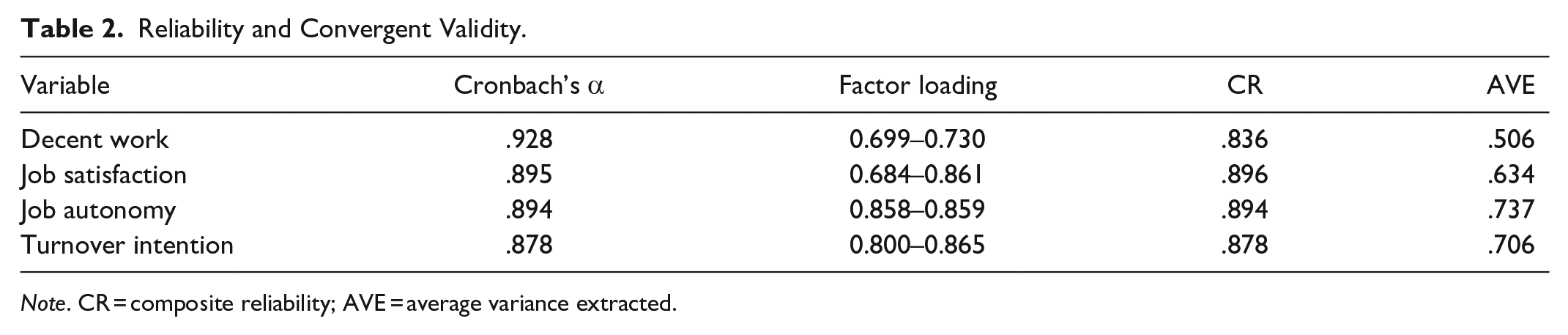
Note. CR = composite reliability; AVE = average variance extracted.
Regarding discriminant validity, we followed the recommendations of Fornell and Larcker (1981). The criterion of discriminant validity has been fulfilled if the square root of AVE is larger than the correlations of each construct. Table 3 shows that all the square roots of AVE are greater than the correlations between constructs used in our study, which further suggests good discriminant validity.
Correlation Coefficient Matrix and Discriminant Validity.

Note. N = 391. Figures in bold on diagonals are the square root of AVE of each construct.
p < .01 (two-tailed tests).
Descriptive statistics and correlations for the four variables of this study are also reported in Table 3. Decent work was positively related to job satisfaction (r = .645, p < .01), and negatively related to turnover intention (r = −.448, p < .01). Job satisfaction also indicated a negative correlation with turnover intention (r = −.464, p < .01). Thus, the correlations showed preliminary support for our hypotheses.
Model-Data Fit
A good model-data fit should present χ2/df value below 3, RMSEA value below 0.08, SRMR value below 0.05, and TLI, CFI, GFI, and AGFI values above 0.90 (Hu & Bentler, 1999; Kline, 2015). The fit indexes of the current model were χ2/df = 1.502, RMSEA = 0.036, SRMR = 0.033, TLI = 0.983, CFI = 0.986, GFI = 0.955, and AGFI = 0.937, all reaching or approaching the critical values. Therefore, the proposed model had a good fit with the actual data.
Hypothesis Testing
The hypothesized relationships in the theoretical framework were tested by performing a structural equation model evaluation. According to the results of path analysis shown in Table 4, decent work had a significant negative impact on turnover intention (β = −.302, p < .001); decent work had a significant positive effect on job satisfaction (β = .737, p < .001); job satisfaction had a significant negative impact on turnover intention (β = −.308, p < .001). Therefore, hypotheses 1 to 3 were supported.
Results of Path Analysis.

Note. DW = decent work; JS = job satisfaction; TI = turnover intention.
p < .001.
To test the mediation effect, the confidence interval of the indirect effect was calculated based on bootstrapping. The results are reported in Table 5. The indirect effect of job satisfaction based on 5,000 bootstrapped re-sampling was significant (estimate effect = −0.227, 95% confidence interval [−0.351, −0.087]). Thus, the role of job satisfaction as a mediator between decent work and turnover intention was supported (i.e., hypothesis 4).
Indirect Effect of Decent Work on Turnover Intention via Job Satisfaction.

Note. DW = decent work; JS = job satisfaction; TI = turnover intention; LLCI = bias corrected lower limit of 95% confidence interval; ULCI = Bias corrected upper limit of 95% confidence interval.
According to Aiken and West (1991), multiple hierarchical regression is a common way to verify the moderating effect. The moderating effect of job autonomy was examined by multiple hierarchical regression. According to the results shown in Table 6, we confirmed a significant interaction effect of decent work and job autonomy on job satisfaction (β = .134, p < .05). Besides, a simple slope diagram was drawn (see Figure 2) to further reflect the moderating effect of job autonomy. The simple slope test showed that the positive link between decent work and job satisfaction was much stronger when the level of job autonomy was high. Thus, hypothesis 5 was supported.
Multiple Hierarchical Regression Analysis.

p < .05. ***p < .001.

Visualization of moderation effect.
In order to verify the moderating effect of job autonomy on the mediating effect of job satisfaction, we adopted the PROCESS program in SPSS, selecting Model 7 and conducting 5,000 random sampling tests with the bootstrap method. As shown in Table 7, the index of moderated mediation was significant (β = −.040, 95% confidence interval [−0.087, −0.006]). Besides, decent work has a more significant indirect effect on turnover intention via job satisfaction when the level of job autonomy is high (β = −.271, 95% confidence interval [−0.390, −0.156]) than when the level of job autonomy is low (β = −.195, 95% confidence interval [−0.292, −0.115]). Thus, hypothesis 6 was supported.
Moderated Mediation Effect of Job Autonomy.

Note. LLCI = Bias corrected lower limit of 95% confidence interval; ULCI = bias corrected upper limit of 95% confidence interval.
Discussion
There is a consensus among scholars that it is essential to make the most of new generation employees who are likely to become great contributors to organizations for their open-mindedness, professional knowledge, and creativity (Meister & Willyerd, 2010; Shri, 2011). However, in the existing literature, the research on turnover intention of new generation employees is scarce, and the research from the perspective of decent work is even less. To address these research gaps, this study, based on PWT and job characteristics model, explored the relationship and internal mechanism between decent work and turnover intention among new generation employees. It is found that decent work allows new generation employees to be satisfied with their work, and then exhibit low levels of turnover intention. In addition, job autonomy moderates the relationship between decent work and job satisfaction as well as the mediated relationship between decent work and turnover intention via job satisfaction.
Theoretical Implications
Firstly, studies have demonstrated the high turnover of new generation employees as a pressing issue in many organizations all around the world and have called for more research to address it (Chavadi et al., 2021). Previous studies have focused on the influence of organization support (Cheng & Lin, 2017), inclusive talent development model (Fang et al., 2020), and job mismatch (Chavadi et al., 2021) on new generation employees’ turnover intention. By contrast, our study sets a precedent in its correlation of decent work to new generation employees’ turnover intention. Since decent work consists of adequate pay, comfortable working conditions, free time and rest, healthcare, and values (Duffy et al., 2017), it is a more inclusive and enriching construct which can effectively predict employees’ turnover intention. Consistent with preceding studies (Buyukgoze-Kavas & Autin, 2019; Wang et al., 2019), the results of our research indicate that decent work negatively affects new generation employees’ turnover intention. This is likely due to the fact that young workers growing up in the era of rapid economic development in China pay more attention to decent work experience and work-life balance. They are more likely to stay in the organization if they experience decent work. Conversely, they are likely to leave the organization if their work is not decent enough. Thus, our study enriches the research on the antecedents of turnover intention among new generation employees.
Secondly, our theoretical model not only explains how decent work is linked to the turnover intention of new generation employees but also explores job satisfaction as an underlying mechanism in this relationship. A review of the literature reveals that although past studies have explored the outcomes of decent work (Chen et al., 2020; McIlveen et al., 2021), little attention has been paid to the underlying reasons behind the relationship between decent work and turnover intention in organizational contexts. In order to fill the gap, our study found that job satisfaction mediates the relationship between decent work and turnover intention. Put another way, this finding implies that when new generation employees are engaged in decent work, they are likely to have higher job satisfaction, which will in turn lower their turnover intention.
Thirdly, our study also revealed the moderating role of job autonomy in the relationship between decent work and job satisfaction, and the indirect link between decent work and turnover intention through job satisfaction is moderated by job autonomy. More specifically, drawing on the job characteristics model, we found that job autonomy strengthens the positive impact of decent work on job satisfaction. Therefore, our study reaffirms the validity of the theory and widens its applicable scope. In addition, we also found that when new generation employees are involved in autonomous tasks, they are more likely to become satisfied with their work, which can eventually reduce their turnover intention. The findings help to illustrate how decent work influences turnover intention and when the turnover intention of new generation employees declines. Moreover, our results are consistent with the observations of Galletta et al. (2011) who proposed that organizations need to provide attractive autonomous opportunities for employees to reduce their turnover intention.
Lastly, although PWT has been used to explore attitudes and behaviors of diverse groups, such as low-income employees (Duffy et al., 2019), marginalized grown-ups (Duffy et al., 2018), nursing college students (Ma et al., 2020), and so on, few studies have so far examined variables from PWT to understand the working status of new generation employees, and specifically have linked decent work with young workers’ turnover intention. With a sample of new generation employees in China, we filled these gaps by linking decent work with its outcomes. Thus, our study can not only deepen the understanding of this special group but can also help to expand the scope of the application of PWT.
Practical Implications
The results of this study provide important implications for enterprises. Therefore, this study puts forward the following suggestions for management practices. First, our study draws the attention of managers to the influence of decent work as a source of turnover intention either directly or indirectly through job satisfaction. So, they need to find ways to enhance new generation employees’ perceptions of decent work. For example, organizations should make the scientific and reasonable design of their work content, working hours and salary, and create a free and comfortable working environment, which can not only improve the perception of decent work of employees but also improve their job satisfaction and organizational loyalty.
Second, since job satisfaction is found to mediate the relation between decent work and turnover intention, organizations need to take actions to improve millennial employees’ job satisfaction. For example, organizations can carry out humanized management according to the values and behavior preferences of new generation employees. Since new generation employees value work fun, organizations should create a pleasant atmosphere at work. When new generation employees are pleased with their work, they are more productive and less likely to quit their jobs (Sahni, 2021).
Finally, our findings suggest that job autonomy plays a crucial role in retaining new generation employees. In other words, the degree of job autonomy is of paramount importance to improving their commitment to the organization and their satisfaction with work. Hence, managers should fully empower new generation employees by allowing them to decide what to do at work and how to carry out their work.
Limitations and Future Directions
Although this study makes theoretical and practical contributions, it also has a few limitations which need to be resolved in the near future. First, this study employed a cross-sectional design, so the causality of our results cannot be guaranteed. Future studies could use a stricter research design by obtaining longitudinal data to confirm a causal effect (Ployhart & Vandenberg, 2010).
Second, the sample data were exclusively obtained in the Chinese context, which might limit the general applicability of our findings. Since new generation employees in China might have distinct career attitudes from those in other countries, future studies could adopt our research model using samples in other settings to further improve the external validity of the findings.
Third, our data supported the mediating role of job satisfaction in understanding the impact of decent work on turnover intention. However, other mediators may also clarify the above relationship. For instance, considering that decent work is positively related to employee well-being (Autin et al., 2019) and that employee well-being is negatively related to turnover intention (Duffy et al., 2018), we anticipate that employee well-being might also mediate the effect of decent work on turnover intention.
Finally, although the results of our study showed that job autonomy positively moderates the relationship between decent work and job satisfaction, it is likely that there are other boundary conditions which may be used to explore the above relationship as well as the relationship between job satisfaction and turnover intention. Thus, future research could examine the moderating impact of other variables in order to have a clearer understanding of the underlying mechanism of decent work on turnover intention.
Conclusion
Based on the psychology of working theory and the job characteristics model, the current study aims to explore the influence of decent work on new generation employees’ turnover intention and the roles of job satisfaction and job autonomy in this relationship. After collecting a sample of 391 new generation employees in China through online questionnaires, we utilized SPSS 21.0 and AMOS 21.0 to analyze the data. The results show that decent work has a negative impact on new generation employees’ job satisfaction and turnover intention. In addition, job satisfaction is found to negatively influence the turnover intention of new generation employees and play a mediating role in the relationship between decent work and turnover intention. Moreover, job autonomy is found to positively moderate the relationship between decent work and job satisfaction, and also moderate the indirect effect of job satisfaction on the relationship between decent work and turnover intention. The findings of this study may provide some implications for both managers and scholars.
Research Data
sj-xlsx-1-sgo-10.1177_21582440221094591 – Supplemental material for Decent Work and Turnover Intention Among New Generation Employees: The Mediating Role of Job Satisfaction and the Moderating Role of Job Autonomy
Supplemental material, sj-xlsx-1-sgo-10.1177_21582440221094591 for Decent Work and Turnover Intention Among New Generation Employees: The Mediating Role of Job Satisfaction and the Moderating Role of Job Autonomy by Wei Wan and Ryan D. Duffy in SAGE Open
Footnotes
Acknowledgements
Special thanks to all the subjects for participating in the survey.
Declaration of Conflicting Interests
The author(s) declared no potential conflicts of interest with respect to the research, authorship, and/or publication of this article.
Ethical Approval
Due to the observational nature of the study, and in the absence of any involvement of therapeutic medication, no formal approval of the Institutional Review Board of the local Ethics Committee was required. Nonetheless, all subjects were informed about the study and participation was fully on a voluntary basis. Participants were ensured of confidentiality and anonymity of the information associated with the surveys. The study was conducted according to the guidelines of the Declaration of Helsinki.
Funding
This study appreciated the financial support from Graduate Innovation Special Fund Project of Jiangxi Province, China (Grant No. YC2021-B096).

References
Supplementary Material
Please find the following supplemental material available below.
For Open Access articles published under a Creative Commons License, all supplemental material carries the same license as the article it is associated with.
For non-Open Access articles published, all supplemental material carries a non-exclusive license, and permission requests for re-use of supplemental material or any part of supplemental material shall be sent directly to the copyright owner as specified in the copyright notice associated with the article.
