



Abstract
This research endeavors to investigate the influence of Social Capital and Shared Leadership on both Digital Transformation and Firm Performance, as well as the impact of Digital Transformation on Firm Performance. A survey encompassing 111 Small and Medium-sized Enterprises (SMEs) situated in the Mekong Delta region of Vietnam was conducted. Utilizing Structural Equation Modeling (SEM) analysis, the study examined various facets of leadership style, including task orientation, relationship orientation, representative orientation, and participation in advancing the digital transformation endeavor. Results indicate that a task-oriented leadership approach has a detrimental effect on digital transformation. Conversely, social capital and shared leadership positively correlate with digital transformation and subsequently enhance firm performance. Noteworthy findings include the observation that while the influence of social capital on digital transformation lacks statistical significance, it plays a constructive regulatory role in mediating the relationship between digital transformation and Firm Performance, as well as in the association between shared leadership and firm performance. The study underscores the imperative for SMEs to capitalize on social capital and cultivate leadership styles conducive to fostering digital transformation, thereby augmenting Firm Performance.
Plain language summary
1. Aims and purpose of the research: This study aims to explore the impact of social capital and shared leadership style on digital transformation and business performance; the promoting role of social capital on the relationship between shared leadership style and business performance, and between digital transformation and business performance. 2. Background of the research: Digital transformation helps businesses increase their competitive advantage, improve operational efficiency, and achieve business growth because it significantly changes the way the market operates, reducing the costs of searching, transporting, reproducing, trading, and finding new market opportunities. Especially for Vietnam, a developing country, businesses still have many limitations in terms of capital, technology, and management capacity. Taking advantage of external capital and building a suitable leadership style to promote the digital transformation process is a necessary requirement for development. 3. Methods and research design: The study tests the hypotheses and research model using the structural equation modeling (SEM) tool. To analyze the moderating role of SoC, the study conducts three steps: step 1 analyzes the relationships with the participation of SoC; step 2 analyzes under similar conditions to step one but without the participation of SoC; step 3 compares the results to evaluate the moderating role of SoC. The study was conducted with 222 respondents who were managers and IT officers of 111 enterprises in the Mekong Delta of Vietnam. 4. Results and importance: The research results show that external social capital increases the performance of SMEs. Sharing leadership style promotes the digital transformation process, increasing business efficiency. Although social capital does not affect digital transformation, positive external relationships enhance the positive impact of digital transformation on performance. With these results, SMEs in Vietnam should take advant.
Introduction
Digital Transformation (DTr) is pivotal for nations seeking a competitive edge amid market competition (C. L. Chen et al., 2021). It enables businesses to bolster their advantage, enhance operational efficiency, and drive growth (C. L. Chen et al., 2021). Digital technology reshapes market dynamics, reducing costs and identifying opportunities (C. L. Chen et al., 2021). Consequently, organizations must adapt their practices and mindset to survive (Osmundsen et al., 2018). Despite its benefits, businesses encounter barriers such as technical obstacles and organizational culture (C. L. Chen et al., 2021; Hartl & Hess, 2017).
Vietnam is undergoing the Fourth Industrial Revolution, building a digital society based on a digital economy and digital governance. DTr brings forth numerous benefits, such as reducing societal costs, enhancing service quality, improving the efficiency of government machinery, and boosting business performance. Small and medium-sized enterprises (SMEs) play a particularly crucial role in Vietnam’s economy, with approximately 785,000 enterprises, accounting for over 98% of the total number of businesses. They employ 70% of the workforce and contribute about 50% to the GDP.
Similar to the reality of DTr in other developing countries, the DTr process of SMEs in Vietnam is still lagging behind expectations due to various hindrances. These obstacles include technological infrastructure, financial constraints, the leadership’s awareness, and the ingrained habit of operating within traditional mechanisms. According to a research report on the digital maturity of SMEs in the Asia-Pacific (APAC) region in 2020 by Cisco, Vietnam ranked 14th out of 14 countries. Furthermore, according to forecasts by the Ministry of Information and Communications of Vietnam, if SMEs successfully undergo digital transformation, the GDP will increase by approximately 30 billion USD, accounting for around 7.5% of the GDP in 2022 (Thuy Dieu, 2023). Promoting digitization activities and successfully implementing DTr are urgent requirements of the current landscape.
Social capital (SoC) includes both the form and nature of relationships between members of an organization (Coleman, 1990; Leana & Pil, 2006) called “internal SoC,” as well as the connection between the organization and external entities, which can be competitors or partners (Kale et al., 2000; Uzzi, 1997) known as “external SoC” (Leana & Pil, 2006).
Several scholars have examined the correlation between internal Social Capital (SoC) and organizational performance, such as Aidoo et al. (2020) and Abban et al. (2013), along with investigating the regulatory role of internal SoC as highlighted by Rodrigo-Alarcón et al. (2018). Additionally, research conducted by Lyu et al. (2022) and Ul Zia et al. (2023) illustrates the influence of internal SoC on the innovation performance and capacity of enterprises. However, internal SoC alone may not necessarily enhance operational efficiency due to potential negative compliance arising from close relationships, as noted by Portes (1998) and Uzzi (1997). Therefore, the utilization of external sources for accessing information and resources becomes imperative, as emphasized by Burt (2000). Heller and Firestone (1995) emphasize the crucial role of external SoC in facilitating resource acquisition for organizations. Collins and Clark (2003) observe that robust external connections among top managers in high-tech firms significantly predict sales growth and stock profitability.
Research by Tomlinson and Fai (2013) underscores the importance of collaborative relationships in enabling SMEs’ innovation capabilities across various production activities in the value chain. Similarly, Easmon et al. (2019) demonstrate the impact of external social capital on export performance through innovation and marketing capacities. Kale et al. (2000) provide empirical evidence suggesting that building relational capital, combined with an integrated approach to conflict management, facilitates simultaneous achievement of learning and know-how transfer goals while mitigating opportunistic behavior among alliance partners, thereby preventing the leakage of valuable know-how.
SMEs, facing constraints in capital, technology, managerial capacity, and market conditions, must leverage external opportunities for development, as emphasized by Freel and Harrison (2006). They illustrated the limited capacity of SMEs for independent innovation compared to those engaged in collaborative ventures. Similarly, Koçak and Edwards (2005) advocated for SME survival through cooperative relationships with industries, governments, and other SMEs. Khan et al. (2018) also stressed the importance of seeking external knowledge and support in less-developed economies.
Previous studies primarily focus on the direct or indirect impact of external Social Capital (SoC) on operational efficiency and innovation capacity, neglecting to evaluate its regulatory role in amplifying the effects of other factors on SME performance. Thus, this study examines how external SoC promotes digital transformation and enhances operational efficiency while moderating the relationship with other factors.
The capabilities and leadership approaches of organizational managers play a decisive role in successful digital transformation, helping identify and shape the issues that pave the way for innovation, facilitating favorable interactions among employees within the organization, and encouraging participation in innovative activities. This allows employees to have more involvement in the decision-making process of change (Curry, 1992; Gray, 2009). The shared leadership model, characterized by the participation of members in the organization’s leadership, enhances organizational and team performance (Fransen et al., 2018); Transformational leadership affects organizational performance and culture, with varying impacts depending on the context (N. P. Nguyen et al., 2023; Habeeb & Eyupoglu, 2024). However, some researchers have failed to find support for the idea that shared leadership leads to better team performance (Boies et al., 2009). It is essential to identify the relationship between Shared Leadership and performance to clarify the role of Shared Leadership in business operations; this is a suitable leadership model to promote digital transformation. Research results from Vietnamese enterprises showed that the transformational leadership style of the CEO has a significantly positive impact on the use of management accounting information systems (Abu Afifa & Nguyen, 2023). Shared leadership, characterized by member participation, enhances organizational performance, yet its role in digital transformation remains underexplored Ho Dai and Huynh Tan (2023).
Our research aims to fill this gap by investigating the interplay between social capital, shared leadership, digital transformation, and SME efficiency to propose strategies for enterprise development.
The structure of our paper is as follows:
Section 1: This section serves as an introduction, where we lay out the research background, justify the necessity of our study, and detail our research objectives and the overall layout of the paper.
Section 2: This section presents a review of pertinent literature, providing the academic backdrop against which we study is positioned.
Section 3: Here, we discuss the methodology utilized for this empirical study, explaining the research design, data collection, and analytical tools employed.
Section 4: We report the results of we study in this section, presenting key findings in an organized and interpretable manner and we delve into a discussion of the research results.
Section 5: The final section concludes we study, summarizing key insights, connecting the findings to the existing literature, acknowledging limitations, and highlighting the study’s contribution to the field.
Concept, Hypothesis, Research Model
Theory of Social Capital
Bourdieu (1986) outlines three forms of capital: cultural, economic, and social, with social capital defined as the accumulation of resources through durable networks of mutual acquaintance and recognition, providing collective backing to its members. He argues that social capital is not inherently independent but results from intentional or unintentional investment strategies aimed at establishing or maintaining social relationships.
Social capital (SoC) is vital for group and organizational performance, according to Nahapiet and Ghoshal (1998), Leana and van Buren (1999), and Leana and Pil (2006).
Various studies analyze social capital through general and scope approaches, with the former examining cognitive, relational, and structural aspects. Researchers like H. T. T. Nguyen and Ha (2020), Saha and Banerjee (2015), and Pratono and Mahmood (2014) have demonstrated its positive impact on business performance.
The scope approach considers social capital both within and outside the enterprise. Internal SoC concerns relationships within organizations, while external SoC involves connections with external stakeholders, as highlighted by Coleman (1990), Leana and Pil (2006), Kale et al. (2000), Uzzi (1997), and Luo et al. (2004).
This study explores the role of external social capital in the digital transformation and operational efficiency of SMEs, drawing on social capital theory.
Resource-Based View Theory, RBV
The Resource-Based View (RBV) theory has been extensively employed in Information Technology research to elucidate how companies may acquire competitive advantages and superior performance. The crux of this theory is that a firm’s superior operational effectiveness emanates from its unique, scarce, and difficult-to-imitate resources and competencies (J. B. Barney, 1986; Bharadwaj, 2000). The theory postulates that the skills, capabilities, and other resources owned by an organization vary among organizations, and these resources are the key determinants of the firm’s operations. Therefore, companies that can identify resource characteristics or capabilities that cannot be imitated by competitors will achieve sustainable competitive advantages (J. Barney, 1991).
Social capital (SoC) is a source of enduring competitive advantages and differentiation (Adler & Kwon, 2002). With this characteristic, SoC aligns with the RBV. This study analyzes SoC as a resource propelling DTr and firm performance.
Shared leadership (SL) is the behavior and leadership style of managers and is a unique skill of the organization. With this characteristic, SL aligns with the RBV. This study analyzes SL as a resource driving DTr and firm performance.
Digital Transformation (DTr) assists businesses in enhancing their competitive advantage, improving operational efficiency, and achieving business growth. This study analyzes DTr as a resource bolstering the firm performance.
Concepts
Shared Leadership
Shared leadership has been delineated in various ways, yet a prevailing consensus among scholars suggests that it involves team members sharing leadership responsibilities while still acknowledging vertical leadership capabilities (Fransen et al., 2018; Pearce & Conger, 2003). Burns (1978, pp. 4–20) studied transformational leadership style, a form of empowering leadership; in which transformational leaders build dynamic relationships with employees, who feel elevated by these relationships and become more dynamic, thereby creating new leadership groups and thus having a transformational impact on both. Fisher and Bibo (2004) and Ho Dai and Huynh Tan (2023) elaborated on shared leadership, proposing a tri-dimensional model that preserves two dimensions of the traditional leadership model—relationship orientation and task orientation—and adds a third dimension of representation and participation. Task Orientation (TOL) is crucial for meeting the organization’s task demands, encompassing stress alleviation, support provision, setting work standards, evaluating member performance, and making demands on members. Relationship Orientation (ROL) addresses subordinates’ needs by fostering a positive work environment without compromising task demands. Representation/Participation Orientation (PROL) involves behaviors where subordinates influence work-related decisions. Sarin and O’Connor (2009) systematically categorized four distinct leadership behaviors, including Participative Leadership, Supportive Leadership, Achievement-oriented leadership, and Directive leadership. Our study extends the analysis of shared leadership by Fisher and Bibo (2004), Ho Dai and Huynh Tan (2023), and Sarin and O’Connor (2009), incorporating a tri-dimensional framework encompassing relationship orientation leadership (Support Leadership), task orientation leadership (Achievement-oriented leadership), and Representation/Participation Orientation leadership (Participative Leadership).
Digital Transformation (DTr)
Digital transformation herald significant organizational modifications driven, constructed, or activated by digital technology, altering how business operations are conducted (Hartl & Hess, 2017). It encompasses shifts grounded on the foundation of digital technology, engendering unique alterations in business operations, processes, and value creation (Libert et al., 2016).
In this study, digital transformation in enterprises is delineated as the assimilation and utilization of digital technologies, including big data, analytics, cloud computing, mobile, and social media platforms, to innovate and create novel values. This process aims to augment business efficiency, enhance management efficacy, elevate capabilities, and refine the competitive edge of enterprises.
Firm Performance—FPe
The Firm Performance (FPe) metric is a vital gage of an enterprise’s ability to achieve its goals and assess its competitiveness, characterized by its profitability, growth trajectory, and market valuation (Nwankpa & Roumani, 2016). By utilizing the Balanced Scorecard (BSC) approach, organizations can assess their operational effectiveness by integrating key performance indicators across financial, customer satisfaction, operational processes, and staff learning and development domains (Y. Y. K. Chen et al., 2016).
Our research scrutinizes corporate performance, focusing on facets such as profitability, growth, and market valuation.
Hypothesis on the relationship between the concepts:
Social Capital and Digital Transformation
Tomlinson and Fai (2013) delineated the potency of collaborative relationships across a spectrum of manufacturing activities within the value chain as pivotal catalysts bolstering the innovative capabilities of SMEs in both product and process innovations. Rost (2011) posited that the robustness of inter-organizational relationships plays a cardinal role in fostering innovation. A digital milieu, underpinned by trust, can emanate from knowledge sharing and transactional behaviors (Ridings et al., 2002). Ul Zia et al. (2023) substantiated that social capital bears a positive correlation with the industry’s readiness for the 4.0 era.
Digital Transformation (DTr) embodies the innovation trajectory of SMEs; thus, external social capital significantly propels the DTr dynamics of these enterprises. The hypothesis postulated is:
H1. External social capital exerts a positive influence on the digital transformation of SMEs.
Social Capital and Firm Performance
Social capital positively influences a company’s operational effectiveness (Abban et al., 2013; Koka & Prescott, 2002; H. T. T. Nguyen & Ha, 2020; Pratono & Mahmood, 2014; Saha & Banerjee, 2015; Stam et al., 2014). Ince et al. (2023) study found that social capital impacts firm performance through innovation performance.
The external social capital of medium and small enterprises significantly impacts their operations (Collins & Clark, 2003; Easmon et al., 2019; Luo et al., 2004; Tomlinson & Fai, 2013). Given the constraints of SMEs, external social capital serves to enhance their operational efficiency. The hypothesis proposed is:
H2. External social capital has a positive impact on the firm performance of SMEs.
Shared Leadership and Digital Transformation
Shared leadership indirectly positively influences the operations of a company and its teams (Hmieleski et al., 2012; Ogbonna & Harris, 2000). The transformational leadership style has a significantly positive impact on the use of management accounting information systems (Abu Afifa & Nguyen, 2023).
DTr is a comprehensive innovation process, the role of leaders and employees in the enterprise is especially important. With a task-oriented leadership style, the leader communicates to members what results or goals are expected of them, sets challenging goals for members, expects them to undertake responsibility and perform at the highest level. Through the use of such behavior the leader demonstrates trust in team members that will motivate them to make efforts to achieve goals.
On that basis, we propose the following hypothesis:
H3a: Task-oriented leadership positively impacts the digital transformation process of SMEs.
With a relationship-oriented leadership style, the leader is friendly, approachable, and shows concern for the well-being of team members. It shows the leader’s respect for employees and conveys signals about the leader’s personal qualities. By treating others with respect, considerate leaders create a pleasant work environment, thereby motivating employees to achieve their goals. Based on this, we propose the following hypothesis:
H3b: Relationship-oriented leadership positively impacts the digital transformation of SMEs
With a representative and participative leadership style, the leader invites members to participate in the decision-making process. Participative leaders consult with their team members, solicit their input, and consider these suggestions when making decisions. Engagement demonstrates how a leader behaves toward others as well as his influence on team members, which will have a favorable impact on the digital transformation of SMEs.
Based on this, we propose the following hypothesis:
H3c: Representative and participation leadership positively impacts the digital transformation of SMEs
Shared Leadership and Firm Performance
Shared leadership positively correlates with the operational efficiency of teams (D’Innocenzo et al., 2014; Hoch et al., 2010; Kim & Han, 2019; Saythongkeo et al., 2022). Moreover, shared leadership impacts operational effectiveness more profoundly than traditional leadership (Fransen et al., 2018; McIntyre & Foti, 2013). Using data from 903 employees in Vietnam’s manufacturing sector, N. P. Nguyen et al. (2023) and Habeeb and Eyupoglu (2024) showed that transformational leadership has a positive impact on organizational performance.
By communicating to members about the required outcomes or goals, the leader sets targets and expects employees to take responsibility and perform at their highest level, thereby motivating them to excel in their work. Based on this, the hypothesis is proposed as follows:
H4a: Task-oriented leadership positively impacts the performance of small and medium-sized enterprises.
By treating others with respect, being friendly, approachable, and caring about the well-being of team members, the leader makes employees feel responsible to reciprocate, thereby motivating them to strive to achieve their assigned tasks. Based on this, we propose the following hypothesis:
H4b: Relationship-oriented leadership positively impacts the performance of small and medium-sized enterprises.
By trusting subordinates, listening to their opinions, and boldly delegating authority to them, the leader makes employees proud of themselves, thereby actively performing their work most effectively. Based on this, the hypothesis is proposed as follows:
H4c: Representative and participative leadership positively impacts the performance of small and medium-sized enterprises.
Traditional leadership styles combined with task-oriented, relationship-oriented, participative, and representative directives positively affect the performance of small and medium-sized enterprises.
Digital Transformation and Firm Performance
Portal functionalities and cloud computing significantly influence organizational performance (Y. Y. K. Chen et al., 2016). Ji et al. (2024) also discovered the positive impact of Digital transformation on the financial performance.
Digital transformation, entailing shifts in an organization’s structure, processes, functions, and business models, profoundly enhances its efficiency (Hess et al., 2016; Sahu et al., 2018). Digital transition exerts a favorable influence on the operational effectiveness of female-led businesses (Popović-Pantić et al., 2019). Moreover, digital transformation bolsters innovation and amplifies a company’s operational efficacy (Nwankpa & Roumani, 2016). The digital shift profoundly impacts business efficiency, reverberating through business processes (Lozić & Čiković, 2021). The hypothesis we postulate is:
H5: Digital transformation positively impacts on the firm performance of SMEs.
The Moderating Role of Social Capital
Stam and Elfring’s (2008) research identified the moderating role of social capital in the relationship between entrepreneurial orientation and organizational performance. The study of Ji et al. (2024) also discovered the moderating role of social capital in the relationship between digital transformation and financial performance. External relations facilitate managerial operations, enhancing their efficacy. Concurrently, these external connections amplify the impact of digital transformation on the performance of SMEs. Our hypotheses are posited as:
H6. External social capital moderates the relationship between shared leadership and the digital transformation of SMEs.
H7. External social capital moderates the relationship between shared leadership and the performance of SMEs.
H8. External social capital moderates the relationship between digital transformation and the performance of SMEs.
Research Model
Being based on the Resource-Based View (RBV), social capital theory, and the research models of Nwankpa and Roumani (2016), we propose the research model depicted in Figure 1.

Suggested research model.
Within this framework, we anticipate that leveraging social capital, combined with a shared leadership style, will have a salutary effect on the digital transformation process and the overall operational efficiency of enterprises.
Research Methodology
Research Process
This study is conducted using a cross-sectional design. This method is suitable for identifying and evaluating behavior and expectations and is considered one of the most commonly used designs in the social sciences.
(1) Grounded in the Resource-Based View (RBV), social capital theory, and preceding studies, hypotheses are formulated, theoretical frameworks are crafted, and metrics for various constructs are devised. Qualitative research is then embarked upon to unearth, refine, and augment measurement variables for the conceptual scales; followed by preliminary quantitative research (with a sample of n = 98 selected by convenience method) to preliminarily test the reliability and discriminant validity of the scales introduced into the formal study.
(2) Quantitative research is executed to validate these scales using tools such as Cronbach’s alpha, Exploratory Factor Analysis (EFA), and Confirmatory Factor Analysis (CFA). Hypotheses and theoretical models are subsequently tested using Structural Equation Modeling (SEM). To dissect the moderating role of SoC, the investigation proceeds in three phases: the initial phase analyzes relationships involving SoC; the second phase mimics the conditions of the first but omits SoC’s involvement; the third phase compares the outcomes of the both phases to evaluate SoC’s moderating influence.
Research Samples
Hair et al. (2010) asserted that for adequate sampling, the minimum sample size should be five times the number of observed variables. Given the 27 observed variables in this study, the requisite sample size would be 135. Unlike simulation-based research, this investigation was conducted within authentic enterprise settings. The study employed a stratified random sampling strategy, categorized by the geographical location of businesses headquartered in the Mekong Delta region (The Mekong Delta, located in the southwest of Vietnam, covers an area of 39,700 km2, accounting for 12.2% of Vietnam’s area. It has a population of approximately 18 million people, making up 19% of the country’s population). However, due to health concerns stemming from a disease outbreak, conducting face-to-face interviews as initially planned was impractical. Consequently, a convenient non-random sampling method was adopted, gathering data from willing businesses until the target sample size was attained. Recognizing the potential compromise in reliability with this approach, the sample size was augmented to 222 to bolster the study’s credibility. Participants were directly surveyed through questionnaire administration, utilizing a five-point Likert scale. The study comprised 222 participants from 111 businesses, inclusive of senior managers and IT department heads. Respondents were given a preview of the interview questionnaire, agreed to be interviewed, and signed the document before answering. Among the participants, 51.4% were male, and 48.6% were female. Regarding enterprises’ revenues, 42.3% generated revenues below 50 billion VND annually, while 32.4% fell within the 50 to 100 billion VND range, 16.2% ranged from 100 to 200 billion VND, and 9.1% exceeded 200 billion VND. Business domains encompassed 68.5% in general merchandise, 14.4% in fuel distribution, 6.3% in electronics, and 10.8% in other product categories.
Scale
The scales for various concepts are inherited from prior studies: The external social capital scale adopts the measure from Easmon et al. (2019), Luo et al. (2004), comprising five observational variables; the shared leadership scale encompasses three secondary scales (Task-oriented leadership with four observational variables; relationship-oriented leadership with four observational variables; representative and participatory leadership with five observational variables) based on the measure by Fisher and Bibo (2004), Sarin and O’Connor (2009), and Ho Dai and Huynh Tan (2023); the digital transformation scale with five observational variables and the firm performance scale with four observational variables, drawing from the measure by Nwankpa and Roumani (2016).
Outcomes of Qualitative Research and Preliminary Quantitative Research
Engaging in bilateral discussions with a group of 10 senior managers and focused group discussions with 10 IT department managers from various companies aimed to construct scales and models, all respondents concurred on the relationships within the model and the scales of the concepts with 27 observational variables.
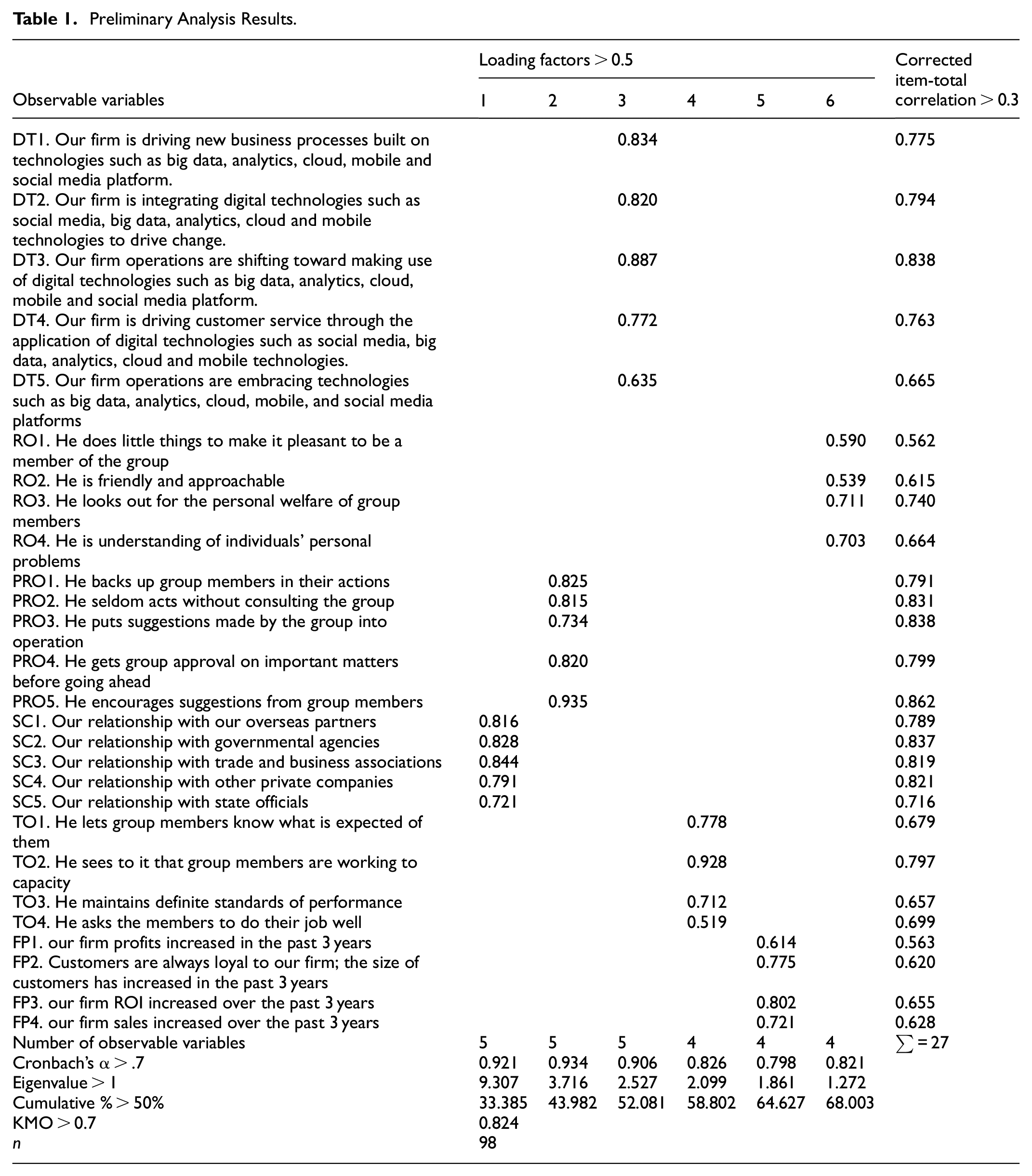
The preliminary quantitative research results are in Table 1. Cronbach’s alpha and EFA values both meet the requirements, the scales can be used for official research.
Preliminary Analysis Results.
Results and Analysis
Exploratory Factor Analysis and Reliability Assessment
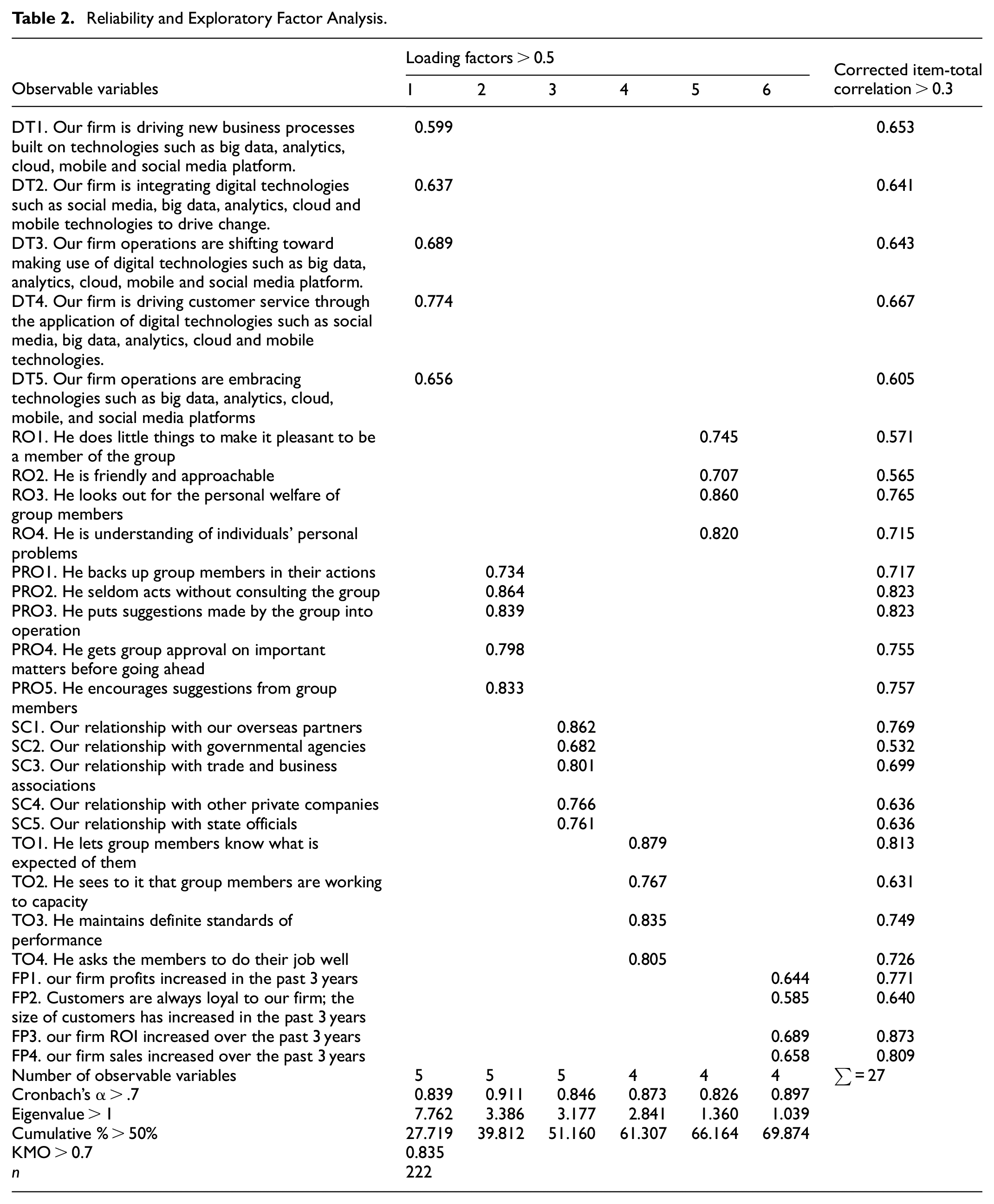
The Cronbach’s alpha results as shown in Table 2, indicate alpha coefficients for the scales exceeding .7, and the total variable correlation for all scales ranging between .532 and .873, ensuring reliability. Table 2 also reveals an Eigenvalue of 1.039, extracting six factors congruent with the model. Factor loadings ranged from 0.585 to 0.879, surpassing the 0.5 thresholds, and a cumulative variance of 69.874%, indicating the scales ensure convergent and discriminant values for the 27 observational variables used in subsequent analyses.
Reliability and Exploratory Factor Analysis.
Confirmatory Factor Analysis (CFA)
Model fit evaluation results in Figure 2 show a χ2/df ratio of 2.083, TLI and CFI indices respectively at 0.900 and 0.912, and an RMSEA of 0.070, all meeting the required standards.

The results of CFA.
Table 3 show that the CFA results with standardized factor loadings for all observational variables range between 0.541 and 0.989, all exceeding 0.5. All
A Table of CFA Results System.

Table 4 show that the Maximum Shared Variance (MSV) is less than the Average Variance Extracted (AVE), and the square root values of the AVE for the variables (in the Fornell and Larcker table) which are numbers in bold in Table 4, are greater than the correlations between that variable and other variables in the model, ensuring discriminant validity.
Model Validity Measures.

p < 0.050; **p < 0.010; ***p < 0.001.
Structural Equation Modeling (SEM) Analysis
Figure 3 shows that SEM model evaluation results mirror the model fit with a χ2/df ratio of 2.083, TLI and CFI indices at 0.900 and 0.912, and an RMSEA of 0.070. With an R2DTr value of 0.50, indicates 50% of the DTr variance is explained by independent variables, and an R2FPe value of 0.51 indicates 51% of the FPe variance is accounted for by the DTr factor, validating the model’s suitability for hypothesis.
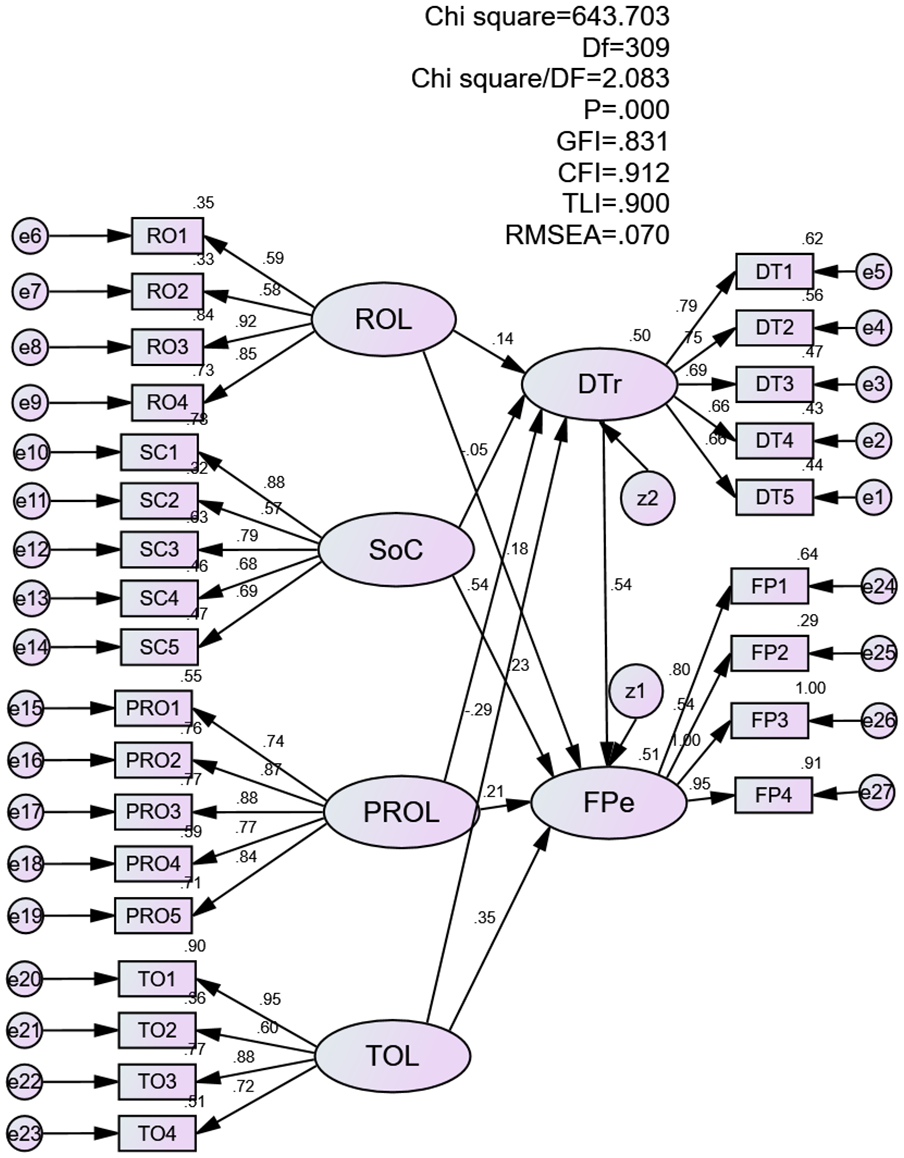
The results of testing the research model.
Hypothesis Testing Results
External social capital’s impact on digital transformation is statistically insignificant (p = .401), rejecting hypothesis
The results in table 5 show that Digital transformation has a strong positive impact on firm performance (with β = .536; p = .000), accepting hypothesis
Summary of Hypothesis Testing Results.

Results of Multicollinearity Test
Multicollinearity is a phenomenon where independent variables are strongly correlated with each other. When this occurs in a regression model, it can cause many indices to be skewed, leading to analysis results that are not very meaningful. A limitation of the SEM model using covariance CB-SEM is that it does not test for multicollinearity. Therefore, to check for multicollinearity, the study uses SPSS software to calculate the Variance Inflation Factor (VIF).
The results shown in Table 6 indicate that all VIF indices are less than 2, suggesting that there is no multicollinearity. The regression results are therefore reliable.
Multicollinearity Test.


Dependent variable: DTr.
Analysis of Social Capital’s Moderating Role
The initial results are evident in the SEM analysis of the research model.
In the second step, an SEM analysis was conducted for the model excluding SoC. The results indicate a χ2/df ratio of 2.359, with TLI and CFI indices at 0.905 and 0.919 respectively, both exceeding 0.9, and an RMSEA of 0.078, all meeting the required standards (Figure 4).

The results of testing the research model without SoC.
In the third step, comparing the two models reveals: Social capital moderates the relationship between shared leadership and digital transformation, altering the impacts of TOL, ROL, and PROL on DTr, though insignificantly with Δβ values of −.007, −.009, and .010 respectively, leading to the rejection of hypothesis
Comparison of Results of Two Models with SoC and Without SoC.

Discussion
SEM Analysis Results and Hypothesis Validation
The SEM analysis underscores the affirmative influence of external social capital on firm performance, enhancing the operational efficiency of SMEs. This is consistent with the changing economic context in Vietnam, where small and medium-sized enterprises, often constrained by limited capital, management experience, and volatile markets, greatly benefit from external support, corroborating the findings of Stam et al. (2014), H. T. T. Nguyen and Ha (2020), Saha and Banerjee (2015), Pratono and Mahmood (2014), Easmon et al. (2019), Tomlinson and Fai (2013), and Ince et al. (2023). While the impact of social capital on digital transformation is not statistically significant in this sample, its positive external relationships amplify the beneficial effects of digital transformation on company performance. This result is consistent with the study by Ji et al. (2024).
Leadership with a relationship orientation propels the digital transformation process, resonating with prior studies. Such leadership styles prioritize employee welfare, empathize with their challenges, actively listen, address their concerns, and foster a congenial environment. This nurtures employee motivation and loyalty, especially during transformative phases that often accompany organizational restructuring. Participation and representative leadership positively influences digital transformation, reflecting real-world business operations. Valuing employee feedback, involving them in decision-making, and elevating their roles ensures they align with the company’s objectives, willingly embracing innovations for growth. Conversely, task-oriented leadership has an inverse effect on digital transformation, diverging from the initial hypothesis. This mirrors the reality of SMEs in transition economies, where survival often necessitates high operational standards, stringent regulations, and managerial oversight, potentially stifling creativity and impeding innovative processes. These findings are consistent with the research of Ho Dai and Huynh Tan (2023), and Abu Afifa and Nguyen (2023).
Shared leadership characterized by its unique attributes, fosters cohesion among employees and between staff and management, leveraging collective strength. This is pivotal for enhancing the operational efficiency of SMEs, these results consistent with studies by D’Innocenzo et al. (2014), Kim and Han (2019), Hoch et al. (2010), Saythongkeo et al. (2022), and N. P. Nguyen et al. (2023), Habeeb and Eyupoglu (2024), once again affirmed the role of shared leadership in business development. Especially when bolstered by positive external relationships, the role of shared leadership in operational efficiency becomes even more pronounced, aligning with the findings of Collins and Clark (2003).
Digital transformation positively impacts business performance, indicating that enterprises benefit from integrating digital elements into their operations. This transformation bolsters various business sectors, enhancing customer trust in the enterprise and its products, and elevating business efficiency as evidenced by previous research conducted by Popović-Pantić et al. (2019), Nwankpa and Roumani (2016), Y. Y. K. Chen et al. (2016), and Ho Dai and Huynh Tan (2023). This effect is further magnified when businesses capitalize on external relationships, this finding are consistent with the research of Ji et al. (2024).
Conclusions and Managerial Implications
Applying the Resource-Based View (RBV) theory and social capital theory, this study developed and validated hypotheses and research models using the Covariance-Based Structural Equation Modeling (CB-SEM) tool. The findings indicate that the theoretical model fits the empirical market data. Digital transformation significantly enhances business performance. Social capital positively impacts the performance of small and medium-sized enterprises (SMEs).
Relationship-oriented, representative, and participative leadership styles positively influence digital transformation, while task-oriented leadership has the opposite effect. Shared leadership positively impacts company performance.
A key finding of this study is the positive moderating role of social capital in the relationship between shared leadership and performance, and between digital transformation and company performance.
For small and medium-sized enterprises (SMEs) in the Mekong Delta region to thrive in the context of innovation, they must actively pursue digital transformation based on investing in technology infrastructure, equipment, and training a team of digital specialists to meet current digital development needs. They should apply digital techniques to business operations and management while fostering a shared leadership style to adapt and navigate the changing competitive and digital landscape. To accelerate this process successfully, SMEs should leverage relationships with external partners, such as business partners, relevant organizations, and government agencies, to gain management, technology, and capital expertise. This not only supports the transformation journey but also enhances operational efficiency and promotes business growth.
The Mekong Delta, an economically and educationally underdeveloped region of Vietnam, is currently receiving significant investment from the government to develop infrastructure in all aspects, aiming to attract foreign investment and elevate the Mekong Delta to be on par with the rest of the country. This presents a great opportunity for SMEs in the Mekong Delta to leverage resources from both the state and foreign investors, to accelerate digital transformation, build a shared leadership style, enhance management and business skills, and improve operational efficiency for sustainable business development.
It should be noted that building a shared leadership style and external relationships (SoC) is closely linked to the culture of the organization, so it is necessary to be careful and meticulous to avoid being superficial and formal, which can easily lead to results are not as expected.
The data collection for this study was confined to the Mekong Delta region. However, due to the convenience sampling method and small sample size (non-probability sampling), the study’s representativeness is limited, restricting its generalizability. It’s essential to expand the research scope. This study focuses only on small and medium-sized enterprises, with the business sector not being specified. Therefore, the findings of the study need to be validated in other business contexts to confirm their universality, especially in areas such as the circular economy and the sharing economy, which have higher applicability. These limitations pave the way for future research efforts.
Footnotes
Acknowledgements
First of all, I would like to thank the authors of the papers related to my research who provided an important theoretical basis for my research. I sincere thanks to all senior managers and IT managers of SMEs in the Mekong Delta in Viet Nam, who agreed to participate in this research and were willing to share their work-life and career related experiences. I am also thankful to my acquaintances, friends and my family, who helped me to establish contacts with various SMEs in the Mekong Delta. Finally, I would like to thank School of Economics and Law, Tra Vinh University for encouraging and creating favorable conditions for me to complete this study.

Ethics Considerations
The College of Economics and Law Ethics Review Committee at Tra Vinh University approved my interviews (approval: CEL/17) on September 15th, 2023. Respondents gave written consent for review and signature before starting interviews.
Funding
The author disclosed receipt of the following financial support for the research, authorship, and/or publication of this article: Tra Vinh University is the sponsor of this research.
Declaration of Conflicting Interests
The author declared no potential conflicts of interest with respect to the research, authorship, and/or publication of this article.
Data Availability Statement
The documents I cited in the article were found through Google, ResearchGate, journal websites, the library of Tra Vinh University, and Authors of articles provided via Researchgate.
Noted: References were searched on google scholar, ResearchGate, journal websites, scopus database and the library of Tra Vinh University