




Abstract
The aim of this study is to analyze the relationships between leadership effectiveness, knowledge sharing behavior, business performance, firm strategy, and firm performance. In this study, to reveal the relationships, statistical analyses were applied to the data collected using one-to-one questionnaire techniques while the relationships between the variables were tried to be revealed. In this study, the importance of knowledge sharing behavior and the positive effects of both independent variable and mediator variable on the organization are emphasized. In addition, the positive effect of leadership effectiveness and knowledge sharing behavior on work performance, firm strategy, and firm performance variables was detected. Analysis was made using LISREL, IBM SPSS 23 software program, and SPSS PROCESS V.3 add-in, and confirmatory and explanatory factor analysis and reliability analysis were performed on questions using Likert-type scale. In the analysis of the relationships between variables in the correlation menu of the main menus of SPSS Program, the regression menu was used to test the hypotheses and to reveal the mediation variable effect of the PROCESS V.3 add-in. Confirmatory factor analysis was performed by LISREL program.
Keywords
Introduction
In recent years, global economic uncertainty has started to increase while the economic recovery has failed to reach desired levels. As well, the risk factor among the sectors has started to increase given that organizations have been more careful in making strategic decisions. Especially, companies like Facebook, Apple, Samsung, and Alibaba give significant importance to avoiding any negative impact on their performance while making strategic decisions for the future (Z. Yang & Zhu, 2016). Making decisions with this “risk” mentality impacts the effectiveness of leadership and information sharing within the organization. In achieving leader effectiveness, trust and vision are at the forefront, and at the same time, employees should feel that there is an effective leader collaboratively promoting sustainability and other important steps to achieve set goals (Zhang et al., 2011). The perceived effectiveness of the leader is a criterion that is expressed through evaluations related to their leaders and aims to reveal how the leader affects an organization (Prati et al., 2003). In other words, the effectiveness of the leader refers to the performance of a leader in directing and influencing his or her activities in the realization of the objectives (Dabke, 2016). The importance of leadership style and knowledge sharing for organizations is shown in Gary Hamel’s (2006) research. In the research, only 10% of the 30,000 products marketed every year by the companies in the production sector are reported to be successful (Hamel, 2006). Likewise, in the research conducted by Castellion and Markham (2013), it was explained that the success rate of the products offered by the companies in the production sector was 20% and below. At the same time, it is stated that the success rate is 15% to 20%, although the production companies spend more than 20 million dollars for the presentation of products they put on the market (Perreault et al., 2013). In other words, only 10% to 20% of new products in the production sector can stay on the market every year. This means that hundreds of billions of dollars are wasted on products that fail worldwide. The main reason for this is due to both problems in leadership and knowledge sharing within the organization (Frackenpohl et al., 2016; Knies et al., 2016; Onesto, 2017; Ritala et al., 2015). Leader effectiveness ensures that organizational objectives are carried out in accordance with a vision and mission. At the same time, the sense of satisfaction in communication between employees and managers is important both in achieving the objectives and in the satisfaction of the parties (Cooper & Nirenberg, 2004). Indicators of employee dissatisfaction within leadership are a primary method of determining a leader’s effectiveness, particularly through attitudes and perceptions of employees that are based on multiple criteria: the level of leaders in meeting expectations and needs of followers, the ability to increase business life quality and the skills of followers, the ability to contribute to the psychological developments of followers, the followers’ respect and gratitude to their leaders, beliefs related to the honesty of leaders, willingness and commitment to fulfill a leaders’ request, absenteeism, leave of employment, complaining, slowdowns, and sabotaging tools (Yukl, 2013). It is stated that the most important element of knowledge sharing in enterprises is individuals and individual information (Nonaka & Takeuchi, 1995). The information management process of each business operates in accordance with its own structure and the common point of these processes is knowledge sharing. Nowadays, the creation and sharing of information in enterprises is a critical factor for the success of enterprises (Mısırdalı, 2006), and knowledge sharing primarily leads to the creation of information within the organization. The organization needs knowledge to solve problems in the organization or to create new products. To market their products, organizations need to create information quickly and use specialized information. Ongoing learning efforts of employees, with the aim of developing and creating new business practices, improve their knowledge sharing capabilities. Many scientists believe that such behavioral changes are important for innovative practices at work (Taş, 2011). In fact, the high performance of an employee depends on their commitment to business, strong emotions, and strong motivation. It can be said that if the employee is satisfied with his job, he will perform well. With the desire to encourage the creative efforts of the employees, it has been suggested that companies will continuously strengthen when internal and external rewarding efforts are creative and require new skills (Jung et al., 2003). Clearly, it is also important to make the employee perform as permanent as the performance, and one of the methods to make the performance permanent is an effective performance evaluation. Therefore, the research was conducted on white-collar employees working in manufacturing companies because of the product innovation activities within this sector. Whereas leading activity was taken as an independent variable and knowledge sharing behavior was interchangeable, job performance, firm strategies, and firm performance variables were taken as dependent variables; the aim was to reveal the relationships between these variables.
Literature
Leadership Effectiveness
Yukl (2013) defined leadership as “the process of facilitating individual and collective efforts to understand and influence the people to realize what is to be done and how and to realize the shared objectives.” Chemers (2000) states that leadership is “the process of social influence that one can get the help and support of others to achieve a common objective.” The effectiveness of the leader is a function of various organizational conditions, some personal and interpersonal behaviors. Leader effectiveness indicates the importance of self-sacrificial work that will bring great benefits to the leader’s organization. Employees can be inspired by the waiver behavior of leaders in organizations and can give meaning to these actions to shape their goals. In general, the effective behaviors of leaders have a significant positive impact on their followers and ultimately on social systems. The renunciative work of the leader in the organization and the proposed effects of this behavior led to an increase in the attention of the researchers (Avolio & Locke, 2002; Choi & Mai-Dalton, 1999; De Cremer & Van Knippenberg, 2002; Yorges et al., 1999). Leadership effectiveness creates a high level of commitment and motivation for employees, reveals personal sacrifice, and is thought to give a desire to work with high performance (Lowe et al., 1996). Leader effectiveness has the ability to create a vision of the future of the organization, to ensure that the members of the organization focus on this vision, and to show their commitment to the organization (Conger, 1999). Primarily, making personal sacrifices by a leader is one of the most direct ways of showing the value that a leader has for the welfare of the organization (Jacobson & House, 2001).
Choi and Mai-Dalton (1998) defined leadership effectiveness as the leader’s sacrifice for the organization, preventing personal interest in the division of labor, ensuring the welfare environment in the organization, and increasing the desire of the employees to stay in the organization. By making self-sacrifices, the leader clearly shows that she or he is focused on the welfare of the organization (Prapavessis & Carron, 1992). Therefore, self-sacrifice does not only have short-term, direct positive results for the functioning of the organization, but also has a long-term impact in terms of engaging employees. An important determinant of leadership activity is the way employees explain their perspective to the organization and how they are committed to the organization (Turner et al., 1987). Leadership effectiveness determines the beliefs, attitudes, norms, values and behaviors of employees toward the organization (Hogg, 2001). Leaders are members of the organization and groups within the organization, so they share one or more group memberships with the employees they lead. The leadership processes came into force in the context of the membership of the organization, and in fact, the characteristics of leaders as members of organizations play an important role in leadership effectiveness. The leader effectiveness organization ensures that individuals are more effectively and efficiently represented (Yorges et al., 1999). Hence, the effectiveness of the leader is measured by different approaches in the context of subjective indicators, such as objective financial criteria, as well as sales, profit rates, return on investment, market share, or stakeholder comments (Procházka & Smutný, 2011). As a result of these characteristics, which are owned by the concept of leader effectiveness, we examine the impacts of the knowledge sharing behavior within the organization on business performance as well as on the firm performance and strategy, and the relationships between them.
Knowledge Sharing Behavior
The organization provides the greatest support in achieving its objectives from the knowledge sharing standpoint. The success of the organization in its knowledge sharing strategy depends largely on its ability to coordinate resource management. Information, which has become the most powerful weapon of creating value, produces more value as it is shared (Gurteen, 1999). Srivastava et al. (2006) defines knowledge sharing behavior as “team members who share ideas, information, and suggestions about the task with each other.” Sharing knowledge is important to increase the competitiveness of a firm (Jasimuddin, 2007). And, many organizations are developing incentive and rewarding systems for sharing knowledge (Bartol & Srivastava, 2002). However, we estimate that leadership effectiveness can trigger knowledge sharing behavior among employees because leadership effectiveness improves knowledge sharing behavior by creating unity and belonging perceptions in an organization, along with the selfless work of the leader, and also increases cooperation between employees in the organization (Bartel, 2001; Kramer, 2006). An employee always takes their organizational interests and mutual cooperation into consideration, motivating them to share knowledge (Jasimuddin et al., 2006). Therefore, employees who identify themselves strongly with their organizations share more knowledge for the benefit of the organization. It is more important to share knowledge rather than the existence of knowledge sources in organizations (Yeniçeri & Demirel, 2007). Indeed, knowledge sharing can occur not only between two individuals but also between the individual and the group, the groups, or the individual or groups (Mısırdalı, 2006). Knowledge sharing is basically considered as information available to other employees within the enterprise. It is generally accepted that information is renewed and transformed into a new form, thereby becoming a valuable element as long as it is transmitted and shared (Charterina et al., 2018). Knowledge sharing primarily leads to the creation of information within the enterprise.
The organization needs knowledge to solve problems in organizations or to create new products (Smith et al., 2006). Knowledge sharing is important not only for organizations but also for employees in organizations (Estrada et al., 2016). Individuals share their knowledge and serve the purpose of verifying and reinforcing the information they have. In other words, the individual evaluates his or her knowledge with the information obtained from the other individual as a result of sharing (Dasí et al., 2017). This evaluation process is based on the self-evaluation feature of the information. It also allows individuals to correct their misperceptions and misinterpretations about the truths and facts underlying their knowledge (Teixeira et al., 2018). In addition, sharing knowledge with other individuals brings together different information to influence each other, thus creating new information and increasing the knowledge of individuals (Barutçugil, 2002). As a result of these explanations, we examine the knowledge exchange behavior, the leader effect, and the inter-variable effect between the organization’s outputs (business performance, firm performance and firm strategy) and the relationships between them. In the above-mentioned conceptual framework, the following hypothesis has been developed:
Job Performance
According to Pugh (1991), performance is the degree to which individuals or institutions reach the goal in an activity. It is a concept that defines how individuals or groups working in the organization can reach their goals. Performance is the level of output that is defined as the result of an activity and that employees perform for themselves in the work that is appropriate to their characteristics and abilities, within acceptable limits (Schermerhorn et al., 1985). This level indicates the degree of fulfillment of the purpose or task. Business performance is considered to be either an effort that employees produce on behalf of their salaries (Rousseau & McLean, 1993) or the time and effort they spend to get what they want as part of an employee’s duties and responsibilities in an organization to satisfy his or her needs (Barutçugil, 2002). The management of employees’ performances is of critical importance for businesses (Van Veldhoven et al., 2017). The absence of good performance management leads to the failure of employees to meet their expectations. For this reason, it is the objective of effective performance management to determine the individual performances of employees through healthy and fair criteria, to inform employees about this issue, and to increase organizational efficiency through the development of individual productivity and employee performances (Dehaghi & Rouhani, 2014). Therefore, the concept of leader effectiveness and knowledge sharing behavior are important in terms of employee performance.
Performance is of primary importance for businesses. Because an enterprise can only be as good as the performance of its employees (Çöl, 2008). Performance evaluation is the work of the employees to determine the actual success of the employees in a certain period of time, in addition to the development potential of the future (Uyargil, 2013). It is possible for enterprises to reach their goals to a certain extent by hiring their employees in a professional manner and by successfully applying the performance evaluation methods and techniques (Palmer & Winters, 1993). Providing a performance-based reward can cause the individual to pay more attention to his or her work and to approach the tasks in a different way in order for the individual to perform well and to present his or her competence better. Employees are also likely to be more committed to the performance targets initiated by the organization. In this study, the effects of the concept of leadership effectiveness and knowledge sharing on business performance and the relationships between them are analyzed. In the above-mentioned conceptual framework, the following hypotheses have been developed:
Firm Strategies
Venkatraman (1989), who carefully assesses the structure of strategic orientation, defined the company’s strategy as “guiding principles in developing appropriate strategies when managers face opportunities in their own markets and organizational environments.” The firm strategy is “aggression” within the enterprise or the willingness of the business to take action to improve its market position. The sector/market/economy of the firms can push firms to be aggressive, and at the same time, the desire of firms to be aggressive is important for transition economies, especially the production sector and the environments where technology is used extensively. The firm strategy is the result of an important “analysis” method or the firm’s efforts to achieve internal consistency in achieving the stated objectives. For example, it is widely discussed that a firm must have consistent control and reward and management systems to achieve its goals efficiently and effectively.
The firm’s strategy to complement each other ensures that the company is more likely to take active steps to take advantage of opportunities in a highly competitive environment (Li & Li, 2009). In an intensely competitive environment, the companies in the production sector are more aggressive and have a risk-taking orientation in the market they are in. The fact that firms are sufficiently active before their competitors, or falling behind or being late in terms of strategy, will cause them to be weak in terms of competition. Zhou and Li (2007) have suggested that firms will create more dynamic capabilities when they have the right market orientations, and relevant strategic actions follow the company’s direction. The effectiveness of a firms’ strategy is important in terms of strengthening the company’s ability to produce more innovative products and processes, to catch market opportunities, and to adapt to corporate needs (Phan et al., 2009; Zhou et al., 2005). For this, knowledge sharing within the company must be very clear and regular, which means that the leader is highly effective. Zhou and Li (2007) suggested that organizations’ strategic orientations play an important role in determining the impact of a firm on its processes and results. Similarly, Lu et al. (2008) suggest that an institution-based view would be useful for investigators to study knowledge management and strategies. Under the influence of institutions, firms are developing different strategies to gain legitimacy. To give the desired result of a company’s strategy, we analyze the effects of the concepts of leader effectiveness and knowledge sharing in terms of the company strategy and the relations between them. In the above-mentioned conceptual framework, the following hypotheses have been developed:
Firm Performance
In a general definition, performance is a description of what an individual, a group, or a business that accomplishes a job can achieve in terms of where they reach the intended goal. Performance, which is also expressed in terms of success and success terms, is that employees realize the jobs which are appropriate for them and assigned to them (Boylu & Sökmen, 2002). This is the whole of the goods and services ideas put forward in order for the employees to fulfill their duties and realize the purpose to meet the predetermined goals within the framework of the task to be performed (Pugh, 1991). The performance of the enterprise determines where it will be in the future, which position and size it wants to be, and which areas it will direct (Koçel, 2003). The performance of the firm is the result of a specific time, output, or study in the fulfillment of the company’s objectives or duties. In this context, firm performance can be defined as the evaluation of all efforts to achieve business objectives (Zerenler, 2005).
Clearly, successful performance evaluation ensures the development of the company, and knowing the success levels of company executives and employees, and learning the reasons for their failures are of great importance in terms of increasing the success of firms in the long term (Kara, 2010). In addition to the in-house data, enterprises will increase their operating profitability as long as they carefully analyze both financial and non-financial environmental factors related to the global business world, and their fields of activity, so that enterprises can sustain their existence (Ağca & Tunçer, 2006).
Performance measurement occurred in the 1900s with the financial ratios and budget control methods applied by Dupont and General Motors, and the enterprises used these measurements for 80 years (Çetinkaya, 2007). In the 1980s, it was also necessary to take into consideration the non-financial criteria in addition to the financial criteria in the performance measurements of enterprises (Barker, 1995). In the 1980s and 1990s, there was an increase in the importance of performance evaluation, and in today’s business world, changing market dynamics have revealed the need for market-oriented indicators, such as competitiveness, in addition to financial performance indicators in evaluating business performance (Eroğlu, 2004). In the above-mentioned conceptual framework, the following hypotheses have been developed:
Method
Within the scope of the research, a scale was prepared and applied to textile companies. The reason why the textile companies are selected is that they include many white-collar employees (department managers and experts) and different departments within the company. The scale prepared in the framework of the literature was tested for pretest on 66 white-collar employees randomly selected from each of 22 textile companies to ensure that there are no misunderstood questions and is high reliability. The scale, which was arranged on the basis of expressions, was made ready for implementation. A total of 573 white-collar employees were identified for the white-collar employees in 22 companies. According to Yazıcıoğlu and Erdoğan (2004), if the population size is 573, a sample of 400 units is considered sufficient for a 5% error margin. At the same time, 66 participants, who were previously interviewed for the pretest, were excluded from the total population. Thus, among the remaining 507 employees, the scale was applied to the selected personnel by random sampling. All data were obtained from randomly selected white-collar workers as primary data source. In the first part of the two-part questionnaire questions, participants’ demographic information and questions about their work are included. The second part of the questionnaire consists of scale questions related to leader effectiveness, knowledge sharing behavior, job performance, firm strategies, and firm performance. The scale has a five-dimensional design. The scale items of these five dimensions were presented to white-collar employees, and scoring was taken with the 5-point Likert-type scale ranging from “Strongly Disagree” to “Strongly Agree.” Considering the performance criteria of the last 3 years on the scale of the performance of the company, the scale was asked to be evaluated in the 5-point Likert-type scale between “Very Good” and “Very Bad.” Different hypotheses were established on the model presented in Figure 1. First, the relationship between leader activity and the other four dimensions (KSB, JP, FS, and FP) was analyzed, and in the second stage, the relationship between knowledge sharing behavior and three dimensions (LP, FS and FP) was analyzed. In these two stages, a simple linear regression model was established for one dependent and one independent variable. The third stage of the analysis was on the effects of the inter-variable and the inter-variable effect between the LE–JP, LE–FS, and LE–FP variables of the KSB that were tested. Common method variance (CMV) problem may be encountered due to the data obtained from the dependent and independent variables from the same participants, the place of the expressions in the survey, and the environment in which the survey measurements are collected (Özyılmaz & Eser, 2013). CMV will be most especially apparent when the data of dependent and independent variables are collected from the same people, in the same environment, using the same or similar expressions (Podsakoff et al., 2003). The most important way to prevent CMV is to get the answers of dependent, independent, and mediation variables from different individuals; however, in studies where this is not possible, applying the scales at different times or places while obtaining the data and the response formats used to collect the data of independent and dependent variables will be different from each other (Podsakoff et al., 2003). In the study, the formats of the scales measuring the dimensions were differentiated to prevent CMV, anonymity was provided for the questionnaire respondents, and it was explained that the information about the responder was not required. At the same time, the number of questions was kept low and the opportunity to answer as wide as possible was provided to prevent the participants from being bored and giving random answers. Some of these analyses were performed using IBM SPSS 23 package program and some by LISREL program. First, demographic data are included. For the Likert-type questions included in the scale, descriptive factor analysis was applied first, and then, the control was performed with confirmatory factor analysis. The results of factor analysis were controlled by confirmatory factor analysis performed in LISREL. Correlation analysis of the relationships between variables and regression analysis were performed to test the hypotheses. The IBM SPSS PROCESS extension was used to detect the mediation variable effect.
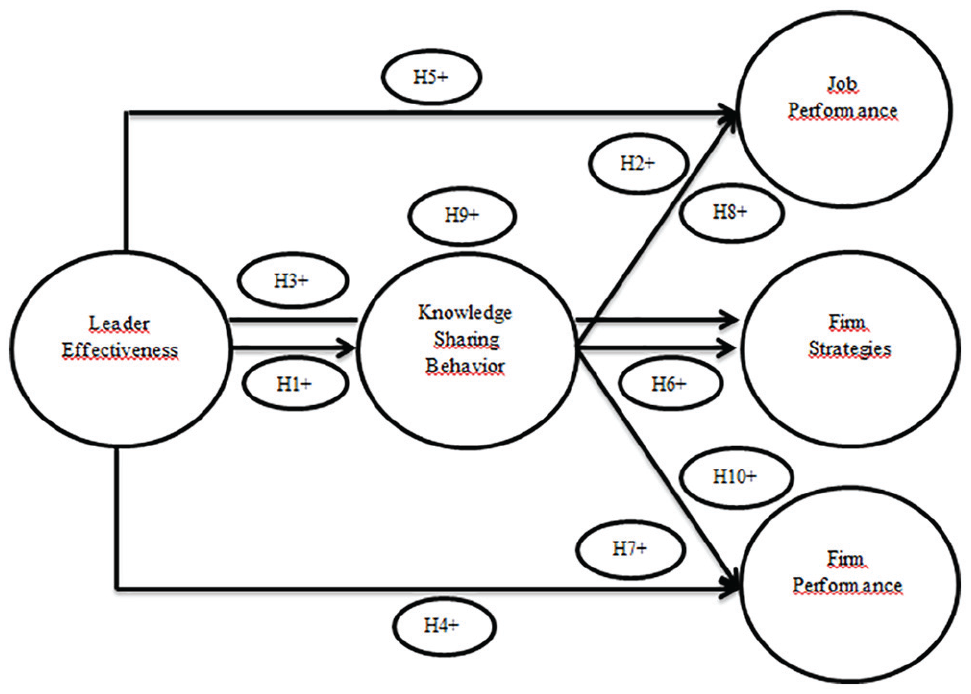
Research model.
Measures
In the preparation of the scale used in the study, the studies listed were used. The reliability coefficients (Cronbach’s alpha, α) of the scales are shown next to the dates. Leader effectiveness scale was adapted from the studies of Srivastava et al. (2006, α = .97) and Y. Yang et al. (2016, α = .96). Knowledge sharing behavior scale was developed by Shao et al. (2012, α = .98), Srivastava et al. (2006, α = .94), Hau et al. (2013, α = .91), Farooq et al. (2014, α = .89), and Chumg et al. (2016, α = .93). Lau and Roopnarain’s (2014, α = .83) job performance scale was used to measure the job performance variable. The firm strategies scale was obtained from the scales in the studies conducted by Dess et al. (2003, α = .75) and Lau and Bruton (2011, α = .87). While preparing the firm performance scale, values from Patel et al. (2016, α = .93), Homburg and Pflesser (2000, α = .87), Zahra and Bogner (2000, α = .86), and Robert Baum and Wally (2003, α = .96) were used.
Findings
The scale was applied on 400 white-collar (department managers and experts) working in different departments of 22 companies. A total of 292 (73%) male and 108 (27%) female respondents were surveyed. Of them, 148 (37%) of the participants were in the 17 to 27 years age group. And, 199 (49.7%) are in the 28 to 40 years age group. The number of managers over the age of 41 years was 53 (13.3%). Nineteen (4.8%) of the workers who answered the questionnaire were high school, 40 (10%) were high school, 261 (65.3%) were university graduates, and 80 (20%) were graduates.
Of the white-collar employees who responded to the survey, 74 (15.9%) were in the marketing department of the company, 36 (7.8%) in the IT department, 35 in the white-collar (10.4%) accounting/finance department, 34 white-collar employees (8.9%) in the human resources department, 38 white-collar employees (8.1%) in the operations department, 48 white-collar workers (12.3%) in the production department, 32 white-collar employees (5.8%) in the technical department, 30 white-collar employees (6.9%) in the purchasing department, 21 white-collar employees (8.5%) in the R&D department, 29 white-collar employees (4.0%) in the management and other departments out of the specified departments working in the number of 23 (10.9%). The level of achievement of the goals of the employees and the level of attainment of the objectives of the 34 participants was very low; the level of reaching the goals of the 57 participants was low; the level of reaching the goals of the 137 participants was medium; the level of reaching the targets of the 126 participants was high; and the level of reaching the goals of the 46 participants was too high.
Research Framework
Based on the literature review, a research model was applied as an independent variable, and leading effectiveness, mediation variable, knowledge sharing behavior, and dependent variables were used for job performance, firm strategies, and firm performance. We use the argument or argument to judge the effect on the dependent variable on a quantitative research test (Thomas et al., 2018). In the study, data were analyzed to determine the relationship between statistical concepts due to a quantitative approach.
Analyses
Factor analysis was performed to investigate the construct validity of the scale used in the study. Büyüköztürk (2018) identifies factor analysis as a multivariate statistical method that aims to explore a few unrelated conceptually meaningful new variables (factors, dimensions) by combining the interrelated variables. To determine whether the data obtained from pretreatment were suitable for factor analysis, the Kaiser–Meyer–Olkin (KMO) sample suitability test and Bartlett’s sphericity test were performed to evaluate the diagonal values of the anti-image correlation matrix. The KMO sample suitability value in Table 1 is .949 and the significance level of Bartlett’s sphericity test is .000 (for p ≤ .05), indicating that the data are suitable for factor analysis.
KMO and Bartlett’s Test Results.

Note. KMO = Kaiser–Meyer–Olkin.
In the study, the variables prepared according to the 5-point Likert-type scale were measured with a 40-item questionnaire. Variables were determined as leader effectiveness, knowledge sharing behavior, job performance, firm strategies, and firm performance and subjected to factor analysis. As a result of factor analysis, 11 questions did not show factor distribution and were excluded from the scale because they were included in different factors by decreasing the reliability. To bring the data set into a form that can be analyzed by factor analysis, five factors have been formed as a result of the basic component analysis. Factor analysis along with factor loadings is presented in Table 2.
Factoring Results.

Note. KSB = knowledge sharing behavior; FS = firm strategies; LE = leader effectiveness; FP = firm performance; JP = job performance.
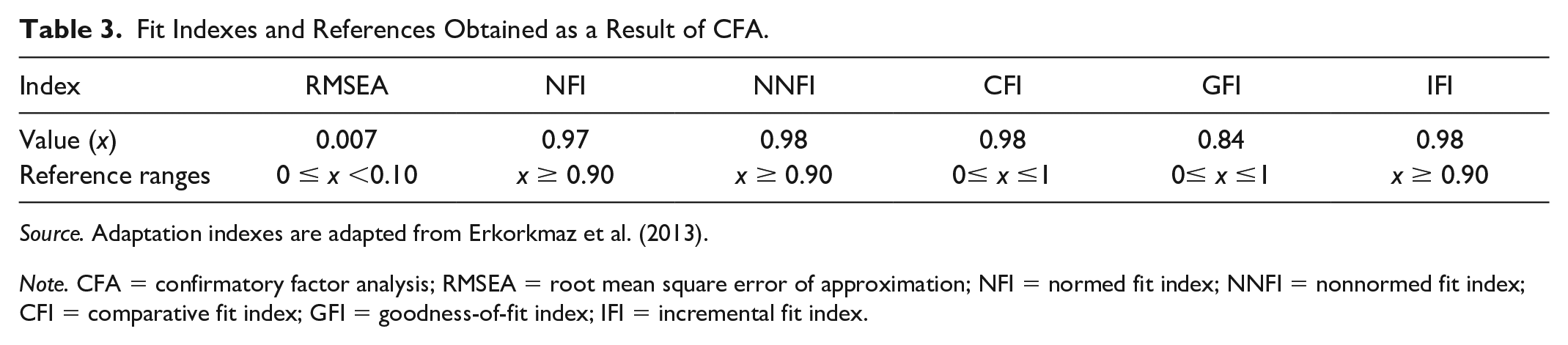
Confirmatory factor analysis is used to identify multivariate statistical analyses that contain the hidden structures represented by a large number of observed or measured variables (Aytaç & Öngen, 2012; Özdamar, 2013). Model fit values are examined when analyzing the confirmatory factor analysis results. Generally accepted values for model fit are as follows goodness-of-fit index (GFI), comparative fit index (CFI), normed fit index (NFI), incremental fit index (IFI), and root mean square error approximation (RMSEA) (İlhan & Çetin, 2014; Schumacker, 2006). The reported values may vary depending on the values the researcher wants to draw attention to. The conformity values obtained from the model created as a result of the confirmatory factor analysis performed in the LISREL program and the appropriate reference ranges of the values are given in Table 3.
Fit Indexes and References Obtained as a Result of CFA.
Source. Adaptation indexes are adapted from Erkorkmaz et al. (2013).
Note. CFA = confirmatory factor analysis; RMSEA = root mean square error of approximation; NFI = normed fit index; NNFI = nonnormed fit index; CFI = comparative fit index; GFI = goodness-of-fit index; IFI = incremental fit index.
When the values in Table 3 are examined, it is seen that all conformity values are in the reference ranges. The validity of the five-factor structure that emerged with explanatory factor analysis was confirmed by confirmatory factor analysis.
Reliability analysis: the internal consistency of the measurement that takes into account the average relationship between the questions. In the literature, the measurements with Cronbach’s alpha coefficient of .50 and above are considered to be sufficient (Büyüköztürk, 2018; Nunnally, 1978; Santos, 1999). The reliability values of each factor constituting the five-factor structure obtained as a result of the factor analysis are calculated, and these values are given in Table 4. AVE (average variance extracted) gives the convergent validity value. To validate the validity of the agreement, this value should be .50 or more (Alarcón et al., 2015; Bagozzi & Yi, 1988). The composite reliability (CR) value is one of the criteria used to measure content validity. Composite reliability value is above .70 for model reliability. At the same time, all AVE values must be smaller than their CR values. AVE values for both variables were below .50, but all CR values were greater than AVE values. AVE is obtained by dividing the sum of the squares of the covariances of factor indicators by the number of expressions (Yaşlıoğlu, 2017). All values are given in Table 4.
Cronbach’s Alpha Values, Descriptive Statistics, and AVE Values for Factors.

Note. AVE = average variance extracted; CR = composite reliability.
Table 4 shows that the reliability coefficients of all factor groups are over 80%. These values indicate an adequate level of reliability. Descriptive statistics are used to summarize a large number of numerical data obtained in the research in a few simple expressions. Descriptive statistics cover the number of times each value or set of values occur within a variable, the distribution of values around a centrally selected point, and the distance to the midpoint or relative distance to each other. The mean and standard deviation values of some of these statistics were calculated for the factors and are given in Table 4.
The correlation coefficient gives the degree of the mathematical relationship between the data. The values of the interrelated factors are presented in Table 5. The correlation coefficient takes a value between −1 and 1, and when the absolute values of these values are taken, the closer the coefficient is to 1, the stronger the relationship is. The “Correlation Is Significant” hypothesis was tested to determine whether the correlation coefficient was significant or not.
Correlation Analysis Results for Factors.

Note. LE = leader effectiveness; KSB = knowledge sharing behavior; JP = job performance; FS = firm strategies; FP = leader effectiveness.
As can be seen in Table 5, it was found that all coefficients were significant at the significance level of 1% in the significance tests performed for Pearson correlation coefficients calculated among the variables. All calculated significance values were less than .01.
Regression analysis was used to test predicted research hypotheses. The structure of the installed model can be seen in Figure 1. First, simple regression equation was established for each dependent variable using leader effectiveness which is an independent variable. With these regression equations, the effect of independent variable on each dependent variable was examined separately. To calculate the effects of the mediation variable, knowledge sharing behavior was added to the regression model together with the independent variable, and regression equations explaining a dependent variable were established using two independent variables. Table 6 shows whether the hypotheses and the hypotheses tested are supported in this analysis.
Regression Analysis Results of Impact of Independent Variables on Dependent Variables.

Note. LE = leader effectiveness; KSB = knowledge sharing behavior; JP = job performance; FS = firm strategies; FP = firm performance.
p < .001.
The single and multiple regression analyses were performed on our factors to determine the interim variable effect, and the obtained values are presented in Table 7.
The Effect of the Mediation Variable According to Regression Analysis Results.

LE = leader effectiveness; JP = job performance; KSB = firm strategies; FS = firm strategies; FP = firm performance.
p < .001.
The interfering effect was examined by SPSS PROCESS V.3 add-in. According to the test developed by Hayes, indirect effect X on Y is an important indicator for the mediation variable. There is no p-value for this model. Results are given thanks to confidence intervals. If there is no zero value between BootLLCI and BootULCI values, a significant intermittent effect is mentioned (Hayes, 2009). For the following hypotheses, Hayes test values and acceptance or rejection of hypotheses are given in Table 8.
Hayes Test Results.

Note. KSB = knowledge sharing behavior; LE = leader effectiveness; JP = job performance; FS = firm strategies; FP = firm performance.
BootLLCI value (.1817) and BootULCI value (.3540) were found in the model where Hypothesis H8 was tested. There is no zero between the two values. Knowledge sharing behavior has a significant intermittent effect between leader effectiveness and job performance. In the model for Hypothesis H9, BootLLCI value (.1838) and BootULCI value (.3483) were found. There is no zero between the two values. Knowledge sharing behavior has a significant intermittent effect between leader effectiveness and firm strategies. Finally, when the results of the model established for the Hypothesis H10 were examined, the BootLLCI value (.1766) and the BootULCI value (.3546) were found. The values between these two values are not zero again. Knowledge sharing behavior has a significant intermittent effect between leader effectiveness and firm performance.
Discussion
The main purpose of this study is to evaluate the effects of knowledge sharing behavior on performance and strategy, which are often beneficial for organizations. Leadership is an important factor to ensure that information sharing can be done in a healthy way and that employees can share information at the desired level. Leadership styles from the 1970s to the present have been receiving increasing interest. To date, research has mostly been related to the impact on employees and their impact on innovation and creativity (Hussain et al., 2017). For this reason, it is necessary to examine the relationships between variables in terms of how the effectiveness of the leader and information sharing behavior is reflected both within the organization and their strategy. According to Chemers (2000), the establishment of good relations between the leader and the employees depends on the competence of the leader. Employees’ personality and other characteristics, psychological maturity, efforts and skills, the level of knowledge held, and status factors such as the type of organization has been found to be associated with the effectiveness of leaders (Hersey & Blanchard, 1982). It is suggested that the self-perceptions and social identities of the leader and the followers are also determinants of the leader effectiveness (B. Van Knippenberg et al., 2005). The effectiveness of the leader is historically associated with a number of different factors such as the individual characteristics of the leader, the behavior of the leader, the style of the leader, and cultural characteristics (Ayman & Korabik, 2010). When the results of the research are examined, it can be seen that the information sharing and leader effectiveness between department managers and experts in the textile sector have a positive effect. However, it is necessary to conduct research on whether leader effectiveness is suitable for every working mass—in every sector and within every culture without cultural differences. The knowledge management process of each organization works in accordance with its own structure, and the common point of these processes is the sharing of knowledge. It is expected that the relationship between the leader and the employee will have a positive impact on performance, especially if leadership effectiveness is ensured within the organization (Ghasemy et al., 2018). Leader effectiveness, which we can define as the process of directing followers to the desired goals, requires the use of social power and mobilizing existing resources for purposes. Chemers (2000), in his study on the historical development of the leadership style of leadership, states that the evaluations of the leaders are shaped as a result of various processes. It will be an important indicator of the effectiveness of the leader to measure the satisfaction levels of the followers’ leaders by suggesting that the expectations of the followers will be an important determinant of the leadership behaviors (Den Dekker, 2016). It can be explained that for the department managers and experts in the textile sector, which constitute the sample group, their leaders have a significant influence on their position. Today, the creation and sharing of knowledge in organizations is a critical factor for the success and competitive advantage of organizations. Many organizations have focused on jobs related to the transfer of the covert information of their employees to the other employees of the organization.
Knowledge sharing can be defined as the transfer of information from one location, from another person, and from one property to another. However, to achieve this, the hierarchical structure in the organization, that is, the supra-top relation, must be fully established. Knowledge sharing includes two or more intermediaries and has a source and destination (Hamdan et al., 2019). Therefore, providing knowledge sharing in a healthy way is important for the strategic success of the organization. With knowledge sharing, information flows through effective communication, information searching, information learning, or those who need information (Kurata et al., 2017). Knowledge sharing is basically considered as information that can be obtained by other employees within the organization (Ipe, 2003). When the results of the research are analyzed, it can be seen that if information sharing behavior among employees is effective, it has a positive effect on both performance and strategy. However, information sharing behavior is often confused with knowledge sharing. The main difference between them is that information should be produced by the buyer in knowledge sharing, but it is not compulsory to produce new information in information sharing. Especially when the leader is influential, information sharing behavior among employees can be more effective for the organization. For organizations, not only is knowledge important, but the process of renewal is also important, not just content. It is generally accepted that information is renewed and transformed into a new form and becomes a valuable element as long as it is transmitted and shared (Odabas, 2003). Employees will feel comfortable in the event of knowledge sharing as flat and lean organizations will feed the employees’ feelings of trust (Barutçugil, 2002). Their tendency to share information will positively affect an employee’s perception of the legitimacy of organizational practices (Maciariello, 2005). Factors such as the attitude and perception levels of the employees, and the ability to adapt to the changes occurring in the organization also reveal the importance of knowledge sharing.
Conclusion
The main purpose of the leadership is to realize the objectives and duties of the enterprise in the best possible manner. What is most effective depends on the performance understanding of the leadership. In the simplest sense, performance is the contribution that employees make to the company’s goals (Tütüncü & Kılınç, 2000). In general terms, performance is a concept that determines either qualitatively or quantitatively as a result of a purposed and planned activity (Nursoy & Şimşek, 2001). To determine the performance, the results of the activities should be evaluated (Altin et al., 2018). In other words, the performance of a firm is the output of a given time. At the same time, it is very important for the organization to have a positive impact on the strategies implemented by the company against competitors in a highly competitive environment. Leadership effectiveness has a significant effect on the success of organizations in their strategies (Ioan, 2014). Analysis shows that leader effectiveness and knowledge sharing have a positive impact on the firm’s strategy. This result can be perceived as the degree of fulfillment of the purpose or task of the firm. In this case, the performance can also be defined as the evaluation of all efforts made by the firm to achieve its objectives (Gürkan, 1995). Knowledge sharing is the activity of transferring or disseminating information from one person, a group and organization to another person, or a group and organization. Information, which is a valuable asset in a competitive environment, is occasionally and not randomly shared, and it is very important for those who have knowledge with whom and when they share this information. Information should be actively distributed to those who use information in the organization because the speed of return of information becomes increasingly critical for the competition of enterprises. Communication and knowledge sharing technology work in business cultures that rely on trust rather than just fear. There may not be a direct relationship between the degree of people’s willingness to work together and the degree of trust that exists at that time. In a business environment, based on trust, that will be provided in information organizations, communication and knowledge sharing technologies create more confidence, open channels of communication, increase organizational learning, and encourage information sharing. The first principle for the success of information organizations should be to do everything that is necessary to maximize trust at all levels, both inside and outside the organization. Trust is one of the most essential elements for an organization to live and is the most advanced form of human motivation (Jyoti & Bhau, 2015). People work most effectively when they trust each other. As a result of the analysis of the research, it is seen that both leader effectiveness and knowledge sharing behavior positively affect the work performance of the employees within the organization. It is highly likely that the top management of the organizations will have positive feedback if they apply the leadership characteristics they have in an effective and meaningful way.
To develop and implement the best possible communication strategy that can fully utilized, the second important step is to develop communication technologies after creating a trusting business culture and working environment for the information organization. One aspect in which the knowledge sharing strategy can never be ignored is that team members are encouraged to participate and to express their beliefs and opinions. Team members should always be well informed. The more the feedback, the greater the integrity of the communication and sharing process. Increasing leadership effectiveness is based on the development of organizational adaptation and employee perceptions of leading characters, as well as other psychological empowerment factors. In this way, information sharing behaviors within the organization are positively reflected in performance. In order for organizations to be successful in performance and strategically, leaders need to create a climate that encourages the sharing of information among employees. These findings and conclusions are consistent with the studies in the literature (Z. Yang & Zhu, 2016; Zhang et al., 2011). In future research to be conducted on this subject, the effectiveness of leader and information sharing behavior should be examined in detail and theoretically developed among different sectors and different working groups.
Footnotes
Declaration of Conflicting Interests
The author(s) declared no potential conflicts of interest with respect to the research, authorship, and/or publication of this article.
Funding
The author(s) received no financial support for the research, authorship, and/or publication of this article.
