




Abstract
Memorable tourism experiences (MTEs) is a contributing factor in promoting the sustainable development of intangible cultural heritage (ICH) tourism. This study aims to discuss tourists’ MTEs of ICH. A quantitative examination was conducted in Wuxi, China, where 538 tourists were surveyed. By using SPSS 26, factor analysis, correlation analysis, and linear regression were used to analyze the data. This study found that tourists generally have MTEs of ICH tourism. Their MTEs were influenced by four dimensions: information services and credibility, experiential authenticity, price value, transportation and environment. This study also found that tourists with different sociodemographic characteristics show significant differences in their MTEs of ICH tourism. It applies MTEs to the context of ICH tourism, thereby expanding the research boundaries. Finally, this study offers some practical implications for ICH tourism.
Plain language summary
This research looks into the experiences of tourists visiting Wuxi, China, specifically focusing on Intangible Cultural Heritage (ICH) tourism. We surveyed 538 tourists to understand their memorable tourism experiences (MTEs). The study identified four key categories of these experiences: “Information Services and Credibility,”“Experiential Authenticity,”“Price Value,” and “Transportation and Environment” The findings indicate that tourists generally have positive MTEs in ICH tourism. Additionally, the study revealed that tourists with different demographics have varying MTEs. In simpler terms, people of different ages, backgrounds, etc., have different opinions about their experiences. The study suggests that to enhance tourism, managers should focus on creating memorable cultural experiences, improving transportation and spatial environments, optimizing pricing, and enhancing information services. In summary, providing high-quality travel experiences in ICH tourism involves making cultural activities memorable and improving overall comfort and convenience for tourists.
Keywords
Introduction
Intangible cultural heritage tourism is a tourism activity with intangible cultural heritage as its core attraction. It includes cultural expressions such as traditional crafts, folk activities, performing arts, and festive rituals (Song et al., 2019). ICH represents the unique ways of life and production that distinguish one nation from another, embodying the esthetics, values, and identity of national personality. However, ICH is highly vulnerable, particularly under the impact of modern lifestyles. Young people have little interest in traditional ICH, especially the skills taught by the mouth may completely disappear with pass away of the older generation of inheritors (Sun et al., 2021). Therefore, conservation and inheritance of ICH are two significant themes of concern.
As a form of cultural capital, ICH has become a scarce resource in the tourism market due to its placeness and uniqueness (Jarratt et al., 2019; Zandieh & Seifpour, 2020). These living cultural resources serve not only as important carriers of regional cultural transmission but also as important components of tourist experiences. Previous studies have showed that tourism industry can play a significant role in ICH conservation (Esfehani & Albrecht, 2018). By participating in and experiencing ICH activities, tourists can not only gain intellectual enrichment and esthetic pleasure, but also resonate with the culture of the destination emotionally and spiritually. Finally, they will have an impressive tourism memory.
Memorable Tourism Experience (MTEs) refers to the tourism experience of positive memories and recollections after tourism activities (J. H. Kim et al., 2012). MTEs includes key moments of what tourists do, feel, and think at a destination. Specifically, these experiences are unusual and extraordinary, making them more easily accessible for recall compared to routine tourism experiences. Consequently, an increasing number of destinations are adopting MTEs as a marketing and management strategy to offer unique products for competitive advantage (Bai et al., 2023). Factors influencing MTEs typically include both internal and external (J. H. Kim & Jang, 2016), with internal factors highlighting emotions (Tung & Ritchie, 2011) and personal traits (Leri & Theodoridis, 2020), while external factors cover a wide range of factors. It is usually discussed in a specific context. For example, culture and cultural destinations are significant themes in MTE research (Bai et al., 2023). Taheri et al. (2020) discovered in Iran’s heritage sites that perceived trust positively effects tourists’ perceptions of integrity, existential authenticity, and object-based authenticity, which later stimulates MTEs during the process. Moreover, the tourism destination reputation of cultural heritage sites and tourists’ enjoyment will also affect tourists’ MTEs (Z. Wang et al., 2021).
Although these studies have laid a solid foundation for understanding various ways of promoting tourists’ MTEs, some research gaps remain.
Firstly, current studies mainly focus on tangible cultural heritage or specific cultural tourism destinations, and lack of discussion on the relationship between ICH tourism and MTEs. In fact, ICH has been proved to be a important factor in promoting sustainable tourism development (N. Tan et al., 2023). The incorporation of ICH in tourism activities enhances awareness of local cultural characteristics (Greathouse-Amador, 2005) and can significantly boost tourist memory through its features such as uniqueness, impressiveness, authenticity, and a sense of self-discovery (Alahakoon & Udunuwara, 2022), and even a sense of awe. This awe is persistent for tourists (Su, Li, Chen, & Zeng, 2020; Su, Li, Wang, et al., 2020). From this, it can be found that the relevant research conclusions are consistent with the factors affecting MTEs. Secondly, although previous studies have acknowledged the impact of sociodemographic characteristics on MTEs (Brochado et al., 2022; Shabnam et al., 2022), but it has not been considered whether sociodemographic characteristics will affect MTEs in the context of ICH tourism. A in-cultural heritage sites, tourists with different socio-demographic characteristics have different preferences and feelings in specific tourism activities (Valverde-Roda et al., 2023) show more interest in ICH tourism (Jiang et al., 2024). Therefore, we must consider whether the MTE of tourists with different socio-demographic characteristics is different in participating in ICH tourism.
Therefore, this study aims to fill the research gaps mentioned above, and raises two research questions. First, what dimensions of ICH tourism affect MTEs in cultural tourism destinations? Second, whether different sociodemographic characteristics affect MTEs when participating in ICH tourism activities.
The contributions of this study to the literature are threefold. First, this study applies MTEs to the context of ICH tourism, thereby expanding the research boundaries. Tourists can not only appreciate the charm of tangible cultural heritage at heritage sites but can also engage in activities related to ICH, creating wonderful memories and experiences. Second, this study examines whether there are differences in MTEs manifested by tourists with different sociodemographic characteristics. It helps us understand which dimensions have a greater impact on MTEs when different tourists participate in ICH tourism. Therefore, it further enriches the theoretical research on MTEs. Third, the study offers some practical implications for ICH. It is possible that different tourists may have different experiences of ICH tourism. Managers of cultural tourism destinations should make differentiation in the design of ICH tourism products, so that every tourist will be unforgettable for a lifetime.
Literature Review and Hypothesis
S-O-R Theory
From the perspective of environmental psychology, Mehrabian and Russell (1974) introduced intrinsic cognitive and emotional activities to study human intrinsic responses and put forward the Stimulus—Organism—Response theory (SOR). It is used to explain and predict the behavior of individuals in specific situations (Mehrabian & Russell, 1974).
The three main components of the SOR model are as follows:
Stimulus refers to the various external elements present in an individual’s surrounding environment. These elements can be visual, auditory, olfactory, or tactile in nature, and they serve as inputs to the individual’s senses. Stimuli can take the form of concrete objects, events, interpersonal interactions, and so on. They have the ability to capture the individual’s attention and elicit a response.
Organism: Organism refers to the person or living being that receives the stimulus. They have their own characteristics, attitudes, emotions, beliefs, etc. The internal states and features of the individual can influence their perception and response to the stimulus.
Response: Response refers to the behavioral and emotional reactions of the individual to the stimulus. This can include physical actions, verbal expressions, emotional experiences, etc. The response is the connection between the individual and the external stimulus, and it is the positive or negative reaction that the individual makes to the stimulus.
The relationship between these three components can be summarized as: Stimulus → Organism → Response. In this process, the individual’s characteristics and internal states can influence their perception of the stimulus, thereby affecting their behavioral response.
The SOR model is widely applied in the field of tourism research, particularly achieving rich findings in studies of tourist perceptions and behaviors. Peng et al. (2023) explored the influence mechanism of tourists’ happiness on their willingness to re-visit traditional Chinese medicine cultural tourism destinations. The results show that tourists’ happiness promotes memorable tourism experiences and place attachment, thereby stimulating the willingness to revisit. Shi et al. (2023) also found that the tour guides’ interpretation at cultural heritage sites significantly affect tourists’ MTES.
In this study, tourists’ participation in ICH tourism activities generates MTEs, which is consistent with the Stimulus and Organism components. However, the main purpose of this study is to explore whether the dimension of tourists’ perception in ICH tourism can affect MTEs. These contents need to be empirically verified, so R(Response) was not further analyzed. That is, whether MTEs will cause tourists to further travel behavior. If the positive effects between these dimensions and MTEs are verified, future research will further explore the subsequent dimensions of MTEs in ICH tourism.
Tourism in China
With a history of more than 5,000 years, China is one of the oldest civilizations in the world. It is abundant in rich historical and cultural heritage and is a great attraction for tourists from all over the world (Niu et al., 2024). After the founding of the People’s Republic of China, the tourism industry mainly focused on foreign affairs reception, and more importantly assumed the political function (Zhang et al., 1999). The true development of modern tourism actually began after the reform and opening up in 1978, and China’s tourism was transformed from a diplomatic subsidiary cause into an economic industry (Airey & Chong, 2010). In 2018, with the merger of the Ministry of Culture and the National Tourism Administration into the Ministry of Culture and Tourism, the concept of “cultural tourism integration” was officially introduced. There is a natural coupling between the cultural industry and the tourism industry. Culture is a necessary condition for the rapid and healthy development of the tourism industry, while tourism provides a platform for cultural exchange and communication and injects strong impetus into the development of culture (Jin et al., 2022).
In the past decades, China has thus become one of the most populous tourism destinations worldwide (Niu et al., 2024). Although China’s tourism industry suffered a great impact during the global COVID-19 pandemic, with the end of the pandemic, China’s tourism market is recovering significantly, and the development of the tourism market shows a trend of diversification and personalization. Among them, cultural tourism and cultural heritage tourism have become important growth points and popular choices during holidays (Gu, 2024). When choosing cultural tourism destinations, tourists pay more attention to the cultural value, historical knowledge and authenticity of experience activities (Genc & Gulertekin Genc, 2023). Young people have become the main force of cultural tourism, and they are more inclined to explore and experience different cultures through tourism. Nowadays, ICH tourism has become an important resource for cultural tourism (Poria et al., 2003). ICH is the precious heritage of human history and culture, which bears the historical mark of human development. It plays a special role in promoting cultural diversity and demonstrating human intelligence, and has great economic and research significance (Zhao et al., 2024). ICH tourism is a new type of tourism consumption pattern relying on ICH resources. At present, the development trend of cultural tourism is gradually shifting from tangible cultural heritage to intangible cultural heritage (Richards, 2018). In the context of the integration of culture and tourism, the combination of ICH and tourism has become a new strategy to promote the development of cultural tourism in China.
ICH Tourism
ICH has emerged as a significant tourist attraction; its value has been acknowledged and constantly reevaluated. ICH is not just appreciated for its cultural significance, but also for its uniqueness and exceptional value in comparison (Yang, 2021). Ölçer Özünel (2018) has recognized ICH as fragile heritage, analyzing its characteristics in terms of locality, ethnicity, or universality. She also pointed out that in the context of globalization, ICH contributes to addressing challenges such as cultural industries, cultural tourism, and migration. Some scholars propose that the development of ICH tourism involves a construction process that combines the authenticity of the tourists’ experience and the authenticity of the tourism object. Through multi-dimensional and multi-level cultural displays, the authentic experience of tourists can be satisfied, and the dissemination, continuation, integration, and innovation of ICH can be achieved (N. Tan et al., 2023). The negotiation between authenticity and commodification suggests that while ICH has provided opportunities for the development of tourism characterized by uniqueness, quality, and profitability (Dang et al., 2021), tourism has provided a platform for enhancing the allure, competitiveness, and influence of ICH (Sohunet., 2020).
While discussing the sustainability of ICH, scholars have presented different and effective models by analyzing various ICH tourism cases worldwide. When it comes to the preservation and development of ICH, researchers have taken a balanced approach to ICH tourism development: commercializing ICH while safeguarding the core elements of ICH. This balanced approach allows for the simultaneous promotion and integration of cultural preservation and tourism development (Ye & Shi, 2022). For instance, the development of Sicilian puppetry tourism in Italy has resulted in the establishment of puppet-making workshops, museums, and puppet theaters. This practice has led to the revitalization of the service sector in several major cities. In addition to enjoying the natural beauty of Sicily, tourists purchase puppet souvenirs, which have become a new source of growth for tourism. This case helps to explain why the Italian government has incorporated ICH into its national economic development strategy (S. K. Tan et al., 2018).
In light of these economic benefits, scholars have discussed different approach to develop ICH tourism. From the perspective of ICH tourism models, Ye and Shi (2022) have categorized five integrated ICH tourism development models: museum exhibitions, cultural festivals, ecological museums, performance displays, and tourism merchandise. Additionally, S. K. Tan et al. (2018) examines the sustainability of ICH tourism from the standpoint of stakeholders, highlighting the significance of community participation in the development of ICH tourism. This involvement plays a crucial role in ensuring the sustainable growth of ICH by fostering a strong connection between people and their heritage, and how these elements contribute to the sustainable development of heritage tourism. The main focus for scholars studying ICH tourism is to investigate management methods, government policies, market initiatives, and legal safeguards involved in integrating ICH with tourism development. N. Tan et al. (2023) have identified several common challenges in the development of ICH tourism, such as cultural conflicts, content similarity, insufficient development depth, and poor experiential quality.
In response to such challenges, S. Liu and Wu (2015) proposes that by incorporating cultural tourism and outdoor education into tourism development, ICH can be revitalized and ensure its continuous inheritance. This approach has been used by countries like South Korea and Japan, where they have implemented policies and institutions along with protective mechanisms to safeguard ICH. In contrast, the United Kingdom took a different approach by relying on local government legislation for ICH protection, with local governments playing a significant role in this process. Similarly, countries like Switzerland and Finland not only focus on preserving cultural ecosystems and protecting cultural diversity, but also recognize the potential for ICH tourism to stimulate new industries and sectors. They have emphasized the development of a market operation model for ICH tourism, aiming to align social and economic benefits and promote growth in the service sector, employment, and residents’ income (Petronela, 2016). This Western approach seeks to establish a unified framework that simultaneously delivers societal and economic advantages.
Memorable Tourism Experiences (MTESs)
Tourism experiences are defined as pleasant, memorable, and engaging encounters (Oh et al., 2007), as well as transient phenomena (Volo, 2009). There is also a perspective that suggests the tourism experiences at a destination can result in lasting memories of the trip (C. Wang et al., 2020). Regardless of the duration, the decision of whether or not to revisit a destination largely depends on the tourist’s own memory of the tourism experience (Marschall, 2012). J. H. Kim et al. (2012) introduced the concept of memorable tourism experience (MTEs), which refers to a tourism experience that is positively remembered and recalled after the event, encompassing key moments of what tourists do, feel, and think at the destination. In other words, these experiences are extraordinary and are more easily triggered compared to regular tourism experiences.
In the current decade, the largest proportion of researches focused on how MTESs influenced tourists’ perceptions and behaviors (Akhshik et al., 2023; Hosany et al., 2022; Hosseini et al., 2023; Krajnović & Gortan-Carlin, 2007), and the discussion is carried out in different research contexts. In the context of cultural tourism, Antecedents affecting MTEs mainly include: Attraction, Cultural inheritance, Nostalgia, Visitors’ perceptions of sincerity, existential authenticity, and object-based authenticity (Lee, 2015; Taheri et al., 2020). Su, Li, Chen, and Zeng (2020) introduced the concept of subjective authenticity into ICH tourism and proposed a theoretical model that involves subjective vitality, authentic experiences, experience quality, perceived value, and tourist behavioral intention. Discussing MTEs in the context of ICH tourism is beginning to gain academic attention.
Previous studies have shown that tourist experience and satisfaction with ICH is not a separate cultural activity, but is integrated into their overall tourism experience (Alahakoon & Udunuwara, 2022). Therefore, it is not only necessary to understand tourist behavior (Yuksel et al., 2010), but also to understand tourists’ purchasing power, spending willingness and purchasing behavior. Moreover, tourists’ cognition of ICH (Yoon & Uysal, 2005), including emotional experience, attitudes, emotions and behavioral tendencies, must also be considered. It is worth noting that various factors such as tourists’ cultural background, educational background, occupation, experience and interests may also affect their perception and satisfaction with ICH.
Anyway, tourism is all about creating experiences, especially memorable ones (Cohen, 1979). However, scholars have also found limitations in this area of research. Hosany et al. (2022) points out that despite some progress over the past few decades, the theoretical framework for MTEs remains unclear and fragmented. On the one hand, MTEs theory is mainly used to study specific tourist destinations or types of tourism, such as cultural heritage, popular tourist attractions and rural tourism. In specific tourism context, especially in the field of ICH research application is obviously insufficient. Therefore, this study applies MTEs to ICH tourism and tries to explore some new influencing factors to expand the scope of research and application of MTEs.
Research Hypothesis
In ICH tourism, the importance of information service cannot be ignored. Firstly, comprehensive and accurate information services enable tourists to gain a deeper understanding of the essence of intangible culture. Some tourism destinations have introduced instant exchanges of information related to tourism activities online, in order to meet the unique needs and preferences of tourists, thus potentially enhancing their tourism experience (Buhalis & Amaranggana, 2015). If tourists can obtain time arrangement and features of local cultural tourism projects through effective information services before arriving at their destination, they can better plan their itineraries and reduce the inconveniences caused by information asymmetry (H. Liu, 2022). Secondly, credibility plays a significant role in this context. Providing accurate information at tourism destinations can improve trust among tourists. A good reputation emphasizes transparency in all aspects of tourism services, such as clear ticket pricing and reliable guidance services. When tourists feel honest and fair, they will be more satisfied with the whole tourism experience (Veasna et al., 2013). Moreover, a positive reputation evaluation will attract more tourists, who will have higher psychological expectations and pay more attention to the positive aspects in the experience process (González-Rodríguez et al., 2022), and in turn, good information services will continue to meet this expectation, which are mutually reinforcing and work together to positively influence tourists’ memorable tourism experiences. Therefore, the following hypothesis is proposed:
H1: Information Services and Credibility has a positive effect on MTEs.
From the perspective of tourist psychological needs, modern tourists seek in-depth experiences, and are eager to break away from superficial sightseeing. Experience authenticity satisfies this psychological demand (Eck et al., 2023). When tourists feel the genuine essence of local culture during their travels, such as participating in traditional folk activities and having direct interactions with the authentic lifestyles and age-old rituals of local residents, it creates a profound sense of immersion, as if traveling through time and space and penetrate into the core of local culture (Mou et al., 2024). From the perspective of cultural inheritance, authentic experiences of ICH serve as effective pathways for cultural spread. Tourists have an accurate knowledge of the techniques and values of ICH in the real experience, and this memory is profound and unique (Lu et al., 2022). Tourists can experience the making process of traditional handicrafts by themselves instead of simply watching the performances. They can feel the craftsmanship passed down from generation to generation, and the shock brought by this sense of reality will become unforgettable memories (Cheng et al., 2023). Moreover, the real experience is often accompanied by emotional investment, and tourists establish an emotional connection with the local culture, which makes the tourism experience more memorable than ordinary sightseeing (Xu et al., 2023). Therefore, the following hypothesis is proposed:
H2: Experiential Authenticity has a positive effect on MTEs.
Tourists generally believe that when the price paid in cultural tourism matches or even exceeds the value of the experience obtained, a high degree of satisfaction will be generated (Campo & Yagüe, 2008). Reasonable ticket prices can cover wonderful tour performances, professional cultural explanations and in-depth cultural experience activities, and this cost-effective feeling will make tourists feel worthwhile, thus deepening the good impression of tourism experience (C. Wang & Hao, 2023). Therefore, if the pricing of cultural tourism products or services follows market rules and is transparent and fair, tourists will not have negative emotions due to price fraud or unreasonable pricing. On the premise of reasonable prices, tourists are more able to focus on experiencing the unique charm of intangible culture, such as learning traditional skills and participating in folk festivals, etc. In turn, these positive experiences will be integrated into the entire tourism memory and positively affect the MTES of tourists (Boonpat & Suvachart, 2014). In addition, price can serve as a signal of service quality, with higher prices often high-quality service. Reasonable pricing of ICH tourism products can convey the signal of high-quality service to tourists, thus improving the quality of tourists’ experience and making their tourism experience more memorable (Tleuberdinova et al., 2024). Therefore, the following hypothesis is proposed:
H3: Price value has a positive effect on MTEs.
A well-developed transportation network and convenient modes of transit transportation mode can improve the accessibility of tourism destinations. Efficient transportation conditions can reduce travel time and costs for tourists, thereby increasing their overall satisfaction with the destination and enhancing the memorability of their travel experiences (Loi et al., 2017). Convenient public transportation or good road conditions make it easy for tourists to reach their destinations. Moreover, a comfortable transportation environment will bring positive psychological cues to tourists and make them look forward to the upcoming travel experience (Sultana & Hameed, 2016). In addition, in terms of environment, the natural environment and social and cultural environment of the tourist destination will profoundly affect the experience of tourists. A beautiful, clean and distinctive natural environment is an important background for ICH, which can bring visual, physical and mental pleasure to tourists and enhance their favorable impression of ICH tourism (Qiu et al., 2022). Therefore, the following hypothesis is proposed:
H4: Transportation and Environment has a positive effect on MTEs.
Research Methods
This research survey adopts the method of anonymous questionnaire to understand tourists’ perception of ICH tourism experience, and does not involve animal or human clinical trials. According to the ethical principles outlined in the Helsinki Declaration, all participants provided informed consent before participating in the study. The anonymity and confidentiality of participants are guaranteed, and participation is completely voluntary. Therefore, the ethical risks of this study are extremely low, and it has been approved by the author’s school and does not require further ethical review.
Research Context
The survey was conducted in intangible cultural heritage tourism experience sites in Wuxi, Jiangsu Province. Wuxi is home to a wide range of intangible cultural heritage tourism resources with a history of over 2,200 years. Currently, there are 361 representative ICH projects including 11 national-level, 51 provincial-level, and 168 municipal-level productive protection demonstration bases. These projects, with their wide range of cultural resources, play a significant role in supporting the growth and advancement of the intangible cultural heritage tourism industry.
Wuxi has actively explored and practiced the integration of ICH and tourism. The local government actively organize various exhibitions of ICH and cultural festival activities, such as hosting the 2023 China Grand Canal ICH Tourism Conference. This initiative promotes Wuxi’s ICH through multiple channels, enhancing its reputation and impact. Many tourist attractions have incorporated elements of ICH, creating distinctive tourism products. For instance, in Huishan Ancient Town, tourists can not only appreciate the beauty of the old town but also personally experience the process of making Huishan Clay Figurines and watch performances of Wuxi Opera. This mode of deep integration makes intangible cultural heritage no longer an isolated cultural symbol, but closely integrated with tourism experience and creates unique tourism charming.
The study sites include Qingming Bridge Canal District, Nanchan Temple Canal Wharf, Huishan Ancient Town, these three sites are abundant in ICH tourism resources in Wuxi. (Figure 1) The survey titled “Influencing factors for the most memorable ICH tourism experience” was conducted from June 2023 to September 2024. A total of 600 questionnaires were distributed, and 582 were returned, with 538 valid questionnaires, resulting in an effective response rate of 89.67%.
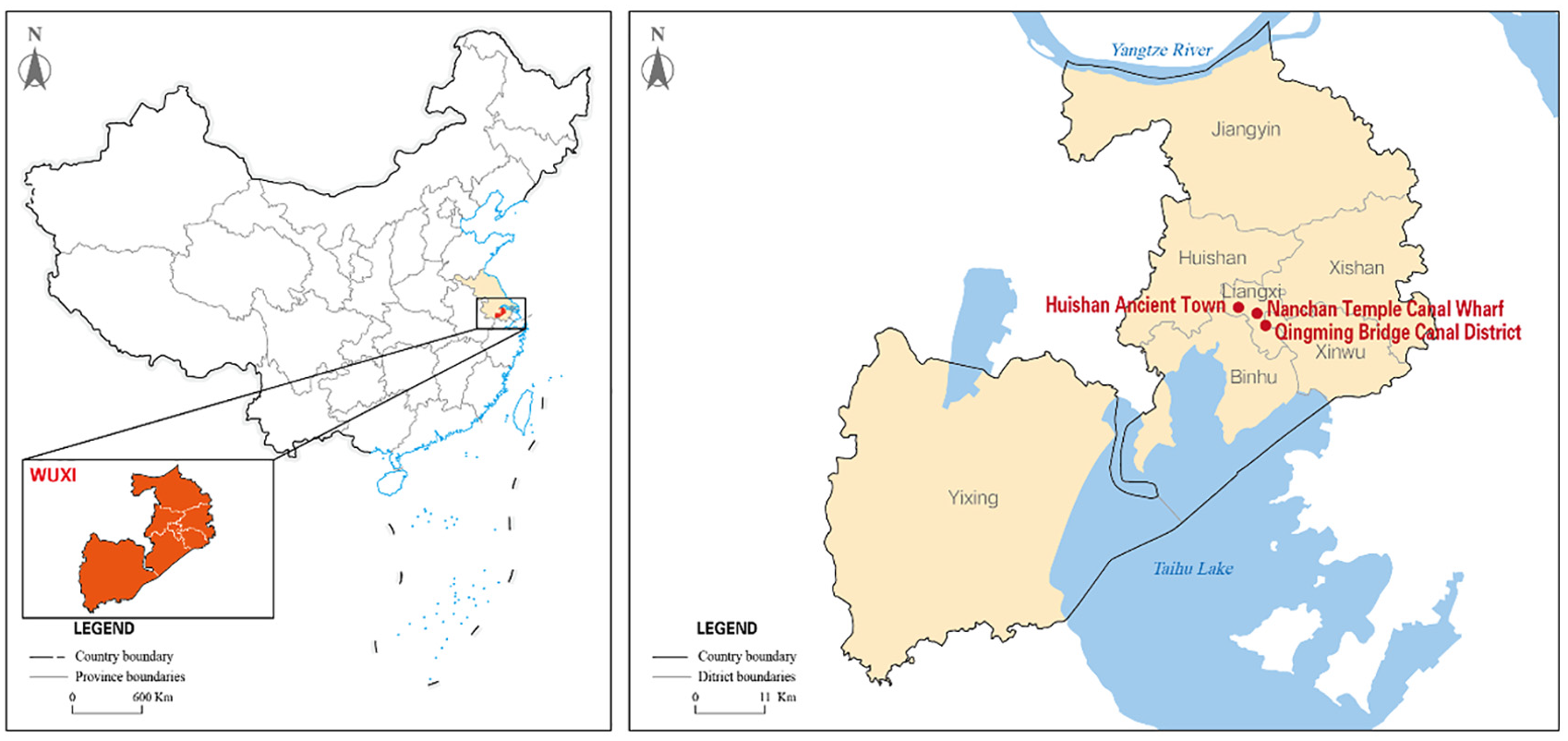
Three classic intangible cultural heritage tourism experience sites in Wuxi.
Questionnaire Design
The survey questionnaire included scales to measure each construct in this study. Validated scales from previous studies were identified and modified to fit the study setting. The first part of the questionnaire, collected basic information about the respondents, such as gender, age, place of origin, travel companions, travel purposes, educational level, and monthly income. The measurement of the second part of the questionnaire consists of four factors: experiential authenticity, transportation and environment, price value, and information services and credibility. To facilitate data collection and statistical analysis, attitude quantification methods were primarily used for the tourist experience indicators. The widely recognized Likert Scale with five levels (1 = Very Disagree 5 = Very Agree) was employed for measurement.
Information services and credibility was measured using five items that were adopted from D. Kim et al. (2008): “Online information enable me to have more convenient ICH tourism experience”; “Punctural information delivery enhanced the effectiveness on my ICH tourism experience”; “Accuracy of media promotion increased my experience productivity”; “Variety of media promotion increased my experience diversity”; “Richness of media promotion content provided more freedom choice.”
Experiential authenticity was measured using six items that were adopted from J. H. Kim (2018): “I really enjoyed the immersive tourism experience”; “I had a chance to closely experience the regional cultural”; “I learned some new knowledge from this tourism experience”; “I experienced something attractive during this tourism experience”; “I experienced something innovative during this tourism experience”; “I revitalized through this tourism experience.”
Price value was measured using four items that were adopted from Rehman et al. (2023): “I think the ticket prices of destination are reasonable”; “I think the souvenir prices of destination are reasonable”; “I think the price for activity experience are appropriate (e.g., ICH handmade)”; “I think the price for service are appropriate (e.g., guide service).”
Transportation and Environment was measured using for items that were adopted from Le-Klähn et al. (2014): “Accessibility of transportation (e.g., station, vehicle)”; “Space for vehicles (e.g., parking lot)”; “Convenience of service (e.g., punctuality, reliability)”; “Feel comfort environment (e.g., clean, safety)”; “experiences of provided public services.”
Memorable Tourism Experiences was measured using for items that were adopted from J. H. Kim et al. (2012), Vada et al. (2019): “I had a once-in-a-lifetime experience.”; “I really enjoyed this tourism experience.”; “It was different from previous experiences.”; “I visited a place where I really wanted to go.”; “I was interested in the ICH activities of this tourism experience.”
Data Analysis
In this study, statistical analysis software SPSS 22.0 was used to analyze the collected data and draw conclusions. The data underwent reliability tests and the KMO test. Exploratory Factor Analysis, specifically Principal Component Analysis, was utilized to extract common factors influencing tourists’ evaluations of MTEs with ICH tourism. Independent samples t-tests and one-way ANOVA were employed to analyze the relationship between demographic information of the respondents and their MTEs with ICH tourism. Linear regression was used to analyze the relationship between various factors and overall MET levels.
Empirical Analysis and Results
The Cronbach’s α coefficient was employed to assess the reliability of the questionnaire. The Cronbach’s α coefficient for the questionnaire model was .897, indicating good internal consistency and high reliability of survey items. This was followed by conducting a factor analysis to examine the relationships between different indicators. The results showed a Kaiser-Meyer-Olkin (KMO) value of 0.906 (>0.6), and the Bartlett’s sphericity test yielded a highly significant p-value of .000*** (<.05). These results suggest the significant correlations between different variables the suitability and effectiveness of processing the factor analysis.
Demographic Characteristics of Survey Participants
Table 1 showed that males accounted for 42.19%, while females were 57.81%, suggesting a relatively balanced gender ratio. Regarding the age range, most were between 19 and 28 years old (44.05%), followed by those aged 29 to 55 (31.04%). While looking at educational qualifications, nearly half (48.51%) held a bachelor’s degree. 29.55% of the participants were local residents, 24.72% were from other cities of Jiangsu Province, 22.86% were from other provinces. These participants were on higher monthly incomes as 80.48% exceed 3,000 RMB. They often travel with their parents, accounting for 28.25%, and mostly motivated by experiencing local culture.
Socio-demographic Characteristics of the Respondents.

Factor Analysis of Tourists’ Experience of ICH Tourism
Exploratory factor analysis was conducted with the criteria of characteristic roots >1 and rotated factor loading coefficients >0.5 (Bryman & Cramer, 2002). On this basis, principal component analysis (PCA) was performed using maximum orthogonal rotation. Table 2 shows that the cumulative variance explained reached 62.067%. Four experience common factors were named as follows: “Information Services and Credibility,”“Experiential Authenticity,”“Price Value,” and “Transportation and Environment.”
Factor Analysis of Tourists’ MTEs with ICH Tourism (N = 538).
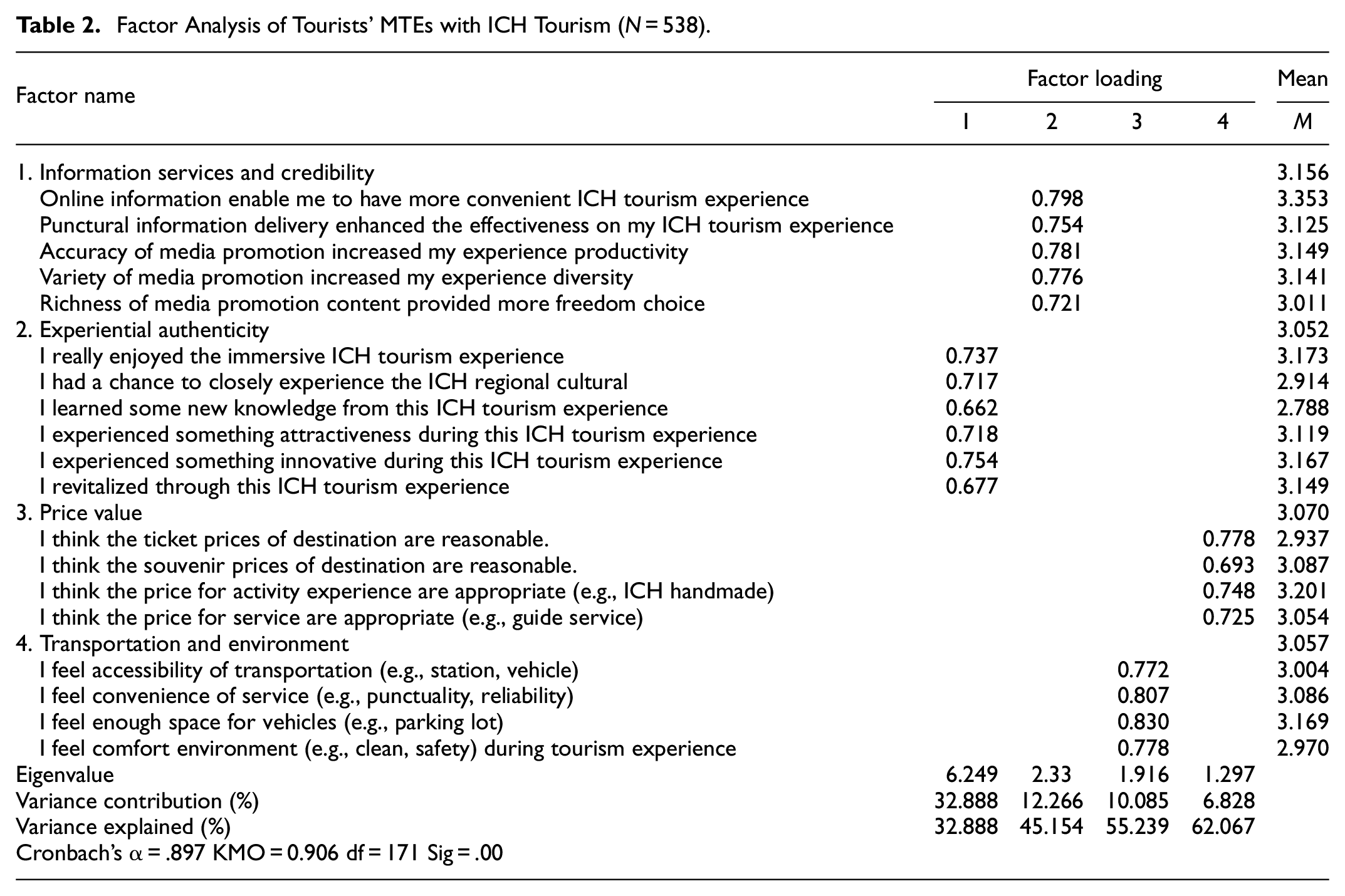
Based on the mean (M) calculation results from high to low, the “information services and credibility” (M = 3.156) had the highest mean value, followed by “Price value” (M = 3.070) and “transportation and environment” (M = 3.057). “Experiential authenticity” had the lowest MTEs level (M = 3.052). This presentation provides an intuitive ranking of tourists’ MTEs with various aspects of ICH tourism.
The comparison of the variance contribution rates shows that the first common factor, “Experiential Authenticity,” contributes 32.888% of the variance and tourists have a strong demand for “I really enjoyed the immersive ICH tourism experience,”“I had a chance to closely experience the ICH regional cultural,” and “I revitalized through this ICH tourism experience” during tourism. Among them, tourists are most satisfied with the “I really enjoyed the immersive ICH tourism experience” presented in the activity content (M = 3.173), and the “I learned some new knowledge from this ICH tourism experience” is the lowest (M = 2.788). The second common factor is “Information service and credibility,” which has significant factor loadings in terms of “Online information enable me to have more convenient ICH tourism experience,”“Accuracy of media promotion increased my experience productivity,”“Variety of media promotion increased my experience diversity,” indicating that “Information service and credibility” is an important factor affecting tourists’ MTEs of ICH tourism. Among them, tourists are most satisfied with the “Online information enable me to have more convenient ICH tourism experience” (M = 3.353). The third common factor is “Transportation and environment.” The results of data analysis show that “I feel enough space for vehicles (e.g., parking lot)” has the highest MTEs (M = 3.169) and “I feel comfort environment (e.g., clean, safety) during tourism experience” has the lowest (M = 2.970) effects on tourist’ MTEs. The fourth common factor “Price Value” indicates that the cost of traveling contributes to MTEs. “I think the price for activity experience are appropriate (e.g., ICH handmade)” has the highest MTEs (M = 3.201) and “I think the ticket prices of destination are reasonable” is lower (M = 2.937), indicating that the current pricing of tickets and related fees for ICH tourism activities may be out of line with the adjustment of tourists’ expectations and needs.
The Impact of Socio-Demographic Characteristics on MTEs in ICH Tourism
The analysis of the impact of socio-demographic characteristics on tourist MTEs with ICH tourism revealed significant differences based on several factors. The statistical tests conducted using independent sample t-tests and ANOVA single-factor variance analysis indicated significant differences in tourist MTEs based on gender, age, place of origin, travel companions, trip purpose, education level, and monthly income (Table 3).
The Impact of Various Demographic Factors on Tourist MTEs with ICH Tourism.

For Gender, Male tourists expressed higher MTEs with ICH tourism compared to female tourists for “Information Services and Credibility,”“Experiential Authenticity,”“Price Value” and “Transportation and Environment.” Specifically, although the difference between males and females did not reach statistical significance (p > .05) for “Information Services and Credibility” and “Price Value,” the gender differences were significant (p < .05) for “Experiential Authenticity” and “Transportation and Environment.” This suggests that males rated “Experiential Authenticity” and “Transportation and Environment” significantly higher than females. These findings may reflect the different preferences and evaluation criteria of different gender groups in the experience of tourism or related services, in which males may value the combined performance of these aspects more, while females may be more detailed and critical in their evaluations. At the same time, in the future development of the ICH tourism market, it is important to pay more attention to the development of the female tourism market and improve their MTEs levels.
The analysis of how age impacts tourist MTEs of ICH tourism revealed several interesting findings. Specifically, age had a significant effect (p < .05) on the ratings of all these indicators, although the extent of the effect varied. The group younger than 18 years of age had the highest ratings on most of the indicators, while ratings were generally lower in the 19 to 28 age group, which may reflect differences in consumer attitudes, financial means and life experience between the young and the old. Subsequently, ratings pick up in the 29 to 55 age group, but do not continue to rise in the group of more than 56, but level off. This trend suggests that age has a complex impact on the evaluation of service experiences, with different age groups having unique preferences and evaluation criteria. In summary, understanding the impact of age differences on service evaluations can help service providers better meet the needs of different age groups and improve overall service quality and customer satisfaction.
When analyzing the level of education, the results showed that although there were differences in the various ratings among the education groups, the level of education mainly had a significant effect on the credibility ratings (F = 4.212, p = .006), with the group with a master’s degree giving the highest ratings. In contrast, differences in ratings of “Information Services and Credibility,”“Experiential Authenticity” did not reach the level of significance, while ratings of “Price Value” and “Transportation and Environment” showed a high degree of consistency, with insignificant differences between groups with different levels of education. This finding suggests that more educated tourists tend to have a strong desire for knowledge and a deeper understanding and experience of intangible cultural heritage, and immersive experiences, such as interactive learning environments, can fulfill the intellectual input sought by more educated tourists. In contrast, less educated tourists may have limited understanding of the cultural significance of ICH tourism activities.
For the factor of residence, the results show that although “Information Services and Credibility” is relatively consistent among different residential locations and does not show significant differences, the evaluation of “Experiential Authenticity” is close to the significance level, showing certain regional differences. In terms of “Price Value” and “Transportation and Environment,” the differences in residential location are even more pronounced. In particular, “Transportation and Environment” (F = 4.621, p = .003) showed a significant residential location effect, while the group with the “other” residential location had the lowest rating. This finding highlights the multi-dimensional impact of residential location on the service experience, providing service providers with an important reference for market segmentation and positioning, helping them better meet the needs of different customer groups and optimize the service experience. Specifically, local residents are familiar with the traditions and history of the ICH. Experiential activities often center around these cultural elements and are particularly engaging and meaningful to residents.
For the factor of income, the results showed that the effect of income level was mainly on “Information Services and Credibility.” This rating showed a significant upward trend with increasing income levels (F = 3.756, p = .011). It suggests that higher income groups are more satisfied with this factor, possibly because they have access to higher-quality services or have higher expectations and demands for services. In contrast, ratings of other three factors were not significantly affected by income level (F = 1.471, p = .222; F = 1.168, p = .321; F = 0.109, p = .955). These ratings were relatively consistent across income level groups and did not show significant differences. In summary, income level primarily influenced the ratings of “Information Services and Credibility.” These tourists typically have extensive travel experience and may have their own means, such as premium accommodations and travel memberships, to organize self-guided activities and experience them independently, relying less on the information services provided by the destination. Conversely, in terms of “Price Value,” MTEs gradually improves as income levels rise, in part because increased spending allows access to exclusive or premium activities that can create unique memories, such as private guided tours, VIP attractions at destinations, or specialized experiences tailored to individual preferences.
For the factor of “travel companions,” The results showed that the influence of the main escorts on showed significant differences. In the areas of “Information Services and Credibility,” although there were differences in the evaluations of different groups of escorts, these differences did not reach the level of significance (F = 1.900, p = .109). This suggests that overall group ratings of “Information Services and Credibility” were relatively consistent regardless of who the primary escort was. However, in terms of “Experiential Authenticity,” the difference reached the level of significance (F = 3.874, p = .004). In particular, the group that traveled alone gave relatively higher ratings, which may mean that individuals are more able to focus on the experience itself when not accompanied by an escort, and thus feel a higher level of authenticity. Ratings of “Price Value” and “Transportation and Environment” also showed significant differences (F = 2.609, p = .035 and F = 2.735, p = .028). In terms of price value, the group who traveled alone rated it slightly lower, which may indicate that they are more price-sensitive in the absence of an escort. As for “Transportation and Environment,” the group of other accompanying persons (e.g., friends, children, parents, or others) gave relatively high ratings, which may be related to their mutual support and shared experience during the trip. This finding has important implications for service providers, who can provide a more personalized and attentive service experience based on the preferences and needs of different groups of escorts.
For the main purpose of trip, the results showed that the main purpose of travel significantly influenced on “Information Services and Credibility” and “Transportation and Environment.” On “Information Services and Credibility,” groups with different travel purposes showed significant differences (F = 3.526, p = .004). The group whose main purpose was leisure and recreation gave the highest ratings, while the groups of knowledge learning and just passing by gave relatively low ratings. This may imply that leisure and recreation travelers have a higher need for information services and are more likely to feel satisfied. On Experiential Authenticity, although there was some difference between the travel purpose groups (F = 1.545, p = .174), it did not reach the level of significance. While the difference in ratings for “Price Value” did not reach the level of significance (F = 0.547, p = .741), the trend suggests that the recreational and just passing through groups may be more price sensitive. As for “Transportation and Environment,” the difference reached the level of significance (F = 2.366, p = .039), with the Other as Main Purpose group giving the highest ratings and the Just Passing By group giving the lowest ratings. This may be related to the fact that tourists who are just passing through are more concerned about the convenience of the trip and less demanding about the overall quality of transportation and environment.
The Relationship Between MTEs Evaluation Factors and the Overall MTEs of Tourists with ICH Tourism
The regression equation showed high statistical significance (Table 4). By analyzing Table 4, four evaluation factors “Information services and credibility” (p = .000), “Experiential authenticity” (p = .003), “Price value” (p = .000), and “Transportation and environment” (p = .000) significantly contribute to overall MTEs. With an R2 of .230, the MTEs with ICH tourism derived from these four common factors closely approximates overall MTEs. This finding indicates that these four evaluation factors are important indicators for measuring MTEs. According to the Beta values, the correlation coefficients between these four common factors and overall MTEs, from highest to lowest, are as follows: “Information services and credibility” (.209), “Experiential authenticity” (.145), “Price value” (.170), “Transportation and environment” (.140; See Figure 2).
Regression Analysis of Tourist MTEs Evaluation Factors and Overall MTEs in ICH Tourism.


Antecedent dimensions of MTEs in the context of ICH tourism.
General linear multiple regression analysis revealed that all four of these factors had a significant impact on overall MTEs with ICH tourism experiences. Notably, the “Information Services and Credibility “had the most substantial influence on tourists’ overall MTEs. Providing high-quality travel experiences requires tourism managers to focus on creating memorable cultural experiences, in addition to creating comfortable transportation, spatial environments, and information services. This is consistent with the viewpoint proposed by other scholars that future directions in ICH tourism research are influenced by three factors: local activity making, technology, and environment (Qiu et al., 2022).
Discussion
This study extensively analyzed tourist’ MTEs in the context of intangible cultural heritage tourism. Through a MTEs survey of 538 tourists to the ICH tourism attractions, it was analyzed that the tourists have a high level of MTEs with the local ICH tourism experience. The dimensions of MTEs in the context of ICH tourism can be summarized into four categories: “Information Services and Credibility,”“Experiential Authenticity,”“Price Value” and “Transportation and Environment.” Among these dimensions, tourists reported the highest MTEs with “Information Services and Credibility” (M = 3.156), while MTEs with “price value” was the lowest (M = 3.052). This study also finds that sociodemographic characteristics will affect the MTE of tourists in ICH tourism, which is specifically manifested in: gender, age, education level, place of origin, monthly income, travel companions, and main tourism purposes.
Theoretical Contributions
First, this study expands the research boundary of MTEs and places MTEs in the research context of ICH tourism. The discussion of tourist MTEs within cultural tourism sites has yielded rich research findings. However, many cultural tourism destinations include both tangible heritage and intangible cultural heritage (Z. Chen, 2022; Yuan et al., 2022), even tourism destinations with higher cultural diversity have more ICH resources (N. Tan et al., 2023). Therefore, focusing solely on the tourism of tangible heritage in cultural tourism sites presents a partial perspective (Taheri et al., 2020). ICH tourism is not simply about sightseeing, but participation in activities themed on ICH, which is more likely to generate MTEs (H. Chen & Rahman, 2018). In this paper, ICH tourism is included in the study of MTEs.
Secondly, this study identifies the antecedent factors influencing MTEs in ICH tourism and focuses on the effect of different sociodemographic characteristics on MTEs of ICH tourists. Previous studies on the antecedent factors of MTEs in cultural tourism destinations primarily discussed elements such as Attraction, Cultural Inheritance, Nostalgia, and Authenticity (Lee, 2015; Taheri et al., 2020). In contrast, this study explores four dimensions: “Information Services and Credibility,”“Experiential Authenticity,”“Price Value,” and “Transportation and Environment”—regarding their effects on MTEs within ICH tourism, thereby enriching the antecedent dimensions of MTEs. Moreover, MTEs generated by tourists with different sociodemographic characteristics is also different, which is more conducive to MTEs research on objects with different characteristics, and also provides practical implications for ICH tourism managers to provide personalized tourism products for tourists with different sociodemographic characteristics.
Practical Implications
In terms of Information services and credibility, it is essential to enhance information channels, implement targeted media promotion, and diversify promotional formats. Given the significance of Information services and credibility to the tourist experience (M = 3.156), tourism enterprises should establish tourism information websites and mobile applications that regularly update information such as tourist activities, ticket prices, and transportation guides, ensuring the accuracy and comprehensiveness of the information provided. Concurrently, the precision of media promotion targets should be improved, with personalized promotional strategies developed for different tourists. For example, Tourism companies should develop ICH tourism programs such as parent-child activities and family friendly tourism programs that target family tourists.
In terms of experiential authenticity, it is essential to create immersive experiences that allow tourists to experience regional culture. Given that “Experiential authenticity” is the lowest (M = 3.052), tourism enterprises must focus on breakthroughs and innovations in ICH tourism activities. It is crucial to thoroughly explore the regional cultural characteristics of local intangible cultural heritage and develop unique tourism experience programs. In particular, combining modern elements with traditional intangible cultural heritage can promote cultural innovation.
In terms of pricing, it is essential to establish a reasonable pricing strategy to enhance cost-effectiveness. Tourism enterprises should conduct market research to understand tourists’ purchasing power and price sensitivity, t and formulate a reasonable price system. Various ticket packages can be introduced, such as family passes, student tickets, and senior citizen discounts, to cater to the needs of different tourists. By improving the cost-benefit ratio of tourism products and incorporating value-added services, such as complimentary specialty drinks or small souvenirs, travelers can experience enhanced value for their money.
In terms of transportation and environment, tourism enterprises need to continuously improve the transportation infrastructure and improve the environmental comfort by optimizing the sign guidance and cleanliness. Tourism enterprises should cooperate with the local transportation department to increase the bus routes and frequencies of the scenic spot, and set up tourist bus parking lots to facilitate tourists to enter and exit the intangible cultural heritage tourist spot. In addition, clear geographical signs and location guidance should be set up in the ICH tourism activity area, such as obvious signs at the intersection to indicate the direction and distance of each scenic spot. At the same time, tourism enterprises should strengthen the environmental health management of scenic spots, regularly carry out garbage cleaning and environmental disinfection, and provide a clean and tidy tourism environment for tourists.
According to different tourist groups, ICH tourism enterprises need to provide personalized services to enhance tourists’ MTEs. Tourism enterprises should pay more attention to the development of the female tourism market. Due to the significant impact of age on METs, tourism enterprises should strengthen the development of projects for different age groups. In particular, it is necessary to strengthen the care of senior tourists, they can provide special guide services for elderly tourists, and set up barrier-free access and rest facilities in the scenic areas. Tourism companies can also provide special cultural integration activities for out-of-town tourists, such as inviting them to participate in the traditional festival celebrations of local residents, so that they can better understand the local culture. At the same time, a variety of ICH activity themes should be designed for different travel companions and tourists with different travel purposes. For example, families traveling with children should provide parent-child interactive ICH experience projects, such as parent-child handicraft and parent-child cultural games. For tourists traveling with friends, team building activities are provided to enhance the interaction and understanding between tourists. Moreover, tourism enterprises can provide professional cultural learning materials for the group of knowledge-learning tourists, and provide more abundant cultural experience activities for the tourists whose main goal is cultural experience. Finally, in terms of price, a gradient price system should be developed to provide economic inclusive ICH tourism projects. At the same time, tourism enterprises can provide more personalized services for high-income tourists, such as private butler service and customized travel itinerary. According to their consumption habits, high-end intangible cultural heritage experience projects are recommended, such as ICH exhibitions in private collections and high-end cultural tasting activities.
Limitations and Future Research Direction
First, although the global COVID-19 pandemic has officially ended, China’s inbound tourism market has not totally recovered. Consequently, the number of western tourists is generally small. The 538 samples in this study are all from Chinese tourists, which could not reflect the influence of cultural differences on MTEs in ICH tourism. Therefore, the generalizability of the conclusion needs to be further improved. Second, this study only focuses on traditional tourism activities in ICH destinations, while now, smart technology is beginning to be applied to cultural heritage sites and greatly improve tourist experience (Kotsopoulos et al., 2024). Third, this study explores what factors affect MTEs in ICH tourism, but does not pay attention to whether tourists may have further tourism behaviors after MTEs in ICH tourism.
In the future, this study intends to investigate the experience perception of western tourists in ICH, and consider the influence of cultural differences on the MTEs dimension of Chinese and western tourists, so as to enhance the generalizability of ICH tourism and MTEs research. Secondly, this study plans to expand the numbers and types of ICH destinations in the future, so as to further verify the research results of MTEs in ICH tourism, such as what factors will affect the MTEs of tourists in ICH tourism destinations that adopt smart technology. Third, previous studies have shown that MTES, as antecedent, will affect tourists’ subsequent behaviors (Shi et al., 2023). This study plans to add more variables to ICH tourism to explore whether tourists have further tourism behaviors after MTEs, so as to enrich the S-O-R theory.
Footnotes
Acknowledgements
This paper has received great care and assistance from Dr. Cheng Denian, who is the lecturer in the Department of Business Administration at Nanjing Forestry University, during the writing and revision process. All authors would like to express sincere gratitude to Dr. Cheng.
Declaration of Conflicting Interests
The author(s) declared no potential conflicts of interest with respect to the research, authorship, and/or publication of this article.
Funding
The author(s) disclosed receipt of the following financial support for the research, authorship, and/or publication of this article: This research received funding of Jiangsu Province Qing Lan Program of University.
Ethical Approval
The study uses survey data, and we had institutional IRB approval for data collection. We subscribe to and comply with all publication ethics guidelines.This study does not involve animal or human clinical trials, so there are no ethical risks of this study.

Data Availability Statement
The datasets of this study are available from the corresponding author on reasonable request.