




Abstract
Locality is an important foundation of local characteristics and image, encompassing the natural qualities and inherent cultural features of a place. Researching the process and mechanism behind the reconstruction of locality in Miao silver ornament, under the context of tourism development, holds significant importance for the inheritance and protection of intangible cultural heritage. This article is based on the theory of locality, utilize grounded theory to process interview transcript data and find that: (1) Tourism has transformed Miao silver ornaments in Qiandongnan from everyday decorations to core elements in tourism performances, this process has expanded their usage scenarios and reshaping the landscape space of Xijiang Miao Village; (2) Within the social context constructed by Miao silver ornaments, traditional craftsmanship and patterns provide a basis for individual and ethnic identity recognition, further establishing connections between individuals and groups, as well as between people and place in space-time; (3) Miao silver ornaments serve not only as material representations of primal religious beliefs but also as significant symbols of culture and ethnic identity; (4) Miao silver ornaments carry profound familial and cultural emotional identity. Through tourism activities, this emotional identity is concretely manifested in Xijiang Miao Village, becoming a bond between individuals and their ethnic group. To promote the protection, inheritance, and development of Miao silver ornaments, various measures can be taken, such as encouraging master silversmiths to conduct Miao silver forging workshops, regularly organizing silver ornament cultural festivals, developing integrated online and offline display platforms, and introducing silver ornament culture-related courses in local primary and secondary schools.
Plain language summary
Locality is an important foundation of local characteristics and image, encompassing the natural qualities and inherent cultural features of a place. Researching the process and mechanism behind the reconstruction of locality in Miao silver ornament, under the context of tourism development, holds significant importance for the inheritance and protection of intangible cultural heritage. This article utilize grounded theory to process interview data and find that: (1) Tourism has shifted the use of Miao silver ornaments in Southeast Guizhou from daily life to tourist performance, expanding their usage scenarios and reshaping the landscape space of Xijiang Miao Village; (2) Within the social context constructed by Miao silver ornaments, traditional craftsmanship and patterns provide a basis for individual and ethnic identity recognition, further establishing connections between individuals and groups, as well as between people and place in space-time; (3) Miao silver ornaments serve not only as material representations of primal religious beliefs but also as significant symbols of culture and ethnic identity; (4) Beyond being mere decorations, Miao silver ornament carry deeper emotional identification with traditional family culture, which are concretely manifested through Xijiang Miao Village, becoming a bond between individual and ethnic emotion.
Keywords
Introduction
As the socio-economic transforms, tourism has gradually become a major driving force for the development of villages, ethnic communities, and traditional districts (Castells, 1996), tourism products act as carriers that represent the locality of tourist destinations, while the locality of these destinations imbues the tourism products with symbolic meanings (e. g. L. Yang, 2010; Benur & Bramwell, 2015). The forging skill of Miao silver ornaments was included in the first batch of the national list of intangible cultural heritage (ICH) in 2006. Regarding the research on ICH, scholars have explored issues and strategies in aspects such as the activation and utilization of ICH in the tourism field (Z. F. Wang & Chen, 2023), living heritage (J. M. Li et al., 2020; Y. Li et al., 2020), local construction (Dai, 2017), and co-creation of value by multiple entities (Song et al., 2022), intangible cultural heritage tourism can enhance ethnic cultural identity, diversify and enrich tourist experiences, and promote the innovative development of local culture. However, it also brings issues such as loss of authenticity, excessive commercialization, and homogenization, establishing a collaborative management mechanism, promoting community participation (Tan et al., 2018), and utilizing modern technology for the innovative inheritance of intangible cultural heritage can contribute to the sustainable development of ICH (Y. Li, 2018).
Previous studies on locality mainly focused on three dimensions: Firstly, the physical landscape (Ma et al., 2018), include the geographical environment, geomorphology, etc. Secondly, local culture, which carries the perception, imagination, memory, and thought formed by residents within a locality, representing the meaning and value (B. H. Wu, 1987), cultural differences between different region and ethnic group are one of the significant form of showcasing locality. Lastly, the social structure and living atmosphere, where culture permeates into the local social space practice, promoting the formation of complex social relations and organizational networks based on kinship, marriage, neighborhood, etc. good interpersonal relationships and community atmospheres jointly enhance community cohesion and residents’ happiness (B. H. Li et al., 2023, Y. Li et al., 2023), these dimensions highlight the cultural differences between various regions and ethnic groups. All of which reflect locality. However, research on Miao silver ornament has mainly focused on their esthetic value (J. T. Wu & Pan, 2022), craftsmanship (e.g., Mei & Yang, 2019; Yu & Su, 2022), design application (Xiao et al., 2018), pattern symbol and meaning (e.g., Li, 2018; Hu et al., 2022; Y. Li, 2018; X. H. Wang, 2017), and their inheritance and development in modern society, in-depth interpretation and research on its locality remain insufficient, necessitating studies on the locality and reconstruction of intangible cultural heritage.
This study uses Xijiang Qianhu Miao Village in Guizhou as a case study, aiming to construct the locality representation of Miao silver ornaments and analyze their reconstruction mechanisms, thereby filling the theoretical gap in the current research on intangible cultural heritage. The research objectives include: (1) exploring the uniqueness of Miao silver ornaments in terms of locality representation; (2) examining how tourism practices influence the locality reconstruction of Miao silver ornaments; and (3) proposing specific strategies for their protection, inheritance, and development. The innovation of this study lies in focusing on the locality of Miao silver ornaments as the core of the research, conducting a comprehensive analysis from multiple dimensions such as landscape, text, symbols, and emotions, thereby enriching the theoretical framework of the locality studies in intangible cultural heritage.
In summary, this study takes the Xijiang Qianhu Miao Village in Guizhou as a case, aims to construct the representation of locality in Xijiang Miao silver ornaments and analyze the mechanism of its reconstruction, this approach can augment the theoretical framework pertaining to the study of Miao silver jewelry and enhance the depth of intangible cultural heritage research in analogous regions,intending to provide references for the protection, inheritance, and development of ICH in ethnic tourism destinations, promoting the sustainable development of local culture.
Literature Review
The concept of locality originates from place theory, locality represents the essential foundation of local characteristics and image, embodying the natural qualities and inherent cultural features of a place (F. Wang et al., 2014). It encompasses all characteristics formed by the combined forces of physical geography and human culture. Locality can be both described and constructed (e.g., Relph, 1976; S. Y. Tang et al., 2015; X. M. Zhang & Deng, 2022). As one of the key theoretical perspectives in tourism research, locality has long been a focal point in the academic world (Zhu et al., 2010). Research on locality began relatively early, starting in the 1970s, and has since matured. The research has not been confined to theoretical explorations; there is also a substantial body of empirical work. The perspectives are diverse, Dogan examining how tourism activities influence and alter the social and cultural structures of tourist destinations, the concept of locality continually evolves through the practice of tourism (Doğan 1989). Jess proposed that place, as sites of social and cultural construction, must maintain their uniqueness in the process of globalization. She explores the impact of globalization from multiple dimensions, including economic, social, political, and cultural aspects (Jess et al., 1995). Escobar indicates that landscapes carry memories and nostalgia, which can drive the continuous development of culture. The actual embedding of culture in a place influences the manner and outcomes of globalization (Escobar, 2001).
Through a review of the literature found that,studies of locality and tourism often focus on three aspects: Firstly, analyze the materialization and carrier process of locality reconstruction and formation, involve studies on the production, evolution, and construction of locality in tangible materials such as architecture, clothing, music, etc. (Liang, 1997; Y. Yang et al., 2021). Secondly, in terms of landscapes and symbols, the main focus is on locality in relation to tourism landscape design and symbol construction (Ma et al., 2018). Lastly, research also delves into the local sense, cognition, and emotional experience of residents and tourists at tourist destinations, including discussions on the perception of locality (W. Y. Tang, 2013), local identity (Qian et al., 2015), and emotional belonging (Y. Yang et al., 2021) among others. The study of locality in ethnic tourism villages is closely related to the protection of ethnic village culture, ethnicity, tourism image, and group identity (L. Yang & Wall, 2009). On this basis, the study introduces the theory of locality to provide practical guidance for the protection, inheritance, and development of intangible cultural heritage (Y. Yang et al., 2021).
In the context of globalization, with the continuous flow of capital elements such as the economy, information, technology, and labor, locality is continuously being dismantled and reconstructed through interactions between locales and people, and among different locales. Using text mining techniques, information is extracted from tourist blogs to analyze the perception of the tourism image of Zhujiajiao, revealing three main perceptions: the image of the geographical location, the type of tourist site, and the locality image (Y. Wang et al., 2013). A case study of the Water-Splashing Festival in the Xishuangbanna Dai Park explored changes in locality during the commercialization of tourism, which altered the meaning of traditional cultural festivals and triggered a reevaluation of cultural identity among local residents (Y. Li & Sun, 2021). By analyzing multimodal tourism language landscapes, it was found that effective language landscape planning can promote the integration of culture and tourism, enhancing local features (J. N. Zhang & Wang, 2022). Locality plays a crucial role in the development of tourism, not only due to its cultural value and contributions to sustainable development but also because it provides a unique tourism experience that attracts visitors. The preservation and dissemination of culture are crucial for promoting local economic and social sustainable development. These studies show that tourism is not only an economic activity but also a process of cultural and social interaction, in which the expression and maintenance of locality are key factors.
In the field of cultural geography, scholars’ research have revealed that local landscapes, texts, cultural symbols, and emotions are all important aspects of constructing locality (e.g., Coddington, 2011; Gao & Qian, 2016; Reid, 2008; Relph, 1981). The study indicate that by integrating material culture, institutional culture, behavioral culture, spiritual culture with the landscapes, texts, symbols, and emotions of locality, conducted a continuous social construction analysis on the locality changes in Liede Village (Huang & Yuan, 2015). The case of Lugu Lake further shows that locality is a process co-represented, constructed, and reshaped by the complex interactions of culture, values, knowledge, and capital in the tourism practices of media, tourists, and the local practices of residents, where internal identifications within a place display multiple characteristics (Wei et al., 2015). However, most of these studies tend to view locality as a static and fixed entity, emphasizing the impact of tourism on locality at a certain time point, lacking exploration from a “process” perspective on the changes of locality under the backdrop of tourism and the underlying institutional logical mechanisms. Research on Miao silver ornaments primarily focuses on their esthetic value, the inheritance of craftsmanship, jewelry design, and the preservation and protection of these ornaments. However, no scholars have yet analyzed the uniqueness of their crafting techniques, usage scenarios, and roles in Miao social structure and daily life from the perspective of locality.
Therefore, this paper aims to identify the locality of Miao silver ornament in Xijiang Qianhu Miao Village from the aspects of landscapes, texts, symbols, and emotions, to interpret the process and mechanism of its locality reconstruction under the influence of tourism, in hopes of enriching the practice of locality research in the context of tourism.
Research Design and Data Collection
Overview of the Case Study
Guizhou Xijiang Miao Village, located 36 km from the city of Leishan, is composed of 12 natural villages include Pingzhai, Dongyin, Yangpai, Nangui, Ying Shang, Ganrong, Changwu, Kaijue, Baozi, Kongbai, Maliao, and Wugao. The village retains an intact “primitive ecological” culture of the Miao ethnic, such as silver ornament, stilted building, festival, traditional music, and dance, which are well-preserved and inherited in Xijiang. Pingzhai, Dongyin, Yangpai, and Nangui form the core area of Xijiang Qianhu Miao Village. Kongbai and Maliao Village are known as “the hometown of Chinese silver ornament.” Silver ornament culture is the most representative of its ethnic characteristics. Therefore, this paper selects these six villages as the research area (Figure 1).

Geographic location of the sample area in the study region.
Silver ornament is an important part of Miao culture, featuring unique shapes and decorations that possess a rich ethnic character and artistic charm. They are symbols of the wearer’s identity as well as carriers of the ethnic community’s culture and history. Before the development of tourism, silver ornaments were mainly used in daily life, significant festivals, and wedding ceremonies, with silversmiths being “nomadic,” crafting silver ornaments in other villages during the agricultural off-season, contributing to a positive traditional village cultural atmosphere. After the introduction of tourism, silver ornaments shifted from everyday use to stage performances, becoming a tourism commodity. In recent years, supported by government policies, young silversmiths have returned to their hometowns to start businesses focused on silver ornament crafting, establishing workshops and embroidery classes, effectively promoting the inheritance and development of silver ornaments. Under the influence of tourism, significant changes have occurred in the locality’s landscape, texts, symbols, and emotions. Practically, tourism development has highlighted the locality of Miao silver ornaments, and conversely, Miao silver ornaments have enriched the development of local tourism. Selecting these villages as case study sites offers a representative analysis.
Research Method
The Grounded Theory proposed by Glaser and Strauss provides a robust research paradigm for qualitative studies (Glaser & Strauss, 1967). Grounded theory involves systematically collecting data to identify core concepts that reflect specific phenomena or objects, and subsequently forming a theory by establishing connections between these core concepts (Chen et al., 2019). This study employs grounded theory based on the following considerations: First, the theoretical framework for the reconstruction of the locality of Miao silver ornaments is not yet fully developed. One of the advantages of grounded theory is that it allows for exploratory analysis through the organization and excavation of raw data, helping to discover and explain unknown topics or phenomena. Second, the reconstruction of the locality of Miao silver ornaments involves complex processes and multidimensional characteristics, such as cultural heritage, economic development, and social interaction. Grounded theory provides a systematic approach to constructing and interpreting the narrative of specific phenomena and processes (Miao & Xie, 2021). Therefore, the grounded theory method is suitable for the exploratory study of the reconstruction of the locality of Miao silver ornaments. Through open coding, axial coding, and selective coding, to conduct a qualitative analysis of the interview texts, summarizing information to form main concepts and constructing relationships between different concepts (Figure 2).

Research design flowchart.
Data Collection and Processing
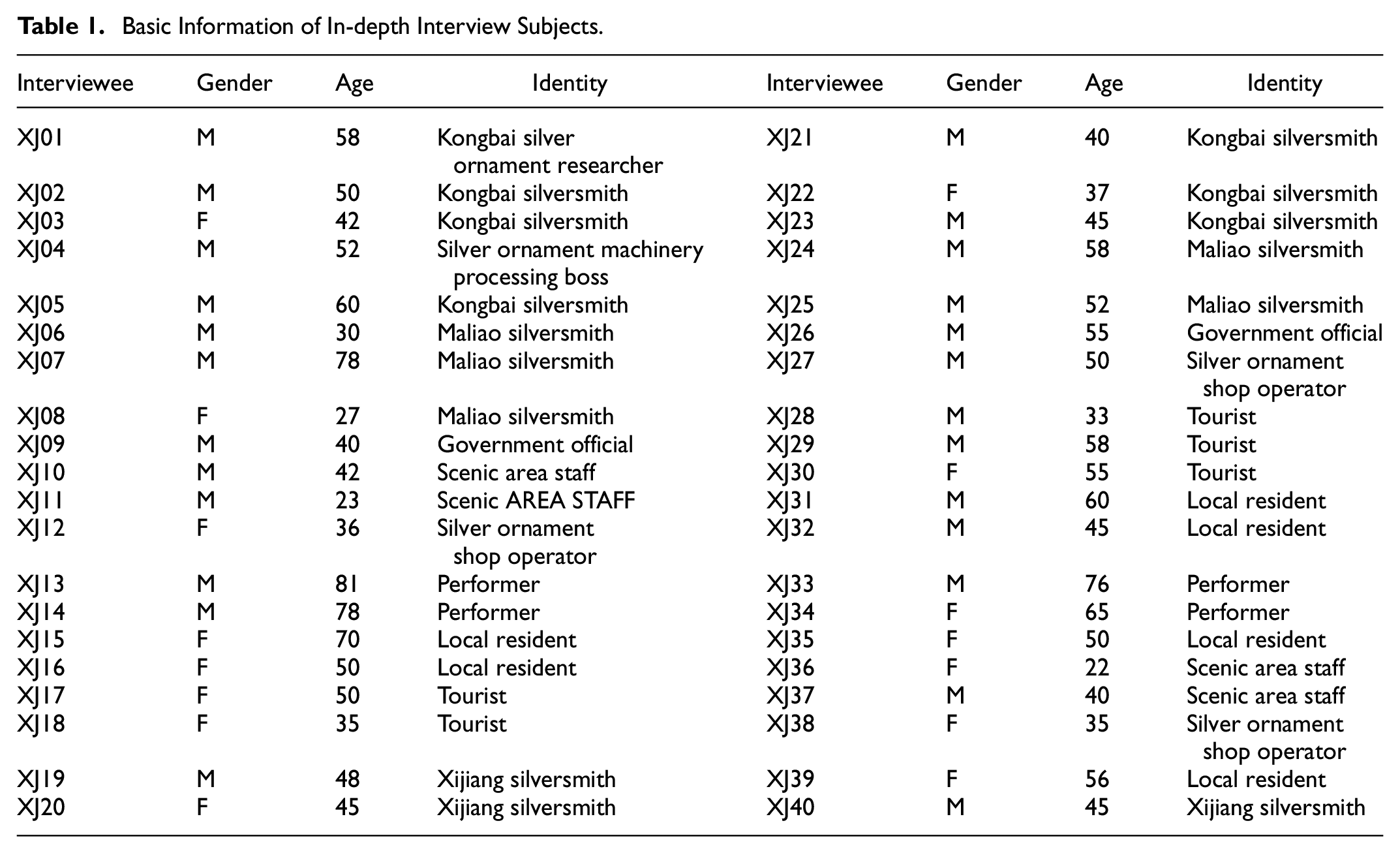
The data collection methods used were participatory observation and in-depth interviews. The research team conducted field surveys in Xijiang Miao Village from July 15th to 19th, 2018, July 21st to 27th, 2019, supplementary research was conducted on some silversmiths in Kongbai Village and Maliao Village, through in-depth interviews, from August 23rd to 25th, 2023, with a total investigation period of 15 days. Researchers conducted in-depth observations on scenarios related to Miao silver ornaments, local residents’ wearing of silver ornaments, and the distribution of shops. By participating in local daily activities and cultural performances, detailed information related to silver ornaments was recorded. Notebooks and cameras were used to document observed phenomena and scenes. Additionally, relevant scholars’ research was referenced. Meanwhile, representatives from the government, enterprises, performers, silversmiths, silver ornament researchers, silver ornament shop operators, local residents, and tourists were selected as subjects for semi-structured in-depth interviews, on topics such as the landscape, texts, symbols, emotions, supporting actions, and the impact of tourism related to Miao silver ornaments. Each interview lasted between 20 and 40 min, and the process continued in a snowball manner until information saturation was reached. A total of 40 valid interview samples were obtained (Table 1), with 36 used for coding analysis and 4 for theoretical saturation testing (J. M. Li et al., 2020; Y. Li et al., 2020).
Basic Information of In-depth Interview Subjects.
Grounded Theory Analysis
Open Coding
Open coding, also known as first-level coding, involves converting interview audio into text, reading and analyzing repeatedly occurring words, themes, or concepts, and progressively conceptualizing and categorizing the content of the textual data (Miao & Xie, 2021). In practice, the first step is to carefully identify the content in the interview materials related to the locality of Miao silver ornaments, such as landscape and text, and code them sentence by sentence. During this process, the original wording is used as much as possible as the names and basis for initial concepts and categories. Through open coding, ultimately resulting in 52 concepts. Subsequently, categorization was performed to further summarize the initial concepts. Based on semantic and logical relationships, related concepts were classified into the same category (Table 2).
Examples of Partial Open Coding.

Axial Coding
Axial coding, also known as second-level coding, builds upon the relatively independent and dispersed categories obtained from open coding, exploring the associations between categories through semantic relations, causal relationships, etc. That is, by discerning the similarities and differences in the connotations of the initial categories, the main categories are further refined. Based on a careful analysis of the interrelationships and logical sequence among the 15 initial categories, this study ultimately extracted 7 subcategories and 4 main categories. The categories derived from axial coding are shown in Table 3.
Main Categories Formed by Axial Coding.

Selective Coding
Selective coding, also known as third-level coding,The purpose of it is to develop a core category from the main categories and to describe a “storyline” that connects objects and phenomena around this core category. In this article, “Identification and Reconstruction of Locality in Silver Ornaments” is selected as the core category, through the analysis and summarization of the interview data from Xijiang Miao Village. Its “storyline” is as follows: Ritual activities are not only an important part of community collective memory, but also a symbol of cultural inheritance and identity. It reveals that cultural activities serve as a medium for community cohesion and cultural dissemination. With the involvement of tourism, traditional skills are preserved, inherited, and innovated against the backdrop of a changing socio-cultural context (Figure 3). Through embodied experiences, an emotional connection with culture is established, deepening emotional identification and promoting the reconstruction of locality in silver ornament.

Typical relationship structure of the main category.
Identification of Locality in Miao Silver Ornament of Xijiang Miao Village
Locality, as the core of place theory, represents both the material expression and the deep spiritual core (Liu et al., 2021). From both diachronic and synchronic perspectives of locality reconstruction, tourism practices have facilitated the “melting” and production of local cultural contexts with enterprises and tourists among other acting bodies, promoting the integration of places (e.g., B. H. Li et al., 2023; Qian et al., 2011). In the context of ethnic tourism villages, locality is not only the inheritance and embedding of local natural environments and ethnic cultures, but also the continuous creation by diverse entities using strategies and knowledge, in a constantly strengthening reconstruction process (Sun et al., 2020).
Based on previous research, landscape is a key element in the construction of locality, with the uniqueness and meaning of local culture largely presented through landscapes. The landscape of Miao silver ornaments is displayed in various forms such as elaborate costumes, festivals, and performances; text, as a material expression of the past, history, and memory, encapsulates the emotional value connections of individuals or groups and deep interpretations of local culture, as seen in Miao ancient songs, batik patterns, and craftsmanship inheritance, presenting the textual content of locality; symbols serve as representations and symbolic meanings of local culture, such as cultural identity and identity markers; emotions are reflected in the close connection with the local natural environment and lifestyle, wearing silver ornaments not only stimulates a sense of belonging but also deepens cultural integration.
According to the coding results, the locality embedded in Miao silver ornament is interpreted from the aspects of landscape, text, symbols, and emotions. (1) Silver ornament is not only a part of the Miao village landscape, but also a vivid representation of Miao culture. Through exquisite design and artistic expression, silver ornament present a unique esthetic, most notably in elaborate costumes. During festival ceremonies, whether headwear, necklaces, bracelets, or other ornaments, they carry rich symbolic meanings. The number of silver ornaments worn by Miao women peaks during puberty. When a daughter gets married, her family provides a complete set of elaborate costumes as dowry. In Miao weddings, the use of silver ornaments not only serves to display status but also represents a tradition deeply rooted in Miao culture and belief; Miao New Year, Eating New Festival, Dragon Invitation Festival, and the Drum Storing Festival held every 13 years, where women dressed in elaborate costumes gather at the Lusheng field. The Miao Drum Storing Festival, one of China’s first batch of national intangible cultural heritage, is the largest and most meaningful Miao festival in Leishan County and a solemn ceremony to worship the gods, sacred and rich in activities; silver ornaments play a role not only in ceremonies and festivals, but also integrate into women’s daily dress, becoming a part of their daily life.
(2) The locality of Miao silver ornaments is reflected through forging skills, ancient song lyrics, batik patterns, etc. The making of Miao silver ornament, with a long history, includes complex crafts such as forging, carving, and inlaying. These crafts require exquisite skills from artisans and a deep cultural understanding. The making of silver ornament is a display of craftsmanship, and a carrier of cultural inheritance, encompassing the transfer of technology and the heritage of Miao culture, history, and values. Miao ancient song narrate the history of the Miao people, recounting the origins of ancestors, ethnic origins, migration processes, and social customs orally, shaping Miao social concepts and the construction of their worldview to some extent. In silver ornament making, patterns often combine with ancient songs, with lyrics containing stories behind the patterns. The design elements are rich, including natural landscapes, flora and fauna patterns, geometric shapes, etc. Moreover, patterns in embroidery resonate with those on silver ornaments, collectively constructing a diverse expression of the locality of silver ornaments (Chang & Lin, 2022).
(3) In Miao society, silver ornaments are not just decorations but symbols of cultural identity, social status, and ethnic identity, carrying rich cultural meanings. The types, styles, and quantities of silver ornaments often reflect an individual’s or family’s economic capability and social status, creating a social hierarchy within Miao society and serving as key symbols of Miao identity (C. B. Zhang, 2017). The use of silver ornaments in weddings reflects unique traditions in Miao marriage ceremonies, where the exchange of silver ornaments is an acknowledgment of marriage, and a symbolic construction of familial and social relations. Wearing silver ornaments during festivals highlights the festive atmosphere, and conveys worship of ancestors and community wishes.
(4) The Miao people’s emotional identification with silver ornaments originates from traditional family culture and historical inheritance. Silver ornaments passed down through generations carry the emotional memory of the family, embodying the wisdom and diligence of ancestors. In Miao society, silver ornaments serve as a flowing social memory, pervading festival ceremonies and personal daily rituals, representing an important aspect of bodily practice. By wearing silver ornaments, Miao women can feel a strong sense of belonging and pride, strengthening the emotional connection between individuals and the community. During the making of silver ornaments, the silversmiths feel joy and satisfaction, making silver ornament workshops the best places for tourists to immerse themselves in Miao culture.
Analysis of Locality Reconstruction of Xijiang Miao Village Silver Ornaments
The Process of Locality Reconstruction in Xijiang Miao Village Silver Ornaments
The development of tourism has facilitated a dialog between the “self” and the “other” of a place, where otherness refers to the impression formed by one ethnic group toward another during their interactions, encompassing a collection of symbols, discourses, and value judgments (Fabian, 1983). Objects are not distinguished by their material differences alone but acquire beauty, ugliness, wealth, and poverty distinctions through cultural additions and certain values. In the tourism context, Xijiang Miao Village has transformed from a traditional residential space into a diverse space involving tourist participation, making the power structure more complex. Besides local resident, the involvement of the government, tourism company, operator, and tourist adds multiple participant, increasing the usage scenarios of Miao silver ornament and thereby accelerating their locality reconstruction (Figure 4).

Reconstruction mechanism diagram of miao silver ornaments.
Landscape: The Reproduction and Evolution of Ceremonial Activities
Silver ornaments delineate a binary space of “sacred/secular” within the Miao culture of Southeast Guizhou, distinguish between formal and casual attire, where casual attire refers to everyday clothing, which is relatively simple. Before the development of tourism, formal attire played a significant role in traditional festivals such as the Drum Storing Festival, Chixin Festival, Miao New Year, and in wedding ceremonies. The wearing of silver ornaments was closely related to specific rituals and sacrificial activities, bearing a strong religious implications. With the advent of tourism development, the government and tourism companies transformed these traditional ceremonies into tourism performances, such as traditional festival performances, 12 Courses of Block-the-Way Wine, and High Mountain Flowing Water, promoting the widespread use of formal attire in performances. “Previously, formal attire was only worn during major festivals and weddings, and we would wear casual clothes at other times. Earrings and bracelets were worn daily, and silver combs and neck rings were worn to the market or when visiting relatives. Now, it’s different. There are so many performances every day that we have to wear formal attire, but those are not handmade, they are made by machines, different from what we wear. Hand-embroidered clothes also look better with silver ornaments” (XJ16).
Traditional ceremony performers are mainly women over 60 years old, who, after being organized and trained by tourism companies, wear uniform attire and perform at specific locations. In the ethnic feature district of the scenic area, Gage Ancient Alley, men in their seventies and eighties wear black long robes and silver neck rings, singing ancient songs in the Ancient Song Hall. Twelve Courses of Block-the-Way Wine is a welcoming ceremony set up at the North Gate, and “High Mountain and Flowing Water” is a performance during dining, enhancing interaction with tourists, with the team composed of young people.
The government has established the Xijiang Miao Ethnic Museum within the scenic area, with a special clothing and silver ornament hall, focus on Miao silver ornament, clothing, and embroidered garment, showcasing the attire and silver ornament of the three major Miao branches, allow tourists to experience the style and cultural connotations of Miao silver ornament. With technological advances and the development of social media, promotional videos and short clips vividly display the features of Miao silver ornament, festive attire, folk music, dance, and festival activities, enhancing the fame of Xijiang Miao Village, promoting image building, making the tourism destination more tangible, and stimulating tourism demand. Silver ornaments are also made into silver paintings for wall decoration, allowing tourists to directly appreciate the beauty of silver ornaments; tourists can rent festive attire for photography. Local operators, by teaching dressing skills and providing cultural explanations, enrich the tourist experience. Although the attire for photography differs from traditional formal attire, tourists focus on the experience. In this way, festive attire not only becomes an element to attract tourists but also an important means of traditional cultural inheritance and promotion, reflecting the community’s active participation in cultural preservation and inheritance.
Text: Pattern, Craftsmanship Inheritance, and Development
In the social construction of place, texts record and reflect the visual, auditory, and linguistic habits etched into daily life, provide a tangible or intangible foundation for people’s lives and identities, build connections between the present and the past, between people and place (Fabian, 1983). Totem worship is a cultural phenomenon of human childhood, which, once formed, becomes deeply embedded in human consciousness and is released through materialization. Patterns are the visualized creative language of the Miao people, record the evolution of Miao social consciousness and ethnic emotional world. The essence of the universally revered entity “Butterfly Mother” and its spiritual mission have remained unchanged. After the development of tourism, the patterns on silver ornaments have become diverse. Traditional patterns are still being produced, and patterns can also be customized based on customer demands, “If it’s for formal attire, we know those patterns by heart and can start carving directly. The patterns now are not completely the same as before; we make them according to customer needs. For personalized patterns, we need to draw and print them out first, then affix them to the silver sheet for carving” (XJ25).
Silversmiths excel at drawing creative inspiration from embroidery and batik patterns, continuously integrating and innovating in pattern design and striving for excellence in craftsmanship. “Miao silver ornament patterns were relatively simple in the early days, focused on being large and heavy as beauty standards. After the availability of silver materials, the designs gradually became more intricate. Totem shapes are mainly used in batik and embroidery, with less than 20% used on silver ornaments, mainly derived from embroidery patterns, plus our own ideas for innovation” (XJ01). In Miao society, the inheritance of skills often occurs through apprenticeship systems or within families. With continuous socio-economic development, the mode of skill inheritance has changed, from “nomadic” to “fixed,”“handmade” to “mechanical,”“kinship” to “teacher-student,”“family” to “society.”“I learned my skills from my father, and we used to go to other villages to make silver, but now it’s different, we work at home. I’ve taught many apprentices, and my wife can also make silver ornaments. When training classes are held, I also go to teach” (XJ23). The first “Free Silversmith Training Class” in the nation was opened in Maliao Village, collaborating with some universities to establish practical course bases related to the profession.
After tourism intervention, with the surge of tourists, a number of embroidery, batik, and silver forging experience workshops emerged. Interactive experience activities allow tourists to immersively experience Miao culture. Silver ornaments sold in shops are divided into machine-made and handmade, with handmade ones being more expensive. A group of master silversmiths in Kongbai Village and Maliao Village insist on handmade production, not losing the original craft characteristics due to commercialization, endowing products with more connotations, driving the renewal of Miao silver forging skills, and promoting inheritance.
Symbols: The Expression of Cultural Identity and Identity Indicators
Silver ornament symbolize primitive worship, a materialized symbol of faith. In terms of their design, they emphasize the pure expression of the silver material itself, rarely combine with other materials. The symbolic function of Miao silver ornament actually encompasses three meanings: firstly, the pattern symbols attached to the silver ornaments themselves, as Miao silver ornaments carry a wide variety of pattern designs, forming a complete system of primitive worship symbols; secondly, the symbolic meaning of silver itself, as the material carrier of silver is a symbol of primitive religion; thirdly, a symbol of marriage, where the marital status in most areas is mainly indicated by the quantity of silver ornaments worn.
With the development of tourism, Miao silver ornaments have been provided with more channels for display and dissemination, strengthening them as symbols of ethnic identity. Tourism companies, through festive attire experience activities, treat silver ornament as valuable cultural symbols. This not only strengthens tourists’ identification with Miao culture but also reinterprets Miao traditional identity indicators. Tourists prefer to purchase handmade silver ornaments, “Many tourists come here feeling that non-handmade silver ornaments are not interesting, but actually, they just haven’t found the right place. Like my shop, we have both handmade and machine-made, and we recommend based on the tourists’ wishes” (XJ27). The development of the tourism has promoted the commercialization process of Miao silver ornaments, designing and producing specific styles of silver ornaments to meet tourist demands, deepening the influence of Miao silver ornaments as symbols of local culture.
Emotions: The Construction of Emotional Identification and Emotional Memory
For the Miao, silver ornaments are not only decorations but also an emotional bond. A person living in a place for a long time, or having special life experiences in a place, will establish an inseparable emotional connection with it. Similarly, a long-term use of an item can also create emotional ties. When a metal is integrated into the “esthetic temperament,” it becomes an emotional symbol. Emotional expression is significantly manifested in the close association with the local natural environment and lifestyle. For Miao women, silver ornaments can enhance their sense of belonging and pride in their ethnicity, “Every Miao girl has silver ornaments, from birth, parents start preparing the dowry, which includes a set of formal attire for marriage or festivals, it’s our tradition. During festivals, we dance to the Lusheng wearing formal attire to blend in with everyone. On ordinary days, we wear simpler items like earrings and bracelets because they are inconvenient for work, so we wear less. Wearing them makes us feel good physically and happy mentally” (XJ35).
The process of making silver ornaments reflects the inheritance of craftsmanship and expresses local cultural characteristics, and emotional identification. Specific historical, cultural customs, and natural environments provide unique inspiration and emotional support for silver ornament design and production, “In the village, I have many inspirations, when I go to other places, I can’t think of anything. It’s like the local environment nurtures its people. Is this place supposed to produce silversmiths, or is it the feng shui? This local environment truly drives our culture” (XJ24). Within this cultural context, the joy, happiness, and satisfaction experienced by silversmiths during the crafting process are deeply rooted in a sense of pride and belonging to their local culture.
Tourism has made traditional culture more visibly displayed in ceremonial activities, strengthening emotional identification with Miao silver ornaments. Tourists participating in silver ornament making and festival activities not only reinforce community participation, and evoke pride and emotional identification with their own culture, “Handmake silver ornaments is a completely different experience, I draw a picture, and the master teaches me how to make it, spend two or three hundred yuan to take away something I designed creates a special emotion and memory. And I happened to be here for the Chixin Festival, with many performances, the locals were very hospitable, and the experience was great, I will come again” (XJ02). It also sparks tourists’ interest in Miao silver ornaments and their underlying culture, in interacting with tourists, new elements and inspirations are absorbed, promoting the innovative development of Miao silver ornament.
Mechanism of Locality Reconstruction for Silver Ornaments in Xijiang Miao Village
Tourism is considered a significant force driving the reconstruction of locality, where subjects involved in tourism practices gradually transform their local identification into a broader recognition (Smith et al., 2016). On the one hand, the mechanism of locality reconstruction under the “global-local” context originates from the diachronic process of layering, re-layering, and delayering of local natural and cultural contexts (Zhou & Zhang, 2015), layering refers to the different cultural strata formed by the landscape and cultural characteristics of Miao silver ornaments. Re-layering is the integration of modern elements with traditional culture, continuously enriching and updating the cultural connotations of Miao silver ornaments. De-layering, on the other hand, refers to the fading or transformation of certain cultural elements, reflecting the adaptation and adjustment of local culture in the context of globalization; on the other hand, the process is also driven and shaped by the active participation of various stakeholders, including the government, businesses, residents, and tourists. These stakeholders bring different forms of capital, power, institutions, and cultural imaginations. In specific spatiotemporal contexts, through human-environment interactions, they collectively shape the process of locality reconstruction. For example, government policy support and infrastructure development provide a favorable environment for the development of Miao silver ornaments. Businesses and entrepreneurs enhance the appeal of local cultural symbols through their operations and market promotion. Residents and silversmiths, as the core agents of cultural heritage, continually innovate and adapt to meet market demands. Tourists, as participants and disseminators of cultural experiences, drive the enrichment and diversification of Miao silver ornament culture through their needs and feedback (Figure 4).
The reconstruction of the locality of Miao silver ornaments is a complex and dynamic process. Tourism development has led to Miao silver ornaments being more widely recognized and respected as a cultural symbol, enhancing the cultural identity of the community. Cultural identity serves as an important driving force for heritage preservation and innovation. In the context of tourism development, various stakeholders interact to shape this process. Government support for building museum and exhibition halls, opening traditional skills training classes, ensures that Miao silver ornaments can exert their unique cultural value in tourism development; businesses and operators organize silver ornament production, display, and sales, enhancing the influence of silver ornaments as cultural symbols; residents and silversmiths, as the core subjects of Miao silver ornament cultural inheritance, continuously innovate while maintaining traditional crafts to meet the demands of the tourism market; tourists are not only participants in cultural experiences but also carriers of cultural dissemination. The demand and feedback from tourists make silver ornament production more diversified and provide new perspectives for the reconstruction of locality in silver ornaments.
From a spatial dimension, the flow of tourism commodities allows the local symbols of tourist destinations to move to the tourists’ places of origin, expanding the influence of local culture and promoting interaction and integration with external cultures. As a tourism commodity, Miao silver ornaments are recognized and accepted in a broader spatial context through tourists’ purchases and dissemination, enhancing the influence and identity of their cultural symbols. From a temporal dimension, the evolution of tourism commodities reflects the ongoing reconstruction of locality in tourist destinations. With changes in the tourism market and the diversification of tourist demands, tourism commodities are continuously adjusted and updated. Miao silver ornaments, while preserving traditional craftsmanship and cultural connotations, incorporate modern elements and design concepts, demonstrating the complexity of the locality of Miao silver ornaments in different periods.
On November 16, 2023, the China Leishan Miao New Year and the once-every-13-years Drum Storing Festival, held in Leishan County, Qiandongnan Miao and Dong Autonomous Prefecture, Guizhou Province, traditional festivals serve as important representations and carriers of ethnic culture. Through the display and inheritance of these festivals, social interaction and cultural exchange are further enhanced, providing new content and forms for the reconstruction of the locality of Miao silver ornaments. The Guzang Festival attracts a large number of tourists who come to experience the event. Through interaction with the outside world, Miao silver ornaments not only maintain continuity within tradition but also achieve innovation and development in a new social and cultural context. During the festival activities, the display of intangible cultural heritage such as Miao songs and dances, Miao embroidery, and Miao silver forging techniques not only strengthens community cultural identity but also enhances the attractiveness and influence of local culture.
Discussion and Conclusion
Discussion
In the context of globalization, the case of the reconstruction of the locality of Miao silver ornaments in Xijiang Miao Village not only highlights its unique local context but also reveals a series of complex challenges and opportunities. Through a theoretical review, locality can be deconstructed into four dimensions: landscape, text, symbols, and emotions. Combined with the analysis of the locality reconstruction of Miao silver ornaments in Xijiang Miao Village, the reconstruction of locality is closely related to spatiotemporal elements, embedded in the local development process, and subject to dynamic changes. The evolution of tourism commodities reflects the complexity of locality changes.
Existing literature predominantly focuses on the erosion and homogenizing impact of globalization on local cultures (e.g., Ma et al., 2018; S. Y. Tang et al., 2015) . However, this study, through the case of Miao silver ornaments in Xijiang Miao Village, reveals the complex responses of local cultures in the context of globalization, demonstrating an intertwining of “accommodation” and “resistance” In terms of craftsmanship, Miao silver ornaments “accommodate” globalization through technological innovation and market adaptation, yet they often “resist” in their cultural symbols by adhering to tradition to maintain inherent local characteristics, ultimately producing new local features. The development of tourism has encouraged community residents to actively participate in the protection and inheritance of Miao silver ornament culture, enhancing cultural pride and economic benefits for residents. Tourism practices have improved local living conditions, fostering the integration of the locality of Miao silver ornaments with the locality of tourists, indirectly promoting the protection and inheritance of traditional culture.
By deconstructing the four dimensions of locality, this study contributes to a deeper understanding of the dynamic changes in local culture under globalization. The case analysis provides feasible research pathways for future studies. However, the study has certain limitations. The sample scope is limited to Miao silver ornaments in Xijiang Miao Village, and does not cover similar phenomena in other regions and cultural contexts. Moreover, the research mainly focuses on recent changes, without fully considering the dynamic processes of locality reconstruction over a long time span. Future research could explore the following directions: conducting comparative studies across different regions and cultural contexts to investigate the commonalities and differences in locality reconstruction, thereby enriching the general applicability of the research; undertaking multi-dimensional comprehensive studies to thoroughly examine the influencing factors of locality reconstruction and their interactions.
To promote the protection, inheritance, and development of Miao silver ornaments, several strategies can be implemented: encouraging master silversmiths to conduct workshops to impart craftsmanship skills and attract more participants in silver ornament making; regularly organizing silver ornament cultural festivals to showcase the culture of Miao silver ornaments in various forms, thereby enhancing cultural interaction and enriching cultural connotations; developing combined online and offline display platforms to promote silver ornament culture through modern technology, attracting more attention and participation; establishing a silver ornament museum in Xijiang Miao Village to exhibit silver ornaments from different historical periods and families, thereby strengthening tourists’ emotional identification with silver ornaments; incorporating Miao silver ornament culture courses in local schools to cultivate students’ cultural identity and heritage consciousness from a young age; collaborating with well-known brands to launch Miao silver ornament product lines, promoting cultural dissemination through market-oriented means.
Conclusion
This paper identifies the locality of Miao silver ornaments in Xijiang Miao Village and elucidates its reconstruction process and mechanism, find that:
(1) Tourism has shifted the use of Miao silver ornaments in Southeast Guizhou from traditional daily life decorations into core elements tourism performances, this process has expanded their usage scenarios and reshaping the cultural and landscape space of Xijiang Miao Village. Tourism activities in Xijiang Miao Village, through the organization of silver ornament displays, craftsmanship experiences, and cultural performances, have deepened tourists’ understanding of Miao silver ornaments. The participation of the government and enterprise have enhanced silver ornament landscape integration and cultural experience activities, enhancing tourists’ sense of immersion and participation, change the use of silver ornaments and formal attire, and reinforce their symbolic significance in maintaining Miao cultural traditions and identity.
(2) Within the social context constructed by Miao silver ornaments, traditional craftsmanship and patterns provide a basis for individual and ethnic identity, further shaping connections between individuals and groups, as well as between people and place over time. Totem worship, released through the visual language of patterns, along with silver forging, embroidery, and batik, providing opportunities to practice these traditional crafts and enhancing cultural interaction and experiential engagement. The study finds that master silversmiths insist on pure handmade production amidst commercialization waves, promoting the sustainable inheritance of intangible cultural heritage, demonstrating cultural vitality and adaptability.
(3) The study shows that Miao silver ornaments are not only material representations of primal religious beliefs but also significant markers of culture and ethnic identity. The development of tourism has strengthened the role of Miao silver ornaments in cultural identity and ritual activities, enhancing their function as cultural symbols. Through exhibitions, craftsmanship explanations, and live demonstrations, the display and dissemination of Miao silver ornaments, inject new elements into cultural exchange and innovative development of silver ornament craftsmanship.
(4) Miao silver ornaments carry deep familial and cultural emotional identity. Through tourism activities, this emotional identity is concretely manifested in Xijiang Miao Village, becoming a bond between individual and ethnic emotions. In tourism, silver ornaments serve both as emotional symbols and as mediums for cultural transmission and innovation. Tourism promotes the living preservation of silver ornament culture, ensuring the continuity of traditional culture in modern society.
Footnotes
Declaration of Conflicting Interests
The author(s) declared no potential conflicts of interest with respect to the research, authorship, and/or publication of this article.
Funding
The author(s) disclosed receipt of the following financial support for the research, authorship, and/or publication of this article: This research was supported financially by the National Natural Science Foundation of China (42271238); The Guangdong Natural Science Foundation for Basic and Applied Basic Research (2023A1515011882).

Data Availability Statement
All data generated or analyzed during this study are included in this published article.