




Abstract
This study zeros in on the research subject of seasonality that is exacerbated by literary tourism at cultural heritage destinations, a nascent yet pivotal niche yet largely under-researched by far. Informed by the Difference-in-Differences (DID) algorithm, a comprehensive econometric model is proposed and utilized to explore and assess the seasonality of concentrated visitations in March and April bound for the Chinese heritage destination of Yangzhou, all mobilized by a pithy yet riveting classical line from China’s most prestigious romantic poet in the Tang Dynasty. Modeling results coupled with cross-examinations with a placebo sample reveal the exceedingly pronounced literary tourism-exacerbated seasonality at the destination as well as its reverberations. Besides, it is highlighted by the research findings that the excessive growths wielded by the evoked seasonality have tempered with and eclipsed the natural uptick of local tourism development in an over drafting fashion, posing salient challenges to realization of sustainable objectives of the destination. This study embarks on some of the first steps toward understanding the mechanism and repercussions of seasonality at cultural destinations, and offers corresponding marketing and managerial implications.
Plain language summary
This study zeros in on the research subject of seasonality that is exacerbated by literary tourism at cultural heritage destinations, a nascent yet pivotal niche yet largely under-researched by far. Drawing upon the Difference-in-Differences (DID) algorithm, a comprehensive econometric model is proposed and utilized to explore and assess the seasonality of concentrated visitations in March and April bound for the Chinese heritage destination of Yangzhou, all mobilized by a pithy yet riveting classical line from China’s most prestigious romantic poet in the Tang Dynasty. Modeling results coupled with cross-examinations with a placebo sample reveal the exceedingly pronounced literary tourism-exacerbated seasonality at the destination as well as its reverberations. Besides, it is highlighted by the research findings that the excessive growths wielded by the evoked seasonality have tempered with and eclipsed the natural uptick of local tourism development in an over drafting fashion, posing salient challenges to realization of sustainable objectives of the destination. This study embarks on some of the first steps toward understanding the mechanism and repercussions of seasonality at cultural destinations, and offers corresponding marketing and managerial implications.
Introduction
My old friend bids the Yellow Crane Tower goodbye, amidst the smoky flowers, for Yangzhou he’s bound in March’s tide. A lone sail’s distant shadow fades in azure sky, only the endless Yangtze is seen to river’s end, in a silent glide.
Ever since its composition by China’s most prestigious romantic poet Li Bai in 727 B.C. during the Tang Dynasty, the poem, Farewell to Mr. Meng Haoran at the Yellow Crane Tower, has cast a magic annual spell luring dedicated annual tides of visitors to Yangzhou, a heritage destination which, located at the intersection of the Yangtze River and the Grand Canal in east China, boasts a rich history of over 2,500 years with picturesque landscape gardens, indelible gourmet and charming folklores. The most renown line out of over 500 pieces of Tang poems mentioning Yangzhou (Yangzhou Evening Daily, 2023), such a spell is most prominent with the seasonality of March, as specified in the lines of the poem, albeit usually falling in both March and April in the Gregorian calendar observed by contemporary China. The annual March tide bound for the city as induced by a famous poetic line which is a must read and recital for every Han Chinese primary school student, while enamored by impressive tourist flows and prominent publicity of the destination both on and offline especially in the post pandemic era, is also imbued with mixed consequences generally compounded by tourism seasonality, such as environmental degradation, crowding, over-capacity, price scalping, stretched services from tourism businesses and employees verging on burnout, disruptions of and intrusions into daily lives of local residents as well as public security incidents etc. Such a scenario of exceedingly pronounced and involuntary seasonality is in sharp contrast with the local tourism product portfolios which, with strong tangible and intangible heritage features, are amicable for experiencing and consumption all year around (See Figures 1 and 2).

Location of Yangzhou, China.

Sceneries in Yangzhou, China, a cultural destination amicable for all year round visitation.
The case of Yangzhou involuntarily bound by the boon of March tide every year thanks to a pithy yet riveting classic poetic line bestows a germane research angle contemplating on one unique downside of literary tourism, which, credited with its prominent congruency with the cognitive and emotional proclivities of tourists pining for meaningful iterations of admired literary works (Baraw, 2017; Çevik, 2020), has gained solid traction in destinations around the world in the past few decades. Especially, while extant body of theoretical and empirical investigations have mostly endorsed the development of cultural and heritage tourism as an effective measure mobilizing off-season visitation and hence alleviating seasonality for destinations (Belarmino, 2023; Ferrante et al., 2018), the case of Yangzhou, on the contrary, is embodied with seasonality-embedded literary tourism flows, hence claiming considerable research values. In other words, better understanding of literary tourism would be garnered by addressing its dominant effects underpinning rather than moderating seasonality at cultural destinations like Yangzhou. On top of that, negative physical and psychological outcomes arising from seasonality would hamper and even inhibit the inception, configuration and reinforcement by the visitors of “the third space,” a unique state of perceived and augmented reality for immersion into and appreciation of literary tourism (Sevin, 2014). The resulting inauthentic travel experiences may further ripple to unfavorable perceptions of the destination during off season and corresponding behavioral inclinations, which pose grave challenges to tourism development of cultural destinations hinging on consistent financial, intellectual and cultural input by destination authorities and small and medium creative enterprises (H. J. Wang & Zhang, 2017).
Furthermore, in view of the profound affective, emotional and conative chords stricken by literary tourism with not only the visitors but also destination residents, undesirable impacts of seasonality, if not duly addressed, would wreak more irreversible damages on destination images and branding by decimating the social and cultural identifications of visitors and local residents with the destination, and inhibit its sustainable goals, especially in the life qualities of local residents (Duro & Turrión-Prats, 2019). This is further compounded by the current tendency of integration of literary components into various sectors of cultural destinations, such as accommodations, restaurants and retailing, etc. (Schiavone & Reijnders, 2022).
By far, despite recognition of the substantial significance of cultural tourism to economic and social development, seasonality issues of cultural destinations have been inadequately examined by existing studies (Cuccia & Rizzo, 2011), with scanter probes focusing on seasonality exacerbated by literary tourism. This study primarily aims to fill the current research void by dissecting the effects of the niche literary tourism on the outstanding March and April seasonality in Yangzhou in a comprehensive manner, from which practical countermeasures can be derived for cultural destinations with heritage-based attributes which would otherwise bear no seasonality concerns. Specifically, the research objectives of this study are three-fold. First, utilizing the method of Difference-in-Differences(DID) of Parallel Trend Test which claims its strength in teasing out and examining causality immune to disturbances of endogenous factors and correcting deviations arising from missing and dummy variables (Baker et al., 2023; Enache et al., 2023), this study proposes and applies a holistic econometric model to explore and evaluate the seasonality of the captivating annual March tide in Yangzhou. In particular, this study aims to investigate the influences of literary tourism-exacerbated seasonality on annual tourism development in cultural destinations like Yangzhou with their own intrinsic tourism economy peculiarities. Therefore, this study bridges the current knowledge gap in exacting seasonality connotations, patterns and impacts of destination tourism and hospitality products and services that are strongly embedded with cultural components. Second, seasonality of the March tide in Yangzhou is cross-examined with the control city of Suzhou, another renown historical and cultural destination in east China, so as to discriminate the exact repercussions of literary tourism-exacerbated seasonality in Yangzhou. Accordingly, this study advances theoretical understanding of literary tourism-induced seasonality and its influencing mechanism, which also rides on the viral dissemination of mobile internet social networking platforms in the new media era. Third, pertinent strategies are correspondingly furnished for better management of the March tide, and more sustainable development of cultural destinations at large.
Literature Review
Literary Tourism
Regarded as a congenial component of cultural and heritage tourism, literary tourism refers to sightseeing activities inspired by “places celebrated for literary depictions and/or connections with literary figures”’ (Squire, 1996, p. 119). While later scholarly expansions and refinements of this definition have added components such as the literary authors and their residences, together with various genres of literary works (Anderson & Smith, 2019; Çevik, 2020), the literary place as both fictionally and concretely perceived and identified by the readers is still concurred as the bedrock and core attraction of literary tourism (Baraw, 2017; D. T. Herbert, 1996). Boasting its own spatial and temporal characteristics, the literary place serves as the fulcrum of the intersection of the writer and fiction, and is socially constructed, interpreted, amplified and pitched as a tourism attraction as constituted by historical, cultural, social and scientific functions (D. Herbert, 2001). Utilizing its piercing narratives and depictions of imagery, symbols, cultural landscapes, and material incarnations of the place of visit, literary tourism initiates and configures an agency of “the third space” perceived by the visitors, overriding both their sense of reality and place imaginations, fostering their identifications with and attachment to the visited place (Moles, 2008; Sevin, 2014). Centering on the significance of literary places, Hoppen et al. (2014) identified three major streams of literary tourism, namely those which are author-related, fictional-related as well as book and festival related.
An emerging segment underscored by its own traits, literary tourists have been canonically profiled by D. Herbert (2001) as flexible in nature, mostly seeking relaxing, leisure, and nostalgic experiences from the literary visit. That said, the dedicated cohort of literary tourists have been analogized to pilgrimage travelers searching for life meanings by visiting the favored literary places (N. J. Watson, 2006). Literary tourists vary in the specific and detailed knowledge about the concerned literature and are motivated to embrace a better understanding of it during the visit (D. T. Herbert, 1996). The literary works facilitate a context of preconstruction and preunderstanding which, while braced for by the literary tourists, evoke, and reinforce their multisensory experiences in the forms of perception, imagination, understanding and emotion (Jiang & Yu, 2020). Affectively, literary tourists are often poised to culminate in empathy and embodied catharsis, thereby optimizing their visiting experiences. Belarmino (2023) highlighted the remarkable degree of cohesiveness among the literary tourists with shared group identities and collective sentimental connections, which can be accounted for by elaborations of value co-creation and parasocial interactions.
Hoppen et al. (2014) had presciently advocated the vast potential of literary tourism, as one of the inception forms of modern tourism, from niche to mass tourism magnitude with proportional impacts for the destination, to such an extent that literary tourism has asserted itself as an established tourism genre literally. In particular, literary tourism infuses creative expatiations and presentations into the issue of authenticity, with profound implications for destination cultural and heritage tourism development at large (Baraw, 2017; Schiavone & Reijnders, 2022). Meanwhile, as the frontline of applications of state-of-the-art augmented and virtual reality technologies which “de-fictionalize” the literary authors, characters, settings and plots, literary tourism readily leverages the immersive and engaging experiences of visitors (Jiang & Yu, 2020).
Furthermore, literary tourism helps bridge cultural and nature-based tourism with the arousing of tourists’ literary knowledge, associations and identifications of esthetics of natural attributes, thereby extending the boundaries of cultural tourism (Q. Zhang & Xu, 2020). The resilience of literary tourism is reflected in the induced demand for it during the pandemic era, as an inadvertent beneficiary fueled by increased reading under pandemic lockdown and quarantine (Belarmino, 2023). Among the diverse sub-genres of literary forms, film has repopularized the literary works and boosted mass interests of visits to related destinations with an effectiveness like no others, indicating the inherent links between literary tourism and the media (Hudson & Ritchie, 2006).
Tourism and Seasonality
An entrenched norm rather than exception nearly concomitant with the tourism sector, tourism seasonality is canonically summed up by Butler (1994, p. 332) as “the temporal imbalance in the phenomenon of tourism, which may be expressed in terms of facets of such elements as numbers of visitors, expenditure of visitors, traffic on highways and other forms of transportation, employment and admissions to attractions.” With this definition the multitude of tolls of tourism seasonality are implied, spanning economic, social and cultural realms, to such an extent that seasonality is deemed as the most understandable, protracted, and difficult problem of tourism (Coshall et al., 2015; Koenig-Lewis & Bischoff, 2010). Depending on the lifecycles of the destination, the temporal and spatial features of tourism seasonality can change accordingly over time, in salient responses to entrance and presence of competing destinations (Connell et al., 2015). Seasonable patterns and intensity measurements are the primary indicators of tourism seasonality with its basic traits of uneven and fluctuating demand in both spatial and temporal dimensions (H. Q. Zhang & Kulendran, 2017). On an annual scale, tourism seasonality patterns have been empirically examined to take the shapes similar to geographic terms, comprising “rolling hills,” the “plain,” the “single-peak mountain,” the “multi-peak mountains,” the “basin”, and the “plateau” (Chen & Pearce, 2012).
Two categories of causes of the pervasiveness of tourism seasonality have been identified, namely the natural ones like weather conditions and climate factors which are in sync with seasonal alternations, as well as the institutional ones comprising social, cultural, and religious factors (Connell et al., 2015). What is also worth noting is that given the historical intrinsic linkage between tourism and seasonality, tourism seasonality has taken on remarkable inertia in its own right, inducing and stabilizing seasonality cycles at the destination (Duro & Turrión-Prats, 2019). The ongoing global warming, in addition, has upended the established seasonality dynamics at destinations around the world (Qiang, 2020). Except for a few locales where tourism development can be complementary to that of primary sectors, tourism seasonality has wrought mostly unfavorable reverberations on all of the stakeholders of the industry at the destination, which mainly arise from the imbalance in supply and demand in peak and shoulder seasons, such as higher prices paid by the tourists and local residents, annoyance and disturbance to lives of local residents and pressure on destination environment during the peak times; during off-season times, meanwhile, tourism businesses suffer from lower returns on investment and under-exploited capacities, and workers of the tourism sector experience job insecurity and unemployment, despite general social acceptance of transience of tourism-related jobs at the destination (Coshall et al., 2015).
Numeric determinants of tourism seasonality have been investigated at both the demand and supply side, taking into account facets concerning the economic, social and cultural particulars of the tourists and the destination respectively (Duro, 2016; Duro & Turrión-Prats, 2019). Specifically, demand side determinants entail the income of the tourists, absolute and relative prices paid for tourism products, exchange rates, prices of substitute products and services, together with demographic characteristics of tourists, their travel patterns and propensities and social and cultural consumption interests. As for supply side facets, distribution and quality of tourism facilities, amenities and services, etc., portfolio of tourism products and services, and destination regulations have been singled out, with special attention paid to the accommodation sector.
Literary Tourism and Destination Branding
Traditionally limited to destinations directly related to outstanding literary works, literary tourism and destination branding has been more and more generically if not organically linked in contemporary marketing and management of destinations (C. Watson, 2013). Literary tourism has been pinpointed as coherent with connotations of destination branding at both cognitive and affective levels, appealing to the perceptions, ideas and sentiments of potential visitors (Demir et al., 2021). Especially, in addition to possessing the general qualities concerning superb physical attractions and service attributes that distinguish a competitive destination, the literary angle claims its strength in capturing the exceptional qualities of arousing identifications with and senses of belonging to personalities and associated feelings and emotions as the key competitive edge of destination marketing (Schiavone & Reijnders, 2022).
At present, literature has become the leverage point for numerous destinations around the world in positioning themselves. This is duly reflected in the designation and promotion of UNESCO Cities of Literature, through which destinations are effectively co-branded with literary tourism and sharing brand images and equities (UNESCO, 2023). In the meantime, the concept of literary trail has matured, referring to packing biographic trails of the literary authors with literary characters, ambiance and destination amenities, and offering optimized experiences for literary tourists (MacLeod et al., 2009). This type of packaging literary tourism products also rides on the nascent city walk movement, highlighting in-depth knowledge and appreciation of literary attributes of the destination. Literary tourism has further been actively cultivated by destination authorities to realize greater socio-cultural policy objectives, such as justifying sanctioned narratives of native authors and works, enhancing the cultural image of the destination and the country at large to foreign visitors, and facilitating shared cultural and social identities of local residents and citizens of the country (H. J. Wang & Zhang, 2017).
In contrast with the flurry of articulations on seasonality in more generic destinations, the topic is addressed and elaborated in a much more limited fashion in the realm of cultural destinations. Among the few pioneering works by scholars, Cuccia and Rizzo (2011) reported a less degree of seasonality at cultural destinations, as well as a positive relationship between cultural attractiveness of attractions and seasonality. Institutional as well as climate factors were examined by Meng (2020), drawing greater impacts of the former driving seasonality in cultural destinations. This study intends to shed light on research on cultural destination seasonality by applying the DID econometric model to decipher the case of seasonality in Yangzhou, China which, while bathing in the glamor of a famous classic poetic line lending legibility as well as imageability of destination branding, is literally bound by the line at the same time, and deriving corresponding far-reaching practical implications.
Methodology
The Research Models
This study utilizes the DID model of Parallel Trend Test to explore and evaluate the literary tourism-exacerbated seasonality of tourism development in Yangzhou, China, a cultural heritage destination which would have received even visitations all year around rather than concentrated flows in March and April (Figure 1). The DID model is credited with disentangling cause and effect issues in a comprehensive and accurate manner, to extract and investigate the reverberations of the researched variables (Baker et al., 2023; B. Wang, 2023). Besides, validity of the research results is consolidated with the effective incorporation by the DID model of control variables accounting for the nuanced research settings and ruling out possibility of reversed endogenous causality (Bernhardt et al., 2023). Furthermore, application of the DID model fits the context of the researched subject of this study, whose seasonality is elicited by exogenous factors rather than endogenous ones, so the DID model helps capture and compare the excess growths during the peak 2 months of March and April with expected natural growths of the entire year, from which in-depth understanding of the mechanism of literary tourism-exacerbated seasonality can be garnered.
In accordance with relevant criteria on metrics of seasonality in the context of service industries and tourism (Duro, 2016; Lo Magno et al., 2017), the researched seasonality is calculated by means of coefficient of variation and monthly ratio, which are calculated by means of:


In addition, based upon DID analysis of relevant panel data, excessive growth incurred by seasonality is expressed as:

Where Travel denotes the monthly visitation number and tourism receipt in Yangzhou respectively, treat is construed as the dummy variable of the placebo destination, time as the event dummy variable, with
Meanwhile, to better tease out the effects of literary tourism-exacerbated seasonality in Yangzhou, tourism seasonality at the placebo destination of Suzhou is obtained for comparison. Suzhou is selected based upon the rationale that located in the same province of Jiangsu as Yangzhou, Suzhou is also a renown historical and cultural heritage destination whose tourism product portfolio overlaps with that of Yangzhou to a substantial extent, therefore facilitating the cross identification and examination of the effects of literary tourism on seasonality in Yangzhou.
Data Sources
This study designates the time frame of the research period as between January 2018 and June 2023, collecting relevant data of 54 months in total. Only data on domestic monthly visitation and tourism income were collected, in view of the comparatively small proportion of international visitation to Yangzhou (less than 1% of the total) and less familiarity of international visitors with the researched literary tourism in the Chinese language. Given the challenging access to monthly data on domestic tourists in China, this study utilizes search indices of Baidu.com, the top internet search engine in China, to account for domestic monthly visitation and tourism income in Yangzhou. The reliability of search engine data in approximating and predicting actual tourist numbers and receipts has been empirically validated by a vast volume extant literature (Bangwayo-Skeete & Skeete, 2015; Choi & Varian, 2012). Besides, analysis of data gathered from internet search engines is coherent with the research aim of this study on seasonality, focusing on comparisons of monthly and annual data not restricted by scales of the data. Furthermore, the search engine-derived monthly data were cross-examined with those officially released on half year basis, and modified when deemed necessary. With reference to relevant literature, domestic monthly visitation consisted of the search indices of three phrases of “travel to Yangzhou,”“ticket to the Slender West Lake” and “ticket to the Geyuan Garden,” with the Slender West Lake and Geyuan Garden being the top attractions in Yangzhou. Domestic monthly tourism receipts, meanwhile, were constituted by the average of the search indices of three phrases of “Travel agencies in Yangzhou,”“Gourmet in Yangzhou” and “Accommodation in Yangzhou,” exhaustive with the key sectors generating tourism income. For the placebo destination of Suzhou, the phrase of “travel to Suzhou” was browsed to generate the search index. All of the dependent data were handled by the method of robustness analysis to factor in the effects of the Covid-19 pandemic in China, spanning from January 2020 to December 2022.
As for data on the controlled variables, references were made to relevant statistics bureaus of local authorities and the Statistic Yearbooks for officially published data (Yangzhou Statistics Bureau, 2019–2023). Specifically, the monthly price paid for local tourism products was expressed as the local Consumer Price Index (CPI), and the income of the tourists made up of the average of the disposable incomes of the top three domestic provincial source markets to Yangzhou, namely Jiangsu, Anhui and Shanghai.
Data collection was conducted in August 2023 for 1 week, employing the internet-based data capturing and categorizing tool of Python. Human interventions from the two authors would be implemented should it be deemed as necessary. Two site visits to Yangzhou in the same month were also paid to communicate with local tourism and statistic authorities, and better familiarize the authors with the research contexts of this study. The statistic software of Stata 18.0 was employed in data analysis and tabulation.
Results
Figure 3 displays the respective longitudinal paths of visitor flows to Yangzhou and Suzhou represented by internet search indices during the examined periods, with rudimentary observation of a more pronounced degree of seasonality in Yangzhou. Specifically, the trajectories of visitation flows to the two flagship local attractions of Ge Garden as well as The Slender West Lake followed a similar pattern of similarity, with peak figures reached in March and April of the period examined. On top of that, Figures 4 and 5 depict the corresponding coefficients of variation in the two destinations, from which it can be learned that demonstrating more frequent fluctuations of peak and bottom periods of visitor flows to Yangzhou, as contrasted with the curves of the control destination of Suzhou delineating a more classic type of seasonality induced by calendar. Hence, it can be safely concluded that there have been greater degrees of seasonality in both visitors and tourism receipts in Yangzhou.

Search indices of visits to Yangzhou and Suzhou from January 2018 to June 2023.

Coefficient variations of volume of visits to Yangzhou and Suzhou from January 2018 to June 2023.

Coefficient variation of tourism receipts of Yangzhou from January 2018 to June 2023.
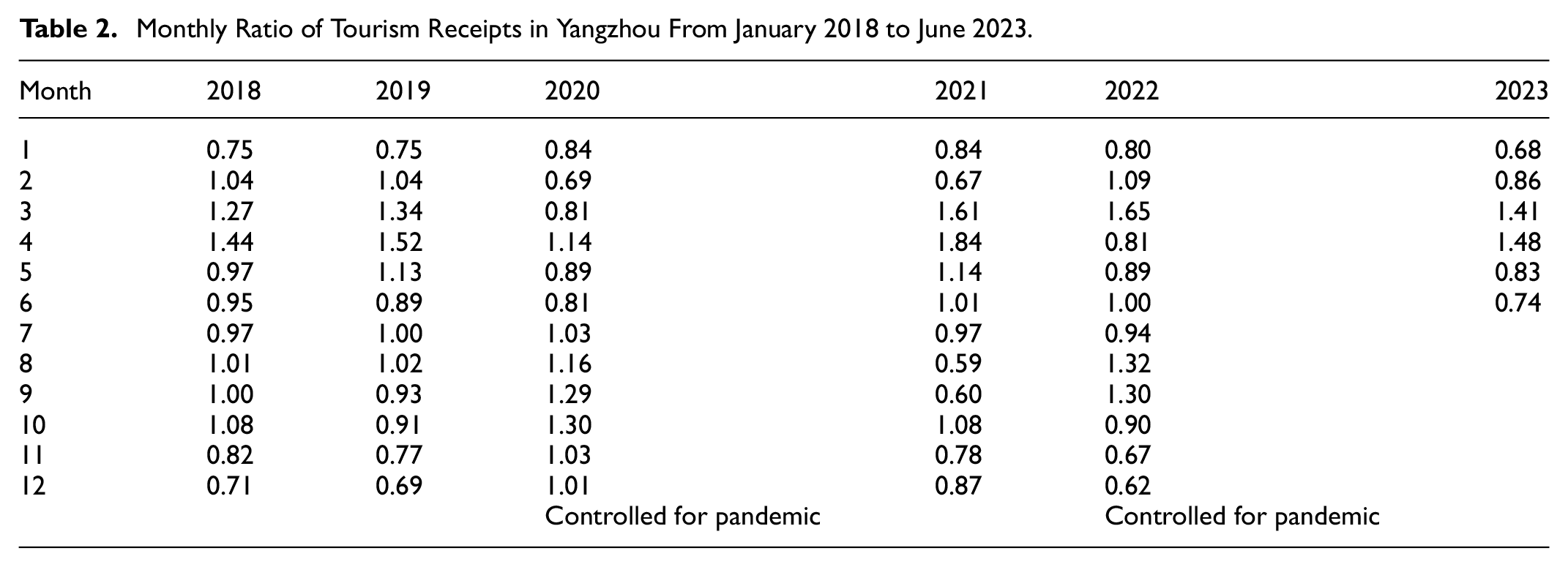
In addition, the visitor flows to Yangzhou gravitating to March and April as well as the tourism receipts generated are evident from Tables 1 and 2 on monthly ratios of seasonality, depicting the pronounced seasonality of these 2 months. Both tables have reported indices well above the 1.00 threshold and doubling or even tripling those of the other months of the year. Especially worth observing from Table 1 is the marked resilience of March and April during the 2 years of pandemic-wrought disruptions of 2020 (Wuhan lockdown) and 2022 (Shanghai lockdown), still yielding monthly ratios in the upper half fraction of the total. The March tide in Yangzhou, in the shape of a single peak mountain, had still subdued and inflected the cusps and nadirs of all of the other months of the year. Consequently, the salient resilience of the literary tourism-induced, -reinforced and even -exacerbated seasonality in Yangzhou can be consolidated. Such discrepancies are in sharp contrast with normalized seasonality periods of most top Chinese destinations regulated by the climate of north temporate zone such as the summer school holidays of July and August, and even traditional holidays like the Spring Festival in January and February, and National Day in October (Chen & Pearce, 2012; Qiang, 2020). Hence, concrete empirical evidence can be drawn from Tables 1 and 2 that the March and April seasonality in Yangzhou is well intertwined with the cultural psyches of the domestic visitors to the destination.
Monthly Ratio of Visitor Flows to Yangzhou from January 2018 to June 2023.

Monthly Ratio of Tourism Receipts in Yangzhou From January 2018 to June 2023.
Lastly, Table 3, which sums up the results of DID analysis, exhibits a discernible degree of excessive growth consumed by the two peak months of March and April. The analytical model was found out to be significant (p = .000), confirming a positive effect of March and April on visitor flows to Yangzhou. Specifically, compared with the other months of the year, March and April reported a higher index by 505.0270, meaning that Yangzhou experienced more excessive growth in visitor flows in March and April than the placebo destination of Suzhou. A similar outcome of unbalanced tourist receipts was also obtained, which, looking sanguine at first sight, may not be amicable for the sustainable development of the destination in the long run, as demonstrated by smaller annual tourism receipts of Yangzhou than those of Suzhou after controlling for size of population. In other words, the 2 months of March and April have disproportionately gouged the dominant fraction of annual tourism process in Yangzhou, even from the metrics of peer cultural tourism destinations, siphoning off visitation and receipts flows from not only traditional calendar peak months like summertime, but also cultural holiday periods like the lunar new year of China. In view of the strains on environmental capacity, service provisions and visitor experiences elicited from such exacerbated imbalanced seasonality, grave challenges may be posed to destination sustainable tourism development when cross-examined with other similar cultural destinations in China. This is further reflected from the DID tabulation outcomes of tilted CPIs during the March tide, meaning that residents have to bear the brunt of higher prices of daily necessities with the huge influx of visitors.
DID Analytical Results of Panel Data.

p < .01. **p < .05. *p < .1.
Discussion and Implication
A perennial dilemma inextricably intertwined with the tourism industry, seasonality has mostly exerted negative effects on all of the stakeholders concerned. Such effects are further amplified and customized when compounded with the peculiarities of cultural tourism, depriving the visitors of immersed and engaging experiences, burdening the creative participation of businesses and employees, crippling life qualities of local residents in both physical and mental terms, and finally compromising sustainable development of the cultural destination in the long run (Cuccia & Rizzo, 2011; Schiavone & Reijnders, 2022). In response to current research lacuna on seasonality at cultural destinations, this study explores and evaluates how literary tourism, albeit ensuring free-riding benefits in both annual progress of the local tourism development and salient publicity, has exacerbated seasonality at a typical heritage destination through comprehensive econometric modeling. Research findings of this study have primarily ascertained compelling evidence on the tremendous effects of the seasonality exacerbated by literal tourism on both visitations to and tourism income of Yangzhou, China. On one hand, findings of this study resonate with those of highlighting mitigated effects of traditional factors like climate and economic conditions on tourism products and destination visitation with salient cultural features. One the other hand, this study has gone one step further to bridge current knowledge gap on seasonality issues at cultural destinations from the perspective of literary tourism, deepening understanding of the nuanced and bi-directional effects of the intangible heritage and attractiveness of the destination on its brand image and sustainable development for all stakeholders concerned.
In particular, when controlled for the decimating impacts of the Covid-19 pandemic, it has been revealed by modeling results that seasonality of the researched 2 months of March and April had still been at a significant level during the pandemic period of 2020 to 2022. In addition to conforming to elaborations on the influences of socially seasonal factors on seasonality (Chen & Pearce, 2012; Duro, 2016), the substantial magnetic force of the classic poetic line of March tide has, literally, underscored the single-peak mountain which regulates the directions of tourist flows and expenditures at Yangzhou. This study, hence, complements extant pioneering research exploring and identifying culturally-embedded seasonality as intrinsically accounted for by interpersonal and intrapersonal factors imbued with cultural peculiarities (de Almeida & Kastenholz, 2018; Fusté-Forné, 2019), by uncovering the unique can captivating mechanism of internalization by visitors to Yangzhou of literary tourism influences and prompting their seasonal visiting patterns. Also, with the dedicated flows in March and April as indicated by the modeling results, this study contributes to understanding of literary tourism-exacerbated seasonality which may well be immune to counter-seasonality measures like reversed tourism (Feng et al., 2014).
In addition, such research takeaways are further cross-examined and bolstered with the introduction and analysis of the pattern seasonality of the controlled placebo destination of Suzhou, another renown cultural destination only 160 km away from Yangzhou. Unique insights have been gleaned on the siphoning effects of literary tourism-evoked seasonality in Yangzhou on not only traditional calendar peak seasons like summertime, but also cultural holidays like the lunar new year, as reflected from the comparisons with the placebo destination of Suzhou. Validating the outstanding impacts of literary tourism emblematic of Yangzhou, this study further verifies the veracity of the DID model of Parallel Trend Test in identifying, addressing and evaluating the subtlety inherent in the research subjects of prominent endogenous agencies, excluding the possibility of reversed endogenous causality (Bernhardt et al., 2023). Therefore, this study furnishes methodological implications for unleashing the potential of more potent and relevant analytical algorithms better explaining differentials in seasonality-induced performances vis-à-vis possible relevance of individual characteristics, as concurred with by D. Zhang et al. (2020).
Theoretical Contribution
This study first and foremost advances theoretical understanding of the conceptualization of seasonality and unlocks its mechanism in the development and operation of cultural tourism, with tilted deliberations on the benefits of mitigating and flattening seasonality by tangible and intangible cultural tourism products (Belarmino, 2023; Ferrante et al., 2018). As has been found out by this study, however, seasonality is induced and exacerbated by literary tourism, especially those with outstanding heritage resources. Such a scenario may be accounted for by the halo effects of the overriding cultural tourism signifier which have overwhelmed the functions of other cultural, natural and social monthly factors (Duro & Turrión-Prats, 2019), as is the case of the researched classic poetic line of “bound for Yangzhou in March’s tide” with its pithy yet riveting language that appeals to the cultural psyches of domestic visitors. The March seasonality, narrated and anthropomorphized by local cultural tourism discourses, may have also morphed into an integral ritualized part of cultural and heritage visits to Yangzhou (Jiang & Yu, 2020). In both senses, the literary tourism-exacerbated seasonality has been embodied into the place-branding image and equity of the destination. Such an embedded congruity is further bolstered by the research results reporting “travel to Yangzhou” as demonstrating the highest level of seasonality, showcasing the March tide as proxy for cultural tourism in Yangzhou at large.
On top of that, by identifying the detrimental repercussions of excessive growth fueled by seasonality, this study enriches conceptual expatiation on seasonality at cultural tourism destinations, which would have boasted immunity to regular highs and lows in tourism flows and receipts with diverse product portfolio and emphasis on affective connectiveness between visitor and destination. It can be conspicuously discerned from the findings of this study that the March tide to Yangzhou, whilst attracting and taking in remarkable visitor numbers and tourism income during the peak months of March and April, has surged at a cost of over drafting those of the neighboring months as well as the entire year regardless of pandemic disruptions. Such discrepancies, resonating with previous studies on other genres of tourism development (Connell et al., 2015; Koenig-Lewis & Bischoff, 2010), are particularly evident when compared with the placebo destination of Suzhou which is equally attractive as a cultural destination but for the poetic line concerned. Therefore, with the ebbing of the March tide, the momentum of cultural tourism to the destination could not hold up, rendering sustainable challenges to local tourism development in addition to incurring the environmental, social and cultural tolls for all stakeholders concerned. In other words, the March tide line is not omnipotent in sustaining visitor flows to Yangzhou, illustrating its own decaying power dragging other months of the year, especially in terms of upending more normalized seasonality periods like summer holidays. While the influences of a cascade of exogenous and endogenous determinants beyond the control of the tourism sector may have compounded the excessive growth, this study offers an innovative research prism to contemplate on the rippling inimical effects of seasonality, as inadvertently exacerbated by literary tourism.
Besides, the imbalanced unfavorable repercussions of literary tourism-exacerbated seasonality are further ascertained by the cross examinations by this study of the placebo destination of Suzhou, which is mostly homogenous with Yangzhou in cultural tourism attractions and operations. Research findings confirm that Suzhou, while also intensively depicted by a vast array of classic and modern literary works in China, has generally manifests an even distribution of tourist flows across the four seasons, fitting the taxonomy of rolling hills offered by Chen and Pearce (2012), and echoing travel patterns to generic cultural destinations as posited by existing literature (H. Q. Zhang & Kulendran, 2017). Moreover, the research period has witnessed an overall declining trend of seasonality indices in Suzhou, as contrasted with the ascending one in Yangzhou. Findings from the placebo destination, thus, further give prominence to the overriding role played by the poetic line of March tide in underscoring the outstanding and thought-provoking level of seasonality in Yangzhou.
Practical Implications
Practically, research findings of this study can proffer references pertaining to better assuaging literary tourism-exacerbated seasonality for destinations eyeing on this product genre in the post pandemic era, so that the development of literary tourism is a boon rather than a burden on realization of sustainability goals at the destination. First, to dilute and divert the effects of the overriding literary work on seasonality, corresponding marketing initiatives should be devised and launched by the destination narrating and presenting destination attractiveness that is spread across all of the months. Particularly, the rebalanced brand image of the destination may well semantically capitalize on the classic line of the March tide in an innovative manner, thereby successfully arousing brand re-associations by potential visitors and guiding more evenly distributed visitor flows and expenditures (Demir et al., 2021). Second, creative efforts should be expended into developing complementing tangible and intangible tourism attractions with seasonal features distinguished from the current peak periods, by which cultural tourism at the destination can be integrated into local cultural and leisure industries and unleash synergistic effects. Third, regional cooperation among the neighboring destinations needs to be enhanced through the coordination of authorities at higher levels, and co-operated endeavors in marketing, product development, management and service among the destinations would definitely facilitate the regulation and dispatch of spill-over effects arising from the surges and ebbs of seasonality. As for the researched destination of Yangzhou, one promising area of concerted development may rest in the collaborations of cultural destinations along China’s Grand Canal.
Conclusion
Literary tourism has received accumulating interest as a tenable frontier for fostering cultural tourism at destinations across the world, especially in the post pandemic era. This paper duly identifies and analyzes the mixed consequences of seasonality exacerbated by a powerful poetic line at a typical heritage destination with product features which would otherwise be immune to seasonality. Besides evaluating the exacerbated seasonality, this study highlights how balanced cultural tourism development at the destination is bound by the detrimental effects of excessive growth incurred by seasonality. The study offers some first steps toward understanding and facilitating sustainable development of cultural destinations.
That said, several limitations of the current study should be addressed. In the first place, the econometric models applied by this study can be refined by future research efforts to incorporate additional variables and algorithms coupled with richer body of data to go a longer way toward capturing the mechanism of seasonality at cultural destinations, and thereby drawing more provocative implications. Second, findings of this study can be triangulated with examinations of seasonality at the micro level enlightened by relevant conceptual frameworks, gathering and investigating visitor experiences, employee perceptions and local resident perspectives of literary tourism-exacerbated seasonality, from which more in-depth understanding of seasonality can be yielded (Belarmino, 2023). Last but not least, in future studies it would be interesting to elicit opinions from cross-samples on whether Chinese traditional literary works assume the same magic power in eliciting dedicated cultural tourists and consolidating overwhelming seasonality.
Footnotes

Funding
The author(s) received no financial support for the research, authorship, and/or publication of this article.
Declaration of Conflicting Interests
The author declared no potential conflicts of interest with respect to the research, authorship, and/or publication of this article.
Data Availability
Data sharing not applicable to this article as no datasets were generated or analyzed during the current study.