




Abstract
This paper examines the factors influencing passengers’ intention to use urban rail transit, with a particular focus on psychological variables. A comprehensive psychological model, integrating the Value-Belief-Norm (VBN) theory and Customer Satisfaction (CS) theory, is employed to analyze passengers’ travel intentions. Grounded in this theoretical framework, the study applies Structural Equation Modeling (SEM) and survey data to evaluate the impact of low-carbon transportation policies and low-carbon awareness on passengers’ intentions to reuse rail transit in Tianjin, China. The empirical results show that the integration of VBN and CS theories provides an effective framework for predicting passengers’ reuse intentions. Specifically, low-carbon transport policies have a positive effect on passengers’ reuse intentions, while low-carbon awareness influences these intentions indirectly through the mechanisms of awareness of consequences, ascription of responsibility, and personal norms. This study offers valuable insights for transportation authorities to better understand the psychological factors shaping passengers’ decisions and to enhance service provision accordingly.
Keywords
Introduction
With the rapid development of urbanization in China, living standards are improving, and car ownership is increasing at a rapid pace. Concurrently, urban traffic congestion and environmental pollution caused by motor vehicles have become increasingly prominent issues. Urban transportation is facing the dual pressures of high demand growth and the need for low-carbon emissions. To address these challenges, urban rail transit has become an increasingly important solution for cities. However, despite the advantages of urban rail transit, such as high capacity, low energy consumption, and punctuality, it also has drawbacks in terms of comfort and convenience, especially when compared to private car travel. These factors influence passengers’ willingness to use urban rail transit. Therefore, to enhance service quality and increase rail transit ridership, it is crucial to accurately assess passengers’ satisfaction with urban rail transit services and to thoroughly analyze the factors that affect their reuse intention.
In recent years, China has implemented a series of public transportation policies to encourage low-carbon travel modes, including restrictions on private car use and increased parking fees. However, the effectiveness of these measures has been less than expected. A major challenge in promoting low-carbon travel is helping travelers recognize its benefits. Donald et al. (2014) argued that the success of initiatives aimed at reducing private car use through behavioral change depends largely on understanding the psychological factors that influence passengers’ travel mode choices. However, the preference for low-carbon travel options is influenced not only by environmental concerns but also by external factors such as the quality of rail transit services. Therefore, this paper aims to understand residents’ perceptions of urban rail transit, specifically how psychological factors and satisfaction interact, both directly and indirectly, to shape passengers’ travel choices. The empirical results show that the integration of VBN and CS theories provides an effective framework for predicting passengers’ reuse intentions. Specifically, low-carbon transport policies have a positive effect on passengers’ reuse intentions, while low-carbon awareness influences these intentions indirectly through the mechanisms of awareness of consequences, ascription of responsibility, and personal norms.
It is widely accepted that behavioral intention plays a crucial role in determining actual behavior (Hua & Dong, 2022). To this end, many scholars have adopted a comprehensive approach, considering various factors that influence residents’ choice of public transportation. These factors include urban characteristics, psychological influences, policy measures, and other relevant elements. Classic theories such as the Value-Belief-Norm (VBN) theory and Customer Satisfaction (CS) theory have been extensively applied to research on travel mode choices. Previous studies have sought to extend the VBN or CS models by introducing variables such as environmental values (Nordlund & Garvill, 2003), subjective norms (Yilmaz et al., 2021), moral norms (Choi et al., 2021), accessibility (Ittamalla & Kumar, 2021), and transportation environment (Mahapatra & Bellamkonda, 2023). However, the Theory of Planned Behavior (TPB), VBN theory, and CS theory alone fail to adequately explain residents’ prior environmental behaviors (Fu & Juan, 2017; Mandhani et al., 2020). As a result, many scholars have integrated these theories to enhance the explanatory power of the model (Fu & Juan, 2017; Liu et al., 2017).
Based on this idea, this paper develops a rail transit behavior choice model for urban residents, integrating the Value-Belief-Norm (VBN) theory and Customer Satisfaction (CS) theory. The model explores the relationship between personal awareness and behavior, focusing on the factors that influence residents’ choice of rail transit as a travel mode, particularly the impact of low-carbon awareness on their transportation behavior. This study examines how these factors shift behavioral agents from passive encouragement to active, subjective engagement in low-carbon transportation behaviors.
The structure of the paper is organized as follows: Section “Theoretical framework and hypotheses” introduces the Value-Belief-Norm (VBN) theory, Customer Satisfaction (CS) theory, and the conceptual framework, based on which a series of hypotheses are developed. Section “Study area and questionnaire design” details the questionnaire design and the data collection process, and section “Data analysis” presents the results by using Structural Equation Modeling (SEM). Section “Discussion and policy implications” provides an interpretation of the findings and outlines the policy implications. Finally, Section “Conclusion” concludes the paper.
Theoretical Framework and Hypotheses
Before establishing the integration model, this paper first reviews the VBN theory and CS theory. From the perspective of social psychology, individual behaviors are influenced by psychological variables such as values, beliefs, and perceptions. Additionally, after using rail transit, factors such as service quality and users’ satisfaction significantly impact the decision to continue using the service.
Value-Belief-Norm Theory (VBN)
Building on Schwartz’s (1977) normative moral theory, Stern et al. (1999) developed the Value-Belief-Norm (VBN) theory by integrating value theory, Norm-Activation theory, and the New Environmental Paradigm. Further research by Stern (2000) expanded this framework by introducing a causal chain that includes awareness of consequences, ascription of responsibility, personal norms, and other influencing factors, culminating in a comprehensive and systematic theory.
The VBN theory consists of three key components - values, beliefs, and personal norms - forming a causal chain. Under the influence of different values, individuals develop an awareness of the consequences of their actions and beliefs regarding responsibility attribution, which subsequently activates their sense of responsibility and ultimately leads to specific behaviors. In this causal chain, each variable can directly influence the next, or even exert a direct effect on the two subsequent levels. The theory posits that an individual’s beliefs influence their decision-making process, particularly regarding the potential consequences of a specific behavior, and their attribution of responsibility for those outcomes. This, in turn, shapes normative behavior, guiding individuals toward preventive actions. Personal norms, as an attitudinal factor, directly affect actual behavior decisions, reflecting individuals’ moral obligations and sense of responsibility, which enhances their intention to engage in the behaviors. Moreover, research has shown that specific beliefs and the moral norms influencing individual behavior decisions within this framework are shaped by underlying values, thereby influencing actual behavior.
Using the VBN theory, Nordlund and Garvill (2003) conducted a survey of 2,500 car owners to examine their intention to reduce car travel. The study found that values, awareness of consequences, and personal norms positively influenced the intention to reduce car travel. Similarly, Lind et al. (2015) applied the VBN theory to study urban residents in Norway, revealing that personal norms and situational factors significantly impacted the residents’ sustainable travel patterns. Jakovcevic and Steg (2013) utilized the VBN theory to explore urban residents in Argentina, demonstrating that the theory effectively explained the acceptability of low-carbon policies and the intention to reduce car use. Hiratsuka et al. (2018) used the VBN framework to identify factors influencing travel modes among Japanese residents. Their findings suggested that personal norms did not predict intentions and policy acceptance as effectively as expected, and that pro-environmental beliefs acted as a mediator between hedonistic values and biosphere value orientation. Building on these findings, this study proposes the following hypothesis to explore the effect of VBN on customers’ reuse intentions in urban rail transit:
Hypothesis 1 (H1): Awareness of consequences positively influences the ascription of responsibility.
Hypothesis 2 (H2): The ascription of responsibility positively influences personal norms.
Hypothesis 3 (H3): Personal norms positively influence passengers’ intention to reuse urban rail transit system.
Customer Satisfaction Theory (CS)
Customer satisfaction, as a perception formed after a customer purchases a product or service, is closely related to marketing studies. The concept of customer satisfaction was first defined within the field of marketing. In 1965, Cardozo (1965) conducted a study on the emotional changes experienced by customers during transactions, providing a definition of customer satisfaction. Customer satisfaction is a quantitative measure of the level of satisfaction, which results from comparing the actual experience of receiving a product or service with the expected value. The stronger the feeling of satisfaction, the higher the satisfaction level is.
Urban rail transit serves as a fundamental mode of transportation for spatial displacement, enabling passengers to reach specific destinations. It is a crucial element in transforming urban life from static to dynamic, acting as a key infrastructure supporting the completion of daily activities. The service quality of urban rail transit is subjectively evaluated by passengers, primarily reflecting aspects such as safety, convenience, comfort, and economy. Numerous studies have focused on assessing the service quality of urban rail transit and identifying which service aspects are most valued by passengers (de Oña, 2021; Isikli et al., 2017; Wang et al., 2020). Machado-León et al. (2017) highlighted that service quality is a key factor in attracting people to use urban rail transit. Ojha (2020) emphasized the importance of factors such as service availability, monitoring, travel time, safety, and maintenance activities in determining rail service quality.
Customer satisfaction, defined as the overall affective response to the perceived difference between prior expectations and perceived performance after consumption (Mishra & Panda, 2023), plays a pivotal role in shaping passengers’ reuse intention. The service quality of urban rail transit significantly impacts customer satisfaction, which in turn affects the intention to reuse the service (Aston et al., 2021; Farazi et al., 2022; Wang et al., 2024; Yilmaz & Ari, 2016). In studies examining the relationship among service quality, customer satisfaction, and reuse intention, researchers have noted that positive customer satisfaction driven by service quality leads to increased reuse intention (Tice et al., 2022; Wang et al., 2024; Yilmaz & Ari, 2016). Specifically, Wang et al. (2024) indicated that service quality is a critical factor in encouraging passengers to reuse urban rail transit, while Sukhov et al. (2021) confirmed that customer satisfaction is positively associated with reuse intention. Based on these findings, to examine the impact of service quality and customer satisfaction on reuse intention, the following hypothesis is proposed:
Hypothesis 4 (H4): service quality positively influences customer satisfaction.
Hypothesis 5 (H5): service quality positively influences passengers’ reuse intention.
Hypothesis 6 (H6): customer satisfaction positively influences passengers’ reuse intention.
Low-Carbon Transport Policy (LCTP) and Low-Carbon Awareness (LCA)
Consciousness and behavior of individuals do not exist in isolation. They are shaped and executed within a social context, such as through policies. Sun et al. (2015) argued that low-carbon transportation policies play a crucial role in encouraging residents to adopt low-carbon transport modes. In China, many cities have implemented a series of policies to promote public transportation, such as travel restrictions and subsidies for public transit (Liu et al., 2017). From the perspective of the policy makers, it is important to explore whether subsidy policies and purchase restriction measures positively influence residents’ travel behavior (Zhao et al., 2021). Fu et al. (2020) noted that low-carbon awareness (LCA) significantly impacts individuals’ decisions to adopt low-carbon travel behaviors. As a multi-dimensional variable, LCA remains under-explored in the literature. This study considers low-carbon awareness as a moderating variable to examine its potential strengthening or weakening effect on reuse intention. If residents exhibit high levels of low-carbon awareness, it is likely to influence their awareness of consequences, thereby increasing their intention to reuse rail transit. Based on these considerations, the following hypothesis is proposed to examine the impact of low-carbon transportation policies (LCTP) and low-carbon awareness (LCA) on reuse intention:
Hypothesis 7 (H7): low-carbon transport policy positively influences service quality.
Hypothesis 8 (H8): low-carbon awareness positively influences awareness of consequence.
An integrated Theoretical Framework
Existing research applying the VBN theory primarily focuses on personal norms, awareness, and sense of responsibility to characterize individual values and behavioral preferences (Liu et al., 2017). However, the VBN theory does not account for certain critical factors influencing individual behaviors, such as service level(Eboli and Mazzulla, 2014). This limitation restricts the comprehensive applicability of the VBN theory. Therefore, it is essential to incorporate additional factors - such as service level, low-carbon transportation policies, and low-carbon awareness - to enhance the explanatory power of the model, enabling a more effective prediction of residents’ rail transit travel intentions. In response to this, this study proposes an integrated framework that combines elements of the VBN theory (awareness of consequences, ascription of responsibility, personal norms), CS theory (service quality, customer satisfaction, reuse intention), as well as low-carbon awareness (low-carbon values, low-carbon knowledge) and low-carbon transportation policies. The theoretical framework is established as presented in Figure 1. Compared to the VBN or CS models alone, the advantage of this integrated framework lies in its ability to identify the potential impact mechanisms of policy promotion and explain how low-carbon awareness and service quality influence travel behavior choices.

The proposed theoretical framework.
Study Area and Questionnaire Design
Study Area
Tianjin, one of China’s four direct-controlled municipalities, is the largest port city in northern China and one of the first coastal cities to undergo development. It has about 15.6 million inhabitants within a 11,920 km2 area. In its central city of 433 km2, the population is 4.7 million.
Tianjin, the second city in mainland China to establish the urban rail transit system after Beijing, initially faced challenges in attracting passengers due to its low rail transit network density. In the early stages of operation, rail transit was not widely regarded as an attractive mode of transportation for citizens. However, as the economic hub of Northern China, Tianjin has undergone rapid urbanization, resulting in significant population concentration. In recent years, exacerbated urban congestion and environmental pollution have prompted the city to accelerate the development of its urban rail transit system. The ongoing expansion and connection of new lines have progressively enhanced the accessibility and convenience of urban rail transit.
By the end of 2022, Tianjin’s central city operated eight rail transit lines (M1, M2, M3, M4, M5, M6, M9, M10), including three major radial lines (Lines 1, 2, and 3), the Jinbin Light Rail Line 9 connecting the urban core with the Binhai New Area, and supplementary lines (Lines 4, 5, 6, and 10). The total operating network spans 286 km, with 182 stations, covering ten municipal districts of Tianjin (Heping, Hebei, Nankai, Hexi, Hedong, Hongqiao, Dongli, Jinnan, Xiqing, and Binhai). Additionally, several new lines are currently under construction and planning (Figure 2).

The urban rail transit system for Tianjin central city.
Questionnaire Design and Data Collection
The questionnaire is structured into four sections: (1) Demographic characteristics of passengers; (2) Behavioral intentions of residents regarding urban rail transit usage; (3) The impact of low-carbon awareness and policies on travel mode choices; (4) Passenger satisfaction. A five-point Likert scale is employed to capture responses, with the values representing varying levels of agreement: 1 - Strongly disagree, 2 - Disagree, 3 - Neutral, 4 - Agree, and 5 - Strongly agree.
The demographic section captures key characteristics, including gender, age, education level, and car ownership. The behavioral intention scale includes three variables: Awareness of Consequence, Ascription of Responsibility, and Personal Norms. Awareness of Consequence refers to residents’ understanding of the positive or negative impact that choosing rail transit has on city traffic and environmental conditions (Du et al., 2018). Ascription of Responsibility reflects residents’ sense of duty in choosing rail transit as a travel mode. Personal Norms pertain to the personal responsibility individuals feel when opting for urban rail transit.
The passenger satisfaction scale evaluates three aspects: Service Quality, Customer Satisfaction, and Reuse Intention. Service Quality is defined as the ability of the service to meet customer expectations (Lind et al., 2015) and is a multidimensional construct encompassing functional and technical service quality, comfort and cleanliness, service planning, and reliability. Customer Satisfaction is the overall emotional response of customers to the perceived difference between their expectations and the actual performance of the service (Farazi et al., 2022). Reuse Intention is related to customer loyalty (Machado-León et al., 2017) and represents residents’ subjective judgment and intention to continue using rail transit as their preferred travel mode.
The low-carbon awareness and policy scale includes four variables: Low-carbon Value, Low-carbon Subjective Knowledge, Low-carbon Objective Knowledge, and Low-carbon Transportation Policies. Low-carbon Value refers to an individual’s perception of low-carbon issues based on personal value judgments. It is measured using the Environmental Concern Scale (NEP) developed by Dunlap (2008). Low-carbon Knowledge assesses an individual’s understanding of low-carbon concepts and behaviors related to environmental protection (Liu et al., 2020). Low-carbon Subjective Knowledge refers to personal beliefs about understanding low-carbon issues, while Low-carbon Objective Knowledge reflects the actual level of understanding about low-carbon issues (Liu et al., 2020). Low-carbon Transportation Policies refer to government policies that promote public transportation and restrict the use of private cars, including traffic and purchase restrictions, and measures to enhance the convenience of public transport.
A questionnaire survey was conducted to investigate the eight existing rail transit lines currently operating in Tianjin. A total of 30 trained graduate students were selected to distribute the questionnaires at rail stations across the ten districts. Each group of three students was assigned to collect data at one station within a specific district. The survey was carried out over multiple periods from March 13 to April 24, 2023.
The data collection was organized into four time slots: morning rush hours (7:00 am to 8:30 am), daytime hours (9:00 am to 4:30 pm), evening rush hours (5:00 pm to 6:30 pm), and late evening hours (7:00 pm to 10:30 pm). Specifically, data was collected during the morning rush hours from March 13 to 17, during the evening rush hours from March 20 to 24, during the daytime hours from April 13 to 17, and during the late evening hours from April 20 to 24. In each of these periods, 150 questionnaires were collected, for a total of 600 distributed questionnaires. The final dataset includes 371 valid responses.
As shown in Table 1, male passengers (54.1%) are more likely to use the metro. Additionally, 51.6% of respondents do not own a car. In terms of educational background, nearly half of the respondents are college graduates (47.8%), while 26.2% have graduated from a junior college, and 17.9% hold a Master’s degree or higher. Regarding travel frequency, 30% of respondents use urban rail transit 3 to 5 times a week, and 43% use it occasionally.
Summary of Demographic and Rail Transit Usage.

Data Analysis
Evaluate the Validity and Reliability of the Measures
To explore the factors influencing residents’ travel intentions, exploratory factor analysis (EFA) was conducted to examine the correlations among various indicators. The results show that Cronbach’s α is .719 (>.6), confirming the reliability of the method. Bartlett’s test of sphericity yielded a value of 2,531.12, with a significance level of .000, indicating significant correlations among the variables and supporting the validity of the factor analysis. The Kaiser-Meyer-Olkin (KMO) value is 0.710 (>0.7), suggesting the data is suitable for factor analysis. Following EFA, confirmatory factor analysis (CFA) was conducted to assess convergent validity. The results of the CFA are presented in Table 2.
The Validity and Reliability of the Measures.

Note. S.E. = Standard Error; C.R. = Critical Ratio. Regression weights are fixed to 1; therefore, S.E. and C.R. are not calculated. LCTP1: Policies of driving restriction and vehicle purchase limitation are necessary to encourage passengers to choose metro. LCTP2: Policies of driving restriction and vehicle purchase limitation are effective in encouraging passengers to choose metro. LCTP3: The policy of driving restriction influences my decision to choose rail transit on days without driving restrictions. PSQ1: Overall service quality. PSQ2: Availability of the service. PSQ3: Tangibility of service equipment. CS1: Overall satisfaction with the service. CS2: The service is good. CS3: I feel comfortable traveling by metro. CS4: The service meets my expectations. RI1: I will travel by metro again under the same conditions. RI2: I will recommend the service to others. RI3: I will continue to use the metro. LCA1: People should protect the environment to avoid an environmental crisis. LCA2: I have sufficient knowledge of low-carbon environmental issues. LCA3: Carbon emissions can be reduced by taking the metro instead of private cars. AC1: The metro can reduce city congestion. AC2: The metro can reduce air pollution. AC3: The metro can reduce energy consumption. AR1: It is the responsibility of both the government and individuals to reduce air pollution. AR2: Individuals have a duty to choose a low-carbon travel mode. AR3: I have a duty to choose a low-carbon travel mode. PN1: The metro is environmentally friendly. PN2: Regardless of others’ actions, I will choose the metro. PN3: Taking the metro aligns with my personal values and responsibilities.
, **, and * represent the 1%, 5%, and 10% significance levels, respectively.
The overall fit indices indicate that the model meets the required goodness-of-fit criteria, as the various fit indices fall within the specified range. The key fit indices of the model are presented in Table 3.
Results of the Model’s Goodness-of-Fit Test.

Path Analysis
The path relationships in the research model were analyzed using Structural Equation Modeling (SEM). The results show that, the overall fit indices of the model are acceptable, with the following values: RMSEA = 0.08, CFI = 0.73, GFI = 0.84, and RMR = 0.13. The calculation results of the SEM are presented in Table 4. The findings support the proposed hypotheses 1-8. Specifically, Personal Norms (PN) have a significant effect on Reuse Intention (RI) (H3 = 0.264), and Customer Satisfaction (CS) has a significant effect on Reuse Intention (RI) (H6 = 0.723). The model with standardized path coefficients is shown in Figure 3.
Results of Hypothesis Testing in the Model.

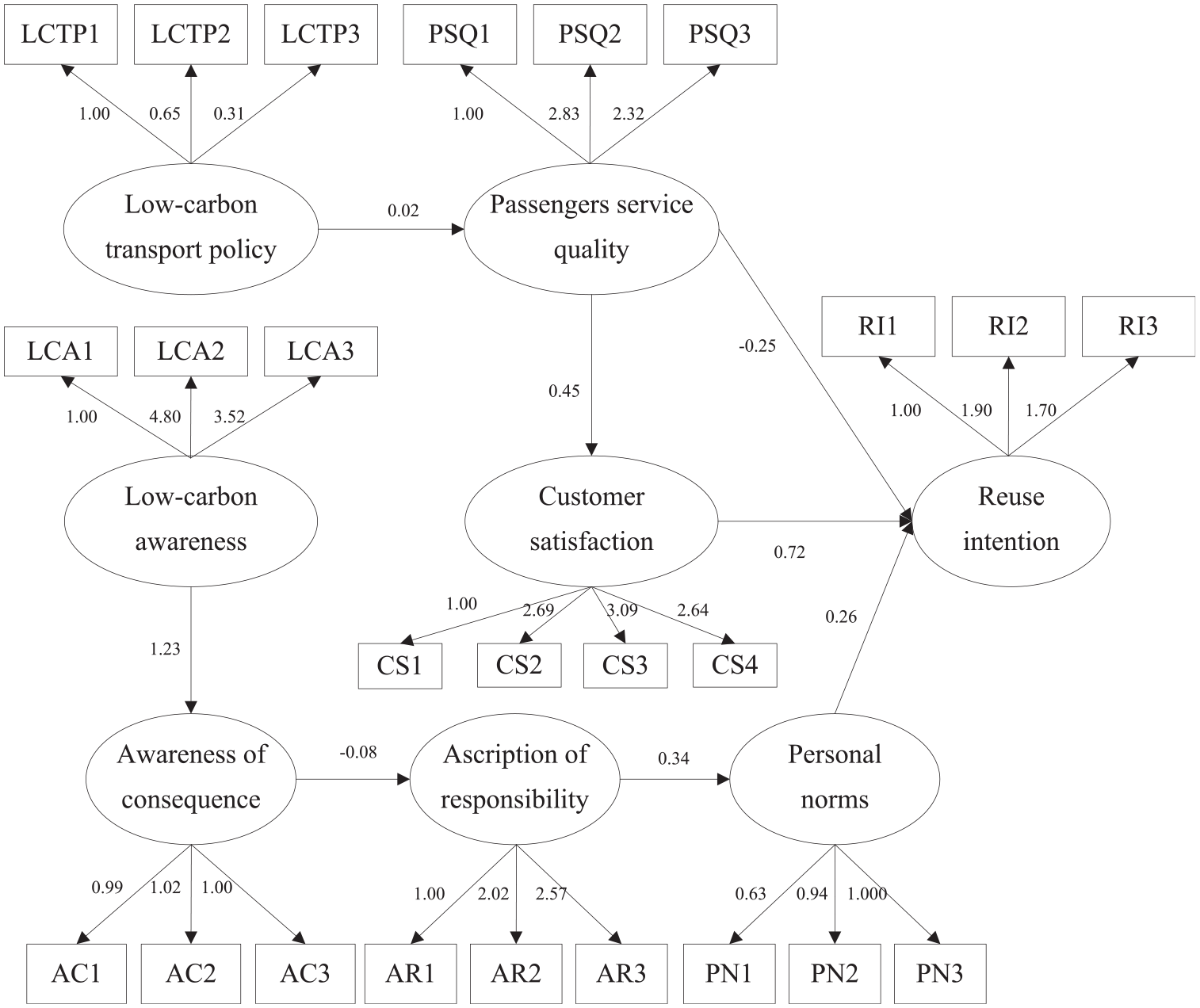
Hypothesized model with path coefficients.
Discussion and Policy Implications
This study conducts Structural Equation Modeling (SEM) analysis on residents’ travel intentions related to urban rail transit and explores the impacts of low-carbon transportation policies, low-carbon awareness, sense of responsibility, and customer satisfaction on reuse intention. The results are as follows:
Analysis of the Impact of Awareness of Consequence, Ascription of Responsibility, and Personal Norms on Urban Rail Transit Travel Intentions
The SEM model analysis confirms the validity of hypotheses 1 to 3. Specifically, residents’ awareness of consequence positively influences personal norms, ascription of responsibility positively affects personal norms, and personal norms positively influence passengers’ reuse intention to choose rail transit. These results suggest that the Value-Belief-Norm (VBN) theory effectively explains residents’ intentions to choose rail transit. While awareness of consequence is negatively correlated with the choice of rail transit, ascription of responsibility and personal norms are positively associated with the intention to use rail transit. The perceived consequences of travel mode selection lead individuals to feel a sense of responsibility to choose public transportation, thereby enhancing their intention to use rail transit. Additionally, ascription of responsibility indirectly influences residents’ travel intentions.
Analysis of the Impact of Service Quality and Customer Satisfaction on Urban Rail Transit Travel Intentions
This study posits that service quality directly influences both customer satisfaction and reuse intention, with customer satisfaction further impacting reuse intention. The analysis reveals a positive correlation between service quality and customer satisfaction, which is consistent with previous studies (Eboli & Mazzulla, 2014; Yilmaz & Ari, 2016; Ibrahim et al., 2021). Additionally, the findings indicate that customer satisfaction is positively correlated with reuse intention, suggesting that customer satisfaction plays a key role in influencing passengers’ intentions to choose urban rail transit. Therefore, urban rail transit operators should prioritize improving service quality and enhancing customer satisfaction, focusing on factors such as punctuality, safety, and comfort to encourage passengers to select urban rail transit as their preferred mode of travel.
Analysis of the Impact of Low-Carbon Awareness and Policy Factors on Urban Rail Transit Travel Intentions
Low-carbon awareness has an indirect effect on rail transit travel intentions, mediated through awareness of consequence (β = 1.23). While urban residents exhibit some level of low-carbon awareness, the results indicate that it has limited influence on rail transit travel intentions and has not effectively translated into actual travel behavior. This highlights the need to reshape and strengthen low-carbon awareness in order to influence residents’ travel choices.
From the perspective of external factors, low-carbon transportation policies play a significant role in encouraging residents to choose rail transit. Specifically, the mandatory measures implemented by the Tianjin government, such as driving restrictions and vehicle purchase limitations, have proven effective in curbing car use. These policies, therefore, help shift residents toward rail transit as a more sustainable travel option.
Policy Implications
The study indicates that both low-carbon awareness and passenger satisfaction significantly influence passengers’ rail transit travel behavior. By addressing the relationship between “awareness and behavior,” it is possible to develop and implement targeted transportation policies aimed at transforming residents’ travel behaviors and adjusting urban travel patterns, which will be conducive to achieving low-carbon development in urban transportation.
Firstly, improving the service quality of urban rail transit is crucial and should be approached from both hardware and software perspectives. On the hardware front, efforts should focus on accelerating the development of a networked rail transit system that facilitates residents’ daily commuting. Furthermore, upgrading and renewing rolling stock can positively contribute to enhancing passenger satisfaction. On the software side, with the rapid advancement of the internet, big data, and mobile internet technologies, the development of “Internet + Rail Transit” should be promoted. This would not only expand the use of emerging technologies such as mobile payments and e-tickets within the rail transit sector, but also enable better monitoring of the system’s operational status. By leveraging the widespread reach of mobile internet, real-time rail transit operation information can be disseminated to guide passengers’ travel behaviors.
Secondly, educational campaigns on low-carbon knowledge should be implemented. While the government has already introduced numerous environmental education initiatives, the majority of residents are aware of the importance of reducing carbon emissions. Since reducing carbon emissions in travel is a key factor, enhancing public education on energy-saving behaviors is an effective way to promote rail transit usage.
Thirdly, increasing the costs associated with purchasing and owning private cars should be considered. The research indicates that the number of privately owned cars strongly influences car usage. Therefore, policies such as higher taxes, car plate lotteries, and increased parking fees can help reduce the number of privately owned vehicles in the city. This not only encourages more residents to use rail transit, but also alleviates road congestion, improving the overall efficiency of the urban traffic system.
Conclusion
As China accelerates the construction of urban rail transit systems, the question of how to attract more people to use urban rail transit and increase its ridership has become a critical issue. This study, based on the Value-Belief-Norm theory and Customer Satisfaction theory, incorporates low-carbon awareness and policy factors to construct a theoretical model of residents’ rail transit travel intention. The analysis explores the factors influencing residents’ choices of urban rail transit, aiming to shift behavioral agents from passive encouragement to proactive, low-carbon transportation behaviors. The following conclusions are drawn:
The combination of the VBN theory and CS theory offers a comprehensive explanation of residents’ rail transit travel intention. The findings suggest that the construction of this theoretical model provides valuable insights and methodologies for studying low-carbon transportation behaviors in China.
Among the factors influencing the intention to reuse rail transit, the most significant impacts (from largest to smallest) are customer satisfaction, personal norms, and passenger service quality. In other words, personal satisfaction and the perceived consequences of travel mode choices strengthen residents’ sense of responsibility and satisfaction, thereby enhancing their intention to choose rail transit.
While low-carbon awareness has an indirect impact on rail transit reuse intention, its effect is relatively weak. Although urban residents are somewhat aware of low-carbon issues, the awareness has not yet strongly influenced their actual travel behavior. However, low-carbon transportation policies, such as driving restrictions and vehicle purchase limitations, have proven effective in encouraging residents to choose rail transit, highlighting the role of government measures in shaping low-carbon travel intention.
Despite the theoretical and practical contributions, this study has some limitations. First, the existing research mainly focuses on data from a single period. Future studies should collect data from multiple time periods to conduct empirical research and analyze how the results may vary over time. Second, considering the unique economic, cultural, and geographical characteristics of each city, more empirical case studies are needed to enhance the generalizability of the findings. Future research could further explore the relevance and relative importance of various factors, such as psychological influences, planned behaviors, safety, and the provision of accurate and accessible information, in multi-cultural and multi-regional contexts.
Footnotes

Ethical Considerations
This article does not contain any studies with human or animal participants.
Funding
The author(s) disclosed receipt of the following financial support for the research, authorship, and/or publication of this article: This paper is supported by The Youth Program of Humanities and Social Sciences Foundation of Ministry of Education of China (21YJCZH169).
Declaration of Conflicting Interests
The author(s) declared no potential conflicts of interest with respect to the research, authorship, and/or publication of this article.
Data Availability Statement
The raw data supporting this study are available from the corresponding author upon reasonable request.