



Abstract
Artificial intelligence (AI), as a tool to enhance operational efficiency and improve customer experience, has rapidly reshaping service and the pervasive integration of intelligent systems into commercial ecosystems has fundamentally redefined value co-creation mechanisms. Prior research has confirmed that the customer satisfaction and loyalty is expected to be critical factors for the success of business. Meanwhile, product quality has been proven to shift service quality as one of the most crucial drivers for customer satisfaction and loyalty across all industries. However, the number of current studies show that most customers prefer human interactions rather than AI services. Thus, understanding the drivers behind how customer loyalty evolves when it comes to AI services is therefore crucial. This study presents a cross-sectional study based on questionnaire survey data from the Chinese market to investigate whether and how the service quality of AI affects customer loyalty. Specifically, the research takes customer interaction uncertainty as a moderating variable and constructs a conceptual model of the relationship between AI service quality, customer satisfaction, and customer loyalty. A regression analysis is performed to unravel the mechanism of the model mentioned above by using the data collected from 466 respondents in a cross-sectional study. The findings indicate that AI services have a profound positive impact on customer loyalty and customer satisfaction plays an intermediary role between them. Furthermore, customer participation moderates the relationship between AI service quality and customer satisfaction.
Plain Language Summary
Purpose – Artificial intelligence (AI) is increasingly reshaping service by performing various tasks with incorporating more sophisticated social skills and creativity. In this context, it has become an integral part of daily life and plays a crucial role in the competitive landscape of enterprises. Hence, it is imperative for companies to improve service quality by utilizing and exerting the advantages of AI. Thus, this paper aims to investigate whether and how the service quality of AI affects customer loyalty. Design/methodology/approach – Using a sample of 466 respondents in a cross-sectional study, this paper employs empirical method to test the hypotheses. Findings – This study finds that AI services have a profound positive impact on customer loyalty and customer satisfaction plays an intermediary role between them. Furthermore, customer participation plays a moderating role between AI service and customer satisfaction.
Introduction
The service sector is undergoing a paradigm shift as artificial intelligence (AI) performs various tasks through cognitive automation systems that now permeate hospitality, healthcare, and e-commerce sectors. This transition shifts service interactions from interpersonal exchanges to algorithmically mediated engagements (Haenlein & Kaplan, 2019; Huang & Rust, 2018). Whereas conventional wisdom posited automation resistance in low-complexity service roles, contemporary neural network architectures challenge this viewpoint through adaptive task execution. The ongoing industry 4.0 transition, characterized by symbiotic human-AI collaboration, dissolves traditional sectoral boundaries while fundamentally reshaping the traditional business and management landscape (Ali & Johl, 2023; Huang et al., 2022; Schwab, 2021). These technologies such as AI, big data, and Internet of Things empower firms to enhance customer engagement, acquisition, and retention strategies, suggesting potent synergies between marketing and AI for driving substantial outcomes (Anshari et al., 2019; Chintalapati & Pandey, 2022). Consequently, the AI integration has emerged as a transformative force in service industries, significantly influencing customer loyalty through redefined business-customer interactions that foster deeper connections and enhance overall satisfaction.
AI has developed exponential growth over the past decade (Labib, 2024). According to the data from the World Trade Organization, there are 37% of organizations had adopted AI technologies by 2019, with this adoption rate nearly doubling by the end of 2021. Practically, McKinsey analytics reveal that half of the firms have integrated AI into at least one of their business functions (Singla et al., 2025), among which 75% have achieved over 10% improvement in customer experience. Within this rapidly proliferating AI ecosystem, their roles in the field of marketing are being increasingly leveraged. On one hand, growing numbers of companies are using big data analysis to decode consumer purchasing patterns and provide them with marketing information and customize products that can meet their demands (Chatterjee et al., 2020; Wirth, 2018). This approach increases the efficiency of precision marketing while driving business growth. On the other hand, as consumer priorities shift from price sensitivity to service quality, companies are progressively deploying AI-driven solutions to improve customer experience. How companies make decisions and engage with customers by using AI is essential for retaining and attracting new customers. However, every coin has two sides. There is a growing recognition of significant concerns regarding its potential drawbacks like data leaks, privacy worries, surveillance risks, loss of autonomy, diminished human interaction, and cybersecurity threats (Lobschat et al., 2021; Pragya & Vandana, 2024). Hence, it is imperative for companies to improve service quality by utilizing and exerting the advantages of AI while implementing robust safeguards against its inherent risks.
Literature Review and Hypotheses Development
AI Service and Customer Loyalty
The focus of AI related research has progressively shifted from technological development and advancement over the past decade to investigating the role of AI in customer-centric service (Prentice et al., 2020). Nevertheless, a significant theory-practice gap persists in this domain. In practice, AI is widely used in customer service to improve customer engagement and experience through convenient and flexible solutions. While scholar investigation remains limited due to terminological inconsistencies and underdeveloped conceptual framework. AI services refer to the services such as intelligent customer service and personalized recommendations provided by enterprises that are driven by AI technology. Their quality can be measured in terms of tangibles, reliability, responsiveness, assurance, and empathy (Rendiansyah & Putra, 2024).
AI’s capability for personalizing customer experiences is pivotal in driving loyalty. For instance, AI-driven algorithms such as machine learning and deep learning analyze consumer behavior patterns and preferences, enabling businesses to tailor marketing strategies and product offerings to individual needs. Such personalization not only enhances customer satisfaction but also increases conversion rates and cultivates enduring loyalty (Holloway, 2024; Marti et al., 2024). Particularly evidenced in retail banking, AI facilitated personalized communications have been shown to improve brand experience and customer retention.
Adoptive structuration theory (DeSanctis & Poole, 1994) provides a meaningful framework for understanding how users interact with AI technology, particularly in the context of digital applications and systems. This theory postulates that mutual adaptation between users and technology shapes how affordances are recognized and utilized, ultimately influencing user experience and satisfaction outcomes. One salient application of this theory is in the realm of mobile learning apps, where affordances emerge dynamically from the relationship between technology and users rather than being inherent to the technology itself (Gholizadeh et al., 2021). This perspective highlights the importance of designing user-centered mobile learning environments that enhance engagement and satisfaction. By understanding the affordances that users seek, developers can create applications that better meet user needs and expectations, thereby improving the overall user experience.
According to the adoptive structuration theory and referring to previous research, AI services can be defined as AI-powered tools delivering human-like services that meet customer needs while fostering mutual benefits across all stakeholders (de Kervenoael et al., 2020; Prentice et al., 2020). As stated by the theory of planned behavior, customers’ perceptual assessments determine service quality outcomes, through which the value of AI services comes to light (Yuan & Jang, 2008). Given that the quality of service is widely recognized as a prerequisite for customer satisfaction and loyalty. Service organizations such as hotels strategically deploy AI services to simultaneously improve operational efficiency and customer experience.
Customer loyalty is a critical factor and an indicator of businesses sustainability (Chen et al., 2022), conceptualized in extant literature as a favorable attitude held by customers, which is specifically manifested through their resolute commitment to consistent repeated purchase behavior in the future (Hidayat et al., 2016). This behavioral allegiance can help enterprises to gain new and loyal customers likely to re-buying or re-patronizing products and services (Rather, 2019). Moreover, such a commitment enables customers to stick to choosing the same brand, even when exposed to various advertising activities and situational effects, without switching to other brands due to these factors (Al-Adwan et al., 2020).
Considering that the quality of AI services is technology-based, customer reactions may depend on their attitudes and experiences with technology. Take the conversational software agents or chatbots for example, the utilization of chatbots has proven to be advantageous for companies by leading to favorable outcomes like customer satisfaction, continued usage, product purchases and recommendations (Nicolescu & Tudorache, 2022), particularly when it can provide relevant responses and resolve client issues. Hence, AI tools must be able to respond to customer needs promptly and provide sufficient flexibility in accordance with their demands. This can be transformed into loyalty, which will undoubtedly drive the purchasing decisions. Therefore, we put forward the following hypotheses based on above discussion:
The Mediating Role of Customer Satisfaction
Customer satisfaction was initially defined as the discrepancy between the pre-purchase expected value and actual value that customers perceived after consumption and subsequently evolved into mental feelings with three levels of product, service, and social satisfaction. However, customer perceptions of ideal value and experiential feelings toward products or services vary significantly among individuals. So, customer satisfaction has the characteristics of subjectivity and dynamics. Satisfied customers feel that their needs and desires have been met or exceeded, and they perceive value in the products or services received. The existing empirical evidence has confirmed a robust satisfaction-loyalty linkage, wherein satisfaction is considered as a fundamental prerequisite for achieving customer loyalty. This causal relationship originates from the conventional view that heightened focus on customer satisfaction fosters stronger customer loyalty (Al-Adwan et al., 2020).
As customers are the direct users of products and services, their psychological and behavioral responses are significantly influenced by satisfaction. If customers believe that products or services meet their needs, they will trust that this satisfactory behavior will continue in the future, thereby making them more likely to repeat using the same product or service. In another words, a pleasurable and memorable experience fosters positive attitude towards the enterprise, which in turn drives sustained loyalty and thus motivates repeated purchasing behavior. Social exchange theory further demonstrates that customers are more likely to engage in continued transactions if they experience satisfaction. Therefore, customer satisfaction actively promotes customer loyalty. Based on these findings, we propose the following hypothesis:
With the rapid development of AI, the service industry is confronted with an important question of whether human services or AI services can better satisfy consumers. In practice, an increasing number of enterprises are embracing AI to provide services, aiming to enhance customer satisfaction by offering more efficient and stable service quality. However, scholars hold sharply contrasting perspectives on this issue. For example, AI services not only saved labor costs but also effectively enhanced the personalized experience of consumers by recording the behavioral preferences, thus had a significant positive impact on consumer satisfaction (Nozawa et al., 2022; Prentice et al., 2020). On the contrary, AI services may lead to a decline in customer satisfaction in scenarios where consumers pay more attention to the details and human touch of the service (Jain et al., 2023).
Due to the various characteristics of human service and AI service, there are differences in the measurement of service satisfaction. Factors such as accuracy, service attitude, and interaction experience are all important factors influencing customers’ perception of service quality and satisfaction. Although traditionally conceptualized as discrete constructs, service quality and customer satisfaction exhibit intrinsic theoretical linkages. According to the theory of planned behavior (Ajzen & Kruglanski, 2019), service quality relates to individual’s object-based attitude, which is reflected in the corresponding level of service quality satisfaction. More specific, service quality perception is the cognitive response to the service experiences, whereas customer satisfaction represents the emotional reaction to those experiences (Prentice et al., 2020; Tosun et al., 2015). Previous studies have confirmed the impact of a company’s ability to provide services on customer satisfaction and found that high-quality service is a fundamental determinant of customer outcomes (Islam et al., 2021). That is to say, service quality perception functions as a prerequisite determinant of customer satisfaction.
Compared with human services, AI services can offer massive data storage capacity, high processing speed and a lower error rate, significantly improving the service quality and customer satisfaction. Hence, consumers have preference for AI services in specific service scenarios such as e-commerce livestreaming and hotel checking in (Paluch et al., 2022). If customers are seeking precise and efficient services, algorithm-based AI services are faster and more stable than human services. It can almost eliminate human errors and can simultaneously access the entire data set and perform multiple tasks without delay in service (Gelbrich et al., 2021). Empirically, AI-powered services have proven effective in providing timely and relevant customer service, which is crucial for maintaining customer satisfaction (Mathur & Jain, 2020). Hence, we propose:
Over all, consumer satisfaction refers to the subjective evaluation and emotional response of consumers after using AI services, which is the result of comparing perceived performance with expectations. While consumer loyalty aims to the continuous commitment and positive behavioral tendencies of consumers towards the enterprises providing AI services. High-quality AI services can effectively meet or exceed consumer expectations, bringing higher perceived value and thereby directly enhancing consumer satisfaction. For example, precise recommendation in e-commerce as one type of AI services can dynamically adjust the recommended content by integrating consumers’ historical search records, browsing depth, and real-time behaviors. This ensures that the recommended products closely match the consumers’ potential needs, reducing their search time and enhancing the efficiency of decision-making.
Then, satisfied consumers are more likely to continue using the AI services, explore more functions, and engage in positive word-of-mouth promotion. Satisfaction is the foundation for building trust and emotional connection, and is a key antecedent variable for loyalty. Hence, AI services may directly bring about loyalty due to the novelty and irreplaceability of the technology, but the impact is largely achieved through enhancing the psychological state of satisfaction (Rendiansyah & Putra, 2024). In other words, satisfaction is the core psychological mechanism that connects the objective experience of AI services and future behavioral intentions of loyalty. Furthermore, considering the diversity of AI, we presume that AI services have not only a direct influence but also an indirect effect on customer loyalty. That is, the AI services have a positive impact on customer loyalty, and this impact is mediated through customer satisfaction. AI services achieve consumer loyalty by ensuring their satisfaction. Therefore, we propose the following hypothesis:
The Moderating Role of Customer Participation Uncertainty
Customer satisfaction refers to the perception and assessment of the perceived discrepancy between pre-purchase expectations and actual performance, which is predominantly determined by the customer’s experiential engagement throughout the consumption process of products or services (Al-Adwan et al., 2020; Hidayat et al., 2016). Customer participation refers to the customer’s actions during the production and delivery of services. Given the characteristic of the service industry that production and consumption occur simultaneously, customer participation is inevitable. The mental and material contributions of customers in the production and delivery of services, as well as their level of involvement, all fall under the category of customer participation behavior. Based on the theory of S-D logic, customers are no longer passive recipients of value but co-creators of value. Contemporary research regarded consumer participation as an iterative process including three aspects of cognition, emotion, and action that begins with customer satisfaction and ultimately forms customer loyalty (Brodie et al., 2013). In practice, many successful leading enterprises maintain continuous interaction with potential customers during the process of new product development to gain a deep understanding of user needs.
Extant research has not reached a consensus on the relationship between AI services and consumer satisfaction. There is a complex causal relationship between them, and the customer participation is the key for researchers to understand this complex relationship. It has been regarded as an engagement strategy constituting a time-tested approach for securing sustainable competitive advantages (Alvarez-Milán et al., 2018; Chen et al., 2022). Existing literature defined the customer participation from different perspectives such as psychological process, behavioral manifestations, and cognitive states (Kumar & Pansari, 2016). In this study, we operationalize customer participation through the lens of interaction uncertainty, encompassing both the diversity of AI services as well as the uncertainty regarding the level and extent of customers’ willingness to engage during the service delivery process (Meyer et al., 2020). In this study, we focus on the consumers’ perception of uncertainty and risk regarding the process and outcome when participating in AI services, which lies in the contradiction between technical rationality and human sensibility. Its nature is the cognitive anxiety of consumers caused by information asymmetry and the black box of the system. Specifically, it manifests in three dimensions: process uncertainty, outcome uncertainty, and timeliness uncertainty.
The role of AI in enhancing customer satisfaction is further amplified through its ability to facilitate proactive interactions. Empirical evidence indicates that AI chat-bots can deliver personalized and timely responses, which significantly boost customer loyalty in service-intensive sectors like hospitality and banking (Khana, 2023; Meeprom, 2024). These interactions not only meet customer expectations but also create a sense of connection and trust, essential components for fostering loyalty (James, 2024; Mathur & Jain, 2020). However, consumers’ participation behaviors in AI services are driven by the need to fulfill certain requirements. Whether AI services can meet these needs is a key factor determining the extent of their participation.
On the one hand, high uncertainty in participation leads consumers to experience anxiety of investing resources but having no clear expectation of return, thereby suppressing the perception of the advantages of AI services, and hindering the improvement of consumer satisfaction. On the other hand, consumers can clearly predict the outcome of participation when the participation uncertainty is low. In this case, consumers can efficiently enjoy the value brought by AI services. Since this article focuses more on the uncertainty of customer-AI interaction, it is reasonable to infer that the uncertainty of customer participation will moderate the relationship between AI services and customer satisfaction. When the degree of customer participation uncertainty is high, the positive role played by AI services on improving consumer satisfaction tends to be relatively limited. Therefore, we propose the following hypothesis:
In short, we propose the research model in Figure 1 to demonstrate the relationships between AI services and customer loyalty with the roles of customer satisfaction and customer participation.

The research framework.
Method
Data Collection
This study uses questionnaire survey data to empirically test the theoretical model proposed above. To ensure the measurement validity, the operationalization of variables referred in this study were measured with a rigorous multi-stage procedure as follows. Firstly, an initial item pool was generated through comprehensive literature review to ensure full coverage of the theoretical domains of each construct. The questionnaire was originally developed in English, translated into Chinese, and independently back-translated into English by a third party to establish cross-linguistic validity and conceptual equivalence. Secondly, interdisciplinary team discussions were conducted to refine scale phrasing through multiple rounds of semantic adjustment. Finally, in order to enhance content accuracy and respondent comprehension, we implemented a pilot testing and optimized item design based on participant feedback. The instrument was finalized through iterative refinement of phrasing by the authors and peer scholars, yielding the formal research questionnaire.
Given that the study involved human participants, ethical considerations were carefully addressed throughout the research process. The study adopted a non-invasive, survey-based design that posed no foreseeable physical, psychological, or social risks to participants, as it solely focused on individuals’ prior use and perceptions of AI-based services in everyday consumption contexts. No sensitive personal information was collected, and participation did not involve any form of deception or manipulation.
The questionnaire was mainly collected through a combination of online and offline ways. We utilized Wenjuanxing, like Survey Monkey, China’s premier survey platform, as the online way to collect data. The survey link was shared in the form of snowball sampling through social networks. Meanwhile, we conducted on-site intercept surveys randomly at high-traffic locations (campuses, shopping malls, transportation hubs) by employing quota sampling. Prior to participation, all respondents were clearly informed about the academic purpose of the study, the voluntary nature of participation, and their right to discontinue the survey at any stage without any negative consequences. All responses were collected anonymously, and no identifying information was recorded, thereby ensuring participant confidentiality. Upon completion of all questions, respondents would receive a small token of appreciation. Furthermore, we also sought professional services from third-party investigation agency to supplement a certain number of questionnaire surveys.
Informed consent was obtained from all participants before data collection. Specifically, at the beginning of both the online and offline questionnaires, participants were provided with an informed consent statement outlining the study’s objectives, procedures, anonymity assurance, and data usage for academic research purposes only. Only those who explicitly agreed to the consent statement were allowed to proceed with the questionnaire.
Since the main research group of this study consists of consumers who have used AI services, a screening item was set, namely “Have you ever used AI services such as intelligent customer service, personalized recommendations, or AI robots?” before filling out the online and offline questionnaire. After excluding online questionnaires with response times shorter than one minute and the offline questionnaires with incomplete answers or detectable errors, we finally received 466 valid responses. In the process of on-site questionnaire survey, we found the reason why there will be invalid questionnaires is that AI robots are not common; many people have not experienced the service of such robots, so they cannot continue to fill the questionnaire.
Overall, the minimal-risk nature of the study, combined with strict anonymity, voluntary participation, and informed consent procedures, ensured adequate protection of participants’ rights and well-being. The potential benefits of the research, including advancing scholarly understanding of AI-based service usage and informing ethical and responsible AI deployment in consumer markets, outweigh the negligible risks associated with participation.
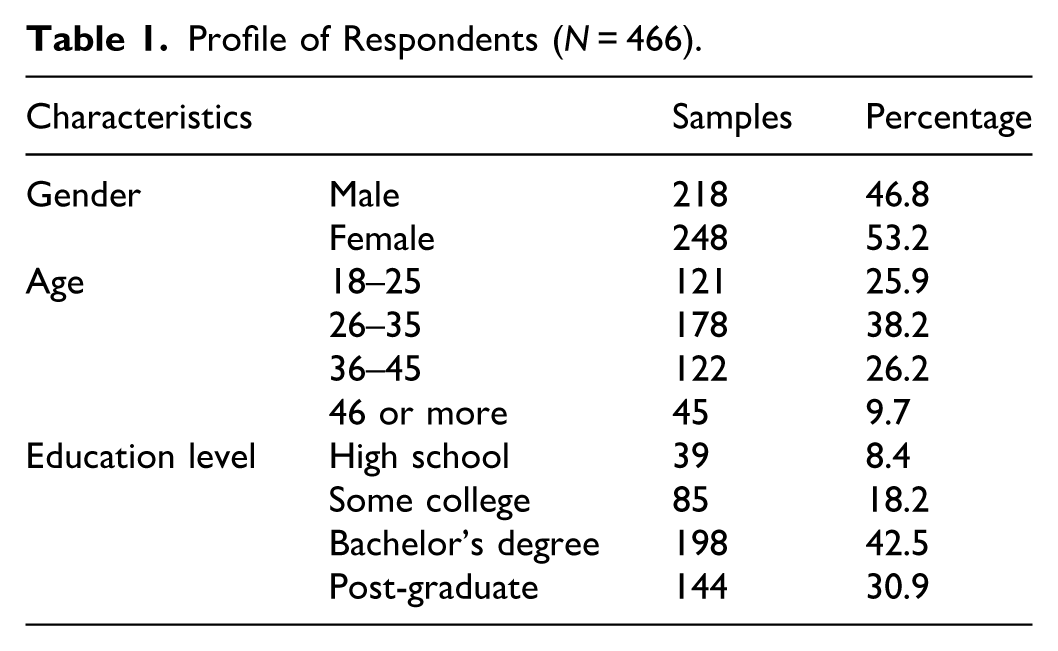
Among the retained sample, 53.2% identified as female and 46.8% as male. Approximately 38.2% of respondents fell within the 26−35 age group, followed by the 36−45 demographic (26.2%), while 25.9% were aged 18−25. Moreover, majority of participants (73.4%) held a bachelor’s degrees or higher. Consistent with technology adoption lifecycle theory (Kim, 2003), our sample predominantly comprised digital natives (18–45 years, 90.3%), who represent the primary user base for current AI applications. This aligns with industry reports indicating that 78% of generative AI users are under 45 (Gartner et al., 2024). Table 1 presents the demographic profile of the sample. Furthermore, independent samples t-tests comparing early and late respondents revealed no statistically significant differences (p < .05) across demographic characteristics or model variables. These results thus indicate the absence of non-response bias in this research.
Profile of Respondents (N = 466).
Measurement
The scale measurement items of interest were adopted from previous research. In this paper, we adopted a 5-point Likert scale ranging from 1 (strongly disagree) to 5(strongly agree) to measure all variables.
Independent Variable
AI services as independent variable was measured using four items which were referred from Makadia (2018) and Prentice et al. (2020). The measure aims to find out what customer think about the services provided by AI services. For example, “In the process of communicating with the AI service, I feel relax and happy,”“I can trust the AI,”“It will promptly introduce new services to me,”“It will provide me with updated information when my needs and preferences change.”
Dependent Variable
Customer loyalty (CL) is the dependent variable and consists of four items, which were developed and adapted from Oliver (1999) and Noor et al. (2022). Such as “I will encourage friends and others to use this AI service,”“I will use this service more in the coming months,”“I am willing to tolerate its minor flaws,” etc.
Mediator Variable
Customer satisfaction (CS) as mediator variable was referred from Hallencreutz and Parmler (2021) and Noor et al. (2022), including six items: I can feel enough attention during the service, I can feel the warmth during the service, I feel constant care after the service, I am satisfied with the service, My expectations can be fulfilled, This service is close to my ideal.
Moderator Variable
Customer participation uncertainty (CPU) as moderator variable were adapted from Ngo and O’Cass (2013) and Meyer et al. (2020), using a four-item scale (i.e., “I can participate in the process of service,”“I think this AI service is flawed”) to capturing the degree of uncertainty of customer’s interaction with AI services.
Control Variables
For analysis, we use gender, age, and education background (Edu) as control variables. Specifically, we define the gender as a binary variable, the education background as a categorical variable. And the age is presented by the natural log value.
Analysis and Results
Reliability and Validity
All scales were tested for internal consistency using Cronbach’s alpha coefficients to ensure the reliability. The reliability coefficient of the scale in this study is .756 and the reliability coefficients for each dimension range from .733 to .851. All scales demonstrated satisfactory levels of reliability. As shown in Table 2, The Cronbach’s α coefficients for AI services, customer loyalty, customer satisfaction, and customer participation uncertainty were .751, .784, .851, and .733 respectively. All these values are exceeded the acceptable threshold of .7, indicating that the scales selected for the questionnaire have favorable internal consistency. Furthermore, the composite reliability of each latent variable also reached above .7. Moreover, to assess the factorial validity, we conducted confirmatory factor analysis (CFA) following the procedure described by Blau et al. (2009), which yielded a model with good fit. And the discriminant validity also is achieved. Besides, all these factors cumulatively explained 68.2% of the total variance, exceeding the recommended threshold of 60%. Hence, the scale used in this study performed well in reliability and validity, and could be further tested for hypothesis.
Factor Analysis.

Descriptive Analysis
Before testing the hypotheses, Table 3 presents the descriptive statistics and correlation matrix of all variables. The correlation coefficients and variance inflation factor (VIF) values were commonly employed to examine potential multicollinearity issues that could compromise estimation accuracy. The table indicates positive correlations between any two key variables, providing preliminary support for the research hypotheses. Furthermore, the VIF values were examined to assess the likelihood of multicollinearity. The maximum VIF value of 3.205 suggests the absence of severe multicollinearity concerns. Generally, it is accepted that multicollinearity poses minimal risk when VIF values are substantially below the recommended threshold of 10 (Gao et al., 2022).
Descriptive Statistics and Correlations.
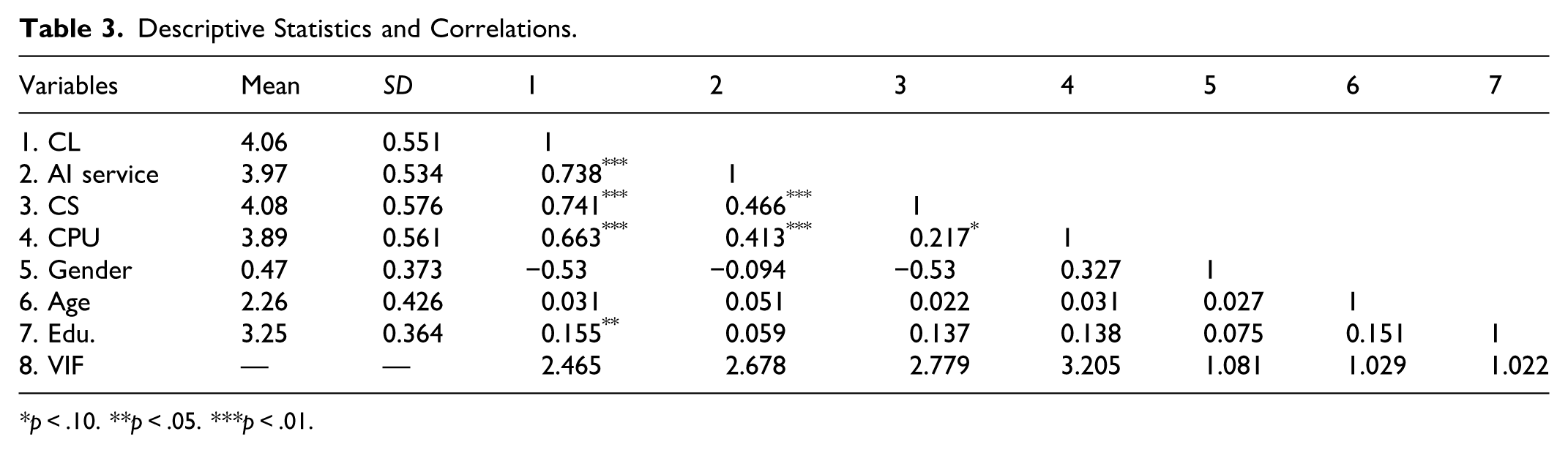
p < .10. **p < .05. ***p < .01.
The Main and Mediator Test
To examine the proposed hypotheses, we performed ordinary least squares (OLS) regression analyses in SPSS. A hierarchical moderated regression approach was further utilized to observe changes in variable coefficients. The results of the hierarchical regression analyses for mediating effects are presented in Table 4.
Results for the Mediating Effects of Customer Satisfaction.

p < .10. ***p < .01.
As is shown, Model 1 serves as the baseline model, incorporating all control variables and independent variable. Its result demonstrates the effect of AI services on customer loyalty. The results reveal that AI services has a positive effect on customer loyalty (β = .732, p < .01). Hence, H1 is supported. From Model 2, we can know that the regression coefficients of customer satisfaction on customer loyalty is .734 (p < .01), which supported H2. That is to say, customer satisfaction has an important role in improving the level of customer loyalty.
Consistent with prior study (Gao et al., 2022), we use the stepwise analysis approach to examine the mediating effect of customer satisfaction. A prerequisite for this analysis is the existence of significant relationships among the dependent variable, the independent variable, and the mediator variable. The test result of Model 1 and Model 2 have shown the significant relationships exist between AI service and customer loyalty, as well as between customer satisfaction and customer loyalty, thereby satisfying the first two steps of mediating effect test. Subsequently, it is necessary to examine the relationship between the dependent variable and the mediator variable, the relationship between the mediator variable and independent variable, and the changes observed after including the mediator.
As presented in Table 4, the results of Model 3 demonstrate the positively effect of AI services on the customer satisfaction (β = .661, p < .01), supporting H3. Moreover, the mediation test comparing Model 1 and Model 4 is revealed. Both AI service (β = .446, p < .01) and customer satisfaction (β = .432, p < .01) exhibit significant effects on customer loyalty in Model 4. Therefore, customer satisfaction mediates the relationship between AI service and customer loyalty, supporting H4. However, this method has also received much criticism and doubt (Hayes et al., 2017). Currently, the widely accepted supplementary method is the coefficient test method including Sobel test and Bootstrap test. It has been found that the Bootstrap method has higher statistical power. Although the test power of the stepwise test is the lowest among various methods (Fritz & Mackinnon, 2007), it is no longer a problem if a significant result has been obtained using the stepwise method. Therefore, this study follows the test process for mediating effect and combines the stepwise method and Bootstrap method to test the mediating effect. In the mediation effect test procedure, c represents the regression coefficient of the independent variable on the dependent variable, a represents the regression coefficient of the independent variable on the mediating variable, b and c’ respectively represent the regression coefficients of the mediating variable on the dependent variable and the independent variable on the dependent variable after the inclusion of the mediating variable.
To test the mediation effect, the following five steps are required: (1) There exists a mediating effect if c is significant, otherwise there exists a masking effect. (2) Successively test the significance of a and b. If both are significant, the mediation effect is significant and proceed to the fourth step, otherwise proceed to the third step. (3) For the insignificant cases, a Booststrap test is required. If it is significant, the mediating effect is significant and the next step can be carried out; otherwise, there is no mediating effect. (4) Test c′. If not significant, it indicates a complete mediation effect; if significant, proceed to the fifth step. (5) Compare the signs of ab and c′. If they are the same, it indicates a partial mediation effect, otherwise it indicates a masking effect. Hence, we conducted a Bootstrap test to assess the robustness of the mediating effect of customer satisfaction. This method determines the presence of a mediating effect based on whether zero is included within the confidence interval of the indirect effect. The analysis results are shown in Table 5 and the Bootstrap analysis confirmed the existence of a significant mediating effect, indicating that customer satisfaction plays a partial mediating effect between AI service and customer loyalty, with the 39.1% proportion of the total effect.
Bootstrap Test Results of the Mediating Effect.

Note. Bootstrap = 5,000.
p < .01.
The Moderator Test
In this study, we proposed the H5, positing that customer participation uncertainty plays a moderating role of in the relationship between AI service and customer loyalty. Using hierarchical regression analysis, we tested the moderating effect by including interaction terms composed of the centralized variables. To test the theoretical model incorporating this moderation effect, we firstly centered independent variable and moderator variable to mitigate potential multicollinearity. And then created the interaction terms, namely AI × CP. Furthermore, we calculated VIF for each variable to assess multicollinearity. The maximum VIF in the model was 1.791, well below the empirical cut-off threshold of 10.
The findings are reported in Table 6. The baseline model 1 is the influence of control variables on customer satisfaction. Model 2 introduces independent variable and Model 3 introduces moderator variable. Model 4 introduces the interaction of independent variable and moderator variable (AI × CPU). Briefly, we find that customer participation uncertainty exerts a significant moderating influence on the relationship between AI services and customer satisfaction. Regarding the moderating influence of customer participation uncertainty, the interaction of AI services and customer participation uncertainty has a negative but significant effect on customer satisfaction (β = −.213, p < .01). That is to say, customer participation uncertainty functions as a moderator. H5 is supported.
Results for the Moderating Effects of Customer Participation Uncertainty.

p < .01.
As plotted in Figure 2, this simple slope analysis represents the relationship between AI services and customer satisfaction at two different levels of the customer participation uncertainty and reveals its double-edged effect. More specifically, in low level of customer participation uncertainty, the positive influence of AI services on customer satisfaction is stronger. Whereas this positive influence is weaker at a high level. Therefore, in order to maximize the effectiveness of the quality of artificial intelligence services, enterprises should strive to reduce the uncertainty of customer participation.

The moderating effect of firm social capital.
Discussion and Conclusion
Main Findings and Implications
As AI technology continues to mature and becomes more widespread, an increasing number of enterprises have come to recognize its immense commercial potential. Many have actively integrated AI services into their business models to attract and retain consumers, thereby driving business growth and transformation. This trend is not limited to technology giants but has also pervaded various industries, encompassing retail, finance, healthcare, education, entertainment, and many others. This study establishes a theoretical framework to investigate the relationship between AI services and customer loyalty. Through rigorous empirical analysis, we probe the underlying mechanisms encompassing the direct effect, the mediating effect of customer satisfaction, and the moderating effect of customer participation uncertainty. The key findings are summarized below.
First, our results reveal a direct, statistically significant, and positive effect of AI service on customer loyalty, which is coordinated with our intuition. For example, when nursing robots provide customers with efficient and humanized services through their intelligent functions like precise medical advice, personalized care plans, and 24/7 uninterrupted care, customers not only experience the convenience of the service but also develop a strong sense of dependence and trust in the brand or service provider. In agreement with previous studies (Anggraini, 2024; Zahra et al., 2023), this can drive customer satisfaction and serves as the cornerstone for building long-term customer loyalty, encouraging customers to continue choosing and recommending the service to their friends and family in the future.
Second, consistent with prior research findings (Kosasih et al., 2024), customer satisfaction partially mediates the relationship between AI services and customer loyalty. This mediating role is not merely a simple transmission mechanism, but a complex psychological process. In practice, when customers are satisfied with AI services, they translate this positive emotion into positive evaluations and attitudes towards the brand or service provider. These positive evaluations and attitudes further influence customers’ purchase decisions and recommendation behaviors, thereby encouraging them to continue choosing the brand’s services and recommending them to others in the future. Therefore, if enterprises aim to enhance customer loyalty through AI services, they must attach great importance to improving customer satisfaction by continuously optimizing service quality and customer experience to earn customer loyalty.
Third, the relationship between AI services and customer satisfaction is inversely moderated by customer participation uncertainty. The higher the uncertainty of customer participation in human-robot interaction, the smaller the impact of AI services on customer satisfaction, and vice versa. This reverse moderating effect of is primarily manifested in two aspects. On the one hand, customers may doubt the accuracy and reliability if they experience uncertainty about the capabilities, behaviors, or intentions of AI services. Consumers cannot predict how their participate actions will affect the AI’s output, and this loss of control inhibits the generation of satisfaction. On the other hand, this uncertainty can also trigger psychological burdens and anxiety in customers, causing them to worry that the AI services might make mistakes or adversely affect them. Such psychological burdens and anxiety weaken the positive impact of AI services on customer satisfaction. Therefore, when promoting AI services, enterprises need to adopt various measures to reduce the uncertainty of consumer participation, such as providing detailed usage instructions, establishing clear interaction rules, strengthening privacy protection to build a sense of security in AI services.
AI research is a hot topic nowadays, and there have been numerous studies on customer satisfaction and customer loyalty. However, research that integrates interaction uncertainty is scarce. This paper bridges these gaps, striving to enrich the research content by verifying the mediating effect of customer satisfaction between AI service and customer loyalty, as well as the moderating role of customer participation uncertainty. While AI can bring numerous conveniences and has advantages that cannot be matched by human service, it still relies on human assistance in certain situations. AI cannot fully replace the functions of human. The interaction between humans is complex, and human thinking is even more intricate. Currently, AI does not possess this level of complexity. Therefore, for enterprises considering introducing AI to provide services, it is essential to conduct specific analyses based on their own situations.
Limitations and Future Research Directions
Furthermore, several limitations need to be addressed in future research. Firstly, this study failed to conduct an in-depth analysis specific to industries or service types when examining the impact of AI service on customer satisfaction and loyalty. Given the incredibly wide application range of AI services, spanning from retail to manufacturing, financial services to healthcare, customer needs and interaction patterns vary significantly across different industries and service types. Consequently, the findings of this study may lack deep insights tailored to specific contexts, limiting their practical relevance and value in application.
Secondly, this study selected customer satisfaction as a mediating variable, which has been extensively discussed in previous research. While it validated the mediating role of customer satisfaction between AI services and customer loyalty, it did not present novel insights or uncover new mediating mechanisms. Future research could consider introducing more innovative mediating variables like customer perceived value or enhanced customer trust to explore the deeper-level effects of AI services on customer loyalty.
Thirdly, the data were mainly collected from a single country may indeed limit the global applicability of the research conclusions. Future studies should conduct repeated verifications in different cultural backgrounds (such as individualistic vs. collectivist societies) and different countries (such as European and American countries).
Lastly, the measurement scales employed in this study may be insufficient and incomplete, failing to comprehensively cover all crucial variables and dimensions. This could lead to potential biases in the measurement results or the omission of important information. To enhance the accuracy and reliability of the research, future endeavors should strive to develop and refine more comprehensive and detailed scales, ensuring accurate measurement of the actual levels of various variables.
Footnotes

Ethical Considerations
The study complied with ethical standards for minimal-risk social science research in accordance with APA ethical guidelines.
Consent to Participate
This study involved an anonymous, questionnaire-based survey with no foreseeable risks to participants. Informed consent was obtained from all respondents prior to participation, and participation was entirely voluntary.
Funding
The authors disclosed receipt of the following financial support for the research, authorship, and/or publication of this article: This research was funded by the National Social Science Fund of China, grant number 23BGL307; and the Joint Fund Project of the Small & Micro Enterprises Development Research Center in Hubei Province and the Social Science Association in Xiaogan City, Grant Number LH202413; the Hubei Province Higher Education Institutions Outstanding Young and Middle-aged Science and Technology Innovation Team Program Project, Grant Number T2023023.
Declaration of Conflicting Interests
The authors declared no potential conflicts of interest with respect to the research, authorship, and/or publication of this article.
Data Availability Statement
Data sharing not applicable to this article as no datasets were generated or analyzed during the current study.