



Abstract
An increasing number of tourist accommodations are proactively altering their operations to incorporate more sustainable practices, reflecting the massive interest in consumers’ green purchasing. Despite the widespread interest in eco-friendly consumer behavior, few studies have applied the value-belief-norm (VBN) theory to the tourist accommodation sector, and its cross-cultural validity remains underexplored. Specifically, this study incorporated green trust into the original VBN model to gain a comprehensive understanding of consumers’ decision-making processes. Data was collected through an online survey from 2038 tourists in Lithuania, Spain, and Norway. Structural equation modeling was applied to test the hypotheses, revealing significant causal relationships between the constructs of green consumer values, subjective knowledge, attitude, personal norms, green trust, and green purchasing behavior. Personal norms were found to play a crucial role in influencing green trust, which in turn impacts green purchasing behavior in all three countries. These findings underscore the importance of tourism businesses in strengthening environmental education, fostering trust through eco-labeling and certifications, and developing market-specific strategies that align with travelers’ values and norms.
Plain Language Summary
As more tourists choose eco-friendly travel options, many accommodations are adopting sustainable practices. However, little is known about the factors that guide travelers’ decisions to select these green accommodations. This study aimed to explore how tourists’ values, beliefs, and personal norms influence their decision to choose sustainable accommodations. The study collected responses from 2,038 tourists in Lithuania, Spain, and Norway. Researchers used a survey to gather information on factors such as green values, knowledge, attitudes, trust in sustainability practices, and personal norms, and then analyzed the data using a statistical model. The findings show that personal norms—what travelers believe is the right thing to do—are crucial in shaping their trust in the sustainability of accommodations. Green trust, in turn, was found to play an important role in influencing the decision to choose eco-friendly accommodations. These results highlight the importance of understanding tourists’ values and personal beliefs when promoting sustainable travel choices. This study provides valuable insights for the tourism industry, suggesting that encouraging travelers’ personal norms and trust in green practices could help increase the demand for sustainable accommodation options across different countries.
Keywords
Introduction
The tourism industry has recently undergone a transformative shift, as travelers increasingly prioritize sustainability in their travel choices. As environmental degradation and society’s awareness of climate change continue to rise, there is a critical demand for environmentally friendly practices in tourism (He et al., 2024; Kortsch & Händeler, 2024; Waris et al., 2024). Recent data indicates that 75% of global travelers are willing to travel more sustainably (Global Sustainable Tourism Council, 2024), underscoring the significance of this new wave of eco-conscious traveler behavior. The changes toward a more sustainable tourism industry not only reflect evolving traveler preferences but also present challenges and opportunities for the tourism industry (Fauzi et al., 2024).
Sustainable travel encompasses a range of measures aimed at reducing the environmental impact of the tourism industry while simultaneously fostering economic and social advantages for local communities (Kiatkawsin & Han, 2017). The integration of sustainability principles into various facets of tourism, including accommodations, transportation, and the industry as a whole, has become pivotal in the decision-making processes of travelers (Han, 2015; Khan et al., 2024; Lind et al., 2015; L.Wang et al., 2024).
This study specifically examines the domain of sustainable touristic accommodations, deliberately setting aside other facets of the tourism product spectrum. Sustainable accommodation refers to facilities that emphasize environmentally responsible practices, support local communities, and enhance the overall tourist experience while reducing negative environmental and societal impacts (Midgett et al., 2020; Pavić et al., 2019). The emphasis on sustainable accommodations is warranted by their significant representation within the tourism industry (Midgett et al., 2020) and the growing consumer demand for such options (Islam, 2024).
As travelers increasingly strive to align their choices with their values, comprehending the underlying factors driving sustainable accommodation choices has become essential. Prior studies (Ahn & Kwon, 2020; Jian et al., 2020) have demonstrated that factors such as environmental concerns, green trust, uncertainty, value, cost, attitudes, emotional predispositions, and other determinants influence the evolution of sustainable accommodations. Understanding these factors is imperative for tourism businesses and policymakers in order to promote sustainable accommodation practices that yield benefits for the environment and local communities. However, the majority of the research has relied on the theory of planned behavior (TPB) to explain the green purchasing behavior exhibited by tourists (Bashir et al., 2019; Eunike et al., 2025; Fauzi et al., 2024; Nguyễn et al., 2025; Pan et al., 2022; Sági et al., 2025; Sann et al., 2024; Ulker-Demirel & Ciftci, 2020). While TPB has offered valuable insights, its main focus is rational decision-making and the theory has been criticized that TPB factors may be insufficient to explain human behavior and decision-making (Gulati et al., 2025). In contrast, the value-belief-norm (VBN) theory, has been recognized as an alternative theoretical framework for understanding consumers’ green behaviors, as it highlights how values and moral obligations translate into actions (Al Mamun et al., 2024; M. Chen, 2015; Elakkad et al., 2025; Hidalgo-Crespo et al., 2023; Khan et al., 2024; Mamun et al., 2023; Ocloo et al., 2024; Sonkar et al., 2025; Su et al., 2022; Waris et al., 2024). This moral and normative focus enhances the relevance of VBN in sustainability contexts, where decisions are rarely based on utilitarian cost-benefit arguments and are instead more connected to value-based motivations. Yet, applications of VBN in tourism, particularly in the context of sustainable tourist accommodations, have remained limited, despite growing evidence of VBN’s capability to predict eco-friendly behavior (Denley et al., 2020; Gupta & Sharma, 2019; Landon et al., 2018; Megeirhi et al., 2020). This restricts the understanding of how normative processes shape accommodation choices, leaving an important theoretical gap. Furthermore, while previous research have acknowledged green trust as a determinant of sustainable consumption (Balaji et al., 2019; Choi et al., 2015; Fauzi et al., 2024; Jian et al., 2020), it has typically been modeled separately from VBN sequence. This leaves unanswered questions about how green trust itself is shaped by personal norms and cognitive factors? And does it mediate the path from moral obligations to actual green purchasing? Taken together, these gaps highlight the need for a comprehensive model that integrates green trust into the VBN framework and applies it to the sustainable accommodation sector.
The aim of this study is to develop a comprehensive model that provides an in-depth understanding of travelers’ sustainable decision-making processes, employing an expanded version of the VBN theory as its theoretical foundation. It is anticipated that this approach will facilitate a nuanced examination of how value systems and belief structures influence travelers’ decisions, ultimately promoting sustainable accommodation choices.
In the subsequent sections of this paper, we will delve into the pertinent literature concerning VBN theory. Following this, a conceptual model and corresponding hypotheses will be introduced. Subsequently, the research methods will be outlined. This will be followed by the presentation of the empirical study’s results. Finally, the discussion and conclusions will be presented.
Literature Review
VBN theory serves as a fundamental framework for evaluating behavior and behavioral intentions within the realm of sustainable purchasing (Kortsch & Händeler, 2024). It extends the Norm Activation Theory (NAT), which has been effectively applied to pro-environmental behavior (Stern et al., 1999). VBN delves into the role of personal moral inclinations in shaping specific behaviors (Al Mamun et al., 2022; Fornara et al., 2020; Khan et al., 2024). The VBN theory establishes a causal chain between norms, beliefs, values, and behaviors, positing that individuals’ values influence their beliefs, influencing the norms directly impacting their pro-environmental conduct (Choi et al., 2015; Hidalgo-Crespo et al., 2023; Ocloo et al., 2024; Raghu & Rodrigues, 2022). While previous research has tested either the full or partial models of the VBN theory (Al Mamun et al., 2022; Awais et al., 2022; Gupta & Sharma, 2019; Johansson et al., 2013; Kim et al., 2022; Le et al., 2021; C.-P. Wang et al., 2023), limited efforts have been made to expand the model by incorporating additional variables to better explain green behavior. Therefore, to enhance the predictive capability of green consumption behavior, this study introduces subjective knowledge and green trust as supplementary predictors of green purchasing behavior. Prior literature has underscored the relevance of these variables in forecasting consumer behavior (Ahn & Kwon, 2020; Çakır Yıldırım & Karaarslan Semiz, 2019; Fauzi et al., 2024; Han, 2015; Jian et al., 2020; Zasada et al., 2020). The hypothesized model, which is grounded in the VBN theory, is depicted in Figure 1.

Conceptual framework.
In considering the trajectory of an individual’s life, values play a pivotal role in establishing essential benchmarks. They form the cohesive bedrock of one’s social and personal identities (Hitlin, 2003). Values represent an inherent system of preferences that steer human conduct and are characterized by the significance assigned to a particular entity or action (Fornara et al., 2020). Understanding value orientations is crucial in discerning tourists’ inclination toward sustainable lodging (Waris et al., 2024). The conventional iteration of the VBN theory posits that values can be egoistic, altruistic, and biospheric (Hidalgo-Crespo et al., 2023; Waris et al., 2024). Through an extensive review of the literature, it has become evident that these two value bases are somewhat expansive and can be applied across various domains (De Dominicis et al., 2017; Venugopal & Shukla, 2019; Xu et al., 2021). Considering that different value bases can lead to varying environmental action levels (Venugopal & Shukla, 2019), we sought to identify a more pertinent value base specifically for predicting choices concerning sustainable tourism accommodations. Our focus shifted to green consumer values, which explicitly target the environmental domain, allowing for a more nuanced understanding of the cognitive processes that shape tourists’ behavior. Green consumption values are defined as the inclination to reflect the value of environmental protection through purchasing and consumption practices (Haws et al., 2014). These values present a refined and meaningful foundation for analyzing the motivated choices associated with sustainable accommodation. It is our aspiration that this modification of the VBN theory will enhance its explanatory efficacy.
According to the VBN theory, an individual’s fundamental values wield substantial influence over their beliefs (Batool et al., 2024; Ocloo et al., 2024). Beliefs are a critical intermediary between values and personal norms (Stern et al., 1999). Traditionally, the beliefs component comprised awareness of consequences, ascription of responsibility, and ecological worldview (Ikhsan et al., 2023; Sharma & Gupta, 2020). However, this study narrows the focus of the beliefs component to two primary elements: subjective knowledge and attitude. In the context of environmental psychology, subjective knowledge pertains to an individual’s self-perception regarding their knowledge base (Tassiello & Tillotson, 2020). Attitudes encompass a synthesis of responsibility and ecological worldview. According to Ajzen (1991), attitude can be defined as the degree to which an individual holds a positive or negative evaluation of a particular behavior. This construct is shaped by past experiences and is intimately connected to an individual’s assessment of the outcomes associated with specific behaviors (Kashif et al., 2018). By integrating subjective knowledge and attitude, this study modernizes the traditional beliefs component, emphasizing constructs directly relevant to sustainable accommodation.
Subjective knowledge acts as a proxy for awareness of consequences, representing individuals’ perceived understanding of environmental issues and their potential impacts. Mere knowledge of environmental issues is insufficient; individuals must also possess a sense of understanding and confidence regarding these issues (Rizkalla & Erhan, 2020). It is more likely that individuals with stronger green values will have higher engagement with information and a stronger sense of subjective knowledge about environmental issues (Thøgersen, 2000). Building on previous research and the conceptual foundation of the VBN theory (Batool et al., 2024; Ocloo et al., 2024), we expect that green consumer values will have a significant impact on subjective knowledge as a component of beliefs. Therefore, we posit the following hypothesis:
The VBN theory posits that values serve as a foundational element in forming beliefs (Batool et al., 2024; Ikhsan et al., 2023; Ocloo et al., 2024). Empirical evidence from previous studies supports the notion that attitudes, as a component of beliefs, are significantly influenced by green consumer values. For instance, research conducted by Woo and Kim (2019) indicates that green consumer values have a substantial impact on consumer attitudes. Furthermore, Kautish and Sharma (2019) reinforce this perspective by demonstrating that green consumer values function as a predictor of attitude. In light of this, we hypothesize that:
According to the VBN theory, beliefs related to subjective knowledge play a pivotal role in shaping personal norms (Choi et al., 2015; Ocloo et al., 2024). This influence stems from the idea that subjective knowledge regarding environmental issues heightens awareness of one’s impact on the environment (Han, 2015), subsequently reinforcing personal norms. Heightened awareness of the consequences of one’s actions fosters a sense of responsibility for environmental impact and encourages individual-level changes (Çakır Yıldırım & Karaarslan Semiz, 2019; Zasada et al., 2020). Individuals who perceive themselves as possessing knowledge about environmental issues are more likely to assume greater responsibility. This notion is supported by a study conducted by Dursun et al. (2019), which revealed a significant impact of subjective knowledge on personal norms as part of the psychological barriers to energy conservation behavior. Thus, we propose the following hypothesis:
Attitude plays a crucial role in shaping personal norms. D’Souza et al. (2020) found that consumers are more likely to participate in fair trade consumption as a means of differentiating themselves from others. This research supports the idea that positive attitudes can effectively activate personal norms. In emphasizing the significance of attitude as a fundamental component of beliefs, it is pertinent to highlight the findings of Ikhsan et al. (2023), who demonstrated that pro-environmental beliefs exert a positive influence on personal norms. Consequently, it can be anticipated that attitude will positively affect personal norms. This leads to the following hypothesis:
Trust is defined operationally as the belief that one has in a trustee’s ability to uphold commitments and fulfill responsibilities (Hagen & Choe, 1998). In this context, “green trust,” as conceptualized by Guerrero and Pacheco (Guerreiro & Pacheco, 2021), relates specifically to consumers’ confidence in the environmental performance of particular products, services, or brands. Unlike general trust, which reflects broad confidence in systems, institutions, or sustainability initiatives overall, green trust specifically targets particular environmental claims. This confidence takes on added significance in situations marked by high risk and uncertainty, as noted by Choi et al. (2015). Consequently, green trust becomes a pivotal element in consumer decision-making processes, functioning as a mediating mechanism that translates personal norms and knowledge into actual behavior. This highlights its crucial role in promoting sustainable consumption and encouraging environmentally responsible choices (Guerreiro & Pacheco, 2021).
Existing literature emphasizes the importance of subjective knowledge in developing consumer trust. Hoque and Alam (2018) have demonstrated that subjective knowledge, when combined with trust, plays a vital role in comprehending consumer behavior regarding green products. Furthermore, research conducted by Hossain et al. (2022) has illustrated a significant and positive correlation between environmental knowledge and green trust. Thus, we propose the following hypothesis:
The VBN theory explicitly connects personal norms with behavior. Consumers who feel a moral obligation to engage in sustainable practices, as dictated by their personal norms, are more likely to translate these norms into concrete actions (Mamun et al., 2023), such as green purchasing. Empirical evidence (Gupta & Sharma, 2019; Kortsch & Händeler, 2024; Lee et al., 2023; Shanmugavel & Balakrishnan, 2023; C.-P. Wang et al., 2023; Waris et al., 2024) supports the association between stronger personal norms and higher rates of sustainable purchasing behaviors. Shanmugavel and Balakrishnan (2023), Lee et al. (2023) found that personal norms play a significant role in developing positive behavioral intentions toward e-vehicles (Shanmugavel & Balakrishnan, 2023). Similarly, Waris et al. (2024) and C.-P. Wang et al. (2023) discovered a positive influence of personal norms on visiting green hotels. Kortsch and Handeler (2024) also confirmed the significant impact of personal norms on green purchasing behavior. Based on the literature, the following hypothesis has been posited:
Based on our expectations, personal norms are anticipated to exert influence on various personal characteristics, notably trust. As individuals internalize their personal norms with respect to sustainability, it is conceivable that they will be more inclined to place trust in products and services that are congruent with these norms (Jimenez & Iyer, 2016; Kostritsa & Sittler, 2017). The link between personal norms and green trust is underpinned by the idea that individuals are predisposed to trust entities that reflect their ethical principles (Uslaner, 1999), thus establishing trust as a consequence of robust personal norms.
Empirical studies have corroborated this relationship (Balaji et al., 2019; Y.Chen & Chang, 2012; Yang et al., 2024). For instance, Y. Chen and Chang (2012) demonstrated that reducing the perceived risk associated with sustainable products can significantly enhance green trust. Moreover, Yang et al. (2024) provided evidence that personal norms exert a notable influence on green trust, specifically in the context of organic food. Similarly, Balaji et al. (2019) reinforced this notion by illustrating that personal norms have a substantial impact on green trust toward green hotels. While this study focuses on personal norms, we acknowledge that other factors, such as social norms or consumers’ past experiences with sustainable products, may also play a role in shaping trust. Consequently, we propose the following hypothesis:
Trust in green products is believed to have a substantial effect on purchasing decisions. When consumers perceive that the products align with their environmental values and norms, they are likely to purchase (Fauzi et al., 2024). This assertion is supported by research indicating that trust can mitigate perceived risks associated with green products and elevate the probability of engaging in green purchasing behavior (Balaji et al., 2019; Choi et al., 2015; Fauzi et al., 2024; Sparks & Browning, 2011). Taking into account these findings, the following hypothesis has been formulated:
Methods
Sample and Data Collection
The research data was collected between 2023 and 2024 using an online panel provided by the research company “Intraresearch.” An online survey was administered to tourists from Lithuania, Spain, and Norway, with participants selected from these three countries based on their cultural diversity. The choice of Lithuania, Spain, and Norway was based on their unique cultural profiles, providing a solid foundation for meaningful comparison. According to Hofstede’s cultural dimensions (The Culture Factor Group, 2025), Spain scores very high in uncertainty avoidance and relatively high in power distance, indicating that a preference for structure, rules, and social hierarchy may shape consumer behavior. Norway is characterized by strong individualism, high indulgence, and low motivation toward achievement and success, reflecting a culture where autonomy, personal freedom, and enjoyment are valued, with less emphasis on competition or material success. High uncertainty avoidance and low indulgence in Lithuania suggest a more cautious and restrained approach to sustainable consumption. The selection of the three culturally different contexts broadens the empirical base of sustainable tourism.
All participants were assured that the study was conducted solely for academic purposes and that their data would be kept confidential. Additionally, they were informed of their ability to request information regarding the study’s results. A total of 2,038 usable questionnaires were obtained after accounting for missing and unengaged cases. These responses were ultimately included in the analysis.
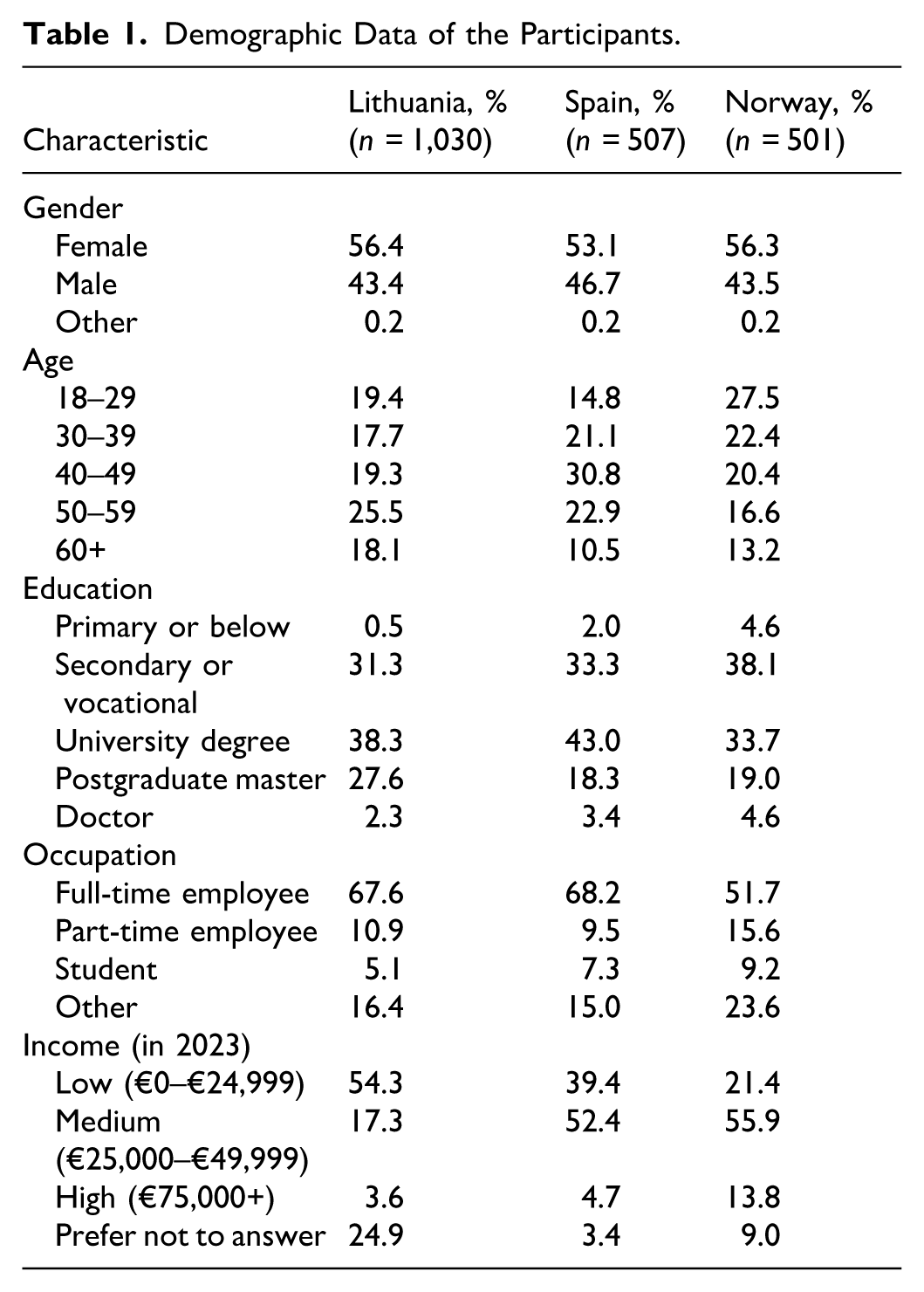
The gender ratio was female-skewed in all the countries (Table 1). The majority of respondents in Lithuania were in the 50 to 59 age group (25.5%), while in Spain, the dominant age group was 40 to 49 years old (30.8%). In Norway, the majority of respondents were in the youngest age group, 18 to 29 years old (27.5%). Regarding education, the majority of respondents in Lithuania and Spain had a university degree, accounting for 38.3% and 43.0% of the study participants, respectively. In Norway, 38.1% of research participants had secondary or vocational education. The sample was predominantly composed of full-time employees. A significant proportion of the Lithuanian sample reported their income to be up to €24,999. The majority of the Spanish and Norwegian samples were comprised of respondents with incomes ranging from €25,000 to €49,999.
Demographic Data of the Participants.
Measures
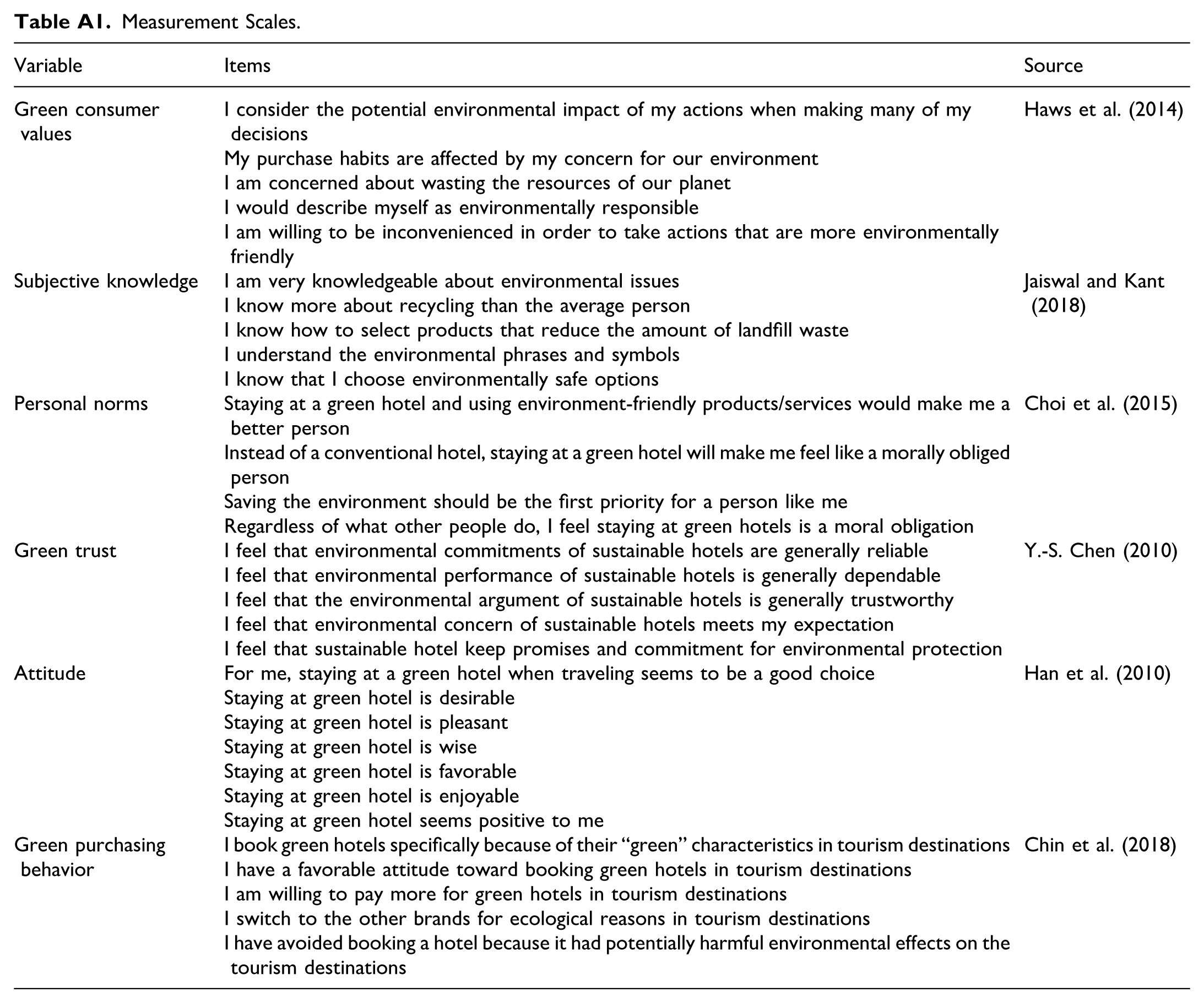
The measurement items used to assess model constructs in this study were adapted from previous research that has established and validated measures for studying consumer purchasing behavior (Table A1 in Appendix A). All the items were designed to highlight green hotels as the most popular and knowledgeable option for sustainable accommodations. However, in the questionnaire, respondents were informed they could consider any other sustainable accommodation options while answering the questions. The items for green consumer value (consisting of five items) were developed based on a study conducted by Haws et al. (2014). Representative items include statements such as “I consider the potential environmental impact of my actions when making many of my decisions” and “I am willing to be inconvenienced to take actions that are more environmentally friendly.” Subjective knowledge was measured using items derived from the research of Jaiswal and Kant (2018). Sample items included “I am very knowledgeable about environmental issues” and “I understand the environmental phrases and symbols.” Personal norms were assessed using items suggested by Choi et al. (2015), with sample items including “Instead of a conventional hotel, staying at a green hotel will make me feel like a morally obliged person” and “Saving the environment should be the first priority for a person like me.” Green trust was measured using five items from Y.-S. Chen (2010), with sample items including “I feel that environmental commitments of sustainable hotels are generally reliable” and “I feel that environmental concern of sustainable hotels meets my expectation.” The attitude was assessed using a scale recommended by Han et al. (2010), with sample items including “Staying at a green hotel is desirable” and “Staying at a green hotel is enjoyable.” To measure green purchasing behavior, a scale proposed by Chin et al. (2018) was used, with sample items including “I have a positive attitude toward booking green hotels in tourism destinations” and “I switch to other brands for ecological reasons in tourism destinations.”
All constructs in the study were measured on a five-point Likert scale (1 = Strongly disagree, 5 = Strongly agree). The data collection instrument also included demographic profiles such as gender, age, education, occupation, and income.
The survey instrument was first developed in English and then translated into Lithuanian, Spanish, and Norwegian through a rigorous translation-back translation methodology (Klotz et al., 2023; Ozolins et al., 2020). Before the commencement of the online survey, a pretest was administered to 20 graduate students who had recently experienced an overnight stay at a tourist accommodation. The survey was refined based on the feedback received during the pretest, focusing on improving linguistic and conceptual clarity.
Data Analysis
In the measurement analysis, the partial least squares (PLS) method was used, which has gained significant popularity in the past few decades (Ali et al., 2018; Guenther et al., 2023). PLS-SEM is well suited for estimating complex models with multiple constructs, indicators, and structural paths, while relaxing the assumption of multivariate normality (Vasilica-Maria et al., 2023). Although the sample size of the study was sufficient for covariance-based (CB) SEM, we selected PLS-SEM as we intended to maximize explained variance and assess the predictive relevance of the extended VBN framework. In this context, PLS-SEM was chosen as an effective alternative to CB-SEM, which is more focused on model fit, whereas PLS-SEM emphasizes prediction (Manley et al., 2021).
The data underwent analysis using SmartPLS 4. In light of the multicultural composition of the dataset, we implemented a methodological framework in which the model was assessed independently across three distinct national contexts: Lithuania, Spain, and Norway. This approach entailed partitioning the dataset into three independent subsamples, thereby facilitating an empirical validation of the proposed relationships within each specific cultural milieu. Such a strategy not only enhances the robustness of our findings but also underscores the contextual nuances that may influence the dynamics under investigation.
To ensure a comprehensive approach, a two-stage analytical procedure was followed. This involved initially testing the measurement model to validate the instruments, followed by evaluating the structural model to test the hypothesized relationships.
Results
Common Method Bias
The study utilized Likert-type scales to gather various measures from a single source, prompting concerns about potential common method variance (Podsakoff et al., 2003). To assess this, Harman’s single-factor test was conducted using exploratory factor analysis (EFA), loading all variables into a single factor. The results revealed that the total variation explained by a single factor was 49.978%, falling below the established threshold of 50% (Podsakoff et al., 2003). Based on these findings, it can be inferred that common method variance is unlikely to be a significant issue in the study. Furthermore, an assessment of multicollinearity using the variance inflation factor (VIF) revealed values ranging from 1.000 to 1.725, well below the conservative threshold of 3.3, indicating that the dataset was not affected by multicollinearity (Hair et al., 2019). Therefore, the results suggest that the potential impact of common method bias on the study’s outcomes was unlikely. Additionally, we implemented procedural remedies during the survey design (randomized item order, varied scale anchors) to further reduce the likelihood of bias.
Measurement Model
In the initial phase, a confirmatory factor analysis (CFA) was conducted, resulting in the exclusion of several indicators with inadequate factor loadings (FL). As a result, one item pertaining to green consumer values (“It is important to me that the products I use do not harm the environment”) and one related to green purchasing behavior (“I am aware of the environmental impact of the hotels I book”) were removed. The remaining items exhibited factor loadings exceeding the recommended threshold of 0.708 (Hair et al., 2012).
In the Lithuanian, Spanish, and Norwegian samples, the Cronbach’s α values for the latent variables were found to be high, as indicated in Table 2. This suggests that the internal consistency is satisfactory.
Factor Loadings, Reliability, and Convergent Validity of the Constructs.

In evaluating the internal consistency reliability, or the degree to which a set of items consistently reflects the underlying construct, we utilized the recommended approach of reporting composite reliability (CR), as suggested by Guenther et al. (2023). All CR scores exceeded the threshold of 0.70 (Hair & Sarstedt, 2019), ensuring the measurement constructs’ reliability.
Conducting a check for convergent validity, we relied on the average variance extracted (AVE). The AVE for all constructs surpassed the recommended minimum value of 0.50 (Guenther et al., 2023), indicating that each construct explains more than half of its items’ variance.
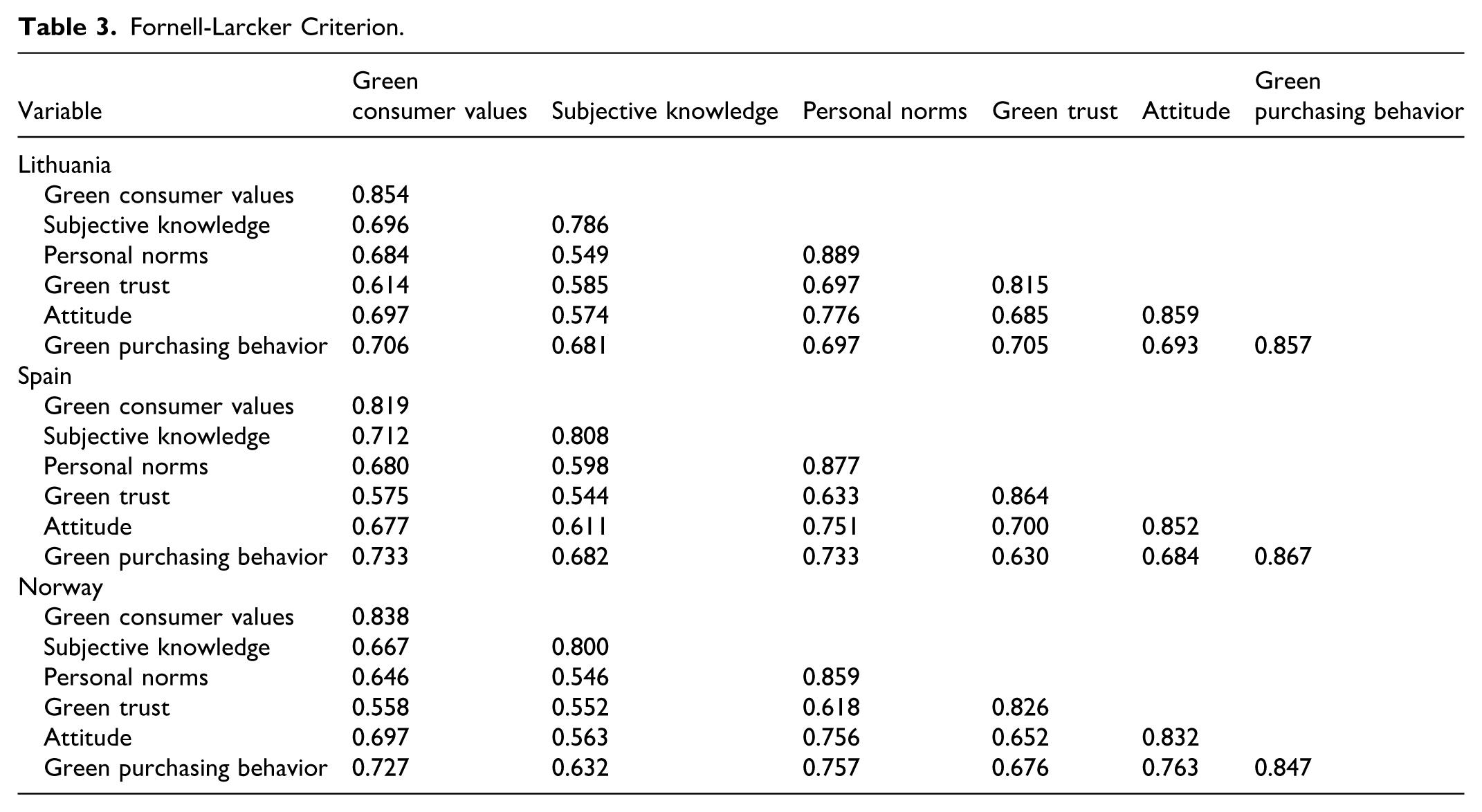
For the assessment of discriminant validity, we employed the Fornell-Larcker criterion and the heterotrait-monotrait (HTMT) ratio of correlations. Comparing the AVE scores of each factor with the squared correlations between each pair of factors confirmed the model’s discriminant validity. As indicated in Table 3, no correlation exceeded the square root of the AVE, providing strong evidence for discriminant validity.
Fornell-Larcker Criterion.
According to Henseler et al. (2015), who introduced the HTMT ratio, it is suggested that the result should be lower than the more conservative threshold of 0.85 or the more liberal threshold of 0.90. As indicated in Table 4, the HTMT values are below the threshold of 0.85, thus confirming that discriminant validity has been achieved.
HTMT Criterion.

The findings indicate that, overall, the constructs conformed to the prescribed standards for measurement reliability and validity. The measurement model fulfills the requisite quality benchmarks, prompting us to shift our focus toward evaluating the structural model.
Structural Model
In the assessment of a structural model, it is imperative to conduct a thorough analysis of key statistical indicators, with particular attention to the determination coefficient R2. R2 holds significant importance as a criterion for evaluating the results of the structural model (Guenther et al., 2023). The R2 values reveal that in all three samples, personal norms and green purchasing behavior account for the largest share of the variance (Table 5). To gauge a model’s predictive capabilities, it is recommended to utilize Stone-Geisser’s Q2 criterion, which is based on the blindfolding procedure (Guenther et al., 2023). The Q2 values for all constructs exceeded 0, thereby establishing the predictive relevance of the model.
Variance Explained (R2) and Predictive Scores (Q2) of the Structural Models.

In accordance with the suggestion of Guenther et al. (2023), the standardized root mean square (SRMR) was utilized to assess the model’s goodness of fit. The SRMR for each sample remained below the recommended threshold of 0.08 (Guenther et al., 2023). Specifically, in the context of Lithuania, the SRMR was 0.070, while for Spain and Norway, it was 0.046 and 0.051, respectively.
The path coefficient analysis conducted in this study aimed to test the conceptual model by calculating path coefficients for each country. The results, as presented in Table 6, clearly illustrate the structure of the hypothesized relationships.
Hypothesis Testing Results.

The examination of the influence of green consumer values on subjective knowledge yielded significant findings across three distinct samples: Lithuania (β = .690, p = .000), Spain (β = .712, p = .000), and Norway (β = .666, p = .000) (Figure 2). These results indicate a strong and consistent effect of values on subjective knowledge across all countries, therefore, providing substantial support for Hypothesis 1. Moreover, the analysis revealed that green consumer values positively affected attitudes in all three countries, with particularly pronounced effects observed in Lithuania and Norway (β = .696, p = .000), as opposed to Spain (β = .677, p = .000), thereby validating Hypothesis 2. These results suggest that values are a robust predictor of attitudes toward sustainable accommodations and may be relatively unaffected by cultural differences.

SEM results with standardized path coefficients.
The research further identified a significant, albeit more modest in size, positive relationship between subjective knowledge and personal norms, with the strongest effect reported in Spain (β = .220, p < .000), followed by Lithuania (β = .151, p < .000) and Norway (β = .174, p < .000), thus affirming Hypothesis 3. Additionally, Hypothesis 4 was robustly supported through high path coefficients among the three nations: Lithuania (β = .689, p = .000), Spain (β = .617, p = .000), and Norway (β = .657, p = .000), highlighting the impact of attitudes on personal norms.
Subjective knowledge was also demonstrated to have a significant and positive influence on green trust across all samples, with values of β = .324 (p = .000) for Lithuania, β = .256 (p = .000) for Spain, and β = .308 (p = .000) for Norway. These moderate coefficients substantiate Hypothesis 5.
The analysis emphasized the role of personal norms as a critical determinant of green purchasing behavior, with varying effects observed: Spain (β = .558, p = .000), Lithuania (β = .413, p = .000), and Norway (β = .548, p = .000), thereby supporting Hypothesis 6. Strong and statistically significant path coefficients were also identified between personal norms and green trust in all three countries: Lithuania (β = .473, p = .000), Spain (β = .481, p = .000), and Norway (β = .450, p = .000), further validating Hypothesis 7. Finally, the data confirmed a significant effect of green trust on green purchasing behavior (H8), with a notably stronger influence in Lithuania (β = .437, p = .000) compared to Norway (β = .337, p = .000) and Spain (β = .276, p = .000). these findings suggest that trust is an important driver of behavior.
To enhance our understanding of the influence of personal norms on green purchasing behavior, we analyzed the total effects of personal norms across different countries. In Lithuania, the total effect of personal norms on green purchasing behavior was found to be significant, with a coefficient of β = .620 and a p-value of .000. Similarly, in Spain, the total effect was also significant, demonstrating a coefficient of β = .691 and a p-value of .000. Furthermore, Norway exhibited a significant total effect of personal norms on green purchasing, with a coefficient of β = .700 and a p-value of .000. These findings underscore the substantial role personal norms play in influencing green purchasing decisions in these countries.
Based on the analysis, it is evident that all causal relationships explaining green purchasing behavior are supported in our study. The VBN theory is found to be equally valid in Lithuania, Spain, and Norway in terms of explaining tourists’ choices of sustainable accommodation. Finally, the proposed extension of VBN to include the impact of green trust also appears to be supported.
Discussion
The extension of the VBN theory to diverse contexts and cultures is crucial for enhancing its overall generalizability, as highlighted in previous research (Hong et al., 2024; Lebrument et al., 2024; Lima et al., 2024). This study builds upon that foundation by validating an extended VBN framework within the contexts of three previously unexplored countries: Lithuania, Spain, and Norway. Beyond cross-cultural validation, the contribution of the study lies in the theoretical refinement of the VBN framework. Specifically, the study reveals not only expected relationships but also subtle differences in the strength of paths across the three countries. By integrating green trust as a pivotal construct, this model contributes to a deeper understanding of how individual values and beliefs are translated into environmentally responsible behaviors, particularly within the sustainable accommodation sector. Whereas green trust has been previously examined as a direct antecedent of purchase intention, our model integrated it as a mediator shaped by subjective knowledge and personal norms. This reconceptualization highlights the role of moral obligations and cognitive evaluations in forming trust, thereby strengthening the explanatory power of the VBN framework. Furthermore, the inclusion of subjective knowledge and attitude as determinants of personal norms and green trust, this study demonstrates the joint power of both cognitive and attitudinal factors in driving pro-environmental decision making in sustainable accommodation sector. Our findings support each hypothesis, confirming the relationships proposed within the extended framework of VBN. Notably, the strong positive impact of green consumer values on subjective knowledge (H1) across all the countries involved in the study reinforces the foundational premise of VBN theory, suggesting that individuals’ beliefs are influenced by their values. The research outcomes affirm that tourists who espouse more vital green values tend to perceive themselves as more knowledgeable regarding environmental issues. Furthermore, we observed minor coefficient variations, which may be attributable to differing levels of sustainability awareness or environmental education across the countries analyzed.
The strong positive impact of green consumer values was found on attitude (H2). This impact was consistently strong across three countries—Lithuania, Spain, and Norway. The evidence suggests that individuals who possess more vital green values are inclined to exhibit more favorable attitudes toward sustainable accommodation options. Notably, this pattern of results remains stable despite the varying cultural contexts of the countries studied. Consequently, it can be inferred that green consumer values may serve as a universal determinant of attitudes regarding sustainable practices.
The study emphasizes the importance of subjective knowledge and attitude in influencing personal norms (H3, H4). The results affirm that travelers’ moral obligation to engage in sustainable behavior is contingent on their knowledge of environmental issues and attitudes. The findings are consistent with previous literature suggesting an increasing environmental awareness (Hidalgo-Crespo et al., 2023) and its impact on developing enhanced pro-environmental norms (Dursun et al., 2019).
The notable influence of subjective knowledge on green trust in all three countries (H5) indicates that tourists who regard themselves as more knowledgeable about sustainability issues are more inclined to exhibit higher confidence in sustainable accommodations. However, the comparatively weaker impact of subjective knowledge on green trust observed in Spain is noteworthy, as prior studies often found trust to be a strong determinant of pro-environmental behavior (Hoque & Alam, 2018; Hossain et al., 2022). This unexpected finding may reflect higher consumer skepticism toward green claims or a greater reliance on social and normative cues in shaping trust.
The strong positive influence of personal norms on green purchasing behavior (H6) in Lithuania, Spain, and Norway further substantiates the notion that moral obligations drive choices related to sustainable accommodations. This association was most pronounced in Spain, possibly attributable to the cultural and religious milieu that fosters heightened community involvement in sustainabiage lity initiatives (Huete-Alcocer et al., 2024; Robina-Ramírez & Roets, 2024). This finding is consistent with prior research indicating the substantial impact of personal norms on green purchasing behaviors (Gupta & Sharma, 2019; Kortsch & Händeler, 2024; Lee et al., 2023; Shanmugavel & Balakrishnan, 2023; C.-P. Wang et al., 2023; Waris et al., 2024).
The strong relationship between personal norms and green trust (H7) underscores the pivotal role those personal norms play in cultivating trust. The substantial path coefficients indicate that individuals with a strong sense of obligation to engage in sustainable behavior are more inclined to trust sustainable accommodations.
The research findings confirm the positive influence of green trust on green purchasing behavior (H8), thereby validating the relationships proposed in the expanded version of the VBN theory. The results suggest that consumers with a higher level of trust in sustainable accommodations are more inclined to opt for such accommodations. This finding underscores the importance of sustainable tourism accommodations in bolstering trust to promote the selection of sustainable accommodations.
The post hoc analysis indicated a statistically significant total effect of personal norms on green purchasing behavior across all three countries: Lithuania, Spain, and Norway. These findings emphasize the critical importance of personal norms in influencing sustainable tourism decisions in varied cultural contexts.
The study presents four notable theoretical contributions to the field of sustainable tourism. Firstly, it utilizes the VBN framework to assess tourists’ preferences for sustainable accommodation within Lithuania, Spain, and Norway. This application of the VBN model underscores its robustness and highlights its potential for investigating travelers’ choices concerning sustainable accommodations across varying cultural landscapes.
Secondly, by adapting the VBN framework to incorporate green consumer values as a foundational element, the study enriches the applicability of the VBN model to contemporary sustainability research. This enhancement facilitates a more nuanced understanding of pro-environmental behavior, specifically within the realm of sustainable tourism.
Thirdly, integrating subjective knowledge and attitude as belief components represents a modernized and practical adaptation of the VBN theory. This incorporation aligns with the foundational tenets of the VBN framework and enhances its relevance in addressing contemporary consumer behavior challenges related to sustainability.
Finally, the study extends the VBN model by introducing the concept of green trust, which is pivotal in encouraging the selection of sustainable accommodation services. By emphasizing the significance of consumer confidence in sustainability claims, the findings reveal crucial relationships among personal norms, green trust, and green purchasing behavior. This suggests that green trust functions as a vital link between internalized moral obligations and the behavior of tourists when selecting sustainable accommodation options.
The research findings offer valuable insights for stakeholders in the tourism industry. Firstly, the influence of subjective knowledge on shaping personal norms suggests that raising awareness about environmental issues is crucial in promoting sustainable behavior. Therefore, educational campaigns informing travelers about the environmental impact of their choices are imperative for tourism businesses. Secondly, considering the strong impact of personal norms on green trust to encourage sustainable consumer behavior, tourism businesses need to foster transparency and credibility in their sustainability claims. Accommodation providers should consider obtaining endorsements and certifications from recognized environmental organizations to enhance their credibility. For providers of sustainable accommodation, it is imperative to effectively communicate their environmentally friendly initiatives in a manner that aligns with the values and knowledge of prospective tourists. The observed variations in the strength of relationships across the three countries indicate the necessity for market-specific strategies. In particular, the influence of personal norms appears more pronounced in Spain and Norway, suggesting an opportunity for targeted marketing campaigns that emphasize moral responsibility and collective action. Furthermore, initiatives aimed at enhancing subjective knowledge through environmental education and media outreach may play a crucial role in fostering green trust and influencing purchasing behavior in Lithuania. Particularly, stakeholders are encouraged to implement national eco-labeling campaigns, promote certifications from reputable environmental organizations, and launch targeted marketing communication programs aimed at explaining the environmental benefits of sustainable accommodation. Such initiatives that strengthen subjective knowledge could be helpful in bridging the gap between green consumer values and green purchasing behavior in the Lithuanian tourism market.
Conclusions
The study sheds light on the intricate interconnections among values, beliefs, norms, trust, and purchasing behavior within the context of the sustainable accommodation. Empirical evidence demonstrates that the causal links between green consumer values, subjective knowledge, attitude, personal norms, green trust, and green purchasing behavior align with predictions from previous literature. Therefore, this study strongly supports the applicability of the VBN model in elucidating tourists’ green purchasing behavior in Lithuania, Spain, and Norway. At the same time, the results revealed notable cross-country differences in specific relationships. The strongest influence of personal norms on behavior in Spain may stem from high uncertainty avoidance and power distance, which enhance the importance of moral and normative obligations. In Norway, pronounced individualism, high indulgence, and low achievement motivation suggest that sustainable choices are more likely driven by personal responsibility and lifestyle preferences rather than normative pressure. In Lithuania, higher uncertainty avoidance and lower indulgence contribute to a more cautious and restrained approach to sustainability-related decisions. These sociocultural interpretations reinforce the exploratory strength of the extended VBN framework and highlight the significance of cultural contexts in analyzing green purchasing behavior.
It is important to note certain limitations of this study. Firstly, although the extended VBN framework explained nearly 60% of the variance in green purchasing behavior, we cannot rule out the possible influence of other potentially influential factors, such as perceived quality, price sensitivity, or social influence that were not included in the study. Future studies should incorporate additional factors to capture a broader range of influences on green purchasing behavior. Secondly, the research focuses exclusively on green purchasing behavior in the context of sustainable accommodations. Consequently, the findings may not universally apply to other tourism industry segments. Future studies could explore additional touristic services and products to provide a more comprehensive understanding of green consumer behavior. Additionally, it is pertinent to acknowledge that the study was conducted in Lithuania, Spain, and Norway. Therefore, conducting similar research in countries with significantly different cultural backgrounds would be beneficial in gaining a more global perspective and providing deeper insights into cross-cultural nuances. In light of this, future researchers are encouraged to utilize the VBN theory to investigate consumer behavior across diverse contexts and critically assess its validity and limitations. Another key limitation stems from demographic differences between samples, notably the higher proportion of younger people in Norway compared to Lithuanian and Spanish populations. Additionally, the sample included a slightly higher percentlabelingof women and highly educated respondents. These demographic imbalances may have strengthened some of the specific relationships predicted by the framework. Therefore, future research should consider examining age, gender, and education as potential moderators. Finally, the study has a methodological limitation—the survey relied solely on self-reported measures of green purchasing behavior, which included both intention-based items and past self-reported actions. Although such measures are common in sustainability research, they may not always align with actual behavior. Future research, therefore, could supplement this self-reported data with longitudinal studies or experimental designs to more accurately capture sustainable purchasing behavior.
Footnotes
Appendix A
Measurement Scales.
| Variable | Items | Source |
|---|---|---|
| Green consumer values | I consider the potential environmental impact of my actions when making many of my decisions | Haws et al. (2014) |
| My purchase habits are affected by my concern for our environment | ||
| I am concerned about wasting the resources of our planet | ||
| I would describe myself as environmentally responsible | ||
| I am willing to be inconvenienced in order to take actions that are more environmentally friendly | ||
| Subjective knowledge | I am very knowledgeable about environmental issues | Jaiswal and Kant (2018) |
| I know more about recycling than the average person | ||
| I know how to select products that reduce the amount of landfill waste | ||
| I understand the environmental phrases and symbols | ||
| I know that I choose environmentally safe options | ||
| Personal norms | Staying at a green hotel and using environment-friendly products/services would make me a better person | Choi et al. (2015) |
| Instead of a conventional hotel, staying at a green hotel will make me feel like a morally obliged person | ||
| Saving the environment should be the first priority for a person like me | ||
| Regardless of what other people do, I feel staying at green hotels is a moral obligation | ||
| Green trust | I feel that environmental commitments of sustainable hotels are generally reliable | Y.-S. Chen (2010) |
| I feel that environmental performance of sustainable hotels is generally dependable | ||
| I feel that the environmental argument of sustainable hotels is generally trustworthy | ||
| I feel that environmental concern of sustainable hotels meets my expectation | ||
| I feel that sustainable hotel keep promises and commitment for environmental protection | ||
| Attitude | For me, staying at a green hotel when traveling seems to be a good choice | Han et al. (2010) |
| Staying at green hotel is desirable | ||
| Staying at green hotel is pleasant | ||
| Staying at green hotel is wise | ||
| Staying at green hotel is favorable | ||
| Staying at green hotel is enjoyable | ||
| Staying at green hotel seems positive to me | ||
| Green purchasing behavior | I book green hotels specifically because of their “green” characteristics in tourism destinations | Chin et al. (2018) |
| I have a favorable attitude toward booking green hotels in tourism destinations | ||
| I am willing to pay more for green hotels in tourism destinations | ||
| I switch to the other brands for ecological reasons in tourism destinations | ||
| I have avoided booking a hotel because it had potentially harmful environmental effects on the tourism destinations |

Ethical Considerations
The study was conducted in accordance with the Declaration of Helsinki and VILNIUS TECH Code of Academic Ethics, which outlines the ethical standards for academic research (the institution does not have a dedicated ethics committee or a specific department responsible for granting ethics approval for research studies).
Consent to Participate
All participants provided written informed consent prior to participating. Before beginning the questionnaire, participants confirmed their informed consent by proceeding with the survey.
Author Contributions
Neringa Vilkaite-Vaitone: Conceptualization, Methodology, Investigation, Data Curation, Validation, Formal analysis, Writing—original draft. Vilma Tamuliene: Methodology, Editing, Supervision.
Funding
The authors received no financial support for the research, authorship, and/or publication of this article.
Declaration of Conflicting Interests
The authors declared no potential conflicts of interest with respect to the research, authorship, and/or publication of this article.
Data Availability Statement
The dataset analyzed during the current study is available from the corresponding author on reasonable request.