



Abstract
The imbalance in China’s digital economy is undeniable, making its analysis and impact on carbon emissions highly significant. Using unbalanced panel data from 256 prefecture-level cities in China between 2011 and 2019, this study measures the Gini coefficient of digital economy development in China. It explores the effects and transmission mechanisms of this imbalance on carbon emissions. The empirical results show that: (1) The imbalance in the digital economy has a significant positive impact on carbon dioxide emissions. (2) Mechanism regressions reveal that the imbalance negatively affects regional industrial structures and significantly hinders improvements in green total productivity. Based on these findings, the study proposes policy recommendations to promote the balanced.
Keywords
Introduction
In the contemporary era of the digital economy, China is experiencing significant economic structural shifts and societal transformations propelled by the extensive application of advanced technologies, including information technology, artificial intelligence, and big data. The swift advancement of digital technologies has catalyzed the ascent of China’s digital economy. The widespread adoption of next-generation information technologies, including the Internet, the Internet of Things, and blockchain, has positioned China prominently on the global stage of digital innovation.
Amidst the ascent of the digital economy, global concerns regarding climate change are gaining heightened attention. As a committed participant in the Paris Agreement, China shoulders substantial responsibilities in pursuing carbon neutrality objectives. The pursuit of carbon neutrality seeks to synchronize economic advancement with environmental preservation by curtailing greenhouse gas emissions. Yet, in navigating the digital economy’s expansive growth, it becomes crucial to confront the challenges posed by the imbalance progression of digital economic development and to discern the intricate ramifications of digitization on the journey toward carbon neutrality. Chinese government has instituted a gamut of policies centered on carbon neutrality, encompassing initiatives like advancing clean energy and fortifying the carbon market infrastructure, aiming to galvanize a collective endeavor across diverse sectors toward the carbon neutrality mission.
Under the digital wave, regional imbalances in China’s digital economy have become evident (Han et al., 2021; S. T. He, 2021). Leading cities like Beijing and Shanghai, leveraging technological innovation and industry clustering, dominate growth. This imbalance extends beyond economics to society, education, innovation, and the environment, posing challenges for sustainable development. The imbalanced development of the digital economy exacerbates regional disparities, benefiting first-tier cities and coastal areas while hindering central, western, and rural regions. It worsens social inequality as some groups and areas lack the skills and resources for digital participation, leading to marginalization. Resource allocation becomes uneven, with underutilization in some areas and over-concentration of digital industries in others. In advanced regions, traditional industries are replaced, reducing carbon emissions locally but increasing energy consumption and emissions from data centers. Moreover, innovation resources cluster in major cities, limiting innovation in less developed regions. Addressing these challenges requires policies to balance digital economy development, ensuring coordinated progress in economic, social, and environmental dimensions (Z. Y. He et al., 2020; J. Q. Liu et al., 2022). To reduce carbon emissions, it is crucial to tackle these imbalances and understand digitalization’s impact on carbon reduction pathways(W. X. Xu et al., 2022).
This paper makes two contributions to the literature. First, it introduces an innovative empirical framework that combines both provincial and urban panel data, allowing for a more detailed and nuanced examination of the impact of imbalance of digital economy on carbon emissions. Unlike previous studies that often focus on a single spatial level, this multi-tiered approach enables a more comprehensive understanding of regional variations by capturing both macro-level trends and micro-level dynamics. This method not only enhances the granularity of the analysis but also improves the credibility and robustness of the results, thereby advancing the literature by providing a more detailed spatial perspective on the intersection of digital economy and environmental outcomes. Second, the paper enhances the methodological rigor of existing research by employing a diverse set of indicators to measure the level of digital economy. Prior studies have tended to rely on singular or limited measures, which may oversimplify the complexity of digital transformation. By using a range of macro-level indicators—such as total digital economy output, internet infrastructure, and the extent of digital connectivity at the provincial level—alongside micro-level indicators—such as mobile payment adoption and digital service penetration at the urban level—this study offers a more comprehensive and multidimensional evaluation of digital economic progress. This approach not only allows for a more accurate assessment of the digital economy’s impact on carbon emissions but also contributes to the literature by addressing gaps in the measurement and conceptualization of digital development, thereby providing a more holistic framework for future research.
The remainder of this paper will be divided into six parts to systematically present the research. The first section provides an overview of the relevant literature on the relationship between the digital economy and carbon emissions. The second section presents the theoretical framework and research hypotheses. The third section describes the data and model settings. The fourth section describes the empirical results on the impact of imbalance digital economy on carbon emissions and its mechanism. The fifth section summarizes the research findings. Finally, the sixth section proposes relevant policy recommendations.
Literature Review
In recent years, research on the digital economy has gained prominence, with a focus on its carbon reduction effects. Studies highlight how the digital economy optimizes energy efficiency and upgrades industrial structures to mitigate emissions. Romm et al. (2000) first explored the internet economy’s role in improving energy efficiency and reducing regional carbon emissions. Recent works, such as Xue et al. (2023), show the digital economy’s potential to reduce emissions in China by enhancing energy efficiency, promoting economic agglomeration, and adopting advanced production equipment. Similarly, Y. F. Xie (2022) highlights its role in improving energy structures and production technologies. X. Li and Shi (2021) and Lu et al. (2020) underscore how digital technologies drive innovation and industrial upgrading, contributing to emission reductions. This literature underscores the diverse ways the digital economy addresses environmental challenges, offering key insights into its role in carbon reduction.
Some scholars argue that the growth of the digital economy may increase carbon emissions due to higher energy consumption. Salahuddin and Alam (2015) and Jones (2018) highlight that digital technologies drive up electricity use, complicating carbon reduction efforts. Hamdi et al. (2014) further note that transforming traditional industries within the digital economy requires substantial energy. These perspectives reveal a nuanced, context-dependent relationship between digitalization, energy consumption, and environmental impact.
The research described above indicates that although researchers have conducted relatively in-depth explorations of the relationship between the digital economy and carbon emissions, a definitive conclusion has not yet been reached. The reason for the divergence in studies may be that researchers have not fully considered the imbalance of digital economy across regions.
This imbalance in digital proficiency across regions hinders technological progress and leads to imbalanced development in the digital economy. Regions with advanced digital economies are better positioned to use digital technologies to boost production efficiency and reduce carbon emissions. In contrast, less developed regions often experience a “rebound effect,” where digital technology adoption raises energy demand, especially in areas reliant on non-renewable energy (Zhu & Lan, 2023). This imbalanced distribution of environmental benefits suggests that underdeveloped regions may contribute more to carbon emissions. Recent literature advocates for tailored regional policies to support balanced digital development, enabling these regions to benefit from digital transformation without worsening environmental impact (Luo et al., 2022).
Studies on industrial structure and carbon emissions, especially in China’s low-carbon city pilot initiatives, suggest that such policies refine urban industries, and foster new ones, reducing emissions (Qin & Jiang, 2022). Industrial restructuring and circular economy principles are widely recognized as effective strategies for emission reduction(Lin, 2022; W. J. Wang & Xiang, 2014). L. J. Yang and Liao (2021) highlight the role of green finance and optimized energy and industrial frameworks in cutting emissions. Recently, research has begun exploring industrial structure as a mediating factor between the digital economy and carbon emissions. Ge et al. (2022) and W. Q. Xie et al. (2022) emphasize its critical role, showing that digitalization drives industrial adjustments, progressively lowering carbon intensity. These findings highlight the complex interplay between digitalization, industrial evolution, and environmental outcomes.
The previous research has provided a solid foundation for an in-depth exploration of the relationship between the digital economy and carbon emissions. However, there remains a number of limitations in the research. First, one major shortcoming of earlier studies is their tendency to emphasize the aggregate impact of digitalization on carbon emissions at the national or sectoral level, while overlooking regional heterogeneity. L. Zhang et al. (2022) and Wang et al. (2022b) primarily focuses on how digital technologies enhance energy efficiency and reduce carbon emissions on a macro scale. However, they fail to account for the imbalanced distribution of digital infrastructure across different provinces and cities, which could lead to varied outcomes in terms of carbon reduction. This oversight is particularly significant in a country as geographically and economically diverse as China, where the digital divide can exacerbate regional carbon emission disparities.
Second, there is limited research quantitatively analyzing regional disparities in the digital economy and their impact on carbon emissions. T. Liu et al. (2023) calculated the Gini coefficient of China’s regional digital economy and used a panel fixed effects model to show that imbalanced digital development reduces job quality. However, no studies have explored how such imbalances affect carbon emissions or the mechanisms involved.
Third, while existing research examines the role of industrial structure in the digital economy-carbon emissions nexus, it often focuses on upgrading industrial structures without addressing the interplay between digital development and industrial structure. Although digitalization is expected to foster greener industries, few studies investigate how disparities in digital infrastructure influence regional industrial upgrading and their carbon implications (Bai et al., 2023). Understanding these dynamics is essential for assessing digitalization’s broader economic and environmental impact.
Optimizing industrial structure involves upgrading and rationalizing both its quantity and quality, while green productivity significantly influences carbon emissions. Investigating these indirect effects could clarify how digital imbalances shape carbon outcomes. Finally, this paper incorporates the Broadband China policy through moderation analysis, accounting for its phased implementation across regions.
Theoretical Analysis and Research Hypothesis
Direct Impact of the Imbalance of Digital Economy on Carbon Emissions
With the rapid development of the digital economy, the imbalance of it directly influences carbon emissions levels. Among these factors, imbalanced resource allocation has become the main reason for increased carbon emissions. Although the digital economy has the potential to empower regions with green production capabilities (X. Li & Shi, 2021; Gan & Zheng, 2010; Guo & Lan, 2021), the excessive industrial agglomeration often leads to increased electricity consumption, overshadowing the role of digital economy in facilitating green production (Salahuddin & Alam, 2016). At the same time, in undeveloped regions of the digital economy, the loss of digital economy-related resources hinders the effective empowerment of green production. This prevents the realization of digitization and upgrading of traditional industries, thereby inhibiting the reduction of carbon emissions.
The digital economy’s growth relies on technologies like data centers, cloud computing, and AI, which require vast amounts of electricity, significantly increasing energy consumption in advanced regions(Kenny, 2003). The rapid expansion of data centers in these areas has driven up both electricity demand and carbon emissions. Although the digital economy fosters green innovations, such as intelligent energy management systems and energy-efficient servers, the concentration of high-energy-consuming industries in advanced regions sustains rising energy demand. This offsets much of the digital economy’s carbon reduction potential (Ren et al., 2021). While digital technologies can promote green production through efficient resource use and process optimization(Manzoor, 2012), these benefits are often eclipsed by the excessive industrial agglomeration in digitally advanced regions.
The excessive agglomeration of the digital industry in specific regions not only hinders the potential for green production but also amplifies the concentration of carbon emissions. The excessive agglomeration of industries means that in these regions high-carbon-emitting industries associated with the digital economy become dominant, leading to a more intensive carbon footprint in digitally advanced areas (Wang et al., 2022c), contradicting the principles of green production. In this context, the environmental potential that the digital economy could bring is significantly constrained. In digital underdeveloped regions, resource loss is prevalent, given the challenge for digital economy to play a role in supporting green production and reducing carbon emissions. Resource loss has primarily two aspects: talent outflow and the loss of necessary equipment and technological investment for digital economy development.
First, the development of digital economy requires a large amount of highly skilled talent, including data scientists and software engineers. However, in digital underdeveloped regions, due to relatively low educational levels, weak innovation environments, and lower job quality, there is a widespread outflow of highly skilled talent to digitally advanced regions. This makes it difficult for digitally underdeveloped regions to muster sufficient technical talent to drive the application of digital technologies across various sectors, thus hindering their ability to harness the digital economy to support green production (Niu et al., 2024).
Second, the development of digital economy relies on a strong technological foundation and supportive infrastructure, including high-speed internet and cloud computing centers. However, in digital underdeveloped regions, due to a lack of sufficient investment and technological support, these infrastructure components cannot be adequately developed, limiting the progress of digital economy. As a result, digital underdeveloped regions struggle to fully leverage the potential of digital technologies in promoting green production, thus inhibiting effective reductions in carbon emissions (Wang et al., 2022a).
Based on the above analysis, the imbalance of digital economy leads to an increase in carbon emissions. The fundamental reason for this problem lies in the imbalanced development of digital economy, where excessive agglomeration and imbalanced resource allocation create contradictions between the digital economy and environmental principles, limiting its role in reducing carbon emissions.
Based on the preceding analysis, this study proposes research hypothesis H1:
Imbalance in the Development of the Digital Economy, Industrial Structure, and Carbon Emissions
The imbalanced development of the digital economy across regions in China has raised concerns about its impact on industrial structure. This disparity affects both sustainable economic growth and carbon emission levels. While the digital economy was expected to drive industrial upgrading, in some regions, its excessive growth has led to an overconcentration of related industries. This results in irrational industrial development trends, hindering progress toward a more advanced industrial structure. This section examines how imbalances in the digital economy contribute to the irrationality of industrial structures, impeding their development and indirectly exacerbating carbon emissions.
The imbalanced development of digital economy across various regions in China has influenced the positive development of industrial structures. Initially, the emergence of digital economy was anticipated to catalyze the modernization of industrial structures. However, in certain regions, unchecked growth of the digital sector has led to an oversaturation of associated industries. This has not only skewed the trajectory of industrial development but also impeded its evolution toward more advanced stages. This segment will examine how imbalance in digital economy growth can distort industrial structures, hindering their advancement and consequently exacerbating carbon emission challenges (X. Li & Shi, 2021).
This kind of unfavorable impact on the rationalization of industrial structure is attributed to multiple factors. First, sectors associated with the digital economy typically pose substantial technical barriers and demand significant capital, leading to a relative lag in other traditional industries. Second, policy orientation is also a contributing factor, as governments may be more inclined to support and guide industries related to the digital economy while relatively neglecting other industries. Finally, market factors play a role, as the explosive growth of the digital economy may attract more resources and funds to digital economy industries (Guo & Lan, 2021).
The level of industrial rationalization will impact carbon emissions. In regions with agglomerations of the digital economy industry, carbon emission levels may increase instead of decrease because digital industries are often high-tech, high-energy-consuming sectors (Sadorsky, 2012). The core industries of the digital economy, such as data centers and cloud computing, require significant power support. Due to rebound effects, this electricity demand can lead to an increase in carbon emissions to some extent (W. Zhang et al., 2022). At the same time, industries related to the digital economy may also involve substantial energy consumption and carbon emissions, especially in the production and disposal processes of electronic devices. Therefore, as the industrial structure becomes more unreasonable, the carbon emissions levels of industries related to the digital economy tend to increase, becoming a significant driving force behind the continuous increase in carbon emissions.
The imbalance in the digital economy reduces the rationalization of industrial structures, posing challenges to advanced industrial development and complicating efforts to reduce carbon emissions. First, in digitally advanced regions, while digital technologies hold significant potential to enable green production in traditional industries, the monopolization and overconcentration of resources in digital economy sectors limit resource allocation to other industries. This hinders traditional industries’ ability to lower emissions, preventing an overall reduction in carbon levels. In digitally less advanced regions, weak digital economy industries and insufficient funding (Wang et al., 2023) hinder the clustering of related industries, leading to an unconsolidated industrial structure dominated by traditional industries, or delayed digital development. This limits the adoption of green production practices that could benefit from digital technologies. Second, talent outflow from digitally less advanced regions to more advanced ones exacerbate their challenges. The lack of high-level digital economy industries makes it difficult to retain skilled professionals, slowing digital transformation and industrial progress while indirectly impacting carbon emissions. Finally, resource constraints in less advanced regions directly impede industrial advancement. Substantial technological investment, R&D funding, and innovation resources are crucial for development, but these are often scarce, limiting efforts to reduce emissions in traditional industries.
Imbalance in the Development of the Digital Economy, Green Productivity, and Carbon Emissions
To further clarify the relationship between the imbalance of digital economy and carbon emissions, this section analyzes the impact of imbalance of digital economy on carbon emissions from the perspective of the mediating variable of green productivity. Specifically, this section first examines the direct impact of an imbalance of digital economy on green productivity and then analyzes the indirect effects of the imbalance on carbon emissions.
“Green productivity” refers to minimizing adverse environmental impacts during the production process, promoting sustainable resource utilization, and balancing production efficiency with economic benefits. Therefore, in this study, green productivity is considered a strategy that enhances productivity levels and environmental performance while simultaneously achieving comprehensive socioeconomic development and improving living standards. Considering the concept of green productivity and data availability, this study chooses to use green total factor productivity (TFP) as a proxy variable for green productivity. Green TFP is calculated by subtracting factors that generate negative externalities, such as pollution, from total factor productivity(Chen, 2010). Specifically, this study employs the global Malmquist index estimation method, using total electricity consumption, fixed asset investment, and the number of employees in the primary, secondary, and tertiary industries as input indicators and GDP and industrial emissions of wastewater, air pollutants, and solid waste as output indicators to calculate green total factor productivity at the city level in China (Kumar, 2006).
The imbalance in the development of the digital economy has resulted in divergent development philosophies among different regions and cities. The imbalanced development of the digital economy has led to disparities in green productivity levels, further impeding efforts to reduce carbon emissions. On the one hand, for digitally advanced regions, the integration of digital industries and the development of the digital economy inject new energy and vitality into traditional industries, such as by empowering the manufacturing and service sectors through the application of digital technologies. Digitally advanced regions have distinct advantages in areas such as smart manufacturing, mobile payments, online shopping, and the sharing economy. In summary, regardless of the level of digital economy development, imbalances in digital economy development have adverse effects on reducing carbon emissions through the channel of green productivity. Based on the preceding analysis, this study proposes research hypothesis H3:
Imbalance in the Development of the Digital Economy, the Broadband China Policy, and Carbon Emissions
The Chinese government introduced the Broadband China policy in August 2013 with the aim of improving nationwide broadband network coverage and quality, providing inclusive services, promoting the development of the digital economy, and advancing the construction of an information society. As strategic public infrastructure, broadband networks play a fundamental role in the development of the digital economy. The Broadband China policy strengthens the development of digital economy infrastructure (Wang, 2023). Therefore, this section focuses on exploring the role of the Broadband China policy in the process of imbalanced development of the digital economy and its impact on carbon emissions.
The implementation of the Broadband China policy is based on the existing digital infrastructure in various regions and cities. Considering the significant differences in economic development levels and digitization across regions and cities, the effects of policy implementation and enforcement are bound to vary. In fact, the implementation of this policy may further widen the gap in the scale of the digital economy among different cities, which could hinder the reduction of carbon emissions. Therefore, the task of this section is to analyze whether the impact of the imbalanced development of the digital economy on carbon emissions depends on the influence of the Broadband China policy. Based on the preceding analysis, this study proposes research hypothesis H4:
Based on the above hypothesis, we constructure the following framework of mechanism diagram Figure 1:

The mechanism of imbalance of digital economy on carbon emission.
Data and Model Setting
Construction and Measurement of the Evaluation System for the Digital Economy
The digital economy is an economic activity driven by internet information technology that integrates industrial digitization, digital industrialization, and data monetization. Its goal is to restructure traditional resource elements, optimize resource allocation, and usher in a new economic form. Internet information technology is considered an essential prerequisite for realizing the digital economy. Therefore, this study combines the availability of relevant data at the city level and measures the comprehensive development level of the digital economy from the perspectives of internet development and digital finance.
To measure the level of internet development at the city level, five indicators are used: the internet penetration rate, relevant professionals, relevant output, and the mobile phone penetration rate. These indicators, combined with the Digital Inclusive Finance Index, measure the digital economy at the prefecture-level city level. The actual content corresponding to these 5 indicators is the number of internet broadband access users per 100 people, the proportion of professionals in the computer services and software industry to urban employees, the per capita total telecommunications volume, the number of mobile phone users per 100 people, and the Digital Inclusive Finance Index. The data for the first four indicators are obtained from the “2012–2021”), while the Digital Inclusive Finance Index is sourced from the Digital Finance Research Center at Peking University.
Utilizing the previously mentioned indicator data, this research employs the entropy method to ascertain the weights attributed to each indicator. This process culminates in the creation of a digital economy index for the various regions within China. The complex steps involved in this computation are as follows:
First, the indicators in Table 1 are standardized. Since all the indicators mentioned are positive, the standardization formula used is as follows, as shown in Equation 1:

Here,
Indicators of Evaluation System for the Development Level of Digital Economy.

The second step entails computing the weights for each indicator in each region, as depicted in Formula 2:

The third step involves calculating the information entropy based on the results obtained in the second step using the following formula:

In the fourth step, the coefficient of variation for each indicator is calculated according to Equation 3, as indicated in Equation 4:

In the fifth step, the process involves normalizing the coefficient of variation:

The final step entails calculating the comprehensive index of the digital economy based on the determined weights:

Selection of Variables and Setting of the Baseline Model
Definition of the Core Explanatory Variable
The core explanatory factor examined in this study is the imbalanced development of the digital economy. The particular metrics and computation methodology for the digital economy index were elucidated in the preceding section. To evaluate the disparities in the developmental stages of the digital economy across various regions in China, we employ the Gini coefficient specific to the digital economy. This coefficient is determined using the following formula (Equation 7):

Here,
Control Variables
This study selects the following control variables: Finance, Science, Govern, Open, Private, and Edu. Finance represents the proportion of employees in the financial industry to the total number of employees. Science represents the proportion of employees engaged in scientific research to the total number of employees. Govern represents the ratio of government expenditure (excluding education expenditure) to GDP. Open represents the ratio of actual utilization of foreign direct investment to GDP. Private represents the proportion of employees in private enterprises to the total number of employees. Edu represents the average years of education per capita in each city, calculated by summing the years of education for each educational stage and dividing it by the total population.
For the
For the
For the
For the
For the
For the
Mediating Variables
Building on the theoretical framework, we hypothesize that the imbalance of digital economy in China will exert indirect effects on carbon emissions by reshaping the industrial structure. In this intricate relationship, we introduce two mediating variables: the rationalization level and the advanced development level of the industrial structure.
The Theil index, a widely recognized measure in the field of economics, provides a means to quantify inequality or disparity within a given context. When applied to the assessment of industrial structure rationalization, the Theil index can offer insights into the distributional characteristics of industries within a region. The measurement methodology for the rationalization level of the industrial structure draws inspiration from scholars such as Gan and Zheng (2010), who employed the Theil index for assessment.
The formula for calculating the rationalization level of industrial structure in each region is delineated as follows:

Here,
The assessment of the advanced development level of industrial structure follows the methodology introduced by W. Wang et al. (2015). This approach entails assigning weights to the primary, secondary, and tertiary industries before computing the weighted average. The formula is expressed as follows, where

Here,
In data envelopment analysis (DEA), the Luenberger productivity index based on the slack-based measure (SBM) directional distance function addresses both radial and angular problems. It is currently the most widely recognized method for calculating green total factor productivity. Therefore, this study adopts the SBM method to measure GTFP. It should be noted that this method calculates the growth rate of GTFP. Following the approach of Yuan et al. (2022), this study employs a cumulative multiplication method to calculate the GTFP index. To calculate the GTFP, it is necessary to determine indicators for input factors, expected outputs, and undesirable outputs. The input factors mainly include labor, capital, and energy inputs. In this study, the selected input variables are the number of employees per unit at the end of the year, the number of industrial enterprises above a certain scale, fixed asset investment, urban construction land area, scientific expenditure, total water supply, and total electricity consumption in each city. The expected outputs are represented by the actual regional gross domestic product (GDP), per capita social consumption expenditure, and urban green area. For undesirable outputs, in addition to commonly included indicators such as dust emissions, wastewater discharge, and SO2 emissions, this study also incorporates the PM2.5 mass concentration as an indicator of pollution emissions to align with the current focus of the international community on pollution emissions.
Table 2 shows the descriptive statistical results of all variables. According to the table, we can intuitively find the unit and numerical characteristics of each variable.
Statistical Summary of Variables.

Utilizing the aforementioned data, this paper formulates the following benchmark regression model:

In Equation10, the dependent variable is the logarithm of carbon dioxide emissions in different regions of China. The term
Empirical Results Analysis
Regression Results for the Baseline Model
This study employs the Hausman test, a critical tool in panel data analysis, to determine the most suitable model for the dataset: fixed effects or random effects. As shown in Table 3, the Hausman test yields a highly significant test statistic of 3,351.27 at the 1% level, indicating a substantial correlation between the explanatory variables in Equation 10 and regional characteristics. Consequently, the fixed-effects model is deemed more appropriate for this dataset than the random-effects model. This choice implies that the unobserved individual-specific effects are correlated with the explanatory variables, and by accounting for these effects, the fixed-effects model offers a more robust and unbiased estimation of the relationship between the variables under investigation.
Hausman Test Result.

Note. ***, and ** represent statistical significance levels of 1%, and 5%. The figures in parentheses are normal standard errors. The following stars in the tables are same to this.
In Table 4, Model (1) presents a basic univariate regression examining the relationship between the Gini coefficient of the digital economy and carbon dioxide emissions. As the subsequent models progress from (2) to (7), additional control variables are incorporated, refining the analysis of the core relationship. By the time we reach Model (7), which aligns with the specification of Equation 10, the relationship between the digital economy’s Gini coefficient and carbon dioxide emissions is particularly pronounced. The coefficients across all models consistently exhibit significance at the 1% level, underscoring the considerable impact of the digital economy’s Gini coefficient on carbon emissions. Specifically, as indicated by Model (7), for every 1% point increase in the Gini coefficient of the digital economy, there is a notable 0.1721% increase in carbon emissions.
Estimation Results of the Baseline Regression.

Note. ***, and ** represent statistical significance levels of 1%, and 5%. The figures in parentheses are normal standard errors.
Robustness Test
Replacing the Core Explanatory Variable
In Table 4, the dependent variable is carbon dioxide emissions. To further examine the reliability of the baseline regression results, this study uses carbon emissions per unit of GDP as a new dependent variable. The specific approach is to divide the total GDP of each city by the carbon dioxide emissions. If the regression results remain positive, this indicates that an imbalance in digital economic development leads to an increase in energy consumption per unit of GDP. This finding further supports research hypothesis H1, which suggests that an imbalance in digital economic development increases carbon dioxide emissions.
Table 5 presents the regression results after replacing the new dependent variable. The results show that during the stepwise inclusion of control variables, the estimated coefficient of the core explanatory variable remains significantly positive at the 5% level of significance. According to the regression results shown in Equation 7, for every 1% increase in the Gini coefficient of the digital economy, carbon emissions per unit of GDP increase by 0.0609%. This finding provides further validation for research hypothesis H1.
Robustness Test Result of the Baseline Regression.
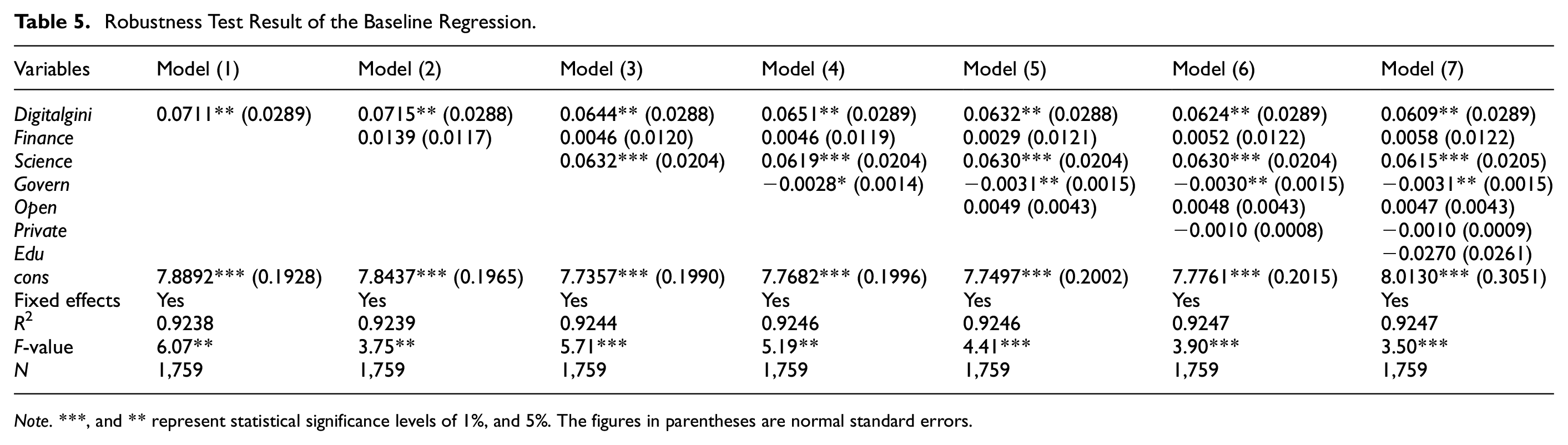
Note. ***, and ** represent statistical significance levels of 1%, and 5%. The figures in parentheses are normal standard errors.
Regression Results for Provincial Data
When measuring the digital economy using data at the prefecture level, the availability of data may limit the comprehensiveness of the indicators used. Therefore, in this section, provincial-level data for China are used to re-examine the baseline regression results and assess their reliability.
Based on data availability, the digital economy in Chinese provinces is divided into 3 primary indicators and 10 secondary indicators, which comprehensively measure the Gini coefficient of the digital economy in various dimensions. The selected indicators are shown in Table 6. The data for Table 6 are sourced from the “China Statistical Yearbook 2012–2021” and the Digital Inclusive Finance Index from Peking University’s Digital Finance Research Center. Similarly, the entropy method is used to calculate the digital economy index, and then the Gini coefficient of the digital economy is calculated based on Equation 7. Subsequently, an OLS regression is conducted, using the provincial-level Gini coefficient of the digital economy as the core explanatory variable to assess the carbon emissions levels in each province while controlling for various provincial-level variables.
Indicators of Evaluation System for the Development Level of Digital Economy (Based on Provincial Data).

Due to the differences in statistical items between the “China Statistical Yearbook” and the “China Urban Statistical Yearbook,” there are changes in the control variables when conducting regressions using provincial-level data. However, the control variables remain consistent with the broad categories used in the baseline regression. The selected control variables in this section are as follows: urbanization rate (City), technological progress level (Inno), human capital level in each region (Hc), road infrastructure (lnfra), policy framework (policy), and per capita regional gross domestic product (lnrgdp).
The regression results in Table 7 show that the Gini coefficient of digital economy has a significant positive impact on carbon dioxide emissions. The estimated coefficient of the core explanatory variable remains consistently positive and significant at the 1% level. This indicates that an increase in the Gini coefficient will significantly increase carbon emissions. According to the regression results from Model (7), an increase of 1% point in the Gini coefficient leads to a 0.1562% increase in carbon emissions. Using provincial-level data reaffirms that an imbalance in digital economy significantly increases carbon emissions levels.
Robust Test Based on Provincial Data.

Note. ***, and ** represent statistical significance levels of 1%, and 5%. The figures in parentheses are normal standard errors.
According to the regression results in Tables 4 and 7, for every 1% point increase in the Gini coefficient of China’s digital economy, the carbon emission level increases by approximately 0.1562% to 0.1721%. This conclusion differs significantly from the current literature. For instance, G. Yang et al. (2023) found that the digital economy has a significant inhibitory effect on carbon emissions, with every 1% increase in the development of the digital economy reducing carbon emissions by 0.0086% to 0.01%. Similarly, Gao and Ding (2024) discovered that the digital economy can reduce carbon emissions per unit of GDP, with every 1% increase in the development of the digital economy lowering carbon emissions per unit of GDP by 0.1385%.
This study is contrary to existing research, primarily due to different views. Most existing studies focus on the role of digital economy, arguing that digital technologies have a positive impact on reducing carbon emissions by improving energy efficiency and promoting green innovation. However, few studies have recognized that the imbalance of digital economy can lead to resource misallocation, which in turn limits the digital economy to drive green growth. There is significant imbalance in digital economy across regions and industries, and this imbalance may result in inefficient industrial distribution and resource allocation, thereby increasing carbon emissions. In regions where the digital economy lags behind, traditional high-energy-consuming industries still dominate, making it difficult to achieve a swift green transition. Conversely, in rapidly developing regions, excessive concentration of resources and energy usage may lead to increased carbon emissions. Therefore, this study highlights the potential negative impact of the imbalance of digital economy on carbon emissions, offering a new perspective and supplement to the existing literature by revealing the complexity of the digital economy’s influence on carbon emissions.
Endogeneity
In the baseline regression, there may be endogeneity between the Gini coefficient of the digital economy and carbon dioxide emissions, potentially due to omitted variables. To address the potential endogeneity problem in the baseline regression, this study employs an instrumental variable approach for correction. Drawing on the research of Zhao et al. (2020), the author selects the product of the fixed telephone quantity per 100 people in each city in 1984 and the lagged one-period internet penetration rate in each city as instrumental variables.
There are several reasons for selecting this instrumental variable. First, the digital economy, as an innovative economic model based on the internet, developed from traditional communication technologies. This study selects the number of fixed telephones in each city in 1984 as a representative variable reflecting the level of telecommunications infrastructure. The number of fixed telephones can indicate the development status of telecommunications infrastructure at that time, which is a crucial foundation for the development of digital economy. T. Liu et al. (2023) mentioned that early telecommunications infrastructure had a significant impact on the flow of information, the emergence of the digital economy, and its development. Hence, historical telecommunications infrastructure development are an important factor influencing the imbalance of digital economy.
Second, the telecommunications infrastructure in 1984 has a minimal direct impact on current carbon emissions. Although telecommunications infrastructure is the basis for the digital economy’s growth, its effect on carbon emissions is mainly realized through the digital economy as an intermediary variable. This aligns with the exogeneity assumption that the instrumental variable affects the endogenous variable but has limited direct influence on the dependent variable. From a temporal perspective, telecommunications technology from 1984 has barely direct connection with today’s industrial and energy consumption, making it more likely to indirectly influence carbon emissions rather than directly drive them.
Third, since the fixed telephone user data from 1984 is cross-sectional and cannot be directly applied to instrumental variable estimation in panel data, this study constructs an instrumental variable by creating an interaction term between the number of fixed telephones per 100 people in each city in 1984 and the lagged one-period internet penetration rate. This method not only captures the regional differences in the digital economy but also effectively adapts to the characteristics of panel data, enabling the instrumental variable to more accurately reflect the level of digital economy development across different times and regions while ensuring its exogeneity in relation to current carbon emissions.
Finally, to enhance the validity of the instrumental variable, statistical tests were conducted, including the Cragg-Donald Wald F statistic in the first-stage regression, to ensure the strength of the instrumental variable. Based on the comprehensive test results and the qualitative discussion of the exogeneity of the above instrumental variable, the authors believe that the selected instrumental variable meets the relevance assumption, thereby strengthening the robustness of the results.
Table 8 presents the results of the instrumental variable (IV) estimation. In the first-stage regression, the impact of the instrumental variable on the primary explanatory variable is significantly positive at the 1% level. This indicates that the establishment of telecommunications infrastructure in each regional context distinctly contributes to subsequent imbalanced development within the digital economy. Furthermore, in the second-stage regression, the Gini coefficient of the digital economy consistently demonstrates a notably positive influence on carbon dioxide emissions, aligning with the baseline regression results presented in Table 4. This reaffirms the idea that divergent digital economic development across various regions in China is associated with an increase in carbon dioxide emissions. Additionally, based on the statistics from the Anderson canonical correlation LM test and the Cragg-Donald Wald F statistic, there is a significant rejection of the hypotheses of instrument nonidentification and weak instruments. This indicates that all instrumental variables are uncorrelated and serve as exogenous robust instruments. Consequently, the IV regression presented in Table 8 is considered both reasonable and effective.
IV Regression Result.

Note.*** represent statistical significance levels of 1%. The figures in parentheses are normal standard errors.
According to the regression results in Table 8, after the IV regression, the impact of Gini coefficient on carbon emissions remains significantly positive, with an estimated coefficient of 0.5479. This indicates that for every 1% point increase in the Gini coefficient, carbon emissions will rise by 0.5479%. After addressing the endogeneity issue, the estimated coefficient of the core explanatory variable has increased. In the previous regressions in Tables 4 and 7, the impact of digital economy’s imbalance on carbon emissions was likely underestimated due to unresolved endogeneity. The imbalance in digital economy leads to industrial disarray, hindering the digital economy’s ability to facilitate green production. Additionally, policies aimed at promoting the digital economy may further exacerbate this imbalance, having an adverse effect on reducing carbon emissions.
Mechanism Analysis
Table 9 offers insights into the mechanisms underlying the relationship between the imbalance of digital economy and the characteristics of the industrial structure. In Model (1), where the focus is on the rationalization of the industrial structure, as per Equation 8, the regression results reveal a concerning trend: greater disparities in the development of the digital economy obstruct progress toward a more rational industrial structure. This suggests that regions grappling with pronounced digital economic imbalances are less likely to witness the desired shifts toward a balanced and optimized industrial structure. In Model (2), which focuses on the advancement level of the industrial structure, the implications are equally profound. Here, the Gini coefficient of the digital economy emerges as a pivotal determinant. The regression insights indicate a palpable and detrimental influence: regions marked by skewed digital economic growth patterns face considerable challenges in advancing and refining their industrial structures. Such findings underscore the intricate interplay between digital economic dynamics and the broader industrial landscape, emphasizing the need for cohesive and balanced development strategies.
Mechanism Regression Results.

Note. ***, and ** represent statistical significance levels of 1%, and 5%. The figures in parentheses are normal standard errors.
An imbalance in the digital economy results in certain regions achieving earlier and more comprehensive progress in digital transformation, while other regions experience relatively delayed digital development. This imbalance in digital transformation development poses challenges for achieving diversified development in industrial structures, gradually constraining the level of industrial sophistication.
First, the excessive concentration of industries related to the digital economy severely limits the ability of other sectors within the region to access necessary resources and support. In regions where the digital economy dominates, industries tied to digital technologies, such as IT services and high-tech manufacturing, often monopolize resources, leading to an imbalanced industrial structure. This resource allocation inequality causes other industries to struggle for investment, talent, and infrastructure, ultimately stifling their growth. Such an industrial singularity restricts regional economic diversification, impeding the advanced development of a more balanced and sophisticated industrial ecosystem. A diversified industrial structure, which promotes synergies between sectors and fosters innovation across the value chain, is essential for sustainable economic growth. Over-reliance on the digital economy in certain regions therefore obstructs this path by reinforcing a narrow industrial base, which undermines the capacity for dynamic, long-term development.
Furthermore, in digitally underdeveloped regions, the lack of advanced digital infrastructure and innovation exacerbates the challenges faced by traditional industries in reducing carbon emissions. These regions, often characterized by outdated technology and inefficient production methods, are unable to capitalize on the benefits of digital innovation for green development. As a result, traditional high-carbon-emission industries continue to dominate, without the digital tools necessary to transition toward greener practices. This technological lag further entrenches carbon-intensive practices, thereby impeding the region’s ability to reduce emissions and progress toward a low-carbon future. Consequently, the imbalance in digital economy development across regions limits the potential for industrial upgrades, directly contributing to increased carbon emission levels.
The regression in Model (3) of Table 9 examines the relationship between the Gini coefficient of digital economy and GTFP as the dependent variable. Based on the regression results, we observe a significant inhibitory effect of the Gini coefficient on green TFP, with a coefficient of −0.1265. According to the results of Model (3), the imbalance of digital economy has a restraining effect on green development, which indirectly reflects its negative impact on carbon emissions reduction. Therefore, we can conclude that the regression results of Model (3) provide evidence in support of H3.
The regression in Model (4) of Table 9 examines the interaction between the Broadband China policy and the Gini coefficient to investigate whether the Broadband China policy can affect carbon emissions by adjusting the imbalance of digital economy. The Broadband China policy has been implemented gradually in cities across China since 2014. Its aim is to strengthen the digital infrastructure construction in each city, providing a broader platform for the development of the digital economy. However, it is worth noting that the policy involves further infrastructure investment in addition to the existing digital infrastructure in each region. Considering the differences in economic development level and human capital among cities, the policy may further increase the imbalance of digital economy, widening the disparity in the scale of digital economy between cities. Ultimately, this may be detrimental to reducing carbon emissions. According to the regression results of Model (4) in Table 9, the Broadband China policy plays a positive moderating role between the Gini coefficient and carbon emissions. The regression results of Model (4) validate H4.
Conclusion and Policy Implications
Conclusion
This study examines how the imbalance in China’s digital economy development influences carbon emissions through the lenses of industrial structure, green productivity, and the Broadband China strategy. The findings indicate that this imbalance hinders the rationalization and advanced development of industrial structures, contributing to increased carbon emissions. Additionally, the uneven development of the digital economy also suppresses carbon emissions by limiting green productivity. Moreover, the implementation of the Broadband China policy exacerbates the effect of imbalanced digital economy development on rising carbon emissions.
Overall, the imbalance in the development of the digital economy has contributed to increased carbon emissions, negatively impacting China’s carbon neutrality goals. This study, using unbalanced panel data from 256 cities in China between 2011 and 2019, analyzes how the uneven development of the digital economy influences carbon emissions, and explores the underlying mechanisms. The findings show that greater regional disparities in digital economy development are associated with higher carbon dioxide emissions. After conducting robustness tests, the study confirms that the imbalanced development of the digital economy continues to significantly increase carbon emissions. Mechanism analysis reveals that this imbalance affects emissions through its impact on industrial structure and green productivity. Additionally, the Broadband China policy amplifies the effect of the imbalanced digital economy on increasing carbon emissions.
Policy Implications
(1) Promote Regional Coordination and Balance Digital Economy Resource Allocation: The government should strengthen efforts to promote coordinated regional development by ensuring more equitable distribution of digital economy resources across different regions. This could involve increasing investments in digital infrastructure in less-developed areas and implementing targeted support policies that foster the growth of the digital economy in underrepresented regions. By narrowing the development gap between regions, this approach would help mitigate the negative effects of imbalanced digital growth on carbon emissions.
(2) Encourage Industrial Upgrading and Digital Integration for Green Transition: Policymakers should promote the integration of advanced digital technologies into traditional industries to encourage industrial upgrading. This includes incentivizing the adoption of green technologies and practices through tax benefits, subsidies, or low-interest loans for companies that implement digital solutions aimed at improving energy efficiency and reducing emissions. Strengthening the digital economy’s role in driving the green transformation of industries would contribute to reducing carbon emissions while enhancing productivity.
(3) Enhance Green Productivity through Digital Innovation: To combat the suppressive effect of digital economy imbalances on green productivity, it is essential to boost innovation in green technologies, particularly in regions where digital development lags. Government-led initiatives and public-private partnerships could be launched to support research and development in energy-saving technologies and green practices. At the same time, expanding digital access and training in environmentally-friendly technology applications would raise green productivity and foster sustainable growth.
(4) Strengthen the Role of Relevant Strategy in Supporting Low-Carbon Development: The implementation of the relevant digital strategy should be refined to support carbon neutrality objectives. In particular, policies that prioritize green digital infrastructure, such as energy-efficient data centers and low-carbon network technologies, should be emphasized. Furthermore, regulatory frameworks should be updated to ensure that digital expansion efforts under the Broadband China strategy do not inadvertently exacerbate carbon emissions. This would require integrating environmental impact assessments into digital economy initiatives at all levels.
(5) Strengthen Policy Monitoring and Evaluation Mechanisms: A comprehensive system for monitoring and evaluating the environmental impact of digital economy development should be established to ensure that policies aimed at balancing regional digital growth are effective. This includes setting up robust data collection mechanisms to track carbon emissions in relation to digital economy activities and conducting regular policy assessments to make necessary adjustments. By maintaining oversight, the government can better manage the intersection of digital and green growth, ensuring that imbalanced development does not undermine carbon reduction efforts.
Footnotes
Acknowledgements
We appreciate the editors and anonymous reviewers for their efforts and valuable comments on this paper.

Author Contributions
Conceptualization, T.L.; Data curation, T.L., and M.L.; Formal analysis, T.L.; Investigation, T.L., and D.X.; Methodology, T.L.; Resources, T.L.; Software, T.L., and X.H.; Supervision, M.L.; Validation, T.L. and D.X.; Visualization, T.L., and X.H.; Writing—original draft, T.L.; Writing—review & editing, T.L., X.H., D.X., and M.L. All authors have read and agreed to the published version of the manuscript.
Funding
The author(s) disclosed receipt of the following financial support for the research, authorship, and/or publication of this article: This work is financially by Postgraduate Cultivating Innovation and Quality Improvement Action Plan of Henan University (Grant No. SYLYC2022209).
Declaration of Conflicting Interests
The author(s) declared no potential conflicts of interest with respect to the research, authorship, and/or publication of this article.
Data Availability Statement
The datasets generated during and/or analyzed during the current study are available from the corresponding author on reasonable request.