



Abstract
Since AI Chatbots are increasingly adopted in different industries, the purpose of this paper is to examine the influence of AI Chatbots on pro-environment attitudes and willingness to pay for environmental protection. By employing quantitative methodology, multivariate data analysis was conducted to test the effects of AI Chatbot in terms of its interaction, anonymity, customization, and problem-solving on pro-environmental attitudes and individual willingness to pay for environment protection. This study reveals the critical role of Chatbots in encouraging people to protect the environment. Problem-solving is found to be the highest influence on both pro-environmental attitudes and individual willingness to pay. Meanwhile, interaction, anonymity, and customization were revealed to affect WTP indirectly through pro-environmental attitudes. Therefore, digitalization by exploring new technology like AI Chatbots becomes an important concern to reduce the negative actions of humans on the environment and Carbon emissions and develop agricultural tourism activities toward green production.
Plain language summary
AI Chatbots are increasingly well-defined research subjects in different contexts, but the implementation of Chatbots in preserving the natural environment is still in the early stages of development. This study aims to examine the impact of AI Chatbots on pro-environment attitudes and willingness to pay for environmental protection. By employing quantitative methodology, this study conducted Multivariate data analysis to investigate the effects of four Chatbot dimensions (interaction, anonymity, customization, and problem-solving) on pro-environmental attitudes and individual willingness to pay for nature conservation. This study reveals the critical role of Chatbots in encouraging people to protect the environment. Problem-solving is found to be the highest influence on both pro-environmental attitudes and individual willingness to pay for nature conservation. Meanwhile, interaction, anonymity, and customization were revealed to affect WTP indirectly through pro-environmental attitudes. Therefore, digitalization by exploring new technology like AI Chatbot becomes an important concern to reduce the negative actions of humans on the environment and Carbon emissions and develop agricultural tourism activities toward green production.
Keywords
Introduction
Agricultural tourism (agritourism) is one kind of rural tourism based on exploiting the resources in the countryside (Phillip et al., 2010). Agritourism is complex and different from other types of tourism because of its effects on socio-economics and landscape (Lupi et al., 2017; Nam et al., 2020). It becomes a key factor for local development (Baipai et al., 2023; Nguyen, 2021). However, rural tourism can create positive and negative impacts on the natural environment (J. Chen et al., 2023; Lee et al., 2019). Several destinations are threatened by increasing pollution, environmental hazards, damage to heritage sites, and overuse of resources. Therefore, research on individuals’ pro-environment attitudes and willingness to pay for environmental protection becomes urgent.
With the development of information technology, several developed countries have adopted new technology to protect the natural environment and promote rural development (Billig et al., 2022; Chi & Hoang Vu, 2023; Guo et al., 2022). Chatbot is an emerging technology for increasing the users’ environment knowledge (Kan et al., 2020; Verma, 2018). Several prior scholars have demonstrated the role of Chatbot application in different perspectives. For example, Buhalis and Cheng (2020) addressed the benefits of using Chatbot in hospitality industry while Chi (2022) focuses on the critical role of AI Chatbots on increasing individuals’ motivation on nature conservation. These previous studies examine the technology built for AI Chatbot systems and the effects of AI Chatbot on individual behaviors in different areas. Unfortunately, regarding environment protection, there is an unclear question about the role of AI Chatbot on customers’ willingness to pay when they engage in agricultural tourism activities. Consequently, a significant concern is understanding how AI Chatbot affects individuals’ pro-environment attitude and willingness to pay for environmental protection.
Vietnam is selected as an empirical context in this study. As a developing country, the Vietnamese government understands the importance and effectiveness of AI Chatbots to save costs in responding to the Covid-19 pandemic. By assessing the appropriateness of deploying IT applications in epidemic prevention, Vietnam can become a reference model for other countries in the Asia-Pacific region (Chi et al., 2021; Kosowicz et al., 2023; Nam et al., 2023; Vu et al., 2023; Vu & Nguyen, 2022). The Institute of Information & Communications Strategy has collaborated with the KDDI Foundation (Japan) in developing the chatbot system. Currently, the chatbot platform is 100% complete with a virtual assistant capable of recognizing context, understanding Vietnamese language, and having conversational capabilities (Dat, 2023). The open-source-based system is compatible with popular messaging channels such as Facebook Messenger, Telegram, Slack. This chatbot platform can also support many different languages in analyzing and processing conversation contexts (Dat, 2023). In recent years, agricultural and rural tourism has developed strongly; agricultural tourism activities have been formed in several destinations, promoting their effectiveness and becoming a destination that attracts the attention of tourists (Trung, 2023). Otherwise, the Vietnamese government has regulations to protect and sustainably develop critical natural ecosystems. Therefore, it is necessary to find different alternatives to maintain and build ecosystem to adapt to climate change and improve the effectiveness of management and public awareness of environment protection.
Against this background, this study aims to explore the impact of AI Chatbot on individuals’ pro-environment attitudes and willingness to pay for environment protection. This study employed covariance-based structural equation modeling (CB-SEM) to investigate the impact of AI Chatbot. The empirical findings of this research stated that (1) Chatbot dimensions (interaction, customization, anonymity, and problem-solving) play a crucial role in leading a pro-environmental attitude, which in turn makes individuals willing to pay for environment protection; (2) problem-solving is revealed to be the most critical determinant in individuals’ WTP; (3) recommendations are proposed to relevant parties (government and policy-makers) to seek for understanding the vital role of Chatbots on encouraging individual for environment protection.
Literature Review and Hypothesis Development
Chatbot and Environment Protection
With the development of information technology (IT), citizens, enterprises, and governments in many countries worldwide are forced to move to the online world to connect with their working lives and increase environmental concerns successfully (Doan et al., 2022). Some prior studies have found the association between Chatbot and environment protection. Hillebrand and Johannsen (2021) studied the impact of Chatbot on pro-environment behavior and revealed that Chatbot is a vital technology for promoting individuals’ behavior toward environment protection. Furthermore, Chatbot is also an instrument for changing individuals’ motivation into their intention to protect the natural environment (Chi, 2022). Kan et al. (2020) examined the role of Chatbot in monitoring air quality. However, investigating the impacts of Chatbot on pro-environment attitudes and willingness to pay for environmental protection is still scant.
Figure 1 shows the progress of automated AI Chatbot in contacting individuals and providing information for service providers and environment authorities. Chatbot generates a natural response to user text input (6). Through this diagram, AI Chatbot can learn from each interaction and improve their behaviors, developing the answer toward environmental protection. Hence, AI Chatbot can encourage individuals (who have pro-environment attitudes) for willingness to pay for environmental protection (Jadczyk et al., 2021). Figure 1 also shows the security of using Chatbot, which presents that the AI Chatbot system can prevent hackers from accessing chat interfaces.

AI Chatbot system (Jadczyk et al., 2021).
Åberg (2017) conducted an experiment on individuals’ consumption behavior toward environment protection. He found that Chatbot provides users with clear information (Figure 2).

The conversation flow of using Chatbot (Åberg, 2017).
Pro-Environmental Attitude and Willingness to Pay for Environment Protection
According to, “Attitude is a psychological tendency expressed by evaluating a particular entity with some degree of favor or disfavor.” Ajzen and Fishbein (2000) defined attitude as “beliefs and feelings about an object that causes one to behave consistently toward the object.” Regarding the environmental context, a pro-environmental attitude refers to “the stability of an individual toward environmental issues” (Tao et al., 2004, p. 34). Yilmaz and Anasori (2022) show a pro-environmental attitude relating to individual feelings about “the protection and conservation of the environment and nature in general.”
Initially, Oliver and Swan (1989) suggested that “intention is considered as people’s intended or expected future behavior.” Intention “presents the expectations of a kind of behavior and may be operated as the ability to act. Willingness to pay a premium (WTP) basically is referred to an amount or cost that an individual intends to commit for a designated improvement or compensation” (Ramdas & Mohamed, 2014). They also viewed WTP as the tendency for an individual to act in monetary terms to acquire the quality of services or products. Some researchers also suggest WTP as stakeholders’ willingness to pay an amount to protect the environment (Chi, 2022). In this study, WTP is considered as an amount that an individual intends to contribute to protect the environment at agricultural tourism places.
Hypothesis Development
Burgess (1982, p. 50) stated that tourism “should be understood as a social relationship characterized by the friendly, welcoming and warm behavior of the hosts to the customers.” It can be noted that service quality depends on the interaction between individuals and providers, the process quality, the way of problem-solving, and the providers’ ability to create a pleasant and relaxing environment (Blain & Lashley, 2014). Quality of service no longer depends on the result of the physical service encounters but mostly depends on “facility design” and “in-room technologies” (Kandampully et al., 2018). The findings of Johansson and Naslund’s (2009) study about cruise ships further confirmed the impact of AI-based Chatbots on service quality. Additionally, Entry-level Chatbots can be deployed in most tourism agents to answer FAQs and simple everyday questions, leading to improved customer service. From these perspectives, Chatbot e-service can help agents improve their communication quality with individuals and encourage them to protect the environment and ecosystem at national parks. “User interaction suggests the user based up on” (Swearingen & Sinha, 2002).
Another previous research argues that IT interaction is a factor in explaining and predicting consumers’ behavior (Jumaan et al., 2020). The individual interaction with technology influences their intention to use the service (Agarwal & Karahanna, 2000). Consumers are undoubtedly motivated to buy products or services from their interaction with the IT system of the purchaser (Van der Heijden, 2004). Hoffman and Novak (Hoffman & Novak, 2009) suggested that user-IT interaction contributes to their willingness to pay for service. Based on these previous findings, this study proposes that user who interacts with Chatbots in traveling to national parks will have a pro-environment attitude and be willing to pay for nature conservation. Hence, the hypotheses are following:
According to Lowry et al. (2009), anonymity becomes a critical concern for individuals engage in a certain kind of services. Anonymity increases person’s motivations for making purchase (Dennis et al., 2001) and make individuals form thinking and intention following the right direction under Chatbot comments (Vance et al., 2017). Therefore, in term of environment protection, AI Chatbot anonymity can suggest individuals having the right actions in the natural conservation. There is little research currently demonstrated the link between AI Chatbot and individual behaviors for environment protection. One of the limited research is Chi’s (2022) study about the role of AI Chatbot on transforming tourist motivations into their intention for nature conservation. From this respect, this study proposes that AI Chatbot anonymity has linkages with individuals’ pro-environment attitude and their willingness to pay for environment protection. The hypotheses are:
Following the suggestion of Haas and Kenning (2014), customization not only provides the accurate information and contents about a specific service through communicating with customers but also support organizations adapting to individual’s references. Other scholars, Vos (2009), Emmers-Sommer (2004), the customization of e-service agents improves the communication with users through time-saving and providing the accurate contents under the users’ demands. Once customers receive complete information and suggestions about something, they will have a positive attitude and be willing to pay for that service (Jiang et al., 2023). Chatbots can collect and analyze user data by interests, geography, occupation, income, and interests to help organizations have the most complete customer information (Zumstein & Hundertmark, 2017). Furthermore, since the role of customization is to create and maintain a significant difference and uniqueness in organization’s servicers, this may include providing higher quality, unique features, better customer service, added value or more advanced technology (X. Wang et al., 2022). Therefore, customization push users to pay for a service. This study suggests that AI Chatbot customization has linkages with individuals’ pro-environment attitude and willingness to pay for environment protection. The hypotheses are:
Problem solving is the use of logical thinking and imagination to understand the problem, thereby providing the optimal solution in any given situation (Weisberg, 2006). Krishnan et al. (2022) revealed that AI Chatbot handles arising issues quickly. Chatbot is a technology, so AI Chatbots are not afraid of the unknown issues and the difficulties in its processing (Kizza, 2023). Chatbots can provide information and guidance on policies and procedures, as well as answer questions and resolve problems (Nuruzzaman & Hussain, 2018). Besides, Ngai et al. (2021) stated that AI Chatbot can replace humans in answering users’ messages and questions through a set of pre-installed questions or robot intelligence, similar to humans chatting with each other. Subudhi (2019) also confirmed that Chatbots have the ability to self-learn from real conversations with users to become smarter over time. Since natural language processing (NLP) technology helps Chatbot AI understand the intention of the user’s statements and provide accurate responses, AI Chatbot understands and responds flexibly to the user (Pandey et al., 2022). Therefore, in terms of agri-tourism activities, providers use AI Chatbot to increase tourist attitude toward environment knowledge and suggest them to pay for the natural conservation. From these perspectives, this study proposes that AI Chatbot problem-solving forms the positive users’ pro-environment attitude and make them willing to pay for environment protection. The hypotheses are:
From the previous research, this study proposes a framework to examine the impact of AI Chatbot on individuals’ pro-environment attitudes and their willingness to pay for environment protection at agricultural tourism destinations (Figure 3).

The proposed framework.
Research Method
Scale of Measurement and Sampling Method
This study employs the measurement scale of the six proposed constructs from prior studies which have been validated. Five items of interaction were validated from the study of Chung et al. (2020) and Y. J. Kang and Lee (2015) while four items of anonymity were explored from the study of Vance et al. (2017). Five items of customization and four items of problem-solving were adapted from Chung et al. (2020). Meanwhile, four items of the pro-environment attitude were explored from the finding of Chi (2022). Willingness to pay for environment protection was captured using three items adapted from Casidy and Wymer (2016) .
A structured questionnaire was used to collect information for the study. The sampling participant is domestic tourist who engage in agricultural tourism activities and have used Chatbot for checking destinations and finding contents relating to agri-tourism. The sample size was determined by using a “95% confidence interval and ±0.05 sampling error” as suggestion of The formulation is calculated under the total number of tourists (85 million people in 2020) (Dang Cong San Viet Nam, 2020).

The eight trained research assistants were employed in this project. The 560 questionnaires were distributed to Vietnamese tourists. The participants were directly contacted and kindly asked to participate in the survey from November 2021 to January 2022. This study follows proper ethical procedure by ensuring that all the answers of participants will be kept confidential. The questionnaires and the name of respondents were anonymous. This study obtained 405 valid responses which represented 72.32%. For respondents’ information, 41% responses were male while 59% were female. When it comes to age of respondents, 66.6% were from 21 to 40 year-olds with full-time staff position having university degree.
Data Analysis
Data screening and cleaning were conducted to perform the multivariate analysis by assessing missing data, outliers, multicollinearity, and normality. This study employed SPSS AMOS 26 to analyze data. Firstly, the confirmatory factor analysis (CFA) was conducted to test the reliability and validity of the proposed scale of measurement. Secondly, the covariance based structural equation modeling (CB-SEM) was used to test the proposed hypotheses.
Research Results
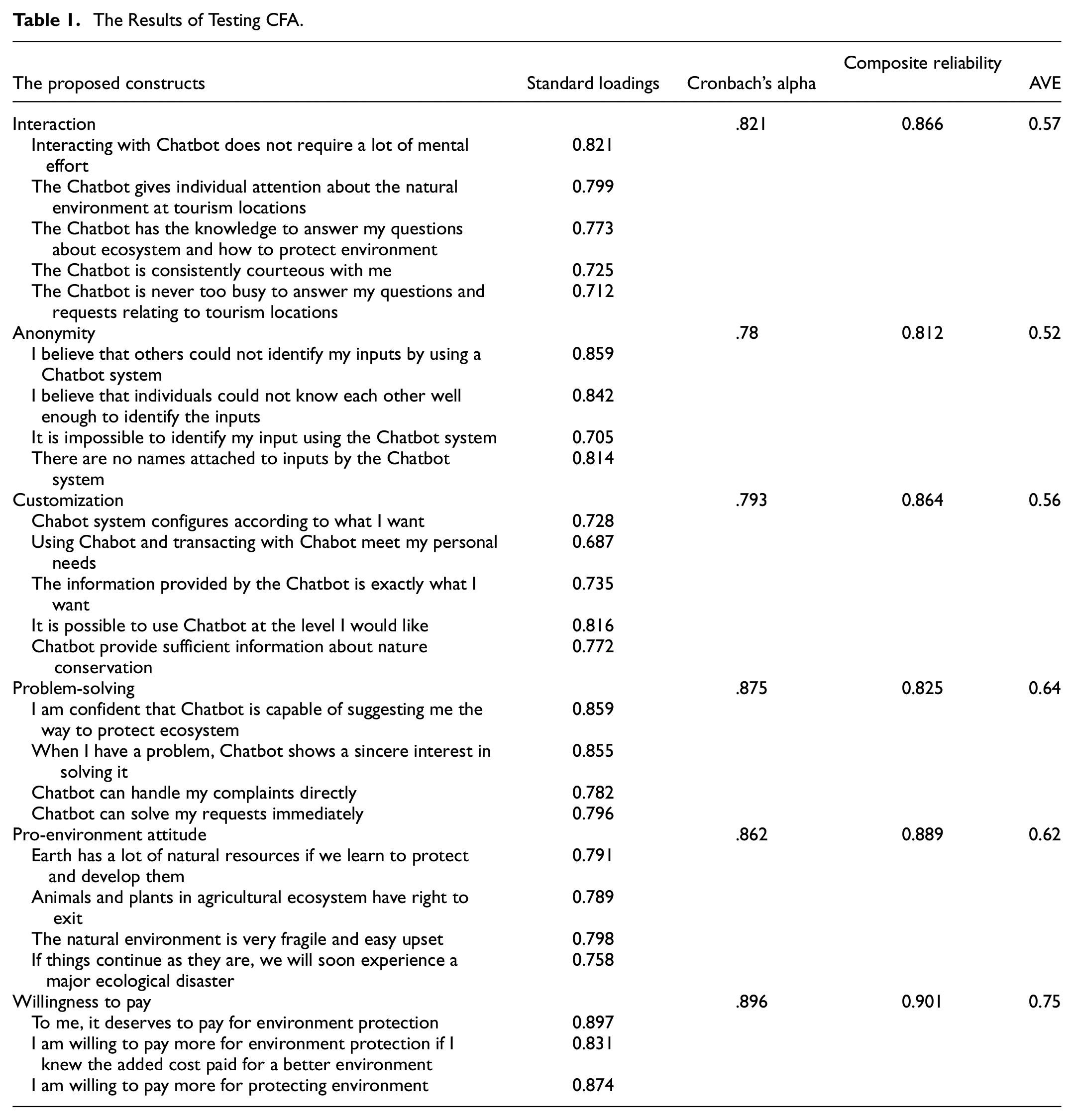
Table 1 presents that the range of loadings of five constructs is higher than 0.65 while Cronbach’s Alpha is higher than .7, and the average variance extracted of all variables is higher than 50%. These indicators are acceptable under the suggestion of Hair et al. (2010) and Furthermore, the model fit is achieved: χ2/df = 3.108 and a root mean square error of approximation (RMSEA) = 0.041, Comparative Fix Index (CFI) = 0.928, goodness of fix index (GFI) = 0.936, and incremental fit indices (IFI) = 0.928. Therefore, Tables 1 and 2 confirm the reliability and validity of the constructs.
The Results of Testing CFA.
Mean, SD, and Discriminant Validity.

Note. CB-SEM was conducted to test seven proposed hypotheses. The theoretical model fits well with the data withχ2/df = 3.336; CFI = 0.928; TLI = 0.903; IFI = 0.916; RMSEA = 0.051. The proposed hypotheses (H1a, H2a, H3a, H3b, H4a, and H5) were accepted while other hypotheses (H1b, H2b, and H3b) were unaccepted (Table 3). INT = interaction; ANO = anonymity; CUS = customization; PRO = problem-solving; COM = communication quality; WTP = willingness to pay for nature conservation.
Direct Effect Testing Results.

p < .001. **p < .01.
Interaction, anonymity, customization, and problem-solving have the positive effects on pro-environmental attitudes. Problem-solving has the highest impact (0.427) on pro-environmental attitudes, followed by interaction (0.402) and customization (0.344), while anonymity has the lowest effect (0.305) than the others. Meanwhile, only problem-solving has a positively direct influence on individuals’ willingness to pay for environment protection (0.346), while interaction, anonymity, and customization do not have a direct impact (p > .05).
Table 4 shows that four constructs (interaction, anonymity, customization, and problem-solving) have indirectly linked with individuals’ willingness to pay for nature conservation. The indirect effect of customization of Chatbot on WTP has the highest (0.109), followed by problem-solving (0.083), interaction (0.071), and anonymity (0.066). Hence, the total effect of problem-solving on WTP is the highest than the others (0.429).
The Total Effect Coefficients.

Finally, the control effects in hypothesis testing were examined. Table 5 showed that gender, age, and income do not have a significant impact on WTP (p > .05) and also presented that these variables do not affect the paper’s interpretation of the result.
The Results of Control Effects.

Note.χ2/df = 2.942; CFI = 0.915; IFI = 0.911; RMSEA = 0.062.
Discussion
The findings of this study reveal that AI Chatbot has significantly impacted individuals’ willingness to pay for environmental protection. Problem-solving has the highest impact on both pro-environmental attitudes and WTP. First, the association between problem-solving and willingness to pay is consistent with the study of Buhalis and Sinarta (2019). They argued that Chatbot services ensure high-quality customer communication by solving their problems. The positive effect of problem-solving on WTP was also found which is similar to prior research in IT system (Ivanov & Webster, 2018; Kuo et al., 2017). When individuals’ questions and problems are handled, they are certainly willing to pay for environment protection.
Secondly, this study also found that interaction positively impacts pro-environmental attitudes. This result is consistent with the finding of Jumaan et al. (2020). Nevertheless, the result does not focus on the impact of interaction on individuals’ WTP, which is not in line with the research on IS by Van der Heijden (2004) and Hoffman and Novak (2009). The reason is perhaps because of a lack of customer belief in Chatbot systems in developing countries, like Vietnam since the IT infrastructure in developing countries is not as good as in developed countries. Therefore, most customers in developing countries are not strong enough to take actual action by paying costs for environmental protection only by interacting with Chatbot. They may be willing to pay to protect the environment as soon as they receive high-quality communication and trust the Chatbot.
The third critical finding reveals that anonymity positively impacts pro-environmental attitudes but does not impact individuals’ willingness to pay for nature conservation. The effect of anonymity on pro-environment attitudes is similar to the suggestion of Alonzo and Aiken (2004). However, anonymity does not affect individuals’ WTP which differs from the study of Appel et al. (2014). They focused on the link between AI Chatbot anonymity and users’ intentions. People tend to be more aware of their actions to protect the environment and ecosystems. This may be a reason why anonymity is not a factor promoting tourists’ willingness to pay for environment protection.
Finally, customization is seen as a factor having positively impact on pro-environmental attitudes, which aligns with Vos (2009) findings. He suggested that individuals will have a good attitude toward the environment because of its time-saving and accurate contents. The study’s result also find that customization has no direct effect on individuals’ willingness to pay for environment protection.
Theoretical and Managerial Implications
The findings of this study propose four significant contributions to the literature. First, interaction, customization, anonymity, and problem-solving are important factors in leading pro-environmental attitudes between individuals and tourism agents who provide agricultural tourism activities. Second, this paper demonstrates the influences of the four dimensions of AI Chatbot system on pro-environmental attitude, which motivate individuals willing to pay for environment protection. Out of the four dimensions, the problem-solving of AI Chatbot plays a more critical role than the other three. This study highlights that domestic tourists tend to pay for environment protection if their questions or requests were satisfyingly handled through AI Chatbot. The third highlight is that Chatbot system is a good solution for tourism providers, policy-makers, and the government to send the message of nature conservation and encourage individuals to protect the environment and ecosystem. Finally, this study also finds the indirect effect of Chatbot system on individuals’ willingness to pay for nature conservation. This research opens new horizons in the application of AI Chatbot to develop rural areas toward environmental protection and sustainable development.
For practical implications, this study recommends threefolds as follows:
This study recommends relevant parties (i.e., government, policy-makers, and tourism providers) to understand the critical role of Chatbots in encouraging individuals to environment protection.
Agri-tourism service providers should implement digital transformation through AI Chatbot applications. Travel marketers should ensure that when using AI Chatbot, the interaction information is accurate and trustworthy. Information about nature protection must be complete, clear, and convincing so that individuals are motivated not to damage the environment and are motivated to protect the ecosystem.
The government should provide a roadmap for applying technology, especially AI Chatbot, in tourism and agriculture as well as other industries, to transition the economy to low-carbon growth, circular economic development, and sustainable development. to environmental costs in development investment.
Tourism providers, marketers, and the government need to be aware of the role of Chatbots so that they can better explore Chatbots to reduce the negative actions of humans on the environment.
However, this study still remains several limitations. First, this research only found these four dimensions of AI Chatbot, but some studies have found other dimensions affecting individual behavior. Hence, future research can explore other dimensions to fully explore the role of AI Chatbot in raising individual environment concern. Second, the measurement of the dependent variables in this study is based on the premise that AI Chatbot has not been widely promoted in the environment protection, so the changes in agricultural tourism before and after the whole public participation in AI Chatbot have not been reflected. The follow-up can focus on multi time longitudinal data research to explore the dynamic impact of AI Chatbot on individual’s behavior toward environment protection.
Footnotes
Acknowledgements
The author gratefully acknowledges the sponsor of Foreign Trade University, Hanoi, Vietnam under the Research Program Number FTURP02-2023-14.
Credit Authorship Contribution Statement
Nguyen Thi Khanh Chi is the only author of this manuscript, which includes the Introduction, Conceptualization, Methodology, data collection, data analysis, Formal analysis, Resources, Writing an Original Draft, Writing a Review, and Editing.
Declaration of Conflicting Interests
The author(s) declared no potential conflicts of interest with respect to the research, authorship, and/or publication of this article.
Funding
The author(s) disclosed receipt of the following financial support for the research, authorship, and/or publication of this article: This research is sponsored by Foreign Trade University under Research Program number FTURP02-2023-14.
Author Declaration
I wish to draw the attention of the Editor to the following facts that there is no conflict of interest exists. I also confirm that I have given due consideration to the protection of intellectual property associated with this work and that there are no impediments to publication, including the timing of publication, with respect to intellectual property. In so doing, I confirm that I have followed the regulations of our institutions concerning intellectual property.

Data Availability Statement
Data sharing does not apply to this article as data is belonging to the security conditions of the sponsors.