




Abstract
The digital economy is an important driving force for China’s economic transformation and upgrading, while “carbon peaking and carbon neutrality” is the goal to be achieved in China. Based on the panel data of 30 Chinese provinces (cities and districts) from 2012 to 2019, the article empirically investigates the impact of the digital economy on regional carbon emissions and its mechanism of action by using a two-way fixed-effects model and mediated-effects model. The study shows that, firstly, the digital economy has a significant carbon emission reduction effect, and the conclusion still holds after robustness testing. Secondly, the emission reduction effect of industry digitization in the digital economy dimension is the most obvious. Again, the carbon emission reduction effect of digital economy development on different regions varies, with the strongest carbon emission reduction effect on western regions and regions with high carbon emission levels. Finally, the analysis of mediating effects shows that the energy structure is an important mechanism for the digital economy to suppress regional carbon emissions. The findings of the study provide a feasible path and policy reference for the digital economy to contribute to the goal of “carbon peaking and carbon neutrality.”
Plain Language Summary
Global warming caused by carbon dioxide and other greenhouse gases has become the focus of global attention, and China, as the world’s largest emitter of carbon dioxide, has actively set carbon emission reduction targets. Meanwhile, at this stage, the digital economy has become an important driving force for China’s future high-quality economic development, and it is of great practical significance to explore whether the digital economy can contribute to carbon emission reduction. Therefore, based on the provincial panel data from 2012 to 2019, this paper firstly confirms that the digital economy can reduce regional carbon emissions in a more systematic way using a two-way fixed-effects model, and the conclusion that the digital economy has a significant carbon emission reduction effect still holds after passing a series of robustness tests. Secondly, to investigate the effect of three different dimensions of the digital economy on carbon emissions, a heterogeneity analysis of the digital economy reveals that digital infrastructure, digital industrialization, and industrial digitization all have significant negative effects on carbon emissions, and the effect of industrial digitization is the most obvious, followed by the effect of digital infrastructure, and the effect of digital industrialization is the weakest. Then, to investigate the carbon emission reduction pattern of the digital economy under different carbon emission levels, quantile regression was conducted, and the regression results found that the higher the carbon emission level, the more obvious the inhibitory effect of the digital economy on carbon emission. Then, to investigate the carbon emission reduction effect of the digital economy in different regions of China, the regional heterogeneity analysis was conducted in the eastern, central, and western regions of China, and it was found that both the eastern and western regions can promote carbon emission reduction, but the western region has the most obvious role in promoting carbon emission reduction. Finally, to investigate whether energy structure can play a mediating role in the impact of the digital economy on carbon emissions, the energy structure was included in the regression analysis, and the results showed that the digital economy can reduce the share of coal and thus reduce carbon emissions by improving the energy structure.
Introduction
According to the climate detection and attribution analysis, a large amount of greenhouse gas emissions, such as carbon dioxide, have been the main cause of global warming in the past 100 year. Establishing a low-carbon economy is the consensus to solve the global warming problem, which is the main path to reducing the concentration of greenhouse gases and reduce carbon dioxide emissions, and the most common indicator to measure the quality of the environment is carbon dioxide emissions (Liu, Murshed et al., 2021). According to the UK Tyndall Center for Climate Change Research, China has been the world’s highest emitter of carbon dioxide since 2011 (Liu, Wahab, et al., 2021). 2019 China’s total carbon emissions not only ranked first in the world with a global share of 28.8%, but the volume is also quite impressive. As shown in Figure 1, China’s total carbon dioxide emissions are already close to the sum of four countries, the United States, India, Russia, and Japan, and these four countries are the remaining four countries in the top five of global carbon emissions in addition to China, which shows the great pressure on China to reduce carbon emissions in the future. Because of this, China, as a strong supporter and implementer of the Paris Agreement, has set a series of goals to achieve carbon emission reduction: peak carbon emissions by 2030 and net zero carbon emissions by 2060 (referred to as “carbon peaking and carbon neutrality” goals). This means that China’s carbon reduction curve will be steeper than that of Western countries, and China will make greater efforts to reduce carbon emissions. There is a long-term causal link between China’s economic growth and CO2 emissions, and economic growth is an important variable in predicting China’s CO2 emissions (Kirikkaleli, 2020). Although China’s economic development has entered a “new normal” phase, it is still growing at a medium to a high rate. China is experiencing industrialization and urbanization characterized by high energy consumption, and the development of industrialization and urbanization means that China’s dependence on energy will continue for a long time (Shi et al., 2018). This means that China will also face long-term pressure to reduce carbon emissions. Therefore, it is important to investigate the factors influencing carbon emission reduction in China.

Top 10 countries with global CO2 emissions in 2019 (in million tons).
It is worth noting that the digital economy has become the new “engine” of China’s high-quality economic development. According to the China Digital Economy White Paper (2021), China’s digital economy reached RMB 39.2 trillion in 2020, accounting for 38.6% of GDP, and this trend will continue in the future. In other countries around the world, information and communication technology (ICT) in the digital economy can compress manufacturing expenditures, improve resource allocation efficiency to reduce carbon emissions, and also reduce carbon emissions through smart applications, energy efficiency, etc (Ramzan et al., 2022). Economic growth has a positive and significant impact on the development of renewable energy (Samour et al., 2022). Non-fossil renewable energy sources such as solar, wind, hydro, geothermal, biomass, etc. are critical to the improvement of environmental quality in both the long and short term (Ali et al., 2022). The consumption of non-renewable fossil energy such as coal is the main source of carbon dioxide emissions, and renewable energy is a green low-carbon energy source. Increasing the consumption share of renewable energy and reducing the consumption share of fossil energy such as coal is essential to reduce carbon dioxide emissions (Usman & Makhdum, 2021). Different countries have different social stages and economic development, so can China’s growing digital economy reduce CO2 emissions at this stage in the situation? If so, can the digital economy, as one of the main engines driving China’s high-quality economic development, reduce CO2 emissions by improving the energy consumption structure and reducing the share of consumption of fossil energy such as coal? And what are the patterns and characteristics of the impact of China’s digital economy on carbon emissions? The answers to these questions will help to comprehensively assess the driving role of China’s digital economy in reducing carbon emissions and provide effective policy insights for achieving the goal of “carbon peaking and carbon neutrality”.
In summary, it is crucial to clarify the role of the digital economy in reducing carbon emissions to achieve China’s “carbon peaking and carbon neutrality” goals, and since China is the world’s largest energy consumer, this study also introduces the energy structure as a mechanism variable to investigate whether the digital economy can reduce carbon emissions by improving the energy structure. This study provides three main contributions to the existing empirical literature. First, most of the existing literature does not consider the carbon dioxide produced by non-carbon combustion materials during the production process. In this paper, we calculate carbon dioxide emissions by calculating the carbon dioxide produced by cement during the production process in addition to the carbon dioxide produced by various fossil energy consumption, which makes the carbon dioxide estimation results more accurate. Secondly, this paper also constructs a system of indicators to measure the digital economy, which may provide some reference for subsequent scholars to study the digital economy. Finally, this paper also explores the relationship between the digital economy, energy structure, and carbon emission, which fills the gap between these three relationships in previous studies.
The rest of the paper is organized as follows. Section 2 reviews the existing literature and presents the research hypotheses of this paper. Section 3 establishes the theoretical model explanatory variables selection and data sources. Section 4 reports the empirical results and discussion. Section 5 provides further analysis. Section 6 concludes and makes appropriate policy recommendations based on the findings.
Literature Review and Research Hypothesis
Literature Review
The digital economy, energy structure, and carbon emissions are currently the key areas of research in economics and environmental studies at home and abroad, respectively, and the main research contents can be broadly divided into the following three areas.
Digital Economy-Related Studies
The term digital economy was first Tapscott (1996) proposed, after which several scholars have outlined the definition of the digital economy, where in a narrow sense, some scholars believe that the digital economy is the Internet economy (Turcan & Juho, 2014), while some scholars have elaborated it in some detail, considering the digital economy to be the application of digital technology to achieve new financial forms such as financing and payment, but it is still only at the single level of digital technology (Huang & Huang, 2018). However, it is still only at the single level of digital technology. In recent years, scholars have added to the meaning of the digital economy. in a broad sense, the digital economy includes trade, finance, governance, investment, industry, investment, services, and government (Jinyi & Zhikai, 2021). In other words, a digital economy is an economic form or activity that uses exponential data as a factor of production, leading to the reconfiguration of the original factors of production and triggering fundamental changes in the economic structure and production methods on this basis (Kang & Jinhua, 2022). In addition, most of the literature related to the digital economy focuses on the measurement of the level of development of the digital economy (Wang et al., 2021).
Energy Structure and Carbon Emissions
At present, there many works of literature on the relationship between energy structure and carbon emission. In the studies of other countries and regions in the world, some scholars have found that the carbon emission intensity of the glass industry decreases with the decrease of energy intensity through the study of the European glass industry in the early stage (Schmitz et al., 2011). In addition, a study of Australian data from 1995 to 2012 found that the popularity of the Internet and economic growth stimulated electricity consumption and increased carbon emissions in Australia (Salahuddin & Alam, 2015). Reducing the direct use of coal as a power sector and energy source can reduce carbon emissions intensity is the overwhelmingly common view of scholars (Cao & Karplus, 2014; Hamdi et al., 2014). In the case of China, China’s existing development model, industrialization and urbanization are still largely dependent on energy consumption, and the growth of energy consumption will contribute to the increase in carbon emissions. Some scholars have explored the relationship between carbon emission intensity, energy carbon emission intensity, and energy consumption intensity in 29 provinces in China from 1995 to 2014, and found that the low-carbon development of China’s industrial system is driven by the change in energy structure, which belongs to the energy structure change type (Wei et al., 2016).
Digital Economy and Carbon Emission Reduction
Many scholars have studied the relationship between digital economy and carbon emissions. In studies of other regions outside China, scholars have studied the panel data of BRICS countries from 1994 to 2014 and found that ICT use has a significant inhibitory effect on CO2 emissions (Haseeb et al., 2019), and other scholars have also reached the same conclusion when studying the impact of environmental factors in the African region (Shobande, 2021). On China’s digital economy and carbon emissions research. In addition to some of the literature listed in Table 1, scholars have also found that the digital economy can contribute to the promotion of low-carbon industries through two channels: resource flow and energy flow, by studying provincial panel data in China from 2005 to 2017 (Wu & Gao, 2020). Other scholars have also found that the factors that specifically affect carbon emissions are digital industry development, digital innovation capacity, and digital inclusive finance through a study of urban panel data in China from 2011 to 2017 (Xu et al., 2022). For China’s research on the law of influence of the digital economy on carbon emissions, some scholars also put forward a different point of view, they found that the influence of the digital economy on carbon emissions is non-linear through the study of panel data of 283 cities in China from 2011 to 2018, the digital economy will promote the increase of carbon emissions in the early stage, and the carbon emission reduction effect will be exerted only in the later stage, and the digital economy has a double threshold effect on carbon emissions (Zhao, Yu, et al., 2021).
Summary of the Linkages Between the Digital Economy and CO2.
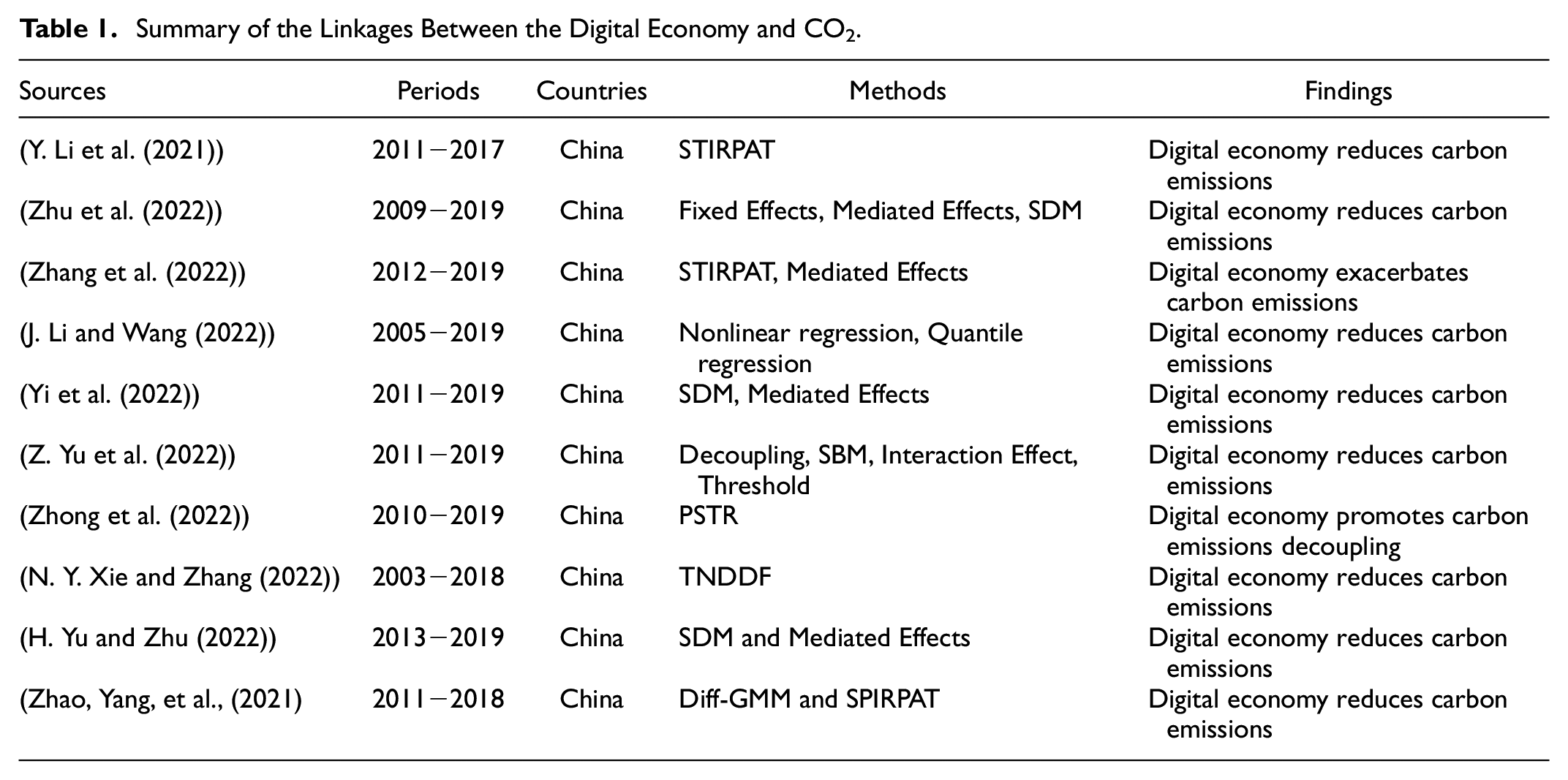
By combing through the relevant research literature, it is easy to find that scholars at home and abroad have basically reached a consensus on the environmental benefits brought by the digital economy at the theoretical level, but most of them mention the digital economy as an important path to achieve the goal of “carbon peaking and carbon neutrality”, but only make theoretical exposition without citing empirical models to verify it. The literature on the impact of the digital economy on carbon emissions is even less, and most of the studies on the impact of the digital economy on carbon emissions are based on local analysis, with little systematic research on the overall development level of the digital economy on carbon emissions. Some scholars only analyze the relationship between the digital economy and carbon emission or energy structure and carbon emission, but there is little research on the relationship between the digital economy, energy structure, and carbon emission. Given this, this paper draws on the relevant research experience of scholars to consider the relevant index system of digital economy development level from three aspects: infrastructure, digital industrialization, and industrial digitization. In addition, the effect of the digital economy on carbon emissions is examined in terms of the heterogeneity of the digital economy dimension, regional dimension, and carbon emission level dimension, and the impact of digital economy characteristics, spatial differences, and carbon emission level differences on the regression results are analyzed more specifically.
Research Hypothesis
Natural greenness, platformization, and sharing are typical features of the digital economy. The combination of data, algorithms, and arithmetic power breaks the time and space boundaries, promotes the rapid flow of various resource elements, achieves precise matching and effective coupling, and improves production efficiency and resource utilization. First of all, the digital economy’s paperless trading process is friendly to the environment. Digital enterprises operate businesses mostly based on information technology services and other services, which are greener than traditional manufacturing industries, and some digital enterprises have launched environmentally friendly products, such as the Ant Forest launched by Alibaba, which can obtain energy to plant trees through steps, which also deepens users’ environmental protection concepts and encourages the public to choose green travel. Moreover, many scholars have confirmed that the implementation of carbon trading policies can promote carbon emission reduction (Zhou & Liu, 2020). The development of the digital economy is conducive to improving the efficiency of carbon trading market financing, which in turn reduces carbon emissions. Secondly, the digital economy can provide a platform for consumers and producers to connect directly. The platform holds the data and can feed back the consumer’s demand to the producer more precisely, and the producer can provide the product to the consumer the first time, which reduces the intermediate link, improves the efficiency of the transaction, and reduces the input of resources. Finally, hitchhiking and bicycle sharing born under the sharing economy have greatly reduced the empty run rate and reduced carbon emissions in a win-win model under the precise matching of the digital economy. The popularity of shared bicycles has also reduced the number of self-driving private car trips, making the traditional travel mode more efficient and green, and low-carbon. Based on the above analysis, the following hypotheses are proposed in this paper.
Energy is the basis for the development of modern society, and rapid economic growth depends on the large supply of energy, while coal has become the main force of energy consumption in China with its low price. According to statistics, >80% of China’s total carbon emissions come from energy activities, and the coal burned per unit of electricity generation is 1.3 times more than the carbon dioxide produced by burning oil (Boqiang & Yijun, 2009). The carbon dioxide emissions from coal consumption are the highest among energy consumption types. The solution to the energy problem is inextricably linked to the achievement of the “carbon peaking and carbon neutrality” goal. Changing from capital and policy-driven to data and knowledge-driven is the way to achieve high-quality development in the energy sector. The digital economy can change the energy production structure, optimize the energy consumption structure and accelerate the development of new energy sources to drive the transformation and upgrading of the energy structure to low-carbon and green (Y. Xie, 2022). First, the digital economy can have a significant impact on energy production and consumption. First, the digital economy can upgrade the production of energy and improve the efficiency of energy use. The FREEDM architecture is a revolutionary network architecture with intelligent functions that can absorb large amounts of distributed energy, complemented by high-speed digital communication, power electronics, and distribution control technologies (Chunping et al., 2017). Secondly, with the increase of infrastructure investment in the ICT industry such as network equipment, base stations, and data centers, the efficiency of energy structure optimization increases, and the carbon emission from traditional energy consumption decreases. Finally, solar energy, bioenergy, wind energy, and other renewable energy sources have the characteristics of clean and environmental protection, the development of the digital economy can accelerate the development and utilization of such new energy sources, and accelerate green technology innovation (Acemoglu et al., 2012; Lee & Min, 2015). The development of the digital economy can accelerate the development and utilization of these new energy sources, accelerate green technology innovation, realize the replacement of clean energy to high emission energy, improve the energy structure, and reduce carbon emission. Based on the above analysis, this paper proposes the following hypotheses.
Data, Model Specification, and Methodology
Variable Selection
Explained Variable: Carbon Emissions (LNCE)
At present, most scholars estimate the carbon emissions of each region from energy consumption and the corresponding carbon emission factors. However, this method does not take into account the carbon dioxide produced by non-carbon combustion materials in the production process, such as cement, steel, lime, etc. Therefore, this paper draws on the practice of Du (2010) to measure carbon dioxide emissions. To reduce the sample fluctuation, the calculation results are logarithmically treated as the explanatory variables in this paper. To improve the accuracy and completeness of the estimation results, the carbon dioxide emissions from the manufacturing process of cement are also estimated in this paper. Data from the Energy Research Institute of the NDRC (2007) were rejected, showing that among the CO2 emissions from all industrial production processes, calcium carbide, as well as steel production, accounted for less than 10%, lime for 33.7%, and cement for 56.8%. Since the data of steel and lime are difficult to obtain and the proportion of carbon emissions is relatively small compared with that of cement, they are not considered in this paper. Based on the above analysis, this paper mainly uses the production of cement and the consumption of seven fossil energy sources (see Table 2) to comprehensively measure the CO2 emissions of each province. Most of the crude oil is converted into secondary energy such as coke, kerosene, and gasoline, while the thermal power portion of electrical energy, which emits carbon dioxide, overlaps with the coal power portion, and is not taken into account to avoid double counting of carbon dioxide emissions.
Carbon Dioxide Emission Factor Table.

Source. Data from the Office of the National Coordination Group for Climate Change Countermeasures, IPCC (2006), and the Energy Research Institute of the National Development and Reform Commission (2007).
Note. Calcium carbonate (CaCO3) is the most important component of limestone, and cement is mainly made of limestone calcined at high temperatures, CaCO3 will produce a large amount of carbon dioxide in the process of calcination, the specific chemical equation is CaCO3→CaO+CO2↑. To avoid cross-counting, only the carbon dioxide emissions from the chemical reaction are considered, excluding the carbon dioxide emissions from the burning of fossil fuels in the cement production process.
The specific calculation formula is as follows.


where CE 1 is the estimated total CO2 emissions from fossil energy combustion; i is the type of fossil energy; CF i is the heating value; E i is the total consumption of the first fossil energy source in each province; CC i is the carbon content; 3.67 is the conversion factor of carbon emissions into CO2 emissions by molecular weight; COF i is the oxidation factor. CE 2 denotes the total CO2 emissions from cement production; EF cement is the CO2 emission factor of cement production; Q denotes the total cement production. CE is the total CO2 emissions.
Core Explanatory Variables: Digital Economy (DIGE)
This paper, Considers the study of T. Zhao et al. (2020) and Yang and Jiang (2021). The entropy method is used to measure the development of the digital economy in each province in three dimensions: “Digital Industrialization,”“Digital Infrastructure” and “Industry Digitization.” The level of digital economy development in each province is measured by the entropy method. The specific index system is shown in Table 3.
Digital Economy Indicator System.

“Digital Infrastructure” includes five indicators: first, the hardware facilities of basic communications, expressed by the length of fiber optic cable lines in each province compared to the area of the previous province; second, the Internet facilities, expressed by the number of Internet broadband access ports in each province compared to the resident population at the end of the previous year; third, the popularity of cell phones, expressed by the cell phone penetration rate The fourth is the Internet penetration, expressed as the number of Internet users per 100 people; the fifth is the situation of computer-related employees, expressed as the proportion of employees in software and computer services to those in urban units.
“Digital Industrialization” includes three indicators: first, the supply of electronic services, expressed as the number of cell phone subscribers per 100 people; second, the supply of telecommunications services, expressed as the ratio of total telecommunications services to the resident population in each province at the end of the previous year; and third, information technology services, expressed as the ratio of information technology service revenue to the resident population in each province at the end of the previous year. The third is the information technology service situation, which is expressed as the ratio of information technology service revenue to the resident population in each province at the end of the previous year.
“Industry Digitization” includes three measures: first, digital financial inclusion, which is measured by the Digital Financial Inclusion Index compiled by the Digital Finance Research Center of Peking University (Guo et al., 2020). The second is the digitalization of enterprises, which is expressed by the number of websites per 100 enterprises; the third is the degree of digital transformation of enterprises, which is expressed by the number of enterprises with e-commerce transactions.
Mediating Variable: Energy Structure (ES)
China’s energy consumption is mainly based on coal, so this paper draws on Shao et al. (2011), the energy structure of each province is expressed by the ratio of coal consumption of each province to the total energy consumption of each province.
Remaining Control Variables
Level of economic development (LNGDP): GDP per capita is used to express the level of economic development, and the logarithm is taken. According to existing studies, there is an inverse “U” nonlinear relationship between economic development and carbon emissions, that is, the environmental Kuznets curve (EKC). Given this, the quadratic term of economic development level (LNGDP2) is also included as a control variable in this paper. Level of technology (LNTCE): The level of technology is measured using the number of urban patent applications. Weights are assigned according to the high and low levels of innovation, including 0.5 for invention patents, 0.3 for utility model patents, and 0.2 for design patents, and the last three patents are weighted and summed and logarithmically processed. Population scale (LNPOPU): The total resident population at the end of the year is used to measure the population scale of each province, and the logarithm is taken for processing. Greening level (GREEN): The park’s green area per capita is used to express. Industrial structure (IS): The level of the industrial structure of each province is measured by using the hierarchical coefficient of industrial structure, and the specific measurement formula.

Where Is is the level of industrial structure and Q i is the value added of each industry as a share of GDP.
Methodologies Framework
This study involves four stages of analysis. In the first stage, this paper introduces the data sources and descriptive statistics of variables. In the second stage, two-way fixed effect model and mediating effect model are constructed according to the research hypothesis. In the third stage, the correlation analysis and VIF test between the variables were carried out. Finally, in the fourth stage, we conducted a regression analysis.
Data Sources and Descriptive Statistics
The research object of this paper is the 30 provinces (cities and districts) in China, and the data from Hong Kong, Tibet, Taiwan, and Macao are seriously missing, so they are excluded. At present, most of the data on fossil energy consumption in China is only updated to 2019, and the data for 2020 are seriously missing. Moreover, the digital inclusive finance index has only been counted since 2012, and considering the importance of digital inclusive finance index data to measure the digital economy, this paper limits the study to the period of 2012 to 2019 and uses linear interpolation to make up for individual missing samples. The data of the selected indicators are obtained from China Energy Statistical Yearbook, the annual data of the National Bureau of Statistics by province, the China Environmental Statistical Yearbook, and the statistical yearbooks of each province, except for the Digital Inclusive Finance Index, which is obtained from the Digital Finance Research Center of Peking University. And in this paper, to reduce the volatility of the sample data, all the data of non-ratio type are treated as a logarithm. The descriptive statistics of each variable are shown in Table 4.
Descriptive Statistics of Each Variable.

Model Construction
To test hypothesis 1, the omitted variables that do not vary over time but vary with individuals and those that do not vary with individuals but vary over time are also addressed. The following two-way fixed-effects model (5) is constructed based on the direct transmission mechanism of the digital economy on carbon emissions.

Among them,
China is experiencing urbanization and industrialization characterized by high energy consumption (Miao et al., 2019), and carbon emissions are necessarily closely related to the energy structure. It is then worthwhile to consider whether the digital economy can reduce carbon emissions by improving the energy structure. To test hypothesis 2 this paper refers to Wen and Ye (2014) approach, the mediating effect econometric model equations (6) to (8) are set.


where
Variable Correlation Analysis and VIF Test
Table 5 shows the correlation coefficients among the variables, and the results show that the correlation coefficients among the explanatory variables, core explanatory variables, mediating variables, and each control variable are small, indicating that there is no serious problem of multicollinearity among the variables. And the correlation coefficient between the digital economy (DIGE) and carbon emission (LNCE) is significantly negative, which tentatively verifies hypothesis 1 that the digital economy can suppress carbon emission. Secondly, the article also conducted the variance inflation factor (VIF) test for each variable, and the test results showed that the VIFmax = 4.95, and the VIF values of all variables were less than 10, which again indicated that there was no multicollinearity problem among the variables.
Correlation Test of Variables.

Note. *, **, and *** denote 1%, 5%, and 10% significance levels, respectively.
Empirical Results and Analysis
Baseline Regression
Based on the analysis of the above econometric model, in this paper, to control for individual differences that do not vary over time and the influence of the external macroeconomic environment, a two-way fixed effects model is chosen for the regression treatment, but for the stability of the results, the regression results are also presented for the control variables as well as time and individual control or not, respectively, and the specific regression results are shown in Table 6. Table 6 reports the impact of the digital economy on carbon emissions. Among them, from model 1 to model 4, the coefficients of the core explanatory variable digital economy are significantly negative at the 1% level, indicating that the digital economy presents a significant inhibitory effect on carbon emissions, which verifies hypothesis 1. This result is consistent with previous scholarly findings (Y. Li et al., 2021; Zhu et al., 2022).
Baseline Regression Results.

Note. Robust standard errors are in parentheses, where *, **, and *** denote significance at the 10%, 5%, and 1% levels, respectively.
In terms of control variables, the primary term LNGDP of economic development level is significantly positive at 1% level, and the secondary term LNGDP2 is significantly negative at 1% level, indicating that there is an inverted “U” non-linear relationship between economic development level and carbon emissions, that is, it verifies the EKC theory, and the relationship between economic development and carbon emissions. This conclusion is consistent with previous scholars ’ conclusions (Guangyue & Deyong, 2011). Population size has a significant positive effect on carbon emissions, that is, an increase in population size will lead to an increase in carbon emissions, mainly because the increase in population size will lead to an increase in the consumption of fossil energy, which is the main factor leading to an increase in carbon emissions, and therefore the coefficient of population size on carbon emissions is significantly positive (Y. Xie, 2022).
Robustness Tests
Substitution of Explanatory Variables
Although this paper uses a two-way fixed effects panel model and controls for variables affecting carbon emissions as much as possible to reduce measurement error, there is still a possibility of endogeneity bias due to reverse causality and omitted variables in the model estimation. For example, a region with high carbon emissions implies that heavy industry accounts for the poorer foundation for digital economy development, that is, there is an endogeneity problem due to reciprocal causality. For this reason, this paper mitigates the lagged one-period replacement of the core explanatory variable digital economy with the current period index. The results are presented in Model 1 of Table 7, and using the explanatory variable carbon emissions to regress the digital economy (L.DIGE) with one period lag, it can be seen that the coefficient of the digital economy is still significantly negative, which is consistent with the results of the previous benchmark regression.
Robustness Test Regression Results.

Note. Robust standard errors are in parentheses, where *, **, and *** denote significance at the 10%, 5%, and 1% levels, respectively.
Shrinkage Processing
Considering the robustness of the regression results from the perspective of the data, to avoid the interference of outliers on the regression results, the explanatory variable carbon emissions (LNCE) was subjected to two-way tailing at the 5% level, respectively, and the processed data were regressed again, and the results are shown in Model 2 of Table 7, where the coefficient of the core explanatory variable digital economy (DIGE) is still significantly negative at the 1% level, confirming again the robustness of the previous benchmark regression results.
Reject Municipality Processing
Considering that there is a large gap in the development level of each province in China, especially since the economic volume of municipalities directly under the central government is much larger than other provinces, the samples of four municipalities (Beijing, Shanghai, Tianjin, and Chongqing) are excluded from the regression test again. The regression results are shown in Model 3 of Table 7, and it can be seen that the coefficient of the core explanatory variable digital economy (DIGE) is still negative at the 10% significance level, confirming that the previous results are robust.
Substitution of Explanatory Variables
Considering the differences in population size in each region, carbon emissions per capita (LNPCE) were used to replace the explanatory variable carbon emissions (LNCE) for the re-regression. The carbon emissions per capita (LNPCE) are expressed by the number of carbon emissions in each province over the Resident population at the end of the previous year, which is calculated in the previous section and processed by taking the logarithm. The specific regression results are shown in Model 4 of Table 7, which shows that the coefficient of the digital economy remains significantly negative at the 1% level, confirming that the previous baseline regression results are robust.
Heterogeneity Analysis
Digital Economy Dimensional Heterogeneity
The level of digital economy development consists of three components: the level of digital infrastructure, the level of digital industrialization, and the level of industry digitization, and given this, it is necessary to examine their effects on carbon emissions from each of these three dimensions. Model 1, Model 2, and Model 3 in Table 8 show the regression results of digital infrastructure, digital industrialization, and industrial digitization on carbon emissions, respectively.
Heterogeneity Regression Results of Digital Economy Dimensions.

Note. Robust standard errors are in parentheses, where *, **, and *** denote significance at the 10%, 5%, and 1% levels, respectively.
From the regression results, it can be seen that digital infrastructure, digital industrialization, and industrial digitization all have significant inhibitory effects on carbon emissions, which are significantly negative at 10%, 1%, and 1% levels, respectively. Among them, the digitization of industry has the most significant inhibitory effect on carbon emissions, and each unit increase in digitization of industry can reduce carbon emissions by an average of 0.119 units. The main reasons may be that, on the one hand, industrial digitization integrates traditional industries with digitization, which can promote traditional industries to optimize the allocation of production factors, move from low marginal returns to high marginal returns, and improve the efficiency of resource utilization thus reducing carbon emissions. On the other hand, e-commerce and other industries in industrial digitization can reduce the transaction cost of goods and thus reduce carbon emissions. In contrast, digital infrastructure also consumes a lot of energy in the process of construction and production, and the carbon emissions generated will partially offset each other with its energy-saving and emission-reducing effects, so digital infrastructure has fewer inhibiting effects on carbon emissions than industrial digitization. As for digital industrialization, digital industrialization is the basis for the development of the digital economy. Compared with traditional industries, digital industries such as the software service industry and mobile electronic information have natural green and low-carbon nature, so digital industrialization also has a significant inhibiting effect on carbon emissions.
Heterogeneity of Carbon Emission Levels
The quantile regression has the advantage of portraying the conditional distribution and excluding the interference of extreme values, so to further investigate the differences in the effects of the digital economy on different carbon emission levels, this paper divides the carbon emission levels into five representative quantile points of 20%, 35%, 60%, 75%, and 95%, which can represent the medium and low levels of carbon emission respectively. The results of the carbon emission quantile regression are shown in Table 9. When the quantile is below 95%, the coefficients of the effect of the digital economy on carbon emission are all gradually increasing, but not significantly. This finding is consistent with the results of previous studies (Y. Xie, 2022). The coefficient of the digital economy on carbon emissions is significantly negative when the carbon emission level is at the 95% quantile, and the coefficient of the digital economy on carbon emissions is as high as 2.623. Thus, the higher the carbon emission level, the more obvious the carbon reduction effect of the digital economy is.
Quantile Regression Results.

Note. Robust standard errors are in parentheses, where *, **, and *** denote significance at the 10%, 5%, and 1% levels, respectively.
Regional Heterogeneity
It has been shown that the level of digital economy development is influenced by the conditions of the regional economic development level (Shaohua & Zhi, 2021). As it has been confirmed that the digital economy can significantly curb carbon emissions in general, what is the impact of this emission reduction effect in different regions? Therefore, to explore the impact of the digital economy on carbon emissions in regions with different levels of economic development, this paper divides the 30 provinces (cities and districts) in China into the eastern, central, and western regions. Table 10 reports the impacts of the digital economy on carbon emissions in the eastern, central, and western regions, respectively.
Regression Results by Region.
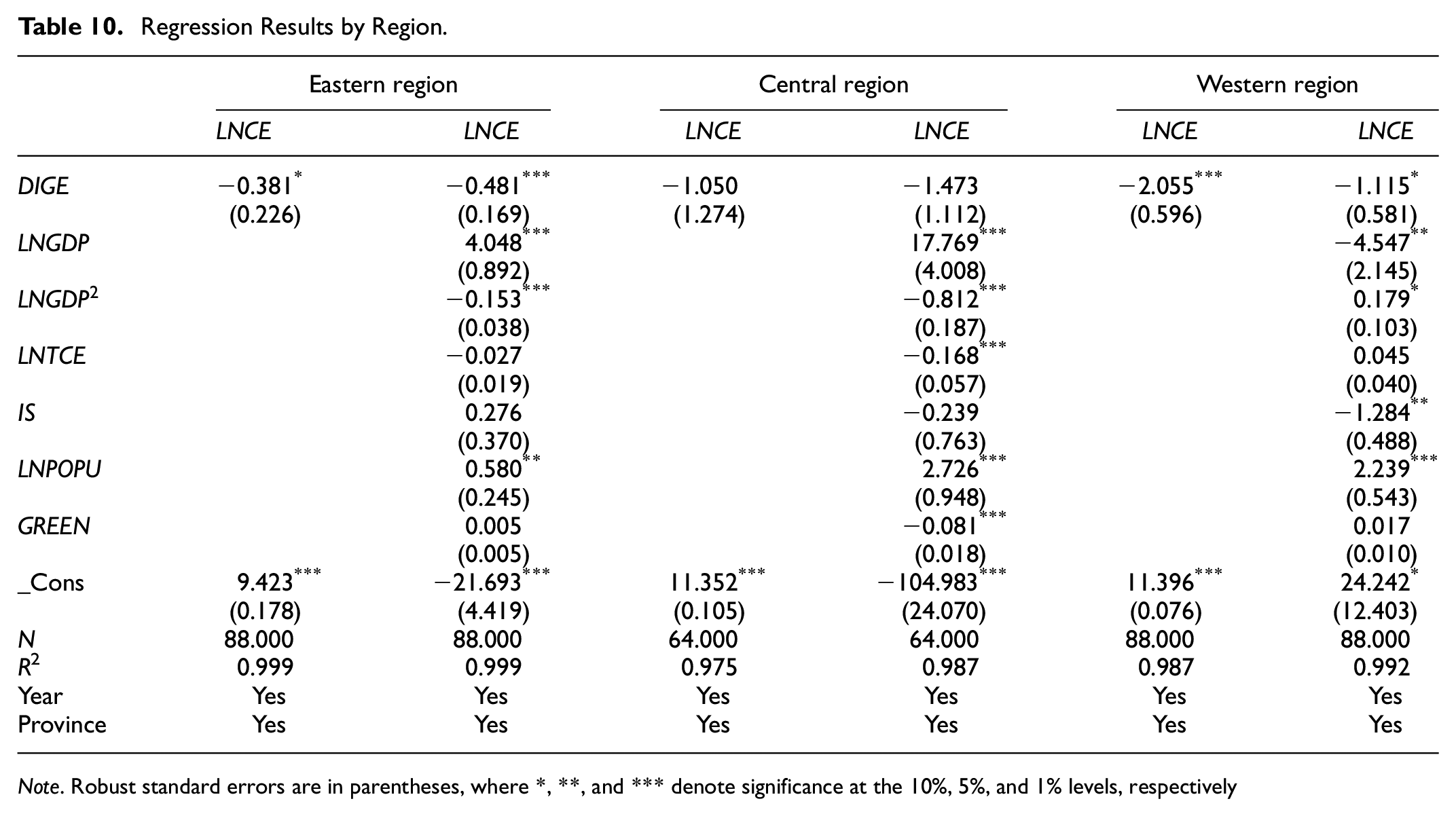
Note. Robust standard errors are in parentheses, where *, **, and *** denote significance at the 10%, 5%, and 1% levels, respectively
The results in Table 10 show that the coefficient of the effect of the digital economy on carbon emissions is negative in the eastern region as well as in the western region, which is consistent with the regression results of the full sample, but not significant in the central region. The best inhibitory effect of the digital economy on carbon emissions is found in the western region, where for every 1 unit increase in the level of digital economy development in the western region, carbon emissions will be reduced by 1.115 units on average, and the inhibitory effect is 2.318 times higher than that in the eastern region (1.115/0.481). This finding is consistent with most previous scholarly conclusions (Wu & Gao, 2020). This is mainly because the economic development level of the western region is lower than that of the central and eastern regions, especially the dependence of the western region on resources is still higher, and the binding force of local environmental policies is lower, some enterprises “transfer pollution” from the east to the west, resulting in much higher carbon emissions than the eastern region. This conclusion is consistent with the results of the quantile regression of carbon emissions in the previous paper, in which the higher the level of carbon emissions, the more obvious the carbon reduction effect of the digital economy is, and the digital economy in the western region has a better marginal utility in reducing carbon emissions.
Further Analysis, Mediating Effect Test
The digital economy is mainly to improve the energy structure by accelerating the research and development of clean energy to improve the efficiency of energy use, and the energy structure shift with the goal of environmental management can significantly curb the consumption of coal (Lin & Li, 2015). The energy structure shift with the goal of environmental management can significantly curb the consumption of coal. From the previous analysis, it is clear that China’s carbon dioxide emissions mainly originate from coal-based fossil energy combustion, so the
Mechanism Analysis—Energy Structure.

Note. Robust standard errors are in parentheses, where *, **, and *** denote significance at the 10%, 5%, and 1% levels, respectively.
Summary and Recommendations
Global warming caused by carbon dioxide and other greenhouse gases has become the focus of global attention, and China, as the world’s largest emitter of carbon dioxide, has actively set carbon emission reduction targets. Meanwhile, at this stage, the digital economy has become an important driving force for China’s future high-quality economic development, and it is of great practical significance to explore whether the digital economy can contribute to carbon emission reduction. Therefore, based on the provincial panel data from 2012 to 2019, this paper firstly confirms that the digital economy can reduce regional carbon emissions in a more systematic way using a two-way fixed-effects model, and the conclusion that the digital economy has a significant carbon emission reduction effect still holds after passing a series of robustness tests. Secondly, to investigate the effect of three different dimensions of the digital economy on carbon emissions, a heterogeneity analysis of the digital economy reveals that digital infrastructure, digital industrialization, and industrial digitization all have significant negative effects on carbon emissions, and the effect of industrial digitization is the most obvious, followed by the effect of digital infrastructure, and the effect of digital industrialization is the weakest. Then, to investigate the carbon emission reduction pattern of the digital economy under different carbon emission levels, quantile regression was conducted, and the regression results found that the higher the carbon emission level, the more obvious the inhibitory effect of the digital economy on carbon emission. Then, to investigate the carbon emission reduction effect of the digital economy in different regions of China, the regional heterogeneity analysis was conducted in the eastern, central, and western regions of China, and it was found that both the eastern and western regions can promote carbon emission reduction, but the western region has the most obvious role in promoting carbon emission reduction. Finally, to investigate whether energy structure can play a mediating role in the impact of the digital economy on carbon emissions, the energy structure was included in the regression analysis, and the results showed that the digital economy can reduce the share of coal and thus reduce carbon emissions by improving the energy structure.
In summary, this paper puts forward the following policy recommendations: First, actively promote the development of the digital economy. Make comprehensive use of tax incentives, financial subsidies, and other means to increase the coverage of the digital economy and encourage more enterprises to move toward the digital economy era. Second, tilt more resources for digital economy development to the central and western regions. According to the “2020 Global Computing Power Index Assessment Report,” for every 1% increase in the computing power index, the digital economy and GDP will grow by 3.3‰ and 1.8‰ respectively. Therefore, we should continue to promote the construction of the “East Digital West Computing” project, to direct the intensive computing power demand in the eastern region to the western region in an orderly manner, accelerate the construction of a new development pattern in the western region, and cause the overall marginal utility of carbon emission reduction to be greater. Third, accelerate the integration of traditional industries with the digital economy. Actively use the driving effect of industrial digitization on carbon emission reduction, increase the integration of enterprise digital technology, focus on the research and development of green innovative technology, and promote the transformation and upgrading of traditional high-emission enterprises to green and low-carbon. In addition, while increasing the construction of digital infrastructure, attention should also be paid to the carbon emissions brought by itself to avoid the offsetting effect of its emission reduction. Fourth, pay attention to the improvement of the energy structure by the digital economy. The digital economy should be used to optimize the energy structure, improve the utilization rate of various resources, actively promote the concept of low-carbon energy consumption, accelerate the research and development of clean energy, reduce the proportion of traditional high-emission energy consumption, reduce carbon emissions, and help achieve the goal of “carbon peaking and carbon neutrality”.
Footnotes
Declaration of Conflicting Interests
The author(s) declared no potential conflicts of interest with respect to the research, authorship, and/or publication of this article.
Funding
The author(s) disclosed receipt of the following financial support for the research, authorship, and/or publication of this article: This paper was supported by National Social Science Foundation of China (Statistical Measurement and Policy Research on the Spatiotemporal Evolution Mechanism of Greening of High Energy Consumption and Heavy Pollution Industrial Chain under Path Dependence, 22XTJ001), Jiangxi Provincial Social Science Foundation Project (Research on the Mechanism and Countermeasures of Digital Economy Development to Promote Carbon Emission Reduction, 22YJ24), Science and Technology Research Project of Jiangxi Provincial Department of Education (Research on the Impact of Green Finance on Green Technology Innovation Performance and Its Spatial Heterogeneity in China, GJJ201421), Jiangxi Provincial Postgraduate Innovation Special Fund Project (“Double Carbon” Research on the mechanism and influencing factors of digital economy on carbon emissions, YC2022-S917).
Research Direction

Data Availability Statement
The data presented in this study are available on request from the corresponding author.