




Abstract
With the introduction of the dual carbon goals of “carbon peak” and “carbon neutrality”, low-carbon economic development has become the focus of attention for all sectors in China. Improving carbon productivity (CP) is the key to developing a low-carbon economy and is essential to achieving carbon emission reduction and economic growth. The rapid development of the digital economy (DE) provides a new breakthrough for improving carbon productivity, but there are few studies on the digital economy and carbon productivity in the existing literatures. We empirically investigate the impact mechanism of the digital economy on provincial carbon productivity using China’s provincial panel data from 2010 to 2019. This study finds that the digital economy significantly raises provincial carbon productivity; this result remains valid after a series of robustness tests. The digital economy can impact provincial carbon productivity through both energy consumption structure (ECS) and green technology innovation (GTI) and can contribute to the improvement of provincial carbon productivity by optimizing energy consumption structure and improving green technology innovation. In addition, different environmental regulations have different impacts. Command-and-control environmental regulation (CER) weakens the positive impact of the digital economy on provincial carbon productivity, whereas market-based environmental regulation (MER) enhances the positive impact of the digital economy on provincial carbon productivity. This study extends the research on the digital economy in the field of low-carbon development, providing insights and policy suggestions for relevant departments to promote low-carbon development from the perspective of the digital economy.
Plain language summary
This study uses panel data of 30 provinces in the Chinese mainland (excluding Tibet) from 2010 to 2019 to conduct an empirical study combining the digital economy, carbon productivity, energy consumption structure, green technology innovation, and different environmental regulations into an integrated framework to explore the direct impact of the digital economy on carbon productivity, as well as the mediating roles of energy consumption structure and green technology innovation in this impact process, and the moderating roles of different types of environmental regulations. This study clarifies the impact mechanism of the digital economy on carbon productivity, and provides suggestions for relevant departments to promote the improvement of carbon productivity under the digital economy. In the future, we can explore the impact of the digital economy on carbon productivity in different industries, select micro-enterprise data and expand the sample size, so as to obtain more targeted suggestions.
Keywords
Introduction
As the global economy is growing, carbon emissions have become an increasingly serious problem, and many countries are struggling to reduce carbon emissions. S. Li and Wang (2019) asserted that improving carbon productivity was a possible approach for establishing coordination between economic development and carbon emission reduction. Sustained improvement of carbon productivity is conducive to low-carbon transformation of the industrial structure, ultimately leading to a reduction in total carbon emissions (He & Su, 2011). However, China’s carbon productivity level is not high, and there is a long way to improve the nation’s carbon productivity. At the same time, with the continuous development of internet technology and the continuous promotion of social informatization, the digital economy wave has rapidly swept across the globe, providing new solutions and ideas for carbon productivity improvement. The digital economy is often accompanied by the characteristics of high efficiency, low cost, and great convenience, which provides opportunities for technological innovation and productivity improvement for economic and social development (Chun et al., 2015; Ekener, 2019), and can encourage traditional industries to move toward digital intelligence, providing support for carbon emission reduction. In the face of the vigorous development of the global digital economy, “expanding and strengthening the digital economy” and “building digital China” have been repeatedly proposed in China (Xi, 2022). The digital economy has an important role in environmental management, which can help to optimize production and improve resource utilization efficiency (Lange et al., 2020). The digital economy has become an important starting point for high-quality economic development and an urgent requirement for addressing climate change in favor of carbon productivity. Therefore, in the face of the new requirements of “carbon peak” and “carbon neutrality” goals, further research on the relevant issues of the digital economy in the low-carbon field has important theoretical and practical significance for promoting the reform and construction of the climate governance system.
Carbon productivity refers to the ratio of gross domestic product to carbon emissions, and seeks to obtain the maximum output with the minimum carbon emissions under certain production conditions (Kaya & Yokobori, 1997). Carbon productivity balances the two objectives of low carbon and economic development, meets the needs of China’s current economic development and realizes the goal of protecting the environment (J. Yang et al., 2023). In contrast to carbon emissions per capita, total carbon emissions, and carbon intensity, carbon productivity can reflect both carbon emissions and economic development, with stronger emphasis on economic development. Over time, carbon productivity has gradually entered some scholars’ research horizons and some research results have emerged. Some scholars (He & Su, 2011; Xiong et al., 2021) contended that improving carbon productivity was the primary way to combat climate change. L. Zhang et al. (2018) examined the relationship between foreign trade and carbon productivity. G. Chen et al. (2018) investigated the influencing factors of carbon productivity from the perspective of production and consumption to find out that labor productivity, energy consumption, and other variables were important influencing factors. Some scholars focus on specific industries to study the influencing factors of transportation carbon productivity (J. Chen et al., 2020), industrial carbon productivity (H. Yang et al., 2020), agricultural carbon productivity (Xiong et al., 2021), and manufacturing carbon productivity (Bagchi et al., 2022). Existing studies have not examined the relationship between digital economy and carbon productivity. Carbon productivity is an important criterion for evaluating the economic development model of a country or region. As improving carbon productivity is the key to developing low-carbon economy (Mielnik & Goldemberg, 1999), it is urgent to explore the impact of the digital economy on carbon productivity to expand theoretical support for promoting the development of low-carbon economy.
Xue et al. (2022) believed that the digital economy promoted the digital transformation of energy enterprises, which was conducive to the optimization of the energy consumption structure. The optimization of the energy consumption structure dominated by coal is of great significance to the development of low-carbon economy. In the process of the digital economy affecting carbon productivity, what role does the energy consumption structure play? The digital economy brings opportunities for the development of green technology innovation. Hu and Liu (2016) argued that green technology innovation played an important role in promoting carbon productivity. As an important variable in promoting the development of green transition, does green technology innovation play a mediating role? In addition, the laws, regulations and policies on emission reduction formulated by the government have created an institutional environment for the development of the digital economy and carbon productivity, and what are the impacts of different environmental regulations in the process of the digital economy affecting carbon productivity? To answer the above questions, this study explores the direct impact of the digital economy on carbon productivity, clarifies the impact mechanism of the digital economy on carbon productivity incorporating energy consumption structure, green technology innovation and different environmental regulations into a research framework, and provides suggestions for relevant departments to promote the improvement of carbon productivity under the digital economy.
In contrast to previous literatures, the contributions of this study are threefold. (1) The study combines the digital economy and the low-carbon economy, enriching the field of research on the digital economy in efforts to advance low-carbon development. Some studies have explored the relationship between the digital economy and carbon emissions (Z. Li & Wang, 2022; Ma et al., 2022; Zhang et al., 2022), as well as carbon emission efficiency (Lyu et al., 2023; J. Wang et al., 2022). However, carbon emissions only reflect the current status of low-carbon development, and carbon emission efficiency reflects the relationship between the input and output of unit carbon emissions. In comparison, carbon productivity can reflect both low-carbon development and economic growth, which is essential to reducing carbon emissions and promoting the economy. This study incorporates the digital economy and provincial carbon productivity into a research framework, answering the question of what impact the digital economy has on provincial carbon productivity, reflecting the importance of the digital economy to low-carbon economic development, and enriching academic research on the digital economy in the low-carbon field. (2) The study reveals the pathways through which the digital economy affects provincial carbon productivity. This study clarifies the pathway roles of energy consumption structure and green technology innovation in the process of the digital economy influencing provincial carbon productivity, providing a new perspective to reveal the impact mechanism of the digital economy on provincial carbon productivity and deepening the research in related fields. (3) The study confirms the differentiated situational impacts of command-and-control and market-based environmental regulations on the effect of digital economy on carbon productivity, clarifying the different effects of command-and-control and market-based environmental regulations. The study findings provide further theoretical support to better exploit the role of the digital economy and promote the development of provincial low-carbon economy.
Literature Review and Research Hypothesis
Literature Review
The digital economy originated in the 1990s. With the advent of the internet, which changed the structure of economies and industries, the global economy entered a new phase. The traditional economy was slowing down, and the digital economy rose rapidly. Tapscott (1996) firstly defined the economic model of presenting information flow in a digital way as the digital economy. Since then, the digital economy has been widely discussed by scholars (Y. Chen, 2020; Z. Chen et al., 2022; Y. Li et al., 2021; Xue et al., 2022). As a new economic form, in the “G20 Digital Economy Development and Cooperation Initiative” released at the G20 Hangzhou summit in 2016, the digital economy was defined as “a broad range of economic activities that the use of digital knowledge and information as key production factors, modern information networks as important carriers, and the effective use of information and communication technology as an important driving force for efficiency improvement and economic structure optimization”.
In the era of the digital economy, the economic activities and behaviors of market transaction subjects depend on the information network, which significantly differs from the transaction behavior and business model of the industrial era. Governments are investing significant resources in the digital economy development to bridge the “digital divide” between countries and different regions within the country (Reggi & Gil-Garcia, 2021). In fact, as a new factor of production, digitalization not only has an important role in the social economy but also in environmental management (Y. Li et al., 2021). The environmental effects of the digital economy have gradually attracted extensive attention from scholars. Scholars (Hampton et al., 2013; Kwon et al., 2014) believed that the digital technology development could improve environmental quality. Cho et al. (2007) argued that the rise of the digital economy could reduce energy use. J. Zhang et al. (2022) found that the digital economy had carbon emission reduction effect. In fact, with the support of digital technology, the effectiveness and availability of information allow resources to be better matched through the market, thus realizing the effective use of resources, making better contributions to green and low-carbon development, and realizing the improvement of carbon productivity.
In the process of the digital economy affecting provincial carbon productivity, from the perspective of energy consumption structure, the digital economy promotes the dual digital transformations of both the supply and demand sides of energy, which can have a profound impact on energy consumption and promote the optimization of energy consumption structure (Xue et al., 2022). Energy consumption is one of the most significant sources of carbon dioxide (CO2) emissions (Y. Li et al., 2021) and energy consumption structure optimization improves carbon productivity (S. Li & Wang, 2019). The digital economy can impact carbon productivity through energy consumption structure. From the perspective of green technology innovation, the widespread use of digital technologies, such as big data and the internet, accelerates the dissemination of information resources and promotes innovation activities (Audretsch et al., 2015), facilitates the development of green technology innovation. Hu and Liu (2016) asserted that green technology innovation contributed to carbon productivity. Green technology innovation can facilitate the low-carbon transition of high-energy consumption products to achieve energy consumption reduction and carbon productivity improvement. The digital economy can promote carbon productivity by increasing the level of green technology innovation. In terms of the policy environment, environmental regulation can impact the digital economy development and provincial carbon productivity through the implementation of restrictive policies and measures. Moreover, the focus of environmental regulations varies, and the impact of the digital economy on carbon productivity may differ under different environmental constraints. Based on this, this study launches an empirical study using relevant panel data of 30 provinces (excluding Tibet) in the Chinese mainland from 2010 to 2019 to examine the impact mechanism of digital economy on provincial carbon productivity.
Research Hypothesis
The Direct Impact of the Digital Economy on Provincial Carbon Productivity
Carbon productivity can directly reflect the goal of stabilizing carbon emissions in the economic growth. The improvement of carbon productivity indicates simultaneous higher output and lower carbon emissions. The digital economy improves energy efficiency and reduces CO2 emissions, helps to eliminate extensive high carbon economic growth mode and continuously alleviates high carbon emissions to improve carbon productivity. Specifically, the digital economy helps to improve energy efficiency through technological advances and efficiency improvement (Z. Li & Wang, 2022). By using digital technology to transform traditional industries, the digital economy promotes the development of industries toward digital intelligence and economic greening, thereby increasing industries’ value added, reducing energy consumption and carbon emissions, and contributing to the improvement of carbon productivity. Moreover, the penetration and popularization of digital technologies in the low-carbon sector are conducive to the development of more low-carbon, energy-related, and environmental technologies, which lower energy losses and promote the improvement of provincial carbon productivity. In addition, digital technologies such as the internet and cloud computing break down traditional geospatial boundaries, shorten the spatial and temporal distances between regions, enable information sharing across space-time and low-cost access to information and can maximize the integration of various resources (Ren et al., 2021), reducing CO2 emissions in the circulation and transportation of resources to improve carbon productivity. The digital economy also provides manufacturers with more advanced technologies, which can help to advance green production through cloud computing and integrated operation mode, improve production efficiency and reduce CO2 emissions (J. Zhang et al., 2022), ultimately achieve the purpose of carbon productivity improvement. Accordingly, this study proposes the following hypothesis:
H1: The digital economy has a positive impact on provincial carbon productivity.
The Mediating Role of Energy Consumption Structure
Energy consumption structure refers to the proportional relationship between the compositions of various energy sources within a country or region in a certain period of time. Due to its resource endowment, China’s energy consumption has always been dominated by coal, and coal has the highest proportion in the energy consumption structure (Xuan et al., 2020). Reducing the proportion of coal consumption and optimizing the coal-based energy consumption structure are of great significance to the development of China’s low-carbon economy.
The digital economy can optimize the energy consumption structure in three ways. Firstly, digital technology ensures the safe and efficient operation of energy systems (Y. Chen, 2020), which can reduce energy consumption, and affect the energy consumption structure. In general, digital technology can reduce energy consumption and improve the production efficiency of the traditional fossil energy industry by monitoring data along the energy production chain, intelligently transforming the energy production process, preventing and warning about production risks in advance, and upgrading energy enterprises’ production management systems, thereby enabling energy recycling. Secondly, the digital economy can change the production process and human lifestyles, promoting the “virtualization” and “dematerialization” of economic activities, which reduces energy consumption (Pradhan et al., 2020). By dematerializing human activities, the digital economy reduces the demand for energy and raw materials (Heiskanen et al., 2005), which contributes to a shift in the energy consumption structure, and eventually achieves effective carbon emission control. Finally, through embedding digital technologies, more renewable energy sources will replace traditional fossil energy, which will further improve the energy consumption structure.
Some studies (S. Wang et al., 2017, 2019) confirmed that energy consumption was the most important source of CO2 emissions. A large amount of greenhouse gases is emitted in the process of energy consumption, and the “overflow” of energy in the process of mining, transformation, storage, transportation, and combustion also produces greenhouse gases. Adjusting the energy consumption structure is generally regarded as an essential measure for reducing CO2 emissions and improving carbon productivity (S. Li & Wang, 2019). Moreover, the growth of greenhouse gas emissions in China predominantly comes from the energy supply provided by coal combustion. China’s coal-based energy consumption structure is the main reason for the nation’s low-carbon productivity. The lower the proportion of coal consumption in total energy consumption, the lower the carbon emissions, which can promote carbon productivity improvement and provincial low-carbon development. Based on the above analysis, this study proposes the following hypothesis:
H2: Energy consumption structure has a mediating role in the process of the digital economy affecting provincial carbon productivity.
The Mediating Role of Green Technology Innovation
Green technology refers to general technologies, processes, or products that reduce the consumption of raw materials and energy and lower environmental pollution (Braun & Wield, 1994). Technological progress will reduce carbon emissions, while green technology innovation will reduce energy consumption and even facilitate resource replacement, thereby improving carbon productivity. The continuous growth of the digital economy can improve carbon productivity by enhancing the level of provincial green technology innovation.
Audretsch et al. (2015) argued that widespread use of the internet had accelerated the dissemination of ideas and information, facilitated the application of innovative technologies and increased innovation activities. The digital economy can improve green technology innovation in three ways. Firstly, the rapid development of ICT provides a lower-cost competitive advantage for data-based innovation activities. Based on big data, enterprises are able to analyze specific information about the ecological environment and target green innovation, thereby driving up the level of green technology innovation in a province. Secondly, the development of the digital economy facilitates rapid information transfer and diversified access to knowledge, leading to a more open and transparent market environment, which is conducive to green technology innovation of various entities in a province. Finally, the development of the IoT has eliminated the restrictions of time and space for innovation activities, enabling different innovation subjects to participate in the process of green innovation at the same time in different spaces and improving the green innovation level of provincial innovation subjects.
He and Su (2011) argued that the fundamental way to balance economic development and climate protection was technology innovation and the development of low-carbon energy technologies. Du and Li (2019) similarly argued that green technology innovation was an important factor for advancing carbon productivity. Improving the level of green technology innovation can promote the development and use of renewable energy and promote the substitution of renewable energy for non-renewable energy to achieve the purpose of energy conservation and emission reduction and improve carbon productivity. Enterprises’ green technology innovation activities also improve the technology research and development (R&D) of energy efficiency (Alam & Murad, 2020). Technological advances and green technology innovation can improve the carbon efficiency levels of major energy-intensive products, induce the transformation of pollution-intensive or resource-consuming industries in a region and achieve carbon emission reduction while increasing productivity, thereby contributing to carbon productivity improvement. Based on the above analysis, this study proposes the following hypothesis:
H3: Green technology innovation has a mediating role in the process of the digital economy affecting provincial carbon productivity.
The Moderating Role of Environmental Regulation
Environmental regulation refers to all laws, policies, and measures adopted by the state to protect the environment, which are restrictive to economic activities and implementation processes. The Porter hypothesis suggests that environmental regulation can stimulate enterprises to invest in environmental technological transformation and can achieve innovation compensation (Porter, 1991), while cost constraint theory suggests that environmental regulation can lead to increased production costs for enterprises, which can slow down economic and technical efficiency (Lanoie et al., 2011). Further research has led to a discussion of the effects of different regulations, called the “narrow” Porter hypothesis. Majumdar and Marcus (2001) proposed that flexible policies were more conducive to encouraging enterprises to develop new processes or products. In contrast, rigid environmental regulations are not conducive to enterprises’ investing in innovative R&D (López-Gamero et al., 2010). Subsequently, different types of environmental regulations have different effects on organizational behavior (Zhao et al., 2015). Scholars, such as Testa et al. (2011) and Williams (2012) classified the environmental regulations into two types of command-and-control and market-based regulation. Command-and-control environmental regulation refers to the government’s control of the pollution behavior of provincial entities through coercive measures, such as orders and prohibitions to eliminate outmoded production capacity and improve the circumstances of social environmental pollution. Market-based environmental regulation refers to the use of market-based instruments, such as prices and fees by government departments, to induce provincial actors to reduce environmental pollution, establishing an intrinsic incentive to prevent damage to environmental resources and improve the environmental challenges in the region. The difference between market-based and command-and-control environmental regulation is that the former can be both rewarding and punishing, while the latter primarily employs punitive measures. Referring to the view of some scholars (Tang et al., 2020; Testa et al., 2011; Williams, 2012; Zhao et al., 2015), this study divides environmental regulations into command-and-control environmental regulation and market-based environmental regulation to analyze the different impacts of these policy approaches in the process of the digital economy affecting provincial carbon productivity.
The Moderating Role of Command-and-control Environmental Regulation
Command-and-control instruments limit an enterprise’s carbon emissions by setting stricter emission reduction goals, clear technical standards, and related criteria, which can necessitate additional costs that can have an impact on enterprises’ investment decisions and profitability (Testa et al., 2011). In this case, digital technology may not be a priority for various entities in a province due to its high cost, the advantages it offers may not be fully exploited and there may not be significant increase in carbon productivity. Moreover, command-and-control environmental regulation can impose additional production burdens and constraints on enterprises, generate difficulties in production, management, and marketing, and potentially reduce competitiveness (Lanoie et al., 2011). Thus, excessively strong command-and-control environmental regulation increases resistance to digital economy development, which is not conducive to the improvement of provincial carbon productivity under the digital economy. In addition, command-and-control instruments are stricter. In actual circumstances, it is easy to delegate objectives through level-by-level decomposition to force the provincial environment to meet the standard through mandatory means. Under the relevant mandatory measures, strict environmental policies can bring greater resistance to business operations, leading to a reduction in the economic benefits of carbon emissions in the region, and reducing the positive impact of the digital economy on provincial carbon productivity. Moreover, the foundation of economic development, resource endowment, degree of environmental pollution, and technological innovation capabilities in different regions are diversified (Hattori, 2017), which requires policymakers to adapt to and prioritize local conditions. However, the implementation standards of command-and-control environmental regulation are unified, making it difficult to formulate environmental policies suitable for all regions. This makes it impossible for enterprises to independently choose pollution reduction measures according to the actual circumstances. As a result, the local impact of environmental policies is then discounted, and the interactive effect of environmental regulation and the digital economy affecting carbon productivity cannot be effectively exploited. Based on the above analysis, this study proposes the following hypothesis:
H4a: Command-and-control environmental regulation weakens the positive effect of the digital economy on provincial carbon productivity.
The Moderating Role of Market-based Environmental Regulation
Albrizio et al. (2017) found that the impact of environmental regulation on productivity did not depend on the strength of the existing level of regulation in the country, but rather on the type of environmental policy. As a more flexible regulation instrument, market-based environmental regulation primarily provides economic incentives to encourage various entities’ innovative behavior through market-oriented means, such as price, subsidy, tax, and fee, which can promote the digital economy to fully leverage the role of energy conservation and emission reduction and achieve the purpose of improving provincial carbon productivity. Consequently, in recent years, market-based environmental regulation, as opposed to previous command-and-control environmental regulation policies, has been advocated as a means to improve the environment. Previous studies have confirmed that market-based instruments play a clear role in inducing enterprise innovation (Xie et al., 2017). More flexible market-based environmental regulation can more effectively encourage provincial entities to develop and use digital technology and fully leverage the role of the digital economy in promoting provincial carbon productivity. Market-based environmental regulation can achieve the mutually beneficial circumstance of both environmental improvement and economic development by encouraging enterprises to upgrade technology and equipment (Zhou & Tang, 2021), to promote provincial carbon productivity improvement. In addition, market-based environmental policies provide enterprises with more flexibility in production activities, allowing for the independent choice of the appropriate production technology and the timing of technological adjustments according to the actual circumstances and making full use of the advantages offered by digital technology to improve carbon productivity. The impact of market-based environmental regulation is clearly conducive to the technological innovation advantages of the digital economy and can contribute to the improvement of provincial carbon productivity. Based on the above analysis, this study proposes the following hypothesis:
H4b: Market-based environmental regulation enhances the positive effect of the digital economy on provincial carbon productivity.
In summary, we present the research framework in Figure 1.

Research framework.
Variable Measurements and Data Sources
Explained Variable
The explained variable in this study is carbon productivity (CP). The CP refers to the ratio between a country’s or a region’s gross domestic product (GDP) and CO2 emissions over a period of time, reflecting the economic benefits generated per unit of CO2 emissions (Kaya & Yokobori, 1997). This study uses the ratio of provincial GDP to CO2 emissions to measure CP. The data on CO2 emissions (Tibet data is unavailable) can be obtained from the China Carbon Emissions Database, and the data on regional GDP can be obtained from the official website of China’s National Bureau of Statistics.
Explanatory Variable
The explanatory variable in this study is the digital economy (DE). Referring to the view of Yu et al. (2021), this study selects four dimensions to measure the level of the DE development. Among them, digital infrastructure includes four indicators, namely, the IPv4 address the number of domain names per 10,000 persons, the length of long distance optic cable lines, and the number of broadband subscribers port of Internet. Digital economy popularization includes two indicators: the number of Internet subscribers and the number of mobile phone subscribers. Network information resources include two indicators, that is, the number of webpages and the average number of bytes per webpage. Finally, digital economy commercialization includes two indicators: the total amount of express delivery service and the number of persons in information transmission, software, and information technology. Thus, this study constructs an indicator system for the level of the DE development. The relevant data can be obtained from the China Statistical Yearbook, the Statistical Yearbooks of each province in China, and China Statistical Report on the Internet Development. This study measures the level of the digital economy development based on the entropy method formula used by Liang and Asuka (2022). The calculation steps are as follows.
Firstly, this study uses the min–max standardization method to standardize each indicator, with the following calculation formula:

The measurement indicators are then objectively assigned a value using the entropy method to calculate the weight of each indicator, the calculation formula is as follows:



Finally, the DE development index for each province is measured by the calculated weights as follows:

The larger the calculated composite index, the higher the level of the DE development. Due to space limitation, this study presents the level of China’s DE development in 2019, as shown in Table 1. The results in Table 1 indicate that Beijing has the highest level of the DE development in 2019, that is 0.676, while Ningxia has the lowest level of the DE development, that is 0.015. The measurement results are more similar to the actual circumstances.
The Level of Digital Economy Development in 2019.

Overall, the spatial layout of China’s digital economy development presents “highlands” and “depressions”, forming a positive driving effect of “highlands” and “depressions”. For example, Beijing has a relatively high level of digital economy development, while the surrounding areas such as Tianjin and Hebei have a relatively low level of digital economy development; the development level of digital economy in Guangdong is higher than that of neighboring provinces such as Guangxi and Jiangxi. Taking the Beijing-Tianjin-Hebei region as an example, Beijing, due to its special political and economic advantages, is a region with high resource allocation, where the priority level of digital economy development is higher than that of surrounding provinces and cities, making it a “highland” for digital economy development. However, the resources of Tianjin’s digital economy development are far fewer than those of Beijing, and its development of the digital economy is slower, presenting a “depression”. In this situation, Tianjin and other digital economy development “depressions” should deepen cooperation with Beijing, so that the “highlands” of digital economy development can form radiating effect and drive the rapid development of the “depressions” of digital economy.
Mediating Variables
(1) Energy consumption structure (ECS). With China’s accelerated urbanization and industrialization, the nation’s energy consumption is also rising. Moreover, coal accounts for an absolute share of China’s ECS (Xuan et al., 2020). Current studies generally agree that the energy consumption structure is an important factor of carbon emissions, and in particular, the share of coal in energy consumption is an important indication of a country’s energy consumption structure. In this study, referring to the view of Xuan et al. (2020), Z. Wang and Jia (2022), the ratio of coal consumption to total energy consumption is used to indicate the provincial ECS. The data on coal consumption and total energy consumption can be obtained from the China Energy Statistical Yearbook.
(2) Green technology innovation (GTI). GTI refers to the development and use of green technologies that meet environmental requirements and the provision of green products to the market for the purposes of saving resources and energy and reducing or eliminating environmental pollution. In this study, referring to the view of Feng et al. (2022), the number of green patents is chosen to measure the level of GTI. This study selects the green patent code based on the green patent list issued by the World Intellectual Property Organization, then obtains the number of green patent authorizations in each province at the China National Intellectual Property Administration. The number is log-transformed after adding one to measure the level of GTI.
Moderating Variables
(1) Command-and-control environmental regulation (CER). Based on the view of Xie et al. (2017) and the actual circumstances in China, this study uses the ratio of total investment in environmental protection of “three simultaneities” projects in each province to the GDP to measure command-and-control environmental regulation. The “three simultaneities” system is an environmental management system with Chinese characteristics, indicating that pollution prevention and other environmental protection facilities in all-new, reconstructed, and expanded projects of production and business units must be designed, constructed, and put into production and used at the same time as the main project. Pollution prevention and control facilities should meet the requirements of the approved environmental impact assessment documents and should not be demolished or left idle without authorization. The amount of investment in environmental protection works for the “three simultaneities” projects is obtained from the China Statistics Yearbook on Environment.
(2) Market-based environmental regulation (MER). This study refers to the view of Xie et al. (2017) and selects the ratio of pollutant discharge fees to the GDP of each province as the measure of market-based environmental regulation. Pollutant discharge fees are a typical market incentive environmental regulation policy. According to the principle of “who pollutes, who governs”, all enterprises that discharge pollutants into the environment are required to pay a certain fee in accordance with the provisions and standards of the government to internalize the external costs caused by their pollution behaviors and urge polluters to take measures to control pollution. In this study, the data source of pollutant discharge fees from 2010 to 2017 is the China Statistics Yearbook on Environment. The pollutant discharge fees were replaced with environmental protection tax in the environmental protection tax law which was officially implemented in 2018. Therefore, the data in 2018 and 2019 in this study are used the data of the environmental protection tax obtained from the China Taxation Yearbook.
Control Variables
This study controls six variables to ensure the accuracy of the estimation results and prevent the effects of omitted variables, including:
(1) Investment in exhaust-gas treatment (ETI). The formation of low-carbon environment requires effective environmental management measures (Cao & Bian, 2021). The completed investment in exhaust-gas treatment projects is an important indicator of low-carbon economy, which can reflect the important aspect of the CP development in the region. In this study, the investment amount of exhaust-gas treatment projects in each province is taken as the control variable, and the data can be obtained from the China Statistical Yearbook.
(2) Urban greening level (UGL). UGL has an important link with carbon emissions (P. Li & Wang, 2021), which can reflect the low-carbon ecological status of a city and may have a certain impact on carbon emission reduction and the improvement of CP. This study takes the UGL as a control variable, using the green space per capita to measure the provincial UGL. The data can be obtained from the China Statistical Yearbook.
(3) Transport infrastructure level (TIL). Transport infrastructure level is closely related to carbon emissions (J. Zhang et al., 2021). The construction and operation of transport infrastructure directly emits CO2 into the atmosphere, which directly affects CP, while transport infrastructure affects CP by influencing economic activities. This study takes transport infrastructure level as a control variable, using the length of railways in opeation to measure provincial transport infrastructure level. The data can be obtained from the China Statistical Yearbook.
(4) Industrial structure (IS). The optimization of IS is important for achieving energy saving and emission reduction (Dong et al., 2020) and it is an important consideration for improving CP. In this study, the IS is taken as a control variable, and the ratio of the secondary and tertiary industries to the GDP is used to measure the provincial IS, with data obtained from the China Statistical Yearbook.
(5) Urbanization level (UL). The urbanization level has a significant impact on carbon emissions (Poumanyvong & Kaneko, 2010), which also affects CP. This study chooses the ratio of urban population to the total population to measure the provincial urbanization level, and the data can be obtained from the China Statistical Yearbook.
(6) Opening up degree (OD). Opening up to the outside world is an important channel for obtaining foreign resources and advanced green technology. Foreign trade and foreign investment brought by opening up to the outside world are engines of technological progress and productivity improvement. L. Zhang et al. (2018) asserted that foreign trade was one of the primary sources of carbon emissions in China, which also had an important impact on CP. This study chooses the ratio of total foreign imports and exports to the GDP of the region to measure the provincial opening up degree to the outside world, with data obtained from the China Statistical Yearbook.
The variables and data sources involved in this study are shown in Table 2.
Variable Description and Data Sources.

Data Analysis
Descriptive Statistical Analysis
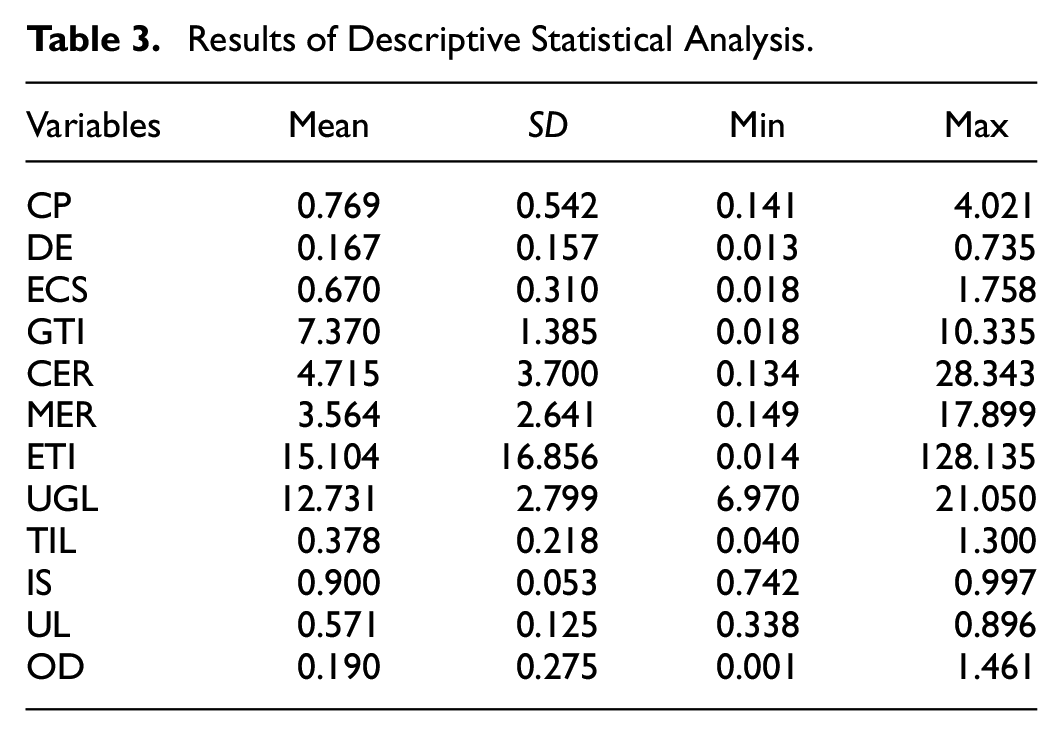
In this study, descriptive statistical analysis is conducted on CP, DE, ECS, GTI, CER, MER, ETI, UGL, TIL, IS, UL, and OD. The results are presented in Table 3
Results of Descriptive Statistical Analysis.
Correlation Analysis
This study analyzes the correlation between variables, and the results are shown in Table 4.
Results of Correlation Analysis.

, **, and *** denote significance at the 10%, 5%, and 1% levels, respectively.
From the results of the correlation analysis in Table 4, the OD has the highest correlation coefficient with UL at 0.718 without considering the coefficient between DE and CP. Therefore, this study further conducts a variance inflation factor (VIF) analysis on all variables and the results are shown in Table 5. All variables’ VIF values are below 4, and the average VIF is 2.50, which is much smaller than the critical value of 10, indicating that there is no multicollinearity between the variables.
Results of Variance Inflation Factor Analysis.

Econometric Model Selection
We use SPSS 25.0 software with the Linear trend at point command to supplement the missing values of sample data, followed by STATA 15.0 software to test the model selection for this panel data. The results of the F-test show that F (29, 263) = 25.20, Prob > F = .000, indicating that the fixed effects model is more appropriate than the mixed effects model. The results of the Hausman test show that χ2(7) = 52.68, Prob > χ2 = .000, indicating that the fixed effects model is more appropriate than the random effects model. Therefore, the fixed effects model is chosen for the regression in this study. In addition, heteroskedasticity and serial correlation often exist in panel data, and this study also performs heteroskedasticity and serial correlation tests. The results show that χ2(30) = 11,917.51, Prob > χ2 = .000, indicating the existence of heteroskedasticity; F(29, 233) = 15.07, Prob > F = .000, indicating the existence of serial correlation. Liu et al. (2018) contended that feasible generalized least squares (FGLS) could correct data problems such as heteroskedasticity and serial correlation to improve the consistency and validity of panel regressions; therefore, to eliminate the heteroskedasticity and serial correlation problems, the FGLS estimation method is used for data analysis in this study.
Direct Effect Test
Benchmark Regression Analysis
The regression results of the impact of the DE on provincial CP are shown in Table 6.
Regression Results of the Impact of the DE on Provincial CP.

, **, and *** denote significance at the 10%, 5%, and 1% levels, respectively. The values in parentheses are standard errors.
According to the regression results in Table 6, model 1-1 only includes the DE. Then models 1-2 to 1-7 include the six control variables of ETI, UGL, TIL, IS, UL, and OD one by one. In the model 1-1, the regression coefficient of the digital economy affecting provincial CP is positively significant, indicating that the digital economy can enhance provincial CP, supporting H1. With the addition of different control variables one by one, the regression coefficients of the DE affecting provincial CP remain significant, and the coefficients have a small change, indicating that the DE can contribute to provincial CP in a more stable way. Thus, it is clear that the DE is conducive to achieving an increase in CP.
Robustness Tests
To verify the stability of the benchmark regression results, this study conducts three robustness tests. (1) Instrumental variable method. In this study, a one-period lagged DE is used as an instrumental variable for the current period DE and a two-stage least squares regression is used to address the endogeneity issue. (2) Winsorizing treatment. To prevent the impact of outliers on the research results, this study regresses the relevant variables after winsorizing treatment at the 1% quantile level. (3) Eliminating special samples. The four economically developed municipalities of Beijing, Shanghai, Tianjin, and Chongqing and the four relatively economically backward autonomous regions of Inner Mongolia, Guangxi, Xinjiang, and Ningxia are excluded, and the remaining panel data is regressed again. The results of the robustness tests are presented in Table 7.
Robustness Test Results.

, **, and *** denote significance at the 10%, 5%, and 1% levels, respectively. The values in parentheses are standard errors.
From Table 7, the regression coefficients of the DE on provincial CP remain positively significant after using the instrumental variable method, winsorizing treatment, and eliminating special samples and are consistent with the benchmark regression results in Table 6, indicating that the result is robust. The DE has an obvious positive effect on provincial CP.
Mediating Effect Test
The Mediating Effect of Energy Consumption Structure
When examining the mediating role of energy consumption structure, based on model 2-1, this study firstly examines the impact of the DE on ECS, then the impact of ECS on CP and finally the impact of the DE and ECS on CP, constructing models 2-2 to 2-4. The test results are presented in Table 8.
Regression Results of the Mediating Effect of ECS.

, **, and *** denote significance at the 10%, 5%, and 1% levels, respectively. The values in parentheses are standard errors.
In model 2-2, the DE significantly negatively affects ECS (β = −0.852, p < .01); in model 2-3, there is a significant negative effect of ECS on CP (β = −0.987, p < .01); in model 2-4, there is a significant effect of ECS on CP (β = −0.649, p < .01), and the coefficient of the explanatory variable of the DE is also significant (β = 1.699, p < .01), indicating that ECS has a partial mediating role in the impact of the DE on provincial CP, supporting H2. Clearly, advancing the DE can improve CP by reducing the coal-based ECS.
To further verify the mediating effect of ECS, this study uses the bootstrap method proposed by Preacher and Hayes (2004). Using SPSS 25.0 software, with the sample size set at 5,000 and the confidence interval set at 95%, the sample confidence interval is [0.388, 0.737], which does not contain 0, indicating that the mediating effect is significant and the result is robust.
The Mediating Effect of Green Technology Innovation
When testing the mediating role of GTI, based on model 3-1, this study firstly examines the impact of the DE on GTI, then the impact of GTI on CP and finally the impact of the DE and GTI on CP, constructing models 3-2 to 3-4. The test results are presented in Table 9.
Regression Results of Mediating Effect of GTI.

, **, and *** denote significance at the 10%, 5%, and 1% levels, respectively. The values in parentheses are standard errors.
In model 3-2, there is a significant positive effect of the DE on GTI (β = 3.686, p < .01); in model 3-3, there is a significant positive effect of GTI on CP (β = 0.248, p < .01); in model 3-4, there is a significant effect of GTI on CP (β = 0.158, p < .01) and the coefficient of the explanatory variable of the DE is also significant (β = 1.671, p < .01), which indicates that green technology innovation has a partial mediating role in the impact of the DE on provincial CP, supporting H3. Clearly, the DE can further improve CP by increasing the level of green technology innovation.
This study also uses the bootstrap method to further test the mediating effect of GTI. With the sample size set at 5,000 and the confidence interval set at 95%, a sample confidence interval of [0.445, 0.776] is obtained, which does not contain 0, indicating that the mediating effect is significant and the result is robust.
Moderating Effect Test
The Moderating Effect of Command-and-control Environmental Regulation
This study constructs models 4-1 to 4-4 to test the moderating role of CER in the process of the DE affecting provincial CP. The results are presented in Table 10.
Regression Results of the Moderating Effect of CER.

, **, and *** denote significance at the 10%, 5%, and 1% levels, respectively. The values in parentheses are standard errors.
In model 4-2, the DE has a significant positive impact on provincial CP (β = 2.252, p < .01). In model 4-4, the regression coefficient of the interaction term between CER and the DE is significantly negative (β = −0.213, p < .01), indicating that strict environmental regulation weakens the promoting role of the DE on provincial CP, supporting H4a. This study uses Process program in SPSS software to further verify the moderating effect of CER. With the sample size set at 5,000 and the confidence interval set at 95%, the sample confidence interval is [−0.316, −0.109], which does not include 0, indicating that the moderating effect is significant and the result is robust. This finding indicates that when CER is enhanced, the role of the DE in promoting provincial CP is weakened.
This study presents Figure 2 to illustrate the moderating role of CER in the process of the DE affecting provincial CP. Figure 2 shows that in contrast to low CER, the straight line under high CER is flatter, indicating that CER weakens the positive effect of the DE on provincial CP.

Moderating effect of CER.
The Moderating Effect of Market-based Environmental Regulation
This study constructs models 5-1 to 5-4 to test the moderating role of MER in the process of the DE affecting CP. The test results are shown in Table 11.
Regression Results of the Moderating Effect of MER.
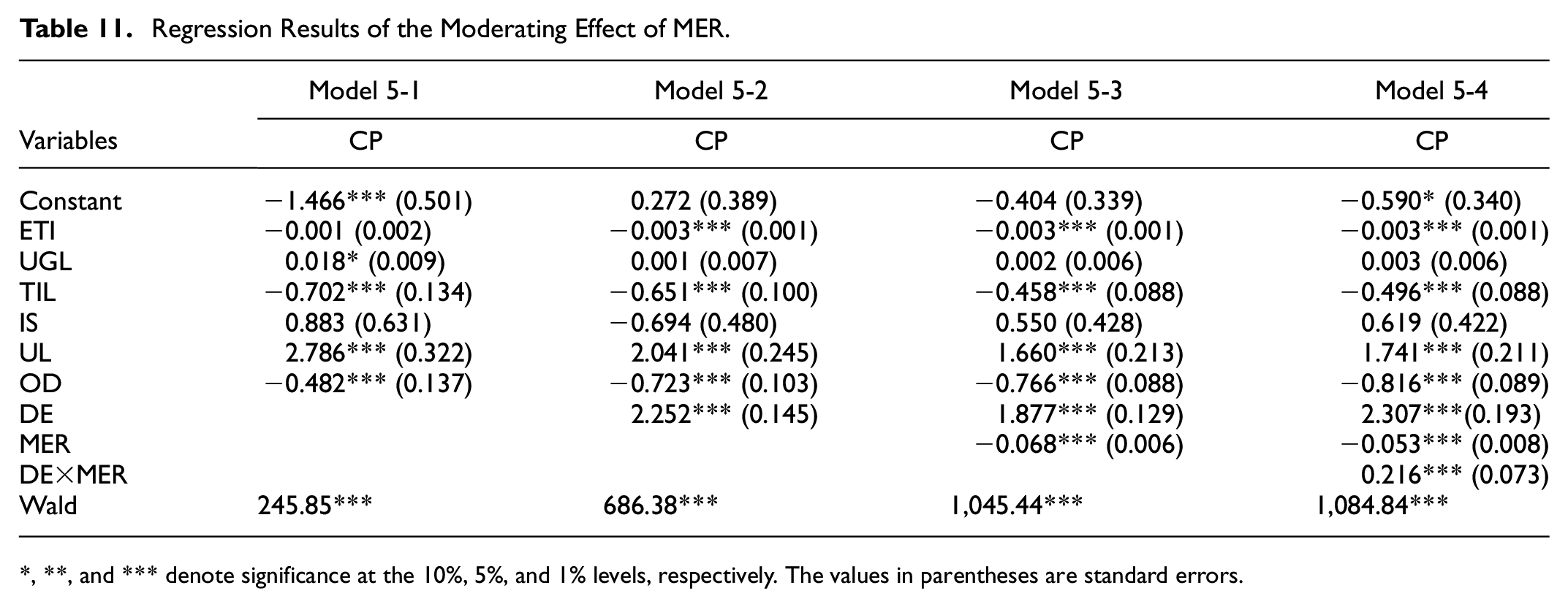
, **, and *** denote significance at the 10%, 5%, and 1% levels, respectively. The values in parentheses are standard errors.
Model 5-2 indicates that the DE has a significant positive impact on provincial CP (β = 2.252, p < .01). In model 5-4, the regression coefficient of the interaction term between MER and the DE is significantly positive (β = 0.216, p < .01), indicating that MER can enhance the promoting role of the DE on provincial CP, supporting H4b. This study also uses the Process program in SPSS software to further verify the moderating role of MER. When the sample size is set at 5,000 and the confidence interval is set at 95%, the sample confidence interval is [0.070, 0.363], which does not include 0, indicating that the moderating effect is significant and the result is robust. The finding demonstrates that the enhancement of MER strengths the role of the DE in promoting provincial CP.
This study presents Figure 3 to further illustrate the moderating role of MER in the impact of the DE on provincial CP. Figure 3 shows that the straight line under high MER is steeper than that under low MER, indicating that when the MER is higher, the positive impact of the DE on provincial CP is more significant.

Moderating effect of MER.
Discussion
Existing studies have conducted extensive discussions on the relationship between the digital economy and carbon emissions, and have achieved certain results (Z. Li & Wang, 2022; Ma et al., 2022; J. Zhang et al., 2022). However, there are few studies on the impact of the digital economy on carbon productivity. Existing literatures mainly study China’s low-carbon development status from the perspective of carbon emissions, few literatures explore the development of China’s low-carbon economy from the perspectives of both carbon emissions and economic development. Therefore, this study focuses on carbon productivity that reflects both low-carbon development and economic growth, and explores the impact mechanism of the digital economy on carbon productivity.
Scholars (Y. Li et al., 2021; Peitz & Waldfogel, 2012) believed that digital technology could help to reduce carbon emissions and achieve economic development. The research conclusion also confirms this viewpoint. The result of H1 shows that the digital economy has a positive impact on carbon productivity. Digital technology is conducive to reducing the excessive consumption of physical resources and energy by traditional industrial production. The carbon emission trading platform based on digital technology can quickly reduce the intensity of carbon emissions and improve the efficiency of energy use and allocation (Peitz & Waldfogel, 2012). Through efficient exchange and sharing of data resources and market information, the digital economy can promote the formation of cluster and network effects in industrial ecological factors, further squeeze the development space of high energy consumption and high emission industries, optimize industrial structure. Therefore, the digital economy is conducive to improving carbon productivity.
The results of H2 and H3 indicate that the digital economy promotes the improvement of provincial carbon productivity by optimizing energy consumption structure and improving green technology innovation. On the one hand, Miller and Wilsdon (2001) argued that the digital economy, with data as the key production factor and digital technology as the core driving force, could promote green technology innovation. Digital technology has the characteristics of fast iteration, fast diffusion, and strong penetration. By integrating with energy-saving and low-carbon technologies, it can accelerate the supply and diffusion of green technology innovation, promote the transformation of traditional industries to low-carbon and intelligent development, improve the technological efficiency and labor productivity in the production process of traditional industries, reduce energy consumption and carbon emissions per unit of output, and thus increase the growth rate of carbon productivity. On the other hand, the digital economy can also improve carbon productivity by optimizing resource allocation and improving energy utilization efficiency through allocation effects. The application of digital technology can better help stakeholders to understand the trends and price changes in the energy market to ensure energy supply, and guide energy elements to achieve efficient allocation, and can also help to promote the smooth upgrading and optimization of energy consumption structure, and increase the output value increment of unit energy to form a new mode of economic development and energy consumption, and finally promote the integrated development of low-carbon and the improvement of carbon productivity.
Scholars (Cui et al., 2022; Sun et al., 2023) argued that environmental regulation had two sides to green development. The findings of this study confirm this view. The results of H4a and H4b show that there are differences between different environmental regulations. Command-and-control environmental regulation mainly restrains enterprises and focuses environmental performance by enforcing policies and relevant laws and regulations. At this time, overly strong and unitary command-and-control environmental regulation brings greater resistance to the development of the digital economy and business operations, leading to a reduction in the economic benefits of carbon emissions in the region, which is not conducive to the improvement of the provincial carbon productivity under the digital economy. Market-based environmental regulation mainly uses market regulation mechanisms, such as the price of emission rights, carbon trading and other channels to control pollution behavior. As a result, market-based environmental regulation will formulate well-designed countermeasures according to the specific market conditions, and can trigger certain innovative behaviors to meet or even exceed the requirements of environmental policies, reflect greater flexibility. In this context, market-based environmental regulation can help to enhance the contribution of the digital economy to provincial carbon productivity.
Conclusions and Implications
Conclusions
Based on the panel data of 30 provinces in the Chinese mainland from 2010 to 2019, this study explores the direct effect of the digital economy on provincial carbon productivity, further analyzes the mediating roles of energy consumption structure and green technology innovation, and the moderating roles of command-and-control and market-based environmental regulations. The research conclusions are threefold.
(1) The digital economy has significantly improved provincial carbon productivity, which can promote the rapid development of low-carbon economy, so as to achieve the dual goals of reducing carbon emissions and promoting economy development. It can be seen that the improvement of carbon productivity is closely related to the digital economy. The digital economy provides strong support for carbon productivity and is an important driving force for low-carbon innovation, helping to improve provincial carbon productivity level.
(2) The energy consumption structure and green technology innovation both play mediating roles in the process of the digital economy affecting provincial carbon productivity, that is, the digital economy improves provincial carbon productivity through two paths: optimizing energy consumption structure and improving green technology innovation. On the one hand, the development of the digital economy is conducive to the intelligent transformation of energy production processes, optimizing the energy consumption structure, thereby reducing carbon emissions and improving carbon productivity. On the other hand, it can promote the development of low-carbon energy technology, improve the level of green technology innovation among various entities in the province, and enhance provincial carbon productivity.
(3) Different types of environmental regulations play different moderating roles in the process of the digital economy affecting provincial carbon productivity. Under the command-and-control environmental regulation, various entities in the province are subject to strict and clear emission reduction goals and technical standards, which increases additional costs and weakens the promotion effect of the digital economy on provincial carbon productivity. Under the market-based environmental regulation, more flexible marketization methods can motivate various entities in the province to develop and utilize digital technology to achieve carbon emission reduction goals, thereby enhancing the promoting effect of the digital economy on provincial carbon productivity.
Implications
Based on the research conclusions, this study proposes four implications:
(1) Relevant departments should promote the development of the digital economy and make the digital economy as a sustainable driving force to guide the improvement of provincial carbon productivity. Relevant departments should further strengthen the construction of digital infrastructure such as the internet, 5G, artificial intelligence, and blockchain, accelerate the integration of the real economy and the digital economy and promote the digitization of high coal consumption, high pollution, and other industries. It is also essential to utilize emerging digital technology to conduct the all-round and full chain transformation of traditional industries, improve operational efficiency, fully utilize the superposition and multiplication effects of the digital economy and promote the development of low-carbon economy.
(2) Enterprises and other stakeholders should optimize the energy consumption structure, improve energy efficiency and play the role of the digital economy through the energy consumption structure on provincial carbon productivity. On the one hand, regarding energy consumption, stakeholders should comprehensively use digital technologies, such as big data, cloud computing, and the IoT to change the mode of energy consumption, realize the digital and intelligent upgrading and green development of the industry, promote the traditional energy industry to the high-end development, and improve energy utilization efficiency. On the other hand, stakeholders should utilize the internet to introduce new energy consumption concept, and improve provincial carbon productivity by reducing the proportion of traditional energy consumption and reducing carbon emissions in the production process, to enable the role of the digital economy to be played on provincial carbon productivity by the energy consumption structure.
(3) Enterprises and relevant departments should utilize the bridge role of green technology innovation under the digital economy to promote the improvement of provincial carbon productivity. On the one hand, enterprises should improve their core technologies on the basis of existing green technology innovation, accelerate the transformation and upgrading of key green innovation technology, improve the level of green technology R&D, and enable the digital economy and green technology innovation to form a driving force for carbon productivity. On the other hand, relevant departments should strengthen the dominant position of enterprises in green technology innovation, increase investment in R&D of green production technologies, promote green technology innovation under digital economy, so as to improve carbon productivity.
(4) Relevant departments should formulate appropriate environmental policies to provide a good institutional environment for the development of provincial carbon productivity. Relevant departments should implement appropriate environmental regulation standards according to the current circumstances of local economy and industrial layout, combing with enterprises’ demands and make full use of the different impact of various environmental regulations. When adopting command-and-control environmental regulation instruments, relevant departments should strengthen the implementation of supervision mechanisms to prevent the command-and-control environmental regulation from adversely affecting the carbon productivity under the digital economy. In contrast, relevant departments should support the implementation of market-based environmental regulation instruments that encourage enterprises’ initiative by guiding enterprises’ transformation, and enable the promoting role of the digital economy to be enhanced in provincial carbon productivity.
Limitations and Future Research
This study analyzes the impact of the digital economy on provincial carbon productivity, but there are some limitations that can be further investigated in future research. Firstly, the performance of carbon productivity in various industries differs. In the future, the impact of the digital economy on carbon productivity in different industries can be explored to reveal the relationship between the digital economy and carbon productivity in various industries more comprehensively and accurately. Secondly, this study only explores the impact of the digital economy on carbon productivity at the provincial level from the macro perspective. In the future, enterprise data could be used to conduct longitudinal tracking research on typical enterprises by case study to analyze the impact of the digital economy on enterprise carbon productivity from the micro level. Finally, this study only takes China as the research object. In the future, the scope of sample selection can be extended for comparative research to provide more targeted suggestions.
Footnotes
Declaration of Conflicting Interests
The author(s) declared no potential conflicts of interest with respect to the research, authorship, and/or publication of this article.
Funding
The author(s) disclosed receipt of the following financial support for the research, authorship, and/or publication of this article: This study was supported by the General Program of the National Social Science Fund of China “A Study on the Impact of Institutional Gap on the Social Responsibility of Chinese Overseas Investment Enterprise” (Grant No. 18BGL026).

Data Availability Statement
Data sharing was not applicable to this article as no datasets were generated or analyzed during the current study.