




Abstract
Lexeme and root are the prominent, competing morphological approaches that account for the building of words. This study presents a sample of diminutive and super-diminutive forms of native Arabic words and loans from English in the Buraydawi dialect of Najdi Arabic (BNA). Nominals were randomly gathered and transcribed. Unlike consonants, the vocalic melodies of diminutives in BNA reveal a high degree of inconsistency. This can be illustrated with the diminution of d
Introduction
Diminutive formation is an active linguistic phenomenon found in many languages, and it has attracted much scholarly attention. Within Arabic linguistics, diminution has long been a hot topic of debate, notably in the battle between the Basˤri and Kufi linguistic schools, which were two old Arabic linguistic institutes based in two cities in Iraq, Albasˤrah and Alkufah. One of their main disputes was the criterion of classifying a sentence as either verbal or nominal. Each school has its particular viewpoints (see Saidat, 2006: 11–16).
In the present study the meaning, both semantic and pragmatic, of diminution will be largely ignored in favor of its morphological form. With that said, Al-Rojaie (2012) notes that diminutives go beyond showing smallness; they are pragmatically meant to express hidden meanings such as affection, appreciation, depreciation, and irony. As Fayez (1990: 83) remarks: “The diminutive in Arabic has a semantic function of physical diminution, which evolves into other meanings acquiring a certain affective nuance either in a positive or in a negative sense.” He adds that when “the distance between two points, either in time or space, is very short. . . the number or quantity of a given noun in the plural is small. . . and may show contempt, degradation or augmentation” (Fayez, 1990: 83–84).
The formation of diminutives shows tremendous variation not only across languages, but also across varieties of particular languages. For instance, most Arabic varieties create diminutive structures using a template, for example, the syllabic structure of CvCvvC for diminution renders ʔitˤtˤa “cat” into ʔutˤeetˤa “cat-DIM” in the Cairene dialect of Arabic. But Watson (2006) remarks that the most common strategy for deriving diminutives in this dialect is the suffixation of -aaya.
The scant literature about Arabic dialects has shown that Standard Arabic (SA) has more restrictive morphological patterns than other commonly used forms of colloquial Arabic. Notably, the term “super-diminutive,” which I invoke for my Buraydawi dialect of Najdi Arabic spoken by residents of Buraydah in Saudi Arabia (henceforth, BNA), has not been a subject of discussion among linguists who specialize in formal Arabic. In examining my own spoken Arabic, I noted an extensive usage of diminutives accompanied by consistent consonants, but different vocalic melodies when expressing diminution. For instance, the noun r
The Templates of Diminutives in BNA.

Although dialects of Arabic are rich in affixes for creating nouns, traditional Arabic linguistics singles out the consonantal root as playing a key role in the formation of words. In particular, the consonantal root, along with its vocalic melody, is widely assumed to be inseparable from the expression of linguistic meaning in Arabic. In other words, the root consonants, accompanied by unpredictable vowels, are considered the core elements for creating a meaningful Arabic word. A central question, then, is whether we should consider the root and/or the lexeme to account for the derivation of the diminutives and “super-diminutives” in BNA. One objective of the present study is to test two prevailing theories regarding whether Arabic morphology is root- or lexeme-based.
The second objective of this study is to present a new account of super-diminutives in BNA. The extended levels of diminutives in BNA have not been previously discussed in the literature on Arabic. Vowel melodies represent the main process for creating diminutives, and in a few cases a semi-vowel (/j/ or /w/) is introduced along with vowels. Consonants can also be repeated in diminution, but a consonant in such a case must be a part of the diminutivized noun. My aim is to present the mechanisms that govern the application of these diminutives on the lexical level in order to show how the alternation in the vocalic melodies of these words creates some difficulty in predicting the vowels, but not the consonants.
The data in this study consist of 41 nominal words. For words of Arabic origin, there are 25 concrete nouns and 6 dynamic nouns. The data also include 10 loanwords from English. In order to ensure the validity of the list, I consulted native speakers and modified the list as necessary. The total classes of diminutives that I finalized are 13. Generally, the classes indicate that BNA has three levels of diminution: first-degree diminutive, second-degree diminutive, and super-diminutive. My idea of first-degree comes from the operation of diminution in SA, where it follows the internal structure Caj. A comparable pattern in BNA has the template Caɪj. First-degree and second-degree diminutives exhibit free variation and can be considered doublets, as no clear distinction emerges when speakers shift between them. The super-diminutive, however, may convey an extreme degree of smallness, making it less suitable for classification as a doublet. When we consider each class in isolation, the three levels are not distributed equally in the list of nouns. The system has suffered some disruption, leading to one of two outcomes: either nouns will fall under two levels, or in some cases, the noun is restricted to only one.
An example of a class A noun is sˤaħan “plate,” which accepts all three levels of diminution:
The study is structured as follows. First, I discuss root-based and lexeme-based approaches to Arabic morphology. I refer to the two theories in Aronoff (2013) and Benmamoun (2003). I also elaborate on Watson’s (2006) investigation of the diminutives in San’ani Arabic, in which she also mediates between the two theories and ultimately suggests that either theory marks a possible approach to the same set of data. Then, I explain how diminutives function in SA and other dialects to determine the similarities to, and differences from, BNA. After that, I analyze the samples to see if the tokens support or contradict the frameworks adopted in this study. Later, I connect the theoretical approach with the data. The final section is the conclusion.
Lexeme or Root
In this section, I will briefly discuss three central ideas about the role of roots in Arabic. I start by summarizing Aronoff’s (2013) approach and how he upholds the lexeme theory. I then cover Benmamoun’s (2003) analysis of word interdependency in the linear order of segments, which proceeds from left to right, and how this is supported by his data. Lastly, I present Watson’s (2006) view, based on diminutives in San’ani Arabic, that root and lexeme accounts are equally possible proposals.
I switch back and forth in this study among “root,” “lexeme,” and “stem.” I use root to mean the consonantal basis without any consideration of vowels; for example, the Arabic noun
Over the past decade, the definition of the root and lexeme has dominated the literature on Arabic morphology. Aronoff (2013) illustrates the root-based idea with Distributed Morphology (DM), quoting an assertion by the distributed morphologist Marantz (1997) that roots denote meanings. Aronoff (2013) attributes the root-based view of DM to the “Jakobsonian vision of languages: lexical items should be reduced to roots and each root should have a single form and a single meaning at some underlying level” (p. 164). He goes on to emphasize that in DM, roots are “the only true bearers of lexical meaning” (pp. 165–167). But Aronoff opposes the concept that roots contain the mechanisms to construct a concrete morphological structure. He states, “[I]t is not obvious that the root as we understand it today was isolated as a distinct entity by the early Arabic grammarians” (p. 162). According to Aronoff, the belief that the root has something beyond its linguistic shape is nothing more than an old Arabian tradition without any basis in modern linguistics. Rather, he maintains that operations on morphological components must have dependent and unchanged meanings. Thus, any given lexeme may owe its isolatable and constant sense to operations rather than to the root.
Aronoff offers an English parallel to his doubt that the root alone constructs a meaning in Arabic. He provides multiple instances of the verb RUN in English as a demonstration that a root appears to have different meanings: (a) He ran the table; (b) The trains run between Jerusalem and Tel Aviv; (c) run a bath; (d) run before the wind (used of a sailboat); (e) overrun; (f) run over; (g) run a seam; (h) run up a bill versus run up a hill; (i) run someone through with a sword. His argument here—that a root doesn’t have an extended meaning—can be weakened by giving a general semantic value to the verb run—it means “to cause to move or operate.” There are different runs, yet all in one way or another refer to one basic semantic referent. Therefore, English in this regard has a root with a basic meaning and many lexemes. This contradicts his claim for polysemy—his own English example is not strong enough to support the lexeme-based theory over the root-based one.
However, his argument may be substantiated and expanded to Arabic roots if Arabic has roots that refer to more than one semantic value. This has been suggested for the Arabic root n-dʒ-d. Some of its semantic values are presented in Aronoff (2013: 171) as (a) to, help, aid, assist, support; to sweat, perspire; (b) to furnish, upholster; to comb, card, tease (cotton); (c) to travel in the highlands (of Arabia); (d) to ask for help, seek aid; to take liberties, make bold [decisions]. This leads Aronoff to observe that “[d]ictionaries of Arabic ever since have been arranged by the forms of roots, not their meanings” (p. 170).
As mentioned above, Aronoff’s take on Arabic morphology contradicts the work of traditional Arab grammarians. For instance, ɪbn fa:ris (d. 1004), in his dictionary maqaji:s alluɣah “Measures of Language,” which is available online in the search engine [http://www.baheth.info], insists that the root in Arabic has a basic semantic meaning. According to him, the meanings of the forms listed under the entry of one root can be linked semantically to the basic meaning of the root. Each entry begins with the consonantal sounds of the root, followed by the specification of semantic values. For example, in the entry for غفل ɣ-f-l “to neglect,” ɣfl (2025), he writes (the transliterations and translations are mine):
alɣa “the consonant /ɣ/” wa “and” alfa “the consonant /f/” wa “and” alla:m, “the consonant /l/” are a sound ʔasˤl “origin,” it is when something is left either accidentally or on purpose.
Turning now to Benmamoun (2003), he claims that building a word from the stem of another is possible in Arabic. His thesis is that the imperfect can be mapped to discover the nominal, the imperative, and the perfect form. In a word form like the imperfective ya-lʕab “he plays,” one can form the nominal ma-lʕab “playground,” the imperative ɪ-lʕab “play,” and the perfective laʕab “he played.” As we can see from the stem lʕab of the imperfective, it is unchanged in the nominal and the imperative. The affix ya- is the only prefix that is subject to modification (where -ya becomes -ma and ɪ-), or deletion (in the perfective) if there is no prefix needed. The perfective l
I have tried to test Benmamoun’s assumption on some Arabic imperfectives to see whether the pattern can be sustained. While the form ya-lʕab “he plays,” mentioned above, backs the idea of lexemes and supports Benmamoun’s analysis, the imperfective ya-sdʒud “he prostrates,” which becomes the nominal ma-sdʒɪd “mosque”; the imperative u-sdʒud “prostrate”; and the perfective sadʒad “he prostrated” are derived differently. Here, the variants of the root s-dʒ-d challenge the lexeme-based theory because the stem sdʒ
Lastly, Watson’s (2006) article investigates the diminutives in San’ani Arabic and considers them in light of stem-based theory as well as root-based theory. To differentiate the root from the stem in San’ani diminution, she considers how native speakers of the dialect refer to the source of the diminutive. The survey participants often give only one word as a reference for the diminutive words, for example, wazi:r “minister” (from the root /w-z-r/) for the diminutive twajzar, or mudi:r “manager” (from the root /d-w-r/) for the diminutive tmajdar. She therefore rejects the idea that the stem/lexeme is the basis of the formation due to the fact that there is a tight linkage among the diminutivized form, the base noun, and the root. The aforementioned base nouns wazi:r and mudi:r are easily linked to one base root each. But Watson implies that in some cases, an account in terms of both lexeme- and root-based morphology is possible. This is the case when the representation of the base noun is nearly identical to the root, as in tʔaysad “to act like a lion” from ʔasad “a lion” from the root /ʔ-s-d/, and twayɣad “to act the scoundrel” from waɣd “scoundrel” from the root /w-ɣ-d/. Although she does not state this explicitly, the implication is that the lexeme/root theories can combine in the analysis of diminutives in Arabic.
Moreover, Watson reasons that if the speakers of the dialect vary in their suggestions of stems as sources for a diminutive, or else if they refer to more than one stem as the source, then the diminutive in such a case would support the lexeme-based theory. The example she gives is the diminutive txajbal “to maintain a state of stupidity,” a product of four different stems, yet these stems are semantically and phonologically related. Another part of Watson’s research that further supports accounts in terms of lexeme-based theory concerns “synonyms and near-synonyms,” which refer to the sharing of some consonants or places of articulation due to the similarities between the root consonants, as well as being referents of shared semantic values. This is seen in /h-b-l/, /b-l-h/, /x-b-l/ “to show stupidity and naïveté” (p. 193). For instance, txajbal, mentioned earlier, is elicited with reference to the syllable structure tCayCaC without relying much on the root, since it is a matter of controversy among the informants. Watson (2006) extends this to her own observation of the San’ani expansion of the nominal diminutive structure CuCayC, as in ruways
In this section, I have discussed Aronoff’s, Benmamoun’s, and Watson’s ideas on root- and lexeme-based theories. I included their theories to provide context for my analysis of diminutives in BNA and to determine which framework is most suitable to explain the data.
Diminutives in Arabic
The purpose of this section is to show how diminutives are formed in SA. I also give an idea of diminutive formation in some dialects of Arabic. It is worth noting that none of the literature on Arabic and its dialects has anything to say with regard to the claim that I posit in this article about the availability of super-diminutives in BNA. I link this fact to the extended and expanded morphology of BNA, which I consider to be dialect-specific.
To begin, we must consider diminutives in classical/standard Arabic. The best study for our purposes is by Fayez (1990), who divides the basic diminutive patterns in accordance with their agreement with the consonantal stem number. He refers to Si:bawaijh, one of the best-known grammarians of Arabic, who splits the diminutives in Arabic into three types. The tri-literal consonant root is matched to the diminutive measure of /fuʕajl/, as in (1a) and (1b); the quadri-literal consonant root is mapped to the measure of /fuʕajʕil/, as in (1c) and (1d); and the quinti-literal consonant root is associated with the measure of /fuʕajʕi:l/, as in (1e) and (1f).
If we consider the words in (1e) and (1f), we notice that the long vowel is the fifth radical in the word. In compliance with the Arabic system of word-building, mɪfta:ħ is constructed from five consonants (m, f, t, the weak consonant alif, and ħ). I should note that Gadalla (2000: 72–87), in his comparison between Standard and Egyptian Arabic, divides verbs in Arabic into “weak” and “sound.” He states that three kinds of defective/weak verbs exist. Any verb that features the consonants /w/, /j/, or /ʔ/ is considered weak. In many cases the three “weak” consonants are represented as /uu/, /ii/, and /aa/, respectively. Moreover, Ryding (2005: 464) claims that a combination of two weak roots yields a “doubly weak verb,” as in
Alshboul et al. (2013) present the -aat suffix for diminutives in the plural. -aat could be considered the default for most SA words in order to transform the singular diminutive into the plural. In this case, ʔurajnib in (1d), the diminutive of the singular “rabbit,” becomes ʔurajnib
Cross-dialectally, Masliyah (1997) writes about Iraqi Arabic (IA) diminutives and provides a set of tools that represent diminution in the Baghdadi dialect. He uses two interesting approaches. The first approach involves the application in IA of the reduplication pattern and the double diminutive form. For partial reduplication of the consonantal root, he uses the base nouns ħadʒdʒɪ “a man who has been to Makkah” and xadd “cheek” (p. 74) to show how they become ħ
In his second approach, some of his mechanisms are marginal. He considers ta:ʔ marbu:tˤah “feminine /t/” a diminutive suffix, represented in a linear suffix -ah following the base noun (Masliyah, 1997: 71–72). Examples he gives are ħama:m - ħama:m-
After ħadʒdʒɪ and xadd are eliminated, diminutives in IA are in some cases in favor of the lexeme-based approach. IA data show that the diminution is not strictly for nouns, due to the fact that adjectives can be diminutivized. Watson’s (2006) data from San’ani Arabic, mentioned earlier (in the Lexeme or Root section) are also examples of verbal diminutive formation (twayɣad “to act the scoundrel-DIM” and twajzar “to act a minister-DIM”).
Badarneh (2010) analyzes diminutives in Jordanian Arabic from the point of view of their pragmatics. I examined the morphological structure of the examples discussed in the article and found that all diminutive tokens in the sample are matched to a vocalic melody. -ay- is added to exhibit the diminutive form word-medially, as in xw
Another type of Jordanian Arabic (spoken in Wadi Ramm) operates with more productivity, as it features alternation among a few structures for generating diminution (Al Mashaqba, 2015: 188–189). According to this study, the common templates for singular nominals are CCajjiC, CCe:C, and CCe:Ci:C. The last template can be seen in mifta:ħ “key,” which turns into mfe:ti:ħ. In the case of plural nominals, other template patterns are in place: CCe:Ca:C, CCe:CCa:C, CCajCa:C, and CCajCCe:C. The last of these structures is found in ɣurfti:n “two rooms,” which is diminutivized as ɣrajfte:n.
Other types in the data include the color adjectives, for which Al Mashaqba claims to have five possible alternating templates: CCajjiC, CCe:C, CaCe:CiC, CaCajCiC, and CCajC. The base forms of these adjectives are represented in a three-way diminution by selecting one of the five patterns for each diminutivized color; for instance, the word ʔasmar “brown” can be turned into a diminutive in three ways: Ɂase:mir, smajjir, or smēr. The alternation could be considered a case of doublets, since we do not have any evidence for their semantic values, or it could be something of the same nature, in which there are two variants of diminutives for the same base word. This was reported in Mashaqba et al. (2022) for samra “swarthy,” which has a two-way diminution: smeera (for Jordanian Bedouin) and sammuura (for Jordanian urban). As reported in Jaradat and Alkhawaja (2024: 4), Jordanian Arabic utilizes another templatic structure C1aC2.C2u:C3 for forming diminutives, wherein the root dbr yields dab.bu:r “wasp.”
A recent study by Davis et al. (2024) examined the base formation of augmentative forms in Ha’ili Arabic (a dialect spoken in Saudi Arabia) and found that, in most cases, diminutives serve as the base for plural nouns in the dialect. The study identifies monosyllabic structures such as CVCC, CVGG, CVVC, and CCVVC as the driving force behind elevating the diminutive to a base for generating plural forms. In these syllable types, plurals are derived by altering the vocalic melody of diphthongs (eɪ or aɪ) into a long vowel (aa), a process observed in both mono- and disyllabic words in the data. This finding challenges the notion that the imperfective form is the default base for word formation in Arabic, as proposed by Benmamoun (2003); the data from Ha’ili Arabic demonstrate that this principle does not hold consistently across dialects.
Going back to Standard Arabic, as we have seen above, base nouns in SA are mapped to three diminutive templates: CuCajC for the tri-literal roots, CuCajCiC for the quadri-literal roots, and CuCajCi:C for the quinti-literal roots. Further, SA applies the -aat suffixation to the diminutivized singular noun in order to generate the diminutive of the feminine plural. The masculine plural, on the other hand, is suffixed with -uun. Additionally, the common IA structure for diminutivizing nouns is CCe:C. Other base nouns attract suffixation instead: -aya, -ya, and -iyya. As for Jordanian Arabic, both affixation (-ay-) and suffixation (-ayy) are used for showing diminution.
In comparison, we will see in the analysis that BNA has many more variations in its templates than do other dialects. Notably, two strategies which are present in nearly all the diminutivized nouns in BNA are the metathesis of CV → VC and the epenthesis of the vowel /e-ɪ/ word-initially, as in
Methodology
The word list (in Appendix 1) identifies the diminutive forms in BNA by carefully considering the permissible word formation among the younger generation. For the sake of limiting the scope of this morphological analysis, the data solely focus on the nominal lexicon.
Therefore, the building of the dataset was done by maintaining three strategies. First, the words were randomly gathered and transcribed. Second, after the list of words was reviewed and gone over, three clear boundaries were drawn among living (dynamic), non-living (concrete), and borrowed (loan) words. Third, in order to validate the practical usage of any diminution, a few native speakers of BNA were consulted and all archaic expressions were eliminated.
Data Analysis
In this section, I argue that in BNA, a method of preserving the consonantal phonemes in the root is a key element in producing diminutives and super-diminutives. The speakers of the language preserve the consonants of the base form and apply vocalic melodies, shifting from one representation to another. In other words, BNA diminutives and super-diminutives abide by the consonants in the stem of the base noun, yet in the data, most syllable structures of the words derived from the stem consonants alternate between two or three syllables, contradicting the base word’s construction. To the best of my knowledge, the data includes a comprehensive range of diminution patterns and structures found in BNA.
The data have been split into three main categorizations: concrete words, dynamic words (i.e., living things), and loanwords, though the loanword section has only one dynamic word: kabtɪn “captain.” Two dynamic words are included in the category of concrete words: sɪndʒa:b “squirrel” and dɪxaleh “prinia bird.” This is due to the general classification, and by virtue of the fact that these two words exhibit the same morphological formation type of their specific class. The super-diminutive of sɪndʒa:b follows the template ɪC1C2i:C3i:C4, as illustrated in class C, yet the super-diminutive of dɪxaleh has the template ɪC1C2i:C2i:C3, representing the extra-diminutive strategy for class G. Bear in mind that su:g “market,” from the Arabic root s-w-q, and ɪfra:ʃ “sleeping bag,” which belongs to the root f-r-ʃ, are included under the dynamic category (below) for comparative purposes, since they share the same root with the neighboring word.
The categories are then distributed into different classes. Due to the many alternations in the vocalic melodies of the diminutives and the super-diminutives, I divide the concrete native noun category into eight classes (A, B, C, D, E, F, G, and H). The dynamic native nouns are grouped into one class (I), and the category of borrowed nouns has four classes (J, K, L, and M). The tokens under each class vary in number because the samples were collected randomly to rotate as much as possible among the different vocalic interchanges of BNA diminutives and super-diminutives. With the exception of words in the concrete category, most words in the dynamic and borrowed categories have a tendency to adhere to one form of diminution.
The structure of base nouns in the data fluctuates among 1, 2, 3, and 4 syllables. Since disyllabic nouns are commonly used, they surpass the number of the other words. The type with the fewest number of words is the four-syllable, with one word only. In addition, the one- and three-syllable types equally share the remaining 12 words, with 6 for both.
All the base lexemes under the title “word” in the list that end with the suffix -eh/-əh are feminine words, as in classes B, G, and H. These two affixes have nothing to do with the final application of diminution because diminutives in BNA are realized through gradation on vowels, which tend to target the ultimate and penultimate syllables in the super-diminutives. Even so, if the final syllable in the super-diminutives is /eh/ or /əh/, the target would shift from the ultimate and penultimate to target the penultimate and antepenultimate syllables. This is a straightforward observation for the super-diminutives. However, the gradation of vowels in the diminutives from which we derive the super-diminutive would need to be explained in order to account for the lexeme-based theory, since the shift in vowels from base noun to diminutive to super-diminutive overlaps.
In the representation of each class, I transcribe the corresponding roots for each word provided. While some words in (11)-(14) are not purely Arabic, I do my best to show how these might look in the cognition of the mental lexicon of BNA speakers. We will go over these examples class by class, starting from class A in the concrete group and going up to class M in the borrowed part.
Concrete
In (2), which represents class A in the data, we have tri-literal consonantal roots where root (2a) /sˤ-ħ-n/ has a disyllabic word sˤaħan “plate,” but (2b) /d-r-dʒ/ derdʒ “drawer” and (2c) /θ-w-b/ θowb “thaub (a traditional garment)” are monosyllabic. A two-way structure is present among these base nouns. A close observation gives C1VC2VC3 for (2a), yet C1VC2C3 is found in (2b) and (2c). The strategy used to proceed from the base noun to the diminutives is done through metathesis on the first syllable, so the first and second consonants in the root would be in adjacent relation, resulting in the consonant cluster /sˤħ/, /dr/, or /θw/.
In compliance with the previous operation, the vowel in the first syllable of the base noun will be lost, and then the consonant cluster in the first- and second-degree diminutives, along with the super-diminutive, would motivate the vowel epenthesis. This vowel would be either the front vowel /ɪ/ or /e/, preceding the cluster /
Furthermore, for the second-degree and the super-diminutives, the partial reduplication of the first VC1C2 (e.g., /esˤħ/, /ɪdr/, or /ɪθw/) sequence is applied initially on all levels. The second-degree diminutive differs from the first-degree by having a disyllable only, and while the first syllable typically matches its counterpart in the first-degree, the final syllable will have the diphthong /eɪ/ before C3. The second consonantal root in the super-diminutive (C2) is reduplicated twice, along with the following long vowel: /i:/. The last heavy syllable of all words is closed finally with the consonantal root’s C3 (/n/-/dʒ/-/b/).
The examples in (3) demonstrate a different implementation of diminutives than what we have observed in (2). First, in contrast to base nouns in (2), the nouns in (3), which go back to the tri-literal roots /l-ʕ-b/ leʕbeh “toy” and /s-k-r/ sɪkkar “sugar,” have one unified syllable pattern: CVCCVC. The feminine suffix -eh is present in all diminutives (first-/second-degree and super-). For this reason, representing the diminutives without the feminine affix will lead to incorrect forms of diminution: *elʕaɪb/ *elʕeɪb/ *elʕi:ʕi:b or *eskaɪr/ *eskeɪr/ *eski:ki:r.
Furthermore, unlike the varying syllable structure of first-degree diminutives e/ɪC1C2aɪjeC3 and second-degree diminutives e/ɪC1C2eɪC3 in (2), the first- and second-degree diminutives in (3) have a roughly similar trisyllabic pattern (e/ɪC1C2
(4a) in class C has a quadri-literal root /s-n-dʒ-b/ → sɪndʒa:b “squirrel.” First, we have the employment of metathesis, as seen above in classes A and B. In the diminutive, the base nouns’ first two sounds are switched to become /ɪs/. The second consonantal root /n/ comes right after the function of metathesis applies to form the second syllable CV, resulting in the final syllabic representation of ɪCCeɪCɪC. Nevertheless, the syllable structure for the super-diminutive for the three nouns is ɪCCi:Ci:C.
Although the roots in (4b) and (4c) are tri-literal, in order to match the syllable structure of (4a) ɪsneɪdʒɪb “squirrel-DIM” and ɪsni:dʒi:b “squirrel-superDIM,” we are forced to insert the glide /w/. Thus, the glides are implemented for the purpose of either preserving the syllabic representation of similar words as in (4b) ɪd
In the tables below, the [*] symbol represents a mismatch with the general category of the list.
The tri-literal roots in (5a) x-t-m and (5b) r-k-z have paved the way for the diminutive forms in order to compensate for the absence of a fourth consonantal root. On the one hand, the base noun in (5a) xa:tam has added the glide /w/ to complement the consonantal melody of the other diminutives in the set, as seen in the second syllable of ɪx
If we compare the diminutives and super-diminutives in (5), a case of nearly full reduplication occurs, save for the fact that the ultimate short vowels in the diminutives (/ə/, /e/, and /ɪ/) change to long vowels /i:/. One example is (5c):
This could also indicate a shift in whether the representation abides by Mahadin’s rule (1989) on doublets. Based on ideas from Hoenigswald, 1960; Mahadin, 1989: 4) writes, “[I]n any language where we find two or more words having similar forms and denotations but differing only in one sound, we naturally assume that we have a phonological change, specifically, that one form is an old stage and the other is a later stage.” Super-diminutives may be another case of doublets, since the semantics are mainly preserved and the difference is found only in one vowel.
I include nufu:d “sand-dune” in (6) as a separate class because of its mismatch with class A in (2). This can be discussed in two ways. The first is that the diminutive in (6a) has only the first degree of diminution, ɪnfaɪjəd. The second discrepancy is the lost full reduplication in the super-diminutive ɪnfeɪfi:d, which according to the data in (2) should be fi:fi:. Yet we still have partial reduplication through the repetition of the second root’s C2, /f/, only: ɪn
The data for class A in (2) above, which has a three-way diminution, are similar to the nouns that we have here except that the diminutives in (7) have only the first-degree following the template ɪ/eC1C2aɪjəC3. Thus, the missing template in (7) that is found in (2) is the template of the second-degree diminutive: ɪ/eC1C2eɪC3. Nonetheless, the last syllable’s nucleus in the diminutive (/j
The super-diminutives in both (2) and (7) are presented similarly, with the pattern ɪ/eC1C2i:C2i:C3. Two reasons have led to the stability in the template’s form for the super-diminutive in classes A and F: the absence of the feminine suffix (-eh/-əh) and, more importantly, the tri-literal root of the base nouns.
In (8), base nouns belong to a tri-literal root, and (8a) θela:dʒəh “fridge” and (8b) dɪxaleh “prinia bird” are trisyllabic. By contrast, (8c) rɪ
Of special interest is (8c), in which /z/, the C2 in the root, is reduplicated twice in the super-diminutive. I assume the reason for this is that the base noun differs from its counterparts in (8a) and (8b) by having only one consonant cluster, /rz/, in the diminutive e
As I already briefly illustrated about the feminine -eh and -əh, consonantal roots do not affect the usual pattern of the diminutives. The main purpose they serve is to differentiate between the masculine and the feminine. Further, if we consider all the consonantal roots of all base nouns (along with diminutives and super-diminutives) in the data, we notice that the third consonants in the tri-literal, or the fourth in the quadri-literal, always occupy the coda position of the last syllable. Otherwise, these roots would reside in the onset whenever the feminine suffix (-eh/-əh) is present. The partial/full reduplication is restricted to the second consonant (C2) in the tri-literal roots. Moreover, the second root consonant in the quadri-literal, as in (5d) ɪd
The diminutives in (9) have only one form in the first category, that is, there is no second-degree diminutive. This suggests that these base nouns are semantically less common in comparison to the ones in classes A and B. Contrary to the diminutives in (6) and (7), which have the glide /j/ in the final syllable of diminutives, such as (7b) edʒwaɪjəl “cell-phone-DIM,” diminutives in (9a) ɪnʕaɪleh “one shoe-DIM” and (9b) esjaɪreh “car-DIM” have no glide inserted. Likewise, super-diminutives with the vocalic melody /aɪ/ on the penults receive full reduplication, as we have seen before in (7c) ɪdkaɪjən “mini-store-DIM” → ɪdki:ki:n “mini-store-superDIM” by repeating the second root’s C2 together with the following long vowel /i:/, except for (9c), which is best matched with class E’s ɪnfaɪjəd “sand-dune-DIM.” But here, no glide is epenthesized on the diminutive.
Furthermore, if we ignore the nucleus and coda of the ultimate syllable that hosts the feminine suffix -əh, the super-diminutive of class E’s ɪnfeɪfi:d is identical to the super-diminutive template pattern ɪC1C2eɪC2i:C3 of (9c)
In the analysis of the concrete diminutives of BNA, it has been explained that the diminutives are of different varieties. Some nouns prefer the three-way diminution, where they exhibit 2° in the diminutives, first and second, in addition to one super-diminutive. The nouns in the data are exposed to various vocalic melodies toward the syllable structure. While the first level of diminution prefers either the vocalic melody /aɪ/ with the feminine suffix ending -eh/-əh or /aɪj/ elsewhere, the second-degree diminutives prefer /eɪ/ in the ultimate syllable. However, the existence of a four-consonantal root or the insertion of /m/ or /w/ into the diminutivized nouns (see the examples in 5) would shift the vocalic melody /eɪ/ to reside in the penultimate syllable. Finally, the super-diminutives in the data have the two syllable structures e/ɪC1C2i:C2i:C3 and e/ɪC1C2eɪC2i:C3, yet there is no repetition of the second consonantal root, with the nouns either belonging to a quadri-literal root or accepting insertion (of /m/ or /w/).
Dynamic
In the dynamic category, I gather a group of six words, in which each pair similarly shares one root. Evidently, the first of the two combinations (10a) ʕadʒu:z “old lady,” (10c) su:g “market,” and (10e) ɪfra:ʃ “sleeping bag” take the ɪC1C2aɪjɪC3 pattern for the diminutive, yet (10b) ʕa
As noted above, the reduplication mechanism is present in the data in (10). We have partial reduplication by mapping the first three phonemes (e.g., ɪʕdʒ, ɪsw, and ɪfr) of the diminutives to create the super-diminutives. The vowel and consonant cluster of the word-initial VC1C2 are found among all diminutives in all levels in the data. Further, within the super-diminutives we have partial reduplication through the repetition of the consonants /dʒ/ ɪʕ
The diminutives in (10a) ɪʕdʒaɪjɪz “old lady-DIM,” (10c) ɪswaɪjɪg “market-DIM,” and (10e) ɪfraɪjɪʃ “sleeping bag-DIM” are a controversial issue because neither are they an extension of the super-diminutive, nor is the super-diminutive derived from the diminutive even though they belong to one base root. The syllable structure of the diminutives, ɪC1C2aɪjɪC3, is compatible with their diminutive equivalents in (6) and (7) and the first-degree diminutives in (2), showing a preference for the -aɪj- diphthong-glide pattern over the naked diphthongs /aɪ/ or /eɪ/. Besides, if we assume that this is an extension of a lost preceding diminutive level, the super-diminutives have favored the structure CeɪCi: over the commonly used structure of Ci:Ci:. The gemination has not been represented in the data before, except in (3b) sɪkkar “sugar” and (8c) rɪzz “rice.” Moreover, sɪkkar maintains the three levels of diminutives with the three different patterns (Caɪ/Ceɪ, Ci:Ci:), but rɪzz has preserved (Ceɪ, Ci:Ci:) only. It should be noted that the list in (10) contains words that encapsulate the general patterns.
Other template forms can also be detected among the BNA nominals with the same root. From the root /b-z-r/, for instance, the word bazer “kid” is diminutivized as ebzeɪr “kid-DIM,” while ɪbza:r “curry powder” is matched to the syllable structure ɪC1C2eɪC2i:C3: ɪbzeɪzi:r “curry powder-DIM.” By comparing the two diminutives of the root /b-z-r/, we may tentatively conclude that the template ɪCCeɪCi:C is more stable than ɪCCeɪC and ɪCCaɪjɪC, at least in the diminution of observed dynamic nouns.
The dynamic sub-section of BNA nominals shows that the nouns with one shared root apply the diminution differently. The semantic cognition of the diminutives has forced the split in diminutivization. Thus, in the dynamic category, the perceived diminutives refer to no more than one base noun. Despite the fact that I have labeled this section of my study “dynamic,” I failed to find identical counterparts of nouns representing living beings exclusively. For this reason, I was forced to add nouns of the same root, even though they represent abstract/concrete kinds of nominals. Now, I delve into English-borrowed nouns in BNA.
Borrowed
BNA has borrowed words from English that have been introduced into the morphological system of BNA. One of many ways to show this is to test it in the representation of diminutives. The base nouns kertu:n “cartoon” and beskowt “biscuit,” as adopted words, have gone into a function of analogy with data in (5c), (5d), and (5e) because they have quadri-literal roots. However, the structure that best accounts for the diminutives of the two words in (11) is the construction of the super-diminutive in (5), C2eɪC3i:.
The semantic meaning does not express any extra diminution, but the forms disfavor the first and second diminutive formation patterns /eɪ/, /aɪ/, and /aɪj/, which in turn led to their rejection. Metathesis and the consonantal roots are maintained in mapping from the word level to the diminutive one, occurring when /ke/ and /be/ become /ek/ and /eb/. Nonetheless, reduplication is not applicable because the super-diminutive is derived from a quadri-literal root.
Contrary to the data in (11), the borrowed words in (12) have preferred neither the super-diminutive formation pattern CeɪCi: nor the diminutive pattern CeɪC. For ɪblowzeh “blouse,” the preferred pattern is ɪCCaɪCeh as in ɪblaɪzeh “blouse-DIM,” matching the first-degree diminutives of native nouns in (3) elʕaɪbeh “toy-DIM1” and eskaɪreh “sugar-DIM1.” However, dʒakeɪt “jacket” favors the ɪCCaɪjɪC pattern illustrated in ɪdʒkaɪjɪt “jacket-DIM,” a structure that can be found in the diminution of BNA nouns in (2), (5), and (7).
The /w/ in ɪblowzeh is not realized as a part of the root; otherwise, it would be shown in the diminutive form. For this reason, it is a diphthong /ow/. Across the line and in glides /j/ and /w/, it is always a valid consideration to account for glides as a part of the root if they exist in both the word and the diminutive forms, as in (2c) θo
Since BNA speakers consider the long vowel /a:/ in the first syllable of (13a) r
Therefore, the first long vowel in the word list in (13) applies the same strategy as above; nevertheless, the last long vowel is a representation of the semi-consonant (glide) /w/. ebgeɪs in (13c) is directly matched to the syllable pattern of second-degree diminution, e/ɪC1C2eɪC3, shown in (2a), (2b), and (2c) esˤħ
Other cases enforce the insertion of /w/, although it is absent from the root as in (13). The long vowels /a:/ from alif or /u:/ from waw in the base noun, syllable-initially, are responsible for the /w/ insertion in erweɪdu: “radio-DIM” and eʃweɪmbu: “shampoo-DIM” below, along with diminutives of native BNA nouns with long vowels in the first syllable such as (4b), (4c), and (5a) above.
Loanwords in BNA presented in (14) exhibit the same behavior that was found in the pure Arabic words in class A mentioned in (2). Yet, the first- and second-degree diminutives are reversed in comparison to class A. While the varieties of the words in (2) sˤaħan, derdʒ, and θowb prefer the vocalic melody /aɪ/ followed by the glide /j/ as one chunk (i.e., /aɪj/) for the first-degree diminutive, borrowed words choose /eɪ/ for their first-degree diminutives. Moreover, the adopted words in (14) select the melodic representation CeɪCi:. Still, the words of Arabic origin (2) favor the Ci:Ci: structure.
All words in (2) and (14) apply the partial reduplication strategy. The doubling can be word-to-word as in (2a)
To conclude the data analysis, a speaker of BNA has to look for the best vocalic melodies rather than the consonants to form all levels of diminutives. Consonants are predictable because they are already available from the word in its neutral state. Within each diminution establishment, a native speaker of BNA easily sorts out the consonantal roots, then deploys commonly used words to map the vowel pattern that is required for good surface form. The extensive usage of loanwords also diachronically/synchronically analogizes words with other colloquial Buraydawi nouns. Table 1 a displays the syllable structure and the vocalic melodies of BNA diminutives.
The first 8 classes (A-H) in Table 1 are the concrete classes of BNA diminutives. Overall, the predominant vocalic melody for the first-degree diminutive in the concrete category is /eɪ/, and in a three-syllable diminutive, it always resides in the penultimate syllable. Further, the second-degree diminutive is rarely used. Similarly, the vocalic melody used is /eɪ/, yet it targets the ultimate syllable except when there is a feminine ending (-eh), in which case it switches to the penultimate. On the other hand, the super-diminutive is mostly represented through the template Ci:Ci: at the end of the diminutive form. In the case where a feminine ending is used, the last two syllables will be pushed back, staying in the penultimate and antepenultimate syllables, respectively.
Moreover, dynamic nouns have only one class (I). Since there are two counterparts for each root in this class, the dynamic noun with a geminate second root gets the CeɪCi: structure. The non-geminated noun follows the vocalic melody /aɪjɪ/. Lastly, borrowed nouns have been grouped into four classes (J-M). With only a few cases recorded for the second-degree diminutive having the vocalic melody /aɪjɪ/, the commonly used syllable pattern for the first-degree diminutive is ɪ/eCCeɪC, though it should be noted that CeɪCi: is the preferred template for super-diminutives.
Discussion
In reference to the theoretical approaches of this study, and particularly those of Benmamoun (2003) and Alshdaifat (2015), we notice that the mapping from one lexeme to another is not entirely invalid, but its application is subject to some restriction. As introduced earlier, the idea that one word is an extension of another superficially appears to be applicable to Standard Arabic and other varieties of Arabic, as the examples ya-
Nonetheless, the collection of BNA data investigated in the body of this study has proven that the mapping of the full base noun to study diminutives is not an accurate method in determining their formation. For instance, (2a) sˤ
Nonetheless, there is still a glimmer of hope to account for the lexeme-based theory, by focusing on diminutives in isolation. In this case, we ignore the base noun and only consider the diminutives. By taking the first-degree diminutive as the base form, as in esˤħaɪjen “plate-DIM1,” where we keep the first syllable and the onset of the second, esˤħ, we can then build up other diminutives:
Besides, as stated above, the validity of roots in accounting for the derivation of more lexemes casts doubt on Aronoff’s assumption (2013: 168). In the essence of his unspoken argument, he claims that the root is defined by form rather than meaning, and he compares the varieties of run, claiming that although there are many forms of run, each one of them has a “distinct sense.” In contrast to Aronoff’s assumption, the consonantal root in Arabic has a distinct meaning that can transcend its semantic value and affect the basic noun and its accompanying diminutives. The root in (12a) /n-ʕ-l/, which gives a sense of “foot bottom protector,” works as a base for many lexemes:
Those who are inexperienced with the source language are faced with the dilemma of determining how to account for the alternations in the construction of Arabic plurals. For example, Nubi Arabic is spoken in Uganda and Kenya by a population of 50,000 (Kihm, 2011: 2). In Kihm’s study, speakers of Nubi Arabic, who inherited most of their vocabulary from the two lexifiers, Egyptian and Sudanese Arabic (E/S), have lost the plural formation that uses Arabic internal affixes. As in Standard Arabic and other spoken forms of Arabic, the building blocks of plurals in E/S Arabic present themselves as affixes either infixed (the default for nominals, as in sˤaħn → sˤ
Accordingly, BNA, as a variety of spoken Arabic, has differed from the pidginized forms of Arabic (as in Nubi and Gulf Pidgin Arabic) because pidgins fail to recognize consonantal roots as crucial components in the formation of lexemes. Thus, BNA, with its emphasis on consonants in its word roots, has expanded its range of nouns in a way not observed in other Arabic varieties. Unlike other languages, such as Lingchuan (a spoken variety of Mandarin), where affixation and reduplication are the primary strategies for creating diminutives (Wang, 2020), BNA tends to rely on vocalic melodies, often in the form of infixes and reduplications, to indicate different categories of smallness.
The native BNA nouns have given some evidence of full reduplication for a part of the stem of the base word, as in edʒ
The quadri-literal root in (a) blocks the second consonantal root /r/ from doubling because the third consonantal root, /w/, already occupies the slot of the presupposed second copy of root two: ɪC1C2eɪ
With three conditions set for the reduplication of the root above, the repetition of the vocalic melody /i:/ is unpredictable. It is recorded as having a tendency to appear with no consideration of the conditions (compare examples 17–18). An example for the disregard of the first condition is the root /s-n-dʒ-b/, illustrated in (4a) above, in which sɪndʒa:b “squirrel” yields ɪsn
While other languages favor affixes for diminution—such as prefixes and suffixes in Lingchuan (Wang, 2020) or a reliance on suffixes in Urdu (Batool & Saleem, 2023)—BNA stands out by using vowels as the primary mechanism for constructing diminutives. This approach often includes the repetition of syllable chunks to express varying degrees of diminution. Given these cross-linguistic differences, and since Arabic varieties draw heavily from Standard Arabic as their source, other linguists (Gadoua & Davis, 2019) have categorized Arabic dialects into three groups based on their adherence to the standardized form of Arabic. These are “more conservative,” “conservative,” and “less conservative,” with the more conservative varieties being the closest to the original construction of diminution.
Conclusion
This study has discussed the diminutives and super-diminutives in the Buraydawi variety of Najdi Arabic. It has commented on the root- and lexeme-based theories, explored the diminutives in SA and the dialects of Jordan and Iraq, and included a list of diminution mechanisms in BNA while elaborating on the list of tokens presented in the data class by class.
The total classes that I have produced are 13. The data suggest that the lexeme-mapping of words is not totally absent, yet its potential to build up words is limited. Its availability is aided by the creation of a diminutive from another diminutive, but not from the base word, though this process yields only a few initial phonemes. Moreover, I have stated that the speakers of BNA are always concerned with the consonants in the base words, not the vowels. The primary piece of evidence supporting this statement comes from the loanwords, in which the consonants are maintained, but the vowels are unpredictable. The formation of diminutives is dependent on a BNA speaker’s personal preference and how he or she matches the borrowed words to the native ones. Based on the data, the loanwords of predicted quadri-literals follow super-diminutive patterns. If the borrowed words are extensively used in the dialect, they would occupy any level of diminution; however, one would be more common than the other. From the data I would advance a root-based theory, as consonantal roots were preserved in all levels of word formation.
Recalling the above discussion of the terms “root” and “lexeme” and the controversy that surrounds their application to Arabic, it can now be stressed that the analysis of BNA diminutives is compatible with neither Aronoff’s nor Benmamoun’s approaches. Although Aronoff (2013) concedes that the root has its function in the Arabic lexicon, he strongly rejects the idea that the root is capable of evolving into many semantically related lexemes. But diminutives in BNA show that all levels of diminutives (first-degree, second-degree, and super) are dependent on the consonantal melody (root). Partially in support of Benmamoun’s (2003) idea of concatenation in Arabic, McCarthy (1993: 26) concludes that, unlike verb formation, the derivation of nouns needs “external morphology” as in salb “negation,” salb+
Being motivated by the mediation of Watson, the current study’s implication gives a possibility of a lexeme-based theory through the process of reduplication. However, it puts a great deal of emphasis on the root-based account because of the strong support received from native and loanword data. Finally, I need to stress that the study put a great emphasis on morphological theory. Any cross-analyses of the data under the scope of subfields of linguistics, such as the phonological-morphological interface or the interaction between semantics and morphology, are limitations of the study, and they serve as a huge opportunity for a thorough investigation.
Footnotes
Appendix
The Distribution of Diminutives in BNA.
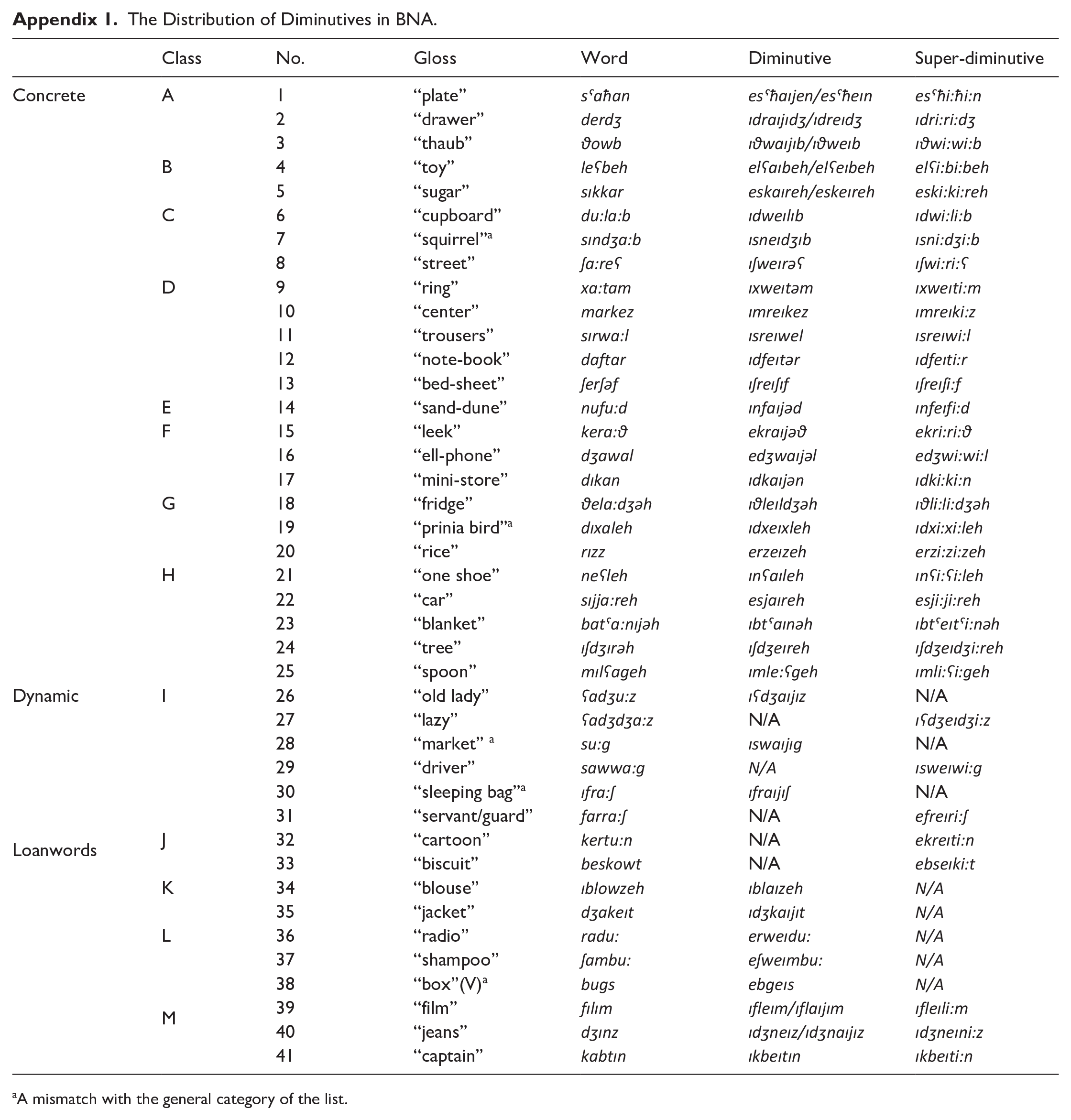
| Class | No. | Gloss | Word | Diminutive | Super-diminutive | |
|---|---|---|---|---|---|---|
| Concrete | A | 1 | “plate” | sˤaħan | esˤħaɪjen/esˤħeɪn | esˤħi:ħi:n |
| 2 | “drawer” | derdʒ | ɪdraɪjɪdʒ/ɪdreɪdʒ | ɪdri:ri:dʒ | ||
| 3 | “thaub” | θowb | ɪθwaɪjɪb/ɪθweɪb | ɪθwi:wi:b | ||
| B | 4 | “toy” | leʕbeh | elʕaɪbeh/elʕeɪbeh | elʕi:bi:beh | |
| 5 | “sugar” | sɪkkar | eskaɪreh/eskeɪreh | eski:ki:reh | ||
| C | 6 | “cupboard” | du:la:b | ɪdweɪlɪb | ɪdwi:li:b | |
| 7 | “squirrel” a | sɪndʒa:b | ɪsneɪdʒɪb | ɪsni:dʒi:b | ||
| 8 | “street” | ʃa:reʕ | ɪʃweɪrəʕ | ɪʃwi:ri:ʕ | ||
| D | 9 | “ring” | xa:tam | ɪxweɪtəm | ɪxweɪti:m | |
| 10 | “center” | markez | ɪmreɪkez | ɪmreɪki:z | ||
| 11 | “trousers” | sɪrwa:l | ɪsreɪwel | ɪsreɪwi:l | ||
| 12 | “note-book” | daftar | ɪdfeɪtər | ɪdfeɪti:r | ||
| 13 | “bed-sheet” | ʃerʃəf | ɪʃreɪʃɪf | ɪʃreɪʃi:f | ||
| E | 14 | “sand-dune” | nufu:d | ɪnfaɪjəd | ɪnfeɪfi:d | |
| F | 15 | “leek” | kera:θ | ekraɪjəθ | ekri:ri:θ | |
| 16 | “ell-phone” | dʒawal | edʒwaɪjəl | edʒwi:wi:l | ||
| 17 | “mini-store” | dɪkan | ɪdkaɪjən | ɪdki:ki:n | ||
| G | 18 | “fridge” | θela:dʒəh | ɪθleɪldʒəh | ɪθli:li:dʒəh | |
| 19 | “prinia bird” a | dɪxaleh | ɪdxeɪxleh | ɪdxi:xi:leh | ||
| 20 | “rice” | rɪzz | erzeɪzeh | erzi:zi:zeh | ||
| H | 21 | “one shoe” | neʕleh | ɪnʕaɪleh | ɪnʕi:ʕi:leh | |
| 22 | “car” | sɪjja:reh | esjaɪreh | esji:ji:reh | ||
| 23 | “blanket” | batˤa:nɪjəh | ɪbtˤaɪnəh | ɪbtˤeɪtˤi:nəh | ||
| 24 | “tree” | ɪʃdʒɪrəh | ɪʃdʒeɪreh | ɪʃdʒeɪdʒi:reh | ||
| 25 | “spoon” | mɪlʕageh | ɪmle:ʕgeh | ɪmli:ʕi:geh | ||
| Dynamic | I | 26 | “old lady” | ʕadʒu:z | ɪʕdʒaɪjɪz | N/A |
| 27 | “lazy” | ʕadʒdʒa:z | N/A | ɪʕdʒeɪdʒi:z | ||
| 28 | “market” a | su:g | ɪswaɪjɪg | N/A | ||
| 29 | “driver” | sawwa:g | N/A | ɪsweɪwi:g | ||
| 30 | “sleeping bag” a | ɪfra:ʃ | ɪfraɪjɪʃ | N/A | ||
| 31 | “servant/guard” | farra:ʃ | N/A | efreɪri:ʃ | ||
| Loanwords | J | 32 | “cartoon” | kertu:n | N/A | ekreɪti:n |
| 33 | “biscuit” | beskowt | N/A | ebseɪki:t | ||
| K | 34 | “blouse” | ɪblowzeh | ɪblaɪzeh | N/A | |
| 35 | “jacket” | dʒakeɪt | ɪdʒkaɪjɪt | N/A | ||
| L | 36 | “radio” | radu: | erweɪdu: | N/A | |
| 37 | “shampoo” | ʃambu: | eʃweɪmbu: | N/A | ||
| 38 | “box”(V) a | bugs | ebgeɪs | N/A | ||
| M | 39 | “film” | fɪlɪm | ɪfleɪm/ɪflaɪjɪm | ɪfleɪli:m | |
| 40 | “jeans” | dʒɪnz | ɪdʒneɪz/ɪdʒnaɪjɪz | ɪdʒneɪni:z | ||
| 41 | “captain” | kabtɪn | ɪkbeɪtɪn | ɪkbeɪti:n |
A mismatch with the general category of the list.
Acknowledgements
The Researcher would like to thank the Deanship of Graduate Studies and Scientific Research at Qassim University for financial support (QU-APC-2025).

Funding
The author(s) received no financial support for the research, authorship, and/or publication of this article.
Declaration of Conflicting Interests
The author(s) declared no potential conflicts of interest with respect to the research, authorship, and/or publication of this article.
Data availability statement
Data sharing not applicable to this article.