




Abstract
This study investigates the phonological, semantic, and pragmatic features of acronyms in Arabic. Acronyms in Arabic have appeared quite recently as a result of globalization and exposure to or contact with, mainly, English via radio stations and TV channels, which are broadcasting in English and in some countries, for example, Morocco in both English and French. Through in-depth analysis, it has been observed that acronyms in Arabic are subject to different restrictions: (a) The phonological combinations are formed on the basis of Arabic templates; hence, should be compatible with Arabic phonotactics, for example, consonant clusters should be broken up by vowels; (b) the connotation of the acronyms should not be negative; and (c) in conformity with relevance theory, when the acronyms are homophonous to existing words, the former maximize contextual effects with minimum processing effort. The fact that they appear in certain contexts also reduces the processing effort. It has also become evident that the period between the establishment of the movement or party and the first use of the acronym decreases over time, provided that the acronyms are frequently mentioned in the media. The examination of acronyms in different languages shows that acronymization is quite pervasive cross-linguistically; this may suggest that not any word-formation process can easily spread; it needs to be prevalent and potentially universal.
Introduction
Language users form new words by different means of word creation, the most common of which, at least in English, are affixation, compounding, and conversion (see Kiparsky, 1982). In addition, there are a number of less common ways in which new words can be formed, such as blending, clipping, coinage, backformation, abbreviations, acronyms, and alphabetisms (Booij, 2007; Haspelmath & Sims, 2010; Lieber, 2010; Plag, 2003). Notwithstanding their limited productivity in some languages, initialisms, that is, acronyms have been found in many languages (Ehrmann, Rocca, Steinberger, & Tanev, 2013). As word-formation processes, such as abbreviation and acronymization, demand minimum amount of processing effort by the recipient in line with relevance theory (RT), this may suggest that these word-formation processes are more likely to spread compared with other ones. In fact, the article argues that as acronyms are pronounced as words, for example, AIDS (
General Background
Initialism and the Significance of Acronymization
Initialism is one of the popular means of forming new words. In this regard, initialism (e.g., NATO and FBI) and blends (e.g., smog and motel) are similar in nature, because all of them are amalgamations of parts of different words (Plag, 2003). 1 Initialism, abbreviation (e.g., Mr), and blending involve loss of material, while affixation involves addition of material. However, abbreviation and initialism differ from blending in that orthography plays a prominent role, while prosodic categories do not (Plag, 2003). Specifically, when the first letters of words that make a name or phrase are used to create a new word, the result is called initialism (Lieber, 2010). The previous definition excludes some initialisms that are created from compounds, at least, in German (Ehrmann et al., 2013). Therefore, initialism could be better defined as a word-formation process used to create new words by taking the initial letters of multiword sequences. Initialisms are traditionally divided into two kinds: acronyms and alphabetisms (Rúa, 2002).

Acronymization can be defined as a morphological process, in which a combination of initial letters of a word sequence is pronounced as a word. Examples of acronymization in different languages can be found, such as English NATO (
With regard to the significance of acronymization, Hartmann and Stork (1976) suggest that acronyms are created to speed up and facilitate communication due to their conciseness and catchiness in both written and spoken mediums (see section “The Pragmatic Features of Acronyms,” for more detail). In this way, conciseness and precision are extremely important in the formation of acronyms. In this regard, Ehrmann et al. (2013), who have recently identified several acronym pairs in 22 different languages, state that “like entities, acronyms have a high reference value, in the sense that they most of the time act as reference anchors of textual content” (p. 237). Simply put, it is a means of word-formation process that creates new words for concepts which are either frequently used in the media or difficult to describe. Stating what the acronym stands for would be time-consuming, especially if one is using common acronyms such as NASA, UNESCO, NATO, AIDS, and so on (Crystal, 2004). Hijazi (2001) suggests three reasons that account for the use of acronyms: (a) Acronymization saves time due to its succinctness; (b) acronym takes less space in printing, as individual letters are used to represent full phrases and/or compounds; and (c) the use of acronyms facilitates the comprehension of the original phrase or compound. Therefore, it is expected that preference for using acronyms is globally shared by several languages.
Reviewing the literature, it seems that no study has, so far, examined acronymization in its correct definition in Arabic. In addition, the fact that acronymization in Arabic is governed by phonological, semantic, and pragmatic factors has not been addressed and accounted for in the previous literature. Therefore, this study investigates acronymization in Arabic to bridge this gap. It traces the foundation and development of this word-formation process throughout the years. In addition, it seeks to answer the following research questions:
The History of Initialism
Investigating the origin of the word acronym, it seems to be originally derived from the Greek words akros and onyma, which mean “tip” and “name,” respectively. Although the word “acronym” was believed to have been coined in 1943 (Thomas, Ethridge, & Ruffner,1965, p. 7), Foster (1972, p. 196) points out that the use of acronyms “ . . . was in full swing during the First World War.” However, the desire to economize emerged several millennia ago. Cannon (1989, p. 99) argues that initialism has existed for centuries because several examples of this phenomenon can be found, namely, in Hebrew, such as MILH (
Furthermore, Russell (1946) notes that Merriam added 72 initialisms to the 1945 supplement to Webster’s second edition (1934) that were not in the 1939 one, becoming part of the American lexicon. In fact, Robbins (1951) collected 126 oral and written initialisms from aviation alone, showing that their popularity had been growing drastically. In this respect, Rúa (2002) states that more attention is paid to initialisms since their analysis exhibits variety and complexity pointing to a structure which clearly makes describing them in the classical fashion quite challenging. On the contrary, Bauer (1983) downgrades initialisms because, apart from being unpredictable, they are heavily based on orthography. In particular, there are two reasons behind the lack of predictability in initialisms. First, the initialism is formed freely from the original phrase. Second, not all initialisms are pronounced as one word (Bauer, 1983). For instance, according to Yule (2006), one element of innovative acronyms, such as PIN (
Acronyms are not only used in English and other European languages; they are also used in Arabic. One of the first researchers to discuss acronymization in Arabic is Al-Samarra’i (1987); he discusses a type of Arabic word-formation process which involves the shortening or blending of the individual words of a particular phrase. Alsamarra’i (1987) refers to this process as nnaħt “abbreviation,” whereby the initial letters of a set of words are used to create a new word. Some of the examples he provides were cited from the Quran, such as khyʕs
(1) rama 2
association the-woman the-Jordanian
“Jordanian Women Association”
The second group, however, consists of acronyms formed on the basis of English words. An example of this case is saabik, the Arabic version of the English acronym SABIC (
Another interesting issue is the adaptation of English abbreviations into Arabic, such as BBC, WAN, ADSL, laser, radar, and e-mail (Alnajjar, 2005). Such adaptation can be also cited in other languages, such as Japanese, in which some English acronyms, for example, FBI and PC were borrowed with certain phonological modifications (Kubozono, 2010). Similarly, some phonological modifications occur when the English abbreviations are used in Arabic, such as leezar “Laser (
The next section presents the methodology used in the current study.
Method
With regard to data collection, with the exception of acronyms whose organizations were established in late 2011 onward, the majority of acronyms were collected from Arabic corpus tool (henceforth, arabicorpus), which is an online comprehensive Arabic corpus available through Brigham Young University:
The linguistic analysis provided focuses on the phonology of the acronyms, explaining how they are formed using autosegmental phonology (McCarthy, 1981). Similar to other languages, for example, English (see Hamdan & Fareh, 2003), the phonological analysis also demonstrates how acronyms in Arabic are permissible phonological words formed through inserting vowel sounds between consonants or making use of already existing vowel sounds in the components of the acronym. The semantic analysis shows that acronyms, on the first level, are usually homophonous to existing words (see Hijazi, 2001). On the second level, acronyms in Arabic need to have a positive connotation. With regard to their pragmatics, the analysis relies on RT, which states that as a matter of general cognitive fact, people attempt to maximize contextual effects with minimum processing cost (Wilson & Spreber, 1981, 2004). In other words, to arrive at maximal relevance, positive cognitive effects (e.g., understand a certain concept, find a solution to a problem, confirm a doubt, etc.) are achieved by processing an input with a minimum processing effort (Wilson & Spreber, 2004, p. 252). For example, upon hearing the utterance “it’s cold in here” while ostentatiously staring at the open window, the hearer will exert little cognitive effort to infer that the speaker wants him to close the window. However, in the same context, inferring that the heater is not working would require more processing effort (Wilson & Spreber, 2004). Hence, RT assumes that every input can be potentially relevant to the hearers; otherwise the speaker may not have uttered it in the first place (Carston, 1998). RT argues that the principle of relevance is entrenched in humans’ cognitive system, as it does not comprise maxims that people choose to follow or flout as delineated by Grice (1989, p. 26). Hence, Grice’s maxims can all be subsumed under relevance provided that a clear definition of relevance is supplied (Wilson & Spreber, 2004). RT does not deny that when speakers and hearers converse, they aim at being cooperative. RT posits that speakers and hearers are cooperative, as they want to maximize relevance. When acronyms possess a meaning that corresponds to one denoted by an established word and they are mentioned in a relevant context which both speakers are familiar with, their processing effort, I argue, is minimized to a great extent. The next section provides an analysis of acronyms in Arabic.
Data Analysis and Discussion
Early Establishment of Acronyms in Arabic
Acronyms in Arabic have appeared quite recently, approximately in the past three decades, compared with other languages, such as English (see section “The History of Initialism”). The emergence of acronymization in Arabic has taken place in two main stages that developed in parallel until one of them fell out of use; first, the acronyms were formed using the translation of the words in English, rather than the original Arabic word. Examples of this case are illustrated below:
(2) sana
l-wikaalah l-ʕarabiyyah s-suwriyyah li l-ʔanbaaʔ
the-agency the-Arab the-Syrian for the-news
“Syrian Arab News Agency”
(3) suna
wikaalat l-ʔanbaaʔ l-suwdaniyyah
agency the-news the-Sudanese
“Sudan News Agency”
(4) kuna
wikaalat l-ʔanbaaʔ l-kuwaytiyyah
agency the-news the-Kuwaiti
“Kuwait News Agency”
An examination of examples (2) to (4) clearly demonstrates that the acronyms are formed based on the English translation of the Arabic words. Based on the official websites of the above agencies, sana (
Another interesting example is haka, which presents an instance of French influence on Arabic acronyms. 4 This example refers to a high authority of audiovisual communication, which was established in Morocco in 2002:
(5) haka
l-hayʔa l-ʕulya li l-ʔitisˤaal s-smaʔy wa l-basˤary
the-authority the-high for the-communication the-hearing and the-sight
“The High Authority of Audiovisual Communication”
This authority resembles in function the French authority HACA (
(6) ʔamal
Regiments the-resistance the-Lebanese
“Lebanese Resistance Regiments”
This movement was established in Lebanon in 1974 and its armed organization was founded in 1975. The ʔamal militia was a major participant in the Lebanese civil war in 1975. Hence, the acronym ʔamal captured the attention of the media at that time. This acronym was mentioned 0.28 times per 100,000 words in the arabicorpus. One may notice that there is a period of time between the establishment of the movement and the first attested use of the acronym ʔamal in 1978. Throughout the study, it will become apparent that this period of time decreases over time, depending on the publicity of the movement by the media and the acceptability of acronymization as a phenomenon in Arabic.
However, one may argue that ʔamal is not the first acronym in Arabic. The acronym fatiħ, which can be treated as a special kind of acronym, has been in use since 1968 (Birzeit University Archive, 2015). This acronym is mentioned 1.44 times per 100,000 words in arabicorpus:
(7) fatiħ
movement the-liberation the-Palestinian
“The Palestinian National Liberation Movement”
This movement was established in 1959 by professional Palestinians whose leader was Yasser Arafat. Interestingly, the acronym is formed in a reversed order, in the sense that the direction of the initial letters started from the last word of the whole phrase (Hamdan & Fareh, 2003). Normally, acronyms, in transliterated form, are formed left to right in a unidirectional way. Therefore, the above example should be ħatif “death.” However, the order of the letters is reversed due to semantic constraints in Arabic. That is, negative connotations cannot be used to label such an organization that aims to liberate Palestine. Therefore, the acronym fatiħ, which literally means “liberation/conquest,” is used instead; showing a new way of forming acronyms that can be called “reversed acronyms.” This example is referred to in section “The Semantic Features of Acronyms,” where I argue that acronyms in Arabic are semantically conditioned. If fatiħ is indeed regarded as an acronym, then it should be considered the first attested acronym in Arabic.
Several years later, another commonly used example appeared, namely, ħamaas, which literally means “enthusiasm.” ħamaas is mentioned 2.75 times per 100,000 words in arabicorpus:
(8) ħamaas
movement the-resistance the-Islamic
“Islamic Resistance Movement”
Based on Birzeit University Archive, the movement was established on December 14, 1987, whereas the first use of the acronym independently in the media was on November 25, 1988. This acronym shows that there is a period of time between the establishment of the party or organization and the use of the acronym related to it. This may be due to three reasons: (a) in the 1980s, many people did not own a TV or even a radio; hence, the acronym needed a period of time to be established among the masses, namely, for them to establish a connection between the acronym and the organization it stands for; (b) the phenomenon itself was not common at that time for people to understand it immediately; they needed some time to grasp the idea behind it; and (c) the extent of publicity of that organization and the role that the media plays to make that acronym known influence its degree of use. Here, I would suggest that in Arabic, the full phrase and the acronym are first used together as one unit and then sometime later, the acronym may get established as an independent entity that can stand for the full name of the referent as a direct result of being used frequently in the media. For instance, ħamaas started to be frequently mentioned in the news after 1993; possibly because it is the year which marked an important event: ħamaas’s members did not recognize the Israeli-Palestinian peace process, which led to the Oslo Accords of 1993.
More recently, many attested acronyms have been created in Arabic in the past decade (2005-2015), especially after the Arab Spring that started in 2011, such as daaʕiʃ and waʕid. Due to the fact that the organizations which these acronyms stand for were established in late 2011 and 2014, respectively, they were not found in arabicorpus. Thus, they were collected through famous media websites, such as Aljazeera 6 :
(9) daaʕiʃ
the-state the-Islamic in the-Iraq and the-Syria
“Islamic State in Iraq and Syria”
(10) waʕid
l-ħizib l-
the-party the-national for the-justice and the-development
“The National Party for Justice and Development”
The acronym daaʕiʃ, which does not have a literal meaning, is the most frequently used acronym in Arabic nowadays. It refers to a terrorist group established in Iraq in 2011. The acronym daaʕiʃ was first used in 2014, since the group occupied a large area of land in both Iraq and Syria. Interestingly, the acronym daaʕiʃ started to be used in the Middle East after Western media, that is, BBC started using the equivalent acronym ISIS (
It should be noted that ISIS threatens to cut out the tongues of whoever refers to them as daaʕiʃ (Oakley, 2016). The reason for such a barbaric behavior can be ascribed to the fact that daaʕiʃ is meaningless in Arabic. Hence, the members of this terrorist group may find it degrading for the media to refer to them using a meaningless acronym. In addition, some phonemes of the acronym daaʕiʃ have been manipulated recently by Arabic-speaking people, especially those who oppose savage beheadings carried out by ISIS, to create words that rhyme with daaʕiʃ, but have offensive meanings. For instance, dʒaaħiʃ meaning “ass” and daaʕir meaning “a man whore” have been used on Facebook and Twitter to refer to ISIS members.
Another example is the acronym waʕid, meaning “promise,” which was both established and used in Syria in 2014, and finally, the acronym ħaqq, which literally means “right.” The latter refers to a political movement that was established in Sudan in 2014. Again, both of these acronyms were not found in arabicorpus, since they were established in 2014; they were found through Aljazeera website.
(11) ħaqq
“New Democratic Powers Movement”
Taking these examples into consideration, it seems that the period of time between the establishment of the organization or party, and the first use of the acronym decreases over time. One reason for such a phenomenon is attributable to the increase in the use of Internet and social media in the Arab world. It could also be because acronymization, as a morphological process, has become an acceptable phenomenon in Arabic. Finally, it goes without saying that acronyms as a way to facilitate conveying the news (i.e., the name is shorter) help spread the use of this new word-formation process. In fact, examining examples (6) to (11) shows that the creation of acronyms on the basis of the translation of English words, possibly, fell out of use.
The Linguistic Features of Acronyms in Arabic
The phonological features of acronyms
Acronyms should conform to the phonological rules of a language because they are pronounced like regular words. For instance, an abbreviation like BBC is not a possible candidate for an acronym, because [bbk] or [bbs] are not permissible combinations in English (Plag, 2003, p. 128). Nonetheless, speakers sometimes make alphabetisms pronounceable, that is, create acronyms. The following are good examples of creating acronyms by inserting a vowel sound to make the internal combination permissible:
(12) SLRF [slərf] (
(13) radar [reɪdɑː(r)] (
The same rule applies to Arabic. All acronyms in Arabic do not create problems in applying regular reading rules; they are formed with permissible phonological words either through inserting vowel sounds between consonants or making use of already existing vowel sounds in the components of the acronyms, as can be seen in examples (14) and (15). 7
(14)
agency xabar ‘lit. single news’ 8 for the-news
“Xabar Agency for News”
(15) taadʒ
grouping hope the-Algeria
“Algeria Hope Gathering”
The acronym waax refers to a news agency which was established in Yemen in 2007 (mentioned one time in arabicorpus), while the acronym taadʒ, which literally means “crown,” refers to a political party that was established in Algeria in 2012. 9 Due to the fact that taadʒ was established in 2012, it was not found in arabicorpus; hence, it was found through other websites, for example, Aljazeera. As only the phonologically permissible acronyms can be formed, an insertion of a vowel sound takes place or the vowels already there in the components of the acronym are used in both taadʒ and waax. Both tdʒ and wx are impermissible in Arabic, as the two unvowelized acronyms are not words (EI-Badarin & Bani-Yasin, 1993). EI-Badarin and Bani-Yasin (1993, pp. 203, 211, 218) note that the previous consonant clusters are impermissible in all positions; word-initial, word-medial, and word-final. Other Arabic examples, such as tawaad, madʒd, and daaʕiʃ, support this argument.
By virtue of having a nonconcatenative morphological system, what is patently clear to a speaker of Arabic is that the acronyms are formed relying on Arabic templates. It is omnipresent that nouns, verbs, and adjectives in Arabic have templates or binyanim (see McCarthy, 1981), based on which they are formed. Binyanim (singular binyan) are derivational classes, consisting of both consonants and vowels, where the consonants represent the root, while the vowels represent the meaning (McCarthy, 1981, pp. 375-378). For instance, the binyan faʕʕal yields a causative meaning in Modern Standard Arabic, for example, kassar “caused to break,” where the root is ksr and the vocalic melody a-a conveys the meaning (McCarthy, 1981). These templates or skeletons can be represented on three tiers, the root tier, the skeletal tier, and the vocalic melody tier, in accordance with the rules of prosodic morphology as stipulated by McCarthy (1981, p. 387). For instance, daaʕiʃ/ISIS (

daaʕiʃ/ISIS (

faatin (Palestine Institution for Loaning and Development).
Figures 1 and 2 indicate that the insertion of vowel in acronyms is not random; it follows the structure of Arabic binyan. Another template is faʕaal CVCVVC based on which ħamaas (Islamic Resistance Movement) and tawaad (Jordan Democratic National Party/Gathering) are formed, as in Figures 3 and 4.

ħamaas (Islamic Resistance Movement).

tawaad (Jordan Democratic National Party/Gathering).
An examination of the acronyms ħaʃid (People’s Democratic Party), fatiħ (The Palestinian National Liberation Movement), daʕim (Labour Democracy Organisation), and waʕid (The National Party for Justice and Development) shows that the formation of these acronyms is based on the Arabic template faʕil CVCVC, as in Figure 5.

daʕim (Labour Democracy Organisation).
A study of the acronym ħaqq (New Democratic Powers Movement), it appears that it is created depending on the template faʕl CVCC, as in Figure 6. The same applies to madʒd (Democratic Front Organisation), which is formed based on the same template.
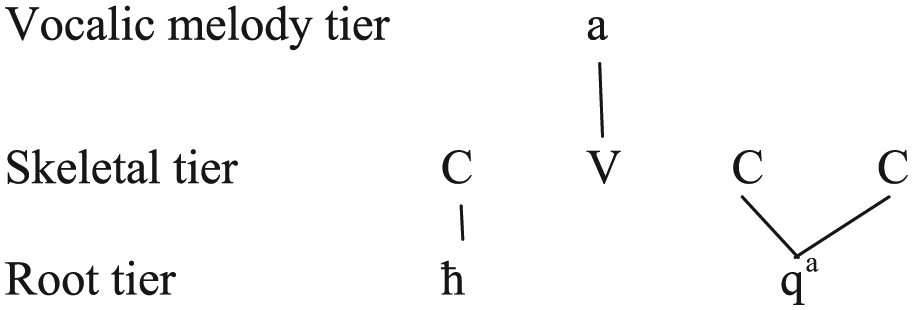
ħaqq (New Democratic Powers Movement).
Investigating the acronym ʔamal (Lebanese Resistance Regiments), it is clear that it is made relying on the template faʕal CVCVC, as in Figure 7.
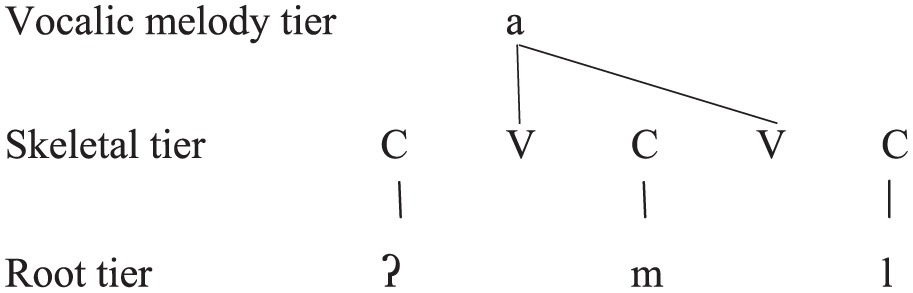
ʔamal (Lebanese Resistance Regiments).
Examining the acronym fidaaʔ (Palestinian Democratic Union), it is clearly formed based on the template fiʕaal CVCVVC, as in Figure 8.

fidaaʔ (Palestinian Democratic Union).
Finally, the acronym rama (Jordanian Women Association) is created on the basis of the template faʕala CVCVCV, as illustrated in Figures 9 and 10. Two phonological processes occur here; the first one is syncope of /w/ which originates in the underlying representation of rama, then compensatory lengthening of the vowel /a/, as explained by Altakhaineh and Alshamari (2016, p. 3).
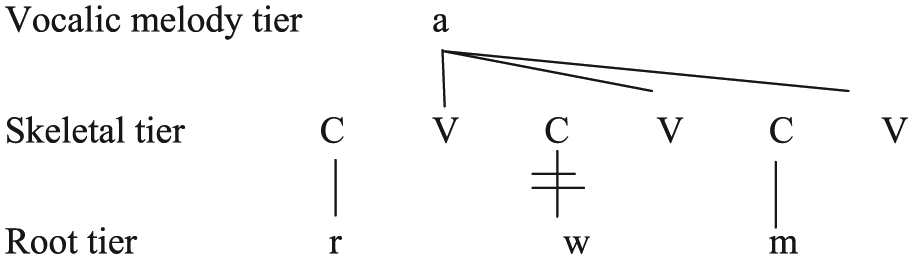
rawama the underlying representation of rama.

rama (Jordanian Women Association).
Figures 1 to 10 show that the phonological combinations of acronyms and the insertion of vowels, if consonant clusters appear, are not arbitrary; they are governed by existing templates. The same applies to other acronyms in Arabic. In the following sections, these examples are discussed, showing their semantic and pragmatic features.
The semantic features of acronyms
Examining acronyms in Arabic, it appears that they are semantically governed. In particular, acronyms are usually homophonous to existing words. In this regard, Hijazi (2001, p. 97) indicates that in some cases, letters are added to the acronym to make it meaningful, in the sense that it would be similar to an established word in Arabic. The following is an example of this case, which was only mentioned once in arabicorpus:
(16) l-
the-organisation the-communism the-Egyptian
“the Egyptian communist organisation”
The original acronym of this organization is miʃm, which is meaningless in Arabic. Therefore, according to Hijazi (2001), another letter was added to the acronym to make it meaningful in Arabic, that is, miʃmi ʃ “apricot.” Based on the analysis of acronyms in Arabic, I argue that there are two levels of semantic conditionality on acronymization. The first level is concerned with the fact that acronyms in Arabic need to be meaningful, whereas the second level deals with the connotation of the acronym, so that it needs to have a positive connotation, as in (17).
(17) tawaad
ħizib t-
party the-gathering the-national the-Jordanianthe-democratic
“Jordan Democratic National Party/Gathering”
The acronym tawaad, which literally means “harmony,” is a political party that was established in 2013, and the first use of the acronym was attested in the same year. It is clear that the meaning of the acronym implies a harmonious relationship between the members of the party and Jordanians. Since, the organization was established in 2013, tawaad was not found in arabicorpus. This acronym was found in Al-Rai newspaper, a daily Jordanian newspaper. Other examples are (18) and (19).
(18) madʒd
organization the-front the-democratic
“Democratic Front Organization”
(19) faatin
muʔassas-at
institution-F Palestine for the-loaning and the-development
“Palestine Institution for Loaning and Development” 10
The acronym madʒd, which literally means “glory,” was established in 1978 (mentioned 0.08 times per 100,000 words in arabicorpus), while the acronym faatin, which literally means “attractive,” was established in Palestine in 1999 to help poor people (mentioned only once in arabicorpus). The previous acronyms imply positive connotations in both organizations. Similarly, in English, acronyms, such as BASIC (
(20) CARE (
(21) SOLE
11
(
The same applies to ħaʃid, which literally means “gathering.” It is a political party that was established in 1993 in Jordan. The word ħaʃid implies the gathering of people to work together for the greater good of the community. This acronym is mentioned 0.05 times per 100,000 words in arabicorpus.
(22) ħaʃid
party the-people the-democratic
“People’s Democratic Party”
As explained in section “Early Establishment of Acronyms in Arabic,” ħatif “death” was replaced by fatiħ meaning “liberation.” In this context, another significant observation is in order. The conformity between the number of acronyms and established words has begun to act as a stimulant for Arabic speakers to manipulate acronyms to serve certain purposes. For instance, the acronym fatiħ, which is repeated below for the reader’s convenience, has been manipulated by opponents of the Palestinian National Liberation Movement via changing it into an offensive word. In lʔittidʒaah lmuʕaakis (2015) “The Opposite Direction,” a debate TV show hosted by Faisal Al-Qasem on Aljazeera TV channel, one of the guests who is an opponent to fatiħ manipulated the acronym, changing it into mataff “spit.”
(23) fatiħ
ħarakat/munaðˤðˤamat t-taħryr l-falastˤyniyyah
movement the-liberation the-Palestinian
“The Palestinian National Liberation Movement”
Through taking the initial letters of the three words
(24) fidaaʔ
l-
union the-democratic the-Palestinian
“Palestinian Democratic Union”
(25) daʕim
organisation the-labour the-democratic
“Labour Democracy Organisation”
The acronyms, fidaʔ “sacrifice” and daʕim “support” are formed in a reversed order to replace ʔadif and maʕid that have no meanings. It seems that most of acronyms in Arabic are homophonous to established words. This is the case, possibly, to make acronyms in Arabic memorable and in some cases for humorous/offensive reasons. For instance, the meaning of the acronym can be manipulated to convey a negative connotation, intended as an insult to the organization about which the acronym is formed; compare examples (26) and (27).
(26) ħaʃid
l-
the-mobilization the-popular
“the Popular Mobilization forces”
(27) dʒaħiʃ
army the-mobilization the-popular
“the Popular Mobilization Army”
Example (26) shows the acronym ħaʃid, which represents an organization founded in 2014 to fight ISIS in Iraq; thus, it was found on Aljazeera website, not through arabicorpus. Interestingly, opponents of ħaʃid, who oppose the organization’s activities in Iraq, manipulated the acronym ħaʃid by adding the word dʒayʃ “army,” to form another acronym that has a negative connotation, that is, dʒaħiʃ “ass,” as in example (27). This may indicate that this word-formation process has become an established one in Arabic, as many Arabic speakers have become aware of the mechanisms by which acronyms are formed.
The only acronyms that are not homophonous to existing words are daaʕiʃ (
The pragmatic features of acronyms
In conveying news to an audience, the communicator usually intends to convey information or clarify a set of assumptions to the recipient. When the recipient recognizes the communicative intention of the communicator, he attempts to use the information conveyed by the message as a departure point to make inferences about the information uttered. In this respect, if a resemblance between the concepts or assumptions that both the communicator and the recipient have in mind is established, then the mutual cognitive environment has been changed; hence, communication is accomplished (Sperber & Wilson, 1996). The more similar the concepts uttered to those stored in the minds of the interlocutors, the more relevant the message (Wilson & Sperber, 2002). It is suggested that the relevance of the message relies on the resemblance versus the difference between the set of concepts or assumptions that exist in the minds of interlocutors and the ones intended by the communicator, on one hand, and on the extent to which the communicator relies on the ability of the recipients to make inferences about the message, on the other.
By uttering the acronym, the communicator, in this case, the news anchor, intends the recipient of the message to make an inference about the party or organization that the acronym stands for, especially if the acronym stands for a well-known organization which the speakers are acquainted with. As mentioned in the preceding section, for the purpose of conveying positive connotations, the majority of acronyms in Arabic are usually homophonous to existing words. Examples, such as tawaad (Jordan Democratic National Party/Gathering), madʒd (Democratic Front Organization), and fidaaʔ (Palestinian Democratic Union), lend support to the argument that acronyms maximize contextual effects with minimum processing effort, in accordance with RT. In this scenario, the contextual effects involve interpreting the meaning of the acronym and making a connection with what it stands for. Semantically, the fact that the above acronyms are homophonous to existing words, that is, tawaad “harmony,” madʒd “glory,” and fidaaʔ “sacrifice,” makes their interpretation much easier and relevant to the hearer (see the previous section). In addition, because these words are homophonous to existing words, it implies that word economy is at play here as well, motivating the use of existing words rather than coining new ones. The transparency and clarity of these acronyms provides indisputable evidence of relevance, which allows for an easy access to sufficient contextual effects. This means that the resemblance between the concepts or assumptions held in the mind of the recipient and the ones intended by the communicator are close enough for relevance to be obtained. Upon hearing the word fidaaʔ (Palestinian Democratic Union), for instance, the hearer retrieves the meaning of the word fidaaʔ “sacrifice,” which is homophonous to the name of the party. Making the connection between the two words requires far less effort if such a word does not share a sense with an established one. In this way, using the word fidaaʔ “sacrifice” instead of another nonestablished word increases the degree of relevance and reduces the processing effort. In a related vein, one can observe that the words used to represent the parties or organizations are common words utilized in everyday conversations, making the retrieval of their meanings in the recipient’s mind quite easy. Thus, connecting the names of the parties with common notions facilitates their comprehension and, by extension, their relevance. Here, one may argue that the fact that some acronyms correspond to actual words might actually inhibit their immediate understanding, as the real meanings form a competing candidate for understanding. In this regard, I suggest that such inhibition does not occur in Arabic acronyms due to three main reasons. First, in most acronyms in Arabic, one element of acronyms is usually repeated (cf. Yule, 2006, p. 57). For instance, in the acronym fatiħ (
(28) ana min ħarakat fatiħ
I from movement Fatih
“I am from Fatih movement.”
Second, the morphosyntactic feature of definiteness can help the addressee decide whether the speaker is referring to the acronyms or the words that have similar meanings. Specifically, acronyms can never be marked with the definite article l- “the”; compare (29) and (30).
(29) ana maʕ (*l-)ħamaas 12
I with (*the-)Hamaas
“I support Hamas.”
(30) l-mudarris laazim yʃadʒdʒiʕ l-ħamaas la-ddiraaseh ʕind tˤ-tˤullaab
the-teacher should encourage the-enthusiasm for-studying for the-students
“the teacher should encourage students to become enthusiastic about studying.”
Examples (29) and (30) show that the absence of the definite article l- “the” in example (30) is an indicator that the speaker is not talking about the political organization, rather its homophonous counterpart (But I provided counter examples). Third, in addition to the lack of the definite article, the context itself can inform the addressee about which word is actually intended, that is, the acronym or its corresponding established word. For instance, if the speaker asked the addressee about which organization he or she supports or which organization he or she is a member of, this context clearly indicates that the speaker is talking about a particular acronym referring to an organization/movement, as in 31.
(31) Speaker: enta maʕ ay ħizib?
you with which party?
“which party do you support?”
Addressee: ana maʕ ħaʃid
I with Haʃid
“I support Haʃid (People’s Democratic Party).”
Finally, the association between RT and acronymization manifests itself in another dimension, that is, the type of contexts in which acronyms is used. From the beginning of acronymization in Arabic up until now, most attested acronyms are associated with the names of organizations or movements that have begun to capture attention in the news, especially as a result of the political crisis that has been wreaking havoc in the Arab world for the past 4 years. In 2014, three acronyms daaʕiʃ, waʕid, and ħaqq have appeared. The most frequently used acronym in Arabic (i.e., daaʕiʃ) acquired its publicity from both local and international media, as it has been translated from English and integrated into Arabic. daaʕiʃ, as a terrorist group, has committed many massacres and executions by beheading American journalists and many others. One may argue that this will keep the use of the name and motivate other acronyms to be formed in Arabic in the near future. Hence, acronymization in Arabic is a potentially productive word-formation process in the sense that new ones are being formed. From the perspective of RT, the use of acronyms in particular contexts may provide an incentive for the hearer to obtain relevance. That is, taking into account that acronyms in Arabic are mostly used in politics, upon hearing an acronym, the hearer makes a connection between that acronym and politics, thus restricting the options of context types available to him or her into one, that is, politics. Establishing such a connection reduces the processing effort of the uttered acronym, and if such an acronym is homophonous to an established word, maximum relevance could be attainable.
All in all, all Arabic acronyms cited in this study are mostly names of political organizations, that is, parties and movements, associations, and news agencies. In other words, acronyms seem to occur in certain contexts. On the basis of corpus study of acronyms that is done by Cannon (1989, p. 115), English acronyms are distributed in quite different areas and proportions from those of Arabic. They are centered in seven areas: “Twenty items refer to primarily political organizations, 15 each to systems and the military, 14 to computers, 11 to space, and 10 each to chemicals and transportation” (Cannon 1989, p. 115). This possibly means that acronyms are pragmatically conditioned in the sense that they occur in certain contexts.
Conclusion
This study has provided a detailed analysis to some examples of acronyms in Arabic. Based on the analysis, several conclusions can be made. First, acronyms in Arabic have appeared quite recently as a result of globalization and exposure to or contact with, mainly, English via social media and some TV channels, which are broadcasting in English or, in some countries, in English and French. Second, after a period of using acronyms formed on the basis of the English translation simultaneously with other acronyms formed relying on the Arabic words, the former fell out of use. At least in the past decade, the new established acronyms in Arabic are not usually translated forms of other languages; they are uniquely formed by Arabic speakers, implying that acronymization has become an established word-formation process. Third, acronymization as a word-formation process was influenced by English, since news has been broadcasted in English even at present. Finally, acronymization in Arabic is subject to certain restrictions:
a. Similar to other languages, for example, English, the phonological combinations of acronyms are formed on the basis of Arabic templates; hence, they should be compatible with Arabic phonotactics, for example, vowels should be inserted or an already existing vowel in the components of the acronym can be used to break up consonant clusters.
b. Acronyms, on the first level, are usually homophonous to existing words to make them memorable and in some cases for humorous/offensive reasons. On the second level, the connotation of the acronyms cannot be negative, for example, fatiħ “liberation” versus ħatif “death.” It has been noticed that the acronyms analyzed in this study usually have a positive connotation, such as ħamaas “enthusiasm,” ħaqq “right,” waʕid “promise,” and ħaʃid “gathering.” In few occasions, the opponents of some political parties, associations, or organizations manipulate the acronyms, yielding acronyms with negative connotations intended to offend the party members.
c. In accordance with RT, acronyms maximize contextual effects with minimum processing effort. Being homophonous to established words means that acronyms require far less processing effort. The differences between acronyms and their homophonous counterparts in terms of the repetition of one of the elements, lack of definiteness, and context of use prevent an inhibition in processing the acronyms. In addition, what increases relevance even more is the fact that they are found in certain contexts. For instance, almost all acronyms in Arabic are names of political movements or organizations. This being so, the available options of context is limited to only one, that is, politics. Hence, the processing effort is lessened.
d. The period between the establishment of the movement or party and the first use of the acronym seems to decrease over time, provided that the acronyms are frequently used in the media, such as daaʕiʃ (known globally as ISIS) (
This study recommends the investigation of other word-formation processes to explore whether other processes in Arabic have possibly spread due to language contact.
Footnotes
Declaration of Conflicting Interests
The author(s) declared no potential conflicts of interest with respect to the research, authorship, and/or publication of this article.
Funding
The author(s) received no financial support for the research, authorship, and/or publication of this article.