




Abstract
This study conducted a preliminary meta-analysis to investigate the origins of rapid morphological effects in masked morphological priming in nonnative derived words. Data were drawn from 44 selected studies, including a total of 1,142 nonnative participants and 2,225 native participants across various language backgrounds. Studies were selected based on specific criteria, including a focus on masked priming effects with Transparent, Opaque, and Form conditions, and prime durations under 84 ms. Statistical analyses were performed to compare the priming effects of Transparent (e.g., worker-WORK), Opaque (e.g., corner-CORN), and Form (e.g., think-THIN) conditions, as well as to assess the interaction effects of group (native vs. nonnative) and prime type (Transparent vs. Opaque vs. Form). The study’s findings revealed that: (a) while native speakers demonstrated graded priming effects across all three prime types (Transparent > Opaque > Form), nonnative speakers exhibited the largest priming effect in the Transparent condition, but equivalent priming effects in the Opaque and Form conditions (Transparent > Opaque = Form); (b) native and nonnative speakers had similar priming magnitudes for the Transparent and Opaque conditions, but not for the Form condition. The study’s results indicate that: (a) rapid morphological effects in the native language are the result of contributions from both morpho-semantic and morpho-orthographic mechanisms, thereby providing support for the hybrid model; (b) nonnative morphological processing leverages the morpho-semantic mechanism, providing additional support for the supralexical model; (c) unlike native speakers, nonnative speakers rely on formal overlap to process pseudo-morphological structure. Overall, the study suggests that nonnative morphological processing appears to be similar to native morphological processing, but not entirely the same.
Plain language summary
In this study, we examined how native and nonnative speakers understand and process parts of words differently. When we speak or hear words, our brains often break them down into smaller parts, which helps us understand their meanings quicker. For instance, from the word “worker,” we can easily get to the root word “work.” We looked at 44 studies involving 3,367 participants to compare how both groups responded to different types of word connections in a process known as “priming.” Priming happens when exposure to one word (like “worker”) makes a related word (like “work”) come to mind faster. Our findings showed that while native speakers show a clear pattern of processing from clear to less clear word connections (from “worker-WORK” to “corner-CORN” to “think-THIN”), nonnative speakers processed clear connections (like “worker-WORK”) faster, but treated less clear and unrelated word pairs similarly. This suggests that nonnative speakers rely more on the actual word meanings they learn than on the form or look of the words, unlike native speakers who use both the word’s form and its meaning to process language. Overall, our study highlights that while nonnative speakers can process word parts similar to native speakers, there are still noticeable differences in how each group approaches word processing. This helps us understand more about how people learn and use languages differently.
Keywords
Introduction
Studying the processing of morphologically complex words (MCWs) offers valuable insights into how individuals recognize and comprehend words, especially in terms of the interplay between meaning and form (Marslen-Wilson, 2007). Masked morphological priming has been a critical tool in exploring these processes, yet research findings in native speakers remain inconsistent regarding the balance between morpho-semantic and morpho-orthographic mechanisms in word recognition (Andrews & Lo, 2013; Beyersmann et al., 2015; Davis & Rastle, 2010; Feldman et al., 2015; Feldman et al., 2009; Giraudo & Grainger, 2000, 2003; Rastle et al., 2004). While native speakers generally show distinct processing patterns shaped by both meaning and form, the extent to which nonnative speakers mirror or diverge from these patterns is less clear. Previous research suggests that nonnative speakers may rely more on orthographic similarity than on semantic relationships when processing MCWs, potentially pointing to different underlying mechanisms (Ciaccio & Clahsen, 2020; Clahsen & Neubauer, 2010; Diependaele et al., 2011; Diependaele et al., 2009; Gu, 2022; Jiang & Wu, 2022; Lemhöfer et al., 2008; Li et al., 2017; Silva & Clahsen, 2008). However, with varying findings across studies, a systematic synthesis is needed to better understand these patterns and assess whether nonnative processing aligns with the morphological processing models proposed for native speakers. Therefore, this preliminary meta-analysis reviews previous studies to investigate the contributions of meaning and form in nonnative MCW processing. By synthesizing existing findings, this study addresses an important gap in the field, offering implications for cognitive models of morphological processing and providing a foundation for future research in second language acquisition.
Literature Review
Masked Morphological Priming in Processing Derived Words
Previous research has established that morphological decomposition plays a significant role in recognizing derived words (Clahsen & Neubauer, 2010; Diependaele et al., 2011; Li & Taft, 2019; Li et al., 2017). To investigate the relative contribution of meaning and form in morphological processing, past studies have employed the masked morphological priming paradigm (Forster & Davis, 1984; Taft & Forster, 1976). This paradigm consists of two components: prime and target, where the relationship between the two can be manipulated to be either unrelated (school-WORK) or related (worker-WORK). The priming effect is calculated by comparing the reaction time for WORK following the presentation of worker and school. In this paradigm, the prime is briefly presented (as short as 30–80 ms), followed by the target (Davis & Rastle, 2010), which requires lexical decision or naming. Additionally, to minimize orthographic overlap, primes are presented in lowercase and targets in uppercase. Three types of primes are typically used: Transparent, Opaque, and Form. As shown in Table 1, Transparent primes (e.g., worker) have semantic, morphological, and orthographic connections to the target (e.g., WORK), whereas Opaque primes (e.g., corner) have only morphological and orthographic connections to the target (e.g., CORN). Form primes (e.g., think) are only orthographically related to the target (e.g., THIN). It should be noted that the term “Opaque” in this study refers to pairs of primes and targets that are semantically opaque, as in the case of “corner-CORN,” rather than pairs that are morphologically opaque, as in the case of “phonetic-PHONE.” Using these three types of primes allows researchers to assess how meaning and form independently contribute to the effects observed in masked morphological priming (Diependaele et al., 2012).
Examples of Prime and Target per Prime Type.

Note. S = semantics; M = morphology; O = orthography.
Representational Architectures in Derived Words Processing
Theoretically, three proposed representational architectures can explain the processing of morphologically complex words. The first suggests that whole-word recognition occurs before morphological decomposition, and morpho-semantic information is activated first. The second suggests that morphological processing is independent of semantics and is morpho-orthographic, indicating that morphological decomposition happens before whole-word recognition. The third posits a parallel activation of morpho-semantic and morpho-orthographic pathways in morphological processing. Three corresponding models have been proposed to formalize these three mental architectures. The supralexical (form-with-meaning/morpho-semantic) model suggests that the whole-word representation is accessed before any morphological decomposition takes place (Feldman et al., 2010; Feldman & Milin, 2018; Feldman et al., 2009; Feldman & Soltano, 1999; Giraudo & Grainger, 2000, 2003). However, the sublexical (form-then-meaning/morpho-orthographic) model proposes that morphologically complex words are obligatorily parsed into sublexical components before whole-word recognition occurs (Davis & Rastle, 2010; Rastle & Davis, 2008; Rastle et al., 2000; Rastle et al., 2004; Taft & Forster, 1976; Taft & Nguyen-Hoan, 2010). Specifically, these two models debate over the role of semantic transparency in lexical processing (Wang et al., 2021). Additionally, the hybrid model suggests that both morpho-semantic and morpho-orthographic mechanisms are simultaneously accessible during masked morphological processing (Diependaele et al., 2011; Diependaele et al., 2012; Diependaele et al., 2005, 2009; Duñabeitia et al., 2013).
In addition, Taft and Nguyen-Hoan (2010) suggest that a lemma layer serves as an abstract intermediate location for morphological representation in the lexicon. It acts as a mediator between function and form. Priming effects between Transparent and Opaque words depend on the amount of competition the lemma for the stem of the target word has with the lemma for the whole prime word. For example, the lemma for “corn” may compete with “CORNER” after the former has been activated through pre-lexical decomposition of the latter. If there is enough time for this competition to occur, Opaque priming will be weaker than for transparent words, where the lemma for the stem (e.g., work) sends activation to the lemma for the whole word (WORKER) instead of competing with it. This indicates that whole-word recognition is activated before morphological decomposition, supporting the supralexical (morpho-semantic) model (Diependaele et al., 2005), as shown in Figure 1. A mandatory sublexical decomposition is responsible for morphological activation if equivalent morphological effects are observed for both Transparent and Opaque conditions, irrespective of semantic transparency. This provides evidence for the sublexical (morpho-orthographic) model (Rastle et al., 2004). If, on the other hand, the Transparent condition results in stronger priming effects than the Opaque condition, which in turn shows greater priming effects than the Form condition, this would support the hybrid model (Diependaele et al., 2011). This occurs because semantic effects hold a numerical advantage over morphological effects, and pseudo-morphological structures lead to greater morphological facilitation than words that are only form-related. However, if equivalent priming effects are observed for Transparent, Opaque, and Form conditions, orthographic overlap solely underlies the activation of morphemic representation.

Morphological processing models (adapted from Diependaele et al., 2012; Taft & Nguyen-Hoan, 2010).
Previous Research in Nonnative Processing of Derived Words
Over the last 20 years, there has been a growing number of studies focusing on the processing of derived words by nonnative speakers, using the masked morphological priming lexical decision task (e.g., Ciaccio & Clahsen, 2020; Ciaccio & Jacob, 2019; Clahsen & Neubauer, 2010; Dal Maso & Giraudo, 2014; Deng et al., 2017; Diependaele et al., 2011; Duñabeitia et al., 2013; Foote et al., 2020; Freynik et al., 2017; Gu, 2022; Heyer & Clahsen, 2015; Jacob et al., 2018; Kirkici & Clahsen, 2013; Li & Taft, 2019; Li et al., 2017; Reifegerste et al., 2019; Silva & Clahsen, 2008; Voga et al., 2014; Zhang et al., 2017). These studies have examined speakers of various native languages (e.g., English, German, Turkish, and Arabic) to investigate how different morphological systems are processed across languages: concatenative systems, which form words by adding morphemes in sequence (as in English, where adding “-ed” to “work” creates “worked” for past tense), and non-concatenative systems, which modify a word’s internal structure (as in Arabic, where altering vowel patterns within the root consonants, such as k-t-b, changes meaning, as in “kataba” (he wrote) versus “kutiba” (it was written)). Additionally, some of these studies have also compared the performance of nonnative speakers to that of native controls, investigating potential differences in masked morphological priming in derived words (e.g., Jacob et al., 2018; Kirkici & Clahsen, 2013; Neubauer & Clahsen, 2009; Silva & Clahsen, 2008). Overall, the findings suggest that nonnative speakers process transparent derived words similarly to native speakers.
Despite numerous studies investigating nonnative speakers’ processing of derived words, there are still ongoing debates regarding the subtle differences between native and nonnative morphological processing. Generally, nonnative speakers show less sensitivity to semantic connections and morphological structure compared to native speakers, and instead rely more on formal overlap for morphological processing. This is evidenced by reduced priming effects for Transparent and Opaque conditions, but increased effects for Form condition in nonnative speakers (Diependaele et al., 2011; Li & Taft, 2019; Li et al., 2017; Li et al., 2019). For instance, Diependaele et al. (2011) observed that nonnative speakers showed weaker Transparent priming effects but stronger Form priming effects in comparison to native English speakers. This suggests that nonnative speakers depend more on orthographic similarity than on morpho-semantic cues when processing morphological structures. In a recent study, Heyer and Clahsen (2015) directly compared native and nonnative English speakers’ processing of Transparent condition (darkness-DARK) and Form condition (example-EXAM). They found that native morphological processing showed morphological priming, while nonnative morphological processing showed priming for both prime types. This suggests that morphological effects are available in both native and nonnative derived words, but nonnative speakers are less sensitive to morphological structure and tend to rely on orthography for morphological processing. It should be noted that in this study, “native derived words” and “nonnative derived words” refer to the same set of words, but their processing patterns differ based on whether they are processed by native or nonnative speakers.
Theoretically, the lexical competition theory (Grainger & Beyersmann, 2017) may explain the form priming effect observed in nonnative speakers. This hypothesis suggests that when primes (Transparent, Opaque, Form) are presented, they and their embedded targets are activated at the same time. However, because primes typically generate stronger activation than targets, priming effects are less likely to be observed when targets follow the primes immediately. However, the presence of affixes such as -er and re- in Transparent and Opaque primes (e.g., worker, corner, rename, reactor) activate representations of edge-aligned words embedded within these primes (e.g., WORK, CORN, NAME, ACTOR), leading to facilitative effects that offset the inhibitory effects caused by lexical competition. This activation, however, does not take place in the Form condition (e.g., cashew-CASH, apparent-PARENT) where lateral inhibition from the embedded word reduces the bottom-up activation of the embedded word (Grainger & Beyersmann, 2017). Thus, their lexical representation is inhibited if the target words only have purely orthographic relationships to the primes (e.g., cashew-CASH). The lexical competition theory explains why native speakers experience priming effects in both Transparent and Opaque words but not in purely form-related words. Conversely, priming effects are often observed for the Form condition among nonnative speakers, indicating that lateral inhibition is reduced in nonnative morphological processing.
Despite variations in the size of priming effects, nonnative morphological processing is believed to be similar to native morphological processing according to various studies (Diependaele et al., 2011; Li et al., 2017; Zhang et al., 2017). In a study by Zhang et al. (2017), Chinese learners of English were tested for the co-activation of semantics and morphology using Transparent, Opaque, and semantically-related primes. The results showed that even when presented briefly (40 ms), Transparent condition primes facilitated the processing of the embedded word. However, Opaque condition primes required 80 ms to facilitate processing, and there was no priming for semantically-related items. This suggests that nonnative morphological processing involves parallel activation of both morpho-semantic and morpho-orthographic processing in decomposing derived words. Similarly, Diependaele et al. (2011) compared Spanish-English and Dutch-English speakers to native English speakers for priming effects under Transparent, Opaque, and Form conditions, finding graded priming effects between the three conditions for both native and nonnative speakers. This supports the view that nonnative morphological processing resembles native morphological processing with parallel activation of both morpho-semantic and morpho-orthographic information in nonnative morphological processing. Li et al. (2017) found similar results, with high-proficiency Chinese learners of English showing similar priming effects to native speakers in Transparent and Opaque conditions but less priming in Form condition. Intermediate nonnative speakers showed smaller differences among the three conditions but more robust priming in Form condition. Other nonnative studies also found similar results (e.g., Duñabeitia et al., 2013; Li & Taft, 2019). Li and Taft (2019) found that nonnative speakers with high proficiency had difficulty accessing the morphological structure of prefixed derived words, but there were no significant differences among the three prime types for nonnative speakers. This lack of difference may be due to less lexical competition experienced by nonnative speakers in processing nonnative morphology (Grainger & Beyersmann, 2017; Qiao et al., 2009).
Previous Meta-analyses on Native Processing of Derived Words
Although there have been no published meta-analyses specifically focused on the processing of nonnative derived words, two quantitative meta-analyses have been conducted on masked morphological priming in native derived words. In the first study, Feldman et al. (2009) examined priming effects associated with Transparent and Opaque conditions across 18 empirical native studies. They found that the Transparent condition generated more robust priming effects than the Opaque condition (mean difference = 7.4 ms), supporting the supralexical model and indicating an early involvement of morpho-semantic processing. By contrast, in the second meta-analysis, Davis and Rastle (2010) analyzed differences between the Transparent-Opaque comparison and the Opaque-Form comparison using a narrative synthesis of published data. They found that the Opaque-Form difference (20 ms) was larger than the Transparent-Opaque difference (7 ms), suggesting support for the sublexical model and morpho-orthographic processing. While both meta-analyses found evidence for priming effects in Transparent and Opaque conditions, they disagreed on the significance of morpho-semantic processing. However, this disagreement could be attributed to differences in the methods used in each study. For example, Feldman et al. (2009) compared priming effects from two prime types, while Davis and Rastle (2010) compared differences in priming effect between two conditions. Additionally, Feldman et al. (2009) used a non-parametric test, while Davis and Rastle (2010) used a parametric one, and the prime durations differed between the two studies. Specifically, the longer prime durations (33 ms ≤ prime duration ≤ 83 ms, that is, the duration of the prime stimulus falls between 33 ms and 83 ms) used in Feldman et al.’s (2009) study may have contributed to the differences between the two meta-analyses, as compared to the shorter prime durations (30 ms ≤ prime duration ≤ 59 ms, that is, the duration of the prime stimulus falls between 30 and 59 ms) used in Davis and Rastle’s (2010) study. Finally, Heyer and Kornishova (2017) conducted a narrative synthesis of 22 native-only studies and found evidence of semantic effects in the Transparent condition for longer prime durations (larger than 50 ms), but suggested evidence of very early morpho-orthographic processing for shorter prime durations (less than 50 ms) that was not influenced by semantic transparency.
The Present Study
Previous studies on morphological processing in nonnative speakers aimed to determine how meaning and form contribute to masked morphological priming, as well as whether nonnative morphological processing differs from native morphological processing. However, there is still no agreement on the underlying representational architecture for rapid morphological effects in nonnative. To address this gap, the present study conducted a preliminary meta-analysis of 22 nonnative studies and 22 native-only studies on masked morphological priming in derived words. Our aim was to investigate the roles of meaning and form by comparing priming effects for Transparent, Opaque, and Form conditions. By using a meta-analytic approach, we could closely measure priming effects across different prime types and pool them from comparable studies. This study provides a novel attempt to aggregate priming effects and better understand masked morphological priming in nonnative derived words. The present study addressed two main research questions.
Hypotheses: (1) if Transparent condition generates more robust priming effects than Opaque condition, then semantics should play a role; (2) if both Transparent and Opaque conditions produce comparable priming effects, then semantics should not play an important role; (3) if Transparent, Opaque, and Form conditions have comparable priming effects, then orthographic overlap should be the underlying mechanism.
Hypotheses: (1) if there is a difference between native and nonnative speakers, then nonnative speakers should display different behavioral patterns in terms of priming effects when compared to native speakers.
Methods
The current study opted for meta-analysis due to two reasons: (a) the ongoing debate regarding the involvement of meaning in nonnative morphological processing of derived words, and (b) the ability of meta-analysis to combine findings from several studies, leading to a more precise and comprehensive assessment of the actual effects or associations between variables (Moher et al., 2015). In line with Avery and Marsden (2019) and following PRISMA guidelines (Moher et al., 2015), the process involved four essential components (see Figure 2), namely, study search, inclusion and exclusion, data coding and computation, and statistical analysis.

The methodological flowchart.
Study Search and Eligibility Criteria
To conduct the search for this study, a variety of search methods and online databases were utilized, following the recommendations of Plonsky and Brown (2015). The databases included ERIC, LLBA, PsycINFO, ProQuest, Web of Science, PubMED, and Google Scholar. The search terms used were “masked visual priming,”“derived words,”“morphological processing,” and “visual word recognition,” and were combined with “nonnative,”“second language,”“nonnative,” and “speakers.” If the search did not yield any eligible studies, the references of qualified articles were manually inspected for further inclusion. To be included in the analysis, studies had to meet the following criteria: (a) they had to be empirical studies focusing on masked morphological priming in nonnative derived words, and could include native controls; (b) studies had to focus on masked morphological priming in native derived words, and native-only studies were included as baselines to increase the sample sizes and statistical power; (c) prime duration could not exceed 84 ms, following Davis and Rastle (2010) and a recent synthesis on masked morphological priming (Heyer & Kornishova, 2017) where primes were presented within 100 ms; (d) studies had to include at least one of the three prime types (Transparent, Opaque, Form); (e) studies could not include simultaneous bilinguals and heritage speakers; (f) studies had to provide group mean reaction times. These criteria for corpus selection aimed to ensure consistency and comparability across studies, focusing on masked morphological priming in nonnative derived words to address the study’s research questions directly. Native controls were included to create a baseline for comparing native and nonnative processing, while prime duration limits (up to 84 ms) followed established protocols (e.g., Davis & Rastle, 2010) to capture rapid, automatic processing and prevent conscious prime recognition. Including only Transparent, Opaque, and Form primes ensured uniform operationalization of morphological conditions, widely used to examine morpho-semantic and morpho-orthographic effects (Diependaele et al., 2011).
Coding Studies and Calculating Priming Effects
To collect data, we established a coding scheme that included bibliographic information (authors, publication year), participant characteristics (native vs. nonnative speakers, number of participants), prime types (Transparent vs. Opaque vs. Form), and prime durations (SOA). To ensure accuracy, two independent coders were trained on the protocol and consulted to achieve 100% inter-coder reliability. For effect size measurement, we initially considered using conventional metrics such as Hedge’s g, but abandoned this option due to missing standard deviations in selected studies, which are necessary for accurate effect size calculation. We attempted to contact authors to obtain missing SDs, but only received a response from one study. We determined that imputing data based on other studies would be imprecise, and instead calculated effect sizes by subtracting unrelated group mean reaction times from related group mean reaction times (i.e., priming effects), consistent with previous meta-analyses on native morphological processing (e.g., Davis & Rastle, 2010; Feldman et al., 2009). This allowed us to combine effect sizes across studies with varying participants and items. To visualize the effects of Transparent, Opaque, and Form conditions, as well as publication bias, we used a funnel plot, as recommended by Davis and Rastle (2010). This plot displays priming effects on the x-axis against the number of associated data points (i.e., precision of effect size) on the y-axis. We assumed that less precise studies (with small sample sizes) would produce a range of effect sizes spreading along the x-axis, while more precise studies (with large sample sizes) would produce effect sizes that converged on more accurate effect size estimates. The vertical broken line indicated the mean over all studies.
Statistical Analysis
The lmerTest package (Kuznetsova et al., 2017) was used to examine the effect sizes (priming effects) in the R programming language (R Core Team, 2018). The linear mixed-effects model included four fixed effects: main effect of prime duration, main effect of group (native vs. nonnative), main effect of prime type (Transparent vs. Opaque vs. Form), and interaction effect of group and prime type. Following Yanagisawa and Webb (2021), The model also accounted for between-population and between-study variances. The between-population random factor was defined as the groups of participants who had received treatments in a study, and the between-study random factor was defined as the selected studies. The main analysis consisted of three parts: (a) interaction effect between group and prime type, (b) simple effect of prime type, and (c) simple effect of group. The statistical significance for (a) was measured by fixed-effects omnibus tests, whereas the significance for (b) and (c) was measured by corresponding t-tests. Due to the imbalance in data points, permutation tests (iteration = 1,000) were conducted to obtain significance values (cf. Luo et al., 2021; Welham et al., 2004). A two-tailed test with a p-value below .05 was deemed statistically significant, and when multiple contrasts were conducted, the Holm method was used to adjust the p-values (Ludbrook, 1998).
Results
Characteristics of the Eligible Studies
We collected a total of 44 studies from the literature, 22 of which were nonnative studies and the other 22 were native-only studies. Table 2 provided these studies’ characteristics, with nonnative and native-only studies distinguished by a horizontal dotted line. Native-only research had a longer history of research, spanning approximately two decades, while nonnative research started only about fifteen years ago. The most commonly studied target languages in nonnative studies were English and German, while English was the dominant language in native-only studies. Furthermore, native-only studies tended to investigate all prime types (Transparent, Opaque, Form) and manipulate prime durations (ranging from 33 to 84 ms) more frequently than nonnative studies. However, the prime duration did not significantly differ between the two groups, as indicated by the results of an independent samples t-test (mean difference = 1.89 ms, p = .581).
The Characteristics of the Included Studies.

Note. N/A = not applicable; N = number of participants; NS = native speakers; NNS = nonnative speakers; in NNS, the first language in the compound refers to the speaker’s native/first language, while the second language refers to their nonnative/second language; T = Transparent; O = Opaque; F = Form; for studies with various prime durations, the associated participant numbers are provided in the brackets.
Meta-analysis Results
Table 3 displays the priming effects for Transparent, Opaque, and Form conditions separately for native and nonnative speakers. Notably, the Opaque condition had very few data points in nonnative studies (N = 15). Nonetheless, nonnative speakers demonstrated magnitudes of priming effects similar to native speakers in Transparent and Opaque conditions. However, nonnative speakers exhibited numerically higher priming effects for the Form condition compared to native speakers. We examined publication bias through funnel plots (Figures 3–8) and observed symmetry for native morphological processing, indicating no publication bias. However, nonnative morphological processing appeared to have some degree of publication bias, particularly for the Form priming, as evidenced by the unsymmetrical distribution of data points. To validate these observations, we checked the relevant inferential statistics.
Priming Effects by Group and Prime Type.

Note. N = number of experiments; SD in the bracket.

Funnel plot for native morphological processing (Transparent).

Funnel plot for native morphological processing (Opaque).

Funnel plot for native morphological processing (Form).

Funnel plot for nonnative morphological processing (Transparent).
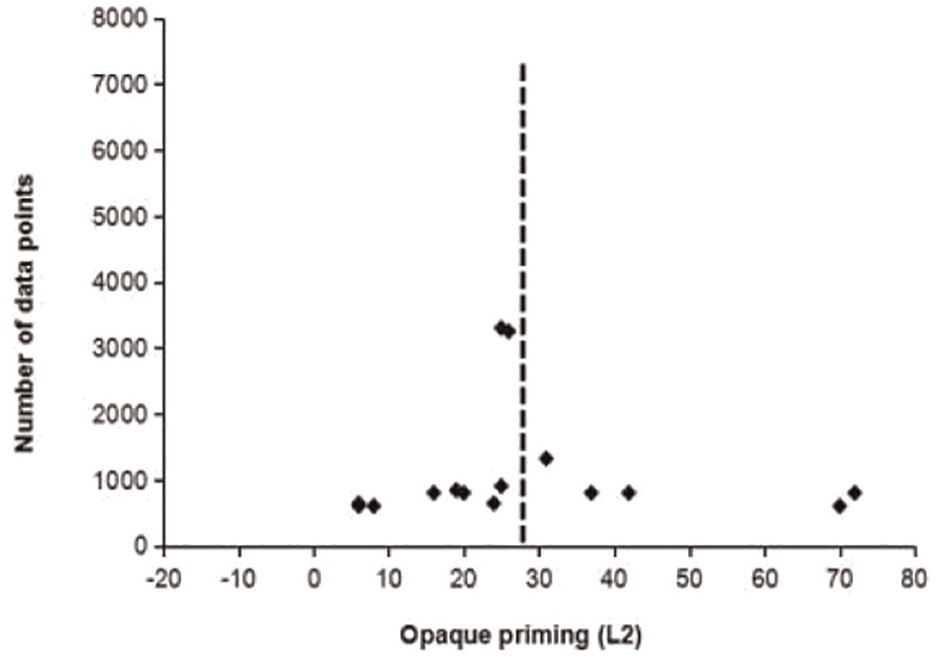
Funnel plot for nonnative morphological processing (Opaque).
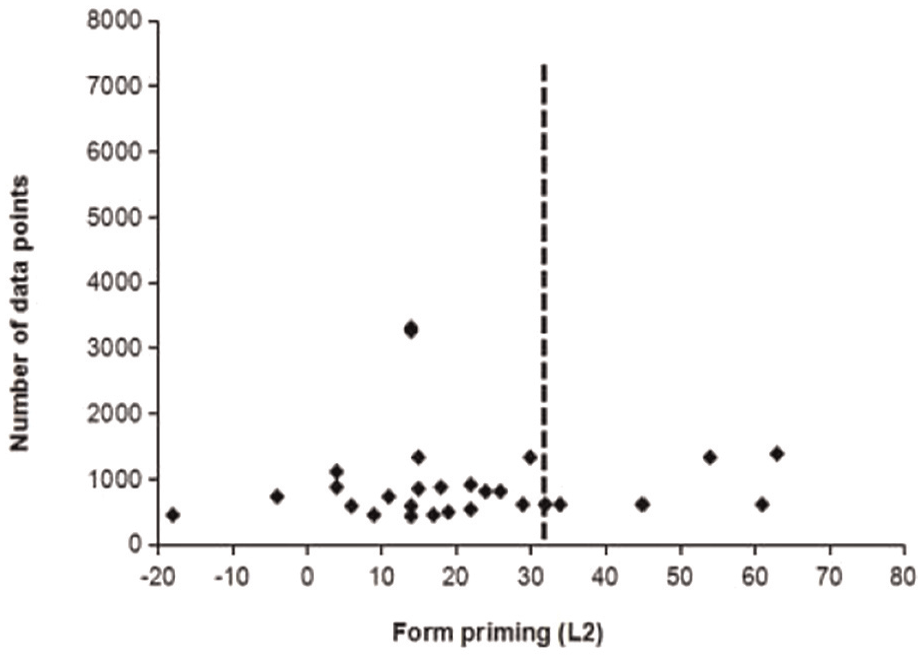
Funnel plot for nonnative morphological processing (Form).
The statistical analysis results indicated that the random components, specifically the random intercepts for between-population/study factors, explained over a quarter of the within-subjects variance (ICC = 0.26). As indicated by AIC, while we attempted to fit the model with random slopes, it failed to significantly enhance model fit. The omnibus tests for fixed effects revealed that the main effect of prime duration was not significant [F (1, 142.60) = 0.70, p = 0.465]. However, there was significant significance in the fixed effects omnibus tests for group [F (1, 105.80) = 6.99, p = .009], prime type [F (2, 192.90) = 21.24, p < .001], and their interaction [F (2, 196.30) = 6.14, p = .003].
As a result of the significant interaction effect between prime type and group, we conducted two simple effect analyses, specifically for prime type and group, to explore the individual effects of these variables on priming effects. The results, presented in Table 4, showed that native speakers demonstrated significant priming differences between Transparent and Opaque conditions (t = 3.02, SE = 4.34, p = .003), between Opaque & Form (t = 3.30, SE = 4.82, p = .001), and between Transparent & Form (t = 6.73, SE = 4.31, p < .001). In contrast, nonnative speakers demonstrated differences between Transparent & Opaque (t = 3.08, SE = 6.52, p = .002), between Transparent & Form (t = 2.21, SE = 4.78, p = .028), but not between Opaque & Form (t = 1.14, SE = 6.73, p = .160). These findings align with the predictions made in Figure 1 of the literature review, which suggested that native morphological processing is indicative of the hybrid model, in which both morpho-semantic and morpho-orthographic mechanisms are involved in morphological processing of derived words. In contrast, nonnative morphological processing suggests the supralexical model, in which morpho-semantic information underlies nonnative morphological processing. The simple effect for group was also conducted to identify group differences (levels in group were compared at each level of prime type). As shown in Table 5, native and nonnative speakers produced equivalent magnitudes of priming effects for the Transparent condition (t = −1.39, SE = 4.72, p = 0.17) and Opaque condition (t = −0.06, SE = 7.17, p = 0.96). However, native speakers produced diminished priming effects for Form items compared to nonnative speakers (t = −4.64, SE = 5.39, p < .001).
Simple Effect of Prime Type.

Note. T = Transparent; O = Opaque; F = Form.
p < .05; **p < .01; ***p < .001; ns = not significant.
Simple Effect of Group.

Note. ns = not significant.
p < .05. **p < .01. ***p < .001.
The results were further visualized in Figure 9, which showed the interaction effects between prime type and group. The plot revealed that native speakers had varying priming effects for Transparent, Opaque, and Form conditions, with non-overlapping error bars indicating significant differences between the conditions. In contrast, nonnative speakers had a stronger priming effect for Transparent condition than for Opaque and Form conditions, as indicated by the non-overlapping error bars. Furthermore, there was no significant difference between Opaque and Form conditions for nonnative speakers, as indicated by the overlapping error bars. Finally, native speakers had weaker priming effects than nonnative speakers for Form condition, as indicated by the non-overlapping error bar.

Effects plot by prime type and group.
Discussion
The present study aimed to investigate the factors contributing to the rapid morphological effects in masked morphological priming in nonnative derived words. Specifically, the study sought to determine the relative impact of semantic, morphological, and orthographic factors on masked morphological priming in nonnative derived words. Additionally, the study aimed to investigate potential differences in masked morphological priming between native and nonnative speakers in derived words. Methodologically, the study utilized a meta-analytic approach to combine priming effects from both nonnative studies (N = 22) and native-only studies (N = 22) investigating masked morphological priming. Overall, this study reveals that native and nonnative speakers process morphological structure differently in masked morphological priming. Native speakers employ both morpho-semantic and morpho-orthographic mechanisms, consistent with the hybrid model, and exhibit inhibition in form priming due to strong lexical competition. In contrast, nonnative speakers rely more heavily on orthographic overlap, aligning with the supralexical model, and show form priming due to reduced lateral inhibition, reflecting a lesser sensitivity to morphological structure. In all, these findings indicate that, while both groups engage with semantic cues, native speakers integrate morphological structure more robustly, whereas nonnative speakers depend more on orthographic cues to process derived words.
Regarding the First Research Question
The results showed that the prime type significantly impacted both native and nonnative morphological processing (as shown in Table 4). The Transparent-Opaque, Opaque-Form, and Transparent-Form differences produced graded priming effects among Transparent, Opaque, and Form conditions, indicating that both semantic and morphological effects contributed to native morphological processing. The Transparent condition generated more robust priming effects than the Opaque condition for nonnative morphological processing, indicating that morpho-semantic information facilitated nonnative morphological processing. Despite priming effects in both conditions, the Opaque-Form difference was insignificant for nonnative morphological processing, indicating that orthographic effects underlay pseudo-morphological structure in nonnative morphological processing. Overall, there was a numerical advantage for the Transparent condition over the Opaque condition, suggesting that whole-word recognition should be activated before morphological decomposition. These findings suggest that semantic effects play a role in both native and nonnative masked morphological priming in derived words.
The study also indicates that the lemma plays a role in facilitating lexical processing by mediating the relationship between function and form. Specifically, the findings show that Transparent priming generates stronger activation than Opaque priming, as the lemma for the stem sends activation to the lemma for the whole word rather than competing with it. This effect is modulated by the consistency of the lemma (Wang et al., 2021). Additionally, the study found that native speakers are more sensitive to morphological structure than nonnative speakers, who rely more on formal overlap for both pseudo-morphological and orthographic priming. The lexical competition theory (Grainger & Beyersmann, 2017) hypothesizes that when affixes (-er) are presented, the representation of edge-aligned words embedded in the primes (CORN) was activated. This leads to facilitative effects that offset the inhibitory effects of lexical competition. Nevertheless, this facilitation does not occur in Form priming because lateral inhibition emerges from embedding word, which diminishes the bottom-up activation. As a result, it is less likely for native speakers to have priming effects in the Form condition.
Nonnative speakers show less sensitivity to morphological structure, which may explain the lack of significance in the Opaque-Form difference (Gu, 2022). Instead, nonnative speakers rely more on orthographic information for handling Opaque words. The absence of lexical competition in the nonnative mental lexicon may also contribute to the formal priming observed in nonnative speakers. This is because lateral inhibition from the orthographically similar words may not be robust enough to suppress the bottom-up activation from embedded words (Grainger & Beyersmann, 2017; Qiao et al., 2009). This lack of competition may ultimately lead to orthographic priming in nonnative speakers (Diependaele et al., 2011; Heyer & Clahsen, 2015; Li & Taft, 2019; Li et al., 2017). The study’s findings regarding Transparent-Opaque differences for both native and nonnative speakers and Opaque-Form differences for only native speakers align with the processing models described in the Literature Review section. The hybrid model, which posits that both morpho-semantic and morpho-orthographic facilitation contributes to morphological processing, seems to apply to native morphological processing. On the other hand, nonnative morphological processing appears to align with the supralexical model, which proposes that morpho-semantic information facilitates morphological processing.
Regarding the Second Research Question
For RQ2, our study examined similarities and differences in masked morphological priming between native and nonnative speakers. As discussed previously, both native and nonnative speakers were found to be facilitated by semantic effects in Transparent conditions, but nonnative speakers relied more on formal overlap for pseudo-morphological structure, while native speakers utilized both morpho-semantic and morpho-orthographic segmentation. Regarding the simple effect of group (as shown in Table 5), our results showed that native and nonnative morphological processing patterns were similar for Transparent and Opaque conditions, indicating a high degree of overlap (Diependaele et al., 2011). However, nonnative speakers had stronger priming effects in the Form condition compared to native speakers, and nonnative speakers did not distinguish between Opaque (corner-CORN) and Form (think-THIN) priming, suggesting that nonnative speakers may have less robust knowledge of nonnative morphological structures and may rely more heavily on orthographic overlap than morphological structure when processing words (Heyer & Clahsen, 2015). In contrast, native speakers experienced inhibitory effects from lateral inhibition in the Form condition, resulting in a lack of Form priming. The exclusive Form priming effect observed in nonnative speakers may be due to the lack of lexical competition in their mental lexicon, resulting in mild inhibitory effects from lateral inhibition (Grainger & Beyersmann, 2017; Taft & Li, 2020). Overall, our findings suggest that while nonnative speakers can use semantic information similarly to native speakers, they may have reduced sensitivity to morphological structures and rely more on surface forms when processing derived words.
Previous studies have shown that both native and nonnative speakers exhibit Transparent and Opaque priming effects, suggesting the involvement of both morpho-semantic and morpho-orthographic decomposition in masked morphological priming. While nonnative morphological processing of regular inflections may not involve significant morphological decomposition (Neubauer & Clahsen, 2009) (there are also counter examples, which are discussed in Coughlin et al., 2019; Foote, 2017), the same may not be true for derived words. The hybrid model, which posits simultaneous activation of both morpho-semantic and morpho-orthographic processing, is a better fit for native morphological processing, whereas the supralexical model, which emphasizes morpho-semantic processing, better explains nonnative morphological processing. Both native and nonnative morphological processing show rapid morphological effects arising from morpho-semantic processing, which directly generates a masked morphological priming effect through the whole-word route. In addition, for native morphological processing, rapid morphological effects can arise in parallel through morpho-orthographic processing, which involves the direct parsing of input into morphemes without accessing whole-word information. The present study supports previous meta-analyses that have shown evidence for both morpho-semantic and morpho-orthographic mechanisms in the rapid processing of native derived words (Davis & Rastle, 2010; Feldman et al., 2010; Rastle & Davis, 2008). Furthermore, our study confirms similarities between native and nonnative morphological processing but also reveals differences, with nonnative speakers exhibiting less sensitivity to morphological structure and greater dependence on forms (Diependaele et al., 2011; Heyer & Clahsen, 2015; Li et al., 2017; Silva & Clahsen, 2008). Specifically, we found that nonnative speakers show significant priming in the Transparent and Opaque conditions, with equivalent priming in the Form condition, whereas native speakers show the largest facilitation in the Transparent condition, intermediate facilitation in the Opaque condition, and the least facilitation in the Form condition. Our results suggest that while nonnative speakers can make use of semantic information in a similar manner to native speakers, they are less sensitive to morphological structure and more reliant on forms.
Conclusion
The preliminary meta-analysis aimed to achieve two key research objectives. Firstly, it aimed to uncover the potential sources of rapid morphological effects in masked morphological priming in nonnative derived words. Secondly, it attempted to validate any differences between native and nonnative morphological processing of derived words. The findings suggest that native morphological processing utilizes both morpho-semantic and morpho-orthographic mechanisms for processing derived words, whereas nonnative morphological processing relies primarily on morpho-semantic mechanisms. Furthermore, the results suggest that while nonnative morphological processing is similar to native processing, it still shows distinct differences. Although nonnative speakers can use morpho-semantic information for morphological processing, they lack sensitivity to morphological structure and depend more on orthographic overlap. In summary, the processing patterns for native and nonnative speakers are respectively captured by the hybrid and supralexical models, while the lexical competition theory may describe the underlying mechanisms. Additionally, this study’s originality lies in its meta-analytic approach, which combines sublexical, supralexical, and hybrid processing models with lexical competition theory to systematically examine native and non-native morphological processing. By focusing on Transparent, Opaque, and Form conditions across both groups, this analysis reveals unique cross-linguistic insights into the role of orthographic overlap and lexical competition in morphological processing. These contributions enhance our understanding of cognitive mechanisms in second language morphological processing and offer a new perspective on the distinct adaptations that shape non-native speakers’ interactions with complex word forms.
Limitations
While this study made contributions to understanding morphological processing in nonnative speakers, it has some limitations. Firstly, due to the under-researched nature of Opaque priming, the statistical power of its role in our study may have been affected, even though we used the permutation test to address this. However, it is important to note that the lack of research on Opaque priming is a limitation of the field rather than our study. Future studies are encouraged to investigate Opaque priming in nonnative speakers. Secondly, our study only examined the role of meaning and form and group differences in morphological processing, and did not consider external factors that could moderate the processing. For example, native-nonnative similarity and morphological richness may influence nonnative morphology processing (Clahsen et al., 2010). Future studies should consider these factors, especially in cross-linguistic comparisons, to gain a better understanding of nonnative morphological processing. Thirdly, priming effects based on lexical decisions are likely to be post-lexical in nature, and that ERP data could potentially offer a more sensitive measure of cognitive processes. Future studies should be consider using complementary methods, such as ERP measurements, to provide a more comprehensive understanding of the cognitive processes involved in word recognition. Overall, we acknowledge that our study is preliminary and encourage further exploration in these areas.
Supplemental Material
sj-xlsx-1-sgo-10.1177_21582440251340563 – Supplemental material for What is the Origin of Rapid Morphological Effects? A Preliminary Meta-analysis Investigating the Contribution of Meaning and Form in Masked Morphological Priming in Nonnative Derived Words
Supplemental material, sj-xlsx-1-sgo-10.1177_21582440251340563 for What is the Origin of Rapid Morphological Effects? A Preliminary Meta-analysis Investigating the Contribution of Meaning and Form in Masked Morphological Priming in Nonnative Derived Words by Lei Gu, Ken Chen and Wenrui Zhang in SAGE Open
Footnotes
Acknowledgements
Not applicable.

Ethical Considerations
We rigorously followed ethical principles in our study utilizing publicly-available bibliometric data. We ensured data privacy, accuracy, transparency, and respect for intellectual property. As the study did not involve human participants, formal ethical approval was not necessary, but ethical guidelines were strictly adhered to for integrity and credibility.
Funding
The author(s) received no financial support for the research, authorship, and/or publication of this article.
Declaration of Conflicting Interests
The author(s) declared no potential conflicts of interest with respect to the research, authorship, and/or publication of this article.
Data availability statement
All data generated or analyzed during this study can be found in the supplementary information files of this manuscript.
References
Supplementary Material
Please find the following supplemental material available below.
For Open Access articles published under a Creative Commons License, all supplemental material carries the same license as the article it is associated with.
For non-Open Access articles published, all supplemental material carries a non-exclusive license, and permission requests for re-use of supplemental material or any part of supplemental material shall be sent directly to the copyright owner as specified in the copyright notice associated with the article.
