




Abstract
In this study, we investigate the impact of remittance inflows on poverty reduction in South Africa, using time series data from 1980 to 2017. The main objective of this study is to establish whether South Africa can harness remittance inflows to alleviate poverty. Two poverty proxies, namely household consumption expenditure and infant mortality rate, are used in this study. To ensure robustness of the results, both income and non-income proxies of poverty are employed. Using the autoregressive distributed lag (ARDL) bounds approach, the study found that remittance has a negative impact on poverty in the short run and in the long run when household consumption expenditure is used as a proxy for poverty. However, when the infant mortality rate is used as a proxy, remittance is found to have no impact on poverty. It can be concluded that the impact of remittance on poverty is sensitive to the proxy used. The study concludes that South Africa could benefit immensely from some forms of remittances in its quest to poverty alleviation.
Keywords
Introduction
The end of the Millennium Development Goals (MDGs) in 2015, with some of the goals partially achieved, paved the way for the Sustainable Development Goals (SDGs) 2030. Under the MDGs, the poverty reduction target was achieved in aggregate; but at a country level, a number of developing countries are still struggling with high poverty levels, and South Africa is not an exception. Thus, many countries are still seeking solutions to poverty by focusing on different macroeconomic variables, such as foreign direct investment (FDI), and most recently, attention has been drawn to the poverty-reducing effect of remittances. The literature on the impact of remittances on economic growth is well documented, although the findings are inconclusive (Atanda & Charles, 2014; Goschin, 2014; Imai et al., 2014; Imran et al., 2018; Kumar, 2013; Lim & Simmons, 2015; Makun, 2018; Meyer & Shera, 2017). However, few studies have been conducted to establish if remittances contribute positively to poverty reduction at the household or national level. The SDGs also support favorable migration policies based on the potential that remittances have on the policy thrust of inclusive development, as spelt out by SDG indicator 10.7.1-reduce recruitment cost of migrant workers; SDG indicator 17.3.2-increase remittance inflows as a percentage of gross domestic product (GDP); and SDG indicator 10.c.1-reducing remittance cost (World Bank, 2019a). Given a dearth of literature on the impact of remittances on poverty levels, on one hand, and the thrust of the SDG spearheaded by the United Nations, on the other hand, another study that explores the direct impact of remittances on poverty levels in South Africa cannot be overemphasized, as it will shed more light on the country’s poverty alleviation policies.
According to the World Bank (2019a), remittance inflows in low- and middle-income countries have significantly increased in the past years and are projected to reach US$528 million in 2018—a growth of 10.8% from the 2017 level. This has caused remittance inflows to be three times greater than official development assistance (ODA), and larger than FDI when China is excluded in low- and middle-income countries (World Bank, 2019a). Remittances have grown to be an important source of income, not only for low- and middle-income countries at the macro level (national level), but also at the micro level (household level). Despite the surge in remittances, a few studies have investigated the nature of the relationship between remittances and poverty in South Africa. The majority of the studies that have been done on South Africa on this subject are largely based on panel data and cross-sectional analysis. Given the limitations of cross-sectional data in capturing country-specific effects that underlie the relationship between remittances and poverty (Ghirmay, 2004; Odhiambo & Nyasha, 2019) and that of panel data in pooling countries with different economic dynamics (Blonigen & Wang, 2004), this study employs a time series methodology, autoregressive distributed lag (ARDL) in particular, to investigate South African country-specific remittance-poverty nexus.
To improve the robustness of the results and given the debate that is still raging on what a more comprehensive measure of poverty is between income and nonincome measures, this study uses two poverty proxies-household consumption expenditure, which is an income measure, and infant mortality rate, a non-income measure. These poverty proxies have been selected based on the need to capture poverty from income and non-income perspectives. Moreover, the unavailability of time series data for other poverty measures such as poverty headcount, poverty gap, poverty gap squared, and human development index (HDI) has contributed to the selection of these proxies. Other studies have used these poverty proxies, for example, Ravallion (2001), Rehman and Shahbaz (2014), and Kaidi et al. (2018) used household consumption expenditure as a proxy for poverty and Van Multzahn and Durrheim (2008) and Abosedra et al. (2016) used the infant mortality rate as a poverty proxy.
Although South Africa is a major source of outward remittance, especially in the Southern Africa Development Community (SADC), the country has also experienced emigration, with more than 824,000 South Africans in 2019 estimated to be working outside the country (United Nations, 2019) The question that needs an investigation is whether the money that is sent in by South Africans working abroad can help to alleviate poverty in the country. This study will inform policy makers on whether remittances are useful in reducing poverty so that they can, in an informed way, devise measures that can be taken by the government to harness remittances to reduce poverty.
The rest of the study is set out as follows: section “Literature Review” discusses the literature review both empirical and theoretical; section “Method” outlines estimation techniques; section “Results” presents and discusses the results; and section “Conclusion and Recommendation” concludes the study.
Literature Review
Remittance and Poverty Dynamics in South Africa
The United Nations (2018) defines remittance as personal transactions from a migrant to their family and friends back in their home country. This makes remittances more targeted to the needs of the family or friends. Thus, remittances are more inclined to the special needs of the family, which are unique and vary from individual to individual, in contrast to other cash transfers from the government that are one size fit all.
South Africa has experienced notable emigration, with mostly young age groups looking for greener pastures in other countries. Among the top destinations for these migrants are the United Kingdom, Australia, New Zealand, Canada and the United States (World Bank, 2019b). The South African government has put in place policies that focus much on regulating remittance outflows. Unlike the FDI drive that is well supported in the economic policies and different arms of government, the remittance issue is still on the back burner, though it is gradually gaining attention.
Remittance inflows in South Africa improved during the period under study, although the numbers remain depressed when compared with countries like India and Brazil (United Nations Conference on Trade and Development [UNCTAD], 2018). Remittance inflows in South Africa were depressed in 1980 when a proportion of 3% of GDP was received (UNCTAD, 2018). An average of 5% was recorded between 1980 and 1996. The inflows significantly increased from 1997 when the inflows increased from 5% to 11% (UNCTAD, 2018). An average of 24.3% was registered between 1997 and 2017 (UNCTAD, 2018). This period received the highest remittances during the period under study (UNCTAD, 2018). South Africa, like other middle-income countries, experienced a gradual increase in remittance levels from the late 90s (UNCTAD, 2018).
On the poverty front, South Africa has made great strides in implementing policies that focus on poverty alleviation. The country’s national economic policy, National Development Plan 2030, has a broad objective of reducing poverty and inequality, among other policy advancements. The approach to poverty alleviation has been multifaceted and can be categorized as follows: (a) economic empowerment, associated with financial support for small businesses, training to improve success rates of business, marketing of products, copyright and intellectual property rights with the Competition Commission being the custodian, international exposure to business, and export opportunities; (b) improved access to social services, such as education, housing, and health through free access to those who cannot afford these and increasing awareness and accessibility of the services; and (c) direct intervention through the social safety net, where social grants are given to targeted individuals, public works programs, and social insurance. In response to these policies, there has been a gradual reduction in poverty, although the figures are still high and volatile (World Bank, 2019c). The poverty headcount was recorded at 29.3% in 1993 and increased to 33.8% in 1996 before falling consistently over the years to 16.5% in 2010 (World Bank, 2019c). In 2014, the poverty headcount took an upward trend, recording 18.9% (World Bank, 2019c). The HDI marginally improved from 0.618 in 1990 to 0.699 in 2017 (United Nations Development Programme [UNDP], 2018). This was a great improvement compared with 0.39 and 0.537 recorded for sub-Saharan Africa during the same period (UNDP, 2018).
A Review of Related Literature
According to Hagen-Zanker and Himmelstine (2016), remittances can be in cash or kind. Theoretical literature suggests a positive relationship between remittance and poverty reduction. Although it has the potential to mitigate poverty, a remittance option does not belong to the poorest in society because of the cost associated with migration (Hagen-Zanker & Himmelstine, 2016).
The literature further splits the positive impact of remittances on poverty reduction into direct (see De Vries, 2011; Hagen-Zanker & Himmelstine, 2016) and indirect impact (see Ratha, 2007; UNCTAD, 2013). Remittance has a direct positive effect on households (Hagen-Zanker & Himmelstine, 2016). They reach a greater share of the overall population compared with other forms of transfers (Hagen-Zanker & Himmelstine, 2016). Another advantage of remittances is that it reaches both male and female recipients compared with targeted cash transfers (Duflo & Udry, 2004). Apart from consumption, remittances are associated with investment—human capital, cash assets (Adam & Page, 2005; Bui et al., 2015), real estate, and small business (Ratha, 2007; UNCTAD, 2013). UNCTAD (2013) summed the impact of remittance on household welfare in a pyramid. Remittance is channeled to consumption first; the next level of satisfaction is home comfort, followed by health and education expenditure. The next level on remittance expenditure according to UNCTAD (2013) is long-term household expenditure on durable goods, and the last level in the pyramid is savings and investments. Thus, households strive to satisfy consumption needs, and savings and investment only come after satisfaction of immediate needs. According to the pyramid, if remittances are not huge enough, households are likely to spend all the remittance income on consumption.
In addition to the direct impact of remittances on poverty through positively affecting household income, remittances have an indirect effect on welfare through the multiplier effect on the economy (Ratha, 2007; UNCTAD, 2013). Thus, remittances can mitigate poverty at a national level through the multiplier effect, which is realized through changes in consumption and investment (Ratha, 2007).
The stable and countercyclical nature of remittances makes it important as a shock absorber when there are social shocks like civil wars and disasters (Kapur, 2004). The ultimate result of the multiplier effect is a growth in the economy that is more than the initial change in investment and consumption. De Vries (2011) summed the benefits of remittances as poverty reduction, economic growth spur, savings and investment increase, and sectoral growth stimulation.
The empirical studies on the impact of remittances on poverty or welfare have recently drawn widespread attention following the realization of the potential that the remittances have on poverty alleviation, coupled with a steady increase in remittance inflows that developing countries have been receiving of late. However, unlike the theoretical literature, which lays bare in no uncertain terms the positive relationship between remittances and poverty reduction, the empirical literature on the subject is still subject to debate. Studies that have attempted to establish the relationship between remittances and poverty reduction largely found a positive relationship between the two (Acosta, 2008; Adam & Cuecuecha, 2013; Adam & Page, 2005; Akobeng, 2016; Fuente, 2010; Gupta et al., 2009; Imran et al., 2018; Nahar & Arshad, 2017; Tsaurai, 2018; Vacaflores, 2018). There are also some studies that found the relationship between remittances and poverty alleviation to be a complex one, varying from one study country to the other or sensitive to the poverty proxy used (see, for example, Azam et al., 2016; Wangle & Devkota, 2018).
Adam and Page (2005) studied the impact of remittances on poverty using data from 71 developing countries and found remittance to reduce the depth and severity of poverty. A 10% increase in per capita international remittance was found to lead to a 3% reduction in people living in poverty. Acosta (2008) analyzed the impact of remittances on poverty in Latin America, employing panel data from 59 industrial developing countries from 1970 to 2000. The findings from the study were consistent with those by Adam and Page (2005)—thus remittance was found to reduce poverty.
Gupta et al. (2009) also found a positive direct poverty-mitigating effect in 76 countries. A 10% increase in remittances was found to lead to a 1% decrease in the poverty headcount and poverty gap. In the same vein, Fuente (2010) investigated the impact of remittance on poverty in Mexico, using data from 1998 to 2000, on rural households and found a negative relationship between poverty and remittance. Adam and Cuecuecha (2013) also analyzed the impact of remittance on poverty. The findings from the study were consistent with Fuente (2010) and Gupta et al. (2009).
Akobeng (2016) investigated the impact of remittance on poverty and inequality using micro data from sub-Saharan Africa and found remittance to reduce poverty, but the extent to which poverty reduction is achieved was found to be sensitive to the poverty measure used. Nahar and Arshad (2017) investigated the impact of remittance on poverty reduction in Indonesia using data from 1983 to 2015 and also found remittance to reduce poverty, however, only by a small margin.
Vacaflores (2018) investigated the relationship between remittance and poverty employing panel data from 2000 to 2013 from 19 Latin America countries. The results confirmed a negative relationship between remittance and poverty. Thus, remittance was found to reduce poverty in Latin America. Tsaurai (2018) also investigated the impact of remittance on poverty in selected emerging market economies using panel data from 1980 to 2012. The results were in line with the findings by Vacaflores (2018) and Wangle and Devkota (2018). In the same spirit, Imran et al. (2018) investigated the impact of remittances on poverty headcount and severity in rural and urban Punjab. Using cross-sectional data collected from a cluster survey, they found remittances to negatively affect poverty with variations from rural to urban areas. In the same study, they found households that receive remittances to be less impoverished compared with those without the additional resource.
Azam et al. (2016) analyzed the impact of remittance on poverty alleviation in 39 lower middle, upper-middle, and high-income countries using panel data. Remittance was found to have a positive impact on poverty alleviation in upper middle-income countries. A 1% increase in remittance was found to lead to a 0.2% reduction in poverty. However, in the same study, remittance was found to be insignificant in high-income countries. The findings by Azam et al. (2016) imply that results from one study country may not be generalized or used to inform policy in another country.
Wangle and Devkota (2018) analyzed the impact of remittance on poverty using longitudinal panel survey data from 1996 to 2017 for Nepal. The results confirm that remittance reduces poverty in Nepal. However, the results were sensitive to time frame and poverty definition. It can be concluded that the impact of remittance on poverty reduction is largely supported in the literature. However, studies like Azam et al. (2016) and Wangle and Devkota (2018) suggest that a country-specific study remains important to come up with policy-relevant results.
Method
An autoregressive distributed lag (ARDL) bounds testing approach is used to investigate the impact of remittances on poverty in this study. The ARDL bounds testing approach has been selected because of a number of advantages. First, the ARDL approach does not require all variables to be integrated of the same order (Pesaran et al., 2001). Variables can be integrated of Order 1 (I(1)), Order 0 (I(0)), or fractionally integrated (Pesaran et al., 2001, p. 290). Second, the ARDL bounds approach uses a single reduced form equation, unlike other methods (see Duasa, 2007). Third, the ARDL approach to cointegration is robust in a small sample (Odhiambo, 2009; Solarin & Shahbaz, 2013). Fourth, the ARDL bounds testing approach to cointegration provides unbiased estimates of the long-run model, even in cases where some variables are endogenous (Odhiambo, 2009). It is against this background that the ARDL bounds approach was selected in this study.
Variable Definition
In this study, poverty is the dependent variable measured by household consumption expenditure (Pov1) and infant mortality rate (Pov2). These two proxies have been selected based on the need to capture poverty from a multidimensional perspective so as to improve the robustness of the results. Pov1 (household consumption expenditure) is expressed as a percentage of GDP. This proxy captures income poverty. In the literature, a number of studies have employed this poverty proxy (see Kaidi et al., 2018; Odhiambo, 2009; Ravallion, 2001; Rehman & Shahbaz, 2014). A positive relationship between Pov1 and remittance implies that remittances mitigate poverty. Pov2 (infant mortality rate) captures non-income poverty. The higher the infant mortality rate, the worse the poverty. A negative relationship between infant mortality rate and remittances implies that remittance leads to poverty alleviation as it reduces mortality. There are numerous studies that used the infant mortality rate as a proxy for poverty (see Abosedra et al., 2016; Laderchi, 1984; Van Multzahn & Durrheim, 2008).
The main independent variable of interest is remittance (REM), proxied by international remittance inflows. International remittance inflows are expressed as a percentage of GDP. This has the advantage of taking the size of the economy into account. A number of studies found remittance to mitigate poverty (Tsaurai, 2018; Wangle & Devkota, 2018). Remittance is expected to have a negative impact on poverty when the infant mortality rate is used as a proxy, whereas a positive impact is expected when household consumption expenditure is used as a proxy.
To fully specify the model and to eliminate variable-omission-bias, a number of control variables have been included in the model, namely (a) trade openness (TOP); (b) education (EDU); (c) real gross domestic product per capita (GDPC); and inflation rate (INF). Trade openness is measured by a sum of exports and imports divided by GDP.
Trade openness shows how open the economy is to international transactions. Bharadwaj (2014) found trade openness to help in poverty alleviation. Trade openness is expected to reduce poverty. Another variable that is also included in the model is education. Education, which is a measure of human capital, is measured by gross primary school enrolment rates. Higher enrolment rates are expected to result in high human capital which is crucial in knowledge acquisition, training, and improved access to better-paying jobs; hence higher income. Education is expected to reduce poverty.
Living standards (LS) proxied by real GDP per capita, which is an indicator of living standards in a country, has been included as one of the control variables. A high real GDP per capita indicates better living standards and a decrease in poverty levels. Akobeng (2016) and Nahar and Arshad (2017), among other studies, used GDP per capita as a control variable. The living standards is expected to reduce poverty. Inflation is also one of the control variables, measured as the rate of change of the consumer price index. High inflation rates erode the purchasing power of the poor, putting them in a worse off position (Mohr et al., 2008, p. 480). A positive relationship is expected between inflation and poverty. An increase in the inflation rate is expected to put the poor on a worse off position.
Model Specification
The model specification follows Adam and Page (2005), Gupta et al. (2009), and Abbas (2019) but differs on the variables included in the model. The general model specification is given in Equation 1:

where
The ARDL specification of the general empirical model in Equation 1 can be expressed as the following:

where
The ARDL-based error correction model (ECM) of the general empirical model is specified as follows:
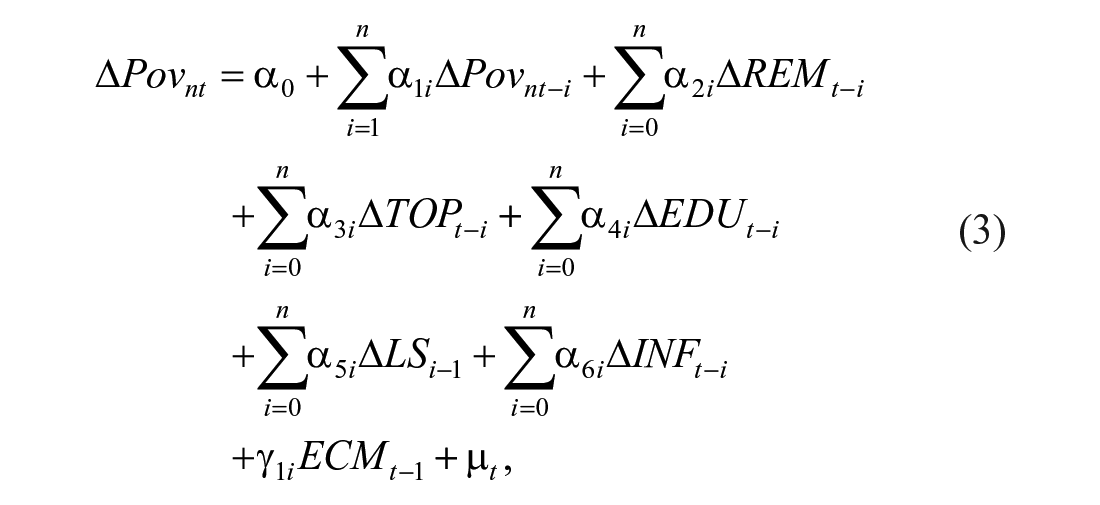
where
Data Sources
The study employs time-series data from 1980 to 2017 to investigate the direct impact of remittance on poverty reduction. The data on GDP, education, trade openness, and inflation were obtained from the World Bank Development Indicators Database, while remittance data were extracted from UNCTAD database. The analysis of the data was done using Microfit 5.0.
Results
Unit Root Test
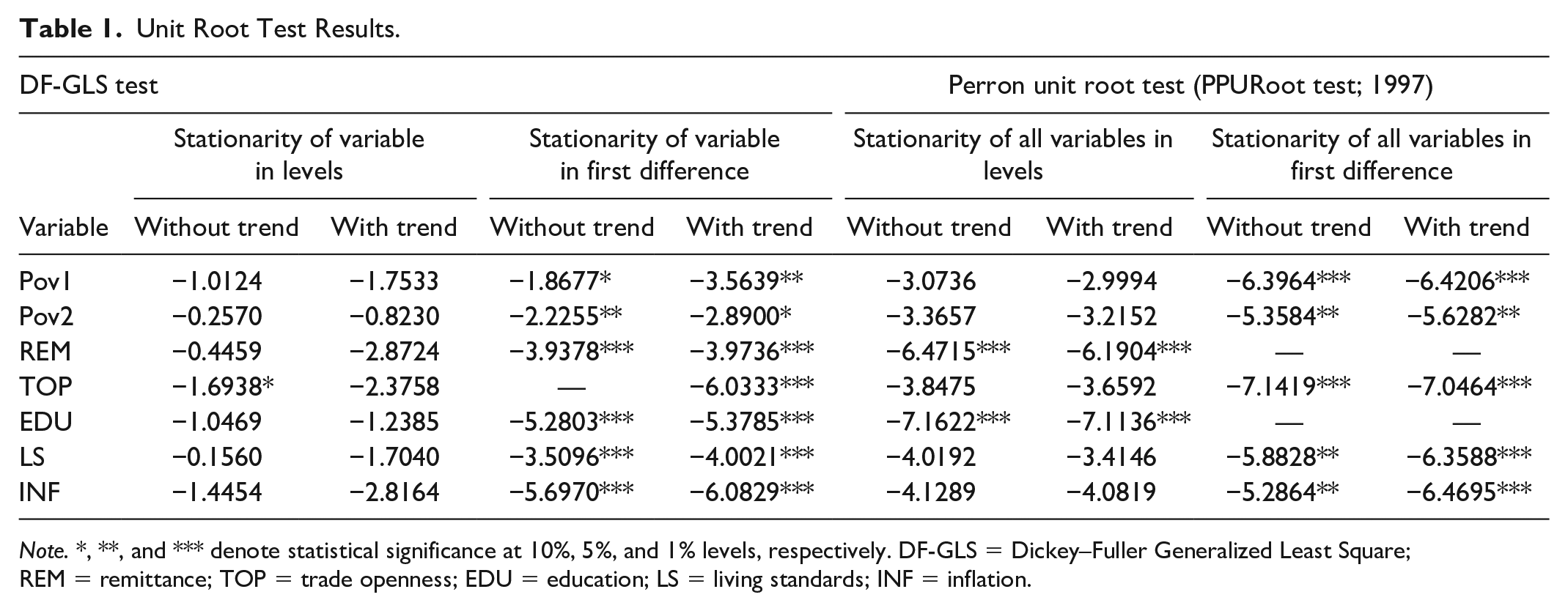
The ARDL approach employed in this study does not require a unit root test, however, the test was done on all the variables included in the model to ascertain that they are integrated of Order 0 (I(0)) or 1 (I(1)). The ARDL approach falls away if variables are integrated of order two or higher. Table 1 presents the results of the unit root tests conducted using the Dickey–Fuller Generalized Least Square (DF-GLS) and Perron unit root test (PPURoot test; 1997) tests.
Unit Root Test Results.
Note. *, **, and *** denote statistical significance at 10%, 5%, and 1% levels, respectively. DF-GLS = Dickey–Fuller Generalized Least Square; REM = remittance; TOP = trade openness; EDU = education; LS = living standards; INF = inflation.
The unit root tests presented in Table 1 show that non of the variables included in this study is integrated of order two (I(2)) or higher. This confirms the appropriateness of the use of the ARDL bounds testing approach. The study, therefore, proceeds to test for cointegration relationship among the variables in Model 1 and Model 2.
Cointegration Test
The results of the cointegration relationship among the variables included in Model 1 and 2 are presented in Table 2.
ARDL Approach to Cointegration Results.

Note. *, **, and *** denote statistical significance at 10%, 5%, and 1% levels, respectively. ARDL = autoregressive distributed lag; REM = remittance; TOP = trade openness; EDU = education; GDPC = gross domestic product per capita; INF = inflation.
Table 2 presents cointegration results for both models.
The calculated F statistics for Models 1 and 2 are 3.8716 and 3.5278, respectively, and are greater than the upper-bound critical values by Pesaran et al. (2001). This confirms a long-run relationship among the variables in both models—Models 1 and 2.
Coefficient Estimation
To proceed with the analysis, after confirming cointegration in Models 1 and 2, ARDL is used to estimate the coefficients for the models. The optimal lag length for the two models is selected using Akaike information criteria (AIC) depending on the most parsimonious model. The long- and short-run results for Models 1 and 2 are presented in Table 3.
Empirical Results for Model 1 and Model 2.

Note. *, **, and *** denote statistical significance at 10%, 5%, and 1% levels, respectively. ARDL = autoregressive distributed lag; REM = remittance; TOP = trade openness; EDU = education; LS = living standards; INF = inflation; ECM = error correction model; DW = Durbin–Watson.
The results presented in Table 3 Panels A and B show that remittance is significant in both the long run and the short run when household consumption expenditure is used as a proxy for poverty. This finding is consistent with other previous studies (see Vacaflores, 2018; Wangle & Devkota, 2018). The results confirm that remittance has a poverty-reducing effect, which is also supported in the literature through a number of advantages highlighted by UNCTAD (2013) and Hagen-Zanker and Himmelstine (2016). This finding implies that South Africa can benefit from policies that support emigration. However, when the infant mortality rate was used as a proxy for poverty, remittance was found to be insignificant. Thus, remittances do not lead to a reduction in the infant mortality rate, neither does it increase it; hence, it does not have a significant impact on poverty in South Africa. These findings are not unique to South Africa alone, as Azam et al. (2016) also found the same results in upper-income countries in a study on global evidence.
Other results presented in Table 3 Panels A and B reveal that when household consumption expenditure (Pov1) is used as a proxy, trade openness is positive and significant in the short run, confirming a poverty-mitigating effect. This can be explained by the fact that trade increases domestic consumption of a wide range of goods; a competition that results in improvement in the quality of goods produced; and also has potential to create new job opportunities in exporting and distribution industries. Education was found to have a positive effect on household consumption expenditure, leading to poverty reduction in the short run. Education increases the chances of the poor in securing better-paying jobs that increase household income and access to goods and services. In South Africa, given the economy has a challenge of high unemployment, education gives a platform for the poor to be employable (Mohr & Associates, 2015). GDP per capita has an insignificant impact on poverty reduction. The possible explanation in South Africa is the high-income inequality with a 63% Gini index recorded in 2014 (World Bank, 2019c). This makes real gross domestic product a less reliable measure of welfare as the real income could be in the hands of a few. Inflation leads to high poverty levels when Pov1 (household consumption expenditure) is used as a proxy in the long run and the short run. This finding is supported in the literature as an increase in prices erodes the purchasing power of income earned by the poor and makes them worse off. The ECM (ECM(−1)) is 76%. Whenever there is a disequilibrium in the economy, it takes 1 year and 3 months to return to equilibrium.
Other results presented in Panels A and B where the infant mortality rate (Pov2) is used as a proxy confirm that trade openness has a positive and significant impact on poverty in the short run. Education has a negative effect on poverty in the long run when the infant mortality rate is used as a proxy. Education helps in reducing poverty, and the possible explanation is increased awareness by mothers on the importance of health care, such as immunization and primary health care.
Real GDP per capita has a negative effect on infant mortality rate; hence, it leads to poverty reduction. The increase in the general standard of living also implies the ability of the government to provide better social services such as health. Inflation has a negative and significant impact on poverty in both the long run and the short run when Pov2 is used as a proxy. The findings from this study reveal that there is a certain level of inflation that gives firms an incentive to continue producing (Mohr & Associates, 2015). The ECM (ECM(−1)) for Model 2 is 18% implying that it takes more than 5 years to achieve full adjustment in the event of an economic disequilibrium in South Africa. The model is a perfect fit with an adjusted R2 of 83%.
Overall, the results presented in Panels A and B reveal that the impact of remittance on poverty reduction is sensitive to the proxy employed. When household consumption expenditure is used as a proxy for poverty, a significantly positive impact was found, whereas no impact was found when the infant mortality rate is used as a proxy.
The diagnostic tests were performed, for Models 1 and 2, on serial correlation, functional form, normality, and heteroscedasticity. Both models passed serial correlation, normality, and heteroscedasticity tests but failed the functional form test. However, upon further test on cumulative sum of recursive residuals (CUSUM) and cumulative sum of squares of recursive residuals (CUSUMQ), both models were found to be stable at the 5% level of significance (see Makuyana & Odhiambo, 2017). The results of the tests are presented in Table 4.
Diagnostic Results for Models 1 and 2.

Note. LM = lagrange multiplier; CHSQ = chi-square.
CUSUM and CUSUMSQ results for are presented in Figure 1.

CUSUM and CUSUMSQ Results for Models 1 and 2.
Models 1 and 2 are stable at the 5% level of significance as presented in Table 4.
Conclusion and Policy Recommendations
This study investigated the impact of remittance inflows on poverty reduction in South Africa using data from 1980 to 2017. The study employed the ECM-based ARDL bounds testing approach to examine this linkage. To improve robustness of the results, two poverty proxies were employed, namely household consumption expenditure and infant mortality rate. The empirical findings of the study revealed that remittances have a poverty-mitigating effect, both in the long run and in the short run when household consumption expenditure was used as a proxy. However, when the infant mortality rate was used as a proxy, no impact was found between poverty and remittance, irrespective of whether the estimation was in the long or short run. The impact of remittance on poverty is, therefore, sensitive to poverty proxy used. Despite the varying results based on poverty proxy under consideration, on the whole, South Africa can benefit from remittance inflows in reducing poverty. The study concludes that South Africa could benefit immensely from some form of remittances in its quest to alleviate poverty. Based on the findings of this study, it is recommended that South Africa should continue to strengthen remittance supporting policies in the fight against income poverty. However, policy makers need to look at other macroeconomic variables that have a direct impact on other poverty dimensions, such as health. A multipronged approach to poverty reduction is suggested as the best strategy for South Africa in order to fight multidimensional aspects of poverty.
Footnotes
Declaration of Conflicting Interests
The author(s) declared no potential conflicts of interest with respect to the research, authorship, and/or publication of this article.
Funding
The author(s) received no financial support for the research, authorship, and/or publication of this article.
