




Abstract
With the development of teacher education, teacher agency has garnered more attention as a vital factor to achieve teachers’ sustainable development in recent years. Based on Biblioshiny, this study attempts to quantify and map 753 articles on teacher agency collected in WOS Core Collection from 2003 to 2024. Specifically, annual scientific production, the contributions of sources, authors, countries and affiliations have been presented. Besides, research relationships and keywords on this topic have also been identified and analyzed to review the progress of this research field. Moreover, it is predicted that more subtopics will appear and teachers’ digital competency related to their agency will particularly be a research frontier in the future.
Plain Language Summary
This article summarizes the research literature on teacher agency over the past twenty-two years by using particular softwares called Biblioshiny. The authors collected 753 articles closely related to teacher agency in Web of Science. Then, annual scientific production, the contributions of sources, authors, countries and affiliations of these articles have been presented. With analysis aided by Biblioshiny, research relationship, cited reference have also been analyzed to display the research development on teacher agency. In addition, research trend on this topic has also been predicted based on the above analysis.
Introduction
Agency, derived from the medieval Latin “agentia,” is the present participle form of “agent.” Since “agent” means a person or thing that exerts influence, “agency (agentia)” indicates the state of being influential etymologically. The intellectual origins of this concept can be traced back to the ancient Greek era in which Socrates directed philosophy from the external world to the human heart by emphasizing the importance of human cognition for the formation of knowledge. This can be considered the starting point of the inquiry into the ontology of man (Bai, 2006). Subsequently, with the development of society, agency as a key feature of human behavior gradually became a common topic in philosophy, sociology, psychology, and other humanities and social sciences. Throughout the research history on agency, the definitions of agency can be broadly grouped into three categories (the individual view, the individual-society interaction view and the time view) among which the individual-society interaction view is currently more favored by the academic community. This view examines agency from the perspective of a combination of individual and social factors, positing that individual agency behavior, regulated by the mediator of social culture (Ahearn, 2001) and closely linked to social structures (Xu & Long, 2020), is a constantly negotiated relationship with society and the surrounding environment (Lantolf & Pavlenko, 2001).
Teacher agency is the development of the concept of agency in the field of education. Based on relevant literature, it is clear that studies on teacher agency are initially scarce, largely intertwined with studies focusing on teacher identity and teacher ethnics (Beijaard et al., 2004; Campbell, 2004). However, as the perspectives on agency research expand, scholars have defined and conceptualized teacher agency in various ways. Currently, a widely accepted definition posits teacher agency as the capacity for teachers to engage in various educational and instructional practices within schools (Priestley et al., 2012). This conceptualization aligns with the two predominant perspectives in agency research, namely, the individual view and the individual-society interaction view. On the one hand, the individual view posits that teacher agency not merely refers to teachers’ capacity to make choices and instigate changes, but encompasses implicit dimensions such as reflection, purpose, intention, and motivation (Paris & Lung, 2008). This perspective emphasizes the significant role of teachers’ subjective agency in educational practice. On the other hand, from the perspective of individual-society interaction view, teacher agency is manifested in the continual negotiation of relationships between the individual and their social environment (Priestley et al., 2012). This view highlights teacher agency as an inter-constructive process between teachers’ beliefs and their surroundings, which aids in the consolidation of teachers’ educational beliefs (Moate, 2011).
Meanwhile, as research deepens, the time dimension has increasingly been incorporated into conceptualization of teacher agency. Priestley et al. (2015) introduced the ecological framework of teacher agency, emphasizing that it is not an inherent trait of individuals but dynamically constructed over time based on the current context and teachers’ personal experiences. This perspective greatly broadens the connotation of teacher agency, underscoring its dynamic and developmental nature. Notably, Tao and Gao (2021) reviewed prior studies and identified four major theoretical perspectives in the research of teacher agency: social cognitive theory, sociocultural theory, poststructuralist perspective, and ecological perspective, providing a more diverse theoretical framework for studying teacher agency.
As the conception of teacher agency becomes increasingly enriched and the research perspectives broaden, the academic community has gained a deeper understanding of the significance of teacher agency. Concurrent with the accelerated pace of global educational change and curriculum reforms at the beginning of the 21st century, teacher education has introduced new requirements for teachers’ professionalism and paid constant attention to teachers’ curriculum implementation processes, so teacher agency has received extensive attention from educators. In the context of educational reforms, teachers need not only to learn and master new teaching content but also to find a suitable path for their professional development. Furthermore, the core of achieving teachers’ professional development lies in whether teachers can give full play to their own autonomy, initiative and agency to proactively adapt to the development and changes in education. Teacher agency has three prominent characteristics: professionalism, active participation, and innovation (Wang, 2021). In terms of professionalism, teachers with agency have adequate professional knowledge and literacy, and conversely, agency helps teachers to improve their professional competence (Brodie, 2021). As for active participation, teachers with high agency will actively participate in educational change and professional development. From the perspective of innovation, teachers with high agency will practice on their own to deal with the various challenges brought by change and improve their education (Wang, 2021). Therefore, it can be said that teacher agency is a key factor in promoting teacher development, improving education and teaching as well as driving educational reforms. Thus, it is necessary to sort out the achievements of the research field to reflect its development history and trend.
Presently, the most widely used literature review approach is bibliometric, which is a quantitative analysis approach by applying mathematical and statistical tools to measure the interrelationship and impact of publications in a particular research field (Lee et al., 2020). Compared to traditional manual literature reviews, which is time-consuming and labor-intensive, bibliometric methods can bring a macro-overview of a mass of academic studies and reliably identify influential performers through data mining and literature analysis (van Eck & Waltman, 2010). This enables researchers to identify influential works and detect evolving occurrences of specific research areas over time. Nowadays, the quantitative method has been extensively applied to monitor the research performance across various themes (Alshater et al., 2021; Hassan et al., 2021; Pattnaik et al., 2020; Z. Wang et al., 2023). It is well acknowledged that bibliometric analysis, as a quantitative approach, relies heavily on citation-based metrics, which is too simple to capture the complexity and multiple dimensions of research output and impact. (Haustein & Larivière, 2014). Despite the limitation, when appropriately applied, bibliometric analysis can still effectively provide an integrative and holistic view, making it useful in exploring the research landscape within the field of teacher agency. The present study aims to address the following research questions (RQs):
RQ1: What is the distribution pattern of annually published documents on teacher agency from 2003 to 2024?
RQ2: Among various journals, authors, countries, and affiliations that have contributed to teacher agency research, which or who are the most influential ones in this research area?
RQ3: What are the relationship networks of research on teacher agency over the last 22 years?
RQ4: What are the hot topics and the corresponding evolving trends in the field of teacher agency research?
Methodology and Methods
Research Design
When a research field reaches maturity, scholars usually apply systematic literature review methods, in which a range of stringent procedures are conducted, such as comprehensive literature search, explicit inclusion/exclusion criteria, and rigorous quality assessment. Such procedures help minimize potential biases in the review process (e.g., selection bias, publication bias) and allow researchers to draw reliable conclusions that provide convincing evidence for the research questions concerned (Moher et al., 2009). By reviewing previously published works, potential research gaps can be illustrated and the threshold of knowledge can also be highlighted (Tranfield et al., 2003). These methods can help provide researchers with an in-depth understanding of the research characteristics of relevant literature.
This study employs bibliometric analysis with Biblioshiny to look into the activities in teacher agency research from 2003 to 2024. To ensure the rigor and transparency of the bibliometric analysis process, a step-by-step research procedure is required (Figure 1). This bibliometric survey mainly includes three parts. Firstly, publication performance analysis was performed (annual publication, source structure, authors, affiliations, countries) to illustrate the basic characteristics of teacher agency research. Secondly, three-field plot was applied to indicate the relationship between various sources, authors, countries, and keywords. Moreover, research hotspots and trends were analyzed using keyword co-occurrence network, treemaps, and thematic evolution maps.

Research procedure of the bibliometric analysis.
Data Source
Among several databases available for bibliometric analysis, Web of Science (WOS) was selected to obtain bibliographic data due to its wide renown for hosting most of the key international journals and research documents. Compared with other famous academic resource systems, WOS is the most reliable global citation database with a collection of over 21,000 peer-reviewed journals and is the most accepted one for analysis of academic papers (van Nunen et al., 2018). Hence, due to the wide coverage offered, WOS is an appropriate target to collect research data for this study.
Search Strategy
PRISMA approach was applied in the whole tracking process of data collection for this study. The flow diagram is shown in Figure 2. The data collection process in WOS Core Collection was completed in 2024. In order to retrieve more relevant documents, the search term included (TI = teacher agency) OR (TI = teachers’ agency) OR (TI = teacher professional agency), covering as many relevant keywords as possible. Due to the data for this study being collected only until October 25, 2024, the data for 2024 is still incomplete. Thereafter, a total of 3,497 documents have been retrieved. With unintended literature types such as book reviews, conference proceedings as well as non-English documents deleted, a total of 2,878 documents remained for manual refinement. By scanning manually the titles and abstracts of these documents, a total of 753 documents were finally left for formal analysis.

PRISMA flow chart for the literature search and selection.
Research Analysis
In this study, Biblioshiny allows the processing of large amounts of literature data and has strong advantages in terms of data visualization and functional extensions. With the reliability in dealing with and combining bibliographic data attached, Biblioshiny was selected for quantitative data analysis (Moral-Muñoz et al., 2020). Simultaneously, tables and figures can be produced by Microsoft Excel based on the statistics from Biblioshiny to double-check relevant analysis for the accuracy of the study.
In a nutshell, by using Biblioshiny for data import, filtering, and analysis, as well as generating various levels of metric analysis diagrams and knowledge structure analyses, the operation is convenient and the precision is high, as well as bring a multidimensional and analytical perspective (Donthu et al., 2021; Moral-Muñoz et al., 2020).
Results and Discussion
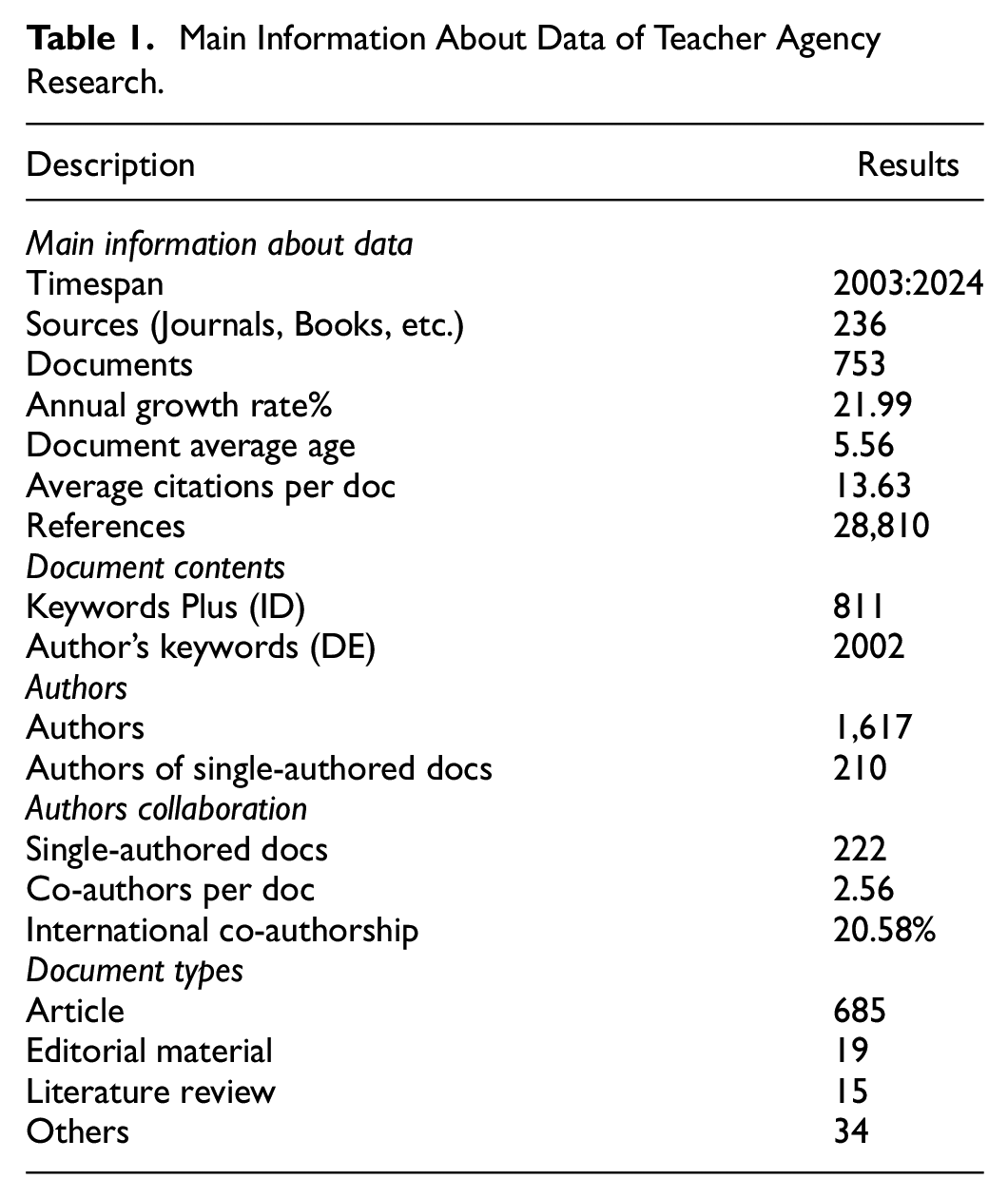
Table 1 describes the primary information of documents on teacher agency extracted from WOS Core collection. A total of 753 articles from 236 sources were covered in the study with a rate of 21.99 in annual growth. These 753 articles cite 28,810 references in total. It is observed that the collected documents have 5.56 average years from publication and the value of average citations per article reach 13.63. Meanwhile, 811 keywords plus and 2002 authors’ keywords appear in the collected data. It is notable that of the 1,617 authors contributing to teacher agency research, only 210 of them produce single-authored documents. Furthermore, the average number of authors per document is 2.56 with an international co-authorship index of 20.58 which shows most authors are not prone to international cooperation.
Main Information About Data of Teacher Agency Research.
Analysis of Publication Performance Using Science Mapping
Yearly Publication Analysis
Figure 3 shows an overall incremental trend of publications on teacher agency from 2003 to 2024 with minor downward fluctuations in certain years. Generally, the development of teacher agency research has gone through five obvious stages. The first stage, from 2003 to 2012, was the germination period in which a constant and stable increment can be seen. Thereafter, teacher agency research entered the second developmental stage which spanned from 2013 to 2015. During this period, the year 2015 witnessed a minor peak of 43 publications, largely resulting from the fact that Teachers and Teaching presented a column themed “Teacher’s Professional Agency in Contradictory Times” which aimed to collect empirical research on teacher agency in diverse social contexts. Following this, the third stage from 2016 to 2019 was featured by continuous growth in the number of publications on teacher agency. However, this growth trajectory was disrupted in 2020, with a slight decrease in publications possibly due to the impact of the COVID-19 pandemic on academic activities (Donthu & Gustafsson, 2020). Despite this temporary setback, teacher agency research rebounded strongly in 2021, marking the beginning of the fourth developmental stage from 2020 to 2022. Due to the influence of COVID-19 on education, teachers have confronted unprecedented challenges such as school closures, online teaching, and learning loss, and it is therefore important to analyze teachers’ pressures when facing the change and the agency they aspire. It is possibly the reason why there was a great surge in the number of research articles on teacher agency from 2020. Between 2023 and 2024, during the fifth phase of development, there was a sudden and significant decrease in the number of articles related to teacher agency, followed by a rapid increase in the number of articles in 2024. The reason may be the introduction of new COVID-19 prevention and control policies by countries such as China at the end of 2022, and at the same time, the hot topics in Chinese educational research may have changed in 2023, causing research related to “teacher agency” to no longer be the focus, thus affecting the number of papers. However, as the field of education increasingly values teacher agency and the advancement of education digitalization and intelligence, related research may once again become a hot topic, prompting an increase in the number of papers.
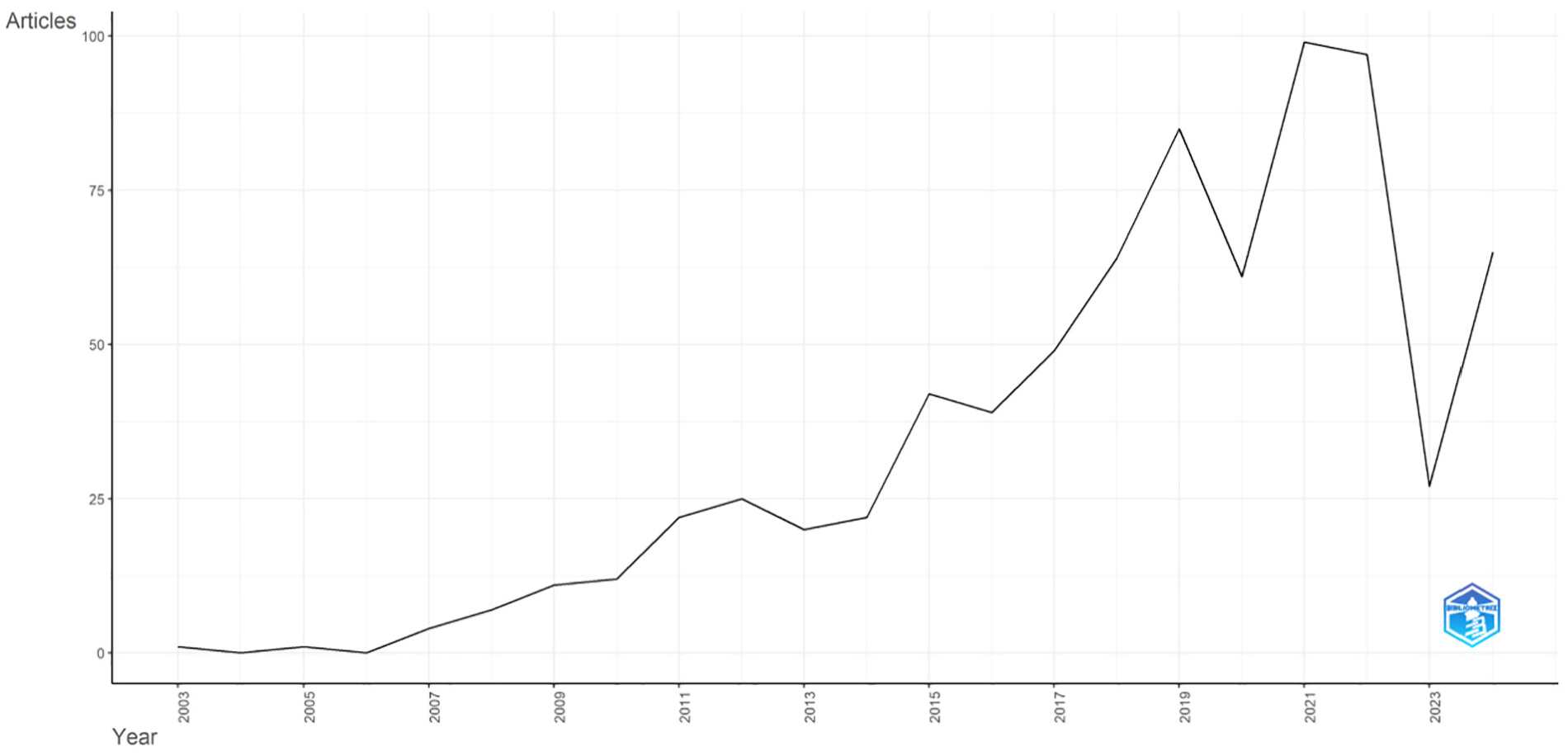
Annual scientific production on teacher agency research.
The citation trajectory over time of publications on teacher agency is depicted in Figure 4. It is found that the average citation per year is maximum in 2005 (6.9) followed by 2015 (5). At the beginning of the 21st century, research on teacher agency has attracted little attention from scholars. When teacher identity research brought a research boom in the field of teacher education, teacher agency research was attached to many studies focusing on teacher identity. Scholars have invoked teacher agency to illustrate the relationship between teacher identity and agency. Hence, the citation value reaches the highest in 2005. Thereafter, in 2015, Priestley first proposed an ecological perspective on agency framework which locates teacher agency in a temporal dimension and emphasized the integration of the individual and the environment (Priestley et al., 2015). This perspective has not only further enriched the spectrum of teacher agency research but also pushed the research field to a higher level. Coupled with the impact of Teachers and Teaching, the citation value of teacher agency research peaked again in 2015.

Average citations per year on teacher agency research.
Prominent Sources
Among 236 sources in the collected data, the top 20 prominent journals are identified and listed in Table 2. Whether in terms of the number of published articles or the total number of citations, Teaching and Teacher Education ranks the first (N. documents = 73, TC = 2,158), followed by Teachers and Teaching (N. documents = 32, TC = 1,250). Both are top journals in the field of teacher education, contributing to facilitating knowledge dissemination.
Top 20 Journals Based on the Number of Published Articles on Teacher Agency Research.

Note. TC = total citation; PY = publication year.
To look deeply into the journals and their impacts, three citation indicators (h-index, g-index, m-index) were computed through Biblioshiny. All three indicators are measures of impact in bibliometrics (Donthu et al., 2021). H-index, the most basic one, is often used to evaluate the scientific output of a researcher (Ball, 2005). H means that a scholar has published at least H papers that have been cited at least H times (Hirsch, 2005). Both g-index and m-index are developed on the basis of h-index in order to more accurately assess the impact of academic output. G-index, taking further citations into account, gives more weight to highly cited journals than h-index. For example, a g-index of 10 implies that a particular research output has been cited at least 100 times. Moreover, m-index represents the median number of citations to publications whose number of citations is equal to or smaller than h-index (Choi & Seo, 2021; Derrick et al., 2011). As demonstrated in Table 3, Teaching and Teacher Education has the maximum h-index, indicating its core position in the field of teacher agency research. Additionally, SYSTEM, an applied linguistics journal, has a high citation rate (h-index = 10, g-index = 17, m-index = 1.111, TC = 308) which indicates the progress of research in this field in an interdisciplinary context.
Top 20 Authors Based on the Number of Published Articles.

According to core journals publishing teacher agency research articles, it is evident that teacher agency research is interdisciplinary and multidisciplinary in nature. And it has integration not only with education but also with linguistics and sociology.
Productive Authors
Out of 1,617 authors in the collected documents, the top 20 prolific authors are listed in Table 3. Although Pietarinen J is the most prolific author in the field with a high number of 10 published articles and citations of 178. Additionally, his g-index is also the highest, reaching 10. However, the differences in these aspects are not significant compared to Vähäsantanen K, Eteläpelto A and Hökkä P. In terms of total citations, Vähäsantanen K’s articles have reached as high as 392, far exceeding Pietarinen J, who is in first place. Therefore, considering these indicators, Vähäsantanen K’s articles are of higher quality and have a greater impact, which are mostly published in high-quality journals such as Teaching and Teacher Education and Teachers and Teaching.
Figure 5 presents a visualization of the top 20 authors’ production over time on teacher agency research computed via Biblioshiny. The size of the circle indicates the number of published articles and the color means the number of citations. Additionally, the length of the line shows the period in which authors published articles. As shown in the figure, although Pietarinen J ranks first in the number of publications, his research started in 2015, which is relatively late, and he falls short of Vähäsantanen K in all other aspects. Vähäsantanen began publishing in 2011 and has contributed greatly to teacher agency research within a decade. What’s more, Vähäsantanen’s most frequently cited two articles appeared in 2015 (the darkest color of the circle). One of the articles is a qualitative meta-study investigating the professional agency of Finnish vocational teachers amid an educational reform. The finding revealed that there were some differences in teachers’ agency regarding their work, involvement with the reform and professional identity. Based on the study, an agency-centered approach has been proposed (Vähäsantanen, 2015). Despite insightful, the specific focus on Finnish vocational teachers may restrict the direct applicability of the findings and proposed approach to other educational settings and teacher populations worldwide.

Authors’ production over time on teacher agency research.
The TC scores of the second place Eteläpelto A and the third place Hökkä P are also not to be underestimated, reaching as high as 319 and 329 respectively. At the same time, the time they started their research on teacher agency is also very close, with only a 1-year gap. It is worth mentioning that although Hökkä P entered this research field 1 year later than Eteläpelto A, in 2017, Hökkäp’s article Teacher Educators’ Collective Professional Agency and Identity—Transforming Marginality to Strength had an annual citation of 10.286 which is much higher than any other article. This study contributes a lot to teacher agency research from a theoretical perspective, proposing an advanced understanding of collective identity and agency, as well as their close relationship through an identity coaching program (Hökkä et al., 2017).
There are also authors with a higher number of publications such as Pyhalto K and Toom A, whose total citation counts are also relatively high. Although they started their research a bit later than the previous scholars, their research contributions hold a significant position. Comparing the two, Toom’s articles have more influence, with an annual total citation count of 16.89 (Toom et al., 2015).
Leading Countries
Table 4 shows the top 15 countries in terms of scientific production in the field with their frequencies, total citations, and average article citations. In terms of article output, the top three are the United States, China, and the United Kingdom. Although China ranks second in article output, surpassing the UK, its total number of citations is far less than that of the UK. As the only developing country in the top three, China has published 279 articles on teacher agency over the past 22 years, but the total number of citations is less than a quarter of that of the United States. It can be observed that although Finland ranks fifth in article output, its citation rate is higher than that of China and Australia, as the country has many authors with significant influence, such as Vähäsantanen and Toom.
Top 15 Countries Based on the Number of Published Articles Per Country.

Note. TC = total citation; PY = publication year; SCP = single country publication; MCP = multiple country publication.
Moreover, the countries of the corresponding authors which are available to access the cooperation among countries have also been considered. SCP, MCP, and MCP-Ratio are three vital parameters which provide specific values to depict the condition of country-wise cooperation. Figure 6 presents the cooperation among countries. SCP indicates the number of articles coauthored by scholars from the same countries while MCP represents those from various countries. MCP-Ratio interprets the ratio of inter-country collaboration. Overall, the level of international cooperation in teacher agency research appears to be relatively weak, as indicated by the small proportion of MCP in total publications. It is observed that Qatar, China and Netherlands stand at the top three places, indicating that these three countries are more willing to cooperate with other countries when doing research on teacher agency. The condition may be attributed to the more internationalized academic community and open education systems in these countries that encourage cross-border exchanges, like China (Bedenlier, 2017; J. Wang, 2009). In contrast, for three dominant countries in teacher agency research (the USA, the UK, and Finland), a large number of articles were co-authored by scholars from the same country, possibly due to the abundance of researchers and institutions in this field domestically, which makes internal collaboration more convenient. As international cooperation is increasingly recognized as essential for addressing complex educational issues and promoting research innovation (Lasthiotakis et al., 2015), more cross-national comparative studies on teacher agency should be encouraged to shed light on how different sociocultural contexts, educational policies and institutional structures shape the development of teacher agency, thus informing context-sensitive strategies to support teachers’ professional growth.

Corresponding authors’ countries on teacher agency research.
Leading Affiliations
Table 5 provides the top 15 affiliations’ contributions to productivity and their countries. As is depicted in the table, strikingly, all of the 15 most productive affiliations are universities, highlighting the overwhelming dominance of higher education institutions in teacher agency research. This finding echoes the argument that universities, with their rich academic resources and research capabilities, are well-positioned to investigate complex educational issues and propose evidence-based solutions (Booth, 2009). Specifically, the University of Jyvaskyla establishes its pioneer with a maximum of 64 articles, followed by University of Helsinki (39), University of Edinburgh (36). Among them, the first and second-ranked affiliations are both from Finland whose influence in teacher agency research can be further proved. The influence of British research affiliations cannot be ignored as its publication share is relatively large.
Top 15 Affiliations Based on the Number of Published Articles Per Affiliation.

Relationship Network Analysis
Three-Field Plot
The relationship among authors (left), keywords plus (middle), and sources (right) is presented in Figure 7, effectively illustrating how these different entities are interconnected based on Sankey diagrams (Riehmann et al., 2005). Sankey diagram, a type of flow diagram in which the width of the arrows is proportional to the flow rate, provide a visual representation of the major transfers or flows within a system (Alemasoom et al., 2016). The use of Sankey diagrams in this study helps to intuitively visualize the complex interrelations among these key elements in teacher agency research. In the plot, the size of the boxes represents the frequency of their occurrences (Riehmann et al., 2005), allowing readers to quickly identify the most prominent components in each category. As is illustrated, Vähäsantanen, the most prolific author in the field of teacher agency, has a strong bond or relation with “identity,”“education,”“professional agency,”“curriculum,”“context,” and “policy.” It is obvious that he was committed to studying the development of language teachers’ agency in education and the influence of teachers’ agency on identity. Meanwhile, articles with “identity” as keyword are more likely to be accepted by Teaching and Teacher Education and Teachers and Teaching while articles with “education” as keyword are mostly to be published in Teaching and Teacher Education. In terms of sources, Teaching and Teacher education, have the maximum number of publications in the domain and accepted papers on a wider variety of keywords.

Three-plot field of authors, keywords plus and sources.
Figure 8 shows the diagram of teacher agency research on the relationship between countries (left), keywords plus (middle), and sources (right). In the aspect of countries, as the leading country, the USA presents various keywords in the research on teacher agency especially “identity,”“education,” and “beliefs,” indicating the USA attaches great importance to the various directions of the research on teacher agency and mostly to the construction of teacher identity in education as well as the influence of teacher agency on teachers’ beliefs. The keywords in teacher agency research from China and the UK are similar. These two countries have strong links with “identity,”“education,” and “curriculum” because they keep on implementing curriculum reforms all the time.
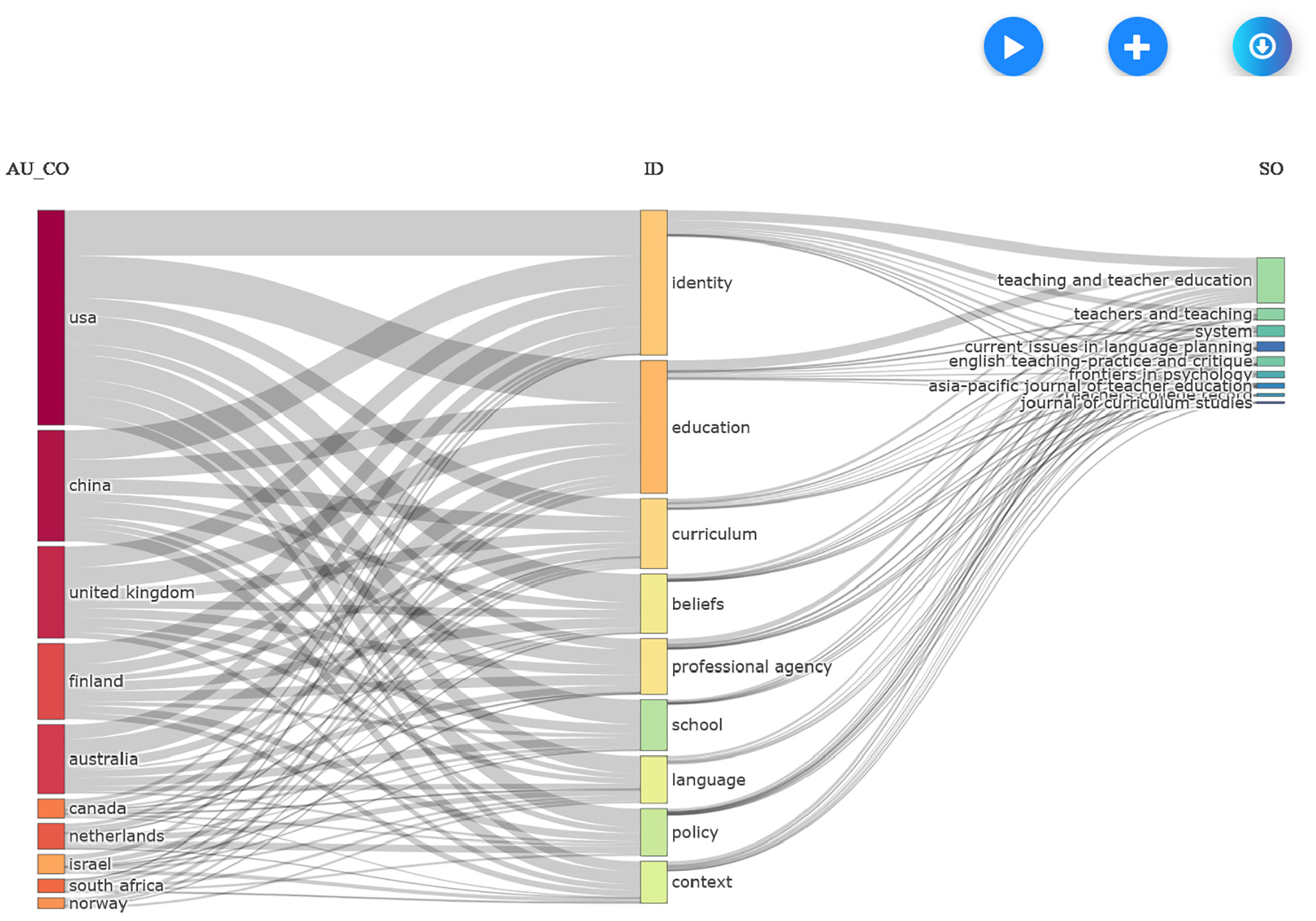
Three-plot field of countries, keywords plus and sources.
Analysis of Research Hotspots and Evolving Trends
Keyword Network Analysis
Analysis of High-Frequency Keywords
Keywords are the high generation of the core content of an article, reflecting the hotspots of the studied field. The frequency of each keyword in the collected data was counted by treemap analysis using Biblioshiny. Figure 9 shows the treemap of the top 15 most salient keywords based on keyword plus. These words enable us to explore precisely research topics in which education (14%), identity (14%), curriculum (6%), professional agency (6%), beliefs (5%), language (5%) and context (5%) account for more than half of the total keywords. In addition to identity, beliefs and context, the remaining four keywords are related to education, indicating the vital role teacher agency plays in education. Moreover, identity, beliefs and knowledge are salient keywords due to the deep impact of teachers’ internal quality on their agency.

Word treemap of high-frequency keywords on teacher agency research.
The word growth graph is displayed in Figure 10, depicting the accumulated distribution trend of the top 10 high-frequency keywords. It is obvious that all 10 high-frequency words are on the rise, witnessing a strong momentum of research hotspots in the field of teacher agency. In terms of research topics, “education” and “identity” have been more popular than other topics. Combined with the word treemap analysis above, “education” and “identity” are the common concerns of the field of teacher agency research. Interestingly, the trend of 10 keywords began to appear only after 2005, proving that there were no fixed themes in teacher agency research before 2005.
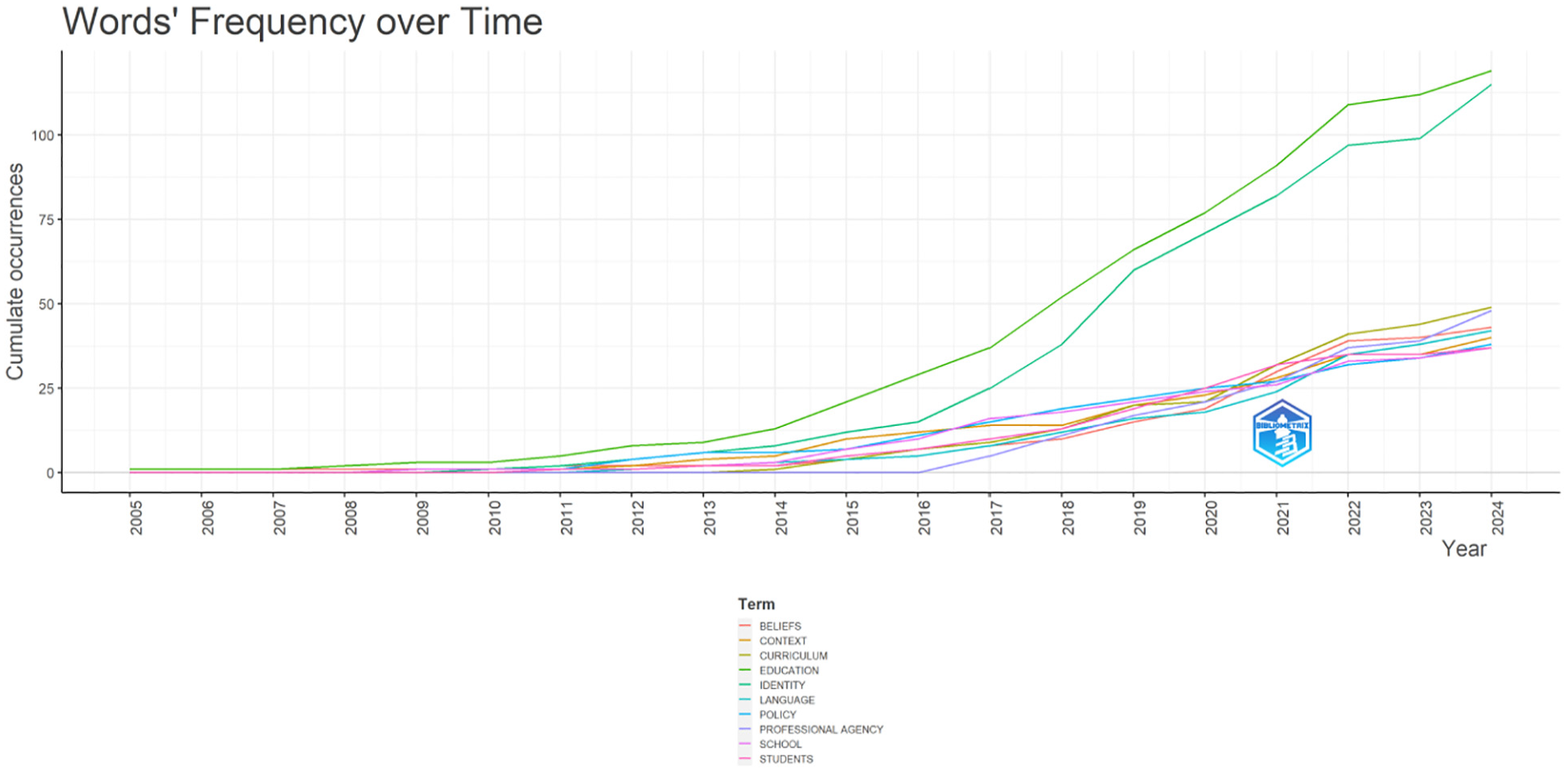
Accumulated frequency of high-frequency keywords over time.
Although the total frequency of high-frequency keywords can reveal the current research hotspots in the subject area, it cannot determine the spanning cycle of research hotspots. From Figure 11 which traces the annual growth of high-frequency keywords over time, it can be observed that the occurrences of some keywords have increased in a fluctuating manner every year due to burnout of different hotspots. Except for “education” and “identity,” other keywords may become hotspots in a certain year, but they last only for a short period. After 2013, the frequency of co-occurrence of education has increased sharply and gradually become the focus of subsequent studies. The same happened to “identity” which became a focus after 2016. It is clear that some traditional research hotspots keep hot although they are not new topics.

Annual frequency of high-frequency keywords over time.
Analysis of Keyword Co-occurrence Network
The co-occurrence network of author keywords of teacher agency research is presented in Figure 12 which is performed through Biblioshiny. As depicted in the figure, two clusters indicated in red and blue were regrouped in the co-occurrence network. By analyzing the clustered terms, the concrete research spectrum can be determined concisely.

Co-occurrence network of author keywords.
Cluster One consists of “identity,”“education,”“curriculum,”“professional agency,” and other similar items (Hökkä et al., 2017; Rosenfeld et al., 2022; Vélez-Rendón, 2010). Teachers are the subjects of the classroom and are closely connected to students, so their personal qualities have a direct impact on students as well as on teaching. Therefore, research on teacher proactivity is essentially focused primarily on the study of teachers’ sense of self-identity. In addition, teacher agency directly affects teachers’ external expressions in the teaching process, such as teaching behaviors and instruction.
“Beliefs,”“school,” and “knowledge” (Biesta et al., 2015; Lai et al., 2016; Zhang et al., 2011) dominate Cluster Two in which belief is the most frequently discussed topic. Teachers’ beliefs directly influence their teaching behaviors and decisions, thereby determining their proactivity and innovative capabilities in educational practice. Another central term is school. At the beginning of the 21st century, the global wave of educational and curriculum reforms emphasized the role and professional development of teachers, making schools, as the primary venues for educational practice, the key context for research on teacher agency. It is clear that the elements affected by teacher agency constitute Cluster 2 and their practical need promotes the research on teacher agency.
Thematic Evolution Analysis
It is crucial to examine the development of research in a given field from the perspective of themes and thematic evolution (Weismayer & Pezenka, 2017). The Sankey diagram not merely details the flow conditions of diverse themes, but also clarifies the development direction, evolution routes, and evolutionary drifts of the research thematic content, intensity, and structures (Cobo et al., 2011b; Xie et al., 2020). Moreover, it also illustrates the conversion associations among various themes.
Figure 13 has been produced by Biblioshiny to analyze the evolutionary paths of themes in teacher agency research from 2003 to 2024. The larger the rectangle is, the more important the theme is during the period. The line connections between rectangles represent the evolutionary flow of the research theme. The thickness of a line illustrates the relevance of the themes to each other over the years (Riehmann et al., 2005; Xiao et al., 2022). The line linking “self-efficacy” and “beliefs” is greatly thick, indicating their close relationship. Coincidentally, the line between “identity” and “perspective” is also thick, indicating that there is a deep connection between them as well. Additionally, “experiences” is a new theme that only emerged in 2016, and it has since become closely linked with themes such as “students” and “school” in its subsequent development. Combined with the analysis results of the annual publication trend of teacher agency research, the subject diversion process of teacher agency research over the past 22 years can be divided into five stages: 2003–2012, 2013–2015, 2016–2019, 2020–2022, and 2023–2024.

Thematic evolution of keywords from 2003 to 2024.
To reveal the evolution of keyword trends on teacher agency research in the above five stages, keyword thematic maps (Figures 14–18) were processed by Biblioshiny. These maps are conducive not only to illustrating the thematic development of teacher agency, but predicting the future trend to a certain extent. In each thematic map, the horizontal axis presents the centrality which indicates “significance” and “relevance” (Cobo et al., 2011). The higher the centrality, the higher the status of the theme, and the greater the influence on other themes. In addition, the vertical axis represents the development of a theme. The higher density connotes a more mature development of the theme. The size of each circle depends on the number of occurrences of the theme.
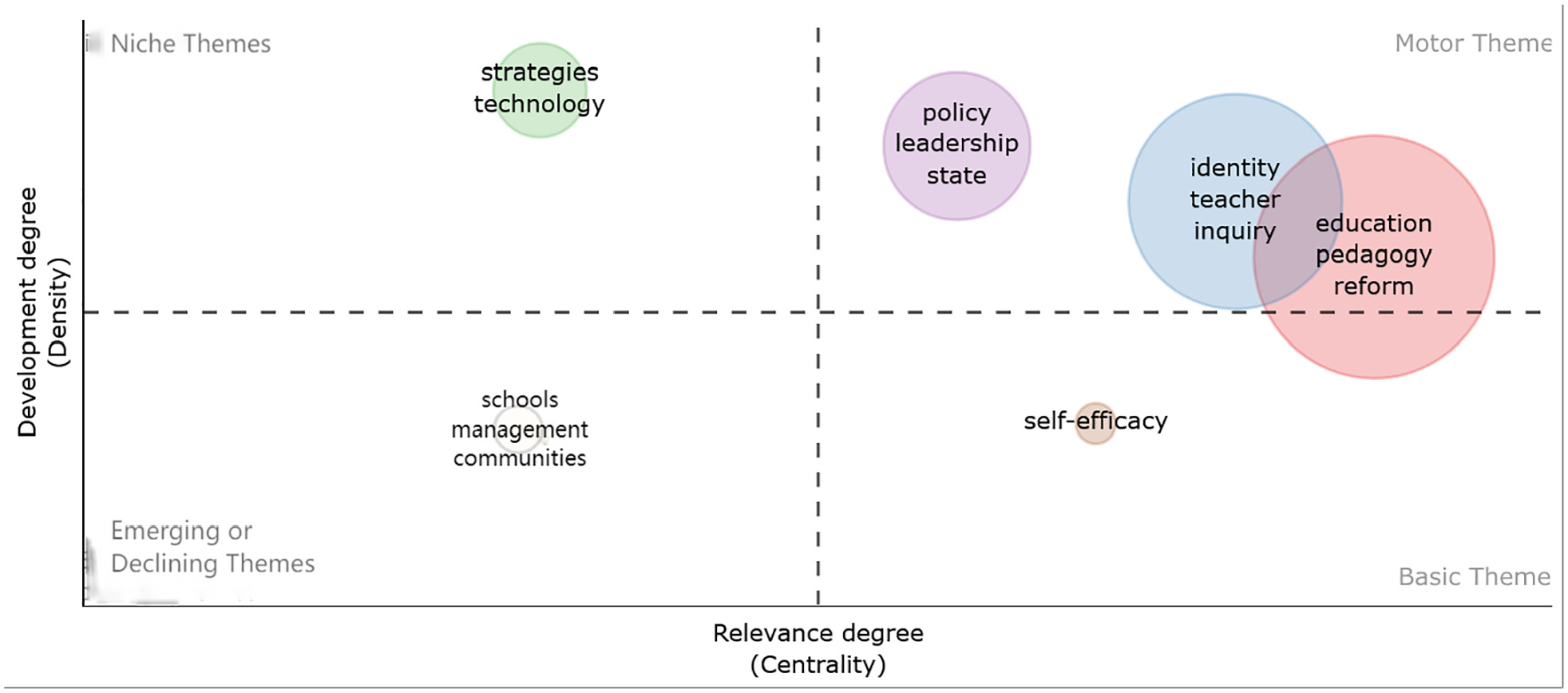
Keyword thematic map from 2003 to 2012.

Keyword thematic map from 2013 to 2015.

Keyword thematic map from 2016 to 2019.

Keyword thematic map from 2020 to 2022.
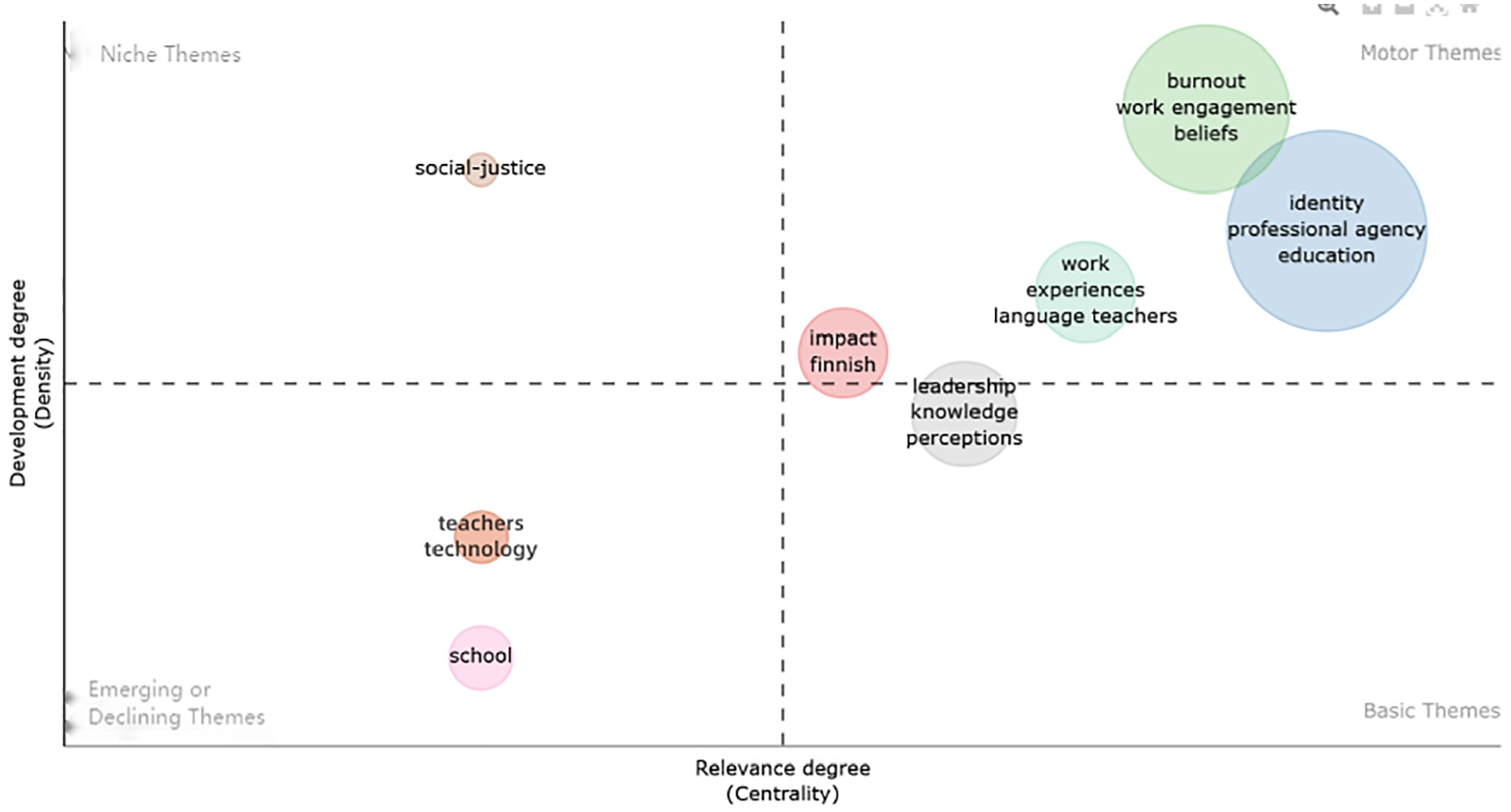
Keyword thematic map from 2023 to 2024.
A thematic map generally consists of four quadrants. The first quadrant includes the motor themes which are vital and well-developed in the whole study, featured by both high centrality and high density. Whereas the themes in the second quadrant belong to niche themes that are highly developed (high density) but of relatively weak importance (low centrality) to the study. Meanwhile, these themes have very limited connections with other themes. In the third quadrant, the themes are less-developed and marginal. They represent emerging and declining themes with a low centrality and density. Finally, the themes in the fourth quadrant, belonging to basic pieces, have great value for the research field and are closely connected to other themes with high centrality. However, due to low density, these themes are less-developed and generally refer to basic research topics.
In the first period, the main themes could be summarized as “education,”“identity,”“policy,” and “reform” (Datnow, 2012; Hökkä et al., 2012; Moore, 2008; Ollerhead, 2010). As the main subject of the educational process, the development of teachers takes place in the context of education and teaching. In addition, teachers’ thoughts and behaviors play critical roles in student learning and even in the whole educational process (Shah, 2009). Therefore, teacher agency should be the focus of the field of education research. In recent years, education reform has been a fundamental driver of educational development and the effectiveness of education reforms depends heavily on teachers’ decisions and actions (Fullan, 1993), so education reforms impose practical demands on teacher agency. Furthermore, during this period, scholars in the field of language policy and planning began noting the countervailing effects of individual teachers on policy, highlighting the importance of teachers’ subjective agency in language education policy. As a result, “education,”“policy,” and “reform” became research hotspots from 2003 to 2012, providing contextual support for research on teacher agency. However, as a fledgling topic, teacher agency research was mostly mixed with teacher identity research (Beijaard et al., 2004).
The transversal themes of “strategies” and “technology” (Chai & Lim, 2011; Starkey, 2010) are of low centrality but high development. Faced with the rapid technological and economic development globally, teachers have been encountering a great deal of challenges such as new educational ideas and advanced technologies. A study explored how teachers may assume agency to mediate the tensions and opportunities between physical behaviors and mental ideas when teaching by using information and communication technologies (Chai & Lim, 2011). The high development of these two themes mirrors that they are emerging topics in teacher agency research, attracting increasing attention from scholars. However, due to the weak connections with other major themes in this field, such as “identity,” and “beliefs,” they possess low centrality. Overall, technology and strategies in teacher agency are still relatively new and developing areas, so more research is needed to explore its relationship with other established dimensions of teacher agency.
Over time, with high centrality and density, “education”“identity,” and “reform” remained the motor themes from 2013 to 2015, confirming the close relationship among them. In the second quadrant, the topic “beliefs” is well-developed, since it evolved from “self-efficacy” (K. A. Howard et al., 2009). Researchers were committed to studying the influencing factors of teachers’ agency and teachers’ belief is one of them. Soini explored Finnish first-year primary teacher students’ sense of professional agency in the classroom, positing that teachers’ efficacy beliefs play a vital role in facilitating and managing new learning in classrooms (Soini et al., 2015). As research progressed, the relationship between individual teacher quality and agency gradually became a concern for scholars.
It’s noteworthy that some new themes emerged in the second phase, such as “science,”“English-speaking teachers,” and “language” (Cho, 2014; Kayi-Aydar, 2015; Martin & Carter, 2015; Ruohotie-Lyhty & Moate, 2015), which refined the discipline of teacher agency research. In particular, the research on agency of bilingual teachers is pervasive. In 2013, Palmer examined how teachers take agency to deepen their understanding of bilingualism in a bilingual classroom context (Palmer & Martínez, 2013). Linguistically and culturally diverse teaching makes teachers’ agency a continuum from their pro-activity to their passiveness (Schwartz et al., 2022).
In this period, “perspective” was taken as an important topic with high centrality (Hökkä & Eteläpelto, 2014; Van Puyvelde et al., 2013). In defining agency, different scholars hold different theoretical perspectives. Initially, Bandura (2001) applied social cognitive theory as the basic framework for studying agency. Subsequently, social and cultural perspectives and ecological perspectives emerged one after another, laying a solid theoretical basis for teacher agency research. In particular, Priestley et al. (2015) proposed an agency framework from an ecological perspective, claiming that the realization of teacher agency is the result of a combination of individual efforts and the environment. The new theoretical perspective contributes a lot to interdisciplinary research on teacher agency.
In the third period, a great number of new themes have evolved. For instance, “applied linguistics” (Hiver & Whitehead, 2018; Leonard, 2019; Miller et al., 2017) evolved from the emerging theme in the second stage, and had great momentum with great development. It is clear that over time, teacher agency research had become more refined and categorized into numerous sub-branches. At the same time, we can clearly observe that while the theme related to “identity” continues to maintain a significant position within teacher agency, its rate of development is declining compared to the past. This indicates that research on this topic may have reached a saturation point during this period, and an increasing number of scholars are focusing their attention on other, newer research topics. From 2016 to 2019, teacher professionalization has made excellent developments in teacher agency research but has fewer connections to other topics. Based on the mutually reinforcing relationship between teacher agency and professional development (N. J. Howard, 2021; T. Wang et al., 2021), the research on the relationship between teacher professionalization and other topics related to teacher agency should be placed more emphasis as time progresses.
As an emerging theme, “narrative inquiry” (Martinie et al., 2016) appeared in teacher agency research. At this stage, researchers began to pursue a diversity of research methods, limiting not to a single research tool. In 2019, based on narrative inquiry, 19 Taiwanese elementary school English teachers’ professional agency construction was analyzed during a series of training sessions with the aid of questionnaires, interviews, and observation notes (Chien, 2019).
As depicted in Figure 17, some themes, such as “identity” and “education,” have slowed down in development speed compared to previous periods due to excessive research and the poor health conditions caused by the global pandemic outbreak, but they still occupy an important position and have a strong correlation with other subjects. At the same time, it is interesting to note that during this period, themes like “student” and “adolescent” have developed rapidly. “Student” is a perennial research topic, and its rise alongside the emerging theme of “adolescent” signifies that during the pandemic, the role of teacher agency in student groups, especially adolescent groups, has gradually attracted the attention of researchers, and is developing rapidly. This indicates that research on the role of teacher agency in the development of various aspects of students has gradually become a hot topic in the field of modern education in recent years. (Mameli et al., 2020; Massey & Wall, 2020; Reichenberg, 2020; Rich, 2021) Recently, schools’ active promotion of digital education makes digital competency an imperative literacy for teachers which plays an important role in improving teacher agency (Damşa et al., 2021; Knussen & Agnew, 2022; Lantz-Andersson et al., 2022). In particular, since 2019, online education promoted by the outbreak of COVID-19 brought about novel digital affordances for teaching and prompted teachers to exert more teacher agency (Chen, 2022). Digital competencies can help teachers better use digital technology tools to design and conduct teaching and learning activities, improve classroom interaction and student engagement, and thus better achieve teaching and learning goals. It is assumed that the theme will also be hot topic in the future.
In summary, while “education” and “identity” still hold significant research positions, many emerging themes are also continuously emerging. Future research directions will continue to focus on the relationship between the intrinsic qualities or external manifestations of teachers and their agency, and will also increasingly pay attention to the actual impact of teacher agency on students. What’s more, based on the rising importance of themes such as “digital competency” as previously mentioned, it can be anticipated that the development of teacher agency in the context of digital education will likely garner more attention. The evolving trends of research themes from 2020 to 2022 also suggest a growing scholarly interest in this direction. As digital technologies continue to reshape the educational landscape in the post-pandemic era, how teachers can harness digital tools to enhance their agency and effectively navigate the challenges and opportunities in teaching practices will become a crucial research agenda (Schulte, 2019). Hence, while more empirical evidence is still needed, it is reasonable to foresee that the intersection of teacher agency and digital education will be a prominent focus in future research endeavors.
In Figure 18, we can observe that themes such as “identity,”“education,” and “beliefs” are gradually becoming motor themes again. This indicates that during the pandemic, the primary form of teaching for teachers was online courses, making it relatively difficult to study the internal factors of teachers. After the pandemic, more and more scholars are turning their research focus back to the internal factors of teacher agency (Liyanage & Walker, 2023; Nazari et al., 2023, 2024) At the same time, a completely new research theme emerged during this period—“work engagement,” and themes like “work” are gaining attention once again. (Mercier, 2024) This might be because, as the global pandemic was brought under control, teachers gradually returned to offline positions, and some scholars explored the level of work engagement and proactivity within teacher agency. Interestingly, during this period, research related to “school” became a less concerned topic. This phenomenon may be due to the shift in research focus in the post-pandemic era, where researchers are more concerned with individual-level factors after teachers return to school, thus making organization-level research represented by “school” not a hot topic. Therefore, in summary, in the fifth period of 2023 to 2024, research on teacher agency has returned to some perennial topics such as “identity” and “beliefs,” and after the pandemic, research on the impact of teacher agency on work engagement has also begun to surge. This shows that changes in the times have led to an increasingly diverse range of research topics in the field of teacher agency.
Conclusions and Research Outlooks
With the accelerated pace of global educational change and curriculum reforms in the 21st century, teacher agency has received extensive attention from scholars and related studies have been gradually enriched. With the aim of providing a bird’s eye view of teacher agency research as well as pointing out intriguing directions for future research, an evolutionary bibliometric analysis and visualization review was carried out. Through the analysis of publication performance, network maps, and hotspots, valuable conclusions and insights are drawn as follows:
In the first place, over the past 22 years, academic literature on teacher agency has witnessed an overall incremental trend with minor downward fluctuations in some years. From 2016, relevant research achievements have increased sharply with a flourishing growth momentum though the number of publications in 2020 decreased. Additionally, the development of teacher agency research has gone through four obvious stages: 2003 to 2012 was the germination period, 2013 to 2015 was the growth period, 2016 to 2019 was the steadily developing period and 2020 to 2022 was the high-yielding period. 2023 to 2,024 was considered the recovery period in the post-pandemic era.
Given core research power in the field of teacher agency, the most effective contributing journal is Teaching and Teacher Education with the highest number of publications and citations, followed by Teacher and Teaching. These two journals provide not only a channel for research on teacher agency but also platforms for people to understand teacher agency. Author-wise, one of the authors who have a potential influence on teacher agency research is Vähäsantanen, topping the charts in academic output, total citations, h-index, g-index, and m-index. When examining the geographical distribution of research, the dominant countries in teacher agency studies are the USA, the UK, and Finland. However, China and the Qatar exhibit a greater propensity for international collaboration, even though the overall cooperation level between countries remains relatively low. This suggests a need for future research to focus on developing more international academic exchange platforms. Such initiatives would encourage dialog and collaboration among researchers from diverse regions and could potentially drive theoretical innovation and practical application in teacher agency research. In terms of the most influential research institutes, University of Jyvaskyla has established its leading position with most publications, trailed by University of Helsinki and University of Edinburgh.
Thirdly, the relationship between authors, keywords, sources, as well as countries, keywords, and sources has been shown in three-field plots to provide a different perspective for research analysis on teacher agency. Vahasantanen, the most prolific author, has a strong bond or relation with “identity,”“education,”“curriculum,”“context,” and “language,” indicating that he was committed to studying the development of language teachers’ agency in education and the influence of teachers’ agency on identity. keywords-wise, the topics “identity,”“education” and “beliefs” dominate the keywords of teacher agency research. Meanwhile, the USA has attached great importance to the construction of teacher identity in education as well as the influence of teacher agency on students and the teaching process, but China and the UK emphasize the development of teacher agency in the context of curriculum reforms. These differences reflect the unique educational contexts and needs of various countries. Future studies could delve deeper into the characteristics and patterns of teacher agency development across various educational settings. By conducting cross-contextual comparative analyses involving different countries, regions, and school types, researchers can explore the manifestations, influencing factors, and mechanisms of teacher agency within respective educational contexts. This, in turn, could lead to the identification of effective strategies and pathways for nurturing teacher agency in various situations.
The fourth finding lies in the most cited reference which lay the solid intellectual basis for research on teacher agency. The article What Is Agency? written by Emirbayer has laid a solid theoretical foundation for research on teacher agency in recent years.
Finally, the research trends and thematic evolution of teacher agency over the past 22 years are also explored to evaluate the evolution direction of the field and elucidate some research frontiers in the future. “education,”“identity,” and “curriculum” are the most concerned keywords, which focus on the development of teacher agency in the educational environment as well as the relationship between teacher agency and identity. The co-occurrence analysis of research themes suggests that there were four main topics: (1) the development of teacher agency in the context of education; (2) the elements which play vital roles in teacher agency such as curriculum and instruction; (3) the internal and external factors that influence teacher agency; (4) some concepts that closely relate to teacher agency such as teachers’ efficacy, autonomy, and motivation.
In the process of hotspots evolution, “education,”“identity,” and “reform” always remain the motor themes during various periods, showing the importance of social context in the study of teacher agency as well as the close relationship between identity and agency. The appearance of “science,”“English-speaking teachers,” and “language” affirms that over time, teacher agency research had become more refined and categorized into numerous sub-branches. From 2020 to 2022, researchers mainly focused on “education,”“identity,”“belief,” and “students.” They were not only the present hot topics, but also research frontiers in the future. At the same time, during this period, many emerging topics have gradually gained attention, such as “adolescents.” What’s more, teachers’ digital competency is also expected to be a hotspot in the field due to the development of online education. Subsequently, further research could also investigate the role of teacher agency at different stages of teachers’ professional development, as well as the impact of various professional development activities (teacher training, educational research activities, and curriculum development) on teacher agency. This could provide a theoretical and practical basis for optimizing strategies for teacher professional development. More attention should also be given to the new dynamics of teacher agency in the context of online education. Notably, researchers could concentrate on the characteristics and challenges of teacher agency in online teaching scenarios, exploring the elements, influencing factors, and improvement pathways of teacher agency in a digital technology environment. This not only enriches the understanding of teacher agency but also offers theoretical guidance for the transformation and enhancement of teachers’ roles and capabilities in the era of online education. In the final analysis of the post-pandemic era research, researchers have once again focused on hotspots such as “identity,”“education,” and “belief,” while research themes like “work engagement” and “work” have also emerged due to changes in the times, providing more paths and possibilities for future research on teacher agency.
More importantly, teacher agency is a complex psychological construct that encompasses multiple internal factors such as beliefs, motivation, and behavior. Future research could employ a multimethod approach, integrating both qualitative and quantitative research. On the one side, qualitative methods such as narrative inquiry and action research could provide deep insights into the internal experiences and meaning-constructing processes of teacher agency. By collecting and analyzing teachers’ personal narratives and interview data, the logic of emergence and developmental trajectories of teacher agency in various contexts can be reconstructed, mirroring crucial points that influence it. On the other side, building on preliminary qualitative explorations, researchers could develop and validate measurement tools for teacher agency, collect large-scale data, and examine the effects of various background factors (such as school culture, educational policies, and social support) on teacher agency. Through quantitative modeling and empirical validation, the key influencing factors and action mechanisms of teacher agency could be further elucidated.
Limitations and Recommendations
Several limitations should be mentioned regarding this review. The main one is the documents not collected in WOS have been ignored. Thus, multiple well-known databases (Scopus, Google Scholar, and Science Direct) should be included in future research to produce more comprehensive and reliable findings. Secondly, non-English documents have been excluded in this study, which may lead to subtle biases in the research findings. In future works, some research outputs of other languages should be taken into account. Ultimately, the article is grounded on the analysis of quantitative data software, yet the author’s subjectivity is inevitably present in the analysis. More specific and comprehensive analysis should be supplemented in the future.
Footnotes

Funding
The author(s) disclosed receipt of the following financial support for the research, authorship, and/or publication of this article: This research was funded by the Graduate Research and Innovation Projects of Jiangsu Province [Grant Number: KYCX22_3732]
This work was also supported by the Philosophy & Social Science Research Projects of Universities in Jiangsu Province [Grant Number: 2022SYJB2245]
Declaration of Conflicting Interests
The author(s) declared no potential conflicts of interest with respect to the research, authorship, and/or publication of this article.
Data Availability Statement
Data sharing not applicable to this article as no datasets were generated or analyzed during the current study.