




Abstract
This review’s objective is to analyze the literature on gender stereotypes in the workplace, focusing on its conceptual and intellectual evolution, growth trajectory, and key works. The authors used a bibliometric analysis, examining 214 documents from Scopus covering the years 1986 to 2022. The results show that knowledge in this field has evolved dramatically over the past three decades, with a particular increase in research since 2010. The co-citation analysis identifies three main study areas: “the underlying characteristics which distinguish women and men attributes,”“women at the workplace as leaders” and “challenges faced by women in the workplace.” Overall, the review highlights the significant progress made in understanding and addressing gender stereotypes in the workplace over the past few decades. The study’s limitations include its reliance on bibliometric analysis, which only provides information about research trends and not specific research outcomes. Additionally, the study only included English- language documents from the Scopus database, potentially excluding relevant publications from other sources.
Plain Language Summary
The purpose of this review is to examine the evolution of literature on gender stereotypes in the workplace, its growth trajectory, and key works. The bibliometric analysis reviewed 214 documents from Scopus, spanning from 1986 to 2022. The results indicate a significant increase in literature from 2004 to 2022, with three primary areas of study identified: “the underlying characteristics which distinguish women and men attributes,”“women at the workplace as leaders,” and “challenges faced by women in the workplace.” The majority of studies use a binary conceptual framework of gender, indicating a need for a more complex mechanism to examine the effect of gender on businesses. Most studies focus on women as the subject of gender-related stereotypes and discrimination, despite the fact that gender stereotypes can negatively impact men in the workplace and society. Furthermore, there is an imbalance in the methodological approach to the first and second research areas, with fewer qualitative studies in the literature on women as leaders. Therefore, future studies should explore other areas of gender stereotypes beyond women in leadership positions. The study’s limitations include its reliance on bibliometric analysis, which only provides information about research trends and not specific research outcomes. Additionally, the study only included English- language documents from the Scopus database, potentially excluding relevant publications from other sources. Future research should consider expanding the scope to include additional databases to reduce this bias. Overall, this review highlights the growth and evolution of literature on gender stereotypes in the workplace while also identifying areas for future research to address gaps in the literature.
Keywords
Introduction
Gender stereotypes are views held by a culture about what roles men and women should adhere to, and these beliefs are due to people’s observations of how men and women behave in various social roles (Charlesworth & Banaji, 2022; Eagly et al., 2020a; Lopez-Zafra & Garcia-Retamero, 2021; Priyashantha et al., 2023; Berdahl & Moon (2013). In society, there exist generalizations about the characteristics of men and women that are known as gender stereotypes. These stereotypes can be prescriptive or descriptive, outlining how men and women are and how they should or shouldn’t be respectively (Burgess & Borgida, 1999; Eagly & Karau, 2002; Heilman, 2012). To summarize, men and women are thought to differ both in terms of achievement-oriented traits, which are mostly assertive, independent, rational and decisive often labeled as “agentic,” and in terms of social- and service-oriented traits, which are mostly showing concern for others, warmth, helpfulness and nurturance often labeled as “communal” it is believed that men and women differ both in terms of social and service-oriented traits, which are primarily characterized by showing concern for others, warmth, helpfulness, and nurturing and are frequently referred to as “communal,” and achievement-oriented traits, which are primarily assertive, independent, rational, and decisive are termed as “agentic” (Abele, 2003; Bakan, 1966; Hoyt et al., 2009; Eagly et al., 2020).
Gender stereotypes are beliefs about the traits, roles, and behaviors that are associated with men and women, and are learned and reinforced through socialization processes (Eagly & Steffen, 1984). They can be positive or negative, but they tend to be restrictive and limiting, especially for women. Worldwide, gender stereotypes are embedded in many cultures, and they continue to have an impact on how men and women are seen, judged, and treated in the workplace (Rudman & Glick, 2021;B). Despite advances in gender equality over the past decades, gender stereotypes continue to pervade many aspects of social life, including the workplace (Heilman, 2001). Eagly and Koenig (2021) argue that stereotypes often arise from gender differences in social roles, but in turn, stereotypes can then reinforce and perpetuate these differences, creating a vicious cycle. Eagly and Wood (1991) and Heilman (2001, 2012) have argued that there are different social expectations or norms for men and women in terms of their behavior in the workplace. In the current workplace, where females’ income-generating activities have increased, researchers claim that these gender-stereotypical beliefs have changed (Eagly et al., 2020). Despite 50 years of research into eradicating gender stereotypes, many academics believe that they impede development in the workplace (Eagly et al., 2020; Haines et al., 2016). But some researchers hold the view that these beliefs are not as rigid as earlier (Blau & Kahn, 2006; Priyashantha et al., 2023).
Interest in gender-related matters has substantially risen in recent years (Belingheri et al., 2021). Gender discrimination is experienced by 42% of women at work, male candidates are twice as likely to get hired by both men and women and male executives are better at evaluating risks, according to one-third of both men and women. (Badura et al., 2018; Parker & Funk, 2017; Reuben et al., 2014; Gorman, 2005). There is a need for a thorough and organized understanding of this subject because the gender stereotypes in family workplace literature are fragmented and lack synthesis. As a result, we want to provide you with a better overall view of the concerns with our study. A recognized method for determining the most important publications, research themes, and conceptual frameworks within a field of study is bibliometrics ( Aria & Cuccurullo, 2017). Gender stereotypes in workplace research have not been investigated in any bibliometric studies. To fully comprehend the intellectual and conceptual structure of the literature linked to gender stereotypes in the workplace, this research makes use of a bibliometric analysis of 214 articles. To guide the investigation, two research questions are presented.
RQ1. Who or which are the most significant contributors to the literature on gender stereotypes in the workplace among the various countries, journals, papers, and authors?
RQ2. What are the main research themes on gender stereotypes in the workplace and the notions that go along with them in the literature?
Method and Material
Materials
The data used in the present research were obtained from Scopus, being the largest database for abstracting and indexing articles and is also regarded as a reliable database (Burnham, 2006; Valenzuela-Fernandez et al., 2019).
The initial search keywords included “gender stereotype*” AND “workplace*” OR “workforce*” 0R “employee*” by using Boolean operators which resulted in 379 documents initially. These sets of keywords were used to search for documents that address gender stereotypes in the workplace. Our time span taken for the study was from 1986 to 2022 (Figures 1 and 2). So we did not include publications from 2023 because we started our search in January of that year, so our corpus was 370 documents (Figure 1).

The PRISMA protocol.

Annual publication.
Inclusion/Exclusion Criteria
By limiting the subject area to “Social Science; Business, Management and Accounting; Psychology, Arts and Humanities; Economics, Econometrics and Finance” due to which 328 documents proceed in the study. As “Verified knowledge” consists of published articles and reviews (Ramos-Rodríguez & Ruíz-Navarro, 2004). We, therefore, restricted our search to them and thus resulted in 275 documents. We only took into account journal papers, excluding materials like book chapters, theses and conference proceedings. After eliminating all articles in languages other than English and 2023 articles, only 256 articles were left in our database. After eliminating data based on data missing like no authors’ name and topic relevancy, 214 articles remained for the purpose of the study (Figure 2).
Data Analysis
In order to examine the gathered data, we used the tools Biblioshiny and VOSviewer. In 2019, Massimo Aria and Corrado Cuccurullo launched Biblioshiny, a web-based visual interface for the R-based application called. It is an effective tool for performing scientific mapping bibliometric analysis (SMA), and it offers a variety of analysis and visualization features( Moral-Muñoz et al., 2020).
Analysis like cluster analysis, thematic analysis, co-citation analysis and co-occurrence analysis are all supported by Vosviewer, a computer program that helps visualization of bibliometric networks and bibliometric mapping (Merigó et al., 2016; Valenzuela-Fernandez et al., 2019; van Eck & Waltman, 2010; Van Eck & Waltman, 2014)
It may be deemed fit for practitioners to use the broad range of approaches provided by Bibliometrix/Biblioshiny in conjunction with the excellent visualization tool, VOSviewer as adopted by many researchers (Banshal et al., 2022; Moral-Muñoz et al., 2020; Pang & Shen, 2022; Srivastava, 2021)
Biblioshiny was used to conduct the performance analysis part which includes the most influential authors, journals, countries and articles. To conduct the conceptual and intellectual structure, we used the vosviewer tool to perform cooccurrence analysis and cocitation analysis. Lastly, content analysis was used to assess and examine patterns to understand each cluster and their research theme.
Identification of Research Gap and Future Research Directions
In order to identify the research themes and newly developing clusters in the field, we also performed cluster analysis and content analysis. To suggest directions for upcoming research on each theme, we conducted a systematic content analysis of the publications from each cluster.
Results
A total of 214 papers studying the link between “gender stereotypes” and “workplace” make up the sample of documents evaluated for this study. From 1986 and 2022 was the time period under investigation. A total of 13,018 references were used by the authors who published in total 148 sources and employed 650 different keywords.
Corpus Performance
The earliest period of the literature lacked excitement for the study of gender stereotypes. The publication has been active since 2004 and has grown consistently since then at a rate of 10.47% annually.
Article Performance
Based on the total number of citations Figure 3 presents the articles that are the most pertinent. When examining gender stereotypes existing at the workplace, the most often cited publication in this field is “Interaction and the Conservation of Gender Inequality: Considering Employment” by Ridgeway (1997) with 595 citations explaining how in the workplace, gender provides an “implicit, background identity.” The second most cited paper was by Heilman (2012), “Gender stereotypes and workplace bias” with a summation of 566 citations followed by Lyness et al. (2006)’s paper “When fit is fundamental: performance evaluations and promotion of upper level female and male managers” with 389 citations. For details see Figure 3.

Ten most-cited gender stereotypes articles.
Author Performance
Based on each gender stereotypes author’s h-index and total (global) citations which are the indicator of productivity and influential impact of work, Figure 4 displays the 25 most productive gender stereotypes authors in the left and right columns, respectively (Donthu, Kumar, Mukherjee, et al., 2021; Donthu, Kumar, Pattnaik, & Lim, 2021). The top five gender stereotypes researchers, as determined by the h-index, a measure of the productivity and influential impact of gender stereotypes authors, are Heilman, Lyness, Carnes, Hagiwara, and Kalokerinos.
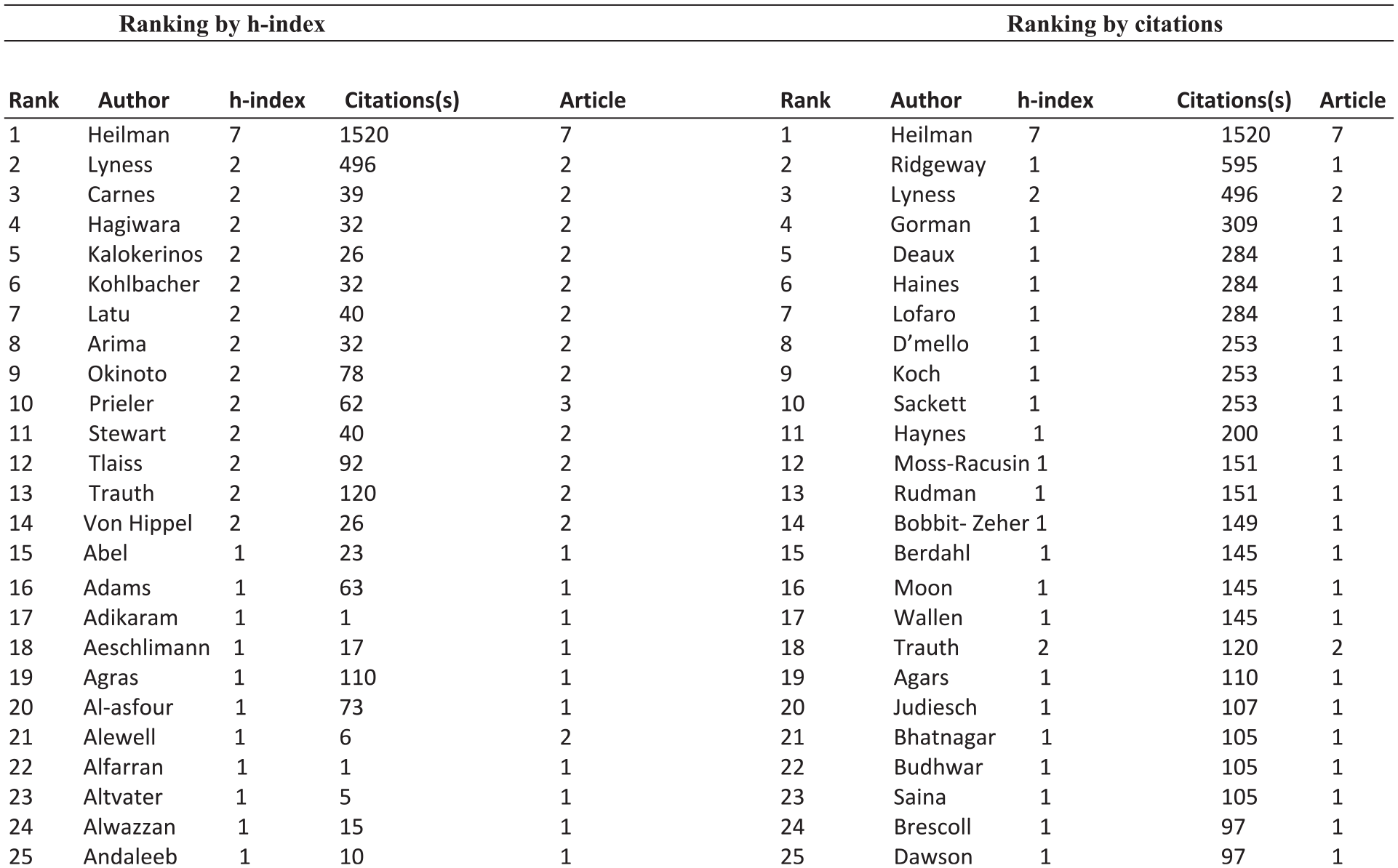
Twenty-five most-cited gender stereotypes authors according to h-index and total citations.
The top five gender stereotypes researchers, as measured by total citations, which demonstrate gender stereotypes authors’ influence are Heilman, Ridgeway, Lyness, Gorman, Deaux. Total citations acknowledge the contributions of researchers in their respective filed as Heilman’s initial work in constructing and assembling the knowledge foundation of gender stereotypes as prescriptive and descriptive types tremendously accelerated the concept’s proliferation, whereas his later work revolves around gender discrimination and penalties faced by women in work settings due to gender stereotypes. Ridgeway’s work focuses on the expectations levied on both men and women due to the presence of cultural gender stereotypes. The top five authors’ cumulative citations show that gender stereotypes authors can have a considerable influence on academic literature irrespective of how frequently they publish gender stereotypes publications. This finding should encourage aspiring authors to conduct high-quality gender stereotypes research.
Countries Performance
In order to identify and categorize the nations that have made a substantial contribution to the advancement of knowledge in the disciplines of gender stereotypes and workplace, we were next interested in the study of scientific production by country (Figure 5). According to the data, the nations with the most productive in terms of the number of citations are the United States of America (4,127), Canada (197), Australia (164), the United Kingdom (123), and Switzerland (94). Depending on how many citations there are on average for each publication, the United States of America leads with 62.53 followed by Switzerland (47), Canada (32.83), Korea (30), and Denmark (26.67).

Ten most prolific countries based on total gender stereotypes articles and citations.
Journal Performance
The eight publications publish articles (Figure 6) are either related to gender issues in an organizational context or the surrounding world concerning women discrimination, or cognitive and behavioral aspects surrounding human behavior. Three of them center their arguments around gender issues. However, it is crucial to note that the discourse about workplace inequality has a profound influence in the organizational context; as a result, there is a need to extensively study these problems in business journals so that managers and decision-makers may be informed of the findings.

The most prolific journals based on the h-index (productivity and influence) of gender stereotypes articles.
Conceptual Structure
The conceptual structure of gender stereotypes in workplace was examined by visualizing the temporal and density co-occurrence network (Figures 7 and 8). Keyword Plus and Author keyword was used with three threshold occurrence to conduct this analysis, so 47 keywords were analyzed.
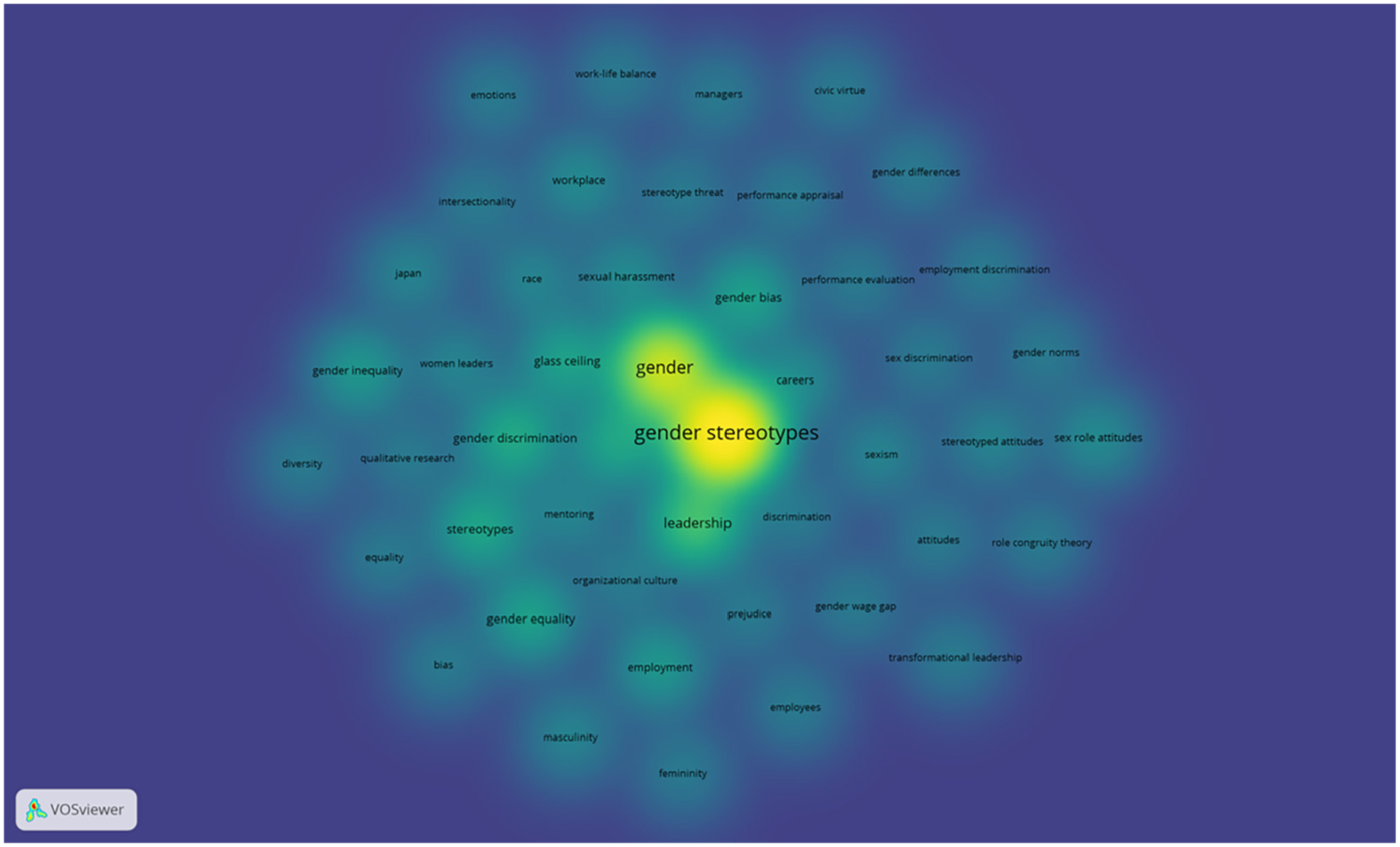
Keyword density heat map of the literature (occurrence threshold is set at 3).

Temporal co-word map of the literature (occurrence threshold is set at 3).
Figure 7 illustrates the density heat map of those keywords. The 10 most frequently used keywords are “gender stereotypes” (90 occurrences), “gender” (56 occurrences), “women” (39 occurrences), “men” (32 occurrences), “workplace” (30 occurrences), “human” (29 occurrences), “leadership” (28 occurrences), “stereotypes” (26 occurrences), “adult” (20 occurrences), “article” (16 occurrences), “gender discrimination” (14 occurrences). The appearance of “women” was more than “men” showcasing the effect of gender stereotypes more on women.
Intellectual Structure
Intellectual structure or knowledge base outlines discipline-specific research lines of the subject regarding gender stereotypes and the workplace. In order to see the intellectual structure surrounding gender stereotypes in the workplace, we used document co-citation analysis (Small, 1973). The size of a node in the co-citation network (Figure 9) shows how often a particular document is mentioned, and the distance between nodes shows how often two or more documents are co-cited. There are three nodes of different colors, each representing a different set of clusters which in turn denotes three different research lines. Three research lines are produced as a result of 44 cited references being included in the analysis after the cut-off of five citations is applied: “the underlying characteristics which distinguish women and men attributes” (red cluster), “women at workplace as leaders” (green cluster), and “challenges faced by women in the workplace” (blue cluster).

Co-citation analysis map of the literature (citation threshold is set at 5).
The first line of research is “the underlying characteristics which distinguish women and men attributes.” The three most frequently referenced sources within the cluster can be used to infer the content of this area of study (Eagly et al., 2020; Heilman, 1983, 2001). The lack-of-fit model (Heilman, 1983, 2001) and the role congruity model (Eagly & Karau, 2002; Koch et al., 2015) both include two different types of attributes or standards as part of these beliefs. Descriptive stereotypes, which are widely held beliefs about what members of a social group actually do. Prescriptive stereotypes also known as injunctive beliefs, are consensus expectations about what group participants should or ideally would do.
The second line of research is “women at the workplace as leaders.” The three most frequently referenced sources within this cluster insights into how cultural stereotypes, and role stereotypes perceived women as leaders or in leadership roles against a biased assessment of them (Eagly & Karau, 2002; Koenig et al., 2011; Schein, 1973).
It may appear, due to cultural stereotypes, that women lack the qualifications for key leadership positions. Unfair assessments of women’s leadership abilities are caused by this cultural mismatch, or role incongruity, between women and the responsibilities of leadership(Eagly & Karau, 2002). The agentic traits attributed to men are in line with traditional leadership stereotypes (Schein, 1973).
The third and the last research line is “Challenges faced by women in the workplace.” Referenced sources articulate that solely based on gender biases and inadaptability to adhere to male leadership style and invisibility of minority groups, women are in disadvantageous position in the workplace(Acker, 1990; Heilman, 2012; Kanter, 1987)
Research Themes
This section examines the three research lines that make up the intellectual framework of the area, including the construct, important and recent findings, and research priorities.
The Underlying Characteristics Which Distinguish Women and Men Attributes
Eagly and Wood (1991) and Heilman (2001, 2012) have argued that there are different social expectations or norms for men and women in terms of their behavior in the workplace. Specifically, there are prescriptive norms that suggest women should exhibit communal behavior, such as being nurturing, helpful, and caring, while men are expected to show agentic behavior, such as being assertive, independent, and competitive. Masculine traits and feminine traits differentiate work and role in an organization (Uhlmann & Cohen, 2005)
A study by Schmitt et al., (2008) found that gender differences in communal and agentic traits were present in 55 different nations, suggesting that they are not limited to any particular culture or region. The violation of both descriptive and prescriptive gender stereotypes by women often results in backlash being received by them (Diekman & Eagly, 2000; Eagly et al., 2000; Heilman, 2012; Moss- Racusin et al.,2010).
Women at the Workplace as Leaders
The impact of gender stereotyping on women is evident irrespective of the level of position women belong to in an organization. However, it is more salient when managerial or leadership positions are concerned (Koenig et al., 2011). One area where gender stereotyping has a significant impact is women in leadership roles. Although the number of women in leadership roles has increased in recent years, women continue to be underrepresented in many industries and sectors. According to a report by Catalyst, 2023, women hold only 41(8.2%) of CEO positions at S&P 500 companies worldwide.
Research by Eagly and Carli (2007) found that gender stereotypes can affect the way that women are evaluated for leadership positions, with women often being seen as less competent and less effective than men. They note that gender stereotypes play a significant role in shaping perceptions of women’s competence and suitability for leadership positions, as well as evaluations of women’s performance and opportunities for advancement (Heilman & Haynes, 2005). The authors also highlight how gendered expectations and scrutiny can undermine the authority and effectiveness of women leaders (Hanek & Garcia, 2022)
According to research (Eagly, 2012), women who create a leadership style that strikes a balance between interpersonal warmth and competence have greater influence as leaders and are viewed as more effective. They suggest that women may need to adopt a more assertive leadership style to overcome gender stereotypes, which often view women as less competent or less suitable for leadership roles. The study suggests that increasing the representation of women in top management can be beneficial for firm performance and that gender stereotypes and biases may not necessarily hinder this effect (Tabassum & Nayak, 2021). Ryan and Haslam (2005) conducted a study which examined the impact of gender stereotypes on the evaluation of leaders, particularly women leaders. They found that when an organization is in crisis, women are more likely to be appointed as leaders but are also more likely to be evaluated negatively and held responsible for any subsequent failure, compared to men in similar situations (Ryan et al., 2011).
Challenges Faced by Women in the Workplace
The paper identified several types of gender stereotypes, such as the motherhood penalty, the lack of fit stereotype, and the glass ceiling. The author concluded that addressing gender bias in the workplace requires a multifaceted approach that includes organizational policies, culture, and individual-level interventions. (Eagly & Carli, 2007).
The findings showed that women in leadership positions are more likely to experience gender-based discrimination, such as being overlooked for promotions, receiving less pay than their male counterparts, and being subject to gender-based comments Bobbit- Zeher & Garcia (2011). The study also found that gender stereotypes play a significant role in shaping these discriminatory behaviors. (Brescoll & Uhlmann, 2008; Eagly & Karau, 2002; Heilman & Okimoto, 2007; Rudman & Glick, 2021).
Hill et al. (2016) identified various barriers faced by women in senior leadership roles, including gender stereotypes, lack of access to mentors and networking opportunities, work-life balance challenges, and biased performance evaluations. The study also highlights the impact of these barriers on women’s career progression and provides recommendations for addressing them. Hewlett et al. (2008) found that women in science, engineering, and technology fields face unique challenges due to bias and inflexible workplace cultures, and suggested that organizations implement targeted interventions to support women’s career advancement. Kanter (1977) argued that women’s advancement in the workplace is hindered by systemic barriers and suggested that organizations take a more holistic approach to promoting gender diversity, including changes in organizational culture, policies, and practices. Rosette et al. (2008) found that white individuals are more likely to be perceived as leaders even when equally qualified as people of color. This highlights the need for organizations to address biases in leadership evaluations to promote greater diversity in leadership positions. Women who experience gender bias and stereotypes in the workplace may be at a disadvantage in terms of job satisfaction and career opportunities (Martell et al., 1996).
There is an upcoming change in the scenario regarding gender stereotypes in the workplace. Researchers contend that these gender stereotypes beliefs have changed in the modern workplace, where females’ income-generating activities have been boosted (Eagly et al., 2020). Various social and economic developments and initiatives have been taken, such as women in development programs, human rights, etc., across the globe to boost the female workforce (Benería et al., 2015; Boehnke, 2011). As a result of this trend, gender preconceptions have changed over the past 50 years and are no longer as rigid as they once were (Blau & Kahn, 2006; Priyashantha et al., 2023). Despite 50 years of research in changing gender stereotypes, many researchers opine that it still exists and hinders growth and development in the workplace ((Eagly et al., 2020; Haines et al., 2016). However, there is substantial evidence that increasing the number of women in leadership positions can improve operational performance, advance innovation, promote group performance, and increase recruiting ability.
Recent research has indicated that perceptions of intelligence and competence between men and women are becoming more similar (Hentschel et al., 2019; Parker & Funk, 2017).
However, women are still expected to meet higher and more restrictive standards that require them to balance assertiveness with maintaining a warm and likeable demeanor. This suggests that while progress has been made in some areas, gender stereotypes and expectations still persist for women (Catalyst (Organization), 2007). According to King et al. (2012), diversity training and a positive diversity climate were both associated with improved organizational performance, suggesting that organizations should invest in these initiatives to promote diversity and inclusion. A study by Hanek and Garcia (2022) suggests that future research should take a cross-level approach that explores the interplay between contextual and individual factors that contribute to gender gaps in organizations.
Conclusion and Future Research
The bibliometric study of 214 scientific papers makes an effort to summarize and scope the intellectual and conceptual framework of the literature body surrounding gender stereotypes in the workplace. According to the synthesis, the number of documents in the literature increased exponentially between 2004 and 2022, especially between 2010 and 2022.
Three main study lines are found by using the co-citation technique, notably: “the underlying characteristics which distinguish women and men attributes,”“women at workplace as leaders” and “challenges faced by women in the workplace.”
The majority of studies in the existing corpus of literature still create their models or plan their studies using binary conceptual frameworks of gender. Future studies examining the effect of gender on the business should take into account a more complicated mechanism due to the discrepancy of research findings and flaws in the binary conceptualization approach.
Most studies focus on women as a subject of gender-related stereotypes and gender discrimination. Attributes of gender stereotypes could negatively affect men as well in the workplace or society in general.
The first and second research lines exhibit a methodological imbalance. While qualitative approaches predominate in the literature on “The underlying traits which distinguish women and men attributes,” there are few qualitative studies on “Women at Work as Leaders.”
Gender stereotypes literature is over-saturated with articles undergoing study on gender stereotypes faced by women in leadership positions. Other domains of study could be undertaken in future studies.
Limitations
Instead of analyzing the outcomes of the documents, the bibliometrics method’s synthesis is restricted to the general research directions and progress in the investigated topic (Punnakitikashem & Hallinger, 2019).
In order to make the synthesis feasible, only English-language documents from the Scopus database were used, and national-recognized bibliographic databases (like the Chinese Science Citation Database, CAIRN International Edition, and CiNii) were excluded.
We gather data from a single source, Scopus, which might have left out publications from other databases. Future researchers could reduce this bias by looking into additional databases.
Footnotes
Declaration of Conflicting Interests
The author(s) declared no potential conflicts of interest with respect to the research, authorship, and/or publication of this article.
Funding
The author(s) received no financial support for the research, authorship, and/or publication of this article.

Data Availability Statement
Data sharing not applicable to this article as no datasets were generated or analyzed during the current study.