



Abstract
In the 21st century, American sociology has significantly influenced global sociological discourse. This research utilizes bibliometric methods to analyze 1,176 articles from the ASR, ARS, and AJS journals between 2011 and 2022, showcasing the dynamic development within the field. The research highlights the pivotal contributions of Harvard, Stanford, and UC Berkeley, and notes the emerging roles of the University of Toronto and NYU in shaping sociological discourse. We spotlight key scholars such as Soule, Desmond, Killewald, and Goldberg, whose works on social inequality—specifically in income, race, and gender—have significantly influenced contemporary sociology. the intensive focus on social inequality has spotlighted themes of income, race, and gender disparities. This focus complements the broad scholarly attention drawn to social movements, organizational studies, and the dynamics of social networks. Intersecting across these domains is the profound scholarly dedication to social justice. Indeed, the quest for equity and justice forms a critical undercurrent in contemporary sociological research, mirroring the discipline’s enduring engagement with these pivotal societal issues. This study not only charts the intellectual progression of American sociology but also underscores its global relevance and potential future directions. By integrating bibliometric analysis with a critical review of sociological literature, this article offers valuable insights into the evolving dynamics of the discipline.
Keywords
Introduction
The trajectory of American sociology, since its rise to global prominence in the 1930s, reflects a journey of intellectual evolution and significant global influence (X. Chen, 2019). This journey, particularly in the 21st century, is characterized by a dynamic interplay of globalization, technological innovation, and pivotal socio-political shifts, a period Burawoy (2000) identifies as the “Second Great Transformation.” During this era, The landscape of global sociology is increasingly influenced by major historical events such as the trends and counter-currents of globalization, the advancement of network technology and artificial intelligence, and the challenges posed by ethnic conflicts and refugee crises (FitzGerald & Arar, 2018; Pellow et al., 2013). These factors stimulate the sensitivity and responsiveness of sociologists worldwide, driving the evolution of sociological research and theory to address these complex, multifaceted global issues. American sociology broadened its horizons, embracing previously marginalized groups and integrating emerging subfields such as environmental and digital sociology (Pellow et al., 2013; Redshaw, 2020). These shifts have not only enriched the field’s tapestry but also expanded its global impact, influencing sociological practices and thought worldwide. The influence of American sociology is evident in the adoption of its theoretical and methodological paradigms across different countries. For instance, in China, American sociological frameworks heavily guide academic inquiry, showcasing the far-reaching impact of American sociology (Xie, 2022).
Many scholars are paying attention to the development of American sociology, substantial scholarly work has been undertaken to map the development of American sociology. For instance, S. Turner’s (2016)“American Sociology: From Pre-Disciplinary to Post-Normal” provides an in-depth historical analysis of the field’s evolution, discussing key theoretical shifts and methodological innovations. Similarly, Calhoun’s (2008) work, “Sociology in America: A History,” offers another extensive overview, focusing on the institutional and intellectual growth of sociology in the United States. These studies exemplify how the landscape of American sociology has been extensively documented and analyzed. Moreover, the methodological approach of using bibliometric analysis to study academic disciplines is not unique to this paper but has been applied in other contexts as well, such as in Lewison and Hartley’s (2005)“What’s in a title? Numbers of words and the presence of colons,” which examines trends in academic publishing across various disciplines to understand changes in communication styles. These references not only provide a background against which this study’s findings can be evaluated but also underscore the importance of engaging with existing literature to enrich the analysis and validate the research methodology. Integrating such reviews would strengthen the manuscript by demonstrating awareness of and building upon previous scholarly efforts.
Building upon the foundational work of noted scholars, this study undertakes a comprehensive bibliometric analysis to delineate the academic networks and key themes within American sociology. By focusing on publications from prominent journals—ASR, ARS, and AJS—from 2011 to 2022, this timeframe was strategically selected due to the completeness and reliability of the available data. Recent publications from 2023 to 2024 were excluded, as they typically lack complete citation records at the time of our analysis, which could skew the results and obscure true impacts and trends in the field. This careful selection avoids the inaccuracies that might arise from the not yet stabilized citation life cycle of newer articles, which often do not reach their peak influence until several years post-publication. The period between 2011 and 2022 is particularly significant, marked by rich academic discourse and notable shifts in sociological research and theory. This decade is critical for examining the emergent and consolidating themes that have significantly shaped the discipline, providing valuable insights into its dynamic changes and sustained impacts. Through this study, we aim to enrich the ongoing discourse on sociology’s evolving role and relevance in an ever-changing global context, offering a nuanced understanding of its complexities and contributions.
Data and Methods
Data Selection
Journal articles provide a window into the development of academic disciplines, making the selection of authoritative journals particularly crucial. Web of Science have conducted impact analyses specifically for sociology journals, whereas Scopus groups sociology together with political science, with the former having greater influence and wider application in the field of social sciences. Therefore, this paper selects journals from the SSCI in Web of Science combined with JCR. The Journal Citation Reports (JCR) for 2021 lists 150 sociology journals in the SSCI category. Among these, the “American Sociological Review” (ASR), a bi-monthly journal started in 1936 and sponsored by the American Sociological Association (ASA), is one of the most influential academic journals in the field of sociology. The “Annual Review of Sociology” (ARS), established in 1975 and published annually by the American Annual Reviews company, offers comprehensive overviews of various subfields and cutting-edge topics in sociology. The “American Journal of Sociology” (AJS), initiated in 1895 by the University of Chicago, is also a bi-monthly journal and was the first academic journal in the field of sociology in the United States. The Impact Factors and rankings of these three journals over recent years are presented in Table 1. These rankings reflect the extraordinary influence of articles published in these journals within the international field of sociology. Scopus database analysis further confirms their status as top journals in the field. The SJR index, a Scopus metric that considers a journal’s topic selection and reputation, assigns higher weights to citations from journals of high repute. Over the past decade (2011–2022), ASR, ARS, and AJS have maintained high SJR values of 5.91, 5.01, and 4.30 respectively, consistently ranking them among the top three sociology journals. Thus, these journals have been chosen as the primary sources for exploring the development of American sociology.
Impact Factors and Rankings.

For meticulous literature selection, the document type was set to “Article,” with a time span from January 1, 2011, to December 31, 2022. The established search expression in the Web of Science was: ((((((SO=(AMERICAN JOURNAL OF SOCIOLOGY)) OR SO=(AMERICAN SOCIOLOGICAL REVIEW)) OR SO=(Annual Review of Sociology)) AND DT=(Article))) AND DOP=(2011/2022)). After data cleansing and deduplication, a sample of 1,176 articles was obtained, with an average citation count of about 61 and an H-index of 131. Similarly, a control group of articles from 1999 to 2010 was obtained, totaling 888 articles with an average citation count of about 190 and an H-index of 219. Both groups of articles possess high impact indices. This division allows for the examination of the field’s evolution in response to significant global and societal changes, including advancements in technology, shifts in political landscapes, and emerging social issues. The earlier period encapsulates the turn of the millennium, a time marked by rapid globalization and the onset of the digital age. In contrast, the latter period covers a phase of further technological integration and social media influence, as well as responses to global challenges like climate change and growing social movements. This comparative approach provides a comprehensive understanding of the changes and continuities in sociological research themes, methodologies, and impacts.
Research Method
The study employs the CiteSpace software as a bibliometric tool for analyzing the sample data. CiteSpace, developed by Dr. Chaomei Chen and his team at Drexel University for the Web of Science database literature, is a knowledge visualization tool primarily based on co-citation analysis theory and pathfinder network algorithms (C. Chen, 2006; Li and Chen, 2016). It processes structured information like keywords, authors, and institutions from sample literature and ultimately presents the evolution of knowledge fields and key information in the form of network maps. Key parameters in the CiteSpace panel were set, including the time range (Time Slicing) from January 2011 to December 2022, with 1 year per time slice (Year Per Slice). The selection criterion mainly used the TopN method, where TopN represents the number of objects extracted within each time slice. Due to the limited number of sample articles, the N value was set to 100, typically avoiding network pruning. Node types were adjusted according to analysis needs. The size of nodes generally represents publication or citation frequency (f), with larger rings indicating higher frequencies. The color of the citation rings corresponds to their respective years, and the node’s betweenness centrality (c) indicates its connecting role in the co-occurrence network. To avoid the one-sidedness of quantitative analysis, this study also combines traditional literature reading methods, focusing on key information identified by the CiteSpace software. The software version used in this study is CiteSpace 6.1R6, with data processing conducted in February 2023.
Academic Network
Regional Distribution
The progress of academic research is closely linked to national support, and the level of academic research is a key manifestation of a country’s comprehensive strength. ASR, ARS, and AJS, as authoritative journals in the field of sociology, cater to scholars worldwide. This study has statistically analyzed the distribution of authors’ nationalities and applied the same treatment to the control group, as detailed below (Table 2).
Distribution of Authors’ Regions (Top 10).

The publishers of the authoritative journals ASR, ARS, and AJS are based in American academic institutions, and a significant proportion of the articles are authored by scholars from the United States, which represents 88.1% of the publications between 2011 and 2022, a slight decrease from 89.19% in the previous decade. This demonstrates a strong but slightly lessening dominance of American scholars in these journals. The high betweenness centrality underscores the central role of the United States in the global network of sociological research. However, there is evidence of increasing global participation. Canadian and UK scholars have made notable contributions, with Canada increasing its output significantly from 1.97% to 5.27% and the UK maintaining a leading contribution. This suggests a strengthening of transatlantic academic collaboration, which enhances the depth and diversity of sociological research and discourse. Furthermore, the data shows a notable rise in contributions from Germany, from 1.53% to 3.83%, indicating an increasing influence of German sociology. Contributions from non-Western regions, particularly Asia, have also grown, with China and Singapore marking their presence in these journals, reflecting broader participation and diversifying perspectives in sociological research. Comparative analysis with the earlier period indicates a trend toward greater inclusiveness in sociological research, with a wider range of countries contributing, thereby broadening the scope and enhancing the global relevance of studies published in these top journals.
Institutional Distribution
Academic institutions, especially universities, are the mainstay of academic research. The academic achievements of these institutions reflect their research capabilities and bolster their academic standing. This study utilized CiteSpace to organize the high-publishing institutions from the sample literature and also conducted a statistical analysis of their publication records during the 1999 to 2010 period (Table 3). The increase or decrease in publication volume largely reflects changes in the strength of universities in the field of sociology.
High-Publishing Institutions (Top 20).
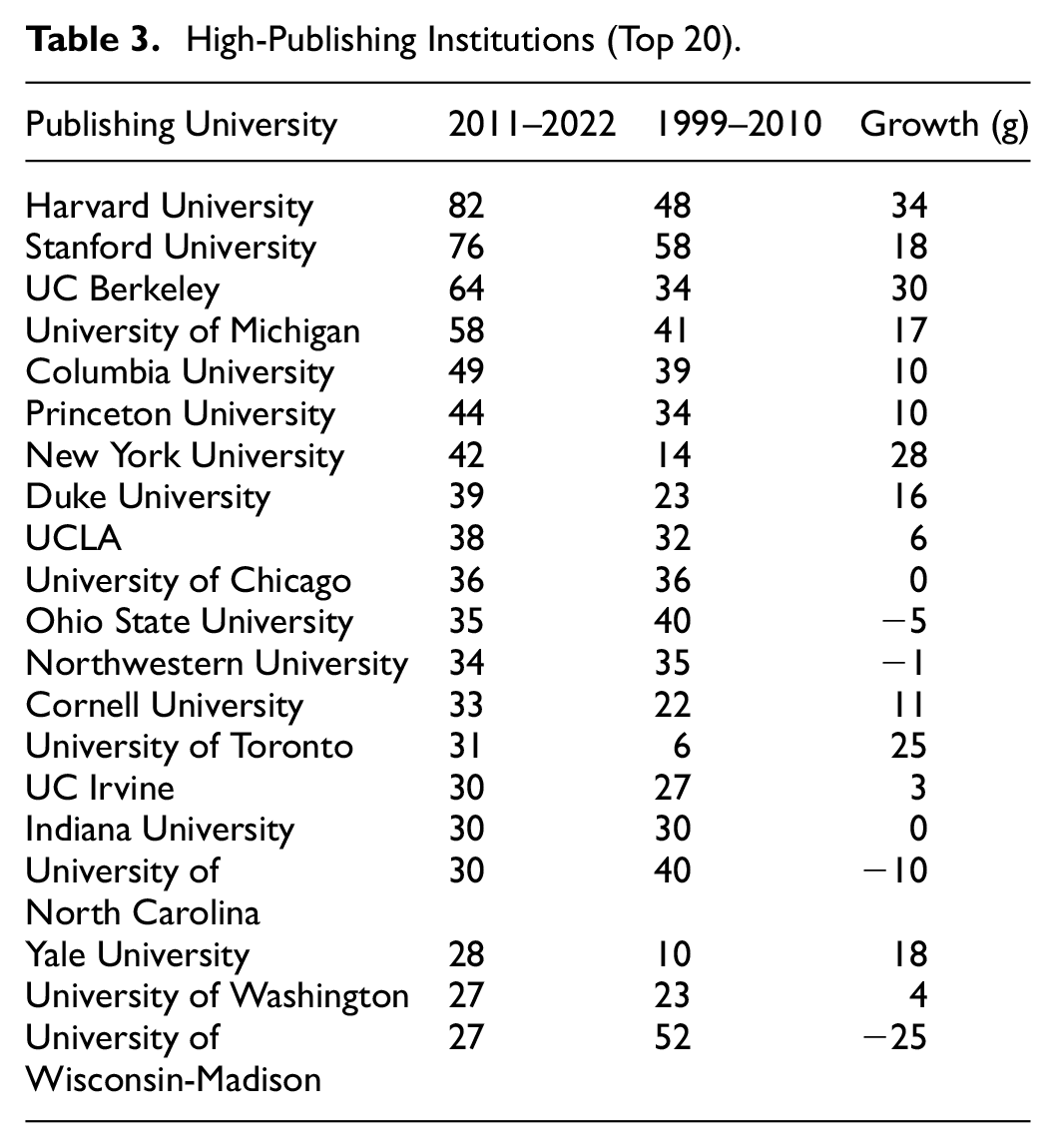
Based on data from the past 12 years, the American universities such as Harvard University (f = 82, c = 0.03), Stanford University (f = 76, c = 0.17), UC Berkeley (f = 64, c = 0.05), University of Michigan (f = 58, c = 0), Columbia University (f = 49, c = 0.12), Princeton University (f = 44, c = 0.02), and New York University (f = 42, c = 0.04) have shown outstanding performance in the field of sociology. Their volume of publications places them at the forefront, indicating their world-class research strength in sociology. Furthermore, Stanford University, Columbia University, and UCLA (f = 38, c = 0.13) have significant betweenness centrality, suggesting they occupy key positions in the network of university collaborations. In addition to the contributions from U.S. academic powerhouses, international institutions like the University of Toronto in Canada (f = 31, c = 0.01) and the University of Oxford in the UK (f = 22, c = 0.18) also make significant scholarly impacts. Their substantial number of publications in these esteemed journals reflects their formidable presence and influence in the realm of sociological research, showcasing the global reach and interdisciplinary nature of the field.
Compared to the early 21st century, these American universities have generally shown an upward trend in publications in these three authoritative journals, indicating the strong are getting stronger. Harvard University (f = 82, g = 34), Stanford University (f = 76, g = 18), UC Berkeley (f = 64, g = 30), and the University of Michigan (f = 58, g = 17) have maintained high standards of publication over the long term and show positive development trends, earning them the status of “evergreens” in the sociology field of the 21st century. New York University (f = 42, g = 28), Yale University (f = 28, g = 18), and the University of Toronto (f = 31, g = 25) have risen strongly in recent years, becoming emerging powers in this field. However, the traditional powerhouse University of Wisconsin-Madison (f = 27, g = −25) has seen a significant decline in its publication volume, indicating a reduction in its former strength.
Scholar Analysis
Prominent Scholars
Scholars and the academic communities they form through collaboration are the core entities of scientific research, with key scholars playing a significant role in influencing the direction of discipline development. The number of publications reflects a scholar’s research capability, while citation frequency directly indicates the impact of a scholar’s work in the scientific field. In this context, local citation score (TLCS) refers to the number of citations a paper receives within the sample literature database of 1,176 documents, reflecting the degree of peer recognition. Global citation score (GLCS) refers to the total number of citations a scholar’s papers have received in the Web of Science database representing the scholar’s influence across the entire knowledge domain, including other disciplines. To comprehensively understand core scholars’ contributions, the author also summarized the main research content of high-publishing scholars, with the top 20 scholars detailed in the Table 4.
High-Publishing Scholars and Their Main Information.

Looking at the publication records, scholars like Soule SA (f = 8, TLCS = 36), Rivera LA (f = 5, TLCS = 62), Goldberg A (f = 5, TLCS = 53), Desmond M (f = 6, TLCS = 52), and Tomaskovic-Devey D (f = 5, TLCS = 41) not only have a high volume of publications but also significant local citation scores, indicating their work is widely recognized and influential among peers. Wimmer (f = 5, TLCS = 5), although an early publisher, has a lower local citation score, suggesting that his influence on transnational migration research has yet to be fully realized. In contrast, Wilmers (f = 5, TLCS = 7) has a relatively low local citation score, but it is noteworthy that his publications are concentrated around 2020. Public records show that this scholar graduated with a PhD from Harvard University in 2018, marking him as an emerging academic star in the field of sociology in recent years. Regarding affiliations, there is a noticeable mobility among high-publishing scholars in American sociology. On average, scholars change university affiliations approximately every 7 years, a mobility that accelerates the cross-fertilization of knowledge. Furthermore, the bidirectional movement of talent between American universities suggests a degree of parity among these institutions. Notably, Harvard University, Stanford University, Princeton University, and Columbia University experience the most frequent bidirectional mobility of sociologists. From the perspective of research topics, authoritative scholars cover a wide range of issues, including urban poverty (Desmond & Western, 2018), crime (Desmond et al., 2016), resistance movements (Andrews, 2015; Lamont, 2018), and organizational development (Marwell & Morrissey, 2020; Ray, 2019).
Additionally, by utilizing Python tools to analyze citation data from Scopus for the three major journals, we found that the list of highly cited scholars closely matches the results from the Web of Science (GLCS) analysis. This consistency between databases underscores the reliability and widespread recognition of these scholars. For example, Desmond M’s profound influence is apparent with a Scopus citation count of 1,328, which closely aligns with his high GLCS of 1,034. Similarly, Soule SA, known for her research on social movements and government decision-making, has a substantial citation presence in Scopus, tallying 625 citations compared to her GLCS of 510. This uniformity across different bibliometric platforms highlights the significant impact these scholars have on the field, especially in areas such as social inequality, poverty, and social movements, affirming their crucial role in shaping global sociological discourse.
Scholar Collaboration
To further understand the collaboration among scholars, a co-occurrence network map of scholars was generated using CiteSpace (Figure 1).

Scholar co-occurrence map.
The co-occurrence network map depicted in the image is a testament to the vigorous collaborative endeavors that underpin sociological research. Central to this network is a prominent cluster of scholars who form the nexus of a robust academic community. This central cohort is characterized by a substantial gravitational pull, indicative of its attractive potential for new collaborations and its formidable capacity for organizational renewal. The vivid variations in the hue of the interlinking lines signal not only a bedrock of stable cooperative ties but also the ongoing genesis of innovative partnerships, thereby consolidating the group’s authoritative influence within the sphere of sociological inquiry. Within the epicenter of this network, we discern two distinct sub-clusters. The first of these is epitomized by scholars such as Desmond (f = 7), Western (f = 5), and Bloome (f = 4), among whom we also recognize Pager (f = 3), Tach (f = 4), and the notable scholar from China, Xie Yu. This subgroup is characterized by its expansive breadth, encompassing an array of scholars who engage in a rich tapestry of discourses, including but not limited to population poverty (Desmond & Western, 2018), social stratification (Western et al., 2012), and urban criminology (Desmond et al., 2016). Their discourse reflects the heterogeneity and breadth of contemporary sociological investigation. The second subgroup features scholars like Tomaskovic-Devey (f = 5), Killewald (f = 5), and Pfeffer (f = 4), whose scholarship cuts across various dimensions of income inequality (Lin and Tomaskovic-Devey, 2013; Tomaskovic-Devey and Lin, 2011). Their rigorous analyses offer nuanced insights into the contours of economic disparity, contributing substantially to the narrative on social equity and hierarchy. In a parallel vein, a robust collaborative dynamic is observed among scholars such as Soule (f = 8), Wang (f = 3), Ingram (f = 3), and Rao (f = 4). Their collective endeavors primarily orbit around themes of social movements and the propagation of public opinion (D. J. Wang et al., 2019), underscoring the pivotal role of collective action and communicative processes in societal evolution (Greve et al., 2022).
Hot topics
Keyword and Citation Analysis
This article focuses on summarizing the key issues in recent American sociology by analyzing keywords and references in scholarly publications. On the one hand, Keywords serve as a distillation of the thematic essence of literature, and their analysis affords a comprehensive view of the evolving research hotspots in American sociology. The frequency of keywords such as “United States” (f = 225), “inequality” (f = 170), “race” (f = 133), “gender” (f = 101), “organization” (f = 86), “sociology” (f = 83), “politics” (f = 76), “network” (f = 73), “identity” (f = 65), and “culture” (f = 64) indicates these as the most prevalent terms in the authoritative journals over the past 12 years. The distribution of these high-frequency keywords significantly mirrors the current research tendencies in American sociology. It becomes evident that issues of disparity, gender, race, and organizational studies have emerged as topics of considerable interest within the American sociological community of the 21st century. To further elucidate the focal points of American sociology, a cluster analysis of keywords from the sample literature was conducted. This analysis led to the identification of six primary clusters, designated by the most representative keywords. As illustrated in Figure 2, these clusters include: #0 “Social Movement,” #1 “Income Inequality,” #2 “Neighborhood Effect,” #3 “Neighborhood Attainment,” #4 “Gender Gap,” and #5 “Racial Inequality.”
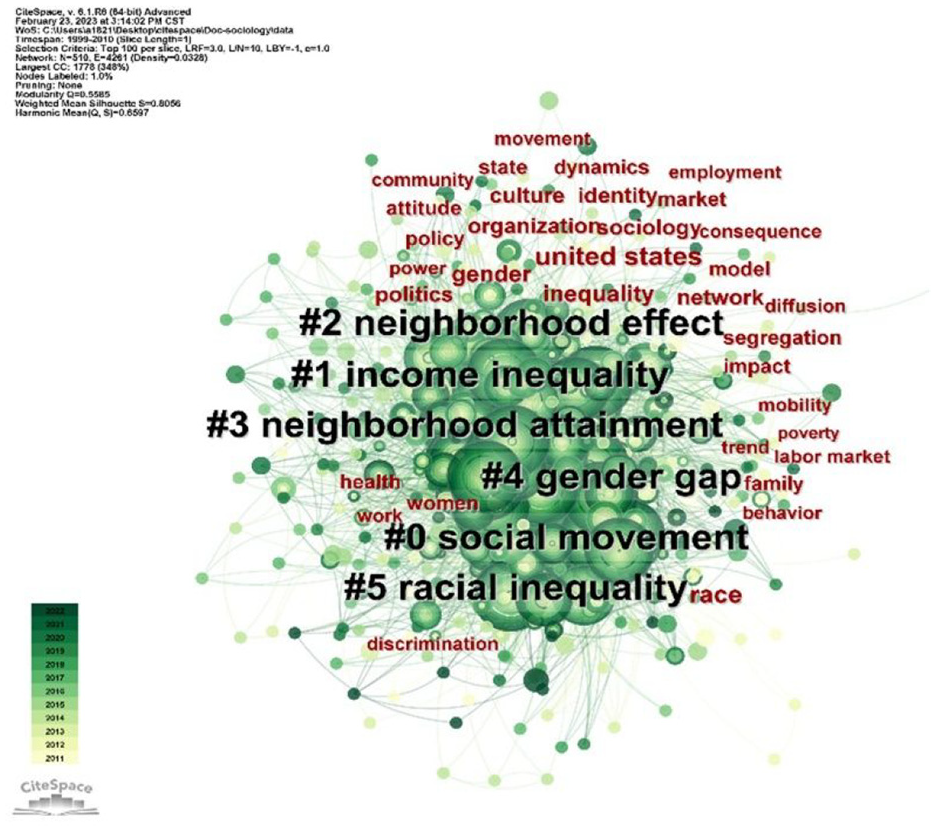
Keyword clustering map.
On the other side of the research spectrum, references constitute the foundational bedrock of scientific inquiry, with the sample literature serving as an extension and expansion of this knowledge base. The frequency of citations reflects the impact and value of the literature; a compilation of highly cited references over the past 12 years (Table 5) reveals works that are not only seminal to the evolution of American sociology but also carry significant weight across the broader scientific community. The prevalence of citations concerning inequality indicates a scholarly preoccupation with themes such as urban poverty, class stratification, and racial segregation. Additionally, the scholarly contributions of P. J. DiMaggio and Powell (1983) have profoundly influenced the development of American sociology, with two classic works appearing in the top ten cited documents. Building upon the keyword cluster map and integrating high-citation articles, four predominant issues in contemporary American sociology have been synthesized: Social Inequality, Social Movements, Organizational Studies, and Social Network.
Highly Cited References from 2011 to 2022.

Social Inequilty
The discourse on social inequality occupies a central place in the annals of sociological research, accentuated since the 1970s with the ascent of neoliberalism on a global stage (Wang et al., 2016). This epoch has witnessed the widening chasm of economic disparities, which has catalyzed a spectrum of intricate and far-reaching consequences. On a micro-level, the burgeoning divide impedes widespread access to resources, while on a macro-scale, it exerts deleterious effects on economic proliferation and societal cohesion, capturing the attention of both the scholarly realm and public discourse.
The American sociological landscape has persistently delved into the phenomenon of social inequality, with recent years observing a heightened focus on the term “inequality.” The substantive nature of this issue is reflected in the keyword cluster map, which delineates prominent clusters such as “#1 Income Inequality,”“#4 Gender Disparities,” and “#5 Racial Inequality.” These clusters represent a comprehensive narrative, encompassing the variegated aspects of societal imbalances.
Income Inequality
Income inequality remains a focal concern among the general populace. An examination of the literature within the “#1 Income Inequality” cluster reveals scholarly analyses probing the genesis of income disparities. The study of income inequality within American sociology has received substantial attention, with an emphasis on analyzing its roots and repercussions. The over-financialization of economies, a key factor identified by researchers, is seen as bolstering the disparity between corporate executives and the workforce. This phenomenon is linked to the relaxing of banking regulations and a concentrated financial sector, which has intensified the divide (Lin and Tomaskovic-Devey, 2013; Tomaskovic-Devey and Lin, 2011). Additionally, neoliberal social policies underpinning income disparity have been scrutinized. Analyzing tax data across various government levels, Jacobs and Dirlam (2016) indicates that neoliberal policies have propelled an extraordinary growth in income inequality in the US. The political ascendancy of the state’s executive branch coupled with skill-biased technological change (SBTC) has led to an expanding income distribution gap since the late 1970s. William Martin and Prased (2014) highlights that tax policy reforms are crucial in understanding the escalation of income inequality and underscores the connection between taxation, welfare states, and economic growth. It also explores taxation’s historical contribution to state building and the contentious debate about its role in modern developing nations and the impact of foreign aid on democracy.
The weakening of union power is another contributing factor, as the lack of collective labor protection leaves workers at a disadvantage in corporate negotiations. It was found that high-level engineers and patent holders often face restrictive non-compete agreements imposed by their employers. These agreements limit their opportunities for internal promotion within their current company and restrict their ability to move freely to other firms. This situation contributes to disparities in income levels, as these highly skilled professionals are constrained in their career mobility, affecting their earning potential and career development (Marx, 2011). The impact of widening income disparities on demographic behaviors has garnered scholarly attention. Cherlin et al.’s (2016) demographic research highlights how substantial income gaps dampen the marital and reproductive aspirations of youth, contributing to societal shifts where traditional family structures are increasingly viewed as burdensome. Schneider et al. (2018) further explores the ripple effects of parental income on education, elucidating how these economic differences perpetuate class divisions through educational investments. Reardon and Bischoff’s (2011) work underscores the intersection of income inequality with residential segregation, noting its disproportionate effect on Black families, emphasizing the multifaceted consequences of income disparities.
Efforts to narrow the income gap have also garnered scholarly attention. Goldrick-Rab et al.’s (2016) research advocates for additional grants for low-income students at public universities to mitigate educational disparities. Western and Rosenfeld (2011) highlight the egalitarian role of labor unions, suggesting that unionization can foster equitable income distribution. Meanwhile, Killewald et al. (2017) critiques the focus on wealth polarization in studies of social inequality, arguing for greater attention to the accumulative aspect of income, which shapes long-term disparities.
Racial Inequality
The issue of racial inequality is a deeply entrenched and complex challenge within the United States, a nation historically rooted in multiculturalism and immigration (Bloome, 2014; Smångs, 2016). Through citation analysis, it becomes evident that Massey and Denton’s seminal work “American Apartheid: Segregation and the Making of the Underclass,” published in 1993, remains one of the most frequently cited pieces in recent years. This underscores the scholarly focus on racial issues, as articulated by Saperstein and Penner (2012), who notes that in contemporary America, the cultural foundations of racial inequality are deeply embedded, with race functioning both as an input and an output. Reskin (2012) argues that racial discrimination is a pivotal issue in American society, profoundly affecting the lives of millions. It is not confined to specific domains but permeates the entire social system, manifesting in various facets. (1) Spatial Segregation: Grigoryeva and Ruef (2015) use 19th-century census data to reveal that Northern cities developed segregation through neighborhood relations, substituting residential inequality for the status inequality of slavery, while Southern cities employed street segregation to recreate the racial inequalities inherent in the slave system. Hwang and Sampson’s (2014) survey of Chicago neighborhoods indicated that racial hierarchies influence residents’ choices of housing and community. When the proportion of Black residents in a community exceeds 40%, it hampers the gentrification process, affecting the influx of middle and upper-class residents. In impoverished minority communities, a collective sense of disorder is more pronounced. Muller (2012) explored the evolution of racial disparities in the American incarceration system from 1880 to 1950. It specifically focuses on the impact of the Great Migration of African Americans to the northern states and examines how this demographic shift contributed to the changing landscape of racial disparities in imprisonment rates. (2) Educational Divergence: Reardon et al. (2019) has been devoted to discussing the racial achievement gaps across the United States, analyzing the disparities between Black-White and Hispanic-White students in math and English between 2009 and 2013. The results suggest that the strongest correlating factors for student performance in these subjects are not school quality but rather parental racial background, parental education levels, and patterns of racial segregation. Gamoran et al.’s (2016) research showed that the racial composition of high schools has no impact on the vocational status, employment, or annual income of Black or White individuals. However, the racial makeup of schools significantly foreshadows the racial composition of future workplaces. Owens (2022) found that, compared to White boys, Black and Latino boys face dual risks in education: firstly, teacher biases which deem them “more blameworthy” and more likely to be punished for the same misconduct; secondly, racialized organizational climates where minority students are subjected to stricter campus norms in predominantly White schools. (3) Income Disparity: Ferguson and Koning (2018) contends that workplace racial segregation in the United States is more severe today than a generation ago, and this increase occurs amid a decline in occupational segregation within institutions. He argues that reducing racial segregation in employment cannot rely solely on government efforts; corporate entities must also take a proactive stance. The racial income gap is not only evident in stable employment—Storer’s analysis of over 32,000 hourly employees in retail and food service companies in the U.S. found that minorities are more likely to engage in non-standard employment (gigs, hourly work). Racial segregation within companies and racial disharmony between ordinary workers and the leadership are commonplace, with racial disparities among women being greater than among men (Storer et al.,2020).
Gender Inequality
The issue of gender inequality, despite significant strides toward women’s rights over the past half-century, continues to manifest stark disparities between women and men in aspects such as employment, advancement, and remuneration (Rivera & Tilcsik, 2016). (1) Academic Disparities: Domina et al. (2017) critically examines the role of educational institutions in societal stratification. They argue that schools are not mere sanctuaries of equality but rather act as “sorting machines” that reinforce social inequalities. This effect is achieved through the implementation of various norms, discourses, and specialized training, all of which contribute to the perpetuation of existing social hierarchies. This perspective challenges the idealistic view of educational settings, highlighting their complicity in maintaining categorical inequalities. Legewie and DiPrete (2012) utilized an experimental design with fifth-grade students in Berlin, found that the notion of a “boy crisis” on a biological level is a misconception. Instead, boys are more sensitive to the academic environment created by schools—a sensitivity at odds with socially demanded masculine traits of defiance and aggression. In other words, boys adapt less well to environmental changes both inside and outside school, while girls, facing consistent societal normative pressures, are better able to transition and perform academically. (2) Employment Disparities: Bloome et al. (2019) explore gender disparities in economic self-reliance in the U.S. from 1970 to 2010, noting a significant increase in women’s independence, contrasted with a marginal decline in men’s self-reliance. This shift is attributed to evolving family structures and industrial changes. Yang and Aldrich (2014) investigate gender inequality within entrepreneurial teams, revealing that despite competence being a key factor in new ventures, persistent gender stereotypes hinder women from ascending to leadership positions. Rivera and Tilcsik’s (2016) study focuses on the hiring process, highlighting that while high-status men receive positive evaluations, high-status women face negative stereotypes about their commitment to work, which undermines their class advantages. These studies collectively shed light on the nuanced dynamics of gender inequality in various spheres of American society. (3) the “maternal penalty” is a topic of keen scholarly interest within discussions of gender inequality. Analyzing data from the National Longitudinal Survey of Youth, Killewald and Gough (2013) determined that household division of labor does not explain the maternal penalty or the wage premium for fathers. Further research indicates that behavioral changes to increase output may warrant a wage premium for the father’s role (Killewald, 2013). Analysis of income dynamics data from 1968 to 2013 found that marriages formed after 1975 had a higher risk of divorce if the husband lacked full-time employment, whereas a wife’s full-time employment or participation in household labor did not constitute a significant divorce risk. This suggests that expectations for wives to perform household labor may have diminished, but the norm for husbands to be the breadwinners persists (Killewald, 2016). Abendroth et al. (2014) notes that the maternal penalty is not limited to wage penalties but extends to professional status penalties as well. An analysis of community and family tracking survey data across 13 European countries shows that the impact of the first child on a woman’s career status is not immediately evident but emerges over the long term, with the impact being even more significant with three children.
Social Movements
The topic of social movements represents a significant area of inquiry within sociological discourse, driven by individual rational choices balancing the costs and benefits of collective action (Olson, 1965). Since the 1960s, the study of social movements has increasingly focused on the rationality of individual participation in collective actions. Scholars like McCarthy and Zald (1977) posit that social movements are the result of actors transforming available resources, organizational structures, and opportunities into concrete action based on rational calculations of costs and benefits. Participants utilize collective action to advance their interests, and as highlighted by Lamont (2018), many social movements aim to eradicate stigmatization, which is deeply intertwined with social inequality. In other words, the pursuit of fairness is a central demand of social movements. The “#0 Social Movement” cluster encompasses keywords such as “protest,”“violence,” and “crime.” Specific literature in this domain explores the following areas:
The Genesis of Social Movements: Social movements often arise from the advocacy for specific interests. Best (2012) examines the impact of single-disease interest groups on setting federal medical research priorities. Social movements can influence policymakers’ perceptions of beneficiaries, with lobbying activities showing a significant correlation with allocated research funds. The success of social movements also depends on specific external conditions. Kimberdorf’s examination of the rise of the American labor movement in the early 21st century finds that labor movements are more likely to occur in places where workers have greater disruptive capability because the cost of worker replacement during strikes is high. This cost is reflected in three aspects: lack of skilled labor, geographically remote job sites, and time-sensitive tasks. Workplaces with at least one of these conditions formed the pillars of the early American labor movement (Kimeldorf, 2013). Mainstream methods in social movement research emphasize the impact of political opportunities and threats on oppositional alliances. Kadivar (2013) introduces the psychological element of affective cognition into social movement analysis, dissecting the formation and dissolution of opposition alliances during the Iranian reform movement from 1997 to 2005. He finds that convergence and divergence in competitors’ perceptions, including attitudes toward state elites, state institutions, and contentious collective actions, decisively influence the rise and fall of social movement alliances.
The Mechanics of Social Movements: (1) Utilizing public opinion. Bail (2012) examines the changes in discourse about Islam within American civil society organizations and media after the 9/11 attacks. Despite a mainstream discourse that is pro-Muslim, anti-Muslim organizations dominate the mass media by conveying emotions of fear and anger, creating a “fringe effect” that significantly impacts the news audience. (2) Employing scientific strategies. X. Wang et al. (2016) engage in enduring collaborative research on social movements. An analysis of over 23,000 protest events in the United States from 1960 to 1995 shows that multi-issue protest events are more likely to use novel strategic reconfigurations, and protests with more peripheral movement claims often introduce new protest strategies. (3) Emphasizing collective power. Research by D. J. Wang et al. (2019) finds that organizational cohesion enhances the legitimacy of movements and impedes the adoption of claims associated with other movements. Jasper (2011) delves into the role of emotions in social movements, arguing that not all emotions function in the same way, and appropriate emotional states can be more effective than rational calculations in achieving social movement goals.
The Impact of Social Movements: (1) Social confrontations. Davenport et al. (2011) analyze over 15,000 protest events in America from 1960 to 1990. They find a distinct pattern of policing, where protests involving African Americans are more frequently met with police presence compared to predominantly White protests. Additionally, African American protests are more likely to experience police action during confrontations. This research highlights the racial disparities in law enforcement responses to civic activism during this period. (2) Securing political opportunities. Steil and Vasi (2014) explore the impact of social movements on local immigration policy in the United States from 2000 to 2011. Their analysis reveals that immigration-related social movements effectively influence policy making. Specifically, these movements have been successful in advancing pro-immigration policies within cities where protests occur. Furthermore, their presence has a preventative effect on the enactment of anti-immigration policies in nearby cities, indicating a broader regional influence of these movements on immigration policy. (3) Altering participants’ lives. Biggs and Andrews (2015) investigate the 1960 sit-in protests by African American college students in the American South, finding that sit-ins significantly increased the likelihood of desegregation, both in the city of protest and nearby cities. Over time, desegregation in one city increased the likelihood of desegregation in nearby areas. Moreover, the abolition of segregation often occurred in places where opposition was weak, political conditions were favorable, and the movement’s supporters wielded economic influence.
Organizational Studies
Organizational studies have a profound foundation within the American sociological discipline. Utilizing CiteSpace for citation tracking of the sample literature indicates that “DIMAGGIO PJ, 1983, AM SOCIOL REV, V48, P147” and “MEYER JW, 1977, AM J SOCIOL, V83, P340” are among the most frequently cited publications in recent years. In their seminal 1983 article in ASR, “The Iron Cage Revisited: Institutional Isomorphism and Collective Rationality in Organizational Fields,”P. J. DiMaggio and Powell (1983) posited that the spread of rationality and bureaucratization into professional organizations is a key factor in understanding why contemporary organizational structures and institutions appear remarkably similar. Meyer and Rowan (1977) discussed in their 1977 AJS article “Institutionalized Organizations: Formal Structure as Myth and Ceremony” how institutional rules provide legitimacy for organizational development, emphasizing that formal organizations reflect not only technical requirements and resource dependencies but also broader environmental influences including rational myths and law. Organizational structures and practices often mirror the rules, beliefs, and conventions present in the broader society.
Organizational Function: Paxton et al. (2020) focused on the growth of nonprofit organizations and found that such entities attract donors and volunteers through emotional ties. Nonprofits that communicate positive emotions are more successful at drawing in social donations and volunteer participation. Bail’s analysis of Facebook platforms suggests that advocacy organizations stimulate public interest in social issues by alternating between rational debate and emotional appeals, fostering dialogue with the audience (Bail et al., 2017). Dobbin et al. (2011) studied the development of 816 companies implementing diversity programs, discovering that the need for innovation functions less critically than corporate culture; larger companies, compared to smaller ones, approach innovation programs with greater caution and face more significant implementation challenges.
Organizations and Their Environment: Sharkey and Bromley (2015) noted the increasing influence of third-party evaluation systems on modern organizational development, particularly on audiences like consumers or investors. Analyzing the environmental behaviors of rated and unrated companies, researchers found that the presence of more rated peers is generally associated with emissions reductions. However, this relationship varies depending on whether the company is rated, the positivity or negativity of the rating, and the characteristics of the competitive and regulatory environment. Knight et al. (2022), analyzing labor data from 632 companies sued between 1997 and 2006, observed that large companies tend to increase workforce diversity after litigation, particularly at corporate headquarters, leading to more diverse member composition, while smaller companies tend to be slower to respond post-litigation.
Organizations and Social Governance: Marwell and Morrissey (2020) argue that sociologists should expand their organizational research perspective within urban poverty studies. They introduced the concept of urban governance and integrated it with the framework of strategic action theory to explain the disintegration of urban communities in Chicago, offering a new direction for urban poverty research. Bouek’s examination of childcare centers in Boston’s impoverished Black neighborhoods reveals that the inequitable distribution of social service organizations perpetuates racial and economic inequalities, leading to organizational deprivation of the poor (Bouek, 2022). Previous scholars have overlooked the role organizations play in racial social construction (Ray, 2019), he indicates that organizational systems also construct racial inequalities, including aspects such as organizations diminishing the agency of racial groups, racialized organizations legitimizing unequal resource distribution, whiteness as a credential, and the disconnect between formal rules and organizational practices.
Social Network
The field of social network research has been one of the most influential areas within sociology since Granovetter. Key works in this field include McPherson, Smith-Lovin, and Cook’s “Birds of a Feather: Homophily in Social Networks,” which discusses how individuals in homophilous networks are encapsulated within limited “social worlds,” powerfully shaping the information they receive, the attitudes they form, and the interactions they experience. Such homogeneity creates echo chambers where individuals primarily interact with others who share similar ideologies (McPherson et al., 2001). Additionally, Granovetter’s seminal papers, “Economic Action and Social Structure: The Problem of Embeddedness” (M. Granovetter, 1985) and “The Strength of Weak Ties,” (M. S. Granovetter, 1973) propose that most actions are closely embedded within networks of personal relations and that weak ties are particularly valuable for accessing information (Granovetter, 1973, 1985). These principles illustrate that social networks essentially reflect the interplay between individuals and their social relations.
Homogeneity in Social Networks: P. DiMaggio and Garip (2011) and collaborators examine internet access and rural-urban migration in Thailand. They explore how social networks contribute to inequality, focusing on the dynamics of network externalities and the homogeneity in social interactions. Their findings indicate that inequalities are not solely the product of individual circumstances but are also significantly shaped by the structure and characteristics of social networks. This research highlights the complex relationship between social networks and the exacerbation of intergroup inequality. In their subsequent paper “Network Effects and Social Inequality,” This work examines how social networks can both amplify and mitigate inequality, depending on various factors such as initial advantages and the homogeneity within these networks. Based on mechanisms of network externalities, social learning, and normative influence, individual differences are amplified by social networks, resulting in greater degrees of inequality. Conversely, networks can reduce inequality under two conditions: first, when initial advantages are negatively correlated with socio-economic status (inverted advantage), and second, when homogeneity is insufficient to amplify initial advantages (P. DiMaggio and Garip, 2012). Lutter (2015) focuses on the impact of social capital on women’s career advancement. Analyzing IMDb data on female actors from 1929 to 2010, the research suggests that women experience significant professional disadvantages when collaborating within cohesive teams. However, women building social capital within diverse and open networks with higher degrees of information flow face reduced gender disadvantages. In “Network Ecology and Adolescent Social Structure” (2014), McFarland et al. examine the intricate social networks among adolescents. They analyze data from the National Longitudinal Study of Adolescent Health and class studies, revealing the persistence of informal hierarchies in schools despite desegregation efforts. The study introduces the concept of “network ecology,” focusing on three key mechanisms: homophily (like associating with like), balance (reciprocal relationships), and dominance (hierarchical interactions). This approach provides a nuanced understanding of adolescent social dynamics and interactions within educational settings.
Networks and Interpersonal Interaction: Kreager and Haynie (2011), building on Granovetter’s concept of weak ties, explore the patterns of dating and drinking behaviors among adolescents and how these behaviors spread within their social networks. The study particularly examines the role of romantic relationships in influencing drinking habits among teenagers. It suggests that dating can serve as a bridge, connecting different social groups and facilitating the diffusion of drinking behaviors across these networks. Traditional views posit that social networks provide positive socio-emotional support. However, Schaefer et al. (2011) found that individuals with depression tend to withdraw from social contacts, becoming social periphery figures. Hence, depressed individuals form homophilous relationships with other marginalized individuals, creating friendships at the edges of social networks. Faris and Felmlee (2011) examined aggressive behavior from a social network perspective and discovered that aggression is inherent to status and escalates with increasing peer status until reaching the apex of the social hierarchy. Over time, those at the bottom and top of the hierarchy become the least aggressive youths. Aggression decreases with enriched cross-gender interactions; however, these factors are also related to peer status: in schools where cross-gender interactions are rare, cross-gender friendships create status differences, thus magnifying the consequences of network centrality.
Additionally, Smith and Papachristos (2016) explored the complexities of organized crime networks in Chicago. They delve into the concept of multiplexity, which refers to the multiple types of relationships that exist within these networks, such as friendship, kinship, and business ties. Their analysis reveals how these diverse connections facilitate trust and cooperation among members of organized crime groups, despite the inherently risky and illicit nature of their activities. This study provides valuable insights into the social dynamics underpinning criminal organizations.
Conclusion
In this comprehensive bibliometric analysis of American sociology from 2011 to 2022, we have delved into 1,176 articles published in top-tier journals ASR, ARS, and AJS. Our findings highlight a significant evolution in the thematic focus and research methodologies within the field. Central themes such as social inequality, particularly in income, race, and gender, dominate the discourse, reflecting sociology’s response to critical societal issues. Prominent scholars like Soule, Desmond, Rivera, and Goldberg have been instrumental in shaping these narratives, indicating a collaborative and dynamic scholarly community. The analysis reveals that institutions like Harvard, Stanford, and UC Berkeley continue to be at the forefront of sociological research, contributing extensively to the field’s development. These findings not only reflect a deep academic interest in issues of social inequality and justice but also offer practical insights for policymakers and educational institutions. By delineating the evolving dynamics of these themes, this research provides valuable data that can inform policy and educational reforms aimed at mitigating social disparities. The intersectionality observed in the research topics serves as a critical lens through which contemporary social challenges are explored, marking a shift toward more nuanced and integrative sociological studies. This approach not only enriches the academic discourse but also mirrors and addresses similar global challenges, thus underscoring the significant impact and relevance of this study in both academic and practical realms.
This study, while providing valuable insights into the evolution of American sociology through bibliometric analysis, does have several limitations that warrant mention. Firstly, the scope is restricted to three highly-regarded journals, which, although influential, do not encompass the entire spectrum of sociological publishing. This selection may inadvertently overlook significant contributions published elsewhere, potentially biasing the analysis toward the themes and trends that are predominant in these specific journals. Another limitation is the reliance on bibliometric data alone; this method emphasizes quantitative measures of scholarly output and may underappreciate the qualitative aspects of research impact, such as the depth and novelty of theoretical contributions.
Several future research directions can be considered to extend the findings of this study. Firstly, expanding the scope to include a broader array of journals beyond ASR, ARS, and AJS could provide a more comprehensive view of the trends and themes in American sociology. This would allow for an analysis of less mainstream but potentially influential publications that might offer new insights into emerging areas of sociological research. Secondly, integrating qualitative analyses with the current bibliometric approach could enrich the understanding of the contextual and theoretical nuances behind the quantitative data. Lastly, comparative studies involving sociological research outputs from other regions or countries could highlight unique or common patterns across global sociological discourses, enhancing the understanding of American sociology’s place in the global context. These directions not only aim to broaden the analytical scope but also deepen the engagement with evolving sociological questions.
Footnotes
Author Note

Author Contributions
Zhou Jialin: Conducted the bibliometric analysis, interpreted the data, and drafted the initial manuscript. Wu Chaojin: Supervised the research, contributed to the study design, revised the manuscript critically for important intellectual content, and acted as the corresponding author.
Funding
The author(s) received no financial support for the research, authorship, and/or publication of this article.
Declaration of Conflicting Interests
The author(s) declared no potential conflicts of interest with respect to the research, authorship, and/or publication of this article.
Data Availability Statement
Data sharing not applicable to this article as no datasets were generated or analyzed during the current study.