




Abstract
The concept of resilience has evolved, from an individual-level characteristic to a wider ecological notion that takes into account broader person–environment interactions, generating an increased interest in health and well-being research, practice and policy. At the same time, the research and policy-based attempts to build resilience are increasingly under attack for responsibilizing individuals and maintaining, rather than challenging, the inequitable structure of society. When adversities faced by children and young people result from embedded inequality and social disadvantage, resilience-based knowledge has the potential to influence the wider adversity context. Therefore, it is vital that conceptualizations of resilience encompass this potential for marginalized people to challenge and transform aspects of their adversity, without holding them responsible for the barriers they face. This article outlines and provides examples from an approach that we are taking in our research and practice, which we have called Boingboing resilience. We argue that it is possible to bring resilience research and practice together with a social justice approach, giving equal and simultaneous attention to individuals and to the wider system. To achieve this goal, we suggest future research should have a co-produced and inclusive research design that overcomes the dilemma of agency and responsibility, contains a socially transformative element, and has the potential to empower children, young people, and families.
Keywords
Introduction
In this article, we explore definitions and criticisms of the concept of resilience within government policy, social justice perspectives, and the resilience research literature that are said to shape the field today. We then introduce our own approach and describe how Boingboing, our community of practice and social enterprise, supports the development of resilience research and practice that includes a strong inequalities dimension (www.boingboing.org.uk). This includes conducting academic research that advocates for people facing embedded societal inequalities, and is more focused on challenging inequitable policy agendas; engaging in co-produced research containing socially transformative rather than solely personally transformative elements; facilitating supported agency, and co-identifying and co-delivering responses to adversities (these may be addressing societal inequalities but may more realistically include tackling prejudice, discrimination, stigma, and stereotyping); and encouraging the research community to be open to and prepared to undertake co-produced research with groups that are perceived to be more challenging to work with, and so are underrepresented in the literature, but whose voices are equally or more important as a result. We outline some examples and steps that we are taking toward our goal of consolidating resilience research and practice with a social justice approach in the support of children, young people, and families.
Resilience Research
Initially spurred by observation of children who performed unexpectedly well in unfavorable circumstances, the first wave of resilience research sought to identify correlates of resilience with a focus on the unique qualities possessed by the person or child (Masten, 2007). With resilience perceived as purely internal it is the individual who becomes tasked with compensating for their disadvantaged circumstances. The second wave of research was interested in associations between correlates of resilience. Identification of risk and protective factors as moderators and mediators of desirable outcomes expanded from the micro level of the individual to incorporate meso-level structures such as the family, school, and local community. The disadvantaged child is, from this perspective, no longer left wholly responsible for their outcomes. In addition to their own attributes, caregivers, schools, neighborhoods, and other community organizations are all seen to play a part in influencing children’s resilience. Putting the findings of the first two waves into practice, the third wave of research focused on developing and testing interventions. By endeavoring to improve outcomes for people facing adversity, valuable learning around effectiveness and the role of context brought to attention both the dynamic nature of resilience processes, and the importance of culture in defining meaningful outcomes (Ungar, 2004). Applying what is defined as a positive outcome within mainstream contexts to disadvantaged and marginalized groups may be inappropriate, and may lead to further exclusion. A focus on wider context and culture encourages a more systemic understanding of resilience in which the individual and his or her environment interact to produce, and construct, outcomes.
Presently, the fourth wave is said to be in ascendance, as the discoveries of the first three waves become assimilated with more sophisticated methods of investigation to develop a richer understanding of the multilevel, contextualized, and dynamic nature of resilience (e.g., Kassis, Artz, Moldenhauer, Geczey, & Rossiter, 2015). Using Bronfenbrenner’s (1977) human ecology theory, an ecological understanding of resilience places both the individual and the adversity within a dynamic multilevel context, where the impact of higher level factors (e.g., social, economic, cultural) on factors proximal to children is emphasized (Cassen, Feinstein, & Graham, 2009).
Resilience itself is not a unified concept, and a long history of controversy means that there is little consensus on its precise meaning. The only feature common to most definitions used by academic authors (see Table 1) is that resilience assumes adversity and is relative to it (Noltemeyer & Bush, 2013). Exactly how resilience relates to adversity is conceptualized in a variety of ways, including helping people and communities adapt to adversity, interact with it, or transform aspects of it. A further complication is that the understanding of resilience and how it relates to adversity also depend upon the nature of adversity (whether defined explicitly or implicitly), which may or may not be related to social disadvantage.
Definitions of Resilience in Research-Based Resilience Literature.
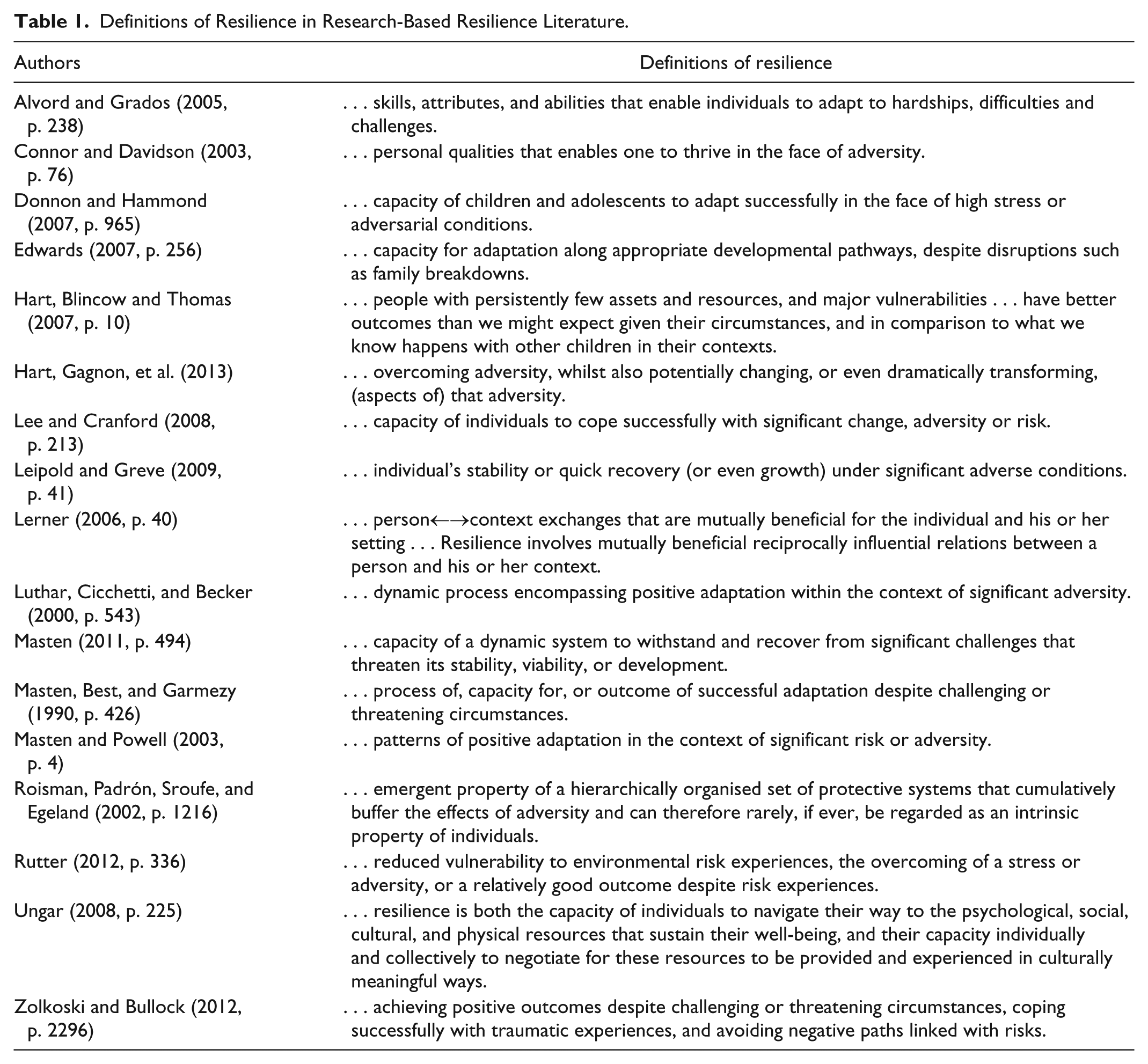
As shown in Table 1, there are 17 subtly distinct conceptualizations of resilience that we have counted in use by academic authors. Only three of these definitions include any potential to alter aspects of the wider adversity context, which are those of Hart, Gagnon, Aumann, and Heaver (2013); Lerner (2006); and Ungar (2008). For instance, the notions of “navigating” and “negotiating” hold the potential to have some influence over the availability of resources for others (Ungar, 2008, p. 225). Similarly, the notion of “reciprocally influential relations between a person” and his or her environment (Lerner, 2006, p. 40) captures at least some potential for the environmental context itself to be altered. However, presenting such exchanges as mutually beneficial fails to acknowledge the extent to which structural power imbalances consistently undermine the efforts of those facing the most profound disadvantage.
For the majority of definitions, resilience is anchored within an individual perspective, as it is the outcome which is most often of interest. However, mechanisms that enhance resilience can be portrayed as residing both internally and externally across the different levels of the system. This breadth has important implications for assumptions about the range of resources available when making resilient moves—small changes that can be made quickly and which acknowledge where the young person is starting from. While definitions which conceive of resilience as internal draw largely upon a person’s psychological resources, more ecological approaches which encompass wider social factors also place responsibility upon institutions and society. The different understandings of resilience can be viewed within the context of how resilience research has developed in the “four waves” said to have shaped the field today (see Masten, 2007).
Health Inequality and Resilience
Following international recognition of the impacts of myriad social inequalities on health (e.g., Black, Morris, Smith, & Townsend, 1980; Lawn et al., 2008) the ethical obligation to tackle health inequalities has been steadily gaining influence as a political issue (Crombie, Irvine, Elliott, & Wallace, 2005; Marmot & Bell, 2012). Health inequalities are defined as “disparities in health (and in its key determinants) that are systematically associated with social advantage/disadvantage” (Braveman & Gruskin, 2003, p. 256). It is not possible to talk meaningfully about health inequalities without talking about ethics and social change. With health and well-being now recognized as social phenomena, questions about how to tackle health inequalities become reframed as questions of how to transform the social structures and systems which produce inequality (Commission on Social Determinants of Health, 2008; Wilson & Pickett, 2009).
The reduction of health inequalities is now a key strategic priority both in the United Kingdom (Public Health England, 2013) and internationally (World Health Organization, 2014). Within this context, building people’s resilience through an individual focus is increasingly being presented within government policy and supplementary papers as a viable mechanism for the reduction of health challenges (Children and Young People’s Health Outcomes Forum, 2012a, 2012b; Department of Health, 2010a; Public Health England, 2014). In government explanations that privilege lifestyle choice and a person’s internal capacities and abilities, it is the individual who bears the brunt of responsibility for reducing health inequalities (Department of Health, 2010b), for example, pressure on individuals to reduce their alcohol consumption within a society that encourages excessive drinking with extended liquor licenses, “happy hours”, and cheap supermarket offers.
Criticisms of Resilience
From a social justice perspective, however, responsibility lies to a larger extent with governments, and global decision makers, in their power to determine the economic, social, and health policies that shape the wider socioeconomic conditions. Taking a capabilities perspective, individuals also have agency to affect their own trajectories and those of others (Nussbaum, 2003; Sen, 1999). It is from within the shifting of responsibility for health outcomes from governing institutions onto individuals, and vice versa, that critique of resilience arises. Reacting to the tendency for neoliberal practices and policies to emphasize personal responsibility, while reducing levels of state services, cultural theorists, and social critics consistently warn against an emphasis on promoting resilience (Bottrell, 2013; de Lint & Chazal, 2013; Friedli, 2012, 2013; Harrison, 2012). They identify the concept of resilience as a vehicle for the responsibilization of individuals in place of social structures and governing institutions (e.g., Bottrell, 2013; de Lint & Chazal, 2013; Harrison, 2012; Schmidt, 2015; see Table 2). Little attempt has been made within the resilience literature to offer a response to this critique despite many resilience frameworks working from a risk/adversity perspective (Noltemeyer & Bush, 2013), which may naturally be assumed to capture inequality issues.
Criticisms of Resilience.

Political and economic influences may become concealed when higher level structural factors are assumed to be only as influential as more intermediary influences, such as the personal capacities and behavior of individuals. Structural determinants are no longer seen as “the causes of the causes” (Marmot, 2005) when they are being given equal status. This paves the way for internalized explanations to proliferate when lifestyle factors of behavioral origin appear to exert the greatest influence over health and well-being outcomes (Department of Health, 2010b) and a focus on the level of the individual and on higher level structural factors is presented as mutually exclusive. Responsibilization of individuals then occurs when structural accountability is denied and health inequalities come to be understood wholly as the result of these individual choices and internal capacities.
To critics, a focus on resilience is seen as synonymous with accepting this internalized explanatory model for health inequalities. Many resilience practitioners’ and researchers’ own understandings and experiences of processes of inequality and disadvantage are not congruent with this model. Particularly for those who identify as members of, or who are working alongside, marginalized and disadvantaged groups, the power of conditions of injustice to constantly undermine caring work does not go unnoticed (Prilleltensky & Prilleltensky, 2005). And in our own projects the impact of structural challenges such as poor housing, transport, and income is often highlighted in the “basics” category of our resilience framework (Hart, Blincow, & Thomas, 2007).
By contrast, abstracted from context, resilience takes on the appearance of an independent variable separable from higher level political and economic factors, and structural accountability becomes deniable, or at least ignorable. It is important to note that decontextualization of resilience also fundamentally ignores findings in resilience research, where context is cardinal for adaptive development (Ungar, 2012). As the internalized resilience presented in policy bears little resemblance to the contextualized ecological models common today, many resilience researchers and practitioners may feel such critique is simply not relevant to their work, even though they may also not feel empowered to influence or challenge policy. Nevertheless, the problem of conflating explanatory levels continues to be an issue.
To overcome these difficulties, Harrison (2012) argues that resilience might be best replaced with the concept of vulnerability. She suggests that while references to resilience emphasize individual responsibility, the term vulnerability suggests moral obligation for those in positions of power toward those who are less powerful. Despite noting that vulnerability can imply people lack agency or are “helpless victims” (p. 99), she proposes that nevertheless the term is preferable, as, in contrast to resilience, vulnerability can be reduced by intervening in the political and economic allocation of resources. To resilience researchers and practitioners working with disadvantaged and marginalized individuals and communities, a focus on vulnerability in place of resilience is neither constructive nor ethical. For marginalized populations, left abandoned to their own fate, the only persons available to act upon their interests may well be themselves and those in close proximity. Relying solely upon appeals to those in power to take on moral responsibility for outcomes antithetical to their own interests remains an insufficient course of action. Furthermore, such an approach risks further marginalizing the most excluded groups in society who are already poorly represented in research. And finally, by replacing the concept of resilience with vulnerability, we risk missing the ways in which some people can display vulnerability, and at the same time strengths and capability (Zautra, Hall, & Murray, 2010). To illustrate the point from one of our own resilience-building research projects, a young woman who consistently displayed considerable signs of distress and vulnerability, often needing to leave meetings, also revealed that she was a prominent and successful campaigner for mental health justice with a leading young people’s mental health charity, simultaneously showing strength and capability.
We propose that approaches should address both individual and structural elements that could make a difference, while acknowledging that the range of individual strategies available may be largely determined by higher level political and economic factors (e.g., healthy eating may not be possible for someone on a low income due to the often higher price of “healthy” foods than “junk” foods, and is not necessarily about their individual conscious unwillingness to adopt a diet that the government tells them will be better for their health).
Resilience and Social Justice
The need for resilience research and practice development to engage with inequalities issues, and consequently the accompanying critique, is becoming increasingly urgent (Ungar, Ghazinour, & Richter, 2013). We propose that it is time for resilience to go beyond understanding how individuals cope with adversity, to challenge the structures that create disadvantages in the first place, and contribute to the development of a new wave of research that unites resilience research and practice development with social justice and activism. This process should invite the relocation of community members, researchers, and policy makers in dynamic, multilevel processes. They can then seek to challenge the contributory practices that conflate higher level causes with proximal determinants.
Recognizing that an unjust system unavoidably demands resilience because it relates to adversity, we suggest, as does Bottrell (2009), that we begin by asking, (a) to what extent adversity will be tolerated, on the assumption that resilient individuals can and do cope; and (b) how much adversity resilient individuals should endure before social arrangements, rather than individuals, are targeted for intervention. However, we propose it is then necessary to consider broader shifts that might emerge from resilient moves at the individual/micro level, where there is potential for knowledge and practice to travel and spread and in the process target social determinants (Aranda & Hart, 2014). For instance, in our mental health–related projects we identify stigma and discrimination as key adversities faced by people with mental health problems, including people in our research team. Our work involves considering ways to challenge that adversity in our daily lives, in our local communities, and at a national level by media campaigns and lobbying.
In addition, we notice that while a social justice–oriented understanding of resilience has been emphasized in adult populations (Brown, Payne, Dressner, & Green, 2010; Irizarry, 2008; Maxwell, Locke, & Scheurich, 2014), remarkably few resilience authors or researchers explicitly attempt to incorporate inequalities perspective when working with children and young people (Hart, Blincow, & Thomas, 2007; Prilleltensky & Prilleltensky, 2005; Ungar, 2015), and therefore there is a clear literature gap in addressing this in younger populations, for whom adults may assume they know best.
At Boingboing, we use a strategic resilience-focused methodology to support disadvantaged children, young people (up to age 25 years), and their families in overcoming the adversity they face in their lives (Hart, Blincow, & Thomas, 2007), attempting to address this literature gap in practice. Our work has always been informed by an inequalities awareness and we have developed and applied the concept of an “inequalities imagination” (Hart, Blincow, & Thomas, 2007; Hall & Hart, 2004; Hart, Hall, & Henwood, 2003). We define adversity in relation to social disadvantage, and building on more recent and socio-ecologically contextualized definitions (e.g., Lerner, 2006; Ungar, 2008), we construct resilience as, “overcoming adversity, whilst also potentially subtly changing, or even dramatically transforming, (aspects of) that adversity” (Hart, Gagnon, et al., 2013). This creates the possibility for resilience-based interventions to have an emancipatory function (i.e., potential to overcome adversity and oppression) and contribute toward systemic change, for example by changing school policy to cultivate a more supportive and positive school culture that discourages discrimination, alongside targeted work to build resilience strategies in pupils to deal with stigma and bullying. Current resilience interventions based on an ecological understanding (e.g., Daniel & Wassell, 2002; Kourkoutas & Xavier, 2010) have the potential to target a number of dynamic processes at a range of levels and to overcome inequalities. Within the systemic approach, resilience researchers should introduce specific directions for interventions and social policies, through identifying processes that significantly mitigate the effects of adverse life conditions (Luthar & Brown, 2007). In most instances, however, practicalities of implementation result in interventions predominantly targeting factors proximal to the individual, while acknowledgment of more distal processes remains fairly cursory. For example, many practitioners feel comfortable with and skilled in helping people to make micro “resilient moves” in their lives but feel less empowered and knowledgeable about influencing or challenging policies.
Boingboing supports the development of resilience research and practice that includes a strong inequalities dimension, underpinned by a co-production framework. According to the Social Care Institute for Excellence (2015), co-production is key in developing public services; the advantages include cost-effective services, integration, improved user and carer experiences of services, and increased community capacity. At Boingboing, our co-production work is carried out both with and as disadvantaged communities; most of the team working on our research themselves experience additional challenges and/or social exclusion. We focus on trying to include those of us who might be perceived as highly disadvantaged and marginalized in all stages of our research and knowledge transfer activities, amplifying the voices of others who experience social disadvantage, mental health problems, disability, and other vulnerabilities at different stages in life. We carry out co-productive resilience research and practice in our various identities as affiliates to the community of practice Boingboing.
From this perspective, we have witnessed firsthand how the concept of resilience generates interest and momentum because it inspires (e.g., Big Lottery Fund UK, who award grants to good causes, made a £75 million investment in HeadStart programs in schools in England with much of the funding going to resilience-based initiatives; Big Lottery, 2013; KidsMatter primary school mental health initiative in Australia; KidsMatter, n.d.); therefore, there is a clear imperative to continue resilience research and practice to strengthen children and young people and enable them to deal with adversities they may face. With the support of concrete examples from a range of our completed and ongoing research, we outline ways in which others can incorporate resilience theory, interventions, and continuing research practice, into an overarching critical approach which privileges knowledge co-produced by researchers and communities (Hart, Maddison, & Wolff, 2007).
Knowledge Co-Production
Traditional forms of knowledge production and transfer, such as the objective measurement of outcomes, are unable to sufficiently capture the multifaceted impacts of health inequalities within a dynamic system. This is partly due to insensitivity to the perspectives of communities. Not only does academic knowledge (Gibbons et al., 1994) have a strong tendency to decontextualize people and communities, but it is also associated with elitism and status inequality (Hart & Aumann, 2007). We suggest that new forms of contextualized, egalitarian knowledge production and exchange are more appropriate for understanding the multifaceted dynamic nature of adversity, resilience, inequalities, and transformational change. We advocate a peer-reviewed, applied, heterogeneous, problem-centered, trans-disciplinary and change-orientated mode of knowledge, with a critical dimension of being “co-produced by the university and community” (Hart, Maddison, & Wolff, 2007, p. 6). Developed in the context of University–Community partnerships, co-produced knowledge develops richer understandings of resilience, captures its costs, and detects hidden resilience, while also empowering people and communities with the tools and voice to challenge processes of injustice (Bolzan & Gale, 2012). An example from Boingboing concerns a group of young adults with learning disabilities. They are working with PhD student, Anne Rathbone, one of the co-authors of this paper, on a co-productive project that enables them to understand and document their own struggles and capacities in relation to the concept of resilience. They have been highly motivated to develop data collection tools. These include a resilience game that when played, helps the group to order their research data in a way that enables the cognitive functioning of the group to be accommodated. The young people have also been highly motivated to support other young people to develop resilience through making their game available more widely (Hart, 2016a). Finally, they have challenged wider inequalities in access to transport through lobbying Members of Parliament (MP) and transport providers (Hart, 2016a).
Looking at resilience through a social justice lens, the synergy between resilience and adversity continually positions researchers and practitioners as the natural advocates for marginalized, excluded, and disadvantaged children and young people, and supporters of their capacities and opportunities for self-advocacy. Co-produced research is necessary to capture the complexities of these groups by enabling a holistic approach. For instance, in our work in schools, we work across the school system in collaboration with all staff groups and levels, as well as students, to understand the resilience mechanisms of students, especially those who are disadvantaged, and to improve their resilience outcomes. In one of our Imagine projects in Greece, undertaken by Elias Kourkoutas and colleagues (Kourkoutas, Georgiadi, & Plexousakis, 2016), school staff, university students, child development center staff, and academics joined with parents of children with complex needs in a resilience-building Community of Practice (CoP). Applying lessons from the resilience research field to their own contexts, including our resilience framework, was the CoP’s focus. This local practice has now influenced the work of other academics in Crete and has also impacted the way that some local councils deliver mental health support. In particular, it has led to more community-based resilience-building practices being adopted and the sharing of expertise between parents, schools staff, local councils, students, and academics becoming routine. University teaching curricula have also been adapted to support trainee teachers to learn about and embed resilience-building approaches through this sharing of expertise.
Transformative Practice
We propose that resilience work should encompass a “basics” dimension designed specifically to tackle deprivation and associated health inequalities (Hart, Blincow, & Thomas, 2007). At a broader level, the Prilleltenskys’ concepts of epistemic and transformational psychopolitical validity (Prilleltensky, 2003; Prilleltensky & Prilleltensky, 2005; Prilleltensky, Prilleltensky, & Voorhees, 2008) provide a constructive framework for uniting micro- and macro-level factors, through combining understanding of psychological and political influences. Epistemic psychopolitical validity refers to using psychology and politics in understanding social phenomena. Resilience researchers can use this to consider how their understanding of adversity and resilience relates to individual and higher level structural influences, such as asking whether their work includes an understanding of (a) the impact of global, political, and economic forces on the issue at hand; (b) how global, political, and economic forces, as well as social norms, influence the perceptions and experiences of affected individuals and groups; and (c) how the cognitions, behaviors, experiences, feelings, and perceptions of individuals, groups, and entire communities perpetuate or transform the relevant forces and dynamics. They should also consider whether they appreciate how political and psychological powers interact at the personal, relational, and collective levels, affecting the issue at hand.
We argue that resilience research and practice has the potential to use psychopolitical validity as a guide toward liberation at the personal, interpersonal, and structural domains. To challenge our own practice and those of others, we might ask questions such as whether interventions (a) promote psychopolitical literacy; (b) educate participants on the timing, components, targets, and dynamics of strategies to overcome oppression; (c) empower participants to take action to address political inequities and social injustice within their relationships, settings, communities, or even internationally; (d) promote solidarity and strategic alliances and coalitions with groups facing similar issues; and (e) account for the subjectivity and psychological limitations of agents of change.
In our ongoing work, we have made modest steps in these directions. For example, all 16 individual projects of an overall program, on which we are working, involve some form of activity designed to challenge adversity conditions. We described above how a group of young adults with learning disabilities are tackling inequalities in transport provision. Emerging findings from other projects suggest that through lived experience, practitioner and academic partners can work together with an inequalities-focused approach to resilience-building. For example, in the building resilience for well-being and recovery course, we developed a session focused on “changing the odds” in which learners shared experiences of challenging adversity and developed action plans. One participant highlighted discriminatory attitudes toward people with mental health problems in her church, and with the support of the learning group developed an action plan involving challenging church authorities to take the issue seriously and to circulate educational material.
To overcome the dilemma of agency and responsibility, one possibility is to move away from modernist notions of agency, which privilege voluntary, deliberate, or conscious efforts (Shove, Pantzar, & Watson, 2012), toward a focus on actions as practices (Aranda & Hart, 2014). In terms of health inequalities, resilience, and ecology, this means moving away from focusing on individuals as sources of action, or on structures as external forces. Instead, accounts of resilience, capacities, or capabilities are intimately entwined with norms, practices, and institutions, which in turn are shaped and modified by those enactments. Practices, rather than individuals, become the unit of analysis.
A practice lens therefore suggests that no one, single factor controls change, including practitioners themselves who do not exist in isolation (and in this theoretical sense of the term “practitioner”, we mean anyone). Yet opportunities for intervention or change remain possible; practitioners can operate in a number of ways to influence elements of practice (Shove et al., 2012). This entails exploring how practices spread through research, intervention, or organization. Any attempt to understand resilient moves must acknowledge that these attempts are set within a nexus of global health practices seeking to address or tackle inequalities. Research should pay attention to the materiality of policies, reports, public health documents, and strategies; for instance, here in England that would include the recent government reforms now influencing the National Health Service (NHS), and reconfigurations of informal and formal health and social care services. It is worth holding in mind that, as we argued earlier, responsibilization of individuals occurs when structural accountability is denied, and health inequalities come to be understood wholly as the result of individual lifestyle choices and capacities.
Participation
Co-production of knowledge means committing to work with and alongside individuals and communities to better understand their adversity context, including the impacts of inequality, and resilience-building as an ecological process. Particular attention should be paid to issues of power and power relations, how power imbalances manifest and how they can be challenged in resilience research and practice development. The relationship between power and knowledge and the existence of different types of knowledge and competing perspectives should be acknowledged. We should be sensitive to how various types of knowledge are valued and constructed and for what purpose; and how they are used, exchanged, and managed (Hart, Davies, et al., 2013). We acknowledge that fully engaging people and communities in research requires resources, effort, time, and management, and often the practicalities are challenging, but we urge researchers to consider the value that co-produced knowledge adds to understandings of resilience. The simple but powerful way we incorporate this into our research agenda is through inviting study participants to become co-researchers and take an active role in the whole research process, in a way that is appropriate to their needs. In this we are not denying the complex power issues (and indeed practicalities) involved in making this happen. However, as a group we are committed to co-productive research and are constantly striving to improve our practice in terms of shared ownership and accountability.
Empowerment
Working with and alongside people and communities not only involves an undertaking to celebrate capability and build capacity as we share knowledge and practice but also provides potential to empower people and groups to challenge their adversity context. However, we must be especially careful around the meaning and use of empowerment. Within government policy, empowerment is presented as “empowering individuals to make healthier choices” (Department of Health, 2010b, p. 2). However, when we refer to empowerment we are interested in the emancipatory potential. In the context of resilience and inequalities, this means supporting individuals, groups, and communities to increase their control over the events that determine their health and well-being in the first place (World Health Organization, 2014). We also see ways in which more collective community-based understandings of empowerment, represented by the disability rights slogan of “nothing about us without us,” has been reinvented into the more individual “no decision about me without me” (Department of Health, 2010c, p. 13), reflecting the need for involvement rather than protection. For example, another PhD student in our group, Stephanie Coombe, supported the development of a resilience-building approach involving the whole-school community, including children (Hart, 2016b). Changes were made to the school day that meant children from disadvantaged backgrounds were able to make choices that increased their chances of going on to further studies or gaining employment. They could choose and/or be paid to develop clubs for hobbies and work experience placements, activities that the school did not previously provide, but which, as reported in the literature, are readily available to more advantaged school children (Broh, 2002; Farb & Matjasko, 2012; Stewart, Sun, Patterson, Lemerle, & Hardie, 2004).
Inclusion
Many of our team of resilience researchers and practitioners are drawn to the field precisely because of our own challenging backgrounds. Particular attention should be paid to explicit inclusion of marginalized people in resilience research and practice, including involvement in the more technical aspects of data collection. Current research practices routinely encourage underrepresentation of those termed hardest to reach and most in need. In our own exploration of the resilience literature, we found that children and young people with complex needs are unjustly underrepresented in study samples (Hart & Heaver, 2013; Hart et al., 2014). As discussed elsewhere (Hart & Heaver, 2013; Hart et al., 2014) the political economy of research, that is, academic capitalism (Barry, 2011), creates conditions which encourage researchers to focus on tame populations, people who will sit quietly and complete pen and paper or computer-based measures, with minimal supervision and in the fastest time.
We know that competition between researchers to present the best value for money to funders is an issue here, having large sample sizes and including people with learning disabilities are not usually congruous, as we have found in our own projects. Furthermore, academic journals often expect similarly large sample sizes, so there is clearly some work to do for both funders and journal boards in encouraging more appropriate research participation.
Resilience researchers and practitioners should be especially concerned about underrepresentation, as it is the people who are in most need of resilience-based interventions who are in danger of being systematically left out of the knowledge base because they may need additional support to participate. Challenging this state of affairs requires commitment from individual researchers and academic institutions to make emancipatory, resilient moves within research itself. Although we urge researchers to strive toward the inclusion of easy to ignore groups, and those who need additional support, there are steps that can be taken in the meantime to create pressure for change within research contexts. We can stop underrepresentation being a hidden problem, and improve the validity of the information we do have, by routinely including detailed demographic information about participants in our research. And, by justifying the use of unrepresentative samples, we can explicitly state decision-making processes, allowing these processes to be more carefully considered (Thimasarn-Anwar, Sanders, Munford, Jones, & Liebenberg, 2014). In our own research, young people with disabilities (physical, mental health, and learning) are integral members of our community of practice and work as Boingboing co-researchers (Hart, Griffiths, & Mena-Cormenzana, 2015).
Measures
The use of representative samples should be especially considered in the development of adversity and resilience measures. If disadvantaged groups are not included when measures are developed, this further perpetuates their exclusion from studies (Hart et al., 2014) and reduces validity. Making measures more accessible (e.g., easy read, symbol, or pictorial format), and ensuring they acquire information from children and young people who have difficulty compiling forms (e.g., read aloud or proxy completion), will aid inclusion.
Resilience-focused items should extend beyond the individual to aspects of the person’s ecology, such as the social (e.g., family), institutional (e.g., school), and cultural and community contexts in which they live. Adversity measures should include questions designed to capture the types of inequalities that the person is facing. Resilience measures should attempt to capture emancipatory elements such as activism and advocacy, both in relation to self and others. We appreciate that this is hard in some contexts, but examples include whether participants take part in political activities, for example, voting, lobbying around inequalities, community advocacy; or whether the resilience program they attended had wider effects for their community, for example, raising awareness of mental health. Finally, cost-free, easily obtainable resilience measures are of the greatest benefit in more disadvantaged contexts, potentially increasing inclusion of disadvantaged people and communities.
Conclusion
Wider structural factors, such as political and economic dynamics, are largely neglected in the current models, research and practices of resilience-building for children and young people. This is partly due to the assumption that a focus on the individual and these wider levels is mutually exclusive. We challenge this assumption by uniting resilience research and practice development with a social justice approach. It is essential for the advancement of the field that researchers and practitioners acknowledge the wider political and economic context in which both the resilience models and resulting research and practice sit. Through a social justice lens, engagement with this wider context demands that those of us who don’t self-identify as disadvantaged take up our role as advocates and/or promote self-advocacy alongside disadvantaged, marginalized, and excluded children, young people, and families.
It is essential that the resilience literature shifts debate on to look beyond the individual. We urge scholars to work with an inclusive and robust conceptualization of resilience that pays attention to the individual, societal, and environmental interactions simultaneously. We also ask researchers and practitioners to consider how they can make resilient moves within their own work which contribute toward systemic transformation and the reduction of inequalities. Moreover, working with and alongside individuals and groups facing disadvantage will deepen researchers’ and practitioners’ understanding of their needs, those that can be met and those that cannot. Resilience research and practice has the potential to affect the wider adversity, and therefore inequalities, context with small resilient moves that set in motion chains of events. This not only raises the profile of and strengthens day-to-day research and practice, but it also encourages academics, practitioners, and policy makers to tackle systemic inequalities (Aranda & Hart, 2014). Key here are the strategic plans and daily practices of research funders. Boingboing has been active in trying to shape these in a context where research funding in the United Kingdom is being increasingly given over to work on big data, with quantitative research, particularly randomized controlled trials, held up as the gold standard against which all other methods are judged.
However, despite this larger picture, there is some room for optimism. For instance, even the National Institute for Health Research, which lauds randomized controlled trials, has a powerful Patient and Public Involvement Agenda, which at least in theory enables service users to lead research projects drawing on expertise gained through their service user identity. Elsewhere in the United Kingdom, co-productive research has been animated by the Arts and Humanities Research Council’s Connected Communities Programme. We are involved in this through our own co-productive research project, Imagine, and by contributing to the Connected Communities’ wider community of co-researchers, which sees us meet regularly to share ideas and develop collaborative practices (http://www.boingboing.org.uk). The Economic and Social Research Council also takes the involvement of people with lived experience seriously with, for example, new initiatives being developed with recourse to service users’ experiences.
Of course there are many miles to go with this agenda, and we constantly challenge our own practices. Furthermore, many aspects of the wider policy context are not favorable to such initiatives at present. However, as we have argued above and elsewhere, there are always practices to be found that start in one arena and get shifted to others, including government policy agendas. The Boingboing community of practice approach is one such grassroots initiative that has traveled beyond its local context and which hopes to sustain itself for the future. Some of the practical steps we attempt to live by are outlined below. Uniting resilience research with an inequalities agenda is where we see our community developing and we hope that others will join us.
Practical moves that can be made in current research practice include
increasing transparency of research, including a clear conceptualization of resilience;
conducting academic research that advocates for people facing embedded societal inequalities and is focused on challenging inequitable policy agendas;
including detailed demographic information about research participants in resilience-based initiatives;
justifying the use of non-representative populations;
encouraging the research community to undertake co-produced research with underrepresented groups that are more challenging to work with;
increasing availability and accessibility of resilience measures;
developing co-produced research and practice designs, with clear skills development pathways for all co-researchers;
engaging in co-produced research containing socially transformative rather than solely personally transformative elements;
initiating research that shares research goals, processes, publications, and financial resources between academic and community partners;
facilitating supported agency, and co-identifying and co-delivering responses to adversities (to address societal inequalities, or tackle prejudice, discrimination, and stereotyping);
investigating the impact of inequalities/social disadvantage at multiple levels on processes of resilience-building, remembering that resilience is concerned with overcoming adversity, while also potentially changing or even dramatically transforming (aspects of) that adversity;
drawing on existing research in allied disciplines (e.g., policy, health disparities, inequalities) when designing resilience research programs to inform the wider socio-ecological context; and
taking every opportunity to influence research policy makers and help them understand the relationship between inequalities and resilience.
Footnotes
Acknowledgements
We are very grateful for the contributions from all the children, young people, and families with whom we work, and members of Boingboing who have helped shape our thinking and in some cases commented on the article. In particular, we would like to thank all current and former Imagine Programme – Social Context group members, including academics, community partners, practitioners, young people and policy-makers. Some of them too have commented on an earlier draft of this article. The Imagine Project was funded by grant ES/K002686/2 from the Economic and Social Research Council (ESRC). The contents are solely the responsibility of the authors and do not necessarily represent the official view of the ESRC. Information on ESRC is available on  .
.
Declaration of Conflicting Interests
The author(s) declared no potential conflicts of interest with respect to the research, authorship, and/or publication of this article.
Funding
The author(s) disclosed receipt of the following financial support for the research and/or authorship of this article: This work was supported by the Economic and Social Research Council (Grant Number ES/J023531/1).
Author Biographies
), and she is its director in a voluntary capacity. She is the academic director of the University of Brighton’s Community University Partnership Programme. She parents three children with complex needs adopted from the foster care system. As a result, she has personal experience of parenting using resilience-based approaches.