




Abstract
Live streaming for assisting farmers (LSAF) is a form of cause-related marketing. Consumers’ purchase intentions during live streaming is related not only to the content of the live streaming but also to consumers’ motivation, cognition, and anticipated emotions. This study integrates the influence of individual self-construal on behavioral attitudes into the theory of goal-directed behavior from the perspective of consumer psychology and constructs a structural equation model of the factors influencing consumer purchase intentions in LSAF. A survey and interviews involving 232 consumers were carried out, and the model was empirically tested using SPSS and AMOS software. The results highlight the diverse impacts of consumer self-construal on attitudes toward such live streaming events, with attitudes, subjective norms, and positive anticipated emotions positively influencing the desire to purchase, whereas negative anticipated emotions negatively influencing this desire The desire to purchase as well as perceived behavioral control positively influence consumers’ purchase intentions. Using the EMGB framework, this study contributes to a deeper understanding of the complex mechanisms involved in shaping the purchase intention in cause-related marketing. The findings offer valuable insights for live streaming e-commerce companies looking to target and optimize LSAF, as well as to enhance consumers’ purchase intentions.
Keywords
Introduction
Owing to inefficient distribution channels and high transportation costs in the rural regions of China, agricultural products marketed through conventional channels often experience significant losses during transit, resulting in elevated selling prices and reduced competitiveness (Zeng et al., 2022). The COVID-19 outbreak in early 2020 has plunged many parts of China into a situation where agricultural products have been struggling to be sold (H. Hou & Zhang, 2024). Thanks to the proactive guidance and policy backing from the government in China, social media platforms, live e-commerce enterprises, and logistics companies have worked in close collaboration to leverage the power of networking and information dissemination. This collaboration has propelled live streaming as a pivotal avenue for supporting farmers in marketing their slow-moving agricultural products. The entities involved in live streaming for assisting farmers (LSAF) include social media platforms, live e-commerce enterprises, streamers, and farmers offering agricultural goods. Social media platforms play a crucial role in shaping public opinion. These platforms can be utilized to showcase and promote LSAF. Live e-commerce platforms have been extended to grassroots rural areas, with professional streamers, grassroots influencers, modern rural streamers, and rural officials engaging in live streaming to promote local agricultural products and drive sales.
LSAF is a form of cause-related marketing, as opposed to live streaming that involves general shopping. This initiative not only facilitates the sale of farmers’ surplus products but also allows businesses to boost their earnings and improve their reputation in society. Gupta and Pirsch (2006) advocate that the primary advantage of cause-related marketing lies in its ability to create a mutually beneficial scenario for enterprises, stakeholders, public welfare participants, and consumers. Howie et al. (2018) propose that achieving a win-win situation through cause-related marketing hinges on positive responses from consumers. Current research explores various factors that affect consumers’ purchase intentions during live streaming: streamer characteristics, live streaming scenes, product features, and interactivity. Furthermore, researchers investigate how a company’s unique circumstances, public welfare campaign content, consumer attributes, and information dissemination methods impact consumer behavior in cause-related marketing initiatives (Xie & Zhao, 2024).
However, the aforementioned studies have certain limitations. First, scholarly research on the influence of live streaming on consumers’ purchase intentions primarily centers on live streaming characteristics, including streamer characteristics, or consumer traits. It primarily delves into analyzing the direct impact of independent explanatory variables on consumers’ purchase intentions and rarely delves into uncovering the mechanisms underlying the combined effects of live streaming characteristics, consumer traits, social influences, and other factors on consumers’ purchase intentions, as well as the interaction pathways among multiple factors. Second, concerning the uniqueness of LSAF, which embodies characteristics of cause-related marketing, research is lacking on the psychological mechanisms underlying consumers’ purchase intentions from a motivational perspective.
The model of goal-directed behavior (MGB) is a classic behavioral theory developed from the theory of planned behavior (TPB). MGB holds that attitudes, subjective norms, positive anticipated emotions, and negative anticipated emotions affect an individual’s desire to act; the desire to act and perceived behavioral control further affect an individual’s intentions to act (Park & Jang, 2020). Owing to its strong capability to predict and explain individual behavior, MGB has been widely used in many fields, including tourism, business, entertainment, healthcare, and education, in recent years (Chang & Cheng, 2015). From the perspective of consumer psychology based on MGB, this study aims to analyze the factors affecting consumers’ purchase intentions and how they influence LSAF.
Self-construal, as a way of understanding and perceiving the self, refers to an individual’s perception of his or her relationship with others, that is, the extent to which they perceive themself to be related to others. It can be categorized into two dimensions: independent self-construal and interdependent self-construal (Guimond et al., 2007). Individuals with an independent self-construal see themselves as more independent and prioritize the development of their own abilities. By contrast, individuals with an interdependent self-construal tend to understand and define themselves through their relationships with others (Xiang, 2018), are able to evaluate issues from the standpoint of others, value maintaining good interpersonal relationships (Markus & Kitayama, 2014), and have more pro-social behaviors (S. Hou, 2021). Park and Jang (2020) showed that consumers’ realization of social responsibility as the focal and integral component of cause-related marketing campaigns has an impact on their purchase intentions. Chang and Cheng (2015) showed that consumers with an individualistic mindset exhibit greater skepticism toward cause-related marketing advertisements than those with a collectivist mindset. Based on the aforementioned research findings, we hypothesize that consumers’ different self-construals affect their attitudes toward cause-related marketing, whereas attitudes toward cause-related marketing affect their desire to purchase, which in turn affects their purchase intentions.
This study aims to integrate the influence of different individual self-construals on behavioral attitudes into the MGB. Based on this extended model of goal-directed behavior (EMGB), the influence of consumers’ cognitive factors (behavioral attitudes, subjective norms, and perceived behavioral control) and affective factors (positive anticipated emotions and negative anticipated emotions) on consumers’ purchase motivation (desire to purchase) in LSAF is empirically analyzed from the perspective of consumers’ psychological mechanisms. We also analyze the influence of purchase motivation (desire to purchase) and cognitive factors (perceived behavioral control) on consumers’ purchase intentions.
The main findings of this study are as follows: (1) Consumers’ interdependent self-construal has a positive effect on their attitudes toward LSAF, whereas consumers’ independent self-construal has a non-significant negative effect on their attitudes toward LSAF; (2) Attitude, positive anticipated emotions, and subjective norms positively affect purchase desire, and negative anticipated emotions have a negative effect on purchase desire; (3) Purchase desire and perceived behavioral control have a positive effect on purchase intention.
The rest of this paper is structured as follows: The second section comprises the literature review; the third section presents our model and research hypotheses; the fourth section is the survey design; the fifth section presents an empirical analysis and discussion of the survey results; the sixth section offers suggestions for livestream e-commerce based on the study’s findings; and the last section discusses the limitations of this study and future research directions.
Literature Review
Factors Influencing Consumers’ Purchase Intentions in Live Streaming E-Commerce
Consumers’ online purchase intention is defined as the probability that a consumer will purchase a specific product or service through an online platform. It is a key predictor of actual purchase behavior (Poddar et al., 2009). Live streaming commerce is an online retail model where streamers demonstrate and share experiences through live streaming platforms, presenting product information more vividly and visually to consumers, thereby enhancing their purchase intention (Qin Fang, 2019). The current research primarily explores the determinants of consumer purchase intention in live e-commerce, focusing on aspects such as live streaming marketing strategies, alignment of streamer and consumer characteristics, dissemination of live streaming information, and interactive relationships during live streaming. The utilization of live streaming marketing diminishes the psychological gap and perceived uncertainty of consumers, positively impacting their purchase intention (Leeraphong & Sukrat, 2018). The streamer’s personality charm, social influence, and interactive communication during live streaming become the core link in maintaining consumer relations. The social capital of the streamer’s position and identity in the entire social network plays an important role in consumers’ trust (Xu et al., 2022). Shang et al. (2023) showed that contextual fitting in live streaming e-commerce has an impact on consumers’ purchase intentions. Clement Addo et al. (2021) demonstrated the positive impact of social factors, including likes, comments, re-tweets, and exposure time, on consumers’ purchase intentions in live e-commerce.
Living streaming e-commerce creates environments that provide knowledge, skills, and services. Streamers provide high-quality services through live streaming platforms, establishing online relationships with consumers and stimulating their online purchase intentions.
The Effect of Consumer Characteristics on Consumers’ Purchase Intentions in Cause-Related Marketing
Cause-related marketing is a marketing model wherein enterprises collaborate with nonprofit organizations to integrate product sales with social welfare causes. Such enterprises contribute to social welfare causes, while simultaneously fulfilling their objectives of enhancing product sales and improving their corporate social image. Consumers’ perceptions of public goods or social issues vary significantly based on differences in personal experiences or values (Bhattacharya et al., 2009; Grau & Folse, 2007). Increased participation from individuals is observed when a social issue is personally relevant or intrinsically important, or when they expect that it will significantly affect their lives (Grau & Folse, 2007). Consumers with a collectivist mindset exhibit a more positive attitude toward cause-related marketing than those with an individualistic mindset. Consumers possessing a high sense of social responsibility will more likely purchase products associated with cause-related marketing (Park & Jang, 2020). Rapert et al. (2021) found that consumers’ pro-social tendencies were positively related to their willingness to buy good cause-related marketing products. Bae and Zamrudi (2018) demonstrated that skeptical consumers may validate their doubts about corporate cause-related marketing and share their concerns, and that consumer skepticism may be a key barrier to the successful implementation of cause-related marketing.
Cause-related marketing can effectively link a company’s social responsibility with consumers’ purchase behavior, and this can improve product sales (Andrews et al., 2014) and enhance the status of the company in the minds of consumers (Lin & Wanping, 2020). However, not all cause-related marketing conducted by companies will have a positive impact on consumers. If companies fail to consider the impact of relevant factors in their cause-related marketing efforts, they may struggle to achieve the desired outcomes, and it may even negatively affect the company (Ma, 2023).
Self-Construal
Self-construal reflects the extent to which individuals view themselves either as an individual entity or in relation to others. Individuals with an independent self-construal consider themselves as unique and value characteristics that distinguish them from other group members. By contrast, when aspects of self-knowledge relating a person to others or to groups are more accessible, individuals tend to construe themselves as interdependent. Individuals with an interdependent self-construal see themselves as part of a group and define themselves in relation to other group members (Agrawal & Maheswaran, 2005). Brewer and Gardner (1996) further developed the self-construal theory by arguing that independence and interdependence are two basic human needs, and that both self-construals can coexist within every individual. In terms of stability, self-construal can be divided into two categories: chronic self-construal and situational self-construal. The former refers to an individual’s stable self-construal system, whereas the latter refers to the dominant self-construal tendency in a given situation. In empirical studies, the former is mainly measured using self-report scales, whereas the latter is activated through different manipulations (Liu, 2011). Vignoles et al. (2016) described the difference between independent and interdependent self-structures in terms of seven dimensions: Self-definition, self-experience, decision-making, self-care, navigation through different situations, interpersonal communication, and conflict management.
In recent years, scholars have arrived at a more consistent conclusion regarding the relationship between self-construal and consumer behavior, that is, self-construal has a direct or indirect impact on consumers’ purchase intentions, value judgments, and actual purchase behavior. Sun and Chen (2023) noted that consumers with an interdependent self-construal show higher intentions to purchase green products; however, they are driven by their own self-interests and may prioritize their own self-interests rather than being forced to comply with group norms in purchasing green products. Z. Chen and Huang (2016) pointed out that consumers with an interdependent self-construal are more responsive to cause-related marketing compared to those with an independent self-construal. Youn and Kim (2008) found that consumers with an interdependent self-construal attribute cause-related marketing to altruistic motives more than independent self-construal consumers.
In summary, self-construal is usually an internal factor that leads to differences in cognition, emotion, and motivation, and individuals with different types of self-construals may develop different perceptions of cause-related marketing. Therefore, this study suggests that consumers with different self-construals may develop different attitudes toward LSAF, and this difference in attitudes may affect their purchase intentions in LSAF.
Theory of Goal-Directed Behavior
Ajzen and Fishbein (1980) proposed the theory of reasoned action, which argues that attitudes and subjective norms influence an individual’s intention to act, which in turn influences their behavior. Ajzen (1985) proposed the TPB, which posits that an individual’s behavioral intentions are influenced by their attitudes, subjective norms, and perceived behavioral control. Perugini and Bagozzi (2001) proposed the MGB, which added two emotional variables to the TPB and also included behavioral desires as a mediating variable that affected behavioral intentions. The MGB suggests that attitudes, subjective norms, positive anticipated emotions, negative anticipated emotions, and perceived behavioral control affect an individual’s desires, which in turn affect their behavioral intention (Perugini & Bagozzi, 2001). In recent years, the theory of goal-directed behavior has been widely used in many fields, including tourism, business, entertainment, healthcare, and education (Song et al., 2014), because of its remarkable capacity to predict and explain individual behavior. Nam (2023) explored the formation mechanism of tourists’ intention to revisit wetland parks with an EMGB by incorporating three influential factors (environmental empathy, sustainable intelligence, and pro-environmental tourism behavior) into MGB. Chiu et al. (2018) applied MGB to investigate consumers’ behavioral intentions to purchase sporting goods online. They found that attitude, subjective norms, and both positive and negative anticipated emotions had a significant effect on consumers’ desire to purchase sporting goods online, and that the frequency of past behaviors and desires had a significant effect on consumers’ online purchase intentions. He and Ding (2023) investigated Chinese college students’ entrepreneurial intentions using MGB. They found that positive anticipated emotions, perceived behavioral control, and governmental support had a significant effect on students’ entrepreneurial intentions through behavioral desires, entrepreneurial intention of college students had an indirect positive effect, and perceived behavioral control and behavioral desire had a direct positive effect on entrepreneurial intention.
Innovation of This Study
Based on the existing research results, the innovation of this study is mainly in three aspects: (1) Prior studies on live e-commerce and factors influencing consumers’shopping intentions have mostly looked at live e-commerce features, such as live features, streamer features, and consumer features. However, this study looks at comprehensive live features, such as social influence, consumer self-construction, and other factors, from a psychological perspective on the formation of consumers’shopping intentions. (2) Although EMGB theory has emerged as a common theoretical model for studying individual behavior and behavioral intention, and has been widely used in tourism, culture, education, entertainment, and so on, few studies have applied EMGB theory to the analysis of consumers’ purchase intentions in cause-related marketing. Thus, this study broadens the scope of application of EMGB theory. (3) Existing studies on consumers’ purchase intentions in cause-related marketing mostly focus on the traditional marketing mode (offline brick-and-mortar sales). However, given that the total online retail sales account for an increasing proportion of total retail sales of consumer goods, it is of great theoretical and practical significance to extend the field of research on cause-related marketing to the emerging online retail channel of live e-commerce.
Research Hypotheses and Models
Self-Construal
Independent self-construal individuals regard the self as an independent individual distinct from others and emphasize self-interest and self-realization. Conversely, interdependent self-construal individuals regard the self as a part of the social group and emphasize harmonious interpersonal relationships and self-restraint (Guimond et al., 2007). In contrast to independent self-construal individuals, who are motivated by self-interest, interdependent self-construal individuals are easily driven by altruistic motives and show more pro-social attitudes when making decisions (S. Hou, 2021). Research has shown that self-construal is one of the important factors influencing consumer’s attitudes toward cause-related marketing. Vaidyanathan et al. (2013) found that individuals with different self-construals have different attitudes toward cause-related marketing. Consumers with an independent self-construal are not willing to pay extra for products that support good causes, whereas consumers with an interdependent self-construal are willing to bear the higher price for a product that supports pro-social causes.
Winterich and Barone (2011) found that consumers with an interdependent self-construal prefer cause-related marketing, whereas consumers with an independent self-construal prefer discount promotions. The reason for this is that the consumer is the primary beneficiary of discount promotions, and these transactional goals are more compatible with an independent self-construal. We suggest that moral and social identity may be the two main reasons why interdependent self-construal consumers prefer cause-related marketing. An individual’s moral identity reflects how important various moral characteristics are to them, and individuals experience positive moral emotions (e.g., pleasure, joy) when they perceive that their behavior is consistent with the moral characteristics of the group they identify with. They usually identify with pro-social and altruistic moral traits (e.g., kindness, empathy for others, and helping strangers). Their purchases of cause-related marketing products are consistent with their pro-social and altruistic moral identities, resulting in positive moral emotions. They view themselves as part of a group and define themselves in relation to other group members, placing a high value on their image within the group (Agrawal & Maheswaran, 2005). Purchasing cause-related marketing products can connect interdependent self-construal individuals with the interests of society and others, giving them stronger pro-social attributes and increasing their likelihood of receiving acceptance and acclaim from others. Additionally, it can help them establish a positive social image. Therefore, we hypothesize the following:
H1a: Consumers’ independent self-construal negatively affects their attitudes toward LSAF.
H1b: Consumers’ interdependent self-construal positively affects their attitudes toward LSAF.
Subjective Norms
Subjective norms refer to the social pressures individuals experience when deciding whether to adopt a certain behavior. These pressures stem from two main sources: first, the expectations of certain important people on the behavior of individuals; second, the restrictions imposed by external institutions on the behavior of individuals (Ajzen, 1991). Bagozzi, Baumgartner et al. (2003) argued that subjective norms do not directly influence individuals’ intention to behave, but rather they work by influencing the mediating variable of desire. During the COVID-19 epidemic, many famous streamers and grassroots cadres in rural China appeared in a live broadcasting room and enthusiastically helped farmers in promoting local agricultural products. Moreover, Several influential social media platforms also guided consumers to actively help farmers through a large number of public opinions and enthusiastically purchased a variety of agricultural products in the live streaming. All of these have positively influenced consumers’ purchase desires. H. Chen et al. (2023) found that subjective norms positively influenced tourists’ desire to travel nearby, which in turn influenced their intention to travel. Poon and Tung (2024) found that subjective norms have a positive effect on consumers’ desire to order food online during an epidemic, and the desire to order food online further affects their intention to order food. Therefore, the following hypotheses are proposed in this study:
H2: Consumers’ subjective norms have a positive effect on consumers’ desire to purchase in LSAF.
Anticipated Emotions
Individuals’ evaluations of goals contain predictions about the prospects of success or failure, that is, “pre-factual evaluations” (Baumgartner et al., 2008). Loewenstein et al. (2001) accordingly proposed the hypothesis that “risk is emotion,” suggesting that when individuals encounter risk and uncertainty, they experience a range of emotional responses, that is, “prospective emotions,” which can have an impact on decision-making independently of rational cognition (Baumgartner et al., 2008). Prospective emotions, as the experience of future uncertainty, are immediate emotions, including negative anticipated emotions (e.g., anxiety and worry) and positive anticipated emotions (e.g., hope and excitement). Positive anticipated emotions motivate individuals to take action to achieve their goals, whereas negative anticipated emotions cause people to fear negative outcomes, resulting in risk-averse intentions and behaviors (Perugini & Conner, 2000). Compared to the “visible and tangible” shopping experience in physical stores, the experience of shopping in live e-commerce can cause consumers to feel that there are a lot of risks and uncertainties involved. For example, they may be concerned that the purchased product may not be as good as the streamers claim it to be, which will evoke negative emotions; these negative emotions can negatively affect consumers’ intention to shop through live e-commerce. On the contrary, live e-commerce can satisfy consumers’ diversified and profound needs, such as shopping, entertainment, leisure, socialization, and learning by creating interactive, experience-rich, and emotionally embedded live broadcasting scenarios and environments, which can evoke positive shopping emotions in consumers. These positive emotions, in turn, strengthen consumers’ purchase intentions in live e-commerce. Chiu et al. (2018) found that positive anticipated emotions and negative anticipated emotions have a significant effect on consumers’ desire to purchase sporting goods online. Ruan et al. (2021) found that positive (negative) anticipated emotions have a positive (negative) effect on tourists’ desire to travel. Therefore, the following hypotheses are proposed in this study:
H3a: Consumers’ positive anticipated emotions will positively influence their desire to purchase in LSAF.
H3b: Consumers’ negative anticipated emotions will negatively influence their desire to purchase in LSAF.
Attitude
Attitude is an individual’s evaluation of things or behaviors (Perugini & Bagozzi, 2001). Song et al.’s (2014) empirical study showed that participants’ attitudes have a positive effect on behavioral desires. Perugini and Bagozzi (2001) argued that attitude does not directly affect an individual’s intention to behave, but rather exerts an indirect effect through desire. Dong et al. (2013) found that the attitudes of public golf course patrons toward the game of golf significantly affected their desire to play golf. Sourirajan and Perumandla (2022) found that consumers’ attitude toward mutual investment funds significantly affected their desire to purchase investment funds. As the independent variable in the goal-directed behavioral model, consumers’ attitudes toward LSAF affects their desire to purchase, which in turn affects their purchase intentions. Therefore, the following hypotheses are proposed in this study:
H4: Consumers’ attitudes toward LSAF will positively affect their purchase desire.
Desire to Purchase
Desire can provide motivation or impetus for behavioral intention. Desire, as an intermediate variable in the goal-directed behavior model, is the most direct determinant of behavioral intention, and it has been experimentally validated (Perugini & Bagozzi, 2001). Perugini and Conner (2000) emphasized that desire is a good predictor of behavioral intention. Cheung et al. (2017) found that consumers’ desire to be environmentally friendly had a positive effect on their intention to consume less energy. H.-S. Chen (2022) found that consumers’ desire to purchase plant-based meat affected their purchase intentions. We believe that in LSAF, consumers are motivated to purchase because of their desire to help farmers deal with slow-moving agricultural products, and this desire is a mediating variable that directly affects their purchase intentions. Therefore, the following hypotheses are proposed in this study:
H5: Consumers’ desire to purchase positively affects their purchase intentions.
Perceived Behavioral Control
Perceived behavioral control is the process by which individuals evaluate their own resources and opportunities, as well as predict obstacles that may arise during the course of a particular behavior, to judge the degree of difficulty in achieving the behavior’s objective (Ajzen, 1991). The stronger an individual’s perceived behavioral control, the greater his or her intention to behave. In the theory of goal-directed behavior, perceived behavioral control is considered an indispensable factor in influencing behavioral intention (Perugini & Conner, 2000). Chiu et al. (2018) confirmed that consumers’ perceived behavioral control had a positive impact on their intention to purchase sporting goods online. We believe that in LSAF, consumers’ income level and ability to handle agricultural products affect their purchase intentions. This leads us to the following hypothesis:
H6: Consumers’ perceived behavioral control has a positive effect on their purchase intentions.
The specific research model is illustrated in Figure 1.

Research model.
Research Design
Questionnaire Design
The questionnaire comprises three sections: description, basic information, and survey items. The description section outlines the purpose of the survey and guarantees respondents that the data collected will solely be used for research purposes. The basic information section elicits information on gender, age, level of education, monthly income, and the frequency of shopping through live e-commerce in the past. The main part of the questionnaire consists of nine categories of measures, including independent self-construal, interdependent self-construal, respondents’ attitudes toward LSAF, subjective norms, positive anticipated emotion, negative anticipated emotion, purchase desire, perceived behavioral control, and purchase intention. The first two categories were adapted from Singelis et al.′s (Singelis, 1994) scale, while the remaining seven categories were adapted from C. K. Lee et al.’s (2012) scale. The questionnaire utilizes a five-point Likert scale. The grades 1, 2, 3, 4, and 5 represent “strongly disagree,”“disagree,”“generally,”“agree,” and “strongly agree,” respectively. “Strongly Disagree” signifies that the question describes a situation that is completely different from the actual situation. “Strongly agree” indicates that the situation described in the question is completely consistent with the actual situation. There are three measurement items under each category. We consulted relevant experts regarding the content of the questionnaires. In accordance with the experts’ suggestions, we revised the unclearly articulated questions and finalized the questionnaire.
Survey Process
During the survey, which was conducted from September 15 to November 15, 2023, the project team collected 15 LSAF videos from the Douyin app, and each video was limited to 7 min in duration. In accordance with the principle of content consistency, three live e-commerce experts selected three videos from the aforementioned 15 videos. To ensure the validity of the survey, 20 consumers with live e-commerce shopping experience were pre-tested. These respondents sequentially watched the three selected LSAF videos in the screening room and filled out a questionnaire following each video. The consistency score of the three questionnaires completed by each pre-tested respondent was 94%, indicating that the three LSAF videos met the content consistency requirements.
A formal survey was administered across three colleges and universities in Hefei city, targeting faculty, staff, and students with live shopping experience. The survey used the simple random sampling method, and 245 respondents were randomly selected. Respondents randomly chose to watch one of the three LSAF videos and then filled out the questionnaire.
Respondents’ Description
The basic information section of the questionnaire inquired about the respondents’ past experience with shopping through live streaming e-commerce to assess their familiarity with the concept. Respondents with less than two live shopping experiences were excluded. A total of 245 questionnaires were distributed, yielding 211 valid responses; this had an effective recovery rate of 84.4%. The basic information of the respondents is presented in Table 1.
Respondents’ Basic Information.
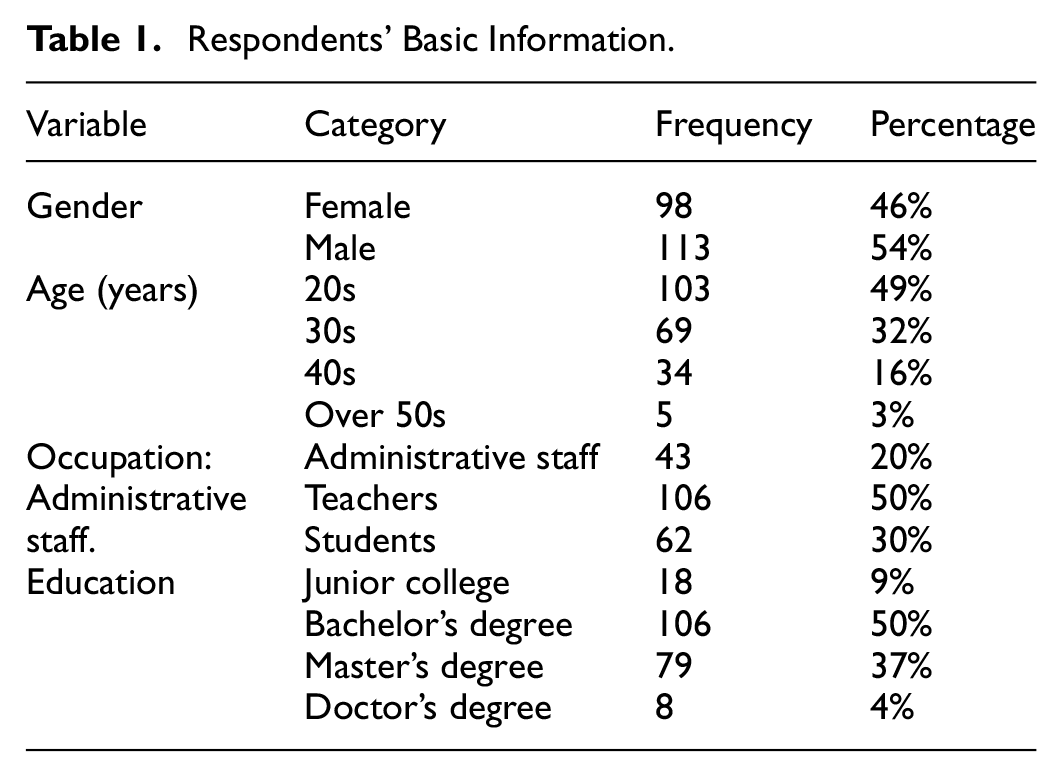
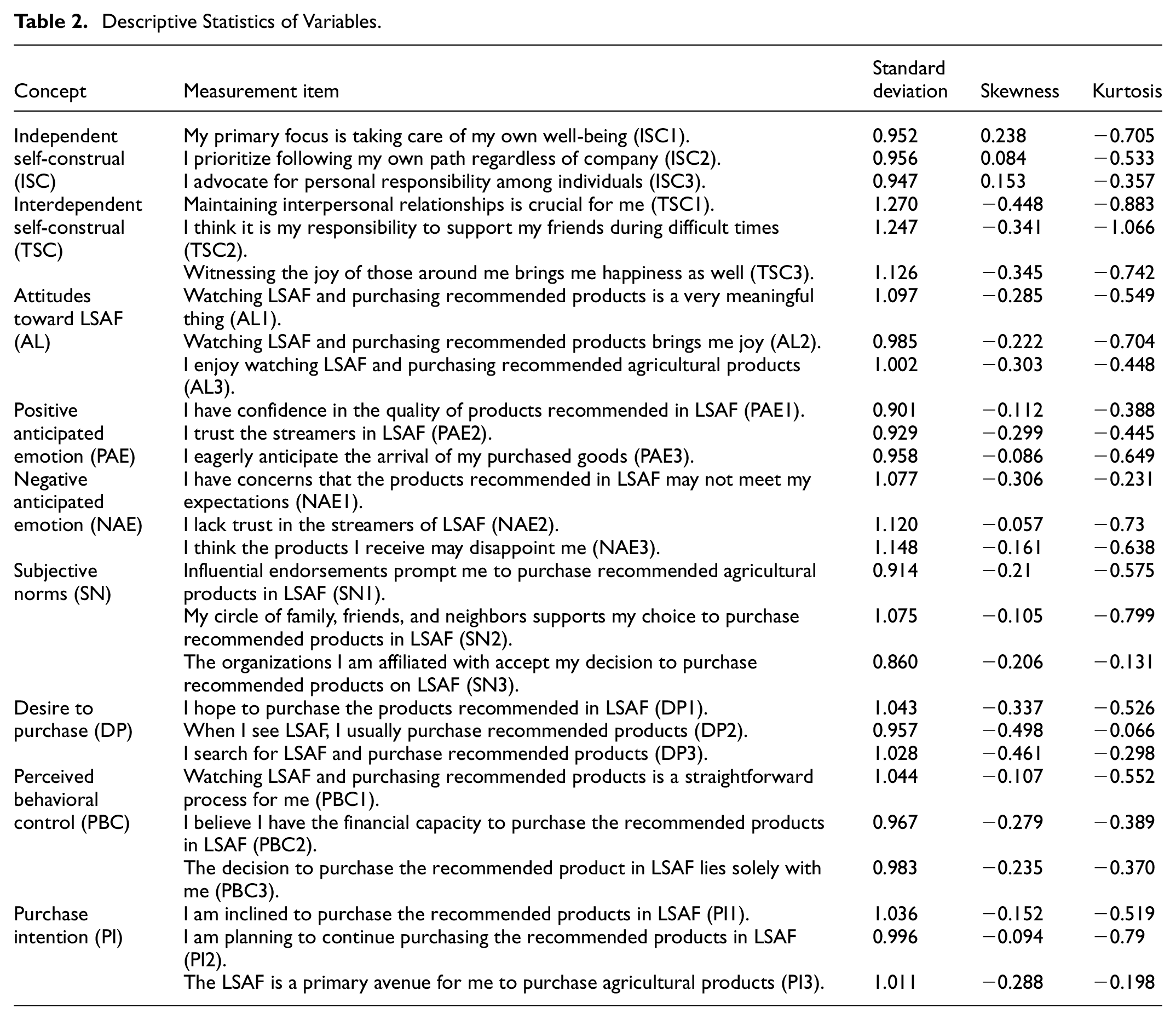
Table 2 presents descriptive statistics for the main variables, showing the standard deviation, skewness, and kurtosis of each measure. If a variable in the sample has a skewness of more than 3 and a kurtosis of more than 8, it may deviate from a normal distribution (C. K. Lee et al., 2012). In this study, the skewness of the variables is less than 3 and the kurtosis is less than 8, indicating that the sample data conforms to a normal distribution.
Descriptive Statistics of Variables.
Empirical Analysis Test
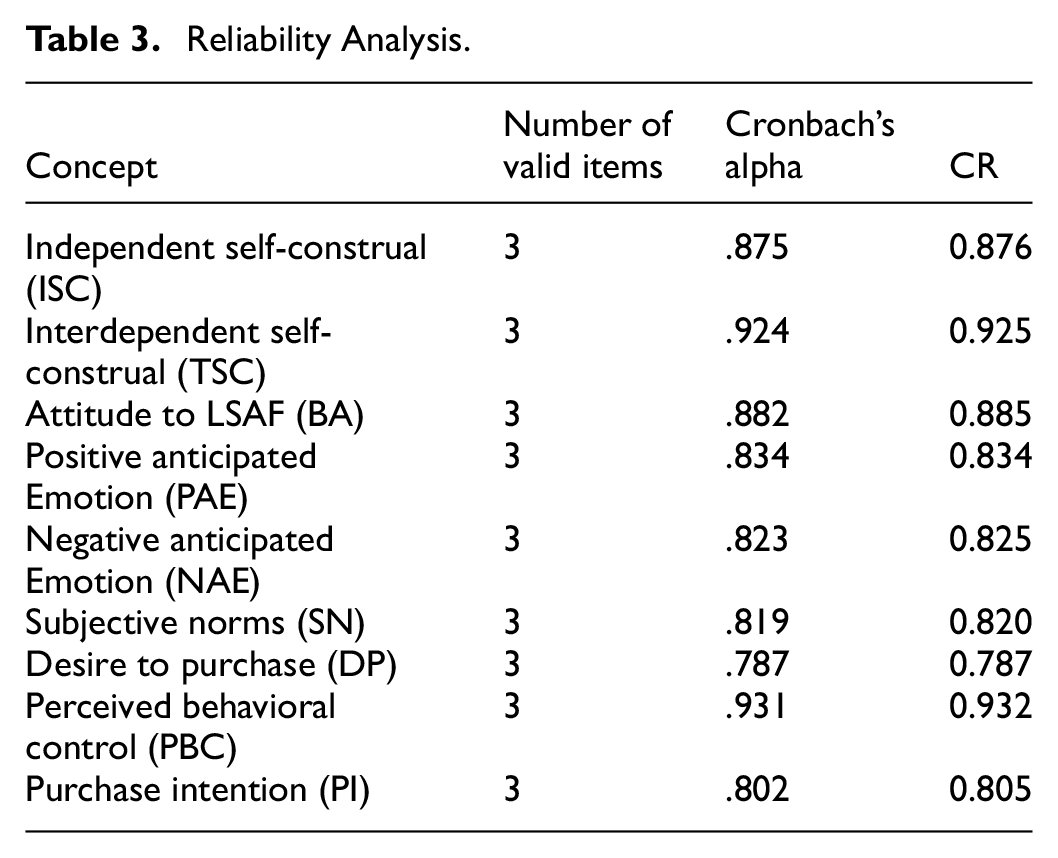
The assessment measurement model needs to be tested for reliability and validity. Reliability is mainly to detect the degree of internal consistency, primarily assessed by the Cronbach’s alpha coefficient and the combined reliability value (CR); a value between .70 and .90 for both is considered appropriate. Validity needs to be tested for convergent validity, which is mainly assessed by factor loading (Factor loading > 0.7) and average variance extracted (AVE > 0.5).
As shown in Table 3, except for the alpha coefficient of 0.924 and CR of 0.928 for interdependent self-construal and the alpha coefficient of 0.931 and CR of 0.932 for perceived behavioral control, the alpha coefficients and CRs of the rest of the measurement items were between 0.70 and 0.90, which indicated that the questionnaire had good reliability.
Reliability Analysis.
As shown in Table 4, the factor loadings of the nine types of measurement items were all higher than 0.7, while the average variance extraction was higher than 0.5, indicating that the various types of measurement items in the measurement model had convergent validity.
Aggregate Validity.

Correlation Analysis and Discriminant Validity Analysis
Discriminant validity is used to test whether there is a significant difference between a group of observed variables and another group of observed variables, and the general test is that the absolute value of the correlation coefficient must be less than the square root of the corresponding AVE, indicating that there is a difference between the latent variables, that is, the discriminant validity is high (Fornell & Larcker, 1981). As can be seen from Table 5, there is a significant correlation (p < .05) between the 9 latent variables. Furthermore, the absolute values of the correlation coefficients are all smaller than the square root of the corresponding AVEs, which means that there is a certain correlation between the latent variables and some differentiation between them, which indicates that the data of the scale Table 5 Discriminant validity.
Discriminant Validity Test of Latent Variables.

Note. ***p < .001. **p < .01.
Model Fit Test
In this study, AMOS 22.0 was used to test and analyze the structural equation model. Model fit is a prerequisite for model testing, and if the fit is not up to standard, the significance of the path coefficients is meaningless. Through the measurement, each fitting index exceeds or basically reaches the recommended value (Table 6), indicating that the model fits better.
Model Fit Test.

Model Path Analysis
The results of the path analysis are shown in Table 7 and Figure 2, and the significance analysis of the structural equation model is an important indicator to verify whether the hypothesis is valid or not.
Table of Path Values.


Graph of path analysis results.
Discussion
Research Conclusion
This study integrated the influence of self-construal on behavioral attitudes into the MGB, used this EMGB to verify the hypotheses. The study examined the path relationship between consumers’ independent self-construal, interdependent self-construal, attitude, subjective norms, positive anticipated emotion, negative anticipated emotion, perceived behavioral control, purchase desire, and purchase intention in LSAF. It also analyzed the intrinsic influence mechanism of consumers’ purchase intention in LSAF. This study mainly draws the following conclusions:
Consumers’ interdependent self-construal significantly and positively influences their attitudes toward LSAF (β = .269, p < .001), and the H1a hypothesis is valid. Individuals have both interdependent and independent self-construals, and the strength of the two self-construals can vary across different contexts. Research indicates that individuals with a stronger interdependent self-construal exhibit more pro-social behavioral traits. Consumers with a stronger interdependent self-construal will have a positive attitude toward LSAF whey they perceive that it can help farmers sell their slow-moving agricultural products, assist poor farmers overcome poverty, achieve common prosperity.
The negative effect of consumers’ independent self-construal on their attitudes toward LSAF is not significant (β = −.152, p = .11), and the H1b hypothesis does not hold. A plausible explanation is that although the ultimate purpose of LSAF is to help farmers sell backlogged and slow-moving agricultural products, many of the agricultural products sold also have the advantages of direct supply from the origin, besides being green and fresh. When consumers with a strong independent self-construal see such high-quality and inexpensive goods, they obviously will not have negative emotions toward LSAF and may even have positive purchase intentions.
The subjective norms of consumers have a significant positive impact on their purchase desire in LSAF (β = .31, p = .003), and the H2 hypothesis holds. In recent years, under the guidance of the Chinese government, the mainstream social media in China actively publicized the social benefits brought about by LSAF, playing a huge role in shaping social opinion, triggering consumer resonance, and stimulating their desire to assist farmers.
Consumers’ positive anticipated emotions have a significant positive impact on their purchase desire in LSAF (β = .316, p = .002), and the H3a hypothesis is established. Consumers’ negative anticipated emotions have a significant negative effect on their purchase desire (β = −.178, p = .003), and H3b hypothesis is valid.
In the LSAF, consumers may be skeptical about the real intentions of the streamer presenting the goods because they do not personally know the streamer. In addition, because they cannot personally touch and experience the goods, consumers may perceive that they cannot accurately judge the authenticity and usefulness of the information; the resulting perception of risk prompts consumers to pay more attention to the potential negative consequences of the purchase (A. Y. Lee & Aaker, 2004), thereby reducing purchase intentions (Petersen & Kumar, 2015). On the contrary, if the streamer has high social credibility, and the information disseminated is highly credible and useful, it will appeal more to consumers, and the resulting positive anticipated emotions will increase the consumers’ desire to purchase. Positive psychological and emotional expectations are the main factors that generate consumers’ purchase desire (Perugini & Bagozzi, 2001).
Consumers’ attitudes toward LSAF significantly and positively affects consumers’ purchase desire (β = .262, p < .001), and H4 hypothesis is valid; the more positive consumers’ attitudes toward LSAF, the stronger their purchase desire.
Consumers’ purchase desire in LSAF has a significant positive effect on their purchase intention (β = .412, p < .001), and H5 hypothesis holds; the stronger the consumers’ desire to purchase in LSAF, the stronger their purchase intention. Behavioral desire is a direct factor that affects behavioral intention. This is consistent with the conclusion of Bagozzi, Dholakia, and Basuroy (2003), who find that desire has an important influence on the formation of behavioral intention.
Consumers’ perceived behavioral control has a significant positive effect on their purchase intention (β = .243, p = .004), and hypothesis H6 is valid. This result supports the results of Song et al. (2014). Perceived behavioral control refers to the ease or difficulty of performing a behavior as perceived by an individual, reflecting the level of difficulty they anticipate when engaging in the behavior. Our survey shows that about 44% of consumers regard price as the main factor influencing their purchase intention, while 37% of consumers consider the long-distance transportation time and the preservation measures adopted during transportation.
Research Implications
This study reveals the influencing factors of consumers’ purchase intention in LSAF, aiding stakeholders in grasping the psychological decision-making processes of consumers and the factors affecting their purchase intentions. Consequently, this understanding enables the design and optimization of various parts of LSAF to enhance consumer conversion rates.
To maximize the effectiveness of LSAF, live streaming e-commerce companies need to consider how to design marketing messages that can successfully guide consumers to identify with LSAF and stimulate their final purchase intentions. We first analyze what consumers with different self-construals are interested in, and then provide recommendations based on relevant research pertaining to information framing theory in the field of marketing.
LSAF should emphasize the public welfare information that purchasing agricultural products can benefit others and society (e.g., helping farmers to sell slow-moving agricultural products, increasing farmers’ income, realizing rural poverty alleviation, and other pro-social attributes), stimulate consumers’ interdependent self-construal, and guide them to develop positive attitudes toward the public welfare claim. The LSAF should also highlight information that will bring returns to consumers, stimulate their independent self-construal, and satisfy their demand for “self-interest” when the agricultural products it promotes have regional characteristics or advantages such as being green, fresh, inexpensive, and of good quality.
Message frames refer to the way in which a message is presented, and in the field of marketing, the two message frames of “promotion/prevention” are often used. Promotional frames tend to emphasize the benefits of doing something, offering a positive portrayal of the message, whereas defensive frames present the message from the perspective of loss aversion, reflecting the costs associated with doing something (Levin et al., 1998). Representational frames motivate people to use different perspectives and viewpoints in decision making, known as the framing effect. Consumers with an independent self-construal have been found to be more oriented toward promotion orientations, whereas consumers with an interdependent self-construal are more oriented toward preventive orientations (A. Y. Lee et al., 2000). Therefore, it is more effective to “match” the message to different self-construals. For example, attributes such as quality, affordability, fresh sourcing, quality assurance, and other promotional information can be pitched to independent self-construal consumers. Conversely, information aimed at helping farmers avoid losses and mitigate agricultural product backlogs, such as destruction, and other defensive information can be directed toward interdependent self-construal consumers. This target communication enhances the precision of the message, thereby effectively enhancing the effect of marketing persuasion.
Furthermore, LSAF needs to fully mobilize the positive anticipated emotions of consumers while avoiding the generation of negative anticipated emotions. Zulfiqar and Ahmad (2019) showed that a good corporate reputation enhances consumers’ motivational perceptions and purchase intentions for corporate cause-related marketing initiatives. First, LSAF can invite streamers with high social visibility and credibility (e.g., famous program hosts, local officials across various levels) to participate in the program, thereby bolstering consumers’ trust in LSAF. Inviting local farmers to stream is another option. Farmers’ rustic style makes them more approachable when they enter the live broadcasting room, and their simple language can inspire trust in consumers. Second, the generation of positive anticipated emotions has a lot to do with the content richness of a live program. For example, some agricultural products with local characteristics carry local customs and rich cultural connotations, and it is necessary to identify hotspots in the live program by excavating the cultural connotations underlying the products and crafting compelling brand stories to stimulate consumers’ interest in the products. Incorporating professional introduction of planting, harvesting, and processing of agricultural products into LSAF will also give consumers a better sense of what life is like in the rural areas. Finally, the positive emotions of consumers are also related to their active participation in the program. Consumers ought to be treated as protagonists rather than passive audience of the program; they should be immersed in the live broadcast through role design to enhance their emotional involvement.
The subjective norms experienced by consumers significantly influence their purchase intentions. Research has found that public interest matters are critical to the success of cause-related marketing because this is what motivates consumers to participate. The greater the significance consumers attribute to public interest matters, the more attractive the outcomes (Howie et al., 2018). The government should promote collaboration between live e-commerce and emerging media, such as video portals, social media, and news entities. The media can penetrate into the grassroots rural areas to showcase the rural landscape, unique culture, ethnic crafts, special agricultural and sideline products, and other economic resources by means of graphic combinations, short videos, live broadcasts, and so on, to improve market visibility for rural agricultural products and create a characteristic label for the industrial economy of rural areas. The media can play a critical role in triggering consumer resonance, increasing their identification with the LSAF program, stimulating their purchase desire, as well as shaping public opinion.
Study Limitations and Future Research Directions
Future research can address the current study’s scope and material constraints. The following are some of the limitations of this study: (1) The respondents in this study comprised students and staff from three universities in Hefei city. Given that the sample is partially homogeneous, future research should investigate whether the research results are generalizable. To further validate the findings, it is imperative that future studies consider ordinary consumers as research subjects. (2) The three LSAF videos in this study featured ordinary, local agricultural products that were not well known and lacked characteristics. It is unclear whether differences in product brand and attributes have an effect on consumers’ purchase intentions. In the future, products with different attributes may be picked for analysis to determine their effect on consumers’ purchase intentions. (3) One of the most popular topics of discussion in the field of socio-cultural studies is the ways in which the differences in individuals’self-construals that exist between the Eastern and Western cultures influence perception formation. In the future, this topic may also be studied in Western countries to analyze the attitudes of consumers with different self-construals toward cause-related marketing campaigns and their purchase intentions across different cultural contexts.
Footnotes
Acknowledgements
We are very grateful to the people who participated in this investigation and supported us.

Ethic Statement
As a voluntary survey, there were no ethical issues associated with this survey.
Funding
The author disclosed receipt of the following financial support for the research, authorship, and/or publication of this article: The study is supported by Major Project of Scientific Research in Anhui Province’s Universities (Philosophy and Social Sciences; 2023AH040186).
Declaration of Conflicting Interests
The author declared no potential conflicts of interest with respect to the research, authorship, and/or publication of this article.
Data Availability Statement
The data that support the findings of this study are available from the corresponding author upon reasonable request.