




Abstract
This study confers certain psychological factors that may affect the learning process of the students such as self-construal, demotivation, and disengagement. Nevertheless, extensive work has been accomplished on the theme of individuals’ motivation and engagement within numerous domains across the world. How self-construal (SC), demotivation (DM), and disengagement (DE) may affect students’ learning process (SLP) got far less reflection by the investigators. Therefore, this study attempts to validate the relationships between self-construal and students’ English learning process with the moderation of two factors, that is, demotivation and disengagement based on a theory of reasoned action. Data were carefully accumulated between September 2022 and November 2022 by targeting 783 students who were trying to learn English within the Chinese market. We currently applied structural modeling to confirm the proposed connections along with the validation process using the SmartPls tool. It is found that SC has a positive connection with SLP. Second, the results proved the insignificant role of both moderating variables such as DM and DE between the relationships of SC and SLP, respectively. This study provides insights into new understandings about motivations along with riveting findings for those individuals or students who were disconnected or demotivated to learn English. Moreover, the study equips numerous fascinating applications for English learners along with future potentials for researchers showing current deficiencies of the work.
Plain Language Summary
This study confers certain psychological factors that may affect the learning process of the students such as self-construal, demotivation, and disengagement. This study attempts to validate the relationships between self-construal and students’ English learning process with the moderation of two factors, that is, demotivation and disengagement based on a theory of reasoned action. Data were carefully accumulated between September 2022 and November 2022 by targeting 783 students who were trying to learn English within the Chinese market. We currently applied structural modeling to confirm the proposed connections along with the validation process using the SmartPls tool. It is found that SC has a positive connection with SLP. Second, the results proved the insignificant role of both moderating variables such as DM and DE between the relationships of SC and SLP, respectively. This study provides insights into new understandings about motivations along with riveting findings for those individuals or students who were disconnected or demotivated to learn English. Moreover, the study equips numerous fascinating applications for English learners along with future potentials for researchers showing current deficiencies of the work.
Keywords
Introduction
This research mainly discusses the phenomena of self-construal, demotivation, and disengagement of students’ learning which is becoming a major concern of academicians, scholars, and practitioners, especially within non-native and developing nations (Cocea & Weibelzahl, 2010; Cross et al., 2011; Gorham & Millette, 1997; Lund Dean & Jolly, 2012; Vidak & Sindik, 2018). English learning is a key consideration for non-natives such as Chinese individuals who are massively endeavoring to learn English to be globalized for distinct reasons, including business, study, and communications purposes (Okyar, 2023; Vidak & Sindik, 2018). In the Chinese market, the trend of learning English is continuously emerging consequently English is increasingly perceived as a gateway to global opportunities, including international business and education. With a strong emphasis on language proficiency. A growing number of Chinese citizens are actively pursuing English language skills for better communication. However, certain factors hurdle learning English such as demotivation and disengagement with the learning process. What is the role of English learning and how to fix these hurdles is a major concern of this paper by spotlighting empirical outcomes. There are several factors or barriers that impact the English learning process such as teacher unavailability and lack of confidence (Gutiérrez & Orellana, 2006). Self-construal (SC) is defined as the capacity of individuals to express themselves as independent from other individuals and interdependent with the rest of the individuals (Cross et al., 2011). Indeed, it states the internal conditions of the individual that encourage them to perform any task (Colzato et al., 2012; Cross et al., 2000). There are two major parts of interdependent SC such as collective and relational whereby the relational component of SC discusses the close relationships of one’s self-defining (Carducci et al., 2020). However, a collective component of SC includes relationships of one’s defining by comparing to distinct groups (Carducci et al., 2020). Demotivation is the opposite of motivation which is defined as the individuals’ lack of spirit or interest in any learning or participation in different activities or tasks (Vidak & Sindik, 2018). There are several factors that cause individual demotivation if we specifically talk about learning processes such as English learning. The studies showed several reasons for individuals’ demotivation to learn a new language such as English (Draissi & Rong, 2023; Gorham & Millette, 1997; Vidak & Sindik, 2018). Disengagement is a sensitive stage of an individual thinking process in which a person slows disconnection or separation to be involved in different activities (Cocea & Weibelzahl, 2010; Lund Dean & Jolly, 2012). Likewise, disengagement in the learning process, that is, English learning shows the disconnection of the learner to being part of the learning process for several reasons (Bergdahl, 2022). For instance, most of the students are disengaged from learning English because of the Covid situation (Branchu & Flaureau, 2022). Other studies show certain factors that cause DE of the learners such as environmental conditions and uncertain circumstances (Cocea & Weibelzahl, 2010).
In the past, several researchers and professionals attempted to investigate the nexus of self-construal, demotivation, disengagement, and students’ learning process across the globe with consideration of different perspectives and themes. These variables were individually treated in many studies where scholars showed insights into each dimension with in-depth analysis. For instance, self-construal was discussed by worldly researchers to show a deep understanding of the phenomena from different lenses such as decision-making, feelings, ethnicity, reliance, and self-concept (Hong & Chang, 2015; Pusaksrikit & Kang, 2016; Sabah, 2017). Although the motivation factor was highly reported in the literature whereby a few studies discuss demotivation, especially learning the English language for non-natives (Çankaya, 2018; Falout et al., 2009; Gorham & Millette, 1997). There are diverse reasons have been stated by experts in learning a foreign language (Çankaya, 2018). Similarly, the learning process is a critical phase where an individual attempts to get new insights, knowledge, understand, values, skills, preferences, attitudes, and basic information about any task such as learning English (Mahu, 2012; Säljö, 1979). In addition, several researchers claimed that learning English is important for the individual in the present era (Mahu, 2012). A study shows the great significance of English learning for better communication (Hakuta, 1976). Therefore, this study aims to contribute to the literature by showing the new findings about SC, DE, and DM for students’ learning process.
It is worth mentioning to uncover the nexus among self-construal, demotivation (DM), disengagement (DE), and students’ learning process (SLP) that got a fewer attention from the researchers, especially within the Chinese market. This study aims to furnish empirical evidence from Chinese perspectives taking into consideration SC, DM, and DE. This study attempts to show additional evidence from a developing nation since most of the studies considered developed nations such as France and Germany (Athanasopoulos et al., 2015; Kusyk, 2019). China is the world’s top country in terms of population (T. Liu et al., 2022); consequently, showing insights into such a huge nation would be a significant contribution to this research. Moreover, most Chinese nowadays attempt to learn English therefore this study may support their learning process and help to overcome the threat of demotivation and disengagement (Jiao & Liang, 2022; W. Li, 2022; Vidak & Sindik, 2018). Furthermore, experts advocated that the trend of English learning is rapidly emerging in the Chinese market (W. Li, 2022). Therefore, the findings of this study must be useful for English learners within the Chinese market and the rest of the non-native countries. To this end, we attempt to meet certain goals as follows.
First, this study attempts to investigate the relationships between self-construal and students’ learning process. Second, this study tries to examine the relationships between the level of demotivation and students’ learning process. Third, this study struggles to analyze the mediating role of disengagement between self-construal and students’ learning processes. The final intention is to assess the mediating influence of disengagement between demotivation and students’ learning process, respectively. The study is outlined in different sections such as follows. The section on theory and literature review has been addressed after the section of the introduction. Subsequently, the section of the entire methods for this study is reported. The results and findings are laid down after the section on methodologies. The final sections include discussion, applications, and concluding lines.
Literature Review and Hypotheses
Literature witnessed numerous theories such as the theory of reasoned action that encourage and strengthen the decision of the researchers to develop a research model for any investigation (Hale et al., 2002). It is direly important to pick a theory that closely supports the study and proposed relationships (Bos et al., 2013; Ulrich, 1999). The theory of reasoned action (Trang & Baldauf, 2007) mainly focuses on explaining the connection or relationships of individuals concerning behavior, attitude, or belief (Fishbein, 1979). This theory helps to predict insights into humans how they behave in different situations (Fishbein, 1979; Madden et al., 1992). The theory of reasoned action is based on past studies derived from social psychology, attitude theories, and theories of motivation of persuasion (Bos et al., 2013; Hale et al., 2002). It is also worth mentioning that most of the behavior-related studies employed the theory of reasoned actions to support their work from various domains and perspectives, worldwide (Ajzen et al., 2007; Chen & Chen, 2006; Karnowski et al., 2018; Lau et al., 2023; Xiao, 2020). Subjective norms are an essential component of the TRA that refers to an individual’s perception of social pressure and influence from others concerning a specific behavior (Park, 2000). It encompasses the beliefs about whether important people or groups approve or disapprove of the behavior, and the motivation to comply with these perceived norms (McKinlay et al., 2001). Our study also discusses similar phenomena related to motivation, demotivation, engagement, and the learning process of an individual which is majorly supported by the theory of reasoned action (TRA).
Chinese schools and colleges play a crucial role in the English language learning of the young generation (Tanaka, 2023; Yu, 2023). They offer structured curricula and resources for students to develop proficiency in English eventually increasing their important role in the globalized world (Zhang, 2007). Such institutions provide language courses, English literature studies, and access to certified teachers which enhance students’ skills with respect to English communications. Moreover, English learning in Chinese schools and colleges promotes cultural exchange and fosters international opportunities, as fluency in English opens doors for students for higher education as well as global job markets. This emphasis on English education aligns with China’s aim to be modest on the global stage and impacts both personal and professional growth.
The relationships of the current study are supported by TRA therefore we are proposing to explore the relationships among self-construal, demotivation, disengagement, and students’ learning process from the domain of China drawing from a theory of reasoned actions. There are many studies that attempted to provide insights into self-construal (Hong & Chang, 2015; Kho et al., 2023; Pusaksrikit & Kang, 2016; Sabah, 2017), demotivation (Çankaya, 2018; Falout et al., 2009; Gorham & Millette, 1997), disengagement (Bergdahl, 2022; Branchu & Flaureau, 2022; Lund Dean & Jolly, 2012; Tillman et al., 2018), and students’ learning process (Çankaya, 2018; Fry et al., 2008; Hattie, 1999; Laurillard, 1979) independently as well as other than Chinese perspective and with consideration of English learning process. Self-construal contributes a vital role in the SLP by influencing how individuals perceive and engage with educational experiences (Yan et al., 2023). It is additionally stated that independent self-construal may lead to autonomy and self-directed learning whereas interdependent self-construal can foster collaborative and group-oriented approaches (Picavet et al., 2023; Tanaka & Ross, 2023). Recognizing and accommodating diverse self-construals is crucial for educators as it promotes inclusive and effective teaching strategies that cater to students’ distinct cultural and personal backgrounds (Rochanavibhata & Marian, 2023; Yan et al., 2023). Recently, we propositioned certain linkages to empirically validate the connection among self-construal (SC), demotivation (DM), disengagement (DE), and students’ learning process (SLP), as shown in Figure 1 and subsequently hypothesized.

Research framework.
Self-Construal (SC), Disengagement (DE), and Students’ Learning Process (SLP)
Self-construal (SC) is a prime driver that relates to the capacity of individuals to express themselves as independent from other persons and interdependent with the rest of the individuals (Cross et al., 2011; Yan et al., 2023). Indeed, it states the internal conditions of the individual that motivate them to perform any task (Colzato et al., 2012; Cross et al., 2000). Self-construal has a significant influence on the learning process whereby experts advocated that self-construal inertly supports an individual behavior to learn new things (Colzato et al., 2012; Cross et al., 2000, 2011; Galang et al., 2021; L. M. W. Li et al., 2021). Disengagement (DE) is another state of an individual’s feelings which is observed as a sensitive stage where a person prefers to be disconnected to be involved in activities (Cocea & Weibelzahl, 2010; Lund Dean & Jolly, 2012). Disengagement in the learning process, that is, English learning shows the disconnection of the learner being part of the learning process (Bergdahl, 2022). For instance, students’ DE to learning has been reduced because of the COVID situation (Branchu & Flaureau, 2022). Although some scholars and professionals attempted to unfold the connection of these factors in various directions over the past decades (Çankaya, 2018; Cocea & Weibelzahl, 2010; Cross et al., 2000, 2011; Kusyk, 2019; Laurillard, 1979). However, how self-construal influences SLP is a key consideration of this study along with the mediating impact of DE that was ignored in the past. Hence, we currently propositioned the following hypothesis based on the high importance of self-construal with respect to the student learning process to confirm the direct and indirect relationships among SC, DE, and SLP.
H1: SC is positively associated with students’ learning process (SLP).
Demotivation (DM) and Disengagement (DE) as Moderation
DM is perceived as an individual’s lack of interest in any learning activities or tasks (Vidak & Sindik, 2018). Many aspects trigger individual demotivation such as lack of interest, lack of teacher availability, and rest environmental concerns (Aydin, 2012; Kızıltepe, 2008; Trang & Baldauf, 2007). The studies confirmed several reasons for one’s demotivation to learn a new language such as English (Gorham & Millette, 1997; Vidak & Sindik, 2018). It found that demotivation has a positive connection with the disengagement of the learners (Cocea & Weibelzahl, 2010; Gorham & Christophel, 1992; Vidak & Sindik, 2018). A study advocated the linkage between demotivation and disengagement that eventually affect the learning process of the individuals among Vietnam students (Trang & Baldauf, 2007). A study concluded demotivation showing distinct factors that cause demotivation (Aydin, 2012; X. Li, 2023). Disengagement in terms of the learning process shows the disconnection of the learner to be part of the learning process anymore where the major reason is demotivation to learn (Bergdahl, 2022; Cocea & Weibelzahl, 2010). It indicates that the learning process is being affected by the demotivation of students or individuals, especially English learning across the globe (Cocea & Weibelzahl, 2010; S. Wang & Littlewood, 2021). Similarly, psychological studies have found that if there is disengagement or demotivation then students may not learn effectively. Studies ignored the nexus of both factors as moderation. Both factors have a significant connection to the student learning process therefore it is notable to uncover the nexus of both factors in terms of English learning of the students within the Chinese market for additional evidence and validation. Therefore, we presently propositioned the following hypothesis based on a discussion about demotivation and disengagement concerning the student learning process to confirm the moderating relationships between SC and the student learning process.
H2: DM moderates the association between SC and the student learning process.
H3: DE moderates the association between SC and the student learning process.
Methodologies
In the present study, a method of quantitative research was utilized to estimate the connections among focused variables such as self-construal (SC), demotivation (DM), disengagement (DE), and students’ learning process (SLP) whereby DE was adopted as mediating determinant among SC, DM, and SLP. The audience for the study was carefully targeted to get feedback on a proposed study by approaching students within the Chinese market using a convenience sampling approach. Convenience sampling is an effective tool to collect data whereby students’ sample also has several benefits for the researchers, as reported by the experts (Waheed & Jianhua, 2018). Convenience sampling supports the collection of data in an easier way (Etikan et al., 2016). For instance, the student sample provides a clear and generalizable outcome since students come from different geographical regions of the country which shows a comprehensive representation (Waheed & Jianhua, 2018). Seven-point Likert scale along with ordinal and nominal scales was used. The Likert scale ranged from strongly disagree to strongly agree and was coded from 1 to 7. In addition, data were obtained with consideration of mainstream cities of China which include Shanghai, Beijing, and Shenzhen. In addition, data were gathered by approaching distinct regions of China since scholars advocated that considering samples from unlike regions supports wider generalizability of the data (Dunnell & Dancey, 1983). For ethical compliance, we primarily requested each respondent for their consent and willingness to spare time for our survey. Subsequently, we provided them with documents for their response and extended them small rewards in the form of ball-pen or small diaries for their motivation.
Furthermore, data were collected based on convenience sampling (Penn et al., 2023), where a total of 1,000 English learners were targeted to circulate the questionnaire by utilizing both methods such as the online method and the traditional method. In the online method, the link was shared using email and WeChat with the respondents while the personal meeting was carried out in traditional methods for their response to our study. WeChat is one of the major applications within the Chinese market that could be used for academic purposes since many experts obtained help from such applications for the aim of data collection (Gan, 2018; D. Liu et al., 2019). Indeed, 855 documents were received from the respondents. Finally, 783 (n = 783) were ultimately consumed after using more robust criteria of survey selection having an improper filling and missing information by the respondents. The questionnaire was divided into two sections such as basic information about the participants’ profile and statements for the major variables, that is, self-construal, demotivation, disengagement, and students’ learning process (SLP). Self-construal along with demotivation is treated as the independent factors, disengagement as a mediating, and the student learning process treated as a dependent factor. The items of each scale were assessed from previous studies as addressed below.
Measurement of Scales
First, self-construal was treated as the independent variable that was assessed from the study of Hardin et al. (2004) and Unal and Yanpar Yelken (2016). Self-construal is based on a 30-item scale (Hardin et al., 2004). Second, demotivation is based on a 10-item scale and is currently treated as a moderating factor (Unal & Yanpar Yelken, 2016). Third, disengagement was also handled as the moderating variable that was assessed from the study of Pham et al. (2022) and based on a 6-item scale. Third, students’ learning process was treated as the dependent variable that was assessed from the study of Tuan et al. (2005) and based on an 8-item scale. Two factors such as gender and age were also considered as control factors. Furthermore, the collected data were initially validated using the suggested techniques of the researchers known as pilot study to ensure the authenticity of the data (In, 2017). The present outcomes for each latent variable are normal as per suggested criteria of the statisticians (>0.7) (Brown, 2002) such as such as SC at 0.785, DM at 0.814, DE at 0.789, and SLP at 0.845, respectively.
Sample Description
Table 1 shows the description of participants’ age, education, gender, income level, and marital status. There are 56% male participants out of 783 documents whereas 44% are female participants. The description of each characteristic both ratio and percentages are shown below.
Descriptive Statistics.

Note. *Any other professional certificate. **Chinese currency.
Data Analysis Techniques
There are certain instruments and procedures were deemed to compute the propositioned relationships among self-construal (SC), demotivation (DM), disengagement (DE), and students’ learning process (SLP). First, descriptive calculations were carried out to calculate the information about age, gender, qualification, marital status, and income of the respondents (see Table 1). Second, convergent validity (i.e., loadings and AVEs) along with reliability (composite reliability) was employed to ensure the data validity (see Table 2). According to statisticians, the outcomes to be considered within the acceptable range must be upper than 0.5 for loadings and AVEs, while must be upper than 0.7 for composite reliability (Hair et al., 2012; Hu & Bentler, 1999). Third, correlation analysis (Pearson) was employed to acquire the interrelations among proposed variables (see Table 3). Fourth, discriminant validity using two methods such as HTMT (see Table 4) and Fornell and Larcker was calculated (see Table 5) (Alarcón et al., 2015; Fornell & Larcker, 1981). Finally, SEM (structural equation modeling) was majorly used for path directions both direct and indirect (see Table 6). SEM outcomes were evaluated based on beta values and model validity was assured using NFI and SRMR. According to Hu and Bentler (1999), the acceptable values for NFI must be upper than 0.9, while SRMS must lower than 0.08. Hence, values are appropriate as per focused criteria (see Table 6). Besides, there are many relevant studies in which researchers used similar methods for data analysis such as convergent validity (Nazempour et al., 2020; Waheed & Zhang, 2020), HTMT (Ashfaq et al., 2021), discriminant validity (Ashfaq et al., 2021), and SEM (Tarhini et al., 2017; Tseng & Schmitt, 2008).
Construct Descriptions.
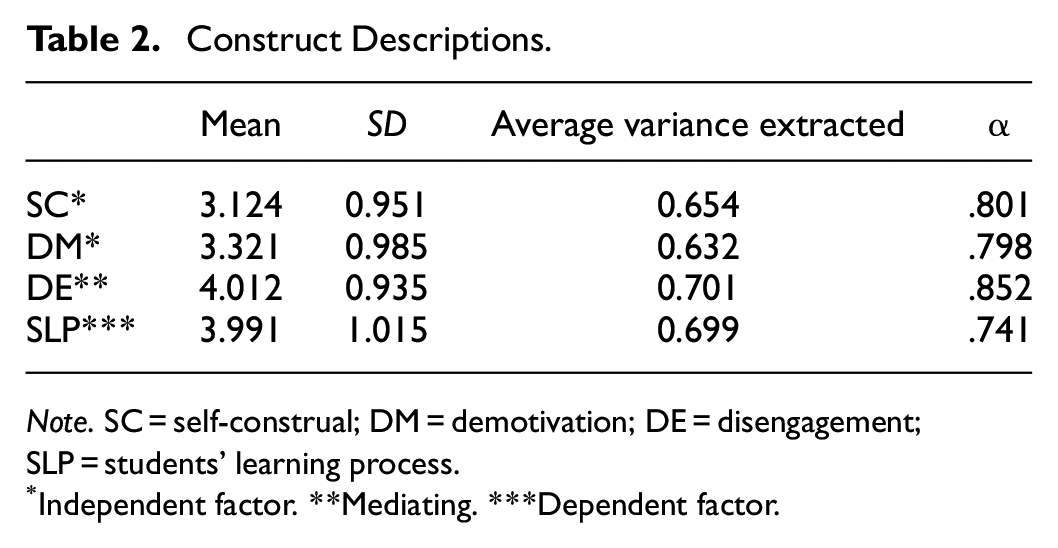
Note. SC = self-construal; DM = demotivation; DE = disengagement; SLP = students’ learning process.
Independent factor. **Mediating. ***Dependent factor.
Fornell and Larcker Validation Process.

Note. Bold values are donated as √AVEs; subsequent values are interrelationships. SC = self-construal; DM = demotivation; DE = disengagement; SLP = students’ learning process.
Independent factor; **Mediating; ***Dependent factor.
Heterotrait-Monotrait Validation.
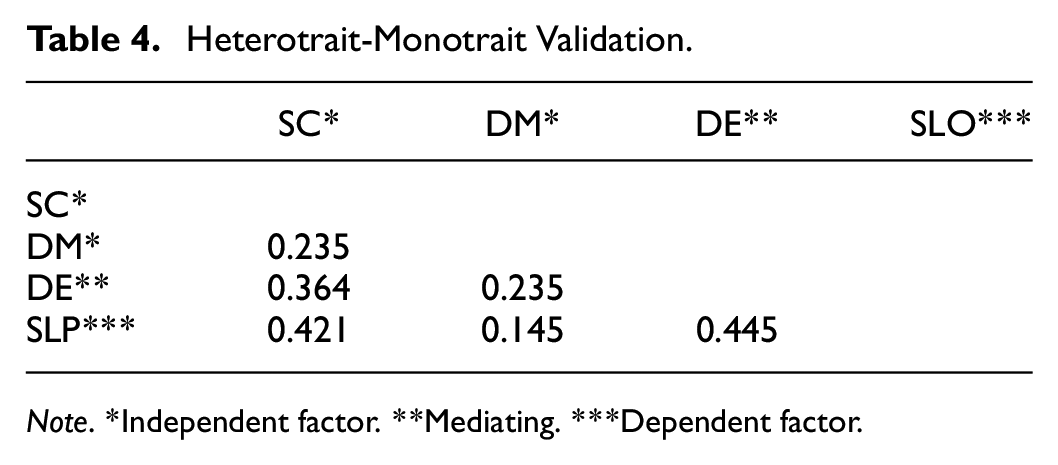
Note. *Independent factor. **Mediating. ***Dependent factor.
Correlation Model.
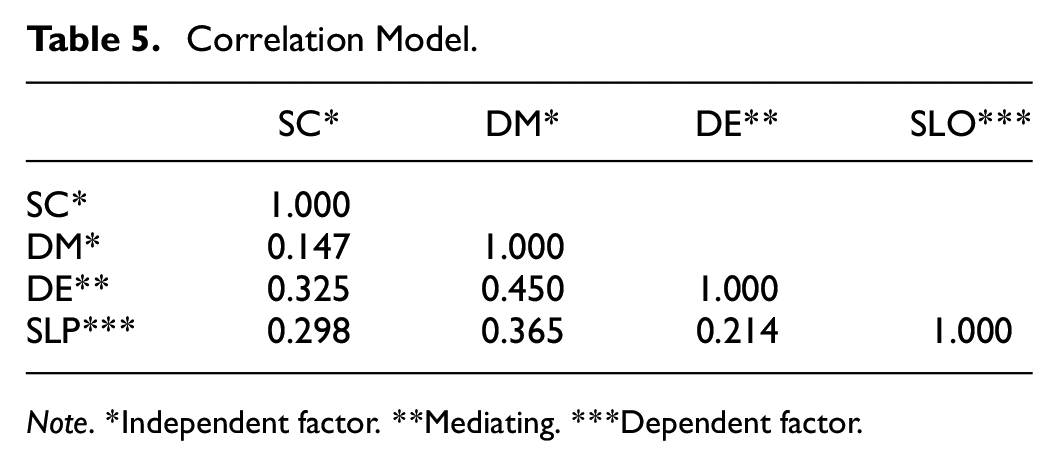
Note. *Independent factor. **Mediating. ***Dependent factor.
Convergent Validity and Reliability.

Note. All the items that were found to be lower or equal than 0.5 for “loadings and AVEs” as well as lower or equal than for “reliability” were removed as per advised criteria. SC = self-construal; DM = demotivation; DE = disengagement; SLP = students’ learning process; SD = standard deviation; AVE=average extracted variance.
Data Analysis
Construct Description
Table 2 indicates the general output description for self-construal (SC), demotivation (DM), disengagement (DE), and students’ learning process (SLP) based on standard deviation, average variance extracted, mean, and alpha values, respectively. The outcomes to be considered within the acceptable range must be upper than 0.5 for loadings and AVEs and must be upper than 0.7 for reliability (Hair et al., 2012; Hu & Bentler, 1999).
Discriminant Validity
The validity of the variables such as SC, DM, DE, and SLP was assessed through two major methods, that is, HTMT and Fornell and Larcker method of validation (Alarcón et al., 2015; Fornell & Larcker, 1981). These methods supported observing the correlation along with the intensity of association among the proposed factors of the study (Colliver et al., 2012). First, Table 3 shows the results of Fornell and Larcker method of discriminant validity. It is reported that the √AVEs values must be compared with the interrelations of the variables to accept or reject the existence of scale validation (Alarcón et al., 2015; Colliver et al., 2012; Fornell & Larcker, 1981; Hu & Bentler, 1999).
Second, the HTMT process of validation was carried out to understand the scale validation by determining the similarities. HTMT technique is considered a novel and authentic way of validation (Alarcón et al., 2015; Henseler et al., 2015). In the past, many scholars have focused on HTMT as well as Fornell and Larcker technique, therefore, this study equipped similar methods.
Model of Correlation for Interrelationships (Pearson)
The model of Pearson’s correlation was another major tool to assess the interrelationships of the variables (Taylor, 1990). Table 5 reports the results as presently determined among self-construal, demotivation, disengagement, and students’ learning process. The higher positive outcomes show a greater connection between two variables; whereas, lower positive or negative directional outcomes indicate a lower or negative connection between two variables (Hair et al., 2012; Taylor, 1990). The results are shown in below Table 5.
Convergent Validity and Reliability
Table 6 represents the results for convergent validity considering two methods such as factor loadings and average variance extracted (AVEs). However, reliability was assessed by calculating composite reliability. The criteria of evaluation for AVEs, loadings, and reliability are advised by the researchers in their studies (Hair et al., 2012; Hu & Bentler, 1999). According to researchers, the outcomes to be considered within the acceptable range must be upper or equal to 0.5 for loadings and AVEs, while must be upper or equal to 0.7 for composite reliability (Hair et al., 2012; Hu & Bentler, 1999). Notably, all the items that were found to be lower or equal to 0.5 for loadings and AVEs as well as lower or equal than for reliability were removed as per advised criteria. By doing so, we kept only accurate and standardized values to ensure the authenticity of the variables, that is, self-construal, demotivation, disengagement, and students’ learning process, as follows.
Structural Model for Path Directions (SEM)
The structural model was run using Smart partial least square for hypotheses testing and for calculating the propositioned relationships among self-construal (SC), demotivation (DM), disengagement (DE), and students’ learning process (SLP). SEM is the most effective method to observe the directional relationships among proposed factors both direct and indirect (Thompson, 1997). It is essential to report that many studies should be considered to ensure the validity or authenticity of applied SEM before evaluating the outcomes for further discussion. Among those criteria, NFI and SRMR are basic indices that can ensure such validation for structural models (Hair et al., 2012; Hu & Bentler, 1999). The values of NFI should be upper or equal to 0.9, while SRMR should be lower or equal to 0.08 (Hu & Bentler, 1999). Besides, the present values for both indices are normal as per suggestions whereby SRMR = 0.0214 and NFI = 0.921, respectively. We were inspired to focus on these methods because many experts utilized similar tactics to calculate and evaluate the results (Ashfaq et al., 2021; Farrukh et al., 2021; George & Elrashid, 2023; Juharyanto et al., 2023; Zafar et al., 2021). The remainder outcomes are shown in the following Table 7 showing direct and indirect path connections.
Hypotheses and Decision.

Note. ***Significant: .05. SC = self-construal; DM = demotivation; DE = disengagement; SLP = students’ learning process.
Discussion and Implications
It is advocated that self-construal (SC) in the context of the SLP is vital for several reasons such as follows. First, it acknowledges the significant impact of cultural and individual factors on how students deal with education. A range of SCs such as independent and interdependent can shape students’ motivation, communication styles, and problem-solving strategies. Understanding these variations allows educators to design tailored teaching methods by ensuring that students from diverse backgrounds are effectively motivated and engaged. Second, SCs’ awareness fosters a more inclusive and respectful learning environment where students’ unique identities are validated. It encourages empathy and cooperation by fostering social and emotional development. By considering SC, we can enhance the effectiveness of educational practices and empower students to thrive in their academic pursuits while respecting their cultural values and individuality.
Notably, three hypotheses were majorly anticipated based on self-construal (SC), demotivation (DM), disengagement (DE), and students’ learning process (SLP) whereas a summary of each hypothesis is shown in Table 7 and Figure 2 below. In H1, a relationship between self-construal (SC) and students’ learning process (SLP) was propositioned and evaluated using a partial least square. The outcomes are toward expectation as evaluated based on beta values for the direct path. Therefore, H1 is supported because of a positive connection between SC → SLP at (β = .285; sig = .000; SE = 0.0240). In H2, a moderating relationship of demotivation (DM) between SC and SLP was propositioned and evaluated using a partial least square. The outcomes seem toward the expected directions as evaluated based on beta values for the interaction path. Therefore, H2 is supported because of a significant connection of DM between SC → SLP at (β = .109; sig = .000; SE = 0.0112). In H3, a moderating relationship of disengagement (DE) between SC and SLP was propositioned and evaluated using a partial least square. The outcomes are toward the expected direction as evaluated based on beta values for the interaction path. Therefore, H3 is supported because of a significant connection of DE between SC → SLP at (β = .158; sig = .000; SE = 0.0231).
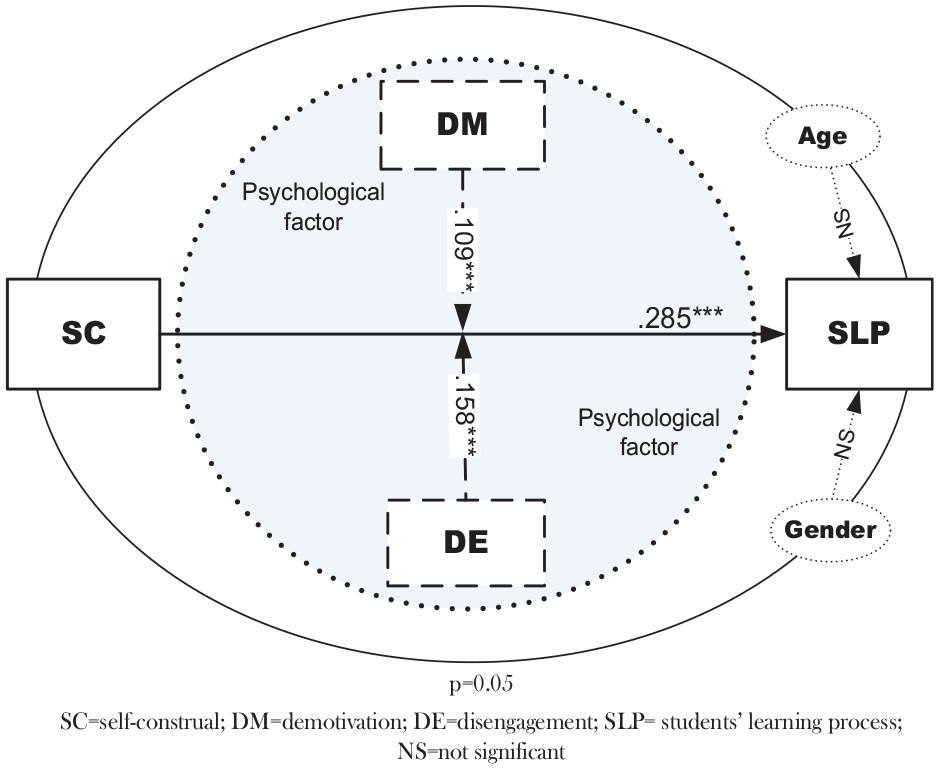
Path directions with beta values.
The present findings in terms of self-construal support the related notion that researchers ensured positive linkages with the learning process from various dimensions and perspectives across the world (Cross et al., 2000, 2011; Fry et al., 2008; Gorham & Christophel, 1992; Hattie, 1999; Lund Dean & Jolly, 2012; Ma & Li, 2023; Mahu, 2012). Similarly, several studies support and validate our findings showing consistency with our results in terms of demotivation, disengagement, and learning process of the students from various dimensions and perspectives across the world (Çankaya, 2018; Cocea & Weibelzahl, 2010; Kızıltepe, 2008; Lund Dean & Jolly, 2012; Unal & Yanpar Yelken, 2016; Vidak & Sindik, 2018; J. Wang & Pan, 2022; S. Wang & Littlewood, 2021). Hence, the learning process is critical for an individual in which different factors may affect one’s learning to understand a non-native language such as English as presently revealed.
Implications
Since the study predominantly reports the concerns of self-construal, student demotivation, and disengagement in the learning process of the students. It is a growing concern for educators, scholars, and practitioners, specifically in non-native and developing countries such as China. English language acquisition is of paramount importance to non-native individuals who are putting substantial efforts into learning English to globalize themselves for various purposes such as business, education, and effective communication. Therefore, learning about an individual can provide a sense of accomplishment that eventually boosts the level of confidence in one’s capabilities. The learning process always empowers a person to grasp new and innovative opportunities to win in different spheres of life. English learning is another key focus point for the Chinese youth to be well-globalized for various reasons such as business, study, and other communications. The trend to learn English is massively rushing in China since a study reported that approximately 400 million people are learning English within China mainland which indicates a substantial development (BritichCouncil, 2020; J. Liu, 2012). This tendency of English learning also contributes to economic growth since a study has shown over $2 billion contribution is made through English learning platforms (BritichCouncil, 2020). It is observed that certain forces influence the learners since a few have been investigated in the present study. This study endows with insightful information by showing the impact of certain factors of the English learning process such as self-construal, demotivation, and disengagement. It is exceptionally crucial to discover the reasons why students become demotivated and show disengagement in learning English (Mohammdi, 2012). This study contributes to the existing literature on self-construal (SC), demotivation, disengagement, and students’ learning process by showing empirical nexus from the domain of China which is a leading inhabited land of the world. It confirmed that the student learning process has valid connections with self-construal whereby demotivation and disengagement lead to a negatively corrected student learning process. For instance, if a student has a state of demotivation to learn something then certainly the student may not be able to learn the English language as validated by the current study. Similarly, disengagement toward learning additionally leads a negative pressure on the English learning process.
Besides, this study encourages Chinese learners to stay connected with the learning process by improving their level of motivation. By doing so, their learning process must be enhanced with time. Several studies intensify the similar notion that students should concentrate on learning by ignoring the negative considerations that may psychologically affect their learning processes such as demotivation and disengagement. A negative feeling often demotivates the individual to act upon any new thing or to take a risk (Hanine & Steils, 2019; Yu, 2023). Therefore, it is advised for students’ bodies to not be discouraged or feel the anxiety to learn new things such as English. Apart from these implications and suggestions, the study offers lines for certain drawbacks along with future directions for academic researchers and intellectuals to validate the outcomes within the Chinese region as well as with consideration of other regions of the world.
Conclusion
It is summarized that “learning” provides a sense of accomplishment which improves the confidence level of an individual. English learning is a major focus point for the Chinese youth to be globalized for distinct reasons such as business, study, and other communications. It is concluded that self-construal is a vital factor in improving the learning process of individuals, including English-learning of Chinese students. This research affirmed the insignificant connection of demotivation to the learning process which shows that demotivation among students is a major hurdle while learning English therefore it is needed to motivate the students by reducing the level of demotivation. Likewise, an insignificant connection of disengagement was observed between self-construal and student learning processes. It is concluded that the English learning process among students might be improved by emphasizing self-motivation and by minimizing the level of demotivation and disagreements. In addition, demotivation and disengagement pose significant obstacles to student English learning process. These negative factors can impede students’ progress which eventually hinders their willingness to learn and ultimately hinders their language development. Therefore, fostering motivation and engagement (opposite to demotivation and disengagement) is essential to creating a conducive environment for successful English language acquisition for the students.
Limitations and Future Opportunities
Besides, several drawbacks along with future opportunities are discussed in this study such as follows. First, the study confirmed the results based on a 783 sample size which limits the scope of widespread generalization of the results. Therefore, future scholars are advised to consider a larger sample to publicize the notion of self-construal and students’ learning processes. Moreover, what are the foremost reasons for demotivation and disengagement of learning English among Chinese students is another interesting and productive gap that could be deemed by future scholars. Finally, this study only used two factors as a moderating variable whereby additional factors could be equipped by the researchers in the future to authenticate the relational capacity between the tie of self-construal and student learning process within the Chinese market or the rest of the countries that are focusing on English learning. How students’ learning processes could be enhanced by understanding their psyche is another interesting gap that needs to be uncovered in the future.
Footnotes
Declaration of Conflicting Interests
The author declared no potential conflicts of interest with respect to the research, authorship, and/or publication of this article.
Funding
The author received no financial support for the research, authorship, and/or publication of this article.

Data Availability Statement
The data is available on reasonable request of the authors.