



Abstract
The purpose of this research is to explore the mechanism by which strong or weak guanxi constructed by mega individuals with interpersonal skills affect incremental or breakthrough innovation performance. Based on the questionnaire of 525 mega individuals, this study has verified that strong guanxi cannot directly affect the incremental innovation performance, but the intermediary variables need Indirect effects of emotional, instrumental, and information support). In addition, the affection support obtained by mega individuals has no positive impact on breakthrough innovation performance. Meanwhile, it is also verified that information support plays a mediating role in weak guanxi and breakthrough innovation performance, as well as in strong guanxi and incremental innovation performance; instrumentality support and affection support play a mediating role in mega individuals strong guanxi and incremental innovation performance; interpersonal capitalization competence has a positive moderating role in between strong guanxi and instrumentality support.
Keywords
Introduction
We are entering a new era of social commerce with borderless occupational adaptability (Ren & Chadee, 2017). In the pluralistic, open and challenging ecosystem that we inhabit, a new group named as mega individuals has emerged (Huang et al., 2022). This group boasts characteristics and abilities distinct from those of ordinary individuals. They possess profound professional knowledge in their respective fields and demonstrate a continuous ability to learn and adjust. Their capability for cooperation extends beyond particular fields and industries. These individuals excel in integrating and splicing a variety of resources, identifying new opportunities and possibilities, and in building robust social relationships and networks. They play a pivotal role within their organizations, influencing and motivating others through their thoughts, behaviors, and achievements. Their powerful individual influence pushes their organizations toward loftier goals. The connections among these mega individuals are strengthening daily as they transcend various boundaries, stimulating the development of numerous new relationships (Bott, 1971). Geographical space is not so important for the connection between mega individuals. The connection between individuals can be maintained for a longer period of time after the migration of personnel or organizations (Brochmann & Hammar, 2020). The border and unique social network form formed between mega individuals have not received much attention so far.
China’s Confucian social theory and China’s concept of “guanxi” were initially introduced into sociological literature as a social network behavior (Jacobs, 1979). Based on this, this paper thoroughly investigates the role of guanxi in the construction of mega individuals’ social network and its influence on dual innovation performance. Under the background of Confucian culture, guanxi is perceived as a extraordinary and significant asset owned by individuals, and its influence is much beyond the scope of general working relationship (Burt et al., 2018). So far, Studies on personal relations are also abound, such as the impact of individual relationships on organizational performance or other financial performance (Chen et al., 2013; Luo et al., 2012). Effects on organizational knowledge sharing and R & D, the positive impact of satisfaction and long-term guidance (Berger et al., 2015; Buckley et al., 2006). Although these studies have increased the role of the relationship between mega individuals in terms of performance results, they still have limitations and need further research. Because in incredibly competitive and unpredictable business environment, it is of great significance to establish valuable individual guanxi to encourage the development of social business transactions, which can assist stakeholders cope with uncertainty and become a crucial strategic tool to attain excellent performance (J. Liu et al., 2018; Luo et al., 2012).
The influence of guanxi in Chinese culture cannot be ignored, and strong and weak guanxi in the social relationship network occupy a very important position in organizational management. The social network is an important source of diverse information and resources, which affects the level of external support that individuals receive in the process of growth, thus determining innovation performance (Yli-Renko et al., 2001). Making good use of social network is an important way for mega individuals to obtain low-cost capital, even scarce resources (Hansen, 1999). Different types of guanxi determined by their functions and purposes. There is an implicit assumption in the existing literature on guanxi research: the larger guanxi network established by individuals, the more benefits they will receive. Therefore, this study focuses on the impact of strong and weak guanxi, constructed by mega individuals, on the performance of incremental or radical innovation, aiming at revealing the different effects of different guanxi types on the performance of dual innovation. Through in-depth study of this issue, this study will significantly contribute to the understanding of guanxi, dual innovation performance and social support, and provide valuable guidance for the practice of mega individuals. At the same time, the results of this study will help us better understand the behavior patterns of mega individuals in the process of building social networks, and provide new ideas and methodologies for enhancing organizational innovation performance.
Theoretical Background and Hypotheses Development
Theoretical Background
Social Exchange Theory
American sociologist George first proposed the theory of social exchange. Blau (1964) develops this theory. He believes that when individuals benefit from others, they will return the support of others, and performance is a proper form him. Social support has a direct impact on the relationship between individuals and affects the work performance of the individual.
When studying the relationship between the two, the theory of social exchange is the theoretical perspective of scholars. In the process of social exchange, individuals feel obliged to help the organization achieve their goals, and expect the efforts made by the representative organization will bring greater returns, which has greater recognition and commitment to the organization (Kurtessis et al., 2017). Better social support can bring better quality, which can also have a benign impact on innovative performance.
Guanxi is a local concept in China, which involves the establishment of interpersonal relationships for tangible or intangible social exchanges. It instills guanxi-centered principle in Chinese society. In Chinese culture, guanxi is regarded as the primary factor, and people believe that transactions and mutual benefit will follow the establishment and maintenance of relationships. It reflects a concept of maintaining and utilizing long-term relationships, aiming at achieving returns, mutual benefit, and reciprocity (Yen et al., 2011). Guanxi provides answers to “what is being exchanged” and “with whom,” thereby providing a more comprehensive understanding of social exchange. Existing literature is not sufficient in researching the quality of guanxi between mega individuals and its influence on dual innovation performance. Specifically, how to optimize cooperation through trust and mutual benefit within the social network of mega individuals, and how to improve dual innovation performance, are issues that warrant in-depth discussion.
In collaboration between mega individuals, respect is fundamental. This lays the groundwork for establishing trust and ensuring effective communication between them. The business network of a mega individual influences preconditions for cooperation through mutual trust and shared commitment (Moshtari, 2016). According to the focus of the existing literature, the primary area of study relates to guanxi within the workplace, such as the exchange of guanxi between leaders, colleagues, and within superior-subordinate dynamics (Xu & Zhang, 2016). Over time, these superior-subordinate relationships may be strengthened through the process of reciprocity, suggesting that a higher quality of social exchange corresponds to improved subordinate behavior. The majority of these studies indicate that social exchange significantly boosts organizational innovation performance, intensifies individual and organizational commitment, and fortifies organizational citizenship behavior. This is also significantly relevant to this study as it seeks to explore the influence of strong and weak guanxi on innovation performance. Social network members of mega individuals can provide direct help for them and help them improve their identity, personal ability, cultural capital, and innovative performance (Kapoor et al., 2018). The actual implementation of social support is the recognition of mega individuals values. Therefore, the quality of social support and relations is included in the research of business relations. Under the understanding of strong and weak guanxi, the social support obtained by the mega individuals has made a unique contribution on the impact of dual innovation performance. This research is important because it not only helps us to understand the behavioral characteristics and influence mechanisms of mega individuals in social exchange and relationship construction, but also provides theoretical support and practical guidance on how to optimize the social networks of mega individuals and improve dual innovation performance. This is of great significance for both organizations and individuals striving for sustainable development in today’s increasingly complex and changeable business environment.
Conservation of Resource Theory
In Conservation of Resource Theory (COR), there are already individuals that have positive effects on work performance after giving social support. That believes individuals need to use their own relationship resources, or call available resources from the environment. To maintain the status quo and growth, individuals must invest in love and emotions, or to transform time and energy into more valuable resources, such as establishing a resource library such as power and money to meet future needs (Hobfoll, 1989). The personal resources (time, physical health, emotional state, and attention) of individuals are limited. Conservation of resources is a means of maintaining and obtaining resources by individuals (van Woerkom et al., 2016). Although the resource conservation theory emphasizes the importance of acquiring, conserving, and utilizing resources for individual growth and development, the research on how to use this theory to improve the dual innovation performance of mega individuals, especially in the cultural context of China, is still insufficient. Chinese culture emphasizes guanxi, human feelings and cooperation. How do these cultural factors influence the behavior of mega individuals in terms of resource conservation and utilization? And how do these behaviors further impact their dual innovation performance? Applying this theory to explain guanxi in the context of mega individuals offers a brand-new theoretical perspective.
Resource conservation theory holds that there is an essential relationship between competitive advantage and the resources and capabilities utilized. Resources within an organization can be transformed into capabilities, thereby improving innovation performance (Shan et al., 2019). Resource conservation theory advocates that individuals should use their relational resources or obtain available resources from the environment to maintain the status quo and grow. In addition, the value of resources lies in the realization of personal goals, and the additional dimension of resource exchange based on cross model is proposed in the resource conservation theory (Hobfoll et al., 2018). The cross model provides a mechanism for transferring experience, emotion and resources in the social and organizational context (Westman, 2001). For example, positive emotions and experiences are transferred from non-work areas to work areas. Resource crossing is regarded as a mechanism of resource exchange within the resource caravan. This exchange mechanism can actively promote the accumulation of resources (Hobfoll et al., 2018). Individuals are motivated to expand one resource, thereby adding other resources to achieve their goals. Based on resource conservation theory, through theoretical analysis and empirical verification, this paper aims to explore the relationship between the strength of mega individuals and the relationship between the social support they get and the innovation performance under the cultural context of China.
Hypotheses Development
In order to explore the direct and indirect impact of mega individuals’ strong and weak guanxi in social networks on innovative performance, our research model is shown in Figure 1, which lists corresponding assumptions and proves its rationality.

Research model.
Business Relationship and Innovation Performance
In a highly competitive business environment, valuable personal relationships help the development of commercial transactions, and achieve strong strategic tools for outstanding performance (J. Liu et al., 2018; Luo et al., 2012). Granovetter (1973) first divided the relationship between social networks into a strong and weak guanxi. The development of relationships is a dynamic process, from being an “outsider” in the eyes of others to becoming a member of an organization (Badi et al., 2017). Bu and Roy (2015) sets the stage goals of the development of relations. In the initial start-up relationship stage, the basis of identification and creation of relationships is mainly to improve the quality of the relationship. The third stage is to improve the quality of the relationship. This is the ultimate use of the relationship. When individuals cannot solve unconventional difficulties, they will seek multiple forms of help, including borrowing money, handling major events, and obtaining favorable work distribution.
In this study, business relations are regarded as the cause of innovative performance in the research model because innovative performance requires cooperation between mega individuals (Soosay et al., 2008). Scholars have affirmed the important impact of inter-organization relationships on innovative performance, but these studies are mainly concentrated in formal working relationships, and have less discussion on individual relations in Chinese cultural and commercial society.
Yang and Gao (2017) found that in the strategic alliance network, strong and weak “guanxi” have different mechanisms. Existing relationships are not conducive to technological innovation, and strong and weak guanxi can produce complementary effects. Strong guanxi can promote the transfer of knowledge and create more customer value, but the dependence of relationships has caused the decline in individual adaptability and the ability to strain, and has certain hinders for breakthrough innovation (Wang et al., 2014). However, a strong guanxi is a high-quality relationship of deep communication and frequent interaction. It can provide positive emotions such as social support, trust, and internal motivation, and then effectively improve the individual’s ability to identify, obtain and information transmission of knowledge. Help each other to solve the problem and provide a good foundation for matching the performance of gradual innovation (Sosa, 2011).
Weak guanxi promotes breakthrough innovation performance has become a “Public perception.” It has an embedded advantage, which has greater openness, has more opportunities for cross-border communication, and the cost of knowledge acquisition is low, so that mega individuals can be able to get rid of the inherent thinking model and get more heterogeneous social network resources (Levin & Cross, 2004).
It can be seen that strong and weak guanxi have different characteristics in information transmission, which in turn affects the differences in innovative performance. The following assumptions are proposed:
Mega Individual Strong and Weak Guanxi and Social Support
Social support was proposed in the 1970s that it was aware of, responding and helping by people in their social groups (Cobb, 1976). Social support is not only a one -way care or help, but most of the situation is an interactive relationship between individuals and individuals. Individuals need social interaction to meet their social needs for belonging and support (Hall et al., 2023). Social support derives from the theory of social exchange and is widely applied within employment guanxi between organizations and their employees. It has been observed that employees often develop a loyalty-based exchange relationship with the organization when the latter demonstrates recognition, attentiveness, and respect toward them (Zong et al., 2010). The material and psychological support received by a mega individual can foster a heightened sense of responsibility within them, making them more flexible and proactive in handling organizational tasks, which in turn fosters greater innovation.
Affection support involves respect, emotion, trust, care, and listening. Strong guanxi provide social affection support for mega individuals, so that they have common values, rules and reciprocity, shorten the distance of the mind, cultivate the cultivation, the foundation of interpersonal trust (Neergaard et al., 2005; Wu et al., 2020). More frequent connections can provide better and more opportunities for mega individuals to share private information with others, better understand each other’s needs, and encourage mutual help (J. Liu et al., 2015). Colbert et al. (2016) believe that strong guanxi have a greater role in acquiring influence through affection support. In China, they are regarded as the power of strong guanxi. Therefore, the following assumptions are proposed:
The social interaction of strong guanxi is inseparable from instrumentality support, especially mandatory (family and kinship), reciprocal (friends and real-world friends; Chen et al., 2013). For instrumentality support, the mega individuals also need a high degree of commitment, and the expectation is implicit in a strong guanxi, which help the exchange parties build trust and reputation to reduce uncertainty in the exchange process, while exchange relationships are driven by the goal of obtaining benefits and rewards (Johnson & Cullen, 2017). The exchange of favors from strong guanxi stimulates entrepreneurial spirit and provides business information, guaranteed initial contracts, start-up capital, and more (Pan & Li, 2014). Therefore, the following hypotheses are proposed:
The higher guanxi between the relationship, the possibility of the individual’s key information from the social interaction process (Granovetter, 1973). The mega individuals who have a strong guanxi are willing to share inspiration, creative ideas, or have unique insights in user needs, as well as valuable information such as reliable suppliers, management practices, legal permits, and promising business directions (J. Liu et al., 2018). Meanwhile, the information will circulate internally, causing the duplication of the information content and the overlapping process of transmission. The mega individuals do not necessarily have relevant professional knowledge, and it does not necessarily guarantee all necessary support, however all the information, suggestions, feedback, and insights received by individuals are sincere (Umashankar et al., 2017). Therefore, the following assumptions are proposed:
Weak guanxi usually provide diverse, new and heterogeneous information and knowledge, which is conducive to new information and opinions such as rapid communication and cross-organization knowledge sharing (Yli-Renko et al., 2001). Let people make contributions (Granovetter, 1973). Granovetter also emphasized that weak guanxi is more important in the process of transmitting information, promoting information distribution and exchange (Bateman et al., 2011). He believes that the influence of weak guanxi on individuals is mainly to expand the scope of search and provide and convey heterogeneous information. This not only obtains information incremental and can increase the novelty of information, and conveys differentiated information flow. Zhang and He (2016) explained the role of “weak guanxi” to share information between cross -organization sub -units. As a result, “weak guanxi” helps to search for useful information on project team members, but at the same time hinders the spread and transfer of complex information Essence Therefore, the following assumptions are proposed:
Social network scholars have been arguing about the relative value of the organization. Granovetter (1973) emphasized that social groups need external connections to obtain new resources, such as money and information. When mega individuals further develop the relationship with external institutions and expand new relations to make up for the restrictions of specific original relationships, we need to develop weak guanxi to integrate new contacts of financial and information (Ashman et al., 1998). N. Lin (1982) found that weak guanxi has special advantages in providing Instrumentality support, and activating all levels of social resources may also be valuable. This strategy can maximize the potential of obtaining resources, although it requires a higher price (Sibunruang & Kawai, 2023). Lin’s research is a further deepening and development of the theory of Granovetter’ s weak guanxi theory. They analyze the “power” of weak guanxi from different perspectives, and they are key factor in promoting destination action. Therefore, the following assumptions are proposed:
Social Support and Dual Innovation Performance
Innovative performance refers to the novel, practical and feasible of individual levels, and is valuable products, processes, methods, and ideas for organizations. In fact, more and more scholars regard innovative performance as an important part of work performance (Ali-Hassan et al., 2015).
With the innovative performance researches go deeper, innovative performance categories can be divided into incremental innovation performance and breakthrough innovation performance, which are also called “dual innovation performance” (Henderson & Clark, 1990). Incremental innovation performance is the improvement and transformation of existing products, technology platforms and services. It is a perfect and steady innovation; meanwhile, breakthrough innovation performance is to fundamentally break the existing technology and even subvert the operating standards and competitive environment of the original industry (Lennerts et al., 2020; Li et al., 2019; C. Lin & Chang, 2015). It is a thorough innovation (Lennerts et al., 2020; Xiao et al., 2018). Studying different types of performance will help mega individuals to continuously strengthen their own ability and enhance competitiveness, and also help them to continuously integrate resources, strengthen and expand their business relationships, and better promote innovative performance improvement.
In the past research, the subordinates who have experienced high -quality relationships will receive better social support, which increases their ability to obtain work resources and help improve work performance (Guan & Frenkel, 2019). Work demand-resource theory also verifies this view. The positive impact of social support systems mainly comes from its ability to satisfy the relationship. Work resources encourage individual work processing behavior, which helps higher personal work performance (Fernet et al., 2013). Based on the above, according to the motivation process of work needs-resource theoretical model, the relationship between mega Individuals affects their inner motivation through social support, so that they are creative in the project. The more the outside world encourages mega individuals to innovate, the more easily generate creative ideas, which can directly have a positive impact on innovation performance.
For mega individuals, resource conservation theory implies that they need to effectively manage and utilize limited resources, preserve and enhance their social resources, and obtain corresponding social support, such as contacts, reputation and status (Hobfoll et al., 2018). By rationally utilizing and allocating resources, mega individuals can improve the performance of dual innovation and achieve sustainable development. Based on this, the following assumptions are proposed:
Social Support Intermediary Effect
Social support is a multi -dimensional structure. House divides social support into affection support, instrumentality support, information support, etc (House, 1981). affection support is the individual being respected or accepted by others, or when you are in trouble to get emotional comfort, encouragement, and help; instrumentality support is the provision of tangible assistance such as money, in-kind assistance or equivalent; information support is when advice, advice, or knowledge helps solve a problem. Most people also believe that these dimensions are intertwined and overlap (Nielsen, 2017). Lee et al. (2016) House’s view. He believes that individual social support is an interpersonal relationship in the organizational environment established through emotional attention, instrumentality support, and information support.
In this paper, we conceptualize social support as a new type of work resource and use resource conservation theory to help mega individuals achieve work-related goals and participate in activities for individual growth and development. Individuals who are supported by society will build more networks to give full play to their advantages. This makes them feel that their unique values and experiences are valued, so that they can effectively cope with high job requirements and make their actions conform to their true selves (van Woerkom et al., 2016).
Mega individuals gain social support (affection support, instrumentality support, information support) from the social network to help them evaluate and develop opportunities, persist and commit to their goals, and finally successfully develop and develop like-minded partners (Nielsen & Klyver, 2020).
According to the above, we have a reason to assume that the social support obtained by the mega individual plays an intermediary role between strong and weak guanxi and the influence of dual innovation performance. Based on this, the following assumptions are proposed:
The Moderating Effect of Interpersonal Capitalization Competence of Mega Individuals
The earliest literature on capitalization mainly studies intimate relationships such as partners and spouses (Beach & Tesser, 1995). With the development of interpersonal capitalization, research focus has begun to transfer from family to workplace, and sharing objects from intimate relationships to colleagues. Sharing good things is an ubiquitous phenomenon. In the workplace, employees and colleagues sharing positive events related to personal work, known as interpersonal capitalization of workplace (Watkins, 2021).
These principles have contributed to capitalization as a general point of establishing a relationship: in most relations, capitalization -sharing the process of personal positive events with others, for individuals to obtain the value of the added value of the incident itself, such as strengthening the quality of the relationship Trust with relations benefit most people (Hadi et al., 2022).
Based on the relevant literature, unlike employees, the relationship network members of mega individuals are mostly win-win cooperation for the ultimate goal of the project. We pay attention to the active work events and experiences of mega individuals and their relationship network members in the project. We call it mega individual interpersonal capitalization. We focus on interpersonal capitalization in active work events, especially the active response of mega individuals to active work events, including sharing or discussing such things with their relationship network members.
According to resource conservation theory, social support and the relationship between strength and the balance between strengths and weaknesses are resources beneficial to individual development (Hobfoll, 2002). Mega individuals can effectively use these resources to enhance their ability and influence through interpersonal capitalization. By sharing positive events with network members, they can enhance their trust and cooperation, thus gaining more social support and opportunities. This capability not only contributes to the growth and development of mega individuals, but also helps to enhance the competitiveness and innovation ability of the entire organization. Based on this, this article proposes the following assumptions:
Methodology
Research Sampling
In order to test the research model and assumptions, we have developed a questionnaire measurement research variable through reference to the mature list of existing literature and predecessors. Involved in the English meter part that needs to be translated, and also invited a scholar of an overseas human resources professional and 2 English major scholars to work with the team members. Verify the accuracy of the translation and the applicability of the scale. During the design of the questionnaire, we specially informed all the mega individuals who filled out the questionnaire about the purpose and intention of conducting this research, and the respondents would fill in the questionnaire only if they were willing. Thus, informed consent was obtained from participants.
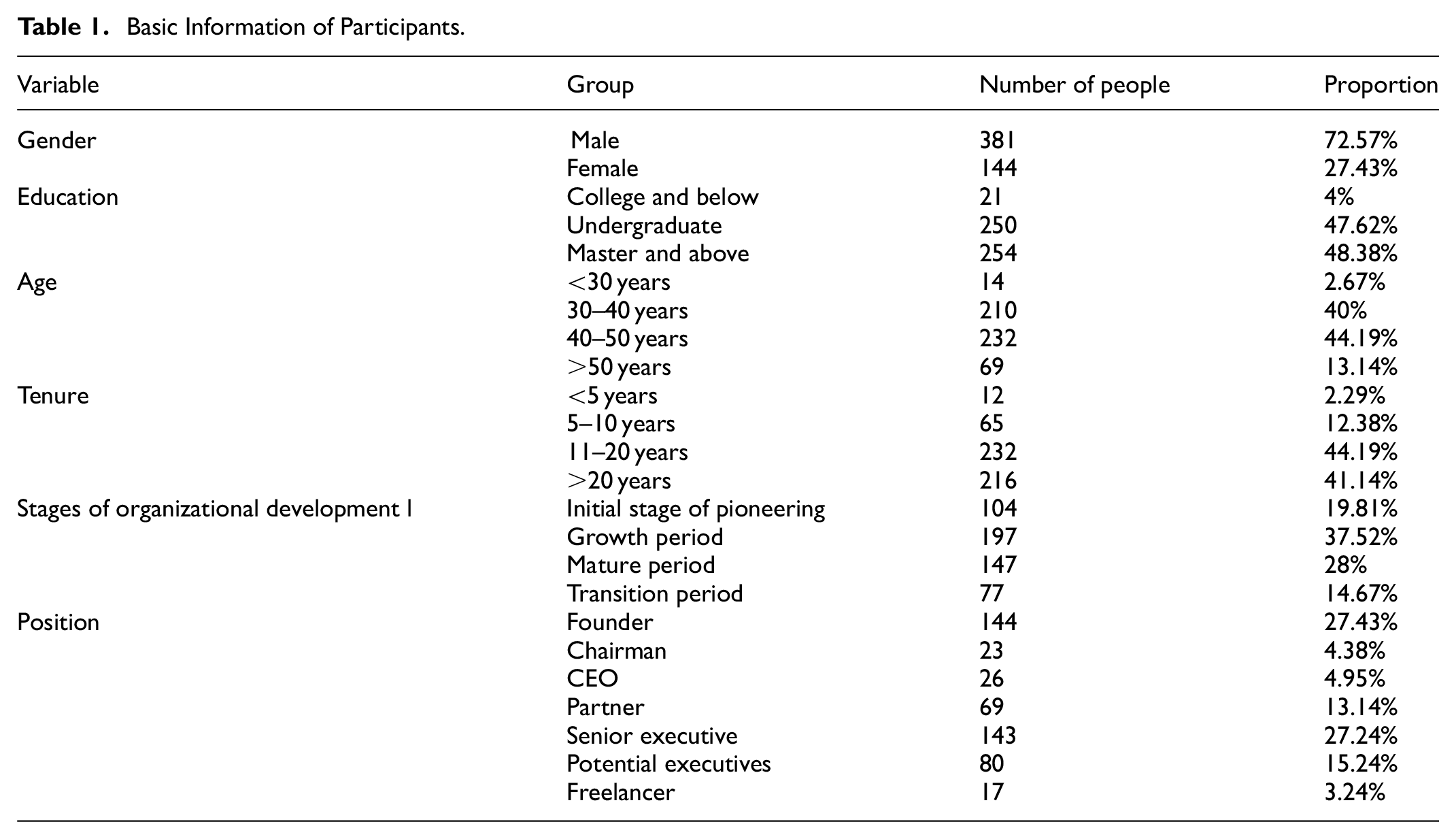
In this study, minimizing the risk of differences in common methods, the data was collected from two sources (Podsakoff et al., 2003). First of all, one of our authors first contacted three mega individuals and two professors in the field of human resources, who carefully read the questionnaire to ensure that the questions, concepts and descriptions in the questionnaire were clear. During this process, the questions and some items in the questionnaire changed slightly. Second, we contacted 25 mega individuals for predictive testing after revising the questionnaire, and there was a light revision to the wording of some items. Third, we employed a stratified random sampling method. To collect the most reliable and available data, the sampling framework was based on mega individuals such as founders, chairmen, CEOs, senior executives, partners and potential executives, freelancers, etc., dominated by mega-individuals. We asked key information providers to respond to the survey. They have the distinctive characteristics of compound ability, collaboration and personal IP, and have a large network of relationships. Valuable social resources have innovated in their respective fields, which will make informed choices for our questionnaire. We distributed 700 questionnaires. At the end of the date, they believe that 525 of them can be used for quantitative analysis. The rest are due to incomplete filling, the selected answers are exactly the same, and the response time is less than 60 seconds. Not used, and the final response rate is 75%. Table 1 summarizes the basic information of the participants.
Basic Information of Participants.
Quantitative Measurement
7-point Likert-type scale was employed to measure all items of latent variables, ranging from 1 (strongly disagree) to 7 (strongly agree).
Weak guanxi. We chose the three lists of the seven original projects of Ren and Chadee (2017), including “I hope to establish a relationship with people in the business field,”“I can communicate with people affecting my business decisions,” and “I am in socializing I am willing to talk to senior managers at the party.” This scale pays special attention to the acting of mega individuals in the development relationship, and has a scale developed with Wolff & Moser’s. For example,“ I can use social activities to make new friends,” which especially emphasizes the importance of establishing a relationship (Wolff & Moser, 2009).
Strong guanxis. We used the following four items to measure to assess behaviors that maintain the quality of relationships to achieve a key psychosocial attribute (Bu & Roy, 2015; Chen et al., 2013). Unlike the West, it is more inclined to believe in individuals rather than exclusively institutions in China (Khan et al., 2016). Behaviors that apply to mega individual strong guanxi is retained: “I can do my best to help my relationship network members solve personal life problems (emotional attachment); I can sacrifice my time to help my relationship network members achieve their goals (personal respect); During holidays, I will call or visit my relationship members (life integration); Outside of working hours, I have social activities with my relationship network members, such as eating together or having fun, which goes beyond work duties (life integration).”
Affection support. This scale refers to the entries of Neergaard et al. and Chiu & Chu modify it for mega individuals, including: “In business execution, I have the greatest ability to encourage or support me; In the case of stress, my relationship network members stand with me; my relationship network members have clearly expressed their understanding of difficulties in the implementation of business projects; my relationship network members will tell me that they think I am very close/I feel that I am very close/Very important; my relationship network members will talk about private feelings with me; my relationship network members will keep the secrets that we talk about. (Chiu & Chu, 2021; Neergaard et al., 2005)”
Instrumentality support. Reflective measurements based on six projects inspired by predecessors, including “When I needed a space, my network members provided me with temporary office space; when I needed funds, my network members lent me a certain amount of money or the kind I needed; my network members provided me with some transportation; when I was in trouble, my network members referred/recommended relevant contacts to me; my network members helped me with things that needed to be done, such as housework, taking care of my family, etc.; When I was busy, my network members helped me with shopping (buy lunch, etc.). (Klyver et al., 2018; Krause & Markides, 1990)”
Information support. Project measurements adapted from Krause and Markides (1990) and Liang et al. (2011) including “when I encounter pressure, my relationship network members will tell me what I have done with similar pressures I have experienced; Relational network members can always give me a rapid response and feedback; my relationship network members will give me some information to make the difficult situation clear and easier to understand; my relationship network members help me understand why I did not do a good job well. Things; my relationship network members will comment on how I deal with a problem, but it does not say that it is good or bad; I can always get valuable information/materials/useful information/useful information/use Knowledge.”
Breakthrough innovation performance. Combining breakthrough innovation performances designed by Ettlie et al. (1984) and Wang et al. (2016) including: I and my relationship network members can create new ideas/services in project innovation, and increase the benefits; my relationship with me and I have a relationship with me. Network members can develop new technologies in innovation and increase their benefits; I and my relationship network members create new technology, technology or services to expand the existing market and increase the benefits; New products have been developed in the market and increasing income.
Incremental innovation performance. Combined with the Incremental innovation performance of Jansen et al. (2006) and Sun et al. (2007) including: I and my relationship network members often improve the supply of existing services and increase the benefits; Improving existing products and craftsmanship, and increasing benefits; my relationship network members can develop and utilize existing technologies and capabilities, and increase the benefits; And expanded services to existing customers.
Interpersonal capitalization competence. Refer to the interpersonal capitalization table of the workplace of Watkins, including: I will tell my network members about the good things in the project; I will discuss positive things at work with my network members when I have the opportunity; I receive good news on the project, and I will share with my relationship network members; I will definitely tell my network members about the good things about my project; I will regularly share the good things about the project with my network members matter (Nunnally, 1978).
Data Analysis
SPSS Statistic 25.0 was used to descriptive analyze respondents’ profiles and screen initial data. Further, PLS-SEM was employed to test research hypotheses. This study consists of eight reflective constructs, with SmartPLS 4 being adopted to assess measurement and structural models.
Findings
Assessment of Measurement Model
The assessment of measurement models in this study consists of four steps. Firstly, Table 2 shows that all values of Cronbach’s alpha and composite reliability meet the minimum requirement of .70 for internal consistency reliability (Nunnally, 1978). Secondly, Table 2 indicates that all values of average variance extracted (AVE) were above 0.50, so convergent validity is achieved. Thirdly, indicator reliability normally refers to assessment of the size of the outer loadings (Wong, 2013). Hulland (1999) observed that an outer loading larger than 0.60 is acceptable. Table 2 presents that all outer loadings are no smaller than 0.60. Finally, Table 3 presents the square root of AVE on the diagonal (also known as Fornell-Larcker Criterion) has the greatest value, and all Heterotrait-Monotrait Ratio values are smaller than 0.85 or 0.90; cross loadings show all indicators load greatest on their associated constructs, which was highlighted in bold in Table 3 (Fornell & Larcker, 1981; Henseler et al., 2015). Thus, discriminant validity is confirmed.
Evaluation of the Reliability and Validity of the Model Variable.

Results of Differential Validity.

Note. IFS = information support; ISS = instrumentality support; WG = weak guanxi; SG = strong guanxi; AFS = affection support; IIP = incremental innovation performance; BIP = breakthrough innovation performance; ICC = interpersonal capitalization competence.
Assessment of the Structural Model
The structural model is assessed to test the relationships between constructs. Firstly, as all values of VIF in the structural model are below the threshold of five, there are no collinearity issues (Wong, 2013). Secondly, as all R2 values are no less than the minimum limit of .10, R2 values of all constructs are satisfactory (presented in Table 4). Thirdly, Table 4 presents that all Q2 values are larger than zero, so the predict relevance of endogenous constructs is achieved (Sarstedt et al., 2014).
The Results of the Values of R2 and Q2.

Finally, the significance and relevance of path coefficients is tested by running Bootstrapping, and the results of hypotheses testing are presented in Table 5. Strong guanxi is not significantly related to incremental innovation performance (=0.070, p = .130 > .05), while weak guanxi positively related to breakthrough innovation performance (=0.103, p = .006 < .01). Thus, H1 is rejected, but H2 is confirmed. Strong guanxi exerts a positively relationship with affection support (=0.618, p = .000 < .01), instrumentality support (=0.450, p = .000 < .01), and information support (=0.506, p = .000 < .01); therefore, H3, H4, and H5 are confirmed. Weak guanxi is found to be positively related to information support (=0.150, p = .023 < .05) and instrumentality support (=0.134, p = .039 < .05); therefore, H6 and H7 are confirmed. Instrumentality support is positively related to incremental innovation performance (=0.184, p = .002 < .01) and breakthrough innovation performance (=0.206, p = .000 < .01); therefore, H8 and H9 are confirmed. Information support is positively related to incremental innovation performance (=0.412, p = .000 < .01) and breakthrough innovation performance (=0.415, p = .000 < .01); therefore, H10 and H11 are confirmed. Affection support exerts a positive relationship with incremental innovation performance (=0.143, p = .016 < .05), while it is not significantly related to breakthrough innovation performance (=0.097, p = .130 > .05). Thus, H12 is confirmed, but H13 is rejected.
Results of Hypotheses Testing.

Note. **p < .01. *p < .05, n’s. p > .05.
Mediation Analysis
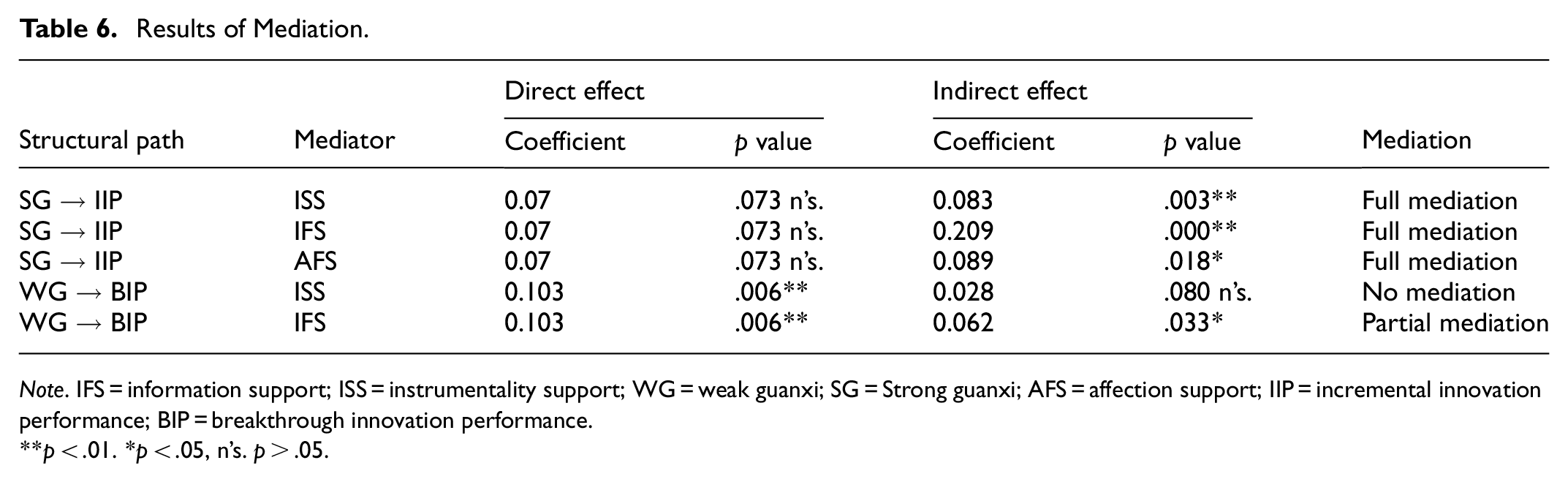
Table 6 presents the results of direct and indirect effects of five groups of structural paths for the mediation testing. Hair et al. indicate that full mediation takes place at the time of indirect effect being significant and direct effect being insignificant (Hair et al., 2021). In this regard, instrumentality support, information support, and affection support are found to fully mediate the relationship between strong guanxi and incremental innovation performance. Besides, partial mediation presents that both indirect and direct effects are significant (Hair et al., 2021). Thus, this study confirms that information support partially mediates the relationship between weak guanxi and breakthrough innovation performance.
Results of Mediation.
Note. IFS = information support; ISS = instrumentality support; WG = weak guanxi; SG = Strong guanxi; AFS = affection support; IIP = incremental innovation performance; BIP = breakthrough innovation performance.
p < .01. *p < .05, n’s. p > .05.
Moderation Analysis
Moderating effects of interpersonal capitalization competence were tested, and the results show that interpersonal capitalization competence moderates the relationship between strong guanxi and instrumentality support (β= .114, p = .006 < .01), but does not play a moderating role in the relationship between strong guanxi and information support (β= .058, p = .258 > .05), and the relationship between strong guanxi and affection support (β= .009, p = .799 > .05). Meanwhile, positively moderating roles of interpersonal capitalization competence in the relationship between weak guanxi and information support (β= −.088, p = .064 > .05), and the relationship between weak guanxi and instrumentality support (β= −.117, p = .007 < .01) are rejected. Overall, the study’s results only support H15a.
Further, f2 is used to measure the strength of moderating effects (Aiken et al., 1991). According to Cohen, effects of f2 values refer to 0.02, 0.15, and 0.35, respectively (Cohen, 1988). However, Aguinis et al. (2005) point out that 0.009 is the average effect size for a moderation testing. In this regard, f2 values of 0.005, 0.01, and 0.025 are recommended as small, medium, and strong effects, respectively (Hair et al., 2021). The study’s result presented that f2 value of interpersonal capitalization competence’s moderating role in the relationship between strong guanxi and instrumentality support is 0.018, representing medium effect. The graphical explanation of the moderating result was presented in Figure 2.

Moderating effect.
Discussion
The Impact of Strong and Weak Guanxi on Dual Innovation Performance
The results of research support the “public perception” of Granovetter and other studies -the weak guanxi produces breakthrough innovation performance, and the existence of structural holes in the “bridge” function is conducive to breaking through the shackles of inherent patterns, allowing mega individuals to find more Like-minded partners, demand new technologies to provide solutions to meet breakthrough innovation performance (Moon et al., 2022; Wu et al., 2020).
According to the results, the strong guanxi does not have a direct positive impact on incremental innovation performance, but needs to have an impact on incremental innovation performance indirectly through mediating variables (affective, instrumental, and informational support). Because the incremental innovation performance is to develop better and more attractive solutions using other mega Individual insights or material support (Parida et al., 2012). This study found that the intensity and innovative performance are not a direct impact, but a complex relationship, which may inspire a more detailed check of the relationship between the two, the interests related to the interests of the mega individuals (Moon et al., 2022). Those who have obtained social support can better enhance communication, trust and mutual benefit cooperation, thereby promoting incremental innovation performance.
These findings contribute significantly to the existing literature. They not only validate previous research conclusions on the relationship between strong and weak guanxi and innovation performance, but also further reveal the underlying mechanism and intermediary variables, enriching our understanding of the relationship between social relations and innovation performance. In addition, when constructing and managing social relationship networks, we should fully consider the nature and characteristics of guanxi, and their potential impact on different types of innovation performance. By optimizing the combination of guanxi and leveraging the positive role of social support, we can more effectively promote the enhancement of organizational innovation performance.
The Impact of Strong and Weak Guanxi on Social Support
Social support is essentially mutual help. In the Chinese cultural, exchanges are more likely in strong guanxi, which form the basis of trust, emotional support, such as comfort, is provided in the face of uncertainty. Similarly, instrumentality support also requires a high degree of commitment. Therefore, mega individuals expect to obtain a higher degree of instrumentality support from strong guanxi. Emotion is more important than information, and information transmits not the cause of human relationships, but the result (Bian, 1999). Previous literatures have mostly believed that strong guanxi provide more emotional and instrumentality support (Nielsen & Klyver, 2020). This study verifies previous results and confirms that strong guanxi of mega individuals also have a strong effect on informational support. That can provide more accurate and “confidential” information to mega individuals.
These guanxi have far-reaching practical significance in the context of mega individuals and their social networks. Strong guanxi not only promote innovation performance by providing emotional support and instrumental support, but also play a key role in information acquisition and transmission. This provides a new perspective on how mega individuals use social networks to promote innovation. In addition, by optimizing the social network structure and improving the quality of social support, we can more effectively promote the innovation performance of mega individuals, thereby enhancing the competitiveness and sustainable development ability of the entire organization.
The Impact of Social Support on Dual Innovation Performance
This study explores the differences and reasons for the influence and effectiveness of instrumental, informational and affection support on breakthrough innovation performance and incremental innovation performance. The research conclusions are as follows: instrumentality support and informational support obtained by mega individuals have a direct impact on progressive innovation performance. Both performances have a direct positive impact; emotional support has a direct positive impact on incremental innovation performance, but has no impact on breakthrough innovation performance. This is because affection support can effectively alleviate the psychological fatigue of mega individuals during project implementation, help resolve negative emotions, and reduce psychological obstacles in the process of progressive innovation. Affection support is exclusive to strong guanxi, and strong guanxi do not have an impact on breakthrough innovation performance. Therefore, affection support has no impact on breakthrough innovation performance.
Different from Affection support, instrumentality support and information support for innovation performance more focused on the material support and accumulation of knowledge and skills required for innovation.
Mediating Effect of Social Support
This study finds that instrumentality support does not play a mediating role in the weak guanxi between mega individuals and breakthrough innovation performance. Through horizontal comparison of empirical results, although strong and weak guanxi has been verified for instrumentality support, from the perspective of impact coefficient which has a higher “gold content” than strong guanxi, that is, only when the relationship between mega-individuals is close to a certain extent, instrumentality support will be generated, and plays a mediating role in the strong guanxi between mega-individuals and incremental innovation performance. Therefore, affected by different mediating factors, the mechanism of action of strong/weak guanxi of breakthrough innovation performance/incremental innovation performance may be different, and it is of great significance to explore more contingency or mediating factors in the relationship in China. Further analysis finds that informational support plays a mediating role in the strong guanxi between mega-individuals and incremental innovation performance, and also plays a mediating role in weak guanxi and breakthrough innovation performance. However, from the perspective of impact coefficient, the “gold content” of strong guanxi for information support is higher than weak one. This is because the trust established by strong guanxi in mega individuals can facilitate the rapid exchange of complex information and promote innovation performance; while weak guanxi facilitate the search for useful information among members, but hinder the dissemination of complex information (J. Liu et al., 2018; Zhang & He, 2016).
This study has deepened our understanding of the complex guanxi between social network and innovation performance by distinguishing the relationship between strength and weakness guanxi and different types of support. Secondly, this study verifies the influence mechanism of strong-weak guanxi and different types of social support on dual innovation performance in the Chinese context, which provides a useful supplement for cross-cultural research. Finally, this study emphasizes the core role of trust in the process of social network and innovation, which provides a new perspective and thinking for future research.
The Moderating Effect of Interpersonal Capitalization Competence
The moderating effect of interpersonal capitalization competence on the relationship between guanxi and types of social support, especially its positive influence on the relationship between strong guanxi and instrumental support of mega individuals, provides us with a new perspective to understand resource flow and strong-weak guanxi in social networks.
Interpersonal capitalization competence has a positive adjustment effect in the relationship between strong guanxi and mega individuals, but no moderating effect was found in other variables. This may be due to other mega individuals who will seek to derive additional value from events, when mega individuals “interpersonal capitalization” them. Previously, the literature was discussing that interpersonal capitalization was mainly the close relationship of capitalization (Henderson & Clark, 1990). When there is a strong guanxi between them, getting instrumental support (office space, money, transportation or equivalent help) is the most direct manifestation, which is also one of the important evaluation criteria to measure the strength of the relationship. If mega individuals want to achieve innovative performance, they need to continuously learn and improve itself. It also needs other mega individuals to share the active events. The most direct support for money is the key to the success of innovation.
It is worth noting that interpersonal capitalization competence is not only a one-way ability to obtain resources, but also a two-way interactive process. While sharing positive events and gaining instrumental support, mega individuals are constantly building and strengthening guanxi with other mega individuals. This interactive process helps to form a closer and more fruitful social network and provides strong support for the innovation and development of mega individuals.
Finally, interpersonal capitalization competence plays a moderating role in the relationship between guanxi and types of social support, which has a practical impact on the success and innovation performance of mega individuals. By improving interpersonal capitalization competence, mega individuals can make better use of resources in social networks, strengthen cooperation with other individuals, and thus enhance their innovation ability and competitive advantage.
Implications and Conclusion
Theoretical Implications
Firstly, this study deepens scholars’ understanding of the role of strong and weak ties in Chinese environment. In recent years, there has been a flood of research on social relationship networks. Many empirical studies have shown that different cultural heritage, social systems, and social groups have different roles (N. Liu, 2016). First, business relationships are an important channel for external resources. Strong and weak ties play a very important role. Mega individuals rely on the social support they receive to seek help. Second, not all relationships are weak ties. That is, being able to link relationships between different relationship groups is not necessarily a weak guanxi, but may also be a strong guanxi. Previous people ignored the cross-structural hole or link advantage in the link. It may be a direct or indirect strong guanxi.
Secondly, this study opens the “black box” between relationship strength and innovation performance, and emphasizes the mediating role of social support. As Rose-Krasnor (1997) points out, in one case, an effective relationship may not achieve similar success. Unlike previous literature, this study finds that the strong following pairs of giant individuals have no direct effect on incremental innovation performance, but require the indirect influence of mediating variables. In this regard, social support, an important mediating variable, can be mined. The key to business relationship strength affecting individual dual innovation performance lies in obtaining social support to be fully applied and effectively linking the impact paths. This not only provides a clear understanding of the internal mechanism of relationship strength affecting innovation performance, but also expands the discussion of relevant mechanisms and research on social support. At the same time, this paper also empirically supplements and enriches the view that social support can promote resource conservation.
Thirdly, this study has expanded the research of interpersonal capitalization competence. Under the role of a strong guanxi, after the mega individual obtains instrumentality support, interpersonal capitalization competence has played a positive role in regulating between the two, which means that the stronger the ability of the mega individual interpersonal capitalization, the stronger the impact of the strong guanxi on the instrumentality support. The existing theory of interpersonal capitalization competence is developed under the background of the close relationship that individuals usually maintain consistent results, and they are generated within the disclosure. Although both potential members can be obtained, they can only be measured when they are related to the disclosure party. This research uses the background of this theory (Ali-Hassan et al., 2015). The study also shifted the focus and discussed whether the relationship between the disclosure and the respondent had an impact on society’s support, and would be disturbed by regulating the interpersonal capitalization of variables. Therefore, this research model has expanded the application and current theoretical boundary of interpersonal capitalization capabilities.
Practical Implications
This study has potential value for general management practice. First of all, mega individuals want to get social support, and it is important to find a same type person together. In the ecosystem of mega individuals, they build business relations and gain social support -emotional, instrumentality or information, which is also considered an important resource, which means that mega individuals except to improve their core competitiveness. In addition, it is necessary to establish a good relationship with other mega Individuals, which is not only conducive to themselves, but also other mega individuals who are in collaboration (Nielsen & Klyver, 2020). The process is also a process of social co-creation.
Secondly, this study emphasizes that it needs to break through the traditional cognition. In business relations, mega individuals are not a single relationship, but a mixture of a strong and weak guanxi. This study shows the characteristics of different relationships and the impact of the characteristics of different relationships. It proves that strong guanxi need to be through different types of social support such as emotional, instrumentality, and information support, and then improve incremental innovation performance. This shows that in strong guanxi, mega individuals with high social skills are more obliged to provide social support. From the perspective of experience, this study shows that mega individuals should provide social support in strong relations, and they should invest time and energy to build these three types of social support. That is good for people who want to become mega individuals as practical guidance.
Thirdly, the research emphasizes the complexity and diversity of the relationship between mega individuals, which is of great significance to policy makers. First of all, policy makers should recognize the important position of mega individuals in social innovation and economic development, and formulate corresponding policies to support their growth and development. For example, by providing funds, training or establishing a communication platform, they can help mega individuals expand their social networks and improve their interpersonal capitalization competence. Secondly, policy makers should also pay attention to how to balance the development of strong and weak guanxi in order to promote the overall progress of society. While encouraging mega individuals to establish strong guanxi, we should also pay attention to the cultivation of weak guanxi in order to obtain information and resources from a more diversified perspective. Finally, policy makers should also pay attention to how to create a social environment and cultural atmosphere conducive to the development of mega individuals, so that they can better play their role and contribute to the prosperity and progress of society.
Limitations and Future Research Directions
There are also limitations in this study: First, the survey used in this study only comes from the group of “mega individuals.” The research sample scale of 525 mega individuals is still small, which limits the universality outside of this context. Different cultures, values, and individuals in the regional environment may be different. Future research can benefit from this study and find out; second, the Harman’s One-Factor Test The degree of popularity of the method effect indicates that a single common method factor do not drive the results. This test does not exclude the existence of common method variance, but it can increase the credibility of explanation. Despite this, future research should collect data at a few different times (Podsakoff et al., 2003). Third, the validity of dual innovation performance depends on the strength of the relationship between mega-individuals, and the social support they receive is also important. This begins an interesting discussion. In the relationship, one party hopes that the other party will provide support and satisfy common expectations. It is more important for mega individuals to obtain and receive social support. As the Chinese “Book of Zhou” said: “If you want to take it, you must give it up.” The same is true of interpersonal capitalization in nature, requiring both disclosures and responders. The existing literature mainly explores how interpersonal capitalization affects disclosures, and there is little discussion of responders. The overall effect of capitalization is better reflected, which can continue to be explored in future research (Hadi et al., 2022).
Footnotes

Funding
The author(s) received no financial support for the research, authorship, and/or publication of this article.
Declaration of Conflicting Interests
The author(s) declared no potential conflicts of interest with respect to the research, authorship, and/or publication of this article.
Data Availability Statement
Data sharing not applicable to this article as no datasets were generated or analyzed during the current study.