




Abstract
Corporate hypocrisy (CH), organizational inertia (OI), and silence are undoubtedly issues many organizations have faced recently. Effective management of these paradoxes requires a different type of leadership. Based on the Paradox theory, Information Manipulation theory, and a few other related theories, the authors propose paradoxical leadership (PL) as an ideal style to deal with such situations in the current volatile and uncertain business environment. The study examined whether PL can revert silence induced by CH and OI to make employees air their voices and facilitate good performance. Data for the study was collected from 617 (response rate of 88.14%) gainfully employed samples. The data was analyzed using Structural Equation Modeling (SEM). Results show that PL can moderate the relationship between employee silence induced by CH and OI and facilitate voice behavior. The study also presented a few plausible suggestions that organizations could adopt to deal with silence and induce voice. The study is expected to stimulate heightened research interest in the fecund area.
Introduction
The contemporary volatile, uncertain, and dynamic business milieu is highly challenging. This uncertainty and dynamism compel business leaders to manage paradoxes and tensions daily. Leaders must adopt unique leadership styles to counter such situations, including shared, servant, situational, paternalistic, ambidextrous, or paradoxical. Further, empirical studies have shown the difficulty of deriving innovative performances in diversified teams due to multiple paradoxes (Guillaume et al., 2017; Sulphey & Alkahtani, 2017; Xue et al., 2020; Younis et al., 2023). Cameron and Quinn (1988, p. 2) state that a paradox is “the simultaneous presence of contradictory, even mutually exclusive elements.” The need to study paradox arises as organizations are built on contradictions involving free, creative, and independent human beings and the relationship between individuals and organizations wherein order and control exist. This paradox exists concurrently and independently of any organization’s will or authority.
Paradox theory considers opposing components simultaneously to differentiate and integrate them to act ambidextrously (Smith et al., 2016; Tushman et al., 2011). Furthermore, the theory assumes that opposites can coexist and be mutually exclusive (M. J. Chen, 2002), and both are indispensable for defining and performing organizational operations (Schad et al., 2016; Y. Zhang & Han, 2019). Paradoxes are also embedded in long-term corporate development (Y. Zhang & Han, 2019). Organizations have to face multiple paradoxes in their routine operations. Examples include facing simultaneous and competing for structural and subordinate demands (Y. Zhang et al., 2015) while being concerned about corporate development and success (Wasserman, 2003). Consequently, organizations must manage multiple emerging paradoxes when building upon and destroying past courses of action to create the future (Smith & Lewis, 2011). They also must deal with multiple collective forces in their environment and satisfy the competing needs of shareholders and various stakeholders (Y. Zhang & Han, 2019). Other specific theories from which the research derives input include the information manipulation theory (McCornack, 1992) and the expectancy theory of Vroom (1964).
Literature suggests multiple ways to deal with paradoxes. The easiest way is to choose between the opposite poles – exploration and exploitation. These two poles are at the two extreme ends of a continuum. At different moments in time, the two poles could succeed each other. Organizations could control certain paradoxes through rational control. (Brunsson and Jacobsson, 2000). Another approach is to balance the two poles of paradoxes, supporting the contingency management approach. Tensions between the paradoxes can also be solved by integrating the opposites (K. Peng & Nisbett, 1999). Yet another approach is to integrate the opposite poles by bringing them together and solving tensions through synthesis (Clegg et al., 2002; Younis et al., 2023).
Paradoxical leadership (PL) has proved to be the most suitable style for managing organizational paradoxes (C. L. Pearce et al., 2019; Sulphey and Jasim, 2022). The style provides input to face organizational challenges (Younis et al., 2023). Paradoxical leaders adopt differentiation and integration thought processes to deal with contradictory organizational problems effectively (Niu et al., 2022). According to C. L. Pearce et al. (2019), paradoxical leaders enhance organizational and individual performance by utilizing their capacity to view higher-level paradoxes. Two opposites bound PL and are reportedly organized around the “Yin and Yang” philosophy, which propounds that the universe exists in a delicate balance of inconsistent and inseparable inverses or paradoxes. PL keeps employees satisfied without compromising rules and regulations (Franken et al., 2020; Younis et al., 2023). PL is a behavioral trait that integrates and accepts opposite demands in parallel to benefit from paradoxes (X. Chen & Yang, 2023; Waldman & Bowen, 2016). As a result, there has been renewed interest in PL recently, and numerous studies have been undertaken about its relationship with organizational variables like silence, employee voice behaviors, corporate hypocrisy, and organizational inertia (Detert & Burris, 2007; LePine & Van Dyne, 2001). PL is also critical in analyzing employee silence and the risks associated with voice behaviors (Backhaus et al., 2021; Giessner & Schubert, 2007; Liu et al., 2013). In addition, studies have observed that competing leadership paradoxes could inspire or limit employee voice behavior (Detert & Burris, 2007). PL involves ambivalent and flexible behaviors that balance and reconcile paradoxes in superior-subordinate relationships, decision-making, and execution, creating a positive work environment and harmony (X. Chen & Yang, 2023; Mastio et al., 2021; Xiong et al., 2022; I. D. Zhang et al., 2025). Though multiple leadership styles are in vogue, PL has received focus in research due to its uniqueness in dealing with the current dynamic, volatile, and uncertain business milieu (Sulphey & Jasim, 2022). Furthermore, paradoxical leaders foster team building and improve performance by displaying multiple positive behaviors (Gioia et al., 1996). Thus, PL is ideal for dealing with complex business situations and environments (Miron-Spektor et al., 2018; W. Zhang et al., 2021), and has effective organizational performance. Empirical results show that long-term orientation positively correlates with paradoxical leader behavior, influencing corporate performance and reputation (Sulphey & Jasim, 2022; Y. Zhang & Han, 2019).
Corporate hypocrisy (CH) is also a paradox, which according to Fassin and Buelens (2011), is the “distance between assertions and performance” of an organization impacting the behavioral inconsistencies of individuals. CH denotes a belief in the minds of stakeholders that the company is not what it claims to be (Wagner et al., 2009). Thus, CH compels stakeholders to perceive that a company has miserably failed to deliver on its promises. As a result, such companies speak in one way and perform in another, pretending to have a flawless face to gain fame before the various stakeholders. In addition, the gap between organizational goals and practices in its march toward sustainability is also perceived as CH (Ha-Brookshire, 2017; Sulphey, 2019). Organizational members perceive hypocrisy when corporate behavior and attributions are incongruent (Bharanitharan et al., 2021; Zeb et al., 2023). Another paradox is organizational inertia (OI), which, according to Grams and Farrell (2008), is a natural and profound change whose presence is difficult to detect. Moreover, OI reduces the speed of adaptability within organizational settings (W. Tsai et al., 2008). Thus, OI acts as an obstacle or resistance to change and organizational effectiveness, thereby averting organizational innovation. However, empirical examinations have proved that PL can successfully overcome these paradoxes of CH and OI.
Voice (VO) behavior is a topic that has attracted recent research attention as it is related to multiple favorable outcomes like competitive advantage and organizational success (Furstenberg et al., 2021; Makwetta et al., 2021; Song et al., 2017; Sulphey & Jassim, 2022; Xue et al., 2020). Voice behavior provides multiple organizational advantages like innovation, effective problem-solving, proper knowledge management (AlAbood & Sulphey, 2023; Bogosian, 2018; Sulphey & Jassim, 2022), quality, and productivity (Liang et al., 2012; Wilkinson & Fay, 2011). There is a definite need to encourage constructive voice behavior, as it can address technical complications and improve organizational performance (Mayer et al., 2009). Since voice facilitates a favorable psychological contract between the organization and its employees, it can be used to ensure fairness and trust (Guest, 2017). Empirical evidence suggests that various leadership styles relate to voice behavior (Adikoeswanto et al., 2024; Makwetta et al., 2021; Yao et al., 2019). Some of them include supportive leadership (Adikoeswanto et al., 2024), narcissist leadership (Yao et al., 2019), and transformational leadership (Ilyas et al., 2021; Wang et al., 2019). Yazıcı et al. (2022) found that employee voice partially mediates agile leadership and affective occupational commitment. However, only limited evidence exists about the relationship with paradoxical leadership.
Organizational leaders routinely face multiple management paradoxes, including an inevitable delicate balance between delegation and control, productivity and individualism, and flexibility and collectivism (Lavine, 2014; Q. Li et al., 2018). They must “accept and reconcile paradoxes” and manage conflicting organizational requirements to achieve long-term performance (Smith & Lewis, 2011). They are an amalgam of self-centrism and other-centrism, maintain distance and nearness with followers, treat subordinates uniformly with individual consideration without any favoritism, simultaneously regulate work behaviors while providing followers flexibility in their activities, and use authority to ensure work outcomes while providing appropriate autonomy to employees (Y. Zhang et al., 2015). The present study is built on the edifice that these PL behaviors would successfully deal with the silence that originates from corporate hypocrisy and organizational inertia. Earlier studies were limited to examining either or a few of the concepts identified in the current study.
The present study examines the efficacy of PL in moderating the relationship between the identified paradoxes of OI, CH, and silence toward employee voice. The study, thus, addresses the following questions to achieve the objectives:
(1) How do corporate hypocrisy and organizational inertia impact silence?
(2) How does organizational silence impact voice behavior?
(3) Does PL have a relationship with silence and employees’ voice behavior?
The study’s objectives thus include identifying the relationship between corporate hypocrisy, organizational inertia, and silence and how PL moderates the relationship between silence and employee voice. PL is expected to revert silence induced by corporate hypocrisy and organizational inertia and motivate employees to engage in voice behavior. A fair literature review has helped identify the conceptualizations of the concerned concepts. This research significantly advances the understanding of PL in organizational behavior by contributing theoretically and practically. It links PL with managing organizational paradoxes, offering theoretical advancements and practical recommendations for improving leadership effectiveness and performance in challenging environments. Theoretically, the study fills the literature gap by offering a deeper understanding of how PL influences employee voice behavior, adding a fresh perspective on managing silence and voice within organizations. It extends paradox theory by highlighting practical leadership strategies to manage organizational contradictions, providing new insights into how these paradoxes influence employee behaviors. The research provides practical strategies for organizations to navigate tensions between competing demands, promoting adaptability, innovation, and sustainability. The following sections summarize the literature in the following order: corporate hypocrisy, organizational inertia, silence, employee voice, and PL.
Literature Review
This section discusses the theoretical background, followed by CH, OI, ORS, and PL. It also includes the formulation of the hypothesis.
Theoretical Background
PL has its underpinnings in the Paradox theory. According to the theory, a paradox is the “contradictory yet interrelated elements that exist simultaneously and persist over time” (Smith & Lewis, 2011, p. 382). The theory illustrates how to enable peak performance and achieve sustainability from paradoxical tensions. In organizational literature, the study of paradoxes involving tensions, contradictions, and dialectics has shown steady growth in the past 25 years (Putnam et al., 2016; Schad et al., 2016). The paradox theory is used extensively in the study of innovation (Andriopoulos & Lewis, 2009; Atuahene-Gima, 2005), top management teams, strategic vision, and vision (Carmeli & Halevi, 2009; Dameron & Torset, 2014; Fredberg, 2014) and sustainability (Carmine & De Marchi, 2022). The theory also peresents deeper insights oh how to organize, learn and perform tensions (Thomas et al., 2021). In addition, the paradox theory has been kept vibrant by social scientists like Cunha and Putnam (2019).
Smith and Lewis (2011) identified contradiction, interdependence, and persistence as the major three significant building blocks of paradox, facilitating the development of an accurate position that helps identify its essential features. However, the theory suffers from definitional coherence (Putnam et al., 2016; Schad et al., 2016). Some scholars refer to paradoxes as organizational phenomena replete with perplexing, conflicting, and contradictory situations and choices (Tse et al., 2013), leading to dualism, dialectics, and tensions (Cunha & Putnam, 2019). Paradoxes are not problems requiring solutions or interventions. They are interrelated opposites existing simultaneously, persisting over time (Cleland et al., 2017; Cunha & Putnam, 2019). Instead, they are to be considered a diverse umbrella phenomenon involving many organizational tensions and contradictions (Schad et al., 2016; Smith & Lewis, 2011). According to Clegg et al. (2002), Galbraith (2002), and Redding (1976), it is ideal to strike a balance between exploration and exploitation in a paradox, which involves the contingency theory of management. Empirical proof exists to prove that paradoxes are not generalist. It is local, embedded within the system, and highly sensitive to time and situation (Kevin Barge et al., 2008; Lüscher & Lewis, 2008). The situation’s uniqueness and circumstances must be addressed to develop unique responses to each paradox. The Paradox Theory has immense practical implications, addressing multiple complex paradoxical processes (Cunha & Putnam, 2019) towards organizational proficiency (Putnam et al., 2016).
Some theorists propose the dynamic equilibrium model, associating paradox with the logic of order in managing important contradictions (Smith & Lewis, 2011; Thomas et al., 2021). This logic restores the status quo and reinstates predictability (Cooper, 1986). Others associate paradox with disorder or logic of difference. They treat instability or disequilibrium of any form as an ideal source of organizing amid opposites (Cunha & Putnam, 2019). Thus, both order and disorder have constant dynamic interplay. In other words, the instability occurring from numerous paradoxical situations provides new directions and opportunities for the organization (Brianza-Padilla et al., 2016).
Silence and voice behaviors have their moorings in the Information manipulation theory proposed by McCornack (1992). According to the theory, individuals habitually manipulate their communication information based on the dimensions of amount, veracity, relevance, and clarity. This manipulation is done to decide what should comprise an expression of voice. Towards this, individuals resort to techniques like resorting to machinations like diversionary tactics, distortions, exaggerations, and even outright deceits. Individuals resort to these tactics to control information to protect themselves (Glassenberg, 2012). Further, individuals tend to choose silence over voice, negatively affecting all stakeholders frequently (Milliken et al., 2003; Sulphey, 2020). This can be explained in the backdrop of self-protective always implicit in the voice theories (Detert & Edmondson, 2011). Another probable theory associated with voice is the Expectancy theory proposed by Vroom (1964). The theory provides a framework for individual motivation to perform in different work circumstances, including choosing not to exercise voice (Uen et al., 2018), extending towards a proper theoretical context for researchers to examine silence and voice behaviors. The theory proposes expectancy, instrumentality, and valence as the factors determining the normal decision-making process. These factors would also influence the process of indulging in defensive silence. Based on the theory, when organizational members perceive an unfavorable situation, they cultivate a negative attitude towards voice (Imran & Nouman, 2017; Prouska et al., 2016) and indulge in defensive silence. Ouyang et al. (2022) found AL to promote employee voice behavior effectively and reasonably. In addition, Ding (2024) observed that social capital, including AL, impacts the internal mechanisms of voice behavior.
Corporate Hypocrisy
In general parlance, hypocrisy is the perception of inconsistencies in an individual or organization’s external behaviors or important practices. According to Wagner et al. (2009), hypocrisy is a “discrepancy between words and action.” Psychologically, a perception of hypocrisy is designed when there is a “distance between assertions and performance” (Shklar, 1984). Zeb et al. (2023) describe CH as a voluntary behavior that contradicts the values proclaimed by organizations and stakeholder expectations. This could involve the contradiction between fundamental beliefs and values propagated by the organization and what it actually practices. This concept is also pertinent to specific organizations as people always perceive different dimensions of hypocrisy in various corporate activities (Aaker, 1997). The concept of CH is complex and is considered a negative behavior, affected by different factors (Alicke et al., 2013). It involves the moral evaluation of individuals and is driven by psychological mechanisms (Jauernig et al., 2021). A stakeholder’s belief that a company has failed to deliver on its promises involves CH (Miao & Zhou, 2020). Goswami et al. (2018) defined CH as “a perception of corporate pretensions of having a virtuous character.” CH involves covert operations and self-presentation, illustrating the dynamic interplay between “immunity, potentialization, and traditional morality” (Jauernig et al., 2021, p. 2). Organizations act hypocritically if they are invented to be socially responsible while stealthily acting in ways that do not fulfill this prerogative (Wagner et al., 2009). Meyer and Jepperson (2000) opine that organizations tend to become inherently hypocritical since they face overlapping outcomes and behavior endowed with social agency. CH acquires significance due to the lack of organizational transparency, which leads to perceptions of hypocrisy and facilitates moral corporate behavior and undesirable dilemmas (Jauernig & Valentinov, 2019). Consumers and other corporate audiences want businesses to project a moral or ethical image (Brown, 2006). The concealment of facts relevant to a purchase, fraud, or other wrongdoing leads to impressions of moral hypocrisy when businesses engage in deceptive activities, including unfounded claims. When such deceptive techniques are revealed, they can damage a company’s reputation (Swaen & Vanhamme, 2004) and cause consumers to believe the organization is morally hypocritical (Swaen & Vanhamme, 2004). Thus, when a company expresses itself in one way and behaves in another to win good fame, it is CH (Miao & Zhou, 2020). Researchers like Wagner et al. (2020) have conducted extensive research on the antecedents and consequences of CH. It negatively influences stakeholders and corporate reputation (Arli et al., 2017; Wagner et al., 2009) and impacts consumer purchase willingness and trust (Guèvremont & Grohmann, 2017; Kougiannou & O’Meara Wallis, 2020; Wagner et al., 2020), and employee turnover intentions (Sandhya & Sulphey, 2021; Scheidler et al., 2019).
Several external factors influence the complex effects and outcomes of the perception of corporate hypocrisy. They include whether the hypocrisy stemmed from intentional deception or weakness of will, how extensive the discrepancy is between the attitude/claims and the contradictory behavior, and how severe the misdeed is (Alicke et al., 2013). The higher the discrepancy between the corporation’s beliefs and acts, the greater the corporate hypocrisy. The misdeed’s severity, the resultant outcomes’ enormity, and any subsequent problems due to hypocrisy can also affect corporate entities (Alicke et al., 2013), impacting employees’ attitudes (Miao & Zhou, 2020).
Organizational Inertia
“Inertia” comes from the Latin word “iners,” which means slow and idle. There is a rule in Physics that everything remains in a static condition or a constant movement unless an external force activates it. In simple terms, inertia is a desire to maintain the status quo (Özgenel & Cetin, 2021). OI occurs if the status quo is maintained for an extended period and the organization fails to respond promptly (Huanga et al., 2020). Organizational inertia was first described by Singh and Lumsden (1990), who used Organizational Ecology Theory to explain the complex connection between the organization and its environment and phenomena that are difficult to change in the face of environmental changes. In the backdrop of uncertainty and volatility, it is inertia if organizations maintain the status quo for an extended period and fail to respond appropriately (Moradi et al., 2021). Zhen et al. (2021) identified OI as “characterized by organizations’ propensity to maintain existing practices and processes rather than adapt to environmental changes.” As a result, OI is a stagnant organization phenomenon that shows an organization’s excessively steady state. This issue could be caused by products, manufacturing practices, or company policy (Huang et al., 2013). According to Özgenel and Cetin (2021), OI is a lack of willingness to initiate and change independently. Employees who intend to depart become silent and exhibit lethargy in their actions. According to Mokyr (2000), inertia is the adversary of creativity. Inertia threatens organizational survival, bringing incongruity with the ever-changing environmental conditions (Sydow et al., 2009). According to Allcorn and Godkin (2008), a fair understanding of OI helps identify and deal with resistance to change. OI is also a key obstacle to the willingness to develop and implement strategic decisions, which could thwart proactive behavior. Empirical evidence (Hongdiyanto et al., 2022; Le & Mohiuddin, 2024; Mastio et al., 2021; Moradi et al., 2021) suggests that OI negatively relates to organizational performance, as inertia prevents innovation and adaptation to environmental changes.
Leadership is the major factor in resisting failures, surviving, and overcoming OI. According to Barnett and Pontikes (2008), organizations suffer from OI when the rate at which they reorganize is slower than the rate at which their environmental conditions change. It is a threat to organizational agility and anathema. Furthermore, as an organization’s age increases, so does OI and resistance to change. Empirical evidence suggests that OI negatively impacts innovation, organizational learning, and performance (Hongdiyanto et al., 2022; Huanga et al., 2020; Jafari et al., 2019; Moradi et al., 2021). Organizations require ongoing change and transformation, and OI is defined as the inability to shift storylines and tone, according to Näslund and Pemer (2012). They claimed that OI comes in two forms: foresight and work inertia. Hung (2015) argues that OI arises when organizations build specialized knowledge. According to the notion, organizations must continually adapt and modify their respective structures, methods, and economic landscape to endure, survive, and grow in dynamic contexts. As a result, changes in the business environment may result in internal changes. Furthermore, organizational inertia can be caused by a combination of conflicts and contradictions between a leader and their subordinates and differences in exploratory and exploitative behaviors (Puhan, 2008).
Godkin and Allcorn (2008) classified OI as insight, action, and psychological inertia. According to Moradi et al. (2021), Insight inertia is associated with mental models and action theories arising from a lack of understanding of organizational environment and changes. Action inertia is derived from managerial assumptions when the information collected by the organization for a conscious action is insufficient (Hedberg & Ericson, 1997). Finally, psychological inertia is a defensive mechanism and a response to change arising from anxiety and stress.
M. Tsai and Huang (2007) identified five factors that contribute to OI: skewed perception, low motivation, creative response failure, political inertia, and cutoffs (leadership inaction). Sakuraki (2016) discussed how OI could influence production line management flaws and the challenges of executing strategic change. According to Oyadomari et al. (2018), organizational scale has a beneficial impact on OI. They made the connection between administrative control and organizational inertia. Brinsfield et al. (2009) found OI to make employees fall silent and prevent them from expressing their ideas. It also impacts organizational responses to adversity and emergencies (Liu et al., 2024) and makes them less aware of the external information environment (Mikalef et al., 2020). Firms with greater OI follow established procedures and historical paths in their strategic decisions (Zhong et al., 2023). Karadal (2011) equated OI to Deaf Ear Syndrome and considered it as employee behavior of not hearing and seeing the real situations they face in the organization. AlKayid et al. (2022) found visionary leadership to negate OI. Hasnawi and Abbas (2020) found that PL significantly affects workplace ostracism and OI. This study empirically supported the mediating effect of PL on OI. This was confirmed by Mastio et al. (2021), who found PL to help deal with inertia.
Employee Silence
Employee silence has gained significance in organizational studies (Dehkharghani et al., 2023; Kim & Wang, 2024; Nechanska et al., 2020). ES reflects situations where employees lack opportunities for VO or do not use them for various reasons (Donaghey et al., 2011). Voice and ES reflect a power-centric relationship shaped by unequal power exchange (Nechanska et al., 2020). ES is the conscious denial of the employee’s mental contribution to organizational issues due to organizational and managerial reasons (Kish-Gephart et al., 2009; Nakane, 2006). Morrison (2011) defines ES as: conscious withholding of information, suggestions, ideas, questions, or concerns about potentially important work- or organization-related issues from persons who might be able to take action to address those issues.
Silence involves employee decisions when confronted with unfavorable business conditions. This situation indicates that people consciously refrain from expressing their opinions, ideas, facts, and knowledge (Dehkharghani et al., 2023; Kim & Wang, 2024; Nechanska et al., 2020). Silence is a decision that employees make when faced with challenging situations (Nechanska et al., 2020), and intentionally abstain from expressing their opinions, ideas, information, and knowledge (Van Dyne et al. (2003). It could also cause potential harm to well-being (Kim & Wang, 2024). Bigo (2017) identified three types of employee silence: quiet mouth, which involves avoiding speaking; quiet mind, which involves withdrawing from communication; and quiet self, which means maintaining inner silence. According to Frederick et al. (2020) and Van Dyne et al. (2003), ES could be passive, defensive, or prosocial. The first happens due to unfavorable leadership behavior, such as retaliation or resignation (Frederick et al., 2020). When people avoid sending a negative message to protect themselves, they use defensive silence. It’s a fear-driven, proactive, and self-directed method of self-protection. Prosocial silence, on the other hand, is “other-oriented” (Van Dyne et al., 2003) and attempts to safeguard colleagues or the organization by withholding inappropriate and damaging information (Frederick et al., 2020). Silence could breed conformity and aversion toward responsibility (Gambarotto & Cammozzo, 2010). In addition, ES may cause leaders or teams to miss important information and thus fail to detect errors or correct recurring problems. This situation would result in employee mistakes and lower performance (Morrison & Milliken, 2000; Sulphey, 2020).
If employees have feelings of being unappreciated, they tend to remain silent (Dellve & Jendeby, 2022). According to Wu et al. (2021), silence occurs when organizational members perceive a lack of organizational justice or a psychological contract breach. Empirical evidence suggests that fair treatment of organizational members enhances trust and fosters psychological safety, reducing employee silence (Wu et al., 2021). Thus, silence is traditionally associated with a passive state of mind, which may occur since effective voice mechanisms are unavailable. Employees may also remain silent as a form of resistance or misbehavior (Nechanska et al., 2020). However, silence does not always imply passive behavior, and silence does not always imply the absence of speech (Scott, 1993). On the other hand, silence can be active, conscious, intentional, and purposeful, as Pinder and Harlos (2001) indicated. This is an important argument because it emphasizes how complicated and multifaceted silence is. Some types of silence, for example, are strategic and proactive – they are deliberate, purposeful, and intentional, such as withholding secret information from others. Employees who aggressively suppress comments concerning confidential firm information are another example. Thus, intentional and proactive, silence could be intentional yet passive (based on resignation). Scholars are trying to figure out how to increase the former and decrease the latter (Chamberlin et al., 2017). Nonetheless, there is a fundamental disagreement about the link between voice and quiet. They are frequently considered opposite extremes of a spectrum or distinct behaviors (Brinsfield et al., 2009; Knoll et al., 2016).
The researchers have attempted to examine the relationship between CH and ES. Earlier results indicate that the two are related, which is in partial agreement with Çayak (2021), Demirtas (2018), Mayhew et al. (2006), and Pinder and Harlos (2001). Thus, by shedding light on the nature of CH, the work suggests that when employees perceive the presence of corporate hypocrisy, it tends to affect their behavior and make them silent. Therefore, the research revealed how CH affects employees negatively, which is a problem that requires renewed attention from the leaders. It is thus hypothesized that:
H1: There is a positive and significant relationship between corporate hypocrisy and employee silence.
Voice
Employee voice is a form of proactive participation in the organization’s affairs to bring constructive ideas or information that could be beneficial (Gao et al., 2011; Tangirala & Ramanujam, 2012). Employee voice, according to Morrison (2011), is the: discretionary communication of ideas, suggestions, concerns, or opinions about work-related issues with the intent to improve organizational or unit functioning.
Bashshur and Oc (2015, p. 1531) extended on the earlier definitions and comprehensively defined voice as: the discretionary or formal expression of ideas, opinions, suggestions or alternate approaches directed to a specific target inside or outside of the organization with the intent to change an objectionable state of affairs and to improve the current functioning of the organization, group or individual.
According to the definition, employee voice is a problem-solving, change-oriented, and improvement-seeking behavior that occurs inside and outside the organization. Employee voice has been found to facilitate organizational performance (Mowbray et al., 2020). Abdullah et al. (2021) point out that voice can address concerns and include ideas, suggestions, or opinions on work-related issues to enhance workplace performance. These could be performed by speaking up and blowing the whistle. It helps bring about various desirable consequences, including innovation (Gilman et al., 2015). Voice behavior, which focuses on voicing constructive challenges to improve processes rather than just delivering criticism, is a crucial component of extra-role behavior that contributes to organizational growth and success (X. P. Chen et al., 2014). Further, leaders and teams can use their voices to spot faults, solve problems, keep operations safe, and innovate (Detert et al., 2013).
However, a status quo in any organization occasionally emerges as individuals develop risk aversion when working in groups or under extreme pressure. Employees often consider speaking up in such instances to question the status quo of those who created the problem (Detert & Burris, 2007). As a result, vocal behavior should not be taken for granted, as it disrupts the status quo due to its change-oriented nature, resulting in resistance and negative consequences for those that engage in it (Gilman et al., 2015).
Employees’ voices could be prosocial, giving positive ideas or information that benefits the company (Gao et al., 2011; Van Dyne et al., 2003). Employees who speak up while suppressing beneficial information and ideas fall into a defensive and passive category. Employees who use a protective voice to protect themselves from undesirable outcomes blame others by changing their attention to protect themselves (Arkin et al., 1989; Morrison & Milliken, 2000). There are also more classes. Liang et al. (2012), for example, classified voice as prohibitive voice behavior (PRVB) or promotional voice behavior (PHVB). While the former emphasizes the importance of sharing proposals and focuses on removing bad organizational circumstances, the latter emphasizes removing harmful ones. Lin and Johnson (2014) found that preventative emphasis is positively connected to restrictive voice behavior, building on the work of Liang et al. (2012). Similarly, they discovered a link between promotional conduct and promotion focus. They also proposed the voice’s “dynamic behavioral model.”
Van Dyne et al. (2003) conceptualized silence and voice based on a complex blend of employee motives. Silence creates uniformity and aversion to responsibility, but employee voice can foster creativity and innovation (Gambarotto & Cammozzo, 2010). According to Gambarotto and Cammozzo (2010) and Van Dyne et al. (2003), efforts are required to reduce employee silence and enhance voice. Silence is classified as acquiescence, opportunistic, prosocial, quiescent, or defensive (Pinder & Harlos, 2001; Sulphey, 2020; Van Dyne et al., 2003). Acquiescent silence is a form of “disengaged behavior” that involves concealing relevant ideas and information (Van Dyne et al., 2003). Opportunistic silence involves strategically withholding information to realize advantages without considering other consequences (Knoll & van Dick, 2013). This withholding could be to mislead, disguise, or confuse others. Prosocial silence is “proactive and other-oriented, based on altruism” (Sulphey, 2020). It involves proactively withholding information and opinions to benefit the organization. Motivation for prosocial silence involves concern for peers rather than fearing negative consequences. Through quiescent or defensive silence, employees seek psychological safety and voice opportunities for speaking up. It involves actively withholding information to protect oneself based on the fear of unpleasant consequences of speaking up (Knoll & van Dick, 2013). Knoll et al. (2021) found that voice climate can ease acquiescent silence. Organizations need to focus their attention on reducing silence and enhancing employee voice.
Employee voice could be positive (prosocial) or negative, with different consequences (Van Dyne et al., 2003). It could take the form of promotive voice behavior (PRVB) and prohibitive voice behavior (PHVB). PRVB is the expression of innovative suggestions that improve organizational performance, and PHVB involves expressing concerns about harmful organizational practices and behaviors. According to Van Dyne et al. (2003) and Hassan (2015), both are valuable and useful from a business perspective as they indicate proactive activity. H2 is thus formulated as:
H2: There is a positive and significant relationship between organizational inertia and silence.
H3: There is a significant negative relationship between silence and voice behavior.
Paradoxical Leadership
PL is a leadership style that simultaneously satisfies multiple competing workplace needs (Laureiro-Martinez, 2017), and paradoxical leaders effectively deal with paradoxes of short and long-term goals (Xue et al., 2020). PL harnesses employee potential through active listening and directing. According to Y. Zhang et al. (2015, p. 539), it is a “seemingly competing, yet interrelated, to meeting competing workplace demands simultaneously and over time.”Sulphey and Jasim (2022) opine that paradoxical leaders focus on the inherent team paradoxes and accept and integrate competing team demands. Furthermore, PL has a good knowledge-sharing influence and emphasizes team achievement rather than individual accomplishment. They also provide guidance and support to attain innovative goals and encourage information sharing. This enhances group synergy by promoting team learning and innovation (Xue et al., 2020). In addition, PL is based on the “Yin and Yang” concept, in which opposing and inseparable opposites exist in a state of harmony. Therefore, it can simultaneously integrate and accept opposite demands (Xue et al., 2020). PL is thus a practical leadership style ideal for managing the current volatile and complex organizational environments (Miron-Spektor et al., 2018; Y. Zhang et al., 2015). The style also integrates both sides of a paradox into an organization’s management strategy, resulting in better organizational performance (Elshaer et al., 2024). The style keeps employees satisfied without any compromise on the rules and regulations (Franken et al., 2020; Younis et al., 2023). Paradoxical leaders also consciously combine contrasting behaviors and foster resourcefulness in the working environment, leading to autonomy and goal clarity (Furstenberg et al., 2021).
Luscher (2019) proposed several characteristics of PL, including having faith in subordinates, being open, fighting for their unity, planning their time, allowing them to express their opinions, having foresight, analyzing opinions, being dynamic, and having a high level of patience. Paradoxical leaders are role models, allowing team members to deal with paradoxical situations positively. Maitlis and Sonenshein (2010) found that employees work confidently and resolutely with paradoxical leaders through modeling their behaviors. Paradoxical leaders also support team members in reducing paradox-related uncertainties (W. Zhang et al., 2021). Furthermore, PL encourages team members to speak up about their thoughts and opinions while respecting each individual’s point of view (Xue et al., 2020). As a result, it can integrate and accommodate competing needs while profiting from paradoxes (Y. Zhang et al., 2015).
Paradoxical leaders have distinct personalities that allow them to show control and freedom, accept subordinates’ vocal conduct, and encourage them to open up. Such leaders stimulate sense-making and foster employee well-being in uncertain and turbulent times by helping followers reframe and deal with challenging working environments (Stynen & Semeijn, 2023). According to Detert and Burris (2007), subordinates of paradoxical leaders are motivated to open up and voice opinions when they see their leaders eager to act on their concerns. Furthermore, constructive support from leaders encourages subordinates to contribute enthusiastically to teams (Edmondson, 2003). C. L. Pearce et al. (2019) conducted a qualitative inquiry and discovered that PL efficiently addresses the numerous organizational paradoxes of balancing short and long-term goals. PL absorbs and accepts opposing organizational demands behaviorally and benefits from them (Waldman & Bowen, 2016; Y. Zhang et al., 2015). Such leaders treat team members uniformly even while permitting individualization. This treatment is done by balancing uniformity and individualization, like assigning the same assignments while delegating different sections of the task to diverse people based on their aptitudes and interests. Paradoxical leaders also maintain appropriate control over decisions while permitting autonomy, simultaneously enforcing work requirements and flexibility, and balancing control and empowerment (W. Zhang et al., 2021). Due to these characteristics, paradoxical leaders positively influence employees’ work attitudes. X. Chen and Yang (2023) found PL ideal for dealing with OI. Hasnawi and Abbas (2020) also found PL to impact OI. Since PL balances contradictions and has close links in superior-subordinate relationships and work climate construction, it can facilitate appropriate decision-making and execution (Xiong et al., 2022). A recent study by I. D. Zhang et al. (2025) found paradoxical leadership to influence group harmony positively.
Evidence demonstrates that paradoxical leaders identify team members and engage them in self-driven behaviors, such as voice, through proper leader-member interchange communication (Boies & Howell, 2006). (LePine & Van Dyne, 1998). According to a recent study by Xue et al. (2020), paradoxical leaders encourage their followers to speak up by voicing their worries, thoughts, and opinions while valuing their followers’ perspectives. Reflections on PL style and its influence on voice behavior are crucial in light of the importance of diverse impelling worries and reservations of organizational members in today’s tumultuous and unpredictable organizational environment. Furthermore, paradoxical leaders foster a feeling of team perspective and improve team performance by displaying various behaviors (Gioia et al., 1996). Thus, PL is an effective style for dealing with complex business environments (Miron-Spektor et al., 2018; Xiong et al., 2022; Y. Zhang et al., 2015; W. Zhang et al., 2021).
Elshaer et al. (2024) and W. Peng and Li (2018) investigated the effect of PL on proactive work behavior and discovered a positive relationship. Detert and Burris (2007) found that leadership paradoxes stimulate or inhibit employee voice expression and speaking up behavior in organizations. Additionally, Liu et al. (2013) discovered that leadership significantly impacts voice behavior and related elements. Employees also develop voice behaviors influenced by leadership styles (Mowbray et al., 2015). Z.-X. Zhang et al. (2014) found that PL promotes flexibility and a sense of responsibility and permits employees to voice their behavior. Furthermore, X. Li et al. (2020) discovered that PL is positively connected to employee voice in a recent study. Xue et al. (2020) found a similar outcome when they discovered that when firms have leaders who use PL, employees engage in voice behavior and express their concerns, ideas, and opinions. When working with paradoxical leaders, employees learn to balance contradictory relationships, encouraging them to express suggestions and opinions without fear. These elements favorably contribute to employee voice. The preceding ideas suggest that PL can impact employee voice behavior. Thus, it is hypothesized that:
H4: PL has a significant relationship between employee silence and voice.
This study is interesting because it looks at how opposing values in PL can help people feel safe, reverse silence, and engage in vocal behavior. The following research model (Figure 1) is presented based on the hypotheses framed for the investigation.

Proposed model.
Methodology
The study population involved full-time employees of large industries in the state of Tamil Nadu in India, including manufacturing and service organizations, which were both public and private. The questionnaire was uploaded to Google Forms, and the online questionnaire was shared with around 700 prospective respondents, and 617 responded (response rate of 88.14%). The respondents were gainfully employed participants who worked full-time in industries in Tamil Nadu, India. The self-reported data was collected with the active help of officials in the HR Departments of the selected organizations. It took three waves, which lasted around 4 months to acquire this data. The potential respondents were identified and informed beforehand about the purpose of the research to ensure they had the required knowledge, as was done in earlier works (Glaister et al., 2017). The responses to questionnaires were purely voluntary and involved informed consent. Thus, any ethical concerns were absent. Care was taken to ensure responders’ confidentiality, and no identifiable or personal information was sought. The anonymity of the responses was ensured for all respondents. In addition, the authors also declare no conflict of interest.
The sample of 617 collected for this study is adequate and significantly beyond Krejcie and Morgan’s (1970) threshold limit of 384. Krejcie and Morgan (1970) propose that a sample size of 384 is sufficient for a population of over one million and that the required sample size increases at diminishing rates as the population rises. Eventually, it plateaus over 380 and remains constant. In addition, according to Alreck and Settle (1995), there is little to be gained over and above a sample size of 380. Hence, the collected sample of 432 is adequate. Further, specific measures were employed to deal with the problems of common method bias (CMB), as the independent and dependent variables were measured simultaneously. The three time periods for data collection also facilitated CMB minimization (Podsakoff et al., 2012). The items in the questionnaire were shuffled, and a few dummy items were added. Harman’s single-factor test was also carried out, as Podsakoff and Organ (1986) recommended. Towards this, instead of extracting through eigenvalues, the number of factors extracted in the exploratory factor analysis (EFA) was restricted to one. The single factor accounted for only 25.51% variance, which is less than the stipulation of 50%. These aspects point toward the nonexistence of CMB. Further, the temporal separation and employing a longitudinal design enhanced internal validity. This could also have eliminated the limitation of examining causal models with cross-sectional data.
Five standardized structured questionnaires to measure OI, ORS, PL, and Voice were used to collect the data. In addition, the demographics of the respondents, including gender, age, educational qualification, income, and experience, were also gathered. The details of the questionnaires are as under:
(1) Corporate hypocrisy (CH): This variable was measured using the Perceived corporate hypocrisy (PCH) scale developed by Goswami et al. (2018). The PCH scale has nine items on a five-point scale. It reported high internal consistency reliability with Cronbach’s α of .93 and robust validity. Sample items include “My supervisor does not practice what (s)he preaches.”
(2) Organizational inertia (OI): The 13-item five-point questionnaire developed and standardized by Huang et al. (2013) was used to measure OI. The questionnaire assessed three sub-scales of OI – Insight inertia (II) having four items, Action inertia (AI) having five items, and Psychological inertia (PI) having four items. The questionnaire had robust α reliabilities. The α of the sub-scales are II– .92, PI – .90, and AI – .91. These α values signify good reliability.
(3) Employee silence (ES): The standardized questionnaire developed by Knoll and Van Dick (2013), having 12 items, was used to measure ES. The questionnaire measures four dimensions of ES on a five-point scale. The domains are Acquiescent silence (AS), Prosocial silence (PS), Opportunistic silence (OS), and Quiescent silence (QS). The α of all the subscales are above the stipulated 0,70, hence having robust reliability. The α reported are Acquiescent silence – .88, Prosocial silence – .82, Opportunistic silence – .80, and Quiescent silence – .89.
(4) Paradoxical leadership (PL): To measure PL, the modified 12-item questionnaire (Xue et al., 2020), which was developed and validated by W. Zhang et al. (2020), was used. The survey questionnaire had a five-point scale. Sample items include “Leaders treat all team members uniformly but also respect their individual capabilities” and “By setting leadership examples for everyone, leaders allow others to assume a leadership role as well.” The original questionnaire reported a robust reliability α of .79.
(5) Voice (VO): The questionnaire developed and standardized by Liang et al. (2012) was used to measure the level of employee voice behavior. The 10-item questionnaire has a five-point scale. It has two subscales – Promotive voice behavior (PRVB) and Prohibitive voice behavior (PHVB). Good reliability was reported by the scale, with PRVB having Crohanch’s α of .95 and PHVB .88. A sample item includes “Proactively develop and make suggestions for issues that may influence the unit.”
The sum of all the components determined the total score for each scale. Since all the items were made compulsory, there was no missing data that warranted rejection, and all responses could be used for analysis. Table 1 presents the demographics of the collected sample. It can be observed that 385 (74.5%) are males and 132 (25.5%) are females. Most of the samples (51.1%) are less than 30 years of age, followed by those between 31 and 40 years – 34.2%. The sample also had varying qualifications – 31.9% graduates, 42.6%, and 25.5% doctorates. The collected data was spread across the junior level (31.9%), middle level (42.6%), and senior level (25.5%). Thus, the sample collected for the study had wide diversity.
Demographics of the Sample.

The descriptive statistics are presented in Table 2.
Descriptive Statistics.

Tables 1 and 2 present the sample diversity identified for the study. It can thus be considered that the sample is representative.
Reliability and Validity
The validity of the measurement model must be verified before SEM can be performed. The validity was tested using exploratory factor analysis (EFA) and confirmatory factor analysis (CFA). In addition, the average variance extracted (AVE) and composite reliability (CL) were also investigated. While conducting EFA and CFA, a few items had to be dropped due to low cross-loadings. The items dropped include QS-4, OS-4, and PHVB-3. EFA is a valuable tool to explore the data and factor structure before model testing. It helps identify potential latent constructs and refine the measurement model by suggesting how observed variables might load onto latent constructs before proceeding with SEM analysis (Hair et al., 2017). CFA confirms the factor structure and validates the measurement model. It involves testing whether the data fit a hypothesized measurement model. The reliability measures and factor loadings from EFA and CFA are presented in Table 3.
Reliability Measures and Factor Loadings.

Table 4 has the details of the validation of the questionnaires. It can be observed from the Table 4 that the values of item-to-total correlation (Streiner et al., 2015), factor loadings (P. Kline & Walters, 2016), and reliability (Nunnally, 1994), measures are as per the rules-of-the-thumb. The factor loading coefficients are greater than 0.50, as seen in the table. This is in accordance with R. B. Kline’s (2016) instructions. Furthermore, all of the constructs’ average factor loadings (AVEs) are greater than 0.70 (Table 4), as indicated by Hair et al. (2010). The findings show that the constructs are internally consistent. The AVEs determined by factor loading, delta, and item dependability were higher than the 0.50 conservative criterion set by Aimran et al. (2017) and Gefen et al. (2017). Cronbach’s alphas range from .856 to .976, which is higher than the .70 set by Nunnally (1978). The composite reliability (CR) is likewise higher than the .6 threshold for all constructions (Bagozzi et al., 1991). As a result, the measurement model meets the majority of the criteria for reliability and validity. The resultant CFA model is provided in Table 5. The RMSEA (0.037) is well within the stipulated 0.07 (Steiger, 2007). The CFI of 0.972 is also within the limit of 0.90 (P. M. Bentler, 1990). All other model fit indexes like NFI, RMSR, PGFI, and TLI are also within the stipulated limit (Diamantopoulos & Siguaw, 2000; Hooper et al., 2008; Kelloway, 1998), signifying robust model fit.
Convergent Validity: Standardized Regression Weights (Group Number 1 – Default Model).

Fit Index.

Table 6 shows that the concept has more variances with its measures than any other construct in the model, indicating discriminant validity (Hulland, 1999). The inter-correlation matrix has no r values greater than .70, indicating discriminant validity (Anderson & Gerbing, 1988). Furthermore, according to Fornell and Larcker (1981), all R values of the related factors are less than the AVEs.
Discriminant Validity.
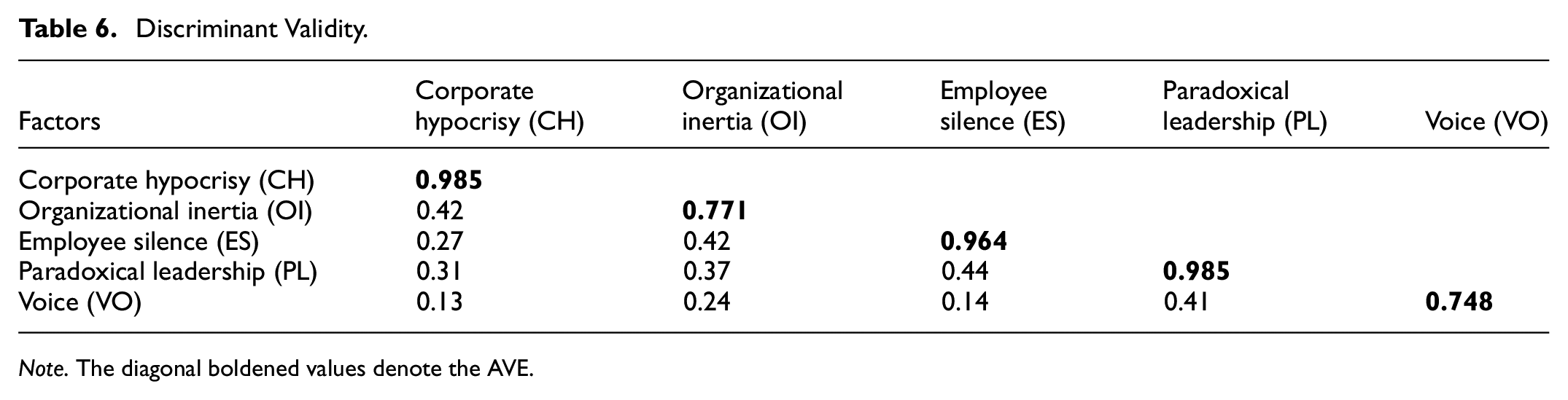
Note. The diagonal boldened values denote the AVE.
Results
After CFA was used to validate the measurement model, SEM examined the variables’ hypothesized associations. SEM was carried out using the R Program and R Studio, and the findings are shown in Table 7 and Figure 2.
Results of the Direct Relationship.

Note. CH = corporate hypocrisy; ES = employee silence; OI = organizational inertial; VO = voice.
Significant at .01 level.

Measurement model.
Structural Equation Modeling
SEM was used for this investigation because it allows for a comprehensive and simultaneous examination of all relevant correlations (Tabachnick & Fidell, 2007). It also assesses measurement and structural models to determine predictive validity (Becker et al., 2013). SEM can also assess theories incorporating many equations and their interactions, according to Hair et al. (2010). Because there are multiple variables in this study, SEM is the ideal method for answering the various research questions.
Hypothesis H1 was that CH has a positive relationship with ES. The results from SEM (Table 7) show empirical support for this hypothesis (coefficient of 0.911 and t-value of 7.12). A positive relationship between OI and ES supports the second hypothesis (H2). The coefficient was 0.876, and the t-value was 6.52, which is significant at 0.01 level. Finally, H3 hypothesized a positive relationship between ES and VO, which is not supported by the SEM analysis, as the coefficient was 0.772 and the t-value was 8.81.
Hypothesis H4 predicts that PL moderates the relationship between ES and VO. The SEM results support this hypothesis (coefficient of 0.781 significant at .01 level, and t-value of 8.46).
Tables 7 and 8 provide the SEM result, which indicates that CH and OI have a significant direct relationship with ES.
Results of the Indirect Effect Analysis.

Note. CH = corporate hypocrisy; ES = employee silence; OI = organizational inertial; PL = paradoxical leadership; VO = voice.
Significant at .01 level.
The final model is presented in Figure 3. CH and OI did not directly relate to voice mediating through ES. However, the path relationship between CH, OI, and ES was measured and found to be significantly and positively related. As expected, the path modeling results reveal that ES does not have a direct relationship with VO. However, when PL was included as a moderator, ES was converted into VO. This result augments well for social scientists and management experts, as it was found that PL could help convert silence into employee voice.

Structural equation model.
Discussion
The present VUCA world is replete with paradoxes. Leaders must manage paradoxes and tensions arising from the volatility, uncertainty, and dynamism to succeed in the current world. Since leaders have a substantial role in the work environment (AlKayid et al., 2022), this study explored how PL could effectively deal with OI, CH, and ES. The findings are in alignment with earlier studies. The negative relationship between OI and organizational performance has been identified by Hongdiyanto et al. (2022), Le and Mohiuddin (2024), and Moradi et al. (2021). Further, inertia prevents effective adaptation to environmental changes and impairs innovation. The identified relationship between CH and ES is as per the earlier findings of Çayak (2021) and Demirtas (2018). In addition, the findings that PL significantly affects OI align with the study of Hasnawi and Abbas (2020). The identified relationship between PL and VO aligns with a few earlier studies like X. Li et al. (2020) and Xue et al. (2020). These studies found that employees in organizations with paradoxical leaders engage in voice behavior. In addition, leaders control and access various organizational resources and can positively impact employee voice behavior (Magee & Galinsky, 2008). Tensions about contradictory demands to problems must be solved by exploring new insights. Proper understanding and acceptance of contradictions would help embrace tensions and derive benefits. Towards this, leaders must encourage organizational members to be involved in “paradoxical thinking.” Leadership is cardinal in creating a positive mutual trust, loyalty, and profitability culture. Further, paradoxical leadership can be inculcated by appropriate training programs on problem-solving skills, systems thinking, mindfulness, and the like. Obied (2023), Ouyang et al. (2022), and Y. Zhang et al. (2015) identified the influencing mechanism of paradoxical leadership on employee voice behavior. Though subsequently, a few empirical works emphasized the need and importance of PL (Alfes & Langner, 2017; X. Li et al., 2020; Schad et al., 2016; Sulphey & Jasim, 2022), scant attention has been paid to its manifestations in the variables like employee silence, voice, and corporate hypocrisy, identified for this study. The present study followed a relational view to connect paradoxical opposites with the identified variables to facilitate long-term corporate effectiveness and development, aligning with Ding (2024), Kundi et al. (2023), Obied (2023), Ouyang et al. (2022) and Xue et al. (2020). The findings of this study about PL and voice behavior are also in line with those of X. Li et al. (2020), who found a positive relationship between them. They also suggested that paradoxical leaders tend to promote promotive and prohibitive voice behaviors. This work also provides a sound basis for scholars to identify how paradoxes help leaders manage employee silence and voice. The study also helps to conceptualize better and differentiate employee silence and voice types.
Organizations must effectively redesign and organize their resources to tackle varying organizational paradoxes. In addition, leaders must adopt unique leadership styles to tackle such situations. This could vary across situational, paternalistic, ambidextrous, or paradoxical styles. However, it should be noted that deriving innovative performances in diversified teams replete with paradoxes is a herculean task (Guillaume et al., 2017; Obied, 2023; Ouyang et al., 2022; Sulphey & AlKahtani, 2017; Xue et al., 2020). Based on the theoretical edifice of Paradox theory and Information manipulation theory, the study examined how paradoxes like corporate hypocrisy and organizational inertia impact silence. In addition, the moderating effect of PL on the paradoxes of OI, CH, and ES towards employee VO was also examined. This study calls for organizations to foster PL to facilitate navigating contradictions in the workplace. PL also cultivates a culture where organizational members feel safe and empowered so that they are willing to share ideas and concerns. Training leaders and encouraging them to use paradoxical thinking will enable transparent decision-making and the navigation of contradictory demands, mitigate ES, and promote VO. This will create a better organizational environment where leaders balance long- and short-term goals, nurturing stability and novelty and resulting in resilience and adaptability. Leaders can also address inertia, improve employee engagement and voice behavior through responsive PL, and encourage employee contributions. This will enhance individual and organizational performance.
Even though several previous studies have looked into the relationship between leadership and voice behavior, there is minimal study on the impact of PL on voice behavior. Furthermore, only limited research studies in India have examined the relationship between the variables included in the present study. The proposed model of the association between the variables was then tested using SEM on a sample of 517 full-time employees. The study’s findings provide some support to the measurement model. SEM was used to evaluate the hypothesized model, and it was discovered that PL has a moderating relationship with VO. As a result, the study substantially contributes to the body of empirical knowledge about PL. Moreover, the study highlights the importance of integrating PL into organizational practices to navigate the complexities of modern business environments effectively. By demonstrating that PL can moderate the impact of paradoxes like corporate hypocrisy and organizational inertia on employee silence and voice behavior, this research underscores the necessity for organizations to cultivate leaders who can embrace and manage contradictions. The findings suggest that fostering paradoxical thinking among employees and equipping leaders with the skills to handle these tensions can significantly enhance organizational resilience and innovation. This study contributes to the empirical understanding of PL and provides actionable insights for organizations aiming to improve their adaptability and long-term performance through strategic leadership development.
Implications
This research significantly contributes to the academic and practical understanding of PL and managing organizational paradoxes in today’s complex business environment. This study expands the paradox theory by applying it to leadership, showing how PL can effectively manage organizational tensions. It highlights how leaders who embrace contradictions are better equipped to foster balanced and effective organizations. The study links PL with silence and voice behaviors, revealing how leadership styles influence whether employees speak up or remain silent, adding to a nuanced understanding of how leadership can mitigate or exacerbate organizational paradoxes. The study also deepens the theoretical exploration of silence, linking it with PL and identifying how leadership can be crucial in managing this phenomenon. This research, thus, provides a framework for managing contradictions, offering valuable insights into how organizations can thrive despite these paradoxical challenges.
Examined through the lens of Information Manipulation Theory and Expectancy, the findings help to expand the understanding of how PL interacts with employee voice and silence, particularly in the backdrop of corporate paradoxes like hypocrisy and inertia. This study offers a better understanding of how PL moderates the impact of paradoxes on employee behavior. PL mitigates the adverse effects of CH and OI by addressing the inherent contradictions and tensions. This helps reduce employees’ need to be silent, as they are reassured that their voice will be heard and acted upon. The study also suggests that fostering paradoxical thinking and promoting transparent leadership strategies enhance the overall effectiveness of organizational communication and decision-making processes. Further, leaders who can manage paradoxes create environments where employee contributions are seen as critical to long-term organizational success. They can also enhance employee motivation to engage in voice behavior and facilitate organizational resilience and innovation in the backdrop of complexity.
However, the caveat that Niu et al. (2022) proposed suggests that if employees attribute the contradictory behavior in PL to hypocrisy, it could impact employee work enthusiasm and the overall organizational environment. This study also contributes to the practical understanding of PL, offering insights for leaders in complex organizational environments to create a culture of open communication, innovation, and adaptability. It presents strategies for leaders to manage organizational paradoxes, reduce silence, and improve performance in a complex business environment. This research offers insights for leaders in complex environments. By adopting PL, leaders can better manage organizational paradoxes, reduce silence, and enhance performance. This is especially relevant in dynamic industries requiring adaptability.
Conclusion
Paradoxical leadership has become crucial for managing complex and dynamic challenges in modern organizations. It balances contradictory demands to enhance organizational and individual performance and is particularly effective in addressing organizational paradoxes such as corporate hypocrisy and organizational inertia, which hinder adaptability and innovation. PL fosters a nuanced approach to leadership by integrating opposing behaviors, thereby reducing silence and encouraging employee voice, which is essential for long-term success. This study extends previous research by linking PL with these paradoxes and demonstrating its capacity to reconcile conflicting organizational demands, ultimately leading to improved performance and organizational effectiveness. In addition, this study makes several significant theoretical contributions to PL and voice literature in the Indian context, contributing to limited studies. Though conducted with Indian samples, the findings have wider acceptability and ramifications, which could be identified by undertaking similar studies in other geographical areas and cultures. The study’s conceptual framework could help managers increase their awareness of employee motives that can stimulate voice behaviors. Focusing on individual and situational voice behavior antecedents could also help further theory development. Finally, such a focus could provide an exhaustive understanding of paradox’s impact on employees’ cognitive mechanisms. The study has thus opened up new vistas that could encourage future empirical examinations of the impact of paradoxes on cognitive mechanisms. Further research works in other cultural contexts can be attempted to examine the generalizability of the present findings. Other possible mediating and moderating variables could also be considered to help elucidate the antecedents and consequences of the studied variables.
Limitations
The current research work has succeeded in achieving the objectives. However, there are a few limitations to the study. Firstly, the data for the study was collected from manufacturing organizations in Tamil Nadu, India, through purposive sampling. Therefore, whether the findings are applicable in other industries must be validated. In addition, future empirical examinations could be undertaken based on data collected from different geographical locations and education levels. Furthermore, future studies could also be extended to include samples from borad range of other sectors like education, telecommunication, hospitality, information technology, government, and the like, expanding the research scope. Data collection could also be spread across other geographical regions or cultures, enhancing the findings’ external validity and cross-cultural comparisons. The study’s data analysis was based on a single moderating variable. However, future researchers could investigate the effect of other moderating variables that could probably influence employee voice behavior. This could include other climate variables like organizational identification, role congruence, intrinsic motivation, intrapreneurial orientation, and person-organization fit. A wide range of moderating variables and the conduct of the study in multiple sectors would facilitate a better understanding of other factors that influence employee voice in different contexts. Furthermore, the study did not consider cognitive variables in the research design, which could be considered in future studies. Towards this, cognitive variables like perceptual differences and biases could be considered. Thus, a comprehensive conceptual model that identifies the antecedents and consequences of PL would interest social scientists and organizational behaviorists.
There could be the possibility of common method bias (CMB) creeping into the study due to the nature of the research design and the data collected since the data was gathered from a single source through a self-reported survey. In addition, future research works could attempt to collect data from multiple sources and levels of organizations and subordinates, which could curtail limitations related to single-source data sets. This could help reduce CMB and provide a comprehensive and exact picture of the relationships between the variables. Research about paradox and PL has recently developed into an exciting, dynamic, pulsating area within leadership and organization theory. Both dwell on the cardinal dimension of organizational life, which practitioners and social scientists often overlook. In the recent past, interest in PL has burgeoned. The present study examined the efficacy of PL revert ES imposed by CH and OI and brought in VO. Future research could consider how PL relates to different leadership styles, adding more variables. Data could be collected from various demographics, cultures, and environmental factors, presenting robust, generalizable findings. Such comprehensive studies could contribute to a better understanding of leadership and employee behavior. It is honestly expected that the present study would trigger more such empirical examinations and broaden the knowledge about PL and VO.
Footnotes

Funding
The author(s) disclosed receipt of the following financial support for the research, authorship, and/or publication of this article: The authors extend their appreciation to Prince Sattam bin Abdulaziz University for funding this research work through the project number (2024/02/30982).
Declaration of Conflicting Interests
The author(s) declared no potential conflicts of interest with respect to the research, authorship, and/or publication of this article.
Data Availability Statement
The data can be provided on request.