




Abstract
From a global perspective, the hypocrisy of enterprises in fulfilling their social responsibilities has become a common phenomenon. However, theoretical research on corporate hypocrisy, especially in the micro level, is still insufficient. To enrich the theoretical achievements of corporate hypocrisy in the micro level, this study adopted the grounded theory methods to explore the employee attributions of corporate hypocrisy in Corporate Social Responsibility (CSR) and dig deeper into the internal links and role paths between the attributions. After the process of defining problems, collecting data, three-level coding, construction theory, and saturation test, we used dates from 21 employees and found that the employee attributions of corporate hypocrisy consist of six major categories: capacity limitation, external pressure promotion, lack of supervision, sincerity of keeping promises, speculation, and external tolerance. Besides, this study proposed a mechanistic model of the employee attributions of corporate hypocrisy in CSR and pointed out that the degree of external tolerance, the sincerity of keeping promises, and speculation play moderating roles in the main effect. Moreover, the speculation also plays a mediating role in the moderation effect of external tolerance’ moderation.
In recent years, corporate social responsibility (CSR) has been the focus of attention from enterprises and academia. The mass media is full of reports on CSR, and the appeal of the government and the public to perform CSR is becoming stronger and stronger (Waheed & Yang, 2019). However, the highly praised CSR can cause harm to enterprises and has a dark side. In terms of the pressure of the increasing concern of CSR, the phenomenon of “Talk the talk, but not walk the walk” (Kim et al., 2015) is often seen in many enterprises. CSR not only does not improve corporate image but also reduces corporate reputation and reliability. This phenomenon was defined by Wagner et al. (2009) as the corporate hypocrisy in CSR and they explain that the idea of CSR propagated is different from the actual action when enterprises undertake their CSR. For example, the well-known Nippon Paint declared that it would never change the color of the earth, but in fact, it failed to carry out production activities with volatile organic compounds (VOCs) in closed space; IKEA, which claims to “help more people create a better home life,” did not recall in the Chinese market after the “Death Cabinet” incident and defended its “conformity to Chinese standards.”
However, the inconsistent in word and deeds for CSR always hurt the public, consumers, and other stakeholders. Corporate hypocrisy was a phenomenon on the dark side of CSR. Wagner et al. (in press) claimed that corporate hypocrisy had negative impact on the responses of corporate stakeholders, such as the reducing of consumers’ purchase willingness (Guèvremont & Grohmann, 2017), the turnover intention of employees (Scheidler et al., 2019), and the loss of community trust (Kougiannou & O’Meara Wallis, in press). As such, it had a negative impact on these enterprises once these corporate hypocrisy activities in CSR are exposed, such as impairing the sustainable competitiveness of enterprises and resulting in capital market punishment (Frooman, 1997).
Taken together, this article aims to explore the employee attributions of corporate hypocrisy in CSR by using the grounded theory method for exploratory qualitative research. Through the process of interviews, collation, and induction, our study obtains the two-dimensional attribution model and attribution relationship mechanism model of corporate hypocrisy in CSR from the perspective of employees. This study has several contributions to academia and practices. First, this study makes up for the shortcomings of existing research and filled in the blank of research on the micro attribution of corporate hypocrisy in CSR. Besides, our study expands relevant theories and further enriched the research results of the dark side in CSR. What is more, the exploratory research and attribution relationship mechanism may provide new sight for empirical research on the antecedent of corporate hypocrisy in CSR. Second, our finding provides new ideas for enterprises with such behavior to deal with their hypocrisy behaviors in CSR. The research results may provide the suggestion for formulation of CSR strategy. Third, we hope that it can warn potential targets of corporate hypocrisy in CSR and encourage enterprises to supervisor their CSR implementation for long-term sustainable development goals.
Literature Review
The concept of corporate hypocrisy in CSR originated from the concept of hypocrisy in the field of psychology. When hypocrisy extended to the area of management, adding the concept element of “social responsibility,” it becomes corporate hypocrisy in CSR and mainly refers to corporate hypocrisy based on the perspective of social responsibility. In terms of corporate hypocrisy, Wagner et al. (2009) defined corporate hypocrisy as the phenomenon that the “true self” of the enterprise was the difference from the “self” it claimed. From the perspective of CSR, van de Ven (2008) proposed that some enterprises declared themselves to be an active social responsibility organization, but they did not take real actions to fulfill its social responsibility, this kind of “declaration” only to be a way for the enterprise aimed to gain a good reputation or gain some benefits. In general, when the actual action of an enterprise is incongruence to the social responsibility it claimed, the enterprise produces corporate hypocrisy in CSR, that is, its actual perform violates its commitment or assertion on social responsibility (la Cour & Kromann, 2011). Thus, based on the views of previous scholars, this article defined corporate hypocrisy in CSR as the inconsistent of corporate social responsibility in terms of words and deeds, and the actual actions not fulfill and even are contrary to those of corporate commitment or claim.
In fact, the occurrence of corporate hypocrisy in CSR always leads to many adverse effects for employees and harm organizations. The existing studies have discussed this issue in depth and mainly divided into two categories: one is to analyze the corresponding consequences of corporate hypocrisy in CSR from the perspective of stakeholders; the other is to explore the possible harm caused by corporate hypocrisy in CSR in overall level. According to the perspective of internal and external stakeholders, some studies had discussed the negative effect of corporate hypocrisy in CSR and mainly focused on the enterprise, the employee, and the customer. In terms of enterprises, this kind of behavior may bring some potential benefits. However, it will be likely to cause a lot of cost wastage. Sikka (2013) suggested that enterprises should cover up corporate hypocrisy in CSR for avoiding the expansion of internal contradictions, and they also need to keep alert for the supervision of environmental protection organizations and potential informers and cope with the high-pressure attention of the media. Thus, these worries and protective measures often exhaust enterprises. Besides, the stock price may be impacted, and the interest of shareholders would be damaged when the corporate hypocrisy was disclosed. In terms of employees, corporate hypocrisy in CSR will affect their psychological perception and work attitudes, and be likely to cause trouble for the daily work task (Scheidler et al., 2019). When employees clearly understand their enterprises’ commitment or declaration about corporate social responsibility in all kinds of media news, they will have certain behavior expectations for their enterprises. If the enterprise arises behavior contrary to their expectations, then employees may arise emotional exhaustion and will possibly have the intention to leave (Philippe & Koehler, 2005; Scheidler et al., 2019). For customers, they will have the cognition of corporate hypocrisy in CSR once they have the perception of inconsistent between corporate declarations and the real actions in social responsibility, and this cognition will damage customers’ trust for enterprises, which in turn decrease their willing purchase intention. Janney and Gove (2011) proposed that customers would feel betrayed by the enterprise and intended to escape from these enterprises when they had the perception of corporate hypocrisy in CSR. Furthermore, if this situation has not been improved, the corporate brand loyalty will be lost, and even damage their reputation after customers inform others of corporate hypocrisy in CSR. Apart from the stakeholders, some scholars also explored other potential damages of corporate hypocrisy in CSR. Some enterprises implemented corporate hypocrisy in CSR through the way of greenwashing; this way not only covers the actual pollutions but also may cause more serious environment pollution (Bowen & Aragon-Correa, 2014), and corporate hypocrisy may further damage the social welfare. Besides, Ha-Brookshire (2015) proposed enterprises in the entire supply chain achieved sustainable development. They need to perform their CSR and have a sense of real moral responsibility rather than hypocrisy morality. Goswami et al. (2018) also mentioned that corporate hypocrisy in CSR could increase interest in the short term, but it had a negative effect on corporate sustainability.
After discussing the definition and negative effects of corporate hypocrisy, scholars have also studied the antecedents of corporate hypocrisy in CSR. The main viewpoints are divided into the following three categories:
One is to regard corporate hypocrisy in CSR as an extension of the study of corporate social responsibility and to explore the causes of corporate hypocrisy in CSR in the perspectives of stakeholders, economy, organization, and media. (a) From the viewpoint of stakeholders, Brunsson (2007) indicated that enterprises emerge corporate hypocrisy in CSR to cope with the different demands of multistakeholders. (b) From the perspective of the economy, due to the existence of profit-seeking nature and shareholders’ demands for short-term interests, enterprises often avoid the related costs caused by a social responsibility to the greatest extent through implementing corporate hypocrisy in CSR (Fassin, 2005; Orlitzky et al., 2003). (c) From the perspective of the organization, early studies had verified that the reward mechanism, manage model, and corporate reputation would lead to corporate hypocrisy in CSR (Fassin, 2005; Lammers et al., 2010; Philippe & Koehler, 2005). (d) From the perspective of media, Fassin and Buelens (2011) pointed out that media would be likely to have the perception of corporate hypocrisy because of the different focus and understanding between the media and the enterprise. Besides, enterprises would be hard to implement corporate social responsibility and easy to lead to corporate hypocrisy in CSR if enterprises had an ambiguous understanding of the concept of corporate social responsibility.
The other is to regard corporate hypocrisy in CSR as a kind of “fraud behavior.” Based on the relevant theory of corporate fraud, past studies discussed the driving factors of corporate hypocrisy in CSR in the view of pressure and opportunity. The pressure of resolving stakeholder conflicts and the information asymmetry opportunities resulting from corporate disclosure impacted the attitude of enterprises to adopt corporate hypocrisy in CSR (Barros et al., 2019). Xiao et al. (2013) proposed the “PORE” motivation model for corporate hypocrisy in CSR, and they suggested that the interaction of pressure, opportunity, rationalization, and exposure determined the risk degree of taking corporate hypocrisy in CSR. Zhao (2014) further discussed the enterprises’ motivation of performing corporate hypocrisy in CSR based on the research methods of grounded theory, and the author proposed the “EIT” (External, Internal, Tolerance) attribution model through interviewing relevant social responsibility scholars, enterprises managers, and consumers.
Taken together, corporate hypocrisy in CSR is becoming a universal phenomenon, but it has tremendous potential damage and profound impact. The existing theoretical research mainly combs the concept definition of corporate hypocrisy in CSR, the possible causes factors, and negative outcomes. However, antecedent research focuses mostly on the perspective of consumers and business managers, ignoring the important internal stakeholders of ordinary employees. Based on the grounded theory, this study reveals the employees’ attribution types and paths of corporate hypocrisy in CSR through interviewing to understand the real psychological activities of employees.
Research Design and Methods
Research Methods
This study intends to systematically explore the attribution of corporate hypocrisy in CSR from the respective of the employee. For the lack of relevant theoretical results that can be directly referred to, this study adapted to the qualitative research of the grounded theory method to construct relevant theories. Grounded theory was proposed by Anselm Strauss and Barney Glaser of Columbia University in 1967, and it is the most widely used and mature qualitative research tool at present in social sciences (Locke, 2001). This theory is an inductive bottom-up research process, which was termed by Bryman and Emma Bell (2003) as an iterative and recursive approach to data collection and analysis. According to Glaser and Strauss (1967), grounded theory refers to the qualitative research method that develops and induces grounded theory by using a systematic analysis procedure in view of a specific phenomenon. Strauss and Corbin (1990) further pointed out that there are five important steps to study grounded theory: defining problems, collecting data, three-level coding, construction theory, and saturation test. As the core step of the grounded theory, the three-level coding process mainly includes open coding, spindle coding, and selective coding. Open coding, also called as initial coding, refers to scrambling and analyzing the collected original data word by word and line by line, in that to extract the corresponding concepts and discover categories. Spindle coding is the second main stage of the coding process. It is the process of directing category to the main category through the generalization and summarization of category. The last stage of selective coding refers to continuously mining the correlation between categories and main categories, and further extracting the core categories with high system inclusiveness (Charmaz, 2006).
The grounded theory starts from a social phenomenon and collects data with research questions. This method summarized and refined from the original data through three coding processes, which constructs a new theory reflecting the essence and significance of phenomena. Moreover, corporate hypocrisy in CSR is an important phenomenon, and the existing literature of corporate hypocrisy at the micro level is rare. Oktay (2012) also claimed that grounded theory is more suitable for exploring the research topic based on the social phenomenon and has little known about this topic. Therefore, our study is suitable for adopting grounded theory to research.
Data Collection
Different from the large-scale random sampling commonly used in empirical research, the grounded theory does not have strict requirements on the number of samples but pays more attention to the representativeness of samples and the richness of data sources. In terms of that employees in the human resource (HR) department are more familiar with the implementation of CSR, therefore, our study mainly selected 21 HR employees from internet industry, real estate industry, fast food industry, travel industry, beverage industry, auditing industry, and financial industry. Among them, 18 samples were used for the research of this grounded theory, and the remaining three samples were used for the test of theoretical saturation. We collected data through the way of in-depth interviews. The researcher and assistants had the face-to-face conversation with participants and obtained the interview materials; besides, the average time of each interview was about 60 min, and the privacy of interviewees was protected, which enhance the authenticity and reliability of respondents’ information. We finally gained about 35,000 words of original written materials after sorting out. The interviewees were mainly women (about 76%), and about 95% of them had bachelor’s degrees or above.
The interview outline was initially determined according to the reports of corporate hypocrisy in CSR cases and the need for data and was revised and finalized by listening to the suggestions of relevant experts and interviewees. Finally, the interview outline of this study mainly included five aspects: confidentiality statement; concept introduction and citation explanation of corporate hypocrisy in CSR; corporate hypocrisy in CSR of interviewees’ enterprises; the attribution of interviewees to their corporate hypocrisy in CSR; the evaluation and feeling of the interviewees to corporate hypocrisy in CSR.
Research Process and Model Construct
Opening Coding
Opening coding is the process of progressive downsizing of raw materials, defining the concept, and refining categories. In this study, three researchers independently coded the interview data. Using the qualitative analysis software, NVIVO 8.0 to multiple analyze and compare, we thus sorted out 527 phenomenon abstracts labeled as “a+ serial number.” Afterward, we conceptualized all phenomenon abstracts separately and eliminated irrelevant information, and thus concluded 324 concepts labeled as “a++ serial number.” To ensure the rationality of categorization, our study drew lessons from prior research experience and deleted the concepts with contradictions or repetitions less than 3 times in the operation process, and we, therefore, obtained 22 categories, namely, management ability, organizational characteristics, short-sightedness, whitewash image, result orientation, seeking development, lack of morality, interest temptation, public CSR expectation, industry nature, competitive pressure, policy lack, external supervision, moral disengagement, hypocrisy degree, pro-social motivation, the type of corporate hypocrisy in CSR, conformity effect, fluke psychology, public response, consumer tolerance, and media attention. The demonstration of opening coding is shown in Table 1.
The Demonstration of Opening Coding.
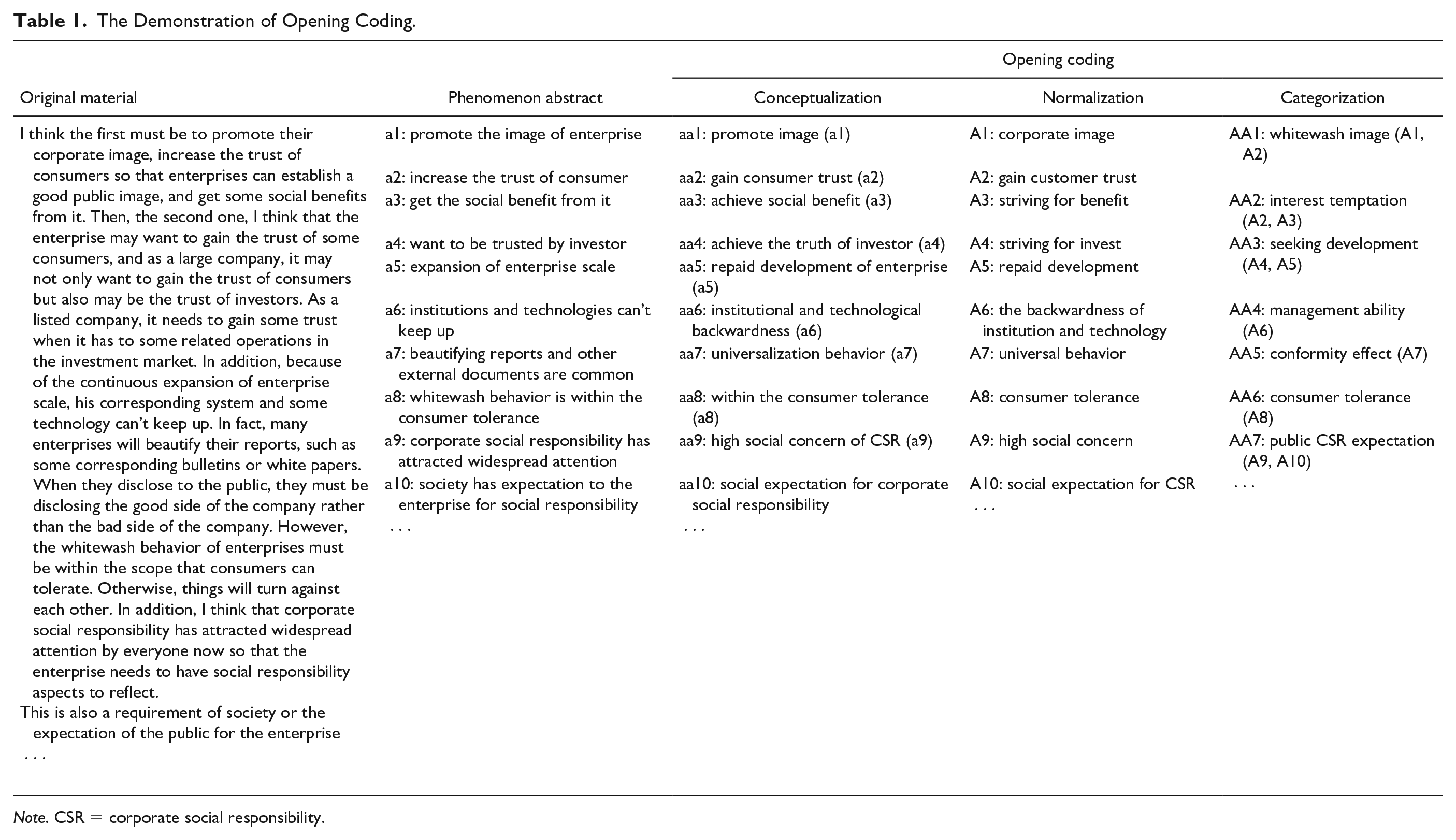
Note. CSR = corporate social responsibility.
Spindle Coding
Spindle coding, the second stage of the coding process, refers to the process of discovering the paradigm model and establishing the correlation between categories, and then further induces the main categories. Besides, the paradigm model of this process is pointed as follows: antecedent conditions → theoretical phenomena → context background → mediated conditions → action/interaction strategy → result. Through the repeated comparison, analysis and mining of the concepts and categories extracted from original data based on the process, it was found that 22 categories could be classified into six main categories, including ability limitation, external pressure promotion, lack of supervision, the sincerity of keeping the promise, speculation, and external tolerance. The detailed content of the main categories is shown in Table 2. Each main category can be verified by the evidence chain of the paradigm model. Taking speculation as an example, the antecedent conditions were whitewash image, seeking development, and interest temptation; the theoretical phenomena was the external instability attribution of corporate hypocrisy in CSR; the context background was lack of policy, industry nature, lack of morality, and organizational characteristics; the mediated conditions were public CSR expectation and competitive pressure; the action/interaction strategy was conformity effect and fluke psychology; and the result was speculation.
Main Categories and the Connotation of Categories.

Note. CSR = corporate social responsibility.
Selective Coding
Selective coding refers to the systematic analysis and comparison of the categories obtained by open coding and the main categories obtained by spindle coding to obtain a highly generalized and inclusive core category, and to establish a corresponding storyline around the core category so that the relevant categories and concepts can form a systematic theoretical framework based on the storyline, and thus obtain the corresponding structural model (Strauss & Corbin, 1990). Meanwhile, to better distinguish the category nature and interdependence of category factors, attribution theory points out that antecedent factors can be classified into 2 × 2 matrices based on control points (internal or external) and stability (stable or unstable) in causal dimension (Weiner, 1986). Therefore, according to the suggestion about 2 (internal, external) × 2 (stable, unstable) causal dimension matrix classification of attribution theory, this study summarized six main categories into a core category, namely, the employee attribution of corporate hypocrisy in CSR. The detailed two-dimensional structural model of the relationship of employee attribution about corporate hypocrisy in CSR is shown in Figure 1.

Two-dimensional structure model of employee attributions for corporate hypocrisy in CSR.
The storyline around the core category of “the employee attributions of corporate hypocrisy in CSR” could be summarized as following: Under the conditions of limited management ability, moral ability, and development ability, after balancing the driving by external pressure (such as public CSR expectation, competitive pressure) and the fact circumstance (such as the lack of relevant policies, the external environment of loopholes about supervision and the tolerance level of the public and consumers), enterprises with the fluke psychology choose to adopt different types of corporate hypocrisy in CSR within their acceptable degree by following other enterprises.
Model Explanation
Our study proposed the two-dimensional structure model of employee attributions for corporate hypocrisy in CSR, and this model involved six main categories containing 22 categories induced previously. Therefore, this study would explain the two-dimensional stricture model around six categories (ability limitation, the sincerity of keeping the promise, speculation, external pressure promotion, lack of supervision, and external tolerance) and its corresponding four attribution relationship types. The six major propositional relationships explained are as follows: capacity limitation → corporate hypocrisy in CSR; sincerity of keeping promise → corporate hypocrisy in CSR; speculation → corporate hypocrisy in CSR; external pressure promotion → corporate hypocrisy in CSR; lack of supervision → corporate hypocrisy in CSR; external tolerance → corporate hypocrisy in CSR.
Basic Proposition 1: Capacity Limitation → Corporate Hypocrisy in CSR
This proposition related to the internal stable employee attribution of corporate hypocrisy in CSR mainly consisted of eight impact paths.
Path 1, management capacity negatively impacted corporate hypocrisy in CSR. That is, the low level of management capacity would limit the ability of enterprises to perform their responsibility, and thus would lead to the arising of corporate hypocrisy in CSR.
Path 2, short-sightedness positively impacted corporate hypocrisy in CSR. When the sightedness of enterprises overly focused on the immediate benefits and short-term goals, enterprises would lack the awareness of overall consideration and long-term vision. Therefore, the phenomenon of corporate hypocrisy in CSR has easily emerged in these enterprises.
Path 3, organizational nature had a significant impact on corporate hypocrisy in CSR. The characteristics of enterprises, such as nature, type, and organization structure, would endow the enterprise with higher standards of social responsibility obligations or weaken the ability of the enterprise to fulfill social responsibility, thus making the enterprise choose or passively take such behaviors.
Path 4, result orientation had a positive influence on corporate hypocrisy in CSR. Enterprises with “result orientation” as corporate culture or code of conduct would form an atmosphere of unscrupulous means to achieve the goal among employees and make employees neglect social responsibility. Meanwhile, the value of “result orientation” also made enterprises acquiesce to the occurrence of corporate hypocrisy in CSR with controllable negative effects.
Path 5, whitewash image positively impacted corporate hypocrisy in CSR. Under the circumstance that repaid the development of media and quick dissemination of information, all enterprises should do a good job in image construction. However, to beauty external image with lower cost or cover up mistakes for the truth of public, enterprises intended to take corporate hypocrisy behaviors in corporate social responsibility.
Path 6, lack of morality also had a positive influence on corporate hypocrisy in corporate social responsibility. In other words, enterprises lacked the moral sense and self-discipline ability of social responsibility; they regarded the legal bottom line as the bottom line or no bottom line and thus allowed themselves to perform corporate hypocrisy in corporate social responsibility.
Path 7, seeking development was positively related to corporate hypocrisy in CSR. To achieve the goal of developing rapid, seizing the market, and expanding the scale, enterprises followed the principle of “develop first, deal with later” to grow savagely, or even to compete improperly, which leads to corporate hypocrisy in corporate social responsibility.
Path 8, interest temptation positively influences corporate hypocrisy in CSR. The hypocritical corporate activities possibly brought the enterprise huge benefits or the compressible costs, and these temptations induced enterprises choose corporate hypocrisy in CSR that can maximize the visible benefits.
Basic Proposition 2: Sincerity of Keeping Promise → Corporate Hypocrisy in CSR
Basic Proposition 2 involved the internal stable employees’ attributions of corporate hypocrisy in CSR, and it consisted of four effect paths. The effect paths were follows:
Path 1, moral disengagement positively affects corporate hypocrisy in CSR. Moral disengagement means that enterprises would take rationalized explanations for their corporate hypocrisy in CSR and find other responsible parties, thus decrease their feeling of guilt. However, the occurrence probability of corporate hypocrisy would increase under the condition of moral disengagement occurred more frequently.
Path 2, hypocrisy degree had a negative effect on corporate hypocrisy in CSR. The judgment of the influence degree and the nature severity of corporate hypocritical behaviors would affect its final decision-making on the relevant behavior. When enterprises had the low cognition of hypocrisy about a certain behavior, they would also have a low perception of estimated impact and severity brought by this behavior, so that enterprises may be likely to perform corporate hypocrisy in CSR.
Path 3, pro-organization motivation significantly influences corporate hypocrisy in CSR, that is, for maintaining the customer relationship and supplier relationship in workplaces, employees would take corporate hypocrisy in CSR, damaging other stakeholders’ benefits.
Path 4, the type of corporate hypocrisy in CSR also had a significant effect on corporate hypocrisy in CSR. Corporate hypocrisy in different areas of social responsibility formed different types of corporate hypocrisy in CSR, such as business hypocrisy, charity hypocrisy. Besides, these different types of corporate hypocrisy in CSR had an effect on the attitude to adopt hypocritical behavior. For example, compared with the basic main business type of hypocrisy, enterprises were more intended to take the charitable type of hypocrisy, because the risk of charity hypocrisy is lower.
Basic Proposition 3: Speculation → Corporate Hypocrisy in CSR
Related to the internal stable employees’ attributions of corporate hypocrisy in CSR, Basic Proposition 3 consisted of two effect paths consisted. The two effect paths were as shown below:
Path 1, community effect had a positive influence on corporate hypocrisy in CSR. Involved in the environment of low cost, generalization, and popularity of corporate hypocrisy in CSR, enterprises may imitate other enterprises and choose to engage in corporate hypocrisy when they need to fulfill CSR.
Path 2, fluke psychology positive impact on corporate hypocrisy in CSR. When enterprises think that their fraud behavior cannot be found by the public or do not cause fatal injury for them, fluke psychology would be stronger. Besides, the lower the concerns and psychological costs of enterprises for corporate hypocrisy, the enterprise would be more likely to induce corporate hypocrisy in CSR.
Basic Proposition 4: External Pressure Promotion → Corporate Hypocrisy in CSR
Basic Proposition 4 involved external stable employees’ attributions of corporate hypocrisy in CSR, consisting of three effect paths.
Path 1, public CSR expectation positive impact on corporate hypocrisy in CSR. With the rise of the corporate social responsibility movement in the world, CSR has become an important standard for the public to measure and evaluate enterprises. When the public’s expectations of CSR are higher, and the preset standards would be more stringent. Under this pressure and for the consideration of balancing their interests and capabilities, enterprises would have a higher probability of choosing corporate hypocrisy in CSR.
Path 2, industry nature had a significant effect on corporate hypocrisy in CSR. The nature of the industry determines the profit model and even the survival of the enterprise, for this, the enterprise easily involved in a dilemma between the implementation of CSR and the development and even survival of the enterprise, so that they would be forced to make concessions to a certain extent and choose fraud or hypocritical behavior.
Path 3, competitive pressure had a positive relationship with corporate hypocrisy in CSR. Market competition is changing rapidly, and competitors are everywhere. In the process of market competition, the enterprise was faced with more competitive pressure; it was more likely to take fraud or hypocritical behavior in response to the fierce competition.
Basic Proposition 5: Lack of Supervision → Corporate Hypocrisy in CSR
Basic Proposition 5 was the same as Basic Proposition 4, and it is also related to external stable employees’ attributions of corporate hypocrisy in CSR, but it consisted of two effect paths. The two effect paths were as follows:
Path 1, lack of policy had a positive influence on corporate hypocrisy in CSR. At present, the outsides had not formulated perfect policies, such as lack of punishing regulations or existing vague definitions of relevant behaviors, the lack of policy could decrease the cost of implementing corporate hypocrisy in CSR, and this condition thus encouraged enterprises to engage in corporate hypocrisy in CSR.
Path 2, external supervision negative influence of corporate hypocrisy in CSR. When the external supervision of corporate fraud was reduced, it would enhance the opportunistic tendency of enterprises and reduce the cost of making mistakes. Therefore, enterprises would increase the probability of taking corporate hypocrisy.
Basic Proposition 6: External Tolerance → Corporate Hypocrisy in CSR
The last basic proposition referred to external unstable employees’ attributions of corporate hypocrisy in CSR and it mainly consisted of three effect paths. The explanation of effect paths was shown as below:
Path 1, public response had a significant influence on corporate hypocrisy in CSR. The public’s cognition, evaluation, and behavior tendency of a certain kind of corporate hypocrisy in CSR would affect the final decision of the enterprise on whether to implement such behavior. In addition, the public response was more intense, the rejection was higher, and enterprises would have the greater psychological burden and perceived higher speculative risk so that they would choose to reduce the occurrence possibility of corporate hypocrisy in CSR to avoid public discontent.
Path 2, consumer tolerance positively affects corporate hypocrisy in CSR; namely, the high level of consumer tolerance means that they had low resentment and weak resistance for a certain kind of corporate hypocrisy in CSR, and enterprises would be likely to take actions in this behavior.
Path 3, media attention also had a significant effect on corporate hypocrisy in CSR. Different focus points of media on corporate social responsibility would affect the attitude of enterprises to corporate hypocrisy in CSR, such as the media more focused on the enterprises’ CSR theme background; it would be more likely to encourage enterprises to take fraud or hypocritical behavior to win the favor of media. However, the media more focused on the actual performance of corporate social responsibility, and it added the potential cost of corporate hypocrisy so that enterprises would choose to carry out the responsibility in CSR and avoid corporate hypocrisy in CSR.
Theoretical Model of Relational Mechanism
The Construction of the Theoretical Model of Relationship Mechanism
In the fourth part of this study, based on the grounded theory and attribution theory division model, we constructed a two-dimensional structure model of corporate hypocrisy in CSR from the perspective of employee attribution. Besides, this study explicated the subordination structure relationship between each category, the main category, and the core category, as well as the main proposition relationship. To better show the internal mechanism of the main related categories and main categories for corporate hypocrisy in CSR, and to mine the mediated variables and moderated variables in the structural relationship model, this study proposed the employee attribution model of corporate hypocrisy in CSR based on the analysis of existing data. The specific model was as shown in Figure 2.

The theoretical model of relationship mechanism for employee attribution of corporate hypocrisy in CSR.
The Explanation of Theoretical Model of Relationship Mechanism
As the main relationship effect of factor categories (external pressure promotion, lack of supervision, interest temptation, lack of morality, organizational nature, capacity limitation, sincerity of keeping promise, speculation, and external toleration) on corporate hypocrisy in CSR had been discussed in structure model one by one, it will not be discussed here again. The following will mainly explain the moderate effect and the moderated mediation relationship in the theoretical model.
First, the factors of organizational nature and capacity limitation are depended on its institutional form and practical capacity, and they are all internal stable factors in perspective of employee attribution. Thus, they are not moderated by other factors in the model and the significant impact of corporate hypocrisy in CSR.
Second, external tolerance moderates the impact of external pressure promotion, lack of supervision, interest temptation, and lack of morality on corporate hypocrisy in CSR. The high level of external tolerance means that consumers, the public, and media have more inclusive of corporate hypocrisy in CSR. Therefore, the pressure of external social responsibility, the lack of supervision, the temptation of interests, and the lack of its morality will more likely promote enterprises to choose hypocritical behavior under the lower level of external tolerance.
Third, the sincerity of keeping promise also moderates the impact of external pressure promotion, lack of supervision, interest temptation, and lack of morality on corporate hypocrisy in CSR. The real sincerity of enterprises in fulfilling their social responsibility commitments is less, and we proposed that these enterprises lacked the determination of firm commitment and were good at taking moral disengagement for themselves so that the pressure of external social responsibility, the lack of supervision, the temptation of interests, and the lack of its morality would encourage enterprises with less sincerity of keeping promises to implement corporate hypocrisy in CSR.
Fourth, speculation as a moderator plays a role in the positive relationships between external pressure promotion, lack of supervision, interest temptation, lack of morality, and corporate hypocrisy in CSR. Enterprises have more serious fluke psychology and more obvious conformity effect, have more intention to speculate and neglect the risk of taking fraud behavior, and have a high possibility to take corporate hypocrisy in CSR when facing the condition of external pressure promotion, lack of supervision, interest temptation, and lack of morality.
Fifth, speculation has a mediated effect on the moderated relationship between external tolerance and corporate hypocrisy in CSR. In the circumstance of high external tolerance, consumers, the public, the media, and other social sectors have more high acceptance and less resistance response for corporate hypocrisy in CSR. Therefore, the high external tolerance will raise the fluke psychology as well as reduce the psychological presupposition cost of fraud and the risk prediction; besides, enterprises have strength herd mentality to imitate other enterprises; in turn, enterprises will be likely to adopt corporate hypocrisy in CSR under the condition of external pressure promotion, lack of supervision, interest temptation, and lack of morality.
Results and Discussion
Research Results
Based on the grounded theory research method, this study explored the employees’ attributions of corporate hypocrisy in CSR. Through the process of data collection, one-to-one interview, three-level coding, and other procedures, we constructed a two-dimensional structural model of corporate hypocrisy in CSR under the perspective of employee attribution, and this two-dimensional model included six main categories, namely, ability limitation, external pressure promotion, lack of supervision, sincerity of keeping promise, speculation, and external tolerance. What is more, we proposed six basic propositions around the six main categories, the basic propositions are as follows: (a) capacity limitation → corporate hypocrisy in CSR; (b) sincerity of keeping promise → corporate hypocrisy in CSR; (c) speculation → corporate hypocrisy in CSR; (d) external pressure promotion → corporate hypocrisy in CSR; (e) lack of supervision → corporate hypocrisy in CSR; and (f) external tolerance → corporate hypocrisy in CSR.
Among of them, Proposition 1 involves the internal stable employee attributions of corporate hypocrisy in CSR, and the main category capacity limitation includes eight subcategories: management ability, short-sightedness, organizational nature, result orientation, whitewash image, lack of morality, seeking development and interest temptation. Basic Propositions 2 and 3 are related to internal unstable employee attributions of corporate hypocrisy in CSR; the main category sincerity of keeping promise includes four subcategories: hypocrisy degree, moral disengagement, pro-social motivation and the type of corporate hypocrisy in CSR. The main category speculation includes two categories: conformity effect and fluke psychology. Basic Propositions 4 and 5 involves external stable employee attributions of corporate hypocrisy in CSR, and the main categories are external pressure promotion and lack of supervision. The main category of external pressure promotion includes three subcategories: public CSR promotion, industry nature, and competitive pressure. The main category lack of supervision includes two subcategories: lack of policy and external supervision. The last basic proposition involves external unstable employee attributions of corporate hypocrisy in CSR, and the main category external tolerance includes three subcategories: public response, consumer tolerance, and media attention.
Moreover, we further explored the moderating and mediating effects in the categories and found out the moderating effects of external tolerance, speculation, and the sincerity of keeping the promise on some of the main effects. In detail, the categories of unstable attribution (such as external pressure promotion, lack of supervision, interest temptation, and lack of morality) had a different effect on corporate hypocrisy in CSR under the different levels of external tolerance, speculation, and sincerity of keeping the promise. Taking consumer tolerance in external tolerance as an example, enterprises will learn the consumer response to corporate hypocrisy in CSR through observing consumer responses to other enterprises after making the decision. When enterprises found that other enterprises taking corporate hypocrisy in CSR were seriously protested by consumers, and even greatly affect the sales data and the market is severely damaged, this cognition would increase enterprises’ psychological error cost, and they should think twice and weigh the pros and cons to reduce the probability of corporate hypocrisy in CSR when enterprises were in the face of external pressure promotion, lack of supervision, interest temptation and lack of morality. In contrast, when enterprise found that consumers care less about the corporate hypocrisy of a certain enterprise in the society and give a certain degree of understanding and tolerance, enterprises thus possible choose to perform corporate hypocrisy in CSR under the conditions of external pressure promotion, lack of supervision, interest temptation, and lack of morality. There is also relevant supporting evidence in the original data: “I think this form (corporate hypocrisy in CSR) may be a corresponding whitewash and beautification within the tolerance of consumers.”
Research Implications
Our study conclusions came from corporate practices, and we constructed a relational theory model based on the existing basic theory; therefore, our study has certain theoretical and practical implications.
The theoretical contributions of this study mainly include the following three aspects. First, this study enriches the research results of CSR dark side and has a more comprehensive understanding of corporate hypocrisy in CSR. This study also expands the research scope of Groza et al. (2011) and responds to the appeal of Arli et al. (2017) that more research pays more attention to corporate hypocrisy in CSR. Second, this study expands the scope of the attribution of corporate hypocrisy and explores the antecedent of corporate hypocrisy in CSR from the perspective of employees for the first time. Previous studies mainly discussed antecedents of corporate hypocrisy in CSR from the perspective of the enterprise or the consumer. Moreover, past research less focuses on the role of the vital stakeholder (employee) in the area of corporate hypocrisy in CSR and neglecting the employee’s attribution model and specific path of corporate hypocrisy in CSR. Scheidler et al. (2019) emphasize the important relationship between employees and corporate hypocrisy in CSR, and our study further enriches the role of employees in corporate hypocrisy. Third, this study is further to discuss the type of attribution factors and their interaction relationship and constructed the attribution mechanism model of corporate hypocrisy in CSR from the respective of the employee. Besides, the study constructs a two-dimensional model of employee attributions for corporate hypocrisy in CSR and responds to Weiner’s (1986) call for attribution of the antecedent. Moreover, our study can be used for reference in other perspectives of corporate hypocrisy attribution and help researchers better understand the interdependence of antecedents. Our study results enrich related theories and lay a foundation for further research.
This study not only contributes to the relevant theories but also provides a guide in practice. First, our research results can provide suggestions for the formulation of the CSR strategy. Corporate hypocrisy in CSR is gradually becoming a common phenomenon in enterprises. When making the CSR strategy, corporates should be aware of the negative impact of corporate hypocrisy in CSR. The objective of the CSR strategy is to help the organization achieve long-term sustainable development. Second, the results of the study help organizations avoid the occurrence of corporate hypocrisy in CSR. Our study explains the employee attribution paths corporate hypocrisy in CSR, and it provides practical guidance for corporate social responsibility management. In the process of corporate development, enterprises need to continually promote their ability and sincerity of fulfilling corporate social responsibility, reduce blind development, and do an excellent job in internal governance. Furthermore, enterprises should balance the external pressure from all stakeholders, and the relationship between external tolerance and its speculation, and they also should improve their quality and decrease the possibility of corporate hypocrisy in CSR.
Meanwhile, this study can warn potential targets of corporate hypocrisy in CSR and encourage enterprises to supervisor their CSR implementation for long-term sustainable development goals and thus improve social welfare. For reducing the adverse external effects of corporate hypocrisy in CSR as much as possible, all sectors of society can carry out corresponding regulation and control work of corporate hypocrisy in CSR according to the employee attribution paths. For example, the media can pay more attention to the corporate hypocrisy in CSR, the government can strengthen supervision, the consumer needs to increase the awareness of corporate social responsibility, and the focus of multistakeholders plays a deterrent role for fraudulent enterprises, which thus diminish the phenomenon of corporate hypocrisy in CSR.
Research Limitations
Although this study adopts the rigorous “grounded theory” research method to conduct exploratory research and obtains many useful research conclusions contributing to both theory and practice, this study still has some certain limitations.
First, using the methods of grounded theory, the situation of personal subjective assumptions, expression differences, and even selective memory is inevitable in the process of three-level coding of the original data. In do so to solve it, further research can further improve the research validity and enhance the research conclusion by increasing the sample object, enriching the original data, and continuously demonstrating and falsifying.
Second, in this study, the basic propositions of the attribution theory model have not been verified by quantitative data. Based on the existing qualitative research, we can use quantitative data analysis to carry out empirical research, verify the influence relationship between various factors, and explore more factor interactions in the future.
Footnotes
Author Contributions
H.Z. contributed to conceptualization, review, funding acquisition, and supervision; J.X. contributed to conceptualization, drafted methodology, collected data and analyzed, and wrote original draft; Y.C. contributed to conceptualization, drafted methodology, collected data and analyzed, and wrote original draft; W.S. collected data and analyzed.
Declaration of Conflicting Interests
The author(s) declared no potential conflicts of interest with respect to the research, authorship, and/or publication of this article.
Funding
The author(s) disclosed receipt of the following financial support for the research, authorship, and/or publication of this article: This research was funded by National Natural Science Foundation of China (71772116).
