




Abstract
The Chinese government has implemented several policies to promote the development of childcare services. However, Chinese childcare services are facing a dilemma rather than flourishing. Against this background, this study intends to reveal the development process of the Chinese childcare service from prosperity to stagnation, the dilemmas that arise during this process, and the reasons why they face these dilemmas. Based on the grounded theory methodology, we interviewed 13 childcare institutions in Wuhan, coded the data, and formed a theoretical framework. We found that childcare services have undergone four development stages: rise, face dilemmas, attempt to Re-Rise, and Prefer to Stable. During the development process, childcare services are faced with four dilemmas: the external dilemma of lacking support, the internal dilemma in operation, the teacher dilemma of low quality and high turnover, and the parent dilemma of demands that cannot be met. We analyzed the reasons behind these issues and proposed suggestions to help Chinese childcare services boom again.
Keywords
Introduction
In recent years, the size of Chinese families has gradually decreased, the family structure has shifted to a nuclear family, and the number of dual-income families has increased. This has resulted in a shortage of people disposing of the energy and time to care for infants and toddlers from birth to the age of 3 (Wang, 2023). Specifically, an increasing shortage of resources to care for infants and toddlers within the family has been witnessed, -as well as a lack of social support to care for infants and toddlers outside the family (J. G. Zhao & Wang, 2018). Moreover, it is important to note that the care for infants and toddlers affects family fertility. For example, Wood and Neels (2019) carried out research in Belgium and found more formal childcare services help encourage local dual-earner fertility. In China, a recent survey (X. Q. Zhang & Song, 2024) found the Work-Family conflict faced by women decreased their willingness to have more children, which would be resolved with childcare support. Against this background, the Chinese government attaches great importance to establishing a high-quality birth-to-child system. This is not only to address the problem of low fertility but also to enable children aged 0 to 3 years old to develop their physical and mental well-being through sufficient care.
In China, childcare services refer to the provision of care and education for infants and toddlers from birth to 3 years of age in childcare institutions (Yang, 2018). To promote the development of childcare services, the Chinese government has issued a series of guidance and policies, as well as explored and offered various types of childcare services. For example, General Office of the State Council (2019) established Guideline on promoting the development of care services for infants and young children under 3 years old, the national guidance for developing childcare services. Guided by this policy, the Nanjing Government (2014) issued measures for establishing and managing childcare institutions. Shanghai (2018) and the Sichuan governments (2019) provided full-time, part-time, and hourly childcare services.
Based on these explorations, China has developed a childcare service system. Wei (2018) surveyed institutions that provide childcare services in China and categorized them according to location and funding sources. Depending on where childcare services are provided, childcare institutions can be categorized into three types of centers: childcare, family childcare, and kindergarten-based childcare centers. The first ones are market institutions that specialize in early education and care for children aged 0 to 3; family childcare centers refer to institutions that provide care for infants and toddlers in the homes of children or caregivers; and kindergarten-based childcare centers refer to institutions that offer additional childcare rooms for infants and toddlers under 3 years of age (in China, kindergarten refers to providing education and care for children from 3 to 6 years old.). Depending on the funding source, childcare services are divided into Public, Private, and State-supported. Public childcare institutions are part of the public services provided by the government and are established and operated with government funds. State-supported private childcare institutions refer to government and private individual funding and the management of childcare. In other cases, the government provides funds and private individuals are responsible for their operations and management. Private childcare institutions are established by individuals who aim to meet the parents’ needs and are relatively expensive. We selected different types of childcare institutions to thoroughly explore the current status of childcare services.
Following the establishment of numerous childcare institutions, the Chinese government issued a series of policies to support their development. The State Council (2021) has proposed improving subsidy support to Optimizing fertility policy and promoting balanced population development. The National Health Commission (2019a, b) issued Standards for childcare facilities (Trial) and Management regulations of childcare service (Trial). Due to strong national policy support, childcare institutions in China have been booming. Interestingly, despite favorable policies, childcare services still fall into trouble. For example, Wei (2018) found that childcare services provided by institutions cannot meet the needs of customers because of high operating costs, frequent staff leave and so on. In addition to the problem of operational difficulties, Li et al. (2017) found some childcare institutions even had to close due to financial difficulties. Moreover, the development of childcare services is constrained by internal and external factors, such as funds and facilities, staff, and public policies (Y. Chen et al., 2022; Pan, 2020). Although these studies have explored the problems childcare services encounter, they only investigated problems of childcare institutions at a specific stage rather than connecting with the overall development of the Chinese childcare service. The details of the development process of Chinese childcare service, the dilemmas arising during this process, and why it is facing such issues have rarely been mentioned. Based on the gaps in the previous research, this study attempts to answer the following three questions.
Answering these questions not only helps us understand the overall development of Chinese childcare, but also clarifies the relationship among the development stages, the problems at each stage and the reasons behind them. It provides Chinese experience for the development of childcare services in the global context, and a new perspective for other countries to reflect on their childcare services.
Methods
This study applies a methodological approach based on grounded theory, which is a general methodology for generating theory from data that includes collecting, coding, and analyzing the data (Strauss & Corbin, 1990). The investigator should conduct the study without pre-existing conceptualizations and form a theoretical framework by systematically gathering and analyzing the data (Noble & Mitchell, 2016). This study examined 13 childcare institutions in Wuhan, Hubei Province, China. The concrete information about samples, data collection, and data analysis are as follows.
Sample
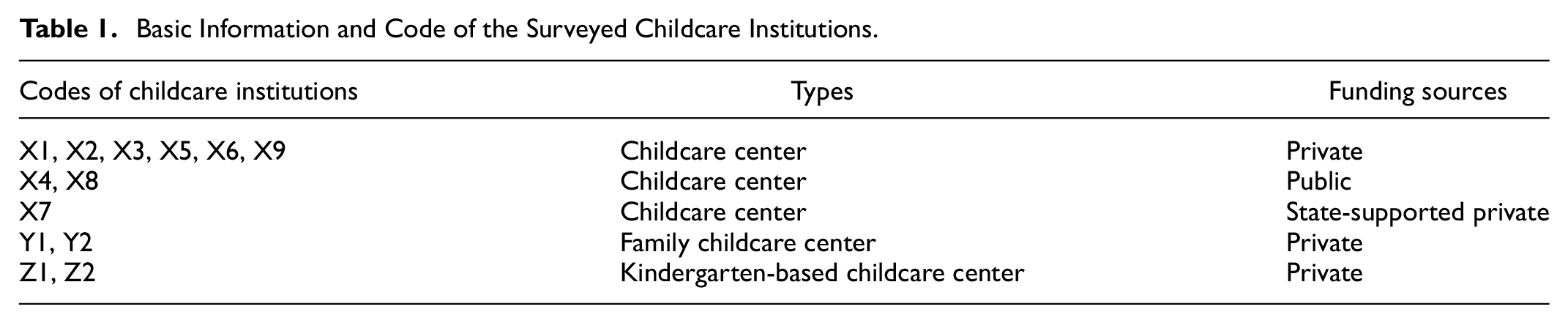
The samples in this study were all from Wuhan, the capital city of the Hubei Province, located in Central China. It is a city with various districts, each with different levels of economic development and offering diverse types of childcare institutions. To ensure the diversity of sample sources, we used the classification of childcare services in the previous study (Wei, 2018). We randomly selected childcare institutions with different funding sources in three main types, which included childcare, family childcare, and kindergarten-based childcare centers, and represented them as X, Y, and Z, respectively. Basic information about the 13 childcare institutions is presented in Table 1. After selecting the childcare institutions, we chose the leader of every childcare institution as the interviewee. Because these leaders not only have decades of practical experience in early education and childcare, but also are responsible for the management and operation of childcare institutions. Their teaching and management experiences can help us to get a full picture of the current situation in childcare institutions.
Basic Information and Code of the Surveyed Childcare Institutions.
Data Collection
Our research team conducted semi-structure interviews to collect data. The interview protocols include three parts: “the basic situation of childcare institution,”“the work situation of childcare institution,” and “the willingness to expand childcare service.” Before collecting data, we firstly acquired the ethical approval and verbal consent of each interviewee. Then the leader of the research team and two research assistants attended the interview. The leader is responsible for one-on-one interviews with the childcare institution provider. At the same time, research assistants used tape recorders and notebooks to record the interview. Each interview lasted 1 to 1.5 hr.
Data Analysis
We transcribed 13 audio interviews and the final transcription was about 150,000 words. The grounded theoretical analysis method introduced by Qualitative research in social sciences (X. M. Chen, 2000), and the coding paradigm pattern theory in the Basics of qualitative research (Strauss & Corbin, 1990) were used to analyze and encode the interview data. During data analysis, one researcher used NVivo12.0 to code the data, and another team researcher checked and added the codes to prevent subjectivity. Data analysis was divided into three steps: open coding, axial coding, and selective coding. This process is summarized in Table 2.
Process of Data Analysis.

Open Coding
Open coding includes coding, conceptualization, and categorization. The process of forming the category of “Teacher factors” is employed as an example to show the data analysis process. The results are summarized in Table 3.
The Example of the Open Coding Process.

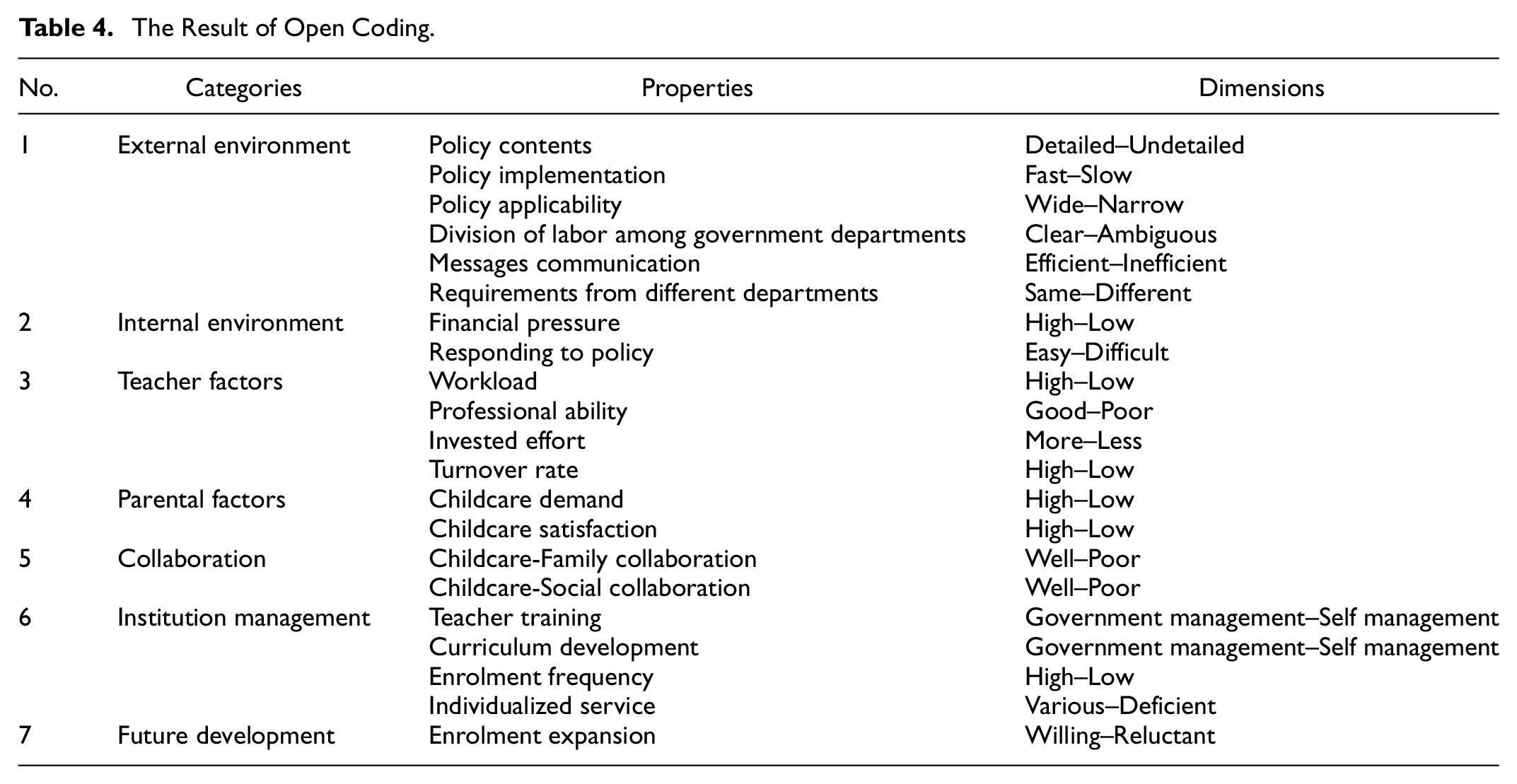
Seven categories were formed using a process similar to that described above. Table 4 shows the results of open coding.
The Result of Open Coding.
Axial Coding
First, we identified this study’s central phenomenon, which must satisfy the requirements of being related to all categories. Based on this principle, we choose the current situation of childcare service—Chinese childcare service is facing a dilemma—as the central “Phenomenon.” This is also the core category of this study, and all other categories are relevant to it. Subsequently, according to the characteristics of each category and its relationship to the core category, we mapped these categories to the relationship model of “Causal condition—Phenomena—Context—Intervening condition—Strategy—Consequence” (Strauss & Corbin, 1990).
The external and internal environments represent the background of childcare service, so they are mapped into the “Context” of the model. Meanwhile, the external and internal environments and teacher-related factors influence the dilemmas faced by childcare services. Thus, they correspond to the “Causal condition” of the model. Institution management represents the set of strategies that childcare institutions take to resolve dilemmas, corresponding to the model’s “Strategy.” Parental factors and collaboration play a moderating role and, although not directly linked to the dilemmas faced by childcare services, they influence the effectiveness of strategies. Thus, they indirectly affect whether childcare institutions can overcome these dilemmas. Therefore, they correspond to the “Intervening condition” of the model. Lastly, the willingness for future development consists of the response of childcare service to the dilemmas it faces, corresponding to the “Consequence” of the model. Figure 1 shows the results of axial coding.

The result of axial coding.
Selective Coding
The core category and the study’s core subject is “Chinese childcare service is facing a dilemma.” Our research will focus on this core subject to reveal which dilemmas childcare services are facing and the underlying reasons. In order to do this, we must first explore the overall development of childcare services in China. The dilemma that childcare services face has emerged with the development process rather than arising independently. Revealing the development of Chinese childcare services not only helps us understand the background of the faced dilemmas, but also answers our study’s Q1, which has been overlooked by previous research.
The development of Chinese childcare services and the dilemmas they are facing are closely related to the seven categories formed during the open coding process. We developed a theoretical framework based on the complex relationships between development, the seven categories, and the dilemmas. This is shown in Figure 2. The details of the theoretical framework are explained in the Results and Discussion sections.

A theoretical framework of the dilemma of Chinese childcare service.
Results
In this section, we will reveal the overall development of childcare services and the dilemmas childcare services face.
The Development of Childcare Service
The first research question is How did childcare services develop in China? This study found the Chinese childcare service went through four development stages: Rise, Face dilemmas, Attempt to Re-Rise, and Prefer to Stable.
Rise
Under a favorable external policy environment, many practitioners in preschool education have poured into childcare services. Childcare providers have implemented numerous strategies, such as staff training, learning about childcare experiences from other countries, and offering individual services to attract parents. These efforts have contributed to the Rise of childcare services in China.
Face Dilemmas
However, three factors—external environment, internal environment, and teacher factors—interact and bring many difficulties to childcare services. Specifically, they face three dilemmas: the external dilemma of lack of support, the internal dilemma of financial pressure and difficulties in meeting policy requirements, and the teacher dilemma of low quality and high turnover.
Attempt to Re-Rise
As an attempt to Re-Rise, childcare services adopt some positive Strategies related to improving management. These strategies include expanding enrolment, training staff, and designing new curricula. During the Re-Rise process, parents and collaborations both represent Intervening conditions that influence management strategies. For example, whether parents’ expectations are met and whether good collaboration with communities can be built, affect the effectiveness of the strategy. However, these strategies cannot meet the increasing demands of parents, which causes them to face a parent-service dilemma.
Prefer to Stable
Under the influence of these four dilemmas, childcare providers hold conservative views of future development and they prefer to maintain stability rather than grow as rapidly as they initially did.
Dilemmas Faced by Childcare Service
In this part, we will answer the second research question Which dilemmas have Chinese childcare services faced during their development? Our study found that childcare services faced four dilemmas associated with external support, internal operation, teachers and parents.
The External Dilemma of Lacking Support
Lack of policy and government support is the external dilemma for childcare institutions.
Lack of Policy Support
The lack of policy support includes insufficient operation guidance, and unimplemented measures.
Firstly, policies on service quality standards and fees management are missing. This makes it difficult for childcare institutions to obtain clear guidance. For example, childcare policies lack clear standards for charging management, resulting in childcare centers struggling to solve refund problems.
Children aged 0-3 years often ask for leave for various reasons, and there are no policy standards for chargeback. It is difficult to solve parents’ requirements of returning their fees. (Interview material X5)
Furthermore, said policy requires rapid implementation; however, taking the distribution of subsidies as an example, we found that applying for subsidies is a lengthy process. If childcare institutions want to be subsidized, many checks should be carried out on whether they meet the application requirements, which takes a significant amount of time, as well as obtaining permission to gain subsidies and waiting for subsidies to arrive at their accounts. Many institutions were still waiting.
During the epidemic, there was a slight subsidy, but at other times there was no subsidy. We don’t need anything else, at least the policy promised enrollment subsidy should be distributed so that everyone has the motivation to continue. (Interview material Z1)
Lack of Government Support
Childcare institutions reflected that they lacked efficient government support in terms of registration and operation.
In China, childcare institutions usually want to register as inclusive childcare service, which is provided to the public at an affordable price and with high quality (Liu, 2022). Because when a childcare center is registered as an inclusive childcare institution after being assessed by the government, it can receive government subsidies (C. X. Zhao, 2023). However, our study found childcare providers struggled to be approved as an inclusive childcare service.
When I ask for help about how to become an inclusive childcare institution. Government departments often pass responsibility on to each other. It is not because they ignore the problem or do not want assistance, but because they were unsure of who should be responsible for this. They suggested that I contact another department for help. The other departments gave me the same answer. This cycle continues, and eventually, there is no way to answer my questions. (Interview material, X2)
Moreover, childcare providers reflected that the process of obtaining final operation permission is fraught with difficulties and lacks support.
It took us a long time to apply for an operation license because communication between the State Administration for Industry and Commerce and the National Health Commission was too slow. We passed the National Health Commission assessments, but the other department did not receive the relevant information, so we could not obtain the license. (Interview material X5) We have a special situation: our childcare center is located in a villa. Due to limitations in area, capacity, and fire safety, we can only apply for a business license now instead of a childcare certificate. We have reported this situation to the National Health Commission, and they have expressed their understanding and recognition of our efforts in childcare. However, many policies are still being adjusted and they are unable to handle these problems. So, we are stuck in the process of obtaining certification. (Interview material Y2)
The Internal Dilemma in Operation
In their internal operation, they face the problems of financial pressure and difficulties in meeting policy requirements.
Financial Pressure
The childcare institutions surveyed generally faced high financial pressure; for example, certain kindergarten-based childcare facilities have indicated that they must subsidize their childcare rooms with the money they earn from kindergarten.
Running a childcare room is challenging because of insufficient income. Without money, it is impossible to maintain operations or provide high-quality services. I use money from kindergarten to subsidize childcare classes. I am passionate about childcare services, but if there is no profit at all times, I will not be motivated to continue running the childcare room. (Interview material X5)
Difficulty in Meeting the Policy Requirements
National Health Commission (2023) provides healthcare and safe operational standards to manage the establishment of childcare institutions. However, our study found if childcare institutions operate according to the policy requirements, they will be at a loss and struggling to maintain basic operations. As the provider said: According to the policy requirements for the number of teachers needed in a room, we require two teachers and two caregivers in one room. If we do not consider other costs, charging 3,000 RMB monthly only covers staff salaries. If we tend to meet the requirements of providing high-quality childcare, we need to charge 4,000 RMB per month. (Interview material X8)
The Teacher Dilemma of Low Quality and High Turnover
Low Quality
Among the 13 childcare institutions surveyed, the educational level of childcare teachers was generally low and their professional competencies were inadequate to meet their work requirements.
Although we would like to organize parental guidance activities, we rarely do. These activities have stringent requirements for teachers. I am unsure whether our teachers are equipped with the relevant capacities. I am afraid that carrying out these activities would misguide parents. (Interview material X6)
This shows that childcare institutions face the dilemma of teachers with insufficient competencies.
High Turnover
Except for the low quality of teachers, our study found teachers were unstable, which meant they often change jobs. As the childcare providers described: We cannot deny that teachers are tired even though only ten children are in one room. It is exhausting to take care of them because these children are too little without self-care skills. Teachers must constantly feed the children, put them to bed, and change their diapers. Moreover, children cannot express themselves clearly, which requires teachers to pay attention to them from 7.30 am to 5 pm. After working for one or two months, several teachers changed jobs. There is a severe shortage of teachers. (Interview material X5)
Parent Dilemma of Not Meeting Parents’ Demands
To solve the above three dilemmas, childcare institutions have adopted positive management strategies. This study found that parents are important factors influencing childcare management strategy. On one hand, childcare institutions have provided many methods to attract parents, including using new publicity tools, collaborating with communities and collecting good recommendations.
Publicity methods are important for childcare facilities’ popularity. In addition to distributing pamphlets, we started using media platforms to let more parents know about us, such as WeChat (WeChat is more than a free messaging and social media app. Its basic function is to chat and make calls with friends, like What’s up. Moreover, it provides a public platform that everyone can use to publicize themselves, likes Instagram. Since most Chinese people are using WeChat, it has become a good platform for publicity in China). Good reputation is also important; therefore, we show recommendations from our clients to attract new clients. (Interview material X3) We have also promoted many activities to attract more community families. Usually from 4:30 to 6:30pm every day, we open a picture book corner for parents and children to read together. In addition, we cooperate with the Maternal and Child Health Hospital which has many public welfare resources. Residents only need to make an appointment to attend expert lectures, parent-child early education classes, case consultations, and even receive 10 hours of timed childcare services per month, all of which are free. (Interview material Y1)
On the other hand, childcare institutions have improved their service management by collaborating with professional teams, such as hiring experts to develop childcare curricula and providing professional staff training.
We have four different forms of expert lectures every month, including parent-child classes, micro classes, themed activities, etc. We have one-to-one case consultation and entry guidance. For the questions that parents are more concerned about, experts will first list some answers, and then our teachers will communicate with parents for more detailed answers. Micro class is mainly to ask some professional teams to share, such as experts in a certain field, and front-line medical staff such as doctors who are good at pediatric massage. For some activities that cannot be completed in our center, I will ask them to cooperate with us to do online guidance. (Interview material Y1)
However, nowadays, parents’ childcare demands have changed from basic care to individualized education. One childcare provider revealed the increasing demands of parents: Parents may not request much at the beginning. They wanted us to take care of their children. After a certain period, they have more requirements. They wanted to provide individualized educational services. They want their children to acquire knowledge and skills in physics, language, emotion, and social interactions. (Interview material Z1)
In this study, only a few childcare institutions provided individualized services through collaboration with experts. Most childcare institutions face internal operational dilemmas. Therefore, they lacked sufficient funds to seek help from outside experts, and their teachers were unable to fulfill the task of individualized education.
We did not implement one-to-one entry guidance, first of all, the cost is very high, and then because of the epidemic, we must consider some factors in terms of safety. Finally, entry guidance requires high professional quality of teachers, and we currently do not have enough teachers to carry out it. (Interview material X8)
As a result, although childcare institutions have adopted positive strategies to improve management, their services cannot meet the parents’ demands; against this background, childcare institutions face a parent-service dilemma.
Discussion
Applying grounded theory, this study examined the current situation in 13 childcare institutions in Wuhan. Childcare institutions face four dilemmas: the external dilemma of lack of support, the internal dilemma in operation, the teacher dilemma of low quality and high turnover, and the parent service dilemma of unsatisfied demands. This section focuses on explaining the possible reasons underlying these dilemmas, which answers the third research question Why do Chinese childcare services face these dilemmas?
Reasons for the External Dilemma
Why Do Childcare Institutions Lack Policy Support?
In our study, childcare institutions faced the problem of lacking policy guidance, such as a chargeback problem, and could not gain the subsidy policy promised. Possible reasons could be ignorance of fees and service standards and insufficient financial input.
Ignorance of Fees and Service Standards
Policymakers may not notice the importance of fees or service standards. Many policies about healthcare standards and establishment standards exist, but few about fees and services (Guo & Zuo, 2021). However, fee standards influence fee management and are essential to reasonable childcare prices; service standards are a core element influencing the quality of childcare institutions (Guo & Zuo, 2021). Many policies about healthcare standards and establishment standards exist, but few about fees and services (Guo & Zuo, 2021). Consequently, childcare institutions are unable to get comprehensive policy guidance.
Insufficient Financial Input on Childcare Service
There is insufficient public financial input in childcare services. In 2020, the total budget for preschool education was 420.3 billion RMB, accounting for only 7.9% of the education budget (Ministry of Education, 2021) and even less of this is spent on childcare for 0 to 3-year-olds. Inadequate funding may cause childcare institutions to receive little subsidy support from these policies.
Why Do Childcare Institutions Lack Government Support?
The government has not yet built a management system for childcare services (Liu, 2019). We suppose that this is the main reason why childcare institutions have difficulty in obtaining government assistance.
Unclear Work Divisions Among Government Departments
The management responsibilities of government departments are unclear (Hong & Tao, 2019), which also appeared in our study. We found that when childcare institutions ask for help from the government, none of the departments can provide a definite answer to their questions. It reflected that the work divisions of the different government departments were confused.
Inconsistent Requirements Between Different Departments
Childcare institutions provide various services to infants and toddlers such as healthy nutrition, early education, and care. These services correspond to different management departments, such as the Ministry of Education, the National Health Commission, and the Food and Drug Administration (National Health Commission, 2019). However, the leading management departments and approaches still need to be clarified; this has resulted in either non-departments managing childcare institutions or in departments managing childcare institutions to have inconsistent requirements (B. B. Zhang & Wei, 2019). Thus, when childcare institutions face trouble, they are unsure of which departments to contact for help and often they do not receive any support.
Reasons for the Internal Dilemma
Why Do Childcare Institutions Face High Financial Pressure?
Restricted conditions for acquiring subsidies and high costs might explain why childcare institutions face high financial pressure.
Restricted Conditions for Acquiring Subsidies
The government imposes restrictions on subsidies and childcare institutions applying for subsidies are not allowed to set pricing standards. For example, the Notice of Xinjiang Government (2023) issued a document that the childcare institutions which charge less than RMB 1,800 can receive subsidies. This policy overlooked the profits of childcare institutions.
Higher Operation Costs
Childcare institutions face high-cost pressure. They spend much on venue rentals, decorations, and staff salaries (Y. Chen et al., 2022). This study found that venue rental places considerable financial pressure on childcare institutions. Childcare providers are inclined to operate in central but expensive areas because it is more convenient to attract more parents to send their children for childcare. Under the interaction of government-restricted charges, the slow distribution of subsidies, and elevated costs, childcare institutions face high financial pressure.
Why Do Childcare Institutions Have Difficulty in Meeting the Policy Requirements?
Policies have been established while ignoring the actual situation in childcare institutions. This might be the main reason why childcare institutions struggle to meet these requirements.
Policies Ignored the Actual Situation in Childcare Institutions
The standard for the Management of Childcare Institutions (Trial) (2019) requires “childcare institutions to ensure that infants and toddlers have no less than two hours of outdoor activities per day.” The original intention behind this requirement was to develop physical motors in infants and toddlers. However, some childcare institutions have limited outdoor space. Additionally, parents are always worried about their children’s safety (Xu, 2022), which results in decreased outdoor time to avoid potential dangers in kindergartens (Qian, 2012). The safety of infants and toddlers aged 0 to 3 years is a significant concern for parents (Yang, 2018) and this phenomenon may be more common in childcare institutions. These practical issues have been ignored, making it difficult for childcare institutions to meet these requirements.
Reasons for the Teacher Dilemma
Why Are Teachers in Childcare Institutions of Low Quality?
We assumed that the low degree of competencies of teachers was related to their lack of professional training.
Inadequate Pre-Service Education System for Childcare
There was a lack of pre-service training: only a few Chinese universities offer majors in childcare (Yang et al., 2019) and some colleges provide childcare majors but do not establish clear training standards. Moreover, they still train childcare teachers in the same way as kindergarten teachers (Dong, 2014). They ignore the fundamental differences between childcare and kindergarten teachers, such as educational goals, content, and professional requirements (Qin & Wang, 2018). As a result, few teachers have received pre-service training specifically focused on childcare for 0- to 3-year-olds.
Inadequate Post-Service Development Systems for Childcare
High-quality in-service training is lacking. Certain childcare institutions hired experts and purchased childcare curricula to train teachers. However, due to financial pressures, most childcare institutions do not provide in-service training. This has resulted in not all teachers having the opportunity to receive in-service training. Meanwhile, training curricula in the market usually lack standards (Y. L. Zhang, 2017) and emphasize education over care (Cai & Wang, 2020). Thus, even if teachers receive in-service training, the quality of the training cannot be guaranteed.
Why Is There a High Turnover of Teachers in Childcare Institutions?
Teachers’ rewards are not equal to their efforts, which may explain why childcare teachers leave or change their jobs.
High Work Effort
A lot of efforts, such as dealing with difficult parents, high work demands, and long working hours (Pek-Greer & Wallace, 2017), as well as treatments such as salaries and opportunities for professional development (Kaliprasad, 2006), influence childcare teachers’ permanence.
In this study, both the work efforts of child-care teachers and their treatments were undesirable. On the one hand, we found that besides hard childcare work, teachers need to deal with other trivial work, such as helping recruit children, carrying out research projects, and contacting parents.
Teachers have a lot of painstaking work that requires contact with their parents. For example, they hosted group parent meetings at work and provided individual family guidance afterward. They even respond to messages from children’s parents at night when they prepare to sleep. (Interview material Z1).
Low Work Treatment
We found childcare teachers’ treatment is undesirable, which is consistent with previous findings. Compared with the perfect career development and treatment system for kindergarten teachers, childcare teachers have less social esteem and fewer development opportunities (C. Z. Zhang, 2019). Moreover, they receive lower salaries and lack social security (Y. Chen et al., 2022). Low pay and high work pressure may undermine teachers’ enthusiasm for work, making it difficult for them to stay in their jobs.
Reasons for the Parent Dilemma
Insufficient supply of childcare institutions and lack of government supervision might be the two reasons to explain why parents’ demands are difficult to meet.
Shortage of Public Childcare Institutions
The number of childcare institutions is insufficient, with the enrolment rate of infants and toddlers aged 0 to 3 years in all childcare institutions being only 4%, which indicates the need for more childcare services (Yang & Jing, 2018). Meanwhile, among existing institutions, parents prefer public childcare institutions or State-supported private childcare institutions, distrusting private childcare institutions (P. Zhang & Mao, 2017). This is because Public and State-supported private childcare institutions benefit from government supervision and subsidies, which means that they generally offer high-quality services, good security, and lower fees (Yang, 2018). However, less than 4% of childcare institutions are public (Yang, 2018). The limited number of public childcare institutions restricts parents’ choices, and their needs in safety, security and affordability cannot be met.
Worries About the Service Quality of Childcare Institutions
The lack of government supervision may be another reason for the parent service- related issues. The government lacks supervision of service quality. Due to this flaw, some childcare institutions decrease the quality of their services to reduce costs (Yang, 2018). Moreover, the government has not developed supervision standards for childcare curricula (Y. Chen et al., 2022); in fact, certain curricula are nominally designed for early education, but their content is neither scientific nor reasonable (Yang, 2018). This has resulted in a failure to meet parents’ demands for high-quality childcare services.
Conclusion and Suggestions
The constant development of childcare is essential for China’s population (Yang, 2019). Well-designed childcare policies can promote the development of childcare institutions and, consequently, this development can help parents reduce care pressure and remove barriers to childbearing and low birth rates. Based on the above findings and discussion, this study proposes three suggestions for promoting the constant development of childcare services.
Guaranteeing Financial Inputs
Funding affects not only the development of childcare institutions, but also the willingness of families to attend childcare services (Hong et al., 2020). This study found that inadequate funding places childcare institutions under high financial pressure, making it challenging to provide in-service training for teachers and high-quality childcare services for families. Thus, the government should guarantee and increase the financial input for childcare services.
The government should be the principal investor in childcare institutions, especially when facing the dilemma of operating losses. Firstly, investments in public childcare institutions should be increased and financial support to private childcare institutions should be provided. Specifically, improving the facilities and equipment of public childcare institutions, ensuring their service quality and safety standards, as well as providing financial subsidies or tax exemptions to eligible private childcare institutions to encourage them to provide high-quality child care services. Secondly, the distribution of subsidies should be accelerated, ensuring that childcare institutions that meet the funding requirements receive grants quickly. For example, a special approval agency or simplified approval process can be set up to speed up the subsidy distribution process, or an online application and e-approval system can be provided to facilitate childcare institutions to apply for and obtain government subsidies. Thirdly, childcare institutions with high rental costs should be granted a decrease in operating costs such as low water and electricity charges. A diverse subsidy system should be introduced, adjusting subsidies according to differences in rent levels and operating costs in different regions. Finally, subsidy standards should differ across childcare institutions. For example, childcare institutions with small class sizes that cater mainly to infants under 1 year of age should be provided with more subsidies.
In addition to guaranteeing financial input for childcare institutions, the government should increase financial support for parents who send children to childcare institutions and pay more attention to disadvantaged families, giving them priority for receiving childcare subsidies. Moreover, the government could reduce or exempt childcare fees and personal taxes for parents to decrease their burden.
Establishing National Childcare Standards
It is urgent to establish national childcare standards. The lack of teachers and curriculum standards hinder the development of high-quality childcare services. In terms of manpower allocation, promoting the specialization and professionalization of talents is the key to ensuring high-quality childcare teachers. First of all, the government can guide colleges and universities to set up nursing-related majors to train more professionals. Second, set clear entry requirements, including academic backgrounds, certifications, work experience, and professional ethics. In addition to pre-service access, relevant departments should also strengthen post-service training and establish a reasonable assessment and promotion system to encourage the career development of childcare practitioners. Moreover, the government should formulate treatment standards to protect childcare workers’ rights and interests. For instance, local governments could set basic salaries, social insurance payments, and bonuses based on economic level, and set special bonuses for excellent childcare staff.
In terms of childcare curriculum, standards should be set based on the well-being of infants and toddlers aged 0 to 3 and the curriculum’s objectives, content, and methods should be clarified to ensure that it is scientific and beneficial to the development of infants and toddlers.
Building Effective Management and Supervision Mechanisms
This study found that some flaws in government management, such as work divisions, the efficiency of information communication, and the requirements of different departments, have negatively influenced the development of childcare institutions. Therefore, it is necessary for the government to build systematic and effective management and supervision mechanisms.
Firstly, the government should define the core responsibilities of the National Health Commission, ensuring clear delineation of roles and responsibilities between the government, maternal and child health hospitals, housing and construction bureaus, and other relevant departments. A centralized information-sharing platform should be established within these departments, with procedures and inquiry channels made publicly available to enhance communication efficiency and transparency.
Secondly, the government can establish a supervision department to manage the services provided by childcare institutions. It is the responsibility of the supervisory authority to ensure that the facilities, sanitary conditions, educational content and the quality of the staff meet the requirements. Based on regular monitoring, the supervision department should reward high-quality childcare institutions and ban low-quality institutions. Specifically, on one hand, they can set up a reward mechanism, such as evaluating excellent child care institutions and issuing awards or financial subsidies to encourage them to provide high-quality services. On the other hand, strict regulatory measures are adopted to ensure the safety and well-being of children by warning, fining or even closing childcare institutions that fail to meet the standards. Moreover, the government should manage and use social resources to develop childcare services; for example, mass media can be used to publicize high-quality childcare institutions, helping the public become aware of a particular childcare service. Professional teams such as childcare experts and university professors are also valuable social resources. The government can collaborate with these organizations to provide pre-service and in-service training to childcare workers. Finally, the government could use community resources to set up more family based childcare centers to provide more personalized child care services to meet the diverse needs of parents and children. At the same time, community residents are encouraged to participate, support the operation and development of these centers, and promote the concept of community co-education and the formation of social support networks.
Limitations
First of all, this article only reports on dilemmas faced by childcare institutions in Wuhan, which is limited to a specific location in China. Wuhan can be considered as a typical city in Central China, while the sample of other cities may have regional differences. Secondly, perspectives of government officials are lacked. Government officials play a key role in formulating and implementing policies that directly affect childcare services. They provide vital insight into the considerations behind the policies, the difficulties faced in implementing them, and the expected outcomes of those policies. The absence of policymaker perspectives may lead to an incomplete understanding of the systemic issues affecting childcare in Wuhan, as the study primarily focuses on institutional challenges without considering the broader policy context that directly shapes these issues. Future research could examine how policymakers assess the effectiveness of current policies and the improvements they envision for the sector. Finally, this study found that teachers play an important role in the quality of nurseries, but this study failed to explore the perspectives and experiences of teachers in childcare. Future studies could make efforts to explore more regions and integrate government and teacher perspectives to develop a more comprehensive understanding of the issues affecting childcare services in China.
Footnotes
Acknowledgements
We acknowledge the contribution of all childcare institution participants in this study.

Ethical Considerations
The study has been reviewed and approved by the Ethics Review Committee of Central China Normal University. The author provided the written or verbal consent to participate in this study. The IRB Number is CCNU-IRB-202406015A.
Funding
The author(s) disclosed receipt of the following financial support for the research, authorship, and/or publication of this article: This work was supported by the National Office for Education Sciences Planning Grant [grant number CHA190266].
Declaration of Conflicting Interests
The author(s) declared no potential conflicts of interest with respect to the research, authorship, and/or publication of this article.
Data Availability Statement
Due to ethical consideration, the interview data related to the study presented in this article cannot be accessed to public. Anyone who would like to get access to the data, please contact the corresponding author for details.