




Abstract
This systematic review analyzes the literature studying the effects of the Union of European Football Associations (UEFA) Financial Fair Play (FFP) on the financial health of European clubs. A Preferred Reporting Items for Systematic Reviews and Meta-Analysis (PRISMA) approach was utilised to conduct a systematic literature search of selected databases with a search range of 2012 to 2022. A previous bibliometric analysis allowed a mapping of the most relevant keywords. The content analysis revealed the characteristics of the sample; objectives, methodologies and theoretical frameworks used, main conclusions and research limitations. The results highlight the need to observe the capacity of the recent UEFA Club Licensing and Financial Sustainability Regulations to cover the limitations of the previous regulations.
Plain language summary
This research analysed how the financial rules of the Union of European Football Associations (UEFA) affect the financial situation of European football clubs. It reviewed scientific articles from 2012 to 2022 and also looked at important words used in these studies. They looked at things like what the studies were about, how they were done, what ideas they used, what they found and what problems they had. The results show that it is important to see if the new UEFA rules on club licencing and financial sustainability from 2022 onwards can solve the problems that the old rules had.
Keywords
Introduction
The finances of European professional football have never had a good reputation. Despite persistent deficits and mounting debts in most clubs in the top European leagues, their survival rate is abnormally high. A clear example of this can be seen in Spain’s first and second divisions, where, despite more than 20 clubs declaring bankruptcy between 2004 and 2012, most of them successfully resolved their legal insolvency. This was largely due to the systematic support of public administrations, which provided assistance to football clubs that exhibited significantly worse economic indicators than other insolvent companies they refused to help (Llopis & Blanco, 2015).
The reason is that European professional football clubs operate within soft budget constraints, so very few go bankrupt despite chronically operating on the brink of financial collapse. Another way to explain this phenomenon is by applying the theory of the ‘Soft Budget Constraint (SBC) Syndrome’ used to understand the inefficiency of companies in socialist or post-socialist economies, according to which, financial efficiency ceases to be a priority for organisations if they have the perception that they will be bailed out in case of difficulties (Storm & Nielsen, 2012). This phenomenon, which has also been observed in other sectors such as hospitals (Kornai, 2009), would justify the characteristic management model of the European football industry focused on maximising sporting performance without much concern for financial risks (Kennedy, 2013).
Due to the terrible financial situation that European football was going through, in 2009 the Executive Committee of the Union of European Football Associations (UEFA) approved the creation of the Financial Fair Play Regulations (FFP). In May 2010, this concept of good economic practices was embodied in a regulatory framework called ‘UEFA Club Licensing and Financial Fair Play Regulations’ whose main objective was to introduce greater discipline and rationality in the finances of clubs, providing them with greater control and rigidity, and preventing them from living beyond their means (UEFA, 2010). The aim was to prevent clubs from engaging in unsustainable practices that would lead to non-compliance with the principles of economic stability. UEFA understood that instability in transactions between clubs, signing economic operations that they could not afford in the long term, or signing renowned players at unpayable salaries, could lead to a lack of confidence among the rest of the players in the football sector. At the same time, the measures approved by UEFA’s do not take place in isolation but it faces pressure from clubs as well as national and supranational governments. This highlights the complexity of the soccer industry, where interactions among all involved parties lead to attempts to influence each other’s decisions through dynamic alliances and confrontations as interests align or diverge.
This fact has given rise to a vast scientific literature that the last decade has debated on the ability of the regulation to achieve the objectives proposed by the regulators.
This paper aims to carry out a semi-systematic review of such literature to analyse the evolution of the research on the impact of the UEFA FFP. The goal is to strengthen the criteria of the scientific community when addressing the recent replacement of the UEFA FFP by the new UEFA Club Licensing and Financial Sustainability Regulations (UEFA, 2022) implemented in June 2022 for the 2022/23 season.
To this end, the study provides a bibliometric analysis, offering an initial overview of the research on the topic. Second, a semi-systematic review delves into the main peer-reviewed publications from 2012 to 2022 that examine the impact of UEFA’s Financial Fair Play on the financial health of European clubs. The review highlights the most influential authors and journals in this field, identifies the European countries where research is concentrated and explores the main methodologies and most commonly used financial and economic variables. Additionally, it summarises their key findings and suggest how research in this field can further advance.
Materials and Methods
The systematic review process used by many studies in the social sciences starts from protocols developed from and for the medical sciences to provide a rigorous and replicable method that minimises possible biases. The literature suggests that this fact should be considered when extrapolating these protocols to the managerial setting to ensure the production of a reliable body of knowledge (Snyder, 2019; Tranfield et al., 2003). Some studies have successfully applied this adaptation in the field of sport management (Thompson et al., 2022; Thomson et al., 2023). Likewise, this paper develops a semi-systematic review of the literature based on the three steps described by Tranfield et al. (2003):
Planning the review: establishing the research question and developing a review protocol.
Conducting a review: search and selection of relevant articles using inclusion and exclusion criteria.
Reporting and disclosure: data extraction and analysis.
Observing the guidelines of Tranfield et al. (2003) in our review protocol in a first step we have set our research questions as follows:
First, since its implementation in 2010, the UEFA FFP Regulation has tried to introduce more discipline and rationality in clubs’ finances, preventing them from living beyond their means (UEFA, 2010). However, the effectiveness of the regulation has been an open debate. The recently implemented UEFA Club Licensing and Financial Sustainability Regulations (UEFA, 2022) stand as a testament to the limitations of the previous regulations, which for more than a decade have generated a vast literature either applauding or questioning their effectiveness This fact justifies the present review in order to locate the main peer-reviewed publications within the current literature (between 2012 and 2022) that consider the impact of UEFA Financial Fair Play on the financial health of European clubs. Moreover, the studies subscribe to a diversity of theories that are complementary to generate a multi-theoretical framework. Given this situation, one might ask:
RQ1: What are the main theories to which studies considering the impact of UEFA’s Financial Fair Play on the financial health of European clubs subscribe?
In addition, some studies focus on the impact of regulation on all European leagues, on the major leagues (Big 5) or one league. However, regulation has a different impact on each league, many of which have national rules that come into debate with European normative. It is against this backdrop that we pose our second research question:
RQ2: Which European countries does research in this field focus?
Finally, the literature shows a diversity of quantitative methodologies ranging from financial ratio analysis, statistical analysis and econometric studies that make our third and final research question necessary:
RQ3: What are the main methodologies in this field?
Experimental Approach to the Problem
To answer these research questions, a preliminary bibliometric study was conducted using the VOSviewer tool, followed by a more exhaustive analysis whose screening was subscribed to the protocols for a semi-systematic review in the field of management (Snyder, 2019), based on the Preferred Reporting Items for Systematic Reviews and Meta-Analyses (PRISMA) statement.
Search Strategy and Eligibility Criteria
A search strategy was developed to identify those articles that evaluate the effect of UEFA’s Financial Fair Play on the financial situation of European clubs. The systematic search was conducted in the most recognised multidisciplinary research database (Web of Science) and a specific database covering the field of accounting and business management (ProQuest ABI/INFORM). The search process was conducted during March 2023. The search terms used were: (‘UEFA Financial Fair Play’ OR ‘Financial Fair Play Regulation’ OR ‘FFP’) AND (‘Sport’* OR ‘football’ OR ‘soccer’) AND (‘Financial sustainability’ OR ‘Financial performance’ OR ‘profitability’).
The studies included in the analysis were from original research articles that had to meet the following criteria: (1) peer-reviewed articles; (2) publication in English; (3) articles published in scientific journals indexed in all editions of the Web of Science Core Collection as a quality criterion; (4) published in the period 2012 to 2022.
An additional screening adds as exclusion criteria studies that despite having been published within the period analysed in this review (2012–2022) do not use data from seasons before the promulgation of the UEFA FFP (UEFA, 2010) that allow the impact of the regulations to be contrasted a posteriori. Also excluded are studies whose object was not the analysis of the financial situation (e.g., social, political, sports performance, competitive balance among others). Figure 1 provides a flow chart on the process of identifying the selected studies.

Process of selection of the sample of articles (2012–2022).
The bibliometric study carried out with VOSviewer software based on the search criteria, and delimited according to the inclusion and exclusion criteria, allowed the elaboration of networks describing the main links between keywords by establishing clusters, a heat map in which to observe the behaviour of keywords over time, and a density map showing, using clouds, where the main research in the area is concentrated. Subsequently, we proceeded to a more rigorous screening based on a preliminary reading of abstracts, and then of the full articles, leading to the final selection of the sample of 40 studies.
Data Extraction and Quality Assessment
The following information was summarised in a spreadsheet (see Table 2): author/year, published journal, sample/contry/region, methodology and conclusions. Data extraction, quality assessment and risk of bias were performed independently and in duplicate by two investigators. Discrepancies were resolved by consensus consultation with a third independent reviewer.
Results
Bibliometric Analysis: Network Mapping Based on Bibliographic Information (Complete Counting Process)
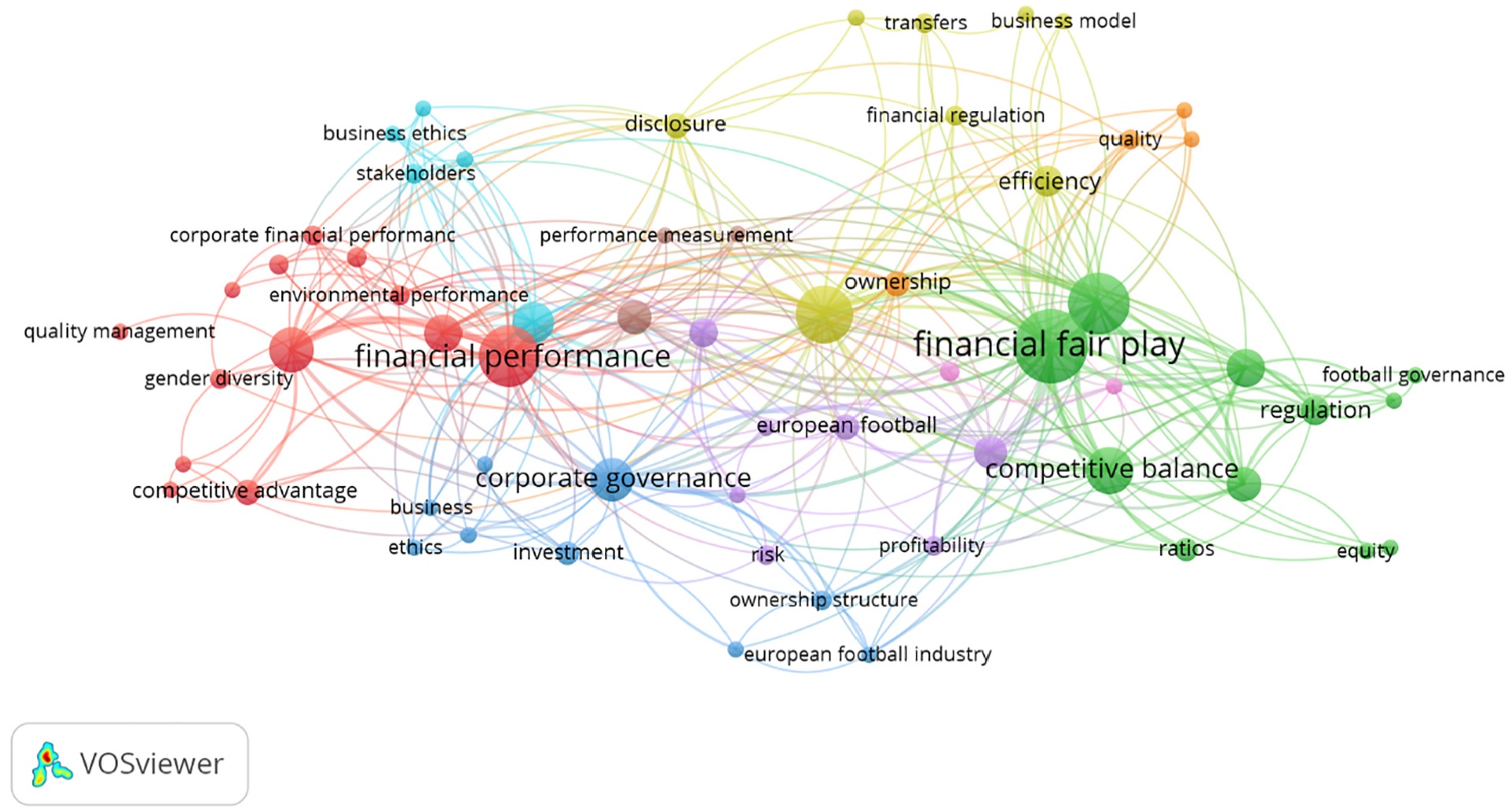
The preliminary bibliometric study shows nine differentiated clusters that allow an analysis before the literature review.
Two main clusters stand out: The first cluster (red) revolves around keywords related to financial performance and similar concepts (corporate financial performance, organisational performance, firm performance). It is also linked to management quality in terms of Corporate Social Responsibility (CSR), with a leadership model that promotes competitive advantages through transparency-oriented decision-making (disclosure), and the promotion of environmental and gender diversity policies (see Table 1 and Figure 2).
Distribution of Keywords in Clusters.


Main links between keywords.
The second main cluster (green) revolves around keywords related to the regulation of Fair Play in football (see Figure 2), competitive balance and, to a lesser extent, football governance and compliance with ratios to guarantee the equity, financial stability and economy of clubs through equity policies in the sector.
The third cluster (blue) focuses on Corporate Governance, suggesting an Ownership structure in the European football industry that harmonises financial aspects (Firm value, Business, Investment) which are close to the green cluster, and other aspects of social responsibility such as Ethics and Sustainable investment are nearby to elements of the red cluster.
The fourth Cluster (yellow) revolves around performance, and represents a core between the previous Clusters, highlighting the link between financial Fair Play regulation as a driver of a new Business Model focused on transparency (Disclosure) and efficiency in investments and player transfers.
The fifth cluster (purple) is located in the centre of the map, shown in Figure 2, surrounded by the 4 clusters above where European/Professional football is the core between Financial Performance, Financial Fair Play, Corporate Governance and performance. In doing so, it highlights the need within the football industry to comply with UEFA requirements in terms of profitability, accountability and social performance policies, and the risks posed by the emergence of earning management practices that distort the quality of financial reporting to comply with regulations. The sixth cluster (turquoise blue) highlights the importance of the various stakeholders in the fulfilment of corporate values and social and environmental responsibility within the sports industry.
Finally, Cluster 7 (orange), 8 (brown) and 9 (pink) identify isolated complementary terms within the network mapping on bibliographic information.
In this case, the size of the spheres in Figure 2 is determined by the areas where most of the research in the area is concentrated and, therefore, the focus of this review: the impact of UEFA Financial Fair Play on the performance of European football clubs. The smaller spheres represent potential areas to explore.
The heat map in Figure 3 allows us to analyse the evolution over time of the areas of research interest through the variation of the most frequent keywords. Thus, the keywords in yellow, such as competitive balance, efficiency, and disclosure, are the most recent and, therefore, possible emerging niches on which to focus future research.

Heat map between keywords.
It is interesting to observe how research has evolved from one thematic axes to another as a result of recent coordinates within the European context, such as compliance with the Sustainable Development Goals and the growing demands on issues of gender, environment, efficiency and equity.
Semi-Systematic Literature Review
As a result of the selection process of the sample of articles (see Figure 1) we obtained 40 studies, of which 7 are qualitative (17%) and 33 quantitative (83%), which determine the semi-systematic approach of the present review, as opposed to a systematic review subscribed exclusively to quantitative studies, or a more open integrative review (Snyder, 2019).
The years investigated by the studies in the sample range from 1994 to 2021 (see Graph 1). The number of years considered in each study ranges from 1 in cross-sectional studies to 23 in longitudinal studies, resulting in an average period of 8.7 years, with most of the literature concentrating on studying the period 2008 to 2015 (>24 articles/year), which corresponds to the years before and after the entry into force of UEFA FFP (UEFA, 2010).

Density of the studied periods.
Based on this, we have prepared a summary table (See Table 2) detailing the main peer-reviewed publications within the current literature between 2012 and 2022, which consider the impact of UEFA FFP on the financial health of European clubs according to the inclusion and exclusion criteria to which the present study subscribes.
Literature Review.

Note. EBT = earnings before taxes; EBITDA = earnings before interest, taxes, depreciation and amortisation; EBIT = earnings before interest and taxes; ROA = return on assets; ROE = return on equity; ROS = return on sales; RCSD = debt coverage ratio.
As for our first research question (RQ1), the review points to the need for a multi-theoretical framework, given the cross-cutting nature of the theories that frame studies of the sector (see Table 3).
Theories to Which the Studies That Consider the Impact of UEFA’s Financial Fair Play on the Financial Health of European Clubs Subscribe.
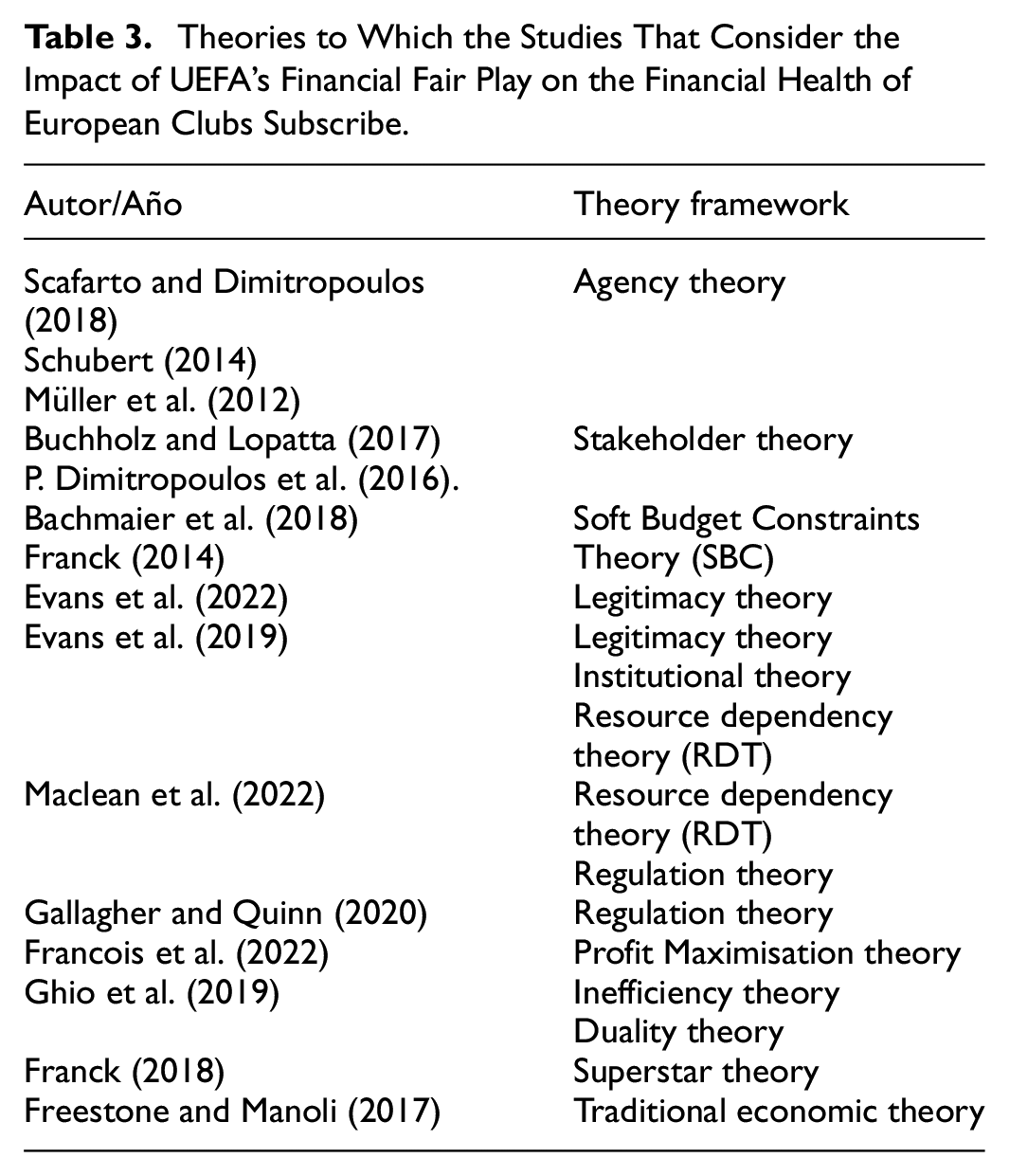
However, despite this transversality, two distinct aspects can be observed because of the regulation: the relationship between UEFA and the clubs, and the behaviour of the latter. In this regard, the relationship between UEFA and the clubs is determined by a body of theory that integrates the Stakeholder theory, since the managers’ ability to prioritise and reconcile stakeholder demands plays an important role in corporate viability (Freeman, 1984; Mitchell et al., 1997). In this case, considering fans and UEFA are the most influential stakeholders for the clubs. The Resource Dependency theory establishes that organisational survival is based on organisational capabilities to acquire and maintain the essential resources for the organisation (Pfeffer & Salancik, 1978). In this case, UEFA’s control over broadcasting rights (the clubs’ main source of income), creates a dependency on clubs who fear coercive action in the event of non-compliance with the rules. Agency theory, which considers the separation between owners and managers (Jensen & Meckling, 1976), because of the problems encountered between UEFA as principal and the clubs as agents when applying the regulation and, consequently, the Regulation theory allows us to understand FFP regulation as an alternative to strike a balance between the opposing interests of those who receive the resources (the clubs) and those who grant them (UEFA).
On the other hand, when describing the behaviour of clubs, Institutional Theory provides a framework through coercive, normative, and mimetic isomorphisms derived from the application of UEFA FFP, since the main concept behind Institutional Theory (IT) is that organisations operating within a common environment will gradually become similar (DiMaggio & Powell, 1983). Soft Budget Constraints (SBC) Theory allows for justifying the management model of European football clubs, focused on maximising sporting performance without much concern for financial risks, given the certainty of being bailed out in case of difficulties (Storm & Nielsen, 2012). And Legitimacy Theory allows us to understand the behaviour of clubs by regulations, without entailing a structural change in the financial habits that have led them into compromised situations (Figure 4).

Multi-theoretical framework of the impact of regulation on the UEFA-Club relationship and on club behaviour.
Other theories are mentioned in the body of some articles justifying specific topics, such as the Superstar theory to justify the high wage costs in the sector, the X-inefficiency theory to explain the inefficiency of clubs in minimising these costs to maximise their profits or produce competitive results, or profit Maximisation to propose a new, more sustainable management paradigm within the European football industry.
To answer our second research question (RQ2), Graph 2 shows that research in this field focuses on the ‘Big 5’ European Leagues, with England standing out followed by Italy, Spain, France and Germany.

European countries where research in this field is focused.
When analysing the main methodologies (RQ3), Graph 1 showed a clear predominance of quantitative over qualitative studies. However, qualitative studies approach the phenomenon from the perception of the main actors and contribute to the construction of a theoretical framework for the research from different approaches.
We can mention the contribution of regulation to the consolidation of the hegemony of the big clubs through interviews with managers (Maclean et al., 2022), case studies where FFP regulations are breached and which evidence how outside investors are outside the scope of the regulation (Sims, 2018), studies looking at the impact of regulation on the presence of benefactors (Franck, 2014), content analyses questioning the effectiveness of internal regulations in national leagues (Bachmaier et al., 2018), analyses on the achievement of fairness through UEFA FFP regulations, and the pursuit of financial efficiency as a more concrete goal (Szymanski, 2014), studies raising the emergence of agency issues as a consequence of regulation between UEFA as principal, and clubs as agents (Schubert, 2014).
In all cases, these studies allow us to identify possible research niches and to contrast the findings of quantitative studies.
On the other hand, within quantitative studies we have differentiated five types of methodologies:
1) Financial ratio analysis
2) Statistical analysis
3) Econometric analysis
4) Efficiency analysis
5) Revenue distribution analysis
Graph 3 illustrates the proportion of quantitative methodologies in the final sample of selected articles. As can be seen, there is a predominance of studies using econometric analyses to model club behaviour. In second place are classical ratio studies, followed by statistical analyses, revenue distribution and competitive balance through the Herfindahl Index, and performance studies through parametric and non-parametric techniques.

Most common quantitative methodologies for studying the impact of UEFA FFP on clubs.
Additionally, within the quantitative studies, a look at the most representative financial variables is provided. Out of a total of 92 variables, we have considered those that have been used in at least two studies (n = 37). Considering that regulations focus on the reduction of expenditure and the achievement of the break-even point (between income and expense), the observed predominance of variables that are part of the profit and loss statement (64%) over the balance sheet variables is logical (36%).
When breaking down the specific items used in the studies, Graph 4 identifies players’ salaries as the most frequent measure among the 35 most representative indicators.

Most common financial indicators.
Secondly, and given that the objective of the law is to decrease debt levels to achieve sustainable financing, it is consistent that we find leverage (understood as Total Liabilities/Total Assets), as clubs are often willing to take on disproportionate debts to improve their on-field performance (P. Dimitropoulos & Tsagkanos, 2012), and this fact could pave the way for a default of UEFA’s FFP that compromises its ability to pay when meeting its commitments to its stakeholders (UEFA, 2010).
The third most used indicator is ROA (represented by the result from operations before interest and taxes divided by total assets), which is consistent with the development of the line of research related to the pursuit of financial efficiency as a more concrete objective of UEFA FFP (Szymanski, 2014), as performance ratios use profit as the numerator. And because the denominator in ROA is the amount of the teams’ total assets that never assume negative values, the specialised literature has been inclined to employ ROA as a performance measure (P. Dimitropoulos & Tsagkanos, 2012; Mareque et al., 2018). In this respect, in the football industry, ROE is usually discarded, as the number of teams that tend to report negative equity distorts the comparison between clubs and makes this ratio lose some of its meaning (Urdaneta et al., 2021).
Additionally, accounting measures, and especially ROA, are generally better indicators of financial performance than measures based on market values such as Altman’s Z-score or Tobin’s Q (McGuire et al., 1988; Wu, 2006), to which is added the predominance of countries such as Spain, where no clubs are listed on the stock exchange (Urdaneta et al., 2021).
Subsequently, measures of size such as total assets and net turnover stand out, which are often common in capturing the size of clubs. This is logical in the framework of positive accounting theory, considering that the effect of regulatory scrutiny increases as firms become larger (Watts & Zimmerman, 1990).
Finally, we have classified the findings of the sample studies into three distinct blocks according to the positive, negative or neutral impact of UEFA FFP regulations on the financial situation of clubs. In contrast to the intention of the regulators, the studies in the sample agree on a negative impact of the regulation (40%), above the positive effect (32%) and no impact at all (neutral = 28%). Therefore, the fact that opinions are divided in such an even proportion fuels the current debate and, to some extent, justifies the recent replacement of UEFA FFP by the new UEFA Club Licensing and Financial Sustainability Regulations (UEFA, 2022) which came into force in June 2022 for the 2022 to 2023 season and which is sure to arouse the same interest in assessing its impact.
Discussion
The bibliometric analysis of the literature studying the impact of financial regulations on the football industry has revealed the great interest it has aroused among academics from different fields who have approached the subject from different perspectives. Predictably, a good part of these studies is concentrated around the years of entry into force of the FFP Regulation promoted by UEFA since 2010, whose effectiveness and suitability have generated a great deal of controversy both within the sector itself and in academia. In this section, we will reflect on some of the ideas discussed in previous literature with varying degrees of consensus to try to outline the future coordinates of research in this field.
From the point of view of the effects of FFP on the financial situation of clubs, there is no consensus in the literature and we can find studies that point out that the entry into force of FFP has contributed to improving the financial sustainability of clubs (Calahorro-López et al., 2022; Freestone & Manoli, 2017; Urdaneta et al., 2023), along with others that do not detect significant changes (Ahtiainen & Jarva, 2020) or even observe a deterioration (Evans et al., 2019, 2022; Plumley et al., 2021). This disparity of results seems to indicate that FFP is not sufficient on its own to achieve the desired results, but that other elements can influence the effectiveness of the standard.
On Corporate Governance (CG)
Studies in the sample agree that CG mechanisms should be considered to promote financial discipline, as they enhance the value of policies and reinforce current regulations, which are limited to monitoring processes linked to accounting data (Scafarto & Dimitropoulos, 2018). In this sense, future studies should test whether ethical improvements in corporate culture influence financial viability (Fernández-Villarino & Domínguez-Gómez, 2022), for example, by encouraging economic investors to monitor the actions of club managers (Buchholz & Lopatta, 2017). In this regard, the consideration of personal characteristics such as age, education, or professional background of board members and especially of family/individual owners involved in board management and governance is another open field when assessing the levels of UEFA FFP implementation in clubs (Scafarto & Dimitropoulos, 2018).
Other studies also promote research on the impact of governance and ownership structures and their influence on the quality of accounting information (P. Dimitropoulos et al., 2016; P. E. Dimitropoulos & Koronios, 2018; Neri et al., 2021), or on ownership concentration (Acero et al., 2017), most notably on the extent of regulation on foreign investors (Franck, 2014; Sims, 2018), and their ability to choose between winners and losers (Sims, 2018).
Another issue arising from the relationship between UEFA and the clubs corresponds in many respects to a classic principal-agent problem, emerging as a potential conflict of interest between the two actors which, together with asymmetric information, creates incentives for opportunistic behaviour on the part of the clubs (Schubert, 2014).
The European Union and national governments also play roles in shaping the behaviour of football’s regulatory bodies and clubs, though they are likewise sensitive to these entities’ interests and pressures. The EU has supervisory power through community law that can limit the autonomy of UEFA and FIFA (Geeraert & Drieskens, 2015). A notable example is the Bosman ruling, which affected the mobility of professional players within the European Union, and more recently, the Diarra case, which argues that FIFA’s transfer rules conflict with EU law.
However, the relationship between UEFA and the EU is not always confrontational; UEFA also seeks to collaborate with and influence EU authorities to preserve its privileges within football’s governance structures (García, 2007), as evidenced recently in the conflict with the European Super League. National governments, for their part, also seek to influence the football industry, and some countries such as Qatar and Russia have been accused of employing soft power strategies to increase their influence in the football arena and secure favourable political outcomes, such as the awarding of the World Cup (Grix & Houlihan, 2014).
These incidents have sparked debates about the lack of transparency in decision-making processes within UEFA and FIFA, leading to internal reforms aimed at reducing corruption. However, these initiatives have been met with scepticism by some stakeholders, who believe that big interests continue to dominate the system.
Faced with all these problems, one proposal drawn from the studies in the sample is the introduction of corporate governance codes by regulatory bodies, not only for aspects related to the transparency of financial information but also to demand greater transparency in information related to corporate governance (Acero et al., 2017).
On the Competitive Balance and the Players’ Market
A second line of research that has been widely explored and on which there is greater consensus in the literature concerns the effect of FFP on the competitive balance and the players’ market. Competitive balance is a particular area of research that would involve a systematic review (Plumley et al., 2019; Ramchandani et al., 2023). For this reason, the present review has considered the analysis of financial aspects as an inclusion criterion.
In this sense, the studies in the sample coincide in reporting on the influence of UEFA FFP on the imbalance between clubs and, therefore, of the competition system (Urdaneta et al., 2023), opening the possibility that the gap between the elite clubs and the rest is widening (Calahorro-López et al., 2022). This fact derives directly from the financial gap between clubs, for which different solutions are proposed, including the assessment of new criteria for the distribution of broadcasting rights revenues (Francois et al., 2022) and, on the expenditure side, the reduction of player salaries (Nicoliello & Zampatti, 2016), considering conventional salary caps as a superior device to improve the competitive balance in national leagues (Peeters & Szymanski, 2014), which implies proposing a salary cap at league level based on a nominal value and not on a percentage of revenue (Plumley et al., 2021).
This measure could prevent transfer fees from being concentrated on the best clubs, depriving the rest of the race to attract and retain top talent. In this context, it will be necessary to analyse whether the belief that the recruitment of superstars, and the consequent policy of demand for talent by clubs in the labour market, is the only route to sporting success (Andreff, 2018). In this situation, the idea of investing in academies, infrastructure, technology, human capital and especially in the youth academy to reduce exposure to large investments by supporting young players who can be traded (Alajbeg et al., 2022; Nicoliello & Zampatti, 2016) is gaining momentum. However, the big European clubs have tried to prevent salary cap measures that they consider detrimental to their interests, as they have access to financial resources beyond the reach of other clubs, especially in smaller leagues (Franck, 2014).
Major European football clubs are also forming alliances to lobby UEFA for greater flexibility in Financial Fair Play (FFP) regulations and to secure larger shares of broadcasting rights. These clubs have even proposed a European ‘super league’ with promotion and relegation above the domestic leagues, capable of attracting higher broadcasting and sponsorship revenues and influencing the market for players (Bishop et al., 2022; Franck, 2018). However, such a move could introduce greater equality in the different levels of competitions but could perpetuate the differences between clubs capable of entering the ‘super league’ and those relegated to domestic competitions that would lose much of their interest and thus broadcasting revenue. Pressure and threats from UEFA, as well as from the clubs’ own supporters and even from federations and governments in some countries, led practically all the founding clubs to announce their withdrawal from the project.
In this respect, the high dependence on broadcasting rights is a recurrent issue for small clubs, as they cannot generate additional revenue from their participation in European competitions, or commercial activities (Chelmis et al., 2019). This is widespread in some leagues such as the Greek league, whose local rather than international character generates reduced ticket revenues given the small capacity of the stadiums and the limited population of the province, together with its negative on-field results (P. Dimitropoulos, 2011). Therefore, television, which is football’s main economic driver, is also its main risk due to the excessive financial dependence of most clubs on this source of revenue, which requires efforts towards revenue diversification (Urdaneta et al., 2023).
On alternative oversight and control measures: transparency and accountability
A third major stream of research in the literature reviewed is work that links FFP regulation and supervisory and control measures. Undoubtedly, the most relevant aspect revolves around transparency and accountability, whereby the literature agrees on pushing for greater disclosure of information, given the scarcity of critical data, such as individual player salaries, which makes it difficult to delve into the real dynamics behind the player transfer market (Neri et al., 2021). Improvements are also needed in the quality of management reporting (Birkhäuser et al., 2019). To this end, it is necessary to expand the availability of non-financial information, and to standardise such reports so that they are comparable in the future and allow for longitudinal studies (Miragaia et al., 2019). There has also been interest in the impact of governance and ownership structures and their influence on the quality of accounting information (P. Dimitropoulos et al., 2016; P. E. Dimitropoulos & Koronios, 2018; Neri et al., 2021), or on ownership concentration (Acero et al., 2017), most notably on the extent of regulation on foreign investors (Franck, 2014; Sims, 2018), and their ability to choose between winners and losers (Sims, 2018).
Some studies agree in suggesting financial control of clubs by independent organisations (Evans et al., 2022; Miragaia et al., 2019), or the establishment of audit committees by UEFA (Birkhäuser et al., 2019). Regarding the audits conducted, it is suggested to observe whether there are changes in the auditors’ opinion because of UEFA FFP (Mareque et al., 2018).
An added complexity to this whole process is the coexistence of internal regulations with UEFA FFP, which in many cases generates disparities, as has been observed in the German and English leagues (Bachmaier et al., 2018), French (Dermit-Richard et al., 2019) or Spanish (Urdaneta et al., 2021). All these studies agree on the complexity of management, and that, in some cases, stricter internal regulation may generate a disadvantage for some leagues (Calahorro-López et al., 2022; Dermit-Richard et al., 2019), although in no case have these regulations been able to prevent mismanagement of clubs. In response, one approach is that all European national leagues should apply the FFP rules instead of applying them only to clubs participating in European competitions (Dermit-Richard et al., 2019).
The introduction of UEFA FFP has been observed as a ‘legitimisation exercise’ in which UEFA strengthens its position vis-à-vis national leagues and football clubs (Evans et al., 2019). In this sense, the relationship between UEFA and the clubs corresponds in many respects to a classic principal-agent problem, emerging as a potential conflict of interest between the two actors which, together with asymmetric information, creates incentives for opportunistic behaviour on the part of the clubs (Schubert, 2014). Faced with all these problems, one proposal drawn from the studies in the sample is the introduction of corporate governance codes by regulatory bodies, not only for aspects related to the transparency of financial information but also to demand greater transparency in information related to corporate governance (Acero et al., 2017).
Conclusions
The present review provides an analysis of the impact of the UEFA FFP regulation (UEFA, 2010) through the literature, in the context of the recent entry into force of the UEFA Club Licensing and Financial Sustainability Regulations (UEFA, 2022) implemented in June 2022 for the 2022/23 season.
A multi-theoretical framework is confirmed, addressing the relationship between UEFA and the clubs from the Stakeholder theory considering UEFA as an influential stakeholder for the clubs, the Resource Dependency theory, for UEFA’s control over the clubs through the broadcasting rights, the Agency theory, for the relationship between UEFA as principal and the clubs as agents and the Regulation theory from the balance between the opposing interests of those who receive the resources (the clubs) and those who grant them (UEFA).
The behaviour of clubs is approached under the figure of isomorphisms through the Institutional Theory, the Soft Budget Constraints (SBC) Theory justifies a management model focused on success on the playing field regardless of the financial risks, given the certainty of being bailed out in case of difficulties. And Legitimacy Theory makes it possible to understand the behaviour of clubs by regulations, without entailing a structural change in the financial habits that have led them into compromised situations.
Limitations
One of the most common limitations among the empirical studies analysed is the small sample size and the consequent loss of robustness of the results obtained. This fact is due to different factors that characterise the football industry, among which, for cross-sectional studies, the limit of clubs that participate in a division stands out, for longitudinal studies the survival bias as a consequence of sporting performance (promotions and relegations), and in general terms the lack of availability of financial information.
Future Expectations
The results highlight the need to observe the capacity of the new regulations to cover the limitations of the previous regulations. In this sense, it is expected that CG mechanisms can be considered to promote financial discipline, addressing problems such as ownership concentration, control of foreign benefactors or information asymmetries. It is also expected that new thresholds for classic financial ratios will be established, allowing for stricter monitoring of the financial reality of clubs. In terms of transparency and accountability, greater disclosure of information is expected to allow for more in-depth analysis of certain areas of interest and the evolution towards a process of standardisation of non-financial information to allow for comparability. In addition, the disparities that may arise from the coexistence of the new rules with the internal regulations in force pose a challenge for the future.
Thus, a new episode in European football has begun, and with it, the challenge for the scientific community to make contributions that will pave the way for the longed-for improvement of the financial situation of the clubs in the region.
Footnotes
Acknowledgements
To Professor José Mariano Moneva of the Department of Accounting and Finance of the University of Zaragoza for his valuable contributions to the design of this research.
Author Note
This protocol was registered with the International Platform of Registered Systematic Review and Meta-Analysis Protocols (INPLASY): Urdaneta et al. European football clubs’ financial performance under UEFA Financial Fair Play: A bibliometric analysis and semi-systematic review. Inplasy protocol 202350008. doi:10.37766/inplasy2023.5.0008.
ORCID iDs

Funding
The author(s) disclosed receipt of the following financial support for the research, authorship, and/or publication of this article: This work has been co-financed by the Spanish Ministry of Science, Innovation and Universities through the projects PID2020-113905GB-I00 and PID2023-146084OB-I00 (COL-ACREFIN), as well as by the Regional Government of Aragón through the research groups S56_23R ‘GESPÚBLICA’ and S33_23R ‘Socio-Economy and Sustainability’.
Declaration of Conflicting Interests
The author(s) declared no potential conflicts of interest with respect to the research, authorship, and/or publication of this article.
Data Availability Statement
Data sharing not applicable to this article as no datasets were generated or analysed during the current study.