



Abstract
This study examines the impact of employing temporary workers on technical efficiency (TE) by employing stochastic frontier analysis (SFA) and meta-frontier analysis (MFA). These two statistical methods yield slightly different, yet empirically meaningful, results. SFA—the more conventional methodology for conducting efficiency analysis—confirms that firms with temporary workers show a somewhat lower level of TE; while MFA, which allows a comparison of TE across groups with heterogeneous technologies, reveals that firms hiring temporary workers are technologically less efficient and have a more pronounced relative gap in efficiency. With the application of MFA, it was observed that firms hiring only temporary workers come farther to the meta-frontier than their counterparts.
Introduction
Over the last few decades, the share of temporary workers in the workforce has soared; accordingly, numerous issues relevant to the employment of temporary workers have been on the rise. Temporary workers’ employment factors may differ, depending on the socioeconomic background of each country. European countries hire temporary workers primarily to cut costs (Cahuc & Postel-Vinay, 2002), workers are evaluated, and less productive workers are offered short-term labor contracts. In this approach, European countries use temporary employment to screen workers (Faccini, 2014). Meanwhile, US firms avoid risk by hiring temporary workers during economic downturns (Yang, 2018). Emerging countries use temporary workers as stepping stones for economic development (Cano-Urbina & Gibson, 2018). Although the reasons for using temporary workers vary, companies ultimately seek to reduce their labor costs and enhance internal employment flexibility through temporary employment. It is unclear, however, whether the employment of temporary workers leads to positive firm performance in terms of revenue, profits, and productivity because despite the aforementioned positive effects, the use of temporary workers also seems to have negative effects, such as increasing turnover rates, lowering job satisfaction, and demoralizing permanent workers.
Temporary workers are generally considered less productive than permanent workers; earlier studies confirm that temporary workers negatively affect productivity in firms or at the industry level (Autor et al., 2007; Lisi & Malo, 2017). As an example, Autor et al. (2007) explored the impact of enhanced discharge protection on productivity in the United States. They observed that the increase in labor cost, due to the implementation of this regulation, shifted to further development in technology and more capital investment, thereby reducing the total productivity. Lisi and Malo (2017) conducted a similar study that examined the effect of using temporary workers on productivity, using industry-level data among EU member countries. The use of temporary workers results in lower productivity, and the negative effect appeared to be more pronounced in the high-skill rather than the low-skill sectors.
However, the evidence seems to be convergent on the positive impact that hiring temporary employment can have on the performance of establishments. Using firm-level data from the United Kingdom, Bryson (2013) examined the impact of using temporary agency workers (TAW). Although the use of TAW was not associated with lower productivity, it raised financial performance, likely because the labor cost of temporary workers was cheaper than that of permanent workers. Note that other studies provide similar evidence but demonstrate a nonlinear relationship between using TAW and productivity. For instance, Hirsch and Mueller (2012) estimated the effect of TAW on productivity using firm-level data in Germany. Interestingly, they found an inverse U-shape with the proportion of TAW increasing along with productivity; however, after a certain threshold of TAW, the productivity began to diminish. We interpret this finding to mean that a low share of TAW within a firm could result in numerical flexibility (Vidal & Tigges, 2009) and screening of new workers (Autor, 2001). In contrast, a high share of TAW could signal a larger substitution between permanents to temporaries, likely lessening the commitment and motivation of the workforce.
Earlier studies have examined the association of temporary workers with total employment, productivity, and profit (Hirsch & Mueller, 2012; Houseman, 2001; Ichino et al., 2008); however, the impact of hiring temporary workers has rarely been observed from the perspective of firm efficiency. Companies hire temporary workers to increase efficiency, but frequent layoffs can increase firing costs. Yang (2018) argued that allowing temporary employment did not recover inefficiencies due to firing costs. Conversely, in Europe, flexible employment with low firing costs has increased resilience to economic shocks. In contrast, Bentolila and Saint-Paul (1992) found that flexible employment did not improve total efficiency in expansion. Still, the contribution of flexible employment to total efficiency in recession exceeded more in the long run than in the short run. As a result, there are two opposing views on the effectiveness of temporary employment. Therefore, an analysis of how employing temporary workers affects efficiency in the production process is required. Higher production efficiency might be achieved if employing temporary workers enables a firm to reduce their labor costs and increase input flexibility. On the other hand, it is also feasible that the negative aspects of hiring temporary workers might actually serve to lower efficiency. Thus, the net impact of temporary workers on efficiency is largely an empirical question.
In this study, we employed a conventional methodology, stochastic frontier analysis (SFA, hereafter), to address the role of temporary workers as a determinant of technical efficiency (TE), using a workplace panel survey (WPS) of workers in South Korea. For the purpose of analysis, we classified establishments into two mutually exclusive groups based on their employment of temporary workers: (1) those only hiring permanent workers (Group 1) and (2) those that have some share of temporary workers (Group 2). However, SFA is not applicable when comparing TE between establishments that use different technologies. Therefore, meta-frontier analysis (MFA, hereafter) was also employed, which allowed the comparison of TE across different groups characterized by heterogeneous technologies. This study is the first to examine the association between temporary workers and TE by employing both SFA and MFA methodologies.
Methodology
Stochastic Frontier Analysis (SFA)
To account for changes in efficiency over time, we measured TE using equation (1), in accordance with the work of Battese and Coelli (1992):

where

We used a random effects time-varying production model to estimate the production function and assumed the functional form of translog. In the extant literature, the Cobb–Douglas production function has been most widely adopted. However, the function has also been criticized for being overly simplistic because it estimates the output as a linear combination of input variables. Therefore, this study uses the translog production function, which adds the interaction term of input variables to a linear combination of input variables. This approach addresses the simplicity issue with the Cobb–Douglas production function and expresses the output variable more flexibly. The production function is as shown in equation (3):

where
Meta-frontier Analysis (MFA)
Given SFA’s underlying assumption of the use of homogeneous technologies, it is implausible that TE can be compared between firms with and without temporary workers because it is likely that the two groups are working with different technologies. Efficiency, which is based upon estimates of the meta-frontier function, is eligible for comparison between groups that operate under different technical conditions (Battese & Rao, 2002). The meta-frontier function model set forth by Battese et al. (2004) is defined as follows:

where
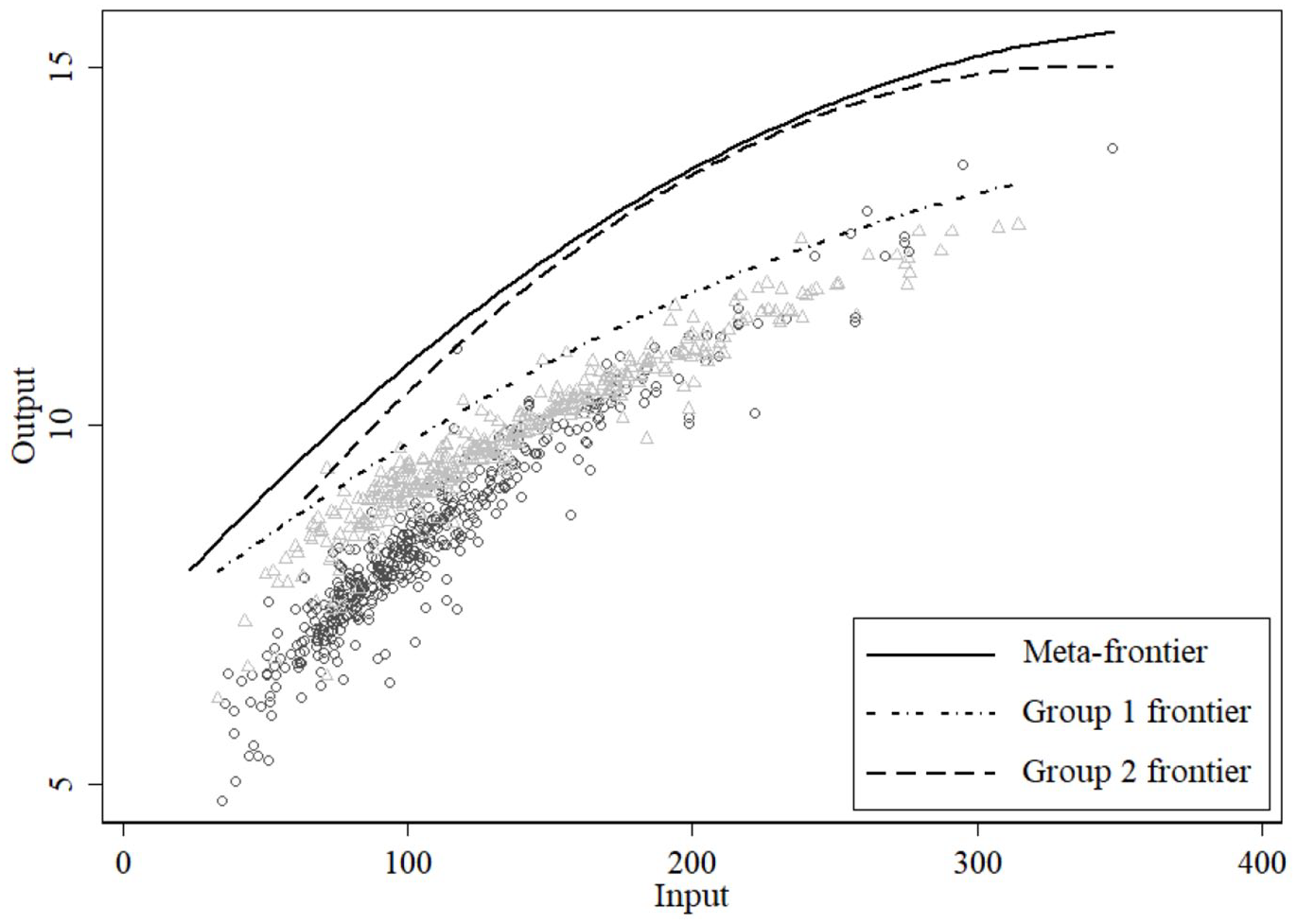
Meta-frontier function model.
Equation (4) can be decomposed as follows:

Dividing both sides of equation (5) by

In equation (6), the first term on the right-hand side,

To calculate the meta-frontier function parameters, two optimization approaches were used: (1) linear programming (LP), which minimized the sum of the absolute values of the deviations, and (2) quadratic programming (QP), which minimized the sums of the squares of the deviations. According to Battese et al. (2004), LP and QP are defined as follows:


We used two different software packages: Frontier 4.1 for conducting SFA and MATLAB 7.0 for conducting MFA.
Data Description
This study exploited the bi-annual longitudinal data from the WPS, conducted by the South Korea Labor Institute for the years between 2005 and 2013. In the analysis sample, 1,521 companies employed at least some temporary workers (n = 3,577 observations) and 1,144 of their counterparts employed only permanent workers (n = 2,144 observations). In South Korea, in the case of a permanent worker, (1) there is a direct employment contract between the worker and the employer; (2) the worker has no fixed period of employment; and (3) the worker is guaranteed continuous employment. All other types of workers are temporary. Specifically, temporary workers in South Korea are (1) fixed-term, (2) part-time, (3) temporary agency, (4) seasonal, or (5) daily workers, among others.
In South Korea, most temporary workers are hired simply to reduce costs, not for performing special tasks. Therefore, in general, temporary and permanent workers perform similar tasks. Further, fixed-term and part-time workers make up most of the temporary workforce, and the proportion of other types of workers is very low. For example, dispatched workers in South Korea accounted for 2.4% of all wage workers (Korea Labor Institute [KLI], 2020; Labor Statistics). Therefore, we conducted our analysis on temporary workers without distinguishing between specific types of temporary workers. According to KLI (2020), the number of temporary workers in South Korea has been consistent (30%–36%) between 2010 and 2019 (Kim, 2010; Kum & Yi, 2013). Fixed-term workers have the highest proportion, followed by part-time workers; they accounted for less than 20% in 2004 but up to 42% in 2019. The employment contract determines whether a worker is a permanent or temporary worker. In South Korea, permanent workers are generally called regular workers, and temporary workers are called non-regular workers. WPS examines a worker’s status based on the employment contract type and determines whether they are temporary workers. We used this variable to classify companies employing only permanent workers (group 1) and companies employing temporary workers (group 2). Temporary workers investigated by WPS include all fixed-term, part-time, daily, and seasonal workers. We measured firms’ output according to their total sales. For input variables, the cost of sales, total assets, and total wages were considered. Table 1 reports the summary statistics. The group employing temporary workers showed higher mean values for both input and output than the group employing only permanent workers.
Sample Statistics.

Note. Units: Millions of South Korean Won (KRW) (One [1] US dollar [USD] equals 1,212.5 KRW as of April 11, 2020).
Estimation Results
Table 2 reports the group frontier production function parameters, estimated using SFA, and the meta-frontier parameters, calculated using LP and QP. It appears that the vast majority of parameter estimates are statistically significant, with the expected signs.
Parameters of Group Frontier and Meta-Frontier Production Functions.

Note. LP = linear programming; QP = quadratic programming.
The TE, MTR, and TE* were calculated using each group frontier and meta-frontier production function. They appear in equations (2) and (6), and the results are reported in Table 3. The estimates of TE demonstrate that the group with permanent workers (0.8152) was slightly more efficient than the temporary worker group (0.8123). However, since the two groups likely work with different technologies, further comparison between the groups’ efficiency using MTR concludes that using temporary workers leads to lower efficiency (Lee et al., 2017). The results from MFA reconfirmed that companies only hiring permanent workers were more efficient than those with temporary workers, that is, temporary worker (0.9320) versus permanent worker (0.9609) groups. Further, there was no significant difference between the MTR_LP and MTR_QP. Higher efficiency was also observed in TE*, which equals the product of TE and MTR, that is, temporary worker (0.7581) versus permanent worker (0.7836) groups. In sum, regardless of the approach adopted, the group hiring only permanent workers seems more efficient. When comparing the efficiency between the two groups, the difference became more pronounced when MFA was applied.
Estimation Results.

We averaged each result by year to examine TE, MTR, and TE* changes over time. The analysis results are described in Figure 2, and as a result of the analysis, the TE of the permanent worker group showed an increasing trend. In contrast, the TE of the temporary worker group showed a decreasing trend. Also, in the case of MTR, it was difficult to determine a clear trend, but the MTR of the temporary worker group was higher than that of the permanent worker group across all years. The Great Recession was included within the analysis period; however, the study results show no difference before and after the Great Recession.

Time trend of TE, MTR, and TE*.
In addition, we performed Tobit regression to determine if the MTR difference between the two was statistically significant, even after controlling the firm size and time trend. Firm size, time trend, and group dummy variables were independent variables, and MTR LP value was used as a dependent variable. As shown in Table 4, the MTR LP value was statistically significantly larger in 2005 than in 2013; however, the dummy for the rest of the years was not significant, meaning that there was no time trend in the impact of employing temporary workers on technical efficiency. Further, the coefficient of the temporary worker group was statistically significant at the 99% level, and the estimate was negative. Our finding shows that the MTR difference between the permanent and temporary worker groups is statistically significant, even after controlling for firm size and time trend.
Estimation Results of Tobit Model.

Note. ***significant at 1% level.
Summary
By applying the conventional SFA method as well as the MFA method, which is scarcely applied in the economic literature, our study sheds light on the controversy regarding the impact of using temporary workers on TE. Although different results were estimated for SFA and MFA, it is difficult to directly compare the efficiency with SFA because the two groups use different technologies. It is necessary to estimate the meta-frontier that encompasses the different production functions of the two groups to compare their efficiency. Through MFA analysis, the higher efficiency of those firms that hired only permanent workers was shown to be more pronounced, which reconfirmed the relative efficiency between the two different groups. Overall, firms with only permanent workers were likely to be closer to the meta-frontier production function. Our findings indicate that when firms increase their temporary worker ratios to lower their labor costs, the differential between their actual and potential output becomes larger. Our findings suggest that while companies use some temporary workers to operate efficiently, in reality, companies that use temporary workers are less efficient than those that do not. The use of temporary employment makes businesses inefficient; further, temporary employees have a poorer working environment than those with permanent employment and face issues such as (1) job instability, (2) low wages, and (3) poor working conditions. Therefore, companies need to be wary of excessively employing temporary workers for efficient operation. Although the use of workers increases the inefficiency of companies, some companies still use temporary workers. These companies may be more concerned with cost minimization than efficiency. Companies that do not consider efficiency and prioritize cost minimization may want to continue using temporary workers.
Footnotes
Declaration of Conflicting Interests
The author(s) declared no potential conflicts of interest with respect to the research, authorship, and/or publication of this article.
Funding
The author(s) received no financial support for the research, authorship, and/or publication of this article.
