




Abstract
This study examines the effect of blended learning (BL) practices on students’ academic achievement in higher education settings through meta-analysis and meta-thematic analysis based on the data derived from document analysis. To comprehensively understand the effect of BL practices on students’ achievement in higher education settings, the independent (BL), dependent (students’ academic achievement), and moderator variables (school subjects, duration of implementation, and sample size) were considered. Forty-nine studies were analyzed in meta-analysis thanks to CMA and MetaWin software programs. The meta-analysis indicated that the practices affect learners’ academic achievement positively. On the other hand, 20 studies were examined in the meta-thematic analysis with the Maxqda-11 software program. The meta-thematic analysis revealed four themes, namely “effects of BL settings on achievement,”“social contributions of BL settings,”“general characteristics of BL settings,” and “negative characteristics of BL settings.” The meta-analyses and the meta-thematic analyses revealed that BL practices positively affect students concerning academic sense in educational settings. Some suggestions were made to overcome the shortcomings of BL practices in education.
Plain language summary
This study looks at how blended learning (BL) — a mix of online and traditional classroom teaching — impacts students’ grades. We considered various factors, including the type of BL, student performance, and other influencing factors like subjects taught, how long BL was used, and the number of students involved. By analyzing 49 studies with special software, we found that BL generally helps students do better in their courses. Additionally, we delved deeper into 20 studies to understand the broader effects of BL, uncovering insights about its benefits for learning, social interaction, key features, and some downsides. Overall, our findings show that BL can positively influence students’ academic success, though there are areas for improvement to make the most of BL in education.
Introduction
The recent rapid change and information and communication technology (ICT) developments have substantially influenced education. Therefore, ICTs are frequently used in formal and informal educational settings to enhance quality and efficiency. The developments and new applications in distance learning technologies have enabled people to benefit from education independently from time and place, making distance education and blended learning (BL) applications a significant alternative to traditional education. The developments in science, particularly in internet technologies, have provided teachers and educators with new opportunities to design instructional activities that support their students’ cognitive competencies. During the COVID-19 pandemic outbreak, the challenge within higher education was embracing forms of online learning. Its effect, thus, had a significant impact on how academia perceives technology, as ICTs had to be embraced to continue teaching and facilitate learning (Du Plessis, 2022). Following the COVID-19 process, the use of technology in educational environments is carried out with different models, such as blended and flipped learning. One of the changes in teaching and learning approaches is the introduction of blended learning, which includes a variety of methods and innovations.
BL is an educational approach that combines various models used in face-to-face learning and distance education and uses all diversities in technology (Pearson & Trinidad, 2005). Moreover, teachers must design activities and build new methods to ensure students’ participation in online learning settings (Howard et al., 2021). The thought that the pandemic process will continue for a while has incited institutions to notice new teaching methods (Saboowala & Mishra, 2021). Many institutions have transitioned to blended teaching, which can potentially increase collaboration, interaction, and active learning (Cunningham, 2021). Particularly, the COVID-19 pandemic worldwide seems to hasten the integration of new educational approaches into education. In this regard, BL offers promising theoretical and practical perspectives for the related educational stakeholders, such as policy-makers, educators, researchers, and students, to be used in teaching and learning processes. In recent scholarly discourse, the trajectory of blended learning has been subject to extensive scrutiny, revealing a nuanced understanding of its application and efficacy in contemporary educational contexts. Abuhassna et al. (2022) underscore the imperative for pedagogical strategies harmonizing with digital platforms to optimize learner engagement and outcomes in blended environments. Concurrently, integrating artificial intelligence and adaptive learning technologies in blended learning frameworks has been heralded for its potential to personalize education and address diverse learning needs, a development explored in depth (Xiang & Ma, 2023). Moreover, the importance of designing blended learning experiences that foster a sense of community and student connectedness, thereby mitigating feelings of isolation, is emphasized (Pei et al., 2024).
Theoretical Background
Blended Learning
BL is an educational approach that combines traditional classroom teaching with online learning. This model integrates the use of ICT with face-to-face instruction, aiming to harness the benefits of both settings (Rasheed et al., 2020). Essentially, BL facilitates learning through a mix of direct classroom interaction and online educational activities, enabling students to benefit from the flexibility and resources available on the web alongside the personalized guidance of classroom instruction (Naidoo & Singh-Pillay, 2020). Blended learning is fundamentally underpinned by the constructivist theory, which posits that learners construct their own understanding and knowledge of the world through experiences and reflecting on those experiences. It leverages the sociocultural theory by incorporating both social interaction and collaboration in the learning process, facilitated by a mix of traditional classroom and digital learning environments (Al-Huneidi & Schreurs, 2012). Finally, blended learning draws upon cognitive theory by employing diverse instructional methods and technologies to cater to different learning styles and cognitive processes, aiming to enhance understanding, retention, and application of knowledge.
The core of BL lies in its flexibility; it adapts to the diverse needs of students by offering them the opportunity to learn in physical and virtual classrooms. This approach is not just about combining online and traditional learning methods; it strategically merges them to enhance the learning experience, making education more interactive and accessible (Dziuban et al., 2018; Singh, 2021). By doing so, BL seeks to mitigate the limitations inherent in purely face-to-face or online learning modes. It capitalizes on the strengths of each to provide a more effective and engaging educational experience (Pesen, 2014; Smith & Hill, 2018). It can be deduced that BL can be considered to remove the limitations of both face-to-face and online learning and use both learning settings to enhance learning processes (Kurt, 2017).
While blended learning offers a combination of traditional and modern teaching methods, it also has disadvantages that must be addressed. One of the major problems is the potential overload it can place on students. Research has shown that students may perceive blended learning as more challenging and less convenient than traditional learning methods (Mutya & Masuhay, 2023). Moreover, the design of blended learning environments can sometimes lead to negative attitudes among students, mostly due to poor design aspects (Lu, 2021). In addition, instructors may face challenges in interacting with students online, especially in large groups, which may hinder the creation of a sense of community and motivation and lead to reduced teacher-student interaction (Zhang & Xu, 2022). Organizing learning activities flexibly and encouraging student participation are also some of the major concerns in BL programs (Yu et al., 2022).
Historical Context
Bliuc et al. (2007) found out in their research that the references to the BL term predate 2000. They indicated that hundreds of articles have been written since then, including this term. Bonk and Graham (2006) wrote a handbook, The Handbook of Blended Learning: Global Perspectives, Local Designs. Likewise, Garrison and Vaughan (2008) authored the book BlendedLearning in Higher Education: Framework, Principles, and Guidelines. Moreover, Bernard et al. (2014) pointed out in their systematic study that BL has been documented in the surveys of instructors. Although the use of BL terms traces back to the 2000s, it has become quite popular among researchers thanks to its promising features in education.
Theoretical Foundation
There are different patterns of BL in the literature, namely a mix of Web-based technologies, a mix of various pedagogical approaches, a combination of instructional technologies with face-to-face instruction and a combination of instructional technology with tasks to conduct learning and working (Driscoll & Carliner, 2005). According to Köse (2010), BL involves different face-to-face and distance education models and uses all educational technologies. In this study, the definition of Bernard et al. (2014) BL as a “mix of classroom instruction (i.e., face-to-face) and out-of-class online learning where the online work substituted for class time” (p. 91) was taken into account to conceptualize and research BL effectively in the mixed-meta method. A distinction was made between BL and pure online learning, where students are provided with most or all of the content online (Allen & Seamen, 2010). This study disregarded the pure online learning practices with no face-to-face meetings in classroom instructions.
The State of Blended Learning
Higher education students are already familiar with the digital technologies. They attend their face-to-face courses and then convey their learning content online through computers. Synchronous and asynchronous learning are presently utilized in higher education to implement BL practices. Online components of BL, such as video tutorials and interactive discussion forums and an offline component of BL, namely presentations and projects, are mostly used as the BL method (Feng, 2022). BL practices are more likely to be conducted in higher education to promote the effectiveness of learning and teaching processes.
Variables of Study
This study examines the effects of BL practices on students’ academic achievement in higher education settings. In line with this aim, BL and students’ academic achievement are regarded as the independent and dependent variables, respectively. There are several factors influencing the effectiveness of BL practices in educational settings (S. Li & Wang, 2022; Vo et al., 2017). Therefore, moderator variables, including school subjects, implementation duration and sample size, were selected to comprehensively and thoroughly understand the effect of BL practices on the student’s academic achievement. Vo et al. (2017) indicated in their meta-analytic studies concerning the effect of BL on student performance at the course level in higher education that the effect of BL on student performance differed between STEM and non-STEM disciplines. The disciplines, namely subject differences, enable instructors to use different teaching approaches. In this study, school subjects were dealt with under three categories, including science courses, social sciences, and foreign languages, to contain a variety of disciplines to understand this issue better. Likewise, S. Li and Wang (2022) found that intervention duration and sample size were effective in their mate-analytic study with regard to the effect of BL on student performance in K-12 settings. So, these moderator variables were included in this study. The implementation duration was examined under five categories, namely 1 to 4 weeks, 5 to 6 weeks, 7 to 8 weeks, 9-over weeks, and unspecified weeks. Small (Sample Size ≤ 50), Medium (51 ≤ Sample Size ≤ 100), and Large (Sample Size ≥ 101) sample sizes were used to understand the effect of sample size better.
Significance and Purpose of Study
BL settings, which are planned according to the advantages generated from using formal and distance education together, are becoming increasingly important (Dikmenli & Ünaldı, 2013). Although computer-based or online technologies have been developed to promote interactions among students and teachers and take over face-to-face interactions, it is a question whether these technologies will replace face-to-face interaction in traditional classroom settings. In the literature, it is possible to encounter a variety of studies (e.g., Bernard et al., 2014; S. Li & Wang, 2022; C. Li et al., 2019; Müller & Mildenberger, 2021; Vallée et al., 2020; Vo et al., 2017) dealing with the effect of BL on students’ performance and learning. To illustrate, the meta-analytic study conducted by Vo et al. (2017) revealed that BL has greater learning performance for STEM-disciplined students than traditional classroom practice. Another recent systematic review of BL in higher education implemented by Müller and Mildenberger (2021) found that BL with reduced classroom time is not more or less effective than traditional classroom learning. These studies offer inconsistent findings concerning the effectiveness of BL on students’ learning practices in higher education. These findings are incredibly interesting when higher education students’ taking more flexible, individualized and autonomous training compared with the ones in K-12 schools are taking into account. So, a holistic perspective is needed to understand the issue in higher education. This mixed-method meta-analysis aims to offer researchers, educators, and policy-makers in the field of education a nuanced understanding of blended learning’s (BL) effectiveness in higher education, distinguishing itself from previous meta-analyses and systematic reviews. This study uniquely combines quantitative meta-analysis to assess BL’s impact on learning environments with qualitative meta-synthesis to explore participants’ perceptions of BL’s use in higher education. The study illuminates BL’s positive and negative aspects, its contribution to student socialization and interaction in online education, and its comprehensive impact on academic achievement through meta-synthesis. The primary objective is to quantify the effect size of BL on academic performance, identify its beneficial and adverse features in educational processes, and examine its influence on academic outcomes and social interactions using a mixed-methods approach. Accordingly, this research seeks to answer the following questions related to these goals, providing a thorough evaluation of BL’s role in enhancing higher education learning experiences:
RQ1. What is the effect size of BL practices on academic achievement in terms of school subjects, durations of implementation and sample sizes?
RQ2. What are the participants’ perceptions of BL practices concerning the general and negative characteristics, academic achievement and social dimension?
Research Methodology
This study examines the effectiveness of BL practices in higher education through a mixed-meta method involving meta-analysis and meta-thematic analysis. The mixed-meta method can be defined as the holistic analysis of quantitative and qualitative data derived from document analysis (Batdı, 2019). Scientific and published quantitative and qualitative data construct the basis of a mixed-meta study. The analyses of the studies implemented with a mixed-meta method are presented under two main titles: meta-analysis and meta-thematic analysis.
Meta-analytic Process
In the quantitative dimension of the study, in order to identify the effect of blended learning on academic achievement, the relevant studies in the literature were examined via the method of meta-analysis, reflecting the process of combination and re-evaluation of the results of studies independent from each other and conducted on a certain topic. Meta-analysis can be defined as a statistical technique that is used to combine the findings of independent studies conducted on a particular issue. Gathering these independent studies under a single study gives researchers strong statistical power (L’Abbe et al., 1987). So, presenting the findings of separate studies on a definite subject makes more holistic, comprehensible, and generalizable results compared with a single study (Borenstein et al., 2007).
Data Collection
Document analysis was used to collect the data. To reach the studies concerning the effects of BL practices in education in the literature, keywords such as “the effects of BL, the impact of BL, the effects of hybrid” in Turkish and English were searched in the Council of Turkish Higher Education (CoHE), Google, Web of Science, Taylor & Francis Online, ScienceDirect, ProQuest Dissertations & Theses Global, Sage Journal, and EbscoHost databases. In this study, the masters and dissertations were also included to gain more holistic insight into the effectiveness of BL in higher education settings as students are involved in conducting their research for a long time. They are required to defend their masters or dissertations in front of jury members. In this sense, these works should be scientifically adequate to make their holders successful in their studies. To make it more concrete, in Türkiye, students defend their master’s or doctoral dissertations before jury members. If the jury members regard the candidates as being successful in their defenses, the institutes where they have completed their training send them to CoHE to be published in the thesis center database of CoHE. The study paid attention to the fact that it should be published between 2005 and 2023. 2005 was chosen as a starting period because, in Türkiye, a constructivist and student-centered approach was embraced in the curricula of K-12 settings. It is envisaged that those students trained in line with the new approach can undertake their learning responsibility in higher education settings.
Some criteria taken into account to involve the studies in the search are as follows:
• Carried out in the period between 2005 and 2023 in higher education settings.
• Written articles, theses and dissertations in English and Turkish.
• Including a pre-and post-test design.
• Containing statistical data such as sample size, arithmetic means, and standard deviation.
The flow diagram in Figure 1 indicates the screening and inclusion of studies and the number of studies involved in the meta-analysis and meta-thematic analysis in the current study. In the context of meta-analysis, 1,840 studies were identified. Owing to the duplication, screening, and compliance treatments, 49 studies were involved in the meta-analysis. On the other hand, 830 studies were determined for the meta-thematic analysis. They were evaluated according to these treatments. Finally, 20 studies were included in the meta-thematic analysis. The studies involved in the analyses were provided in the reference section.

Selection of the studies included in the analysis.
Data Analysis in Meta-analysis
In the meta-analysis in the present study, Hedges’g and Cohen’s d values were calculated according to the level of the classification of Thalheimer and Cook (2002) through MetaWin and Comprehensive Meta-Analysis (CMA) 2.0 (Borenstein et al., 2009) programs. Hedges’g value was used as a standardized measure of mean differences in predicting the effect sizes of the research in the present study (Hedges, 1981). The effect size is determined by the fixed effects model (FEM) or random effects model (REM) in the meta-analysis (Ried, 2006). However, Schmidt et al. (2009) have declared that cases in which conditions are convenient to FEM are minimal, and REM was used. The analysis in the research was executed within two processes, as we mentioned that one is a meta-analysis and the other is a meta-thematic analysis.
Meta-thematic Analysis Process
Meta-thematic analysis is a process of evaluating the qualitative data of the studies included in the research. It is put forward by Batdı (2019). It can be defined as a type of analysis based on generating themes and codes by analyzing participants’ views in related qualitative studies on a particular subject regarding document analysis. While re-analyzing the views of the participants, attention is paid to their direct sentences/statements, which are regarded as raw data, in other words. The case in which participants’ views are re-analyzed establishes a reliable research process. Following the meta-thematic analysis, the data collected this way is thought to support and integrate the meta-analysis process.
Data Collection and Analysis in Meta-thematic Process
The data were obtained with document analysis of theses and articles in the meta-thematic analysis. Content analysis was applied to analyze the data. Qualitative studies involving content analysis focused on the characteristics of the language regarding the content of a text or its contexts (Hsieh & Shannon, 2005). In the meta-thematic analysis, the codes and themes obtained from the content analysis of the texts were re-interpreted. The analysis of the studies included in the meta-thematic was conducted via the Maxqda-11 qualitative analysis software program.
Coding
Coding is an essential step in the meta-thematic analytic process. Coding was implemented through the Maxqda-11 software program. As a result of the analysis, four themes, namely “effects of BL settings on achievement,”“social contributions of BL settings,”“general characteristics of BL settings,” and “negative characteristics of BL settings,” were derived. These themes were displayed in the models. Two researchers coded the data independently. The inter-rater reliability between the coders was measured with the Cohen Kappa value (Cohen, 1960). In the present study, the values were calculated for the effects of BL settings on achievement, social contributions of BL settings, general characteristics of BL settings, and negative characteristics of BL settings themes as 0.80, 0.84, 0.72, and 0.89, respectively. These values indicate a near-perfect agreement between the two coders (Appendix Table A1).
Trustworthiness
To increase the trustworthiness of the meta-thematic analysis, another expert’s perceptions concerning the study’s selection, analysis, coding, and interpretation were obtained. Besides, direct quotations were presented from the participants. Furthermore, every detail was provided in the meta-thematic analysis. To illustrate, the A8-p.5 reference indicates the code number of the article used in the analysis process and p. the number of pages.
Findings
In this part of the study, the findings from the mixed-meta method regarding the BL settings were presented and interpreted. The quantitative and qualitative data were displayed under meta-analysis and meta-thematic analysis.
Findings Concerning Meta-analysis Process
Meta-analysis findings are presented in Table 1. It is clear from the findings that the participants’ academic achievement scores for BL settings were calculated as 0.668 (0.482; 0.854) according to the random effects model (REM). This effect size is moderate based on the classification of Thalheimer and Cook (2002), which means that BL practices positively affect learners’ academic achievement. However, a significant difference occurred regarding the test type scores (p < .05).
Meta-analysis Results.

When the heterogeneity test type value is examined in Table 1, it is seen that there was a heterogeneous distribution in the effect sizes for academic achievement (Q = 578.254; p < .05). I2 value (90.143%) indicates that 90% of observed variance stems from the actual variance among the studies. I2 values with 25%, 50%, and 75% and over show consecutively low, moderate, and high levels of heterogeneity (Cooper et al., 2009). In this regard, the high level of heterogeneity shows the existence of moderator variables affecting the total effect size. In other words, the moderator analysis of the test should be conducted as the I2 value indicates heterogeneity (Borenstein et al., 2009). Therefore, school subjects, implementation duration, and sample size were selected for moderator analysis. The moderator analysis results indicate that a significant difference did not occur according to school subjects (QB = 0.187; p > .05), duration of implementation (QB = 0.806; p > .05), and sample size (QB = 1.678; p > .05). When the analysis results are evaluated, BL practices have positive impacts on all the groups in the educational process.
Figure 2 displays the Funnel plot involving a visual summary of the meta-analysis data set (Cooper et al., 2009) and the possibility of publication bias. These visuals calculated through MetaWin and CMA analysis software generally cause the calculated effect size deviations. However, standard quantile plots, funnel plot graphs, and classic fail-safe n results were analyzed to examine the publication bias in the study. Based on the analysis result, it was understood that the significant effect becomes invalid if 8,738 studies dealing with the effects of BL practices on academic achievement scores should be included. It was figured out that there was not any effect of publication bias (Cheung & Slavin, 2013) as this value was extremely high. So, the analytic treatment was quite reliable. In other words, the publication bias was calculated in the meta-analysis process, and the fail-safe number (fail-safe [FSN]) was calculated to minimize or remove the publication bias (Rosenthal, 1979). When the chart of the normal quantile plot, which was obtained through the MetaWin analysis program in Figure 2, is considered, the distribution of the effect size of the studies included in the analysis is at the reliable interval on account of the studies occurring between two lines (Rosenberg et al., 2000).
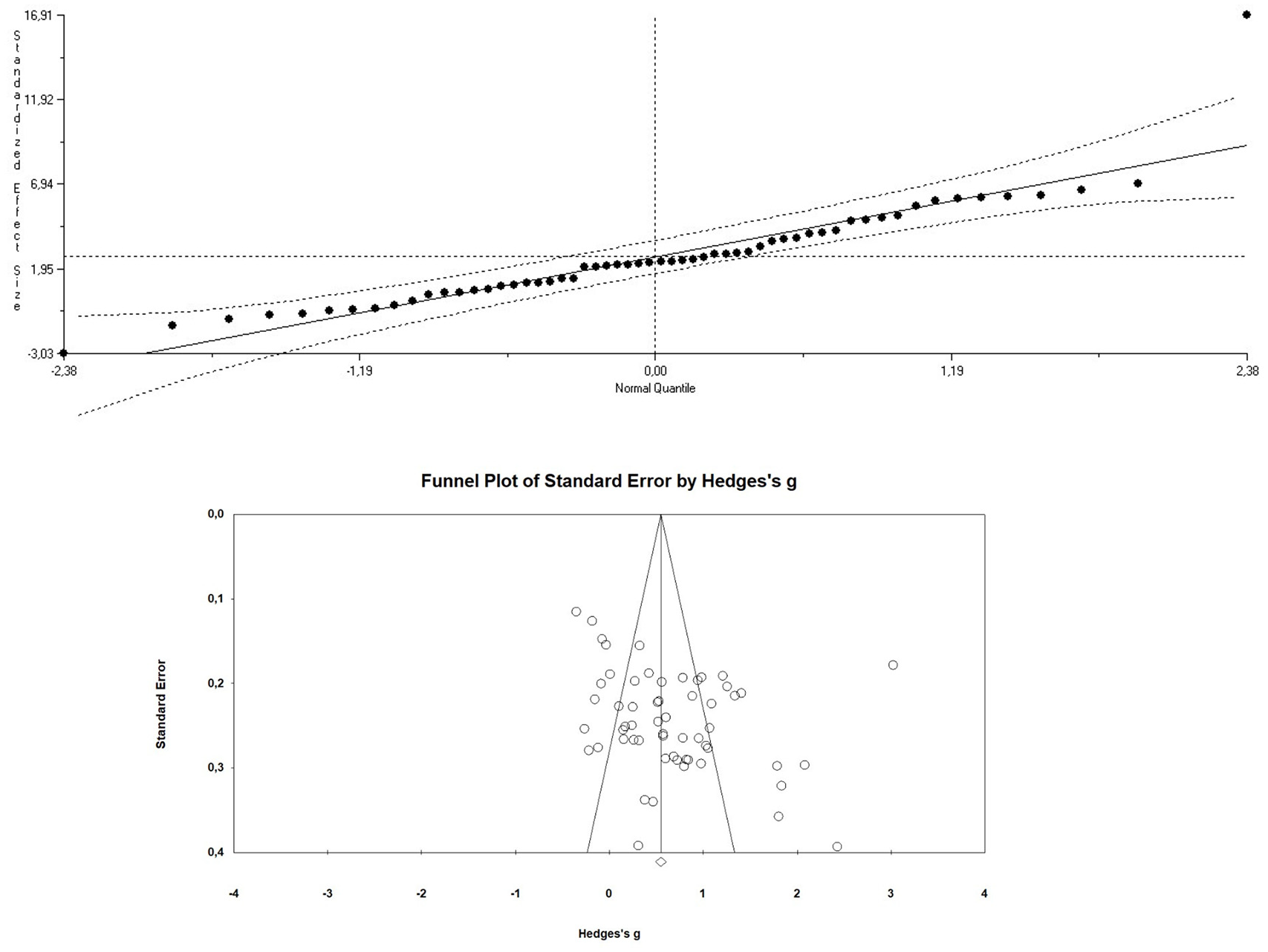
Normal quantile plot and funnel plot.
Findings Concerning Meta-thematic Analysis Process
This part presented the themes and codes derived from the meta-thematic analysis as a result of the document analysis. At this point, themes were generated on the effect of BL settings on achievement, the social contributions of BL settings, the general characteristics of BL settings, and the negative characteristics of BL settings. Each theme was visualized in the models and interpreted separately. Besides, the presentation of the related code ad theme was enriched with the quotations cited from the resource.
Effects of BL Settings on Achievement
The impact of BL settings on student achievement encompasses a variety of dimensions, as illustrated by the findings under this theme. Figure 3 visually represents the findings:

Effect of BL settings on achievement.
Figure 3 shows some effects of BL settings on achievement, such as “providing learners with different alternatives to solve problems, developing learners’ writing skills, being effective in learning and activities to simplify learning practices” were mentioned. Some expressions were provided to indicate how the codes were generated. To illustrate, “Blended learning was helpful for improving my English writing skills. It was effective because I learned more in BL setting compared to the lessons.” (M31-p.8). “It taught me different ways to solve problems.” (M40-p.48). Besides, BL settings include “enabling learners to learn by seeing and hearing, improving concentration, making learning long-lasting, broadening learners’ perspectives, being appropriate for learners’ level of learning and enabling learners to develop themselves.” For example, “Animations and pictures were useful for me. However, I did not have difficulty in focusing on the lesson as I felt more comfortable sitting at my computer.” (245410-p.75) “It becomes a reinforcement for us, and we can do it by researching. We can add something new.” (438244-p.100). When all the codes identified under this theme are considered, BL practices have many contributions in academic respect.
Social Contributions of BL Settings
The second finding of meta-thematic analysis is the social contribution of BL settings. The research’s qualitative findings revealed the transformative potential of BL settings in fostering rich student engagement and interactive learning experiences.
When Figure 4 is examined, it is seen that some codes, such as “creating discussion and interaction, allowing for information exchange, ensuring participation in lessons actively, enabling students to contact their teachers at any time, supporting social activities, and keeping communications with students outside of class” emerged. These codes emphasize issues including discussion and interaction, information exchange, social activities, collaborative environments, acquiring knowledge outside of class, active participation, and teacher interaction. For example, “I have learned how to work in groups and to get better products.” (M18-p.75). “I definitely believe that it is useful. It makes a significant contribution to learning because of continuing learning outside of class.” (M80-p.80). In addition to these social contributions, BL practices have positive characteristics such as “learning by sharing, making holistic learning with new different ideas and stating opinion freely.” It was also observed in the discussions that there was an environment where students had a chance to learn their ideas. In this regard, it can be stated that BL practices enable students to share and debate constantly in virtual classes and instantly get feedback concerning their learning.

Social contributions of BL settings.
General Characteristics of BL Settings
Within the overarching framework of BL settings outlined in Figure 5, the analysis identified key attributes contributing to the effectiveness and depth of learning experiences. These attributes, encapsulated through codes such as fostering regular study habits, enhancing the meaningfulness of learning, and enabling constant access to and archiving of course materials, underline the multifaceted impact of BL on cognitive and social dimensions of education.

General characteristics of BL settings.
In the context of the general characteristics of BL settings, as represented in Figure 5, the codes with regard to the characteristics of BL settings include “studying regularly, making learning meaningful, being effective, allowing effective, long-lasting and constant learning and archiving course materials and accessing them whenever possible.” Some expressions were considered to form these codes. To illustrate, “Interaction with field experts and opportunity for getting feedback.”(M6-p.187). “She also felt that she was more “active online” than in class.” (M10-p.75). Of the codes generated in this theme, the “studying regularly, tracking learning constantly and being creative” codes are noted. BL practices can develop friendly relations and enhance students’ motivation for exploratory applications. BL learning practices have many positive characteristics besides cognitive and social aspects.
Negative Characteristics of BL Settings
As delineated in the findings, the analysis of the drawbacks within the BL setting revealed a spectrum of challenges that may hinder the educational process. These challenges include difficulties tailoring the learning experience to diverse student needs, the potential monotony of the curriculum, and obstacles to clear comprehension of the material, alongside a noted scarcity of expert evaluations and barriers to effective online collaboration. Such insights underscore the complexity of implementing BL settings effectively, pointing to the necessity of addressing these shortcomings to optimize the BL experience for all participants.
In Figure 6, the negative characteristics of BL settings are displayed. Some negative aspects include “not understanding students’ level of learning, the monotonous process for some students, students’ not understanding the process explicitly, lack of experts’ evaluations and difficult to share online.” To illustrate, “That’s a problem with blended. Some people give it busy work, and some people make it so dull, too dull, and then students also want high entertainment, and that’s not possible.” (M10-p.86) “The kids in the class … can be a variety of levels, a variety of backgrounds, a variety of motivation, learning abilities. You know, it’s difficult. Face-to-face, if you are a teacher that’s aware, you can within a day, you can tell who’s going to make it, who cannot … It’s hard to tell online or blended.” (M10-p.87). Besides, BL settings involve communication failure among group members, inability to use time effectively, lack of experience, and lack of applications. The BL settings have other negative aspects, such as incomprehensible knowledge, lack of infrastructure, and excessive assignments. Overall, BL settings can have significant shortcomings, which should be considered when utilizing BL practices in education efficiently and effectively.

Negative characteristics of BL settings.
Discussion and Conclusion
The effect of BL practices on students’ academic achievement in higher education settings was examined through meta-analysis and meta-thematic analysis based on the data derived from document analysis. The meta-analysis revealed that BL practices greatly increased the success levels of students. Besides, they are more effective than traditional learning practices. Norberg et al. (2011) showed that the lessons given with the BL method increased the students’ performance and that this method was more effective than face-to-face learning in many cases. Ünsal (2010), on the other hand, found that students can focus on superior success through the combination of BL methods, personal learning style and the right learning technologies. Contrary to these views, as a result of the study conducted on the effect of teaching a lesson with the BL method on students’ academic motivation, Balaman (2016) concluded that BL is not superior to traditional learning in increasing students’ academic motivation. Batdı (2014) stated that BL practices positively affect students’ general and academic success, ability to control their own learning, and motivation toward learning. Bağcı and Yalın (2018) concluded that the 5E learning model led to more permanent learning of the subject of the algorithm in the BL environment. Kadirhan and Korkmaz (2020), in their study examining the effect of blended science education on students’ academic achievement and attitudes, indicated that the use of a BL environment in science courses contributed positively to students’ academic achievement and attitudes.
As a result of the meta-thematic analysis, it was understood that the BL practices lead to many positive social outcomes, such as presenting opportunities for discussion and interaction, allowing information exchange, encouraging active participation in the lesson, making it possible for students to interact with their teacher any moment, supporting social activities, requiring working in collaboration outside the classroom and students’ continuing to interact outside the classroom. The relevant codes emphasized discussion and interaction, information exchange, social activities, collaborative environments, learning outside the class, active participation, and teacher interaction. In addition, it was observed that the related practices made other social contributions, such as allowing learning by sharing, providing holistic learning environments with new and different ideas, providing an easy way to express ideas and providing environments for students to learn each other’s ideas in discussions. Providing opportunities to discuss and share opinions and get immediate feedback in the virtual classes, creating excellent competition between students to participate in the lesson, making it possible to be open to new ideas and discussions and fostering student-teacher interaction are among the social contributions of the BL practices. Given the size and influence of the relationships established through social networks and environments in the era of informatics and communication, where we are constantly exposed to new information, it is argued that the importance of the BL environments in terms of social dimension has increased. In this context, Eryılmaz and Karakaya (2018) stated that when the number of educational content shared by students in the social media environment is examined, it can easily be seen that students are willing and prone to use such environments. They also stated that BL environments are effective educational environments that eliminate the necessity of being in the classroom and support social media applications and collaborative learning, resource-document sharing, active participation and research and discussion environments. They stated that educators can easily communicate with their students by using these environments, sharing information about the course, starting discussion topics, discussing with other students in the class and following homework and projects in these environments. Al-Harbi (2015) stated that through the discussion and sharing environments provided by the online social networks used in the BL environments to users, the interaction has increased, and the information desired to be conveyed can be delivered to the target audiences more quickly. Research states that with mobile technologies and BL, learners’ social relationships improve, and they find opportunities to share their learning experiences with their classmates and teachers. All these are very important regarding the benefits perceived in instructional interactions (Ghazal et al., 2018; Pimmer et al., 2016).
In the context of the general characteristics of the BL environments, the following characteristics come to the fore: providing opportunities to revise, requiring being more active online, helping to have access to different resources, fostering permanent learning, providing opportunities to work independently of time and place, allowing monitoring homework regularly, making visualization in the mind possible and ensuring that the course materials are archived and accessed at the desired time. When the relevant codes were evaluated, they emphasized the repetition of the practices, the necessity of being active, working independently of time and place, regular homework monitoring, mental visualization, and archiving of materials. In addition to these characteristics, codes with different content were reached, such as offering opportunities to share notes, enabling the use of different modules, saving time, enabling the use of technology outside the classroom, providing quick access to the desired information, allowing preliminary preparation and updating information. Emphasizing the issues of regular study, continuous monitoring and creativity, the codes of allowing regular study, continuous monitoring and prioritizing creativity also come to the fore. It can be said that BL applications also have general characteristics such as fostering the development of friendship relations, exploratory applications increasing motivation, providing practices to develop all skills and having more advantages than traditional learning. In other words, it can be said that the related practices have many positive aspects in general and many cognitive and social contributions. In support of the results of the current study, Arkorful and Abaidoo (2015) pointed to the general characteristics of BL environments, such as flexibility in time and space, convenience in accessing information, motivating students to interact with each other and sharing their ideas and considering individual learning differences so that each learner can learn at their own pace. Ekwunife-Orakwue and Teng (2014) stated that the frequency of communication between students and instructors outside the classroom would increase student motivation and interest and that interactive dialogue between the teacher and students would reduce the feeling of isolation and perceived distance and BL environments would be necessary in this regard. Wright (2017) stated that due to their different responsibilities, many students today think of accessing the additional training they want without any time and place limitations and continuing their social interactions. Therefore, BL is essential in being easily accessible and enabling individuals to continue their personal communication and social interactions. In his study on pre-service teachers, Y. Li (2015) noted that pre-service teachers generally have positive perceptions of BL and pointed to the role of BL environments in pre-service teachers’ gaining a broad perspective and developing their communication. Hubackova and Semradova (2016) stated in their research on foreign language students that BL is not only acceptable but also preferred by students, and it increases communication and sharing and makes teaching convenient by using constructivist principles and an electronic teaching style. Investigating the application of the BL method for problem-solving, Dwiyogo (2018) found that the BL-based method for problem-solving helps students learn the software they need for physical education lessons. The application of BL increases learning effectiveness and facilitates the learning process. Yulia (2020) stated that the coronavirus pandemic has affected the education system in Indonesia, that very positive developments have been experienced in the teaching-learning processes due to the general characteristics of BL practices and that the most important thing for educators to do is to use various strategies to improve online learning. Munro et al. (2018) pointed out that the BL environments are a more effective model than traditional education for teaching students self-management skills, according to their research on 120 entry-graduate physiotherapy students and medical students at Flinders University. In their study on nursing students, Sáiz-Manzanares et al. (2020) stated that the BL practices effectively analyze individual and collaborative students and apply automatic feedback and hypermedia resources. In addition, they emphasized their positive effects on students’ access to information at any time, facilitating learning, motivating students and helping students gain the collaborative working skills they will encounter in project-based learning environments.
With regard to the negative aspects of BL environments, the participants’ perceptions are mainly concerned with students’ unreadiness for BL practices, incompetencies in ICT, lack of expert evaluations for BL practices processes, communication problems among group members, lack of experiences, ineffective use of time, lack of practice and discussions, and technical problems. BL environments have serious negative aspects, with infrastructure and system-related problems emerging. Hodges et al. (2020) pointed out that it is difficult to create a learning process that supports different types of interaction to ensure both cognitive and social participation of individuals living in separate spaces in distance education. This is important for the efficiency of the process. Agamben (2020) stated that if distance education-teaching, which is a part of BL practices, lasts too long, it will create a new education culture with features such as cultural pluralism and a culture of criticism-discussion, which can be seen as positive aspects of face-to-face education, may suffer from this situation. In a study they conducted on science teachers from different regions, Bakioğlu and Çevik (2020) found that concerns of the teachers about internet connection, communication with students, low participation rate of students and their anxiety about not being able to complete practical laboratory and workshop courses were very high in BL environments. Hiğde and Aktamış (2021) stated that students had technical problems and internet-related problems during distance education used in the BL environments, that group work was ineffective compared to face-to-face education, that there occurred lack of communication, inequality of opportunity in education and lack of concentration and motivation, that students were not encouraged to take responsibility as much as in face-to-face education, that students did not much participate in online lessons thus they lagged behind, that exams were found to be unjust and that there was not a good study environment and thus students developed negative opinions. Yıldırım (2020) drew attention to the fact that the increase in screen time, one of the criticisms of the digitalization of education, will have negative social and physical effects and that there is not enough work to compensate for these negative effects.
Implications
In light of the positive impacts of BL on academic achievement and social outcomes in higher education, educators and institutions must embrace BL’s multifaceted benefits. Teachers should have the necessary skills and knowledge to design and implement BL environments effectively, focusing on integrating online and traditional teaching methods to cater to diverse learning styles and needs. This includes developing curricula that leverage BL to enhance comprehension, engagement, and practical application of knowledge. Furthermore, providing ongoing professional development opportunities for educators is essential to ensure they remain adept at utilizing the latest technological tools and educational strategies within BL settings. At this point, as Alshahrani (2023) has already pointed that BL, strategically combining face-to-face instruction with online resources and activities, has gained notable acceptance throughout educational contexts. Using AI-based chatbots, such as ChatGPT, presents a promising avenue for reinforcing the efficacy of blended learning models, offering personalized assistance, fostering engaging interactions, and improving the overall learning experience.
Enhancing the technical infrastructure to support BL is paramount for institutions and policymakers. This ensures reliable access to online learning platforms, resources, and support services for teachers and students. Additionally, policies should encourage the development of BL environments that promote active learning, collaboration, and student autonomy, extending beyond the classroom to foster lifelong learning skills. By prioritizing these areas, educational stakeholders can maximize the effectiveness of BL, contributing to a more dynamic, inclusive, and enriched learning experience for students across various disciplines.
Given the rapid technological advancements in informatics and communication, alongside the global pandemic’s impact, new methods and practices in distance education have become critically important. Recognizing that distance education alone may not suffice to enhance the quality and efficiency of education, there is a growing shift toward BL environments that merge both traditional and online modalities. However, the novelty of this educational model introduces various challenges. Therefore, future research should evaluate BL applications through students’ attitudes and perceptions, which could illuminate the path for upcoming BL studies. Moreover, as Müller et al. (2023) attained from their results, BL-designed environments encourage higher education institutions to offer flexible study programs in a blended learning format with reduced classroom time but also underscore the importance of the educational design quality. Therefore, it is of the utmost importance to consider the following elements as being crucial for practical blended learning courses: an adequate course structure and guidance for students, activation of learning tasks, stimulation of the social presence and interaction of teachers, as well as the provision of timely feedback on the learning process and outcomes. The effectiveness of BL environments in supporting learners’ perspectives, enhancing writing skills, facilitating understanding, and offering diverse problem-solving approaches warrants further exploration. These environments, with their capacity to incorporate visual and auditory learning materials such as animations and images, can significantly enrich practical lessons and language learning by making them more engaging and less monotonous. Future studies could investigate how in-service teacher training on BL and preparing course content tailored to these environments can boost practical and foreign language education efficiency. Moreover, the interactive and flexible nature of BL environments, which allow for discussions, information exchange, and continuous teacher-student communication, presents an opportunity to cultivate sociable, cooperative, and communicatively adept individuals. Research could explore how the design of BL environments can maximize these interactions to benefit students’ social skills and learning autonomy. Ensuring learners can access course materials anytime and from anywhere, thereby supporting independent study and content repetition, is another area for investigation. This includes examining infrastructure improvements, internet access, and potential incentives for education-focused internet service providers. On the other hand, some researchers indicate that they have not seen any significant difference in student performance between BL and non-BL applications. Although blended learning can yield favorable outcomes in numerous domains, it may not be optimal for all student profiles or learning contexts. Consequently, it is crucial for educators to meticulously assess the requirements of their students and the learning environment when determining whether to adopt a BL process (Cao, 2023). In addition, the efficacy of BL is contingent upon its actual and potential applicability in productive and efficacious ways. McCarty and Palmer (2023) revealed that the application of BL is an individual endeavor that relies heavily on implementing robust educational design by the teacher, who is the subject matter expert. This process is supported by those directly involved in the teaching and learning process. Similarly, Ayob et al. (2023) detected in their research that implementing BL has resulted in a notable enhancement of the educational process, rendering it a more efficacious and interactive endeavor than in traditional classroom settings. In a BL environment, students can pursue their learning according to their individual requirements.
However, BL has drawbacks, such as limited practical experimentation in scientific and applied courses, adaptation challenges, technical issues, and the need for continuous content updates. Future studies should consider developing distance education materials and programs specifically for practice-heavy disciplines (e.g., Physical Education, Arts, Music) based on teacher feedback. This nuanced exploration of BL’s benefits and challenges can guide the development of more effective and engaging learning environments, addressing both the academic and social dimensions of student experiences.
Limitations and Suggestions for Further Research
The findings of this study are limited to the effects of BL practices conducted in higher education settings. Therefore, researchers could study the effects of these practices at different levels of education, such as elementary, lower-secondary, or upper-secondary education. At these levels of education, they could investigate the impact of these practices in courses such as science, mathematics, and technology.
This research focused on the effectiveness of BL practices in higher education settings. Researchers could study the effects of BL practices concerning a specific course, such as ESL, history, and geography, at undergraduate or graduate levels in higher education settings. They could understand the strengths and shortcomings of the practices thoroughly, thereby designing curricula that more effectively benefit from BL practices in the settings.
Footnotes
Appendix
Cohen Kappa Values of Research Themes.
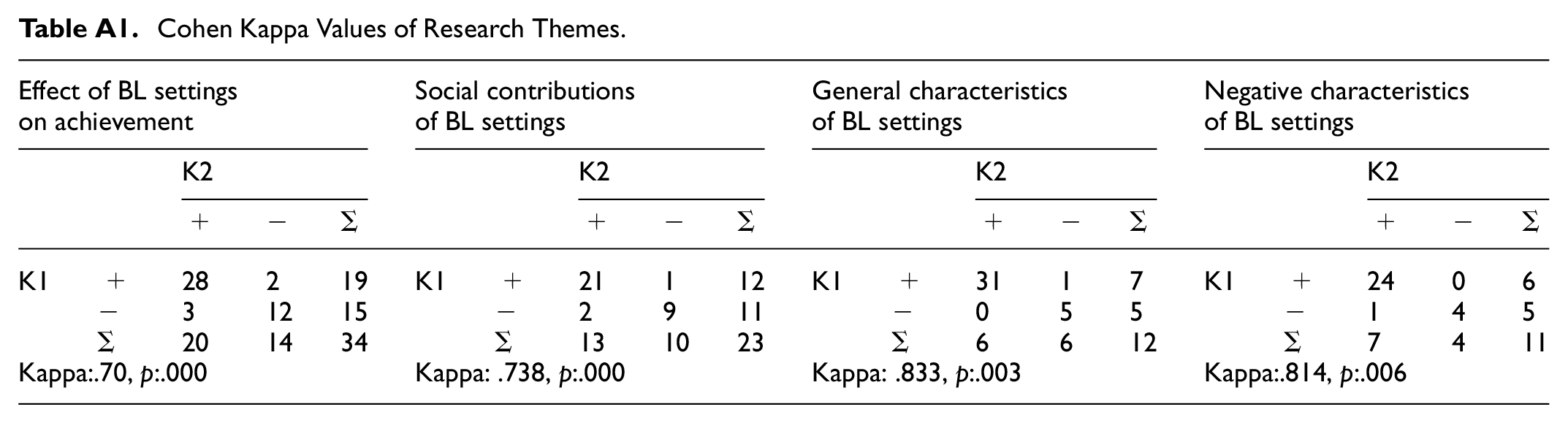
| Effect of BL settings on achievement | Social contributions of BL settings | General characteristics of BL settings | Negative characteristics of BL settings | ||||||||||||||||
|---|---|---|---|---|---|---|---|---|---|---|---|---|---|---|---|---|---|---|---|
| K2 | K2 | K2 | K2 | ||||||||||||||||
| + | − | Σ | + | − | Σ | + | − | Σ | + | − | Σ | ||||||||
| K1 | + | 28 | 2 | 19 | K1 | + | 21 | 1 | 12 | K1 | + | 31 | 1 | 7 | K1 | + | 24 | 0 | 6 |
| − | 3 | 12 | 15 | − | 2 | 9 | 11 | − | 0 | 5 | 5 | − | 1 | 4 | 5 | ||||
| Σ | 20 | 14 | 34 | Σ | 13 | 10 | 23 | Σ | 6 | 6 | 12 | Σ | 7 | 4 | 11 | ||||
| Kappa:.70, p:.000 | Kappa: .738, p:.000 | Kappa: .833, p:.003 | Kappa:.814, p:.006 | ||||||||||||||||

Funding
The author(s) received no financial support for the research, authorship, and/or publication of this article.
Declaration of Conflicting Interests
The author(s) declared no potential conflicts of interest with respect to the research, authorship, and/or publication of this article.
Data Availability Statement
Data sharing not applicable to this article as no datasets were generated or analyzed during the current study.