




Abstract
For many years, researchers interested in the blogosphere have collectively acknowledged the lack of scholarly attention into the role of blog readers in the blogging activity. While many pioneering studies as well as new studies have highlighted the rising potential of this field, there has been no systematic examination of the growth or lack thereof of this field. As a result, this article reviews blog reader–focused research between 2008 and 2018 through a content analysis of blog reader–focused research articles obtained from seven databases: EBSCO’s Academic Search Complete, JSTOR, EBSCO’s Communication & Mass Media Complete, SAGE Journals, Elega’s Chronological Arrangement of Blog Readership Research, Wiley Online Library, and Taylor and Francis. We also identified the methods, theories, geospatial concentration, and journals that published these articles. Findings show that although at least one article was published each year with a peak of six in 2013 and 2015, blog reader–focused research has not really evolved given that concentration has tremendously decreased in the last 3 years (2016–2018). Regarding genres, we learnt that the majority of articles focused on political blogs, and most of the studies adopted quantitative research methods and survey as a data collection method. The results also show that blog reader–focused studies published between 2008 and 2018 used Uses and Gratification Theory more than other theories, and the majority of these articles focused on blogs in the United States. Journal of Computer-Mediated Communication, New Media &Society, and Computers in Human Behavior published more blog reader–focused research than other journals.
Introduction
Over the past few years, the world has witnessed an extraordinary advancement of information communication technologies, which has led to the emergence of different forms of new media tools such as blogs, online television, social media, and apps for mobile phones (Zheng et al., 2016). A weblog or blog, one of the aforesaid media tools, is a shared online journal that contains many filed posts, gets updated from time to time, and is presented in reverse-chronological order (Nardi et al., 2004).
Over the past two decades, blogs, the cornerstone of this study, have progressively become more popular. They have become a major digital publishing phenomenon as well as a significant element of contemporary mass media culture (Baumer et al., 2008; Elega & Özad, 2018b). They have also become an important element in different sectors of our communities such as public health (Neubaum & Krämer, 2015; Rains & Keating, 2011), motherhood (Bronstein & Steiner, 2015), war (T. J. Johnson & Kaye, 2010), the fourth estate (Knight, 2008), science (Mahrt & Puschmann, 2014), sports (Galily et al., 2012) fashion (McQuarrie et al., 2013), and politics (Mirandilla-Santos, 2011; Sweetser & Lee Kaid, 2008). According to T. J. Johnson and Kaye (2004), blogs are also one of the most relied-upon online news sources, and they are deemed more factual than many traditional media outlets by their readers.
For many years, blogging research has revealed important insights about the activity of blogging, the attitudes of bloggers, and the practices surrounding blogs. While blogs, blogging activity, and blog authorship have enjoyed enormous scholarly attention, less scholarly attention has been directed toward blog readers, as confirmed by numerous scholars (Baumer et al., 2008; Elega, 2018a, 2018b; Elega & Özad, 2018a; Hsu & Lin, 2008; Huang et al., 2008; Jarreau & Porter, 2018; Karlsson, 2007; Kaye, 2010; Kornejeva, 2012; Nardi et al., 2004; Orton-Johnson, 2017; Treem & Thomas, 2010; Yardi et al., 2009), despite their position as one of the major players in the blogosphere. The aforementioned is the primary reason compelling this research. Another important reason is that the few blog-focused meta-analyses that have investigated the progression of blogging research have only focused on organizational blogging (Baxter & Connolly, 2013) and Africa-focused blogging research (Elega & Özad, 2018a). Hence, this study is the first comprehensive blog reading–focused meta-analysis—a study that is extremely needed to measure the progression of this field.
Given that this research area of blogs is relatively new, it is safe to say that this is an emergent scholarship; nevertheless, it is not uncommon for scholars to map the progression of an emergent scholarship in communication and media studies. By examining 388 articles accessed from EBSCO’s Communication & Mass Media Complete, the website of the Council for the Development of Social Science Research in Africa (CODESRIA), Taylor and Francis Online database, and SAGE Journals, Wasike (2017) reviewed Africa-related mass communication research between 2004 and 2014. In addition, Elega and Özad (2018a) performed an analysis of 32 Africa-focused blog-related research accessed from six databases: EBSCO’s Academic Search Complete, Communication & Mass Media Complete, JSTOR, SAGE, Taylor and Francis, and Wiley Online Library.
This study is a small sample study, yet it makes significant contributions to knowledge. First, although most of the blog reader–focused research has highlighted the lag in this research area, this study is the first meta-analysis to review published research on blog readership between 2008 and 2018. The study provides an overview of blog reading scholarship, thereby greatly informing the progression of the blog reader–focused research. Second, given that this study reviews the geospatial concentration of blog reader–focused research, this study opens a new discourse on nonlagging and lagging countries as well as regions concerning blog reader–focused research. Third, this study also reviews other essential variables such as the distribution of methodology, data collection methods, theories, and journals that have published blog reader–focused articles. Finally, given that “The volume, scope, and quality of research and theory development in any academic discipline are among the important yardsticks for the assessment of the status of the discipline” (Edeani, 1995), this study provides an opportunity to gain new information for researchers who are interested in online audience studies, to help improve the scholarship of emerging new media technologies.
Study Rationale
Blog reader–focused research warrants an inquiry because in 2004, when blogging research commenced, Nardi et al. (2004) predicted that “future research is sure to pay attention to blog readers,” and this forecast was made based on the fact that their research on blogging as a social activity led them to believe that “blogging is as much about reading as writing, as much about listening as talking,” which means that “Blogging is not a solo activity” (Baumer et al., 2008). According to Elega (2018b), it is an activity with two major players, the bloggers and blog readers, who each have distinct roles and activities that are equally important to blogging activities.
For many years, scholars have continued to echo what Nardi et al. (2004) said in their milestone study. Baumer et al. (2008), Kaye (2010), Kornejeva (2012), Orton-Johnson (2017), and other scholars have claimed that prior blog-focused studies have exclusively focused on bloggers and the writers of blogs but failed to focus on the activities despite their contribution to the blogosphere. This study is rooted in empirical evidence stating the nature of the lack of progression of the field, and this lack of progression is why this study deserves academic inquiry. Despite its relatively short history as a focus of academic study, we feel measuring the evolution of this study in the last decade is necessary, and a meta-analysis seems well suited to account for this evolvement.
This study adopts a meta-analysis because, first, “A meta-analysis of this subset of work is appropriate for characterizing the body of literature as it has evolved over the decades” (Sevin et al., 2019, p. 4817). Second, “meta-analysis of the peer-reviewed literature is the most straightforward means of constructing a big-picture view of the state of research” (Sevin et al., 2019). Third, meta-analysis not only allows us to trace the progression of peer-reviewed literature, but it also helps to measure other important variables and elements of blog reader–focused research such as methodological approaches to show the “field’s areas of concentration as well as its oversights” (Comfort & Park, 2018, p. 863). Finally, this study adopts a meta-analysis “because meta-analysis can overcome the limitations of any single study” (Boulianne, 2015, p. 524).
Blog Readership Research
Within the scant literature of blog reader–focused research, few scholars have investigated an array of issues such as political participation and deliberation among blog readers in the American context (Lawrence et al., 2010); blog readers’ assessment of ghost blogging and engagement (Gallicano et al., 2014); an assessment of blog readers’ interactions within the blog environment (Laqua & Sasse, 2009); observation of blog reading behavior of blog readers in the enterprise blogosphere (Singh et al., 2010); political issues discussed on blogs and the consequences on readers’ political blog trust and satisfaction (Sweetser & Lee Kaid, 2008); the role, contributions, and significance of blog readers in the activity of blogging (Baumer et al., 2008).
Arrieta et al. (2019) explored the effect of blogger social influence and the reader’s experience on loyalty toward the blogger. Stubb (2018) studied blog users’ viewing time of sponsored blog entries, and Magno (2017) explored how cultural blogs influence their readers’ choices of which cultural products to consume. Sancheti et al. (2019) investigated blogs as a publishing digital platform through the digital conversations that occur in the blogosphere. T. J. Johnson and Kaye (2004) investigated blog readers’ perceptions of blog credibility in comparison with traditional media and other online news sources, and they also compared the credence and features of war blog users between two periods in another study (T. J. Johnson & Kaye, 2010). Baumer et al. (2008) explored blog reading practices through a mixed research method (semi-structured interviews, a survey, and data collection through software) among 15 blog readers. Based on their findings, the researchers discussed common reading practices, presentations, and perceptions and proposed new directions for further blog reading studies. Kaye and Johnson (2011) investigated blog readers’ reasons for asserting that blogs are factual via an online survey conducted with blog users (n = 1,989); they found that some respondents accede that the following seven genres of blogs are factual: general information, personal, political, journalism, war, military and corporate. Because no study has exhaustively assessed the timeline of blog reader–focused research, this study seeks to know the following:
Blog Genres
Blogs have been organized into different subcategories based on their mission and content (Gill, 2004). Elega (2018b) asserts that there are three types of blog genre: special information blogs (fashion, food, sport, entertainment, celebrity and gossip, and technology), news blogs, and general interest/information blogs. Hookway (2008) posits that “There are a number of weblog genres in existence—from pure filter blogs (literal filters of one’s web surfing) to war blogs and celebrity blogs, through to educational, professional and pornographic ones” (p. 93). Few scholars have investigated blog readers of various blog genres; however, a recent study by Fischer (2018) explored readers’ perceptions of professional blogs. Similarly, Kalaitzandonakes (2019) examined mom blogs’ influence on moms’ nutrition beliefs and habits. Primo et al. (2013) evaluated kinds of blogs through an investigation of two large corpuses from Brazilian blogs. They found 16 blog genres with other subgenres. In a meta-analysis, Elega and Özad (2018a) reviewed the blog genres researched within Africa-focused blog scholarship between 2006 and 2016. Considering that no scholarly effort has investigated the blog genres studied within blog reader–focused research, we ask the following:
Methodologies and Data Collection Techniques
In Zhenget al.’s (2016) analysis of communication technology research in Asia from 1995 to 2014, they reviewed the major methodologies adopted by Asian communication technology research. Li and Tang (2012) also evaluated major methodologies adopted in their meta-analysis study on China-focused mass communication research between 2000 and 2010. Because no meta-analysis has systematically evaluated the methodologies used to evaluate blog reader–focused research, we ask the following:
Also, in terms of specific data collection methods, Zheng et al. (2016) evaluated the data collection techniques used in Asian-focused communication technology research in Asia from 1995 to 2014. They found that survey, content analysis, case study, and interview techniques were favored more than other methods. Given that, according to Wasike (2017), “Contemporary research shows changing trends regarding data collection methods” (p. 202) and no meta-analysis has systematically evaluated data collection methods used to evaluate blog reader–focused research, we ask the following:
Theories
According to Edeani (1995), “The quantity of research and theory produced, and the extent to which the major issues and problems of the discipline are reflected in the available theories and research, all provide concrete evidence of scholars’ awareness” (p. 25). Scholars in the field of communication and media have analyzed communication theories, theories published within Africa-focused mass communication research (Wasike, 2017), theories published within emerging communication technology research (Borah, 2017), and theories published within Chinese-focused mass communication research. Considering that no emerging communication technology–focused meta-analysis has explored the theories within blog reader–focused research, we ask the following:
Geospatial Distribution
In Elega and Özad’s (2018a) evaluation of Africa-focused blog-focused research, an emerging scholarship during the 10-year period from 2006 to 2016, they investigated the geospatial concentration of Africa-focused blog-focused studies. They found that “Half of the articles focused on South African, Egyptian, and Kenyan blogs, bloggers, or other blogging aspects (n = 16; 50%). Three articles focused on African and Tunisian blogs, while two articles focused on the Nigerian and Zimbabwean blogospheres.” Findings also show that at least one Africa-focused blog article was published in the following countries: Ethiopia, South Sudan, Republic of Congo, Rwanda, Mozambique, and Sudan (p. 2248). Given that no study has reviewed what regions and/or countries were focused on within blog reader-focused research, we ask the following:
Communication and Media Journals
Outlets such as journals, conference proceedings, book chapters, books, and reports that publish original research works in a given field are ways we can recognize the field’s progression, changing practices, and the “foci of scientific interest” (Merton, 2017, p. 397). To ascertain the distribution of journals that published blog reader–focused research, we ask the following:
Method
To assess the trends and progression of blog reader–focused research, this study adopts quantitative content analysis to answer the six research questions of this meta-analysis. Quantitative content analysis seems well suited to the study because it helps in providing empirical evidence.
Unlike other data-gathering methods used in systematic literature review studies, this study adopts content analysis to assess the progression of blog reader–focused research. This is because content analysis is a “research technique for the objective, systematic and quantitative description of the manifest content of communication” (Berelson, 1952). Scholars interested in adopting content analysis in analyzing the state of a field accede that this data-gathering method helps in the identification of conceptual content or patterns of a research area (Ryan & Bernard, 2000; Seuring et al., 2005). Zheng et al. (2016) accede that adopting content analysis as well as other data-gathering techniques for meta-analysis helps researchers to “fill this gap in their area of focus, by examining the theoretical frameworks and geospatial distribution of academic articles in areas of focus within the communication and studies field.”
Furthermore, content analysis fits the goal of the study because it looks directly at research papers to identify patterns and allows for quantitative operations and statistical analysis, which is what this study sets out to do to measure whether this field has progressed or not.
Sample
This study analyzes blog reader–focused research between 2008 and 2018 using a content analysis research method. English-language research articles accessible in full text and published between 2008 and 2018 in the following databases—EBSCO’s Academic Search Complete, JSTOR, EBSCO’s Communication & Mass Media Complete, SAGE Journals, Wiley Online Library, and Taylor and Francis—were analyzed.
Elega’s (2018a) chronological arrangement of prior related studies on blog readership was also included, and it is not unusual to include a nontraditional database in a meta-analysis like this. After including EBSCO’s Communication & Mass Media Complete, SAGE Journals, and Taylor and Francis Online databases, Wasike (2017), in his evaluation of emergent Africa-focused mass communication research from 2004 to 2014, added “the hosting organization’s website, CODESRIA (Council for the Development of Social Science Research in Africa), for relevant articles” (p. 205).
All seven databases were explored from January 1 to January 11, 2019, and our unit of analysis in this study is a single published blog reader–focused article. We chose the aforementioned databases for a number of reasons. First, they all publish articles in the field of mass communication or communication and media studies. Second, all of them publish reputable high-impact journals, and they are committed to publishing standard original articles. Third, such databases guarantee reputable articles. We ascertained that these databases are dependable and publish “blog reader–centered studies” because the previous blog-focused meta-analysis explored obtained data from EBSCO’s Academic Search Complete, Communication & Mass Media Complete, JSTOR, SAGE, Taylor and Francis, and Wiley Online Library (Elega & Özad, 2018b). All of the databases are widely considered “the most complete collection of scholarly literature in the physical and social sciences and the humanities are frequently referenced in meta-analyses or reviews” (Comfort & Park, 2018, p. 866).
Apart from the aforesaid criteria, for papers to be eligible, they also have to mention weblogs, blogs, the blogosphere, and/or blogging in their titles, abstracts, or keywords. Following Baxter and Connolly (2013), “the criterion for identifying these papers as empirical was whether the studies had performed either qualitative, quantitative or a mixed-methods approach to obtain data about the use of blogs in a real-life setting” (pp. 108–109).
The phrases “blog reader,” “blog user,” and “blog audience” were used to search results on blog reader–focused research published in the field of mass communication or communication and media studies between 2008 and 2018. This 10-year period was selected to spawn a comprehensive sample. This period was also chosen to make visible a trend of blog reading scholarship and, more importantly, was selected because the first comprehensive study on blog readership accedes that blogging research has existed a little less than twenty years and in the earlier years of blog scholarship, blog readership enjoyed less or no scholarly attention, which in turn means that research in this area has only been very pronounced in the last decade. (Elega, 2018a, p. 56)
To establish parameters for the sample and to get a sizable number of empirical studies conducted on blog reader–focused research between 2008 and 2018, a set of inclusion and exclusion criteria was adopted. These criteria were examined by the authors to provide a comprehensive list of blog reader–focused scholarly papers. The first two phases of the search were done electronically through the databases’ inclusion and exclusion criteria. However, in the third phase, the researchers searched manually to ensure compliance with the listed criteria. After this examination, only 41 papers qualified as focused on blog readers given the established criteria (see Table 1).
Inclusion and Exclusion Criteria.

Coding Scheme
The following categories were coded to achieve a clear quantitative operation. To measure the year, we coded the years 2008–2018 from 1 to 11 (see section “Progression of blog reader–focused research”). For kinds of blogs discussed within blog reader–focused research, we coded genres from 1 to 16 (see section “Blog genres”). For methodologies, we coded from 1 to 3 (see section “Methodologies and data collection method”). For data collection method, we coded from 1 to 14 (see section “Methodologies and data collection method”).
Progression of blog reader–focused research
To capture the years in review, we coded each year as follows: (1) 2008, (2) 2009, (3) 2010, (4) 2011, (5) 2012, (6) 2013, (7) 2014, (8) 2015, (9) 2016, (10) 2017, and (11) 2018.
Blog genres
We adopted Elega and Özad’s (2018a) coding for blog genres. The categories we coded are (1) political, (2) academic, (3) sports, (4) health, (5) science, (6) technology, (7) economy, (8) news, (9) moms, (10) fitness, (11) literature, (12) weddings, (13) lifestyle, (14) cultural and social, (15) general interest, and (16) activism.
Methodologies and data collection method
(a) Following Baxter and Connolly’s (2013) system, we coded methodology as follows: (1) qualitative methods, (2) quantitative methods, and (3) mixed methods.
(b) The coding categories for the methodologies used in this study were highly informed by Wasike’s (2017) coding scheme for methodologies. We revised his 13-item scheme to 14 items: (1) case study, (2) rhetoric analysis, (3) content analysis, (4) survey, (5) mixed methods, (6) document analysis, (7) in-depth interviews, (8) secondary data, (9) experimental, (10) phenomenology, (11) ethnography, (12) focus groups, (13) textual analysis, and (14) review.
Geospatial concentration
To capture the geospatial distribution of blog reader–focused research, we modified Zheng et al.’s (2016) regional coding for first author university affiliations. The following categories were coded as a result: (1) Asia, (2) Africa, (3) Australia, (4) Antarctica, (5) Europe, (6) North America, (7) South America, and (8) Others.
Others
For the journals that published each published article on blog reader–focused research, theories within these publications, and countries on which these research articles focused, we coded the categories after the data were collected.
Interrater Reliability
Two competent researchers whose research interest is emerging communication technologies coded the mentioned categories. The coding was done independently by these researchers and cross-checked until a consensus was achieved. The population of the study was 8,478, whereas the articles agreed upon by researchers are 41. The following calculations show the coefficient of the sample selection and the agreement of the two researchers on this sample:
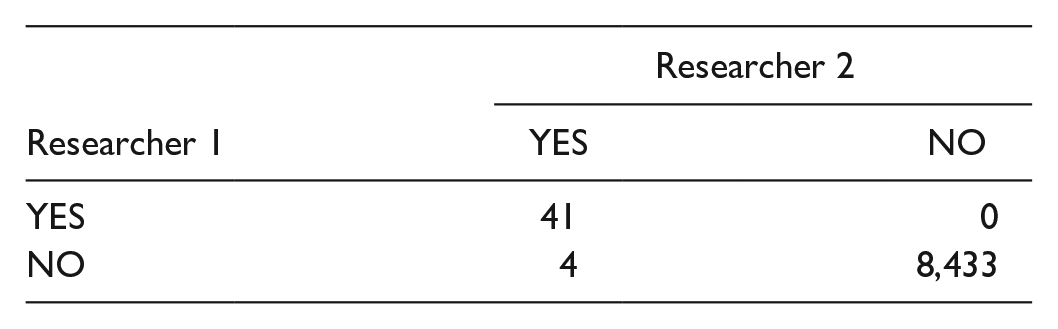





where po is the proportion of units in which the judges agreed, which is 0.999. pe is the proportion of units for which agreement is expected by disagreement chance, which is 0.99. The interrater agreement of 41 blog reader–focused articles was calculated using Cohen’s kappa coefficient (1960). The results prove that the average agreement between the two researchers is K = 0.90, which Cohen (1960) and Fleiss (1971) considered as excellent.
Results
All seven databases—EBSCO’s Academic Search Complete, JSTOR, EBSCO’s Communication & Mass Media Complete, SAGE Journals, Elega’s Chronological Arrangement of Blog Readership Research, Wiley Online Library, and Taylor and Francis—generated 236, 179, 67, 4,170, 37, 2,100, and 1,689 full-text journal articles, respectively. Following our criteria, the majority of the qualified articles were retrieved from EBSCO’s Communication & Mass Media Complete (31.1%) and Elega’s Chronological Arrangement of Blog Readership Research (26.6%). Few articles were generated from other databases such as Wiley Online Library (13.3%), Taylor and Francis (11.1%), and SAGE Journals (11.1%). EBSCO’s Academic Search Complete (4.4%) and JSTOR (2.2%) generated the least number of blog reader–focused research published in the field of mass communication or communication and media studies between 2008 and 2018.
Overall, 8,478 articles covered the subject matter; however, only 41 articles fulfilled our criteria of empirical studies that focus on blog reader–focused articles. Meta-analysis with such a small sample is not uncommon. For example, Elega and Özad (2018a) reviewed Africa-focused blog-focused research during the 10 years of 2006–2016 through a content analysis of 32 Africa-focused blog-related research articles accessed from six databases: EBSCO’s Academic Search Complete, Communication & Mass Media Complete, JSTOR, SAGE, Taylor and Francis, and Wiley Online Library. Also, Uysal and Madenoğlu (2015) conducted a content analysis of 25 research studies on technology leadership in Turkey. Studies with such samples mostly indicate that the researched area is emergent or underdeveloped and therefore certainly requires more scholarly attention.
RQ1 sets to review the progression of blog reader–focused articles published between 2008 and 2018. As shown in Figure 1, at least one blog reader–focused article was published in each of the years in review, whereas three articles were published in 2008. The number of blog reader–focused articles increased by two in 2009. It fell in 2010 and then rose by one in 2011 and 2012. In 2013, the number of blog reader–focused articles reached its all-time high with six published works. It fell back to three in 2014 and doubled in 2015 to six, reaching its apex for the second time. From 2016 to 2017, the number of publications stayed unfluctuating and then decreased to two in 2018. As seen in the chart above, the highest numbers of articles were recorded in 2013 and 2015 (n = 12; 29.2%), and in 2018, the lowest numbers of blog reader–focused articles were published (n = 2; 4.9%).

Number of blog reader–focused articles published between 2008 and 2018.
Table 2 presents the blog genres examined within blog reader–focused research between 2008 and 2018. Result reveals that the majority of the articles focused on political blogs, science, and mom blogs (n = 12; 29.2%). Other blog genres that the blog reader–focused articles investigated are news, sports, health, general information, and lifestyle. Genres that earned the least investigation are general information and lifestyle (n = 2; 2.4%). Blog kinds such as academics, technology, economy, fitness, literature, wedding, cultural and social, and activism were not studied.
Blog Genres Within Blog Reader–Focused Research.

When it comes to the methodologies and data collection techniques within blog reader–focused research between 2008 and 2018 (RQ3a and b), as seen in Table 3, the results show that more than half of the blog reader–focused research between 2008 and 2018 adopted quantitative research method, and 41.4% of the articles adopted qualitative and mixed research methods (n = 17). As for data collection techniques (RQ3b), results show that the survey surpasses other techniques, making it the most used data collection method (n = 17; 41.4%). Regarding other research techniques used, five studies adopted mixed research techniques; three studies adopted experimental, content analysis, and in-depth interviews, respectively. Textual analysis and case study were the least data collection techniques adopted within blog reader–focused research between 2008 and 2018 (n = 2; 4.8%).
Methodologies and Data Collection Techniques Within Blog Reader–Focused Research.

In terms of theoretical adoption within blog reader–focused research (RQ4), results show that majority of the articles were atheoretical (n = 30; 73.1 %). Of the articles that adopted theories (n = 11; 26.8), 12.1% adopted studies that adopted Elihu Katz and Jay Blumler’s Uses and Gratification Theory (n = 5). All other articles adopted Diffusion of Innovation, Social Cognitive Theory, Theory of Emotion, Elaboration Likelihood Model, and Grounded Theory (n = 6; 14.4%) (Table 4).
Theories Within Blog Reader–Focused Research..

Regarding the geospatial distribution of blog reader–focused research between 2008 and 2018 (RQ5), results show that of all the seven continents, the majority of the articles focused on blogs in North America, with the United States being the highest with 56.1% (n = 23). Among other North American countries, only Cuba recorded research in this area (n = 1; 2.4%). Result also shows that Asian countries (Taiwan, Israel, Philippines, Iraq, and China) and European countries (Germany, Sweden, and England) followed North America countries in terms of distribution (n = 11; 26.8%). Also, only one blog reader–focused research between 2008 and 2018 focused on an African blog. Also, the following countries have the least amount of blog reader–focused articles: Nigeria, Israel, Cuba, Philippines, Sweden, Iraq, England, and China (Table 5).
Geospatial Distribution of Blog Reader–Focused Research.

RQ6 identifies the journals that published blog reader–focused research between 2008 and 2018. The results show that the Journal of Computer-Mediated Communication, New Media & Society, Feminist Media Studies, Computers in Human Behavior, and Internet Research published the highest number of these articles (n = 14; 34.1%). The three papers were published in 2010, 2012, and 2014, respectively. Other articles that published blog reader–focused research between 2008 and 2018 are Journal of Marketing Communications, Discourse Processes, Ibérica, Critical Studies in Media Communication, Health Communication, Web Journal of Mass Communication Research, Communication Monographs, Telematics and Informatics, Asian Journal of Communication, Media Asia, Southern Communication Journal, Atlantic Journal of Communication, Media, War & Conflict, Social Media + Society, Global Media and Communication, Information, Communication & Society, Mass Communication and Society, Asian Journal of Communication, Public Relations Review, Information & Management, Journal of Communication Management, Journal for Communication and Culture, Public Relations Journal, International Journal of Communication Research, Journal of the Institute for Public Relations, Journal of Science Communication, and Online Journal of Communication and Media Technologies (Table 6).
Journals That Published Blog Reader–Focused Research.

Conclusion and Discussion
This articles reviews blog reader–focused research between 2008 and 2018 through a content analysis of blog reader–focused studies obtained from seven databases: EBSCO’s Academic Search Complete, JSTOR, EBSCO’s Communication & Mass Media Complete, SAGE Journals, Elega’s Chronological Arrangement of Blog Readership Research, Wiley Online Library, and Taylor and Francis. In general, the findings of this study show that blog reader–focused research has not necessarily improved, given that we observed inconsistent growth in the number of published articles over the years. We learned that even though at least one article was published each year, with a peak of six in 2013 and 2015, the trend reflects that interest in blog readership research reached its lowest in 2018. Regarding blog genres, we learned that the majority of blog reader–focused research articles focused on political blogs more than other kinds of blogs. In terms of research methods, data collection techniques, and theories, we learned that most of the studies adopted quantitative research methods, surveys, and Uses and Gratification Theory more than other variables. Also, the majority of the blog reader–focused research focused on blogs in the United States, and the Journal of Computer-Mediated Communication, New Media and Society, Computers in Human Behavior, Feminist Media Studies, and Internet Research published more blog reader–focused research than other journals.
This study primarily focuses on the direction of blog reader–focused research, and it is evident that this area of research, though emerging, has not grown tremendously despite earlier claims. In the earliest reference to lag in blog readership research, Nardi et al. (2004) predicted that “future research is sure to pay attention to blog readers” (p. 231). As mentioned in the introductory part of this work, many studies have consistently emphasized this lag over the years. In one of the most significant blog reader–focused articles, “Exploring the role of the reader in the activity of blogging,” Baumer et al. (2008) expressed their concern with the continuous lag since Nardi et al.’s (2004) claim when they carried out their research from 2004 to 2008. In Baumer et al.’s words, “little work has been done examining the role of the reader in the blogging process. This gap is surprising” (p. 1111). Elega and Özad (2018a) add in a more recent region-focused blog-focused paper that out of all 32 Africa-focused blog-related research articles found in their study, no study explored blog reader–focused research. Given what we have learned from the findings of this study, it is even more surprising that 14 years after Nardi et al.’s (2004) claim about the future of blog reader–focused research, this area of research still has not really flourished.
Also, we observed while placing this research in the larger context of blogging research that there has been a pattern in the last few years concerning the progression of blogging research as a whole. In Elega and Özad’s (2018a) systematic literature review on Africa-focused blog research, they found that “Over the two years of 2014–2015, the number of publications stayed consistent and then decreased to two in 2016” (p. 2247). This is consistent with the findings of this study, given that blogging research stayed consistent for 2 years of the years in review and fell to its lowest in the last year. This observation from both studies largely informs some important questions that milestone studies have asked over the years—questions such as “What is the future of blogs?” (Elega & Özad, 2018b, p. 86), “Is this just the latest fleeting techie trend? Are blogs here to stay?” (Arnold et al., 2007, p. 175), or “Are blogs strictly ephemera?” (K. Johnson, 2008, p. 204). Following the discourse of the future trends of blogs, some scholars have made very hopeful predictions in respect to the future of blogs; Elega and Özad (2018b) made one that is important to the current study. They claim, Among other types of blogs, I think it is most likely that blogs that are audienceoriented are likely to last given that they are people’s blog [sic]. For instance, Nigerian general information blog, Stella Dimoko Korkus hosted on Blogger has a section on her blog entitled, “Stella Dimoko Korkus Chronicles” where entries mostly titled “Chronicle of Blog Visitor Narrative” are shared. This section of the blog is based on the life of various blog readers fondly called SDK Blog Visitors and, blog author, Stella Dimoko Korkus gives her take and sometimes offers advice on the story. Some of the stories are deeply personal for example, moral dilemma of abortion, marital issues and so on. Blog visitors also organise parties in major Nigerian cities and they get to create camaraderie. All of these makes [sic] it apparent that these types of blogs are more than blogs but more so, a community. (p. 87)
As for the distribution of blog reader–focused research regarding blog genres, we learned that the majority of the blog reader–focused research studied political blogs. This finding is not surprising because political discourse is a popular discourse, and over time blogs have impacted many political processes as well as issues across the globe (Nugroho & Syarief, 2012). They have also continued to facilitate digital conversations about political discourse, not only for bloggers to provide “a counter-narrative” to what is perpetuated by governments through the mainstream media (Al-Ani et al., 2012) but also for blog readers to express their opinions or gratify other needs such as “political surveillance/guidance, expression and affiliation, convenience/information-seeking, and entertainment” (Kim & Johnson, 2012, p. 105).
As for the methodology and data collection variable, we learned that more blog reader–focused articles favored quantitative research methods than qualitative and mixed methods. Many meta-analyses have shown that the majority of communication and media studies adopt quantitative research methods rather than qualitative ones. Regarding the data collection method, we learned that the majority of the blog reader–focused articles adopted surveys. In Zheng et al. (2016), many of the studies adopted a survey, and “almost half of the studies adopted quantitative methodology (49.3%, n = 134), and 41.6% adopted a qualitative method (n = 113)” (p. 522).
According to Edeani (1995), “The quality of the accumulated theory and research demonstrate vividly the scientific skill and capability of scholars in the field” (p. 25). Regarding theoretical contribution, we learned that the majority of the blog reader–focused articles did not adopt a theory to guide their study. Many communication and media studies–focused meta-analyses have highlighted the rarity of theories in communication and media studies research (Li & Tang, 2012; Zheng et al., 2016), especially in recent studies dealing with new media technologies (Borah, 2017). The few blog reader–focused studies that did adopt theories favored Uses and Gratification Theory over other theories. After placing what we found in this study in the larger context of emerging communication technology research, we found this finding to be consistent with Borah’s (2017) study: Majority of the articles (69.6%) did not use a specific theory in the study (N = 2311). This study coded for all the theories used in the published literature. There were several hundred different theories coded. The top 10 are reported here. Examining the most commonly used theory shows that “uses and gratification” takes the top spot as it was used by 32% of the articles. The second most commonly used theory was “diffusion of innovations,” and it was used by 17.7% of the articles. This was followed by “grounded theory” with 9.9% of the articles. (p. 623)
Regarding the geospatial distribution of blog reader–focused research, we learned that the majority of the articles focused on blog readers in North America, with the United States being the country with the highest number of blog reader–focused research. Similarly, Li and Tang’s (2012) systematic review shows that regarding first author geospatial affiliation, “Half of the first authors taught, worked, or studied in the US when their papers were published” (p. 411). This has been the trend; “U.S.-based researchers authored 43% of the world’s total international co-authored journal articles in 2008” (Matthews, 2011, p. 4). According to Elega and Özad (2018a), It is evident that countries that publish a larger number of articles in major databases have more resources; factors such as access to research funding from the government and organizations (local and foreign), the availability of consultancy services, research institutes and so on, are instrumental to this state of affairs. (p. 2251)
The American “federal government has been the primary source of funding for basic research at colleges and universities. In FY2008, the federal government provided approximately 60% of an estimated $51.9 billion of R&D funds expended by academic institutions” (Matthews, 2012, p. 7).
In terms of journals that published blog reader–focused research, we learned that New Media and Society and Journal of Computer-Mediated Communication published more blog reader–focused research. In the larger context of communication technology research, this study is consistent with Zheng et al.’s (2016) study on Asian communication technology research between 1995 and 2014, where 50.8% of the articles were published in New Media and Society and Journal of Computer-Mediated Communication. We also learned from the study that 17 of the articles (41.1%) were published in major international journals, which is relatively high. We found that 12 of these articles were published in the Social Science Citation Index (SSCI), five in the Emerging Sources Citation Index (ESCI), three in SCOPUS, one in the Bibliography of Asian Studies, and six were nonindexed articles. Both academic journals are likely the publishers of the most articles on new media tools such as Twitter, Wikis, Facebook, and WhatsApp because, according to Zheng et al. (2016), “research examining communication processes enabled by new media technologies is fertile—peer-reviewed journals such as New Media and Society and the Journal of Computer-Mediated Communication have devoted many pages to these types of studies” over the last few years” (p. 513).
In sum, we found that blog reader–focused research is still highly understudied even though other areas of blogs such as blogging activity, blog entries, and blog authorship continue to gain scholarly attention (Elega & Özad, 2018a). The lack of scholarly attention on this area could be because people have always doubted the future of blogs and, by extension, the research area. According to Elega and Özad (2018a), “since inception, there have been some conversations on the future of blogs by technologists, blog enthusiasts, journalists and researchers, and bloggers have always asked, ‘what is the future of blogs?’” (p. 86). In K. Johnson’s (2008) study, “Are Blogs Here to Stay? An Examination of the Longevity and Currency of a Static List of Library and Information Science Weblogs,” he stated, “Considering the explosion of blog content and delivery mechanisms, blogs are not going away unless a better way of spreading news and personal chronicles comes along” (p. 199). Also, lack of scholarly attention could be because there are no outlets such as conferences and major journals dedicated to publishing articles on blogs or blog-related topics despite blogging’s importance as a new media tool. Creating journals or conferences will bring blog reader research to the foreground of a community of young researchers who are interested in the audience of online communities.
Limitations and Recommendations for Further Studies
This study provides new insights into the evolution of blog reader–focused research, but there are a few study limitations. In comparison with some other empirical mass communication meta-analyses (Li & Tang, 2012; Liu & Wei, 2017; Wasike, 2017; Zheng et al., 2016), this study’s sample size is limited; however, it is clear that this was largely affected by the state of the field studied. As aforementioned, this is an emerging area. First, in terms of scope, we were restricted to the available databases provided in the online, full-text databases section of Eastern Mediterranean University’s electronic resources. Second, regarding discipline, this study primarily focused on mass communication and communication and media studies articles. Third, data were collected from the first day of 2019, and therefore there is a possibility that some journals that published blog reader–focused research in 2018 might not have been reflected in these databases, hence causing a reduction in the number of qualified 2018 articles. Finally, in the process of analyzing the content, we focused on the following keywords: “blog readers,” “blog users,” and “blog audience.”
Despite the prevailing circumstances, this study has been able to comprehensively review and bring newer insights to blogging scholarship as well as emerging new media technologies. Reviewing prior related studies is not only crucial for highlighting the progression in a specific field, but it could also help researchers make “better decisions about what research needs to be designed next” (Potter & Riddle, 2007, p. 70). Hence, we recommend that future blog-focused studies should explore blog readership research. Researchers in the field should study other blog genres such as fitness, literature, and cultural and social blogs. They should also take advantage of the strength of qualitative research methods and also adopt mixed-methods approaches to provide triangulation to comprehend the activity of blog readers in the blogosphere. Data collection methods such as ethnography, phenomenology, and rhetoric analysis should also be employed to gather and measure information on the variables of interest. Future studies should increase the adoption of mainstream theories such as Uses and Gratification Theory and Diffusion of Innovation Theory and also employ other audience theories such as Reception Theory, Media Richness Theory, and Social Presence Theory to provide newer insights to the blogosphere.
Considering that “Clearly, not only is the number of blogs increasing, but also the number of blog readers” and “The role of this ever-increasing population of blog readers presents a promising and important, yet little-explored, area of research” (Baumer et al., 2008, p. 1111), we researchers interested in blog reader–focused research continue exploring the traditional subjects and problems within audience research such as blog audience as products, blog audience surveillance, and blog audience as labor. Also, current topics and issues within audience studies such as participation and engagement of readers in distributing, reading, and giving credence to fake blog entries in the post-truth era should be greatly focused on. Data-gathering methods such as case studies, content analysis, and social network analysis would be greatly beneficial in exploring the aforenamed research topics.
Footnotes
Declaration of Conflicting Interests
The author(s) declared no potential conflicts of interest with respect to the research, authorship, and/or publication of this article.
Funding
The author(s) received no financial support for the research, authorship, and/or publication of this article.
