




Abstract
According to the impact that sporting events have where they take place, this study aims to analyze the influence of citizens’ participation in sporting events and their identification with the place of residence, their perception of the impacts generated by the events and their support for holding them. Moreover, it also analyzes the influence of the perceived impacts from the event on satisfaction with the quality of life and their support for holding the sporting events. The study was conducted with a sample of 2,049 residents of the three provincial capitals of the Valencian Community (Spain), selected by stratified random sampling, through a questionnaire completed both in person and online. The results confirm the influence of both residents’ participation in the organization and identification with their place of residence on the perceived positive impacts. Likewise, the perception of positive and negative impacts on the events predicts the degree of satisfaction with the quality of life and support for the event. In addition, satisfaction with quality of life was also a strong predictor of event support. Thus, this study highlights the need to involve residents in the planning of sporting events to improve their perception of the positive impacts, which will lead to greater satisfaction with their quality of life and greater support for future sporting events. Finally, some implications are extracted related to the need of sporting event policies that favor the involvement of citizens in its organization to promote the positive impacts of the organization of those events.
Plain language summary
This article analyzes how citizen participation in sporting events can affect both their perception of the impacts of sporting events and their satisfaction with quality of life. The results obtained through a sample of 2049 residents of the three provincial capitals of the Valencian Community (Spain), confirm the need to involve residents in the planning phase of a sporting event in order to lead to greater life satisfaction and support for future sporting events.
Keywords
Introduction
Sporting events have an impact on the municipalities and regions in which they take place. Organizers and administrations are increasingly concerned about the social impact of sporting events and seek to achieve greater involvement of society in them.
In recent years, research on the social impact of events has focused on understanding which variables contribute to explaining the perceived impacts and support of residents in cities where sporting events are held (Parra-Camacho et al., 2023). In this sense, the literature has focused on mega sporting events (e.g., the Olympic Games or World Cups) where the importance of certain variables such as community participation in the organization of the event (Pappas, 2014), community identification (Gursoy et al., 2017) and satisfaction with quality of life (Al-Emadi et al., 2017; Kaplanidou et al., 2013) has been proven as a background to the perceived impacts and support for the hosting of sporting events. In contrast, studies analyzing these variables in the context of small and medium-sized sporting events are scarce or non-existent (Duan et al., 2020), and in those studies that have analyzed the social impact of sporting events in small and medium-sized sporting events, the results show that small and medium-sized sporting events may provide greater opportunities to generate more positive impacts compared to large events (Taks, 2013) emphasizing that the higher the level of residents’ perception of the social impact of sporting events, the higher the level of support for sporting events and sponsors (Duan et al., 2020; Inoue & Havard, 2014). Therefore, due to the scarce analysis of small-medium scale sporting events (Duan et al., 2020) and the lower complexity of organizing this type of events compared to the organization of mega events (Gratton et al., 2000; Taks, 2013), the need to increase knowledge about the influence of these variables on social support for the organization of sporting events to improve policies on sporting events is highlighted (Yamashita & Ogiso, 2023).
Thus, this study aims to test, on the one hand, the influence of citizen participation in sporting events and their identification with the place of residence on citizens’ perception of the perceived impacts of events and support for their celebration in three provincial capitals of the Valencian Community (Spain) and, on the other hand, the influence of the perceived impacts on satisfaction with the quality of life and support for the celebration of sporting events. To this end, this paper is structured as follows: firstly, we will find the theoretical framework, through which we will present a review of the literature related to the study and we will set out the main hypotheses of the study. In the method section, we will explain how the results have been obtained, and then, in the results section, we will present the results obtained through this analysis, which will be discussed in a section dedicated to it, and finally, we will present the main conclusions of the study.
Theoretical Framework
Social Impact of Sporting Events: Social Exchange Theory
The social impact of sporting events is an area of research whose first contributions were made in the 1980s (Oshimi et al., 2022) and has undergone a remarkable evolution in contributions over the last two decades. Social impact can be understood as any positive or negative change in people’s lives that can be affected by planned events such as sporting events and can be understood as any change in the way people’s lives are affected by planned events (Wallstam et al., 2020). Thus, the social impact of sporting events can be defined as the changes in the quality of life of residents as a consequence of holding a sporting event (Parra-Camacho, González-García, & Alonso-Dos-Santos, 2020).
According to Deery and Jago (2010), research in this area can be divided into three groups. The first group corresponds to studies that develop scales to analyze the social impacts of events. It is important to note that there is a lack of consensus in the literature on the use of a common instrument accepted by most studies to analyze the social impact of sporting events (Oshimi et al., 2022; Taks et al., 2020). The second group corresponds to papers that study the relationship between perceptions of impacts and other explanatory variables and residents’ support for events. The third group of papers focuses on the formulation of recommendations to local authorities on how to improve social impacts (Deery & Jago, 2010).
This work is classified within the second group of studies since the objective is to analyze the influence and relationship of variables such as citizen participation in sporting events, the degree of identification with the community, the perception of the impacts of events and the satisfaction with the quality of life as explanatory antecedents of support for the celebration of events.
Within the research area, some theories have been used to explain the results of the studies. In this sense, one of the most widely accepted theories is the Social Exchange Theory (SET). This theory was originally proposed by Homans (1958) as a theory of sociology, and refers to a process of bilateral reward involving various social groups. Then it was further developed by Emerson (1976) who contributed by making a comprehensive overview and analysis of the theory thereby shaping its understanding and development. Emerson (1976) also defined the scope of the theory by the assumption that a resource will continue to flow only if there is a valued return contingent upon it. More recently, Rasoolimanesh et al. (2015) made a significant contribution to this theoretical framework by investigating the determinants that shape residents’ perceptions and their support for tourism development, thereby integrating the SET with prior research, which culminated in the establishment of a comprehensive framework to conceptualize these interrelations. In this context, to ascertain the factors that influence residents’ perceptions, SET seeks to elucidate the underlying motivations for these perceptions (Rasoolimanesh et al., 2015). As Sharpley (2014) explains, SET aims to elucidate these rationales and delineate the mechanisms by which residents interpret the beneficial and detrimental impacts of tourism in their respective manners. Nevertheless, as Rasoolimanesh et al. (2015) reflect, The process of discerning the costs and benefits involved in the exchange between local inhabitants and external entities, the characteristics of these advantages and disadvantages, as well as their interrelation, frequently presents a certain degree of ambiguity. Cropanzano and Mitchell (2005) examined the SET and underscores social interpersonal exchange upon six principles: reciprocity, as the rationale underpinning personal actions predicated upon their principles and convictions; rationality; altruism, as doing something for the benefits of others despite the costs of doing so for themselves; group gain, as the benefits accrued by the community rather than individuals; status consistency, indicating that affiliation with a specific collective, such as an ethnicity or gender, may confer advantages to the individual and shape their cognitions.; and competition, that is, when persons engage in behaviors that are detrimental to others regardless of the potential detriment they may impose upon themselves.
In the context of the social impact of sporting events, this theory is based on the fact that it can be measured large-scale social impacts by looking at the respective small-scale social exchanges between individuals and their environment (Wallstam et al., 2020) In this sense, if residents of a city that hosts a number of sporting events perceive that the personal benefits of hosting the events are equal to or greater than the personal costs of hosting the event, they will tend to consider the overall social impact of the event to be positive (Parra-Camacho et al., 2023).
However, not all sporting events are the same and do not have the same characteristics, which means that we can find different types of distinctions between event typologies.(Gratton et al., 2000; Müller, 2015). Yet, in the current literature we can find a clear distinction between large-scale events (or mega-events) or small-medium scale events (or non-mega-events; Taks, 2013). Among them we can find the main differences in the media repercussion they have (global vs. local), the type of spectators attending the event (local or national vs. international) or the amount of infrastructure necessary for the development of the event, being larger and more demanding in mega-events (Gratton et al., 2000; Taks, 2013). Nevertheless, most of the current literature analyzing the social impact of sporting events is based on major events (Djaballah et al., 2022) such as studies based on the analysis of impacts (both positive and negative) related to the Olympic Games (Lee et al., 2013; Prayag et al., 2013; Ribeiro et al., 2020, 2022), major events organized by the Fédération Internationale de Football Association (FIFA), on the football context (Al-Emadi et al., 2017; Gursoy et al., 2017; Ishac & Swart, 2022; Kaplanidou et al., 2013) or other high-impact formats (Parra-Camacho, Duclos Bastías, Giakoni Ramírez, & López-Carril, 2020; Sato et al., 2022). The main reasons why the mega-events has attracted the attention is due to the important impacts that these events can generate in terms of social development in a population (Ribeiro et al., 2022) such as the impact on the cohesion and pride of a population (Kaplanidou et al., 2013; Ribeiro et al., 2022) and in most cases it is concluded that the perception that residents have about the impacts of sporting events is one of the main determinants toward their support for the event (Parra-Camacho, Alguacil, & Calabuig-Moreno, 2020).
On the contrary, non-mega events have received less attention from researchers (Duan et al., 2020; Taks, 2013), however, this type of event can generate different effects such as a better redistribution of the local economy, generate a greater attachment to the community (Djaballah et al., 2022) or provide a greater number of opportunities for residents to be able to perceive the different impacts of sporting events (K.-C. Chen et al., 2018; Taks, 2013). In addition, it should be noted that, due to the wide variety of sporting events that fall within this categorization (Djaballah et al., 2022) the lower complexity when organizing this type of event (Gratton et al., 2000) and the greater frequency of holding this type of event (Taks, 2013) these can affect a larger population (Duan et al., 2020). Which confirms the need to further analyze the contribution of this type of event with the intention is to improve the knowledge about how the different impacts of a small-medium sporting event scale the perception of residents, and to be able to generate policies based on scientific evidence (Yamashita & Ogiso, 2023).
Citizen Participation in Sporting Events
The involvement of residents in the planning and organization of sporting events can contribute to the sustainability of sporting events and improve the perception of sporting events (Boonsiritomachai & Phonthanukitithaworn, 2019; Lepp, 2007). In this sense, in small and medium-scale events, residents have more possibilities to participate and become involved in the organization and planning (e.g., as volunteers, participating in the organizing committee), which can contribute to their personal growth and development of personal skills (Taks, 2013). And, in addition, this kind of sporting events often bring more positive social effects to local residents (Duan et al., 2020).
Community participation and involvement in sport events can enhance the positive impacts of sport events, increasing social cohesion and community value (Lee et al., 2013; Taks, 2013). Along these lines, the involvement of residents in decision-making in the management of sporting events can help to convince residents understand the social and economic benefits of hosting such events.
Previous studies have found that involving residents in the planning and management of sporting events can lead to a better understanding of the positive and negative impacts associated with hosting sporting events (Boonsiritomachai & Phonthanukitithaworn, 2019; Pappas, 2014). In the case of the London Olympics, community involvement in the event was found to be a direct antecedent to support of the event (Pappas, 2014). Even so, this relationship was not observed in the study of Boonsiritomachai and Phonthanukitithaworn (2019) on residents’ perceptions of sporting event tourism in one of Thailand’s top tourist destinations (Bangsaen) and yet community involvement in the event as an antecedent to support of the event in the analysis of the Olympic Games stands out as having a relatively low influence (Pappas, 2014). This disparity between the results could be explained by the differences between the studies, for example the study by Pappas (2014), focused on analyzing the participation of the population in a specific event (the London Olympics) as opposed to the one by of Boonsiritomachai and Phonthanukitithaworn (2019) which analyzed the perception of all the events that took place in a tourist destination known for holding different events throughout the year. However, studies that have verified this relationship between citizen participation in sporting events and their perceptions of the event impacts are scarce which means that no generalizations can be made about the impact of one component on another. On the other hand, there are few contributions that analyze small and medium-scale sporting events in a specific region. Therefore, this paper aims to test whether citizen participation in the planning and organization of events is an antecedent of the perceived impacts and support for the holding of events for this reason we set the following hypothesis:
H1: Citizen participation in sport events is positively related to the perception of the positive impacts generated by the events (e.g., improvement of employment, redevelopment of existing infrastructures, improvement of safety in the city, etc.).
H2: Citizen participation in sporting events is negatively related to the perception of negative impacts generated by the events (e.g., increased prices of goods and services, damage to the environment, etc.).
H3: Citizen participation in sporting events is positively related to support for the hosting of events.
Community Identification
Community identification or attachment can be described as the degree of social participation and integration of residents in their community or place of residence, reflecting an affective or emotional bond between the resident and their community (Lee et al., 2013). This variable has been analyzed within the social impact of tourism, and it has been found to be one of the most important factors that can influence the perceived impacts of tourism (Gursoy & Rutherford, 2004).
In the context of the social impact of sporting events, the degree of community identification has been found to be a predictor of positive impacts but not of negative impacts (Bakhsh et al., 2018; Gursoy & Kendall, 2006; Lee et al., 2013). Yet, some work has noted that it is a proxy for negative impacts or community concerns but not for positive impacts (Deccio & Baloglu, 2002; Gursoy et al., 2017). It has also been found that this variable can be a direct antecedent in explaining the degree of support for sustainable tourism development (Lee et al., 2013). Independently, although the literature that has previously analyzed the role of community ownership in relation to the perception of impacts has a variety of results, it seems that, in one way or another, there is a relationship between community ownership and the perception of impacts, as in the analysis of Gursoy and Rutherford (2004), albeit with a lack of consensus on the effect of this relationship. This lack of consensus among previous research highlights the need for further analysis of the influence of this variable in explaining impacts and support for the hosting of sporting events. Similarly, there are few studies that analyze the relationship of these variables in the context of small and medium-sized events on a regional scale and their possible importance in explaining perceived impacts and support for their hosting. This leads us to the following three hypotheses regarding community identification:
H4: Community identification is positively related to the perception of the positive impacts generated by events.
H5: Community identification is negatively related to the perception of negative impacts generated by events.
H6: Community identification is positively related to support for events.
Perception of the Positive and Negative Impacts of Sporting Events
Studies in the field of social impact research tend to differentiate between positive and negative impacts when analyzing residents’ perceptions of them (Kim et al., 2015; Parra-Camacho, Alguacil, & Calabuig-Moreno, 2020; Yamashita & Ogiso, 2023). Following some theoretical classifications, such as of the ones from Preuss and Arne Solberg (2006), Fredline (2004), Ma and Kaplanidou (2017) or Parra-Camacho, Alguacil, and Calabuig-Moreno (2020), within the positive impacts, we can highlight the dimensions of socioeconomic impacts, impacts on urban development and infrastructure, political/administrative impacts, psychosocial impacts, impacts on sport and sociocultural impacts. In the case of negative impacts, we can differentiate between socioeconomic, sociocultural and environmental impacts (Prayag et al., 2013). However, as noted above, due to the lack of consensus in the literature in this area, each study has opted for different nomenclatures or for the inclusion of different factors of perceived impacts.
Socioeconomic impacts often include aspects such as improved investment, trade opportunities, employment opportunities, increase of commercial activity, additional sources of income or attracting tourists (Duan et al., 2020; Kim et al., 2015; Ma & Kaplanidou, 2017; Oshimi et al., 2016; Sato et al., 2022). The urban development and infrastructure dimension usually includes aspects such as the construction of new infrastructure or the refurbishment of existing infrastructure, the improvement of the public transport system or the use of existing infrastructure (Ishac & Swart, 2022; Parra-Camacho, Alguacil, & Calabuig-Moreno, 2020; Ribeiro et al., 2022). At the political and administrative level, they usually include aspects related to the improvement of the city’s image, international projection, promotion as a tourist destination or the capacity to organize sporting events (F. Chen & Tian, 2015; Yamashita & Ogiso, 2023). From a psychosocial point of view, aspects such as increased pride of residents, increased cohesion and unity of society, the attractiveness of the city to live in and improved security are considered (Kim & Walker, 2012; Sato et al., 2022). In terms of the sporting impact of this events, they highlight the possibility of increasing sporting practice, the number of sports facilities, support for the city’s sports clubs and associations and new opportunities for young people to practice sports (Liu, 2016; Oshimi et al., 2022; Parra-Camacho, Alguacil, & Calabuig-Moreno, 2020; Taks et al., 2020). Finally, at the sociocultural level, aspects related to entertainment opportunities, the possibility of meeting new people, the improvement of hospitality and solidarity of citizens with visitors and the possibility of fostering exchange and understanding of other cultures should be highlighted (Ma & Kaplanidou, 2017; Prayag et al., 2013; Sato et al., 2022).
Negative socioeconomic impacts include aspects such as the possible increase in the prices of goods and services, the distortion of residents’ daily lives, the restriction of access to public facilities or spaces, or the diversion of economic resources that could be used for other public projects (K.-C. Chen et al., 2018; Duan et al., 2020; Kaplanidou et al., 2013; Prayag et al., 2013). Negative sociocultural impacts include indicators related to the potential for inappropriate behavior, increased crime and vandalism or the increased likelihood of terrorist attacks (F. Chen & Tian, 2015; Kim et al., 2015; Oshimi et al., 2022; Parra-Camacho, Duclos Bastías, Giakoni Ramírez, & López-Carril, 2020). Finally, on the environmental impacts, there are particular concerns related to damage to the environment and natural areas, the possible increase in pollution and the volume of waste. (F. Chen & Tian, 2015; Prayag et al., 2013).
Previous studies have shown the importance of residents’ perceptions of the impact of sporting events as explanatory variables for their satisfaction with their quality of life (Al-Emadi et al., 2017; Kaplanidou et al., 2013; Ma & Kaplanidou, 2017). It seems clear that a good evaluation of the impacts of sporting events will contribute to increasing citizens’ satisfaction with the place where they live. Yet, this relationship has been analyzed in work on mega-events and sporting events (Al-Emadi et al., 2017; Kaplanidou et al., 2013), contributions in the context of small and medium-scale events are scarcer (Duan et al., 2020).
Positive impacts have also been widely confirmed as an obvious explanatory antecedent for the degree of support for the hosting of sporting events, which are included in case studies of major sporting events (Al-Emadi et al., 2017; Bakhsh et al., 2018; Gursoy et al., 2017; Pappas, 2014) and small and medium-sized events (Duan et al., 2020; Parra-Camacho, González-García, & Alonso-Dos-Santos, 2020; Yamashita & Ogiso, 2023). However, data on the relationship between negative impacts and support for the holding of sporting events has not been so decisive, with some studies showing this influence (Parra-Camacho, Alguacil, & Calabuig-Moreno, 2020; Yamashita & Ogiso, 2023) and others where it could not be confirmed (Al-Emadi et al., 2017; Gursoy et al., 2017).
This study therefore analyzes the influence of positive and negative impacts on satisfaction with quality of life and support for sporting events in the context of multiple small and medium-sized sporting events among residents of three cities. To this end, the following hypotheses are established:
H7: Perception of positive impacts is positively related to satisfaction with quality of life.
H8: Perception of negative impacts is negatively related to satisfaction with quality of life.
H9: Perceptions of positive impacts are positively related to support for hosting sporting events.
H10: Perceptions of negative impacts are related to support for the hosting of sporting events.
Satisfaction With Quality of Life
Quality of life is a commonly used term in social impact studies, denoting the perceived conditions in which a person lives (Wallstam et al., 2020). A high quality of life rating can be associated with the perception that one’s position in life is at or above the level imposed by the contextual values of the community and one’s own expectations (Pfitzner & Koenigstorfer, 2016). Personal quality of life refers to how a person feels about the well-being or quality of life in their community (Al-Emadi et al., 2017) and includes both social and cultural factors (Schalock et al., 2002) and objective aspects related to living conditions and subjective aspects related to life experiences (Osborne, 1992). Andereck and Nyaupane (2011, p. 248) point out that it “refers to one’s own satisfaction with life and feelings of contentment or fulfilment with one’s experience in the world.”
According to Ma and Kaplanidou (2017), this paper also indicates that residents’ perceptions of the impacts of sporting events will imply feelings of satisfaction with the experience of living in their cities and, therefore, in their satisfaction with the quality of life in the city in which they reside. In this sense, Ma and Kaplanidou (2017), citing Andereck and Nyaupane (2011) and Taylor and Bogdan (1990), consider it appropriate to analyze satisfaction with quality of life from their perception, as similar contextual conditions may be interpreted differently by the resident consulate.
As previously indicated, one of the positive impacts of sporting events is related to the opportunities they create for entertainment and sporting activities for local residents, which can have an impact on improving the quality of life of residents (Ma & Kaplanidou, 2017). In this regard, there is evidence in the literature on the relationship between residents’ satisfaction with quality of life and willingness to support sporting events (Duan et al., 2020; Kaplanidou et al., 2013; Ma & Kaplanidou, 2017). Thus, it is expected that if residents have a higher degree of satisfaction with their quality of life as a result of sporting events, their support for sporting events will be greater (Kaplanidou et al., 2013).
According to the underlying SET hypothesis, residents’ satisfaction with the quality of life benefits of the sporting event would positively influence their support for the event (Kaplanidou et al., 2013). Therefore, the following hypothesis is included in the present study:
H11: Perceived satisfaction with quality of life is positively related to support for sporting events.
In summary, considering all the theoretical background detailed above and as can be seen in Figure 1, the model proposed in this study aims to analyze the influence of participation in sporting events on the perception of both positive impacts (H1) and negative impacts (H2), while also checking how this participation can affect support for the holding of sporting events (H3). Similarly, with identification with the community in terms of perceived impacts (H4 and H5) and how this can affect support for the holding of events (H6). On the other hand, it aims to analyze the effect that positive and negative impacts have on satisfaction with quality of life (H7 and H8 respectively) as well as the effect that both impacts have on support for the holding of events (H9 and H10). Finally, it aims to know the effect that satisfaction with quality of life has on support for the holding of events (H11).

Proposed model.
Method
Participants
The target population of this study are the residents of the three provincial capitals of the Valencian Community, (Spain). The socio-demographic characteristics of these three cities (Valencia, Castellon, and Alicante) can be found in Table 1.
Sociodemographic Characteristics of the Target Population.

Note. Information extracted from the Spanish National Statistics Institute, according to the year 2022.
Based on the socio-demographic characteristics of the population under study, a stratified random sampling was carried out, with a proportional allocation taking into account the district of residence, age and gender, obtaining a total sample of 2,049 subjects, the characteristics of which can be seen in the Table 2.
Sociodemographic Characteristics of the Sample.

Instrument
The instrument consists of a total of 45 items and five constructs: positive impacts, negative impacts, participation in events, identification with the community, satisfaction with quality of life and support for holding sport events. Positive impacts were queried through a scale consisting of 25 items and six factors, while the scale of negative impacts consisted of 9 items and three factors. Both the indicators of positive and negative impacts have been adapted from previous studies in this area (Parra-Camacho, Alguacil, & Calabuig-Moreno, 2020; Parra-Camacho, Duclos Bastías, Giakoni Ramírez, & López-Carril, 2020). All indicators were assessed on a five-point Likert scale where 1 meant strongly disagree and 5 meant strongly agree with the statement.
On the other hand, the participation of the public in the events was consulted through two indicators adapted from Boonsiritomachai and Phonthanukitithaworn (2019), discarding the two items that did not have a direct relationship with the object of the study and using the ones referred to the degree of involvement and participation in management and planning and decision-making in sporting events. These items were assessed using a five-point Likert scale where 1 meant Never and 5 meant Always.
The construct of community identification was queried through three indicators adapted from Asada and Ko (2023). Satisfaction with quality of life and support for hosting sporting events were both made up of three items adapted from Ma and Kaplanidou (2017). The three constructs were assessed on a five-point Likert scale where 1 meant strongly disagree and 5 meant strongly agree with the statement.
Finally, the questionnaire included several sociodemographic questions to determine where the respondent came from: city of residence, age, gender, and district of residence.
Procedure
To carry out the study, quotas were first established according to the stratification values for each city by age, gender and district of residence (taking into account all districts in each of the cities under study), based on the census on each city in order to obtain a representative sample of the study population with a 95% confidence interval and margin of error below 5% in the three cities (specifically 3.45% in the case of the city of Valencia, 3.84% in the case of Castellon and 4.01% in the case of the city of Alicante). Once the study population had been selected according to the indicated strata, two strategies were used to achieve the total sample for this study, the collection of the questionnaires through an interviewer and the online data collection.
In both methods, the potential interviewees were first asked if they had been living in the city for more than 6 months and if they were registered in the census to exclude tourists. Subsequently, the characteristics of the study were explained to them, and they were presented with the questionnaire, which lasted, both in person and online, 10 min to complete.
Data collection was carried out between December 2022 and February 2023 in the three provincial capitals of the region. During this time, the interviewers searched the different cities for potential respondents, and conducted a face-to-face survey with those who met the profiles established in the relevant stratification and asked them to complete it in the presence of the interviewer. At the same time, on-line responses were obtained through the dissemination of the study through the different social networks, discarding all those responses that did not coincide with the stratification criteria, the non-residents with more than 6 months stay in the city nor tourists.
The work has been approved by the ethics committee of the university of València. (Record: 2619012) , respecting the principles of the Declaration of Helsinki. A preamble was included in the survey with information presented about the project (topic and purpose), the benefits of the information collected by the survey, the willingness to participate and the anonymous treatment of the data (European Union Regulation 2016/679 and Organic Law 3/2018 on Personal Data Protection and guarantee of digital rights). It was considered appropriate to include a contact person from the research team to be able to request further information and resolve possible doubts about the processing of the data. In addition, a few lines were added at the beginning of the questionnaire in which the potential interviewee showed their willingness to participate in the research and tacitly gave their consent by answering the survey.
Data Analysis
First, the measurement model was evaluated by confirmatory factor analysis (CFA) using several goodness-of-fit indices recommended by Hair et al. (2014). The robust maximum likelihood estimation method was applied to correct for the possible absence of multivariate normality. The statistics and indicators used were as follows: the ratio S-B χ2/df; the root mean square error of approximation (RMSEA), nonnormed fit index (NNFI), comparative fit index (CFI) and incremental fit index (IFI). average variance extracted.
Cronbach’s alpha, composite reliability (CF) and average variance extracted (AVE) were the statistics used to test the reliability of the measurement model. The validity of the model was tested by analyzing convergent and discriminant validity. Finally, beta coefficients (β), their associated probability (t-statistic) and the R2 value were used to confirm or reject the hypotheses of the study and explain the percentage of variance of the model.
Results
Evaluation of the Measurement model
To analyze the measurement model, a confirmatory factor analysis was performed on all the items and constructs analyzed in the study. The goodness-of-fit indices of the model showed a good fit of the proposal. The ratio between the value of the chi-squared statistic of Satorra-Bentler (S-B)/degrees of freedom (S-Bχ2 = 3709.58, df = 921, χ2/df = 4.02, p < .01). lower than the value of 5.0 recommended by the literature. The root mean squared error of approximation (RMSEA) and its confidence interval (CI) showed a value of .038 (CI [0.033, 0.040]) below the recommended value of.08 (Hu & Bentler, 1999). Finally, the nonnormed fit index (NNFI) was .92, the comparative fit index (CFI) was .91 and the incremental fit index (IFI) was .91, with all three values above the recommended cutoff point (.90; Hu & Bentler, 1999).
The reliability of the model was tested by analyzing the Cronbach’s alpha, CR and AVE coefficients. The first two presented values above the recommended cutoff point (>.70) for all the variables in the study (see Table 3). Similarly, in the case of AVE, values above the recommended cutoff point (>.50) were also observed for all the study variables.
Factor Loadings, Cronbach’s Alpha, Composite Reliability and Average Variance Extracted From the Factors of the Measurement Model.

Note. CR = Composite Reliability; AVE = Mean Variance Extracted.
On the other hand, convergent validity was checked by means of the values of the factor loadings of each indicator in its factor, observing that all the factor weights presented t-statistic values higher than 1.96 (ranging between 11.46 and 56.06), indicating the significance (p < .05) of each item in the factor of belonging. This check ensures convergent validity in accordance with Anderson and Gerbing (1988).
Discriminant validity was tested by verifying that the correlations between pairs of factors showed values below .85 (Kline, 2015) and, also, by checking the criterion of Fornell and Larcker (1981), which showed values of the correlations between pairs of factors higher than the square root of AVE (see Table 4).
Discriminant Validity and Correlations Between Constructs.
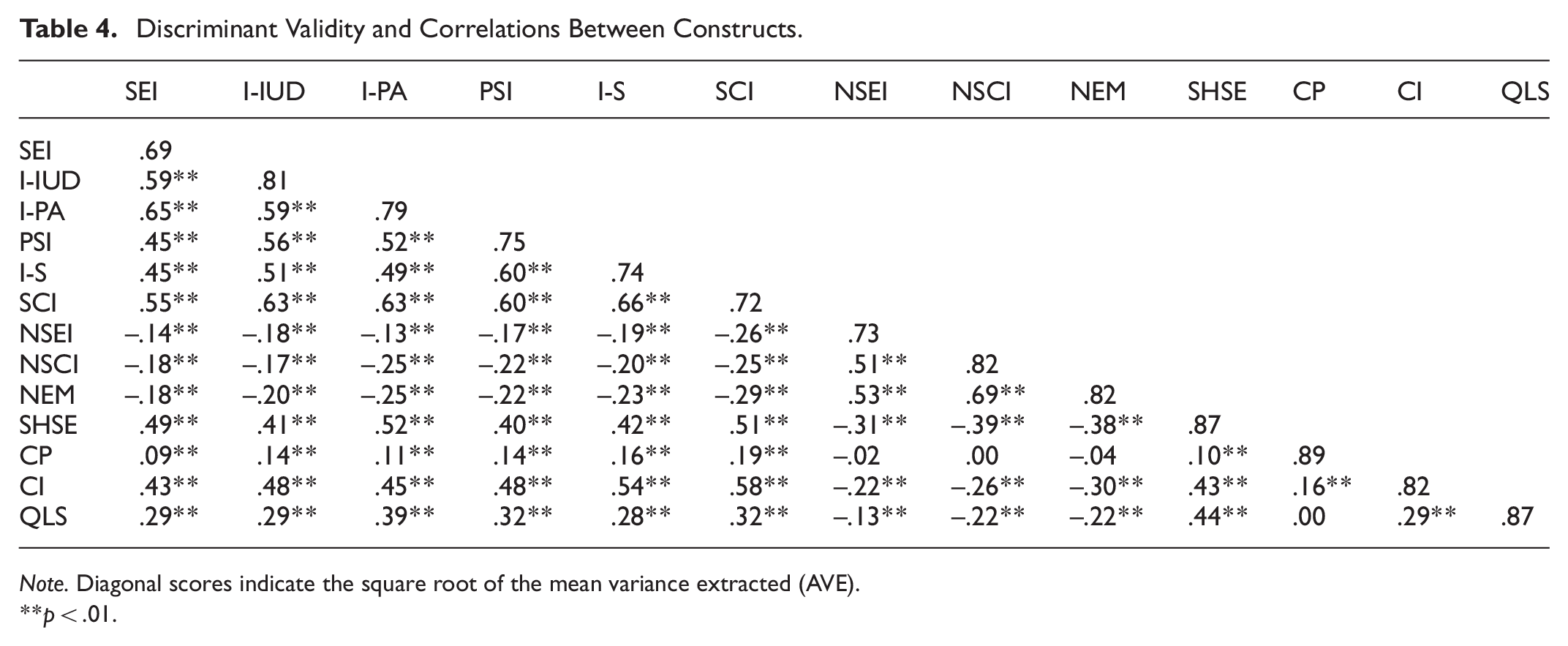
Note. Diagonal scores indicate the square root of the mean variance extracted (AVE).
p < .01.
Evaluation of the Causal Relationship Model and Hypothesis Testing
The results of the causal relationship model showed a good model fit: [(S-Bχ2/df = 4.57, p < .01); (RMSEA = 0.042; CI [0.040, 0.043]); NNFI = .90; CFI = .91; IFI = .91)]. Figure 2 shows the results of the relationships between the different variables. The results confirm that there is a significant relationship between community participation in the events and the perception of the positive impacts of the events, confirming H1 (β = .16; p < .01). However, this relationship was not significant between community participation in events and negative impacts (H2) and support for holding events (H3). There was a significant positive effect of residents’ identification with the community and perception of positive impacts (H4) and a negative effect with negative impacts (H5) of sporting events, confirming these hypotheses (β = .38; p < .01; β = −.38; p < .01, respectively). However, no such effect was observed between residents’ identification with their community and support for holding sporting events, rejecting H6. The model explains 17% of the variance of the perceived positive impacts and 6% of the perceived negative impacts.

A causal relationship model predicting satisfaction with quality of life and support for sporting events.
On the other hand, a significant positive relationship was observed between the perception of positive impacts and residents’ satisfaction with quality of life (H7) besides, significantly negative relationships were found for the perception of negative impacts and residents’ satisfaction with quality of life (H8), confirming both hypotheses (β = .45; p < .01; β = −.16; p < .01, respectively). In addition a significant positive effect was observed between perceived positive impacts and support for holding sporting events (H9), likewise a significant negative relationship was found between perceived negative impacts and support for holding sporting events (H10), also confirming these hypotheses (β = .50; p < .01; β = −.26; p < .01, respectively). Furthermore, residents’ satisfaction with quality of life had a significant positive effect on support for holding sporting events, confirming H11 (β = .23; p < .01). The model explains 24% of the variance in residents’ satisfaction with quality of life and 54% of support for holding sporting events.
Finally, the isolated direct effects, unmediated by perceived impacts, of community participation in the organization of sport events and community identification with their place of residence on satisfaction with quality of life were tested. The model showed a significant impact of community identification on satisfaction with quality of life (β = .67; p < .05), while in the case of community participation in events no statistically significant relationship was observed (β = .04; p > .05). This model explained 45% of the variance in residents’ satisfaction with quality of life.
Discussion
This paper analyzes the influence of citizens’ participation in the organization of sporting events, identification with the place where they reside and the perceived impacts of the events as possible explanatory antecedents of citizens’ satisfaction with the quality of life and support for the holding of events in three cities of the Valencian Community in Spain. The relationship of these variables and their possible explanatory nature on social support for sporting events has not been analyzed in the context of sporting events in Spain and let alone, in the case of multiple events held in different locations. In addition, few contributions have verified the relationship between these variables in the context of sporting events, and even fewer or non-existent if the events are characterized by small and medium-scale events, such as those usually held in the cities analyzed in this study.
To do so, a stratified random sample was used to provide a representation of the main socio-demographic variables of the population under study, and to incorporate a sufficient sample of residents of all age and sex groups by district of residence in each city (Iliyasu & Etikan, 2021; Rahman et al., 2022). In most studies in this area, sampling is of a non-probabilistic convenience type for various reasons. Firstly, the difficulty in accessing samples from all city districts in a representative way according to age and sex due to outdated population censuses. Secondly, the financial cost of financing such fieldwork with stratified sampling. and lastly, because of the time spent in the fieldwork, which is usually less than in other probabilistic sampling methods such as the one used in this study (Wu & Thompson, 2020).
The results of this study allow us to confirm the influence of certain constructs in explaining the perception of perceived impacts, satisfaction with quality of life and support for holding sporting events. In this sense, it has been confirmed that community participation in decision-making and in the planning and organization of sporting events is an explanatory antecedent of citizen perception of the positive impacts of sporting events. These results support what was observed in previous studies in which it has been proven that the participation and involvement of the community in the organization of events influences the perception of the positive impacts or benefits derived from sporting events (Boonsiritomachai & Phonthanukitithaworn, 2019; Lee et al., 2013; Pappas, 2014). However, this relationship was not observed in this study for community participation and the perception of negative impacts. In this matter, the literature does not present a consensus since these findings coincide with what was detected in Lee et al. (2013), in which the involvement of the community was not an explanatory antecedent, but not with the study of Pappas (2014), in which it was observed that the participation of residents in planning and organization contributed to explaining the perceived negative impacts of the London Olympic Games. Any relationship has not been observed neither between citizen participation in the organization and planning processes of sport events and support for the holding of the sport event; these results are consistent with the work of Boonsiritomachai and Phonthanukitithaworn (2019) but not with Pappas (2014).
In conclusion, there does not seem to be a consensus in the literature on the relationship of these variables, and in this work, it has not been possible to determine that they are an obvious explanatory antecedent of both the negative impacts and support for the events. It is important to keep in mind that the participation of residents in the organizing committee of sporting events can contribute to a better understanding of how sporting events are organized and the possible positive impacts it can generate for cities (Boonsiritomachai & Phonthanukitithaworn, 2019). Likewise, including residents in the planning process can also be a mitigating factor to better tolerate the possible negative impacts derived from hosting sporting events, facilitating a better understanding for residents and generate support for hosting events.
Regarding the identification of residents with their city, it has been found that it is an explanatory antecedent of the perceived impacts at both positive and negative levels. In previous works, there are disparities in the results; for example, it has been proven that there is a relationship only with positive impacts in studies of Lee et al. (2013) among residents of tourist destinations in Taiwan, of Bakhsh et al. (2018), among the residents of a hypothetical candidacy for the 2028 Olympic Games in Ontario (Canada), and of Gursoy and Kendall (2006), among Salt Lake City residents about the 2002 Winter Olympics. However, in the work of Deccio and Baloglu (2002), about nonhost residents, and Gursoy et al. (2017), on residents of Natal (Brazil), this relationship has only been observed with negative impacts. On the other hand, in this study, a relationship was not observed between community identification and support for holding events. The study of this direct relationship has barely been analyzed, although in studies such as Lee et al. (2013), its influence was confirmed in supporting the sustainable development of tourism.
In any case, the scarcity of works and the disparity in their results does not allow us to establish an obvious conclusion between identification with the community and the perception of positive and negative impacts and support for holding events. In this sense, this relationship seems to be very context dependent, being significant in some destinations and cultures but not a determining factor in other contexts (Bakhsh et al., 2018). However, in this work, it can be considered that a greater degree of identification of residents with their municipalities will increase the probability that they better value the positive impacts and better tolerate the negative impacts.
On the other hand, this study verifies the influence of positive and negative impacts on satisfaction with quality of life, coinciding with what was observed in previous studies in this area of research, mainly in the benefits and positive impacts (Al-Emadi et al., 2017; Çalışkan et al., 2022; Duan et al., 2020; Kaplanidou et al., 2013; Ma & Kaplanidou, 2017). Nevertheless, the relationship between perceived negative impacts and satisfaction has been less studied since most of the papers that have incorporated this construct usually include mainly positive impacts, excluding negative impacts or incorporating only one dimension for them. In this sense, Kaplanidou et al. (2013) did not observe a significant relationship between residents’ perception of social costs and satisfaction with quality of life. Thus, it is confirmed that a better valuation of positive impacts will increase the probability that residents will perceive a higher degree of satisfaction with their quality of life in the city, while a greater valuation of negative impacts will reduce the probability that residents will perceive greater satisfaction with their quality of life.
Moreover, regarding the relationship between perceived impacts, both positive and negative, and their relationship to support for holding sporting events is also confirmed. These hypotheses, which have been widely confirmed in previous studies, mainly in the relationship between positive impacts and the predisposition of residents to support sporting events have also been confirmed through this analysis, in which positive relationships are found between perceptions of positive impacts and support for the realization of events, as in the studies of (Al-Emadi et al., 2017; Bakhsh et al., 2018; Duan et al., 2020; Parra-Camacho, González-García, & Alonso-Dos-Santos, 2020; Yamashita & Ogiso, 2023). But also, in those cases where residents’ perceptions of negative impacts generated a negative predisposition toward the development of sporting events (Parra-Camacho, Alguacil, & Calabuig-Moreno, 2020; Yamashita & Ogiso, 2023), thus confirming that residents’ perceptions are an important variable to take into account in relation to residents’ support for the realization of sporting events. However, through this analysis it was not possible to prove the impact of each of the positive or negative aspects, as the contribution of each factor within the positive and negative impacts on satisfaction with quality of life or support for hosting events was tested but the model fit indices were inadequate.
In this sense, SET allows us to understand that if citizens perceive that sporting events generate tangible positive impacts (e.g., employment opportunities, improvement of infrastructure or increase in sports facilities) and intangible impacts (e.g., training opportunities, sense of belonging, improve the security or image of the city), there will be a greater probability of support for events among residents of the city. Along the same lines, if they perceive that they generate negative impacts that are disruptive enough to exceed the expected benefits, they will tend to reduce their social support.
Finally, satisfaction with quality of life contributed to explaining support for holding sporting events, coinciding with what was detected in previous analysis (Duan et al., 2020; Kaplanidou et al., 2013; Ma & Kaplanidou, 2017). It seems evident that a higher degree of satisfaction with the quality of life will influence support for the celebration of sporting events, understood as events that increase the city’s leisure and entertainment possibilities, an aspect that is related to improving quality. of life citizens (Ma & Kaplanidou, 2017). Furthermore, most of the sporting events held in the three cities studied are small- and medium-scale events (e.g., popular races, national, European and world championships of minority sports, meetings of professional sports leagues) that facilitates popular participation, and/or opportunities for residents to have fun as spectators. In this way, the possibilities of perceiving the impacts of events favorably and minimizing negative impacts are increased, entering a cycle of positive social exchanges for residents that will improve their satisfaction with the quality of life and, consequently, the degree of support for the celebration. of future sporting events.
Theoretical and Practical Implications
The results of this work provide empirical evidence on the importance of certain variables when explaining support for the celebration of sporting events. Most works in this area have studied mega-events using nonprobabilistic or purposive samples for convenience. In this study, stratified random sampling by quotas was used to reflect a representation of the population under study according to the main sociodemographic variables. Likewise, works on multiple sporting events in various locations are also very scarce, so the findings of this study allow us to reflect collective social representations of sporting events in various medium-sized cities.
First, sport event organizers and public administrations need to advocate for sporting event policies that favor the participation and involvement of citizens in their planning is highlighted, with the aim of increasing the chances that citizens will realize the benefits of hosing sporting events. Therefore, actions that involve residents in the organization should be encouraged, such as participation in volunteering, in the organizing committee itself, in groups for the promotion and animation of events through neighborhood associations, clubs or sports facilities or other social organizations, in order to improve their perception of their participation in events. Moreover, the possibility of participating in the organization of small and medium-scale events can contribute to increasing the knowledge and skills of the local population regarding event organization (Taks, 2013), also facilitating the development of positive social exchanges that help ensure social support and willingness to welcome new events.
On the other hand, the possibilities of increasing support for holding events are largely explained by the perception that residents have of the positive impacts and, to a lesser extent, by the negative impacts. In this sense, it seems evident that residents must fully experience the potential benefits of hosting events in their city, as it will ensure the long-term viability of the cities’ sporting events policy. Therefore, it is essential that when planning events, communication strategies are developed that make it possible to publicize the positive impacts of the organization of sporting events and the possibilities that residents have of experiencing them through their direct participation, such as athletes or fans. or indirectly, as merchants, employees or regular citizens.
In this regard, and given the importance of the perception of positive impacts in supporting the holding of events, both governments and local organizers should understand and address the concerns of the population about the holding of sporting events, generating specific policies and actions to minimize negative impacts (such as the rise in prices of goods and services or the increase in crime) and maximizing positive impacts (such as the increase in trade opportunities) in addition to carrying out the relevant communications to increase the population perception and awareness.
Conclusion
This study confirms, on the one hand, that community participation in the organization, planning and decision-making process of sporting events and the identification of residents with their city are antecedents that help explain the perceived impacts but not the predisposition to support the hosting of sporting events.
On the other hand, it is also confirmed that the perceived impacts are an explanatory antecedent of satisfaction with the quality of life of residents and of support for the hosting of sporting events. In this sense, a better evaluation of the positive impacts will increase satisfaction with the quality of life of residents and the probability of supporting the hosting of events in the three cities studied. The inverse relationship will be observed in the case of the perception of negative impacts.
Finally, satisfaction with quality of life was related to the predisposition to support the celebration of sporting events, so a better experience with sporting events will increase satisfaction with quality of life and, therefore, the probability of supporting the celebration of sporting events.
Limitations and Future Lines of Research
Inevitably, there are still some limitations to this study, and also some future recommendations to fill these gaps. It is important to keep in mind that this study considers the perceptions of various sporting events held in three cities. These cities host numerous sporting events each year, so the overall assessment of the social impacts of the events does not allow the impact of each event to be reflected. In this sense, in future studies, it would be advisable to establish groups or classifications of sporting events in each city to allow comparisons to be made of the relationship of variables in this study according to their nature, magnitude and frequency. In line with this, future research should have to consider and differentiate the events among types of sports, the scale of the event (within the small to medium range), the specific characteristics of each event (such as international vs. local focus), frequency of events (monthly, weekly, annually, etc.) or even the preparation time required (based on how many time the residents are involved in the sporting event) because these possible differences in the nature of the events could lead vary the perceptions of the residents.
Moreover, this study follows a cross-sectional research design, so carrying out longitudinal studies that allow monitoring the impacts before, during and after the event can offer more concise information about the importance of these variables in explaining support for the celebration of events.
Similarly, analyzing the perception of impacts, differentiating according to the city, could allow citizens’ assessments to be compared, as well as to identify different social representations. Along these lines, it is appropriate in subsequent work to determine the possible influence of the explanatory variables of this study (identification, community participation and perceived impacts) in the identification of clusters of residents with different perceptions of the events depending on the city and its characteristics (level of infrastructure, civic engagement, standard of living, etc.).
At the sample level, although stratified random sampling is used for each city, which represents the population under study in the three cities, it is important to carry out work in other regions to continue analyzing the relationships between the studied constructs. In line with this, this study just focuses on the Valencian Community in Spain, one specific region among other 16 autonomous communities and two autonomous cities. This may limit the generalizability of the findings, so future research should compare different regions in the country and also internationally considering possible different cultural, economic and social contexts, in order to generalize the results and conclusions extracted from the study.
About perceived impacts, both positive and negative impacts were considered multidimensional constructs. In future research, the relationship of each impact dimension with the rest of the study’s constructs could be considered to verify the relationships separately.
Finally, the information was obtained from the subjects through a survey, which may cause a response bias in the sample obtained. In the case of this study, an attempt was made to have a sufficiently large and heterogeneous sample, which may help to minimize this bias. However, for future research, it is recommended to carefully review the wording of the items in the instrument with the intention of confirming the results present in this study.
Footnotes

Ethical Considerations
The work has been approved by the ethics committee of the university of Valencia (Record: 2619012), respecting the principles of the Declaration of Helsinki
Funding
The author(s) disclosed receipt of the following financial support for the research, authorship, and/or publication of this article: This research has been funded by Generalitat Valenciana, grant with reference number: CIGE/2021/063.
Declaration of Conflicting Interests
The author(s) declared no potential conflicts of interest with respect to the research, authorship, and/or publication of this article.
Data Availability Statement
The datasets generated and/or analyzed during this study are not publicly available because ownership of the data is shared with the entity that has funded the study without the right to share them publicly, but can be requested from the corresponding author upon reasonable request.