




Abstract
Academic life in the present era is subject to several occupational stressors, including increased workloads, reduced research funding, tenuous career paths, and family-work conflicts. Such stressors affect academics’ quality of life, wellbeing, and job satisfaction, and women are particularly vulnerable. There is, however, a dearth of information on such issues in the Arab World. We conducted a scoping review to map the current body of knowledge related to the institutional and socio-cultural factors that influence the wellbeing status of women working in academia in Arab countries. Fourteen articles were included. Several challenges threatening women’s wellbeing in academia were identified including institutional factors (i.e., human resource policies and laws, workplace empowerment, and academic mentoring) and socio-cultural factors (i.e., work-life balance, culture and religion). Current human resources, policies, and labor laws do not adequately support maternal or complex family roles contributing to work-life imbalances and contribute to poor mental health outcomes for academic women working in academia in Arab countries. Although some of these challenges may stem from lingering cultural stereotypes about gender roles, this review highlights the need for professional development and mentoring programs for academic women in Arab countries, in addition to supportive institutional laws, policies, and resources for empowerment of women in academia.
Introduction
Academia’s traditional key components of research, teaching, and service is subject to rigorous performance-based evaluations with a focus on quality assurance, reward systems, accountability, development of centers of excellence, research productivity (Borrelli & Stazio, 2018), and measurable output contributions to society (Bayuo et al., 2020). Although academia can be very rewarding, these metrics require academics working as university faculty to reconfigure their roles to teach larger cohorts of students, secure dwindling research funding, align research to the demands of the knowledge-based economy, and contribute to social innovation (Bayuo et al., 2020; Muzzatti, 2022). Meeting these competitive performance metrics in the context of an increasingly demanding work environment contributes to occupational stress among academics (Converso et al., 2018) witnessed by increasing rates of academic career attrition (Cidlinska et al., 2023) and speculation about an impending “Great Resignation” in academia (Schmiedehaus et al., 2023). Changes in academia over the past few decades such as increased administrative and teaching workload, reduced research funding, and inadequate reward systems have resulted in an array of occupational stressors that is, burnout, reduced quality of life, reduced job satisfaction, and reduced wellbeing among academics (Alves et al., 2019; Mudrak et al., 2018).
Although many occupational stressors apply to all academics, women contend they encounter additional institutional hurdles that adversely impact their performance and wellbeing within the academic environment (Hart, 2013; McNae & Vali, 2015). Compared to their male counterparts, women academics are less likely to report that universities have reasonable expectations related to their work performance and tenure (Lisnic et al., 2019). Women also face additional socio-cultural barriers to work performance (Hart, 2013; McNae & Vali, 2015). Factors that impact women academics’ performance and wellbeing can be branded as either real or perceived. Barriers that affect everyone tend to be identified as real, whereas women’s “perceived” barriers may be invisible to males as they can be embedded in patriarchal institutional structures. For instance real barriers may include the number of working hours and workload, whereas perceived barriers might include lack of professional development opportunities for females, absence of administrative support, male dominance, and underrepresentation in top academic positions (Hart, 2013; McNae & Vali, 2015; Nurumal et al., 2023).
Within this paper, job satisfaction constitutes a measure of wellbeing. Wellbeing refers to an individual’s global judgment of life satisfaction (Diener, 2009). Women academics’ job satisfaction is an aspect of wellbeing and is an amalgamation of both positive or negative feelings toward work (Aziri, 2011). It is an evaluative state that varies over time (Ritzenhöfer et al., 2019; Wolter et al., 2019), and can be contingent on the person’s sense of wellbeing and personal empowerment at work (Seibert et al., 2011). Women academics have consistently had lower career satisfaction than men (August & Waltman, 2004; Machado-Taylor et al., 2014; Nurumal et al., 2023). A study of academic career satisfaction in Portugal found that women were less satisfied than men with personal and professional development, and the balance between work and family (Machado-Taylor et al., 2014).
Gendered perceptions of work-life balance (or imbalance) also contribute to perceptions of wellbeing. For instance, women academics are more likely to report conflict between expectations from their workplace and their personal lives (Rosa, 2021). Work interference with family negatively impacts on job satisfaction and wellbeing (Lisnic et al., 2019). Work-life balance for women, especially working mothers, significantly improves wellbeing when there is temporal and location flexibility in their work (Kaup et al., 2020). In a cross-sectional study of 216 women academics in American universities, Clancy (2019) found that general job stress and work interference with personal life were associated with symptoms of depression, anxiety, and burnout. In a recent survey of Brazilian academics, more than a third reported burnout, with women reporting lower quality of life in addition to being more exhausted than men (Alves et al., 2019).
Liu et al. (2019) assert that women in academia are challenged by their gender and ethnicity at different levels. They proposed the “leaky pipeline” metaphor to illustrate the “progressive loss of competent women faculty members in the fields of science, technology, engineering and mathematics” (Liu et al., 2019). They identified “pipeline leaks” occurring at various career stages, including selection, promotion and retention, and linked them to the interplay between gender, ethnicity, and socioeconomic status. This study among others, highlights the importance of intersectionality as a feminist framework for understanding the intersections between “deprivileging” factors such as gender and race, and the ways in which they shape women academics’ experiences. Intersectionality was coined by Kimberlé Crenshaw when she challenged the universality of gendered experience and argued that women’s experiences are also shaped by the compounding intersections of race, class and other factors (Crenshaw, 1991). It is therefore vital to explore the differential impact of institutional and socio-cultural factors on the wellbeing of women in academia with intersecting identities.
While much has been written about issues related to academics’ wellbeing, most studies emanate from the Global North. There is a dearth of studies from Arab countries where being a woman academic poses unique and specific cultural challenges and obstacles. One notable exception is Karam and Afiouni’s (2014) extensive study of 17 countries in the Arab Middle East and North Africa region which examined gender-related issues for women working in higher education institutions a decade ago. The study underscored prevailing gender ideologies entrenched in patriarchal customs. The lower participation of women in the economy in the region was also highlighted (Karam & Afiouni, 2014). These factors limit the contribution of women in academia via gender segregation, the gendering of professions, and the concentration of women in lower-level organizational roles while reserving leadership positions for men (Hutchings et al., 2012; Karam & Afiouni, 2014).
Women academics in the Arab region are exposed to sociodemographic “deprivileging” factors, socio-cultural contexts, institutional environments, labor regulations and laws, and in some places, armed conflict or war (Afiouni, 2014). These upstream, midstream, and downstream factors (Dopp & Lantz, 2020) intersect to influence women academics’ wellbeing within the Arab region. To date, research on these issues in the Arab region has been fragmented and under-researched. A contemporary understanding of the nature and intersection of the range of factors influencing the wellbeing of women academics working amidst the shifting contemporary academic landscape is needed. As a first step, we conducted a scoping review which aimed to map the current body of knowledge related to the institutional and socio-cultural factors that influence the wellbeing of women working in academia in Arab countries and to identify areas for further research and practice that will contribute to improving their wellbeing. A scoping review was the most appropriate research method for this study as it is used when there is a need to better understand the current body of knowledge and identify gaps for future research and practice (Peterson et al., 2017).
Methods
The review was conducted in accordance with the Preferred Reporting Items for Systematic Reviews and Meta-Analyses extension for Scoping Reviews (PRISMA-ScR) Statement (Tricco et al., 2018). No protocol is registered for this scoping review. A modified version of the recommended SPIDER (Sample, Phenomenon of Interest, Design, Evaluation, Research type) format was used to refine the parameters of our search strategy and the inclusion/exclusion criteria for this review (Amir-Behghadami, 2024; Methley et al., 2014). The SPIDER framework has higher specificity than the PICO framework and was therefore chosen as a basis for this study (Methley et al., 2014). Based on the SPIDER framework, sources were included if they related to the following:
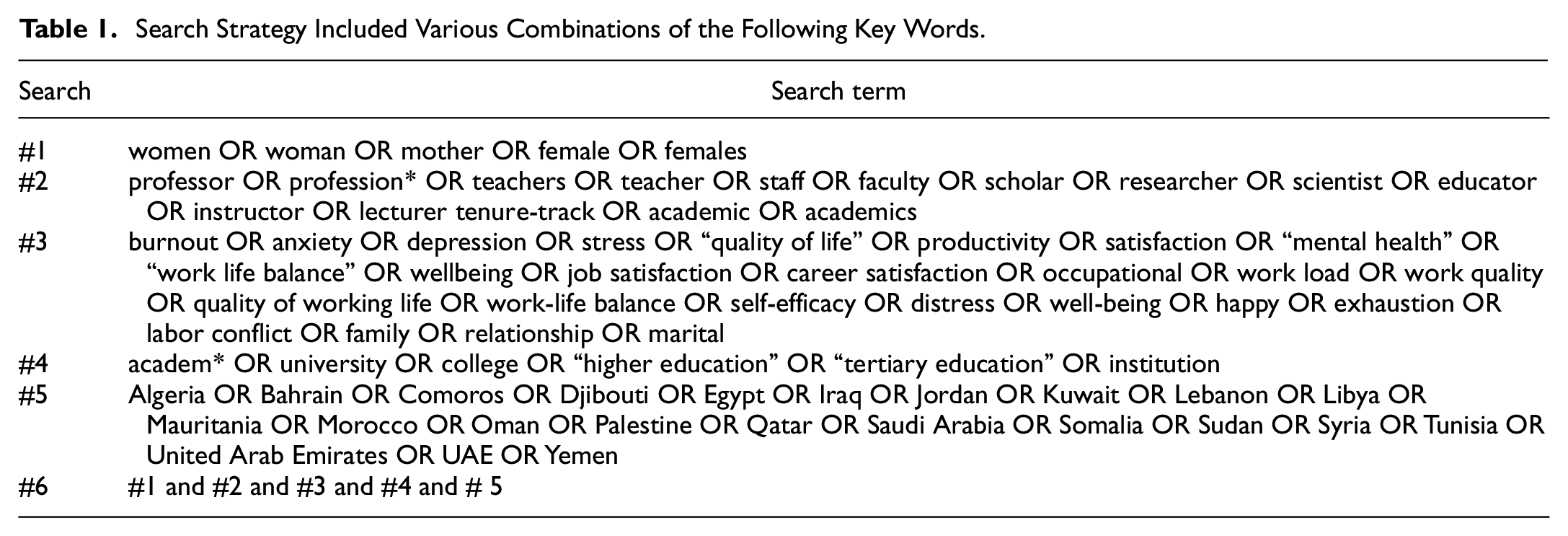
A systematic method was used to search the literature between September 2021 and October 2021 and updates were undertaken in November 2022 and February 2023. Searches were conducted in PubMED, SCOPUS, and ERIC databases via the Qatar University Library platform. Searches were limited to keywords and MeSH terms which were devised and tailored to each database. Reference lists of all selected full-text articles and related reviews were hand searched to identify further relevant articles. A Google Scholar (Google LLC, Mountain View, CA) search was also conducted to identify further relevant articles. Table 1 demonstrates the various search terms and constructs combined in the search to find eligible studies.
Search Strategy Included Various Combinations of the Following Key Words.
Screening of eligible sources was performed at three levels (title, abstract, and full text review). The titles of potential sources were arranged in a Microsoft Excel spreadsheet in alphabetical order to exclude duplicates. The included sources were equally divided among the 12 reviewers involved in the eligibility screening of the article titles and abstracts. Reviewers were assigned to articles using the randomization function in Microsoft Excel and the title and abstract of each source were independently evaluated by two reviewers. Three reviewers were involved in the full text screening of sources. Disagreements at any stage between the reviewers were discussed and resolved.
Data extraction from full text sources included in the review was conducted by the three main reviewers. A custom-built Microsoft Excel spreadsheet was used to collect the extracted data. Data extracted included author names, title, year of publication, country of publication, study aim/objective, study design, study setting, population, sample age, sample language, sample size, construct of interest, and results/conclusion. Similar concepts were identified and data were tabulated accordingly. Although no thematic analysis was conducted specifically, broad constructs were pooled for ease of interpretation of the data.
Results
Study Selection
The database searches yielded 582 sources and the Google Scholar search (Google LLC, Mountain View, CA) yielded 11 additional sources resulting in a total of 593 sources. After removing irrelevant sources and duplicates, 61 sources underwent title and abstract screening. Sixteen sources progressed to the full text screening stage. During the full text screening and data extraction process, two sources were deemed ineligible as there were no separate data or specific focus on women academics. In total, 14 sources were deemed eligible for inclusion in this review (Al Miskry et al., 2021; Alfawaz et al., 2021; Almuhammadi et al., 2020; Al-Qahtani, Ibrahim, Elgzar, El Sayed, & Essa, 2021; Al-Qahtani, Ibrahim, Elgzar, El Sayed, Abdelghaffar, et al., 2021; Al-Rubaish et al., 2009; Al-Smadi & Qblan, 2015; Alwazzan & Rees, 2016; Bani-Hani et al., 2018; Bataineh, 2014; Ensour et al., 2017; Gabr et al., 2021; Ghandour et al., 2020; Karam & Afiouni, 2014). Figure 1 provides a PRISMA flowchart illustrating the search results.
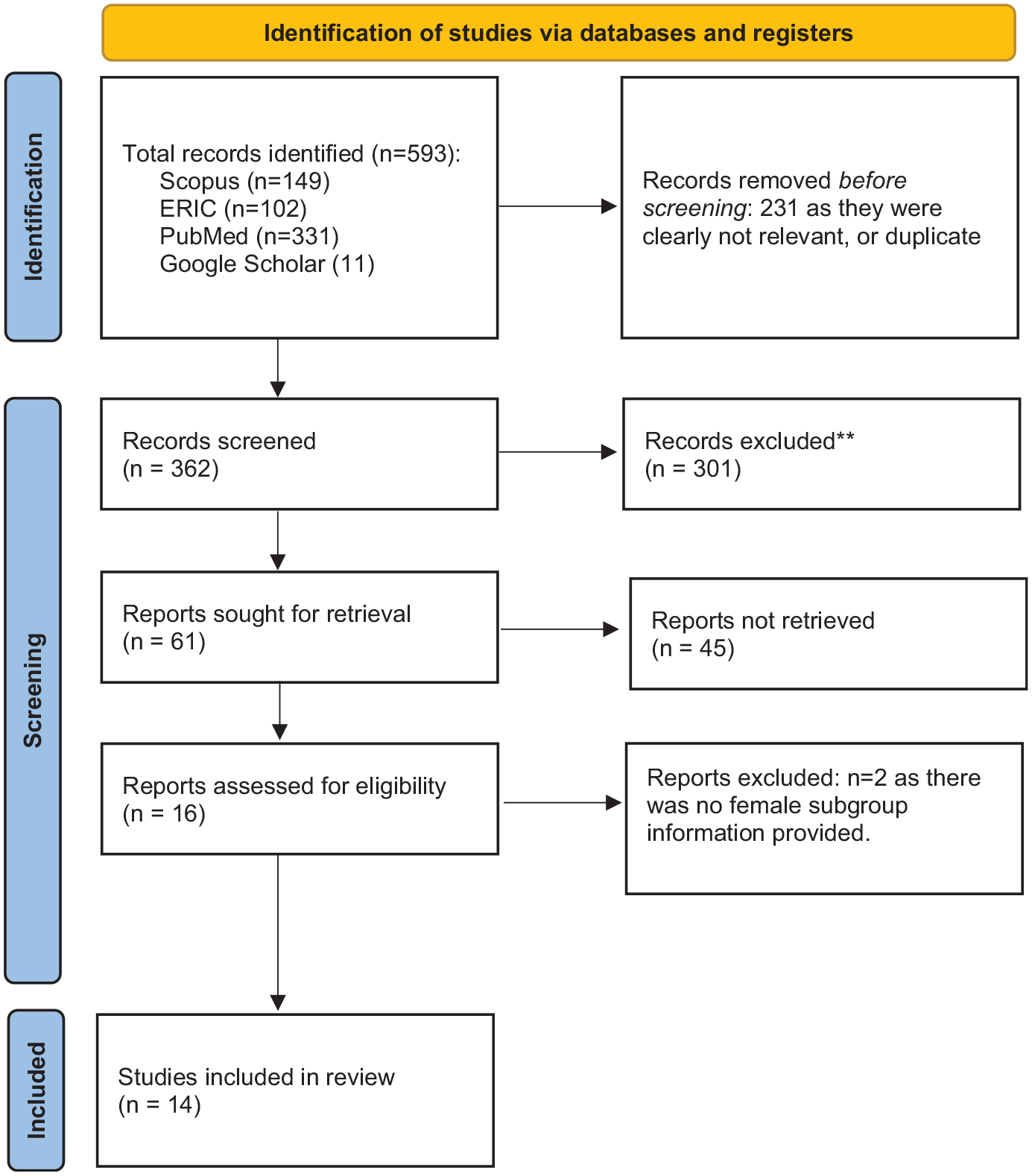
PRISMA flowchart illustrating search results.
Study Characteristics
Of the 14 included sources, the majority (n = 7) were studies conducted in Saudi Arabia, three were conducted in Jordan, with one study each from Lebanon, United Arab Emirates, Egypt, and Palestine (West Bank and Gaza Strip). The included studies were conducted between 2009 and 2021 and published in English. Participants in the studies were women academics/faculty, medical educators, women instructors, university community, staff, and students ranging from 17 to 70 years of age. Sample sizes ranged from six to 5,587 participants. Seven studies included men and women and seven included only women (Almuhammadi et al., 2020; Al-Qahtani, Ibrahim, Elgzar, El Sayed, & Essa, 2021; Al-Qahtani, Ibrahim, Elgzar, El Sayed, Abdelghaffar, et al., 2021; Alwazzan & Rees, 2016; Bani-Hani et al.,2018; Ensour et al., 2017; Karam & Afiouni, 2014). Some studies included more than one type of study design. Study designs included a critical literature review (Karam & Afiouni, 2014), analysis of publicly available documents (n = 2) (Ensour et al., 2017; Karam & Afiouni, 2014), and qualitative interviews (n = 4) (Almuhammadi et al., 2020; Alwazzan & Rees, 2016; Bani-Hani et al., 2018; Ensour et al., 2017). The remainder of the studies were cross-sectional studies, of which six used questionnaires administered by email or online (Al Miskry et al., 2021; Alfawaz et al., 2021; Al-Rubaish et al., 2009; Al-Smadi & Qblan, 2015; Bataineh, 2014; Ghandour et al., 2020), three used questionnaires but the administration process was not described (Al-Qahtani, Ibrahim, Elgzar, El Sayed, & Essa, 2021; Al-Qahtani, Ibrahim, Elgzar, El Sayed, Abdelghaffar, et al., 2021; Gabr et al., 2021), and one involved in-person blood collection (Gabr et al., 2021). Tables 2 and 3 summarize the characteristics and main results/conclusions of the included studies respectively. Constructs related to wellbeing included self-esteem, self-efficacy, job satisfaction, empowerment, stress, mental health concerns, and coping strategies.
Characteristics of Included Studies (n = 14).

Main Study Results/Conclusions of the Included Studies (n = 14).

Discussion of Findings
This scoping review is the first to explore the literature related to institutional and socio-cultural factors influencing the wellbeing of women academics in Arab countries. Constructs of wellbeing addressed by these studies included self-esteem, self-efficacy, stress, personal empowerment, and mental health concerns. The review identified a range of institutional factors that influenced the wellbeing of women academics, including human resources policies and laws, workplace empowerment, academic mentoring, and job satisfaction. Socio-cultural factors that influenced women academics’ wellbeing included work-life balance, culture, and religion. The discussion will discuss the institutional and socio-cultural factors separately.
Institutional Factors that Influence the Wellbeing of Women Academics in Arab Countries
Human resources policies and laws
Our review identified two studies which highlighted how human resources (HR) regulations and labor laws affect a woman’s life in universities in Arab countries (Ensour et al., 2017). Ensour et al. (2017) conducted a document analysis of the Jordanian constitution, Jordanian Labour Law and its amendments, and how it relates to women academics. The higher education and scientific research law, Jordanian universities’ law, and universities’ HR policies and regulations were also analyzed (Ensour et al., 2017). Similarly, Karam and Afiouni (2014) examined publicly available university data in the Middle East and North Africa (MENA) region to document the representation of women across ranks and the content of HR policies. Both studies highlighted a number of restrictive patterns in the legal and legislative framework in relation to women. For example, although the constitutions of most countries in this region guarantee equality of all citizens before the law, women still face forms of discrimination that are legal, systematic and infiltrate every aspect of life (Afiouni, 2014; Kelly & Breslin, 2010; Robbins & Thomas, 2018). Jordanian Labour Law has led to several cases of employers discriminating against women (Nseer, 2015). Ensour et al. (2017) found that the Jordanian Labour Law was perceived as not being fully protective or supportive of women. All participants stated that there is a bias in the law whereby pregnant woman are protected from being terminated from their employment only after the sixth month of their pregnancy or during the maternity leave, rather than at any stage of pregnancy. Study participants argued that such a law creates stress and causes women to hide their pregnancy until the sixth month. Karam and Afiouni (2014) found that only ten out of 234 universities examined had on-site daycare and that maternity leave periods are short (ranging from 30 days in Tunisia to 98 days in Algeria and Morocco). As a result, they proposed that universities develop HR policies that are more family friendly. Discriminatory laws and institutional policies undermine the status of women and impede women’s rights in the Arab region (Afiouni, 2014; Sika, 2011). For women in the Arab MENA, there is a multifaceted and complex set of obstacles that prevent them from enjoying the full political, civil, legal, and economic rights (Kelly & Breslin, 2010; Robbins & Thomas, 2018). Odhiambo (2011) argues that it is nearly impossible to separate a woman’s position in any organization from her position in society, and that nowhere in the world are women and men equal in legal, social or economic rights.
All over the MENA area, the representation of women academics decreases as the academic rank increases. Karam and Afiouni (2014) found that seven of the 234 universities examined provided faculty data by rank. At the Assistant and Associate Professor rank, the representation of women ranged from 0% (Yemen and Syria) and 1.3% (UAE) to 10.7% (Qatar) and 36.8% (Algeria). At the full Professor rank the representation of women ranged from 0% (Yemen) to 5.4% (Lebanon) (Karam & Afiouni, 2014). In universities in Jordan, women constituted 22.9% of Assistant Professors, 12% of Associate Professors, and only 7% of full Professors (www.mohe.gov.jo). According to Ensour et al. (2017), this is due to HR policies in some Jordanian universities which do not provide women with PhD scholarships the same benefits as those provided to men. This can be attributed to Arab women’s perceived dependency that the financial burden is generally the men’s responsibility. This issue is however not confined to Arab women. In the USA, although women outnumber men in academic study, in academic ranks women are on average at a lower level, and slower to reach higher ranks (Fox, 2020).
A similar issue exists with respect to managerial positions. In the included study by Ensour et al. (2017) in Jordan, over 85% of focus group participants stated that managerial promotion regulations are typically unclear for women. In addition, the authors also stated that usually women are excluded from positions such as department head, dean, vice president, and president (Ensour et al., 2017). Between 1962 and 2016, across 28 private and public universities in Jordan, only one female headed a public university, and this was for a period of 1 year. By 2016, there were only two women among 46 university vice presidents, and only 27 women among 300 deans, ten of whom were deans of nursing faculties (Ensour et al., 2017). For women, the issue isn’t about proving they are deserving of a leadership position, but in gaining access to these positions (Odhiambo, 2011). In a study on women’s progression to senior management positions in universities in England, although the criteria for advancement did not explicitly disadvantage women, some female senior managers believed that their involvement in management was not always advantageous to them as it came at the expense of their research (Doherty & Manfredi, 2006).
Enacting quotas of women in higher positions has been proposed as a strategy for increasing representation. In the study by Ensour et al. (2017), 60% of participants supported the institution in applying a quota system to increase the representation of women in higher positions. Gender quotas are typically assumed to provide substantive representation for women (Xydias, 2007) and regarded by some as essential for increasing the number of women in leadership positions (Pande & Ford, 2012). However, they are not without cost. Franceschet and Piscopo (2008) studied gender quotas in Argentina and found that although quotas generated mandates for women legislators, they also reinforced negative stereotypes about women’s capacities.
Workplace empowerment
A key aspect of women’s empowerment in the workplace is its relationship to self-esteem and self-efficacy (Ventura et al., 2015). The self-efficacy of working women is crucial in identifying their potential performance in stressful and ever-changing working conditions, such as those in universities (Al-Qahtani, Ibrahim, Elgzar, El Sayed, & Essa, 2021). According to Hajloo (2014), there is a strong predictive relationship between self-efficacy and self-esteem. In the study by Al-Qahtani, Ibrahim, Elgzar, El Sayed and Essa (2021), 73% of the women’s empowerment level was predicted by self-esteem and self-efficacy. The authors found that Saudi women in higher education institutions had moderate to high levels of self-esteem or self-efficacy. Another study of Saudi women have found similarly high levels of self-esteem, with level of education being strongly correlated with self-esteem (Kazi et al., 2015). Many researchers have highlighted the role of education in women’s empowerment through its contribution to self-esteem (Engida, 2021; Sundaram et al., 2014). Permwonguswa et al. (2018) investigated the role of self-esteem, emotional empowerment, and self-concepts in the readiness for knowledge sharing in different electronic health systems. They reported that self-esteem is a unique and important predictor of psychological empowerment, which can be greatly enhanced by increasing knowledge and economic independence. In the study by Almuhammadi et al. (2020), participants generally agreed that professional development activities assisted women in becoming better professionals and that their confidence was boosted in their teaching abilities. These findings are in line with other studies in Arab countries demonstrating that professional development activities enhance a teacher’s confidence with regards to performance (Tantawy, 2020).
This scoping review found that age and years of experience were the most significant predictors of Arab women’s empowerment at the workplace (Al-Qahtani, Ibrahim, Elgzar, El Sayed, Abdelghaffar, et al., 2021). This is consistent with a study by Menon and Sharma (2020) on women’s empowerment in urban Bangalore, India which found that older, more experienced women were more empowered than younger women. The study by Al Ghamdi (2016) on academic women leaders in Saudi universities also showed a positive relation between years of experience, level of administrative position, and psychological empowerment at the workplace.
Male dominance also plays an important role in the empowerment of women in a workplace. In the study by Al-Qahtani, Ibrahim, Elgzar, El Sayed, Abdelghaffar, et al. (2021), participants identified male dominance as an important barrier for women’s empowerment in the workplace. Similarly, Al Ghamdi (2016) and Bani-Hani et al. (2018) concluded that women academic leaders had limited scope of authority. Women reported having access to fewer training programs, resources, and opportunities, limiting their professional growth and negatively affecting their academic empowerment. A study by Al-Kayed (2015) investigated challenges faced by women leaders at Saudi universities and concluded that male dominance is a significant barrier to Saudi women’s empowerment in managerial positions as the decision-making power of women was significantly restricted by male managers. The gender segregation policies in Saudi universities typically restrain women leaders as they must take approvals for all critical decisions from their male managers.
This scoping review also identified that gender-based violence negatively impacted women’s empowerment in the workplace (Al-Qahtani, Ibrahim, Elgzar, El Sayed, Abdelghaffar, et al., 2021). Gender-based violence, which is violence directed against a person because of their gender or “violence that disproportionately affects persons of a particular gender,” negatively impacts both the physical and psychological aspects of women’s empowerment (Al-Qahtani, Ibrahim, Elgzar, El Sayed, Abdelghaffar, et al., 2021). In the workplace, violence may be expressed in many forms such as ignoring women’s opinions, limiting higher administrative positions to men, verbal abuse, and differential control over resources (Al-Qahtani, Ibrahim, Elgzar, El Sayed, Abdelghaffar, et al., 2021). All types of gender-based violence regardless of where it occurs, destroys women’s self-esteem and self-confidence, and hence woman may feel less empowered.
Academic mentoring
In this scoping review we identified that working in a collaborative atmosphere which is also collegial, enhances women academics’ motivation, enables them to become more productive, and boosts their self-efficacy by improving their emotional state (Almuhammadi et al., 2020). When academics believe that their colleagues and their institution support them and share their values, it is more likely that they will have the confidence to try new teaching strategies, which will further boost their self-efficacy (Almuhammadi et al., 2020). Similar results have been reported in a study by Shousha (2015) at a university in Saudi Arabia. In referring to Bandura’s (1977) sources of self-efficacy, Shousha (2015) highlighted the role of mentoring programs, classroom observations, and role models in increasing academics’ self-efficacy related to teaching. Almuhammadi et al. (2020) found that through active reflection on the behaviors of their mentors and others, a woman academic’s belief in her own abilities was enhanced. Other studies on academics and teachers have found similar results. Khojah and Asif (2020) found that participants in a mentoring program for academics were generally positive about their participation in the program, and believed that it was highly beneficial to mentees, mentors, and the institution. In a study on teachers in Saudi Arabia, women mentees identified the important role that mentors play as both role model and motivator (Shukri & Leil, 2017). A study by Moulding et al. (2014) found that mentors’ feedback and support was viewed as positively influencing women teachers’ level of belief in their own ability.
Although many of the academics in the included Almuhammadi et al. (2020) study stated that classroom observation boosts their sense of self-efficacy and professional development, others perceived it as creating doubt due to the feedback received. Shukri and Leil (2017) reported that most participants agreed that observations played an important role in improving teaching practices. They also highlighted that it was important for observers to maintain a high standard in terms of ethics (Shukri & Leil, 2017). Furthermore, the observers pointed out that there should be more focus on providing positive and constructive feedback on the lesson, and less focus on the errors made (Shukri & Leil, 2017). A positive approach is also more likely to empower academics to engage in a process of reflection, whereby they can identify their educational needs and improve their practice (O’Leary, 2020).
Job satisfaction
Three studies in this scoping review found lower levels of job satisfaction among academic women across most domains (Al-Rubaish et al., 2009; Al-Smadi & Qblan, 2015; Bataineh, 2014). Al-Rubaish et al. (2009) found that job satisfaction for women academics was lower than for men in the domains of supervision, responsibility, interpersonal relationships, administrative policies, and achievement. This finding was similar to the study by Al-Smadi and Qblan (2015) in which women academics reported lower levels of job satisfaction than men in domains related to the academic environment, psychological and social aspects of work, and interpersonal communication, and a similar level of dissatisfaction to men in the salaries and financial support domain. Bataineh (2014) also reported lower levels of job satisfaction among women academics in Jordanian universities compared to men. In contrast to the findings of this scoping review, studies in other socio-cultural settings have not identified such differences in job satisfaction between women and men academics (Machado-Taylor et al., 2014; Santhapparaj & Alam, 2005). This may be explained by differences in gender segregation policies and cultural practices in the Arab region compared to other countries. Such practices occur in education, work, and social settings, and may explain the lower rate of job satisfaction among women academics.
Socio-Cultural Factors that Influence the Wellbeing of Women Academics
Work-life balance
Three studies included in this review highlighted important socio-cultural factors that may contribute to mental health problems among women in academia, particularly anxiety during the COVID-19 pandemic and lockdown (Al Miskry et al., 2021; Alfawaz et al., 2021; Ghandour et al., 2020). These studies highlighted significant differences in coping strategies between women and men academics. Women used more avoidance and emotion-focused coping strategies compared to men. Ghandour et al. (2020) reported that women academics under 35 years of age and with lower income had significantly higher levels of distress and insecurity compared to their male counterparts. Interestingly, family bonding was reported to have strengthened during the lockdown, an association that was more apparent in women than in men academics (Alfawaz et al., 2021). These findings are consistent with previous research highlighting the emotional burden and challenges associated with balancing work and personal lives among women academics prior to the pandemic (Goyal & Arora, 2012; Punia & Kamboj, 2013). Work-life imbalance affects women’s health, causing stress, depression, headache, and muscle tension, and is a greater barrier to career advancement compared to men (Delina & Raya, 2013). A study by Pace and Sciotto (2021) found that work-life balance had a greater impact on wellbeing and was linked to the perception of fewer career opportunities for women compared to men. These findings, together with the findings from this scoping review suggest that the link between work-life balance and wellbeing is stronger among women than men.
Culture and religion
Three studies in this scoping review reported results related to the impact of cultural factors on women in academia (Al-Qahtani, Ibrahim, Elgzar, El Sayed, Abdelghaffar, et al., 2021; Alwazzan & Rees, 2016; Ensour et al., 2017). The study by Ensour et al. (2017) found that women academics are faced with many interconnected and interrelated barriers embodied in cultural, social, and economic factors. In the study by Al-Qahtani, Ibrahim, Elgzar, El Sayed, Abdelghaffar, et al. (2021), over one-third of the participants felt that customs and traditions are barriers to women’s empowerment at the workplace. These results are consistent with those found by Al-Asfour et al. (2017) who studied the barriers facing Saudi women’s career development, and found that customs and traditions are imposed on certain work fields and administrative positions for women. Additionally, Al-Ahmadi (2011) explored leadership challenges for Saudi women and reported many cultural restraints that hinder women’s administrative and professional creativity.
The results of this review are also consistent with other studies that examined women’s experiences regarding perceived cultural barriers. Howe-Walsh and Turnbull (2016) reported that organizational culture with influences such as temporary work arrangements, male-dominated networks, intimidation, and harassment can be considered as a barrier to women’s career advancement. Moreover, Bhatti and Ali (2021) revealed that women are expected to exercise masculine attributes for representing themselves as successful leaders since masculine academic culture does not accept them in their feminine style. Thus, women in Arab academic institutions in particular may encounter numerous challenges in constructing their leadership identities.
Strengths and Limitations
A major strength of this scoping review is that it successfully mapped the current body of knowledge related to the institutional and socio-cultural factors that influence the wellbeing of women working in academia in Arab countries and highlighted a number of challenges which threaten the wellbeing of women in these institutions. This review also highlights the need for professional development and mentoring programs for academic women in Arab countries, in addition to supportive institutional laws, policies, and resources for empowerment of women academics working in Arab institutions. This review further attempted to provide a contemporary understanding of the nature and intersection of the range of factors impacting the wellbeing of women academics working amidst the shifting academic landscape to identify areas for further research and practice that will contribute to improving their wellbeing. A scoping review was the most appropriate research method for this study as it helped to better understand the current body of knowledge and identify gaps for future research and practice.
A limitation to this study was that although a systematic methodological approach was used to identify and screen the literature, a risk of bias evaluation of the included studies was not conducted. In addition, the aim of this scoping review was to map the literature and analysis of the evidence was not included. For this reason, the results of this review have to be viewed with caution, and cannot be used as evidence for clinical guidelines, limitations, or recommendations.
Conclusion
We conducted a systematic scoping review to map the current body of knowledge related to the institutional and socio-cultural factors that influence the wellbeing of women working in academia in Arab countries. To our knowledge, this is the first scoping review of its kind. Fourteen articles were included. Several challenges threatening women’s wellbeing in academia were identified including institutional factors (i.e., human resource policies and laws, workplace empowerment, and academic mentoring) and socio-cultural factors (i.e., work-life balance, and culture and religion). Current human resources, policies, and labor laws do not support maternal or complex family roles contributing to work-life imbalances and poor mental health outcomes for academic women. Even with equal pay policies, these challenges contribute to lower job satisfaction for academic women in Arab institutions and explain their underdeveloped research profiles as well as underrepresentation in higher rank academic posts. Although some of these challenges may stem from lingering cultural stereotypes about gender roles, customs, and traditions, this review highlights the need for professional development and mentoring programs for academic women in Arab institutions, as well as supportive institutional laws, strategies, policies, and resources for the empowerment of women in academia working in Arab institutions. We therefore recommend that more attention be paid to the professional development and mentoring of women academics at Arab institutions, and that labor laws be revised adequately to ensure women are well supported in their careers. Further research is required which delves deeper into the social and cultural nuances from a biopsychosocial theoretical framework around the experiences of women academics in Arab institutions. In addition, further research is also warranted around better understanding the mental health of women academics in Arab institutions and how best to address mental health in this population in a socially and culturally sensitive manner.
Footnotes
Declaration of Conflicting Interests
The author(s) declared no potential conflicts of interest with respect to the research, authorship, and/or publication of this article.
Funding
The author(s) disclosed receipt of the following financial support for the research, authorship, and/or publication of this article: The funding was supported by Qatar university.
Ethical Statement
This study is exempt from ethical approval.

Data Availability Statement
Data sharing not applicable to this article as no datasets were generated or analyzed during the current study.