




Abstract
This study aimed to examine the effects of volunteer management and personality on volunteer job satisfaction, intention to donate, and quality of life based on an environmental psychology model. A total of 238 responses were collected from students who took a mandatory volunteering course offered by a university in Singapore. It is the limitation of this study, as we only collected data from students who participated in the mandatory volunteering course offered by a university in Singapore. This study conducted confirmatory factor analysis and structural equation modeling analysis. Results showed that volunteer management and personality had positive effects on volunteer job satisfaction, which increased their compulsory intention to donate and their quality of life. In addition, personality played a moderating role in the relationship between volunteer management and volunteer job satisfaction. These findings suggest that organizations involved in compulsory volunteer programs should look at the interaction between personality and its management climate to enhance volunteer satisfaction, and in turn, foster intention to donate.
Plain Language Summary
This research aimed to explore how volunteer management and personality traits can influence the satisfaction, donation intentions, and overall well-being of volunteers. The study was based on an environmental psychology model and collected data from 238 students in Singapore who were required to take part in a volunteering course. The researchers used statistical methods like confirmatory factor analysis and structural equation modeling to analyze the data. They discovered that effective volunteer management and the volunteers’ personalities had a positive impact on their job satisfaction. This, in turn, led to an increased likelihood of donating and an improvement in the volunteers’ quality of life. Furthermore, the results indicated that personality traits can influence the relationship between volunteer management and job satisfaction. This suggests that organizations running mandatory volunteer programs should consider the interaction between personality and the management environment to enhance volunteer satisfaction and, ultimately, encourage donations. In summary, this study found that both volunteer management and personality can positively affect volunteer satisfaction, intention to donate, and quality of life. Organizations should take these factors into account to create a more successful and fulfilling volunteer experience.
Keywords
Introduction
Volunteerism has been identified as a multi-beneficial path for promoting social awareness, social responsibility, and civic identity (Baillie Smith & Laurie, 2011; Blyth et al., 1997; Marta et al., 2010). In addition, cultivated civic engagement can lead to sustained volunteering by increasing social capital (Janoski et al., 1998; Paik & Navarre-Jackson, 2011). Non-profit organizations and government agencies are also likely to benefit from an adequate number of volunteers (Butler & Wilson, 2015) as an increase in the size of the workforce allows for more diversified services without extra costs (Brudney & Meijs, 2014; Wu et al., 2016). In this way, savings in human resource costs can be directed toward expenditures in other areas of the organization and program.
Given the positive impacts of volunteering, many educational institutions worldwide, ranging from elementary to tertiary, strongly promote volunteerism to nurture their students into well-rounded and conscientious individuals. For instance, volunteerism is mandatory for students in public elementary and secondary schools and universities in Singapore, albeit under different systems and regulations (Wong, 2016). However, previous studies reported that the obligatory nature of compulsory volunteering results in a lack of motivation and impedes the engendering of civic engagement in volunteers, which subsequently affects their intention to continue or return to volunteering (Stukas et al., 1999; Warburton & Smith, 2003; Yang, 2017). That is, while compulsory volunteer programs ensure a number of volunteers for organizations, the inability to retain them may result in a cycle of additional effort and resources to train new ones.
Although previous studies have identified the negative outcomes of compulsory volunteering, it should be noted that students have a chance to promote academic development, learn social responsibility, and develop life skills by participating in volunteering (Astin & Sax, 1998). This indicates that individuals can have valuable experiences even through forced volunteering. However, to date, the positive aspects of compulsory volunteering have not been explored widely. In other words, there is a need for research on positive outcomes that may arise from compulsory volunteering. Therefore, we conducted a study on compulsory volunteers based on an environmental psychology model (Mehrabian & Russell, 1974). This study focuses on the environmental and personal factors that influence the psychological and behavioral responses of compulsory volunteers (H. Cho, Li, & Wu, 2020). Specifically, it investigates the effects of volunteer management (i.e., external factor) and personality (i.e., internal factor) on compulsory volunteers’ quality of life and intention to donate through volunteer job satisfaction. In addition, given the individual differences in social behaviors (Mischel & Shoda, 1995), we examined the moderating effect of personality on the relationship between volunteer management and volunteer job satisfaction. The findings of this study contribute to expanding the knowledge on the impact of compulsory volunteering and provide practical suggestions that can help increase the well-being and positive behavioral outcomes of volunteers.
Literature Review
Environmental Psychology Model
The environmental psychology model was initially developed to explain an individual’s environmental experience (Mehrabian & Russell, 1974). According to Mehrabian and Russell (1974), the environmental psychology model encompasses a dimension of emotion (i.e., an individual’s state of feeling to describe human perceptions of physical environments), which is influenced by a specific environmental stimulus and personal factors (Mehrabian & Russell, 1974). In addition, the emotional states or responses of an individual are projected to result in behavioral reactions, including approach or avoidance behaviors (Mehrabian & Russell, 1974). Approach behavior is defined as an individual’s positive behavioral intention and actual behavior as a result of personal interest, whereas avoidance behavior refers to an individual’s negative predisposition toward the behavior owing to certain perceived constraints (Mehrabian & Russell, 1974).
Mehrabian and Russell’s (1974) model has been widely used in various academic studies, including consumer research, tourism, sport, and marketing. For instance, Chen et al. (2015) showed how luxury restaurant environments influence consumers’ emotional responses and loyalty. Similarly, in the field of sport, it has been found that different physical and social aspects of the environment (e.g., stadia) create an overall atmosphere that affects fans’ emotions (e.g., arousal and pleasure) (Uhrich & Benkenstein, 2010). A sporting environment, such as a stadium, also influences visitors’ intention to stay and revisit (H. Cho et al., 2019). In this study, we applied an environmental psychology model to understand the behavioral responses of compulsory volunteers. Specifically, this study measured how volunteer management (i.e., environmental factor) and personality (i.e., personal factor) influence compulsory volunteers’ emotional reactions (i.e., satisfaction), resulting in the intention to donate (i.e., behavioral outcome). Additionally, researchers have noted that individuals’ emotions can influence their quality of life (S. Lee et al., 2015). Therefore, based on the findings of previous research, this study extends the environmental psychology model by including quality of life in the research model (Figure 1).

A hypothesized model.
Volunteer Management and Satisfaction
Volunteering plays an important role in almost all societies. However, volunteers do not maintain their commitment to an organization for a long period, leading to volunteerism with a high dropout rate (Chacón et al., 2007). Thus, researchers have discussed how management practices within volunteer organizations play a critical role in influencing volunteer experience and their retention as volunteers (Aakko et al., 2008; Al Mutawa, 2015; Camplin, 2009; Stukas et al., 2009; Won et al., 2023). Specifically, poor volunteer management practices result in weak and poor volunteer group identities, leading to dissatisfaction and a high volunteer turnover rate (Connors, 2011). In contrast, the positive effects of appropriate management can lead to higher volunteer motivation and satisfaction through training, support, volunteer performance management, and a recognition system (Al Mutawa, 2015; Bang et al., 2023; Wisner et al., 2005; Won et al., 2022). From the human resource management perspective, it is essential to create an environment for volunteers that fosters personal growth by providing training, rewards, empowerment, and communication (Wisner et al., 2005).
Volunteer satisfaction is an emotional-mental state resulting from the goals of togetherness, philanthropy, and individual advancement (Nelson et al., 2004). Previous studies highlighted the significance of volunteer management in improving volunteer satisfaction, which plays a critical role in human resource management (H. Cho, Wong, & Chiu, 2020; Galindo-Kuhn & Guzley, 2002). For instance, C. A. Costa et al. (2006) found that an adequate amount and quality of social interaction increases volunteer satisfaction. In addition, volunteers who were empowered to make decisions were more satisfied with their tasks and roles and experienced positive emotions about themselves through autonomy (Boezeman & Ellemers, 2009; Bowen & Lawler, 1995; Wisner et al., 2005; Won et al., 2021). Volunteer organizations can also increase their volunteer satisfaction by providing rewards, orientation, and training, which improves their knowledge and skills in support of volunteering (Morris, 1997; Wisner et al., 2005). In other words, volunteer satisfaction can be influenced by environmental factors, which indicates the importance of environmental impact on volunteering. As such, based on the findings of previous studies, this study proposes the following hypothesis:
H1: Volunteer management is positively related to volunteer job satisfaction.
Personality
The Big Five personality traits were first proposed by Fiske (1949) and have been continuously revised and expanded by researchers (McCrae & Costa, 1987; Norman, 1967). The five-factor personality model (i.e., extraversion, agreeableness, openness, conscientiousness, and emotional stability) has been validated in various populations with support for cross-cultural universality (Hampson, 2000; McCrae & Costa, 1997; Roccas et al., 2002). Generally, volunteers have their own individual personalities based on their capabilities, strengths, and expectations (Stevens, 1991).
The relationship between personality and satisfaction has been studied in several contexts. For instance, Judge et al. (2002) noted that personality is significantly related to job satisfaction. Specifically, extraversion, openness, agreeableness, and conscientiousness tend to positively influence job satisfaction. Similarly, extraversion, conscientiousness, and agreeableness are positively related to leisure satisfaction, whereas neuroticism is found to have a negative impact on leisure satisfaction (Moghadam, 2011). In the context of volunteering, Jabari et al. (2012) found that personality had a positive relationship with volunteer satisfaction. In particular, conscientiousness and agreeableness—altruistic motivations (related to conscientiousness) and philanthropic feelings (related to agreeableness)—are the key characteristics of volunteering (Jabari et al., 2012). Van Vianen et al. (2008) also suggested that personality fit is associated with the satisfaction and affective commitment of volunteers in their volunteering activities. Hence, based on the findings of previous studies, this study proposes the following hypothesis:
H2: Personality is associated with volunteer job satisfaction.
The Moderating Effect of Personality
From the perspective of human resource management, an effective volunteer management policy and practice require an understanding of the personal factors that align with organizational elements and social tendencies (Taylor et al., 2006). In particular, previous studies found that an individual’s personality plays a moderating role in the relationship between various constructs. For example, Bowling and Eschleman (2010) noted that workers with low conscientiousness or high neuroticism were more likely to perceive stress, causing negative work behavior compared to employees with high conscientiousness. In addition, Teh et al. (2014) showed that personality moderates the relationship between environmental and emotional factors, in their study of specialist coffee-house chain preferences.
The moderating role of personality can be further explained by the cognitive-affective processing system (CAPS, Mischel & Shoda, 1995). The CAPS proposes that individuals differ in the features on which they focus in situations. In other words, the system explains how these features are categorized and encoded cognitively and affectively, and how these encodings stimulate and interact with other cognitions and emotions in individuals’ cognitive-affective processes (Mischel & Shoda, 1995). The CAPS expects distinctive and predictable patterns of variation in an individual’s behavior across situations and explains why people in the same situation react differently or why people with the same personality react in different ways when placed in different environments (Mischel & Shoda, 1995). That is, individual differences in social behaviors are inconsistent across different situations, indicating that interactions between external and personal factors often influence individuals’ cognitive and emotional responses. As such, based on the CAPS and findings of previous studies, it can be assumed that the relationship between volunteer management and volunteer job satisfaction changes, depending on the volunteer’s personality. Thus, in this study, we propose the following hypothesis:
H3: An interaction between volunteer management and personality affects volunteer job satisfaction.
Intention to Donate
Philanthropy refers to the action of an individual or private group toward the public good (Payton, 1988). The contribution could be in the form of money, time, goods, or specialization, which are voluntarily donated for the common good (Schuyt et al., 2004). Donation behavior can be influenced by various factors. For instance, an individual’s perceptions arising from their personal values, understanding, and attitude affect their donation behavior (Johnson & Grimm, 2010), which emerges from people’s fundamental desire to contribute to the common good or help those in need, such as responsibility (Y.-K. Lee & Chang, 2007), willingness to initiate a change (Pentecost & Andrews, 2010), and moral obligation (Knowles et al., 2012). In addition, environmental factors, which are associated with the external environment, motivate and influence the donation intention and behavior of donors (Johnson & Grimm, 2010; Treiblmaier & Pollach, 2006), such as socioeconomic attributes (Baruch & Sang, 2012; Y.-K. Lee & Chang, 2007) and location (Treiblmaier & Pollach, 2006).
In the field of volunteer management, Wisner et al. (2005) reported that satisfied volunteers are more likely to continue with their organizations for a longer period and are more likely to offer financial support to the organization through donations. Volunteer job satisfaction consists of several factors, such as schedule flexibility, orientation and training, client contact, empowerment, social interaction, reflection, and rewards and recognition (Wisner et al., 2005). Nguyen et al. (2008) and Boenigk and Helmig (2013) also mentioned that donor or volunteer satisfaction is significantly correlated with donation behavior. That is, previous studies highlighted the importance of delivering satisfaction to volunteers to encourage them to donate to an organization in order to achieve organizational sustainability. Therefore, based on the findings of previous research, we suggest the following hypothesis:
H4: Volunteer job satisfaction positively affects intention to donate.
Quality of Life
According to the World Health Organization (World Health Organization, 1992), quality of life can be defined as an individual’s perception of their current life position based on their culture and value system, including goals, standards, and expectations. It is a broad concept that is influenced by physical and psychological health, social relationships, and other relationships with salient features of the environment (WHOQOL Group, 1993). Specifically, the general health of an individual can be evaluated through energy, sleep, and rest; psychological health can be assessed through feelings, self-esteem, thinking, learning, and concentration; personal relationships and social support can be indicators of social relationships; and finally, the environmental domain can be comprised of financial resources, freedom, and opportunities for development (WHOQOL Group, 1993, 1994).
Previous research has shown a positive relationship between work satisfaction and quality of life in various contexts. For example, Yuh and Choi (2017) found that high job satisfaction increased the quality of teachers’ lives. Similarly, Ioannou et al. (2015) showed that nurses’ job satisfaction played a critical role in enhancing their quality of life. According to Unanue et al. (2017), workers are more likely to experience a better quality of life by satisfying their basic psychological needs, including autonomy (i.e., helping workers feel that their behavior in an organization is volitional and meaningful), competency (i.e., valuing workers’ effectiveness and efficiency), and relatedness (i.e., a tight social bond within the organization). Additionally, Unanue et al. (2017) noted that job satisfaction could have positive effects on life satisfaction in both contemporaneous and longitudinal study settings. When placed in the context of volunteering, Binder and Freytag (2013) found that volunteering can reduce unpleasant emotions and promote well-being. Marchesano and Musella (2020) also showed that volunteer life satisfaction was significantly fostered by involvement in volunteer activities. Thus, based on the findings of previous studies, we propose the following hypothesis:
H5: Volunteer job satisfaction positively affects quality of life.
Methods
Participants and Data Collection
The target population of this study was current and ex-student teachers at a university in Singapore who had undertaken the mandatory volunteering course offered by the institution. This population was chosen to ensure that participants evaluated their experiences based on the same volunteer management factors. Participants between the ages of 18 to 32 were recruited from a university in Singapore. This age range is targeted to ensure that participants would have experienced compulsory volunteering as part of their school curriculum in Singapore. Such programs were first introduced in 1998. Participants were selected randomly and invited to complete the survey using both face-to-face and online modes. Specifically, we contacted and met students who took the mandatory volunteering course at the university campus. If research participants intended to participate in the online survey, they were sent the URL link. Online data collection was performed using Qualtrics.com. In both the face-to-face and online modes, the information page and informed consent were provided and obtained from the participants before they started the survey. To be eligible for participation in the survey, respondents must have previously volunteered as part of a compulsory program. Prior to the survey, participants were provided with information on the procedures, potential risks, and benefits of this study. Informed consent was obtained before commencing the survey. The survey participants voluntarily participated in the study, and no incentives were provided. The response rate of this study was 68.4%.
A total of 345 responses were collected, from which we excluded 89 responses that did not complete more than 50% of the survey. In addition, eight outliers were identified using Mahalanobis distance analysis (Hair et al., 2010). As a result, 238 responses were used for further analysis. More than half of the respondents were male (n = 134, 56.3%). The average age of participants was 25.2 (SD = 3.6), ranging from 20 to 37 years. The majority of the respondents spent between 6 months and 3 years on compulsory volunteering programs. The average frequency of compulsory volunteering among respondents was 2.5 times. The respondents participated in various types of volunteer work, including a heritage tour for households with low socioeconomic status (n = 57, 24.2%), an event for people with special needs (n = 55, 23.3%), tutoring for children (n = 30, 12.7%), a supportive program for disadvantaged youth and families (n = 30, 12.7%), and a community befriending program for the elderly (n = 28, 11.9%).
Survey Instrument
The survey instrument was established based on a review of relevant literature and consisted of five sections: (1) volunteer management, (2) personality, (3) volunteer job satisfaction, (4) intention to donate, and (5) quality of life.
Volunteer Management
Volunteer management was measured using a 25-item scale, adapted from Wisner et al. (2005). It is divided into five dimensions: orientation and training (six items), social interaction (six items), rewards and recognition (six items), empowerment (three items), and schedule flexibility (four items). Sample items include “Volunteers received training prior to beginning work in this organization” (orientation and training), “The organization facilitated social interactions between volunteers” (social interaction), “Volunteers received special recognition in our organization” (rewards and recognition), “Volunteers are actively involved in planning and development of activities” (empowerment), and “The hours that I volunteer were able to fit into my organization” (schedule flexibility). The five-dimensional scale has shown adequate reliability and validity in previous studies (e.g., H. Cho, Wong, & Chiu, 2020).
Personality
Personality was measured using the NEO Personality Inventory (NEO-PI-R) established by P. T. Costa and McCrae (1992). The inventory contains 25 items that measure five personality factors: extraversion, openness, agreeableness, conscientiousness, and emotional stability. Each factor was measured using five items on a 25-item scale. Sample items include, “I make plans and stick to them” (conscientiousness), “I have a vivid imagination” (openness), “I am very pleased with myself” (emotional stability), “I am the life of the party” (extraversion), and “I believe that others have good intentions” (agreeableness).
Volunteer Job Satisfaction
Volunteers’ job satisfaction was measured using a 5-item scale adapted from Wisner et al. (2005). Sample items included “I am satisfied with the people who are in the organization” and “Overall, I am satisfied with my volunteer experience.”
Intention to Donate
Intention to donate was assessed using a 5-item scale from Wisner et al. (2005). Sample items include “I intend to donate to this organization in the future” and “I would be prepared to support this organization financially.”
Quality of Life
Quality of life was assessed using a scale developed by the World Health Organization (WHOQOL Group, 1995), consisting of four dimensions: physical (four items), psychological (four items), social (three items), and environmental (three items) domains. Sample items included “I have enough energy for everyday life” (physical domains), “I feel that my life is meaningful” (psychological domain), “I am satisfied with my personal relationship” (social domain), and “I am satisfied with the conditions of my living place” (environmental domain). All items were assessed on a 7-point Likert scale ranging from 1 (strongly disagree) to 7 (strongly agree).
Data Analysis
Data were analyzed by partial least squares structural equation modeling (PLS-SEM) using SmartPLS 4.0 (Ringle et al., 2022). PLS-SEM is an advanced statistical approach for structural equation modeling that allows the estimation of complex cause-effect relationships in path models (Hair et al., 2022). There are two main reasons for using PLS-SEM in this study. First, PLS-SEM is more flexible in handling complex models with many constructs, indicators, and relationships. Second, PLS-SEM is more focused on predicting the dependent variable(s) (Hair et al., 2022; Sarstedt et al., 2020). Due to the complexity of the research model and the prediction-oriented purpose of this study, PLS-SEM was a suitable statistical approach for this study.
Prior to performing PLS-SEM analysis, common method bias was examined because of the single survey used for data collection (Podsakoff et al., 2003). Following Kock’s (2017) guidelines, a full collinearity test was conducted to examine whether the values of the variance inflation factors (VIFs) were lower than the suggested value of 3.3 (Hair et al., 2022; Kock, 2017). In this case, the VIF values were lower than the cutoff value (3.3), indicating that common method bias was not present in this study.
Next, PLS-SEM was employed in two phases according to Hair et al. (2022). First, the measurement model was evaluated for internal consistency reliability (i.e., Cronbach’s α and composite reliability [CR]), indicator reliability (i.e., factor loadings), convergent validity (i.e., average variance extracted [AVE]), and discriminant validity (i.e., heterotrait-monotrait ratio [HTMT]). Second, the structural model was assessed to examine the hypotheses in the research model using the PLS algorithm with bootstrapping sampling (2,000 resamples).
Results
Measurement Model Assessment
The initial results showed that some items had a low factor loading (<0.40) and were removed for further analysis. Consequently, the measurement model revealed adequate internal consistency reliability because the values of Cronbach’s α and CR exceeded the suggested value (.70) (Hair et al., 2022). As shown in Table 1, the factor loadings were significant and higher than .50, indicating an appropriate indicator reliability. Moreover, AVE values were above 0.50, representing good convergent validity. Finally, discriminant validity was established as the HTMT ratios were lower than the suggested value (0.85) (Henseler et al., 2015) (Table 2).
Measurement Model Assessment.

Discriminant Validity (HTMT).

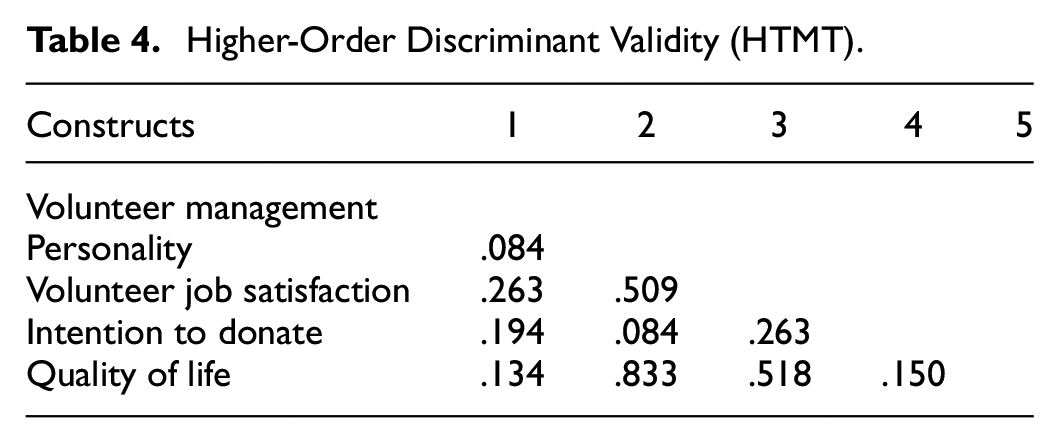
In addition, this study assessed the loadings, CR, and AVE of higher-order constructs. As shown in Table 3, all indicators exceeded the suggested values (Hair et al., 2022). Similarly, the discriminant validity of the higher-order constructs was assessed. The results showed that higher-order constructs displayed adequate discriminant validity (Henseler et al., 2015) (Table 4).
Higher Order Construct Reliability and Convergent Validity.

Higher-Order Discriminant Validity (HTMT).
Structural Model Assessment
Following the structural model assessment procedure (Sarstedt et al., 2020), path coefficient estimates of the structural model were examined. As shown in Table 5, both volunteer management and personality had a significant impact on volunteer job satisfaction (βVM → SAT = .23, t = 3.99, p < .001; βPER → SAT = .377, t = 6.84, p < .001), supporting H1 and H2. In terms of the moderating effect, the interaction between volunteer management and personality had a significant effect on volunteer job satisfaction (βVM*PER → SAT = .20, t = 3.28, p = .001), supporting H3. Finally, both paths from volunteer management to intention to donate (βSAT → INT = .25, t = 3.953, p < .001) and quality of life (βSAT → QoL = .48, t = 8.53, p < .001) were significant, supporting H4 and H5.
Results of Structural Model Assessment.

Discussion
While previous studies have identified the positive outcomes of volunteering (H. Cho, Li, & Wu, 2020; H. Cho, Wong, & Chiu, 2020; S. Cho & Kwak, 2020; Choi & Kim, 2011), the critical role of compulsory volunteering has not been widely addressed. Therefore, to understand its influence, we examined the relationships among volunteer management, personality, volunteer job satisfaction, donation intention, and quality of life in the context of compulsory volunteering. The results showed that all formulated hypotheses were supported. The findings of this study contribute to a deeper understanding of the importance of volunteering in both individuals’ lives and society.
Specifically, this study found that volunteer management had a positive effect on volunteer job satisfaction (
Next, this study found that personality was positively associated with volunteer job satisfaction (
We also found that personality plays a moderating role in the relationship between volunteer management and job satisfaction (
According to the findings of this study, volunteer job satisfaction also affects compulsory volunteers’ intention to donate (
Finally, the results of this study show that job satisfaction positively affects compulsory volunteers’ quality of life (
Theoretical Implications
The findings of this study can contribute to an academic field in several ways. First, one of the main theoretical implications of this study is that it provides support for the importance of volunteer management in increasing volunteer job satisfaction. The finding that volunteer management had a positive effect on volunteer job satisfaction is consistent with previous research and reinforces the idea that effective management practices are critical in creating positive experiences for volunteers. Another important theoretical implication of this study is that it highlights the role of personality in shaping the relationship between volunteer management and job satisfaction. This study found that personality traits moderated the relationship between volunteer management and job satisfaction, indicating that individuals’ personal characteristics can play an important role in determining how they respond to different management practices.
In addition, the finding that volunteer job satisfaction was positively associated with intention to donate has important theoretical implications for understanding the relationship between satisfaction and pro-social behavior. This finding supports previous research suggesting that positive experiences in volunteering can lead to increased commitment and continued participation in volunteer activities. It highlights the importance of creating positive experiences for volunteers, as this can lead to increased donation behavior and ultimately benefit the organization. In summary, this study provides important theoretical insights into the role of volunteer management and personality in shaping volunteer job satisfaction and pro-social behavior and has implications for how organizations can effectively engage and retain volunteers.
Practical Implications
Based on the findings of this study, we suggest practical implications that can help organizations build and maintain better relationships with their volunteers. First, it highlights the critical role of volunteer management in volunteerism. Farmer and Fedor (2001) noted that volunteers contribute less to their work when the time demands of their volunteer responsibilities compete with the time demands of their other commitments. Martinez and McMullin (2004) also mentioned that the primary limiting factor affecting the willingness of volunteers to continue is the presence of other obligations and commitments in their lives that compete for their time and attention. Therefore, managers should identify volunteer schedules and determine their workload to manage them effectively. In addition, providing effective educational programs for volunteers can be beneficial. Such programs can help volunteers enhance their knowledge and skills, thereby contributing to their personal growth and development. This, in turn, can lead to more motivated and effective volunteers who are better equipped to make meaningful contributions to the causes they support. This study also suggests that volunteer managers should prioritize training and support, as well as fostering social interaction and providing rewards and recognition to volunteers, in order to enhance volunteer job satisfaction. Volunteer satisfaction can be increased by providing them with opportunities to interact with others and actively involve them in the decision-making process. As such, managers need to prepare various social interaction programs for volunteers to broaden and build relationships with other volunteers and employees and also encourage autonomy when they carry out their tasks.
Next, this study found that volunteer satisfaction played a mediating role in the research model, which is consistent with the environmental psychology behavioral model (Mehrabian & Russell, 1974). In other words, volunteer job satisfaction, which is affected by environmental and personal factors, generates positive psychological and behavioral outcomes. Therefore, managers should carefully identify how compulsory volunteers feel and assess their volunteer experiences. Specifically, while compulsory volunteers may have been less interested in volunteer work at the outset, it was found that they could still make a meaningful contribution to an organization and subsequently improve their volunteer work satisfaction and well-being. Therefore, schools should ensure that students do not feel burdened or averse about volunteering for the first time. To this end, schools should sufficiently educate their students on the value and benefits of volunteering. In addition, volunteers are more likely to be highly satisfied with their roles and tasks when recognized for their difficult work and achievements. Thus, organizations or schools should select the best volunteers to receive awards to increase their self-esteem. Also, volunteer managers should consider individual differences in personality when developing management strategies and tailor their approaches accordingly.
Limitations and Future Research
This study has some limitations that should be considered in future research. First, we collected data from students who undertook the mandatory volunteering course offered by a university in Singapore. Thus, it is necessary to analyze data collected from various countries that implement compulsory volunteer programs to generalize the findings of this study. Furthermore, the central distinction between mandatory and voluntary volunteering is the freely chosen nature of the latter. Since self-interested motivations are vital for sustained participation (Ryan et al., 2001), it can be assumed that there should be a high turnover rate of volunteers in compulsory volunteering programs. Thus, future studies could compare how compulsory and voluntary volunteers experience different cognitive-emotional processes, affecting their decision-making. Finally, as many of the organizations that benefit most from these compulsory volunteering programs are non-profit voluntary welfare organizations, volunteers are critical assets to them. Volunteer loyalty leads to monetary donations and recommendations for other potential volunteers (Wisner et al., 2005). However, no study has examined volunteer loyalty in the context of compulsory volunteerism. Hence, future research needs to measure how volunteer loyalty and compulsory volunteering are interactively linked.
Footnotes
Acknowledgements
The authors acknowledge that this study was not funded by any organization and would like to thank Ms. Sylvia Tan Han Yu for her help with data collection.
Declaration of Conflicting Interests
The author(s) declared no potential conflicts of interest with respect to the research, authorship, and/or publication of this article.
Funding
The author(s) received no financial support for the research, authorship, and/or publication of this article.

Data Availability Statement
The datasets generated during and/or analyzed during the current study are available from the corresponding author on reasonable request.