




Abstract
This study aims to explore community participation in shaping their support for the development of sports events tourism. As a part of this investigation, the factors affecting local residents’ support of the development of sports events tourism was explored using the triple-bottom-line approach for tourism impacts, thus focusing on socio-cultural, economic, and environmental factors. According to the theoretical framework adopted in this work, residential participation influences their perceptions of tourism impacts and in turn their support for tourism development. This assertion was tested through a survey of Bangsaen residents, as this beach city in Chonburi is a major tourist destination in Thailand. The survey data were subjected to structural equation modelling, revealing that all factors comprising the triple-bottom-line approach exert direct impact on the residents’ support for sports events tourism development, which is unaffected by community participation. These findings can provide local authorities, developers, and organizers with guidelines on how to improve local residents’ support for sports events tourism.
Introduction
To develop sustainable tourism, it is important to understand and assess the attitudes of residents toward tourism (Lee, 2013). If stakeholders are allowed to actively participate in the event planning process, it is more likely that such initiatives would be successful in the long term (Byrd, Bosley, & Dronberger, 2009). The host community is the key stakeholder for any tourism event and should be the central point in tourism planning processes. The community perceptions of tourism can affect the local residents’ behavior toward visitors to their region and the events held locally. Thus, investigating these perceptions is vital (Getz & Page, 2016). Event planners and developers who are aware of the residents’ perceptions of tourism and its impacts on their community can proactively address their concerns and alleviate any problems in a timely manner. This allows for setting applicable policies and taking action immediately, optimizing benefits and diminishing difficulties associated with the tourism industry.
The tourism sector has historically represented an important part of the Thai economy, and this is likely to continue, given that the number of international tourists coming to the country is continually rising. According to the Tourism Authority of Thailand (2017), the number of visitors to the country grew from 81,000 in 1960 to 22 million, 26.74 million, and 32.59 million in 2012, 2014, and 2016, respectively. Consequently, Thailand’s tourism industry generates substantial revenue for the country. In 2016, it generated US$20 billion, up 16% from 2015.
Bangsaen, a beach town in eastern Thailand, derives its main income from the tourism industry. Thus, attracting more tourists to the region is vitally important for the local community. The town has been a popular destination for Thais for a long time due to its proximity to Bangkok, beautiful beaches, and famous food, such as dried seafood and sticky bamboo rice. Each year, around 1.1 million travelers visit Bangsaen and spend around US$40 per person (Saensuk Municipality, 2017). However, the majority of domestic visitors, and international travelers in particular, prefer to visit better-known destinations, such as Pattaya City, located in the same province, not far from Bangsaen.
Sports events tourism is an opportunity for Bangsaen to attract local and international visitors and boost its economy. While the focus of sports events has previously mostly been on organizing quality activities, they have recently become an important type of tourism. As the fastest growing form of tourism, sports events are now considered vital to the local economy. Their organization can, thus, be instrumental for the economic expansion of local communities, regions, or countries (Tzetzis, Alexandris, & Kapsampeli, 2014). In recognition of this fact, in nearly every North American city, enthusiastic personnel and agencies have started hosting sports tourism on a regular basis (Getz & Page, 2016). Sports-related activities are becoming the primary attraction for many visitors, both national and international, to travel to the pertinent location. This increased travel benefits not only the local community but also the entire tourism sector (Homafar, Honari, Heidary, Heidary, & Emami, 2011). The increasing number of domestic and international tourists participating in sports events stimulates the local economy. Participants contribute to the local economy through spending on accommodation, retail outlets, and restaurants, while increasing the demand for local labor (W. Kim, Jun, Walker, & Drane, 2014). Sports events tourism can be leveraged for maximum value in combating seasonality of demand. In a low travel season, tourists can be attracted to the area by organizing sports events that are independent of season (such as indoor sports or those that are played all year round).
Besides the economic benefits, sports events tourism acts as a catalyst for other forms of desired development, such as urban renewal, community capacity building, voluntarism, and improved marketing, thereby generating a long-term or permanent legacy (Getz & Page, 2016). Sports events also attract sponsors and the media, which can contribute to a positive image of the destination and help with creating a unique city brand that would attract tourists in the future. Empirical evidence indicates that sports events could be viewed as an appropriate way to market and promote the characteristics of a destination and community building (Kaplanidou & Vogt, 2007). The host destination can derive diverse benefits from regularly organizing sports events, whether they are held in existing facilities or require development of additional infrastructure (W. Kim et al., 2014). For example, city streets and roadways can be repurposed or become temporary sports arenas in the case of bicycle races, marathon, and car racing (Kaplanidou & Vogt, 2007). Thus, a portfolio of sports events can be developed that are consistent with the community’s available infrastructure, and human and cultural capital to allow for a viable and sustainable tourism development (Gibson, Kaplanidou, & Kang, 2012). However, for sports events tourism to serve as a means of strengthening its economic development, it is essential to develop community support and participation (Fallon & Kriwoken, 2003; Gursoy & Rutherford, 2004; Nicholas, Thapa, & Ko, 2009). Consequently, the local residential support is a critical factor for ongoing sports events tourism.
Factors influencing local community support for sustainable tourism development have been the subject of extensive research. These factors include attitudes toward sport events (Lai & Nepal, 2006), perceived effects and benefits (Dyer, Gursoy, Sharma, & Carter, 2007; Yoon, Gursoy, & Chen, 2001), and the community’s attachment to these events (Lee, 2013). However, relatively few studies have been conducted to investigate the effects of community participation on the success of sports events tourism as a means of boosting local economy. Similarly, there is paucity of studies focusing on these phenomena as they relate to beach cities, such as Bangsaen, or Thailand in general. This is rather surprising, given that sports tourism has received considerable interest in the country in the recent years. To fill these research gaps, a theoretical model was developed as a part of the present study, the aim of which was to examine the structural relationships between residents’ support for sports events tourism and the precedent variables of socio-cultural impact, economic impact, environmental impact, and community’s participation. Implications of the study and topics for future research are also discussed.
Literature Review
Community support for sustainable tourism has been extensively studied (Lee, 2013). However, many earlier studies in this field were descriptive in nature, producing only theoretical formulation of sustainable tourism. Moreover, earlier attempts at understanding community support have failed to elucidate why local people perceive and respond to tourism as they do (Gursoy & Rutherford, 2004). To address this limitation, researchers have recently started applying different theories in the field of sociology, such as the social representation theory (e.g., Andriotis & Vaughan, 2003), the bottom–up spillover theory (e.g., K. Kim, Uysal, & Sirgy, 2013), and the theory of reasoned action (e.g., Dyer et al., 2007), as a means of offering a better rationalization of the factors shaping local people’s support for sports tourism. However, the social exchange theory (SET) has emerged as the most widely accepted framework for describing local residents’ reactions to tourism development and has been adopted as theoretical foundation in many research studies (Andereck, Valentine, Knopf, & Vogt, 2005; Jurowski, Uysal, & Williams, 1997; Rasoolimanesh, Jaafar, Kock, & Ramayah, 2015; Stylidis, Biran, Sit, & Szivas, 2014). SET has been proven useful in evaluating the stakeholders’ attitudes because this theory captures differing views based on experiential and psychological outcomes (Prayag, Hosany, Nunkoo, & Alders, 2013). In line with this view, Andereck et al. (2005) asserted that exchanges must exist for a community to improve and stimulate tourism, whereby residents willingly serve the needs of the tourists. Ap (1992) defined the SET as “a general sociological theory concerned with understanding the exchange of resources between individuals and groups in an interaction situation” (p. 668). In other words, SET specifies the exchange of tangible or intangible resources between residents and tourists within the tourism context. For a community to benefit from tourism, an exchange between stakeholders is necessary. Hence, the local residents must make a decision whether to become dependent on the benefits and costs of tourism by weighing the related economic, social, cultural, and environmental concerns (Gursoy, Chi, & Dyer, 2010), or by evaluating the anticipated value exchanged based on the costs and benefits incurred (Andereck et al., 2005).
The acceptance or rejection of tourism development is determined by the balance of the value exchange it involves. Jurowski et al. (1997) found that perceptions of the exchange depend on the benefits that an individual can derive from tourism outcomes. Authors of several empirical studies, including (Ap, 1992), Andereck et al. (2005), Chuang (2010), and Rasoolimanesh et al. (2015), found that residents will support additional tourism development if the benefits they receive outweigh the costs. Conversely, if local residents are of view that the development of tourism is likely to incur unbearable expenses that would place them at a disadvantage, they will be unlikely to support further development of this initiative (Ap, 1992). More recently, Chuang (2010) observed that, in areas characterized by low economic activity and low tourism development, local residents tend to have positive perceptions of tourism because they have high hopes and expectations of the benefits of tourism. Andereck and Vogt (2000), thus, opined that residents’ needs and wants should take precedence when creating initiatives aimed at tourists.
There is an abundance of research on the demand side of tourism development. In the context of the present investigation, this would mean that the aim of such studies should be on determining who travels for sports events and why, as well as identifying who attends sports events while traveling. This information allows establishing a profile of the travelers’ characteristics, while assisting with measuring their satisfaction with events, and identifying preferred destination attributes. In turn, such profiles can be used to improve those events and attract more travelers. Numerous articles focus on the demand side (Getz & Page, 2016; Tzetzis et al., 2014). Satisfaction and loyalty from athletes and visitors have been the subject of extensive research in the sports events tourism context. These works have been conducted in many countries, including the United Kingdom (Richard & Jones, 2008), Hungary (Kozma, Michalkó, & Kiss, 2014), and Canada (Kulczycki & Halpenny, 2014).
However, empirical research investigating the supply side is limited. Comprehending the perceived impact of sports tourism on the local community and the host residents’ encouragement for sustainable tourism development is essential for the successful management and marketing of this form of tourism (Getz, 2008). Moreover, generating local residents’ support is considered an essential part for planning and operating successful events (S. S. Kim & Morrsion, 2005). Therefore, understanding local residents’ attitudes toward sports tourism can help to better predict their level of support for tourism development. To contribute to filling this research gap, in this study, a theoretical model was developed to examine the structural relationship between community participation, the triple-bottom-line approach to tourism impact assessment, and the residents’ encouragement for sports events tourism. In the following section, how the perceived socio-cultural, economic, and environmental impacts correlate with the residents’ encouragement for sports events tourism development is discussed.
Impacts of Sports Events Tourism on Residents’ Perceptions
It is widely acknowledged that sports tourism can have both favorable and unfavorable impacts on the local community with respect to different exchange domains (García, Vázquez, & Macías, 2015; Ntloko & Swart, 2008). A review of pertinent literature indicated that three elements impact the exchange process for tourism development, namely, socio-cultural, economic, and environmental impacts. This finding is aligned with the triple-bottom-line approach to impacts, commonly used in sustainable tourism development research studies (Prayag et al., 2013).
Economic benefits are the key element in the exchange process of tourism development. Authors of numerous studies in this field have reported that economic benefits are the most significant component sought by local residents (Lee, 2013; Stylidis et al., 2014). Residents who recognize a higher level of economic gain or are dependent on the tourism industry tend to have a more positive attitude toward tourism than others (Stylidis et al., 2014). Empirical evidence also indicates that sports events tourism can enhance economic exchange by being an important source of income for the cities (Carlsen & Taylor, 2003; Kasimati & Dawson, 2009). Konstantaki and Wickens (2010) as well as Homafar et al. (2011) affirm that sports events are generally regarded as leveraging opportunities for economic output through increased employment, new market creation, and minimizing inflation. On the other hand, sports events tourism can incur many costs, such as those related to wages and security equipment (Bob & Swart, 2009; Lorde, Greenidge, & Devonish, 2011), while potentially increasing standard costs of living (Fourie & Santana-Gallego, 2011).
The socio-cultural aspects of tourism development are highly relevant (Nunkoo & Ramkissoon, 2011; Yu, Chancellor, & Cole, 2011). According to Ap (1992), the exchange approach can be viewed in terms of social interaction and intangible benefits. More recently, Wang and Pfister (2008) asserted that noneconomic value domains should not be overlooked even in exchanges that appear to be strictly based on economic activity. It has also been shown that the understanding of economic and social goals is crucial for establishing successful sports events operations. Residents’ perspectives related to social and cultural aspects of sports events tourism can have both positive and negative impacts on the development of this sector. Sports events participation may enhance cultural exchange and increase the awareness of cultural identity in local communities (Hritz & Ross, 2010) as well as promote community pride (Ntloko & Swart, 2008). However, sports tourism can also increase crime rates (Collins, Flynn, Munday, & Roberts, 2007; Dyer et al., 2007), as there is a greater potential for vandalism by visitors (W. Kim et al., 2014), and thus a greater need for ensuring security (W. Kim et al., 2014).
Apart from the socio-cultural and economic impacts, environmental aspects are important to tourism development and its contribution to the host destination. Sports events can assist in preserving the physical environment and local heritage (Lorde et al., 2011). Such events can also serve as a catalyst for enhancing the level of environmental consciousness among the residents. The 2002 FIFA World Cup in South Korea is a good example of this positive effect of sports tourism on local community, as it enticed the conservation of natural resources and historical buildings (S. S. Kim & Morrsion, 2005). The same is true for the 2012 Olympic Games in London, as the organizers considered the environmental impact based on feedback during the lead up to the Olympic Games when constructing the Olympic village, that consequently was built to excellent eco-rating (Konstantaki & Wickens, 2010). However, sports events can also cause environmental pollution, as well as increase litter and waste production, elevate noise levels and traffic congestion, as well as disrupt local residents’ use of public facilities and roads (Hritz & Ross, 2010; W. Kim et al., 2014; Lorde et al., 2011; Ntloko & Swart, 2008).
Applying SET, many scholars have verified the influence of residents’ perceptions of impacts on their support of tourism development. Nevertheless, the resulting classification and measurement of residents’ perceptions of impacts are inconsistent. An extensive review of existing research on tourism revealed that the costs-benefits, domain-related costs-benefits, and the nonforced approach are the most commonly used methods in such investigations.
When the costs-benefits approach is used, the impacts of tourism are grouped into costs and benefits or positive and negative effects (Lee, 2013; Nunkoo & Gursoy, 2012). Due to its simplicity, this approach disregards the impacts of tourism on multifaceted aspects of community life, such as environment, economy, and society. As a result, the understanding of how residents perceive impacts of tourism is limited (Nunkoo & Ramkissoon, 2011). This may obstruct the predictive strength of the structural model and is less applicable to sustainable development (Stylidis et al., 2014).
The domain-related costs-benefits approach has emerged in an effort to better address the aforementioned limitations and understands the association between residents’ support and perceived impacts. Authors who have adopted this approach have classified impacts into several areas of perceived positive and negative environmental, socio-cultural, and economic effects. For example, Prayag et al. (2013) conducted a study on London residents’ support for the 2012 Olympic Games and examined the influence of positive/negative socio-cultural impact, positive/negative environmental impact, and positive/negative economic impact. This approach emphasizes the need to reflect on both the nature and the domain of impacts to increase the understanding of residents’ reaction to tourism, as this explains a greater portion of the variance in residents’ support.
However, domain-related costs-benefits approach is not without limitations, one of which stems from the manner in which surveys used to gather data are worded, as they typically include positively or negatively pre-coded statements. For instance (Kaplanidou et al., 2013) questionnaire included statements like “increased the prices of good and services,” “increased the crime rate,” and “damage the natural environment” (p. 636). This does not permit the respondents to specify the extent to which they perceive an impact as being positive or negative (Andereck et al., 2005; Ap & Crompton, 1998). Consequently, measurements based on this approach may reflect the academics’ assessment of directionality of the potential impacts rather than the participants’ personal perspectives (Andereck et al., 2005). Another concern related to this strategy pertains to the analysis of responses. When participants agree with the assertion that tourism creates more jobs, this does not automatically imply that they see this change as favorable, as jobs created may be inadequately paid and unskilled (Ap & Crompton, 1998). Iroegbu and Chen (2001) concur with this notion and show in their research that, while residents believed that tourism generates more jobs, they did not see this as a positive outcome, as those jobs were aimed at foreigners or were lowly paid.
To avoid the limitations of the domain-related costs-benefits approach, many researchers have adopted a nonforced approach for assessing impacts (Andereck et al., 2005; Ap & Crompton, 1998; Stylidis et al., 2014). When this approach is used, the data collection instruments include a series of impartially phrased statements, prompting the participants to state their own opinion of directionality. In other words, rather than asking whether the sports events have increased the number of jobs, the participants are given the topic “number of jobs,” which they can rate on a negative to positive scale. This strategy allows the researcher to consider residents’ perspectives on the positive or negative effects of tourism within various domains of community life (Ap & Crompton, 1998). In contrast to the costs-benefits approach and the domain-related costs-benefits approach, the nonforced approach can reveal the direct positive relationships between all domains of impacts and support. The perceived nature of the impacts will be reflected by the overall score of each impact. If the mean score of impact is higher than the midpoint of the scale, it implies that the residents view it favorably. Inversely, if the mean score of impact is below the midpoint, it implies that the residents have a more negative perception (Deccio & Baloglu, 2002).
Studies that follow this nonforced approach imply that residents will have more support toward tourism development when they have a positive perception of its impact (Kulczycki & Halpenny, 2014). On the other hand, they will oppose or have less support for such initiatives when their perception of their impact is negative (Stylidis et al., 2014). Strong community opposition could result in the event’s failure or the inability to organize future events. The residents’ feelings of displeasure, anger, mistrust, and inattentiveness will ultimately be projected onto the visitors, who will, in turn, be less likely to travel to a destination at which they feel unwelcome (Yoon et al., 2001).
In this research, the nonforced approach was adopted, as it can overcome bias in the measurement of perceived impacts from residents. The participants can express their own views of sports events tourism impacts, rating them on a continuous positive-to-negative scale in a wide range of contexts. Moreover, this research is based on the SET, as the model can assist in comprehending the local residents’ evaluation of the exchange made with visitors. To enhance theoretical development, there is a need to consider the importance of each impact domain; hence, in the analyses, the focus is given to socio-cultural, economic, and environmental impacts of sports tourism. The following hypotheses were tested in this study:
Community Participation in Sports Events Tourism
Community participation can be considered an important factor in the development of tourism (Lepp, 2007). In recognition of the diversity of reactions among local residents to the development of tourism, authors of extant studies have extended the SET by integrating other enabling factors that affect people’s support, such as the state of the local economy, residents’ economic gain, ecocentric and environmental attitudes, use of tourism resources, and place image (e.g., Gursoy et al., 2010; Jurowski & Gursoy, 2004; Lee, 2013; Nunkoo & Gursoy, 2012). However, each event location has their distinct sustainable development issues, and thus, understanding these issues through participation by local residents would be important.
Active community participation drives sustainable and viable tourism. This is achieved through empowering the community, supporting resident participation in the decision-making processes, and dispersing revenue from tourism to residents (Choi & Sirakaya, 2005). According to Jamal and Getz (1995), community participation plays an important role in the development of sustainable tourism, especially community-based tourism. Participation increases the community value by enhancing the positive effects of tourism and reducing its negative effects. Involvement of resident communities in management and decision-making can convince the community of the need to incorporate tourism into the local economy (Aas, Ladkin, & Fletcher, 2005; Choi & Sirakaya, 2005). This assertion is supported by findings yielded by several studies indicating that local residents have more opportunities to gain financial or other benefits from tourism development if the community is engaged in such initiatives (Sebele, 2010). More recently, Lee (2013) found that direct involvement affected the local residents’ support for sustainable tourism development. However, these results are contrasted by those reported by Nicholas et al. (2009), who found that the degree of support for tourism development was not affected by community involvement. These researchers also found that the majority of local people were not involved in the process of tourism development and decision-making.
Several researchers opted to focus on other factors, such as perceived benefits and costs, which they treated as mediating variables between the support for tourism and community participation (Andereck & Nyaupane, 2011; Zhang & Lei, 2012). However, as research using a triple-bottom-line approach is limited, it was adopted in the present study to elucidate tourism impacts as mediating effects between community participation and residential support for further tourism development. This approach has rarely been employed in tourism studies, especially those focusing on sports events tourism. To overcome this research gap, the following hypotheses were tested in this study:
The findings yielded by the literature review presented earlier were used to develop the conceptual model shown in Figure 1, which was used to examine the relationships between the constructs of this research, namely, community participation, impacts of sports events tourism on residents’ perceptions, and residents’ support for further sports events tourism development (see Figure 1).

Conceptual model.
Research Method
In the present research, a quantitative research method was adopted, as this ensured that the investigator and the investigated are independent entities. Veal and Ticehurst (2005) stated that researchers are independent of the external reality. Thus, they need to conduct a study to find out all facts and explain the reality through numerical measurements. Consequently, quantitative research involves the collection of data, analysis, and presentation of numerical information (Phillips & Burbules, 2000). This approach allows researchers to identify and assess relevant causes and outcomes of the phenomena being investigated. A self-completed questionnaire was chosen as the primary data collection method because it was efficient and cost-effective, as it allowed responses from a large group of participants to be collected at a relatively low cost (Dahlberg & McCaig, 2010).
Survey Items
The survey instrument was divided into three sections. The aim of the first section of the questionnaire was to obtain the respondents’ demographic characteristics, such as age, gender, marital status, ethnicity, education, and occupation. In the second and third section, an interdisciplinary approach commonly adopted in similar studies was adopted, along with scale development procedures for measuring perceived impact from the residents and the encouragement of further sports events tourism development. Both sections required responses on a seven-point Likert scale. The second section examined the impacts of sports events tourism, which were rated on a continuum from very negative to very positive. On the other hand, the third section aimed to elucidate the previous involvement of residents and the residents’ support for further sports events, which was again noted on a continuum ranging from strongly disagree to strongly agree. All question-statements were evaluated by a panel of experts, including five university professors with acumen in sports and tourism management, to enhance clarity, relevance, and effectiveness. As a result, 25 statements were used in the second section of the questionnaire, as follows:
Six statements were designed to assess the residents’ perceptions of the socio-cultural impact of sports events tourism (Hritz & Ross, 2010; Yoon et al., 2001).
Six statements dealt with the economic impact of sports events tourism (adopted from Balduck, Maes, & Buelens, 2011; Hritz & Ross, 2010; Unguren, Kacmaz, & Yetkin, 2015).
Four statements pertained to the environmental impact of sports events tourism (adopted from Andriotis & Vaughan, 2003; Stylidis et al., 2014).
Four statements dealt with the community participation (adopted from Lee, 2013; Nicholas et al., 2009; Tosun, 2006).
Five statements were designed to support future sports events tourism (adopted from Bull & Lovell, 2007; Hritz & Ross, 2010; Stylidis et al., 2014; Yoon et al., 2001).
A pilot test of the questionnaire was conducted to assess the reliability and the ease of understanding of the questions. As a part of this pilot study, 30 questionnaires were distributed to local residents in Bangsaen. Comments from respondents regarding the questionnaire design were mainly related to poor formatting, along with inappropriate wording in some questions. Therefore, to increase comprehension of the survey questionnaire, the suggested adjustments were made.
Sampling and Data Collection
Bangsaen was chosen as the research location due to three main reasons. First, owing to its proximity to Bangkok and readily available amenities, such as hotels and restaurants, Bangsaen is developing into a tourist city. Second, Bangsaen has many attractive tourist destinations, such as historical sites, cultural sites, theme parks, beaches, and other tourist amenities that dominate the region. Third, multi-faceted world-standard sports events are already being organized in Bangsaen throughout the year. These events include the Bangsaen Triathlon Tour Series (a multiple-stage competition) and the Bangsaen Regatta Burapha University (sailboat), which take place in the first quarter of the year. In the second quarter, the FIVB Beach Volleyball World Tour (volleyball competition) and the Bangsaen Water Sports Festival (Jet Ski Aquabike) are held. In the third quarter, Bangsaen normally hosts the Grand Prix Car Race and the Tour of Thailand (cycling competition). This calendar of events is concluded with the Bangsaen Marathon 42 and the Bangsaen Half Marathon 21 (running competition) in the last quarter of the year.
For the present study, residents of Bangsaen City were selected, as the sampling frame was provided by the Saensuk Municipal Office. Their listings were recently updated and encompass all households. Based on the population size, a proportionate stratified random sampling method was used to collect data, as the aim was to reflect the diverse geographical distribution in residential areas (Zikmund, 2003). To represent the Bangsaen population, the multistage sampling was also adopted, as Bangsaen City is divided into 15 communities across which the resident age varies. In the first stage of data collection, the population size of each community was determined in relation to the total population of Bangsaen City. In the second stage, the number of samples in each community was established in relation to the age groups within the population. The survey was carried out in November 2018 by distributing questionnaires door-to-door to identified household members. If an individual was not a local resident or was unwilling to partake in the study, the next household was approached and invited to participate. The characteristics of the survey respondents are summarized in Table 1. In brief, the majority of respondents were adults aged 30 to 44 years who had completed postsecondary education. The proportions of the respondents in each group in terms of age and education were consistent with those pertaining to the entire Bangsaen population, as registered in the Municipal Office. Furthermore, both company and government employees (45.8%) constituted the majority of respondents in this study, with the average monthly income below THB 30,000.
Descriptive Statistics of Respondents’ Profile.

Data Analysis and Results
Structural equation modelling (SEM) was used to analyze the data. In the data analysis, a measurement model was applied to assess the reliability and validity of construct items, while a structural model was adopted to test the study hypotheses.
Measurement Model Assessment
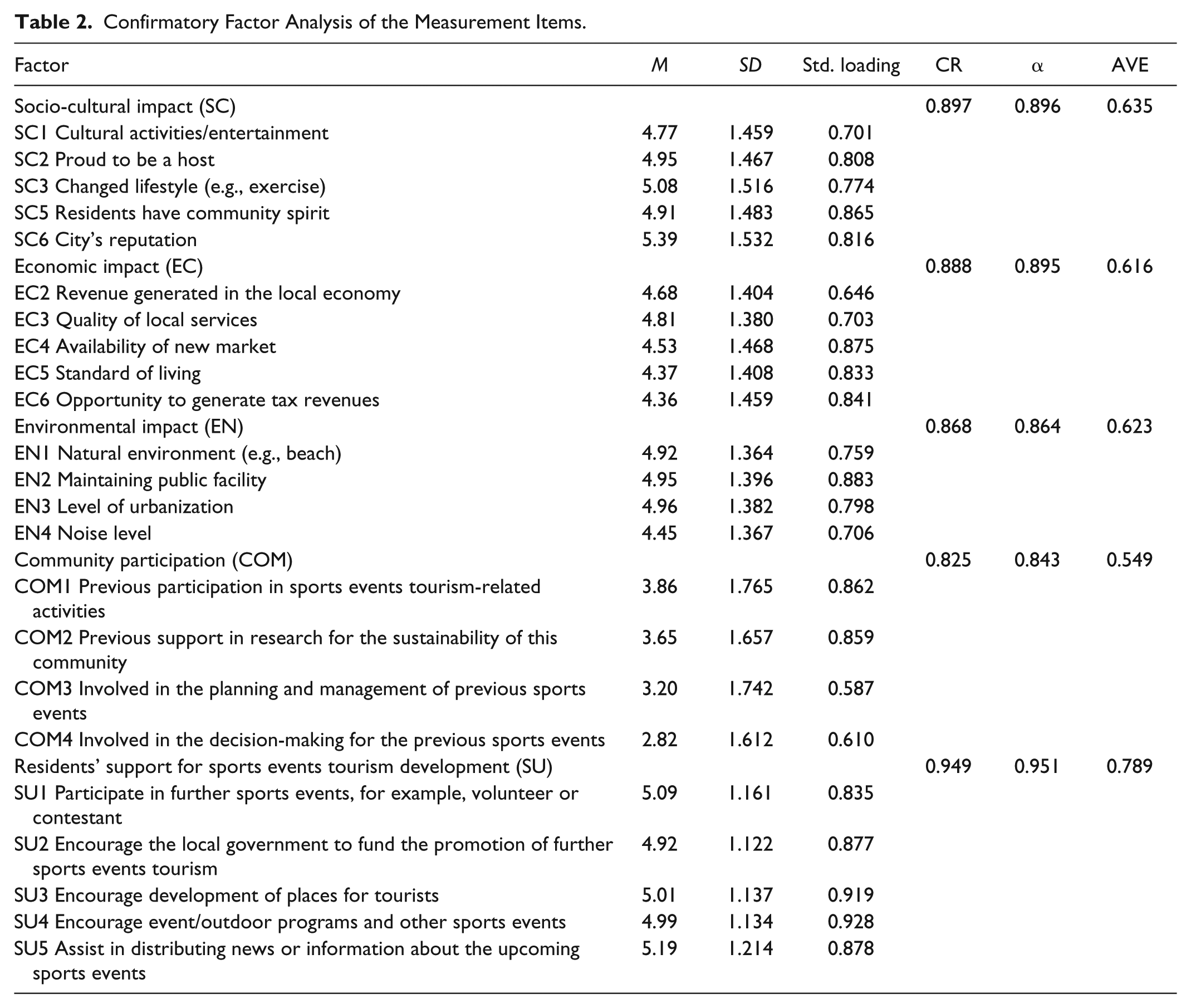
Confirmatory factor analysis (CFA) of all items was conducted simultaneously to evaluate the validity of the items and the five underlying factors. Overall, the fit of the measurement model to the data was found to be good. Fit statistics showed that the chi-squared/df ratio (χ2 = 417.24, df = 217, χ2/df = 1.92, p < .01) was below the suggested threshold of 3.0 (Kline, 1998). The root mean square error of approximation (RMSEA) value of 0.04 was also below the recommended threshold of 0.08 (Hu & Bentler, 1999). The incremental fit index (IFI) of 0.97 and the comparative fit index (CFI) of 0.97 were, as recommended, greater than the threshold of 0.95 (Hu & Bentler, 1999).
Validity includes convergent validity and discriminant validity. Convergent validity measures whether items effectively reflect the corresponding construct, whereas discriminant validity measures whether two factors are statistically different. Table 2 lists the means, standard deviation, standardized item loadings, the average variance extracted (AVE), composite reliability (CR), and Cronbach’s alpha values. As can be seen, most item loadings exceed 0.7. The T-values indicate that all loadings are significant at .001. Each AVE exceeds 0.5, whereas CR is above 0.7. Thus, the scale has a good convergent validity (Hair, Black, Babin, Anderson, & Tatham, 2010). In addition, all a-values are larger than 0.7, suggesting a good reliability (Tabachnick, Fidell, & Osterlind, 2001).
Confirmatory Factor Analysis of the Measurement Items.
As a part of the discriminant validity analysis, the square root of AVE and factor correlation coefficients were compared (Table 3). For each factor, the square root of AVE (in parentheses) is significantly greater than its correlation coefficients with other factors, suggesting a satisfactory level of discriminant validity (Fornell & Larcker, 1981).
Squared Correlations and the Average Variance Extracted (AVE).

Note. EN = environmental impact; COM = community participation; SC = socio-cultural; EC = economic impact; SU = residents’ support for sports events tourism development.
In summary, the measurement model results support the reliability and validity of constructs proposed in the model, which was employed when testing the research hypotheses.
Structural Model Assessment and Hypothesis Testing
The results of the structural model analysis indicate satisfactory fit between the model and the empirical data (χ2/df = 1.923, RMSEA = 0.045, IFI = 0.972, CFI = 0.972). Each hypothesis was tested by examining pertinent path significance. Figure 2 illustrates the path diagram with the standardized structural parameter estimates included.
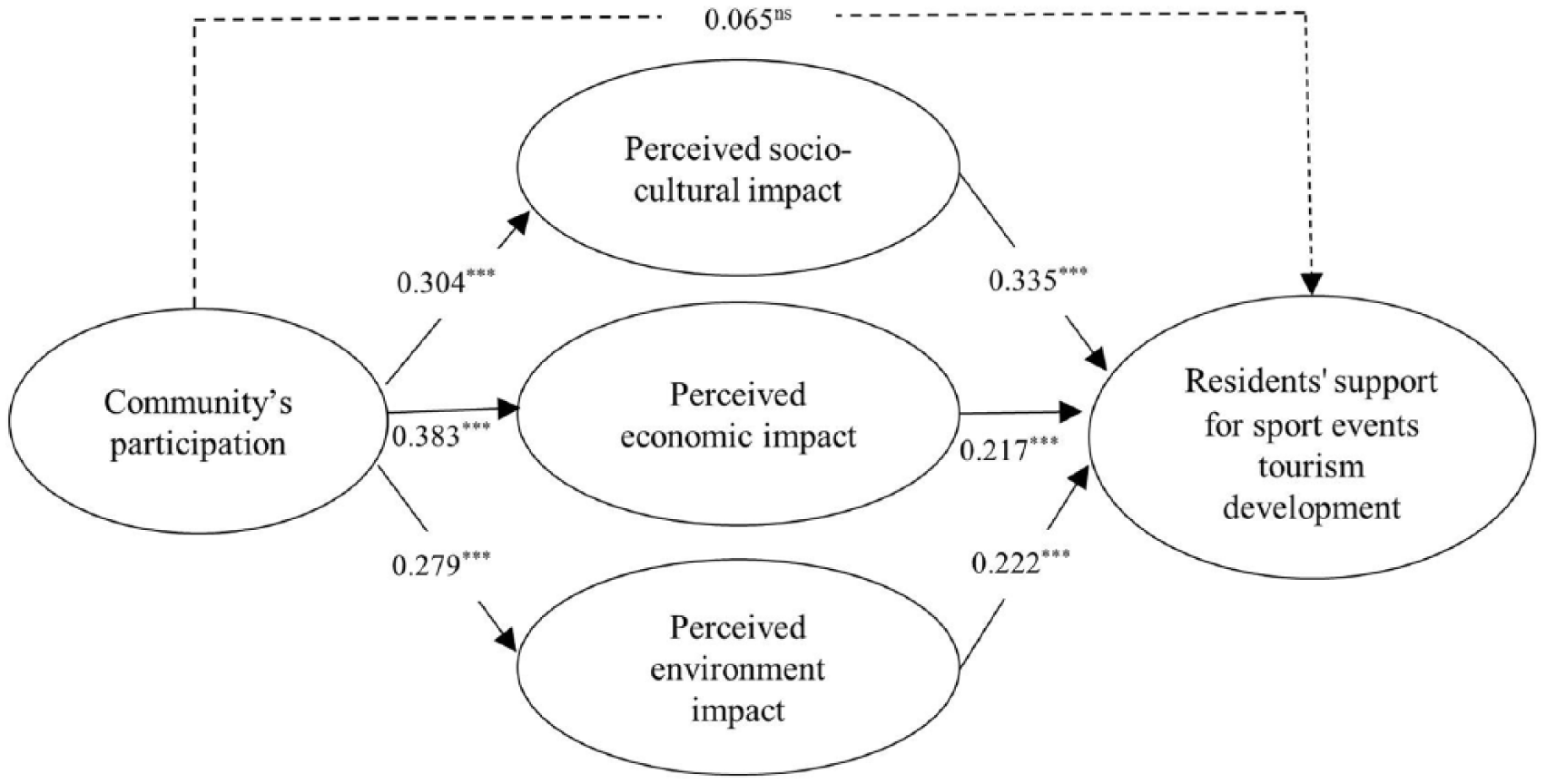
Note. Standardized coefficients are reported; ns = not significant.
According to structural relations for residents’ support for sports events tourism development, the effects of perceived socio-cultural impact (H1), perceived economic impact (H2), and perceived environmental impact (H3) are supported (β = 0.335, p < .001, β = 0.217, p < .001, β = 0.222, p < .001 respectively). However, the relationship between community participation and residents’ support for sports events tourism development predicted by H4 is not supported. The model explains 52% of the total variance in residents’ support, with socio-cultural impact contributing the greatest effect.
With respect to the relationship between community participation and the impacts of sports events tourism on residents’ perceptions, H5, H6, and H7 are supported (β = 0.304, p < .001, β = 0.383, p < .001, β = 0.279, p < .001, respectively). This means that community participation is instrumental in influencing residents’ perceptions toward socio-cultural, economic, and environmental impacts of sports events tourism.
A formal test of indirect effects using a bootstrap procedure was conducted to examine the mediation effects in the path analysis model. The results reported in Table 4 indicate that there is no significant direct effect of community participation on residents’ support for sports events tourism development. However, the effect of community participation is fully mediated via the residents’ perceptions of socio-cultural, economic, and environmental impacts of these events (β = 0.247, p < .001).
Direct, Indirect, and Total Effects of the Relationships.

Note. Standardized coefficients are reported. ns = not significant.
p < .001.
Discussion
The factors affecting the residents’ perceptions of tourism and their support for tourism development have rarely been studied in the context of sports events tourism, especially in Thailand. The results yielded by the present investigation reinforce previous findings on the residents’ attitudes toward tourism. According to a number of prior studies focusing on tourism in general, such as those conducted by Nunkoo and Ramkissoon (2011), Stylidis et al. (2014), and Prayag et al. (2013), some of the three domains of perceived impacts (socio-cultural, economic, and environmental) have been shown to have a direct relationship with the residents’ support for tourism. However, the results obtained in the present study indicate that all three domains have a direct relationship with the residents’ support, which indicates that the SET postulates can be applied to sports events tourism. Thus, it can be asserted that residents who have positive views about the socio-cultural, economic, and environmental impacts of sports tourism may consider supporting future sports events. Specifically, the effect of perceived socio-cultural impact and residential support of sports events tourism development indicates that locals will become supportive when they develop a sense of pride due to their city or region hosting a sports activity, while also valuing its additional benefits. For instance, hosting a sports event allows their city to become well-known among visitors and tourists, which makes them proud to be part of the local community. Although Dyer et al. (2007) and Hritz and Ross (2010) measured socio-cultural impact differently, focusing on crime rate and cultural exchange, these researchers found direct socio-cultural impact toward resident support. Hence, it can be argued that the host residents are concerned and weigh up benefits of sports events tourism on the society and culture when forming their attitudes toward such initiatives. The effect of perceived economic impact on residential support for tourism observed in this study reinforces the main SET postulates. Based on this theory, perceived benefits and costs are effective predictors of the support for sustainable tourism development (Gursoy et al., 2010). Consistent with previous tourism development studies (e.g., Yoon et al., 2001 and Prayag et al., 2013), the findings yielded by the present investigation may imply that locals are likely to be more supportive of hosting a sports event when they perceive an opportunity to gain some financial benefits from being a part of the event. Such results are not unexpected, given that economic benefits of tourism (including sports tourism) are often the most valued among the host community (Jurowski & Gursoy, 2004). For example, locals could set up a new business, such as a restaurant, to meet the demands of event attendees, whereas existing businesses such as hotels or resorts can achieve high occupancy rates during the sports event. The revenue generated in the local economy as a result of these opportunities and benefits potentially allows locals to improve their living standards while increasing the overall quality of local services. In summary, this finding supports the prevalent view that event tourism can be a viable approach to the economic development of local communities (Getz & Page, 2016; Prayag et al., 2013). In line with the findings reported by Stylidis et al. (2014), the perceived environmental impact also plays an important role in residential support for sports events development. However, Konstantaki and Wickens (2010) and Prayag et al. (2013) noted no such effects for mega sporting events. Mega events, such as the Olympics, affect the environment in the long term, but the residents are not immediately exposed to the environmental consequences, while the residents hosting smaller-scale events are more sensitive to the impact on the environment, according to these researchers. To elaborate on the environmental issues, the local government may be required to improve the overall quality of the city when hosting a sports event by, for instance, maintaining public facilities, such as road and street signs. Locals may perceive this initiative as an extra benefit of hosting such an event, as it enhances the overall city environment and expands urbanization. For this reason, locals are likely to support hosting an event, as well as encourage the local government to fund the promotion of further sports events.
Given that, in extant studies, limited attention is given to host resident involvement in the strategic development of tourism, this research advances the current literature on sports events by extending the SET framework for examining local community participation. Local community involvement plays an important role in influencing perceptions and support for tourism development (Lepp, 2007). Community participation in tourism development is recognized by several researchers as an essential precondition for the sustainable development of destinations (Getz, 2008; Rasoolimanesh, Ringle, Jaafar, & Ramayah, 2017). Specifically, the findings yielded by this study offer partial support for the results reported by Lee (2013), who found significant effects of community participation on perceived benefits, while noting that perceived costs did not have significant influence. This disparity in findings can be attributed to the fact that Lee (2013) grouped the benefits related with economy, environment, and society into one factor denoted as “perceived benefits.” However, this study was based on the triple-bottom-line approach, in which the relationship is examined across three factors. More specifically, a significant relationship between community participation and residents’ perception of socio-cultural, economic, and environmental impacts was found in this study. This means that the involvement of locals and resident communities in planning and managing previous sports events allows them to understand the benefits gained from hosting a sports event, as well as appreciate the associated negative impacts. This information would prompt them to form either a positive or negative perception toward hosting sports events in the future. For instance, local communities can understand the process involved in organizing sports events by being part of the organizing committee. This makes them willing to give support, as they perceive that there are benefits gained from organizing the event.
While authors of previous studies in this field found that local residents’ involvement affected their support for future events (Lee, 2013), these results were contrasted in the present research. This study indicated that, as community participation increases, the residents’ support for sports events tourism development does not automatically increase. The insignificant relationship between community participation and local residents’ support could potentially be attributed, in the case of Bangsaen City, to the fact that only a small group of local residents are involved in the work of local authorities or government. In other words, the local community and local authorities have limited opportunities to plan and jointly make decisions during the organization of sports events. Consequently, the majority of local residents may find their participation in event planning irrelevant in influencing sports events tourism development. Therefore, community participation is not a direct effective predictor for the support of sports events in the future. However, when treating the residents’ perceptions of sports event tourism impact as the mediating variable, analyses revealed that community participation is accurate in forecasting residential support for sports events tourism development. As the triple-bottom-line approach allows for elucidating the mediating effects of various factors, this implies that increasing positive levels of residents’ perception of socio-cultural, economic, and environmental impacts is important to consider. Nonetheless, it is imperative to have local residents involved in planning and managing an event. Local residents, who have differing perceptions—be they positive or negative—toward the sports events tourism, can share their ideas, which would prompt them to determine their support of future sports events.
Theoretical Implications
The findings of this study offer additional support to the SET. Specifically, the residents’ perceived impacts—including socio-cultural, economic, and environmental—play an important role in predicting their response to sports events tourism development in their city or region. In addition, this study adds “community participation” to the proposed model to explain the relationship with the residential support. However, resident participation in prior events seemed to have no direct link to the sports events tourism development. Furthermore, the proposed model was successfully validated in the sports events context and in Thailand. The findings of this study support the outcomes of previous research conducted in Western countries, as well as in more developed event tourist destinations. Particularly, local residents’ support for specific event tourism development projects relies on their perceptions of impacts, as implied by the SET. This theory appears to be rather robust when applied in a variety of conditions, types of event tourism, and even in different countries.
Practical Implications
Sports events tourism provides many benefits to local communities and the nation, such as generating new revenue, maintaining public facilities, and increasing city reputation. Consequently, the development of sports events tourism is worthwhile. Even though developers predominantly emphasize the economic impacts of tourism (Hardy, Beeton, & Pearson, 2002), this study highlights the significance of considering a wider spectrum of tourism impacts through a triple-bottom-line approach. According to this study’s findings, community participation exerts a direct effect on all factors considered in the triple-bottom-line approach, while these factors have direct effect on the local support for sports event tourism development. This implies that event stakeholders, including developers and local authorities, should prudently balance local residents’ priorities with commercial priorities. Specifically, to gain greater support from the local community, they need to focus on activities that can increase residents’ perception of socio-cultural, economic, and environmental impacts of sports events by, for example, developing cultural activities, increasing cultural exchanges between visitors and residents, increasing opportunities for creating new jobs, and improving public facilities. To ensure local community support for hosting a future sports event, local authorities should invite locals or community leaders to join the committee team to help in planning and making decisions related to organizing a sports event. Furthermore, the nonforced approach adopted in this study offered a more resident-based understanding of perceived impacts. Armed with such knowledge, local authorities can purposefully devise educational programs to ensure host residents’ encouragement and even participation in events tourism development. These programs should disseminate information and communicate to host residents the positive and negative impacts that hosting sports events tourism may have on their community. These programs may be particularly effective for newly developing destinations, as in the case of Bangsaen beach city, where the host community may be less cognizant of the diverse potential impacts. Empowering local residents via the delivery of information and knowledge on the potential implications of sports events tourism could promote residents’ support by increasing their trust in local authorities, leading to more effective and sustainable tourism development (Nunkoo & Gursoy, 2012). However, as the conditions of the destination could change over time, residents’ perceptions of sports events tourism impact and their effect on support for further development must be continuously observed and managed.
Limitations and Future Research
While the present study has provided novel and valuable contribution to the field of sports events management, it suffered from several limitations that need to be addressed in future research. The first limitation stems from the overly narrow focus, as only sports events tourism was examined. Other types of events tourism, such as cultural, music, and religious, may yield different levels of resident support. Thus, they should be examined in future research. Given the need to assess the effects of community participation on residential support for events tourism development, authors of future research in this field should thoroughly examine this model in relation to the host residents. Accordingly, it would be beneficial to evaluate whether this model can be applied to other forms of event tourism. Second, the model developed as a part of this study was tested in relation to one recently developed tourist destination only. As a result, the generalizability of the findings may be limited. Further validation of the model in other regions would be required, since tourist destinations vary in terms of their residential characteristics, the extent of tourism development, and its impacts. Finally, the model developed in this study has principally focused on community participation as the antecedent of the perceived sports events tourism impacts and residents’ support for sports events development. In future studies, researchers may consider additional antecedents, such as residents’ place image, place attachment, and personal economic gains stemming from involvement in the tourism industry, which could additionally rationalize residential support for sports events tourism.
Footnotes
Declaration of Conflicting Interests
The author(s) declared no potential conflicts of interest with respect to the research, authorship, and/or publication of this article.
Funding
The author(s) received no financial support for the research, authorship, and/or publication of this article.
