




Abstract
This study explores the role of tourism diplomacy in enhancing the sustainability of mega projects, with a focus on the China-Pakistan Economic Corridor (CPEC). Using a qualitative research design, data were collected through policy document analysis, media reports, and semi-structured interviews, analyzed through the grounded theory approach. The findings reveal that tourism diplomacy fosters community participation, cross-border tourism development, negotiation, and propagation, which collectively contribute to psychological identification and economic benefits for local communities. These elements mitigate socio-environmental challenges, build trust, and strengthen support for CPEC’s long-term sustainability. This research proposes a novel sustainability enhancement model that links tourism diplomacy to psychological identity formation and sustainable development outcomes. By addressing government-to-people and people-to-people interactions, the study highlights the transformative potential of tourism diplomacy in bridging gaps between stakeholders and ensuring mutual benefits. This work contributes to the literature on diplomacy, tourism, and sustainable development by providing a theoretical framework and operational strategies for leveraging tourism diplomacy as a tool for advancing megaproject sustainability.
Plain language summary
This study looks at how tourism can help China and Pakistan work together on the China-Pakistan Economic Corridor (CPEC). CPEC is a major project aimed at improving trade, energy, and transportation links between the two countries. By focusing on tourism, our research shows that people from different areas can share their culture, develop friendships, and learn from each other. This goes beyond simple business deals and strengthens the overall bond between the two nations. We used interviews, official documents, and reports to understand how tourism activities—such as hosting cultural events, creating new travel destinations, and providing better local facilities—can lead to positive emotions and economic opportunities. These opportunities include more jobs, new small businesses, and growth in local economies. When people see direct benefits from CPEC-related tourism, they are more likely to support the project and form a lasting connection with it. Our findings show that community involvement is key. When local residents have a say in tourism planning and receive training or financial support, they feel a stronger sense of pride and responsibility for maintaining CPEC’s success. Overall, this research highlights how tourism can serve as a powerful tool for improving relations between China and Pakistan, leading to greater understanding, mutual respect, and sustainable development for everyone involved.
Keywords
Introduction
Tourism diplomacy has emerged as a critical yet underexplored dimension of international relations, where the intersection of economic, social, and cultural exchanges fosters sustainable development (Okafor et al., 2021; Suntikul, 2019). Traditionally defined as official negotiations between state representatives, diplomacy has broadened to include informal interactions facilitated by cultural, sporting, academic, and religious exchanges (Ali, 2018b; Arlt, 2013; Baranowski et al., 2019; Melissen, 2005). Among these, tourism has gained prominence as a strategic tool for economic and diplomatic objectives. In particular, China’s expansive outbound tourism market represents a significant avenue for advancing foreign policy goals, including trade balance optimization, cultural diplomacy, and international cooperation (Huijbens & Alessio, 2015; Liu et al., 2024; Okafor et al., 2021). China’s tourism market has been positioned as a mechanism of “peaceful development” within the broader framework of the Belt and Road Initiative (BRI), where tourism facilitates trade, fosters people-to-people ties, and enhances China’s international image (Dai et al., 2017; Zhu et al., 2022). This paper examines the economic and policy implications of leveraging tourism diplomacy to enhance the sustainability of mega infrastructure projects, with a focus on the CPEC.
CPEC, a flagship initiative under China’s Belt and Road Initiative (BRI), represents a critical nexus of trade, infrastructure development, and regional connectivity (Rashid & Zia, 2017). However, its long-term sustainability faces challenges stemming from environmental concerns, local community grievances, and uneven socioeconomic benefits (Ali, 2018b; Khetran & Saeed, 2017). Tourism diplomacy offers a unique opportunity to address these challenges by fostering economic benefits, such as job creation, entrepreneurship, and real estate development, while enhancing cross-border trade and cultural exchanges (Jin & Wang, 2016; Zhu et al., 2022). This paper quantifies these economic benefits and discusses how tourism policies can be strategically employed to bridge divides between stakeholders, enhance community participation, and generate positive economic spillovers. For instance, targeted tourism initiatives can mitigate negative externalities by creating inclusive economic opportunities for local populations, thereby aligning community interests with broader developmental goals.
Despite growing interest, the literature on tourism diplomacy remains fragmented and conceptually narrow. Most existing studies focus on outbound tourism’s soft power role (e.g., through Approved Destination Status) or the economic spillovers of tourism (Tse, 2013; Xu et al., 2020), but few interrogate how tourism diplomacy can strategically enhance megaproject sustainability in politically contested or environmentally sensitive regions. Moreover, limited attention has been paid to how psychological identification and legitimacy-building mechanisms are embedded in state-led tourism diplomacy. While tourism diplomacy is often viewed positively, critical voices have warned that it may also reproduce unequal power relations, mask environmental costs through “greenwashing,” or contribute to cultural commodification and dependency (Dubinsky, 2019; Fan, 2010; Zielinski et al., 2020). These complexities remain largely under-theorized in current research, particularly in the context of bilateral infrastructure cooperation under China’s foreign aid strategy. The marginal contribution of this study lies in three dimensions. First, it conceptually extends tourism diplomacy beyond soft power and economic exchange by positioning it as a form of anticipatory governance that builds psychological identification and project legitimacy under geopolitical uncertainty. Second, grounded theory is employed not merely as a method for exploring tourism development but as a theory-generating approach within the diplomacy–sustainability nexus—an application that remains methodologically rare. Third, this study introduces a structured input–throughput–output model that explicates the multiple mechanisms, ranging from symbolic to economic, through which tourism diplomacy functions and demonstrates its strategic integration into megaproject development frameworks for achieving long-term sustainability.
The theoretical foundation of this research is grounded in the interplay between tourism diplomacy, psychological identification, and sustainability. Tourism diplomacy is increasingly conceptualized as a multifaceted instrument of soft power and international engagement that can influence host–guest perceptions, build trust, and advance development agendas (Arlt, 2013; Okafor et al., 2021). Psychological identification, rooted in social identity theory and place attachment frameworks, has been shown to enhance community support for development initiatives, especially when local actors feel emotionally and symbolically connected to projects (David & Bar-Tal, 2009; Pierce et al., 2001; Suntikul, 2019; H. Zhang & Xu, 2019). By integrating grounded theory with policy analysis, this study proposes a sustainability enhancement model that identifies actionable pathways for utilizing tourism diplomacy to achieve fiscal and developmental outcomes. The findings emphasize that fostering a sense of psychological attachment and empowerment among local communities is integral to CPEC’s sustainability. This approach addresses socio-environmental concerns and aligns with China’s foreign aid policy, which prioritizes local capacity building and infrastructure development in partner countries (Blanchard, 2015; Bräutigam & Xiaoyang, 2012; Dai et al., 2017; Information Office of the State Council, The People’s Republic of China, 2011).
From a policy perspective, the study highlights how Chinese outbound tourism can serve as a tool for achieving economic and diplomatic objectives, such as enhancing bilateral trade, supporting community resilience, and addressing shared developmental challenges (Information Office of the State Council, The People’s Republic of China, 2011, 2014). Clear policy recommendations are provided to guide stakeholders in optimizing tourism-related strategies to achieve both local and national objectives. For example, policies promoting community-based tourism can generate substantial local benefits while reinforcing diplomatic ties through people-to-people and government-to-people interactions. Additionally, this research underscores the potential of bilateral agreements, such as China’s approved destination status policy, as mechanisms for aligning tourism diplomacy with trade and development goals.
Literature Review
Tourism is recognized as a catalyst for economic growth and societal transformation, often referred to as “a great school for the modernization of a people’s values” (L. Chen, 2014). Sustainable development principles have become integral to regional and sectoral planning globally (A. Khan, Bibi, Ardito, et al., 2020). The Sustainable Development Goals (SDGs) provide a structured framework linking tourism with sustainability, urging countries to integrate tourism into their development policies (UNWTO, 2015, 2018). Five key areas underscore tourism’s role in sustainable development: (a) fostering economic growth and development, (b) promoting social inclusion and poverty alleviation, (c) efficient resource utilization to mitigate environmental risks, (d) safeguarding natural and cultural heritage, and (e) contributing to peacebuilding and global security.
Achieving sustainable tourism necessitates strong public-private partnerships, community engagement, and responsive governance to meet local needs and ensure international alignment (A. Khan, Bibi, Lyu, et al., 2020). Central to sustainable tourism development are considerations of carrying capacity, socioeconomic equity, environmental conservation, and intergenerational equity (Romagosa et al., 2013). Hagerty’s economic theories highlight how tourism development enhances local infrastructure, GDP per capita, healthcare access, and social cohesion, leading to improved livelihoods and living standards (A. Khan, Bibi, Lyu, et al., 2020). These advancements not only support sustainable development goals but also foster positive guest-host relations and international cooperation (Yu & Chung, 2001).
Tourism is widely recognized for its economic and social impacts, yet its role in shaping politics and foreign policy remains less explored. Tourism diplomacy is increasingly valued in public diplomacy for enhancing national image and cultural representation (Okafor et al., 2021; Tuch, 1990). It intertwines social, economic, and political connections on a global scale, emphasizing public diplomacy’s role in international relations (Melissen, 2005). As a complex interplay of natural and cultural phenomena, tourism facilitates communication and cultural exchange between hosts and guests, fostering mutual understanding and emotional connections that influence psychological identification (Fan, 2010; L’Etang et al., 2007). This engagement provides a pivotal platform for reshaping international relations and promoting strategic interests among nations (Zhu et al., 2022).
While tourism diplomacy is often framed as a tool for soft power, mutual understanding, and peacebuilding, scholars increasingly caution against its uncritical adoption. Critics argue that it can function as a strategic form of soft coercion, where economically dominant states use outbound tourism to reward allies or punish dissenters (Airey & Chong, 2010; Tse, 2013; Xu et al., 2020). For instance, changes in tourism flows to Taiwan have often been used as a diplomatic signal, where fluctuations in group travel approvals reflected shifts in cross-strait relations (Lin & Lee, 2020; Wang & Ap, 2013). Furthermore, tourism-led development under diplomatic banners may lead to over-commercialization, loss of cultural authenticity, and local resentment, especially when local communities are excluded from benefit-sharing (Mbaiwa, 2005; Winter, 2009). There is also growing concern that tourism diplomacy, when embedded in large-scale infrastructure projects like those under the BRI, may facilitate greenwashing by portraying environmental harmony while intensifying ecological degradation (Harlan, 2021; James et al., 2023; Schulhof et al., 2022). These critiques draw from postcolonial theory, political ecology, and dependency frameworks, which emphasize the asymmetries of power and narrative control in tourism-based diplomacy (Bianchi, 2009; Boluk et al., 2019; Higgins-Desbiolles, 2021). A more critical lens thus reveals tourism diplomacy as a double-edged sword, capable of generating goodwill but also reinforcing geopolitical hierarchies and environmental inequalities. Recognizing these risks is vital to designing inclusive, ethical, and genuinely sustainable tourism diplomacy strategies.
China leverages outbound tourism as a tool for soft power diplomacy, exemplified by initiatives like Approved Destination Status (ADS), cultural exchanges, and cooperation efforts aimed at fostering positive relations with host countries (Xu et al., 2020). Soft power strategies, including cultural attractiveness and socioeconomic incentives, bolster China’s international influence and credibility, aligning with its long-term strategies for sustainable development, such as the CPEC (Irshad, 2015; Markey & West, 2016). China utilizes outbound tourism as a cornerstone of its public diplomacy strategy, aimed at cultivating a favorable global image (Arlt, 2013). This approach aligns with China’s broader economic goals and policies, particularly within the Belt and Road Initiative (BRI), emphasizing trade balance and cultural influence (Dai et al., 2017; Tse, 2013). China strategically implements long-term sustainability measures for its megaprojects by leveraging tourism development in BRI countries.
Psychological identification refers to an individual’s internalized sense of belonging to a particular group, place, or cause, often shaped by shared history, culture, or ideology (David & Bar-Tal, 2009; Gärling et al., 2000; Pierce et al., 2001). Rooted in social identity theory, this concept explains how individuals derive meaning and self-esteem from group affiliations, such as being part of a nation, community, or region, which in turn influence attitudes, behavior, and loyalty (Anderson, 2005; Sherman et al., 1989; Tajfel et al., 1979). Within tourism contexts, place attachment and psychological ownership are particularly salient, as they capture how both residents and visitors form emotional and symbolic bonds with destinations (J. S. Chen & Gursoy, 2001; H. Zhang & Xu, 2019). These bonds foster a sense of responsibility and stewardship, especially when communities perceive themselves as custodians or beneficiaries of development projects. In the case of tourism diplomacy, such psychological connections are not incidental—they are often strategically cultivated through symbolic gestures, heritage promotion, and cultural alignment (Ekinci et al., 2013; Fan, 2010).
This psychological anchoring extends to national branding and public diplomacy, where the emotional and cognitive ties that individuals hold toward places are intentionally shaped through imagery, policies, and touristic experience (Nye, 2008; Papadopoulos & Heslop, 2002). For instance, outbound tourism from China serves as a conduit not only for economic exchange but also for shaping how host nations perceive China and how returning tourists reinforce domestic narratives. Tourism, therefore, becomes a channel for strategic emotional diplomacy, creating affinities that support the long-term legitimacy and sustainability of state-led megaprojects like CPEC. By embedding tourism initiatives in shared identities and symbolic meanings, governments can foster loyalty, reduce resistance, and enhance project sustainability through a deeply embedded sense of shared purpose.
Public diplomacy serves as a strategic mechanism for achieving foreign policy objectives by engaging with foreign publics (Dubinsky, 2019). It aims to cultivate soft power by promoting a country’s cultural values, tourist attractions, and social systems. Soft power, derived from foreign policy, political values, and cultural appeal, underscores the effectiveness of public diplomacy in international relations (Nye, 2008). Concepts such as tourism diplomacy, public diplomacy, national branding, psychological identity, and national identity are intricately intertwined. They draw upon social identity theory, which posits that individual identity is shaped by membership in social groups, influencing values, behaviors, emotions, and self-perception (David & Bar-Tal, 2009). Social and national identities intertwine to reflect collective sentiments, collaborations, shared history, ideology, and socially constructed communal characteristics (Dubinsky, 2019).
Tourism serves as a multifaceted tool for achieving economic goals, enhancing political influence, promoting local enterprises, and bolstering international reputation. China’s investment in the 2008 Olympics exemplifies leveraging tourism to boost economic development, attract investments, showcase technological prowess, and enhance national image (Heslop et al., 2010). Tourism, public, and cultural diplomacy share the common objective of promoting national branding and accruing soft power through strategic international engagement. Tourism diplomacy serves as a potent tool encompassing cultural and public diplomacy, effectively advancing economic, social, and environmental agendas (Papadopoulos & Heslop, 2002). It plays a crucial role in promoting national branding, which encompasses international perceptions of a country’s heritage, attractions, people, and historical sites. The primary objectives of tourism diplomacy include: (a) enhancing national pride and identity, (b) promoting cultural, political, and economic values, (c) improving national image, (d) achieving economic, peace, and environmental goals, and (e) fostering social cohesion and community development.
In the context of the CPEC, tourism diplomacy aims to enhance socioeconomic benefits and people-to-people connectivity through diplomatic channels, thereby fostering psychological identification with this grand strategy (M. K. Khan et al., 2018). The sustainability of CPEC hinges on core values such as peaceful development, respect for sovereignty, cultural integrity, equality, and mutually beneficial cooperation (Rashid & Zia, 2017). Tourism diplomacy integrates diplomatic and tourism elements, facilitating cultural exchanges, cross-border cooperation, people-to-people interactions, business engagements, and various communication avenues (Fan, 2010). Its informal and culturally vibrant nature enhances public receptivity and fosters psychological identification.
Research Method
This study employed grounded theory methodology to explore the interconnected dynamics of tourism diplomacy, psychological identification, and sustainability. Grounded theory is a qualitative research approach that systematically applies structured data collection and analysis processes to derive an inductively developed theory about a phenomenon (Charmaz, 2006; Corbin & Strauss, 2014). It aims to uncover the abstract logical structure of a specific situation through a methodological chain of interconnected questions (Creswell & Poth, 2016; Morse, 1994). Grounded theory has been extensively employed in tourism and hospitality research to construct data-driven conceptual models—particularly in areas such as tourist behavior, destination perception, and market dynamics—and its adaptability makes it well-suited for interdisciplinary contexts where theoretical foundations remain underdeveloped or fragmented (Matteucci & Gnoth, 2017).
Tourism diplomacy, situated at the intersection of international relations, cultural exchange, and policy analysis, presents a relatively under-theorized area where grounded theory is particularly effective. Existing studies on diplomacy rarely adopt grounded theory, as most rely on document analysis or historical institutionalism (Cornut, 2018; Neumann, 2012). However, the growing convergence between diplomacy and people-to-people strategies—especially under China’s Belt and Road Initiative—demands qualitative exploration rooted in participant perceptions and policy practices. This study thus represents a methodological innovation, applying grounded theory to explore tourism diplomacy underlying mechanisms and its impacts in a structured and inductive manner. The novelty lies in shifting the unit of analysis from state-level diplomatic discourse to stakeholder-level psychological and social identification processes. In doing so, it addresses the call for more inductive, context-sensitive approaches to analyzing soft power and legitimacy-building in global development (Browning & Joenniemi, 2017; Kurowska, 2019).
Grounded theory is a systematic qualitative approach that begins with a guiding research problem or phenomenon and progresses through iterative data collection and analysis to generate conceptual understanding (Allan, 2003; Strauss & Corbin, 1990). Data collection drew on a diverse range of sources—including 40 semi-structured interviews with policymakers, academics, and government officials in both China and Pakistan, as well as policy documents, Chinese white papers, planning reports, and media discourse—thereby ensuring both primary and secondary source triangulation (Flick, 2022; Yousaf, 2021). Figure 1 summarizes the research framework for data collection and analysis.

A research framework for data collection and analysis.
The analytical process followed the classic grounded theory stages of open, axial, and selective coding. Initial coding involved identifying key ideas and perceptions in the data, which were then grouped into emerging concepts. These concepts were further developed into subcategories and higher-order categories based on their conceptual relationships, eventually forming the basis for theory construction (Glaser, 2002; Ralph et al., 2015; Yousaf, 2021). Memo-writing and constant comparison were employed to maintain analytical consistency. Secondary sources such as academic publications, government reports, and media articles provided additional depth and context.
To ensure theoretical saturation, we assessed when new interviews no longer produced novel themes or concepts. After 40 interviews and two rounds of coding, categories demonstrated conceptual density, and no new categories emerged. Constant comparison and memo-writing confirmed that saturation had been reached (Charmaz, 2006; Glaser, 2002). Saturation was not only monitored at the thematic level but also in the density of relationships among categories during axial and selective coding. Following established criteria for grounded theory rigor, coding ceased when all core categories were sufficiently explained in relation to the research phenomenon (Guest, 2012; Saunders et al., 2018). We also adopted a triangulated data strategy to reinforce validity. Data sources included elite interviews, documentary records, and planning reports. This allowed for methodological triangulation (cross-verifying data types) and theoretical triangulation (comparing stakeholder narratives with institutional frames; Denzin, 2018). Divergences—such as between policymakers’ strategic optimism and academics’ critical realism—were retained in analysis to preserve interpretive complexity.
Data Collection Method
We adopted a two-stage sampling strategy consistent with grounded theory methodology. Initially, purposive sampling was employed to identify information-rich participants with direct or indirect involvement in CPEC, including members of the Ministry of Planning, Development & Special Initiatives, the CPEC Authority (Chinese and Pakistani), university experts, local entrepreneurs, community leaders, activists, and political advisors (Palinkas et al., 2015). This preliminary sampling was guided by availability, relevance, and diversity of perspectives. As data collection and coding progressed, theoretical sampling was used to select additional participants who could refine or challenge emerging categories and themes (Coyne, 1997; Sandelowski, 1995). This shift ensured alignment with the inductive nature of grounded theory, where data generation is dynamically linked to evolving theory.
Prior to the interviews, a set of 15 open-ended questions was developed based on a thorough review of academic and non-academic literature. These questions underwent refinement through consultation with a panel of three experts specializing in political science, psychology, and tourism. Following a series of discussions, the questions were condensed to 11, ensuring comprehensive coverage of the research focus. Electronic recordings were made of 40 interviews. Interviews lasted 30 to 35 min on average and were conducted between March and May 2022, depending on participant availability. The interviews were audio-recorded and transcribed verbatim. During and after each interview, the research team took detailed memos and expanded field notes to identify conceptual insights and guide subsequent data collection. To ensure methodological rigor and context sensitivity, interviews were supplemented with documentary materials such as Chinese foreign aid white papers, CPEC planning documents, academic speeches, and newspaper articles. This multi-source triangulation enabled a rich and validated dataset, capturing stakeholder perceptions across different sectors and roles. Participants were informed about the research objectives and assured of data confidentiality and research-only use. The interview questions are provided in the Supplemental Appendix A.
Reflexivity and Researcher Positioning
Given the geopolitical sensitivity surrounding CPEC and the diplomatic dimensions of China–Pakistan relations, reflexivity was an essential component of the research process. The primary researcher maintained an awareness of their positionality as an academic familiar with both Pakistani and Chinese institutional contexts, which provided access to key informants but also risked interpretive bias. To mitigate this, multiple strategies were employed: (1) interview protocols were peer-reviewed to avoid leading questions; (2) member-checking was conducted with selected participants to validate key interpretations; and (3) analytic memos included reflexive annotations noting potential researcher influence on data collection and interpretation (Berger, 2015; Holmes, 2020).
Additionally, care was taken to separate the researcher’s normative stance from the emergent categories. Rather than privileging state narratives or developmental idealism, participant voices were centered in both coding and model development, consistent with the constructivist epistemology underpinning grounded theory (Charmaz, 2006). Researcher triangulation was also applied during coding to challenge assumptions and promote intersubjective validation of key themes (Nowell et al., 2017).
Data Analysis
We comprehensively analyzed policy documents, reports, and literature related to China’s foreign aid policy, focusing on themes crucial to CPEC sustainability. These themes included mutual benefits, local needs, respect for sovereignty and local culture, self-reliance, and technology transfer to address local requirements. This analysis deepened our understanding of China’s diplomatic strategies and provided foundational insights into the key pillars of its foreign aid policy. It also informed the development of interview questions designed to probe these areas with participants. The interviews were conducted in four phases, beginning with participants from the Ministry of Planning, Development & Special Initiatives, followed by representatives from the CPEC Authority, politicians, and academicians from both countries. Transcripts were continuously generated and analyzed iteratively throughout this process, guiding subsequent interviews and concept development. Grounded theory analysis, as outlined by Strauss and Corbin (1990), was employed for data analysis. Initially, the collected data was reviewed to comprehensively understand the underlying concepts.
During the analysis, open coding was utilized to segment textual data into discrete elements, identifying various dimensions and concepts. These smaller concepts were then organized into subcategories, as detailed in Table 1. Axial coding followed, establishing connections between initial codes (subcategories) contextualized within interview transcripts and existing literature. This process grouped similar subcategories into categories based on conceptual proximity. Ultimately, these categories were synthesized into five overarching themes, which are detailed in Table 3, illustrating the evolution from subcategories to categories and broader thematic insights. This methodological approach facilitated a rigorous examination of the interplay between tourism diplomacy, psychological identification, and sustainability within the context of CPEC. By integrating systematic data collection and grounded theory analysis, the study generated nuanced insights into the complexities of China’s foreign aid policies and their implications for sustainable development initiatives like CPEC.
Subcategories.

Source. Author generated.
Findings and Discussion
Table 2 presents the demographic profiles of the 40 interviewees involved in the study. The participants were predominantly male, comprising 75% of the sample, with females accounting for the remaining 25%. The majority of interviewees (27.5%) were aged 45 and above, followed by 31 to 40 years (25%). Participants aged 25 to 30 years constituted 20% of the sample. The interviewees were highly educated and represented diverse professional backgrounds and geographical locations. Specifically, 37.5% were affiliated with the Ministry of Planning, Development & Special Initiatives, 17.5% with the CPEC Authority, 15% were politicians, and 30% were researchers or academicians. This varied representation ensured a comprehensive exploration of perspectives related to CPEC and its implications.
Demographic Profile.
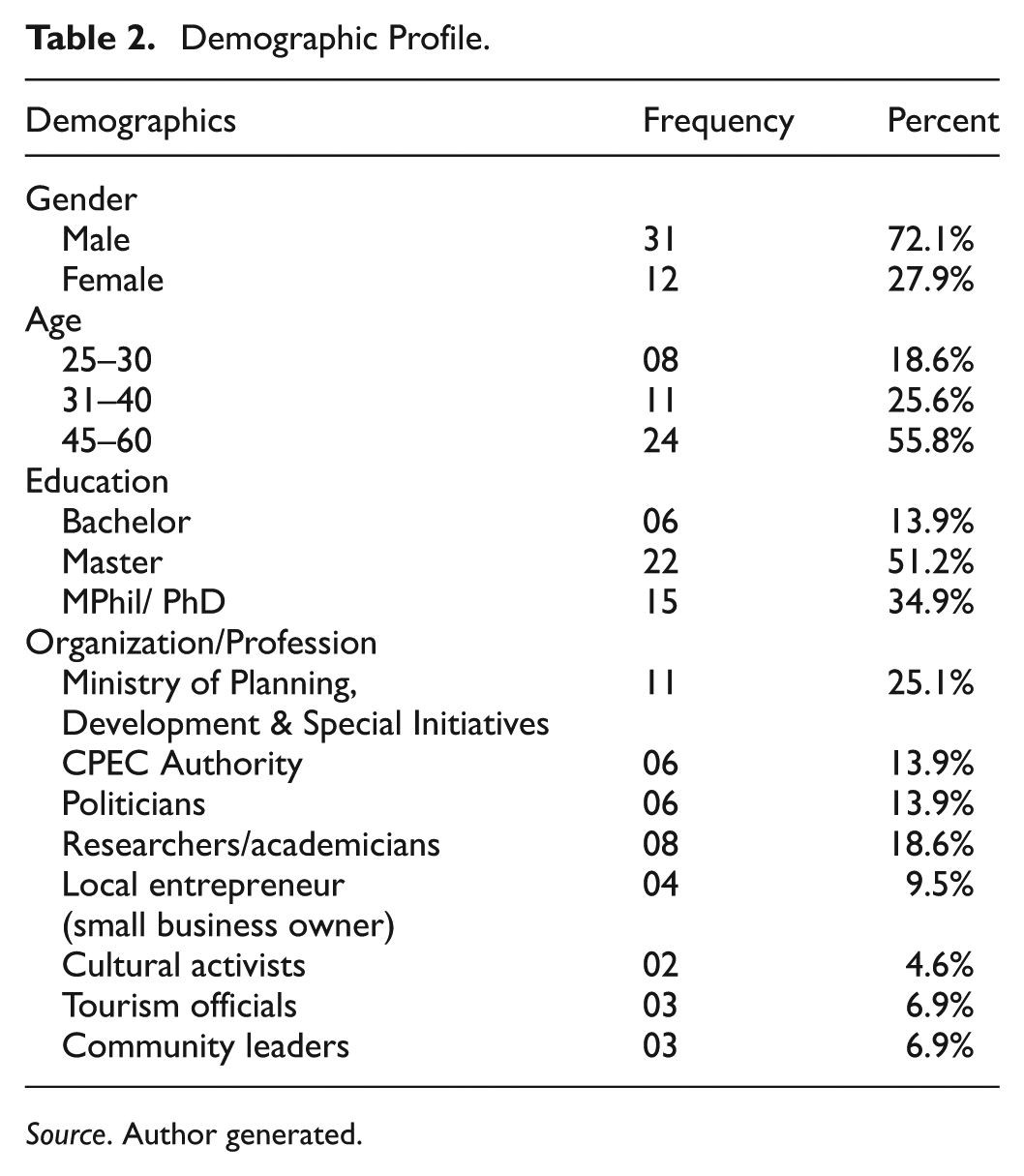
Source. Author generated.
China Foreign Aid Sustainability
China’s foreign aid policy emphasizes sustainable development principles tailored to the resources and conditions of recipient countries. This approach is outlined in Information Office of the State Council, The People’s Republic of China’s (2011) and 2014 White Papers on foreign policy, which underscores diplomatic coexistence, respect for sovereignty and cultural integrity, and autonomous decision-making by recipient states (Blanchard, 2015; Bräutigam & Xiaoyang, 2012; Information Office of the State Council, The People’s Republic of China, 2011). Key pillars of China’s foreign aid include infrastructure development, human resource capacity building, and utilizing domestic resources to meet recipient countries’ needs (Ali, 2018a; Information Office of the State Council, The People’s Republic of China, 2011, 2014). These principles reflect China’s commitment to sustainable and culturally respectful development practices, enhancing its appeal and effectiveness in recipient nations (Lengauer, 2011). Please refer to Table 3 in the Supplemental Appendix for a detailed breakdown.
Major Themes, Categories, and Subcategories.

Source. Author generated.
Major Themes
Based on the stakeholders’ perceptual notions, five broad themes/ categories were identified as per the interviews’ contextual meanings, as shown in Table 3. For instance, stakeholders emphasized the critical need for robust community involvement in CPEC tourism development. This involvement should prioritize policy awareness, employment opportunities, and the growth of local SMEs to foster a deep psychological attachment among community members. These factors are pivotal in ensuring the long-term sustainability of the mega project.
Community Participation in CPEC and Tourism Development
Scholars have emphasized that local community participation is pivotal for sustainable development (A. Khan, Bibi, Lorenzo, et al., 2020). During interviews, stakeholders underscored the critical role of community involvement in ensuring the long-term success of CPEC projects. They highlighted how local participation fosters a sense of ownership and empowerment among community members, which is crucial for their psychological attachment to the project. “When the community feels they are part of the decision-making process, they develop a strong connection and are more likely to support the project,” explained a Ministry official (M1, Male, 45). Local community engagement within tourism development along CPEC allows for maximum participation in the mega projects. This involvement supports small-scale business development, creates employment opportunities, and enhances community members’ sense of ownership and self-esteem. “Tourism development under CPEC has opened new business opportunities for us, from setting up small shops to providing services to tourists,” shared a local entrepreneur (E2, Female, 35). Interviewees pointed out that when communities feel involved in decision-making processes and see direct benefits from tourism initiatives, they are more likely to support and sustain such projects.
Furthermore, community participation aligns with global sustainable development goals and fosters psychological identification, trust, and empowerment (Howard & Wheeler, 2015). Participants stressed that integrating local perspectives and needs into project planning enhances project outcomes and builds social cohesion and cultural richness within communities. “Our cultural heritage is being preserved and promoted through tourism, which gives us pride and strengthens our community bonds,” noted a cultural activist (CA1, Male, 40). Tourism’s socio-economic and cultural exchange potential transforms societies (Khetran & Saeed, 2017). According to our discussions, tourism development that respects and involves local communities goes beyond economic benefits; it enhances cultural identity, promotes local prosperity, and enriches community well-being. To ensure the security and sustainability of CPEC projects, it is essential to integrate economic interests with local communities. Interview insights highlighted the effectiveness of public-private partnerships and the transfer of expertise from China in developing Pakistan’s tourism sector. “Collaborations with Chinese experts have brought new insights and skills that are vital for our tourism industry,” commented a tourism official (T3, Female, 50). They advocated for government interventions to invest in local tourism infrastructure and provide support through initiatives like small tourism loans. “Government support in the form of loans and infrastructure development is critical for us to grow our businesses,” said a local entrepreneur (E3, Male, 30). In conclusion, adopting an inclusive national agenda for tourism development, as evidenced by recent government initiatives, is crucial for sustaining the benefits of CPEC in Pakistan (Daur, 2019). Participants emphasized the importance of such policies in fostering a conducive environment for tourism growth and community engagement. “Inclusive policies that consider our needs and contributions are key to the success of tourism projects under CPEC,” concluded a community leader (L3, Female, 55).
Tourism: A Practical Path to Diplomacy
Historically, the ancient Silk Road facilitated socio-economic exchanges between East and West, serving as a cultural and political bridge. The values of peaceful cooperation, mutual learning, and cultural exchange inherent in the Silk Road spirit are pivotal for fostering understanding and cooperation along the Sino-Pakistan Economic Corridor (CPEC). Interviewees emphasized that reviving this spirit through tourism diplomacy is crucial for building trust and fostering win-win cooperation among regions and communities. “The Silk Road’s legacy of mutual respect and exchange is essential for modern diplomacy,” noted a senior official from the Ministry of Planning Development & Special Initiatives (M8, Male, 54). Tourism diplomacy plays a vital role in enhancing cooperation between nations, exemplified by China’s strategic engagements such as with Brazil (H. Li, 2007). Along the CPEC route, abundant natural and cultural wonders offer immense potential for tourism development. Participants highlighted how tourism can empower local communities by involving them in decision-making processes and economic activities related to tourism. “Tourism development along CPEC provides local communities with the opportunity to participate actively and benefit economically,” explained a CPEC Authority representative and local leader (C6, Female, 47) (L2, Male, 35).
Tourism development along CPEC promises socio-economic opportunities and facilitates poverty alleviation, environmental protection, and cultural heritage preservation. Interview insights underscored that tourism development fosters mutual learning, cultural identity, and community well-being, thereby enhancing the corridor’s socio-economic fabric. “Tourism can play a transformative role in preserving cultural heritage and promoting environmental sustainability,” remarked a politician (P5, Male, 49). The concept of joint celebrations like the “Year of Tourism” can strengthen bilateral relations, as observed in international practices among major powers. According to interviews, such initiatives are seen as essential for promoting political, economic, and cultural agendas between countries. “Joint celebrations and thematic years can significantly boost diplomatic ties and cultural exchanges,” commented a researcher and tourism official (R8, Female, 41) (T2, Male, 31). In conclusion, tourism diplomacy along CPEC emerges as a practical tool for nurturing positive socio-economic impacts and fostering deeper mutual understanding between China and Pakistan. Interviewees stressed the strategic importance of leveraging tourism to enhance diplomatic relations and sustainable development along the economic corridor. “Tourism diplomacy is a powerful means to build lasting relationships and drive sustainable development,” concluded a ministry official (M9, Male, 52).
Propagation and Negotiation
China stands as a global leader in tourism, significantly contributing to the world’s tourism industry and employment (UNWTO, 2017). Interviewees emphasized that China’s robust tourism economy presents an opportunity for Pakistan to enhance its global image and economic prospects through strategic tourism diplomacy. Pakistan can leverage tourism diplomacy to reshape its international perception, especially amidst past challenges like terrorism and political instability. “Negotiating an Approved Destination Status (ADS) with China could boost national income and improve Pakistan’s soft power through initiatives like opening access to Chinese media and enhancing language programs,” explained a researcher (R5, Male, 42). Interview insights highlighted that initiatives such as visa facilitation for Chinese tourists and educational programs in Chinese languages are crucial steps toward fostering closer ties and enhancing tourism exchange.
Advancements in communication technologies are pivotal in modern public diplomacy and foreign policy strategies. Participants pointed out that infrastructure developments like the CPEC’s optical fiber cable project improve communication networks and enhance Pakistan’s ICT capabilities, benefiting tourism, trade, and regional connectivity. “The CPEC’s optical fiber cable project is crucial for enhancing Pakistan’s ICT capabilities, which benefits tourism, trade, and regional connectivity,” noted a CPEC Authority representative (C3, Male, 50). Public-private partnerships are essential for Pakistan to develop sustainable tourism projects and attract international investors. Interview feedback emphasized the importance of promoting these initiatives globally to attract investments and foster sustainable tourism development along the CPEC route. “Promoting public-private partnerships globally can significantly enhance sustainable tourism development along the CPEC route,” stated a ministry official (M4, Female, 43). In conclusion, effective propagation and negotiation strategies, bolstered by communication and public diplomacy advancements, are crucial for Pakistan to capitalize on tourism opportunities within the CPEC framework. Interviewees stressed that aligning these efforts with national development goals and international partnerships can significantly enhance Pakistan’s socio-economic landscape. “Aligning tourism initiatives with national development goals and international partnerships is essential for enhancing Pakistan’s socio-economic landscape,” concluded a senior official from the Ministry of Planning Development & Special Initiatives (M8, Male, 54).
Cross-Border Tourism Cooperation and Coordination Mechanism
Effective implementation of CPEC’s psychological identification strategy worldwide requires robust cross-border tourism cooperation. Interviewees emphasized the significance of establishing institutional frameworks and multi-stakeholder involvement in decision-making processes for successful cross-border tourism initiatives. “CPEC, with its rich natural and cultural resources, presents an ideal platform for China and Pakistan to forge deeper regional ties through tourism,” noted a researcher (R7, female, 44). Interview insights highlighted the potential for creating tourism city alliances and cross-border tourism cooperation zones, accelerating tourism infrastructure development and enhancing service standards. In tourism diplomacy, both governmental guidance and private-sector initiatives are pivotal. Governments must establish dedicated tourism coordination bodies to streamline cooperation between central and local authorities. “Effective management and coordination are crucial for aligning national strategies with regional tourism development along the CPEC route,” emphasized a CPEC Authority representative (C2, Male, 49). To leverage the historical and cultural significance of the Silk Road, both countries can collaborate on comprehensive tourism development plans under the “One Belt One Road” initiative. “Designing cultural tourism routes and products that showcase the diverse cultural heritage and ecological richness along the Silk Road is essential,” remarked a ministry official (M5, Male, 51). In conclusion, fostering cross-border tourism cooperation between China and Pakistan promotes economic development and enhances cultural exchange and mutual understanding. Interviewees highlighted that such initiatives can strengthen the psychological identity of CPEC among local communities and global stakeholders, contributing to sustainable regional development. “Cross-border tourism cooperation is key to promoting sustainable regional development and enhancing the psychological identity of CPEC,” concluded a senior politician (P4, Male, 48).
Brain Regain and Skilled Professional Attraction
Interviews underscored Pakistan’s potential to reverse the brain drain by leveraging CPEC to attract skilled expatriates back home. Interviewees highlighted the critical role of integrated economic zones and IT parks along CPEC in creating opportunities that could entice internationally experienced professionals to return. “Tourism, as a multifaceted industry, offers significant employment opportunities, a phenomenon seen in sectors like medical tourism in India, where skilled professionals have returned home,” noted a senior economist (academician) (SE1, Male, 50). Participants emphasized the importance of developing targeted tourism policies and easy visa schemes to attract professionals interested in business genealogy or heritage tourism. CPEC’s development demands local expertise across various sectors, including medicine, engineering, and hospitality. Interview feedback suggested that a conducive tourism policy could foster peace and prosperity while appealing to a younger generation eager to explore job opportunities. “A conducive tourism policy can attract young professionals and foster peace and prosperity,” remarked a policy analyst (P3, female, 45). To emulate successful initiatives like India’s Pool Officers Scheme and Transfer of Knowledge through Expatriate Nationals, Pakistan could introduce tailored programs under CPEC to attract and retain skilled professionals. “Introducing tailored programs under CPEC can help attract and retain skilled professionals,” emphasized a human resources expert (academician) (H2, Male, 48). In conclusion, by aligning tourism development with strategies to attract skilled professionals, Pakistan can capitalize on CPEC to enhance its workforce and foster economic growth and sustainability. “Aligning tourism development with skilled professional attraction can significantly enhance Pakistan’s workforce and economic growth,” concluded a development strategist (D1, Female, 52).
Model Development
Using the grounded theory approach, this study integrated the identified themes into a substantive theoretical model that demonstrates how tourism diplomacy fosters economic, social, and cultural stability while enhancing psychological identification between host and guest countries. The model comprises three components: input, throughput, and output, as shown in Figure 2. This section advances theoretical insights and emphasizes practical applications, especially in economic and policy domains critical to the sustainability of mega projects like the CPEC.

Tourism diplomacy as a way to sustainability approach.
Tourism Diplomacy Input
Tourism diplomacy is an innovative strategy that blends formal negotiations with informal cultural and economic engagements to strengthen bilateral ties and foster mutual benefits. Formal engagements, such as government negotiations and consular agreements, provide the structural foundation, while informal channels, including cultural festivals, cross-border tourism, and business collaborations, create direct people-to-people connections. This dual-pronged approach enhances public diplomacy and empowers individuals in host and guest countries to serve as informal ambassadors, bridging cultural and social divides.
From a policy perspective, the integration of tourism diplomacy into mega-project strategies presents a novel framework for fostering economic and social stability. For instance, China’s Approved Destination Status (ADS) scheme has been instrumental in driving cross-border tourism. ADS has significantly boosted revenue streams in many countries, created employment opportunities, and stimulated local businesses (Zibanai, 2016). These outcomes exemplify how strategically crafted tourism policies can serve as tools for economic diplomacy. Policymakers in regions hosting mega projects could replicate such models to harness tourism’s potential as an economic stabilizer and a vehicle for trade balancing.
The cultural dimension of tourism diplomacy also offers transformative potential. Initiatives such as the Silk Road heritage conservation project and educational exchange programs highlight how cultural preservation and knowledge sharing can foster soft-power advantages. These programs build positive perceptions and strengthen psychological ties between nations. Policymakers should consider embedding such cultural exchanges into mega projects to foster local acceptance and support, particularly in regions where community sentiment significantly influences project sustainability.
A key novelty of tourism diplomacy lies in its ability to address environmental and cultural concerns through cooperative frameworks. Under CPEC, China’s green initiatives, including biodiversity restoration and joint conferences, exemplify how environmental diplomacy can advance mutual understanding and shared responsibility. By adopting similar approaches, policymakers can align economic development with sustainable practices, ensuring long-term benefits and community goodwill. This policy-oriented integration of tourism diplomacy represents a groundbreaking pathway to enhance the legitimacy, acceptance, and sustainability of mega projects, positioning tourism as an economic asset and a cornerstone of strategic international collaboration.
Tourism Diplomacy Throughput
Tourism diplomacy operates through distinctive strategies that yield tangible economic impacts and intangible socio-cultural transformations, known as semi-throughputs and final throughputs. Economically, tourism fosters trade balancing, recovery, and growth. For instance, after the Tsunami, the Chinese government promoted tourism to affected regions, stimulating local economies and improving living standards (Xu et al., 2020). Similarly, South Africa leverages Chinese tourism to balance trade, illustrating how tourism diplomacy supports broader economic goals (Leso, 2017). It creates employment, boosts small-scale enterprises, and empowers marginalized groups, thereby increasing tax revenue and catalyzing economic growth. These outcomes highlight the dual economic and social benefits of integrating tourism into foreign policy, particularly for regions engaging in mega projects. Policymakers should prioritize local community participation to stabilize these economic benefits, build trust, and enhance public support.
Culturally, tourism diplomacy promotes cohesion and peacebuilding through people-to-people contact. Exchanges, such as educational scholarships and cultural festivals, foster mutual respect and understanding of religious sensitivities and political ideologies, transforming social interactions into bridges of trust and harmony. This cultural dimension also includes innovative approaches like gastro diplomacy, where food becomes a public diplomacy tool, as seen in the global presence of Chinese cuisine. Additionally, artists, musicians, and academicians act as informal cultural ambassadors, mediating cultural gaps. Policymakers can further leverage these strategies to enhance soft power, influence foreign public opinion, and establish enduring cultural connections. A notable innovation of tourism diplomacy lies in its alignment with modern diplomacy through non-governmental and private-sector collaborations. International tourism cooperation involving NGOs and businesses complements traditional state diplomacy, creating synergies that expand the scope of bilateral relations. Effective tourism diplomacy requires robust infrastructure, such as reliable transportation, digital connectivity, and secure environments, underpinned by favorable business and political conditions. Policymakers can enhance these elements to maximize tourism diplomacy’s reach and efficacy.
Tourism diplomacy also contributes to environmental stewardship and collective identity. For instance, initiatives like joint Silk Road heritage conservation between China and Pakistan foster a shared cultural legacy while promoting global tourism. Such projects build a collective identity, portraying nations as environmentally and culturally conscientious. Responsible tourism behavior by Chinese travelers, aligned with state-driven environmental diplomacy, strengthens China’s perception of a peace-loving, and environmentally responsible nation. By integrating tourism into foreign policy, governments can achieve multifaceted outcomes, from economic recovery and trade balancing to cultural harmony and environmental conservation. This novel approach positions tourism as a strategic tool for advancing diplomacy, building national identity, and fostering sustainable international cooperation.
Tourism Diplomacy Output
Tourism diplomacy showcases a country’s economic, social, cultural, and developmental agenda to the global public. Leisure travelers, athletes, and spectators at events like the FIFA World Cup, ICC Cricket World Cup, and the Olympics act as informal diplomats, representing their nation’s culture and policies. Tourists’ interactions with hosts bring economic, social, and cultural benefits, influencing a nation’s image positively or negatively. Focusing on elements that build positive psychological identification, tourism demonstrates its economic impacts by creating jobs, developing businesses, improving living standards, and increasing government revenues. These benefits foster a positive psychological identification among locals toward tourism-originating countries.
Tourist-resident interactions also promote cultural exchange, understanding norms, values, and cuisines, enhancing mutual knowledge. Tourism can replace negative memories, as seen with Pakistan transitioning from a terrorism-affected region to a welcoming tourist destination. It fosters unity by exploring historical connections and developing common identities among communities and nations. Students, musicians, artists, professionals, and academicians contribute to this by translating positive images and building soft power. Positive word-of-mouth from residents and tourists further spreads favorable perceptions. Tourism diplomacy promises economic growth, human interaction, cultural understanding, and peaceful cooperation. Its informal, people-centric nature helps develop a positive attitude toward initiatives like CPEC, reinforcing the project’s acceptance and legitimacy.
Critical and Comparative Insights
While this study highlights the constructive role of tourism diplomacy in enhancing CPEC’s sustainability through psychological identification and inclusive engagement, it is essential to acknowledge the potential risks and unintended consequences that may accompany its application. Tourism diplomacy, especially when embedded within large-scale state-led infrastructure projects, can inadvertently contribute to dependency dynamics, wherein local economies become overly reliant on tourism revenues without parallel investments in institutional or human capital (Becken & Hay, 2012; Hall, 2011). Moreover, the state’s dominant role in shaping tourism narratives can obscure asymmetries in benefit distribution, particularly if local participation remains symbolic or externally guided (Gong, 2019; Y. Zhang et al., 2020).
Another concern relates to the instrumentalization of tourism under diplomatic agendas, potentially leading to greenwashing, where sustainability claims are overstated to legitimize environmentally disruptive development (Gössling & Peeters, 2015; Ruhanen et al., 2015). This risk becomes more pronounced in the context of BRI-related tourism projects, where ecological degradation and socio-spatial inequalities have been reported in parallel with infrastructural expansion (Y. Li et al., 2025; Safdar, 2024; Sattar et al., 2022). Thus, tourism diplomacy should not be viewed as a panacea but rather as a mechanism that must be accompanied by transparent governance, environmental accountability, and participatory safeguards.
Comparative insights from other BRI cases can enrich our understanding of tourism diplomacy’s complexities. For instance, in Laos and Sri Lanka, Chinese tourism investments led to infrastructural modernization but also triggered local resistance due to cultural alienation, land disputes, and perceived erosion of sovereignty (Kuik & Rosli, 2023; Stiftung, 2017). These cases underscore the importance of context-sensitive implementation and reciprocal engagement strategies, reinforcing this study’s emphasis on psychological identification and community empowerment as prerequisites for project legitimacy.
From a theoretical standpoint, this study contributes to tourism diplomacy literature by embedding it within a social-psychological governance logic. Unlike mainstream approaches that emphasize tourism’s soft power or economic function (Arlt, 2013; Tse, 2013), this research offers a more grounded and community-anchored interpretation, where psychological ownership, identity, and relational trust mediate the long-term sustainability of infrastructure diplomacy. The input–throughput–output model operationalizes these relationships, offering both analytical clarity and policy relevance.
Conclusion
This study investigated the transformative role of tourism diplomacy in enhancing the sustainability of the China–Pakistan Economic Corridor (CPEC), emphasizing psychological identification, economic inclusion, and community legitimacy. By applying grounded theory to a rich set of interviews and policy documents, an input–throughput–output model was developed that articulates the symbolic, economic, and participatory mechanisms through which tourism diplomacy contributes to project resilience and developmental trust.
Theoretically, this research advances the tourism diplomacy literature by moving beyond macro-level notions of soft power and economic projection. It reframes tourism diplomacy within a social-psychological governance lens that foregrounds stakeholder-level identification, emotional connection, and perceived legitimacy. The study responds to growing scholarly demand for context-sensitive and actor-focused approaches to development diplomacy, particularly under large-scale initiatives such as the Belt and Road (Browning & Joenniemi, 2017; Kurowska, 2019). The proposed model contributes to grounded theory scholarship by showing the layered nature of legitimacy-building, integrating affective, institutional, and material dimensions into an analytically coherent framework.
From a practical standpoint, tourism diplomacy emerges as a promising strategy for aligning local interests with national infrastructure goals, provided that it is embedded within participatory structures that uphold transparency, cultural integrity, and environmental accountability. Programs that treat tourism as a tool for external image-building without addressing community-level concerns risk fostering dependency, legitimizing inequitable development, or engaging in greenwashing (Gössling & Peeters, 2015; Xu et al., 2020). A more deliberate and community-attuned deployment of tourism diplomacy is therefore essential for achieving durable policy outcomes and equitable project benefits.
Limitations and Future Research Directions
While this study provides valuable insights into the role of tourism diplomacy in enhancing the sustainability of mega projects, it is not without limitations. The primary limitation lies in its reliance on qualitative data, which, although rich in depth and context, may lack the generalizability of quantitative studies. Additionally, the study’s focus on CPEC may limit the applicability of its findings to other contexts, as the specific geopolitical and socio-economic dynamics of China and Pakistan are unique. The grounded theory approach, while robust for developing theoretical models, may also be subject to researcher bias in data interpretation and theme development. Future research should aim to incorporate quantitative methods and comparative analyses across different geopolitical settings to validate and extend the findings of this study.
Future research should aim to quantitatively validate the theoretical model proposed in this study by employing larger, more diverse datasets across different geopolitical contexts. Comparative analyses between various mega projects in different countries could offer a broader understanding of tourism diplomacy’s impact on sustainability. Additionally, exploring the longitudinal effects of tourism diplomacy on community attitudes and economic development would provide deeper insights into its long-term efficacy. Investigating the role of digital diplomacy and social media in shaping tourism diplomacy could also be a valuable avenue, given the increasing importance of online interactions in global diplomacy. Finally, interdisciplinary research integrating perspectives from economics, sociology, and political science could enrich the understanding of the complex interplay between tourism, diplomacy, and sustainability.
Future inquiries can expand the scope of this framework to additional BRI contexts by applying comparative and longitudinal designs that assess the durability of psychological identification and legitimacy outcomes. Mixed-method approaches may also be employed to validate the model’s dimensions and to evaluate tourism diplomacy’s contributions across varying geopolitical and socio-cultural terrains.
Supplemental Material
sj-docx-1-sgo-10.1177_21582440251378541 – Supplemental material for Enhancing Sustainability Through Tourism Diplomacy: A Case Study of CPEC
Supplemental material, sj-docx-1-sgo-10.1177_21582440251378541 for Enhancing Sustainability Through Tourism Diplomacy: A Case Study of CPEC by Asif Khan, Sughra Bibi, Saddam Hussain and Hanliang Li in SAGE Open
Footnotes

Ethical Considerations
Ethical approval was not required for this study because the research did not involve any experiments or interactions with vulnerable populations. The study used a qualitative research design that relied primarily on the analysis of publicly available documents, policy reports, and expert interviews with consenting adult participants who are not part of any protected group. The interviews were conducted in accordance with institutional research guidelines and did not pose any psychological, physical, or social risk to participants.
Consent to Participate
Consent was not required in the formal ethical review sense because all interview participants were fully informed of the research purpose, voluntarily agreed to participate, and had the right to withdraw at any time. Participation was entirely voluntary, and no sensitive personal information was collected. Therefore, this research falls under standard exemptions commonly recognized in ethical guidelines for social sciences.
Funding
The authors received no financial support for the research, authorship, and/or publication of this article.
Declaration of Conflicting Interests
The authors declared no potential conflicts of interest with respect to the research, authorship, and/or publication of this article.
Data Availability Statement
Data sharing not applicable to this article as no datasets were generated or analyzed during the current study.
Supplemental Material
Supplemental material for this article is available online.
References
Supplementary Material
Please find the following supplemental material available below.
For Open Access articles published under a Creative Commons License, all supplemental material carries the same license as the article it is associated with.
For non-Open Access articles published, all supplemental material carries a non-exclusive license, and permission requests for re-use of supplemental material or any part of supplemental material shall be sent directly to the copyright owner as specified in the copyright notice associated with the article.
