




Abstract
The present study aims to investigate the effects of music-related beliefs on musical leisure activities of elementary school students. To this end, the relationship between music-related beliefs and musical leisure activities was examined while controlling for sex, socio-economic status, and migration background. Data analyses are based on a survey-based study conducted with n = 685 fourth-graders in Germany. Sex and socioeconomic status, but not migration background, explained a small amount of variance in musical leisure activities. After including the music-related beliefs as predictors, they completely mediated the effects of domain-general variables on musical leisure activities and explained 77% of variance in musical leisure activities, with all predictors except the intrinsic value showing unique effects. This work further contributes to the development of reliable and valid scales for the assessment of music-related beliefs. When considering avenues for further research, we emphasize that it is important to incorporate a broad range of music-related beliefs as determinants of leisure musicking in children.
Keywords
Musical leisure activities are pivotal for complementing formal music education (Mantie, 2015). Not only do they serve instrumental purposes such as developing musical-artistic skills (Cogo-Moreira & Lamont, 2018). Rather, leisure musicking is a form of cultural participation and is both an engagement with and an appropriation of the world (Baumert, 2002). While many adults consider musicking to be a valuable activity for children, this opinion is not shared by all children, who may refrain from musicking even if they have access to musical instruments or lessons. As for many behaviors, engagement in musicking may largely be explained by favorable domain-specific beliefs (Ajzen, 1991; Yoo, 2020). Unfortunately, many previous studies focused on domain-general, demographic determinants such as sex, migration background, and socioeconomic status thus providing only little information about starting points for getting children involved in musical activities (Grgic & Züchner, 2013; McPherson et al., 2015). As a remedy, the present study explores the role of domain-specific beliefs above and beyond domain-general variables (Ajzen, 1991). We assume that music-related beliefs mediate the effects of demographic variables on musical leisure activities. The scales we developed can be useful in future works, for example, to examine what moderates the effects of interventions that intend to encourage children to make music of their own volition.
Musical Leisure Activities in the Context of Cultural Participation: A Theoretical Framework
If elementary school children make music in their leisure time, this is mostly in extracurricular settings. These cover a wide range of musical activities, with singing and playing an instrument being the most popular (Ruth & Müllensiefen, 2021). The determinants of these activities can be divided into domain-specific and domain-general variables (Kröner, 2013). The domain-general variables include demographics such as sex, age or socioeconomic status (Birnbaum, Schüller, & Kröner, 2020). The domain-specific variables are specific to music and correspond to the three explanatory constructs: attitude toward the behavior, subjective norm, and perceived behavioral control in the theory of planned behavior (TPB, Ajzen, 2002). This socio-psychological theory has already been applied to music participation (see the literature review by Yoo, 2020). It assumes that the three explanatory constructs act as proximal determinants of behavior and are based on beliefs that are representative of both the person’s self and their environment (Ajzen et al., 1995). Those beliefs “reflect the information people have” about a behavior (Ajzen, 2011, p. 1116).
Musical activities take place depending on the elementary students (person side) and their environment (Kröner, 2013; for a comprehensive overview of the framework used see Figure 2 in Penthin, 2021, p. 23). This view provides a broader perspective on determinants of musical activities and allows us to further specify them. Regarding the person side of domain-specific variables, two kinds of beliefs are decisive: behavioral beliefs and competency beliefs. Behavioral beliefs may be further subdivided into intrinsic value and beliefs concerning incongruent consequences. Intrinsic value encompasses the enjoyment, imagination, and autonomy of engaging in musical leisure activities (Rhodes et al., 2006; Wigfield & Eccles, 2000; Woody, 2021). Beliefs concerning incongruent consequences include the alternatives the person forgoes in favor of the activity (Eccles & Wigfield, 2002; Krause et al., 2021). Competency beliefs are important psychological variables on the subject. They may be described as the cognitive self-perception of one’s means, processes, and musical capabilities and are fundamental for the musical self-concept. These collective self-perceptions result from engagement-related experiences and are influenced by interactions with significant others (Schunk & Zimmerman, 2006, p. 352). In turn, they may determine future engagement.
On the environmental side of the domain-specific variables, we distinguish two kinds of normative beliefs that belong to the so-called injunctive and descriptive aspects of the subjective norm. The beliefs related to the injunctive aspect reflect the perceived attitudes or role expectations of significant others, for example, parents, friends, or teachers, in respect to musical behavior (Luo & Liu, 2024; Yoo, 2021). The beliefs related to the descriptive aspect reflect perceptions of the significant others’ musical activities (Manning, 2009). The second major group of environmental beliefs is called perceived behavioral control. It refers to the “perceived ease or difficulty of performing” musical activities (Ajzen, 2002, p. 665). Those beliefs reflect the children’s perception of whether there are resources and opportunities to make music in their leisure time.
When combined, the person- and environment-related beliefs discussed above should explain musical activities. While domain-general variables such as sex on the person side and parental education or migration background on the environmental side may also predict musical behavior, their effects should be mediated by domain-specific beliefs (Ajzen, 2011; Kröner, 2013).
State of Research Regarding Music-Specific Beliefs
With the theoretical framework in mind, we now collect empirical evidence on the relationship between single variables of our framework with musical activities. We first focus on studies that examine variables concerning the person. We then report on studies that focus on variables related to the environment.
Representation of the Person
Based on evidence from mostly descriptive studies, the enjoyment of, and interest in, making music may be considered pivotal to engagement in musical activities (Cantero & Jauset-Berrocal, 2017; Grgic & Züchner, 2013; Kiss & Linnell, 2023). Enjoyment and the perception of the intrinsic value of making music are crucial for sustaining the activity (Hallam, 2013; Hallam et al., 2020). Low perceived cost in related to lost alternatives, that is, beliefs concerning incongruent consequences, explained participation in choral singing in sixth-grade students (Clements, 2002). However, the perceived cost has been under-examined in the past (Sin et al., 2021). There is also a relationship between the individual importance of playing an instrument and the musical self-concept (Scalas et al., 2017). From previous studies, it can be assumed that competency beliefs play a prominent role in explaining the musical activities of elementary school students (Kröner et al., 2009; Hallam et al., 2021). This is to be expected since few people continue to sing or to play an instrument if they show little perceived competence (Morin et al., 2016).
Subjective Reflection of the Environment
Concerning environmental variables, parental involvement and musical activity increase the number of musical leisure activities of their children (Creech, 2010; Yoo, 2020). In particular, encouragement and support from mothers are key to keeping children engaged in music-making in everyday life (McPherson & Davidson, 2002). Moreover, the importance assigned to making music at home is an essential predictor of engagement in musical (leisure) activities after elementary school years (Krupp-Schleußner & Lehmann-Wermser, 2016). Parental support also plays a special role when it comes to control beliefs: parents can encourage musicking in several ways, such as paying for music lessons, buying a suitable musical instrument, or providing physical space in which to play and create music (Creech & Hallam, 2003; Luo & Liu, 2024). Thus, control beliefs should also be regarded as important determinants of musical activities, particularly for elementary school children (see Yoo, 2020 for a review of studies on future music participation in the context of the TPB).
State of Research Into Differences Between Sex, Socioeconomic Status, and Migration Background in Musical Leisure Activities
Besides music-specific beliefs, domain-general variables also play a role in children’s engagement in musical leisure activities. In the following, we focus on the domain-general variables of sex, socioeconomic status, and migration background.
Sex
Sex differences are well-known both from surveys of children’s leisure activities and from music education research. Girls are more likely to attend music classes and spend more time on (leisure) musicking (Hallam et al., 2020; Jänsch & Schneekloth, 2013; McPherson et al., 2015; Welch et al., 2012). However, sex does not explain the decision to take instrumental lessons while controlling for other variables such as music-related beliefs of children, importance of music in the parental home, and domain-general variables such as socioeconomic status and migration background (Krupp-Schleußner & Lehmann-Wermser, 2016).
Socioeconomic Status (SES)
According to Bourdieu’s (1984) habitus theory, parents with higher SES on average provide better formal and non-formal education to their children than parents with a lower one. Along the same lines, children from high SES families are overrepresented in musical activities in general (Albert, 2006; McPherson, 2009; McPherson et al., 2015; Sichivitsa, 2007). They are also more likely to participate in out-of-school music classes and to play (classical) musical instruments (Smolarczyk et al., 2022; Grgic & Züchner, 2013; Guo et al., 2021). In light of this importance ascribed to SES, it is interesting to investigate whether domain-specific beliefs may nevertheless mediate the effects of parental SES on elementary children’s musicking.
Migration Background
As in many Western societies, over a third of elementary school children in Germany have a migration background (Bundesamt des Innern, für Bau und Heimat, 2020). Thus, it is worth investigating if they are musically active to a similar degree as children without a migration background. While it appears that children with a migration background are less likely to play a musical instrument in their leisure time, they show no difference to other children in participation in extracurricular formal music lessons or regarding overall musical involvement (Darmody & Smyth, 2017; Krupp-Schleußner & Lehmann-Wermser, 2016).
Research Aim and Hypotheses
By the end of elementary school, most children have started on the musical instrument which they will still play as 13-year-olds (Grgic & Züchner, 2013). Elementary school is therefore a perfect timeslot to get children engaged in musicking as a creative leisure activity. As mentioned above, domain-general variables such as sex, SES, or migration background are often discussed as determinants, however, they do not provide suitable points of departure for promoting musical leisure activity in children, as they are determinants beyond the reach of music education interventions. At the same time, domain-specific beliefs should explain a large proportion of variance in children’s leisure activities (e.g., Ajzen & Driver, 1992; Birnbaum, Flasche et al., 2020). In contrast to domain-general variables, they are more accessible to interventions. Therefore, the present study aims to investigate the explanatory value of beliefs for musical leisure activities among elementary school children and their mediating role regarding demographic variables. Previous studies explicitly focused on children at elite schools who participated in highbrow musical culture (Fritzsche et al., 2011). However, it is questionable to what extent findings from these contexts can be generalized to occasional leisure-time musicians. Moreover, irrespective of the setting under scrutiny, reliable and valid questionnaires are needed to assess music-related beliefs and activities for the elementary school age. Hence, we investigated the following research questions:
Do children’s beliefs regarding musicking substantially explain musical leisure activities? Do they mediate the effects of the demographic variables (sex, socioeconomic status, and migration background)? Finally, what are the most relevant explanatory variables for musical leisure activities? The hypotheses tested in our study were as follows (cf. Figure 1 for a graphical illustration):
Hypothesis 1: Domain-general variables explain variance in musical leisure activities.
Hypothesis 2: Effects of domain-general variables on musical leisure activities are completely mediated by the domain-specific behavioral, normative, and control beliefs.
Hypothesis 3: Behavioral, normative, and control beliefs are important predictors for musical leisure activities.
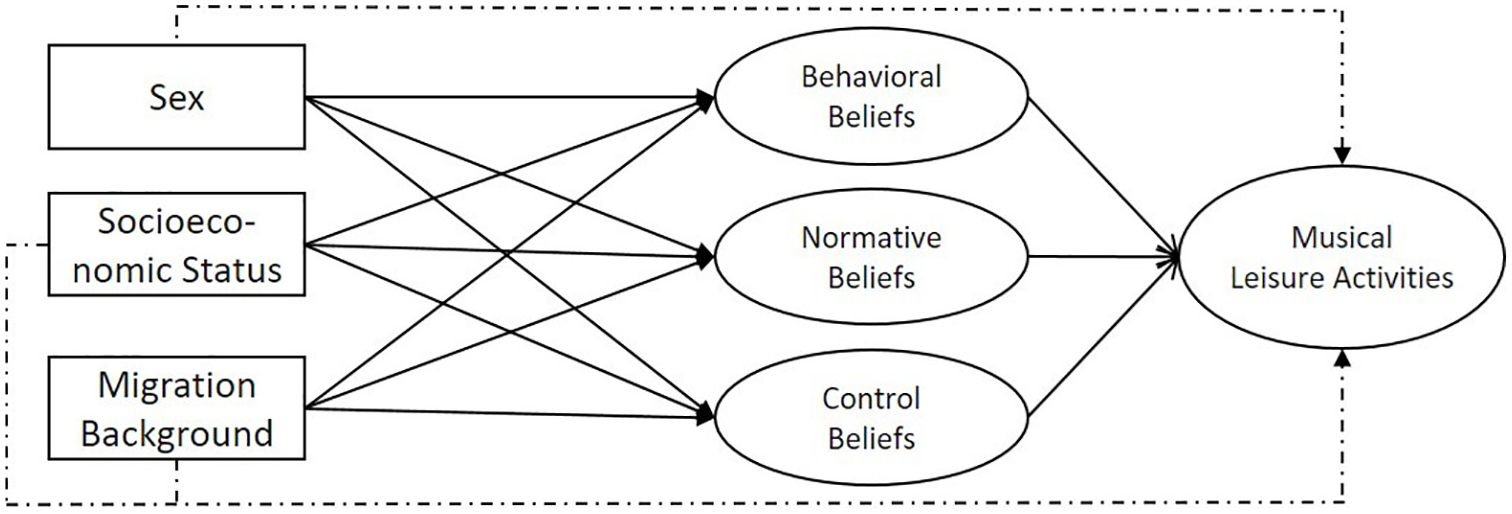
Simplified theoretical framework to explain musical leisure activities by the domain-general variables sex, socioeconomic status (SES), and migration background as well as by the domain-general variables behavioral, normative, and control beliefs.
Method
In the following section, we report all measures in the study, all manipulations, any data exclusions and the sample size determination rule; for further details see the Supplemental Material (https://doi.org/10.17605/OSF.IO/PR8YF).
Participants and Procedure
Almost all elementary schools in the Greater Nuremberg area (urban and rural schools) which is located in the federal state of Bavaria, were initially contacted by email with a brief description of the study and asked whether they would like to take part in the survey. If there was no response to the request, the second step was to contact them via telephone. In the end, data were collected from children in 54 classes of 16 German elementary schools (for details see Penthin et al., 2021). After excluding three questionnaires from children who did not have parental consent to participate and two students with either completely implausible multivariate response patterns or a high number of missings, N = 685 fourth-graders were retained in the dataset (n = 343 females, n = 342 males). According to self-reporting, n = 435 (63.5%) children were musically active outside the school curriculum, in the sense of playing an instrument or singing in a choir or band. During the data validation, some of implausible values were detected (e.g., some respondents stated that they receive instrumental lessons once or twice a month, but then indicated that they do not play any instrument). The answers were checked multivariate and corrected if necessary; in case of doubt, missing answers were assigned.
Trained test administrators explained how to fill in the paper-and-pencil questionnaire during regular music lessons in the school class. The study was conducted with the permission of the local government and approved by the data protection officer of the first author’s university. Written parental consent was obtained for all participants.
Power Analysis
The sample size was constrained by available cases, not determined by a priori calculation. However, we performed sensitivity analyses using the R-shiny-app “powerSEM” (version 0.1.2, Wang & Rhemtulla, 2021) to establish whether our sample size was sufficient for a minimum effect of interest through power analysis via simulations with 5,000 iterations of the final SEM shown in Figure 2. Concerning the minimum effect size of interest, we first set all 20 regression-weights (for sex and HISEI on belief scales as well as for the beliefs scales, sex and HISEI on musical leisure activities) equivalent to a standardized effect of β = .10 (corresponding to Cohen’s d = 0.20, Peterson & Brown, 2005), which equals the lowest boundary of a small effect (Cohen, 1988). Considering a critical α = .05, power was .19 ≤ 1−β ≤ .91 with only the effects of sex and HISEI on musical leisure activities showing a sufficiently high power of at least .80. Setting β = .20 (d = 0.40) representing the upper boundary of a small effect, power (.57 ≤ 1−β ≤ 1.00) was sufficiently high to be able to detect small effects for behavioral beliefs (concerning incongruent consequences) and the descriptive aspect of normative beliefs relating to the mother on musical leisure activities as well as for sex and HISEI on all belief scales. With sufficiently high power, we can detect effects with a minimum effect size of β = .28 (d = 0.56, equivalent to a medium effect in the lower range) for the remaining belief scales on musical leisure activities: in our study. This appliese to behavioral beliefs (intrinsic value), competency beliefs, the injunctive aspect of normative beliefs relating to the mother as well as control beliefs. See Table A4 in the Supplemental Material for details.

Structural equation model on the explanatory value of sex, HISEI, and domain-specific beliefs on musical leisure activities.
Instrument
The questionnaire items were based on the pilot study (Penthin et al., 2017) of the same research project, but with another sample of N = 193 German fourth-graders. The items in the aforementioned pilot study were compiled from questionnaires on musical activities among elementary school children (Kröner et al., 2009) and on other leisure activities of elementary school children (Penthin et al., 2017; Staudenmaier, 2012). In addition, items on determinants of musical activities of adolescents (Fritzsche et al., 2011), musical self-concept (Arens et al., 2011; Schwanzer et al., 2005), and self-developed items were added. According to Hair et al. (2014), for the most of this pilot study there was strong evidence for discriminant as well as convergent validity (i.e., McDonald’s ω ranged from .68 to .91); for details see Penthin et al. (2017). For the present study, we extended the item pool to assess beliefs concerning incongruent consequences and environment-related control beliefs which are part of the theoretical framework but had not been included in the pilot study.
Beliefs
Behavioral beliefs were measured with the two subscales: intrinsic value (e.g., “Musicking is a lot of fun.”) and beliefs concerning incongruent consequences (e.g., “I rather play outside than making music.”). Competency beliefs were operationalized with items such as “I am musically very talented..” Normative beliefs relating to the mother were assessed with the descriptive aspect (e.g., “My mother is a musical person.”) and the injunctive aspect (e.g., “My mother approves of me musicking.”). To measure environment-related control beliefs, we used items such as “At home, I have everything I need to make music..” A four-point rating scale was used for all items (NO—strong rejection, no—rejection, yes—agreement, YES—strong agreement) except for one item of the descriptive aspect of normative beliefs (YES – NO).
Musical Leisure Activities
The extent of musical leisure activities was measured using three items: “How often do you make music in your leisure time?” (5-point rating scale: 1 = I hardly ever make music, 2 = Once to twice a month, 3 = About once a week, 4 = Two to three times a week, 5 = More than three times a week), “How much time per day do you normally spend making music in your leisure time?” (6-point rating scale: 1 = I hardly ever make music, 2 = Up to 15 min a day, 3 = Up to 30 min a day, 4 = Up to 1 hr a day, 5 = Up to 2 hr a day, 6 = More than 2 hr a day), “How often do you get lessons in your instrument or singing in your leisure time (e.g., you go to a music school or a music teacher comes to your home)?” (6-point rating scale: 1 = I do not have classes., 2 = Once to twice a month, 3 = Once a week, 4 = Twice a week, 5 = Three times a week, 6 = More than three times a week).
SES
To measure the SES, we computed the highest International Socio-Economic Index of Occupational Status (ISEI-08; Ganzeboom, 2010) of the parents derived from children’s responses (for details and the adapted coding manual applied, see Supplemental Material (https://doi.org/10.17605/OSF.IO/EYXQA) and Wießnet et al., 2018).
Migration Background
In our sample, 36% of the children had a migration background as defined by the German Federal Office for Migration and Refugees: “A person has a migration background if he/she or at least one parent is not born with German citizenship” (Statistisches Bundesamt, 2023, p. 22).
More information on items, rating scales, and data analyses can be found in the Supplemental Material (https://doi.org/10.17605/OSF.IO/PR8YF). See Table 1 for manifest means, standard deviations, and measures of construct validity of all latent scales.
Bivariate Latent Pearson Correlations (Standard Errors) of Musical Leisure Activities, Beliefs and Covariates, Measures of Discriminant and Convergent Validity and Means of the Manifest Scales.

Note. N = 685. Coefficients taken from the CFA of the final model (cf. hypotheses 2 and 3). HISEI = Highest International Socio-Economic Index; ω = Omega (factor reliability); AVE = Average Variance Extracted; ASV = Average Shared Variance; MSV = Maximum Shared Variance.
Based on z-standardized values due to different response formats of the corresponding items. bn = 4 missing. cn = 19 missing; range: 14–89 (skewness = −0.03; kurtosis = −1.15). p < .05 (null hypothesis testing, NHST) for all correlations except italics; p < .05 (minimum-effect testing, MET, with a predefined smallest effect size of interest of r < |.10|, see Supplemental Material) for all correlations involving column 1 in bold.
Data Analysis
Data, reproducible statistical analyses, outputs, and codebook are freely available at the platform of the open science framework (via https://doi.org/10.17605/OSF.IO/PR8YF). We applied confirmatory factor analysis (CFA) and structural equation modeling (SEM) to test our hypotheses. All analyses were conducted with the software R (R Core Team, 2021, version 4.4.1) using the packages “lavaan” (version 0.6-19, Rosseel, 2012) and “semTools” (version 0.5–7, Jorgensen et al., 2022). Maximum likelihood estimation with robust standard errors (MLR; see Brown, 2015, p. 346) was used due to slight deviations from the standard normal distribution of some variables (skewness range: −1.43 to 1.08, kurtosis range: −1.39 to 1.21). Linearity assumtions for the SEMs held for all variables with minor restrictions on beliefs concerning incongruent consequences and normative beliefs relating to the mother with musical activities (for details see Supplemental Material). In general, with n = 14, missing values were very low for most of the variables. Because we have extended our theoretical basis for the applied model in the course of the survey, the questionnaire page with the items on beliefs concerning incongruent consequences as well as environment-related control beliefs was not integrated into the study until later, thus, values are missing for these scales in n = 296 cases based on survey design. As shown by calculations based on a listwise deletion (n = 275, see Supplemental Material), this structural sampling failure did not affect the stability of the results (cf. Tabachnick & Fidell, 2010, p. 71). Nevertheless, missing values were estimated case-wise with full information maximum likelihood to obtain a greater statistical power (Brown, 2015, pp. 337–340). The school class affiliation was set as a cluster variable for all computations. Thus, potential dependencies due to class membership are accounted for in the data by adjusting the standard errors (for intraclass correlations of the variables used, see Supplemental Material). For all analyses, we used p = .05 as significance level. All reported factor loadings and regression coefficients are completely standardized values.
The quality of the model was assessed by robust variants of CFI/TLI, SRMR, and RMSEA since the χ2-test is sensitive to large samples as well as small deviations from the multivariate normal distribution (Brown, 2015, p. 69). We applied the cut-off values recommended by Hu and Bentler (1999) and Brown (2015, pp. 74–75): CFI/TLI close to .95 or greater and RMSEA close to .06 or below.
Construct Validity
Before examining the hypotheses, a CFA was conducted to verify the factorial structure of the six belief scales and the scale relating to musical leisure activities. In addition, we included all three domain-general variables to compute their correlation with the beliefs and each other. The model showed a good fit, N = 685, χ2 = 729.53, df = 362, p < .001, CFI = .952, TLI = .942, RMSEA = .038, 90% CI [0.039, 0.049]. All belief scales correlated substantially and in the expected direction with each other and with musical leisure activities, thus supporting nomological validity (Hair et al., 2014, p. 620).
There is also strong support for discriminant validity. First of all, there were no substantial crossloadings of the indicators on other factors as shown in the modification indices (see output of model “sem2” in the Supplemental Material). Since there were latent correlations between the predictor constructs whose upper confidence intervals were greater than .80 (intrinsic ∼∼ seko, seko ∼∼ enviro, snim ∼∼ enviro), these correlations were examined for possible problems using the state-of-the-art procedure documented in Rönkkö and Cho (2022). In each case, the baseline model was tested against a model with a restricted correlation of the respective correlation pair to .90. The Chi2 difference test showed that all three models specified in this way were statistically significantly different from the baseline model indicating that there was only a “marginal problem” (Rönkkö & Cho, 2022, p. 30) about these correlation pairs.
A strong case can also be made for convergent validity. According to Brown (2015, p. 115), all items had a sufficiently high factor loading on their corresponding factor (cf. Supplemental Material). Beyond that, McDonald’s ω was used to assess reliability (Revelle & Zinbarg, 2009) and revealed high values for all scales, and an acceptable value for the descriptive aspect of the normative belief scale (Hair et al., 2014, p. 619; see Table 1). Hair et al. (2014) also state that the average shared variance (AVE) should be greater than .50. In our sample, this was the case for most scales, with the injunctive aspect of the normative belief scale just falling short of this value (cf. Table 1).
Results
Table 1 summarizes means and, standard deviations for manifest scales, latent correlations, and measures of construct validity. Means were above the theoretical mean for all beliefs. All beliefs substantially correlated with musical leisure activities (.47 ≤ r ≤ .79). Sex and socioeconomic status also substantially correlated with musical leisure activities, but migration background did not.
We first tested the direct effects of domain-general variables (hypothesis 1). Migration background was not integrated into the model as the bivariate correlation with musical leisure activities was not meaningful (cf. Table 1). Thus, sex and HISEI were modeled as predictors of musical leisure activities (model fit: N = 666, χ2 = 40.39, df = 4, p < .001, CFI = .940, TLI = .849, RMSEA = .128, 90% CI [0.092, 0.168]). Girls as well as children with higher parental SES reported more musical leisure activities (sex: β = −.21, se = .03; HISEI: β = .24, se = .04). These two domain-general variables explained about 9% of the variance in the musical leisure activities.
To test hypotheses 2 and 3, we added the domain-specific variables as predictors of musical leisure activities to the model—allowing for correlations between them in the measurement model—and included paths of the variables sex and HISEI onto all belief scales. This model showed a good fit, N = 685, χ2 = 690.21, df = 342, p < .001, CFI = .953, TLI = .945, RMSEA = .044, 90% CI [0.039, 0.050]. The statistically non-significant paths of sex and HISEI on musical leisure activities indicated that practically all effects of domain-general variables were mediated through domain-specific beliefs. Girls showed higher scores in all beliefs than boys. Also, the higher the SES, the more positive beliefs the children held. As far as the SES is concerned, there was one exception: we found no substantial differences in the extent of the competing activities that the children preferred over making music (beliefs concerning incongruent consequences). All domain-specific variables except intrinsic value substantially explained variance in musical leisure activities via direct effects (R2 = 0.76; see Figure 2). By forming contrasts of all six completely standardized path coefficients of the domain-specific beliefs on musical leisure activities in “lavaan,” we could compare them and identify the most relevant ones (for details see Table A3 in the Supplemental Material). The effect of control beliefs on musical leisure activities was the strongest, followed by competency beliefs however, the two effects did not differ statistically. The negative effect of beliefs about incongruent consequences was the next strongest (except for the statistically non-significant difference with the injunctive aspect of normative beliefs). The effect of intrinsic value was weakest, although the difference between this and the descriptive as well as injunctive aspect of normative beliefs was not statistically significant. The small negative effect of the injunctive aspect of normative beliefs may be due to multicollinearity resulting from the high correlation of this variable with control beliefs (r = .74, cf. Table 1). In alternative models, we examined the effect of fathers or peers but could not detect any (see Penthin, 2021). That is consistent with music pedagogical research on parent-child relationships in the context of learning an instrument. While this may change with current societal trends, the extant literature shows that, from birth, the mother-child dyad is particularly pivotal for musical engagement (McPherson & Davidson, 2002). Note, however, that the explanatory value of a wide range of close significant others (such as mother, father, friends/peers) may easily be assessed in future research with items analogous to those included in our study.
Discussion
The present study aimed to investigate the effects of domain-specific beliefs on musical leisure activities in elementary school children and to explore their mediating role regarding the effects of demographic variables. To this end, we first examined, and then further developed, scales to assess domain-specific beliefs and musical leisure activities. Our results have shown satisfactory evidence of convergent validity (reliability based on McDonald’s ω = .66–.89, adequately high loadings of virtually all items, AVE around .5 or above) as well as discriminant and nomological validity (positive correlations of all belief scales with musical leisure activities between r = .47–r = .79, ASV smaller than AVE in all cases, AVE greater than Maximum Shared Square Variance (MSV) in most cases). These scales are freely available to use in future longitudinal and experimental studies. Our results regarding the relationship of domain-general variables and domain-specific variables with musical leisure activities were in line with previous studies (see, for instance, Krupp-Schleußner & Lehmann-Wermser, 2016; Yoo, 2020). Children with different migration backgrounds did not differ in their musical leisure activities. In contrast, sex and SES displayed meaningful correlations with musical leisure activities in the first place. However, those effects were completely mediated by the music-specific beliefs in our final model (the results of the sensitivity analyses showed that we would have found effects, if they existed, of β = .10 with 90% power). Ultimately, the domain-specific beliefs showed strong explanatory value regarding self-rated musical leisure activities (according to the sensitivity analyses, we would have found effects for all six belief scales, of β = .28 with > 81% power). This is consistent with our theoretical assumption that person- and environment-related beliefs are both important in explaining musical leisure activities in children.
Contradicting the findings of Penthin et al. (2017) and Fritzsche et al. (2015), a substantial direct effect of intrinsic value could not be observed in our study despite the bivariate latent correlation of r = .67 of this variable with musical leisure activities. While it is certainly beneficial if children associate interest or enjoyment with musical activities, this the perception of favorable conditions and the self-evaluation as being musically competent are pivotal for leisure musicking (Fritzsche et al., 2015; Demorest et al., 2016). This expands recent research on musical leisure activities in children, as control beliefs have rarely been investigated in other studies (for some exceptions see reviewed studies in Yoo, 2020, where these studies refer to band classes). The effect of intrinsic value is more likely to be mediated via competency and control beliefs, as indicated by high correlations between those variables. This is consistent with Ajzen’s theory and empirical studies that assume that affect and emotions influence the salient beliefs of behavior (Ajzen, 2011).
We observed a marginal but unexpected negative effect of the injunctive aspect of normative beliefs about the mother on musical leisure activities. However, this may be due to variance inflation caused by high bivariate latent correlations between the injunctive aspect of normative beliefs in terms of the mother, and control beliefs (r = .74). This is corroborated by further analysis: when omitting control beliefs from the model, as displayed in Figure 2, the negative effect of the injunctive aspect of normative beliefs in terms of the mother on musicking decreased almost to zero (β = .04, se = .05). Thus, as far as there are positive effects of maternal support, they are mediated by the control beliefs. Coined differently, if mothers approve of their children’s musical behavior, they also endorse creating opportunity structures and providing resources for making music. Mothers’ actual musical behavior had little explanatory value regarding musical leisure activities. We focused on the mothers as a source of normative beliefs because the mothers are still the key musical socialization agent of most children (McPherson & Davidson, 2002). Thus, while further studies might also consider normative beliefs conveyed by other persons, in different TPB studies they were rarely found to display unique effects on leisure activities (Ajzen, 2011; Ajzen & Driver, 1992).
In summary, the analysis suggests that the music-related beliefs virtually mediated the effects of sex and SES on musical leisure activities (Kröner, 2013, 2017). This illustrated that music-related beliefs are more important than demographic variables in explaining amateur music-making (Krause et al., 2021; Krupp-Schleußner & Lehmann-Wermser, 2016). Note that the music-related beliefs not only mediated effects between domain-general variables and musical leisure activities, but also explained virtually the complete variance in the criterion. Thus, in future research, beliefs should be considered as important determinants of leisure musicking. How these beliefs may be addressed by music education interventions should be investigated in future experimental studies (Birnbaum, Flasche et al., 2020, Zapata & Hargreaves, 2018).
Limitations and Avenues for Further Research
In this study, we analyzed data from fourth-graders, an age at which many children start playing an instrument. Therefore, we considered this age group particularly relevant for a comprehensive study of beliefs about recreational music making. However, it is during secondary school that many adolescents quit playing an instrument or singing in a choir (Simpkins et al., 2010). Thus, further research is needed on the predictive value of beliefs in elementary school age and how the favorable pattern of perception may be maintained throughout secondary school. We would expect that some beliefs, such as those related to peers, will become more important (Fritzsche et al., 2011; Yoo, 2020). Hence, it remains an avenue for further research to examine the generalizability of our results about age groups and school types. There should also be other potentially moderating variables beyond age, affecting the relevance of beliefs. These may include the kind of musical activities (e.g., band classes, leisure musicking) and the level of experience of the young musicians (Spychiger, 2017).
The present study focused on beliefs as domain-specific explanatory variables, which, according to Ajzen’s TPB, determine children’s engagement in musical activities (Ajzen, 2011, 2012). Our data showed that they indeed explain a high amount of variance in musical activities. However, one might argue that our results should not be overinterpreted regarding the relative importance of these beliefs, as our operationalization of intrinsic value and competency beliefs might not have included all nuances of these constructs.
Concerning competency beliefs, we used a narrow, cognitive definition of self-concept, consistent with the literature on academic self-concept, in which a focus is on perceived competence (Bong & Clark, 1999; Morin et al., 2016). In contrast to this, recent studies such as that of Spychiger (2017) have followed a different characterization of musical self-concept by also including a social, emotional, and physical component. While the emotional component (“Music relieves me from daily routine,”Spychiger, 2017), was already present in our study as an aspect of behavioral beliefs (“When I make music, I sometimes forget everything around me”), it might be worthwhile to add a social component as an aspect of behavioral beliefs (“I go to music happenings in order to meet people,”Spychiger, 2017). Regarding the physical aspect, note that we have deliberately excluded self-evaluations related to movement and dance (“Dancing satisfies my need for physical movement,”Spychiger, 2017), as we focused on singing and playing musical instruments as criteria. However, investigating self-expression through dance, for example, while performing to music, would be an interesting extension for further studies. In the meantime, Eisinger et al. (2023) validated the person-environment framework used here (Kröner, 2013) based on longitudinal data and expanded it to include musical self-theories. However, they did not include any other domain-specific variables in their study. Investigating the model used here (see Figure 1) while controlling for such subjective theories (i.e., a person’s belief as to whether music-making is learnable or innate) would be interesting: subjective theories could moderate the importance of the musical self-concept in learning and practicing music. It also has to be discussed that the intrinsic value of musicking could theoretically be captured more broadly than in the present study. Students with a higher level of experience in particular enjoy making music and enjoy the social aspects that come with making music (Hallam et al., 2020). However, a similar picture of beliefs emerges from qualitative interviews as part of other studies on the leisure activities of third and fourth graders. In the quantitative operationalization of these beliefs, the best-fitting items were those related to fun, autonomy, and the experience of competence (Penthin et al., 2017, 2020b). This may be because these studies were based on broad, unselected samples of students, a large proportion of whom had at least sporadic musical experience beyond music lessons at school. If the same studies were to be conducted with children who have been playing an instrument intensively since early childhood, a different pattern of results might emerge, since they have already had a wealth of esthetic experiences making music.
On the level of domain-general explanatory variables, the present study focused on demographic aspects. Beyond this, the person-environment transaction framework suggests that scrutinizing the effects of further variables may be helpful, particularly those of the Big Five personality traits. In addition, cultural and ethnic background may be measured more comprehensively as culture is tied with one’s musicking in a suitable dataset. However, migration background can serve as a proxy for cultural background. The explanatory value of such additional variables for musical leisure behavior could be examined in future studies with longitudinal or experimental designs.
Finally, the quantitative scales we developed for this study, and the application of statistical tools, proved to be valid and reliable for measuring children’s musical leisure activities and related beliefs. It needs to be considered in further studies whether they can be adapted for other cultural contexts and languages. At least in German-speaking countries, they may be used in future longitudinal studies and experiments as well as in Design-based research strategies for the development of music education interventions. With such designs, it could be scrutinized whether beliefs explain musical leisure activities or vice versa, or whether there are reciprocal influences not only between activities and beliefs but also between a person’s self- and environmental beliefs. For instance, Simpkins et al. (2010) have shown that changes in the behavioral beliefs of adolescents were predicted by musical leisure activities at elementary school age. Also, an intervention using musical activities in elementary school showed small positive effects on the participant’s self-esteem (Zapata & Hargreaves, 2018). Moreover, the present study provides a basis for future experimental studies, indicating which beliefs are obvious starting points for interventions to increase leisure musicking in children. The strongest effects were found for competence and control beliefs. While the former is already the focus of music education research (Cantero & Jauset-Berrocal, 2017; Hallam et al., 2021), the latter should receive more attention in future research. It makes sense that children make more music in their leisure time if they have the necessary equipment, time, and place. This could be scrutinized in future experimental designs to confirm our correlational findings with more robust evidence.
Conclusion
There are two main findings of this study: Firstly, music-related beliefs provide substantial explanatory value for the musical activities of elementary students. Secondly, these beliefs mediate the effects of domain-general demographic variables such as sex and SES which have often been the sole predictors in previous studies. It is therefore recommended that future studies on participation in musical leisure activities consider a wide range of person and environmental variables. To further advance the field of music education research, longitudinal and experimental studies are warranted to deepen our understanding of the processes involved in developing musical leisure activities and their interplay with music-related beliefs.
Footnotes
Acknowledgements
The authors would like to thank all the participating students and their teachers for making this study possible. Special thanks to Melissa Schmidt for proofreading some sections of the paper.
Ethical Considerations
The study was conducted with the permission of the local government and was approved by the data protection officer of the first author’s university. Written parental consent was obtained for all participants.
Author Contributions
According to CRediT: Conceptualization, SK, EF; Formal Analysis, MP; Investigation, EF and MP; Methodology, LB, MP, and SK; Project administration, SK; Data curation, MP; Writing—original draft, LB, MP; Funding, SK; Writing—review & editing, LB, MP, EF, SK. All authors have read and agreed to the published version of the manuscript.
Funding
The author(s) disclosed receipt of the following financial support for the research, authorship, and/or publication of this article: Funding was provided by the Staedtler Foundation (grant DS/eh 28/11) to Stephan Kröner.
Declaration of Conflicting Interests
The author(s) declared no potential conflicts of interest with respect to the research, authorship, and/or publication of this article.
Data Availability Statement
We embrace the values of openness and transparency in science (http://www.researchtransparency.org). Data, codebook as well as reproducible scripts for all data analyses reported in this paper are available at the Open Science Framework (https://doi.org/10.17605/OSF.IO/PR8YF). The data of this study has previously been used by Wießnet et al. (2018) and  .
.