




Abstract
The purpose of this study was to examine body image discrepancies in elementary-age children in a racially diverse sample. Body image and body image discrepancy were measured in elementary school children (N = 58) of various racial groups (35% Hispanic, 33% African American, 16% Caucasian, 14% other). Each participant was shown a set of silhouette figure drawings and reported current and ideal body sizes. Children’s body discrepancies appear to change between Grades 1 and 2. Notable discrepancies between their current and ideal figures, and their current figure and those that they believe are most attractive, are largely absent in Grade 1, but are evident in Grade 2 and older children. No substantive racial or gender differences in body image perceptions or dissatisfaction were observed in this sample. Body image dissatisfaction may begin as early as second grade in both girls and boys of various racial and ethnic backgrounds. These findings provide preliminary evidence that body discrepancies may begin much earlier than previously thought.
Keywords
Body image dissatisfaction has been demonstrated to predict poor psychological well-being and can precede the onset of unhealthy eating behaviors in adolescence and adulthood (Stice, 2002). Recent studies have examined the development of body image dissatisfaction in young children, as it may be a risk factor for the onset of unhealthy eating behaviors later on in life (e.g., eating disorders, obesity; Levine & Smolak, 2005). Body dissatisfaction has been defined as displeasure with some aspect of one’s appearance (Rosen, 1992), which can occur when perceptions of one’s physical attributes do not match the characteristics one would like to possess (i.e., body image discrepancies). Evidence suggests that children as young as 8 years report wanting to be thinner than their current body sizes, wishing they weighed less, and having tried dieting (Jung & Peterson, 2007; Robinson, Chang, Haydel, & Killen, 2001). These data suggest that even young children may be dissatisfied with their bodies. As such, pediatric health care providers, health educators, and parents should be aware of children’s concerns; increased awareness may improve the early identification of potentially problematic body preoccupation and eating behaviors, and allow for the utilization of early prevention and intervention.
Children learn social norms associated with physical attractiveness at a young age. Children as young as 7 years reported that obese children have fewer friends, are lazier, and are less attractive than nonobese children, whereas they described their thinner peers as more likable, friendlier, and more polite (Kostanski & Gullone, 1999). Children also report wanting to be thinner than their actual body sizes, wishing they weighed less, and having tried dieting (Rolland, Farnill, & Griffiths, 1997). Therefore, it is not surprising that even young children may be dissatisfied with their bodies. Body image dissatisfaction increases with age for all children, though girls report higher levels of dissatisfaction, more concerns about dieting, and greater preoccupation with their weight than boys do (Gardner, Sorter, & Friedman, 1997; Lowes & Tiggemann, 2003; Phares, Steinberg, & Thompson, 2004; Wood, Becker, & Thompson, 1996). Gender differences in body image dissatisfaction have been found for children as young as 8 years, but such differences appear to be inconsistent or absent in younger children (Gardner et al., 1997; Hendy, Gustitus, & Leitzel-Schwalm, 2001; Lowes & Tiggemann 2003).
One potential moderating influence on child body image satisfaction is race. Most research on body image among children utilizes Caucasian samples, with the few studies of body image in children of different racial groups producing inconsistent results (Edwards George & Franko, 2010). For example, some studies suggested that Caucasian children have more body image discrepancies than other racial groups (Lawrence & Thelen, 1995; Thompson, Corwin, & Sargent, 1997), whereas others show children from various ethnic groups (e.g., Caucasians, Hispanics, African Americans, Asians) experience body discrepancies at similar rates (Collins, 1991; Kelly, Bulik, & Mazzeo, 2011; Robinson et al., 2001; Xanthopoulos et al., 2011). The limited and sometimes conflicting literature on racial and ethnic differences in body image suggests the need for studies that continue to utilize diverse samples. Furthermore, research on race effects are typically conducted with children in middle-to-later childhood, adolescence, and early adulthood (e.g., Roberts, Cash, Feingold, & Johnson, 2006), which has led researchers to call for the inclusion of minority groups in studies of body image and disordered eating in young children (Smolak, 2004; Striegel-Moore, 2001).
Additional studies clarifying the developmental timing of body image dissatisfaction in children of various racial backgrounds are needed. In a sample of racially diverse elementary school children, the present study cross-sectionally assessed body image perceptions and discrepancies, as a measure of body dissatisfaction. This study addressed three primary questions: (a) “Do older children report larger (fatter) body images and discrepancies than younger children?” It was hypothesized that older children would select larger body figures and report a larger discrepancy than younger children. (b) “Do children of diverse racial backgrounds report different levels of body image perception and discrepancy?” No predictions about how racial groups may differ were made because previous research is inconsistent on this point. (c) “Do boys and girls in kindergarten through third grade experience similar levels of body image discrepancy?” Previous research suggests gender differences are apparent beginning at about age 8, but there is more inconsistent evidence in children younger than 8 (e.g., Gardner et al., 1997; Hendy et al., 2001; Lowes & Tiggemann, 2003). As such, it was hypothesized that younger boys and girls would report more similar body image perceptions and discrepancies, and that gender differences would not emerge until about Grade 2 (approximately age 8).
Method
Participants
Fifty-eight (29 males, 29 females) 5- to 11-year-old children from urban elementary schools (kindergarten [K] to third grade) were recruited to participate in this study. They were from diverse ethnic backgrounds: 35% Hispanic (n = 20), 33% African American (n = 19), 16% Caucasian (n = 9), and 14% “other” races, including mixed race (n = 8). Two children did not report their race.
Measures
Demographics
Each child reported age, gender (boy/girl), and race. Race was selected from Caucasian, African American, Asian, Hispanic, or “other” (including mixed race).
Figure Rating Scale
This measure consists of seven gender-specific line drawings of increasing size, labeled from 1 (thinnest figure) to 7 (thickest/heaviest figure; Collins, 1991). Separate sets of figures corresponding to participant gender were used for boys and girls. Respondents selected figures that represent current body size and variations of ideal body type. Discrepancy scores are calculated as the difference between current and ideal body types and are interpreted as measures of body dissatisfaction (Fallon & Rozin, 1985). Research shows young children of various racial backgrounds can reliably complete this measure, and in a sample of more than 1,000 first to third graders, a test–retest reliability of r = .71 was demonstrated (Collins, 1991). This Figure Rating Scale measure was selected because it is one of the few measures that was developed specifically for children that assesses self-reported body discrepancies without requiring extensive child interviews. Previous studies have found that children with larger body mass indexes (BMIs) or heavier weights select larger current figures, suggesting they are able to provide valid ratings of their current body figure (Collins, 1991; Poudevigne et al., 2003; Rolland, Farnill, & Griffiths, 1996). This effect does not vary by age, suggesting children as young as 5 years can accurately select appropriate figures (Williamson & Delin, 2001). The concurrent validity for this measure has been demonstrated, with larger discrepancies correlating with more dieting behavior (Kostanski & Gullone, 1999) and lower self-esteem (Tiggemann & Wilson-Barrett, 1998) in children.
Procedure
The university’s institutional review board and the elementary school administration approved this research. Informed consent was obtained from participants’ parents, and assent was received from the children. During school hours, research staff visited the children’s classrooms. The children individually met with researchers and completed the demographics questionnaire and Figure Rating Scale, and research staff recorded participants’ responses. On the Figure Rating Scale, participants pointed to the figure they most looked like (current body image), wanted to look like (ideal body image), felt like (feel body image), and thought the opposite sex would find attractive (i.e., what a boy/girl would think was pretty/good looking; attractive body image). On completion of these measures, all children were thanked for their participation and returned to their class.
General Analytic Approach
A MANOVA was used to appropriately handle the high degree of relatedness among the body image variables and to reduce the likelihood of Type I error that would result from conducting numerous univariate statistical tests (Tabachnick & Fidell, 2007). Two sets of MANOVA models were used, and all analyses were conducted in the SPSS statistical package. In the first set of MANOVAs, the dependent variables were the four body image perception measures (current, ideal, feel, and attractive body image ratings), and in the second set, the dependent variables were the three body image discrepancy scores (ideal-current, feel-current, attractive-current). The independent variables were grade, race, and the Gender × Grade interaction. Wilks’s Lambda criterion was used for all analyses, and significant multivariate omnibus tests were followed up with univariate testing for individual dependent variables (Tabachnick & Fidell, 2007). A p value of .05 was used for significance testing. This analytic approach provides information regarding whether children’s grade (as proxy for age), race, and gender influenced their overall body image perceptions (across the four dependent variables: current, ideal, feel, and attractiveness ratings) and/or discrepancy scores (across three dependent variables: ideal-current, feel-current, attractive-current discrepancies).
Results
Descriptive Statistics
Mean ratings corresponding to the four Figure Rating Scale questions were calculated by the child’s grade. These four items (current, ideal, feel, and attractive) are measures of body image self-perception, and three body image discrepancy scores were then calculated from these perception ratings—ideal minus current, feel minus current, and attractive minus current—and provide an index of body image discrepancy or dissatisfaction. Descriptive statistics for body image perception scores (current, ideal, feel, attractive) and discrepancy scores (ideal-current, feel-current, attractive-current) are presented in Table 1 by grade level and in Table 2 by race. The mean perception scores (current, ideal, feel, attractive) reflect the average figure children selected (on a 1-7 scale), with smaller numbers reflecting thinner figures. The mean discrepancies are difference scores between children’s ratings of their current figure and the ideal, feel, and attractive figure ratings; negative discrepancies suggest a desire to be thinner, and positive discrepancy scores indicate a desire to be larger. All participants did not provide fully usable data for each question; the actual number of children included for each body image self-perception item and discrepancy is indicated in Table 1.
Descriptive Statistics of Reported Body Image Self-Perceptions and Discrepancies by Grade Level

Note: All = all students Grades K-3; ideal-current = ideal image rating minus current image; feel-current = feel image minus current image; attractive-current = attractive body image minus current image.
Descriptive Statistics of Reported Body Image Self-Perceptions and Discrepancies by Race

Note: Ideal-current = ideal image rating minus current image; feel-current = feel image minus current image; attractive-current = attractive body image minus current image.
Hypothesis Testing
The effect of grade, race, and the Gender × Grade interaction on body image perceptions and discrepancies were evaluated to address the three hypotheses. The MANOVA analysis revealed a significant multivariate omnibus effect of grade on body image perceptions, λ = .63, F(12,125) = 1.97, p = .03, η2 = .37, but not on body image discrepancies, λ = .78, F(9,117) = 1.42, p = .19, η2 = .22. Given the overall F test for body image perceptions was significant, the multivariate analyses were followed up with univariate analyses of the individual dependent variables. There was a significant effect of grade on ratings of current, F(3,50) = 4.97, p = .004, and attractive figures, F(3,50) = 2.74, p = .05, but not on ideal, F(3,50) = 0.68, p = .57, or feel body image ratings, F(3,50) = 2.44, p = .08. These results suggest that—using a continuous grade variable—older children reported larger current body figures and thought the other sex would find larger figures more attractive, but grade had no overall effect on children’s ideal or feel figures, or body image discrepancy.
The mean discrepancy score ratings in Table 1 suggest that a change in body image perceptions may occur between Grades 1 and 2 because the ideal-current discrepancy goes from 0.80 (indicating children want to be larger than their current figure) to −0.38 (suggesting they want to be thinner). To explore this relationship further, post hoc analyses with a recoded grade variable were conducted, comparing children in Grades K and 1 to Grades 2 and 3. Table 3 presents the means and standard deviations for the self-perception and discrepancy scores. Independent sample t tests were used to evaluate for differences in ratings between younger (Grades K-1) and older children (Grades 2-3). As is presented in Table 3, older children selected large current body figures, reported they felt larger, and thought the opposite sex would find larger figures more attractive than younger children; there were no significant differences in older and younger children’s ratings of their ideal figure. Regarding the body image discrepancy scores, results showed children in Grades 2 and 3 wanted to be significantly thinner than their current (ideal-current discrepancy) and thought the opposite sex preferred thinner bodies (attractive-current discrepancy) than did children in Grades K and 1. These data provide evidence that in this diverse sample, body image discrepancy, or dissatisfaction, may emerge between Grades 1 and 2 (or approximately around age 8).
Comparison of Body Image Self-Perceptions and Discrepancies for Younger (Grades K-1) and Older (Grades 2-3) Children
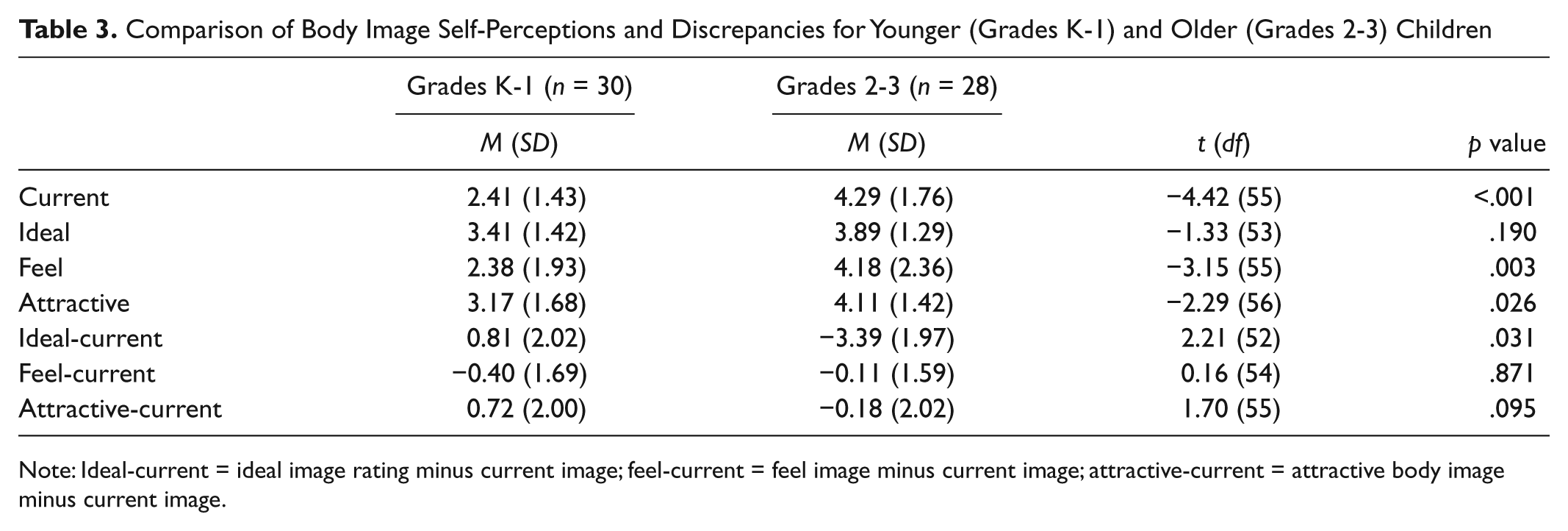
Note: Ideal-current = ideal image rating minus current image; feel-current = feel image minus current image; attractive-current = attractive body image minus current image.
The second question this study aimed to address was whether racial background differentially influenced body image perceptions or discrepancy. No specific predictions about whether children from different racial backgrounds perceive their bodies or discrepancies differently were made because of limited and inconsistent findings from previous research.
Results of the multivariate omnibus test showed that there was no effect of race on body perceptions, λ = .75, F(12,119) = 1.16, p = .32, η2 = .25, or discrepancies, λ = .78, F(9,112) = 1.36, p = .22, η2 = .22. These findings suggest that, in this sample, children of all races perceived their bodies and discrepancies in similar manners.
Finally, this study examined whether there was a Gender × Grade interaction. Based on previous research, it was expected that younger boys and girls would report similar body image perception, but that discrepancy and gender differences would emerge after approximately age 8, with girls showing larger discrepancies than boys (i.e., an interaction of grade and gender). The results did not confirm this prediction; the omnibus multivariate test was nonsignificant for both body image perceptions, λ = .78, F(12,114) = 0.93, p = .52, and discrepancies, λ = .90, F(9,107) = 0.53, p = .85, η2 = .10. These results suggest that boys’ and girls’ body image development show similar trajectories in this diverse sample.
Discussion
The aim of this study was to examine body image discrepancy in a young, ethnically diverse sample of children. It is important to describe body image and body image discrepancy in children at a young age to provide a better understanding of the ways in which children’s early distortions in self-perception may be related to the onset of unhealthy attitudes and behaviors toward eating, food, and their bodies in later childhood, adolescence, and adulthood. Although this study used a relatively small sample of young children, the findings are generally consistent with previous research examining body image concerns in older, less ethnically diverse samples (Jung & Peterson, 2007; Robinson et al., 2001; Rolland et al., 1997). This study provides preliminary evidence that body discrepancies may develop at a very young age, highlighting the importance of considering body image concerns in children in both research and practice.
There is consistent evidence indicating that body dissatisfaction in older children (at least 11 years old) is a risk factor for the development of eating problems (Levine & Smolak, 2005), and the present findings suggest that dissatisfaction may develop at a much younger age. In particular, the direction of body image discrepancy effects were different in younger and older children, suggesting a desire to be heavier (bigger) early in grade school (Grades K-1) and thinner later in grade school (Grades 2-3). One possible explanation for this difference is that during middle and later childhood, sociocultural factors (e.g., media, peers, parents) have been shown to affect children’s body image perceptions and satisfaction (see Levine & Smolak, 2005, for a review of sociocultural influences on body image). For instance, in children as young as 9, appearance-related media exposure and peer conversations have been shown to be negatively associated with body esteem and body dissatisfaction (Clark & Tiggemann, 2007). It is less clear whether and how sociocultural factors influence younger children, although there is some recent evidence that appearance messages from the media and peers may not affect very young children (ages 3-6; Hayes & Tantleff-Dunn, 2012). Although this explanation for the present findings is speculative, it suggests that future research examining the influence of sociocultural factors on body perceptions and discrepancies in young children is warranted. The findings from such studies could help to elucidate the role of sociocultural factors and, in particular, determine the age at which these factors begin to influence children’s body image perceptions and discrepancies, and may affect the risk trajectory for subsequent psychological or physical health conditions.
The racial diversity of the current study’s sample allowed for a preliminary examination of racial differences in body image. Previous research suggests that Caucasian children want to be thinner (Lawrence & Thelen, 1995) and that African American children want to be heavier (Thompson et al., 1997). In the present sample, which was composed primarily of Hispanic and African American children, no racial differences were seen. Although racial differences in the desire for thinness may be evident later in childhood, at a very young age, this may not be the case. This study provides preliminary evidence that, in young children, body image concerns may be relevant for racial groups (e.g., African American) that were not previously considered prone to body image dissatisfaction. As such, the demographic factors associated with higher levels of body image dissatisfaction in older children and adults (e.g., Caucasian, female, adolescent) may have more limited applicability in very young children. As was demonstrated in the present study, body image concerns are beginning to present in younger boys and girls from diverse backgrounds than previously thought, and this issue clearly warrants future research attention.
Although the findings of the present studies are preliminary, they do provide initial evidence that body image discrepancies can be detected in children at a young age and thus there may be opportunity for intervention. An association between body image discrepancy and psychological well-being has been demonstrated in adolescents and adults (Stice, 2002), however, considerably fewer studies have examined this issue in young children. Identifying and providing intervention for children who experience body discrepancies may provide an opportunity to prevent or mitigate more serious behavioral (e.g., unhealthy eating behaviors), psychological (e.g., eating disorders, mood disorders), or health issues (e.g., obesity), which are known to be associated with body image concerns (Stice, 2002; Xanthopoulos et al., 2011).
Despite the important contributions of this study, including the use of very young children and a racially diverse sample, as with any study, there are limitations. First, this was a preliminary research study using a relatively small sample of young children. Although the findings are generally consistent with previous studies using less diverse samples, it is possible that some effects—particularly regarding racial and gender differences—were not detected due to the small sample size. This was a pilot study and thus generalizing to larger populations should be done with great caution. Second, this study used a child figure drawing measure for the assessment of body image discrepancies. Criticism in the literature regarding the reliability of these measures in children under the age of eight have led to the suggestion that they should not be used (Smolak, 2004). However, empirical work has also demonstrated that children as young as six can accurately report on their health and well-being if the measure is appropriately adapted and simple questions are used (Forrest, Riley, Vivier, Gordon, & Starfield, 2004). The measure used in the present study asked children four short questions (e.g., “Which drawing looks the most like your body now?”) in an attempt to make the questionnaire administration as simple and straightforward as possible. Furthermore, in the present study, older children selected larger current figures than younger children, and previous research has demonstrated that children with larger BMIs or heavier weights select larger current figures (Collins, 1991; Poudevigne et al., 2003; Rolland et al., 1996), suggesting (at least in part) that they understand the appropriate use of this measure. Importantly, this study should be viewed as preliminary work that encourages future research addressing the issue of body image dissatisfaction in young children, and the resulting psychological and health concerns.
This study adds to the growing literature that body image perceptions and discrepancies can develop at a young age in both boys and girls in a diverse sample of children. However, as has been noted throughout, the present findings are preliminary work and should ideally be used to encourage additional research on this important topic. Future research should include prospective evaluations of the relationship between body image discrepancies, dissatisfaction, psychological well-being (e.g., self-esteem, depression, anxiety), developmental processes (e.g., physical maturation), and physical health (e.g., eating/exercise habits, appropriate growth) in young children.
Footnotes
Declaration of Conflicting Interests
The author(s) declared no potential conflicts of interest with respect to the research, authorship, and/or publication of this article.
Funding
The author(s) received no financial support for the research and/or authorship of this article.