




Abstract
Carrying, lifting, and turning chairs improve learning activities in schools, which leads to higher quality education. However, it has been shown that elementary school chairs in Indonesia are too heavy for children aged 6 to 9 to easily lift and carry. The present study aimed to investigate children’s methods of carrying chairs as well as lifting and turning them onto desks. Forty-two children (aged 6-9), including 17 Indonesians (6 boys, 11 girls) and 25 Japanese (12 boys, 13 girls), participated in the study. The experiment used three elementary school chairs (one Indonesian, two Japanese) and two desk types (standard and tall). The most popular method for carrying a chair was to carry it in front of the body with the chair in a lateral position (75%). In all carrying methods, participants showed a preference for grasping two particular points to hold the chair. Children lifted and turned chairs most successfully when they used this popular grasping pattern. The carrying method and the popular grasping pattern for carrying, lifting, and turning chairs need to be considered when redesigning heavy Indonesian elementary school chairs to improve the ease of transport without decreasing the weight.
Introduction
In learning process, children not only need to build their own concepts, but also need to share or communicate their understanding to others (Vygotsky, 1980). This requires students to be active in class, such as by speaking, observing, performing tasks, and collaborating with friends. Classroom layouts should be arranged appropriately based on the teaching purpose (Haghighi & Jusan, 2012; Marx, Fuhrer, & Hartig, 1999; Wannarka & Ruhl, 2008), and it can significantly affect improvements in the learning process as well as learning outcomes (Akınoğlu & Tandogan, 2007; Johnson, 2006; Kimonen & Nevalainen, 2005; Pardjono, Groves, & Gough, 1999; Rotgans & Schmidt, 2011; Stern & Huber, 1997; Weltman & Whiteside, 2010). For example, students will more actively ask questions within a row and column arrangement, and to improve social interaction among students, furniture should be arranged in a semicircle (Marx et al., 1999). As in the active learning principle, students should be active mentally and physically to construct knowledge (Dewey, 1938; Pardjono et al., 1999; Piageat, 1999; Vygotsky, 1980), having children arrange furniture themselves may encourage the learning process. Therefore, to encourage furniture arrangement by children for active learning purposes, furniture should be easy for them to transport, which also would reduce the time required to arrange the classroom layout.
However, not all elementary schools in the world, especially in developing countries, have adapted accordingly. Our previous study (Purwaningrum et al., 2015) found that chairs in Indonesian elementary schools were too heavy for children aged 6 to 9 to easily carry and lift. In that study, it took significantly longer for children to complete a carrying task with the Indonesian chair (weight: 5.0 kg) than with the two Japanese chairs (weight: 3.2 kg and 3.9 kg). The result also found that for all children aged 6 to 9, it took children aged 6 to 8 longer to carry the Indonesian chair than children aged 9. In lifting and turning chairs onto standard and tall desks, the Indonesian chair had a lower success rate (around 20%); with 6-year-olds showing especially low success rates. Thus, according to (Purwaningrum et al., 2015), the weight of Indonesian elementary school chairs was not appropriate for children of a certain age, and decreasing the weight of chairs was therefore recommended to encourage dynamic classroom activities.
In developed countries, decreasing chair weight to accommodate children using light, strong, and durable materials and constructions through a qualified manufacturer might be rather easy to execute. In developing countries such as Indonesia, however, there are problems with manufacturing. A simple solution for developing countries might be to produce two types of elementary school chairs—one for ages 6 to 9 and another for ages 10 to 12. However, school furniture producers that use conventional woodworking will face production obstacles, such as difficulties establishing standardized manufacturing processes with strong quality controls and effective management. Moreover, it will require increasing the price of furniture that is too expensive for developing countries. Therefore, if developing countries produce chairs using the same product used in developed countries but in lower price, they might be frail.
Focusing on how elementary school children as a user carry, lift, and turn chairs in common class activities can provide alternative strategies for modifying Indonesian elementary school chairs without decreasing their weight. Due to individual differences in age, physique, knowledge, and so on, children use various carrying methods to complete the same tasks. Previous studies have focused on the effects of carrying methods on anterior load carrying capability. It was found that carrying a load at hand height had better carrying capacity than carrying at elbow height (Mital & Okolie, 1982; Snook, 1978). As such, examining popular carrying methods could indicate that it might be easier for children to perform tasks using their preferred methods.
Thus, the second factor (after weight) in investigating Indonesian elementary school chairs is the parts of chair most popularly used for grasping. Some parts of these chairs are too thick for children to grasp. Moreover, there are sharp corners, making them unsafe. The shapes of these chairs suggest they were not designed to be easily moved. Without improvements, such poorly designed chairs can create hazardous situations and possibly result in injuries. Thus, in redesigning chairs without decreasing their weight for improved ease of transport, parts popularly used for grasping should be suitably shaped to facilitate effective methods of lifting, carrying, and turning.
To obtain useful basic data for redesigning Indonesian elementary school chairs to be easily carried, lifted, and turned by children aged 6 to 9, this study investigated the methods children aged 6 to 9 used to carry chairs, and to lift and turn them onto desks. First, we examined chair-carrying methods, including direction and sequence. Second, we investigated which parts of chairs were most commonly grasped while performing tasks.
Method
Participants
The participants were 42 right-handed children (aged 6-9), including 17 Indonesians (six boys and 11 girls) and 25 Japanese (12 boys and 13 girls). The mean ± standard deviations (SD) for the anthropometric data of all participants were as follows: age: 7.8 ± 1.0 years; body height: 122.7 ± 7.1 cm; body weight: 24.5 ± 3.5 kg; and grip strength: 9.23 ± 2.2 kgf.
As Indonesia is the main target of this study, Indonesian children were involved in the experiment. This study also involved children and chair of Japanese nationality as a comparison. Generally, given user that using the product in daily life are familiar, and perform better. Japanese children use their furniture, and Indonesian children use their furniture. Therefore, including both Japanese and Indonesian children in this study are fair to avoid a bias.
However, the sex of Indonesian and Japanese children in this study was mixed up as previous studies about the designs of elementary school furniture regarded that sex is not a factor that determines the dimensions of school furniture (Adewole & Isedowo, 2012; Dhara, Khaspuri, & Sau, 2009). Furthermore, the Japanese and Indonesian children were mixed up according to the anthropological database of Japanese and Indonesians (Ministry of Education, 2014; Ministry of Internal Affairs and Communications Statistics Bureau of Japan, 2013; Purwaningrum, Aryani, Mulyadi, & Yassierlie, 2011; Rosyidi, Susmartini, Purwaningrum, & Muraki, 2014), which showed that the heights and weights of children aged 6 to 9 are similar.
The ethics committee of the Faculty of Design, Kyushu University, Japan, approved the experiment of this study (Approval Number: 125), and participants’ parents signed informed consent forms before the study.
Experimental Instruments
Chairs
To compare the effects of three dimensions and weight conditions on the carrying, lifting, and turning a chair method, this experiment examined two Japanese (Chairs A and B) and one Indonesian (Chair C) elementary school chair. Chairs A and B were Size 2 (width: 340 mm; depth: 290 mm; seat height: 300 mm; weight: 3.2 kg) and Size 3 (width: 360 mm; depth: 290 mm; seat height: 340 mm; weight: 3.9 kg), respectively. The dimensions of Chairs A and B were appropriate for children aged 6 to 9 (International Organization for Standardization [IOS], 1979) whose heights ranged from 117 to 130 cm and 131 to 144 cm, respectively. The Indonesian chair (Chair C) was produced in Indonesia; it was made entirely of wood with a seat height of 420 mm, a width of 385 mm, a depth of 385 mm, and a weight of 5.0 kg. This chair type is widely used in Indonesia’s public elementary schools (IOS, 1979; Ministry of National Education, 2007). The weight of Chair C fell within the lowest weight range based on a pilot survey of 11 public elementary schools in Indonesia (Rosyidi et al., 2014). The dimension of the chair was the same as the dimension of the chairs generally used that are same for all grade in Indonesian elementary schools (Purwaningrum et al., 2011).
Desks
In this study, desks were only used in the experiment for lifting and turning chairs. Two desk height conditions were used. The first was a Japanese elementary school desk (Size 3; height: 580 mm; weight: 8.4 kg) that is typically used by elementary school children 131 to 144 cm in height. This condition met ISO 5970 (IOS, 1979). The second type was the same as the first, but a box was placed under the desk for additional height (100 mm). The new height simulated the average typical height of Indonesian elementary school desks (550-750 mm; Purwaningrum et al., 2011; Rosyidi et al., 2014). As the study compared the effects of height differences between Indonesian and Japanese desks on lifting and turning chairs, this simulation was sufficient for the task.
Experimental Tasks, Conditions, and Procedures
Two tasks—(a) carrying a chair and (b) lifting and turning a chair onto a desk—were performed in an appropriate experimental space. First, participants were briefed on the procedures for completing each task. They could say “stop” to move on to the next task if they felt the present task was too difficult or impossible to finish. Moreover, a stop instruction would be issued immediately if it appeared to the researcher that it would be impossible or dangerous to continue the task. For safety, participants wore nonslip work gloves and shoes, and an adult guard stood beside the participants. To prevent injury, fear, and so on, and allow participants to easily judge whether they could perform the next task, tasks were sequenced from lighter (smaller) to heavier (larger) furniture. After each task, the participant’s condition was checked (e.g., indications of pain, fatigue, lack of motivation, etc.) to determine whether he or she should continue to the next task.
In the task of carrying a chair, each chair (A, B, and C) was brought from the start to finish line. The distance between lines was 3 m. First, participants sat on the chair which was placed sideways behind the start line. Second, after start command, participants stood up and carried the chair toward the finish line. Finally, the chair was put down on the floor beyond the finish line. In this task, some procedures must be followed by participants: (a) any part of the chair could be hold; (b) the chair should not push or slide on the floor; (c) walking speed during the task should be at an ordinary.
In the task of lifting and turning a chair, each chair (A, B, and C) was turned upside down and put on two desk heights (standard desk height: 580 mm; taller desk height: 680 mm). Before start command, the participant sat on the chair that was placed in front of the desk. Then, the participant stood up from the chair, turned the chair upside down, and put it on top of the desk after the start command. In this task, any part of the chair could be held. The chair could be rotated on the floor if it is necessary.
Measurement
Each participant’s movement was recorded by a digital video camera (Panasonic, HC–V 300 M, Japan) at 30 frames per second. To record tasks in detail, the camera was operated freely by hand (i.e., not mounted, as on a tripod), following participants’ movements step by step, such as their methods for carrying chairs and their grasping positions on the chairs.
Grasping parts of the chairs
Before conducting the experiments, 18 parts of the chairs were coded A-R as the possible points that might be grasped by participants (Figure 1).

Codes for the chair parts.
Criteria for success in lifting and turning chairs
Success criteria were established before performing the experiment involving lifting and turning chairs onto desks. The task was judged successful if the participant executed it smoothly, that is if they could complete lifting and turning the chair without dropping the chair or stopping, and if there were no indications of danger. Danger was indicated if the grasp was unstable, that is, grasping the chair so that it tended to fall to the floor. The task was judged unsuccessful if the participant failed to smoothly lift and turn the chair onto the desk.
Statistical Analysis
The SPSS statistical package (IBM SPSS version 21.0 for Windows, Chicago, USA) was used to analyze the data. The exact chi-square test (Field, 2013; Sheskin, 2004) was calculated to analyze the effects of chair type on the success rate.
Results
Carrying Chairs
The methods for carrying chairs were categorized based on the chair’s direction, its orientation, and how many hands the child used. Figure 2 shows the four carrying methods.
Carrying Method 1: The chair was carried in front of the child’s body with two hands on two parts of the chair, and the chair’s orientation was lateral.
Carrying Method 2: The chair was carried in front of the child’s body with two hands on two parts of the chair, and the chair’s direction was either forward or backward.
Carrying Method 3: The chair was carried in front of the child’s body with one hand in one position.
Carrying Method 4: The chair was carried in front or at the side of the child’s body with two hands on one part of the chair.

Four methods for carrying chairs.
During the task of carrying a chair, an inconsistent procedure was shown by one participant. To obtain a reliable finding, even though he could complete the task, his result was omitted in the analysis. Thus, the number of participants in the carrying a chair task became 41. Figure 3 shows the percentages of carrying methods used by participants for each chair type in the experiment. Even though the dimension and the weight of three chair types, and design between Japanese and Indonesian chair were different, the percentages of each carrying method for all chair types were similar. Method 1 was used the most (73%-78%), followed by Method 2 (15%-17%). Methods 3 (5%) and 4 (2%-5%) were rarely used. The exact chi-square test indicated there was no significant effect of chair type on carrying method.

Percentages of carrying methods used for all chair types.
The participants employed various grasping patterns, using one or two hands to grasp certain parts of the chairs. Table 1 shows nine grasping patterns used by participants: AJ, BJ, DJ, GJ, HI, OO, BB, O, and B. AJ, for example, means the chair was grasped by two hands with the right or left hand on Part A and the other hand on Part J. In Patterns B and O, the chair was grasped using only the left or right hand.
Frequency of Each Carrying Method and Grasping Pattern by Chair Type.

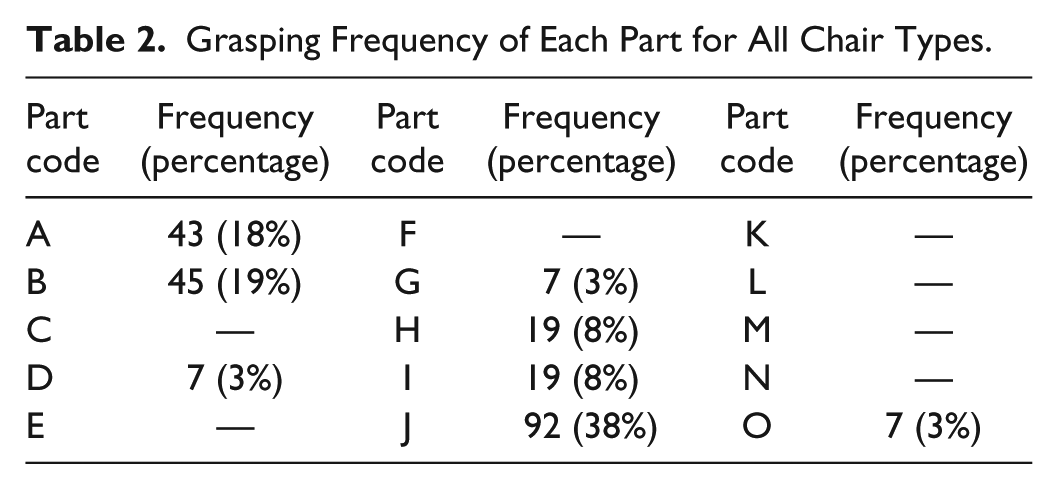
Each carrying method had specific grasping patterns. For example, Method 1 showed patterns AJ, BJ, DJ, and GJ; Method 2 showed patterns HI and OO; Method 3 showed patterns BB and O; and Method 4 showed patterns B and OO. Pattern OO, observed in Methods 2 and 4, was a special case. Using Figure 2, those conditions could be illustrated: Method 1 indicates grasping pattern AJ; Method 2 indicates grasping pattern HI; Method 3 indicates grasping pattern O; Method 4 indicates grasping pattern OO. Table 2 shows the percentages of grasping patterns used for each chair type. Parts J, A, and B showed a higher frequency than the other parts. Meanwhile, Parts C, E, F, K, L, M, and N were not used by any participants.
Grasping Frequency of Each Part for All Chair Types.
Lifting and Turning Chairs Onto Desks
Popular grasping patterns
Participants lifted and turned chairs onto desks using various grasping patterns on different parts of the chairs. They completed the task in steps using different grasping patterns. Grasping patterns were categorized according to the child’s first step in grasping the chair. Forty second-step grasping patterns were identified for all chairs and desks. Participants primarily used seven grasping patterns, with AJ/JA and BJ/BA as the most popular. The 33 other patterns were less popular. Table 3 shows the distribution of the popular grasping patterns.
Frequency of Each Popular First-Step Grasping Pattern by Chair Type.

Popular grasping patterns and success rates
Figure 4 shows effect of chair type and popular/unpopular grasping patterns on success rates for lifting and turning three types of chairs onto standard and tall desks. For both desk types, the popular grasping patterns had higher success rates than the unpopular ones with each chair type (Figure 4). The success rates for both popular and unpopular grasping patterns decreased gradually from Chairs A to C with both desks. The highest success rate (90%) was achieved with Chair A and the standard desk. The lowest success rates, or unpopular grasping patterns, occurred with Chair C with the tall (12%) and standard desks (20%; Table 3; Figure 4).

Success rates of popular and unpopular grasping patterns in lifting and turning three types of chairs onto standard and tall desks.
Figure 5 shows effect of popular/unpopular grasping pattern on success rates for lifting and turning all chair types with both standard and tall desks. The exact chi-square test showed a significant effect of popular and unpopular patterns on success rate among chair types at taller desk (p < .05) but not at standard desks. Interestingly, for both standard and taller desks, the popular pattern had a higher success rate than the unpopular patterns, with taller desk with tall desks (60% and 40%, respectively), and with standard desks (60% and 50%, respectively).

Success rates for popular and unpopular grasping patterns in lifting and turning the three types of chairs on standard and tall desks.
The most popular of first-step grasping patterns (AJ/JA and BJ/BA) were followed by the second-step grasping patterns. The most popular of them were NL/LN and MK/KM. As NL/LN and MK/KM are the same (left and right of the chair’s feet), they were categorized into the same group (Table 4).
Frequency of Popular Second-Step Grasping Patterns Following the Popular First-Step Patterns by Chair Type.

Discussion
Carrying Chairs
This study considered how children carry chairs to redesign them for easier transport. Carrying Method 1 (Figure 2), in which the chair was carried in a lateral orientation in front of the child’s body with two hands on two parts of the chair, was the most popular. Understanding how humans use a product is an important factor in product development (Green & Jordan, 1999; Jordan, 2002; Sanders, 1999; Sanders, 2002). The preferred carrying method in this study was supported by previous research showing that a user’s pleasurable feelings in choosing a product or tool correlate to psychological rather than physical or usability factors ( Jordan, 2002). Furthermore, in the material-handling field, Jordan (2002) and Kuijt-Evers, Twisk, Groenesteijn, De Looze, and Vink (2005) found that an object’s appearance affected comfort and preference during handling. In the present study, the shape (appearance) of the chair led children to use carrying Method 1. This was because the position of the hands on the chair tended to balance and stabilize the direction of the chair mass so that it seemed easy and comfortable. Future research should investigate whether Method 1 is indeed the easiest and safest way for children to carry chairs. This study showed that chair-carrying methods involved the child’s preference for grasping certain parts of the chair. The most popular grasping patterns in M 1 were AJ and BJ (Table 1)—that is, Parts A and B on the top and bottom of the chair’s back and Part J on the front of the seat (Tables 1 and 2). The Indonesian chair’s features were too large for the anthropometry of children aged 6 to 9 (Purwaningrum et al., 2011; Rosyidi et al., 2014). Specifically, the distance between Parts A and B for the right hand and Part J for the left was too large. In addition, its heavy weight (Purwaningrum, Funatsu, Xiong, Rosyidi, & Muraki, 2015) and sharp shape could increase the difficulty of carrying it with a balanced posture and potentially cause injury. Therefore, to improve the ease of transporting Indonesian elementary school chairs without decreasing their weight, the parts children prefer to grasp should be considered.
Lifting and Turning Chairs
The results for lifting and turning chairs onto desks also provide guidelines for redesigning chairs based on grasping patterns. The main considerations were the AJ/JA and BJ/JB patterns, which were used most often in the first step for each type of chair and desk (Table 3; Figure 6). Furthermore, AJ/JA and BJ/JB had higher success rates than the less popular grasping patterns for each type of chair and desk (Figures 4 and 5). Thus, AJ/JA and BJ/JB are the ideal grasping patterns for children to easily lift and turn both Indonesian and Japanese chairs.
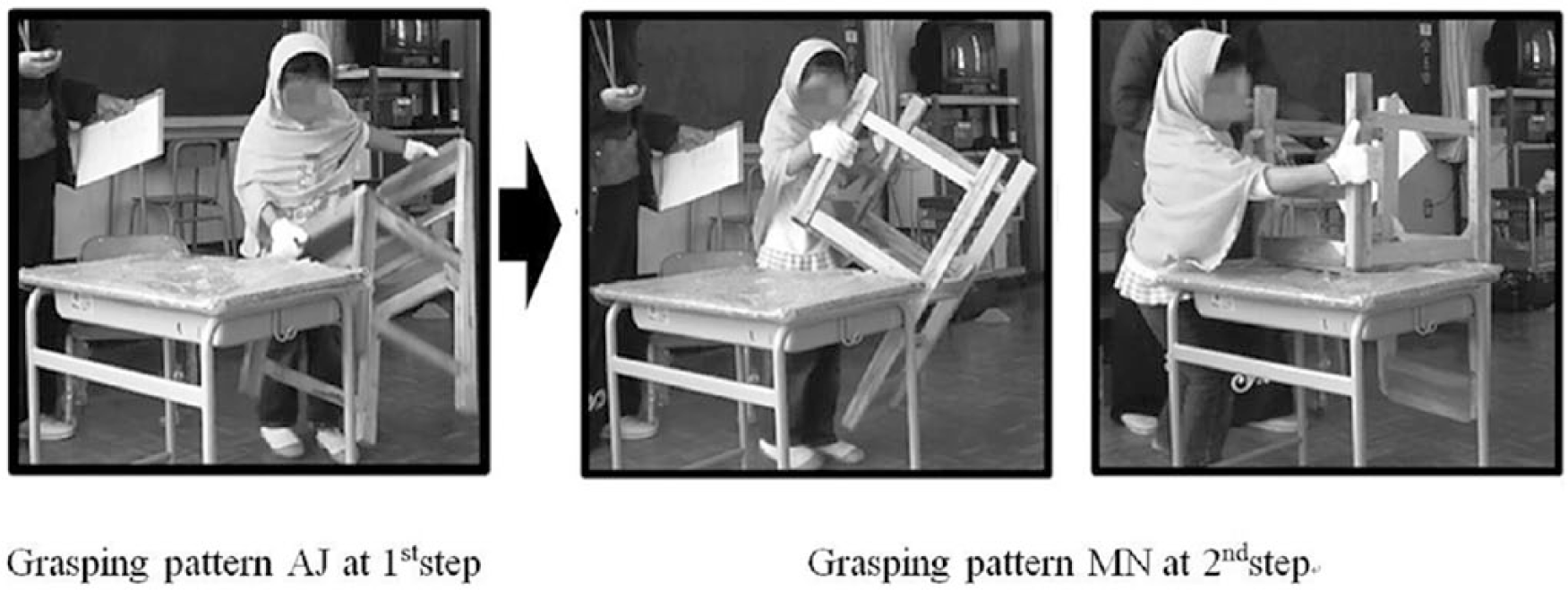
Popular grasping patterns in the first and second steps.
The secondary considerations were the NL/LN and MN/NM patterns, which were used most often in the second step following the most popular grasping patterns in the first step (Table 4, Figure 6). Further, NL/LN is equivalent to MK/KM, and MN/NM is equivalent to KL/LK. Therefore, patterns MK/KM, MN/NM, and KL/LK should be considered secondarily after AJ/JA and BJ/JB to improve the ease of lifting and turning chairs.
The popular patterns (AJ/JA, BJ/JB) nevertheless had low success rates with Chair C and both desks (Figure 4), indicating that lifting and turning the Indonesian chair was difficult. Meanwhile, the popular patterns’ high success rates with Chair A showed that Japanese chairs could be easily lifted and turned. In addition, the exact chi-square test found that the popular patterns’ success rates were significantly higher than the unpopular ones only with the tall Indonesian desk. Therefore, grasping patterns must be considered in redesigning Indonesian chairs to make the task of lifting and turning chairs onto tall Indonesian desks easier.
The results for both tasks (carrying and lifting/turning chairs) showed that Parts A, B, and J were used most by children. Those parts were designed more safely on the Japanese chair than the Indonesian chair. The rounded corners and proper sizes of the Japanese chair parts make it easy for children to grasp and carry the chairs. However, those parts are dangerous on Indonesian chairs, making them difficult for children to carry, lift, and turn. The parts are large, there is no convenient place for children to grasp them, and the sharp corners could cause injuries. Moreover, the chair’s dimensions are unsuitable for children, especially for children aged 6 to 8 (Purwaningrum et al., 2011; Rosyidi et al., 2014). The awkward shapes, weights, and dimensions could cause them to drop the chair. Therefore, considering grasping patterns for redesigning chairs promotes safety in addition to easy lifting.
Conclusion
This study utilized how preference of user to carry, lift and turn a chair easily. The furniture which is easy to transport should be provided due to the proper layout arrangement are required for a teaching purpose (Haghighi & Jusan, 2012; Marx et al., 1999; Wannarka & Ruhl, 2008) in an active learning to improve quality of education. The problem with Indonesian furniture was not only improper dimension (Purwaningrum et al., 2011; Rosyidi et al., 2014) but also the weight was too heavy to transport for children, especially for children aged 6 to 9 years (Purwaningrum et al., 2015). The observation found a key point, and an alternative solution should be considered for redesigning and modifying the heavy Indonesian elementary school chairs without decreasing their weight. Moreover, to decrease the weight of Indonesian school furniture will face a manufacturing problem. To our knowledge, using grasping patterns as a criterion for designing elementary school chairs for easy lifting and turning is new in this research area. The investigations in this area should factor in two aspects: the methods of carrying chairs and the most popular grasping patterns for carrying, lifting, and turning them. It would be interesting for future investigations to evaluate the effectiveness of such modified Indonesian elementary school chairs so that encourage the active learning in a classroom.
Footnotes
Acknowledgements
We would like to thank everyone who participated in this study. We are also extremely grateful to the parents and teachers who kindly supported their children’s participation in the experiments.
Declaration of Conflicting Interests
The author(s) declared no potential conflicts of interest with respect to the research, authorship, and/or publication of this article.
Funding
The author(s) the financial financial support for the research and/or authorship of this article: This article is a part of research funded by Hibah Kolaborasi Internasional (International Collaboration Research Grant) PNBP of Sebelas Maret University, fiscal year 2016 (343/UN27/HK/2016), Republic of Indonesia.