




Abstract
This empirical study proposed a comprehensive model testing the direct and indirect impacts of entrepreneurship extracurricular activities and entrepreneurship inspiration on students’ entrepreneurial intention. With the sample consisting of 640 students from 11 universities in Vietnam, the study used structural equation modeling analysis approach. The results revealed that entrepreneurship extracurricular activities and entrepreneurship inspiration are significantly related to students’ entrepreneurial intention, and entrepreneurship self-efficacy partially mediates these relations. The impact of entrepreneurship education on entrepreneurial intention differs across the field of study. Technical students generally get more benefits from entrepreneurship educational activities than business and economics students do. The research findings recommended some implications for fostering graduates’ entrepreneurship in emerging countries.
Keywords
Introduction
It has long been a conventional wisdom that entrepreneurs are born, and entrepreneurs will succeed with or without education, meaning that education to those lacking the “entrepreneurial spirit” is worthless (Béchard & Grégoire, 2005). This debate on whether students cannot be taught to be successful entrepreneurs has existed for some time. However, most management research recently assumes entrepreneurship behaviors are learned, and entrepreneurs can be taught, developed, and shaped by schools (Martin et al., 2013; Nabi et al., 2017). Although there is an arising acceptance that entrepreneurship can be affected by education, not all higher education institutions have succeeded in fostering entrepreneurship (Oosterbeek et al., 2010). The effects emanating from entrepreneurship education only occur if higher education institutions provide appropriate pedagogical methods for increasing entrepreneurial mind-set (Nabi et al., 2017). Finding educational activities that can help students building on entrepreneurship spirit and capacities become particularly important for undergraduate students who are young and have limited business experience (Vesa, 2010).
The last decade has seen a strong renewed interest in university’s entrepreneurship education study (Liñán & Fayolle, 2015). University entrepreneurship education aims to provide knowledge and supports to promote students’ entrepreneurship (Bae et al., 2014). University supports can be classified into cognitive-emotional supports—aims at elaborating entrepreneurship culture awareness—and informative-instrumental supports—aims at providing information, resources, and physical help for the materialization of entrepreneurial intention (Arranz et al., 2017). A knowledge gap exists regarding the potential causal link between extracurricular activities—an instrumental support—and entrepreneurship inspiration tools—a cognitive-emotional support with their impact on entrepreneurial competences and entrepreneurial intention (Pittaway et al., 2011; Wartiovaara et al., 2019). Although prior research has addressed the importance of inspiration as motivational episodes in entrepreneurship, entrepreneurial inspiration and its linkages to the entrepreneurship process were limited, as discussed in the literature (Nabi et al., 2017; Wartiovaara et al., 2019). In addition, the findings on the impact of entrepreneurship education activities on college students’ entrepreneurial intentions have been reported inconsistent and ambiguous (Bae et al., 2014; Nabi et al., 2017). A positive relationship between extracurricular activities and students’ entrepreneurial intentions is found in Couetil et al. (2016) and Doan and Sung (2018), whereas a negative relationship is found in Oosterbeek et al. (2010). These conflicting findings reinforce the need to deeper examine the relationship between education activities and intention, with a moderator or a mediator (Bae et al., 2014; Doan and Sung, 2018; Martin et al., 2013; Nabi et al., 2017).
In this research, we chose to put our main focus on entrepreneurship self-efficacy as a mediator of the relationship between entrepreneurship extracurricular activities, inspiration, and entrepreneurial intention. The reason for choosing entrepreneurship self-efficacy is that perceived entrepreneurship self-efficacy plays a significant role in career development and it is predictor of intentions (Boyd & Vozikis, 1994). Although entrepreneurship self-efficacy has been used as a mediator in several intention research (Farashah, 2015; Wilson et al., 2007; Zhao et al., 2005), the role of entrepreneurship self-efficacy in the relationship between entrepreneurship extracurricular activities, inspiration, and entrepreneurial intentions in a developing country has been neglected in the entrepreneurial literature.
Furthermore, the failure of researchers to identify a consistent relationship between entrepreneurship education activities and intention also suggests us to use a moderator. Nabi et al. (2017) suggested that student backgrounds is a contextual reason for contradictory findings. The number of studies has examined the role of academic major in building entrepreneurial intention (Herman & Stefanescu, 2017; Wu & Wu, 2008). Arranz et al. (2017) and Chen et al. (2013) suggested to identify the field of study as moderator of the relation between entrepreneurial intentions and its antecedences. Therefore, we choose academic major as a moderator in this study.
The study is conducted in Vietnam—an Asian transitional emerging and developing country with a collectivistic culture. Despite rapidly increasing interests in entrepreneurial research, there is still limited knowledge about entrepreneurship in transition developing economies (Nabi et al., 2017; Rachwał et al., 2016). There are major differences in the institutional infrastructures, entrepreneurship education practices, and strict environments between emerging and developed economy countries (Giacomin et al., 2011; Wu & Wu, 2008). The country collectivistic culture makes the context differentiate with most of the current research, which was conducted in Western countries. Entrepreneurship education in Vietnam is relatively young and underresearched.
With this article, we contribute to the emergent stream of literature on this important topic in two aspects. First, grounded in social-cognitive theory, the research provides empirical evidence on the influence of entrepreneurship extracurricular activities and inspiration on the intention to become an entrepreneur in developing country, where entrepreneurship education is in beginning stage. The second contribution of this study is our specific focus on a mediator—entrepreneurship self-efficacy—and a moderator—academic major in the relationship between those two entrepreneurial education factors and entrepreneurial intention.
The article is constructed into four parts. The first part gives literature review of existing research on entrepreneurship inspiration, extracurricular activities, self-efficacy, and entrepreneurial intention. The second part introduces the research methodology. The third part explores the empirical data and discusses results. Finally, we suggest several recommendations for facilitating entrepreneurial intention of university students.
Theoretical Background and Literature Review
Intention is believed to be the best predictor of planned behavior, especially that behavior is hard to observe, rare, or involves unpredictable time lags (Krueger et al., 2000). Entrepreneurship is a typical planned, intentional behavior (Liñán & Chen, 2009). Entrepreneurial intention is believed to be a reliable precedence to entrepreneurial behaviors. Understanding entrepreneurial intention provides us a chance to understand and predict entrepreneurial activity (Nowiński et al., 2017; Wilson et al., 2007). Consequently, entrepreneurial intention has been received considerable interests in entrepreneurship literature (Liñán & Fayolle, 2015).
Extracurricular Activity and Entrepreneurial Intention
A substantial body of literature centered entrepreneurship education in modeling entrepreneurial intention among students (Liñán & Fayolle, 2015). There are a wide range of education activities and supports that universities provide to students to foster entrepreneurship, in which extracurricular activities play a very important role (Doan & Sung, 2018). Entrepreneurship extracurricular activities involve actions, experiences, and newness, which may be organized inside or outside universities and fall outside the realm of the higher education’s official curriculum (Souitaris et al., 2007). Entrepreneurship extracurricular activities supplement to required coursework of formal curricular in university education. Those activities are provided to promote entrepreneurship initiative, aimed at offering proper support to entrepreneurship interests and intentions to start a new venture of students (Arranz et al., 2017). There are various forms of entrepreneurship extracurricular activity, including entrepreneurship games, business plan competitions, exchanges, business mentoring, clubs and societies, pre-incubators, workshop programs, entrepreneurship support programs, developing new product and innovation competition, idea development, and business incubators (Pittaway et al., 2011).
There are controversial discussions on the relation between entrepreneurship extracurricular activities and entrepreneurial intention in literature. Although some argued that practical activities which are provided in entrepreneurship education can foster but also decrease entrepreneurial intentions (Oosterbeek et al., 2010), the impact of extracurricular activities on entrepreneurial intention has strong theoretical base (Arranz et al., 2017). Two theoretical concepts strongly support this relationship. Béchard and Grégoire (2005) argue to use social-cognitive theory as a coherent framework to understand entrepreneurship education and intention. Angulo (2019) considers the involvement in extracurricular activities to be a form of experiential learning. The Kolb’s theory of experiential learning indicates that experience is a valuable source for learning, changing mind-set and development, people do learn from their experiences (Couetil et al., 2016). Experiential learning constructs new knowledge and perception through collective experiences. Extracurricular activities create a supportive environment within which students experience business and entrepreneurial activities, and raise awareness and attitude of entrepreneurship (Pittaway et al., 2011). Therefore, entrepreneurial intention can be enhanced through knowledge and social capital, which students gain from extracurricular practice (Peterman & Kennedy, 2003). Doan and Sung (2018) and Pittaway et al. (2011) showed that participation in business plan development, competition, or an entrepreneurship-related student organization like clubs has a positive impact on individual’s entrepreneurship intention.
Entrepreneurship Inspiration and Entrepreneurial Intention
Souitaris et al. (2007) defined entrepreneurship inspiration as a change of hearts (emotion) and minds (motivation) evoked by trigger events or inputs of university education and directed toward considering becoming an entrepreneur. Triggers can come from people (role models, university lecturers, mentors and guest speakers, entrepreneurs) or events (educational activities, including presentation of ideas, business simulation exercises, business plan development) (Nabi et al., 2018).
Souitaris et al. (2007) argued that the emotional support in the form of “triggers” coming from verbal persuasion or positive encouragement on entrepreneurial career has a positive effect on entrepreneurial perception. The change in hearts and/or minds can be very strong, leading to the change in entrepreneurial intentions. From social-cognitive career theory perspective in the context of entrepreneurship, entrepreneurship inspiration events or inputs can be seen as contextual supports having a direct effect on the career decision-making process (Wartiovaara et al., 2019). The social, culture, and institutional context creates or constraints opportunities for performing an entrepreneurial activity (Vesa, 2010). Entrepreneurship inspiration is as a kind of emotion, when motivated, through entrepreneurial cognitions will culminate attitude of entrepreneurship, directly changes overall personal perception of entrepreneurship. If triggers are coming from people that students trust or admire, or from successful role model in society, verbal persuasion may make a powerful influence on the development of entrepreneurial interest (Farashah, 2015). Another qualitative work of Nabi et al. (2018) showed that a simple negative experience, for example, a teacher’s funny story of business failure, can serve as a deterrent to personal perception of entrepreneurial intention. The empirical study of Souitaris et al. (2007) on engineering students reported that entrepreneurship inspiration, rather than resources or knowledge transferring and other education benefits, positively relates to the entrepreneurial intention. The presence of triggers directly influences entrepreneurial career intentions and options.
Mediator Role of Entrepreneurship Self-Efficacy
Entrepreneurship self-efficacy is a construct measuring a person’s belief in his or her ability to successfully launch an entrepreneurial venture (Boyd & Vozikis, 1994). It expresses perceptions of an individual about his or her knowledge and skills, and experiences competences. Entrepreneurship self-efficacy indicates an individual feeling whether they can easily engage in entrepreneurial venture; it reflects a person’s confidence in their own ability to perform specific tasks. Entrepreneurship self-efficacy includes perceived capability to find the new ideas, capability in discovering and exploring new business opportunities, capability in managing a new venture, capability in establishing business partner relation, and mental maturity as an entrepreneur (Begley & Tan, 2001).
Entrepreneurial self-efficacy and intention
Entrepreneurial self-efficacy gives a person the belief and readiness to realize an entrepreneurial career (Boyd & Vozikis, 1994). Human behavior and choices are affected by self-efficacy (Bandura, 1986). Perceived self-efficacy determines how people think, feel, motivate themselves, and behave. Self-efficacy affects the motivation and ability to engage in specific activities and is an effective marker, necessary condition of intention (Boyd & Vozikis, 1994). Entrepreneurship self-efficacy is linked to initiating and persisting entrepreneurial intention; it was the “single best predictor in the entire array of variables” for entrepreneurial intention (Boyd & Vozikis, 1994; Wilson et al., 2007). Shahab et al. (2019) described that self-efficacy encourages people to persist and overcome challenges encountered in the entrepreneurial process. The assessment of individual capabilities directs people toward preparing for and entering occupations in which they feel successful, but at the same time avoiding occupations in which they feel a lack of competence. Entrepreneurship self-efficacy has been identified to play important role in business creation process and to be antecedent to entrepreneurial intention (Farashah, 2015; Krueger et al., 2000; Nabi et al., 2018; Nowiński et al., 2017; Zhao et al., 2005).
Extracurricular activity and entrepreneurial self-efficacy
The relationship between students’ extracurricular involvement and learning outcome is well documented. Increasing student engagement in extracurricular activities is considered a best practice to foster student’s general cognitive skills and intellectual skills (Pittaway et al., 2011). Béchard and Grégoire (2005) pointed out that learning tends to be more effective if students have chance to encounter and engage in experience, so extracurricular activities participation and the integration of these activities with academic learning are key tools in building student capabilities (Arranz et al., 2017). Extracurricular activities provide a foundation for experiential learning and create a supportive environment within which students enhance entrepreneurial skills and knowledge about entrepreneurial activity. Those activities give experiences and develop students’ capacities in leading a group or a project, developing a strategic plan, and changing risk-taking tendency (Angulo, 2019). Such opportunities by involving students in entrepreneurial culture help to foster students’ self-efficacy of managing their own business projects (Couetil et al., 2016). Participating in extracurricular activities, students learn from both successes and failure experience, their general levels of confidence to act will increase (Arranz et al., 2017; Couetil et al., 2016; Martin et al., 2013; Pittaway et al., 2011). Studies of Angulo (2019) and Florin et al. (2007) have found that various extracurricular activities participation help students to be included in social groups and gain knowledge and social capital. Group membership through participation in activities can provide access to the business relation and entrepreneurship networks that influence and support positive outcomes for students, as well as to access information, knowledge, and skills, which enhance perceived capability.
Entrepreneurship inspiration and self-efficacy
According to theory of social cognition, an individual’s sense of self-efficacy can be influenced through social persuasion (Bandura, 1986). Entrepreneurship inspiration trigger is a kind of social persuasion that makes one consider to be confident in his or her ability to successfully perform entrepreneurial tasks (Wartiovaara et al., 2019). Self-efficacy can be enhanced from the positive feedback and encouragement given by professors and instructors in university’s entrepreneurship education (Nabi et al., 2017). Inspiration has transformative effects that result in psychological changes within the entrepreneur. It tends to increase the entrepreneur’s perceived competence, self-determination, and optimism (Wartiovaara et al., 2019).
According to theory of planned behavior, exogenous factors indirectly influence intention through personal-situation perceptions of perceived self-efficacy (Krueger et al., 2000). Self-efficacy is a determinant of intention, and perception of self-efficacy is in fact a product of combined effects of several other exogenous variables in external element. Souitaris et al. (2007) suggested that higher education is an exogenous variable, which prepares students technical and humanistic capabilities, and then who acquire different knowledge may have different entrepreneurial intention. Farashah (2015) and Nowiński et al. (2017) also observed that the development of the entrepreneurial self-efficacy can be a key indicator of the entrepreneurial learning effectiveness and increases the rate of entrepreneurial intention. As two principal functions of education are knowledge transferring and ability development, education would change a person’s perception of his or her ability to perform the intentional behavior. Education provides codified knowledge helping people to better understand the general rules and enhances the ability to acquire and apply codified knowledge in life. A high level of perceived entrepreneurial self-efficacy then should strengthen an individual’s intention to perform the behavior and increase his or her effort and perseverance (Nowiński et al., 2017). Krueger et al. (2000), Shahab et al. (2019), and Zhao et al. (2005) indicated that external factors affect entrepreneurial intentions only if they affect self-efficacy. Accordingly, we argue that entrepreneurship self-efficacy mediates the relationship between extracurricular activity, inspiration, and entrepreneurial intention.
Academic Major as Moderator
Béchard and Grégoire (2005) and Hamidi et al. (2008) mentioned that academic major is a decisive factor to career choice intention in general and to entrepreneurial intention in particular. Important differences exist in how students in various academic majors perceive entrepreneurial opportunities in their future profession (Maresch et al., 2016; Wu & Wu, 2008). Herman and Stefanescu (2017) highlighted the role of academic major in the relationship between entrepreneurship education and entrepreneurial intention. Arranz et al. (2017) showed that the impact of extracurricular activities on entrepreneurial intention and its antecedence in group of business students and group of non-business students was different. While Chen et al. (2013) showed neither entrepreneurship curricular nor extracurricular activities have any impact on entrepreneurial intention of students with a business background, the research of Couetil et al. (2016), Roberts et al. (2014), and Souitaris et al. (2007) found that the entrepreneurship program can raise the science and engineering students’ entrepreneurial intention. Nabi et al. (2017) indicated student backgrounds to be contextual reason for contradictory findings. Thus, we propose that academic major can moderate the impact of entrepreneurship inspiration and extracurricular activities on intention.
Engineers who are equipped with an entrepreneurial mind-set have potential to launch a new business (Maresch et al., 2016). Students in technical and science disciplines usually expertise at the technical and creative skills, and often have very solid ideas of new products or services, which are the primary capital of individuals to start new business (Herman & Stefanescu, 2017). Innovative and viable business ideas arise mostly from scientific, technical, and creative studies. The technical training of science and engineering give students in these majors the opportunities to start high growth technology ventures (Souitaris et al., 2007). Arranz et al. (2017) emphasized engineering degree whose creative competences and product knowledge are greater than in other degrees and have greater entrepreneurial potential. We propose that the impact of entrepreneurial education on entrepreneurial intentions is significantly stronger among engineering students than among business students.
Method
Materials
Before quantitative survey, we carried on a qualitative study to check for the research theoretical model and the accuracy of questionnaires. The survey instruments were borrowed from previous research with adaptation for Vietnamese context. The questionnaire includes 23 items, and each administration took between 5 to 6 min. The respondents indicated their agreement and disagreement on a 5-point Likert-type scale with strongly agree (5) to strongly disagree (1).
We used the entrepreneurial intention questionnaire (Liñán & Chen, 2009) to measure entrepreneurial intentions of students. The scale consists of six items like “I will make every effort to start and run my own firm” and “I’m determined to create a firm in the future.” Cronbach’s alpha for this instrument is .81.
Meanwhile, we applied the Souitaris et al. (2007) questionnaire and technique to measure entrepreneurship inspiration. Students were asked to recall any particular event or input during their studying in university that changed their “heart or mind” by ticking event on a list and asked to rate “To what extent have such events made you seriously consider embarking on an entrepreneurial career?” on the standard 5-point scale. This instrument has a Cronbach’s alpha value of .703.
Following Arranz et al. (2017), we adapted the measurement of extracurricular activities with six items asking whether frequency of students attending entrepreneurship activities like conferences and seminars dedicated to entrepreneurship or business plan competitions. The Cronbach’s alpha for this scale is .841.
The measurement of entrepreneurial self-efficacy was adapted from Lee and Bobko (1994), which had been used in Begley and Tan’s (2001) research. It consists of seven items asking whether students could perform each of seven tasks related to starting a business. This instrument has a Cronbach’s alpha of .860.
This study involved final-year students as respondents as they have a relatively high propensity toward starting a firm and often participants in entrepreneurship research. Both online and offline questionnaires were sent to students at 11 universities in Hanoi, Vietnam. This study adopted a convenience sampling method, widely adopted in studies of entrepreneurship (Arranz et al., 2017; Nowiński et al., 2017). A total of 1,500 students were targeted for this study, including two main majors: technical engineering and business economics (sent 1,500, received 651, response rate of 43.4%). After collecting the questionnaires, we checked the data to ensure that the sample consisting of the research designed subjects and eliminated questionnaires with missing important information or bias answers (11 questionnaires). Thus, an acceptable final dataset consists of 640 students.
Method
Statistical analysis was carried out using SPSS 22.0 and AMOS 22.0 software. First, Cronbach’s alpha, exploratory factor analysis (EFA), and confirmatory factor analysis (CFA) were implemented to assess the validity and reliability of the variables. Second, the structural equation modeling (SEM) was applied to estimate path coefficients for proposed relationships (Hair et al., 2009). To investigate mediating impact of factors on entrepreneurial intention, author applied bootstrapping method because it is more effective than Sobel test if using original data (Preacher & Hayes, 2008). To identify the moderating effects of academic major, we used multiple group analysis to estimate the different effects of moderating variable (Frazier et al., 2004). We divided all samples into two groups’ technical-engineering students and business-economics students. Based on these, we employed an unconstrained (or free) model and equality constrained model, which assume that the sizes of relations between variables are equal. We then analyzed the moderating effects of three variables by conducting χ2 difference test between the two models.
Results and Discussions
The final sample consists of 640 questionnaires, in which 63% are men, 17.3% of respondents have entrepreneurial experiences, 82.7% have not involved in business activities, 35.9% of respondents’ parents are working in business-related careers, 64.1% of the students’ parents are doing other occupations, and 55% of sample respondents study business-economics major (Table 1).
Sample Statistics.

Source. Our study.
Test for Instruments
First, we tested the dataset for common method bias by using Harman’s single factor score. All latent variables loaded into one common factor with total variance for a single factor is less than 50% and eigenvalues are greater than 1. Therefore, we concluded that the problem of common method bias is unlikely to represent in the study. Then, EFA and Cronbach’s alpha tests were conducted to test the reliability and validity of the instruments before proceeding to structural path analysis. EFA was conducted for the initial evaluation of the survey instrument validity. Principal components analysis with promax rotation method was used for factor identification, and the results supported the factor structure developed from the literature review. All items loaded in original factors: two independent factors composed of 10 variables (four for entrepreneurial inspiration and six for extracurricular programs), and a mediating factor (entrepreneurial self-efficacy) with seven variables and a dependent factor with six variables. Initial Eigenvalues = 55.038 > 50%, Kaiser–Meyer–Olkin (KMO) = 0.901, significance (Bartlett’s Test) = .000.
The CFA with all 23 variables was conducted to finally confirm the measurement model. The analysis provided support to the validity of the measurement instruments. The values for Cronbach’s alpha and composite reliability (CR) are acceptable (Cronbach’s alpha of all variables ranging from .703 to .86, CR of all scales >0.7), which shows that the items have internal consistency (Table 2). All standardized loading estimates are >0.5, except EI3 = .441 > the cutoff value of 0.4 (Salkind, 2010). All discriminant validity maximum shared variance (MSV) < average variance extracted (AVE) (Hair et al., 2009). The CFA result confirmed that the validity of all scales is proven, and all scales are internally consistent and reliable for using in next steps.
Pattern Matrix and Cronbach’s Alpha of Measurements.

Source. Authors’ elaboration based on research study.
Note. Extraction method: Principal components analysis. Rotation method: Promax with Kaiser normalization. CR = composite reliability; ESE = entrepreneurial self-efficacy; EEA = extracurricular activities; EI: entrepreneurial intention; INS = entrepreneurial inspiration.
Hypothesis Testing
The hypothesized model of the SEM analysis (full mediation model) has satisfactory fitness indices (Figure 1): χ2/df = 2.446 < 3, comparative fit index (CFI) = 0.939 > 0.9, Tucker–Lewis index (TLI) = 0.931 > 0.9, normed fit index (NFI) = 0.901 > 0.9, goodness-of-fit index (GFI) = 0.931 > 0.9, root mean square error of approximation (RMSEA) = 0.048 (Preacher & Hayes, 2008).

SEM analysis.
The direct influence of extracurricular activities on entrepreneurial intention is significant (standardized β = .093*) supporting H1. Similarly, entrepreneurial inspiration directly and significantly affects entrepreneurial intention (standardized β = .157**) supporting H2.
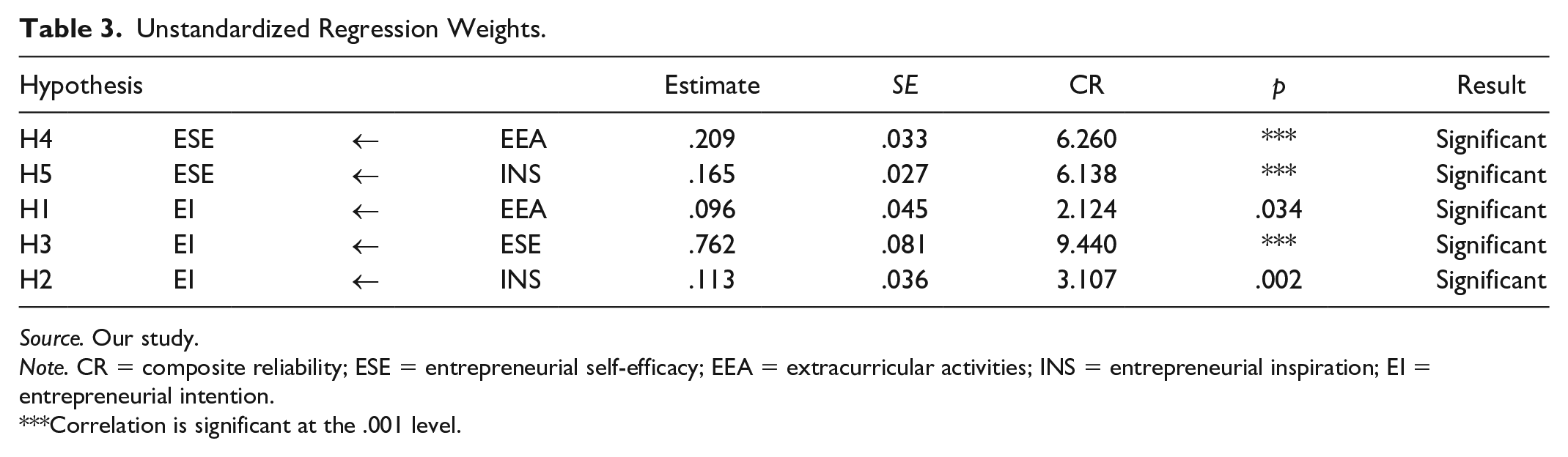
To investigate the indirect effect of factors on entrepreneurial intention with the mediator role of entrepreneurial self-efficacy, we applied bootstrapping method. Bootstrapping confidence interval estimates is the most effective way of testing the mediation role (Preacher & Hayes, 2008). This study applied 2,000 bootstrap samples with a confidence level of 95%. The analysis of this modified model revealed that the structural model meets the goodness-of-fit criteria, which indicates that all hypotheses of the theoretical model are supported (Table 3). From the data we gathered, taking part in extracurricular activities has a significant impact on students’ self-efficacy (standardized β = .334***), which supports H4, and entrepreneurial inspiration was found to directly and significantly affect entrepreneurial self-efficacy (standardized β = .299***) supporting H5.
Unstandardized Regression Weights.
Source. Our study.
Note. CR = composite reliability; ESE = entrepreneurial self-efficacy; EEA = extracurricular activities; INS = entrepreneurial inspiration; EI = entrepreneurial intention.
Correlation is significant at the .001 level.
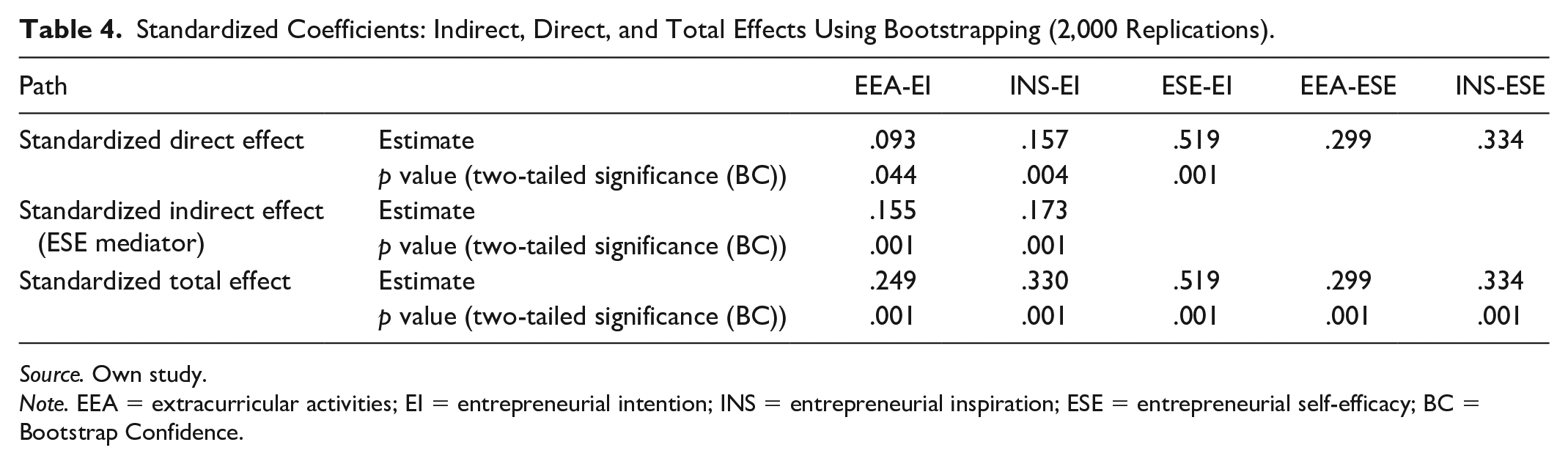
Meanwhile, the relation between entrepreneurial self-efficacy and entrepreneurial intention is also significant (standardized β = .519***), which supports H3. Our study reveals that self-efficacy partially mediates the impact of entrepreneurial extracurricular activity and entrepreneurship inspiration on entrepreneurial intention. Entrepreneurship inspiration and entrepreneurial extracurricular activities have both significant indirect (.173*** and .155***) and direct (.157** and .093**) effects on entrepreneurial intention of students (Table 4). H6a and H6b are supported.
Standardized Coefficients: Indirect, Direct, and Total Effects Using Bootstrapping (2,000 Replications).
Source. Own study.
Note. EEA = extracurricular activities; EI = entrepreneurial intention; INS = entrepreneurial inspiration; ESE = entrepreneurial self-efficacy; BC = Bootstrap Confidence.
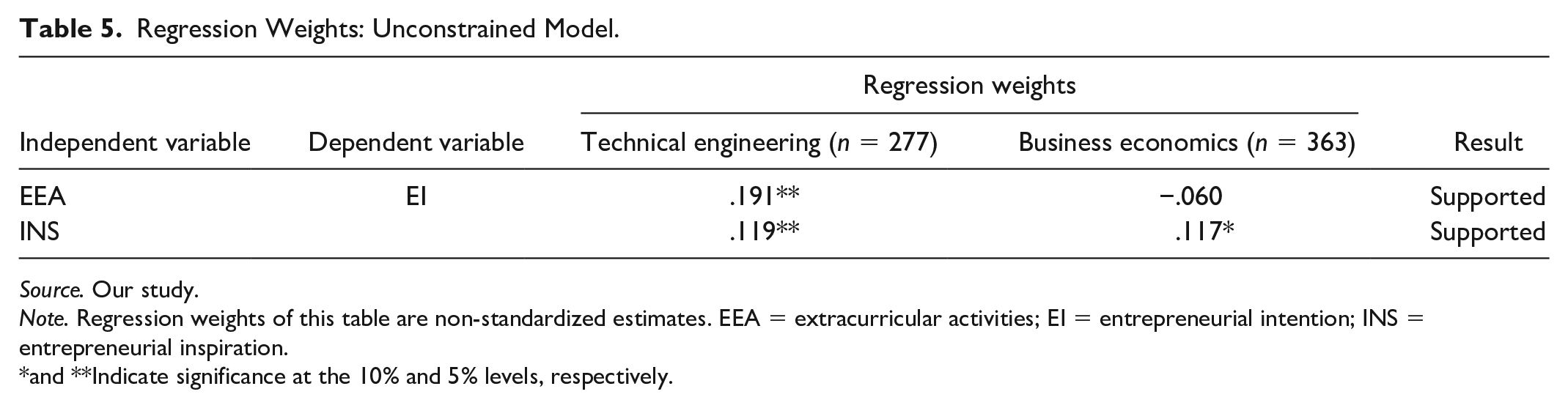
Multiple group analysis was performed to estimate the moderating effects of academic major. In this research, respondents were split into two groups based on their field of study. The first group consists of 288 respondents with science, engineering, and technical majors, whereas 352 respondents with business-economics majors are placed into the second group. The significance of the difference between the two groups was estimated by comparing the chi-square statistics of the cross-group unconstrained and constrained models. If the difference between them is significant, academic major moderates the relations between extracurricular activities, inspiration, and entrepreneurial intention. The SEM for testing academic major as moderator is shown in Table 5. The difference in χ2 value is >3.84 at the .05% significance level (p < .01). The results of the moderate effects are significant. The GFIs of unconstrained model met the recommended level (χ2/df = 1.736 < 3, TLI = 0.930 > 0.9, NFI = 0.867, GFI = 0.905, CFI = 0.938, RMSEA = 0.0354). The effect of entrepreneurship extracurricular activities on intention is not significant for the business-economics group (p > .010). The impact of entrepreneurship extracurricular activities on intention is only significant for the technical group (p < .005). Therefore, H7a is supported; academic major fully moderates the relation between extracurricular activities and entrepreneurial intention. The results indicate that entrepreneurship inspiration significantly and positively affected intention for both business (β = .117, p < 0.05) and non-business (β = .119, p < .01) groups (Table 5). This has also showed that the effect of entrepreneurship inspiration on entrepreneurship intention was stronger for non-business group than the business group. Therefore, H7b is supported; academic major partly moderates the relation between inspiration and entrepreneurial intention.
Regression Weights: Unconstrained Model.
Source. Our study.
Note. Regression weights of this table are non-standardized estimates. EEA = extracurricular activities; EI = entrepreneurial intention; INS = entrepreneurial inspiration.
and **Indicate significance at the 10% and 5% levels, respectively.
Discussions
Findings from the research confirmed the direct impact of extracurricular activities on entrepreneurial intention. This result is consistent with the previous studies of Couetil et al. (2016) and Doan and Sung (2018). This finding supports the theoretical connection between experience-based education and entrepreneurial intention as well as sociocognitive theory. However, the finding is not in line with Arranz et al. (2017) that found extracurricular activities do not affect entrepreneurial intention. The inconsistent finding may result from the fact that our sample includes students in both business-economics and non-business degree, while Arranz et al.’s (2017) research was conducted on sample of business and marketing students only. The field of study may have a certain role in explaining this inconsistent result. The context of high collectivistic culture in Vietnam may reinforce the impact (Bae et al., 2014).
Similarly, entrepreneurial inspiration relation with entrepreneurial intention is confirmed. This is consistent with the findings of Souitaris et al. (2007) and Nabi et al. (2018), who argued that entrepreneurial inspiration can move the individual toward entrepreneurship, and entrepreneurship inspiration rather than knowledge and learning in university increases entrepreneurial intention. The change in hearts and minds from these various types of inspiration activities leads to higher entrepreneurial intentions. This illustrates a strong emotional rather than purely rational basis to entrepreneurial intentions (Nabi et al., 2018). Thus, it is important for education institutions to understand how students have been inspired or deterred from entrepreneurial intentions. Universities instead of teaching knowledge on entrepreneurship and business only should also encourage entrepreneurial spirits through social persuasions. Supporting previous reviews of Bae et al. (2014), Peterman and Kennedy (2003), and Saeed et al. (2014), our results again demonstrate the significant role of entrepreneurship educational emotion in influencing students’ entrepreneurial intentions.
Taking part in extracurricular activities and entrepreneurial inspiration is found to affect, directly and significantly, entrepreneurial self-efficacy. These findings concur with the results of Couetil et al. (2016) and Wu and Wu (2008), and provide certainly evidence that extracurricular activities relate to personal development, raise self-confidence, and provide the requisite skills to engage in venture creation. This finding is also in line with Nabi et al.’s (2017) and Zhao et al.’s (2005) arguments that entrepreneurship education should include wide variety of courses, activities, and experiences. Learning by doing or experience-based learning disciplines provide students critical skills needed by entrepreneurs. This result supports proposition that inspiration drives individuals’ motivational state to reduce fear of failure and increase the entrepreneur’s perceived competence (Wartiovaara et al., 2019).
The presence of positive entrepreneurial self-efficacy was shown to increase students’ entrepreneurial intentions. These results reinforce those of a previous study (Doan & Sung, 2018; Hamidi et al., 2008; Krueger et al., 2000; Liñán & Chen, 2009; Shahab et al., 2019), where self-efficacy positively influences individual intention to start a new venture. It is also consistent with the theoretical establishment of social-cognitive theory that self-efficacy is a critical factor in predicting entrepreneurial intention. Students who perceive that creating a new venture is not a difficult task are more inclined to do so.
The results of mediation effect support the theoretical argument of Arranz et al. (2017) and Krueger et al. (2000) that external factors influence entrepreneurial intention only if they affect self-efficacy, and entrepreneurial self-efficacy provides a legitimate and robust construct that can be used to evaluate education. Our findings again emphasize the role of self-efficacy as a mediator in the relation between exogenous factors and intention, which has been indicated in several previous entrepreneurship studies (Shahab et al., 2019; Zhao et al., 2005).
The findings of this research confirm that the field of study is a significant moderator of the relationship between entrepreneurship education factors and entrepreneurial intentions. The findings support the proposition of Nabi et al. (2017) that student backgrounds have an explanation for inconsistent impact of education on intention. This indicates that important differences exist between how students in various areas of study perceive entrepreneurial opportunities in their future career.
The positive impact of entrepreneurship education activities on entrepreneurial intentions is significantly stronger among technical-engineering students than business-economics students. The relation is contrast with Herman and Stefanescu (2017), who found the impact of entrepreneurship education on entrepreneurial intention is significantly different between business students and engineering students in two universities in Europe country, and the impact was stronger in business students. This result may be explained by Couetil et al.’s (2016) argument that engineering students with technical major do benefit from attending entrepreneurial orientation and extracurricular activities. Our current findings support the view that technological degrees have a higher intent to engage in entrepreneurship activities than traditional degrees on business and economics if they were well educated with entrepreneurship program and training (Roberts et al., 2014). The development of entrepreneurship among science and technical students is very potential because technical students have capacities and skills to create new products and services. This research is an empirical evidence supporting the view that it is necessary to integrate entrepreneurship education and training with scientific and technical studies within technical institutions, to facilitate spin-offs and innovative start-ups (Herman & Stefanescu, 2017). Aspiring entrepreneurs should concentrate in departments outside the school of business (Roberts et al., 2014). The effect of entrepreneurship extracurricular activities on intention was not significant for the business-economics group. This result may be explained by the argument of Arranz et al. (2017) that entrepreneurship extracurricular activities, on one hand, would enrich an individual’s business ability, experiences, which in turn increases the probability of entrepreneurship, but, on the other hand, higher levels of capabilities might create better wage employment options (higher salary opportunities, better work position), and thus decrease the preference of choosing a career as an entrepreneur. Finding a high salary job is easier for business students than technical students in low-tech developing countries as Vietnam. Business students are more interested in a public administration career as traditional long-standing importance of official government in Vietnam. The stronger connection between extracurricular activities and inspiration with entrepreneurial intention of technical students may also be resulted from the fact that entrepreneurship education in Vietnam is a starting point. Extracurricular activities and entrepreneurship education are not provided in secondary schools. For individuals who have less exposure to entrepreneurship, the impact tends to be stronger, and for those who already have high previous entrepreneurial intention, the impact is generally weaker (Graevenitz et al., 2010; Peterman & Kennedy, 2003). Entrepreneurship activities at higher education for technical students, who have limited knowledge of entrepreneurship, effectively affect their intention to create new venture.
Conclusion, Recommendations, and Future Research
The results of this study increase our understanding about the relationship between entrepreneurship extracurricular activities, inspiration, and entrepreneurial intentions. The study finds that educational factors including entrepreneurship extracurricular activities and entrepreneurship inspiration are significantly associated with entrepreneurial intentions through its effect on perceived self-efficacy. This empirical study evidences the fact that entrepreneurial self-efficacy is positively related to students’ entrepreneurial intention. Thus, enhancing student’s confidence to become an entrepreneur through self-efficacy beliefs appears to have an important impact at the early, prelaunch stage of an entrepreneurial venture. Previous studies indicated that entrepreneurial intention can be affected by entrepreneurship extracurricular activities and entrepreneurship inspiration, but the role of perceived self-efficacy remained vague, now we better understand their relations. Another interesting point from the research is that technical-engineering students acquire more benefit from participating in entrepreneurship extracurricular activities and inspiration than business-economics students do. This knowledge is important for university to design their programs in a more targeted and effective manner. The results of this study suggest several implications to promote entrepreneurial intentions through effectively designed entrepreneurship training activities:
Entrepreneurship education should incorporate diverse types of entrepreneurship extracurricular activities as supplementary to formal education curriculum. There should be an increase in interactive activities, which encourage experience-oriented pedagogical learning. Learning by doing such as group work, project, business plan and new product development competition, ideas, and workshop, which combine academic teaching with greater professional business experience, should be more emphasized.
Educators, teachers, and instructors engaged in entrepreneurship courses should be aware of their role in inspiring students with entrepreneurship spirit. Entrepreneurship education course design should include more emotional dimension that specifically provides positive emotions, for example, experiencing happiness and excitement when successfully launching a new product, and commercializing a business idea. Educators not only teach knowledge and skills but also to change perception—change “hearts and minds” of students.
The objectives of higher education should aim not only at developing entrepreneurial intention in students through an increase in entrepreneurship awareness, motivation, and experiences but also enhancing and maximizing entrepreneurial self-efficacy needed to identify and exploit business opportunities. Entrepreneurship self-efficacy plays an important role in educational program design and achievement. It is an essential element determining the readiness to implement entrepreneurial activities. Educators should incorporate teaching activities that are principal sources of entrepreneurial self-efficacy or help students develop positive judgments about their self-capacities. Entrepreneurship program framework should use experimental design that provides successful and vicarious experiences and verbal or social persuasion, which lead to an increase in their entrepreneurial self-efficacy and, in turn, can increase the entrepreneurial intentions.
Entrepreneurship programs should develop entrepreneurship orientation activities for technical-engineering students to improve the students’ entrepreneurial self-efficacy and entrepreneurial intentions. Technical and science learning with the development of specific vocational skills must be synchronized with entrepreneurship activities and social persuasion so graduates of technical degrees, besides being qualified to work in industry, are also be attracted and qualified to create new venture leveraging their technical expertise.
This study has several limitations. This study uses only self-report measures. The cross-sectional study method limits us to see changes in intention over time. Longitudinal method, which follows individuals over time, is better for understanding the process of becoming new entrepreneurs. Future research should apply longitudinal studies to discover the relationship between extracurricular activities, entrepreneurship self-efficacy, entrepreneurial intention, and entrepreneurship behaviors. Finally, the supportive results of our study suggest that future research should fully evaluate the effectiveness of different entrepreneurship extracurricular activities components. Future research should make detailed assessments of the content, design, and delivery of each entrepreneurial extracurricular activities, which was beyond the scope of this study. Future research should explore teaching mode with best practices in entrepreneurship education discipline in the context of emerging economies.
Research Data
sj-xls-1-sgo-10.1177_21582440211032174 – Research Data for Impact of Entrepreneurship Extracurricular Activities and Inspiration on Entrepreneurial Intention: Mediator and Moderator Effect
Research Data, sj-xls-1-sgo-10.1177_21582440211032174 for Impact of Entrepreneurship Extracurricular Activities and Inspiration on Entrepreneurial Intention: Mediator and Moderator Effect by Thuy Thu Nguyen, Linh Thi Phuong Nguyen, Hoa Thi Thanh Phan and Anh Trong Vu in SAGE Open
Footnotes
Declaration of Conflicting Interests
The author(s) declared no potential conflicts of interest with respect to the research, authorship, and/or publication of this article.
Funding
The author(s) disclosed receipt of the following financial support for the research, authorship, and/or publication of this article: This research is funded by the National Economics University, Hanoi, Vietnam.
Ethical Statement
As this was a non-experimental, voluntary survey, there were no ethical issues associated with this survey. The responses were fully anonymous, and the topic of the survey was far from sensitive.

Data Accessibility Statement
The data provided as supplement file with this article. All authors endeavor to contribute the dataset for researchers who want to examine this field of study. We permit an unrestricted use of my data if our article is accepted for publication. Raw data was deposited in the Mendeley repository as a Microsoft Excel file. doi: 10.17632/bcjdytpkn3.1
References
Supplementary Material
Please find the following supplemental material available below.
For Open Access articles published under a Creative Commons License, all supplemental material carries the same license as the article it is associated with.
For non-Open Access articles published, all supplemental material carries a non-exclusive license, and permission requests for re-use of supplemental material or any part of supplemental material shall be sent directly to the copyright owner as specified in the copyright notice associated with the article.
