



Abstract
Layered Curriculum is a method developed by Kathie F. Nunley to differentiate classroom instruction through activities classified under C, B and A layers. Many studies in the literature report that this method has positive contributions to students despite some limitations and difficulties of use within classroom settings, including student management and time constraints. In order to address this issue, we came up with an idea to adapt and implement Layered Curriculum in a university course through out-of-school activities such as visiting museums, going to the cinemas, theaters or concerts. Therefore, the aim of this case study was to evaluate the 14-week implementation with 327 teacher candidates enrolled in various teacher education programs at a state university in Türkiye. We collected the data through an open and closed-ended questionnaire and performed a frequency and inductive analysis. Our findings showed that Layered Curriculum can effectively be designed to support the content of a course through out-of-school activities, and such an implementation has a positive impact on students. These findings also resulted in some suggestions for future practice and research.
Plain Language Summary
Layered Curriculum is a teaching method designed to address different student learning needs through activities grouped into three layers. However, when used only in classroom settings, it often presents challenges like keeping students engaged and managing limited time. To overcome these issues, this study adapted the Layered Curriculum model for use outside the classroom. In a 14-week course, 327 teacher candidates from a Turkish university participated in Layered Curriculum activities, such as visiting museums or going to the cinema. Based on feedback through a questionnaire and the analysis, we found that the Layered Curriculum approach can positively impact student learning when combined with out-of-school activities. Our study also offers practical tips for others interested in using this approach in future courses.
Introduction
Layered Curriculum was developed after the 1980s by Dr. Kathie F. Nunley, who work in the field of educational psychology (Ilıman & Evin Gencel, 2018; Koç Akran, 2018; Nunley & Evin Gencel, 2019; Yılmaz & Gültekin, 2013). The aim of this method is to enable all students to progress according to their chosen path, pace, learning styles and levels, and contribute to the development of high order thinking skills (Başbay, 2005; Canbulat et al., 2019; Ilıman & Evin Gencel, 2018; Kahraman & Gündoğdu, 2021; Nunley, 2003).
Layered Curriculum allows students to choose freely from a wide variety of tasks ranging from simple to complex (Koç & Şahin, 2014). These tasks are structured around three interrelated layers – C, B and A – based on Bloom’s taxonomy to reach the objectives of a course (Nunley, 2003; Önel & Derya Daşcı, 2018). Accordingly, layer C involves tasks for knowledge and comprehension, layer B for application and analysis and layer A for synthesis and evaluation (Nunley & Evin Gencel, 2019). Layer C is the bottom step, which aims to develop students’ basic knowledge and skills related to the subject. If students fail to grasp these basics, they may face difficulties in the other layers. Therefore, there should be more task options in this step, generally around 15 to 20, although it may vary depending on the subject area (Kılınçaslan & Özdemir Şimşek, 2015; Nunley & Evin Gencel, 2019). Layer B is the next step where students apply or analyze the knowledge and skills acquired in the previous one. In this step with generally three to five task options, students engage in activities involving, for example, application, discussion, questioning, testing and making inferences. Finally, layer A is the last step that requires students to use their higher order thinking skills. In this step, students are presented with typically five to seven task options, which focus on forming opinions, criticizing, making decisions and developing original and creative works (Nunley & Evin Gencel, 2019).
An examination of the literature reveals that the majority of the studies on Layered Curriculum have been conducted in the courses of natural sciences and mathematics (Aydoğuş & Ocak, 2011; Blackwood et al., 2007; Demirel et al., 2006; Duman & Özçelik, 2017; Gömleksiz & Biçer, 2012; Kılınçaslan & Özdemir Şimşek, 2015; Koç Akran, 2018; Koç Akran & Gürbüztürk, 2019; Koç Akran & Üzüm, 2018; Önel & Derya Daşcı, 2018; Z. Yıldırım & Albayrak, 2017; Yıldırım Yakar & Albayrak, 2018, 2019; Yılmaz & Gültekin, 2013). There are also other studies in the courses of social sciences (Başbay, 2005, 2008; Bilgili et al., 2020; Canbulat et al., 2019; Gömleksiz & Öner, 2013; Gün, 2013; Karagül, 2018; Koç & Şahin, 2014; Miller & Tratch, 2011; Öner et al., 2014), English language (Field et al., 2010; Ilıman & Evin Gencel, 2018; Kahraman & Gündoğdu, 2021; Koç Akran et al., 2019; Melendy, 2008; Orakcı, 2019; Üzüm & Pesen, 2019; Üzüm & Pesen, 2020) and Informatics (Zeybek, 2021).
The literature also shows that the studies on Layered Curriculum were carried out with secondary school students (Aydoğuş & Ocak, 2011; Başbay, 2005, 2008; Bilgili et al., 2020; Canbulat et al., 2019; Demirel et al., 2006; Duman & Özçelik, 2017; Gömleksiz & Biçer, 2012; Gömleksiz & Öner, 2013; Gün, 2013; Karagül, 2018; Kılınçaslan & Özdemir Şimşek, 2015; Koç Akran, 2018; Koç Akran et al., 2019; Koç Akran & Gürbüztürk, 2019; Koç Akran & Üzüm, 2018; Koç & Şahin, 2014; Z. Yıldırım & Albayrak, 2017; Yıldırım Yakar & Albayrak, 2018, 2019; Yılmaz & Gültekin, 2013), with high school students (Blackwood et al., 2007; Field et al., 2010; Ilıman & Evin Gencel, 2018; Kahraman & Gündoğdu, 2021; Orakcı, 2019; Öner et al., 2014; Üzüm & Pesen, 2019, 2020; Zeybek, 2021), with university students (Evin Gencel & Saracaloğlu, 2018; Melendy, 2008; Önel & Derya Daşcı, 2018) and with primary school students (Miller & Tratch, 2011). These studies generally investigated the effects of Layered Curriculum in various courses on achievement, attitude, self-regulation, retention in learning, metacognitive awareness, cognitive learning level, reading comprehension and writing skills, mental skills, cognitive activity speed, learning styles, problem solving skills, reflective thinking and self-learning readiness, as well as the opinions of teachers, teacher candidates and students regarding the Layered Curriculum method. In addition to the studies above, Nunley (2003) and Nunley and Evin Gencel (2019) also did literature review studies providing information on this method.
According to the findings of the studies, Layered Curriculum had a positive impact on achievement (Aydoğuş & Ocak, 2011; Duman & Özçelik, 2017; Field et al., 2010; Gömleksiz & Biçer, 2012; Gömleksiz & Öner, 2013; Kahraman & Gündoğdu, 2021; Orakcı, 2019; Üzüm & Pesen, 2019; Yıldırım Yakar & Albayrak, 2018; Zeybek, 2021). However, a study by Demirel et al. (2006) reported that it has no effect on achievement. On the other hand, the qualitative findings of the studies demonstrated that it made positive contributions to the learning and teaching processes. These findings emphasized that Layered Curriculum is enjoyable and fun (Aydoğuş & Ocak, 2011; Canbulat et al., 2019; Evin Gencel & Saracaloğlu, 2018; Gömleksiz & Biçer, 2012; Gün, 2013; Ilıman & Evin Gencel, 2018; Kahraman & Gündoğdu, 2021; Kılınçaslan & Özdemir Şimşek, 2015; Koç Akran, 2018; Koç Akran & Gürbüztürk, 2019; Önel & Derya Daşcı, 2018; Zeybek, 2021), facilitates learning (Evin Gencel & Saracaloğlu, 2018; Gömleksiz & Öner, 2013; Kahraman & Gündoğdu, 2021; Kılınçaslan & Özdemir Şimşek, 2015; Orakcı, 2019; Yılmaz & Gültekin, 2013; Zeybek, 2021) and increases interest in the lesson (Gömleksiz & Biçer, 2012; Gün, 2013; Kahraman & Gündoğdu, 2021; Koç Akran, 2018; Önel & Derya Daşcı, 2018; Zeybek, 2021). It also helps students take responsibility for learning (Demirel et al., 2006; Koç Akran, 2018; Koç Akran & Gürbüztürk, 2019; Koç Akran & Üzüm, 2018; Orakcı, 2019), encourages active participation in the lesson (Demirel et al., 2006; Kahraman & Gündoğdu, 2021; Koç Akran, 2018; Koç Akran & Üzüm, 2018; Zeybek, 2021) and provides revision (Gömleksiz & Biçer, 2012; Gömleksiz & Öner, 2013). In addition, it encourages students to do research (Gömleksiz & Biçer, 2012; Gömleksiz & Öner, 2013; Koç Akran & Üzüm, 2018; Önel & Derya Daşcı, 2018; Üzüm & Pesen, 2020), motivates them toward the lesson (Başbay, 2005; Ilıman & Evin Gencel, 2018; Kahraman & Gündoğdu, 2021; Koç Akran, 2018; Koç Akran & Üzüm, 2018; Orakcı, 2019) and promotes retention in learning (Canbulat et al., 2019; Evin Gencel & Saracaloğlu, 2018; Gömleksiz & Biçer, 2012; Gömleksiz & Öner, 2013; Ilıman & Evin Gencel, 2018; Önel & Derya Daşcı, 2018; Orakcı, 2019; Zeybek, 2021). Moreover, it increases students’ self-confidence (Gün, 2013; Ilıman & Evin Gencel, 2018; Kahraman & Gündoğdu, 2021; Koç Akran, 2018; Orakcı, 2019; Zeybek, 2021), addresses diverse individual needs (Demirel et al., 2006; Koç Akran, 2018; Koç Akran & Üzüm, 2018) and helps them become open to criticism (Koç Akran, 2018; Yılmaz & Gültekin, 2013). Furthermore, it enables students to easily transfer what they have learned, challenges them to create original works and encourages them to come up with solutions to the problems they encounter (Koç Akran, 2018). Additionally, it develops students’ imagination, gives them the opportunity to see their learning deficiencies and enhances their skills in preparing homework (Önel & Derya Daşcı, 2018). Finally, it develops collaboration skills (Yılmaz & Gültekin, 2013), strengthens student interaction (Ilıman & Evin Gencel, 2018), improves self-regulation skills (Kahraman & Gündoğdu, 2021), facilitates decision-making (Orakcı, 2019), enhances language skills (Üzüm & Pesen, 2020) and helps students to concretize subjects (Zeybek, 2021). Last but not least, a qualitative study by Bilgili et al. (2020), which was conducted on the effectiveness of Layered Curriculum supported by the Theory of Multiple Intelligences, confirms that it promotes learning, provides revision opportunities, encourages students to do research and increases active participation and interest in the lesson.
While most of the above studies highlighted the advantages of Layered Curriculum in classroom settings, they also identified its limitations. Some studies reported that it is difficult to control all students during the activities, and manage the ones with low interest in the classroom especially when they negatively affect the others with high participation (Gömleksiz & Biçer, 2012); students are sometimes not interested in the lesson, they exhibit disruptive behavior for class order until their turn for the activities, they prefer to do the activities at home and chat in the classroom instead, the high number of students and the physical conditions of the classrooms are not suitable for implementing Layered Curriculum (Demirel et al., 2006); every lesson topic is not appropriate for this method (Aydoğuş & Ocak, 2011); there is too much noise in the classroom during its practices (Başbay, 2005; Demirel et al., 2006; Gün, 2013); effective time management is difficult and more time is needed (Demirel et al., 2006; Gün, 2013); paper-based activities are boring for students (Gün, 2013) and students encounter problems in preparing materials during in-class Layered Curriculum activities (Koç Akran et al., 2019).
The Rationale, Purpose and Significance of the Study
The limitations reported by the studies, which mostly focus on Layered Curriculum practices within traditional classroom settings, revealed a significant research gap that this study specifically addresses. Accordingly, the documented positive contributions of this method to learning prompted us to explore how it could be implemented more effectively. This exploration led us to an innovative idea to adapt and employ it through out-of-school activities. By doing so, we intended to overcome the obstacles during in-class activities such as student management, large class size, time constraints and inappropriate physical conditions. The rationale behind utilizing out-of-school activities in our study can also be grounded in their benefits for university students. The literature offers some perspectives on the positive impacts of out-of-school activities regarding the academic, personal and social development of university students. For example, Wang (2024) concluded in a study that these activities improve students’ interest and motivation in learning, promote the integration and application of knowledge and broaden their horizons. In addition, Ribeiro et al. (2023) found that they positively impact university students’ academic success. Moreover, Nassar et al. (2024) demonstrated that students participating in such activities have better academic performance and greater satisfaction with their university experience. Furthermore, Diniaty and Kurniati (2014) disclosed that out-of-school activities strengthen students’ personal development. In another study, Javed and Srivastava (2024) revealed that these activities promote personal development, essential skills such as communication, social interaction, and the discovery of diverse hobbies and passions, ultimately contributing to holistic development in higher education. Similarly, Hasegawa (2018) added that out-of-school activities for university students can help achieve and improve various skills, such as communication, collaboration, leadership, scheduling and problem finding and solving. Bekova and Kasharin (2018) also showed that these activities help them acquire social capital while interacting with a wider circle of people.
Given these benefits of out-of-school activities, the literature also suggests the integration of such activities into the formal education processes. For example, Nassar et al. (2024) recommended integrating such activities into academic programs. Anzivino and Rostan (2017) also added that university experience is not limited to class attendance, so students may engage in various out-of-class activities, which may influence students’ performance and career. Similarly, Williams (1999) highlighted that learning can extend beyond the boundaries of a classroom since out-of-class learning opportunities can be just as educationally rich as classroom activities, and thus institutions should encourage students to take full advantage of these resources. On the other hand, Derous and Ryan (2008) noted that these activities can be beneficial for students’ academic outcomes when relevant for their academic study and performed in a balanced way. In an effort to achieve such a relevancy and balance, we decided in the study to integrate Layered Curriculum through out-of-school activities into the two units of the course “Introduction to Education,” which are the historical and social foundations of education. This was a university course given to teacher candidates at Faculties of Education in Türkiye and its two units were highly suitable for such an implementation. For example, visiting a madrasa or a museum could be planned as an activity to support the unit of the historical foundations of education.
To sum up, the main purpose of this study was to investigate the effects of the Layered Curriculum implementation through out-of-school activities designed for the two units of the course “Introduction to Education,” namely historical and social foundations of education. In order to achieve this purpose, the study aimed to answer the question “How do students evaluate the adapted Layered Curriculum practices?.” This study may significantly contribute to researchers and educators by offering a novel perspective on effectively adapting and integrating Layered Curriculum into the courses through out-of-school activities. It may also serve as a model to adapt other classroom-based methodologies with similar constraints through authentic out-of-school learning experiences.
Methods
Research Design
This is a qualitative case study. A case study is a research method that allows for an in-depth examination of a phenomenon or event by focusing on the questions of “how” and “why” (A. Yıldırım & Şimşek, 2016). According to Ceylan Çapar and Ceylan (2022), a case study is the most appropriate design if the aim is to describe a situation. Since our research focuses solely on the implementation of Layered Curriculum through out-of-school activities in a university course, it can be considered as a single-case study (Berg, 2001, p. 229). In addition, our research was also planned as a pilot study for larger-scale future studies. In this respect, it can be regarded as an exploratory case study, which “may be useful as a pilot study, for example, when planning a larger, more comprehensive investigation” (Berg, 2001, p. 230).
Participants
The study was conducted with 327 university students taking the course “Introduction to Education” in various teacher education programs at a Faculty of Education in Konya, Türkiye. We adopted convenience sampling since our study was based on these students’ experiences of Layered Curriculum implementation through out-of-school activities. All the students in the course given by the second author participated in the study voluntarily. The department and gender distribution of these participants is presented in Table 1.
The Distribution of the Participants.
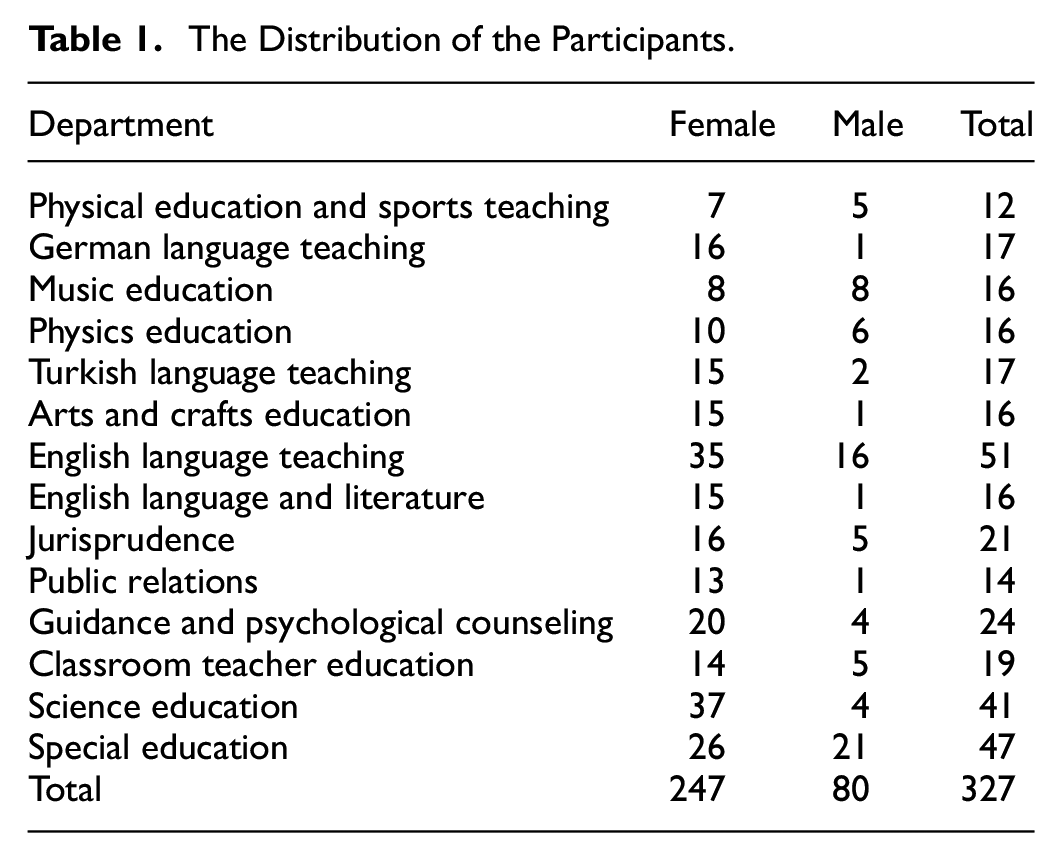
One can argue that the number of our participants is too high for a qualitative study and more appropriate for a quantitative one. However, the methodological decision to employ a larger sample size in qualitative research reflects an intentional emphasis on breadth over depth, which is a legitimate and recognized approach in qualitative inquiry. Firstly, Yıldız (2017) states that the purpose of the research is the most important criterion in determining the number of participants. Patton (2002, p. 227, 228, 244) also maintains that no fixed rules exist for sample size in qualitative inquiry and this decision should be guided by some factors such as the purpose of the study, usefulness, available time and resources. Patton elaborates that depending on these factors, qualitative researchers can opt to focus on studying specific experiences across many participants (seeking breadth) or exploring a wider range of experiences with fewer participants (seeking depth). According to Patton, while in-depth data from fewer participants can be valuable when cases are information-rich, broader data from more participants can better document diversity and variation within a phenomenon. Patton concludes that both approaches are equally valid alternatives rather than choices between good and bad. In addition, Glesne (2016, p. 52) reinforces this perspective by noting that researchers can achieve greater breadth by conducting “one-time interviews with more people and fewer observations in more situations.” Finally, Saldaña (2016, p. 135) emphasizes that qualitative inquiry allows for richer, language-based insights into participants’ values, beliefs and perceptions, which fixed-response quantitative scales may not fully capture. As a result of these remarks, we can argue that the large sample size represents a methodologically sound decision aligned with our research purpose of exploring diverse student experiences with Layered Curriculum implementation. We preferred breadth over depth to achieve the aims of the study. By doing so, we prioritized the richness of the qualitative data over statistical inference, which is consistent with the exploratory nature of our research. Our intention was also to gain an understanding of students’ perspectives rather than to generalize findings to a larger population.
Procedure
First of all, it may be useful to emphasize some theoretical points about our implementation in this study. As mentioned before, the study investigated the implementation of Layered Curriculum through out-of-school activities with the aim of supporting the two units of the course “Introduction to Education.” It should be noted that our implementation was an adaptation, not a typical version of Layered Curriculum because it did not perfectly conform to its general guidelines. Therefore, such an adapted implementation constituted an unusual case. We believe that this is an advantage because, as suggested by Stake (1995), an untypical case may help to reveal what we miss in typical ones. Layered curriculum, in its typical version, is used to achieve the objectives of a course. It includes various tasks for these objectives at different cognitive levels in the C, B and A layers addressing diverse intelligences and learning styles. Students are supposed to choose from and complete adequate tasks to achieve the required score for each layer. Otherwise, they cannot proceed to the next one. The tasks are typically done and evaluated orally within the classroom setting. Accordingly, while the students are working on the tasks, the teacher moves around the classroom and asks some evaluation questions to those who have completed. As explained earlier, this use of Layered Curriculum within the classroom causes some problems such as student management, large class size and time constraints. In order to minimize these problems and benefit from its positive contributions to learning, we adapted and implemented this method in our study through out-of-school activities. To elaborate, our adaptation differed from the typical version of Layered Curriculum in five ways:
(a) The tasks were all out-of-school activities.
(b) The tasks were designed in a such way to support the content of the course. However, their expected function was not to directly achieve the objectives of the course, but to enable students to make the content more meaningful based on their out-of-school experiences. Instruction was already given during the regular classes to cover those objectives.
(c) It was compulsory to do all the tasks in layer C just to ensure that all students took part in each activity. We thought this was necessary, for example, to encourage students who had never been to the cinema or theater before.
(d) Only one task was given in layer B and A to keep it simple and convenient.
(e) The evaluation was not done orally through questions by the teacher; it was only checked whether each student successfully completed the task or not.
On the other hand, our adapted implementation in this study were the same as the typical version of Layered Curriculum in two ways: (a) Students could not proceed to the next layer without getting the required score. (b) Tasks were designed to address diverse intelligence and learning styles.
Regarding our implementation in practice, it lasted 14 weeks throughout the semester. In the first week of the Introduction to Education course, we explained the following guidelines to the students:
(1) You are expected to do the tasks shown in the table by the final week of the course.
(2) Every week after class, you are supposed to give evidence for the tasks you have done up to that day. The evidence for reading books is book summaries. For others, it can be activity tickets or photos that include you.
(3) In order to reach layer B, you are expected to achieve all the tasks in layer C. If so, you will get 60 points. If not, you will get as many points as the tasks you have done, but you cannot move up to layer B. For example, if you only read two books, you get 20 points. Finally, to get to layer A, you are supposed to accomplish the task in layer B.
(4) You will be given information in class on how to write a reflective and evaluation essay.
(5) The total score you receive from this implementation will constitute 30% of your final grade.
We intended through the tasks in Table 2 to enrich and reinforce the two units of the course, the historical and social foundations of education. The activities were carefully designed to align with the underlying layers of Layered Curriculum by addressing different cognitive levels. The C layer tasks, such as visiting historical sites, attending cultural events and reading books, aim to provide foundational knowledge and firsthand experiences that support students’ comprehension of the historical and social foundations of education. For instance, visiting madrasas may enhance students’ understanding of the historical foundations of education previously discussed in class. Similarly, the books recommended for the reading tasks have the potential in content to broaden their knowledge about the social foundations of education. These activities expose students to real-world educational contexts, ensuring they acquire essential background knowledge before progressing to higher layers. Additionally, they could naturally contribute to their intellectual development as teacher candidates. For example, the students who had never been to the theater would have the opportunity to experience it thanks to this practice. Perhaps, this cultural activity would become a daily habit for them. On the other hand, the B layer task, writing a reflective essay, encourages students to analyze and interpret their experiences, fostering critical thinking and deeper engagement with the subject matter. Finally, the A layer task, writing an evaluation essay, requires students to synthesize and evaluate their learning, form opinions, and construct well-supported arguments, demonstrating higher-order thinking. By structuring tasks in this way, we aimed to ensure that students move from basic knowledge acquisition to application and ultimately to critical evaluation, accurately reflecting the principles of Layered Curriculum.
List of Activities in the Layered Curriculum Implementation.
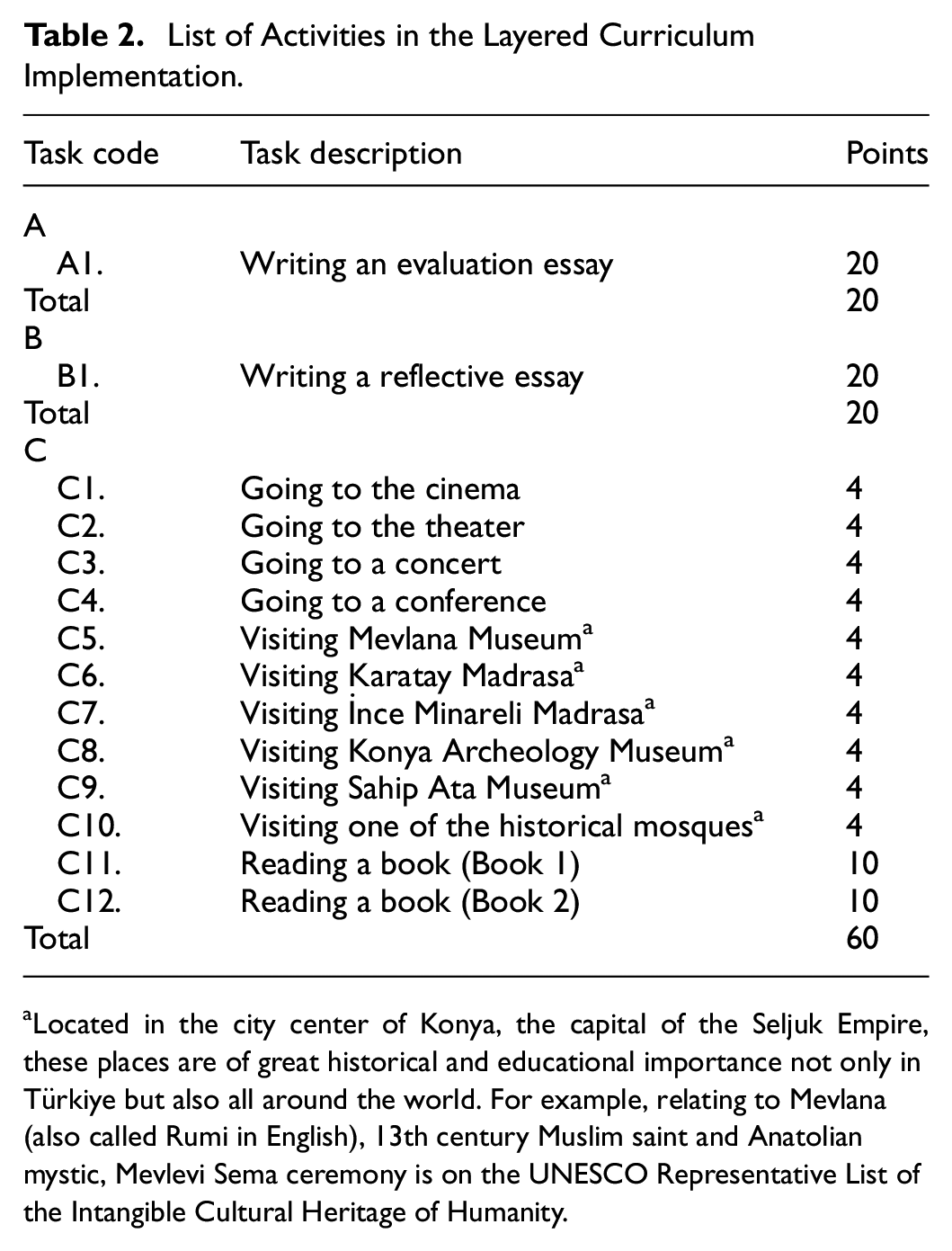
Located in the city center of Konya, the capital of the Seljuk Empire, these places are of great historical and educational importance not only in Türkiye but also all around the world. For example, relating to Mevlana (also called Rumi in English), 13th century Muslim saint and Anatolian mystic, Mevlevi Sema ceremony is on the UNESCO Representative List of the Intangible Cultural Heritage of Humanity.
Data Collection and Analysis
We collected the research data through a retrospective questionnaire to evaluate the impact of the implementation based on the students’ opinions. The questionnaire, which was developed by the researchers, included six closed and one open-ended questions. The closed-ended ones were: “Which of the activities had you never done until you did in this implementation?; Which tasks in layer C did you achieve?; Were you able to fulfil all the tasks in layer C?; What are the tasks you couldn’t accomplish in layer C?; Did you write a reflective essay?; Did you write an evaluation essay?.” The open-ended question was “What would you like to say about this implementation?.” Students completed the questionnaire in the final week of the course.
We performed frequency analysis for the closed-ended questions, and inductive analysis for the open-ended one. According to Johnson (2015), inductive analysis is to examine a data set and draw inferences by organizing what is observed within the data. To ensure consistency, the inductive coding process was managed by the second and fourth researchers using Microsoft Excel software. Initially, they independently read and familiarized themselves with the entire dataset of students’ written comments. Afterward, they performed a pilot coding on three sample documents to establish a shared coding perspective by discussing and comparing their initial codes. Following this phase, each researcher individually coded the entire dataset in Excel spreadsheets, which facilitated systematic documentation and comparison. They then calculated intercoder reliability using the formula proposed by Miles and Huberman (1994), which yielded a coefficient of 0.71. Any coding discrepancies were resolved through detailed discussion and mutual agreement. Finally, they collaboratively grouped the finalized codes into categories and derived main themes based on conceptual similarities.
Findings
The findings obtained from the data analysis are presented under two main subheadings: “findings on the completion of the tasks” and “findings on the evaluation of the implementation.”
Findings on the Completion of the Tasks
Table 3 displays the findings from the frequency analysis of the responses to the closed-ended questions so as to describe the students’ performance of the tasks in our Layered Curriculum implementation.
Findings on the Completion of the Tasks.

As seen in Table 3, there were students who had not previously taken part in some cultural activities until they did in this implementation. For example, about one-fifth of the students had never been to a conference or theater, and one-sixth had no prior experience with museums or concerts. This is a remarkable finding in that such activities were somehow new for these students until our implementation. Table 3 also shows that each student performed at least one task in layer C. The most preferred task was visiting the Mevlana Museum, while the least one was going to a concert. Going to a concert was also foremost among the tasks that the students couldn’t do in layer C. This was followed by the reading of a second book and visiting some museums. Finally, 126 out of 327 students fulfilled all the tasks in layer C. These students also wrote the reflective and evaluation essays in layer B and A, in other words, they were able to accomplish all the tasks in our implementation.
Findings on the Evaluation of the Implementation
Our inductive analysis of the students’ comments on the implementation revealed three main themes, namely “positive aspects,”“negative aspects” and “suggestions.” We also identified two sub-themes under the theme of suggestions: “suggestions for tasks” and “suggestions for the implementation.”Table 4 presents these themes and codes.
Findings on the Evaluation of the Implementation.
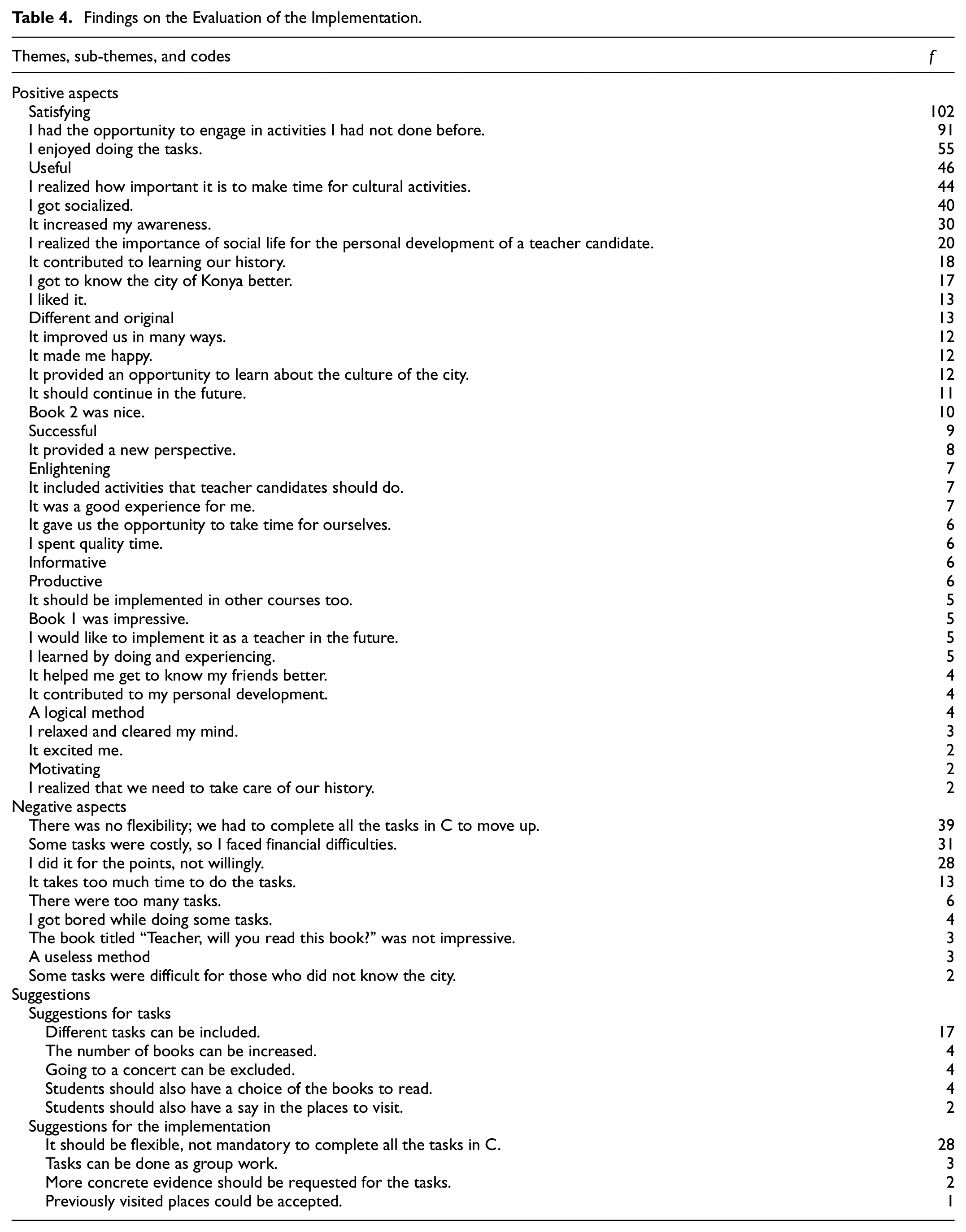
Based on the findings in Table 4, one can infer that our Layered Curriculum implementation in the course had a positive impact on the students. For example, they frequently commented that that it was “satisfying,” and “useful,” and that they “enjoyed doing the tasks.” The students also referred to some positive contributions of the implementation. For instance, they mostly stressed that they had the opportunity to do the activities not experienced before, realized the importance of making time for cultural activities, got socialized, increased their awareness and recognized the importance of social life for the personal development of a teacher candidate. Finally, other ideas with lower frequency such as “It contributed to learning our history,”“I liked it,”“different and original,”“It improved us in many ways” and “I learned by doing and experiencing” also express students’ great satisfaction with the implementation.
On the other hand, the students stated some negative aspects of the implementation. Firstly, some students especially criticized the inflexibility, that is to say, the necessity to complete all the tasks to progress from one layer to the next. Secondly, they explained that they had financial difficulty doing the tasks such as going to concerts, cinemas and theaters where they had to pay for the tickets. Thirdly, some students affirmed that they did the tasks unwillingly just to get the points for the course. Finally, the rest of the negative ideas with lower frequency focused on the high number of the tasks and large amount of time needed to do them.
Lastly, the students made some suggestions for the tasks and the implementation. They particularly offered to include more different tasks. Among the most emphasized task suggestions were “becoming a member of an NGO or a community, planting trees, watching documentaries, collecting books, writing book reviews and travel articles.” Other task-related suggestions involved increasing the number of books to be read, excluding the task of concert, having a say in the books to read and the places to visit. Finally, the top suggestion for the implementation were ensuring flexibility in doing the tasks in layer C.
Discussion
This study investigated the effects of the Layered curriculum implementation through out-of-school activities in a university course. Firstly, our findings on the completion of the tasks revealed that approximately one-fifth of the students had been to a conference or theater, and one-sixth to a museum or concert for the first time in their lives; each student performed at least one task in layer C; the most preferred task was visiting the Mevlana Museum, and the least one was going to a concert and lastly, 126 out of 327 students successfully accomplished all the tasks in our implementation. Secondly, our findings on the evaluation of the implementation indicated that the students mostly considered it a satisfying, enjoyable and useful implementation that provided the opportunity to do activities they had not done before. On the other hand, they emphasized some of its negative aspects, which focused, respectively, on the inflexibility in completing all the tasks to progress to the upper layers, the cost of some activities, doing them unwillingly to get the points for the course, the high number of the tasks and large amount of time needed to achieve them. Finally, the students had some suggestions. Accordingly, they offered some new tasks such as becoming a member of an NGO or a community, planting trees, watching documentaries, collecting books, writing book reviews and travel articles. Other suggestions for the tasks were increasing the number of books, excluding the concert, having a say in the books to read and the places to visit. The top suggestion for the implementation was to provide flexibility in doing the tasks in layer C.
With respect to the positive aspects, our findings indicated strong overall satisfaction with the implementation. The students expressed frequently positive views about the implementation describing it as “satisfying,” stating “I enjoyed doing the tasks,” and considering it “useful.” These positive assessments align with previous research characterizing Layered Curriculum as enjoyable and fun (Aydoğuş & Ocak, 2011; Gömleksiz & Biçer, 2012; Gün, 2013; Ilıman & Evin Gencel, 2018). In addition, some students explicitly recommended that “it should continue in the future,” and “it should be implemented in other courses too.” This finding can also be attributed to the increased satisfaction that out-of-school activities offer to university students (Nassar et al., 2024).
Our findings also implied that the implementation contributed to students’ personal and social development. Arguably, the most striking finding in this regard was that the activities such as attending conferences, theaters, museums or concerts were entirely new experiences for some students prior to this implementation. This is evident in students’ frequent comments, “I had the opportunity to engage in activities that I had not done before.” The novelty of these experiences also underscores the importance of our implementation in providing authentic learning opportunities that extend beyond traditional classroom boundaries, which can be potentially as educationally rich as formal classroom activities (Williams, 1999). This finding also aligns with previous research suggesting that integrating out-of-school activities into academic programs enhances learning experiences and broadens students’ perspectives (Anzivino & Rostan, 2017; Nassar et al., 2024). Additionally, the implementation fostered greater self-awareness. For example, some students stated, “I realized how important it is to make time for cultural activities,”“It increased my awareness,”“I realized the importance of social life for the personal development of a teacher candidate” and “It contributed to my personal development.” Furthermore, the implementation promoted social engagement. This is illustrated by some students’ statements such as “I got socialized,”“I got to know the city of Konya better,”“It provided an opportunity to learn about the culture of the city” and “It helped me get to know my friends better.” As a result, these findings are consistent with the literature indicating that out-of-school activities play a crucial role in students’ personal and social development (Bekova & Kasharin, 2018; Diniaty & Kurniati, 2014; Javed & Srivastava, 2024; Wang, 2024).
Another important finding revealed that the implementation increased active participation in the tasks. We found that all the student performed at least one task in layer C, and 126 students fully accomplished the tasks in all layers. This high rate can be attributed to the fact that the tasks addressed students’ diverse intelligences and learning styles. As mentioned before, Layered Curriculum enables students to progress according to their chosen path, pace, learning styles and levels (Başbay, 2005; Canbulat et al., 2019; Ilıman & Evin Gencel, 2018; Kahraman & Gündoğdu, 2021; Nunley, 2003) and increases active participation and interest in the lesson (Bilgili et al., 2020). This can also be associated with the finding of a study by Wang (2024) showing that out-of-school activities enhance students’ interest and motivation. Naturally, the other contributions of the implementation explained above may also have encouraged student participation.
Concerning the negative aspects, 201 students could not achieve the tasks in layers B and A since they were unable to fulfill all the tasks in C. As noted before, these tasks were not kept optional for the good of the students. However, our findings revealed that some students could not do the activities such as going to cinemas, theaters or concerts due to their financial difficulties in paying for the tickets. It seems that they especially found concert fees very expensive, so they suggested the exclusion of this task from the implementation. Other reasons stated by the students such as the high number of the tasks and the time needed for them may also have negatively affected their participation in the activities in layer C. Similar findings were reported in the literature (Naik & Wawrzynski, 2018; Normah, et al., 2022; White & Gager, 2007) where financial and time constraints were identified as key factors limiting participation in out-of-school learning. This suggests that while these activities can enrich learning, such barriers must be considered to ensure accessibility for all students (Javed & Srivastava, 2024). In addition, these issues may explain why students mostly criticized the lack of flexibility as one of the negative aspects of the implementation and suggested that it should not be compulsory to complete all the tasks in layer C to progress to B and A. Therefore, it would have been a better idea to provide task options especially in layer C as in the original version of Layered curriculum (Kılınçaslan & Özdemir Şimşek, 2015; Nunley & Evin Gencel, 2019). Thus, the students could have freely chosen and completed an adequate number of tasks in C to achieve the required score for the next layer.
Still another finding of the study showed that 28 students did the tasks unwillingly just to get the points to pass the course. Naturally, doing an activity out of curiosity is different from doing it because it is a task. For example, people are more willing to read a book they are interested in. Therefore, it may have been difficult for these students to do some activities with a sense of duty or homework. It seems that they also made suggestions to deal with this issue. For example, they offered a variety of new tasks that appealed to them and suggested that they should be given a say in choosing the books to read and the places to visit. These findings suggest that students desire greater autonomy in the activities of the implementation. As stated by Deci and Ryan’s (2000), autonomy plays a crucial role in fostering intrinsic motivation. Therefore, such autonomy can be achieved by providing students with more flexibility or inclusion in the activities, which may increase motivation and participation.
Conclusion and Suggestions
This study investigated the implementation of Layered Curriculum through out-of-school activities in a university course. Our findings highlighted that the implementation enhanced student satisfaction, increased active participation and fostered personal and social development by providing new experiences, greater self-awareness and social engagement. Based on these findings, we can conclude that Layered Curriculum can effectively be adapted to integrate out-of-school activities into a university course, and such an implementation has a positive impact on students.
The study has important implications for researchers, educators, curriculum designers and policymakers. Firstly, the study contributes to the existing Layered Curriculum literature by demonstrating its applicability beyond traditional classroom settings, thus broadening its theoretical framework. By integrating this method with out-of-school activities, the study extends prior research that has primarily focused on classroom-based applications with some typical challenges such as classroom management and time constraints. From a practical perspective, the study may also serve as a hybrid model for educators to integrate Layered Curriculum into their courses through out-of-school activities, offering an effective alternative for addressing the challenges in traditional classrooms. This model may also provide a novel perspective on adapting other classroom-based methodologies with similar constraints through out-of-school learning experiences. Finally, from a policy perspective, this study underscores the importance of integrating experiential learning into university curricula. Among other positive contributions of the implementation, the study revealed that out-of-school activities provided teacher candidates with entirely new authentic experiences. These newly explored experiences may help students develop a broader perspective on learning and encourage them to seek alternative ways to acquire knowledge beyond traditional classroom settings. By engaging in diverse activities, students may become more aware of the multiple avenues through which learning can occur, which could foster lifelong learning habits. Therefore, policymakers and curriculum designers should consider formally incorporating structured yet flexible out-of-school opportunities into curriculum design, particularly for teacher education programs, because such endeavors may also help equip future educators with innovative teaching strategies.
The study also provides practical suggestions for future implementation. Our findings indicate that addressing issues such as lack of flexibility, financial difficulties, time constraints and autonomy is essential for successful adoption. To that end, the tasks that may be costly for students should be avoided or supplemented with alternative options. It would also be beneficial to maintain flexibility by offering a range of task options for students, especially in Layer C as in the original version of Layered curriculum. In addition, involving students in the planning of tasks could enhance student engagement. Furthermore, the tasks can be enriched, for example, by incorporating student recommendations such as planting trees, watching documentaries or writing travel articles.
Finally, the study offers suggestions for future research. First, we assumed that implementing Layered Curriculum through out-of-school activities could enrich and reinforce the content of the course “Introduction to Education”. For instance, students visiting the Mevlana Museum could better understand Mevlana’s views on education in the unit “the historical foundations of education.” Similarly, the books recommended for the reading tasks had the potential to support the unit “the social foundations of education.” Additionally, the tasks could contribute to the intellectual development of the teacher candidates by providing new experiences. However, these assumptions should be acknowledged as the limitation of our study since we did not aim to empirically measure the direct impact of the implementation on academic achievement in course content or intellectual development. This limitation restricts our ability to draw definitive conclusions about the effectiveness of our implementation beyond student comments. Therefore, further quantitative research could examine such factors through performance assessments or longitudinal tracking of student outcomes. Second, the data was collected from a large sample through an open- and close-ended questionnaire. Regarding the aims of the study, the large sample ensured a greater breadth to document diversity and variation in students’ comments (Glesne, 2016; Patton, 2002). The open-ended responses also allowed for gaining a broad understanding of students’ perspectives on the implementation. However, we acknowledge that methodological triangulation could further strengthen the study. To overcome this limitation, future studies could incorporate multiple data sources such as interviews, focus group discussions or observations to capture a deeper understanding of student experiences and enhance validity.
All in all, the implementation of Layered Curriculum through out-of-school activities represents a promising approach to enriching higher education experiences, particularly for teacher candidates. By addressing the suggestions for implementation and pursuing the research directions recommended in the study, future work can further refine this approach and strengthen its theoretical and practical foundations.
Footnotes
Acknowledgements
Participation in the research was voluntary. The participants were informed that they could withdraw at any stage of the research and their information would be kept anonymous. This work is not currently published or under review at any other publication.

Funding
The author(s) received no financial support for the research, authorship and/or publication of this article.
Declaration of Conflicting Interests
The author(s) declared no potential conflicts of interest with respect to the research, authorship and/or publication of this article.
Data Availability Statement
The complete data that support the findings of this study are not shared due to privacy and ethical restrictions.