




Abstract
Business models (BMs) are extensively studied by academics and practitioners alike. Yet, there is still no consensus for the term’s precise interpretation, dimensions, and idiosyncratic features. Considering that the BM literature is constantly evolving and nowadays firms commercialize ideas and technologies through their BMs more than ever, this shortcoming poses a major challenge to both the academic and business community. In this vein, scholars have made concerted efforts to offer several literature reviews. Nonetheless, in the methodological front most of them rely on fragmented suggestions without clear guiding frameworks. At the conceptual level, a majority of these contributions is disproportionally oriented toward digital-driven business model innovation. In view of the steady increase in BMs’ importance within the academic and organizational milieu, we aim to revisit the literature and provide a multi-method review; with the overall scope to accommodate the diverse research objectives pertinent in the extant research and trace a future roadmap. Our combination of systematic literature review (SLR) analysis with bibliometric elements assessed 174 peer-reviewed publications and concluded in four – partly overlapping – research streams: (1) business model concept, (2) business model design, (3) business model innovation, and (4) business model portfolios. Suggestions for future research endeavors in each one of these streams are further discussed.
Plain language summary
Business models (BMs); that is, the roadmaps for organizations’ value delivery and capture activities, have emerged as a central topic of discussion in both the board rooms and scholarly discourse. However, literature in the field remains diverse and fragmented. This shortcoming prevents managers and entrepreneurs alike from acting with confidence when implementing relevant solutions in their organizations. Here, we present a comprehensive quantitative and qualitative analysis on research dealing with various aspects and dimensions of the topic. Our study clarifies how a company plans to make a profit, identifies the existing design themes for successful corporations, delves into business model innovation, and assess the phenomenon of multi-BM firms.
Keywords
Introduction
Over the past few years, ‘business models’ (BMs) have emerged as a central topic of discussion in both the board rooms (e.g., GE, 2013; IBM, 2006, 2018) and scholarly discourse (e.g., Baden-Fuller & Morgan, 2010; Bruni & Comacchio, 2023; Wirtz et al., 2016). Nowadays, we come across the term in research publications, corporate meetings, popular media, even in chefs’ books. Take the late Anthony Bourdain, for example. In the chapter ‘So You Wanna Be a Chef’ of the New York Times’ bestseller ‘Medium Raw’ (Bourdain, 2011), the author acknowledged that in spite of his bad choices in his personal and professional life, he got lucky, and ‘luck is not a business model’. Yet, despite its popularity, the BM literature still remains fragmented and inconclusive. The field has leveraged a wide range of scientific lenses; including economic assumptions (Seelos & Mair, 2007), resource, and entrepreneurial perspectives (Budler et al., 2021; K. Miller et al., 2021; Wirtz et al., 2016), organizational studies (Deken et al., 2016), international business (Child et al., 2017), network, learning, and change theories (Mason & Leek, 2008). Though insightful and useful, this conceptual diversity has converged toward defining what a business model is not (see e.g., DaSilva & Trkman, 2014; Zott et al., 2011): there is still no consensus for the concept’s precise interpretation, dimensions, and features (DaSilva & Trkman, 2014; Wirtz et al., 2016). As a result, the BM construct lacks clarity (Foss & Saebi, 2017), rehashing continuously the same arguments and working in silos (Budler et al., 2021).
This fragmentation is particularly detrimental in the strategy field, as strategy scholars and corporate leaders have for long recognized that BMs are associated with not only better organizational performance and increased competitiveness, but also with sustained growth (Foss & Saebi, 2017; Massa et al., 2017). Thus, organizations need to manage these imperatives strategically (D. Miller, 2003). This dual-objective quest affects firms in various ways: according to strategists (e.g., Foss & Saebi, 2017; Snihur & Markman, 2023), designing, developing, and implementing appropriate BMs is a powerful tool to manage tensions that may hinder firms’ ability for performance improvements, sustainable competitiveness, and long-term prosperity. Thus, a re-evaluation of the BM literature seems topical. Indeed, despite advancements in the extant research, Long Range Planning Editor’s words on the 2010 special call for papers on BMs posited that ‘there exists no clear body of literature in the academic or practitioner journals that explain how a business model works, what are its important dimensions and features and how a good business model can be created’ (the works of Ancillai et al., 2023; Broccardo et al., 2023 reached the same conclusion). It is apparent then that many vital aspects of BMs are underexplored, others need further refinement, and important questions are left unanswered. From this standpoint, an investigation on what we already know about BMs, as well as what we can explore in the future could add value to relevant inquiries.
This paper serves this purpose by assessing the following questions: (1) what is the development of the BM literature over the past two decades? (2) which are the key themes in BM research? and (3) what are the expected research avenues in the future? In an attempt to advance knowledge in these fields we systematically and comprehensively review 174 publications from highly-ranked practitioner and peer-reviewed academic journals. This procedure triggered a thematic analysis which identified the core topics that have been researched within this literature. In so doing, we inform academicians about the recent evolution on BM-related focal issues. Additionally, by unpacking the specific thematic streams within this literature, we delineate future research directions. Finally, the main findings of this review could help organizations to increase their awareness about BMs that, in the era of technology disruption, seem critical for their competitiveness and sustainability.
We structure our paper as follows: We first identify and evaluate the prior reviews conducted in the BM field, and explicate our reasoning behind an updated systematic review. Next, we present our method section; where we elaborate the guidelines adopted for our research. We then outline the development of the relevant literature to date, and identify four partly overlapping emergent research streams. We conclude by discussing our findings and suggest future research directions in each of these streams.
Business Models: Status of Current Literature Reviews
Research on BMs is a relatively young domain, tracing its origins in the mid-90s (DaSilva & Trkman, 2014; Zott et al., 2011). In the advent of the concept, its widespread use appears to be associated with the technological advancements the world has witnessed at that time (Massa & Tucci, 2014). The dot economy in particular, acted as a catalyst for business evolution: as expected, early BM research was strongly dependent on the e-business sector (Mahadevan, 2000; Shafer et al., 2005; Zott et al., 2011). As digitalization spread to all kind of industries, the BM concept has been introduced to an array of different business and management disciplines. However, there was no wide agreement concerning its precise interpretation (DaSilva & Trkman, 2014; Wirtz et al., 2016; Zott et al., 2011). Following this, Casadesus-Masanell and Zhu (2013), along with other scholars, noted that the BM is a slippery construct to study, which, in turn, makes its operationalization and measurement challenging and accumulation of knowledge difficult (Suddaby, 2010).
To consolidate knowledge in the field, there have been several reviews of the BM literature (see Table 1). Early works focused solely on the definition/conceptualization of the concept (e.g., Morris et al., 2005; Shafer et al., 2005). Whilst this pattern continues on later attempts, George and Bock (2011) and Zott et al. (2011) reached a consensus, by noting that the BM is a new – holistic – unit of analysis that emphasizes firm activities and presents opportunities for value creation. They further argued that BMs bridge the strategy literature (they explain firm’s value creation mechanisms, performance, and competitive advantage fundamentals) with innovation/entrepreneurship studies (they serve as a vehicle to commercialize new products/services or as a locus of innovation in itself). In a later review, Wirtz et al. (2016) showed that the important areas of BM research relate to the definition/conceptualization of the construct, BM design, and business model innovation (BMI); with the latter accounting for nearly half of the relevant publications at that time. Foss and Saebi (2017) review on BMI posits that this literature faces problems with regard to construct clarity – which stems from the operationalization of the construct – and identifies four significant research streams: (a) BMI conceptualization, (b) BMI as an organization’s change process, (c) BMI as an outcome, and (d) BMI – performance linkages. Massa et al. (2017) organized their findings into three perspectives: (a) BMs as attributes of real firms (that refers to what BMs do and their impacts), (b) BMs as cognitive/linguistic schemas (the cognitive structures that reside in managers’ mindsets), and (c) BMs as formal conceptual descriptions that are abstract representations of real systems. More recent attempts (Ibarra et al., 2018; Kraus et al., 2020; Ramdani et al., 2019; van de Ven et al., 2023) also study BMI – both as an outcome and as a process –, while Palmié et al. (2024) assessed the intersection of digitization, sustainability and BM literature to conclude in a strategic management framework that consolidates the BM landscape. Caputo et al. (2021) adopted similar lens and concluded in three main thematic clusters within the BM research: technological innovation, strategic management, and digital transformation.
Prior Reviews of Business Model Research.

Google Scholar, as per February 2025.
In similar directions, Palmaccio et al. (2021) offered a systematic review emphasizing the role of internet of things (IoT) in shaping and developing BMs. They have concluded that IoT impacts on BMs can be assessed in terms of changes to production processes, changes to how companies interact with their customers, and changes to (and the expansion of) BMs’ building blocks. Finally, Budler et al. (2021) analyzed existing literature in order to: (a) provide a mapping of the historical evolution of the extant research by structuring and clustering BM studies into three distinct time periods and (b) identify contemporary clusters. The authors argued that until 2011 BM research was mainly focused on the formation of the construct, between 2012 and 2015 on the consolidation of the concept, whereas between 2016 and 2019 attention has been devoted on BM impacts.
All these works have been proven valuable in advancing BM research and consolidate knowledge. However, a majority focus on BMI, and in particular its associations with the disruptive era of digitalization. Further, (mis)interpretations and vague conceptualizations of the construct still surface; therefore, the need for revisiting BM ontologies and its various research streams is evident. Finally, in an effort to systematize the growing corpus of knowledge on BMs, in their methodological approach researchers usually rely upon a single database and have resorted either to bibliometric methods or systematic literature reviews (SLRs) without clear guidelines and research protocols. However, to cite Zupic and Čater (2015, p. 436), ‘bibliometric methods are not a substitute for but a complement to traditional methods of review’. According to Marzi et al. (2024), multi-method literature reviews, combining bibliometric elements with SLRs would better frame the context of academic production upon a specific topic.
Methods
In performing our review, we combined Siddaway et al. (2019) recommendations for conducting and reporting SLRs as – to the best of our knowledge – this appears to be the most detailed guide for relevant investigations with elements of bibliometric analysis; which offer the opportunity to analyze largely populated research domains by examining influential ties in terms of key contributions, recurrent themes, on-topic journals, and chronological evolutions (Zupic & Čater, 2015). The methodological path designed here is adopted from Marzi et al.’s (2024) guidelines and consists of the following seven steps.
Step 1: Boundaries of the Study
We initiated our review by an informal literature search, in order to gain familiarity with the BM literature. During this step, we have assessed the previous reviews in the field (Table 1) and developed our research questions. This literature scanning allowed us to identify that there is scope for an updated contribution within the BM narrative. Bibliometrics (in that case, the most cited existing reviews) helped us to support the iterative process of BM definition, clarification, and refinement through a preliminary overview of the topic’s structure.
Step 2: Develop a Search Query
During this step, we have developed a search query, that is, specific keywords entered into a database to retrieve relevant documentation. By adopting Williams et al. (2021), we have used a broad search query so as to avoid the involuntary exclusion of relevant documents. For this purpose, we considered that the query ‘business model’ in the title, abstract or keywords of research publications is wide-spanning enough in nature, so as to allow us refine search outcomes further in the next phases through manual selection processes.
Step 3: Database Selection
In order to collect the relevant documents via the ‘business model’ search query, we relied upon three different electronic databases – Scopus, ISI Web of Science, and Google Scholar; which are typically adopted within management studies (Hiebl, 2023). According to Marzi et al. (2024), the inclusion of both Scopus and ISI Web of Science databases is critical for any review since these databases offer extensive bibliographic data and research material, yet they differ in technical aspects, such as coverage, indexing criteria, data extraction capabilities, and functionalities.
Step 4: Data Screening
During this stage, we screened the documents to be included in our dataset. The screening phase involved the identification of the documents from the adopted databases resulting from the search string developed during a previous step. Our search yielded 4,854 (Scopus), 4,632 (ISI Web of Science), and 23,309 (Google Scholar) results. In terms of source quality, we decided to restrict our research to the leading academic and practitioner-oriented business and management journals, as specified by the ABS List (i.e., 4*, 4, and 3 star academic and practitioner journal articles from the 2021 ABS Journal Ranking List; Academic Journal Guide, 2021). This additional restriction left us with 402 (Scopus), 246 (ISI Web of Science), and 307 (Google Scholar) relevant articles. Next, we consolidated the results and removed all duplicate publications; leading us to a final sample of 293 unique articles. Regarding the time coverage of the review, we selected the year 2000 as our starting point since, as stated before, prior literature has identified the mid-1990s as the period the BM concept has emerged in the literature.
Step 5: Data Cleaning and Export
As suggested in the second step, formulating a broad search query could lead to retrieving documents that are not aligned with our research questions (Marzi et al., 2024), therefore we should consider specific inclusion criteria. Here, in order to identify the relevant articles to be assessed in further analyses, and akin to prior reviews (e.g., Foss & Saebi, 2017; Massa et al., 2017; Zott et al., 2011), we applied as inclusion criteria: (a) that the BM topic is dealt in an essential way and (b) that the BM concept investigated is related to business organizations. As a result, by applying these criteria, 119 articles were eliminated, and thus we were left with 174 relevant articles. The articles were analyzed not only by just reading them, but by also creating a database in which we organized the important information that was retrieved.
Step 6: Bibliometric Elements
Here, we have introduced some bibliometric elements in our review. Theory posits that bibliometric analyses, in general, may be categorized into two distinct yet interrelated components: bibliometric indicators and science mapping (Marzi et al., 2024). Bibliometric indicators encapsulate a range of variables; such as authors, keywords, type of documents, and time frames pertinent to the dataset under scrutiny. In our case, we have selected the type of documents and time frames as our points of reference.
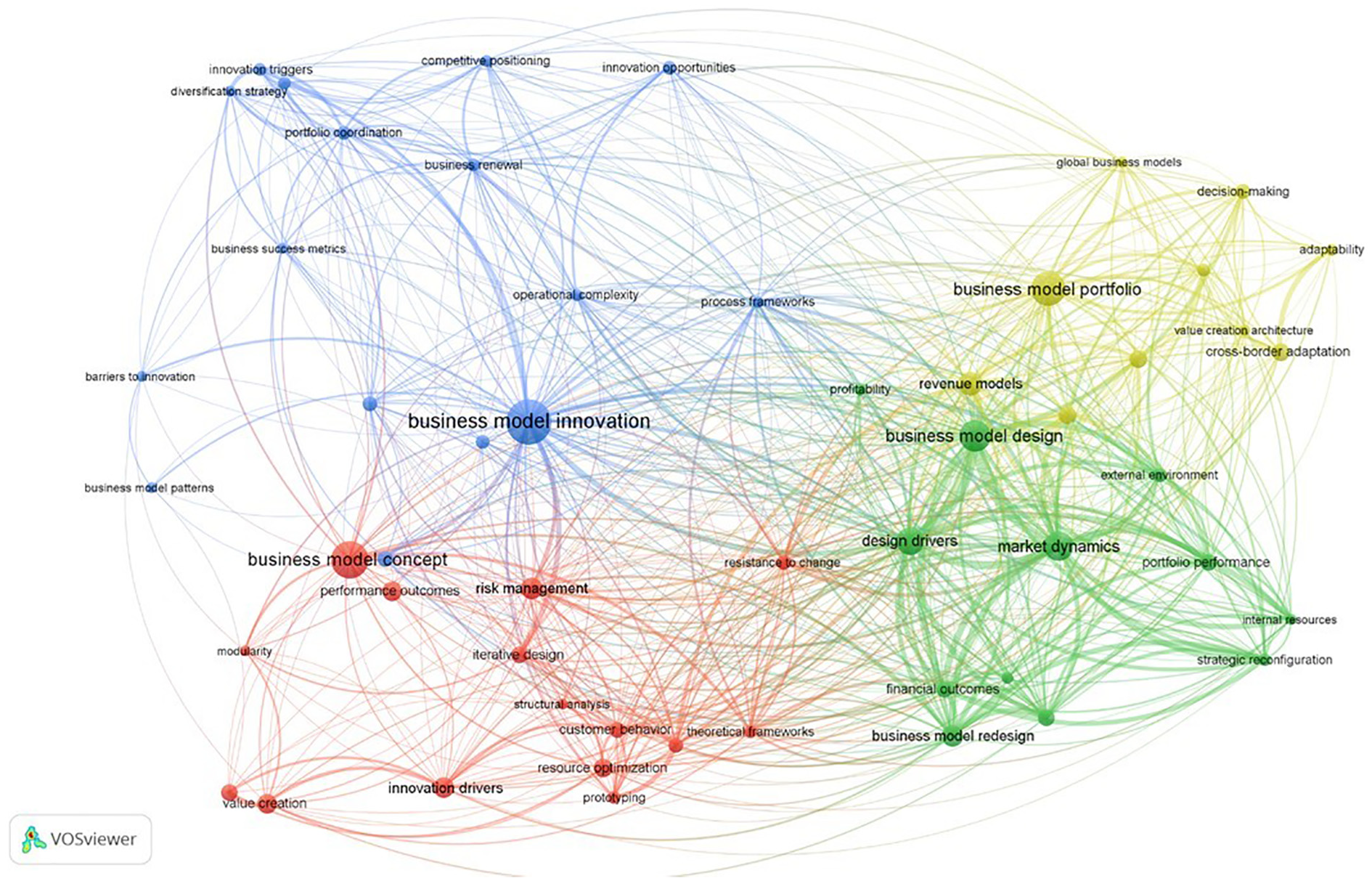
Science mapping highlights the interconnections among documents, authors, publication outlets, and keywords (Zupic & Čater, 2015). In this case, we chose co-citation analysis through keywords as a cluster algorithm for our science mapping. Co-citation analysis offers a snapshot of the field of study; we consider this relevant in our case, since our purpose was to develop an evolutionary picture of the BM field. Eventually, four clusters have emerged from our science mapping.
Step 7: Systematic Literature Review (SLR)
In this step we identify the main research topics through an iterative process based on an in-depth reading of all documents within each cluster created by VOSviewer in step six (Figure 2). We assessed the full text of all the publications included in each cluster and delved into tracing the systematization of the knowledge emerged.
Findings and Discussion
Bibliometric Analysis and Results
Descriptive Analysis
In ‘Step Six’ described in the ‘Methods’ section, we have selected the type of documents and time frames of BM research as our points of reference for the bibliometric analysis. In total, we assessed 174 research publications during 2000 to 2024 (Figure 1). We observe high spikes starting from 2010. These are mainly attributed to special issues/sections on BMs introduced by Long Range Planning (2010, 2013, 2018), Strategic Entrepreneurship Journal (2015) and Journal of Business Research (2021).

Timeline and document types distribution on retained articles (n = 174).
BM literature is dominated by academic rather than practitioner-oriented publications. Regarding the development of the literature, we identified 39 conceptual, 103 empirical and 32 miscellaneous articles (mainly literature reviews). Comparing the number of conceptual to empirical studies, we find a ratio of 3:8; while two-thirds of the empirical studies are qualitative. In the empirical specifications, a majority of the studies resorts to collecting primary data instead of employing secondary available data. Moreover, the most common empirical analysis method used is case studies (single or multiple). The next most commonly used method in the BM literature is regression analysis, either by employing questionnaires as a data collection method or expert panelists to code secondary available data in order to operationalize the various constructs investigated – followed by thematic analysis on interviews and secondary data. We further considered the retained articles by their marketspace. Around half of them are single-sector studies. The sector that BM scholars more often focus upon is technology, followed by retail, e-business, financial services and publishing and media.
Cluster Analysis
A co-citation network was formed in the study by analyzing the co-occurrence of keywords of the sampled articles. Our network consists of four clusters: red, green, yellow and blue (Figure 2). The number of articles contained in each cluster is as follows: The first cluster (green), labeled as ‘business model concept’, includes 40 relevant publications. The second cluster (blue) is labeled ‘business model design’ and includes 43 publications. ‘Business model innovation’ cluster (red) includes 71 publications, whereas the yellow cluster ‘business model portfolio’ contains 20 relevant publications.

Co-citation network (n = 174).
Systematic Literature Review
Upon examining the map generated with VOSviewer (Figure 2), we explored the content of all the documents classified within each cluster by reading the full text. The purpose was to synthesize and critically evluate the existing body of BM knowledge by employing a qualitative thematic analysis to identify, analyze and interpret relevant sub-streams and central concepts within each cluster. Results are presented in Table 2. Next, in an attempt to integrate bibliometrics with SLR, we have employed the keyword frequency as a bibliometric indicator that has helped us to craft the main lines of interpretation of the literature as a whole in each cluster (Figure 3).
Summary of Streams and Sub-streams on Business Model Research.

Visualization of key issues in each thematic area.
The Business Model Concept
This stream elucidates the BM concept itself. Nearly a quarter of the retained articles (n = 40) was classified here. These focus on the definition and conceptualization of the BM construct, the theoretical positioning of the concept and how it differentiates from other, close-related management concepts, and the recognition of patterns in the structure of BMs, as well as the development of BM typologies.
As far as the conceptualization of the construct is concerned, BM definitions range from ‘stories that explain how enterprises work’ (Magretta, 2002) to ‘the heuristic logic that connects technical potential with the realization of economic value’ (Chesbrough & Rosenbloom, 2002), and to ‘a boundary-spanning activity system that centers on focal firm, yet may encompass activities performed by its partners, suppliers, and customers in the pursuit of value creation and capture’ (Snihur & Zott, 2020). This heterogeneity in definitions also manifesrs in the BM components presented in the relevant investigations. To fully illuminate the concept’s definition, its main dimensions and constituent parts, we content-analyzed all relevant documents. We focused on studies that provide concept definitions (n = 122), and found that scholars recurrently report three main dimensions in their attempts to conceptualize the construct – that is, value creation, delivery, and capture – which are supported by multiple interdependent activities. We investigated the most-cited definitions and identified Zott and Amit’s (2010) and Teece’s (2010) contributions as the most frequently employed in our sampled articles.
We further focused on studies that provide specific components of the BM concept (n = 146). These conceptualizations offered 143 potential BM components in total, which can be systematically aggregated into 10 sub-constructs of the three overarching BM dimensions. Most components relate to value creation, which consists of six sub-constructs: (1) value proposition, (2) customer segments, (3) value network, (4) processes and structure, (5) resources, and (6) capabilities. Value delivery consists of two sub-constructs; the (7) distribution channels, and (8) customer relationships. Similarly, components of value capture can be aggregated into two sub-constructs: (9) revenue model, and (10) cost structure.
Our analysis also reveals that a limited number of scholars integrate strategy tenets into the constituent parts of the BM construct (Andries et al., 2013; Chesbrough, 2010; Chesbrough & Rosenbloom, 2002; Desyllas & Sako, 2013; Lubik & Garnsey, 2016; Malmström et al., 2015). This finding brings to the foreground the debate regarding the distinction and positioning of the BM concept relative to other, close-related management concepts (e.g., Lanzolla & Markides, 2021; Shepherd et al., 2023). Indeed, the second theme observed in this research stream is the discussion concerning the positioning and distinction of the BM concept relative to other management concepts, such as strategy, ecosystems, and value chain. Whilst scholarly views partly differ, there is strong consensus that the BM concept is a distinct unit of analysis (Zott et al., 2011).
The last theme we identify in this stream is the recognition of patterns in the structure of BMs and the development of taxonomies or typologies (cf. Lambert, 2015). Scholars propose that the BM concept enables us to categorize the corporate world and classify firms according to their marketspaces (Baden-Fuller & Mangematin, 2013; Baden-Fuller & Morgan, 2010). Some posit that BMs transcend industry boundaries, and a BM deployed by one firm in a particular industry might be adopted by another firm in a different industrial setting (e.g., Baden-Fuller & Morgan, 2010; Teece, 2010), whereas others maintain that the BM concept is dependent upon idiosyncratic factors pertinent to individualized industrial contexts (e.g., Arend, 2013; Foss & Saebi, 2018). Under the first perspective, scholars provide context/firm-independent (arche)types of BMs such as ‘freemium’ (McGrath, 2010; Teece, 2010), ‘razor and blade’, ‘cloud-based’ (Teece, 2010), ‘discount’ (Magretta, 2002), ‘advertising’ (McGrath, 2010), and ‘franchise’ (Baden-Fuller & Haefliger, 2013). By assessing the second perspective, we found that a portion of scholarly investigations are context-specific: for instance, Mahadevan (2000) provides three models for internet-based e-commerce, Looney et al. (2004) reports four models for brokerage services, Kohler (2015) provides a typology of three crowdsourcing-based BMs, Hartmann et al. (2016) offers a taxonomy of six data-driven BMs, Garbuio and Lin (2019) identify seven archetypes in the healthcare sector, Henry et al. (2020) provide a typology of circular start-ups’ BMs, while De Cuyper et al. (2024) identify four distinct types of social enterprises’ BMs: social stimulators, providers, producers, and intermediaries.
In the main, by analyzing the articles of this research stream we conclude that the BM is a distinct concept that is manifested both in the worlds of cognition and action. It is argued that BMs reside in the individual and collective thinking of organizational members as narratives/stories of how an organization works (e.g., Magretta, 2002), as ideal types (e.g., Baden-Fuller & Morgan, 2010), and as representations/graphical frameworks (e.g., Johnson et al., 2008; Teece, 2018). A strand within this literature includes conceptions of BMs as systems of interdependent activities that incur costs and produce value (e.g., Zott & Amit, 2010), with the last layer involving all the resources, competences, organizational structures and routines (referred as ‘stocks’ by Gavetti & Rivkin, 2007) that underlie these systems of interdependent activities (Demil & Lecocq, 2010). All the cognitive conceptions guide decisions that have practical implications. They aim to assist organizational members to navigate through the complex organizational milieu, which is something that the BM construct consciously assumes (Massa et al., 2017).
Business Model Design
The second stream of research is anchored on BM’s design aspects. Almost a quarter of the retained articles was classified here (n = 43), the vast majority of which relates to newly formed organizations (see also Massa & Tucci, 2014). Studies within this stream focus on: (1) the antecedents of BM design, (2) the design process, (3) designs of international enterprises, (4) the fit between BM design and firm’s environment or strategy, and (5) the performance implications of particular designs.
To begin with, a group of studies research the antecedents of BM design. Amit and Zott (2015) identify four designs that are rooted in the broad design literature: (a) goals to create and capture value, (b) templates reflecting BM designs of existing firms, (c) stakeholder activities, which refer to cooperation both with partners during the design process, and as an inherent trait in BMs’ design, and (d) environmental constraints. Malmström et al. (2015) find that entrepreneurs who have clearer and more sorted insights formulate effective cognitions for designing successful BMs. Teece (2018) argues that dynamic capabilities facilitate the development and implementation of effective BMs. He further attests that successful BMs require deep knowledge of the needs of client and adequate resources that can meet these needs, as well as an understanding of the existing BMs in the market. Frankenberger and Sauer (2019) explore attention as a cognitive antecedent of BM design. Their study identifies seven attention targets that are associated with the development of particular designs (i.e., novelty-, and efficiency-centered). They further suggest that a BM design not only depends on these attention patterns, but also on attention intensity, which further unpacks to effort and persistence.
Another ‘design’ group of studies provide: (a) broad rules for designing BMs, and (b) guidance in the design process of particular BMs. In this vein, Novelli and Spina (2024) attest that the adoption of a scientific approach – that is, developing a theory of value, create ‘value’ hypotheses, collect evidence to support/refute these hypotheses, and assess evidence collected – while designing a BM prompts entrepreneurs to reduce uncertainty concerning operational decisions and improve overall venture performance. Felin et al. (2020), N. Bocken and Snihur (2020), and Sinfield et al. (2012) highlight the role of experimentation in the design process. Andries et al. (2013) also stress the importance of distant search (i.e., altering multiple BM elements in each experimentation cycle). Frankenberger and Stam (2020) research the effects of imitation and find that extra-industry BM imitation is positively associated with venture growth, especially when founders have considerable industry experience. McDonald and Eisenhardt (2020) propose a theoretical framework of parallel play (i.e., the process where cognition, action and timing intersect to enable entrepreneurs to effectively design a BM). Akin to prior studies, imitation and experimentation emerge as important aspects of their framework.
In parallel lines, Bruni and Comacchio (2023) depart from imitation and focus on conceptual combination (i.e., the creation of a new concept by combining well-known sources) that coupled with experimentation leads to novel BM designs. Finally, some scholars (e.g., Henike et al., 2020) focus on the effectiveness of visual tool application throughout the design process. Other studies provide guidance for the design of specific models. For example, Fiet and Patel (2008) investigate the design of ‘forgiving’ BMs (i.e., low risk business models) and suggest that entrepreneurs should focus on two factors throughout the design process: (a) the increase of a resource provider’s market interaction costs, and (b) the reduction of a resource provider’s outside relative options. Hienerth et al. (2011) explore user-centric BMs and find that an important factor in their design is that of user interaction, in the sense that users can enable the exchange of ideas, provision of feedback and support. Weill and Woerner (2013) focus on digital BMs and suggest that appropriate content, customer experience and platforms are pivotal for a successful design. Chatterjee (2013) classifies BMs into four archetypes: (a) efficiency-based, (b) perceived value-based, (c) network value (loyalty-based), and (d) network efficiency, and provides ‘simple rules’ to facilitate decision-making in the design of each.
Third, we find studies that focus on the BM designs of international firms. Dunford et al. (2010) elucidate ventures’ internationalization process by focusing on the rapid internationalization of ING Direct. They suggest that the replication of home BMs to foreign markets triggers internationalization. According to their arguements, this process consists of four elements: (a) clarification, which refers to the creation of a core BM design, (b) localization, which includes design adjustments required in order to operationalize the core design into foreign environments, (c) experimentation on foreign subsidiaries’ BM designs, and (d) co-option, which refers to the transfer of accumulated knowledge across the global network. Dahan et al. (2010) focus on multinational enterprises (MNEs) that enter emerging markets, and suggest that endorsing a more ‘open’ design by collaborating with NGOs in foreign locations can facilitate new ways of value creation, in cases where MNEs lack resources and/or knowledge. Child et al. (2017) investigated the BMs of SMEs in foreign markets and found that these firms deploy different designs across the expansion procedure. These designs depend on the industry they operate, whether they are hosted in a developed or developing economy, as well as the stock of decision-makers’ international experience. Colovic (2022) studied the intersection between leadership and BM design during the course of internationalization. Her findings indicate that (a) to maintain international activities firms must perform significant modifications to their original BM designs, and (b) empowering leadership facilitates sales growth in foreign markets. Finally, Thornton (2024) concentrates on the ‘born global’ designs of sharing economy companies and find that whilst most firms designed their BM for global use from the outset, the internationalization process impacted these designs; identifying in particular a reciprocal relationship between BM design and internationalization.
Another theme in this stream concerns the fit between BM design and firm’s environment or strategy. For example, Zott and Amit (2008) investigated the fit between BM designs with product market strategies. They found that novelty-centered designs coupled with product market strategies that accentuate differentiation, cost leadership or early market entry can lead to performance improvements. Pati et al. (2018) found that SMEs’ novelty-centered designs better fit environments with high levels of dynamism, or low levels of munificence in emerging economies, whereas Bryan Jean et al. (2024) found that designs with novel elements can help SMEs ease the liability of foreignness and reduce information asymmetry in foreign markets. Kind et al. (2009) focus on media firms and suggest that a design which emphasizes advertising revenues better fits competitive environments where there is closer substitutability; whereas designs that emphasize direct payments better fit environments where a large number of media products are available. Aversa et al. (2019) focus on BM designs in environments where digital piracy is present and suggest that designs that emphasize accessibility and convenience, greater navigation and guidance, and enable social interactions and opportunities for shared experiences can overtake digital piracy. Finally, C. Markides and Sosa (2013) argue that pioneering advantages may depend upon a firm’s BM design, the BMs late entrants adopt to attack pioneering firms, and the BM design the pioneering firm uses to respond to these attacks.
The last theme relates to the performance implications of particular designs. Zott and Amit (2007) found that the more novelty-centered an entrepreneurial firm’s BM design is, the higher is its performance. In similar lines, Pati et al. (2018) and Bryan Jean et al. (2024) found that novelty designs have a positive effect on SMEs’ performance. Contrary to these studies, Leppänen et al. (2023) reported that novelty alone is insufficient for superior firm performance and firms need to include additional design elements that emphasize efficiency, complementarity and/or lock-in effects.
Business Model Innovation
The third stream of research concentrates on aspects of business model innovation (BMI). More than a third of the assessed articles was classified here (n = 71). Studies within this stream focus on: (1) the definition and scope of the concept, (2) potential drivers and barriers, (3) the BMI process, (4) factors affecting BMI, and (5) BMI performance effects.
A group of scholars focus on the concept of BMI itself (e.g., Amit & Zott, 2012; Foss & Saebi, 2017, 2018; Johnson et al., 2008). To elucidate the BMI concept, we searched for the various definitions scholars offer in their investigations. We find that most studies classified in this stream do not explicitly define the BMI concept and, in cases where explicit definitions are provided, these differ and lack of specificity. Yet, a conclusion has been reached that this concept is most often associated with changes/reconfigurations to an existing BM. The lack of clarity regarding the nature of BMI is also pronounced in this literature. Scholarly opinions differ in the extent of changes that has to occur in order for the BM to be considered as innovative. Some scholars suggest that changing a single component is sufficient (e.g., Amit & Zott, 2012; Menter et al., 2023; von Delft et al., 2019), whereas others maintain that multiple components must change for BMI to occur (e.g., Berends et al., 2016; Clauss, 2017; Gerasymenko et al., 2015). Taran et al. (2015) and Foss and Saebi (2017) take a step further and develop classifications of BMI. The former work reports four BMI types (open/proactive, closed/proactive, open/reactive, closed/reactive) based on three dimensions: (a) radicality (incrementally or radically new), (b) complexity (number of components changed), (c) reach (new to company/market/industry/world). The latter suggests four types (evolutionary, adaptive, focused, complex) based on two dimensions: (a) novelty (new to firm or new to industry), and (b) scope (modular or architectural change). Finally, akin to the development of taxonomies or typologies of BMs under a particular context, some studies have sought to identify sectorial patterns of BMI (e.g., Pieroni et al., 2021).
Second, scholars focus on what fuels and what impedes BMI. Regarding its antecedents, these can be classified as being internal or external. As far as internal are concerned, authors maintain that substantially new value offerings usually demand for innovative BMs (e.g., Johnson et al., 2008; Sitoh et al., 2014). Björkdahl (2009) and Kavadias et al. (2016) identify emergent firm technologies as new BMs’ drivers. Sosna et al. (2010) maintain that severe organizational crises or poor performance can initiate deep reflections on the current BM and lead to BMI. Other scholars focus on the external factors driving changes. Clauss et al. (2021) attest that an exogenous crisis, like COVID-19, may lead to BMI. Casadesus-Masanell and Zhu (2013) and Cozzolino et al. (2018) identify a new market entrant as a triggering event for changes on incumbents’ BMs. Gambardella and McGahan (2010), Cozzolino et al. (2018), Paiola and Gebauer (2020) and other scholars argue that new technology trends can also trigger BMI. Hacklin et al. (2018) find that the importance of changing the BM depends on the firm’s position in the value chain; therefore, firms in the same sector may experience different levels of urgency for BMI. Zhang et al. (2021) summarize several internal (resources and capabilities, organizational characteristics, managers’ cognitions – further discussed below) and external (situational, value network, technology factors) BMI antecedents in their meta-analytic review.
Whilst BMI is vitally important, it is difficult achievable (e.g., Chesbrough, 2010; Christensen et al., 2016). The relevant literature identifies barriers that can be classified into two layers: physical and cognitive. Physical constraints include potential conflicts and the firm’s strategic orientation (see N. M. P. Bocken & Geradts, 2020 for a review of such barriers). For instance, regarding the former, several BM scholars posit that conflicts may arise between the existing and the newly conceived BM, which leads to managers’ resistance, as they fear adverse effects to the current value of the firm (e.g., Berends et al., 2016; Chesbrough, 2007, 2010; Rezazade Mehrizi & Lashkarbolouki, 2016; Sjödin et al., 2021; Sosna et al., 2010). Regarding the latter, Saebi et al. (2017) found that the more firms are oriented toward cost leadership strategies, the more unwilling or unable they become to change their BM in the face of threats or opportunities. Likewise, Bogers et al. (2015) investigate the case of a family-owned airline and argue that the firm’s cost focus orientation limited its exploration and experimentation over the years, thereby limiting its ability for BMI. Firms not only come across physical constraints, but also cognitive barriers. For example, Sjödin et al. (2021) refer to the adherence of manufacturers to their product-dominant innovation and firm-centric value-capture logics as important barriers while trying to engage in digital BMI. In similar veins, Bohnsack et al. (2014) maintain that incumbents are cognitively constrained by path dependencies that create the need to stay close to the present BM. To cite Christensen and colleagues, BMs ‘become less flexible and more resistant to change as they develop over time’. Last, following Bettis and Prahalad’s (1995) view that ‘the old logic must in a sense be unlearned by the organization’, Rezazade Mehrizi and Lashkarbolouki (2016) stress firms’ ability for unlearning as an important requirement for BMI.
Third, a number of studies focus on the BMI process. In these studies, scholars emphasize: (a) the capabilities that trigger BMI, and (b) the practices (that should be) followed throughout BMI. Several capabilities have been proposed as BMI facilitators. For example, Demil and Lecocq (2010) emphasize the importance of ‘dynamic consistency’– that is, the capability to anticipate changes and adapt the BM accordingly, so as performance to be maintained or restored. Doz and Kosonen (2010) highlight the significance of strategic agility in reconceiving a firm’s BM. They identify three meta-capabilities, namely: (a) strategic sensitivity (i.e., sharpness of perception, intensity of awareness and attention to strategic developments), (b) leadership unity (i.e., the ability of the top management team to make bold decisions fast), and (c) resource fluidity (i.e., the ability to reconfigure capabilities and redeploy resources rapidly). Wirtz et al. (2010) mention that firms should possess sensing capabilities to identify changes in their environment, while Achtenhagen et al. (2013) identify three critical capabilities for achieving BM change for sustained value creation: (a) orientation toward experimentation, (b) balanced use of resources, and (c) coherence between leadership, culture and employee commitment. Velu (2017) emphasize three micro-foundations of dynamic capabilities that enable firms to evolve their BMs: (a) balanced redundancy, (b) requisite variety, and (c) cognitive discretion. Bock et al. (2012) investigate how culture and structure affect such capabilities during periods of BMI. By content-analyzing the relevant articles, we observe that the most agreement among scholars regarding the capabilities that assist BMI is found with: (1) orientation toward experimentation (e.g., Achtenhagen et al., 2013; N. M. P. Bocken & Geradts, 2020; Chesbrough, 2007; Doz & Kosonen, 2010), (2) ability to anticipate environmental changes (e.g., Achtenhagen et al., 2013; Demil & Lecocq, 2010; Doz & Kosonen, 2010; Wirtz et al., 2010), (3) ability to sustain firm performance while changing the BM (e.g., Achtenhagen et al., 2013; N. M. P. Bocken & Geradts, 2020; Demil & Lecocq, 2010), (4) resource fungibility (e.g., Doz & Kosonen, 2010; Velu, 2017), (5) ability to use available resources effectively (e.g., Achtenhagen et al., 2013; Velu, 2017), and (6) ability to foster collective commitment (e.g., Achtenhagen et al., 2013; N. M. P. Bocken & Geradts, 2020; Doz & Kosonen, 2010).
Other studies focus on the practices (that should be) followed during BMI. For example, Sorescu (2017) suggest that BMI can be designed around a process of collecting, organizing, and summarizing external and internal data with a view to identify unmet customer demands and improve product-related aspects. Along similar lines, Wirtz et al. (2010) highlight the significance of starting the process of BMI by gaining a thorough understanding of all the relevant changes in the environment, which demands investing in research and business development, as well as constant evaluations of customer needs and technological possibilities. Moreover, most scholars stress the role of experimentation and trial-and-error learning as a key practice in BMI (e.g., Chesbrough, 2007, 2010; Lubik & Garnsey, 2016; Sosna et al., 2010). Lubik and Garnsey (2016) further add that by developing a BM in advance, without exploring and experimenting, the firm risks that its newly conceived BM may not be viable, as the environment is turbulent, complex and uncertain. Martins et al. (2015) take a cognitive approach and provide a conceptual framework consisting of two cognitive processes: (a) analogical reasoning, and (b) conceptual combination, as well as the necessary steps that executives should follow to ideate new BMs. Berends et al. (2016) investigate how incumbents develop new models over time and find two processes that can lead to radical BMI, namely: (a) drifting (i.e., emphasis is first placed on experiential learning and then shifts to cognitive search), and (b) leaping (i.e., emphasis is first placed upon cognitive search and then shifts to experiential learning). Snihur and Zott (2020) investigate how founders imprint novelty in their BM and find two mutually reinforcing pathways that help explain novelty imprinting: (a) structural imprinting (i.e., how founders directly impact BMI), and (b) cognitive imprinting (i.e., how founders convey their practices to other members who in turn influence BMI). They further find that in BMI-intensive ventures members began to aspire to radically innovate, envisioning new ideas for their ventures, whereas in non-intensive BMI ventures, members aspired to incremental innovation and efficiency-driving enhancements of the BM instead.
Fourth, some studies focus on other factors that positively affect BMI. Gerasymenko et al. (2015) examined why some newly-established ventures are more successful than others in substantially changing their BMs. They found that the broader the scope of the venture capital firm (VCF) involvement, the more likely the associated challenges of changing the BM can beeffectively handled. They further report that the contribution of VCF involvement is moderated by VCF’s prior experience with BM change and the recruitment of an outside CEO for the nascent venture. Futterer et al. (2018) investigated the effects of two behavioral logics – effectuation and causation – on BMI, and how their assumptions are moderated by industry growth. They found that both effectuation and causation have a positive impact on BMI, and that industry growth has a positive (negative) effect on the effectuation (causation) – BMI relationship. von Delft et al. (2019) investigated how firms access external knowledge from foreign supply chain partners, combine these knowledge inputs with their internal knowledge stock, and use them to innovate their BM. They found that: (a) externally acquired knowledge has a positive effect on BMI, (b) the more external knowledge is integrated within the firm, the better the firm becomes at developing more BM variants, and (c) strategic learning capability has a positive effect on BMI. The study conducted by Snihur and Wiklund (2019) corroborates von Delft and colleagues’ finding regarding the positive impacts of externally acquired knowledge on BMI. They further found that broad external search (i.e., relying on a wide range of external knowledge) has a stronger positive effect on BMI than deep external search (i.e., the depth of access to external knowledge) or internal search (i.e., relying on knowledge available inside the organization). Along similar lines, Bhatti et al. (2021) found that knowledge absorptive capacity has a positive effect on BMI. They further posit that organizational agility and top management mindfulness also share similar positive effects. On the other hand, Miroshnychenko et al. (2021) separated absorptive capacity between potential and realized, and found that acquisition and assimilation of knowledge (potential absorptive capacity) positively affects BMI, whereas transformation and exploitation of knowledge (realized absorptive capacity) has no significant effects.
The last theme relates to the BMI performance effects. Though the BM literature acknowledges that BMI can lead to performance improvements (e.g., Foss & Saebi, 2017; Zott et al., 2011), only a limited number of studies in our sample empirically test this relationship. In particular, Cucculelli and Bettinelli (2015) studied the BMI – performance relationship on SMEs. They found that BMI has a positive effect on firm performance. This is further corroborated by Bhatti et al.’s (2021) work in the IT sector. Visnjic et al. (2016) focused on a particular type of BMI – that is, servitization, indicating that a customer-oriented BM demonstrates higher profit margin compared to a product-oriented BM. Futterer et al. (2018) found that BMI enhances internal corporate venturing performance. Contrary to the above, Desyllas et al. (2022) reports that BMI has minor performance effects, whereas U-shaped effects appear when accounting for past performance and innovative activity. Menter et al. (2023), on the other hand, found that BMI has a positive but lagged effect on firm performance. They also identify substitutive and complementary effects across BM dimensions and that concentrated BMI efforts outperform dispersed ones.
Business Model Portfolios
The vast majority of the BM literature explores various aspects concerning single-BM firms. However, a limited number of studies focus on firms that operate multiple BMs simultaneously (n = 20). Coined by scholars as ‘dual business models’ (C. Markides & Oyon, 2010), ‘corporate business model’ (Aspara et al., 2013), ‘parallel business models’ (Velu & Stiles, 2013), ‘business model portfolios’ (e.g., Aversa et al., 2020; Hou et al., 2020; Snihur et al., 2023; Westerveld et al., 2023), ‘business model configurations’ (Aversa et al., 2015), ‘business model diversification’ (Sohl et al., 2022), or ‘business model pluralism’ (Bosbach et al., 2020), the common thread in these articles is their focus on aspects of multi-BM firms. For this review, we use the term ‘business model portfolio’ to refer to the phenomenon of operating multiple business models in tandem. By reviewing this stream, we identify four emerging themes: (1) definition of a BM portfolio, (2) drivers and challenges associated with a BM portfolio, (3) managing a BM portfolio, and (4) performance implications of operating a BM portfolio.
First, by reviewing the definitions scholars provide when studying the phenomenon, one finds that they differ, terms vary, and many of the definitions lack specificity, which is likely ‘inherited’ by the divergence in defining the BM concept itself. However, when one incorporates in the analysis the operationalizations employed, we conclude that the term BM portfolio refers to the collection of different BM types operated by the focal organization.
Second, the articles offer valuable insights as to why organizations would operate multiple BMs simultaneously, as well as the associated challenges (for an extensive analysis of such factors, see Westerveld et al., 2023). From the sampled articles, we could identify four main drivers to operate multiple BMs: (a) deploying additional business models is a firm response to market disruptions (e.g., Ahuja & Novelli, 2016; Casadesus-Masanell & Tarziján, 2012; C. Markides & Oyon, 2010). (b) By deploying multiple BMs, firms can meet different customer needs, expand into new markets, and grow their market share (e.g., Aversa et al., 2017; Casadesus-Masanell & Tarziján, 2012; Sabatier et al., 2010). (c) The need for risk reduction (e.g., Aversa et al., 2017; Sabatier et al., 2010). Sabatier et al. (2010), for example, focus on the biopharmaceutical industry and highlight that firms deploy different BMs at once to limit their level of risk, as well as the time lags between returns and investments. (d) There are synergies to exploit when a firm deploys multiple BMs in tandem. These synergies appear to stem both from both the supply- and demand-side. Following a supply-side perspective, Snihur and Tarzijan (2018) and Snihur et al. (2023), mention the sub-additive cost synergies firms can achieve when BMs in the portfolio can share similar activities, Casadesus-Masanell and Tarziján (2012) and Aversa et al. (2017) attest that firms can share resources and, thus, make more efficient use of these resources, and Aversa et al. (2015) highlight the capability-enhancing complementarities firms can pursue when they operate BM portfolios. Following a demand-side perspective, Sohl et al. (2020, 2022) maintain that when a customer uses more than one BMs operated by the focal firm, customer willingness to pay is increased. Similarly, Aversa et al. (2020) argue that when customers interact with more than one BMs from the focal firm, demand-side complementarities, such as network and one-stop shop effects, manifest, enhancing in that way a multi-BM firm growth and competitive advantage.
Whilst firms attempt to deploy more than one BMs to reap benefits as the ones mentioned above, execution is rarely straightforward (Aversa et al., 2017), and, according to Casadesus-Masanell and Tarziján (2012) and C. Markides and Oyon (2010) many cases appear unsuccessful. In this direction, we could identify five major challenges associated with the operation of BM portfolios: (1) cannibalization and conflicts (Aversa et al., 2015, 2017, 2020; Casadesus-Masanell & Tarziján, 2012; Kim & Min, 2015; Kuo, 2017; C. Markides & Oyon, 2010; Smith et al., 2010; Snihur & Tarzijan, 2018; Velu & Stiles, 2013; Wiener et al., 2018), (2) increased complexity (Aversa et al., 2020; Casadesus-Masanell & Tarziján, 2012; Sabatier et al., 2010; Smith et al., 2010; Snihur et al., 2023; Snihur & Tarzijan, 2018; Wiener et al., 2018), (3) heterogeneity management (Casadesus-Masanell & Tarziján, 2012; Kuo, 2017; Wiener et al., 2018), (4) inconsistent firm identity (Kuo, 2017; Smith et al., 2010), and (5) resource misallocations (Kuo, 2017; Sund et al., 2016).
Last, only three studies from our sample empirically investigate the performance effects of operating more than one BMs simultaneously. In particular, Kim and Min (2015) adopt a supply-side perspective to investigate the performance implications of adding an online BM in the retail sector: they argue that the incumbents endowed with complementary assets (i.e., incumbent assets that help the operations of the new BM) demonstrate higher performance than incumbents endowed with conflicting assets (i.e., incumbent assets that detract from the operations of the new BM). Similarly, Sohl et al. (2020, 2022) investigated the performance implications of BM additions in retail sector incumbents, but from a demand-side perspective. They found that adding a demand-related BM is positively associated with firm performance and the overall relationship between BM diversification and firm performance is inverted U-shaped.
Conclusions
The promises and high expectations of the BM concept, on the one hand, and its intensive criticism and questioning, on the other, challenge its overall value. Hence, the purpose of this study was to perform an updated, comprehensive literature review on 174 articles that deal with various BM aspects, with the overall objective to map existing contributions, identify the key themes within this literature, and suggest potential fruitful future research avenues in the field. Our findings record that the BM literature can be unpacked into four research streams: (1) business model concept, (2) business model design, (3) business model innovation, and (4) business model portfolios. Elements of bibliometric analysis indicate that the literature has witnessed an exponential increase after 2010, it exhibits a relatively low conceptual to empirical studies ratio, still remains case-based and exploratory in nature, as well as context-specific; with technology and retail to stand out as the most appealing marketspaces for researchers.
These findings point toward some promising future research avenues: The most important among them seems to be that BM literature should further explore multi-BM firms. Despite an increasing volume of empirical specifications positing that nowadays firms operate several BMs simultaneously (e.g., Casadesus-Masanell & Tarziján, 2012; Sabatier et al., 2010; Smith et al., 2010; Sohl et al., 2020), this appears to be rather underappreciated in scholarly investigations, and therefore the most attractive for upcoming research endeavors. For instance, up to now, the majority of research in this field focus on the organizational design of the multi-BM firms, where structural solutions are proposed. The significance of exploring elements beyond structure to capture the multidimensionality of the organizational context when the performance antecedents of multi-BM firms is researched should have been more pronounced, since there are cases of high performers operating multiple (possibly incompatible) BMs without resorting to structural solutions (see e.g., LAN’s case in Snihur & Tarzijan, 2018). Future studies should accommodate this call which may prove useful to develop new insights also in the ambidexterity literature (see e.g., C. C. Markides, 2013). Next, in the ‘business model design’ layer, we propose that researchers should focus their attention on integrating BM literature with the literature on dynamic capabilities (e.g., Fainshmidt et al., 2016; Laaksonen & Peltoniemi, 2018; Teece, 2007) and the attention-based view of the firm (e.g., Ocasio, 1997; Ocasio & Joseph, 2005, 2018). This integration could provide practitioners with a comprehensive framework for strategic decision-making; fuel innovation and growth, and lead their ventures to resource optimization. Also, of considerable importance is the study of BM designs in MNEs. The current state of research indicates that firms replicate the core BM designs of home countries and adjust them to local contexts when internationalizing. Future studies may explore the homogeneity of these designs across geographically diversified countries/regions, and the reasons beyond MNEs’ choice to deploy similar designs across many peripheries (see Tallman et al., 2017 for more). The literature shows its preference toward BMI, likely due to the wide agreement regarding its positive effects on firm performance. However, tests are generally simple bivariate relationships between various antecedents with BMI, and between BMI with performance, treating these constructs as exclusively orthogonal, and producing repeatedly the same kind of results. Future research could lie in exploring the processes, contingencies and boundary conditions that result in BMI, as well as to adopt an interactionist perspective (i.e., to draw upon disconnected theories and research from different disciplines) when studying BMI – performance associations. Lastly, as far as ‘the business model concept’ research stream is concerned, there is a lack of studies that empirically explore the interfaces of BMs with established management and strategy concepts (for an exception see Zott & Amit, 2008). In addition, studies that search for comprehensive typologies of BMs may be of particular interest with regard to conducting large-scale empirical studies, as these classifications would aid in demarcating single to multi-BM firms. Finally, we would like to encourage further studies on the BM concept applying Ortenblad’s (2010) fragmentary or wholeness approach.
Our assessment of the existing status of the BM literature makes three general contributions to both the academic discourse and management practice. First, by assessing relevant literature related to BM topics and integrating the findings into a four-layer classification, we offer a consolidated body of knowledge to build upon when BM applications are surveyed, designed and executed. Second, the research avenues we identify based on strategy lens support scholars in finding particularly fruitful and relevant research questions. We thus facilitate the field move forward, and provide more academically validated guidance. Finally, our research sheds light on some opportunities and limitations of current BM research and encourages scholars to redirect their attention to finding practical solutions to real-world problems, particularly by utilizing designs, portfolios and applications as a framework for companies to enhance their competitiveness and improve their developmental potentials.
Despite its insights, this review has three recognized limitations. First, the systematic search of publications reviewed here relied solely on academic and practitioner journals. Although this ensures the validity of the review, and sometimes practitioner and industry journals are used interchangeably within the academic community, the inclusion of some highly-prestigious industry journals in our database could better capture the current trends and practices in the BM field. Also, this omission could create some biases in direct relation to specific characteristics of the database, such as its composition. Second, to overcome the limitations of a single methodological approach, we integrated SLR with elements of bibliometric analyses. However, a full-scale bibliometric analysis, or some other forms of visualization of bibliometric findings (such as overly) would definitely strengthen our theoretical contributions. Finally, the keyword search was limited to the term ‘business model’ and did not include keywords that describe semantically similar ideas (cf. Ortenblad, 2010).
Footnotes
Acknowledgements
N/A.

Ethical Considerations
The study was approved by the appropriate ethical review board of our academic institution. We have read and understood the journal’s policies, and we believe that neither the manuscript nor the study violates any of these.
Funding
The author(s) disclosed receipt of the following financial support for the research, authorship, and/or publication of this article: The publication is funded by the Research center of Athens University of Economics and Business, after General Assembly’s decisions nr 198/6-3-2024 and nr 14476/2025 (Grant no. 11381701).
Declaration of Conflicting Interests
The author(s) declared no potential conflicts of interest with respect to the research, authorship, and/or publication of this article.
Data Availability Statement
Data sharing not applicable to this article as no datasets were generated or analyzed during the current study.