




Abstract
Corporate reputation is the most prominent area in corporate studies, which signals the current and future corporate practices to pertinent stakeholders. In Industry 4.0 (I4.0), relying on traditional channels would be deemed unwise as corporate information transmitted through these channels is sluggish compared to the swift processes via social media. The study aims to explore and provide insight into corporate reputation in I4.0 by identifying trends in publication and research productivity. To achieve the study objectives, a systematic literature review (SLR) with a bibliometric analysis of past studies from 2010 to 2022 was performed to identify the emerging themes of corporate reputation in I4.0. Resultantly, an upward trend existed in publications and citations after 2011 when the United States of America (USA) and the Netherlands were demonstrated to be the most productive countries in corporate reputation research. The findings of the bibliometric analysis also postulated that crisis communication, engagement, and credibility, as well as the corporate image, could be emerging areas for further research. As such, this study provides valuable insights for academia and practitioners after discovering several potential themes to be further appraised regarding corporate reputation in I4.0 in future studies.
Introduction
In the era of digitalization, the prominence of contemplating the importance of corporate strategies, policies, and actions when constructing a corporate reputation has grown dramatically. The corporate reputation phenomenon in Industry 4.0, or I4.0, has led to subsequent transformations at individual and corporate levels. At the corporate level, pertinent applications of reputational news and actions become critical for organizations to promote a positive corporate image (Cerda Suarez et al., 2020). Furthermore, the upswing of social and digital media activities has provided contemporary organizations with a new gateway to interact with consumers and affirm their respective convictions on diverse political and social issues (Lim & Young, 2021). Besides, reputation in the public sector can attract foreign investment and assist economic sustainability (Irfan et al., 2020).
Corporate internal and external stakeholders would promote the firm’s reputation through visibility, prominence, and familiarity at the individual level (Khan & Digout, 2018). Visibility represents the collective process of stakeholders in becoming highly aware of corporate actions, prominence details a corporation’s influence and impact via its owned media, and familiarity explain the level of understanding of every member regarding the organization they belong to Khan and Digout (2018). Moreover, Özcan and Elçi (2020) opined that a company with a high degree of positive reputation and employees with high-performance levels would possess long-term competitive advantages.
Corporate reputation is also one of the essential indicators stakeholders may utilize for effective solutions when encountering a crisis. According to Cerda Suarez et al. (2020), understanding the influences of several aspects of a firm’s corporate reputation at the commencement of a crisis was of particular theoretical importance. For instance, the exponential rise of the internet and social media in recent years has led to a shift in the communication environment in which stakeholders or consumers may publish and share personal thoughts about the firm and following products publicly (Szwajca, 2017). Hence, the current study posited that companies should emphasize the importance of managing corporate reputation by utilizing social media to create and sustain a positive image, apart from serving as an additional commercial communication channel.
On the one hand, customer interactions via social and digital media would impact corporate e-reputation (Castellano & Khelladi, 2016). Foroudi and Montes (2017) elucidated that since social media platforms, such as Facebook and Twitter, had emerged as -significant corporate communication platforms, the transition to online communication shifted the relationship between businesses and their customers/clients. Accordingly, assessing online communities, user-generated content, and underlying objectives relating to corporate e-reputation would be an extension of online reputation management. In the event of unfavorable criticism posed to a company in an online environment, appropriate responses are imperative to resolve the issue. Furthermore, information dissemination through the internet and stakeholders’ forecasts would influence share prices (Rojas-de-Gracia et al., 2021).
In contrast, the management of corporate online reputation is increasingly strategic to improve economic performance (Ramos & Casado-Molina, 2021). For instance, a compilation, collection, and interpretation of internet comments are essential because the comments are considered intangible assets that affect a company’s value. Since the primary objective of the intangible economy is to be detectable, measurable, and, in certain situations, assessable via online reputation ratings, the measurement of online reputation is a highly significant indicator of a company’s performance (Elmurngi & Gherbi, 2020; Ramos & Casado-Molina, 2021). Moreover, the reputation of digital media has become an important factor for the usage consideration of organizations due to the advent of a virtual environment generated by the new forms of media organizations (Aula, 2010; Ramos & Casado-Molina, 2021). Hence, feedback or assessments for a corporation in an online environment possess consequential effects on businesses and the offered market price (Seebach et al., 2012).
Rationales of the Current Study
This section explains the rationales for conducting a systematic literature review (SLR) with a bibliometric approach to assess corporate reputation in the I4.0 context. Based on previous research and reviews on corporate reputation studies, several areas were yet to be perused systematically, including I4.0 (Gomez-Trujillo et al., 2020). For instance, the review study of Walker (2010) that explored the definition and operationalization of corporate reputation from 1980 to 2007 contains several shortcomings, such as the improper development of search strings and the lack of a database for gathering relevant articles. Similarly, the review study by Money et al. (2017) did not include search strings and databases, and the application of the study was limited by the conceptual development of corporate reputation that could not produce practical implications.
The bibliometric study of Veh et al. (2019) attempted to identify the research progress of corporate reputation management based on the Scopus database. Although the study comprehensively presented corporate reputation research from a collection of past studies, an extensive search string failed to be developed. Concurrently, the SLR of Gomez-Trujillo et al. (2020), in discovering the causality between sustainability and corporate reputation from 2000 to 2019 by referring to the Web of Science (WOS) database to gather pertinent articles also fell short in developing a search string. The unsuccessful development was related to a larger number of journals in the Scopus database than those in the WOS database (Block & Fisch, 2020; Sureka et al., 2022). Table 1 shows the comparison of past literature review studies.
Comparison of Past Review Studies on Corporate Reputation in I4.0.
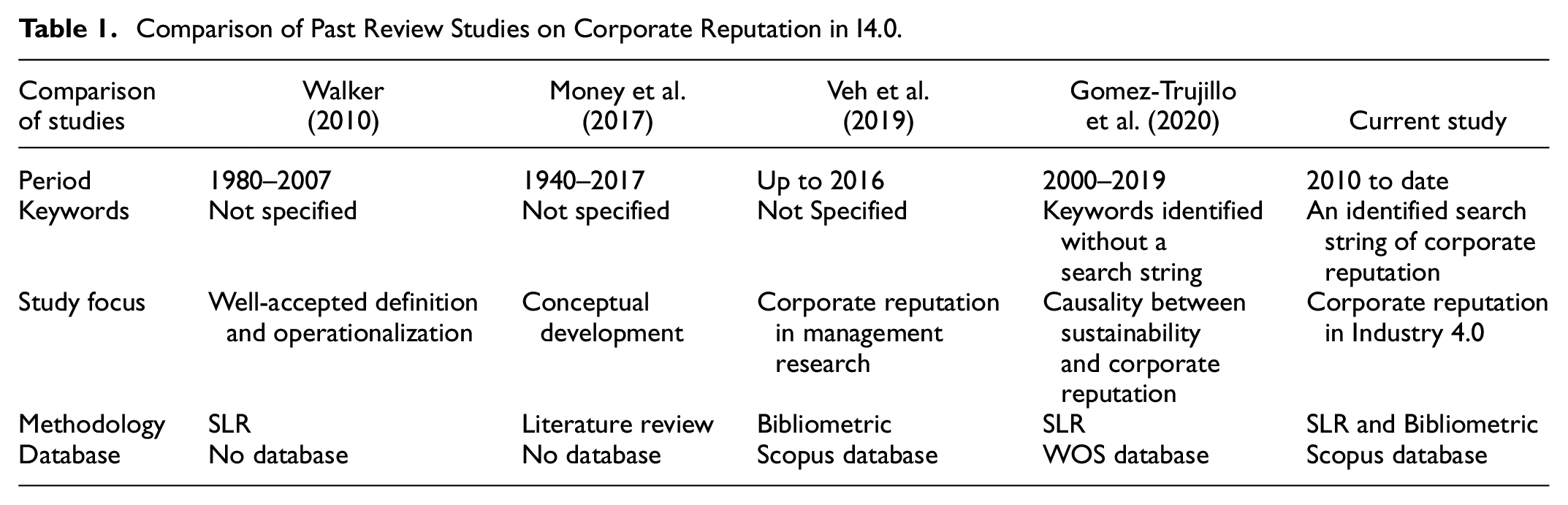
After reviewing the past studies, higher levels of attention were placed on the concept of corporate reputation (Money et al., 2017; Veh et al., 2019; Walker, 2010) and its relationship with sustainability (Gomez-Trujillo et al., 2020) instead of the corporate reputation in the I4.0 context. Thus, the current review study is distinctive in different manners. Firstly, the study scope is emphasized in the area of corporate reputation in I4.0, which would provide an in-depth understanding of avant-garde knowledge. Secondly, the research method implemented in this study is a combination of SLR and bibliometric analysis to provide a comprehensive review in identifying the intellectual structure of the field (Donthu et al., 2021). Furthermore, past literature review studies have shown a deficiency in applying rigorous research methods. As such, the current research aims to fill the existing literature and methodological gaps by proposing the following research questions:
RQ1: What is the current trend of publication on corporate reputation in I4.0?
RQ2: Which scholars, institutions, and countries are the most productive in appraising corporate reputation?
RQ3: What are the most prevalent research themes on corporate reputation among researchers?
The subsequent sections of the current study are structured as follows. Firstly, the following section highlights the research methodology of the study. Next, the descriptive analysis of past studies on corporate reputation is presented, followed by the bibliometric analysis in detail. Then, a brief discussion and suggestions for further research are outlined. The last section offers the conclusion of the study.
Research Methodology
The purpose of this study includes a summary of the existing research works and knowledge gaps on corporate reputation to generate a deeper illumination for future research in the context of I4.0. The current study executed the Systematic Literature Network Analysis (SLNA) introduced by Colicchia and Strozzi (2012) in order to achieve the study objectives. In the SLNA approach, a two-pronged methodology was conducted. In the first phase, the SLR was implemented to enable the researcher to categorize the existing publications methodically (Tranfield et al., 2003). The rationale for conducting an SLR approach is to provide high-quality evidence while effectively identifying and evaluating existing literature (Ali & Johl, 2022). The output of the first phase of the SLR would be the final number of papers selected for the second phase of the SLNA approach. Similar to the study of Inamdar et al. (2020) and Ali and Johl (2022), the review protocol of the Preferred Reporting Items for Systematic Reviews and Meta-Analysis (PRISMA) was adopted. The PRISMA review protocol could assist the researcher in gaining transparency and clarity about the facts while ensuring future reproducibility (Ali & Johl, 2022; Page et al., 2021). Figure 1 delineates the PRISMA diagram.

The PRISMA diagram (Page et al., 2021).
In the second phase, the bibliometric analysis was performed to generate emerging themes for future research. The underlying assumption when performing the bibliometric analysis was that the area of study was not merely based on a formless set of journals and papers in terms of descriptive analysis (Inamdar et al., 2020). The second phase also used conventional techniques that concentrated on the analysis of co-occurring keywords, individual citations, and juxtaposed citations. The R-studio application, a command-based software, was employed to conduct the bibliometric analysis (Aria & Cuccurullo, 2017; Donthu et al., 2021) as the application consisted of more features compared with other software, such as VoSViewer and Gephi (Donthu et al., 2021).
PHASE I: SLR
Defining Database and Search Terms
The researcher first identified the keywords and search strings to perform the SLR, followed by the inclusion and exclusion criteria (Tranfield et al., 2003). In addition, selecting an applicable database was also essential before performing the review. Upon consultation with the research field experts, the Scopus database was selected. According to Sureka et al. (2022), the Scopus database comprised a broader coverage than the WOS database, as the number of Scopus articles that were not included in the WOS database was estimated at 50%, compared to 5% of the number of WOS journals not covered by the Scopus database (Sureka et al., 2022). Therefore, considering the range and coverage of the two databases, the Scopus database was employed to retrieve relevant literature.
In the current study, two sets of keywords were generated to collect the research articles, wherein the first set was related to corporate reputation, while the second included I4.0 keywords. The first group contained the keywords of “corporate reputation,”“firm reputation,”“company reputation,”“corporate image,”“firm image,” and “company image.” The second group consisted of “Industry 4.0,”“Industrial Revolution 4.0,”“digitalization,” and “social media.” Alternative keywords, including “online corporate reputation,”“e-reputation,” and “digital reputation,” were also chosen to extract the data. The selected articles must contain at least one of the above expressions from both sets of terms as part of the title, abstract, keywords, or keyword plus. Upon the stages of database selection and keyword identification, pertinent search strings were developed by utilizing the Boolean operators to allow refinement of the research. Table 2 demonstrates the search strings applied to extract relevant articles from the Scopus database.
Search String for the Scopus Database.

Inclusion and Exclusion Criteria
After selecting the Scopus database selection and identifying the relevant keywords, the next step in the SLR approach was to define the inclusion and exclusion criteria. This study included the empirical, conceptual, and case study articles published from 2010 to February 2022, whereas the review articles or articles focusing on mathematical models were excluded. Furthermore, the current study also excluded papers published in conferences, proceedings, book chapters and reviews, editorial letters, news items, and notes. Articles published in the English language were also considered for further review.
Through the process of searching using the keywords, the initial search recorded 603 articles. After the first round of screening the selected documents, 157 articles were retained by considering the inclusion and exclusion criteria and removing duplication. Seventy-eight articles were found eligible for further analysis after the second round of screening. Finally, the re-application of the inclusion and exclusion criteria determined 54 articles for the phase-2 analysis—bibliometric analysis. Figure 2 shows the complete process of bibliometric analysis in detail.

Complete bibliometric analysis.
PHASE II: Bibliometric Analysis
In the second phase of the SLNA approach, the bibliometric analysis, a popular technique in the research area of information science, and as a quantitative approach, was performed. The bibliometric analysis was recommended by Donthu et al. (2021) due to the approach consisted of two important methods, namely performance analysis and science mapping, in selecting the most relevant articles for review. The performance analysis accounts for research contributions to determine the validity of a paper, while science mapping focuses on multitudinous associations between research constituents. Moreover, the bibliometric technique also allows the implementation of network analysis which will be discussed further in the following section.
Performance Analysis
The performance of a research domain could be described in the form of performance analysis via the bibliometric technique. Although performance analysis is inherently descriptive, it has been frequently employed in various bibliometric studies (Donthu et al., 2021). As such, performance analysis was conducted in the current study to reveal the publication trend by analyzing the top contributing journals, most influential articles, top contributing countries, and methodological choices suitable for reviewing corporate reputation in the era of digitalization. Figure 2 also demonstrates a sample of metrics suitable for performance analysis.
The Publishing Trend of Corporate Reputation Research in I4.0
The year-wise publication trend of corporate reputation is presented in Figure 4. Figure 4 shows the number of articles published from 2010 to 2022 and the number of citations each year. In the year 2010, a single article was published with 101 citations. However, in 2011 and 2012, no article was discovered within the research domain. In the following years, three articles were published in 2013 with 174 citations, and in 2014 and 2015, four articles were published each year with 117 and 349 citations respectively. Besides, an exponential increase in the citation at 349 from four articles was witnessed in 2015. However, there were only two articles published in both 2016 and 2021 respectively, with 46 citations noticed for the year 2016 but no citations in the year 2022. In 2017 and 2021, seven articles were published each year with citations of 112 and nine respectively. After that, an exponential increase in the publication was observed in 2019 and 2020 with 10 articles each year, and the total citation was 215, with 111 and 104 respectively. Summarily, an increased publication trend was found after 2017, in which from 2010 to 2016 only 14 articles were published, whereas 40 articles were published from 2017 to 2022. The trend suggested that corporate reputation research in I4.0 was gaining traction within the scholarly world (Figure 3).

The publication trend from 2010 to 2022 and citations per year.

Co-word analysis based on author keywords.
Top Contributing Journals for Corporate Reputation Research in I4.0
In the bibliometric analysis, Table 3 displays the top ten contributing journals for corporate reputation research in I4.0. The journal with the highest number was Public Relations Review comprising four articles, followed by Corporate Reputation Review, with three articles. The subsequent six journals, namely the Journal of Business Research, Journal of Creative Communications, Journal of Marketing Management, Journal of Product and Brand Management, Meditari Accountancy Research, and Sustainability, published two research articles on the research domain of the current study. The Tourism Management and International Journal of Information Management published only one article respectively. To assess the scientific domains of the journals, the study author referred to the cite score, a metric developed by the Scopus database. Furthermore, the cite score was updated monthly; therefore, the current study employed the latest cite score received by each journal at the end of 2021. As such, the International Journal of Information Management possessed the highest cite score (27.9), followed by Tourism Management (19.5). Moreover, Table 3 highlights the total number of citations (TC) received by a journal against the total number of publications (TP). Tourism Management received the highest TC score (245) with only one publication, followed by Public Relations Review with 190 citations in total from four publications.
Top 10 Most Contributing Journals for Corporate Reputation Research in I4.0.

Most Influential Articles for Corporate Reputation Research in I4.0
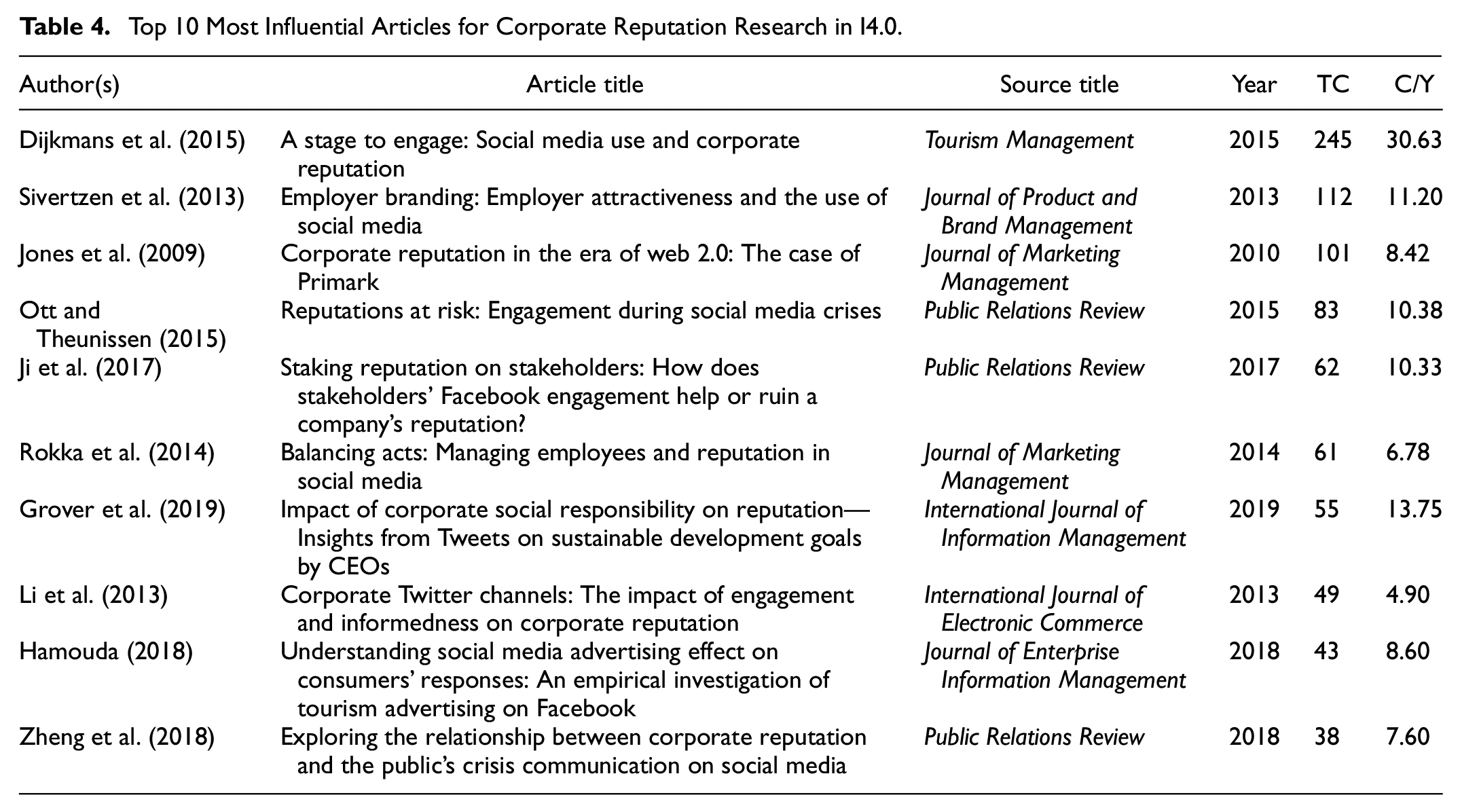
The most influential articles for corporate reputation research in the era of digitalization in terms of citations are presented in Table 4. Table 4 indicates that the article of Dijkmans et al. (2015) received the highest number of citations in the field, with an average of 30.63 citations per year (C/Y = 30.63) from a total of 245 citations since its publication in 2015. The following was the article by Sivertzen et al. (2013) published in the Journal of Product and Brand Management, which demonstrated a total of 112 citations or an average citation of 11.20 since its publication in 2013. In general, the top 10 most influential articles in the current research field had amassed a total of 849 citations, reflecting the significant influence of corporate reputation research in I4.0 within the contemporary scientific community.
Top 10 Most Influential Articles for Corporate Reputation Research in I4.0.
Top Contributing Countries for Corporate Reputation Research in I4.0
The top contributing countries for corporate reputation research in I4.0 are presented in Table 5. The table highlights that the most prolific country was the United States of America (USA) with 11 articles, followed by Indonesia and Spain with six and four articles respectively. On the other hand, the USA and the Netherlands emerged as the top two most influential countries, with 200 and 260 citations respectively, proceeded by Italy with 42 citations. As such, American and European countries are shown to dominate corporate reputation research with higher numbers of publications and citations.
Top Contributing Countries for Corporate Reputation Research in I4.0.

Methodological Choices for Corporate Reputation Research in I4.0
The methodological choices (study type, approach, and data analysis technique) for corporate reputation research in I4.0 are presented in Table 6. In terms of the study type, Table 6 indicates four dominant research types, namely quantitative, qualitative, conceptual, and mixed methods. The quantitative type (f = 32) was demonstrated to be the most preferred study type, followed by the qualitative as indicated by 16 publications adopting this study approach. The least popular research type was conceptual (f = 3) and mixed methods (f = 3). Hence, the prominent share of the quantitative type implemented in corporate reputation research could be considered a reflection of the growing availability and accessibility of corporate big data in the era of digitalization.
Methodological Choices for Corporate Reputation Research in I4.0.

Table 6 also exhibits the preference of the study approach for corporate reputation research in I4.0. The survey approach was employed mainly in corporate reputation research, as manifested by 23 publications that adopted the survey approach, followed by a case study (f = 8) and secondary approaches (f = 8). The least popular research approach was the interview with only four publications adopting this approach.
Table 6 also shows the data analysis techniques implemented in the research of corporate reputation in I4.0. The most prominent analysis technique was discovered to be structural equation modeling (SEM) from 12 publications, followed by the technique of content analysis (f = 11) and other available techniques (f = 11). The least popular was the analysis technique of regression (f = 8).
Science Mapping
Science mapping in the bibliometric analysis is an analysis technique that uncovers and provides a graphical representation of the existing forms and interrelationships of knowledge components in a research domain (Donthu et al., 2021). The science mapping technique used in corporate reputation research in I4.0 was executed via the R-studio software in the current study. One of the methods in the technique of science mapping performed was the co-word analysis to explore the current or future associations among topics in the corporate reputation domain by focusing on the written content of articles. Thematic evolution, another method of science mapping, was also performed to understand the latest advancement in the current research domain (Sureka et al., 2022).
Furthermore, the analysis of keyword co-occurrences, or co-word analysis, was executed through VOSviewer to reveal the major themes underpinning the intellectual structure of corporate reputation research in I4.0 over the last 11 years (from 2010 to 2022), laying the foundation of network analysis wherein the bibliographic coupling was conducted to provide broader and niche research areas in the research domain of corporate reputation (Donthu et al., 2021).
Co-Word Analysis Using Word Clouds
In the bibliometric approach, the co-word analysis examines the actual content of existing publications. The keywords are often derived from author keywords or extracted from the titles, abstracts, and full texts of articles for further analysis (Donthu et al., 2021). In the current study, the co-word analysis was based on author keywords from publications of corporate reputation research in I4.0 between 2010 and 2022. Abstracts or full texts were not employed as noise or confounding variables would be introduced due to the existence of irrelevant words (Chen et al., 2019). Similar to co-citation analysis, the co-word analysis technique assumes the words that frequently appear together possess a thematic relationship with one another (Donthu et al., 2021).
Figure 4 depicts the general representation of the co-word analysis based on author keywords. “Social media” and “corporate” had the highest level of emergence from the analysis. Besides, two main thematic clusters of author keywords were also identified. The first-word cluster comprised “social media,”“Facebook,”“Twitter,”“Industry 4.0,” and “online,” while the second contained “corporate communication,”“corporate social responsibility,”“reputation,”“communications,” and “image.”
Thematic Evolution of Corporate Reputation Research in I4.0
Similar to co-word analysis, the thematic evolution identifies how words evolve across multiple periods (Chen et al., 2019). The thematic evolution extracts pertinent terms from author keywords, abstracts, or full texts (Sureka et al., 2022). In the current study, author keywords were employed as a unit of analysis to perform the thematic evolution of corporate reputation research in I4.0. Figure 5 demonstrates the thematic evolution of research in corporate reputation from 2010 to 2022. To identify the most significant words, the study period was divided into three intervals: 2009 to 2015, 2016 to 2020, and 2021 to 2022. Three words, including media, engagement, and reputation, were discovered as keywords in the first period (2009–2015) in which the plethora of research works were case studies (Ott & Theunissen, 2015; Rokka et al., 2014). In the second period (2016–2020), three distinct keywords were also found, namely corporate, social, and analysis, where the usage levels of the word corporate were shown to be significantly higher in frequency and variety. The finding postulated that the research in the corporate field had grown rapidly, which further enriched the existing literature through various empirical studies (Foroudi & Montes, 2017; Lu et al., 2020; Purwanto et al., 2020). Subsequently, the third period (2021–2022) manifested two prominent keywords: reputation and media.

Thematic evolution of corporate reputation research in I4.0.
Co-occurrence of Author Keywords
By implementing the science mapping technique of bibliometric analysis, the co-occurrence of author keywords was z analyzed on the entire dataset from 2010 to 2022 through VOS viewer to highlight the conceptual structure of past literature (Baker et al., 2021). Furthermore, science mapping would assist in discovering the association strength and the number of publications in which two keywords appeared together. The co-occurrence threshold was set for the keywords to appear concurrently at least two times among the publications. Figure 6 portrays the most frequent co-occurrence of author keywords within the corporate reputation studies in I4.0. The two keywords with the highest degree of co-occurrence were corporate reputation and social media, indicating that both keywords frequently appeared together in most publications.

Co-occurrence of author keywords.
Based on the results, seven clusters were determined. The most co-occurring keywords in the first cluster were discovered to be social media, Twitter, communication, engagement, credibility, corporate social responsibility, and stakeholders, whereas corporate reputation, online engagement, and crisis communication were together in the second cluster. In the third cluster, the prominent words were Facebook, social media engagement, reputation, disclosure, content analysis, and Web 2.0. Online reputation, customer engagement, and corporate communication belonged to the fourth cluster as the most co-occurring keywords. In the fifth cluster, corporate image, reputation management, and national culture were keywords with the highest degree of co-occurrence, whereas in the sixth cluster, the keywords were Industry 4.0 and business model innovation. The final cluster contained only two words that co-occurred: crisis communication and authenticity. In short, two research areas have been categorized from the seven clusters in Figure 6, with clusters C1, C2, and C3 as the prominent areas, while clusters C4, C5, C6, and C7 as the niche areas.
Network Analysis
The science mapping technique that employs the methods of co-word analysis, thematic evolution, and co-occurrence approach is mostly based on keywords as a unit of analysis. Although the science mapping technique generates valuable insights, certain keywords repeatedly appear in research publications. Consequently, the process of cluster formation which includes repeated keywords, would produce an excessive number of clusters repetitive to each other. Therefore, an appropriate number of clusters could be formulated by conducting bibliographic coupling in the network analysis (Donthu et al., 2021). Bibliographic coupling concentrates on the division of publications into thematic clusters based on shared references within a specific timeframe (Zupic & Cater, 2015). The generated thematic clusters could gain visibility by representing general and niche publications (Donthu et al., 2021).
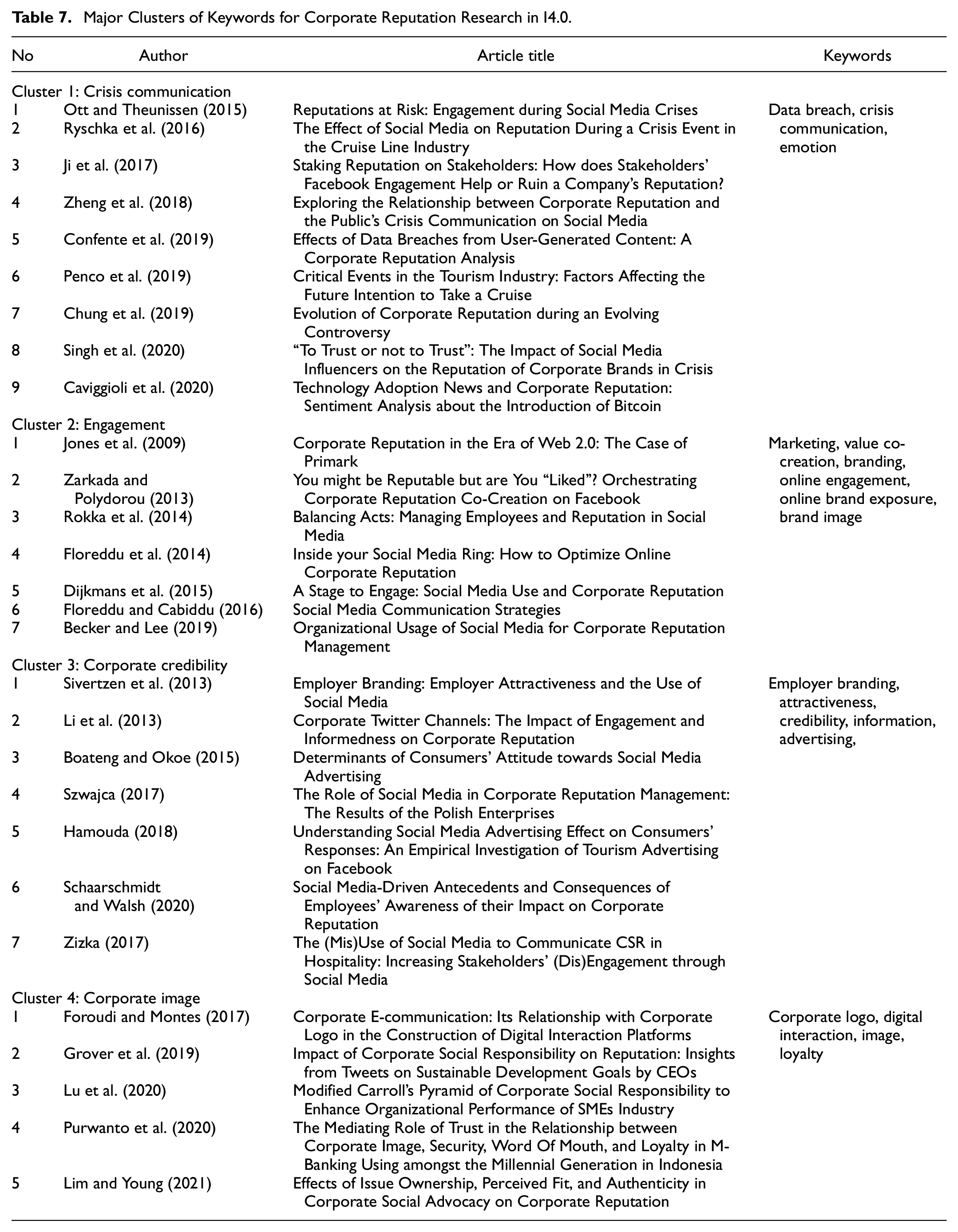
In the current study, the clusters were formed based on bibliographic coupling with existing publications as a unit of analysis. The major themes or clusters that emerged from bibliographic coupling in the network analysis of the entire dataset were generated through VOSviewer as illustrated in Figure 7, with the descriptive results presented in Table 7. The results of the analysis revealed four major themes of corporate reputation research in I4.0, including crisis communication (first cluster in red), customer engagement (second cluster in green), corporate credibility (third cluster in blue), and corporate image (fourth cluster in yellow).

Bibliographic coupling of corporate reputation research in I4.0.
Major Clusters of Keywords for Corporate Reputation Research in I4.0.
CLUSTER 1: Crisis Communication
Based on the bibliometric analysis, four major clusters emerged. The largest cluster pertains to corporate crisis communication, comprising 32% of existing research publications with prominent keywords, including “crisis communications,”“data breach,” and “emotions.” In the era of technology, managing corporate reputation on social media has become increasingly important for public relations. On the other hand, corporate reputation is challenging to manage because of “soft” variables, such as competence, trustworthiness, accountability, reliability, and credibility (Ott & Theunissen, 2015). Moreover, the dialogues from a corporation to persuade the public is frequently found to be confusing, which could further heighten the risk of maintaining a positive image and reputation.
The risk of maintaining a corporate reputation is also elevated due to the embedded programming algorithms that favor posts with a high number of activities regardless of whether such activity is positive or negative (Caviggioli et al., 2020; Ryschka et al., 2016). However, past studies highlighted that conventional or inappropriate strategies could ignite social media crises (Singh et al., 2020). As such, to mitigate the emerging crisis in communication, prior literature proposed several dimensions to resolve the issue from the perspectives of corporations and stakeholders (Ott & Theunissen, 2015; Ryschka et al., 2016). From a corporation’s perspective, companies must employ coherent crisis communication strategies, including constructive dialogues and relationship-building activities, during a crisis period (Ott & Theunissen, 2015). Moreover, speed of response is also an important factor in countering negative feedback or misinformation on social media, wherein the role of crisis managers is highly important in understanding the power of social media before implementing a swift, pertinent response to correct the issue of negative feedback or misinformation (Ryschka et al., 2016).
Another important construct in managing a company’s reputation is brand familiarity during a crisis. Possessing a good brand reputation may assist in reducing adverse public perceptions (Ryschka et al., 2016), and the ethical behavior of a company is the prerequisite for communicating a positive reputation (Penco et al., 2019; Singh et al., 2020). Besides, cultural values also play an essential role when encountering a crisis in public communication, especially online or on social media (Zheng et al., 2018). For instance, Americans were more active on social media than their German counterparts (Ryschka et al., 2016). Similarly, Zheng et al. (2018) demonstrated that the cultural values of a collectivist culture (China) were different from that of an individualist culture (America). Accordingly, understanding the importance of social media comments, particularly positive ones, could significantly help increase the corporate reputation and vice versa (Ji et al., 2017). On the other hand, Confente et al. (2019) propounded that before the existence of a corporate crisis, the perceived quality of a company’s service or product would be a relevant dimension from the perspective of stakeholders. In contrast, after a crisis occurred, stakeholders would pay attention to the corporate performance and customer orientation.
CLUSTER 2: Engagement
The second cluster pertains to engagement, comprising 25% of research publications with leading keywords, such as “marketing,”“value co-creation,”“branding,”“online engagement,”“online brand exposure,” and “brand image.” Social media has ushered in multitudinous ways an organization can communicate with its internal (employees) and external (customer) stakeholders (Becker & Lee, 2019), in which an active relationship between customers, employees, and corporations to actively engage is constantly facilitated. From a customer’s perspective, social media allow consumers to express personal thoughts and ideas, which could enrich engagement with different parties. In regard, an organization should create a more comprehensive community on social media to continuously interact with customers by listening to their feedback and employing appropriate resolutions to various issues, subsequently enhancing the corporate reputation and ultimately reinforcing an existing relationship with an interest group (Zarkada & Polydorou, 2013).
The highly engaging activity with customers may also serve as a critical source of knowledge for a company to become innovative, such as new product or service design and development. Besides, customers who perceive the company as having a good reputation would likely be more willing to engage in positive word-of-mouth behavior as compared to customers who believe otherwise. For instance, Dijkmans et al. (2015) postulated that social media engagement activities would positively link with corporate reputation, especially among non-customers. From an organizational perspective, corporations should be transparent about their policies, practices, and communications procedures to reduce the negative effects on the engagement between employees and customers. Therefore, the communication strategies of a firm are highly crucial on social media.
Floreddu and Cabiddu (2016) delineated six complementary social media communication strategies to enhance consumer engagement before promoting corporate reputation. The strategies include egocentric, conversational, selective, openness, secretive, and supportive. In an egocentric strategy, firms would share information through social media but do not actively engage with customers. Whereas in the conversational strategy, an organization would develop a deep association and dialogue with its customers by responding to every comment on social media and mitigating the impacts of conflicts. In a selective strategy, firms would only engage with consumers who posted positive comments on social media while ignoring the negative comments. In an openness strategy, the firm would aim to improve transparency between the firm and customer dialogue by not deleting or removing every social media post while publicly sharing its point of view. The unwelcome or conflicting posts would be deleted via the secretive strategy. Finally, in a supportive strategy, firms would facilitate the user experience of customers and clients during the purchase process.
CLUSTER 3: Credibility
The third cluster is related to credibility, composed of 25% of research publications with pronounced keywords, including “branding,”“attractiveness,”“credibility,”“information,” and “advertising.” To establish the credibility of a firm, information through conventional channels, such as internal communications, press, advertisements, and social reports, is typically delivered one way from the firm to stakeholders. As such, relying on traditional channels would be perceived unwise in the digital era.
Modern channels, particularly social media, transmit information faster and permit two-way communication. Moreover, modern channels offer an authentic dialogue between customers and firms that ultimately contributing to a firm’s credibility. Boateng and Okoe (2015) highlighted that consumers perceived the advertisement of a firm on social media as a source to gauge its credibility and subsequently influence the positive level of corporate reputation. Li et al. (2013) also demonstrated that consumers referred to a firm’s credibility when evaluating the company, which would positively impact further engagement and corporate reputation. However, on certain occasions, customers would perceive social media advertising as a self-promotion strategy instead of conducting authentic communication of the company’s actions. Consequently, the firm might lose its credibility and be trapped in a self-promoter paradox. Three essential strategies were postulated by Zizka (2017) to encounter the predicament: stakeholder information, response methods, and involvement manners, whereas Hamouda (2018) suggested that honesty, reliability, trustworthiness, and believability on social media would be more pertinent in promoting credibility.
CLUSTER 4: Corporate Image
The fourth cluster discovered is the corporate image, comprising approximately 18% of research publications with notable keywords: “corporate logo,”“digital interaction,”“image,” and “loyalty.” Prior studies manifested that corporate image possessed an intangible value imperative for every organization to achieve competitive advantage and long-term sustainable growth (Grover et al., 2019; Lu et al., 2020). Past studies also suggested that corporate image was unique and difficult to imitate; hence, creating a positive image would help promote a firm’s long-term performance (Lim & Young, 2021).
Corporate image is a psychological process with an elusive passionate relationship with mental conditions before being formed into attitudes and sentiments (Purwanto et al., 2020). Accordingly, Hafez (2018) propounded that corporate image originated from customers’ emotions, desires, and thoughts toward products/services offered by the firm. In current times, corporate logos/brands would significantly improve the corporate image as corporate logos or brands could help facilitate communication, especially via online channels, to allow audiences to fully understand a corporate’s background (Foroudi & Montes, 2017). In the same vein, Pham et al. (2012) argued that corporate logos were the primary instrument that increased customer loyalty and brand recognition. Muller-Kahle and Lewellyn (2011) also discovered similar findings wherein corporate logos or brands could elevate brand loyalty, customer responses, and modernity. Thus, if a corporation would like to generate a positive image and reputation for its stakeholders through social media, a distinguishing corporate logo should be a vital action for a firm’s digital marketing strategy (Foroudi & Montes, 2017).
Findings and Discussion
In general, the current study aims to identify the past and future research on the corporate reputation of I4.0 to achieve the three research questions: the current trend in publications, descriptive analyses, and emerging themes. The following sub-sections describe the research questions in detail.
RQ1: What is the current trend of publication in corporate reputation in I4.0?
To achieve the research purpose of the current study, the first research question underlines the role of current publications in the corporate reputation of the digital era. The study author performed a systematic literature review by employing the PRISMA technique to answer the question. After attaining the study protocols, 54 research articles from 2010 to 2022 were finalized to identify the current publication trend.
Figure 3 illustrates the publication trend in corporate reputation. Since the inception of I4.0 in 2011, a positive publication trend in corporate reputation was discovered, with more than 50 publications and more than 1100 citations demonstrated from 2013 to 2022. Moreover, the included articles were published in more than 42 peer-reviewed journals with a Scopus cite score above 1.0 in 2021. Table 3 presents the most contributing journals in corporate reputation; in which Public Relations Review was found to be the most productive source in terms of publication on corporate reputation in I4.0, followed by Corporate Reputation Review. Meanwhile, Tourism Management was indicated to be the most productive journal in terms of citations, followed by Public Relations Review. The literature findings manifested that the publication on corporate reputation in I4.0 was gaining recognition in the academic world. Accordingly, Veh et al. (2019) posited that the gaining recognition of the topic in management, business, and social studies was due to the corporate reputation being considered a strategic asset that significantly provided various companies with competitive advantages in managing and expanding their businesses (Confente et al., 2019).
RQ2: Which scholars, institutions, and countries are the most productive in appraising corporate reputation?
To achieve the main research purpose, the second research question highlights the prominent contributions of scholars, institutions, and countries to corporate reputation in the era of digitalization. To answer the question, the researcher employed performance analysis as recommended by Donthu et al. (2021).
Table 4 demonstrates the top 10 most influential articles, with the publication of Dijkmans et al. (2015) as the top, which gained a total number of citations at 245 or an average of 30.63 citations per year since the first publication. The article by Sivertzen et al. (2013) was the second most influential publication, with a total of 112 citations or an average of 11.20 citations per year.
Table 5 shows the most contributing countries where the USA was found to be the most productive country in terms of publications, followed by Indonesia, whereas the Netherlands was the most productive country in terms of citations. The developed countries were discovered to be more productive in terms of publications and citations than developing or emerging countries. The findings are aligned with those of the review studies of Veh et al. (2019) and Gomez-Trujillo et al. (2020).
Table 6 portrays the popular methodological choices in corporate reputation literature. Based on the table, most publications are quantitative with surveys as the main study approach, producing empirical data prolific on the study topic. The result of the current study is aligned with the findings of Veh et al. (2019). Regarding the data analysis technique, the structural equation modeling technique was the most popular choice, followed by content analysis, in line with the results of Gomez-Trujillo et al. (2020).
RQ3: What are the most prevalent research themes on corporate reputation among researchers?
To achieve the main research purpose, the third research question focuses on the emerging research themes of corporate reputation in I4.0. To answer the question, the study author performed bibliometric analysis through science mapping as recommended by Donthu et al. (2021).
The techniques of co-word analysis, thematic evolution, and keywords co-occurrence analysis were adopted to uncover the prevalent research themes in corporate reputation. Figure 4 illustrates that “social media” and “corporate” are the keywords mostly used in past studies. Besides, Figure 5 highlights the thematic evolution of corporate reputation research from 2010 to 2022. During the study period, corporate reputation and social media were found to be the dominant themes. In Figure 6, the co-occurrences of author keywords from 2010 to 2022 were analyzed before formulating seven clusters, with social media and corporate reputation as the main clusters, while the remaining were discovered to be niche in nature.
The bibliographic coupling technique was adopted to formulate the clusters to represent the future research themes, as indicated in Table 7 and Figure 7. The first emerging research theme was “crisis communication,” highlighting that organizations should disseminate relevant information in countering the existing crisis through social media to gain stakeholder trust. The research findings of Penco et al. (2019) and Singh et al. (2020) supported the notion that if organizations disseminated crisis-related information ethically, the action would enhance the firm’s corporate reputation.
The second emerging theme that emerged was “engagement.” The theme sheds light on two aspects, namely, customer and organization. When customers express their ideas and experience on social media, high levels of engagement with the firm are then noticed, which could affect the firm’s image. As such, organizations should develop effective online communication strategies that promote customer engagement and loyalty. The findings align with those of Dijkmans et al. (2015) and Floreddu and Cabiddu (2016).
The third emerging theme was “credibility” in which customers would identify a firm’s credibility through social media advertising. In this regard, the authenticity of advertising content and actions would be perceived as vital to promoting corporate credibility in the I4.0 ecosystem. The work of Li et al. (2013) supported the third research theme discovered in the current study. Finally, the last theme, namely corporate image, highlighted that an organization was required to build a strong positive image to remain competitive in the long run. Purwanto et al. (2020) and Hafez (2018) recommended that organizations focus on the psychology of consumers when establishing a positive corporate image. In contrast, Pham et al. (2012) and Foroudi and Montes (2017) highlighted the role of corporate logos in promoting corporate image.
Limitations and Future Research
The present study encountered several limitations. The first limitation is that the databases and search engines used do not cover all the accessible sources of management literature, including textbooks, unpublished articles, and master or doctoral dissertations, although a significant number of keywords were utilized. Therefore, it is recommended that the data be collected from the aforementioned resources in future studies. However, further refinement of the keyword search string is also a prerequisite before replicating the current study, as keywords are based on a more in-depth analysis of the bibliometric approach. As such, other possible keywords could also be included to create an optimal search string pertinent to searching relevant databases.
Another limitation of the current study is the lack of selection criteria. Although the study author followed the quality protocols when selecting relevant research studies, ranking existing publications could not be performed based on the actual contribution (impact factor or cite score) to a research topic. Thus, more comprehensive article selection criteria (publication year and citation number) could be included in future research. The final limitation is that the Scopus database was employed to extract the publications without any data extracted from the WOS database due to dataset integration issues. In this regard, the data from both databases could be utilized in future studies after implementing new techniques for combining data from the two databases as Caputo and Kargina (2022) suggested.
Furthermore, based on the results, it is also suggested that the I4.0 ecosystem’s corporate reputation measurement should be strengthened to initiate corporate sustainability. Future research can emphasize using natural language processing (NLP) and machine learning algorithms to classify corporate reputation from social media to better comprehend the I4.0 ecosystem.
Conclusions
The current paper delivers a comprehensive review of existing studies on corporate reputation in the I4.0 ecosystem to foster a better understanding of a prevalent research area. Several fundamental questions relevant to the research aims and efforts have been answered while simultaneously providing a better platform for further evaluation and perusal of the topic. A robust methodology, namely “Systematic Network Analysis of Literature,” has been adopted for this purpose. In this regard, the current study conducted both SLR and bibliometric analysis techniques on 54 published articles selected from 2010 to 2022 based on titles, abstracts, keywords, and research methods. A bibliometric analysis includes an integrated and systematic review of the literature to explore key themes and the theoretical framework underpinning journals, fields of inquiry, and papers. The published articles were classified into four main clusters: crisis communications, engagement, credibility, and corporate image. The current research also underlines the most productive country and most influential publication in the research of corporate reputation in the digital era.
The current study highlights several possible implications. Based on the study results, researchers and academicians understood the application of social media to promote corporate reputation. This investigation makes various notable theoretical contributions to the existing literature. This study addresses an imperative review of existing research on a corporate reputation that has been neglected in the context of the I4.0 ecosystem. Current trends in corporate reputation publication have been highlighted as having positive impacts, with more than 1100 citations from 2013 to 2022, as shown in Figure 3. These support the recognition in the academic world for corporate reputation due to its importance as a strategic asset based on the topic in management, business, and social studies (Veh et al., 2019). Today, the emerging themes in corporate reputation in I4.0 can be summarized into four main clusters: crisis communications, engagement, credibility, and corporate image, as shown in Figure 7. Hence, different themes in corporate reputation could provide valuable guidance to academia and practitioners in implementing strategies for enhancing corporate reputation through social media in different sectors.
From theorizing the case above, some implications can be directed at managers, who could apply the study findings to develop various online communication strategies to gain a competitive advantage. As a result, managers should actively engage in social media by releasing suitable messages and information consistent with company values, image, culture, and business objectives, allowing the public to understand and connect with them. As a result, focusing on customer engagement and developing credibility in digital communication may aid in the improvement of corporate reputation in the I4.0 ecosystem. Innovative businesses should focus on identifying opportunities to use digital media to launch related corporate social responsibility initiatives that will help them become more marketable and establish a positive corporate reputation, which will give them profitable outcomes over time. Following that, numerous corporate reputation-related challenges may provide academics and practitioners with insightful guidance on how to put approaches for enhancing business reputation via social media in various industries into practice. Finally, this research article provides trends and insights on corporate reputation in the I4.0 ecosystem.
Footnotes
Acknowledgements
The authors gratefully acknowledge the Faculty of Computer Science and Information Technology, University of Malaya and College of Computing, Informatics and Mathematics, Universiti Teknologi MARA, Malaysia, for all supports and resources.
Declaration of Conflicting Interests
The author(s) declared no potential conflicts of interest with respect to the research, authorship, and/or publication of this article.
Funding
The author(s) received no financial support for the research, authorship, and/or publication of this article.
